Improving the employment situation of young people in Europe Mr. Bach Mortensen, Executive Director, Confederation of Danish Employers (DA)
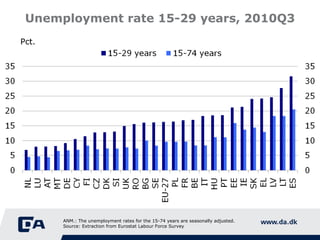
Unemployment rate 15-29 years, 2010Q3 Pct. ANM.: The unemployment rates for the 15-74 years are seasonally adjusted. Source: Extraction from Eurostat Labour Force Survey
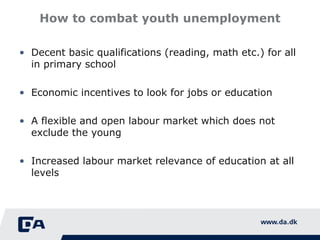
How to combat youth unemployment Decent basic qualifications (reading, math etc.) for all in primary school Economic incentives to look for jobs or education A flexible and open labour market which does not exclude the young Increased labour market relevance of education at all levels
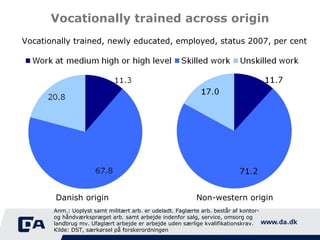
Vocational education and training  One explanation for the low youth unemployment in Denmark is found in VET Nearly all VET-graduates are in employment after a year, which also  applies to young, male immigrants 2/3 of the training takes place at a company VET-graduates attain solid work experience and can contribute to the production from day one
Vocationally trained across origin Vocationally trained, newly educated, employed, status 2007, per cent Anm.: Uoplyst samt militært arb. er udeladt. Faglærte arb. består af kontor- og håndværkspræget arb. samt arbejde indenfor salg, service, omsorg og landbrug mv. Ufaglært arbejde er arbejde uden særlige kvalifikationskrav. Kilde: DST, særkørsel på forskerordningen Non-western origin Danish origin
Suggestions to improve employability of young Education/training where young people obtain the basic competencies that companies are looking for A dual systems is a good way to ubtain this A mobile labour maret with many job-openings

Henrik Bach Mortensen, Building partnerships with real impact for labour market: Improving the employment situation of young people in Europe

  • 1.
    Improving the employmentsituation of young people in Europe Mr. Bach Mortensen, Executive Director, Confederation of Danish Employers (DA)
  • 2.
    Unemployment rate 15-29years, 2010Q3 Pct. ANM.: The unemployment rates for the 15-74 years are seasonally adjusted. Source: Extraction from Eurostat Labour Force Survey
  • 3.
    How to combatyouth unemployment Decent basic qualifications (reading, math etc.) for all in primary school Economic incentives to look for jobs or education A flexible and open labour market which does not exclude the young Increased labour market relevance of education at all levels
  • 4.
    Vocational education andtraining One explanation for the low youth unemployment in Denmark is found in VET Nearly all VET-graduates are in employment after a year, which also applies to young, male immigrants 2/3 of the training takes place at a company VET-graduates attain solid work experience and can contribute to the production from day one
  • 5.
    Vocationally trained acrossorigin Vocationally trained, newly educated, employed, status 2007, per cent Anm.: Uoplyst samt militært arb. er udeladt. Faglærte arb. består af kontor- og håndværkspræget arb. samt arbejde indenfor salg, service, omsorg og landbrug mv. Ufaglært arbejde er arbejde uden særlige kvalifikationskrav. Kilde: DST, særkørsel på forskerordningen Non-western origin Danish origin
  • 6.
    Suggestions to improveemployability of young Education/training where young people obtain the basic competencies that companies are looking for A dual systems is a good way to ubtain this A mobile labour maret with many job-openings

Editor's Notes

  • #2 The Confederation of Danish Employers represents 29.000 Danish companies organised in 13 member organisations. We coordinate collective bargaining, influence political decision-making and secure that companies’ competitiveness and access to skilled labour is as good as possible. The presentation: In our presentation we will try to give you an understanding on the background for the Danish success with low unemployment among young people through the last decades. Firstly we will introduce you to the Danish employment- and education system . What are the basic elements of our employment- and education system , and what have been done to address youth unemployment. Secondly we will discuss the consequences of the financial crisis. How can we combat an explosive increase in youth unemployment and secure future skill needs .