Under the patronage of:


     Ministero della Ricerca (required)


TRACEBACK Project partners:

1.  Tecnoalimenti S.p.A. Consortile
2.

3.
    AINIA – Asociaciòn de Investigaciòn
    de la Industria Agroalimentaria
    Atos Origin Sociedad anònima
                                                         International Conference
    espanola
4.  Engineering Ingegneria Informatica
    S.p.A.
5.
6.
    University of Kent
    ILIM – Institute of Logistics and
    Warehousing
                                                 TRACKING THE FUTURE
7.  Swedish University of Agricultural
    Sciences Faculty of Alnarp
8.  University of Parma
9.  CEMAT – Combined European
    Management And Transportation                                                With the support of:
    S.p.A.
10. City University London – Centre for                                          Integrated Project
    HCI Design
11. Consiglio Nazionale delle Ricerche,
    Istituto di Chimica del
                                                       “INTEGRATED SYSTEM FOR A RELIABLE
    Riconoscimento Molecolare
12. CONSUM Sociedad Cooperativa                       TRACEABILITY OF FOOD SUPPLY CHAINS”
    Valenciana
13. Institut für Agrar – und
    Stadtökologische Projekte an der
                                                                 TRACEBACK
    Humboldt – Universität zu Berlin                                          FP6-2005-FOOD-036300
14. Max Plank Society for the
    Advancement of Science represented                                           www.traceback-ip.eu
    by the Max Plank Institute for
    Polymer Research
15. MTT Agrifood Research Finland
16. Teagasc Agriculture & Food
    development Authority
17. Selex Communications S.p.A.
18. SGS ICS Ibérica, S.A.
19. Federalimentare
20. Akdeniz University, Economic
    Research Center on Mediterranean
    Countries
21. Scuola Superiore ISUFI, eBusiness
    Management Section, University of
    Lecce
22. Centiv GmbH
                                                                         10-11 November 2010
23. NSCE Ltd
24. KBS
25. Parmalat S.p.A
                                                                         Centro Congressi Fondazione Cariplo
26. Technobiochip SCarl
27. Regionalna Wielkopolska Izba Rolno-                             Via Gian Domenico Romagnosi, 8
    Przemyslowa
                                                                              3 Montenapoleone or       1-3 Duomo
In cooperation with:
- Cargill S.r.l. - Div. Animal Nutrition                                               Milan, Italy
- Azienda Venier s.s. Società Agricola
- Trevilat
- Winner supermercati
- Dema car trasporti s.n.c.
- Conalat
- La Sala Viveros-Semilleros
- Pascual Marketing, S.L.


 Scientific Conference Committee:                                              Conference Secretariat: Traceback Coordination Team
 Prof. Hannu Korhonen – Agrifood Research Centre (FIN)                         TECNOALIMENTI S.C.p.A.
 Prof. Nelson Marmiroli – University of Parma (ITA)                            Raffaello Prugger– Marianna Faraldi
 Prof. Neil Maiden – City University London (UK)                               m.faraldi@tecnoalimenti.com
 Prof. Rolf Larsen – Swedish University of Agricultural Sciences (SWE)         Via Gustavo Fara, 39 – 20124 Milan (Italy)
 E. Dallaturca – Parmalat (ITA)                                                Tel. +39 02 67077370 Fax. +39 02 67077405
 L. Brugera Moreno - Consum Cooperativa Valenciana (ES)
 E. De Paoli – Tecnoalimenti (ITA)
International Conference TRACKING THE FUTURE
                                  10 – 11 November 2010
                            Centro Congressi Fondazione Cariplo
                       Via Gian Domenico Romagnosi, 8, Milan (Italy)


                  NOVEMBER 10th, 2010 (morning)
                Session 1 – Results of the TRACEBACK project
   Objective of this session is to illustrate the results of TRACEBACK and to learn the
                   opinion of the end users of the TRACEBACK results.

                                       Programme
8.30    Registration

9:00    Welcome
           Ugo Dozzio Cagnoni, Commissioner Fondazione Cariplo
           Demetrio Corno, President of Tecnoalimenti
           Ciaran Mangan, DG Research, European Commission
           Fabrizio Cobis, Authority of Operational Programme 'Research                    and
           Competitiveness', Ministry of Research
           Ethel De Paoli, TRACEBACK Coordinator and CEO of Tecnoalimenti

9:45    Opening
           Raffaello Prugger, TRACEBACK Coordination team, Tecnoalimenti: The innovative
           concept of TRACEBACK

10:00   Illustration of the results achieved by TRACEBACK project
        Key speakers:
             Nelson Marmiroli, University of Parma – Quality and safety approach of
             TRACEBACK
             Vito Morreale, Engineering Ingegneria Informatica – The novel traceability
             architecture of TRACEBACK and the pilot system for the dairy food chain
             Francesc Rosines, ATOS Origin – The pilot system for the tomato food chain

11:30   Benefits to the food chain
        Key speakers:
           Marian Garcia, University of Kent – Outcomes of the pilot system evaluation
           Evaristo Dallaturca, Parmalat, with supply chain players – Applying the pilot system
           in the dairy food chain
           Miguel Molina, Consum Cooperativa Valenciana, with supply chain players –
           Applying the pilot system in the fresh vegetable food chain
           Patrik Stolt, Swedish University of Agricultural Sciences and Ewa Marciniak, RWIRP
           – Involving SMEs in traceability innovation

        Questions and Answers
A) Summaries
Welcome

• Ugo Dozzio Cagnoni, Commisioner Fondazione Cariplo
                                               Welcome of the host


• Demetrio Corno, President of Tecnoalimenti
                                               Tecnoalimenti (TCA) is a non-profit research
                                               consortium, which generates projects for food industry.
                                               The aim of TCA is to support small and medium sized
                                               enterprises to develop systems such as traceability,
                                               which is essential for their future. Traceability is an
                                               important research area and improved solutions have
                                               been developed. However, in order to create a reliable
                                               traceability system, research must be conducted at
                                               European level. The planning of TRACEBACK started
                                               five years ago. The competition in food industry is
                                               globalizing and getting more severe. There is a
                                               growing need to respond not only by competitive
                                               pricing, but also with high quality, since new countries
                                               such as India and China have emerged to the markets.

• Ciaran Mangan, DG Research, European Commission
                                                 TRACEBACK project is one of the European
                                                 Commission’s traceability projects funded by FP 6,
                                                 thematic priority 5, Food Quality and Safety. In total
                                                 16 traceability projects have been financed by 135 M
                                                 €, being an important field of research in this TP.
                                                 The annual reports of the large projects have been
                                                 reviewed by external experts, who have given
                                                 positive appraisal        about TRACEBACK. A
                                                 conference “What’s for dinner?” to showcase and
                                                 debate the application of FP6 EC funded research to
                                                 improve food safety, quality and security, will be
                                                 organized in Brussels in March 2011. In addition, a
                                                 scientific book on traceability will be published.
• Fabrizio Cobis, Authority of Operational Programme ‘Research and Competitiveness’, Ministry of
Research
                                                 The funding of national research in Italy was
                                                 discussed. The companies should be supported by
                                                 society to establish networks to yield “know how”
                                                 and also “know where”. The financing should be
                                                 targeted for larger research entities in order to
                                                 constitute a sufficiently critical mass.


• Ethel De Paoli, TRACEBACK Coordinator and CEO of Tecnoalimenti
                                                 TCA has for 30 years produced research for industry.
                                                 Like other projects, TRACEBACK has been very
                                                 pragmatic. An example about the previous projects is
                                                 an improvement of product quality by changing the
                                                 method of transport. Projects like this have paved the
                                                 way for TRACEBACK.


Opening
• Raffaello Prugger, TRACEBACK Coordination Team, Tecnoalimenti
                                                 The innovative concept of TRACEBACK
                                                 The TRACEBACK-project was based on the fact
                                                 that the food chains are complicated and
                                                 multinational, and involve both economic and added
                                                 values. The quality of food products may easily be
                                                 impaired.
                                                 In TRACEBACK, the quality is followed along the
                                                 food chain and linked to the product identification
                                                 through internet. The solution must be flexible and
                                                 applicable, and it must be able to communicate with
                                                 the existing systems. The communication and
                                                 sharing of information throughout the whole chain
                                                 benefits all players.
                                                 The prototype was tested and validated successfully
                                                 in feed-dairy and tomato chains.
Illustration of the results achieved by TRACEBACK project
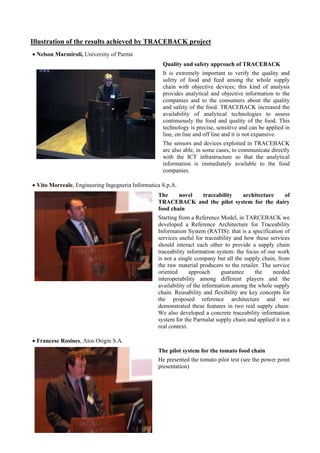
• Nelson Marmiroli, University of Parma
                                                    Quality and safety approach of TRACEBACK
                                                    It is extremely important to verify the quality and
                                                    safety of food and feed among the whole supply
                                                    chain with objective devices; this kind of analysis
                                                    provides analytical and objective information to the
                                                    companies and to the consumers about the quality
                                                    and safety of the food. TRACEBACK increased the
                                                    availability of analytical technologies to assess
                                                    continuously the food and quality of the food. This
                                                    technology is precise, sensitive and can be applied in
                                                    line, on line and off line and it is not expansive.
                                                    The sensors and devices exploited in TRACEBACK
                                                    are also able, in some cases, to communicate directly
                                                    with the ICT infrastructure so that the analytical
                                                    information is immediately available to the food
                                                    companies.

• Vito Morreale, Engineering Ingegneria Informatica S.p.A.
                                                  The     novel traceability architecture   of
                                                  TRACEBACK and the pilot system for the dairy
                                                  food chain
                                                  Starting from a Reference Model, in TARCEBACK we
                                                  developed a Reference Architecture for Traceability
                                                  Information System (RATIS): that is a specification of
                                                  services useful for traceability and how these services
                                                  should interact each other to provide a supply chain
                                                  traceability information system: the focus of our work
                                                  is not a single company but all the supply chain, from
                                                  the raw material producers to the retailer. The service
                                                  oriented      approach     guarantee     the    needed
                                                  interoperability among different players and the
                                                  availability of the information among the whole supply
                                                  chain. Reusability and flexibility are key concepts for
                                                  the proposed reference architecture and we
                                                  demonstrated these features in two real supply chain:
                                                  We also developed a concrete traceability information
                                                  system for the Parmalat supply chain and applied it in a
                                                  real context.

• Francesc Rosines, Atos Origin S.A.
                                                  The pilot system for the tomato food chain
                                                  He presented the tomato pilot test (see the power point
                                                  presentation)
Benefits to the food chain
• Hannu Korhonen, MTT
                                                  Outcomes of the pilot system evaluation
                                                  Business evaluation aimed at identifying financial
                                                  benefits for the companies involved in the pilot testing
                                                  with the adoption of the provided solution. A detailed
                                                  questionnaire has been submitted to each involved
                                                  companies to evaluate their impression about the
                                                  adoption of the new developed system. According to
                                                  the specific functionalities provided to each player
                                                  trough the developed system we collect different
                                                  impression and different comments about the adoption
                                                  of the system.
                                                  Companies in general perceives TRACEBACK as a
                                                  good platform to integrate different systems in a supply
                                                  chain perspective; for example in case of recall the
                                                  TRACEBACK solution is able to provide efficiently a
                                                  complete history of the affected product.
• Evaristo Dallaturca, Parmalat
                                                Applying the pilot system in the diary food chain
                                                Parmalat joined the project because they liked the idea
                                                to make different systems form different players and
                                                devices for objective monitoring interacting in a supply
                                                chain integrated solution.
                                                Basic traceability is not enough for companies like
                                                Parmalat that considers product quality as an added
                                                value for its products. Thus the possibility to link
                                                quality parameters to each product is a good
                                                opportunity. This information can be useful to ensure
                                                the product quality to the final consumer but also to
                                                perform high level analysis that can improve the
                                                knowledge about the supply chain, including raw
                                                material providers and final customers.
• Miguel Molina, Consum Cooperativa Valenciana, with supply chain players
                                                  Applying the pilot system in the fresh vegetable
                                                  food chain
                                                  The TRACEBACK-solution was tested in tomato
                                                  chain, which consisted of three players from seed
                                                  nursery to the point of sale. The main benefits were: 1)
                                                  Improvement of backward traceability and linkage of
                                                  players to the whole food chain, 2) New electronic
                                                  devices, Electronic nose (Technobiochip), Machine
                                                  vision (AINIA), Spectrophotometer NIR (AINIA) and
                                                  Temperature and humidity sensors (KBS), and their
                                                  full integration to the TRACEBACK-system, 3)
                                                  Improvements in test methods: Non destructive, rapid
                                                  tests, which determine several parameters in one test,
                                                  4) Improved exchange of information about lot, quality
                                                  and food safety.
                                                  Future considerations: New methods are not familiar to
                                                  producers and they need adaptation, utilization of
                                                  predictive models and standardization of measurement
                                                  scales.
                                                  Conclusions: Objectives of TRACEBACK were
                                                  achieved: Logistic management (e.g. lot number),
                                                  reliable information for client (e.g. labeling),
                                                  immediate location of lot when alerted and
                                                  collaboration with suppliers were improved.
• Patrik Stolt, Swedish University of Agricultural Sciences and Ewa Marciniak, RWIRP
                                                 Involving SMEs in traceability innovation
                                                 TRACEBACK industrial platform (TIP) exchanged
                                                 knowledge and innovations at two levels, international
                                                 and regional (RIP), the latter being focused on smaller
                                                 local problems. Regional projects were established in
                                                 six countries: Italy, Poland, Egypt, Spain, Sweden and
                                                 Turkey.
                                                 In Poland a successful conference was organized for
                                                 SMEs. The three Polish RIP projects were targeted at
                                                 improving traceability and quality in food and
                                                 cosmetic industry and tomato production. To continue
                                                 responding the needs of SMEs, the organization of
                                                 RIPs needs to be improved. Future challenges of RIPs
                                                 are the stimulation of local and regional networks and
                                                 initiatives, and collaboration between SMEs, academy,
                                                 industry and organizations internally/externally in EU.
                                                 In addition, innovations need support for piloting.
B) Presentations
Index
Speaker                                                                                                   Presentation


Welcome

Ugo Dozzio Cagnoni, Fondazione Cariplo                                                                        ---

Demetrio Corno, President of Tecnoalimenti                                                                    ---

Ciaran Mangan, DG Research, European Commission                                                              Pg. 9

Fabrizio Cobis, Authority of Operational Programme 'Research and Competitiveness', Ministry of Research      Pg. 15

Ethel De Paoli, TRACEBACK Coordinator and CEO of Tecnoalimenti                                                ---


Opening

Raffaello Prugger, TRACEBACK Coordination team                                                               Pg. 17


Illustration of the results achieved by TRACEBACK project

Nelson Marmiroli, University of Parma                                                                        Pg. 24

Vito Morreale, Engineering Ingegneria Informatica                                                            Pg. 42

Francesc Rosines, ATOS Origin                                                                                Pg. 61


Benefits to the food chain

Hannu Korhonen, MTT                                                                                          Pg. 69

Evaristo Dallaturca, Parmalat                                                                               Pg. 80

Miguel Molina, Consum Cooperativa Valenciana                                                                 Pg. 90

Patrik Stolt, Swedish University of Agricultural Sciences and Ewa Marciniak, RWIRP                           Pg. 99
THE FOOD QUALITY AND SAFETY
                     PROGRAMME (2002-2006)
                                                                                                                      Agriculture, Forestry, Fisheries, Aquaculture
                                                                                                              Directorate E: Biotechnologies, Agriculture and Food
                                                                                                                                                                                              Directorate General for Research
                                                                                                                                                                                                        European Commission

                                                                                                              Not legally binding


                                                                                                              Sixth Framework Programme
                                                                                                                                  Research on Food Quality and Safety
                                                                                                         (2002-2006)
                                                                                     Integrating European Research
                                                    Priority Thematic Areas                                                                                                                           Anticipating S/T Needs
                                                                                                                                        Sustainable development and
                            Information society technol.


                                                                                                              Food quality and safety


                                                                                                                                                                                                  Scientific support to policies
Life Sciences, genomics &


                                                                                                                                                                      Citizens & governance
biotechnology for health


                                                                                      Aeronautics and space
                                                              Nanotechnologies ...


                                                                                                                                                                                                  New and emerging S/T needs
                                                                                                                                          global changes


                                                                                                                                                                                                  SME activities

                                                                                                                                                                                                  International cooperation

                                                                                                                                                                                                  JRC
                                                                                                                                        .


                                                           Structuring the ERA                                                                                                                        Strengthening the
Research &                                                 Training &                    Research                                                 Science &                                          foundations of ERA
Innovation                                                  Mobility                  Infrastructures                                              Society

                                          (Global budget European Community 17.883 M €)
                                                          Not legally binding
P5 Food Quality and Safety
      Areas Covered
         •   The whole food chain

         •   Epidemiology of food related diseases and genetic susceptibilities
         •   Impact of food on health
         •   Traceability processes (including GMOs)
         •   Methods of analysis/detection and control of chemical
             contaminants and pathogenic microorganisms
         •   Safer production methods and healthier foodstuffs
         •   Impact of Animal feed on Human Health
         •   Environmental health risks

                            Not legally binding


                        Food Quality and Safety

                                  Fork-to-Farm


                                                     Food
                                                    intake

                                                             Health and
                                          Safe, high-        well-being
Production     Processing                   quality              of
                                             foods           Consumer

                                                    Environmental
                                                       factors

                            Not legally binding
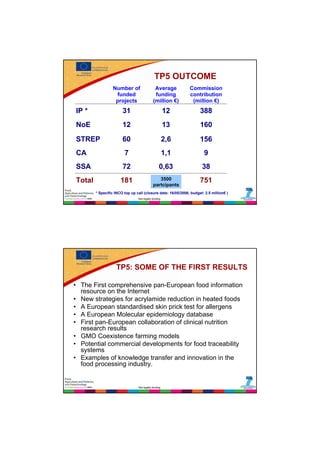
TP5 OUTCOME
                       Number of                  Average          Commission
                        funded                    funding          contribution
                        projects                 (million €)        (million €)
     IP *                   31                             12            388
     NoE                    12                             13            160
     STREP                  60                             2,6           156
     CA                      7                             1,1              9
37


     SSA                    72                        0,63                38
     Total                 181                      3500                 751
                                                 partcipants
             * Specific INCO top up call (closure date: 16/05/2006; budget: 2.5 million€ )
                                     Not legally binding


                        TP5: SOME OF THE FIRST RESULTS

• The First comprehensive pan-European food information
  resource on the Internet
• New strategies for acrylamide reduction in heated foods
• A European standardised skin prick test for allergens
• A European Molecular epidemiology database
• First pan-European collaboration of clinical nutrition
  research results
• GMO Coexistence farming models
• Potential commercial developments for food traceability
  systems
• Examples of knowledge transfer and innovation in the
  food processing industry.


                                     Not legally binding
WHY FUND TRACEABILITY RESEARCH?


• The requirement for traceability labelling and related analytical
  methods under European directives 258/97 on novel foods and
  ingredients publication of the general food law 178/02 regulation that
  entered into force in January 2005.
• Food safety and health crises encountered in the recent past (BSE,
  foot and mouth disease, Listeria, dioxin, growth hormone
  contaminated by Creutzfeld-Jacob prions, etc)
• Increasing demand for high quality food and feed products e.g
  products with protected designation of origin
• Gap between a regulatory demand and practical implementation,
  particularly for SMEs.


                                 Not legally binding


                                                       PART
           PROJECT         Programme                          EU SPEND   TOTAL SPEND
                                                       NERS
TRACE                   FP6 IP                          50       12          19

CHILLON                 FP6 IP                          24       10          15
TRACEBACK               FP6 IP                          28       10          15

BIOTRACER               FP6 IP                          47       11          15
PROSAFEBEEF             FP6 IP                          41       11          18
PATHOGEN COMBAT         FP6 IP                          44       11          14
COEXTRA                 FP6 IP                          54       12          19
SEAFOODPLUS * (only     FP6 IP
                                                        15       3            6
traceability package)
MONIQA                  FP6 NOE                         33       12          12
ALCUEFOOD               FP6 SSA                         13      0.7          0.7
OTAG                    FP6 SSA                         5       0.3         0.42
GTIS CAP                FP6 SSA                         7       0.6          0.8
PETER                   FP6 SSA                         2       0,7          0,9
SIGMACHAIN              FP6 STREP                       11      2.9          4.5

BIOTOX                  FP6 STREP                       12       3           5.3
FISHPOPTRACE            FP7 CP-FP                       15       3            4

                                                       401      98,7        137,9
                        16 projects
TRACEBACK
                   Integrated system for a reliable traceability of
                                         food supply chains (IP)
Strategic objectives:                                   EC contribution 9.74 M€
• tthe development of a global traceability system, routinely applicable to all food
  productions, that will assure food safety and quality through the extension of
  tracing and tracking information to food parameters
• to increase consumer confidence in the food supply by developing new
  technological solutions for ensuring a trustworthy linkage between product flow
  and information flow along the entire food chain
• to improve the competitiveness of the European food industries and small and
  medium-sized enterprises (SMEs) in the food sector by defining a traceability
  system that represents the European response to food globalisation making
  possible to convert the wealth of peculiarities of European food production into
  market assets.


             34 participants from 13 countries (12 industrial partner)
                          (Third country: Russia, Egypt)
                              Not legally binding


                                    TRACEBACK RESULTS:
                                  COMMENTS FROM EXTERNAL
                                        REVIEWERS
• The project is well managed and is on track. There are very few
  delays, and those that have occurred are being addressed.
• The leadership must be commended for their open approach, and
  the fostering of inter-project collaboration; they have provided a suite
  of workshops/seminars (including e-delivery); and have successfully
  used flash meetings to ensure a high level of internal communication
  and direction.
• The project has the potential to contribute significantly to EU policy
  on food safety, and also to commercial needs, but this potential still
  needs to be realized.
• The project has developed some technical innovations addressing
  specific aspects of food chain traceability (notably in reference
  computer architecture and sensing technologies), and these
  developments may be commercially relevant in their own right, but
  also add to the holistic impact of the overall Traceback system. The
  uptake of these developments will depend on what lasting impact
  Traceback will be able to make after the project has finished, and a
  lot of thought and effort need to be expended in the final year to
  make sure that the results and outcome are not ignored or forgotten
  a few years hence.
                              Not legally binding
A BOOK ON TRACEABILITY
                                 CRC PRESS 2011


•   Title: “Food integrity: A holistic approach to
    authenticity, originality, terroir (location),
    traceability, security and safety in food
    production chains.”
•   The book provides the readers with the latest
    development of the science in food safety,
    quality and sustainability. Specifically, the
    book will focus on food authenticity, quality
    markers, origin of foods and feedstuffs,
    tracing and tracking microbial and chemical
    contaminations

                     Not legally binding
TRACKING THE FUTURE
           TRACCIARE IL FUTURO
              With the support of TRACEBACK project:
              “Integrated system for a reliable traceability
                    of the entire food supply chains”
                 Contract n° FP6-2005-FOOD-036300


              Milano, 10-11 Novembre 2010

              www.traceback-ip.eu


          Origin of the idea
FOODNET

          e-MENSA

                        TRACEBACK


                                                   ?

              www.traceback-ip.eu
Programme
• Session 1 – This morning / Mattina
  The results achieved by TRACEBACK
  I risultati del progetto TRACEBACK

• Session 2 - This afternoon / Pomeriggio
  Approaches to traceability and food chain integrity
  Approcci alla tracciabilità e alla integrità della filiera

• Session 3 – Tomorrow morning / Domani mattina
  New technological research scenarioes for the future agrifood
  chains
  Nuovi scenari di ricerca tecnologica per il futuro della filiera

                        www.traceback-ip.eu
TRACKING THE FUTURE 10 November 2010


              Session 1
           TRACEBACK
        The results achieved
        I risultati raggiunti

                 www.traceback-ip.eu


         TRACKING THE FUTURE - 10 November 2010


The innovative concept of TRACEBACK
  Un nuovo approccio alla tracciabilità
         Raffaello Prugger, Tecnoalimenti
        Chief Traceback Coordination Team


                 www.traceback-ip.eu
What is TRACEBACK?
                             Integrated Project
                         FP6 European Commission
FI
                    Coordinated by Tecnoalimenti (IT)
                        TECNOALIMENTI
        Scientific and Technological Research Organisation for the
        Scientific and Technological Research Organisation for the
                               Agro-Food Sector
                               Agro-Food Sector
                                      ***
                                      ***
       • Research and Innovation Pole for the agrofood industry
          Research and Innovation Pole for the agrofood industry
       • Non profit research organisation composed of 28 Agro-
          Non profit research organisation composed of 28 Agro-
          Food related Industries and one financial institution as
          Food related Industries and one financial institution as
          trustee of Research Ministerial funds. Industrial shareholders
          trustee of Research Ministerial funds. Industrial shareholders
          represent about 12% of Italian food sales.
          represent about 12% of Italian food sales.
       • Established in 1981 under Act 1089/68 aimed at fostering
          Established in 1981 under Act 1089/68 aimed at fostering
          Agro-Food Industrial Research.
          Agro-Food Industrial Research.
                       www.tecnoalimenti.com
                       www.tecnoalimenti.com
       www.traceback-ip.eu


      TRACEBACK
                            Project partnership:
 FI
                              28 Participants
                             (51% enterprises)
                                11 countries

                        Cost € 15.5 Million
                    EC Contribution € 9,5 Million

                  Duration 4 years: Jan 2007 – Dec
                               2010


       www.traceback-ip.eu
Why food traceability?
• Food chains are increasingly complex
  and global
• Non-material components add value
  to food products
• Food undergoes biological processes
  > safety, security, quality

              www.traceback-ip.eu


   The objectives of TRACEBACK
• To develop a traceability solution for
  the entire food chain
• To go beyond mere identification by
  incorporating food safety and quality
  parameters
• To ensure flexibility and compatibility
              www.traceback-ip.eu
The results
• Prototypes of a “general solution” to
  food chain traceability
• Tested on 2 real food chains:
Feed dairy (IT) (Parmalat, Cargill, Venier, Trevilat,
  Winner, Dema car, Conalat)
Tomato (ES) (Consum, La Sala, Pascual Marketing)


                    www.traceback-ip.eu


TRACEBACK “general solution”
A general solution to food traceability that
 consists of 2 inter-related components:
• IT (RATIS                  • Devices (and
  framework): umbrella          sensors): objective
  system that inter-            monitoring for
  connects existing and         acquiring product
  novel traceability            quality and safety data
  systems and data along        along the food chain
  the food chain players        and uploading them

                    www.traceback-ip.eu
The IT component
  The TRACEBACK solution is an “umbrella system”.
• Allows to store, share and intercommunicate between
  players, devices and the internet.
• Is an operative system of the traceability systems: i.e.
  “Windows” – that fits to all supply chain players
• Is internet-based, flexible and at reduced cost

  Keywords: RATIS, TRM, Interoperability, Service-
  Oriented Architecture (SOA), Device Manager,
  Services, Legacy systems,
                    www.traceback-ip.eu


        The Devices component
  The TRACEBACK solution can detect product and
  process data on food safety and quality and transfer
  them to the system.
• Allows to acquire product information over the entire
  food chain (in addition to identification)
• Can objectively document product values along the
  food chain
  Keywords: Sensors, DNA based biosensors, Lab-on-
  chips, E-nose, Machine vision, Surface plasmon
  resonance, Immunoarrays
                    www.traceback-ip.eu
Services to
traceability
                                                                                         ?
                                                                                    Transporters

                                                                   ?
                                                                 Feed
                 Internet                                      processor

                                                                                                 ?                   ?
                                                                                             Wholesaler         Transporters

                                                  Packaging                   S
                                                  Materials
                                                   supplier                    TS
                                                                           Transporters
                                                                                                                 S
       S                                                        S                                           TS
                              S                                                                           Retailer
                                                              TS
     TS                  TS               TS            Dairy processor
 Feed supplier       Dairy farm   Milk transporters           KFP                            Retailer
                                                                                             Logistic
                                                                                             Platform


                                                                                  Food
                                                                                Service                     Final
                                                                                Industry                  Customer
                 ?
                                       Dairy by                                 operator
            Feed prducer
                                       products
                                                         Other dairy
                                                          products
                                                                                                                     Courtesy of SLU


                                            www.traceback-ip.eu


                                            The testing
     Pilots tested with success:
           - tomato food chain, across 3 players, CONSUM (ES)


           - feed-dairy food chain, across 7 players, PARMALAT
           (IT)


                                            www.traceback-ip.eu
The results
• The TRACEBACK concept is valid
• An information flow that can demonstrate/document
  the value of a food product
• Moves the detection of the problem close to the
  moment of its inception, avoiding additional expenses
  connected to the delay
• Spreads the cost of safety and quality control over the
  whole food chain
• Turns traceability from a social imposition into a
  market opportunity.

                     www.traceback-ip.eu


     Detailed illustrations follow in Session 1

 • The quality and safety approach
 • The system architecture
 • Illustration of the pilots (dairy and tomato)
                After the coffee break
 • The results of the test and the opinion of the
   food chain players who ran the test

                     www.traceback-ip.eu
QUALITY AND SAFETY 
           APPROACH OF TRACEBACK

                   Nelson Marmiroli 
                  University of Parma 


                             SAFETY
Is the primary requirement to be met before foods can be placed on 
the  market.  A  variety  of  agents  can  compromise  food  safety, 
according  to  hazard  analysis  (HACCP)  scheme:  physical,  biological, 
chemical hazards.

                           QUALITY 
 Is an added value in food marketing. A variety of factors contribute 
 to  establish  quality:  genetic  origin  of  the  raw  matter  (PDO/PGI), 
 genetic  identity  of  the  plant  or  animal  species  utilized  for  food 
 production,  originality  of  treatment  or  processing  procedure, 
 nutritional  value,  the  content  in  principles  active  beyond  the 
 normal  nutritional  components  (antioxidants,  anticancer 
 molecules,  immunomodulating  molecules  or  micro‐organisms), 
 identification with sociological or psychological issues. 
 Quality more often is a prize‐premium for the producer. 
QUALITY AND SAFETY ARE OFTEN RELATED IN 
                        FOOD PRODUCTION  


•Growing  plants  or  breeding  animals  aims  not  only  at  increasing  yield  but 
also at developing raw matters of particular nutritional value and of psico‐
sensorial  attractiveness.  In  doing  this,  the  first  value  is  the  safety  of  raw 
matter  produced.    The  quality  of  raw  matter  often  coincides  with  the 
nutritional and healthy properties of the food obtained
•In  processing  raw  matter,  the  food  producer  aims  at  safety  and  quality 
almost  coincidentally.  During  processing,  food  producers  aim  at  the 
displacement  of  contaminant  and  of  spoilage  micro‐organisms    or  of 
unwanted molecules. At the same time, preserving the healthy, nutritional 
and  sensorial  properties  of  the  raw  matter,  and  potentiating  it  with  new 
factors during processing,  eventually.
•Conservation and distribution are performed in a way that these safety and 
quality  features  of  the  foods  are  maintained  even  on  a  long  time at  long 
distance. Packaging, refrigeration, active packaging are  all  deployed  during  
these phases.


         QUALITY AND SAFETY IN FOOD REGULATION:  
                        QUALITY

•Both  European  (European  Commission)  and  international 
Organisation (Codex Alimentarius Commission) are active in this field
•Council  regulation  882/2004:  how  to  verify  compliance  with  feed 
and  food law (EC 178/2002)
•Codex  Alimentarius  Commission:  ISO/IEG  Guide  25:1980  to  quality 
ensurance  laboratories, ISO Standard 2005.
•In other Countries Regional measure: United Kingdom Accreditation 
in Sciences (UKAS), comply also with EN 45003
•Internal Quality Control (IQC) procedures, cooperation 
•Proficiency testing: ISO‐IUPAC‐AOAC International Cooperation 
•European Committe for standardisation  (CEN)
QUALITY AND SAFETY IN FOOD REGULATION:  SAFETY

    The EU White Paper on Food Safety and the General Food Law 
    Regulation
    • From producers to consumers
    •Responsibilities for all stakeholders in the whole food chain
    •Risk  analysis,  decision  on  safety  is  based  on  a  scientific 
    evaluation of  the risk
    •Communication of the risk must be observed in all cases
    •Application  of  the  precautionary  principle  whenever  a  risk  is 
    possible
    •The  creation  of  the  European  Food  Safety  Agency  (EFSA)  to 
    provide  independent  scientific  advice  on  all  aspects  related  to 
    food safety 

   Traceability of feed and food: when a risk is identified, the risk 
   must be traced to its origin. 


               Traceability in the food chain
                                               Cascade of 
Agricultural                                 responsibilities
production
                                                                                    Internal systems i.e.
               Transport                                                                 company 
                               Primary                                                 responsibility
                           transformation
                                            Transport

                                                         Production
                                                                         Distribution
                                                                           to Trade
                                                                         (Internal to
                                                                          Company)
                                                                                        Trade
                                                                                                Consumer


                                                            Internal
                 Upstream traceability                    traceability
                                                                            Downstream traceability
• Paper traceability is required by laws but product labelling is 
  based also on  compositional informations
• In case of recalls or withdrawals of products,  informations 
  stored in papers  may be not sufficient
• Consumers  are  more  oriented  to  believe  in  science  than  in 
  papers
• According  to  General  Laws,  risk  analysis  and  decisions  are 
  based on scientific evaluation 
                           THEREFORE
• Data  from  an  objective  monitoring  of  specific  parameters 
  performed  at  all  stages  with  sensors  and  devices, 
  automatically  captured  and  stored,  could  be  of  great 
  relevance to the food companies and consumers
• Empiric  traceability  may  be  especially  valuable  in  the 
  context of internal traceability


   TRACEBACK has considered the increasing need  of availability of
   analytical  technologies to assess the quality and  safety of food 
                             supply chain.

   •These technologies  may have these characteristics:
   •To be sensitive: limit of detection (LOD)
   •To be precise: limit of quantification (LOQ)
   •Applicable “on line” and “at line”
   •Applicable in real time
   •Not    too  much  expensive  with  respect  to  the  standard 
   methodologies
   •To  have  a  good  level  of  multiplexing  (more  simultaneous 
   analyses, more kinds of analyses) 
   •To  be  provided  of  Artificial  Intelligence  (AI),    allowing  their 
   addressing  on integrated systems of evaluation 
Three kinds of technologies  have been considered for 
   the food chains: 
1. Already  existing  and  adaptable  without  particular 
   modifications 
2. Already  existing  and  adaptable  with  small 
   modifications (adaptable technologies)
3. Already  existing  but  adaptable  with  new  protocols, 
   new tools and devices (innovative technologies)


  All  types are endowed with Artificial 
       Intelligence and connectivity


                      RATIS - WP4


                            WP5
                                      Existing devices
        New devices


           Artificial intelligence and Software


              Data Capture System - WP6


                      Test in pilot - WP7
Sensors based on existing technologies

 • In food processing companies, these 
   sensors can be applied along food chains 
   for monitoring parameters like 
   temperature, humidity, pH, position, tracks
 • TRACEBACK has introduced a system of 
   connectivity for these sensors to RATIS, the 
   General Informatic Framwork generated 
   within the project


 Sensors based on adaptable technologies

 • Sensors developed within TRACEBACK aim 
   at monitoring of several parameters:
   – Gases and volatile compounds
   – Chemical and physical parameters 
   – Metabolites

Sensors based on innovative technologies
           –Cells
           –Macromolecules
The TRACEBACK concept has been 
                 applied to two supply chains 


    Tomato


   Feed/Dairy 


                                       GMO
      Tomato 
                                                                                  TOMATO
       supply 
        chain 
                     Heavy metals                                  Salmonella

     E. coli   Nitrates, nitrites
 Salmonella     C. jejuni
 Listeria    C. parvum

                      Pesticides


                    Heavy metals             Fungi, moulds   Salmonella
                                                             E. coli Shigella
               Nitrates, nitrites
                                                             S. aureus, pyogenes
Salmonella     E. coli V. cholerae
                                                             C. jejuni Listeria
Shigella C. jejuni Listeria Protozoa
                                                             Spore forming bacteria
Fungi, moulds
         Toxins and aflatoxins          Veterinary medicinal substances

            Antinutrients               Other animal species
       Pesticide residues   GMO
                                                                Campylobacter Salmonella
        Salmonella
                                                                Brucella E. coli Listeria
                                                                Enterobacteriaceae
                                                                Staphylococcus and toxins
                                                                Mycobacterium tubercolosis
                                                                Yersinia enterocolitica
                                                                Coxiella burnetii Shigella

                                                Heavy metals
                                                Pesticides
                                                Antinutrients
                                                Fungi, moulds
                                                Toxins and aflatoxins
                                  GMO
                                                Salmonella
MILK

 Feed/Dairy 
supply chain 


          ADAPTABLE TECHNOLOGIES
          Sensors for shape, weight, colour
 MACHINE VISION OF FRESH TOMATO
ADAPTABLE TECHNOLOGIES
                                Sensors for shape, weight, colour

               ULTRASOUND APPLICATIONS FOR CHEESE DEFECTS


                          Defect                                                   1.9 cm


               1.5

                 1
Amplitud (V)


               0.5

                 0

               -0.5
                                                              Identification of defects in cheese
                -1                                                          texture
               -1.5
                      0      2000    4000     6000     8000
                                Punto adquirido


                              ADAPTABLE TECHNOLOGIES
                             Gas sensors for small volatile molecules
• Four different sensing surfaces are stimulated by four different
  substances, yielding a complex response which is a “signature” of a 
  particular sample
• Artificial Intelligence through a learning process can identify the 
  sample based on the comparison with a database of signatures


                                                   Determination of organic volatile 
                                                  compounds for milk discrimination
ADAPTABLE TECHNOLOGIES
                                 Volatile compounds

                        • Technobiochip’s LibraNOSE 2.1 and 
                          3.0 use oscillating quartzes coated by 
                          polymeric films (the sensor). Polymer 
                          tends to adsorb some gases, and thus 
                          the sensor mass changes, resulting in 
                          a quartz oscillation frequency shift.

                        • Each sample has a recognisable 
                          signature profile, and similar samples 
                          can be grouped together, allowing 
                          identification of outsiders 


  Identification  of tomato cultivars and ripening stage, types of 
           milks, cheese ripening stage, ammonia in milk 


                 INNOVATIVE TECHNOLOGIES
               Sensors based on macromolecules 

Recognition of macromolecules in food samples offers 
         new interesting possibilities, because: 
• The reaction is very specific 
• The limit of detection can be low
• The target can be identified, described an quantified

  The sensors developed within TRACEBACK based on 
    new technologies are for recognition of DNA and 
                     protein using:
• PCR technologies 
• Chips and arrays 
• Surface Plasmon Resonance 
Why DNA analysis 
 • The DNA molecules is present in most of the biological 
   tissues, it is relatively stable to chemical and physical 
   treatments whereas other molecules such as proteins 
   are more labile during food processing
 • DNA can be amplified by PCR, increasing the number to 
   detectable levels. This provides sensitivity to the test 
   decreasing LOD and LOQ

To perform DNA analysis in food there are two basic 
requirements:
•Development of methods for efficient extraction and purification of 
DNA from food matrices 
•Development of diagnostic markers for identification to DNA 
corresponding to ingredients, contaminants, unwanted materials


        Innovative technologies for QUALITY 

                             Buffalo milk
                             Buffalo milk
                                                             Discovery of frauds in milk
          Cow milk
          Cow milk


                            50% cow milk+ 50% 
                            50% cow milk+ 50% 
                                                            discrimination  among  milk 
                            buffalo milk
                            buffalo milk                    samples       derived      from 
                                                            different  animal  species,  and 
                                                            from plant species,  with DNA 
                                                            analysis 


                                       Soybean milk
                                       Soybean milk

           Cow milk 
           Cow milk 
                                       50% Cow milk+ 50% 
                                       50% Cow milk+ 50% 
                                       Soybean milk
                                       Soybean milk
Innovative technologies for QUALITY 
    Cultivar recognition in tomato and tomato products with DNA analysis
    It is important because of:
    -PDO certification
    -PGI certification
    -Allergens
    -Geographic origin
    -GMO presence


Fresh tomato           Puree                Puree           S.Marzano peeled


  Peeled                Pulp             Concentrate       Arrabbiata sauces


     Innovative technologies for SAFETY

  DNA analysis for detection and enumeration 
    of contaminating and spoilage micro‐
        organisms in milk and cheese 

                     Staphylococcus aureus 
                     Salmonella spp
                     Escherichia coli
                     Shigella spp
                     Listeria monocytogenes 
                     Bacillus cereus 
                     Yersinia enterocolitica
                     Vibrio spp 
                     Clostridium perfrigens 
Innovative technologies for SAFETY
               DR Chip platform : Semi-automatic system
               quite cheap, not sophisticated instrumentation
                             PCR
   DNA Extraction
   from milk/cheese


  Reading              Colour developing            Hybridization oven


     Innovative technologies for SAFETY
   DETECTION OF MICROBIAL TOXINS WITH PROTEIN ANALYSIS 

        Microcell hybridization : detection of S. aureus


                            A      B    C    D        A: S aureus
                                                      B: L monocytogenes
                                                      C: Universal bacterial probe
                                                      D: Buffer


Step towards the realization of high-throughput, semi-automated
                                high- throughput, semi-
microdevices for microarray experiments
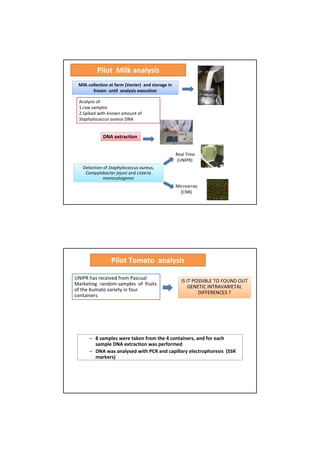
Application of Long Range Surface 
Innovative technologies 
                                              Plasmon resonance (LRSP) to 
      for SAFETY                             Immunoassay for Aflatoxin M1

      Total time 35 min

      Detection range 2-
      500 pg/mL

      LOD less than
      50pg/mL


                                        •     Calibration curve for the LRSP‐enhanced 
                                              fluorescence spectroscopy‐based biosensor 
                                              for the detection of AFM1 contained in a PBS 
                                              buffer and milk standard mixed with a PBS 
                                              buffer to 20 and 50 per cent. Measured 
                                              curves fitted with a sigmoidal function.


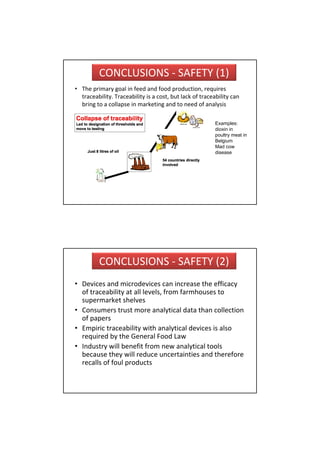
       All those information obtained, all devices and 
  microdevices and their applications in industrial contents 
       were reported in Deliverables 5.1, 5.2 and 5.3


Example of technical description of a device (Machine Vision)
DESK 1                              DESK 2 


                                                   PILOTS 1 and 2
                                                      Parmalat
                                                    Equipments

                                Videos on the pilot experiments have been
                                shown, and more details will be mentioned in
                                the following presentations


             Pilot Feed/Dairy
Detection and enumeration of Salmonella  in 
                   feed    
  Contamination of aliquots of two feed lots 
(CARGILL)   with Salmonella cells at known cfu 


              DNA extraction 


              Real Time PCR
Pilot Milk analysis    
 Milk collection at farm (Venier)  and storage in 
        frozen  until  analysis execution 

  Analysis of
  1.raw samples
  2.Spiked with known amount of 
  Staphylococcus aureus DNA  


             DNA extraction 


                                                     Real Time
                                                      (UNIPR) 
   Detection of Staphylococcus aureus, 
    Campylobacter jejuni and Listeria 
             monocytogenes
                                                     Microarray 
                                                       (CNR) 


                 Pilot Tomato  analysis    

UNIPR has received from Pascual 
Marketing  random samples  of  fruits                  IS IT POSSIBLE TO FOUND OUT 
                                                           GENETIC INTRAVARIETAL 
of the Kumato variety in four 
containers                                                     DIFFERENCES ? 


      – 8 samples were taken from the 4 containers, and for each 
        sample DNA extraction was performed
      – DNA was analysed with PCR and capillary electrophoresis  (SSR 
        markers) 
CONCLUSIONS ‐ SAFETY (1)
• The primary goal in feed and food production, requires 
  traceability. Traceability is a cost, but lack of traceability can 
  bring to a collapse in marketing and to need of analysis

                                                          Examples:
                                                          dioxin in
                                                          poultry meat in
                                                          Belgium
                                                          Mad cow
                                                          disease


          CONCLUSIONS ‐ SAFETY (2)
• Devices and microdevices can increase the efficacy 
  of traceability at all levels, from farmhouses to 
  supermarket shelves
• Consumers trust more analytical data than collection 
  of papers
• Empiric traceability with analytical devices is also 
  required by the General Food Law
• Industry will benefit from new analytical tools 
  because they will reduce uncertainties and therefore 
  recalls of foul products
CONCLUSIONS ‐ QUALITY
• Quality is becoming an essential parameter to distinguish 
  between goods and products and to determine the price
• Industries are interested in quality because this can bring to 
  “brands” and therefore increase competitiveness and market
  penetration
• Consumers are interested in quality because it is not only a 
  psychological parameter but also corresponds to real 
  nutritional claims in terms of health and safety
• Farmers are interested in quality bcause they can concentrate 
  on particular farming procedures requiring less inputs and 
  saving environment. Quality agriculture can be more 
  sustainable, because of reduction in intensity


                        CONCLUSIONS
• Safety and quality altogether do not exhaust the
  food traceability problems
• For instance, security issues are becoming 
  increasingly relevant due to examples of intentional 
  threats to our food supply chain
• Devices and microdevices can have a role to increase 
  preparedness towards intentional and accidental 
  threats (Chapter 4 of the upcoming book “Food chain integrity: a 
  holistic approach to food traceability, safety, quality and authenticity”
  Woodhead Publishing)
The novel traceability
      architecture of TRACEBACK
      and the pilot system for the
      Parmalat’s diary food chain

Milan, 10th November 2010                          Vito Morreale
                                 Head of Intelligent Systems Unit
                            Research & Development Department
                                          ENGINEERING Group
                                          vito.morreale@eng.it


                        Outline

   • TRACEBACK’s approach to traceability
   • Reference Architecture for Traceability
     Information Systems (RATIS)

   • Implementing traceability systems with
     and according to RATIS
   • Parmalat’s Milk pilot system
TRACEBACK approach: towards
                  food chain integrity
   • Universal tracability systems for any product, any food
     chain and any company
       – are not existing
                           NO
       – are difficult (if not impossible) to develop

    • Most companies would like
           – Traceability +
           – Additional (valued-added) services developed on top of it (e.g.
             management of food quality and safety, statistics, monitoring,
             certificates, etc.)
           – Possibility to change (e.g. systems, providers, technologies,
             processes, products, …) without changing too much
           – Not to pay a lot


                                       Our approach

                     Reference Architecture
Abstract      General
                                          Problem domain: what
              Domain-
              oriented                    elements/ideas we are talking
                                          about


                                          Abstract solution: how things
                                          should work/be


                                          Toolset for building concrete
                                          architectures

              Specific
              Situation-
Concrete                                  Concrete solution: how
              oriented
                                          things actually work
TBK system


                           RATIS
• The Reference Architecture for Traceability
  Information Systems (RATIS) aims at providing a
  specification for collaborative and distributed
  service-oriented traceability information systems
  supporting:
   – creation, acquisition, and recording of relevant
     traceability data along the entire supply chain;
   – storage of traceability data in distributed and
     (semantically) interoperating repositories;
   – semantically-sound sharing of traceability information
   – exploitation, browsing and querying of traceability
     information
Metaphor: Lego
• Definition of shape and interlink of pieces
   – Shape: functionality
   – Interlink: interfaces
                             RATIS
         RATIS Framework
• A set of ready-to-use pieces conform to the specification

• Third-party pieces: a set of external pieces (ready to use
  or to be conformed to the specification)

          Actual Traceability
• TISs: objects built with
   – the pieces available within the framework +
   – third party pieces +
              Systems
   – some other new pieces built for the purposes of a TIS


                    RATIS-based TISs
Reception of raw milk &
                                                              Transport of raw milk
  Dispatch of raw milk       Dispatch of pallets of milk      (transporter 1)
  (Venier)                   (Parmalat - Albano)


    Registration
      of quality
     parameters
      along the             RATIS
        supply
        chains
Registration
     of
                           services                             Tracking and Tracing

  devices


     Dispatch &          Reception of pallets of milk   Transport of pallets of milk
     Reception           (Trevilat- Albano)             (transporter 2)
      of pallets
   (proof-of-concept)


             From RATIS to application services for pilots
From RATIS to application services for pilots


From RATIS to application services for pilots
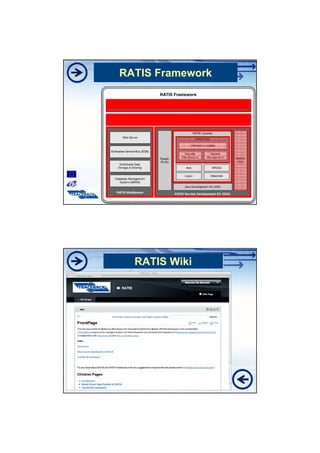
Architecture of RATIS


                       • 27 Business
                         Services
                       • 13 Traceability
                         Events
                       • 17 Logical Services
                           • 44 operations
                       • 10 Web Services
                           • 100+ operations


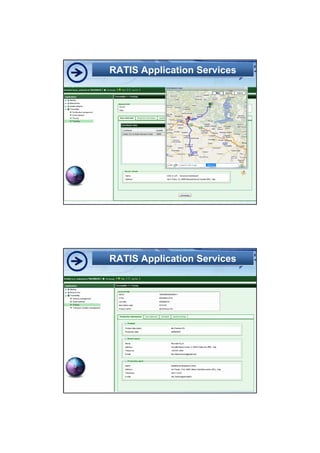
RATIS Business Service: example
Traceability Events

• Internal Events              • External Events
  –   Storage Event               – Despatch Event
  –   Movement Event              – Receive Event
  –   Destruction Event           – Transport Event
  –   Transformation Events
       •   Production Event
       •   Splitting Event
       •   Aggregation Event
       •   Grouping Event
       •   Mixing Event
       •   Packing Event
       •   Repacking Event


                RATIS Dispatch Event Model
RATIS Logical Services: example


        RATIS Technological Suite
• RATIS specifications • RATIS
  have a reference       Technological
                         Suite: intended to be
  implementation: the    used by software and
  RATIS Framework        service developers,
                         system integrators
                         and service providers
                         who to implement
                         traceability systems
                         and services.
RATIS Framework


  RATIS Wiki
Levels of conformance to RATIS

• Within the scope of RATIS
   – having requirements for traceability that can be
     fulfilled by the services included in the RATIS
     BSS
• Compatible with RATIS
   – able to provide/use the RATIS services defined
     into the LSS, simply by “composing” existing
     services (regardless their implementation and
     technology)
• Compliant to RATIS
   – fulfilling the LSS: to be able to provide (and use)
     those logical services (regardless their actual
     implementation and the way they interact with
     other services)      Mapping services can help
• Ready for RATIS Web Services
   – “ready” to be used by or use other “ready” Web
     services (including the ones within the RATIS
     Framework) without any adaptation


           How to implement traceability systems
           with RATIS?
 • The goal: RATIS-based traceability systems
 • The means: Service integration (and development)
 • The provider of traceability system and/or services is a
   “system and services integrator”
     – Provides the “right solution” according to
        • Real and specific needs (traceability analysts may aid in that)
        • Technological analysis
        • Existing systems (if any, they need integration, no
          replacement)
        • Services made available in the Network by SW service-
          providers
        • New services developed by software and service developers
Feed dairy pilot in a nutshell

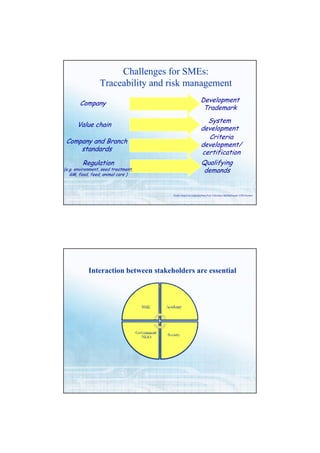
•   Product: Blu Premium
•   Category: fresh milk (shelf life: 15 days)
•   Producer: Parmalat
•   Location: Albano (Bergamo), North of Italy
•   Pilot:
    – Involved parties: 8
    – Scope: both external and internal traceability only from feed
      producers to retailers
    – Usage of both existing and new devices
    – Integration with current procedures … plus some innovations
    – Both acquisition and exploitation of information


                        Supply chain
                       Pilot 1
General features of pilot application services
     • Software-as-a-Service: only a browser is required (optimized
       for                  )
     • Rich user interfaces (Google Web Toolkit)
     • Fulfilling specific requirements of players by means of a
       general reference architecture
         – “Round”      “Lot” of raw milk
         – Sale of fresh milk
         – …
     • Personal mobile devices supporting mobility of people

     • Integration with external services (e.g.                             )


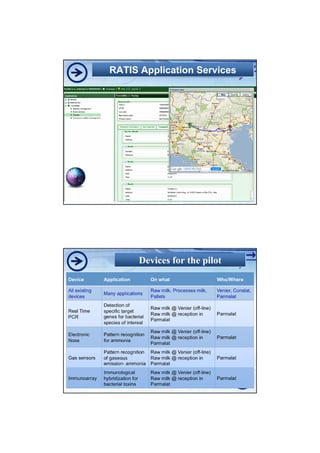
                   RATIS Application Services
                                •   Quality Analysis
•   Material Flow
                                     – Feed quality analysis
     – Feed expedition
                                     – Raw milk quality analysis
     – Feed reception
                                     – Round quality analysis
     – Feed processing
     – Raw milk expedition                              •   Tracing & Tracking
     – Raw milk transport                                    – Tracking (downstream)
     – Round reception                                       – Tracing (upstream)
     – Raw milk processing       RATIS                       – Certification management
     – Pallets expedition                                    – Delivery management
     – Pallets transport        services                     – Traceability Event retrieval
     – Pallets reception                                     – GPS position viewer
     – Product reception                                     – Transport condition
                                                                management
     •   Alerting
                                    •   Configuration
          – Plan management
                                         – Food player management
          – Alert reporting
                                         – User management
          – Action management
                                         – Profiles management
                                         – Supply chain configuration
                                         – Quality requirements management
RATIS Application Services


RATIS Application Services


RATIS Application Services


RATIS Application Services


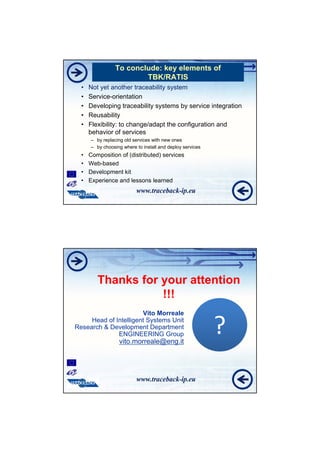
      Devices for the pilot
Devices: integration


                            Gas sensor
                            Electronic nose


           Pilots - Execution

• Duration:
  – 1st pilot: two weeks
  – 2nd pilot: 3 weeks
• Frequency: every day
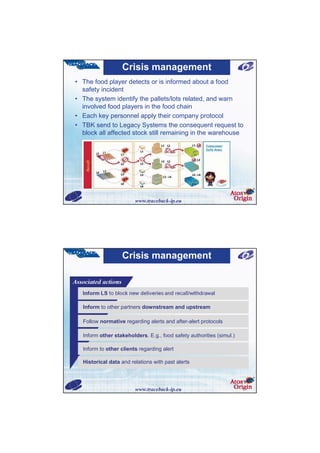
To conclude: key elements of
                         TBK/RATIS
  •   Not yet another traceability system
  •   Service-orientation
  •   Developing traceability systems by service integration
  •   Reusability
  •   Flexibility: to change/adapt the configuration and
      behavior of services
      – by replacing old services with new ones
      – by choosing where to install and deploy services
  •   Composition of (distributed) services
  •   Web-based
  •   Development kit
  •   Experience and lessons learned


         Thanks for your attention
                    !!!
                       Vito Morreale
     Head of Intelligent Systems Unit
Research & Development Department
              ENGINEERING Group
                  vito.morreale@eng.it
                                                           ?
Final Conference

The pilot system for the tomato food chain


              TRACEBACK
       Milano, November 10th 2010


                                             Francesc Rosinés
                                  ARI – Atos Research & Innovation
                                                      Atos Origin


            www.traceback-ip.eu


         Tomato chain pilot


            www.traceback-ip.eu
La Sala

 • La Sala is a plant nursery, developing small plants from seeds


                       www.traceback-ip.eu


                            Pascual


• Pascual is a tomato producer …


• …Processor and packer…                       • …and transporter

                       www.traceback-ip.eu
Consum

• Consum is a logistic platform…


• …transport…                             • …and retailer


                                 www.traceback-ip.eu


                                 Focus of pilot

     Crisis management:
     Crisis management:                                    Interoperability
                                                           Interoperability
   alerts, recall/withdrawal
   alerts, recall/withdrawal                              of legacy systems
                                                          of legacy systems


 Information flow: Internal
 Information flow: Internal                               AIDC information
                                                          AIDC information
  and external traceability
  and external traceability         Traceback
                                     Tomato
  Safety and quality control
  Safety and quality control
                                       pilot           Sensors data collection,
                                                       Sensors data collection,
                                                          new and existing
                                                          new and existing


 Historic on life at any point
 Historic on life at any point                              Services for
                                                             Services for
      of the food chain
      of the food chain                                 external stakeholders
                                                        external stakeholders


   Pilot is done in real installations in the companies

                                 www.traceback-ip.eu
Crisis management

   • Safety alert action plan:     Safety alert
                                   messages       SAFETY
                                                   ALERT
                                                  detected


Action


                         www.traceback-ip.eu


                    Crisis management
                                   Safety alert
   • Quality alert action plan:    messages       QUALITY
                                                   ALERT
                                                  detected


Action


                         www.traceback-ip.eu
Crisis management
• The food player detects or is informed about a food
  safety incident
• The system identify the pallets/lots related, and warn
  involved food players in the food chain
• Each key personnel apply their company protocol
• TBK send to Legacy Systems the consequent request to
  block all affected stock still remaining in the warehouse


                        www.traceback-ip.eu


                  Crisis management


  Inform to other partners downstream and upstream

  Follow normative regarding alerts and after-alert protocols

  Inform other stakeholders. E.g., food safety authorities (simul.)

  Inform to other clients regarding alert

  Historical data and relations with past alerts


                        www.traceback-ip.eu
Implementation

Implementation details:
• Each partner has and maintains different Traceability
  systems or ERP. They are from different providers and
  has different characteristics and technologies
• TraceBack interoperates LS in both directions. In
  addition, each one uses its own ID
• Data is moved between companies in a transparent way,
  ensuring external traceability
• TraceBack is enhancing the interoperability between
  different modules and subsystems inside several
  companies, contributing to internal traceability. It
  includes new mobile based applications


                                       www.traceback-ip.eu


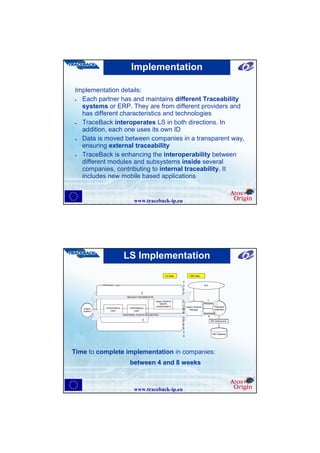
                               LS Implementation
                                                                LS Side          TBK Side


            Middleware Layer                                                                   GUI


                                                   A                      B
                                              2
             Adapter              REQUEST INFORMATION
                                                        Legacy Systems                           1
                                    EVENTS MONITORED       Specific                            REQUEST
                                                        Implementation        Legacy Systems             Traceback
   Legacy     Comunications         Data Mapping
                 Layer                                                           Manager                 Application
   System                               Layer
                                                                                               RESPONSE
                               RESPONSE: EVENTS REQUESTED
                                                                                                  4
                                              3                                                       TBK DataAccess


                                                                                                       TBK Database


Time to complete implementation in companies:
                                    between 4 and 8 weeks


                                       www.traceback-ip.eu
Devices

• Devices included in the pilot are:
   – SELEX Gas sensor
   – KBS Temperature device +
     RFID
   – AINIA electronic nose
   – AINIA machine vision
   – Technobiochip electronic nose

                                               • Parameters controlled
                                                  – CO2 and O2
                                                  – Contaminant fungi
                                                  – Origin
                                                  – Maturity
                                                  – Aspect and defects
                                                  – Ethylene

                         www.traceback-ip.eu


                           Advantages


   Automated synchronized systems. LS to TBK and TBK to LS

   Real time identification of products in same situation (for alerts)

   Quality and safety data included in both internal/external traceability

   Easy and fast to implement

   No proprietary solutions. Companies works with its own systems


                         www.traceback-ip.eu
Thank you


   www.traceback-ip.eu


francesc.rosines@atosorigin.com

        www.traceback-ip.eu


  I’m confuse...
     ...well...
...maybe I’m not


                        Questions?


        www.traceback-ip.eu
TRACEBACK
     Contract n° FP6-2005-FOOD-036300


     International Conference “Tracking the Future”
     10-11 November 2010, Milano, Italy


     Pilot System Evaluation


                      www.traceback-ip.eu


                     Overview

• Business Evaluation
  – Objective
  – Results
• Summative Evaluation


                      www.traceback-ip.eu
Business Evaluation of TRACEBACK
              Integrated Solution

Objective
• To assess the potential business benefits of
  TRACEBACK solutions to food companies


                         Activities where    Operation costs of
    Application:         savings occur:     the food traceability
                                                  system:
   Test Case         •     Communication
                                            •    Staff
                     •     Transcription
                                            •    Time
                     •     Collection
                                            •    Data Accuracy

                     www.traceback-ip.eu


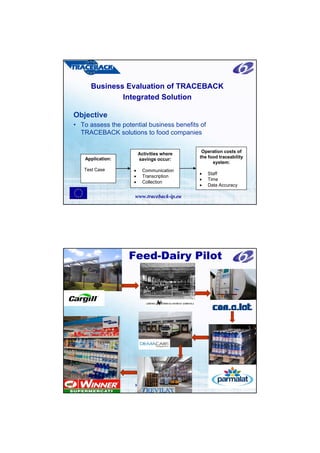
                   Feed-Dairy Pilot


                     www.traceback-ip.eu
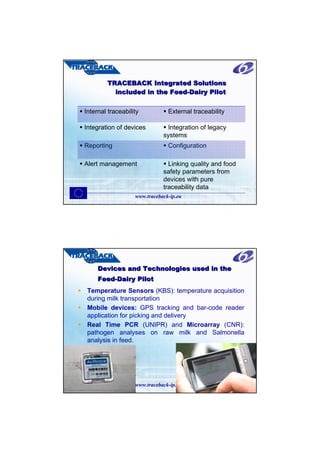
TRACEBACK Integrated Solutions
          included in the Feed-Dairy Pilot
                          Feed-

Internal traceability           External traceability

Integration of devices         Integration of legacy
                              systems
Reporting                       Configuration

Alert management                Linking quality and food
                              safety parameters from
                              devices with pure
                              traceability data
                   www.traceback-ip.eu


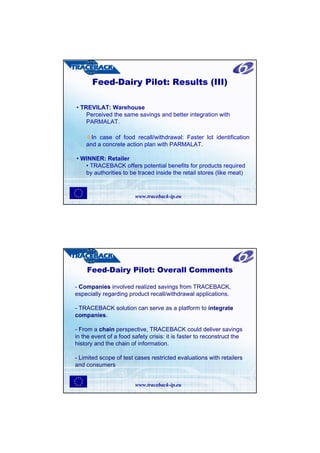
     Devices and Technologies used in the
     Feed-Dairy Pilot
     Feed-
 Temperature Sensors (KBS): temperature acquisition
 during milk transportation
 Mobile devices: GPS tracking and bar-code reader
 application for picking and delivery
 Real Time PCR (UNIPR) and Microarray (CNR):
 pathogen analyses on raw milk and Salmonella
 analysis in feed.


                   www.traceback-ip.eu
Feed-Dairy Pilot: Results (I)

  • Two pilot runs performed: 1st in September-October 2009
                              2nd in June-July 2010

  • CARGILL: Feed Producer
      No integration with legacy system, hence the user perceived the impact to
      be limited.

  • VENIER: Milk Producer
      Partial integration with legacy system allowing better coordination with
      PARMALAT
        Dispatch documentation was sent before the truck left for PARMALAT.

  • CONALAT: Raw Milk Transporter
      Use the mobile device to register data about movement of milk – closer
      monitoring

                            www.traceback-ip.eu


         Feed-Dairy Pilot: Results (II)

• PARMALAT ALBANO : Milk Processor
   Significant value added re. tracing, product recall and
   products withdraw.
           In the case of food recall/withdrawn: Better coordination
        with TREVILAT (one step forward) and VENIER (one step
        backward).

• DEMA-CAR: Pallet Transport
   Monitor the positioning of their vehicles.


                            www.traceback-ip.eu
Feed-Dairy Pilot: Results (III)

• TREVILAT: Warehouse
    Perceived the same savings and better integration with
    PARMALAT.

      In case of food recall/withdrawal: Faster lot identification
    and a concrete action plan with PARMALAT.

• WINNER: Retailer
   • TRACEBACK offers potential benefits for products required
   by authorities to be traced inside the retail stores (like meat)


                        www.traceback-ip.eu


    Feed-Dairy Pilot: Overall Comments

- Companies involved realized savings from TRACEBACK,
especially regarding product recall/withdrawal applications.

- TRACEBACK solution can serve as a platform to integrate
companies.

- From a chain perspective, TRACEBACK could deliver savings
in the event of a food safety crisis: it is faster to reconstruct the
history and the chain of information.

- Limited scope of test cases restricted evaluations with retailers
and consumers


                        www.traceback-ip.eu
Tomato Supply Chain Pilot


                   www.traceback-ip.eu


     TRACEBACK Integrated Solutions
     included in the Tomato Pilot

Internal traceability           External traceability

Integration of devices         Integration with legacy
                              systems
Alert management                Configuration

Reporting                       Services for external
                              stakeholders


                   www.traceback-ip.eu
Devices and Technologies used in the
    Tomato Pilot
    Electronic Nose (AINIA, Technobiochip): for pattern
    recognition
    Machine Vision (AINIA): for image analysis
    Spectrophotometer NIR (AINIA): for maturity analysis
    Temperature Sensors (KBS): temperature acquisition
    during transportation
    Genotyping platform (Automatic DNA sequencer)
    (UNIPR): to detect genetic composition of tomatoes for
    cultivar identification


                    www.traceback-ip.eu


         Tomato Pilot: Results (I)


La Sala: Plant Nursery

•   Delivery documentation is sent before the truck.
•   Pesticide and irrigation data is linked to the lot.
•   Faster tracking/tracing of lots.
•   Better coordination with Pascual Marketing.


                    www.traceback-ip.eu
Tomato Pilot: Results (II)
    Pascual Marketing
    •     Tomato Producer/Packer
             Delivery documentation is received before the truck arrives
             Pesticide and irrigation data is linked to the lot
             Better coordination with La Sala


    •     Packing House
             Delivery documentation is sent before the truck leaves
             Devices allow non-destructive samples.
             Temperature is continuously registered during transportation
             Better coordination with Consum


                               www.traceback-ip.eu


                    Tomato Pilot: Results (III)
Consum
•       Logistic Platform
           Devices allow non-destructive samples.
           Temperature is continuously registered during transportation
           Quality parameters linked to the lot.
           Better coordination with Pascual Marketing


•       Retailer
           In the case of food recall/withdrawal: Faster lot identification and
           easier coordination (concrete action plan).
           Better coordination with Pascual Marketing.


                               www.traceback-ip.eu
Tomato Pilot: Overall Impact
    •    Devices need to be faster, easier to adapt to more
         varieties or allow more than a single test at the time.
    •    Devices allow non destructive sampling. So, they can help
         to reduce garbage.
    •    Quality parameters can be linked to the lot.
    •    Benefits depend on the current traceability level in place.
    •    Move from a single player to the chain perspective.
    •    In the case of food recall/withdrawal: Faster lot
         identification and easier coordination (concrete action
         plan).


                                www.traceback-ip.eu


            Summative Evaluation - Objectives
    Evaluate if TRACEBACK solution satisfies its high levels goals

•       Objective Connections – enable the establishment of an objective
        connection between the product flow and the related information flow,
        along the food chain.

•       Availability and reliability of information along the entire chain
        (Quality of connections) – improve the availability & reliability of
        traceability information along the entire food chain.

•       Compatibility with Existing Technology (fit with legacy
        systems) – compatible with the technologies currently adopted by all
        actors in the agrifood chain including agricultural production, animal feed,
        transportation, manufacturing, handling & distribution.

                                www.traceback-ip.eu
Summative Evaluation – Soft Goals
The following soft goals were prioritised by project partners:
       •   All information travelled with product (lot)
       •   Quality and traceability data linked
       •   Targeted recall undertaken successfully
       •   Successful withdrawal process
       •   Real time traceability achieved
       •   Identification of cause of problem improved
       •   Results from analysis recorded successfully
       •   Reliable traceability and quality info obtained
       •   Traceability info retrieval improved
       •   Efficiency of processes increased
       •   TBK fits with legacy systems and processes
       •   Alerting system certifiable
                        www.traceback-ip.eu


 Summative Evaluation – Goals framework
   The soft goals were associated with the relevant objective


                        www.traceback-ip.eu
Preliminary findings from exit interviews
with food players
TRACEBACK objective              Soft goal                                Did TRACEBACK contribute
                                                                          to the achievement of this soft
                                                                          goal?

Objective connections between    All information travelled with product   Yes
product and info flow            (lot)
                                 Targeted recall undertaken               Yes
                                 successfully
                                 Successful withdrawal process            Yes
Availability, reliability of     Identification of cause of problem       To some extent ~ 50%
traceability info along whole    improved
chain
                                 Real time traceability achieved          Yes
                                 Results from analysis recorded           To some extent ~ 50%
                                 successfully
                                 Reliable traceability and quality info   To some extent ~ 85%
                                 obtained
                                 Traceability info retrieval improved     Yes
Compatibility with technology    Efficiency of processes increased        To a minor extent ~ 33%
currently used by food players
                                 TBK fits with legacy systems and         To some extent ~ 85%
                                 processes
                                    www.traceback-ip.eu


   TRACEBACK
   Contract n° FP6-2005-FOOD-036300


                                   Thanks


                                    www.traceback-ip.eu
Applying the pilot system
    in the dairy food chain
            Evaristo Dallaturca
            Quallity Assurance Manager
            Quallity Assurance Manager
              Parmalat S.p.A. Italiy
               Parmalat S.p.A. Italiy


            International Conference
            International Conference
            TRACKING THE FUTURE
             TRACKING THE FUTURE

  TRACEBACK FINAL CONFERENCE MILANO
  TRACEBACK FINAL CONFERENCE MILANO
        November the 10th 2010
         November the 10th 2010


               www.traceback-ip.eu


SY                 TRACEBACK: THE BASE IDEA
                   TRACEBACK: THE BASE IDEA
   ST
     EM
        S

                             TRACEBACK

        S
     SOR
 SEN


               www.traceback-ip.eu
ADVANCED TRACEABILITY:
Moving on the same highway product genealogy information and
quality attributes through connections with innovative (and
standard) detectors for quality relevant parameters and letting those
information available for everybody who needs them, from raw
material producers to end consumer.


                         www.traceback-ip.eu


For branded products “regular traceability” is not enough:

•It’s a law requirement (EC Regulation 178/2002, the “food law”)

•It guarantees food safety (when a major food safety issue occurs)
•It guarantees food safety (when a major      safety issue

    •It is mainly a Health Authority tool, even if handled by Food
    •It is mainly a Health Authority tool, even if handled by Food
    Business Operator
    Business Operator

•It is used to set “side goals” like food origin

•It in not intended for overall quality purposes

    •It does not give any further information about quality attributes
    •It does not give any further information about quality attributes


                         www.traceback-ip.eu
Today the consumer needs to feel
comfortable giving food to his child and to
himself.
himself.

Food related scandals rose in the near past
•on one side leaded to new EC food policy
and regulations (White Paper, EC reg 178/02
and related laws)
and related laws)
•on the other side increased the food safety
demand from citizens, and generally increased
the overall quality demand
Brand Companies (not necessarily large Companies) need to meet their
consumer trust, giving them not only a nutritional, hygienically safe
valuable product, but also the pool of information that is useful to feel
comfortable in consuming it.

                           www.traceback-ip.eu


     Knowing ORIGIN is not everything.

               A couple of examples….


                           www.traceback-ip.eu
M1 aflatoxin : an highly origin related problem
                                                    Distribuzione di frequenza del livello di M1
                                             masse latte comunitario in ingresso 2006-2010 : 2500 dati


                     100
                     90
                     80
                                                   Francia    Germania   Austria    Slovenia   Ungheria
                     70
      F qez %


                     60
       re u n a


                     50
                     40
                     30
                     20
                     10
                      0
                               =< 10              11 - 20                 21 - 30                 31 - 40   >40
                                                               M1 (ppt) classe di frequenza


                                              Distribuzione di frequenza del livello di M1
                                       masse latte ITALIANO in ingresso 2006-2010 : 15.000 dati


                      100
                       90
                       80
                       70
         Fe u n a%


                       60
          r qez


                       50
                       40
                       30
                       20
                       10
                           0
                                =< 10              11 - 20                 21 - 30                31 - 40   >40
                                                             M1 (ppt) classe di frequenza


                                                    www.traceback-ip.eu


Environment related food safety problems : Dioxin in southern Italy


                                                    www.traceback-ip.eu
ADVANCED TRACEABILITY

Is a useful and important tool (not the only one, of course) to allow
information to be provided, giving a new and more deeper
significance to traceability, upgrading genealogy data to quality and
safety data.
safety data.

This may be transformed in a competitive advantage for brands, in a
serious approach to dependable and REALLY USEFUL information for
consumer
consumer

The advanced traceability Traceback project will also provide a
useful tool to the company to keep better under control the product
life cycle, from raw material to distribution , making easier to track
quality information along the whole chain. This translates in an
increase of quality and safety content of the product itself.

                        www.traceback-ip.eu


      The consumer must also be granted a
      The consumer must also be granted a           early intervention,
                                                    early intervention,
      especially in case of health risk.
      especially in case of health risk.


      All F.B.O. must
      All F.B.O. must
      •Guarantee very short time response and intervention time.
      •Guarantee very short time response and intervention time.
      •Provide complete and accurate information in order to
      •Provide complete and accurate information in order to
          •Support management decisions
          •Support management decisions
          •Ensure adequate delineation of the problems
          •Ensure adequate delineation of the problems
          •Ensuring the effectiveness of recall
          •Ensuring the effectiveness of recall


                        www.traceback-ip.eu
TRACEABILITY 'itself is not therefore an absolute value if the
systems are not effectively linked and if they do not convey useful
information.
information.

“Usefulness” and “precocity” are closely linked concepts.

Information can be used properly if the system receives data as
close as possible to the phase that has generated it.

Examples
Examples

•Descriptive characteristics related to the batch production of feed,
raw milk, processed milk, the packaged product (relatively trivial).

•Analytical characteristics, nutritional, food safety (integration of
sensor systems, non-trivial)


                          www.traceback-ip.eu


 Analytical information: the added value of the sensors
 Analytical information: the added value of the sensors

 Through the connection with sensors or analytical systems will be
 Through the connection with sensors or analytical systems will be
     possible to
     possible to

 1. Hook analytical information that can accompany the product
 1. Hook analytical information that can accompany the product
    during the production cycle.
    during the production cycle.
 2. Increase the level of prevention in the system by moving the
 2. Increase the level of prevention in the system by moving the
    genesis of the analytical data to the step where the
    genesis of the analytical data to the step where the
    phenomenon that it describes occurs (eg: antibiotics at farm
    phenomenon that it describes occurs (eg: antibiotics at farm
    level mycotoxins on feed, after heat treatment microbial
    level mycotoxins on feed, after heat treatment microbial
    recontamination, etc.).
    recontamination, etc.).
 3. Increase accountability of all F.B.O.s dealing with their relevant
 3. Increase accountability of all F.B.O.s dealing with their relevant
    part
    part
 4. Spread the cost of control on the whole chain
 4. Spread the cost of control on the whole chain


                          www.traceback-ip.eu
Applying an advanced traceability system to the dairy food chain
 Applying an advanced traceability system to the dairy food chain
 helps to
 helps to

 •Ensure the safety of the consumer (a priority)
 •Ensure the safety of the consumer (a priority)
 •Increase in the level of consumer awareness about quality of the
 •Increase in the level of consumer awareness about quality of the
 chosen product.
 chosen product.

 This will constitute a true advantage for brand names. adding value
 This will constitute a true advantage for brand names. adding value
 to the product.
 to the product.

 This is not to invent "swindles" to be printed on the packaging or
 This is not to invent "swindles" to be printed on the packaging or
 providing useless information or even misleading.
 providing useless information or even misleading.

 These provide a real service, whose value depends mainly on the
 These provide a real service, whose value depends mainly on the
 level of acculturation of the consumer, its ability to discriminate the
 level of acculturation of the consumer, its ability to discriminate the
 real risks from hysteria, etc.
 real risks from hysteria, etc.

                          www.traceback-ip.eu


PILOT TESTING : IT CAN BE DONE!

The project content has been tested into the dairy
   food chain targeting upstram and downstream
   food chain targeting upstram and downstream
   the production flow of an up-to date drinking
   the production flow of an up-to date drinking
   milk product:
   milk product:

“Blu Premium” microfiltered pasteurized milk.

The product is obtained by raw milk collected in the
    surroundings of the production plant (Parmalat
    surroundings of the production plant (Parmalat
    Albano S. Alessandro – BG – Italy) .
    Albano S. Alessandro – BG – Italy) .
Milk is microfiltered, pasteurized and filled into blue
    (light barrier) PET bottles.
    (light barrier) PET bottles.

It requires cold storage and has 15 days shelf life

                          www.traceback-ip.eu
PILOT TESTING
PILOT TESTING

The choice of the product was done because it resumes a wide
   range of food production topics of the dairy field:
   range of food production topics of the dairy field:

•
•   High hygiene and nutritional quality raw milk
    High hygiene and nutritional quality raw milk

•
•   A certain degree of process complexity
    A certain degree of process complexity

•
•   Cold chain distribution requirement
    Cold chain distribution requirement

•
•   Longer shelf life than regular fresh milk (longer time on retailer
    Longer shelf life than regular fresh milk (longer time on retailer
    shelf and into consumer fridge)
    shelf and into consumer fridge)

•
•   Shorter shelf life than long life milk (faster market rotation)
    Shorter shelf life than long life milk (faster market rotation)


                          www.traceback-ip.eu


PILOT TESTING
PILOT TESTING

All supply chain players were involved:
• Cargill as feed supplier
•
•   Venier as raw milk producer
    Venier as raw milk producer
•
•   Con.a.lat as raw milk hauler
    Con.a.lat as raw milk hauler
•
•   Parmalat Albano S. Alessandro as processing plant
    Parmalat Albano S. Alessandro as processing plant
•
•   Demacar trasporti as finished product hauler
    Demacar trasporti as finished product hauler
•
•   Trevilat for distribution platform and transportation
    Trevilat for distribution platform and transportation
•
•   Winner as final retailer
    Winner as final retailer


                          www.traceback-ip.eu
PILOT TESTING EVALUATION

The pilot test deployment gave some useful information at the level of:

1. Traceability information from the feed producer ad from the farm.
2. Time saving for traceability information recovery
3. No need of several different company information systems queries to
    obtain genealogy of the specific product.
    obtain genealogy of the specific product.
4. “Smooth” information flow along the supply chain
5. Data collection from both innovative and traditional sensor or
    instruments.
    instruments.


                         www.traceback-ip.eu


 PILOT TESTING
 PILOT TESTING
 TBK system application:
 TBK system application:
 1. Highly improves data dependability
 1. Highly improves data dependability
 2. All information are better organized
 2. All information are better organized
 3. Actual processes are not overloaded except for the time needed
 3. Actual processes are not overloaded except for the time needed
     for data entry. This part may be improved and strongly depends
     for data entry. This part may be improved and strongly depends
     by the existing tools that may be more or less updated and
     by the existing tools that may be more or less updated and
     easily connected to the information flow.
     easily connected to the information flow.
 4. Supplier/costumer information exchange is easier.
 4. Supplier/costumer information exchange is easier.
 5. Production lot, delivery information recording is easier.
 5. Production lot, delivery information recording is easier.
 6. Easier withdrawal / recall operation
 6. Easier withdrawal / recall operation


                         www.traceback-ip.eu
CONCLUSIONS
CONCLUSIONS

Traceback project :
Traceback project :

Supplies a strong tool for integrated food chain traceability solutions
   to food industry and dairy food chain
   to food industry and dairy food chain
• Stimulates research for more and more innovative sensor to be
   applied and connected to keep the supply chain better under
   applied and connected to keep the supply chain better under
   control
   control
• Helps companies
• Helps companies
   • to give really useful information to the costumer
   • to give really useful information to the costumer
   • to facilitate a conscious choice based on effective quality
   • to facilitate a conscious choice based on effective quality
        determinants,
        determinants,
   • to increase citizen trust into the positive role of dairy
   • to increase citizen trust into the positive role of dairy
        industry in delivering a genuine, safe, healthy and nutrient
        industry in delivering a genuine, safe, healthy and nutrient
        food.
        food.

                        www.traceback-ip.eu


        THANKS
        THANKS
           !!


                        www.traceback-ip.eu
Applying the Pilot System in
            the Tomato Food Chain


                       Miguel Molina Salinas


                                Milan, 10th November 2010


Index

1   Presentation of Consum S. Coop. V

2   Consum’s incorporation to Traceback


3   Application of the Electronic Devices
    in the Tomato Food Chain

4   Conclusions
1   Presentation of Consum S. Coop. V

  The Valencian Cooperative CONSUM was born in 1975 and it is one of the main
  retailers in the Mediterranean area of Spain.
  In Spain, Consum is sixth in the commercial distribution ranking.
  We are a cooperative with more than 1.200.000 partners-customers and a staff of
  almost 10.000 workers (76,5 % women)
  Currently, we have nearly 600 supermarkets between Consum, Consum Basic and
  the Charter franchises distributed throughout the Valencian Region, Catalonia,
  Murcia, Castilla-La Mancha, Aragon and Andalucia.
  In addition, we supply our points of sale from six Logistic Platforms located in: Silla,
  Quart de Poblet and Ribarroja in Valencian Region, El Prat de Llobregat and Sant Boi
  in Catalonia and Torres de Cotillas in Murcia.
Regions of influence


       Consum’s supermarkets scope


                                     1   Presentation of Consum S. Coop. V

                                         YEAR 2009

                  6$/(6

                       MILLION
                        EUROS


                                     ,19(670 (17

                                            MILLION
                                             EUROS
2      Consum’s incorporation to Traceback


2.1. Motivation

    Exchanging knowledge with different EU countries.
    Collaborating with different Technological Centers and Universities.
   Extending the Traceability scope, including origin: “from farm to
 fork”.
   Improving the exchange of information, not only Lot Number but
 other Quality and Food Safety Parameters.
    R&D and investment Project. Developing a new Exchange
 Information System and Product Quality Control.


                        2      Consum’s incorporation to Traceback


2.2. Our previous Traceability System
     Integrated by several areas of the cooperative.
                                                                              Traceability
      Internal Traceability                                                   Committee
                                                                                Quality
      - From the reception in the Logistic Platform to the
                                                                             Organization &
      Point of Sale                                                             Systems

                                                                                Logistic
      External Traceability
                                                                              Purchasing

      - From the Supplier                                                     Point of Sale


       SUPPLIER        RECEPTION       STORAGE


                                        PICKING       DISPATCH      POINT OF SALE


 The system guarantees the Traceability of one lot from the Supplier to the Point of Sale
2         Consum’s incorporation to Traceback


2.3. Traceability with Traceback’s incorporation

    Utilization of the EAN128 labels complying                       EMPRESA
                                                                     COMPANY
    with GS1 standards.                                              PALET ESTANDAR PESO VARIABLE
                                                                      PALLET STANDARD VARIABLE WEIGHT


                                                                     EAN PALLET:98456789000062
                                                                       EAN PALET:                       NET WEIGHT:95.50 KG
                                                                                                                 95.50 KG
                                                                                                        PESO NETO:


              COMPANY
             EMPRESA                                                  F. EXP. DATE:
                                                                         CADUCIDAD:                      LOTE:
                                                                                                          LOT:

                                                                      10/11/2010
                                                                      2 / 3 / 2006                        12345678
             BOX FIXED WEIGHT
             CAJA PESO FIJO
                                                                         SSCC: 384567890000000091
                                                                             384567890000000091
             EAN CAJA : 8456789000038
             EAN BOX8456789000038
                    :                     LOTE: 12345678
                                           LOT:12345678


             F. EXP. DATE: 2 / 3 / 2006
                CADUCIDAD: 10/11/2010


                                                                              (01)98456789000062(3102)009550(17)060302


                                                                                   (00)384567890000000091(10)12345678
                     (01)08456789000038(10)12345678


                                2         Consum’s incorporation to Traceback


2.3. Traceability with Traceback’s incorporation
   Extension of the traceability scope                     from the origin: “from farm to fork”.
   An improvement in backward traceability, reaching origin (the system allows
   to monitor all the links involved in the food chain).


  The system guarantees the Traceability from the Seednursery to the Point of Sale
2    Consum’s incorporation to Traceback


2.3. Traceability with Traceback’s incorporation
   Improving the exchange of information, not only Lot Number but
   other Quality and Food Safety Parameters linked to this lot:

       Tracing of information to the Seed Nursery (grafting, seedling,
       pesticides, etc.).
       Continued measurement of Temperature and Humidity during
       transport to Consum’s logistic platforms.
       Acquisition of Quality Parameters (ripeness, rottenness, defects,
       colour,…) after the recepcion in Consum`s logistic platforms by
       electronic means.
   Seamless integration of Traceback with our Legacy Systems.


                      2    Consum’s incorporation to Traceback


2.3. Traceability with Traceback’s incorporation
   Register and management of Quality Incidents and Food Safety Alerts:
      Search a certain lot of product in Traceback system related to the
      processes suffered along the food chain (pesticides, fertilizers, water,
      substrates used, etc.).
      Withdrawal and Product Recall due to Quality Incident or Food Safety
      Alert detected in any stage of the food chain (Ex.: consumer poisoning).
3    Aplication of the electronic devices
                           in the Tomato Food Chain

3.1. Devices and Technologies used

   New electronic devices that allow the acquisition of Quality Parameters as:

       Electronic Nose (Technobiochip): to manage the degree of ripeness and
       to detect rottennesses.
       Machine Vision (AINIA): to measure size, colour and detect defects.
       Spectrophotometer NIR (AINIA): to measure firmness, category and
       sugar contents.
       Temperature and Humidity Sensors (KBS): to determine the
       temperature and humidity during transport.

   Full Integration of these devices in the Traceback Traceability System.


                      3    Aplication of the electronic devices
                           in the Tomato Food Chain

3.2. Advantages vs traditional methods

   Non-destructive tests: possibility of
   performing higher number of samplings
   eliminating the wastage.
   Possibility of determining several Quality
   Parameters in a single analysis.
   Fast gathering of measurements.
   Electronic register of Quality Parameters
   linked to a certain lot number.
   Possibility of adjusting the devices in a
   continuous process line.
3    Aplication of the electronic devices
                            in the Tomato Food Chain

3.3. Future considerations

                                  New measurement technologies are not
                                  commonplace among fruit and vegetable
                                  producers.
                                  There is a need to adapt these devices to
                                  the distribution companies that commercialize
                                  a lot of references in different formats,
                                  varieties, sizes, etc.
                                  Accomplishment of predictive models for
                                  product analysis.
                                  Standardisation of measurement scales.


                       4    Conclusions

Main Goal
The principal aim of the Tracebility Systems is not only to comply with the
current legislation, but to be a tool of Quality and Food Safety that allows us to
achieve the following objectives:

     Improvement of logistic management (lot number, packaging date or expiration
    date, etc.).
      Transfer to clients a reliable information in the labelling products to comply
    labelling regulations.
     Inmediate location of a lot when a Quality Incident or a Food Safety Alert is
    detected in any stage of the food chain.
      Colaboration with our suppliers to prevent, as far as possible, any kind of
    incident.
4   Conclusions

  Traceability must go towards Integrated Management in case of a Food
Safety Crisis, providing the transmission of information between all the
links involved in the food chain, achieving a correct management of the
information and guaranteeing confidentiality.


              Thank you very much
                for your attention

               Vi ringrazio molto de
                     l'attenzione
5HVXO DGRV
    W
Involving SMEs in
traceability innovation


       Ewa Marciniak, RWIRP
         Patrik Stolt, SLU


          www.traceback-ip.eu


               SMEs

     ”Innovation is the
profitable implementation
  of strategic creativity”

Elaine Dundon (2002), ”The seeds of innovation”


          www.traceback-ip.eu
Challenges for SMEs:
                 Traceability and risk management

       Company                                                Development
                                                               Trademark
                                                                System
      Value chain
                                                              development
                                                                Criteria
 Company and Branch
                                                              development/
     standards                                                certification
         Regulation                                           Qualifying
(e.g. environment, seed treatment,                            demands
   GM, food, feed, animal care )


                                      Partly based on original from Prof. Christina Skjöldebrand, LTH Sweden

                                        Partly based on original from Prof. Christina Skjöldebrand, LTH Sweden


            Interaction between stakeholders are essential
Template: Partnership Alnarp – Industrial Platform

    In five years                            Membership fee:
    80 Companies                             120 000 EUR/year
   100 Researchers                              Workshops
                                               Coordination
   Applied projects                           Communication
                          Coordinator
   11 000 000 EUR             Six              New projects
                          secretaries

                      Communication group


                                        Regional Industrial Platform
                                        • Identify local “real” traceability “problems”
                                        • Solutions on “real” problems
                                        • Applied and tailored projects
                                        • Finance as “joint venture”
                                        • Traceback exchange of knowledge and
                                          innovations via TIP
                                        • RIP networking
Regional Industrial Platforms - RIP

ITALY – to trace mastitis in dairy products                           SPAIN – a LIMS system
“Development of a rapid test for the detection of infectious agents   “Deployment of a laboratory information management system
causes of mastitis in dairy cows”                                     for improving the breadth and precision of food safety
                                                                      information in Traceback and assuring the quality control
                                                                      between the producer and packer”
Poland – to harmonize EU and Polish product ID in
fresh fruit
“To adjusting Polish food processing industry to the EU law
requirements in the scope of FMCG products identification”            SWEDEN – pre-harvest test to avoid mycotoxins in wheat
                                                                      “Developing a grain pre-harvest test to “predict” the likeliness
                                                                      of having mycotoxins in the final harvest. To improve quality
Poland – to harmonize EU and Polish product ID in
                                                                      and trace sources.
cosmetics
“To adjusting Polish food processing industry to the EU law
requirements in the scope of FMCG products identification”            SPAIN – improving tomato seedlings
                                                                      “Developing a to control and trace tomato seedlings, avoid
Poland – to secure controlled condition transportation                inmixtures and non-approved qualities down-stream the
“Transport container for products that need controlled conditions”    tomato food chain. Trace mistakes in the tomato food
                                                                      chain..

Egypt – to establish networks                                         Turkey – to establish networks
“To establish an open dialog between stakeholders in the food         “To establish an open dialog between stakeholders in the food
sector, academy and organizations. To establish structures for        sector, academy and organizations. To establish structures for
collaborations and handle innovations related to traceability”        collaborations and handle innovations related to traceability”


                         Wielkopolska Food Sector
                               Benefits for SME from TRACEBACK project


                                            RWIRP - Ewa Marciniak


                                                  www.traceback-ip.eu
RIP Wielkopolska
•   Introduction of TBK project – conference for SME - high
    interest from SME , WGRO in name of shareholders and regional
    government
•   RIP - expected platform for cooperation in traceability and innovation
•   Choosing the best form for RIP – conference with support of regional
    government /ALNARP pattern/
•   FINET establishment /schema/ - tool for food industry SME in
    developing traceability and innovation rewarded by regional government


                      www.traceback-ip.eu


                                             FINET Coordinator


                           FINET                   FINET
                        Administration             Board


                                                                      Marketing 
                            Logistics            Traceability
                                                                       Financing
                       coordinated by ILiM   coordinated by ILiM
                                                                   coordinated by DB


                        Distribution          Automatic
                                                                   Credits
                                              Identification
                        Stock                Electrtonic Data
                                                                   Subsidies
                        Management           Exchange
                                                                   Financial
                        Transportation
                                              Standardization      Consulting

                        Warehousing


                      www.traceback-ip.eu
Benefits for RIP from TBK

• RIP related to TRACEBACK TIP – international
  networking, contact with experts, priority in traceability
  information
• Wielkopolska RIP /FINET/-the main center in the region for
  SME to announce needs in traceability and innovation


                                   www.traceback-ip.eu


                Wielkopolska RIP projects
Goal
   To be capable of transporting of products (fresh food, seedlings, etc.) that need constant
   temperature control system during transportation

•   Who: food industry and growers (seeds)

Vision:
    Common container used for transportation of goods that need constant temperature
    control system

•   based on SME owner’s patent
•   innovative solution - allows to transport goods in controlled conditions and constant
    temperature for a specified time period by any means of transportation
•   significant reduction of transport costs
•   different applications:
         food sector - transportation of fresh food
         health sector - transportation of medicines, organs, etc.
•   temperature registering pill with independent electricity source
•   long time of temperature registration (max. 5 days)
•   possibility of tracing the product during transportation

                                   www.traceback-ip.eu
Wielkopolska RIP projects
    Goal:
       To collect and identify data within supply chains meeting the traceability requirements

    •    Who: food industry

    Vision:
        Design and preparation for implementation of traceability system in the Grze kowiak
        production company based on the Traceback project assumptions related to data
        collection and identification

    •    auditing the capability of meeting the requirements posed by the product flow traceability
         system
    •    carrying out crisis simulation
    •    describing of the entire production chain
    •    identification of sub-processes and all participating elements
    •    working out recommendations for changes and improvement actions
    •    preparation of the necessary database, tag models
    •    implementation of traceability system
    •    verification of system’s functioning in practice, i.e. in the frame of crisis simulation

                                     www.traceback-ip.eu


                   Wielkopolska RIP projects
Goal:
   To increase safety of the customers through efficient identification of the origin of the
   product within supply chain allowing immediate withdrawal of defective products from the
   market

•       Who: cosmetic industry

Vision:
     Implementation of traceability system in the supply chain

•       introducing of operational system based on GS1 for recording actions at every stage of the
        physical flow of materials through:
•       collection of data about raw materials and components for the production of specific
        production order
•       identification of the manufacturing processes and the consumption of raw materials and
        components
•       tracing of individual pallets of finished products


                                     www.traceback-ip.eu
Future of Wielkopolska RIP

Continuation as the answer for real needs of SME and supporting
  development of food industry in the region:

  - improvment of RIP organization
  - activity in traceability and innovation EU projects
  - international networking


                          www.traceback-ip.eu


     Big challange for RIP - solve last
           announced problem
• Certification of fresh fruits and vegetables
• Announced by shareholders from the regional
  wholesale market and shops related to the market
• Growers see the benefit from certifications


                          www.traceback-ip.eu
Future

• Stimulate local and regional networks and
  initiatives
• Stimulate collaborations between SMEs,
  academy, industry and organization
• Stimulate innovations and support with ”pilot”
  founding
• Stimulate collaboration and networking
  internally/externally EU
                 www.traceback-ip.eu


Thank you to all who gave SMEs in our regions
      a new tool for better development


                 www.traceback-ip.eu

Session 1: International conference "Tracking the future"

  • 1.
    Under the patronageof: Ministero della Ricerca (required) TRACEBACK Project partners: 1. Tecnoalimenti S.p.A. Consortile 2. 3. AINIA – Asociaciòn de Investigaciòn de la Industria Agroalimentaria Atos Origin Sociedad anònima International Conference espanola 4. Engineering Ingegneria Informatica S.p.A. 5. 6. University of Kent ILIM – Institute of Logistics and Warehousing TRACKING THE FUTURE 7. Swedish University of Agricultural Sciences Faculty of Alnarp 8. University of Parma 9. CEMAT – Combined European Management And Transportation With the support of: S.p.A. 10. City University London – Centre for Integrated Project HCI Design 11. Consiglio Nazionale delle Ricerche, Istituto di Chimica del “INTEGRATED SYSTEM FOR A RELIABLE Riconoscimento Molecolare 12. CONSUM Sociedad Cooperativa TRACEABILITY OF FOOD SUPPLY CHAINS” Valenciana 13. Institut für Agrar – und Stadtökologische Projekte an der TRACEBACK Humboldt – Universität zu Berlin FP6-2005-FOOD-036300 14. Max Plank Society for the Advancement of Science represented www.traceback-ip.eu by the Max Plank Institute for Polymer Research 15. MTT Agrifood Research Finland 16. Teagasc Agriculture & Food development Authority 17. Selex Communications S.p.A. 18. SGS ICS Ibérica, S.A. 19. Federalimentare 20. Akdeniz University, Economic Research Center on Mediterranean Countries 21. Scuola Superiore ISUFI, eBusiness Management Section, University of Lecce 22. Centiv GmbH 10-11 November 2010 23. NSCE Ltd 24. KBS 25. Parmalat S.p.A Centro Congressi Fondazione Cariplo 26. Technobiochip SCarl 27. Regionalna Wielkopolska Izba Rolno- Via Gian Domenico Romagnosi, 8 Przemyslowa 3 Montenapoleone or 1-3 Duomo In cooperation with: - Cargill S.r.l. - Div. Animal Nutrition Milan, Italy - Azienda Venier s.s. Società Agricola - Trevilat - Winner supermercati - Dema car trasporti s.n.c. - Conalat - La Sala Viveros-Semilleros - Pascual Marketing, S.L. Scientific Conference Committee: Conference Secretariat: Traceback Coordination Team Prof. Hannu Korhonen – Agrifood Research Centre (FIN) TECNOALIMENTI S.C.p.A. Prof. Nelson Marmiroli – University of Parma (ITA) Raffaello Prugger– Marianna Faraldi Prof. Neil Maiden – City University London (UK) m.faraldi@tecnoalimenti.com Prof. Rolf Larsen – Swedish University of Agricultural Sciences (SWE) Via Gustavo Fara, 39 – 20124 Milan (Italy) E. Dallaturca – Parmalat (ITA) Tel. +39 02 67077370 Fax. +39 02 67077405 L. Brugera Moreno - Consum Cooperativa Valenciana (ES) E. De Paoli – Tecnoalimenti (ITA)
  • 2.
    International Conference TRACKINGTHE FUTURE 10 – 11 November 2010 Centro Congressi Fondazione Cariplo Via Gian Domenico Romagnosi, 8, Milan (Italy) NOVEMBER 10th, 2010 (morning) Session 1 – Results of the TRACEBACK project Objective of this session is to illustrate the results of TRACEBACK and to learn the opinion of the end users of the TRACEBACK results. Programme 8.30 Registration 9:00 Welcome Ugo Dozzio Cagnoni, Commissioner Fondazione Cariplo Demetrio Corno, President of Tecnoalimenti Ciaran Mangan, DG Research, European Commission Fabrizio Cobis, Authority of Operational Programme 'Research and Competitiveness', Ministry of Research Ethel De Paoli, TRACEBACK Coordinator and CEO of Tecnoalimenti 9:45 Opening Raffaello Prugger, TRACEBACK Coordination team, Tecnoalimenti: The innovative concept of TRACEBACK 10:00 Illustration of the results achieved by TRACEBACK project Key speakers: Nelson Marmiroli, University of Parma – Quality and safety approach of TRACEBACK Vito Morreale, Engineering Ingegneria Informatica – The novel traceability architecture of TRACEBACK and the pilot system for the dairy food chain Francesc Rosines, ATOS Origin – The pilot system for the tomato food chain 11:30 Benefits to the food chain Key speakers: Marian Garcia, University of Kent – Outcomes of the pilot system evaluation Evaristo Dallaturca, Parmalat, with supply chain players – Applying the pilot system in the dairy food chain Miguel Molina, Consum Cooperativa Valenciana, with supply chain players – Applying the pilot system in the fresh vegetable food chain Patrik Stolt, Swedish University of Agricultural Sciences and Ewa Marciniak, RWIRP – Involving SMEs in traceability innovation Questions and Answers
  • 3.
    A) Summaries Welcome • UgoDozzio Cagnoni, Commisioner Fondazione Cariplo Welcome of the host • Demetrio Corno, President of Tecnoalimenti Tecnoalimenti (TCA) is a non-profit research consortium, which generates projects for food industry. The aim of TCA is to support small and medium sized enterprises to develop systems such as traceability, which is essential for their future. Traceability is an important research area and improved solutions have been developed. However, in order to create a reliable traceability system, research must be conducted at European level. The planning of TRACEBACK started five years ago. The competition in food industry is globalizing and getting more severe. There is a growing need to respond not only by competitive pricing, but also with high quality, since new countries such as India and China have emerged to the markets. • Ciaran Mangan, DG Research, European Commission TRACEBACK project is one of the European Commission’s traceability projects funded by FP 6, thematic priority 5, Food Quality and Safety. In total 16 traceability projects have been financed by 135 M €, being an important field of research in this TP. The annual reports of the large projects have been reviewed by external experts, who have given positive appraisal about TRACEBACK. A conference “What’s for dinner?” to showcase and debate the application of FP6 EC funded research to improve food safety, quality and security, will be organized in Brussels in March 2011. In addition, a scientific book on traceability will be published.
  • 4.
    • Fabrizio Cobis,Authority of Operational Programme ‘Research and Competitiveness’, Ministry of Research The funding of national research in Italy was discussed. The companies should be supported by society to establish networks to yield “know how” and also “know where”. The financing should be targeted for larger research entities in order to constitute a sufficiently critical mass. • Ethel De Paoli, TRACEBACK Coordinator and CEO of Tecnoalimenti TCA has for 30 years produced research for industry. Like other projects, TRACEBACK has been very pragmatic. An example about the previous projects is an improvement of product quality by changing the method of transport. Projects like this have paved the way for TRACEBACK. Opening • Raffaello Prugger, TRACEBACK Coordination Team, Tecnoalimenti The innovative concept of TRACEBACK The TRACEBACK-project was based on the fact that the food chains are complicated and multinational, and involve both economic and added values. The quality of food products may easily be impaired. In TRACEBACK, the quality is followed along the food chain and linked to the product identification through internet. The solution must be flexible and applicable, and it must be able to communicate with the existing systems. The communication and sharing of information throughout the whole chain benefits all players. The prototype was tested and validated successfully in feed-dairy and tomato chains.
  • 5.
    Illustration of theresults achieved by TRACEBACK project • Nelson Marmiroli, University of Parma Quality and safety approach of TRACEBACK It is extremely important to verify the quality and safety of food and feed among the whole supply chain with objective devices; this kind of analysis provides analytical and objective information to the companies and to the consumers about the quality and safety of the food. TRACEBACK increased the availability of analytical technologies to assess continuously the food and quality of the food. This technology is precise, sensitive and can be applied in line, on line and off line and it is not expansive. The sensors and devices exploited in TRACEBACK are also able, in some cases, to communicate directly with the ICT infrastructure so that the analytical information is immediately available to the food companies. • Vito Morreale, Engineering Ingegneria Informatica S.p.A. The novel traceability architecture of TRACEBACK and the pilot system for the dairy food chain Starting from a Reference Model, in TARCEBACK we developed a Reference Architecture for Traceability Information System (RATIS): that is a specification of services useful for traceability and how these services should interact each other to provide a supply chain traceability information system: the focus of our work is not a single company but all the supply chain, from the raw material producers to the retailer. The service oriented approach guarantee the needed interoperability among different players and the availability of the information among the whole supply chain. Reusability and flexibility are key concepts for the proposed reference architecture and we demonstrated these features in two real supply chain: We also developed a concrete traceability information system for the Parmalat supply chain and applied it in a real context. • Francesc Rosines, Atos Origin S.A. The pilot system for the tomato food chain He presented the tomato pilot test (see the power point presentation)
  • 6.
    Benefits to thefood chain • Hannu Korhonen, MTT Outcomes of the pilot system evaluation Business evaluation aimed at identifying financial benefits for the companies involved in the pilot testing with the adoption of the provided solution. A detailed questionnaire has been submitted to each involved companies to evaluate their impression about the adoption of the new developed system. According to the specific functionalities provided to each player trough the developed system we collect different impression and different comments about the adoption of the system. Companies in general perceives TRACEBACK as a good platform to integrate different systems in a supply chain perspective; for example in case of recall the TRACEBACK solution is able to provide efficiently a complete history of the affected product. • Evaristo Dallaturca, Parmalat Applying the pilot system in the diary food chain Parmalat joined the project because they liked the idea to make different systems form different players and devices for objective monitoring interacting in a supply chain integrated solution. Basic traceability is not enough for companies like Parmalat that considers product quality as an added value for its products. Thus the possibility to link quality parameters to each product is a good opportunity. This information can be useful to ensure the product quality to the final consumer but also to perform high level analysis that can improve the knowledge about the supply chain, including raw material providers and final customers. • Miguel Molina, Consum Cooperativa Valenciana, with supply chain players Applying the pilot system in the fresh vegetable food chain The TRACEBACK-solution was tested in tomato chain, which consisted of three players from seed nursery to the point of sale. The main benefits were: 1) Improvement of backward traceability and linkage of players to the whole food chain, 2) New electronic devices, Electronic nose (Technobiochip), Machine vision (AINIA), Spectrophotometer NIR (AINIA) and Temperature and humidity sensors (KBS), and their full integration to the TRACEBACK-system, 3) Improvements in test methods: Non destructive, rapid tests, which determine several parameters in one test, 4) Improved exchange of information about lot, quality and food safety. Future considerations: New methods are not familiar to producers and they need adaptation, utilization of predictive models and standardization of measurement scales. Conclusions: Objectives of TRACEBACK were achieved: Logistic management (e.g. lot number), reliable information for client (e.g. labeling), immediate location of lot when alerted and collaboration with suppliers were improved.
  • 7.
    • Patrik Stolt,Swedish University of Agricultural Sciences and Ewa Marciniak, RWIRP Involving SMEs in traceability innovation TRACEBACK industrial platform (TIP) exchanged knowledge and innovations at two levels, international and regional (RIP), the latter being focused on smaller local problems. Regional projects were established in six countries: Italy, Poland, Egypt, Spain, Sweden and Turkey. In Poland a successful conference was organized for SMEs. The three Polish RIP projects were targeted at improving traceability and quality in food and cosmetic industry and tomato production. To continue responding the needs of SMEs, the organization of RIPs needs to be improved. Future challenges of RIPs are the stimulation of local and regional networks and initiatives, and collaboration between SMEs, academy, industry and organizations internally/externally in EU. In addition, innovations need support for piloting.
  • 8.
    B) Presentations Index Speaker Presentation Welcome Ugo Dozzio Cagnoni, Fondazione Cariplo --- Demetrio Corno, President of Tecnoalimenti --- Ciaran Mangan, DG Research, European Commission Pg. 9 Fabrizio Cobis, Authority of Operational Programme 'Research and Competitiveness', Ministry of Research Pg. 15 Ethel De Paoli, TRACEBACK Coordinator and CEO of Tecnoalimenti --- Opening Raffaello Prugger, TRACEBACK Coordination team Pg. 17 Illustration of the results achieved by TRACEBACK project Nelson Marmiroli, University of Parma Pg. 24 Vito Morreale, Engineering Ingegneria Informatica Pg. 42 Francesc Rosines, ATOS Origin Pg. 61 Benefits to the food chain Hannu Korhonen, MTT Pg. 69 Evaristo Dallaturca, Parmalat Pg. 80 Miguel Molina, Consum Cooperativa Valenciana Pg. 90 Patrik Stolt, Swedish University of Agricultural Sciences and Ewa Marciniak, RWIRP Pg. 99
  • 9.
    THE FOOD QUALITYAND SAFETY PROGRAMME (2002-2006) Agriculture, Forestry, Fisheries, Aquaculture Directorate E: Biotechnologies, Agriculture and Food Directorate General for Research European Commission Not legally binding Sixth Framework Programme Research on Food Quality and Safety (2002-2006) Integrating European Research Priority Thematic Areas Anticipating S/T Needs Sustainable development and Information society technol. Food quality and safety Scientific support to policies Life Sciences, genomics & Citizens & governance biotechnology for health Aeronautics and space Nanotechnologies ... New and emerging S/T needs global changes SME activities International cooperation JRC . Structuring the ERA Strengthening the Research & Training & Research Science & foundations of ERA Innovation Mobility Infrastructures Society (Global budget European Community 17.883 M €) Not legally binding
  • 10.
    P5 Food Qualityand Safety Areas Covered • The whole food chain • Epidemiology of food related diseases and genetic susceptibilities • Impact of food on health • Traceability processes (including GMOs) • Methods of analysis/detection and control of chemical contaminants and pathogenic microorganisms • Safer production methods and healthier foodstuffs • Impact of Animal feed on Human Health • Environmental health risks Not legally binding Food Quality and Safety Fork-to-Farm Food intake Health and Safe, high- well-being Production Processing quality of foods Consumer Environmental factors Not legally binding
  • 11.
    TP5 OUTCOME Number of Average Commission funded funding contribution projects (million €) (million €) IP * 31 12 388 NoE 12 13 160 STREP 60 2,6 156 CA 7 1,1 9 37 SSA 72 0,63 38 Total 181 3500 751 partcipants * Specific INCO top up call (closure date: 16/05/2006; budget: 2.5 million€ ) Not legally binding TP5: SOME OF THE FIRST RESULTS • The First comprehensive pan-European food information resource on the Internet • New strategies for acrylamide reduction in heated foods • A European standardised skin prick test for allergens • A European Molecular epidemiology database • First pan-European collaboration of clinical nutrition research results • GMO Coexistence farming models • Potential commercial developments for food traceability systems • Examples of knowledge transfer and innovation in the food processing industry. Not legally binding
  • 12.
    WHY FUND TRACEABILITYRESEARCH? • The requirement for traceability labelling and related analytical methods under European directives 258/97 on novel foods and ingredients publication of the general food law 178/02 regulation that entered into force in January 2005. • Food safety and health crises encountered in the recent past (BSE, foot and mouth disease, Listeria, dioxin, growth hormone contaminated by Creutzfeld-Jacob prions, etc) • Increasing demand for high quality food and feed products e.g products with protected designation of origin • Gap between a regulatory demand and practical implementation, particularly for SMEs. Not legally binding PART PROJECT Programme EU SPEND TOTAL SPEND NERS TRACE FP6 IP 50 12 19 CHILLON FP6 IP 24 10 15 TRACEBACK FP6 IP 28 10 15 BIOTRACER FP6 IP 47 11 15 PROSAFEBEEF FP6 IP 41 11 18 PATHOGEN COMBAT FP6 IP 44 11 14 COEXTRA FP6 IP 54 12 19 SEAFOODPLUS * (only FP6 IP 15 3 6 traceability package) MONIQA FP6 NOE 33 12 12 ALCUEFOOD FP6 SSA 13 0.7 0.7 OTAG FP6 SSA 5 0.3 0.42 GTIS CAP FP6 SSA 7 0.6 0.8 PETER FP6 SSA 2 0,7 0,9 SIGMACHAIN FP6 STREP 11 2.9 4.5 BIOTOX FP6 STREP 12 3 5.3 FISHPOPTRACE FP7 CP-FP 15 3 4 401 98,7 137,9 16 projects
  • 13.
    TRACEBACK Integrated system for a reliable traceability of food supply chains (IP) Strategic objectives: EC contribution 9.74 M€ • tthe development of a global traceability system, routinely applicable to all food productions, that will assure food safety and quality through the extension of tracing and tracking information to food parameters • to increase consumer confidence in the food supply by developing new technological solutions for ensuring a trustworthy linkage between product flow and information flow along the entire food chain • to improve the competitiveness of the European food industries and small and medium-sized enterprises (SMEs) in the food sector by defining a traceability system that represents the European response to food globalisation making possible to convert the wealth of peculiarities of European food production into market assets. 34 participants from 13 countries (12 industrial partner) (Third country: Russia, Egypt) Not legally binding TRACEBACK RESULTS: COMMENTS FROM EXTERNAL REVIEWERS • The project is well managed and is on track. There are very few delays, and those that have occurred are being addressed. • The leadership must be commended for their open approach, and the fostering of inter-project collaboration; they have provided a suite of workshops/seminars (including e-delivery); and have successfully used flash meetings to ensure a high level of internal communication and direction. • The project has the potential to contribute significantly to EU policy on food safety, and also to commercial needs, but this potential still needs to be realized. • The project has developed some technical innovations addressing specific aspects of food chain traceability (notably in reference computer architecture and sensing technologies), and these developments may be commercially relevant in their own right, but also add to the holistic impact of the overall Traceback system. The uptake of these developments will depend on what lasting impact Traceback will be able to make after the project has finished, and a lot of thought and effort need to be expended in the final year to make sure that the results and outcome are not ignored or forgotten a few years hence. Not legally binding
  • 14.
    A BOOK ONTRACEABILITY CRC PRESS 2011 • Title: “Food integrity: A holistic approach to authenticity, originality, terroir (location), traceability, security and safety in food production chains.” • The book provides the readers with the latest development of the science in food safety, quality and sustainability. Specifically, the book will focus on food authenticity, quality markers, origin of foods and feedstuffs, tracing and tracking microbial and chemical contaminations Not legally binding
  • 15.
    TRACKING THE FUTURE TRACCIARE IL FUTURO With the support of TRACEBACK project: “Integrated system for a reliable traceability of the entire food supply chains” Contract n° FP6-2005-FOOD-036300 Milano, 10-11 Novembre 2010 www.traceback-ip.eu Origin of the idea FOODNET e-MENSA TRACEBACK ? www.traceback-ip.eu
  • 16.
    Programme • Session 1– This morning / Mattina The results achieved by TRACEBACK I risultati del progetto TRACEBACK • Session 2 - This afternoon / Pomeriggio Approaches to traceability and food chain integrity Approcci alla tracciabilità e alla integrità della filiera • Session 3 – Tomorrow morning / Domani mattina New technological research scenarioes for the future agrifood chains Nuovi scenari di ricerca tecnologica per il futuro della filiera www.traceback-ip.eu
  • 17.
    TRACKING THE FUTURE10 November 2010 Session 1 TRACEBACK The results achieved I risultati raggiunti www.traceback-ip.eu TRACKING THE FUTURE - 10 November 2010 The innovative concept of TRACEBACK Un nuovo approccio alla tracciabilità Raffaello Prugger, Tecnoalimenti Chief Traceback Coordination Team www.traceback-ip.eu
  • 18.
    What is TRACEBACK? Integrated Project FP6 European Commission FI Coordinated by Tecnoalimenti (IT) TECNOALIMENTI Scientific and Technological Research Organisation for the Scientific and Technological Research Organisation for the Agro-Food Sector Agro-Food Sector *** *** • Research and Innovation Pole for the agrofood industry Research and Innovation Pole for the agrofood industry • Non profit research organisation composed of 28 Agro- Non profit research organisation composed of 28 Agro- Food related Industries and one financial institution as Food related Industries and one financial institution as trustee of Research Ministerial funds. Industrial shareholders trustee of Research Ministerial funds. Industrial shareholders represent about 12% of Italian food sales. represent about 12% of Italian food sales. • Established in 1981 under Act 1089/68 aimed at fostering Established in 1981 under Act 1089/68 aimed at fostering Agro-Food Industrial Research. Agro-Food Industrial Research. www.tecnoalimenti.com www.tecnoalimenti.com www.traceback-ip.eu TRACEBACK Project partnership: FI 28 Participants (51% enterprises) 11 countries Cost € 15.5 Million EC Contribution € 9,5 Million Duration 4 years: Jan 2007 – Dec 2010 www.traceback-ip.eu
  • 19.
    Why food traceability? •Food chains are increasingly complex and global • Non-material components add value to food products • Food undergoes biological processes > safety, security, quality www.traceback-ip.eu The objectives of TRACEBACK • To develop a traceability solution for the entire food chain • To go beyond mere identification by incorporating food safety and quality parameters • To ensure flexibility and compatibility www.traceback-ip.eu
  • 20.
    The results • Prototypesof a “general solution” to food chain traceability • Tested on 2 real food chains: Feed dairy (IT) (Parmalat, Cargill, Venier, Trevilat, Winner, Dema car, Conalat) Tomato (ES) (Consum, La Sala, Pascual Marketing) www.traceback-ip.eu TRACEBACK “general solution” A general solution to food traceability that consists of 2 inter-related components: • IT (RATIS • Devices (and framework): umbrella sensors): objective system that inter- monitoring for connects existing and acquiring product novel traceability quality and safety data systems and data along along the food chain the food chain players and uploading them www.traceback-ip.eu
  • 21.
    The IT component The TRACEBACK solution is an “umbrella system”. • Allows to store, share and intercommunicate between players, devices and the internet. • Is an operative system of the traceability systems: i.e. “Windows” – that fits to all supply chain players • Is internet-based, flexible and at reduced cost Keywords: RATIS, TRM, Interoperability, Service- Oriented Architecture (SOA), Device Manager, Services, Legacy systems, www.traceback-ip.eu The Devices component The TRACEBACK solution can detect product and process data on food safety and quality and transfer them to the system. • Allows to acquire product information over the entire food chain (in addition to identification) • Can objectively document product values along the food chain Keywords: Sensors, DNA based biosensors, Lab-on- chips, E-nose, Machine vision, Surface plasmon resonance, Immunoarrays www.traceback-ip.eu
  • 22.
    Services to traceability ? Transporters ? Feed Internet processor ? ? Wholesaler Transporters Packaging S Materials supplier TS Transporters S S S TS S Retailer TS TS TS TS Dairy processor Feed supplier Dairy farm Milk transporters KFP Retailer Logistic Platform Food Service Final Industry Customer ? Dairy by operator Feed prducer products Other dairy products Courtesy of SLU www.traceback-ip.eu The testing Pilots tested with success: - tomato food chain, across 3 players, CONSUM (ES) - feed-dairy food chain, across 7 players, PARMALAT (IT) www.traceback-ip.eu
  • 23.
    The results • TheTRACEBACK concept is valid • An information flow that can demonstrate/document the value of a food product • Moves the detection of the problem close to the moment of its inception, avoiding additional expenses connected to the delay • Spreads the cost of safety and quality control over the whole food chain • Turns traceability from a social imposition into a market opportunity. www.traceback-ip.eu Detailed illustrations follow in Session 1 • The quality and safety approach • The system architecture • Illustration of the pilots (dairy and tomato) After the coffee break • The results of the test and the opinion of the food chain players who ran the test www.traceback-ip.eu
  • 24.
    QUALITY AND SAFETY  APPROACH OF TRACEBACK Nelson Marmiroli  University of Parma  SAFETY Is the primary requirement to be met before foods can be placed on  the  market.  A  variety  of  agents  can  compromise  food  safety,  according  to  hazard  analysis  (HACCP)  scheme:  physical,  biological,  chemical hazards. QUALITY  Is an added value in food marketing. A variety of factors contribute  to  establish  quality:  genetic  origin  of  the  raw  matter  (PDO/PGI),  genetic  identity  of  the  plant  or  animal  species  utilized  for  food  production,  originality  of  treatment  or  processing  procedure,  nutritional  value,  the  content  in  principles  active  beyond  the  normal  nutritional  components  (antioxidants,  anticancer  molecules,  immunomodulating  molecules  or  micro‐organisms),  identification with sociological or psychological issues.  Quality more often is a prize‐premium for the producer. 
  • 25.
    QUALITY AND SAFETY ARE OFTEN RELATED IN  FOOD PRODUCTION   •Growing  plants  or  breeding  animals  aims  not  only  at  increasing  yield  but  also at developing raw matters of particular nutritional value and of psico‐ sensorial  attractiveness.  In  doing  this,  the  first  value  is  the  safety  of  raw  matter  produced.    The  quality  of  raw  matter  often  coincides  with  the  nutritional and healthy properties of the food obtained •In  processing  raw  matter,  the  food  producer  aims  at  safety  and  quality  almost  coincidentally.  During  processing,  food  producers  aim  at  the  displacement  of  contaminant  and  of  spoilage  micro‐organisms    or  of  unwanted molecules. At the same time, preserving the healthy, nutritional  and  sensorial  properties  of  the  raw  matter,  and  potentiating  it  with  new  factors during processing,  eventually. •Conservation and distribution are performed in a way that these safety and  quality  features  of  the  foods  are  maintained  even  on  a  long  time at  long  distance. Packaging, refrigeration, active packaging are  all  deployed  during   these phases. QUALITY AND SAFETY IN FOOD REGULATION:   QUALITY •Both  European  (European  Commission)  and  international  Organisation (Codex Alimentarius Commission) are active in this field •Council  regulation  882/2004:  how  to  verify  compliance  with  feed  and  food law (EC 178/2002) •Codex  Alimentarius  Commission:  ISO/IEG  Guide  25:1980  to  quality  ensurance  laboratories, ISO Standard 2005. •In other Countries Regional measure: United Kingdom Accreditation  in Sciences (UKAS), comply also with EN 45003 •Internal Quality Control (IQC) procedures, cooperation  •Proficiency testing: ISO‐IUPAC‐AOAC International Cooperation  •European Committe for standardisation  (CEN)
  • 26.
    QUALITY AND SAFETY IN FOOD REGULATION:  SAFETY The EU White Paper on Food Safety and the General Food Law  Regulation • From producers to consumers •Responsibilities for all stakeholders in the whole food chain •Risk  analysis,  decision  on  safety  is  based  on  a  scientific  evaluation of  the risk •Communication of the risk must be observed in all cases •Application  of  the  precautionary  principle  whenever  a  risk  is  possible •The  creation  of  the  European  Food  Safety  Agency  (EFSA)  to  provide  independent  scientific  advice  on  all  aspects  related  to  food safety  Traceability of feed and food: when a risk is identified, the risk  must be traced to its origin.  Traceability in the food chain Cascade of  Agricultural responsibilities production Internal systems i.e. Transport company  Primary responsibility transformation Transport Production Distribution to Trade (Internal to Company) Trade Consumer Internal Upstream traceability traceability Downstream traceability
  • 27.
    • Paper traceability is required by laws but product labelling is  based also on  compositional informations • In case of recalls or withdrawals of products,  informations  stored in papers  may be not sufficient • Consumers  are  more  oriented  to  believe  in  science  than  in  papers • According  to  General  Laws,  risk  analysis  and  decisions  are  based on scientific evaluation  THEREFORE • Data  from  an  objective  monitoring  of  specific  parameters  performed  at  all  stages  with  sensors  and  devices,  automatically  captured  and  stored,  could  be  of  great  relevance to the food companies and consumers • Empiric  traceability  may  be  especially  valuable  in  the  context of internal traceability TRACEBACK has considered the increasing need  of availability of analytical  technologies to assess the quality and  safety of food  supply chain. •These technologies  may have these characteristics: •To be sensitive: limit of detection (LOD) •To be precise: limit of quantification (LOQ) •Applicable “on line” and “at line” •Applicable in real time •Not    too  much  expensive  with  respect  to  the  standard  methodologies •To  have  a  good  level  of  multiplexing  (more  simultaneous  analyses, more kinds of analyses)  •To  be  provided  of  Artificial  Intelligence  (AI),    allowing  their  addressing  on integrated systems of evaluation 
  • 28.
    Three kinds of technologies  have been considered for  the food chains:  1. Already  existing  and  adaptable  without  particular  modifications  2. Already  existing  and  adaptable  with  small  modifications (adaptable technologies) 3. Already  existing  but  adaptable  with  new  protocols,  new tools and devices (innovative technologies) All  types are endowed with Artificial  Intelligence and connectivity RATIS - WP4 WP5 Existing devices New devices Artificial intelligence and Software Data Capture System - WP6 Test in pilot - WP7
  • 29.
    Sensors based on existing technologies • In food processing companies, these  sensors can be applied along food chains  for monitoring parameters like  temperature, humidity, pH, position, tracks • TRACEBACK has introduced a system of  connectivity for these sensors to RATIS, the  General Informatic Framwork generated  within the project Sensors based on adaptable technologies • Sensors developed within TRACEBACK aim  at monitoring of several parameters: – Gases and volatile compounds – Chemical and physical parameters  – Metabolites Sensors based on innovative technologies –Cells –Macromolecules
  • 30.
    The TRACEBACK concept has been  applied to two supply chains  Tomato Feed/Dairy  GMO Tomato  TOMATO supply  chain  Heavy metals Salmonella E. coli Nitrates, nitrites Salmonella C. jejuni Listeria C. parvum Pesticides Heavy metals Fungi, moulds Salmonella E. coli Shigella Nitrates, nitrites S. aureus, pyogenes Salmonella E. coli V. cholerae C. jejuni Listeria Shigella C. jejuni Listeria Protozoa Spore forming bacteria
  • 31.
    Fungi, moulds Toxins and aflatoxins Veterinary medicinal substances Antinutrients Other animal species Pesticide residues GMO Campylobacter Salmonella Salmonella Brucella E. coli Listeria Enterobacteriaceae Staphylococcus and toxins Mycobacterium tubercolosis Yersinia enterocolitica Coxiella burnetii Shigella Heavy metals Pesticides Antinutrients Fungi, moulds Toxins and aflatoxins GMO Salmonella MILK Feed/Dairy  supply chain  ADAPTABLE TECHNOLOGIES Sensors for shape, weight, colour MACHINE VISION OF FRESH TOMATO
  • 32.
    ADAPTABLE TECHNOLOGIES Sensors for shape, weight, colour ULTRASOUND APPLICATIONS FOR CHEESE DEFECTS Defect 1.9 cm 1.5 1 Amplitud (V) 0.5 0 -0.5 Identification of defects in cheese -1 texture -1.5 0 2000 4000 6000 8000 Punto adquirido ADAPTABLE TECHNOLOGIES Gas sensors for small volatile molecules • Four different sensing surfaces are stimulated by four different substances, yielding a complex response which is a “signature” of a  particular sample • Artificial Intelligence through a learning process can identify the  sample based on the comparison with a database of signatures Determination of organic volatile  compounds for milk discrimination
  • 33.
    ADAPTABLE TECHNOLOGIES Volatile compounds • Technobiochip’s LibraNOSE 2.1 and  3.0 use oscillating quartzes coated by  polymeric films (the sensor). Polymer  tends to adsorb some gases, and thus  the sensor mass changes, resulting in  a quartz oscillation frequency shift. • Each sample has a recognisable  signature profile, and similar samples  can be grouped together, allowing  identification of outsiders  Identification  of tomato cultivars and ripening stage, types of  milks, cheese ripening stage, ammonia in milk  INNOVATIVE TECHNOLOGIES Sensors based on macromolecules  Recognition of macromolecules in food samples offers  new interesting possibilities, because:  • The reaction is very specific  • The limit of detection can be low • The target can be identified, described an quantified The sensors developed within TRACEBACK based on  new technologies are for recognition of DNA and  protein using: • PCR technologies  • Chips and arrays  • Surface Plasmon Resonance 
  • 34.
    Why DNA analysis  • The DNA molecules is present in most of the biological  tissues, it is relatively stable to chemical and physical  treatments whereas other molecules such as proteins  are more labile during food processing • DNA can be amplified by PCR, increasing the number to  detectable levels. This provides sensitivity to the test  decreasing LOD and LOQ To perform DNA analysis in food there are two basic  requirements: •Development of methods for efficient extraction and purification of  DNA from food matrices  •Development of diagnostic markers for identification to DNA  corresponding to ingredients, contaminants, unwanted materials Innovative technologies for QUALITY  Buffalo milk Buffalo milk Discovery of frauds in milk Cow milk Cow milk 50% cow milk+ 50%  50% cow milk+ 50%  discrimination  among  milk  buffalo milk buffalo milk samples  derived  from  different  animal  species,  and  from plant species,  with DNA  analysis  Soybean milk Soybean milk Cow milk  Cow milk  50% Cow milk+ 50%  50% Cow milk+ 50%  Soybean milk Soybean milk
  • 35.
    Innovative technologies for QUALITY  Cultivar recognition in tomato and tomato products with DNA analysis It is important because of: -PDO certification -PGI certification -Allergens -Geographic origin -GMO presence Fresh tomato Puree Puree S.Marzano peeled Peeled Pulp Concentrate Arrabbiata sauces Innovative technologies for SAFETY DNA analysis for detection and enumeration  of contaminating and spoilage micro‐ organisms in milk and cheese  Staphylococcus aureus  Salmonella spp Escherichia coli Shigella spp Listeria monocytogenes  Bacillus cereus  Yersinia enterocolitica Vibrio spp  Clostridium perfrigens 
  • 36.
    Innovative technologies for SAFETY DR Chip platform : Semi-automatic system quite cheap, not sophisticated instrumentation PCR DNA Extraction from milk/cheese Reading Colour developing Hybridization oven Innovative technologies for SAFETY DETECTION OF MICROBIAL TOXINS WITH PROTEIN ANALYSIS  Microcell hybridization : detection of S. aureus A B C D A: S aureus B: L monocytogenes C: Universal bacterial probe D: Buffer Step towards the realization of high-throughput, semi-automated high- throughput, semi- microdevices for microarray experiments
  • 37.
    Application of Long Range Surface  Innovative technologies  Plasmon resonance (LRSP) to  for SAFETY Immunoassay for Aflatoxin M1 Total time 35 min Detection range 2- 500 pg/mL LOD less than 50pg/mL • Calibration curve for the LRSP‐enhanced  fluorescence spectroscopy‐based biosensor  for the detection of AFM1 contained in a PBS  buffer and milk standard mixed with a PBS  buffer to 20 and 50 per cent. Measured  curves fitted with a sigmoidal function. All those information obtained, all devices and  microdevices and their applications in industrial contents  were reported in Deliverables 5.1, 5.2 and 5.3 Example of technical description of a device (Machine Vision)
  • 38.
    DESK 1 DESK 2  PILOTS 1 and 2 Parmalat Equipments Videos on the pilot experiments have been shown, and more details will be mentioned in the following presentations Pilot Feed/Dairy Detection and enumeration of Salmonella  in  feed     Contamination of aliquots of two feed lots  (CARGILL)   with Salmonella cells at known cfu  DNA extraction  Real Time PCR
  • 39.
    Pilot Milk analysis     Milk collection at farm (Venier)  and storage in  frozen  until  analysis execution  Analysis of 1.raw samples 2.Spiked with known amount of  Staphylococcus aureus DNA   DNA extraction  Real Time (UNIPR)  Detection of Staphylococcus aureus,  Campylobacter jejuni and Listeria  monocytogenes Microarray  (CNR)  Pilot Tomato  analysis     UNIPR has received from Pascual  Marketing  random samples  of  fruits   IS IT POSSIBLE TO FOUND OUT  GENETIC INTRAVARIETAL  of the Kumato variety in four  containers DIFFERENCES ?  – 8 samples were taken from the 4 containers, and for each  sample DNA extraction was performed – DNA was analysed with PCR and capillary electrophoresis  (SSR  markers) 
  • 40.
    CONCLUSIONS ‐ SAFETY (1) • The primary goal in feed and food production, requires  traceability. Traceability is a cost, but lack of traceability can  bring to a collapse in marketing and to need of analysis Examples: dioxin in poultry meat in Belgium Mad cow disease CONCLUSIONS ‐ SAFETY (2) • Devices and microdevices can increase the efficacy  of traceability at all levels, from farmhouses to  supermarket shelves • Consumers trust more analytical data than collection  of papers • Empiric traceability with analytical devices is also  required by the General Food Law • Industry will benefit from new analytical tools  because they will reduce uncertainties and therefore  recalls of foul products
  • 41.
    CONCLUSIONS ‐ QUALITY • Quality is becoming an essential parameter to distinguish  between goods and products and to determine the price • Industries are interested in quality because this can bring to  “brands” and therefore increase competitiveness and market penetration • Consumers are interested in quality because it is not only a  psychological parameter but also corresponds to real  nutritional claims in terms of health and safety • Farmers are interested in quality bcause they can concentrate  on particular farming procedures requiring less inputs and  saving environment. Quality agriculture can be more  sustainable, because of reduction in intensity CONCLUSIONS • Safety and quality altogether do not exhaust the food traceability problems • For instance, security issues are becoming  increasingly relevant due to examples of intentional  threats to our food supply chain • Devices and microdevices can have a role to increase  preparedness towards intentional and accidental  threats (Chapter 4 of the upcoming book “Food chain integrity: a  holistic approach to food traceability, safety, quality and authenticity” Woodhead Publishing)
  • 42.
    The novel traceability architecture of TRACEBACK and the pilot system for the Parmalat’s diary food chain Milan, 10th November 2010 Vito Morreale Head of Intelligent Systems Unit Research & Development Department ENGINEERING Group vito.morreale@eng.it Outline • TRACEBACK’s approach to traceability • Reference Architecture for Traceability Information Systems (RATIS) • Implementing traceability systems with and according to RATIS • Parmalat’s Milk pilot system
  • 43.
    TRACEBACK approach: towards food chain integrity • Universal tracability systems for any product, any food chain and any company – are not existing NO – are difficult (if not impossible) to develop • Most companies would like – Traceability + – Additional (valued-added) services developed on top of it (e.g. management of food quality and safety, statistics, monitoring, certificates, etc.) – Possibility to change (e.g. systems, providers, technologies, processes, products, …) without changing too much – Not to pay a lot Our approach Reference Architecture Abstract General Problem domain: what Domain- oriented elements/ideas we are talking about Abstract solution: how things should work/be Toolset for building concrete architectures Specific Situation- Concrete Concrete solution: how oriented things actually work
  • 44.
    TBK system RATIS • The Reference Architecture for Traceability Information Systems (RATIS) aims at providing a specification for collaborative and distributed service-oriented traceability information systems supporting: – creation, acquisition, and recording of relevant traceability data along the entire supply chain; – storage of traceability data in distributed and (semantically) interoperating repositories; – semantically-sound sharing of traceability information – exploitation, browsing and querying of traceability information
  • 45.
    Metaphor: Lego • Definitionof shape and interlink of pieces – Shape: functionality – Interlink: interfaces RATIS RATIS Framework • A set of ready-to-use pieces conform to the specification • Third-party pieces: a set of external pieces (ready to use or to be conformed to the specification) Actual Traceability • TISs: objects built with – the pieces available within the framework + – third party pieces + Systems – some other new pieces built for the purposes of a TIS RATIS-based TISs
  • 46.
    Reception of rawmilk & Transport of raw milk Dispatch of raw milk Dispatch of pallets of milk (transporter 1) (Venier) (Parmalat - Albano) Registration of quality parameters along the RATIS supply chains Registration of services Tracking and Tracing devices Dispatch & Reception of pallets of milk Transport of pallets of milk Reception (Trevilat- Albano) (transporter 2) of pallets (proof-of-concept) From RATIS to application services for pilots
  • 47.
    From RATIS toapplication services for pilots From RATIS to application services for pilots
  • 48.
    Architecture of RATIS • 27 Business Services • 13 Traceability Events • 17 Logical Services • 44 operations • 10 Web Services • 100+ operations RATIS Business Service: example
  • 49.
    Traceability Events • InternalEvents • External Events – Storage Event – Despatch Event – Movement Event – Receive Event – Destruction Event – Transport Event – Transformation Events • Production Event • Splitting Event • Aggregation Event • Grouping Event • Mixing Event • Packing Event • Repacking Event RATIS Dispatch Event Model
  • 50.
    RATIS Logical Services:example RATIS Technological Suite • RATIS specifications • RATIS have a reference Technological Suite: intended to be implementation: the used by software and RATIS Framework service developers, system integrators and service providers who to implement traceability systems and services.
  • 51.
    RATIS Framework RATIS Wiki
  • 52.
    Levels of conformanceto RATIS • Within the scope of RATIS – having requirements for traceability that can be fulfilled by the services included in the RATIS BSS • Compatible with RATIS – able to provide/use the RATIS services defined into the LSS, simply by “composing” existing services (regardless their implementation and technology) • Compliant to RATIS – fulfilling the LSS: to be able to provide (and use) those logical services (regardless their actual implementation and the way they interact with other services) Mapping services can help • Ready for RATIS Web Services – “ready” to be used by or use other “ready” Web services (including the ones within the RATIS Framework) without any adaptation How to implement traceability systems with RATIS? • The goal: RATIS-based traceability systems • The means: Service integration (and development) • The provider of traceability system and/or services is a “system and services integrator” – Provides the “right solution” according to • Real and specific needs (traceability analysts may aid in that) • Technological analysis • Existing systems (if any, they need integration, no replacement) • Services made available in the Network by SW service- providers • New services developed by software and service developers
  • 53.
    Feed dairy pilotin a nutshell • Product: Blu Premium • Category: fresh milk (shelf life: 15 days) • Producer: Parmalat • Location: Albano (Bergamo), North of Italy • Pilot: – Involved parties: 8 – Scope: both external and internal traceability only from feed producers to retailers – Usage of both existing and new devices – Integration with current procedures … plus some innovations – Both acquisition and exploitation of information Supply chain Pilot 1
  • 54.
    General features ofpilot application services • Software-as-a-Service: only a browser is required (optimized for ) • Rich user interfaces (Google Web Toolkit) • Fulfilling specific requirements of players by means of a general reference architecture – “Round” “Lot” of raw milk – Sale of fresh milk – … • Personal mobile devices supporting mobility of people • Integration with external services (e.g. ) RATIS Application Services • Quality Analysis • Material Flow – Feed quality analysis – Feed expedition – Raw milk quality analysis – Feed reception – Round quality analysis – Feed processing – Raw milk expedition • Tracing & Tracking – Raw milk transport – Tracking (downstream) – Round reception – Tracing (upstream) – Raw milk processing RATIS – Certification management – Pallets expedition – Delivery management – Pallets transport services – Traceability Event retrieval – Pallets reception – GPS position viewer – Product reception – Transport condition management • Alerting • Configuration – Plan management – Food player management – Alert reporting – User management – Action management – Profiles management – Supply chain configuration – Quality requirements management
  • 55.
  • 56.
  • 57.
  • 58.
    RATIS Application Services Devices for the pilot
  • 59.
    Devices: integration Gas sensor Electronic nose Pilots - Execution • Duration: – 1st pilot: two weeks – 2nd pilot: 3 weeks • Frequency: every day
  • 60.
    To conclude: keyelements of TBK/RATIS • Not yet another traceability system • Service-orientation • Developing traceability systems by service integration • Reusability • Flexibility: to change/adapt the configuration and behavior of services – by replacing old services with new ones – by choosing where to install and deploy services • Composition of (distributed) services • Web-based • Development kit • Experience and lessons learned Thanks for your attention !!! Vito Morreale Head of Intelligent Systems Unit Research & Development Department ENGINEERING Group vito.morreale@eng.it ?
  • 61.
    Final Conference The pilotsystem for the tomato food chain TRACEBACK Milano, November 10th 2010 Francesc Rosinés ARI – Atos Research & Innovation Atos Origin www.traceback-ip.eu Tomato chain pilot www.traceback-ip.eu
  • 62.
    La Sala •La Sala is a plant nursery, developing small plants from seeds www.traceback-ip.eu Pascual • Pascual is a tomato producer … • …Processor and packer… • …and transporter www.traceback-ip.eu
  • 63.
    Consum • Consum isa logistic platform… • …transport… • …and retailer www.traceback-ip.eu Focus of pilot Crisis management: Crisis management: Interoperability Interoperability alerts, recall/withdrawal alerts, recall/withdrawal of legacy systems of legacy systems Information flow: Internal Information flow: Internal AIDC information AIDC information and external traceability and external traceability Traceback Tomato Safety and quality control Safety and quality control pilot Sensors data collection, Sensors data collection, new and existing new and existing Historic on life at any point Historic on life at any point Services for Services for of the food chain of the food chain external stakeholders external stakeholders Pilot is done in real installations in the companies www.traceback-ip.eu
  • 64.
    Crisis management • Safety alert action plan: Safety alert messages SAFETY ALERT detected Action www.traceback-ip.eu Crisis management Safety alert • Quality alert action plan: messages QUALITY ALERT detected Action www.traceback-ip.eu
  • 65.
    Crisis management • Thefood player detects or is informed about a food safety incident • The system identify the pallets/lots related, and warn involved food players in the food chain • Each key personnel apply their company protocol • TBK send to Legacy Systems the consequent request to block all affected stock still remaining in the warehouse www.traceback-ip.eu Crisis management Inform to other partners downstream and upstream Follow normative regarding alerts and after-alert protocols Inform other stakeholders. E.g., food safety authorities (simul.) Inform to other clients regarding alert Historical data and relations with past alerts www.traceback-ip.eu
  • 66.
    Implementation Implementation details: • Eachpartner has and maintains different Traceability systems or ERP. They are from different providers and has different characteristics and technologies • TraceBack interoperates LS in both directions. In addition, each one uses its own ID • Data is moved between companies in a transparent way, ensuring external traceability • TraceBack is enhancing the interoperability between different modules and subsystems inside several companies, contributing to internal traceability. It includes new mobile based applications www.traceback-ip.eu LS Implementation LS Side TBK Side Middleware Layer GUI A B 2 Adapter REQUEST INFORMATION Legacy Systems 1 EVENTS MONITORED Specific REQUEST Implementation Legacy Systems Traceback Legacy Comunications Data Mapping Layer Manager Application System Layer RESPONSE RESPONSE: EVENTS REQUESTED 4 3 TBK DataAccess TBK Database Time to complete implementation in companies: between 4 and 8 weeks www.traceback-ip.eu
  • 67.
    Devices • Devices includedin the pilot are: – SELEX Gas sensor – KBS Temperature device + RFID – AINIA electronic nose – AINIA machine vision – Technobiochip electronic nose • Parameters controlled – CO2 and O2 – Contaminant fungi – Origin – Maturity – Aspect and defects – Ethylene www.traceback-ip.eu Advantages Automated synchronized systems. LS to TBK and TBK to LS Real time identification of products in same situation (for alerts) Quality and safety data included in both internal/external traceability Easy and fast to implement No proprietary solutions. Companies works with its own systems www.traceback-ip.eu
  • 68.
    Thank you www.traceback-ip.eu francesc.rosines@atosorigin.com www.traceback-ip.eu I’m confuse... ...well... ...maybe I’m not Questions? www.traceback-ip.eu
  • 69.
    TRACEBACK Contract n° FP6-2005-FOOD-036300 International Conference “Tracking the Future” 10-11 November 2010, Milano, Italy Pilot System Evaluation www.traceback-ip.eu Overview • Business Evaluation – Objective – Results • Summative Evaluation www.traceback-ip.eu
  • 70.
    Business Evaluation ofTRACEBACK Integrated Solution Objective • To assess the potential business benefits of TRACEBACK solutions to food companies Activities where Operation costs of Application: savings occur: the food traceability system: Test Case • Communication • Staff • Transcription • Time • Collection • Data Accuracy www.traceback-ip.eu Feed-Dairy Pilot www.traceback-ip.eu
  • 71.
    TRACEBACK Integrated Solutions included in the Feed-Dairy Pilot Feed- Internal traceability External traceability Integration of devices Integration of legacy systems Reporting Configuration Alert management Linking quality and food safety parameters from devices with pure traceability data www.traceback-ip.eu Devices and Technologies used in the Feed-Dairy Pilot Feed- Temperature Sensors (KBS): temperature acquisition during milk transportation Mobile devices: GPS tracking and bar-code reader application for picking and delivery Real Time PCR (UNIPR) and Microarray (CNR): pathogen analyses on raw milk and Salmonella analysis in feed. www.traceback-ip.eu
  • 72.
    Feed-Dairy Pilot: Results(I) • Two pilot runs performed: 1st in September-October 2009 2nd in June-July 2010 • CARGILL: Feed Producer No integration with legacy system, hence the user perceived the impact to be limited. • VENIER: Milk Producer Partial integration with legacy system allowing better coordination with PARMALAT Dispatch documentation was sent before the truck left for PARMALAT. • CONALAT: Raw Milk Transporter Use the mobile device to register data about movement of milk – closer monitoring www.traceback-ip.eu Feed-Dairy Pilot: Results (II) • PARMALAT ALBANO : Milk Processor Significant value added re. tracing, product recall and products withdraw. In the case of food recall/withdrawn: Better coordination with TREVILAT (one step forward) and VENIER (one step backward). • DEMA-CAR: Pallet Transport Monitor the positioning of their vehicles. www.traceback-ip.eu
  • 73.
    Feed-Dairy Pilot: Results(III) • TREVILAT: Warehouse Perceived the same savings and better integration with PARMALAT. In case of food recall/withdrawal: Faster lot identification and a concrete action plan with PARMALAT. • WINNER: Retailer • TRACEBACK offers potential benefits for products required by authorities to be traced inside the retail stores (like meat) www.traceback-ip.eu Feed-Dairy Pilot: Overall Comments - Companies involved realized savings from TRACEBACK, especially regarding product recall/withdrawal applications. - TRACEBACK solution can serve as a platform to integrate companies. - From a chain perspective, TRACEBACK could deliver savings in the event of a food safety crisis: it is faster to reconstruct the history and the chain of information. - Limited scope of test cases restricted evaluations with retailers and consumers www.traceback-ip.eu
  • 74.
    Tomato Supply ChainPilot www.traceback-ip.eu TRACEBACK Integrated Solutions included in the Tomato Pilot Internal traceability External traceability Integration of devices Integration with legacy systems Alert management Configuration Reporting Services for external stakeholders www.traceback-ip.eu
  • 75.
    Devices and Technologiesused in the Tomato Pilot Electronic Nose (AINIA, Technobiochip): for pattern recognition Machine Vision (AINIA): for image analysis Spectrophotometer NIR (AINIA): for maturity analysis Temperature Sensors (KBS): temperature acquisition during transportation Genotyping platform (Automatic DNA sequencer) (UNIPR): to detect genetic composition of tomatoes for cultivar identification www.traceback-ip.eu Tomato Pilot: Results (I) La Sala: Plant Nursery • Delivery documentation is sent before the truck. • Pesticide and irrigation data is linked to the lot. • Faster tracking/tracing of lots. • Better coordination with Pascual Marketing. www.traceback-ip.eu
  • 76.
    Tomato Pilot: Results(II) Pascual Marketing • Tomato Producer/Packer Delivery documentation is received before the truck arrives Pesticide and irrigation data is linked to the lot Better coordination with La Sala • Packing House Delivery documentation is sent before the truck leaves Devices allow non-destructive samples. Temperature is continuously registered during transportation Better coordination with Consum www.traceback-ip.eu Tomato Pilot: Results (III) Consum • Logistic Platform Devices allow non-destructive samples. Temperature is continuously registered during transportation Quality parameters linked to the lot. Better coordination with Pascual Marketing • Retailer In the case of food recall/withdrawal: Faster lot identification and easier coordination (concrete action plan). Better coordination with Pascual Marketing. www.traceback-ip.eu
  • 77.
    Tomato Pilot: OverallImpact • Devices need to be faster, easier to adapt to more varieties or allow more than a single test at the time. • Devices allow non destructive sampling. So, they can help to reduce garbage. • Quality parameters can be linked to the lot. • Benefits depend on the current traceability level in place. • Move from a single player to the chain perspective. • In the case of food recall/withdrawal: Faster lot identification and easier coordination (concrete action plan). www.traceback-ip.eu Summative Evaluation - Objectives Evaluate if TRACEBACK solution satisfies its high levels goals • Objective Connections – enable the establishment of an objective connection between the product flow and the related information flow, along the food chain. • Availability and reliability of information along the entire chain (Quality of connections) – improve the availability & reliability of traceability information along the entire food chain. • Compatibility with Existing Technology (fit with legacy systems) – compatible with the technologies currently adopted by all actors in the agrifood chain including agricultural production, animal feed, transportation, manufacturing, handling & distribution. www.traceback-ip.eu
  • 78.
    Summative Evaluation –Soft Goals The following soft goals were prioritised by project partners: • All information travelled with product (lot) • Quality and traceability data linked • Targeted recall undertaken successfully • Successful withdrawal process • Real time traceability achieved • Identification of cause of problem improved • Results from analysis recorded successfully • Reliable traceability and quality info obtained • Traceability info retrieval improved • Efficiency of processes increased • TBK fits with legacy systems and processes • Alerting system certifiable www.traceback-ip.eu Summative Evaluation – Goals framework The soft goals were associated with the relevant objective www.traceback-ip.eu
  • 79.
    Preliminary findings fromexit interviews with food players TRACEBACK objective Soft goal Did TRACEBACK contribute to the achievement of this soft goal? Objective connections between All information travelled with product Yes product and info flow (lot) Targeted recall undertaken Yes successfully Successful withdrawal process Yes Availability, reliability of Identification of cause of problem To some extent ~ 50% traceability info along whole improved chain Real time traceability achieved Yes Results from analysis recorded To some extent ~ 50% successfully Reliable traceability and quality info To some extent ~ 85% obtained Traceability info retrieval improved Yes Compatibility with technology Efficiency of processes increased To a minor extent ~ 33% currently used by food players TBK fits with legacy systems and To some extent ~ 85% processes www.traceback-ip.eu TRACEBACK Contract n° FP6-2005-FOOD-036300 Thanks www.traceback-ip.eu
  • 80.
    Applying the pilotsystem in the dairy food chain Evaristo Dallaturca Quallity Assurance Manager Quallity Assurance Manager Parmalat S.p.A. Italiy Parmalat S.p.A. Italiy International Conference International Conference TRACKING THE FUTURE TRACKING THE FUTURE TRACEBACK FINAL CONFERENCE MILANO TRACEBACK FINAL CONFERENCE MILANO November the 10th 2010 November the 10th 2010 www.traceback-ip.eu SY TRACEBACK: THE BASE IDEA TRACEBACK: THE BASE IDEA ST EM S TRACEBACK S SOR SEN www.traceback-ip.eu
  • 81.
    ADVANCED TRACEABILITY: ADVANCED TRACEABILITY: Movingon the same highway product genealogy information and Moving on the same highway product genealogy information and quality attributes through connections with innovative (and quality attributes through connections with innovative (and standard) detectors for quality relevant parameters and letting those standard) detectors for quality relevant parameters and letting those information available for everybody who needs them, from raw information available for everybody who needs them, from raw material producers to end consumer. material producers to end consumer. www.traceback-ip.eu For branded products “regular traceability” is not enough: For branded products “regular traceability” is not enough: •It’s a law requirement (EC Regulation 178/2002, the “food law”) •It’s a law requirement (EC Regulation 178/2002, the “food law”) •It guarantees food safety (when a major food safety issue occurs) •It guarantees food safety (when a major safety issue •It is mainly a Health Authority tool, even if handled by Food •It is mainly a Health Authority tool, even if handled by Food Business Operator Business Operator •It is used to set “side goals” like food origin •It is used to set “side goals” like food origin •It in not intended for overall quality purposes •It in not intended for overall quality purposes •It does not give any further information about quality attributes •It does not give any further information about quality attributes www.traceback-ip.eu
  • 82.
    Today the consumerneeds to feel Today the consumer needs to feel comfortable giving food to his child and to comfortable giving food to his child and to himself. himself. Food related scandals rose in the near past Food related scandals rose in the near past •on one side leaded to new EC food policy •on one side leaded to new EC food policy and regulations (White Paper, EC reg 178/02 and regulations (White Paper, EC reg 178/02 and related laws) and related laws) •on the other side increased the food safety •on the other side increased the food safety demand from citizens, and generally increased demand from citizens, and generally increased the overall quality demand the overall quality demand Brand Companies (not necessarily large Companies) need to meet their Brand Companies (not necessarily large Companies) need to meet their consumer trust, giving them not only a nutritional, hygienically safe consumer trust, giving them not only a nutritional, hygienically safe valuable product, but also the pool of information that is useful to feel valuable product, but also the pool of information that is useful to feel comfortable in consuming it. comfortable in consuming it. www.traceback-ip.eu Knowing ORIGIN is not everything. A couple of examples…. www.traceback-ip.eu
  • 83.
    M1 aflatoxin :an highly origin related problem Distribuzione di frequenza del livello di M1 masse latte comunitario in ingresso 2006-2010 : 2500 dati 100 90 80 Francia Germania Austria Slovenia Ungheria 70 F qez % 60 re u n a 50 40 30 20 10 0 =< 10 11 - 20 21 - 30 31 - 40 >40 M1 (ppt) classe di frequenza Distribuzione di frequenza del livello di M1 masse latte ITALIANO in ingresso 2006-2010 : 15.000 dati 100 90 80 70 Fe u n a% 60 r qez 50 40 30 20 10 0 =< 10 11 - 20 21 - 30 31 - 40 >40 M1 (ppt) classe di frequenza www.traceback-ip.eu Environment related food safety problems : Dioxin in southern Italy Environment related food safety problems : Dioxin in southern Italy www.traceback-ip.eu
  • 84.
    ADVANCED TRACEABILITY ADVANCED TRACEABILITY Isa useful and important tool (not the only one, of course) to allow Is a useful and important tool (not the only one, of course) to allow information to be provided, giving a new and more deeper information to be provided, giving a new and more deeper significance to traceability, upgrading genealogy data to quality and significance to traceability, upgrading genealogy data to quality and safety data. safety data. This may be transformed in a competitive advantage for brands, in a This may be transformed in a competitive advantage for brands, in a serious approach to dependable and REALLY USEFUL information for serious approach to dependable and REALLY USEFUL information for consumer consumer The advanced traceability Traceback project will also provide a The advanced traceability Traceback project will also provide a useful tool to the company to keep better under control the product useful tool to the company to keep better under control the product life cycle, from raw material to distribution , making easier to track life cycle, from raw material to distribution , making easier to track quality information along the whole chain. This translates in an quality information along the whole chain. This translates in an increase of quality and safety content of the product itself. increase of quality and safety content of the product itself. www.traceback-ip.eu The consumer must also be granted a The consumer must also be granted a early intervention, early intervention, especially in case of health risk. especially in case of health risk. All F.B.O. must All F.B.O. must •Guarantee very short time response and intervention time. •Guarantee very short time response and intervention time. •Provide complete and accurate information in order to •Provide complete and accurate information in order to •Support management decisions •Support management decisions •Ensure adequate delineation of the problems •Ensure adequate delineation of the problems •Ensuring the effectiveness of recall •Ensuring the effectiveness of recall www.traceback-ip.eu
  • 85.
    TRACEABILITY 'itself isnot therefore an absolute value if the TRACEABILITY 'itself is not therefore an absolute value if the systems are not effectively linked and if they do not convey useful systems are not effectively linked and if they do not convey useful information. information. “Usefulness” and “precocity” are closely linked concepts. “Usefulness” and “precocity” are closely linked concepts. Information can be used properly if the system receives data as Information can be used properly if the system receives data as close as possible to the phase that has generated it. close as possible to the phase that has generated it. Examples Examples •Descriptive characteristics related to the batch production of feed, •Descriptive characteristics related to the batch production of feed, raw milk, processed milk, the packaged product (relatively trivial). raw milk, processed milk, the packaged product (relatively trivial). •Analytical characteristics, nutritional, food safety (integration of •Analytical characteristics, nutritional, food safety (integration of sensor systems, non-trivial) sensor systems, non-trivial) www.traceback-ip.eu Analytical information: the added value of the sensors Analytical information: the added value of the sensors Through the connection with sensors or analytical systems will be Through the connection with sensors or analytical systems will be possible to possible to 1. Hook analytical information that can accompany the product 1. Hook analytical information that can accompany the product during the production cycle. during the production cycle. 2. Increase the level of prevention in the system by moving the 2. Increase the level of prevention in the system by moving the genesis of the analytical data to the step where the genesis of the analytical data to the step where the phenomenon that it describes occurs (eg: antibiotics at farm phenomenon that it describes occurs (eg: antibiotics at farm level mycotoxins on feed, after heat treatment microbial level mycotoxins on feed, after heat treatment microbial recontamination, etc.). recontamination, etc.). 3. Increase accountability of all F.B.O.s dealing with their relevant 3. Increase accountability of all F.B.O.s dealing with their relevant part part 4. Spread the cost of control on the whole chain 4. Spread the cost of control on the whole chain www.traceback-ip.eu
  • 86.
    Applying an advancedtraceability system to the dairy food chain Applying an advanced traceability system to the dairy food chain helps to helps to •Ensure the safety of the consumer (a priority) •Ensure the safety of the consumer (a priority) •Increase in the level of consumer awareness about quality of the •Increase in the level of consumer awareness about quality of the chosen product. chosen product. This will constitute a true advantage for brand names. adding value This will constitute a true advantage for brand names. adding value to the product. to the product. This is not to invent "swindles" to be printed on the packaging or This is not to invent "swindles" to be printed on the packaging or providing useless information or even misleading. providing useless information or even misleading. These provide a real service, whose value depends mainly on the These provide a real service, whose value depends mainly on the level of acculturation of the consumer, its ability to discriminate the level of acculturation of the consumer, its ability to discriminate the real risks from hysteria, etc. real risks from hysteria, etc. www.traceback-ip.eu PILOT TESTING : IT CAN BE DONE! PILOT TESTING : IT CAN BE DONE! The project content has been tested into the dairy The project content has been tested into the dairy food chain targeting upstram and downstream food chain targeting upstram and downstream the production flow of an up-to date drinking the production flow of an up-to date drinking milk product: milk product: “Blu Premium” microfiltered pasteurized milk. “Blu Premium” microfiltered pasteurized milk. The product is obtained by raw milk collected in the The product is obtained by raw milk collected in the surroundings of the production plant (Parmalat surroundings of the production plant (Parmalat Albano S. Alessandro – BG – Italy) . Albano S. Alessandro – BG – Italy) . Milk is microfiltered, pasteurized and filled into blue Milk is microfiltered, pasteurized and filled into blue (light barrier) PET bottles. (light barrier) PET bottles. It requires cold storage and has 15 days shelf life It requires cold storage and has 15 days shelf life www.traceback-ip.eu
  • 87.
    PILOT TESTING PILOT TESTING Thechoice of the product was done because it resumes a wide The choice of the product was done because it resumes a wide range of food production topics of the dairy field: range of food production topics of the dairy field: • • High hygiene and nutritional quality raw milk High hygiene and nutritional quality raw milk • • A certain degree of process complexity A certain degree of process complexity • • Cold chain distribution requirement Cold chain distribution requirement • • Longer shelf life than regular fresh milk (longer time on retailer Longer shelf life than regular fresh milk (longer time on retailer shelf and into consumer fridge) shelf and into consumer fridge) • • Shorter shelf life than long life milk (faster market rotation) Shorter shelf life than long life milk (faster market rotation) www.traceback-ip.eu PILOT TESTING PILOT TESTING All supply chain players were involved: All supply chain players were involved: • Cargill as feed supplier • Cargill as feed supplier • • Venier as raw milk producer Venier as raw milk producer • • Con.a.lat as raw milk hauler Con.a.lat as raw milk hauler • • Parmalat Albano S. Alessandro as processing plant Parmalat Albano S. Alessandro as processing plant • • Demacar trasporti as finished product hauler Demacar trasporti as finished product hauler • • Trevilat for distribution platform and transportation Trevilat for distribution platform and transportation • • Winner as final retailer Winner as final retailer www.traceback-ip.eu
  • 88.
    PILOT TESTING EVALUATION PILOTTESTING EVALUATION The pilot test deployment gave some useful information at the level of: The pilot test deployment gave some useful information at the level of: 1. Traceability information from the feed producer ad from the farm. 1. Traceability information from the feed producer ad from the farm. 2. Time saving for traceability information recovery 2. Time saving for traceability information recovery 3. No need of several different company information systems queries to 3. No need of several different company information systems queries to obtain genealogy of the specific product. obtain genealogy of the specific product. 4. “Smooth” information flow along the supply chain 4. “Smooth” information flow along the supply chain 5. Data collection from both innovative and traditional sensor or 5. Data collection from both innovative and traditional sensor or instruments. instruments. www.traceback-ip.eu PILOT TESTING PILOT TESTING TBK system application: TBK system application: 1. Highly improves data dependability 1. Highly improves data dependability 2. All information are better organized 2. All information are better organized 3. Actual processes are not overloaded except for the time needed 3. Actual processes are not overloaded except for the time needed for data entry. This part may be improved and strongly depends for data entry. This part may be improved and strongly depends by the existing tools that may be more or less updated and by the existing tools that may be more or less updated and easily connected to the information flow. easily connected to the information flow. 4. Supplier/costumer information exchange is easier. 4. Supplier/costumer information exchange is easier. 5. Production lot, delivery information recording is easier. 5. Production lot, delivery information recording is easier. 6. Easier withdrawal / recall operation 6. Easier withdrawal / recall operation www.traceback-ip.eu
  • 89.
    CONCLUSIONS CONCLUSIONS Traceback project : Tracebackproject : Supplies a strong tool for integrated food chain traceability solutions Supplies a strong tool for integrated food chain traceability solutions to food industry and dairy food chain to food industry and dairy food chain • Stimulates research for more and more innovative sensor to be • Stimulates research for more and more innovative sensor to be applied and connected to keep the supply chain better under applied and connected to keep the supply chain better under control control • Helps companies • Helps companies • to give really useful information to the costumer • to give really useful information to the costumer • to facilitate a conscious choice based on effective quality • to facilitate a conscious choice based on effective quality determinants, determinants, • to increase citizen trust into the positive role of dairy • to increase citizen trust into the positive role of dairy industry in delivering a genuine, safe, healthy and nutrient industry in delivering a genuine, safe, healthy and nutrient food. food. www.traceback-ip.eu THANKS THANKS !! www.traceback-ip.eu
  • 90.
    Applying the PilotSystem in the Tomato Food Chain Miguel Molina Salinas Milan, 10th November 2010 Index 1 Presentation of Consum S. Coop. V 2 Consum’s incorporation to Traceback 3 Application of the Electronic Devices in the Tomato Food Chain 4 Conclusions
  • 91.
    1 Presentation of Consum S. Coop. V The Valencian Cooperative CONSUM was born in 1975 and it is one of the main retailers in the Mediterranean area of Spain. In Spain, Consum is sixth in the commercial distribution ranking. We are a cooperative with more than 1.200.000 partners-customers and a staff of almost 10.000 workers (76,5 % women) Currently, we have nearly 600 supermarkets between Consum, Consum Basic and the Charter franchises distributed throughout the Valencian Region, Catalonia, Murcia, Castilla-La Mancha, Aragon and Andalucia. In addition, we supply our points of sale from six Logistic Platforms located in: Silla, Quart de Poblet and Ribarroja in Valencian Region, El Prat de Llobregat and Sant Boi in Catalonia and Torres de Cotillas in Murcia. Regions of influence Consum’s supermarkets scope 1 Presentation of Consum S. Coop. V YEAR 2009 6$/(6 MILLION EUROS ,19(670 (17 MILLION EUROS
  • 92.
    2 Consum’s incorporation to Traceback 2.1. Motivation Exchanging knowledge with different EU countries. Collaborating with different Technological Centers and Universities. Extending the Traceability scope, including origin: “from farm to fork”. Improving the exchange of information, not only Lot Number but other Quality and Food Safety Parameters. R&D and investment Project. Developing a new Exchange Information System and Product Quality Control. 2 Consum’s incorporation to Traceback 2.2. Our previous Traceability System Integrated by several areas of the cooperative. Traceability Internal Traceability Committee Quality - From the reception in the Logistic Platform to the Organization & Point of Sale Systems Logistic External Traceability Purchasing - From the Supplier Point of Sale SUPPLIER RECEPTION STORAGE PICKING DISPATCH POINT OF SALE The system guarantees the Traceability of one lot from the Supplier to the Point of Sale
  • 93.
    2 Consum’s incorporation to Traceback 2.3. Traceability with Traceback’s incorporation Utilization of the EAN128 labels complying EMPRESA COMPANY with GS1 standards. PALET ESTANDAR PESO VARIABLE PALLET STANDARD VARIABLE WEIGHT EAN PALLET:98456789000062 EAN PALET: NET WEIGHT:95.50 KG 95.50 KG PESO NETO: COMPANY EMPRESA F. EXP. DATE: CADUCIDAD: LOTE: LOT: 10/11/2010 2 / 3 / 2006 12345678 BOX FIXED WEIGHT CAJA PESO FIJO SSCC: 384567890000000091 384567890000000091 EAN CAJA : 8456789000038 EAN BOX8456789000038 : LOTE: 12345678 LOT:12345678 F. EXP. DATE: 2 / 3 / 2006 CADUCIDAD: 10/11/2010 (01)98456789000062(3102)009550(17)060302 (00)384567890000000091(10)12345678 (01)08456789000038(10)12345678 2 Consum’s incorporation to Traceback 2.3. Traceability with Traceback’s incorporation Extension of the traceability scope from the origin: “from farm to fork”. An improvement in backward traceability, reaching origin (the system allows to monitor all the links involved in the food chain). The system guarantees the Traceability from the Seednursery to the Point of Sale
  • 94.
    2 Consum’s incorporation to Traceback 2.3. Traceability with Traceback’s incorporation Improving the exchange of information, not only Lot Number but other Quality and Food Safety Parameters linked to this lot: Tracing of information to the Seed Nursery (grafting, seedling, pesticides, etc.). Continued measurement of Temperature and Humidity during transport to Consum’s logistic platforms. Acquisition of Quality Parameters (ripeness, rottenness, defects, colour,…) after the recepcion in Consum`s logistic platforms by electronic means. Seamless integration of Traceback with our Legacy Systems. 2 Consum’s incorporation to Traceback 2.3. Traceability with Traceback’s incorporation Register and management of Quality Incidents and Food Safety Alerts: Search a certain lot of product in Traceback system related to the processes suffered along the food chain (pesticides, fertilizers, water, substrates used, etc.). Withdrawal and Product Recall due to Quality Incident or Food Safety Alert detected in any stage of the food chain (Ex.: consumer poisoning).
  • 95.
    3 Aplication of the electronic devices in the Tomato Food Chain 3.1. Devices and Technologies used New electronic devices that allow the acquisition of Quality Parameters as: Electronic Nose (Technobiochip): to manage the degree of ripeness and to detect rottennesses. Machine Vision (AINIA): to measure size, colour and detect defects. Spectrophotometer NIR (AINIA): to measure firmness, category and sugar contents. Temperature and Humidity Sensors (KBS): to determine the temperature and humidity during transport. Full Integration of these devices in the Traceback Traceability System. 3 Aplication of the electronic devices in the Tomato Food Chain 3.2. Advantages vs traditional methods Non-destructive tests: possibility of performing higher number of samplings eliminating the wastage. Possibility of determining several Quality Parameters in a single analysis. Fast gathering of measurements. Electronic register of Quality Parameters linked to a certain lot number. Possibility of adjusting the devices in a continuous process line.
  • 96.
    3 Aplication of the electronic devices in the Tomato Food Chain 3.3. Future considerations New measurement technologies are not commonplace among fruit and vegetable producers. There is a need to adapt these devices to the distribution companies that commercialize a lot of references in different formats, varieties, sizes, etc. Accomplishment of predictive models for product analysis. Standardisation of measurement scales. 4 Conclusions Main Goal The principal aim of the Tracebility Systems is not only to comply with the current legislation, but to be a tool of Quality and Food Safety that allows us to achieve the following objectives: Improvement of logistic management (lot number, packaging date or expiration date, etc.). Transfer to clients a reliable information in the labelling products to comply labelling regulations. Inmediate location of a lot when a Quality Incident or a Food Safety Alert is detected in any stage of the food chain. Colaboration with our suppliers to prevent, as far as possible, any kind of incident.
  • 97.
    4 Conclusions Traceability must go towards Integrated Management in case of a Food Safety Crisis, providing the transmission of information between all the links involved in the food chain, achieving a correct management of the information and guaranteeing confidentiality. Thank you very much for your attention Vi ringrazio molto de l'attenzione
  • 98.
  • 99.
    Involving SMEs in traceabilityinnovation Ewa Marciniak, RWIRP Patrik Stolt, SLU www.traceback-ip.eu SMEs ”Innovation is the profitable implementation of strategic creativity” Elaine Dundon (2002), ”The seeds of innovation” www.traceback-ip.eu
  • 100.
    Challenges for SMEs: Traceability and risk management Company Development Trademark System Value chain development Criteria Company and Branch development/ standards certification Regulation Qualifying (e.g. environment, seed treatment, demands GM, food, feed, animal care ) Partly based on original from Prof. Christina Skjöldebrand, LTH Sweden Partly based on original from Prof. Christina Skjöldebrand, LTH Sweden Interaction between stakeholders are essential
  • 101.
    Template: Partnership Alnarp– Industrial Platform In five years Membership fee: 80 Companies 120 000 EUR/year 100 Researchers Workshops Coordination Applied projects Communication Coordinator 11 000 000 EUR Six New projects secretaries Communication group Regional Industrial Platform • Identify local “real” traceability “problems” • Solutions on “real” problems • Applied and tailored projects • Finance as “joint venture” • Traceback exchange of knowledge and innovations via TIP • RIP networking
  • 102.
    Regional Industrial Platforms- RIP ITALY – to trace mastitis in dairy products SPAIN – a LIMS system “Development of a rapid test for the detection of infectious agents “Deployment of a laboratory information management system causes of mastitis in dairy cows” for improving the breadth and precision of food safety information in Traceback and assuring the quality control between the producer and packer” Poland – to harmonize EU and Polish product ID in fresh fruit “To adjusting Polish food processing industry to the EU law requirements in the scope of FMCG products identification” SWEDEN – pre-harvest test to avoid mycotoxins in wheat “Developing a grain pre-harvest test to “predict” the likeliness of having mycotoxins in the final harvest. To improve quality Poland – to harmonize EU and Polish product ID in and trace sources. cosmetics “To adjusting Polish food processing industry to the EU law requirements in the scope of FMCG products identification” SPAIN – improving tomato seedlings “Developing a to control and trace tomato seedlings, avoid Poland – to secure controlled condition transportation inmixtures and non-approved qualities down-stream the “Transport container for products that need controlled conditions” tomato food chain. Trace mistakes in the tomato food chain.. Egypt – to establish networks Turkey – to establish networks “To establish an open dialog between stakeholders in the food “To establish an open dialog between stakeholders in the food sector, academy and organizations. To establish structures for sector, academy and organizations. To establish structures for collaborations and handle innovations related to traceability” collaborations and handle innovations related to traceability” Wielkopolska Food Sector Benefits for SME from TRACEBACK project RWIRP - Ewa Marciniak www.traceback-ip.eu
  • 103.
    RIP Wielkopolska • Introduction of TBK project – conference for SME - high interest from SME , WGRO in name of shareholders and regional government • RIP - expected platform for cooperation in traceability and innovation • Choosing the best form for RIP – conference with support of regional government /ALNARP pattern/ • FINET establishment /schema/ - tool for food industry SME in developing traceability and innovation rewarded by regional government www.traceback-ip.eu FINET Coordinator FINET FINET Administration Board Marketing Logistics Traceability Financing coordinated by ILiM coordinated by ILiM coordinated by DB Distribution Automatic Credits Identification Stock Electrtonic Data Subsidies Management Exchange Financial Transportation Standardization Consulting Warehousing www.traceback-ip.eu
  • 104.
    Benefits for RIPfrom TBK • RIP related to TRACEBACK TIP – international networking, contact with experts, priority in traceability information • Wielkopolska RIP /FINET/-the main center in the region for SME to announce needs in traceability and innovation www.traceback-ip.eu Wielkopolska RIP projects Goal To be capable of transporting of products (fresh food, seedlings, etc.) that need constant temperature control system during transportation • Who: food industry and growers (seeds) Vision: Common container used for transportation of goods that need constant temperature control system • based on SME owner’s patent • innovative solution - allows to transport goods in controlled conditions and constant temperature for a specified time period by any means of transportation • significant reduction of transport costs • different applications: food sector - transportation of fresh food health sector - transportation of medicines, organs, etc. • temperature registering pill with independent electricity source • long time of temperature registration (max. 5 days) • possibility of tracing the product during transportation www.traceback-ip.eu
  • 105.
    Wielkopolska RIP projects Goal: To collect and identify data within supply chains meeting the traceability requirements • Who: food industry Vision: Design and preparation for implementation of traceability system in the Grze kowiak production company based on the Traceback project assumptions related to data collection and identification • auditing the capability of meeting the requirements posed by the product flow traceability system • carrying out crisis simulation • describing of the entire production chain • identification of sub-processes and all participating elements • working out recommendations for changes and improvement actions • preparation of the necessary database, tag models • implementation of traceability system • verification of system’s functioning in practice, i.e. in the frame of crisis simulation www.traceback-ip.eu Wielkopolska RIP projects Goal: To increase safety of the customers through efficient identification of the origin of the product within supply chain allowing immediate withdrawal of defective products from the market • Who: cosmetic industry Vision: Implementation of traceability system in the supply chain • introducing of operational system based on GS1 for recording actions at every stage of the physical flow of materials through: • collection of data about raw materials and components for the production of specific production order • identification of the manufacturing processes and the consumption of raw materials and components • tracing of individual pallets of finished products www.traceback-ip.eu
  • 106.
    Future of WielkopolskaRIP Continuation as the answer for real needs of SME and supporting development of food industry in the region: - improvment of RIP organization - activity in traceability and innovation EU projects - international networking www.traceback-ip.eu Big challange for RIP - solve last announced problem • Certification of fresh fruits and vegetables • Announced by shareholders from the regional wholesale market and shops related to the market • Growers see the benefit from certifications www.traceback-ip.eu
  • 107.
    Future • Stimulate localand regional networks and initiatives • Stimulate collaborations between SMEs, academy, industry and organization • Stimulate innovations and support with ”pilot” founding • Stimulate collaboration and networking internally/externally EU www.traceback-ip.eu Thank you to all who gave SMEs in our regions a new tool for better development www.traceback-ip.eu