A presentation created by the 2014
Women's Center Internship Cohort
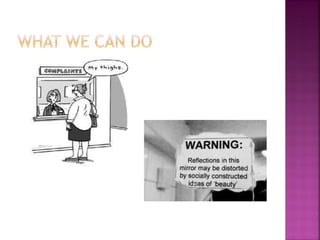
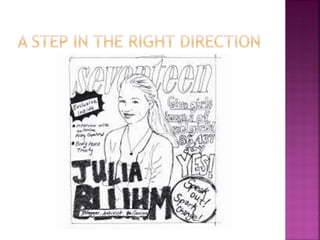
You’ve heard the problems.

Now what can we do to address them?
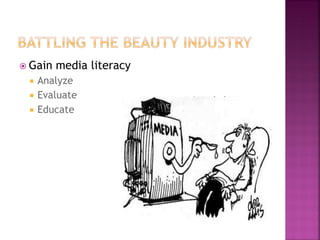
Gain media literacy
Analyze
Evaluate
Educate
When looking at an advertisement, analyze
and ask questions
What is this the goal of this advertisement?
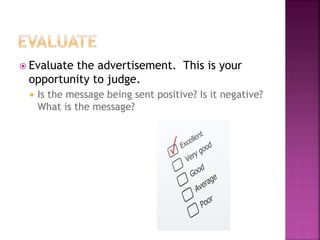
Evaluate the advertisement. This is your
opportunity to judge.
Is the message being sent positive? Is it negative?
What is the message?
How can you educate?
Tell people! Tell your friends, tell your family,
tell anyone.
Affects how we view ourselves and others
self esteem
purchase products to be beautiful
perpetuates stereotypes and gender roles
Sexy images of women—viewed as objects
Dehumanized to sell products
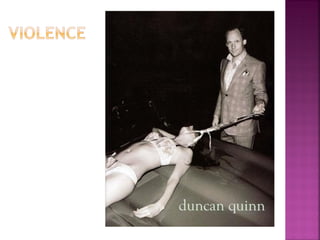
Violence
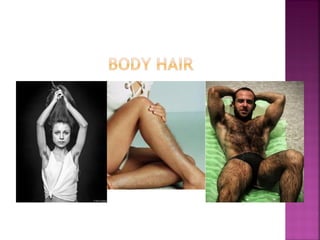
Body hair
Skin/Complexion
Ageism
Violence
For women:
Hairless legs, arms, and underarms
No facial hair
Shaped eyebrows
No pubic hair
For men:
Hair on legs, arms, underarms, and facial
hair is acceptable
Groomed eyebrows
Back hair, chest hair, and stomach hair are
becoming less desirable
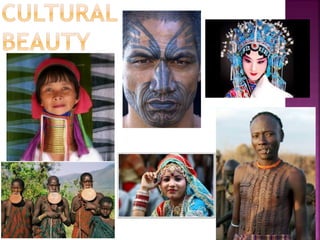
What society says is “attractive” is not the
same in all cultures
Thailand
Mexico
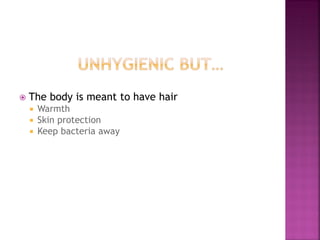
The body is meant to have hair
Warmth
Skin protection
Keep bacteria away
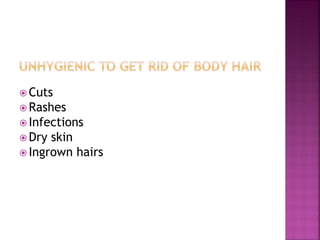
Cuts
Rashes
Infections
Dry skin
Ingrown hairs
Skin color
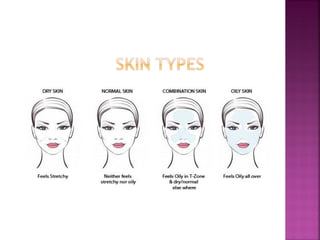
Skin types
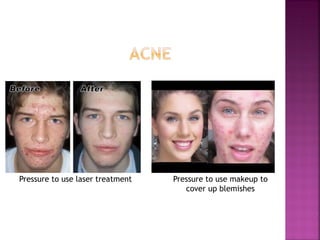
Acne
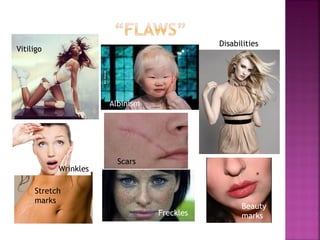
“Flaws”
Pressure to use laser treatment Pressure to use makeup to
cover up blemishes
Freckles
Albinism
Scars
Stretch
marks
Beauty
marks
Wrinkles
Vitiligo
Disabilities
Everyone is encouraged to look younger
Botox
Skin lifts
Age defying products
Job market
Perceived attractiveness
Men — “silver fox”
Women not seen as sexy anymore
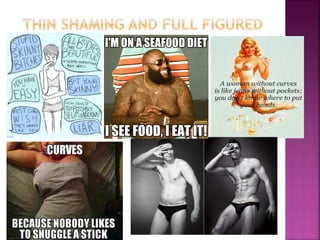
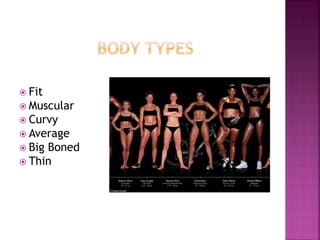
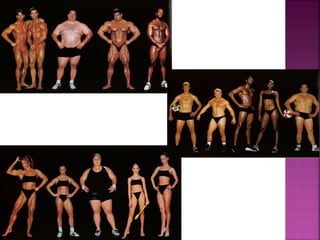
Fit
Muscular
Curvy
Average
Big Boned
Thin
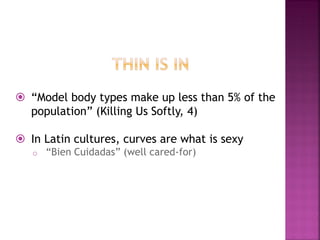
“Model body types make up less than 5% of the
population” (Killing Us Softly, 4)
In Latin cultures, curves are what is sexy
o “Bien Cuidadas” (well cared-for)
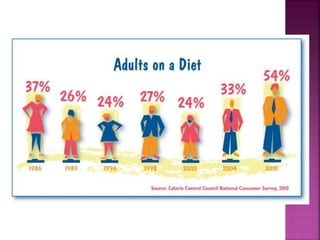
Dieting
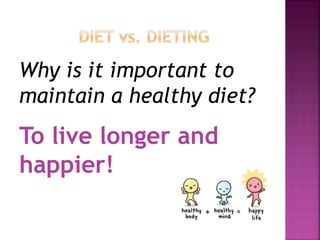
Why is it important to
maintain a healthy diet?
To live longer and
happier!
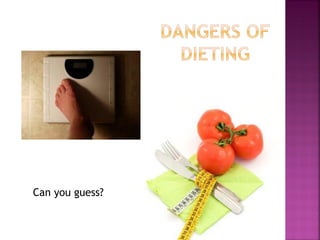
Can you guess?
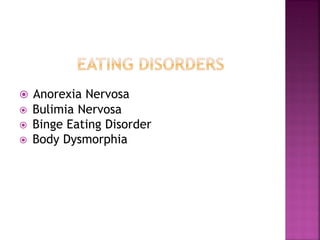
Anorexia Nervosa
Bulimia Nervosa
Binge Eating Disorder
Body Dysmorphia
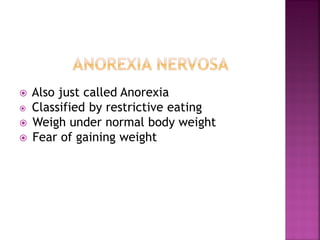
Also just called Anorexia
Classified by restrictive eating
Weigh under normal body weight
Fear of gaining weight
Also known as just Bulimia
Classified by bingeing and purging
Bingeing—frequent episodes of overeating
Purging—removing in an abrupt manner
(cleanse or purify)
Purging includes, but is not limited to:
Vomiting
Use of laxatives
Compulsive exercise
Classified as frequent episodes of overeating
Overeating is defined as feeling a loss of control,
rather than consuming a set amount
Individuals are usually overweight
Distorted view of one’s own body
Can be combined with, or be the precursor to
other eating disorders or disordered eating
While eating disorders are mostly not directly
caused by a certain reason, they are influenced
by a couple of factors.
Predisposing
Precipitating
Predisposing factors are factors that set an
individual up in an environment that makes the
person more likely to develop an eating disorder.
Predisposing factors include, but are not limited to:
Perfectionist personality
High achiever
Have other anxiety disorders
High achieving family
Chaotic family
Controlling, over-protective parents
Precipitating factors are events or changes that
happen in a person’s life that doesn’t cause them to
have an eating disorder, but may push them into an
eating disorder.
Precipitating factors include:
Divorce
Loss of a loved one
Changing school
Moving
Starting high school of college
Onset of puberty
Sexual abuse
While these are all factors that can increase
someone’s likelihood of developing an eating disorder,
it all depends on the individual’s coping skills.
For example, two people with the same predisposing
and precipitating factors can result in just one of
them developing an eating disorder and the other not,
because one may be better equipped emotionally to
cope with the negative factors in their life.
www.somethingfishy.org
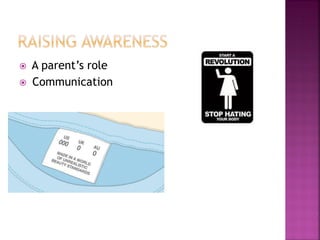
A parent’s role
Communication
Women’s Center
Memorial Gym, Rm 109
Phone: 208-885-2777
Alternative to Violence of the Palouse
24 Hour crisis hotline
1-887-334-2887
FINAL Body rEvolution presentation

FINAL Body rEvolution presentation