BY SAKSHI RAWAT
A file system is a technique of arranging the files in a
storage medium like a hard disk, pen drive, DVD, etc.
It helps you to organizes the data and allows easy
retrieval of files when they are required. It mostly
consists of different types of files like mp3, mp4, txt,
doc, etc. that are grouped into directories.
A file system enables you to handle the way of reading
and writing data to the storage medium. It is directly
installed into the computer with the Operating systems
such as Windows and Linux.
Database Management System (DBMS) is a software for
storing and retrieving user's data while considering
appropriate security measures. It consists of a group of
programs that manipulate the database. The DBMS
accepts the request for data from an application and
instructs the DBMS engine to provide the specific data.
In large systems, a DBMS helps users and other third-
party software to store and retrieve data.
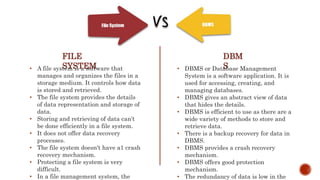
• A file system is a software that manages and organizes the files in a storage
medium, whereas DBMS is a software application that is used for accessing,
creating, and managing databases.
• The file system doesn't have a crash recovery mechanism on the other hand,
DBMS provides a crash recovery mechanism.
• Data inconsistency is higher in the file system. On the contrary Data
inconsistency is low in a database management system.
• File system does not provide support for complicated transactions, while in the
DBMS system, it is easy to implement complicated transactions using SQL.
• File system does not offer concurrency, whereas DBMS provides a concurrency
facility.
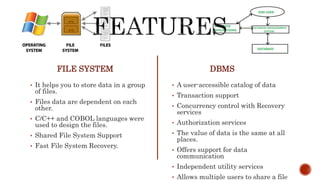
• It helps you to store data in a group
of files.
• Files data are dependent on each
other.
• C/C++ and COBOL languages were
used to design the files.
• Shared File System Support
• Fast File System Recovery.
• A user-accessible catalog of data
• Transaction support
• Concurrency control with Recovery
services
• Authorization services
• The value of data is the same at all
places.
• Offers support for data
communication
• Independent utility services
• Allows multiple users to share a file
FILE SYSTEM DBMS
FILE
SYSTEM
DBM
S
• A file system is a software that
manages and organizes the files in a
storage medium. It controls how data
is stored and retrieved.
• The file system provides the details
of data representation and storage of
data.
• Storing and retrieving of data can't
be done efficiently in a file system.
• It does not offer data recovery
processes.
• The file system doesn't have a1 crash
recovery mechanism.
• Protecting a file system is very
difficult.
• In a file management system, the
• DBMS or Database Management
System is a software application. It is
used for accessing, creating, and
managing databases.
• DBMS gives an abstract view of data
that hides the details.
• DBMS is efficient to use as there are a
wide variety of methods to store and
retrieve data.
• There is a backup recovery for data in
DBMS.
• DBMS provides a crash recovery
mechanism.
• DBMS offers good protection
mechanism.
• The redundancy of data is low in the
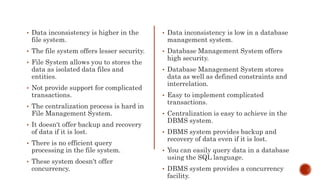
• Data inconsistency is higher in the
file system.
• The file system offers lesser security.
• File System allows you to stores the
data as isolated data files and
entities.
• Not provide support for complicated
transactions.
• The centralization process is hard in
File Management System.
• It doesn't offer backup and recovery
of data if it is lost.
• There is no efficient query
processing in the file system.
• These system doesn't offer
concurrency.
• Data inconsistency is low in a database
management system.
• Database Management System offers
high security.
• Database Management System stores
data as well as defined constraints and
interrelation.
• Easy to implement complicated
transactions.
• Centralization is easy to achieve in the
DBMS system.
• DBMS system provides backup and
recovery of data even if it is lost.
• You can easily query data in a database
using the SQL language.
• DBMS system provides a concurrency
facility.
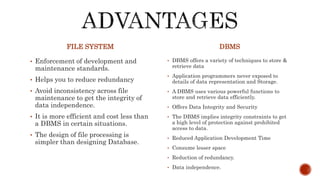
FILE SYSTEM
• Enforcement of development and
maintenance standards.
• Helps you to reduce redundancy
• Avoid inconsistency across file
maintenance to get the integrity of
data independence.
• It is more efficient and cost less than
a DBMS in certain situations.
• The design of file processing is
simpler than designing Database.
DBMS
• DBMS offers a variety of techniques to store &
retrieve data
• Application programmers never exposed to
details of data representation and Storage.
• A DBMS uses various powerful functions to
store and retrieve data efficiently.
• Offers Data Integrity and Security
• The DBMS implies integrity constraints to get
a high level of protection against prohibited
access to data.
• Reduced Application Development Time
• Consume lesser space
• Reduction of redundancy.
• Data independence.
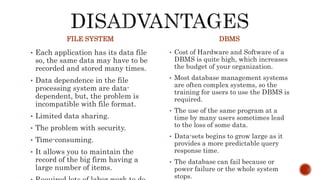
FILE SYSTEM
• Each application has its data file
so, the same data may have to be
recorded and stored many times.
• Data dependence in the file
processing system are data-
dependent, but, the problem is
incompatible with file format.
• Limited data sharing.
• The problem with security.
• Time-consuming.
• It allows you to maintain the
record of the big firm having a
large number of items.
DBMS
• Cost of Hardware and Software of a
DBMS is quite high, which increases
the budget of your organization.
• Most database management systems
are often complex systems, so the
training for users to use the DBMS is
required.
• The use of the same program at a
time by many users sometimes lead
to the loss of some data.
• Data-sets begins to grow large as it
provides a more predictable query
response time.
• The database can fail because or
power failure or the whole system
stops.
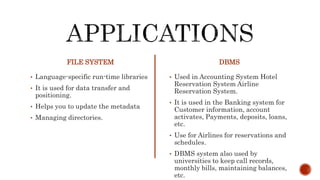
FILE SYSTEM
• Language-specific run-time libraries
• It is used for data transfer and
positioning.
• Helps you to update the metadata
• Managing directories.
DBMS
• Used in Accounting System Hotel
Reservation System Airline
Reservation System.
• It is used in the Banking system for
Customer information, account
activates, Payments, deposits, loans,
etc.
• Use for Airlines for reservations and
schedules.
• DBMS system also used by
universities to keep call records,
monthly bills, maintaining balances,
etc.
FILE SYSTEM VS DBMS ppt.pptx

FILE SYSTEM VS DBMS ppt.pptx

  • 1.
  • 2.
    A file systemis a technique of arranging the files in a storage medium like a hard disk, pen drive, DVD, etc. It helps you to organizes the data and allows easy retrieval of files when they are required. It mostly consists of different types of files like mp3, mp4, txt, doc, etc. that are grouped into directories. A file system enables you to handle the way of reading and writing data to the storage medium. It is directly installed into the computer with the Operating systems such as Windows and Linux.
  • 3.
    Database Management System(DBMS) is a software for storing and retrieving user's data while considering appropriate security measures. It consists of a group of programs that manipulate the database. The DBMS accepts the request for data from an application and instructs the DBMS engine to provide the specific data. In large systems, a DBMS helps users and other third- party software to store and retrieve data.
  • 4.
    • A filesystem is a software that manages and organizes the files in a storage medium, whereas DBMS is a software application that is used for accessing, creating, and managing databases. • The file system doesn't have a crash recovery mechanism on the other hand, DBMS provides a crash recovery mechanism. • Data inconsistency is higher in the file system. On the contrary Data inconsistency is low in a database management system. • File system does not provide support for complicated transactions, while in the DBMS system, it is easy to implement complicated transactions using SQL. • File system does not offer concurrency, whereas DBMS provides a concurrency facility.
  • 5.
    • It helpsyou to store data in a group of files. • Files data are dependent on each other. • C/C++ and COBOL languages were used to design the files. • Shared File System Support • Fast File System Recovery. • A user-accessible catalog of data • Transaction support • Concurrency control with Recovery services • Authorization services • The value of data is the same at all places. • Offers support for data communication • Independent utility services • Allows multiple users to share a file FILE SYSTEM DBMS
  • 6.
    FILE SYSTEM DBM S • A filesystem is a software that manages and organizes the files in a storage medium. It controls how data is stored and retrieved. • The file system provides the details of data representation and storage of data. • Storing and retrieving of data can't be done efficiently in a file system. • It does not offer data recovery processes. • The file system doesn't have a1 crash recovery mechanism. • Protecting a file system is very difficult. • In a file management system, the • DBMS or Database Management System is a software application. It is used for accessing, creating, and managing databases. • DBMS gives an abstract view of data that hides the details. • DBMS is efficient to use as there are a wide variety of methods to store and retrieve data. • There is a backup recovery for data in DBMS. • DBMS provides a crash recovery mechanism. • DBMS offers good protection mechanism. • The redundancy of data is low in the
  • 7.
    • Data inconsistencyis higher in the file system. • The file system offers lesser security. • File System allows you to stores the data as isolated data files and entities. • Not provide support for complicated transactions. • The centralization process is hard in File Management System. • It doesn't offer backup and recovery of data if it is lost. • There is no efficient query processing in the file system. • These system doesn't offer concurrency. • Data inconsistency is low in a database management system. • Database Management System offers high security. • Database Management System stores data as well as defined constraints and interrelation. • Easy to implement complicated transactions. • Centralization is easy to achieve in the DBMS system. • DBMS system provides backup and recovery of data even if it is lost. • You can easily query data in a database using the SQL language. • DBMS system provides a concurrency facility.
  • 8.
    FILE SYSTEM • Enforcementof development and maintenance standards. • Helps you to reduce redundancy • Avoid inconsistency across file maintenance to get the integrity of data independence. • It is more efficient and cost less than a DBMS in certain situations. • The design of file processing is simpler than designing Database. DBMS • DBMS offers a variety of techniques to store & retrieve data • Application programmers never exposed to details of data representation and Storage. • A DBMS uses various powerful functions to store and retrieve data efficiently. • Offers Data Integrity and Security • The DBMS implies integrity constraints to get a high level of protection against prohibited access to data. • Reduced Application Development Time • Consume lesser space • Reduction of redundancy. • Data independence.
  • 9.
    FILE SYSTEM • Eachapplication has its data file so, the same data may have to be recorded and stored many times. • Data dependence in the file processing system are data- dependent, but, the problem is incompatible with file format. • Limited data sharing. • The problem with security. • Time-consuming. • It allows you to maintain the record of the big firm having a large number of items. DBMS • Cost of Hardware and Software of a DBMS is quite high, which increases the budget of your organization. • Most database management systems are often complex systems, so the training for users to use the DBMS is required. • The use of the same program at a time by many users sometimes lead to the loss of some data. • Data-sets begins to grow large as it provides a more predictable query response time. • The database can fail because or power failure or the whole system stops.
  • 10.
    FILE SYSTEM • Language-specificrun-time libraries • It is used for data transfer and positioning. • Helps you to update the metadata • Managing directories. DBMS • Used in Accounting System Hotel Reservation System Airline Reservation System. • It is used in the Banking system for Customer information, account activates, Payments, deposits, loans, etc. • Use for Airlines for reservations and schedules. • DBMS system also used by universities to keep call records, monthly bills, maintaining balances, etc.