1
PREPARED BY
Using Advertising Theory and
Practice to Improve Healthcare
Delivery and Quality of Life
@MARSINTHESTARS
March 25, 2017
AMERICAN ACADEMY OF ADVERTISING
Marli Mesibov, Director of Content Strategy
2
Mad*Pow | @marsinthestars
Marli Mesibov
• Managing Director of
Content Strategy at Mad*Pow
• Editorial Director of UX Booth
3
1 in 4 Americans has a
mental illness.
Mad*Pow | @marsinthestars
Fighting Stigma
4
THE PROBLEM WITH STIGMA
5
• Believing people with mental illnesses are
dangerous
• Determining that people with mental
illnesses are incapable of making life
decisions
• Assuming people with mental illnesses are
victims who need to be cared for
Mad*Pow | @marsinthestars
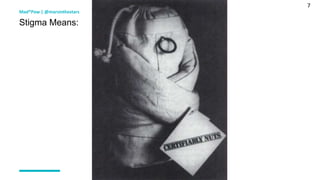
Stigma Means:
6
“…Discrimination is also about the conditions
in which our patients live, mental health
budgets and the priority which we allow these
services to achieve.”
– Peter Byrne, BJPsych Advances
Mad*Pow | @marsinthestars
Stigma Leads to Discrimination
7
Mad*Pow | @marsinthestars
Stigma Means:
8
• Physicians are reluctant to ask, and thus
can’t diagnose
• Patients feel shame in admitting to
mental illness, which hinders finding
treatment
• Diagnosed patients experience exclusion,
poor social support, and low self-
esteem, which impedes recovery
Mad*Pow | @marsinthestars
We Can’t Face What We Ignore
9
ADVERTISING VS. STIGMA
10
Mad*Pow | @marsinthestars
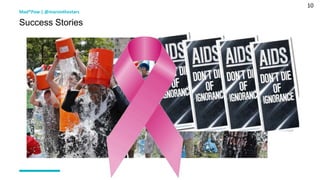
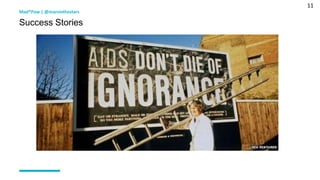
Success Stories
11
Mad*Pow | @marsinthestars
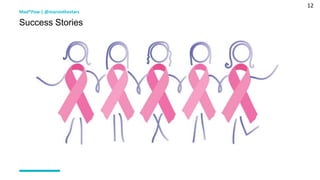
Success Stories
12
Mad*Pow | @marsinthestars
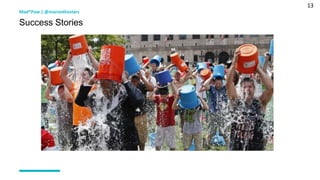
Success Stories
13
Mad*Pow | @marsinthestars
Success Stories
14
WHERE ARE THE PATTERNS?
15
• Do something visible
• Plan ahead
o Create a campaign
o Partner with organizations
• Identify an action item
o Wear the pin
o Make the video
Mad*Pow | @marsinthestars
Where are the Patterns?
16
1. improve attitudes towards people with
mental health problems
2. increase patient willingness to disclose
mental health problems
3. promote behavior associated with anti-
stigma engagement
Mad*Pow | @marsinthestars
Goals
17
Bring Change 2 Mind
• Distributing public education materials
• Founded by Glenn Close’s family
Heads Together (UK)
• Spearheaded by the Duke and Duchess of Cambridge and Prince
Harry
• Creating films and messages
Mad*Pow | @marsinthestars
Who’s Doing This?
18
Make It OK
• Provides resources for patients and allies
See Me (Scotland)
• Provides educational resources
• Funded by the Scottish Government
Time to Change (UK)
• Provides resources for patients and allies
• Focuses on educating the media, offering interviews, etc
Mad*Pow | @marsinthestars
Who’s Doing This?
19
Mad*Pow | @marsinthestars
Questions?
Email:
marli@madpow.com
Twitter: @marsinthestars

Fighting Stigma

  • 1.
    1 PREPARED BY Using AdvertisingTheory and Practice to Improve Healthcare Delivery and Quality of Life @MARSINTHESTARS March 25, 2017 AMERICAN ACADEMY OF ADVERTISING Marli Mesibov, Director of Content Strategy
  • 2.
    2 Mad*Pow | @marsinthestars MarliMesibov • Managing Director of Content Strategy at Mad*Pow • Editorial Director of UX Booth
  • 3.
    3 1 in 4Americans has a mental illness. Mad*Pow | @marsinthestars Fighting Stigma
  • 4.
  • 5.
    5 • Believing peoplewith mental illnesses are dangerous • Determining that people with mental illnesses are incapable of making life decisions • Assuming people with mental illnesses are victims who need to be cared for Mad*Pow | @marsinthestars Stigma Means:
  • 6.
    6 “…Discrimination is alsoabout the conditions in which our patients live, mental health budgets and the priority which we allow these services to achieve.” – Peter Byrne, BJPsych Advances Mad*Pow | @marsinthestars Stigma Leads to Discrimination
  • 7.
  • 8.
    8 • Physicians arereluctant to ask, and thus can’t diagnose • Patients feel shame in admitting to mental illness, which hinders finding treatment • Diagnosed patients experience exclusion, poor social support, and low self- esteem, which impedes recovery Mad*Pow | @marsinthestars We Can’t Face What We Ignore
  • 9.
  • 10.
  • 11.
  • 12.
  • 13.
  • 14.
  • 15.
    15 • Do somethingvisible • Plan ahead o Create a campaign o Partner with organizations • Identify an action item o Wear the pin o Make the video Mad*Pow | @marsinthestars Where are the Patterns?
  • 16.
    16 1. improve attitudestowards people with mental health problems 2. increase patient willingness to disclose mental health problems 3. promote behavior associated with anti- stigma engagement Mad*Pow | @marsinthestars Goals
  • 17.
    17 Bring Change 2Mind • Distributing public education materials • Founded by Glenn Close’s family Heads Together (UK) • Spearheaded by the Duke and Duchess of Cambridge and Prince Harry • Creating films and messages Mad*Pow | @marsinthestars Who’s Doing This?
  • 18.
    18 Make It OK •Provides resources for patients and allies See Me (Scotland) • Provides educational resources • Funded by the Scottish Government Time to Change (UK) • Provides resources for patients and allies • Focuses on educating the media, offering interviews, etc Mad*Pow | @marsinthestars Who’s Doing This?
  • 19.

Editor's Notes

  • #4 More prevalent than asthma Raise hand if you know someone has asthma Raise your hand if you know someone who has a mental illness (fewer? More? Should be double) Diverse, like physical ailments
  • #5 - When you don’t talk about it, rumors start and spread
  • #6 Discrimination isn’t always bad But it is bad when different means lesser, or us v. them They are scary They are pathetic They are bad Friends/kids hear “they” and worry that it will be them
  • #7 Leads to lower quality of life Fewer opportunities and access to care
  • #8 Is this the only way to deal with mental illness? Who’s seen this in a movie or book? Most of us
  • #9 Structural stigma in social and institutional policies creates barriers Lack of parity between coverage for mental health and other health care Lack of funding for mental health research Use of mental health history in legal proceedings, such as custody cases Social stigma poor social support poorer subjective quality of life low self-esteem
  • #11 Three examples of marketing campaigns that reduced stigma and encouraged discussion, fund raising, education, and change The opposite of hiding is sharing
  • #12 https://www.youtube.com/watch?v=TMnb536WuC0 - Norman Fowler, Health Secretary under Margaret Thatcher, responding to the mid-1980s epidemic. - “he wanted to cut through the prejudice and push the message that AIDS could affect any sexually active person, regardless of sexuality” Created AIDS leaflet to be delivered to every household in the UK spelling out in straightforward language what they needed to know Thatcher and other protested, thought it was “inappropriate” Maybe it succeeded in part because it was shocking! But also because it was everywhere - ‘new diagnoses of HIV, which were over 3,000 in 1985, dropped by a third in three years. The number of new diagnoses stayed relatively stable until 1999’.
  • #13 Susan G. Komen Breast Cancer Foundation. Mid-1980s, beginning of cause-related marketing Carol Cone’s research proved at the same cost and quality, >50% of consumers would switch to a brand with a good cause. 1990 Komen handed out bright pink visors to breast cancer survivors running in its Race for the Cure Inspired by red ribbons used to signify support of AIDS victims 1991 Avon was competing against 15 medium-to-large companies. Carol Cone suggested a good cause, they started selling a pin with their products 1992 Estée Lauder introduced a heart-shaped compact with an enameled pink ribbon design, profits to go to its Breast Cancer Research Fund Susan G. Komen Foundation began offering a pink rhinestone brooch designed by Carolee Jewelry Today there are 80 to 100 companies involved Everyone associates pink ribbon with breast cancer Because large companies made it ubiquitous (to make a profit!)
  • #14 More recent (2014) Raised more than $50 million for the ALS Association The myth: “ESPN’s Tom Rinaldi says that it began “with one name”: Pete Frates. A former Boston College baseball player, Frates was diagnosed with ALS in 2011. On July 31 2014, he challenged some friends and celebrities (including NFL quarterbacks Tom Brady and Matt Ryan) to take the ice bucket challenge to “strike out ALS.”  It’s visible, it’s emotional, it’s unexpected, there are celebs, and there’s a clear CTA (basic marketing!!) VIRAL – what does this mean?
  • #16 Jonah Berger, “Contagious” Partner with those that can fund Bring together groups already working for change (we don’t always need something brand new)