Volition Services LLC © 2007-2013
Tel: +1 832-687-0625 | Email: tiffany@officeovereasy.com
Customer Profile
Federal Home Loan Bank (FHLBank) Pittsburgh provides readily available low-cost funding and opportunities for
affordable housing and held approximately $60 billion in assets as of September 30, 2012. They have 200 on-site
employees – half of which create electronic records.
Situation
Normalized retention – Electronic records currently adhere to one of two retention periods (6 or 7 years after
some event). Only records mandated by a legal citation were in scope for this project.
Departmental buckets – Department names and custodians change throughout the lifecycle of records. Each
change to how unstructured data is managed puts an administrative burden on the corporate records manager to
redesign the ERM environment to suit.
Objective
Secure collaboration – Provides a way for all employees to submit records to the drop off library but minimizes
the number of people with access to the electronic record repository. This allows for a select number of record
custodians to be granted security clearance to confidential data. We recommended having a small number of
records custodians for electronic records as opposed to reusing all the existing records coordinators engaged in
paper retention.
Key design features:
 Limited access – SharePoint 2010 can support a complex security model if their needs change.
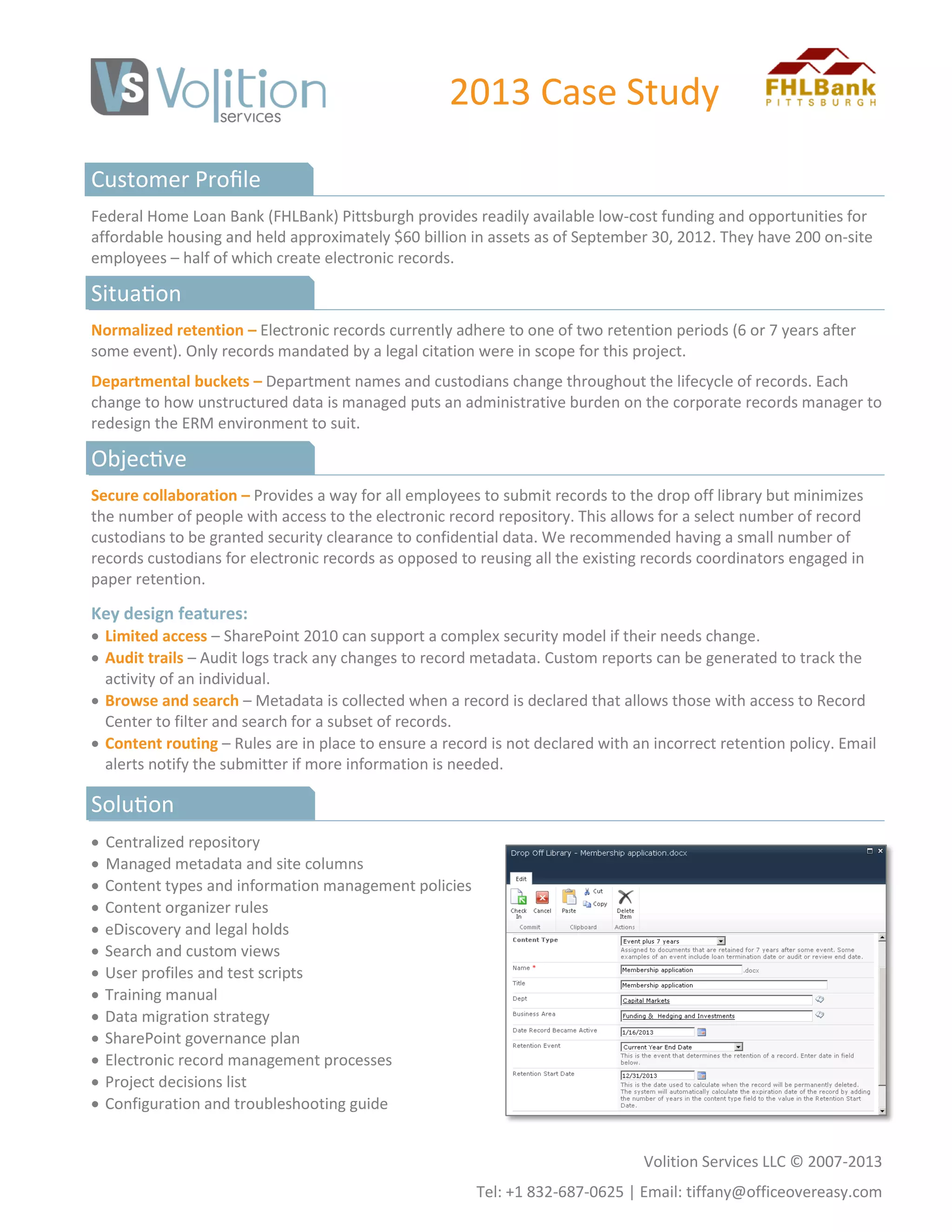
 Audit trails – Audit logs track any changes to record metadata. Custom reports can be generated to track the
activity of an individual.
 Browse and search – Metadata is collected when a record is declared that allows those with access to Record
Center to filter and search for a subset of records.
 Content routing – Rules are in place to ensure a record is not declared with an incorrect retention policy. Email
alerts notify the submitter if more information is needed.
Solution
ď‚· Centralized repository
ď‚· Managed metadata and site columns
ď‚· Content types and information management policies
ď‚· Content organizer rules
ď‚· eDiscovery and legal holds
ď‚· Search and custom views
ď‚· User profiles and test scripts
ď‚· Training manual
ď‚· Data migration strategy
ď‚· SharePoint governance plan
ď‚· Electronic record management processes
ď‚· Project decisions list
ď‚· Configuration and troubleshooting guide
2013 Case Study
Volition Services LLC © 2007-2013
Tel: +1 832-687-0625 | Email: tiffany@officeovereasy.com
Success
In addition to bringing FHLBank Pittsburgh into compliance with FHFA regulations, they saw the
following benefits:
ď‚· Minimized the amount of time required to find the latest version of a record
ď‚· Reduced the time and effort involved in tracking down information for an audit
ď‚· Minimized the costs of legal discovery
ď‚· Minimized risk to the organization by automating the record destruction process
ď‚· Improved visibility and tracking of electronic records under legal hold(s)
Project Schedule 60 Days Promise
Hours Deliverable
32 ERM Governance Plan
8 Vendor Analysis
16 Requirements Gathering
40 Project Planning
56 Build Pilot Environment
40 Records Management Processes
16 Documentation Edits
40 Migration Strategy
48 Training Content and Delivery
24 Search Configuration and Troubleshooting
32 SharePoint Governance Plan
40 Business Solutions Consulting (other projects)
24 Configure Production
32 Testing
32 Project Close out and Knowledge Transfer
480 Total Hours
2013 Case Study (continued)

FHLB Case Study

  • 1.
    Volition Services LLC© 2007-2013 Tel: +1 832-687-0625 | Email: tiffany@officeovereasy.com Customer Profile Federal Home Loan Bank (FHLBank) Pittsburgh provides readily available low-cost funding and opportunities for affordable housing and held approximately $60 billion in assets as of September 30, 2012. They have 200 on-site employees – half of which create electronic records. Situation Normalized retention – Electronic records currently adhere to one of two retention periods (6 or 7 years after some event). Only records mandated by a legal citation were in scope for this project. Departmental buckets – Department names and custodians change throughout the lifecycle of records. Each change to how unstructured data is managed puts an administrative burden on the corporate records manager to redesign the ERM environment to suit. Objective Secure collaboration – Provides a way for all employees to submit records to the drop off library but minimizes the number of people with access to the electronic record repository. This allows for a select number of record custodians to be granted security clearance to confidential data. We recommended having a small number of records custodians for electronic records as opposed to reusing all the existing records coordinators engaged in paper retention. Key design features:  Limited access – SharePoint 2010 can support a complex security model if their needs change.  Audit trails – Audit logs track any changes to record metadata. Custom reports can be generated to track the activity of an individual.  Browse and search – Metadata is collected when a record is declared that allows those with access to Record Center to filter and search for a subset of records.  Content routing – Rules are in place to ensure a record is not declared with an incorrect retention policy. Email alerts notify the submitter if more information is needed. Solution  Centralized repository  Managed metadata and site columns  Content types and information management policies  Content organizer rules  eDiscovery and legal holds  Search and custom views  User profiles and test scripts  Training manual  Data migration strategy  SharePoint governance plan  Electronic record management processes  Project decisions list  Configuration and troubleshooting guide 2013 Case Study
  • 2.
    Volition Services LLC© 2007-2013 Tel: +1 832-687-0625 | Email: tiffany@officeovereasy.com Success In addition to bringing FHLBank Pittsburgh into compliance with FHFA regulations, they saw the following benefits:  Minimized the amount of time required to find the latest version of a record  Reduced the time and effort involved in tracking down information for an audit  Minimized the costs of legal discovery  Minimized risk to the organization by automating the record destruction process  Improved visibility and tracking of electronic records under legal hold(s) Project Schedule 60 Days Promise Hours Deliverable 32 ERM Governance Plan 8 Vendor Analysis 16 Requirements Gathering 40 Project Planning 56 Build Pilot Environment 40 Records Management Processes 16 Documentation Edits 40 Migration Strategy 48 Training Content and Delivery 24 Search Configuration and Troubleshooting 32 SharePoint Governance Plan 40 Business Solutions Consulting (other projects) 24 Configure Production 32 Testing 32 Project Close out and Knowledge Transfer 480 Total Hours 2013 Case Study (continued)