Graduate School
Rizal St., Iloilo City
Reporters: GEMMARIE JECKERIE C. CAMAGO
JULIE IVY C. CAJUTOL
Professor: DR. CESAR P. BASINANG
School Learning Environment
(EDU 299)
OBJECTIVES:
 Understand the different diversity of
learners and how to deal with it as
teacher.
 Learn how are the learners influence by
several factors such as language,
gender, culture and socio-economic
status.
 Know the different ways on how
teachers may address diversity of
learners inside the classroom.
DOMAIN 3
LEARNING AND THINKING STYLES
- refer to the preferred way an
individual processes information
I. SENSORY PREFERENCES
-individuals tend to gravitate toward one or two
types of sensory inputs and maintain a dominance
in one of the following:
1. Visual Learners – may think in pictures and learn
best from visual aids like diagrams, illustrated
textbooks, overhead transparencies, videos,
flipcharts and hand-outs.
a. Visual Iconic – prefer visual imagery
like film, graphic display or picture.
b. Visual Symbolic – prefer abstract
symbolisms like written words or
mathematical formula.
2. Auditory Learners – learn best through verbal
lectures, discussions, talking things through and
listening to what have others say.
a. Listeners – remembers things said to them and
make the information on their own.
b. Talkers – prefer to talk and discuss.
c. Tactile/Kinesthetic - prefer “Learning by
Doing”, benefit much from hands-on approach,
actively exploring the environment around them.
GLOBAL ANALYTIC CONTINUUM
1. Analytic Learners – tend to learn towards the
linear, step-by-step process of learning and see
finite elements of patterns rather than a whole.
2. Global Learners – lends toward non-linear and
tend to see the whole pattern rather than
particular elements.
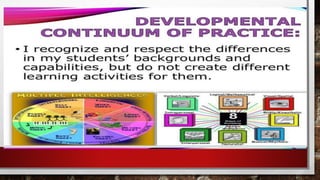
Multiple Intelligences (Howard Gardner)
1. Visual /Spatial (Picture Smart)
2. Verbal/Linguistic ( Word Smart)
3. Mathematical/Logistic (Number Smart)
4. Bodily/Kinesthetic (Body Smart)
5. Musical/Rhythm (Music Smart)
6. Intrapersonal (Personal Smart)
7. Interpersonal (People Smart)
8. Naturalist (Nature Smart)
Exceptionalities:
These refer to learners who are different in some
way from the normal or average. Most of these
learners require a lot of understanding and
patience as well as special education and related
services if they are to reach their full potential and
development.
1. Mental Retardation and Developmental
Disabilities
2.Learning Disabilities
3.Intellectual Differences (Gifted and Talented)
4. Emotional and Behavioral Disorder
5. Visual Impairment
6.Hearing Impairment
7. Oral Communications Problem
8. Orthopedic Impairments
Other Factors:
1. Gender
2. Racial, Ethnic or Cultural
Background
3. Socio-economic Status
APPLICATIONS IN TEACHING AND LEARNING PROCESS
1. Encourage learners to share their personal history and
experiences.
2. Integrate learning experiences and activities which promote
students’ multicultural and cross-cultural awareness.
3. Aside from highlighting diversity, identify patterns of unity
than transcend group differences.
4. Communicate high expectations to students from all sub-
group.
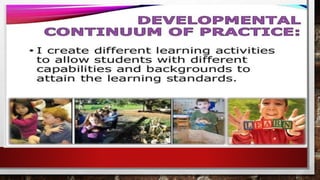
5. Use varied instructional methods to accommodate student
diversity in learning styles and multiple intelligences.
6. Vary the examples you use to illustrate concepts in order to
provide multiple contexts that are relevant to learners' diverse
background.
7. Adapt to learners’ diverse background and learning styles by
allowing them personal choice and decision-making opportunities
concerning what they learn from it.
8. Diversify your methods of assessing and evaluating student
learning.
9. Purposely, from small group-discussions to learners from
diverse background; different learning styles, multiple
intelligences, different cultural background and etc.
REFERENCES:
https://www.slideshare.net/lemarmakipig/ncbts-national-competencybased-teacher-
standards

Report Edu 299.pptx

  • 1.
    Graduate School Rizal St.,Iloilo City Reporters: GEMMARIE JECKERIE C. CAMAGO JULIE IVY C. CAJUTOL Professor: DR. CESAR P. BASINANG School Learning Environment (EDU 299)
  • 2.
    OBJECTIVES:  Understand thedifferent diversity of learners and how to deal with it as teacher.  Learn how are the learners influence by several factors such as language, gender, culture and socio-economic status.  Know the different ways on how teachers may address diversity of learners inside the classroom.
  • 3.
  • 23.
    LEARNING AND THINKINGSTYLES - refer to the preferred way an individual processes information
  • 24.
    I. SENSORY PREFERENCES -individualstend to gravitate toward one or two types of sensory inputs and maintain a dominance in one of the following: 1. Visual Learners – may think in pictures and learn best from visual aids like diagrams, illustrated textbooks, overhead transparencies, videos, flipcharts and hand-outs.
  • 25.
    a. Visual Iconic– prefer visual imagery like film, graphic display or picture. b. Visual Symbolic – prefer abstract symbolisms like written words or mathematical formula.
  • 26.
    2. Auditory Learners– learn best through verbal lectures, discussions, talking things through and listening to what have others say. a. Listeners – remembers things said to them and make the information on their own. b. Talkers – prefer to talk and discuss. c. Tactile/Kinesthetic - prefer “Learning by Doing”, benefit much from hands-on approach, actively exploring the environment around them.
  • 27.
    GLOBAL ANALYTIC CONTINUUM 1.Analytic Learners – tend to learn towards the linear, step-by-step process of learning and see finite elements of patterns rather than a whole. 2. Global Learners – lends toward non-linear and tend to see the whole pattern rather than particular elements.
  • 28.
    Multiple Intelligences (HowardGardner) 1. Visual /Spatial (Picture Smart) 2. Verbal/Linguistic ( Word Smart) 3. Mathematical/Logistic (Number Smart) 4. Bodily/Kinesthetic (Body Smart) 5. Musical/Rhythm (Music Smart) 6. Intrapersonal (Personal Smart) 7. Interpersonal (People Smart) 8. Naturalist (Nature Smart)
  • 29.
    Exceptionalities: These refer tolearners who are different in some way from the normal or average. Most of these learners require a lot of understanding and patience as well as special education and related services if they are to reach their full potential and development.
  • 30.
    1. Mental Retardationand Developmental Disabilities 2.Learning Disabilities 3.Intellectual Differences (Gifted and Talented) 4. Emotional and Behavioral Disorder 5. Visual Impairment 6.Hearing Impairment 7. Oral Communications Problem 8. Orthopedic Impairments
  • 31.
    Other Factors: 1. Gender 2.Racial, Ethnic or Cultural Background 3. Socio-economic Status
  • 32.
    APPLICATIONS IN TEACHINGAND LEARNING PROCESS 1. Encourage learners to share their personal history and experiences. 2. Integrate learning experiences and activities which promote students’ multicultural and cross-cultural awareness. 3. Aside from highlighting diversity, identify patterns of unity than transcend group differences. 4. Communicate high expectations to students from all sub- group. 5. Use varied instructional methods to accommodate student diversity in learning styles and multiple intelligences.
  • 33.
    6. Vary theexamples you use to illustrate concepts in order to provide multiple contexts that are relevant to learners' diverse background. 7. Adapt to learners’ diverse background and learning styles by allowing them personal choice and decision-making opportunities concerning what they learn from it. 8. Diversify your methods of assessing and evaluating student learning. 9. Purposely, from small group-discussions to learners from diverse background; different learning styles, multiple intelligences, different cultural background and etc.
  • 36.