BIO SOLIDS MANAGEMENT
JOSEPH RAVIKUMAR
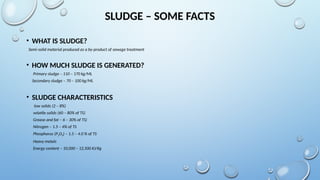
SLUDGE – SOME FACTS
• WHAT IS SLUDGE?
Semi-solid material produced as a by-product of sewage treatment
• HOW MUCH SLUDGE IS GENERATED?
Primary sludge – 110 – 170 kg/ML
Secondary sludge – 70 – 100 kg/ML
• SLUDGE CHARACTERISTICS
low solids (2 – 8%)
volatile solids (60 – 80% of TS)
Grease and fat – 6 – 30% of TS)
Nitrogen – 1.5 – 4% of TS
Phosphorus (P2O5) – 1.5 – 4.0 % of TS
Heavy metals
Energy content – 10,000 – 12,500 KJ/Kg
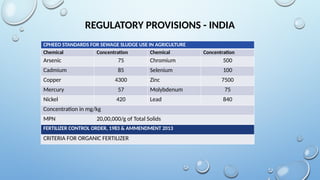
REGULATORY PROVISIONS - INDIA
CPHEEO STANDARDS FOR SEWAGE SLUDGE USE IN AGRICULTURE
Chemical Concentration Chemical Concentration
Arsenic 75 Chromium 500
Cadmium 85 Selenium 100
Copper 4300 Zinc 7500
Mercury 57 Molybdenum 75
Nickel 420 Lead 840
Concentration in mg/kg
MPN 20,00,000/g of Total Solids
FERTILIZER CONTROL ORDER, 1983 & AMMENDMENT 2013
CRITERIA FOR ORGANIC FERTILIZER
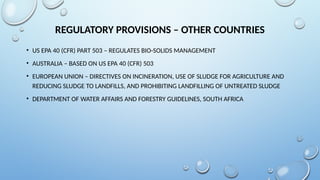
REGULATORY PROVISIONS – OTHER COUNTRIES
• US EPA 40 (CFR) PART 503 – REGULATES BIO-SOLIDS MANAGEMENT
• AUSTRALIA – BASED ON US EPA 40 (CFR) 503
• EUROPEAN UNION – DIRECTIVES ON INCINERATION, USE OF SLUDGE FOR AGRICULTURE AND
REDUCING SLUDGE TO LANDFILLS, AND PROHIBITING LANDFILLING OF UNTREATED SLUDGE
• DEPARTMENT OF WATER AFFAIRS AND FORESTRY GUIDELINES, SOUTH AFRICA
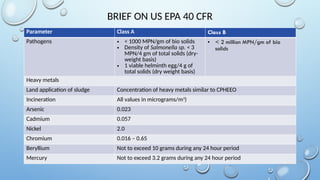
BRIEF ON US EPA 40 CFR
Parameter Class A Class B
Pathogens • < 1000 MPN/gm of bio solids
• Density of Salmonella sp. < 3
MPN/4 gm of total solids (dry-
weight basis)
• 1 viable helminth egg/4 g of
total solids (dry weight basis)
• < 2 million MPN/gm of bio
solids
Heavy metals
Land application of sludge Concentration of heavy metals similar to CPHEEO
Incineration All values in micrograms/m3
)
Arsenic 0.023
Cadmium 0.057
Nickel 2.0
Chromium 0.016 – 0.65
Beryllium Not to exceed 10 grams during any 24 hour period
Mercury Not to exceed 3.2 grams during any 24 hour period
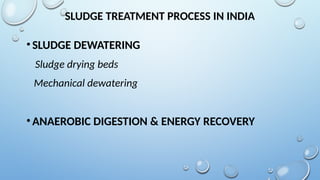
SLUDGE TREATMENT PROCESS IN INDIA
•SLUDGE DEWATERING
Sludge drying beds
Mechanical dewatering
•ANAEROBIC DIGESTION & ENERGY RECOVERY
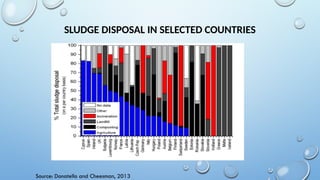
SLUDGE DISPOSAL IN SELECTED COUNTRIES
Source: Donatello and Cheesman, 2013
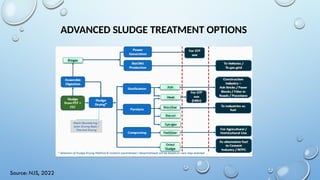
ADVANCED SLUDGE TREATMENT OPTIONS
Source: NJS, 2022
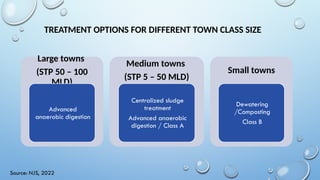
TREATMENT OPTIONS FOR DIFFERENT TOWN CLASS SIZE
Source: NJS, 2022
Large towns
(STP 50 – 100
MLD)
Advanced
anaerobic digestion
Medium towns
(STP 5 – 50 MLD)
Centralized sludge
treatment
Advanced anaerobic
digestion / Class A
Small towns
Dewatering
/Composting
Class B
DISCUSSIONS
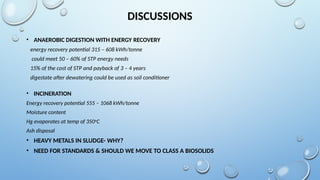
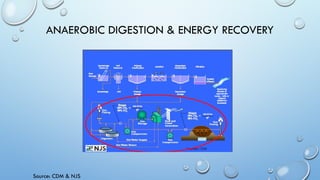
• ANAEROBIC DIGESTION WITH ENERGY RECOVERY
energy recovery potential 315 – 608 kWh/tonne
could meet 50 – 60% of STP energy needs
15% of the cost of STP and payback of 3 – 4 years
digestate after dewatering could be used as soil conditioner
• INCINERATION
Energy recovery potential 555 – 1068 kWh/tonne
Moisture content
Hg evaporates at temp of 350o
C
Ash disposal
• HEAVY METALS IN SLUDGE- WHY?
• NEED FOR STANDARDS & SHOULD WE MOVE TO CLASS A BIOSOLIDS
Thanks
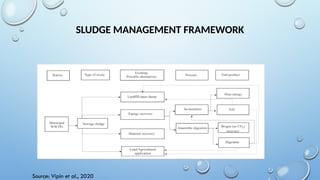
SLUDGE MANAGEMENT FRAMEWORK
Source: Vipin et al., 2020
Others
ANAEROBIC DIGESTION & ENERGY RECOVERY
Source: CDM & NJS
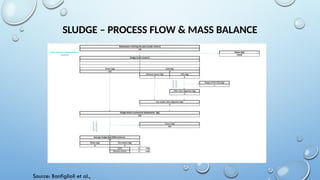
SLUDGE – PROCESS FLOW & MASS BALANCE
Source: Bonfiglioli et al.,
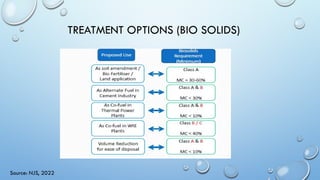
TREATMENT OPTIONS (BIO SOLIDS)
Source: NJS, 2022

Few slides on biosolids management options

  • 1.
  • 2.
    SLUDGE – SOMEFACTS • WHAT IS SLUDGE? Semi-solid material produced as a by-product of sewage treatment • HOW MUCH SLUDGE IS GENERATED? Primary sludge – 110 – 170 kg/ML Secondary sludge – 70 – 100 kg/ML • SLUDGE CHARACTERISTICS low solids (2 – 8%) volatile solids (60 – 80% of TS) Grease and fat – 6 – 30% of TS) Nitrogen – 1.5 – 4% of TS Phosphorus (P2O5) – 1.5 – 4.0 % of TS Heavy metals Energy content – 10,000 – 12,500 KJ/Kg
  • 3.
    REGULATORY PROVISIONS -INDIA CPHEEO STANDARDS FOR SEWAGE SLUDGE USE IN AGRICULTURE Chemical Concentration Chemical Concentration Arsenic 75 Chromium 500 Cadmium 85 Selenium 100 Copper 4300 Zinc 7500 Mercury 57 Molybdenum 75 Nickel 420 Lead 840 Concentration in mg/kg MPN 20,00,000/g of Total Solids FERTILIZER CONTROL ORDER, 1983 & AMMENDMENT 2013 CRITERIA FOR ORGANIC FERTILIZER
  • 4.
    REGULATORY PROVISIONS –OTHER COUNTRIES • US EPA 40 (CFR) PART 503 – REGULATES BIO-SOLIDS MANAGEMENT • AUSTRALIA – BASED ON US EPA 40 (CFR) 503 • EUROPEAN UNION – DIRECTIVES ON INCINERATION, USE OF SLUDGE FOR AGRICULTURE AND REDUCING SLUDGE TO LANDFILLS, AND PROHIBITING LANDFILLING OF UNTREATED SLUDGE • DEPARTMENT OF WATER AFFAIRS AND FORESTRY GUIDELINES, SOUTH AFRICA
  • 5.
    BRIEF ON USEPA 40 CFR Parameter Class A Class B Pathogens • < 1000 MPN/gm of bio solids • Density of Salmonella sp. < 3 MPN/4 gm of total solids (dry- weight basis) • 1 viable helminth egg/4 g of total solids (dry weight basis) • < 2 million MPN/gm of bio solids Heavy metals Land application of sludge Concentration of heavy metals similar to CPHEEO Incineration All values in micrograms/m3 ) Arsenic 0.023 Cadmium 0.057 Nickel 2.0 Chromium 0.016 – 0.65 Beryllium Not to exceed 10 grams during any 24 hour period Mercury Not to exceed 3.2 grams during any 24 hour period
  • 6.
    SLUDGE TREATMENT PROCESSIN INDIA •SLUDGE DEWATERING Sludge drying beds Mechanical dewatering •ANAEROBIC DIGESTION & ENERGY RECOVERY
  • 7.
    SLUDGE DISPOSAL INSELECTED COUNTRIES Source: Donatello and Cheesman, 2013
  • 8.
    ADVANCED SLUDGE TREATMENTOPTIONS Source: NJS, 2022
  • 9.
    TREATMENT OPTIONS FORDIFFERENT TOWN CLASS SIZE Source: NJS, 2022 Large towns (STP 50 – 100 MLD) Advanced anaerobic digestion Medium towns (STP 5 – 50 MLD) Centralized sludge treatment Advanced anaerobic digestion / Class A Small towns Dewatering /Composting Class B
  • 10.
    DISCUSSIONS • ANAEROBIC DIGESTIONWITH ENERGY RECOVERY energy recovery potential 315 – 608 kWh/tonne could meet 50 – 60% of STP energy needs 15% of the cost of STP and payback of 3 – 4 years digestate after dewatering could be used as soil conditioner • INCINERATION Energy recovery potential 555 – 1068 kWh/tonne Moisture content Hg evaporates at temp of 350o C Ash disposal • HEAVY METALS IN SLUDGE- WHY? • NEED FOR STANDARDS & SHOULD WE MOVE TO CLASS A BIOSOLIDS
  • 11.
  • 12.
  • 13.
  • 14.
    ANAEROBIC DIGESTION &ENERGY RECOVERY Source: CDM & NJS
  • 15.
    SLUDGE – PROCESSFLOW & MASS BALANCE Source: Bonfiglioli et al.,
  • 16.
    TREATMENT OPTIONS (BIOSOLIDS) Source: NJS, 2022

Editor's Notes

  • #2 Sewage sludge is the residual, semi-solid material that is produced as a by-product during sewage treatment. When fresh sewage or wastewater enters a primary settling tank, approximately 50% of the suspended solid matter will settle out in an hour and a half. This collection of solids is known as raw sludge or primary solids primary sedimentation produces about 110–170 kg/ML of so-called primary sludge, with a value of 150 kg/ML regarded as being typical for municipal wastewater in the U.S. or Europe The secondary treatment process also generates a sludge largely composed of bacteria and protozoa with entrained fine solids, and this is removed by settlement in secondary settlement tanks. Both sludge streams are typically combined and are processed by anaerobic or aerobic treatment process at either elevated or ambient temperatures Of the biological treatment processes, the activated sludge process produces about 70–100 kg/ML of waste activated sludge, and a trickling filter process produces slightly less sludge from the biological part of the process: 60–100 kg/ML.[1] This means that the total sludge production of an activated sludge process that uses primary sedimentation tanks is in the range of 180–270 kg/ML, being the sum of primary sludge and waste activated sludge. 62000 MLD of sewage will produce about 4 million tons of sludge (Singh et al., 2020) Estimation of energy recovery potential of sewage sludge in India: Waste to watt approach "Biosolids" is a term often used in conjunction with reuse of sewage solids after sewage sludge treatment. Biosolids can be defined as organic wastewater solids that can be reused after stabilization processes such as anaerobic digestion and composting. Heavy metals – Cd, Pb, Cr, Cu, Ni and Hg A study in Bengaluru reported Cd (2.7 – 4.2), Pb (76.1 – 104.6), Cr (42.9 – 59.1), Cu (219.7 – 312.3), Ni (29 – 43.4) (Prakash et al., 2018; Assessment of heavy metals in sewage sludge: A case study of Kadubeesanahalli sewage treatment plant, Bangalore, India
  • #3 Criteria for organic fertilizer – stricter than US EPA for heavy metals
  • #5 Class B possible use – Forestry, Soil and site rehabilitation, Landfill disposal (cannot be used for home lawn gardens, public contact sites and urban landscaping Helminths – 3 eggs/4 g dry weight
  • #9 Class B possible use – Forestry, Soil and site rehabilitation, Landfill disposal (cannot be used for home lawn gardens, public contact sites and urban landscaping
  • #10 Incineration - As incineration completely oxidizes volatile matter, there is significant benefit of thermal route for consideration of large weight (or volume) reduction, removal of toxic organic matter and pathogens. Moisture content in sludge (60 – 70% MC); Incineration would require total solids > 40%; remove 1 kg of water require 3000 KJ of energy; Emissions and ash disposal Organic content of soil – 0.3 – 0.4%; composted bio solids potential carbon source and nutrients Heavy metals – Hg – geological process magmatic intrusion and hydrothermal cycles, mining, burning of fossil fuels and incomplete burning of waste that has Hg Pb – lead smelting & extraction, lead based gasoline, battery processing and burning of fossil fuels Arsenic - Agricultural, electronic waste, metal smelting Cadmium - Batteries, natural sources, mining and/or metal working Mercury – mining Zinc – industrial emissions Copper – agriculture, mining Chromium – metal fabrication, energy recovery
  • #16 Class B possible use – Forestry, Soil and site rehabilitation, Landfill disposal (cannot be used for home lawn gardens, public contact sites and urban landscaping