Origin
 Many stories attached

 The day when Parvati prayed for Shiva’s well being

 The day when Shiva drank the poison that came out of

  Samudra Manthan

 The day when Shiva and Shakti married

 Includes Shiva Worship - offering Bael leaves, washing the

  Shiv Ling and a 24 hour strict fast
Mahashivratri Worship
 According to the Shiva Purana, the Mahashivaratri worship must incorporate

  six items:

 Bathing the Shiv Linga with water, milk and honey - representing

  purification of the soul;

 The vermilion paste applied on the Shiv Linga after bathing it, representing

  virtue;

 Offering of fruits, which is conducive to longevity and gratification of

  desires;

 Burning incense, yielding wealth;

 The lighting of the lamp which is conducive to the attainment of knowledge;

 And betel leaves marking satisfaction with worldly pleasures.
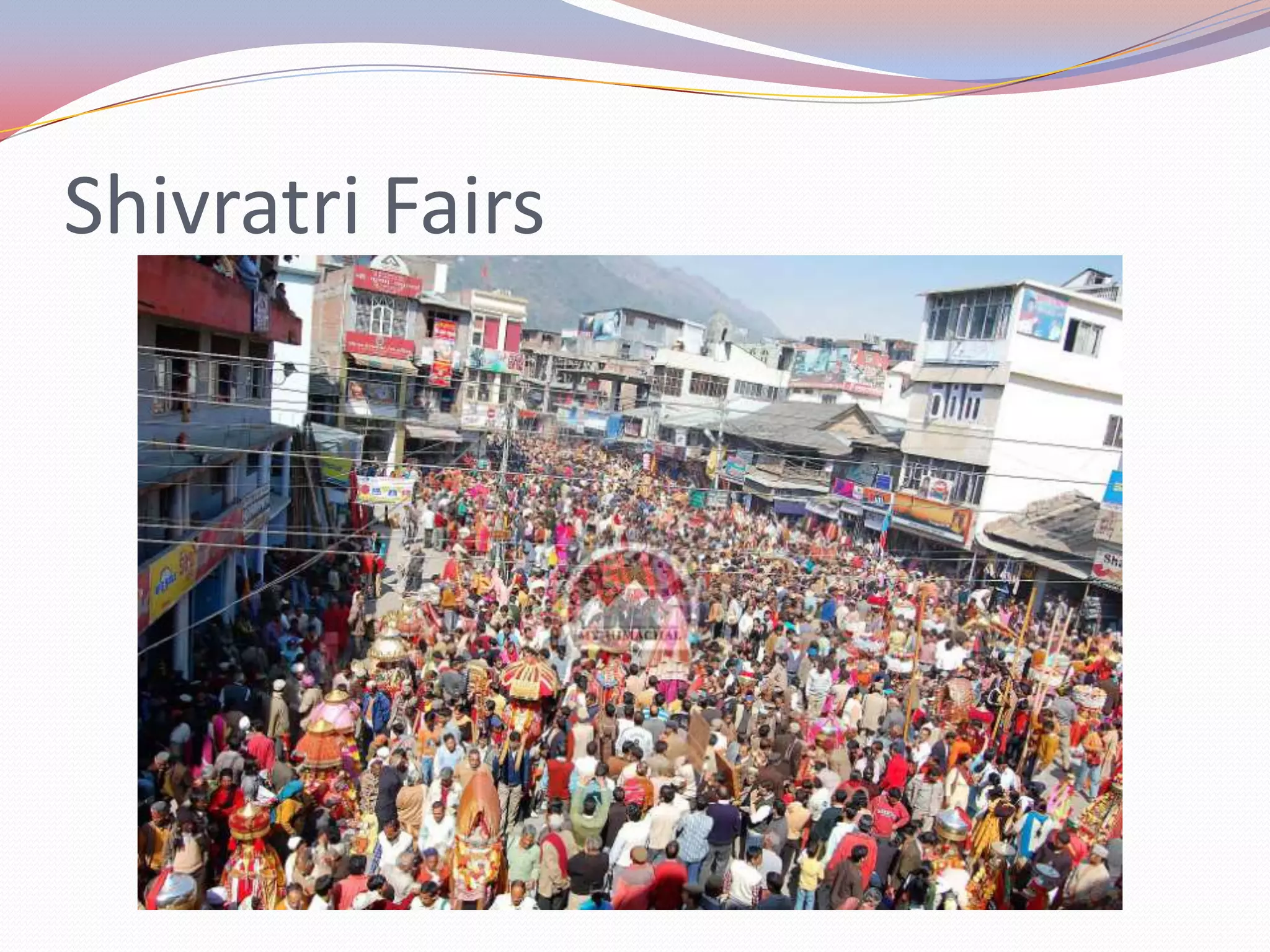
Shivratri Fairs
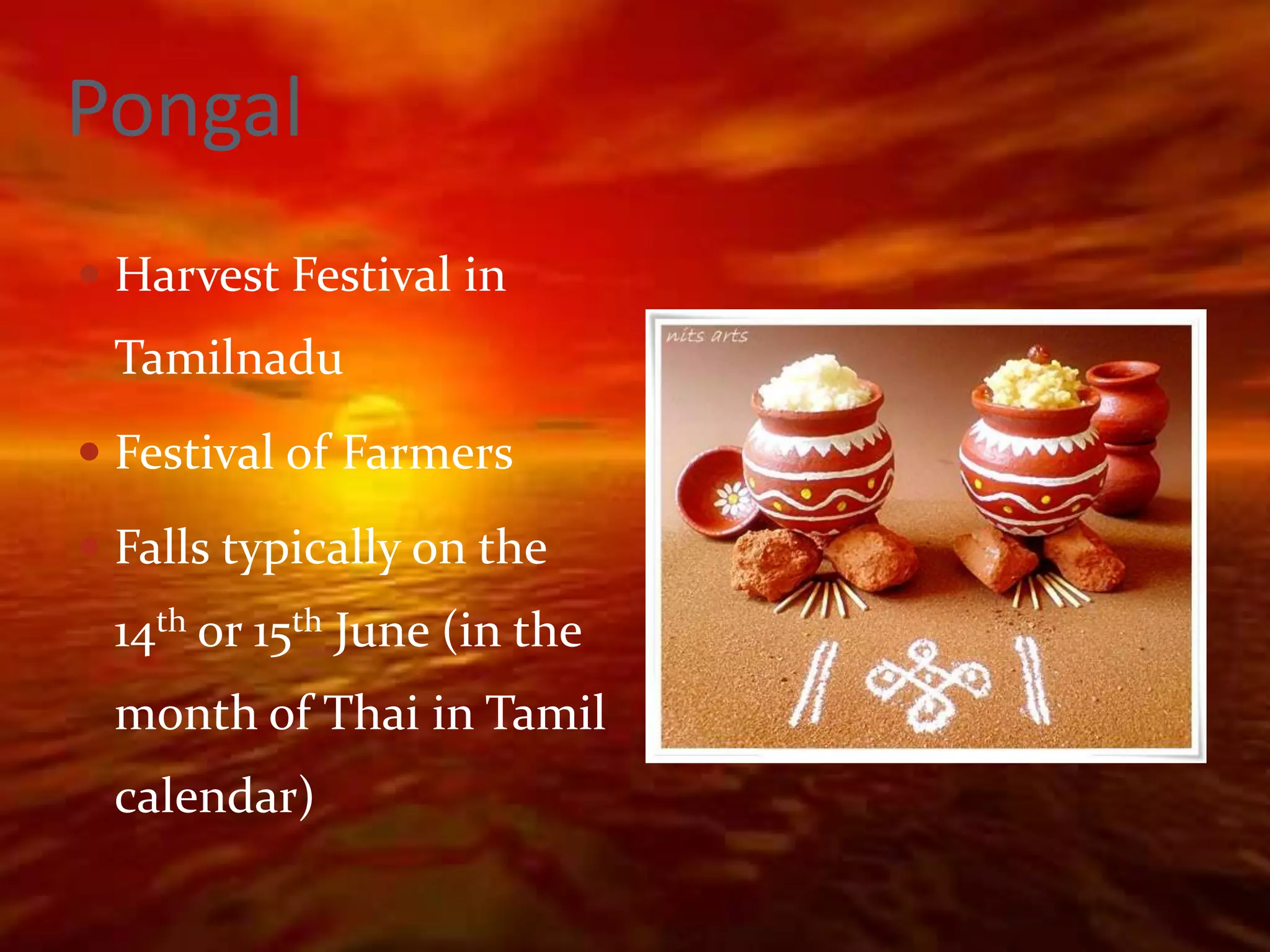
Pongal
 Harvest Festival in
 Tamilnadu
 Festival of Farmers

 Falls typically on the
 14th or 15th June (in the
 month of Thai in Tamil
 calendar)
History of Pongal

 Ancient festival of Tamils

 originated as a Dravidian Harvest festival and has a
 mention in Sanskrit Puranas

 The celebrations of Sangam Era led to today's Pongal
 celebrations
 First Day : Bhogi Festival
  In honor of lord Indra – the supreme ruler of   clouds
  that give rains
 Second Day : Perum Pongal

  Offering of payasam (rice boiled in milk) to Sun god
 Third Day : Mattu Pongal

  Worship of cattle
 Fourth Day : Kaanum Pongal

  A day of relaxation and socializing
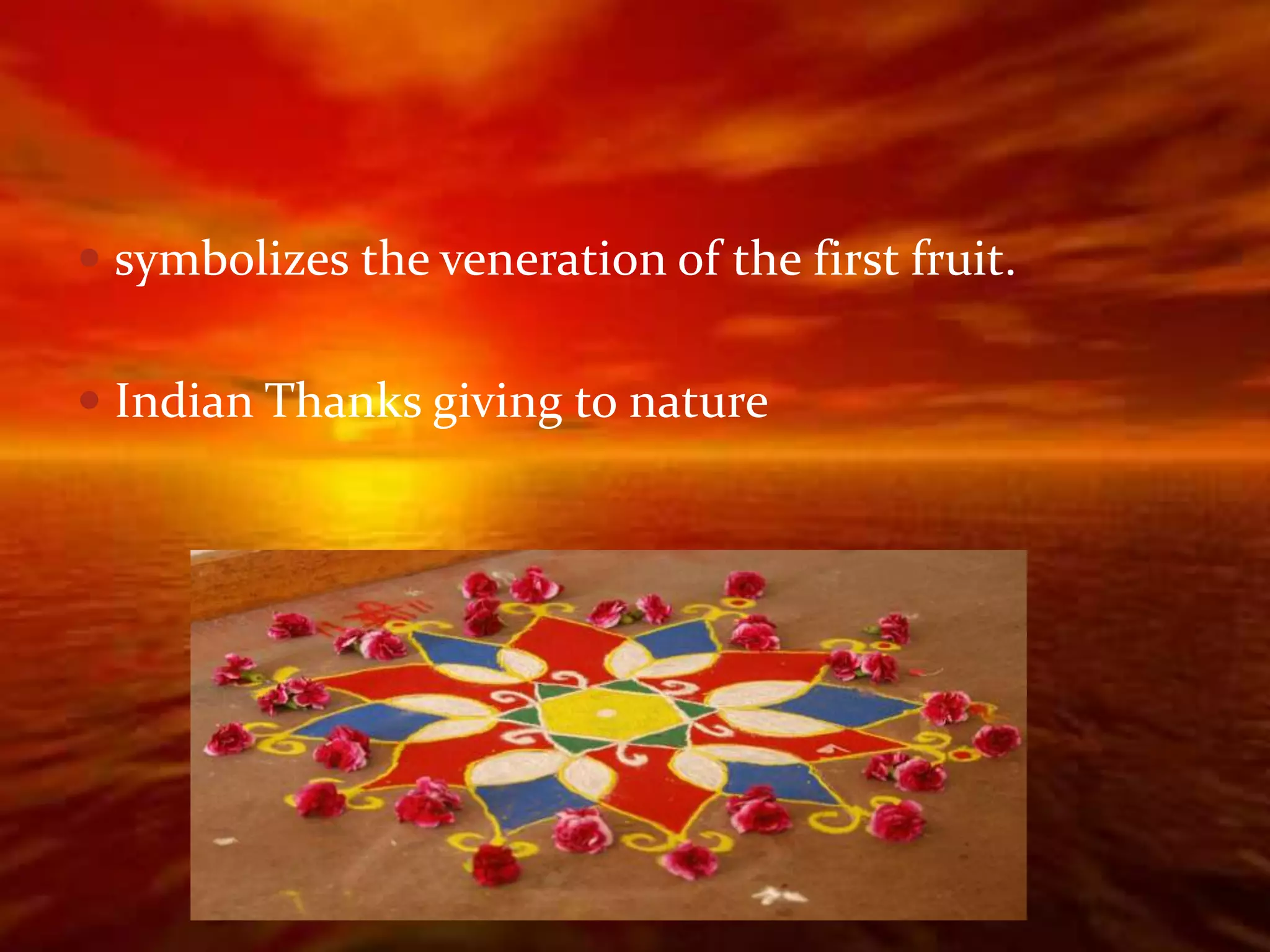
 symbolizes the veneration of the first fruit.


 Indian Thanks giving to nature
HOLI
Legends and Mythology


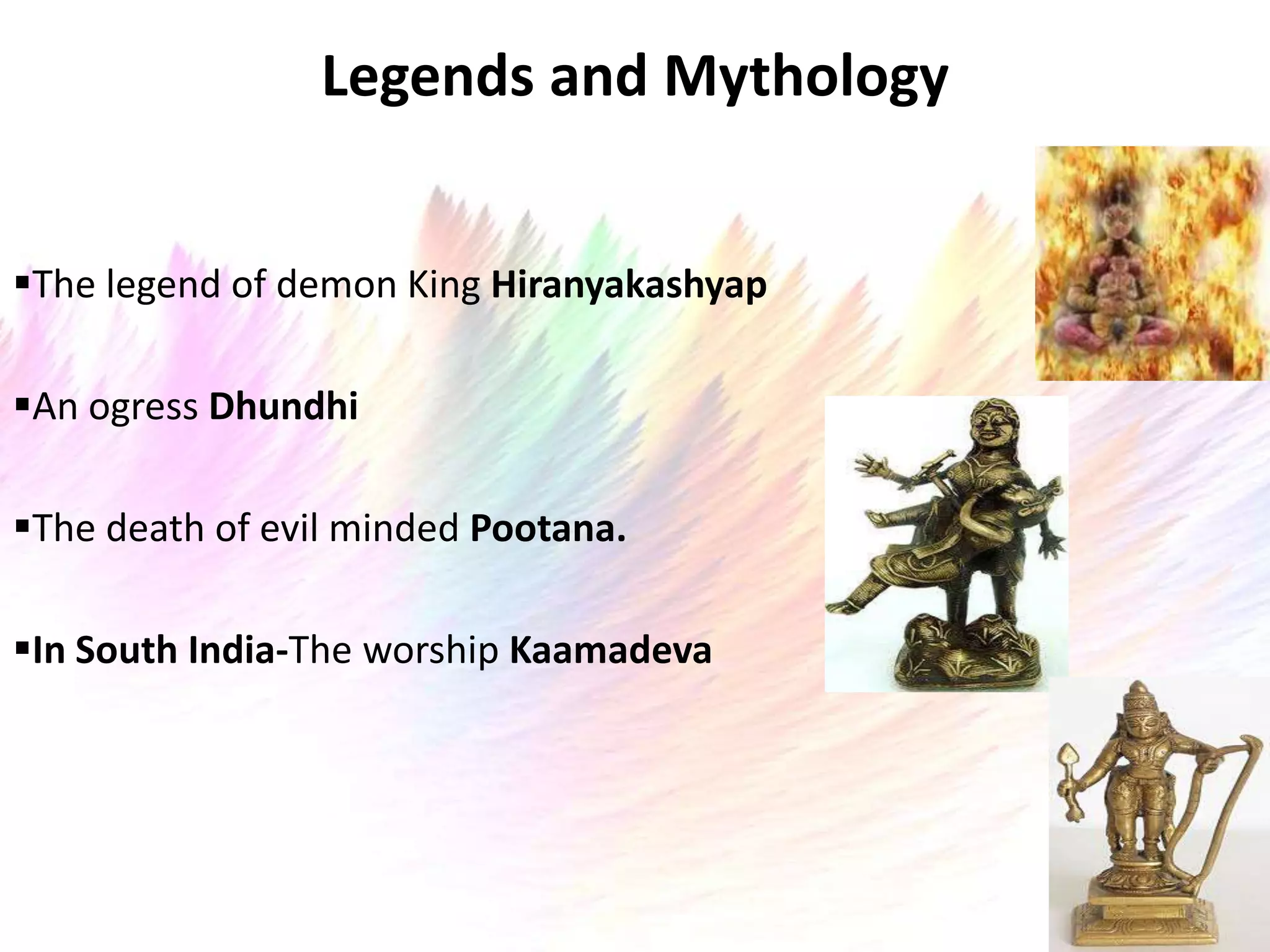
The legend of demon King Hiranyakashyap

An ogress Dhundhi

The death of evil minded Pootana.

In South India-The worship Kaamadeva
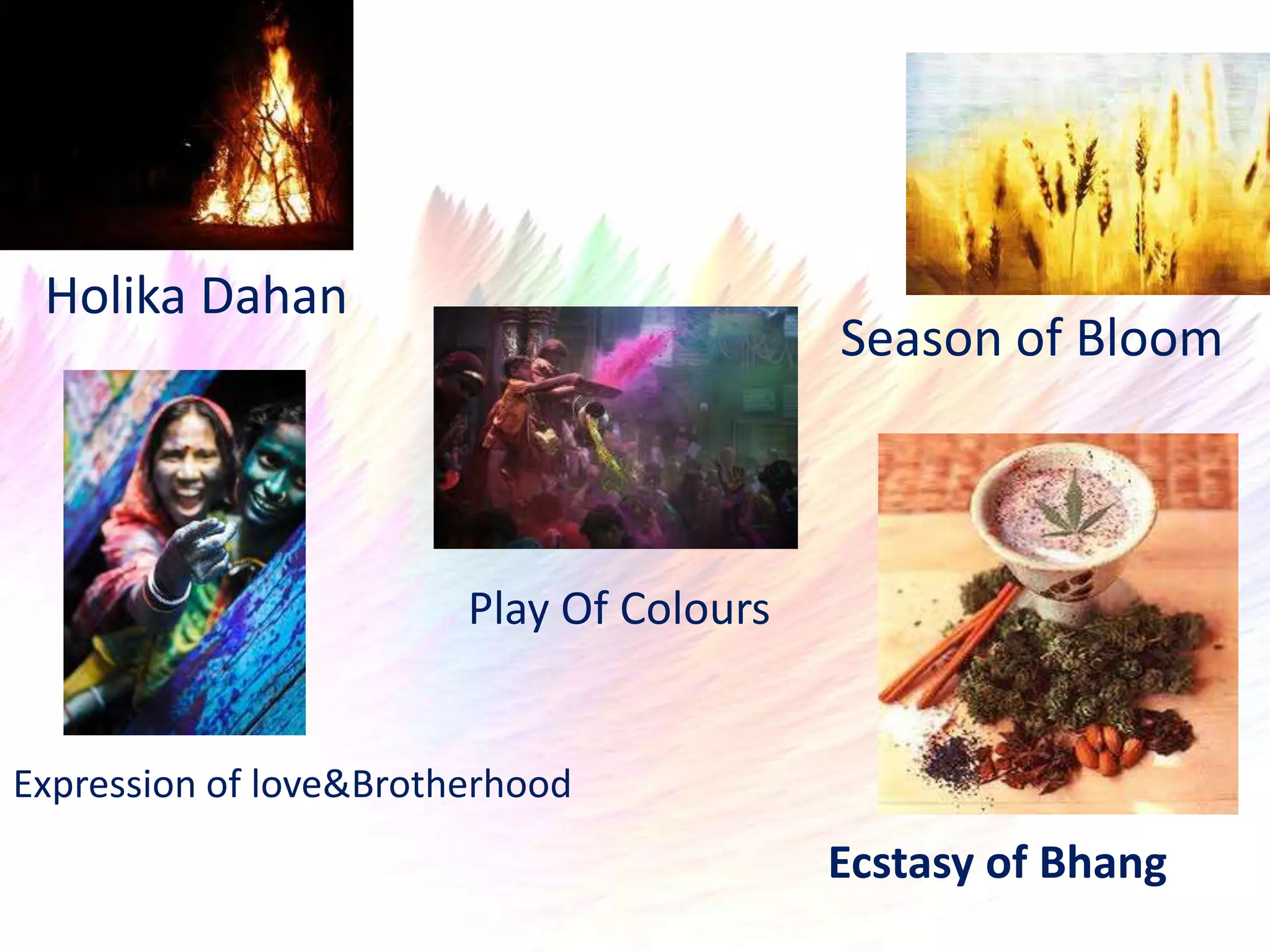
Holika Dahan
                                          Season of Bloom


                        Play Of Colours


Expression of love&Brotherhood
                                          Ecstasy of Bhang
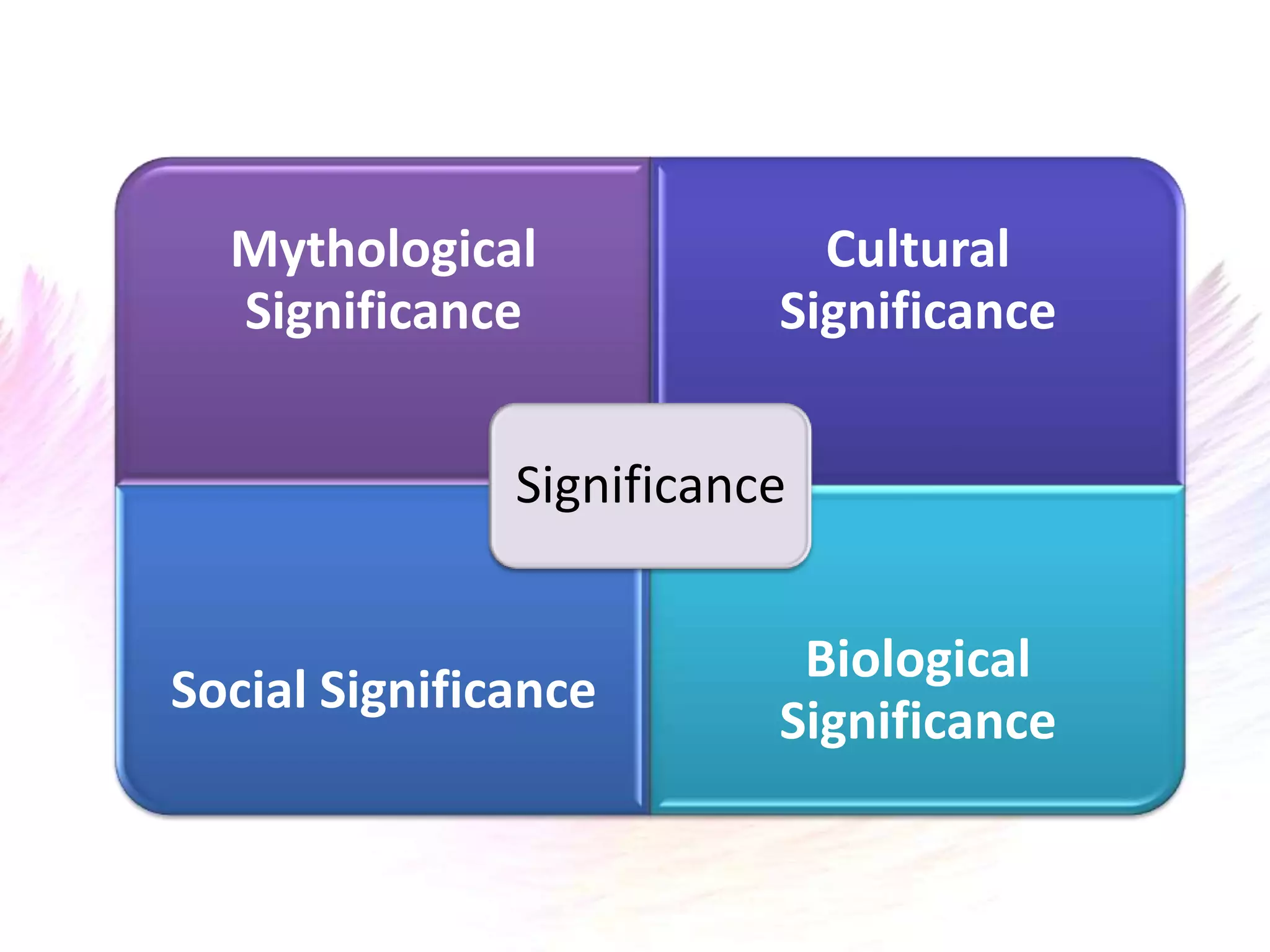
Mythological              Cultural
  Significance            Significance


               Significance


                           Biological
Social Significance
                          Significance
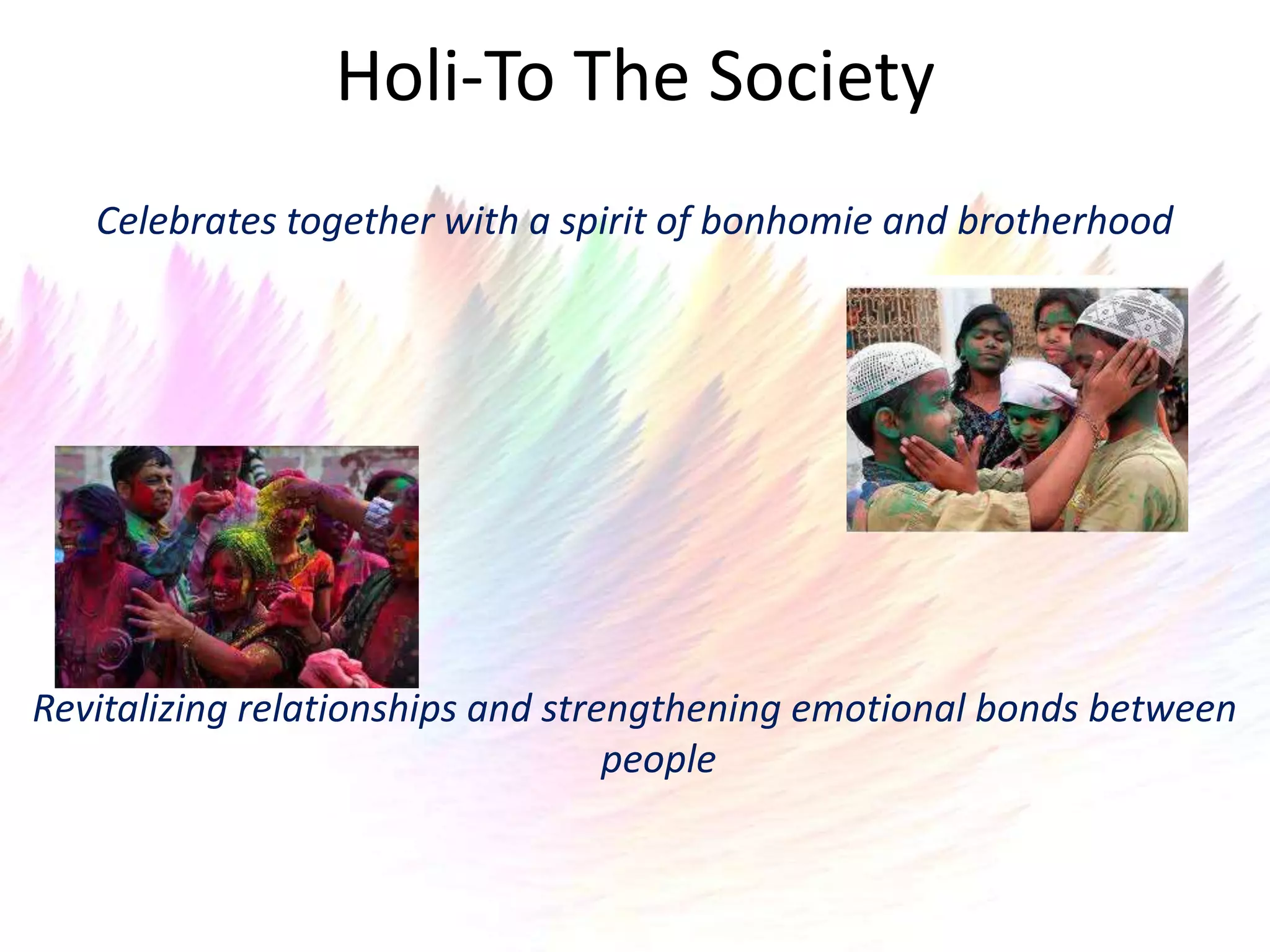
Holi-To The Society
   Celebrates together with a spirit of bonhomie and brotherhood


Revitalizing relationships and strengthening emotional bonds between
                                   people
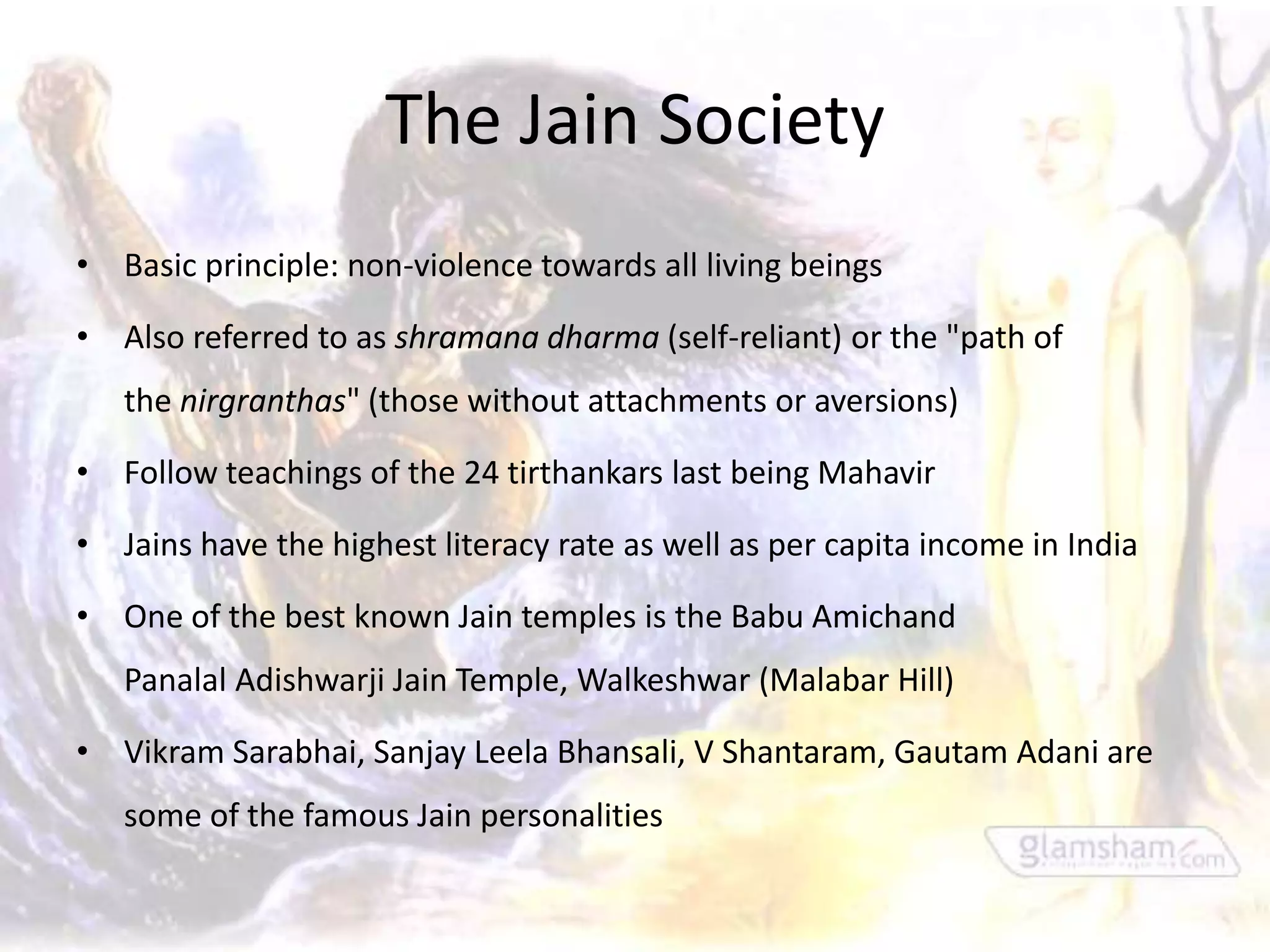
The Jain Society
• Basic principle: non-violence towards all living beings

• Also referred to as shramana dharma (self-reliant) or the "path of
   the nirgranthas" (those without attachments or aversions)

• Follow teachings of the 24 tirthankars last being Mahavir

• Jains have the highest literacy rate as well as per capita income in India

• One of the best known Jain temples is the Babu Amichand
   Panalal Adishwarji Jain Temple, Walkeshwar (Malabar Hill)

• Vikram Sarabhai, Sanjay Leela Bhansali, V Shantaram, Gautam Adani are
   some of the famous Jain personalities
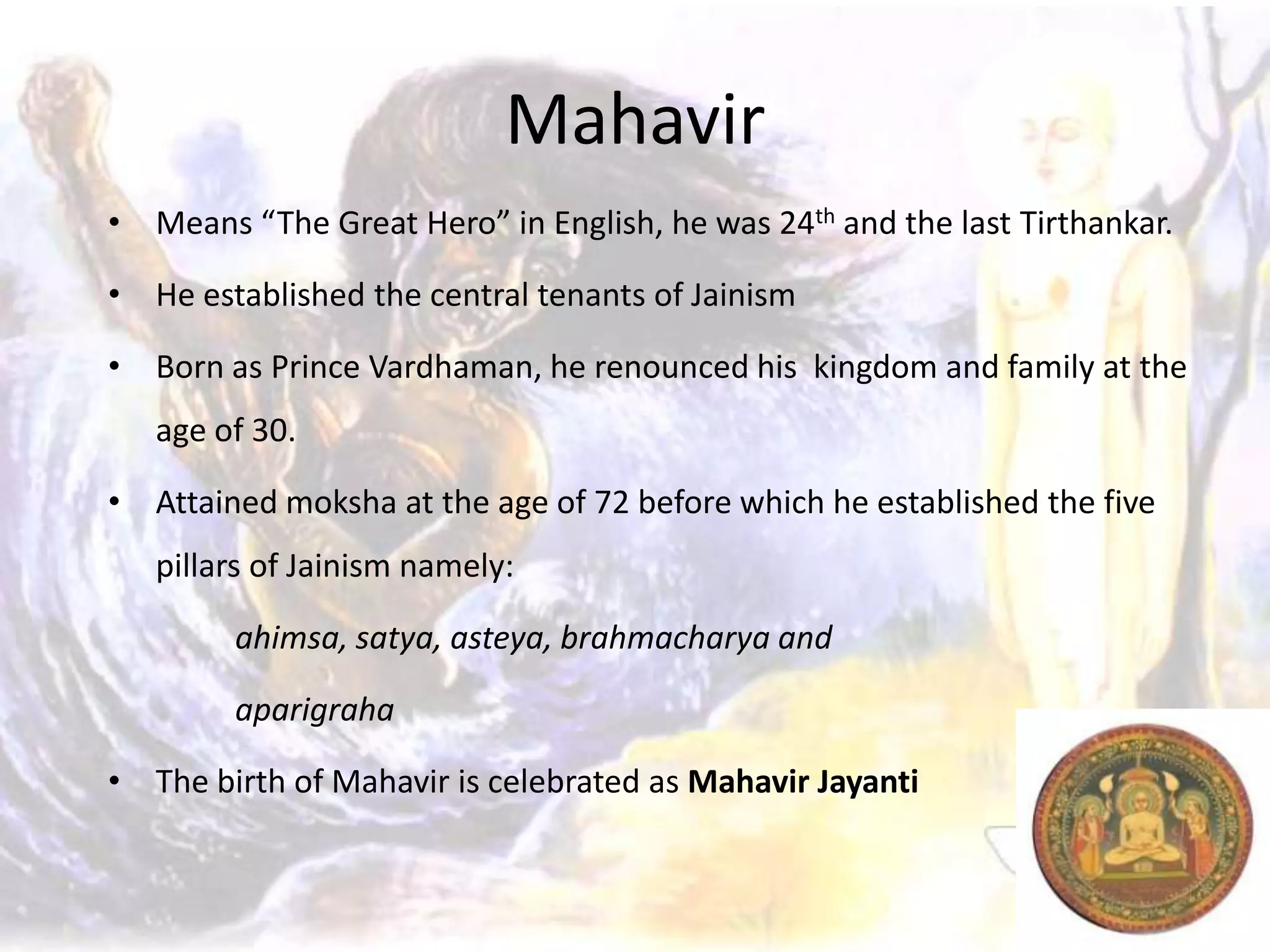
Mahavir
• Means “The Great Hero” in English, he was 24th and the last Tirthankar.

• He established the central tenants of Jainism

• Born as Prince Vardhaman, he renounced his kingdom and family at the
   age of 30.

• Attained moksha at the age of 72 before which he established the five
   pillars of Jainism namely:

        ahimsa, satya, asteya, brahmacharya and

        aparigraha

• The birth of Mahavir is celebrated as Mahavir Jayanti
Mahavir Jayanti
History
• Bhagwan Mahavir was born on 13th day under rising moon of
   Chaitra to King Siddhartha and Queen Trishla

• The day falling in the month of March or April is celebrated as
   Mahavir Jayanti

• It is believed that life forms in all three worlds were cheerful and
   gods descended from heavens to pay homage

• Mahavir denounced any sort of killing and believed most virtuous
   life is spent sitting and fasting

• Jains resolve to follow his teaching on his birth anniversary
Celebrations
• Followers visit the temples and offer ceremonial bath, known as
   'abhishek', to Mahavira's idol

• Temples are lavishly decorated with flags and chariot processions carried
   out

• The four kinds of donations recommended for every Jain on this day
   include:
   Gyan daan: sharing of knowledge
   Abhay daan: protecting people from bad actions
   Aushad daan: donating medicines
   Ahaar daan: giving food

• Sermons are also held in shrines or temples to preach the philosophy of
   spiritual freedom and virtue.
Buddha Paurnima
• Celebrates in
  remembrance of Lord
  Gautam Buddha – The
  great spiritual teacher
  in India
• Buddha Purnima falls
  on the full moon day in
  the Hindu month of
  Vaisakh
• Also known as Vesak
Buddha Paurnima Marks three important events of
   Lord Buddha’s life :
• Birth :
   Life in Palace, The four sights, Renunciation
• Enlightenment :
  Struggle for truth, achieved state of Buddha (the
   awakened one)
• nirvana (salvation):
  The final stage of life - extinction of desire
• Buddha's teachings :
  Suffering is unavoidable
• All living beings have the Buddha nature and
  can become Buddhas.
• Buddha Paurnima - Hint to us to develop
  our inner strength
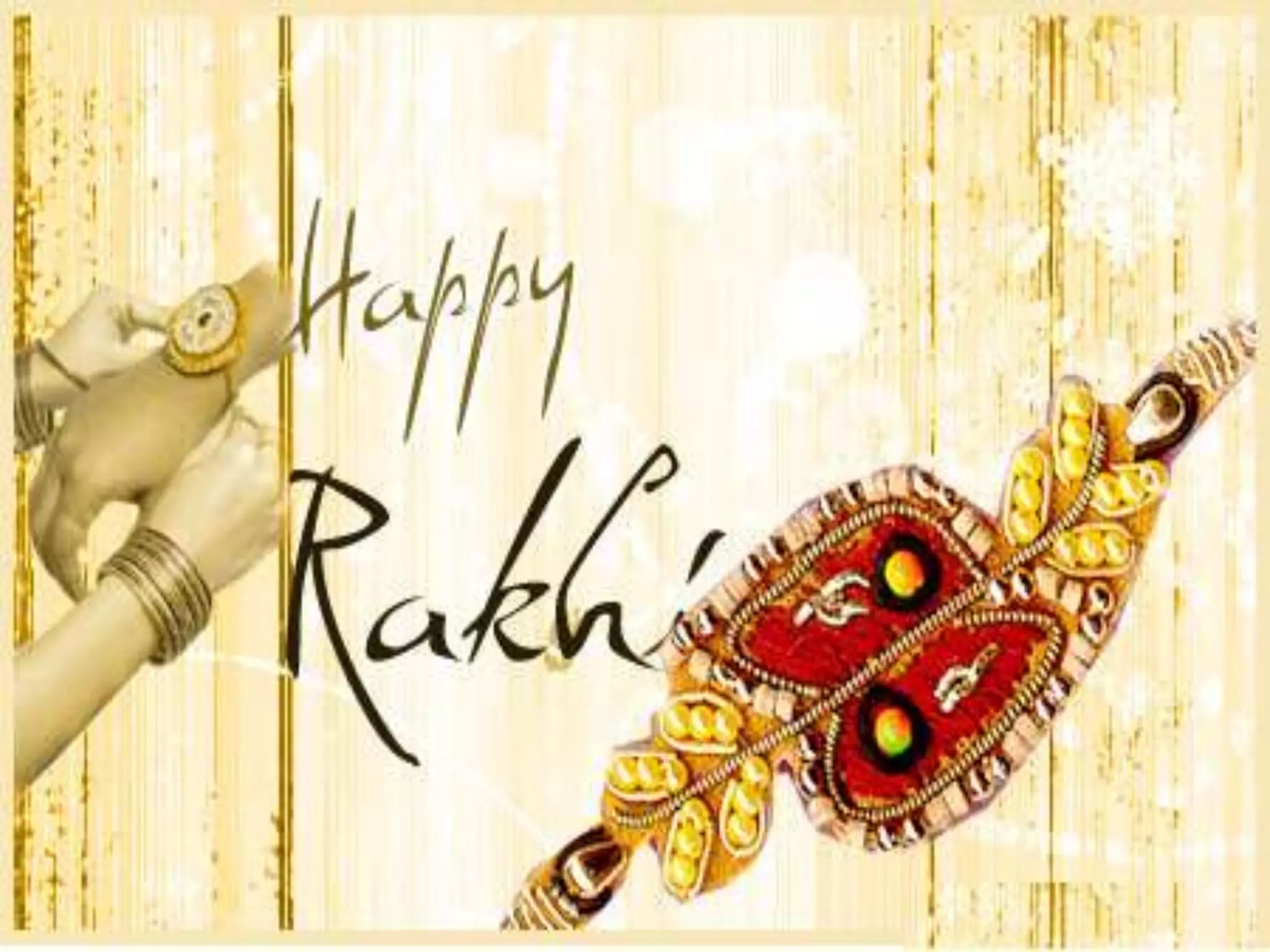
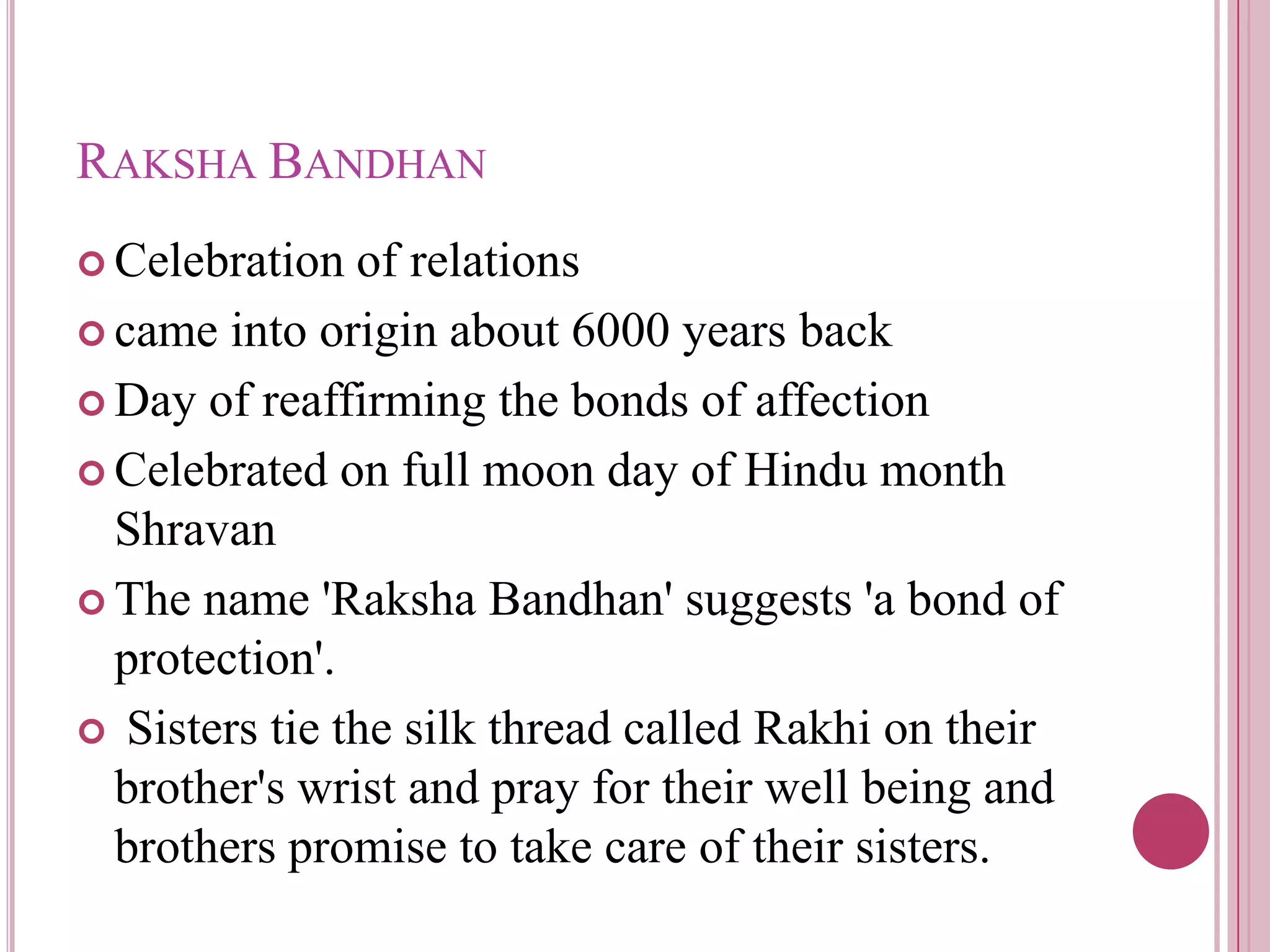
RAKSHA BANDHAN
 Celebration  of relations
 came into origin about 6000 years back

 Day of reaffirming the bonds of affection

 Celebrated on full moon day of Hindu month
  Shravan
 The name 'Raksha Bandhan' suggests 'a bond of
  protection'.
 Sisters tie the silk thread called Rakhi on their
  brother's wrist and pray for their well being and
  brothers promise to take care of their sisters.
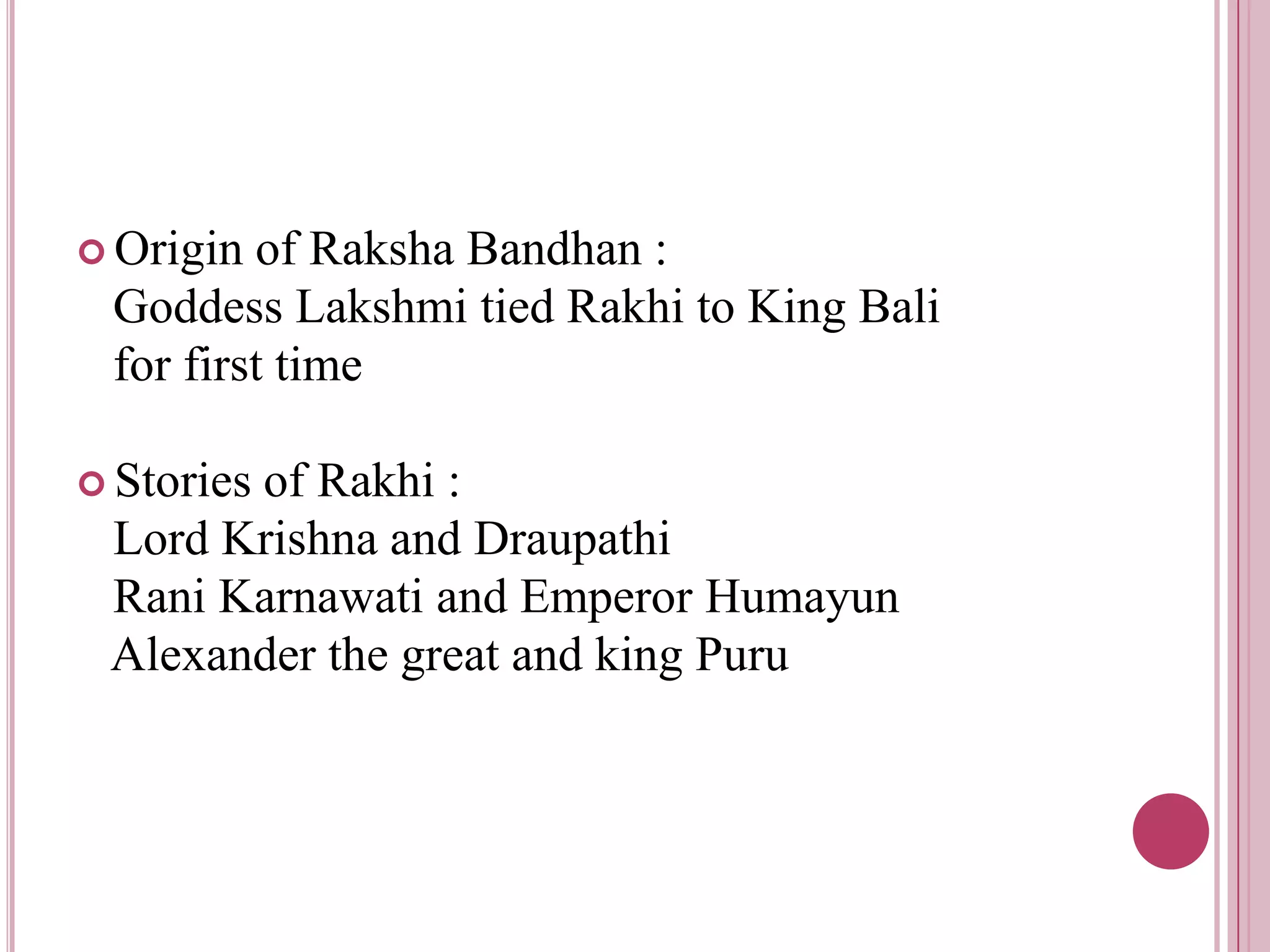
 Origin of Raksha Bandhan :
 Goddess Lakshmi tied Rakhi to King Bali
 for first time

 Stories
       of Rakhi :
 Lord Krishna and Draupathi
 Rani Karnawati and Emperor Humayun
 Alexander the great and king Puru
THE SIGNIFICANCE


 day  to celebrate the sacred relation of a brother
  and a sister.
 binding the family together in an emotional bond
  of love.
 festival encompasses true sense of peace and
  brotherhood
 can bring the much-needed relief from the
  ongoing violence and mistrust.
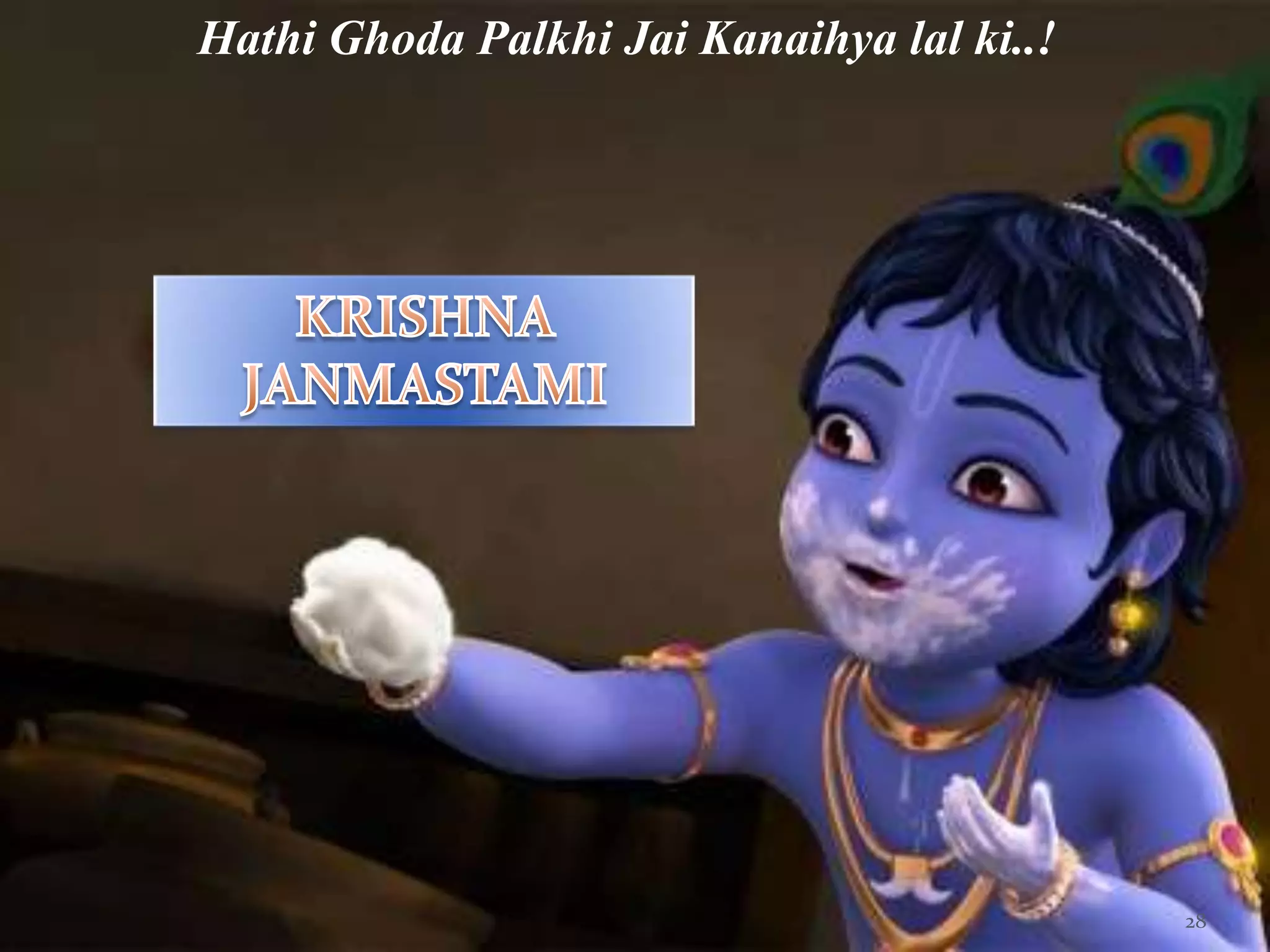
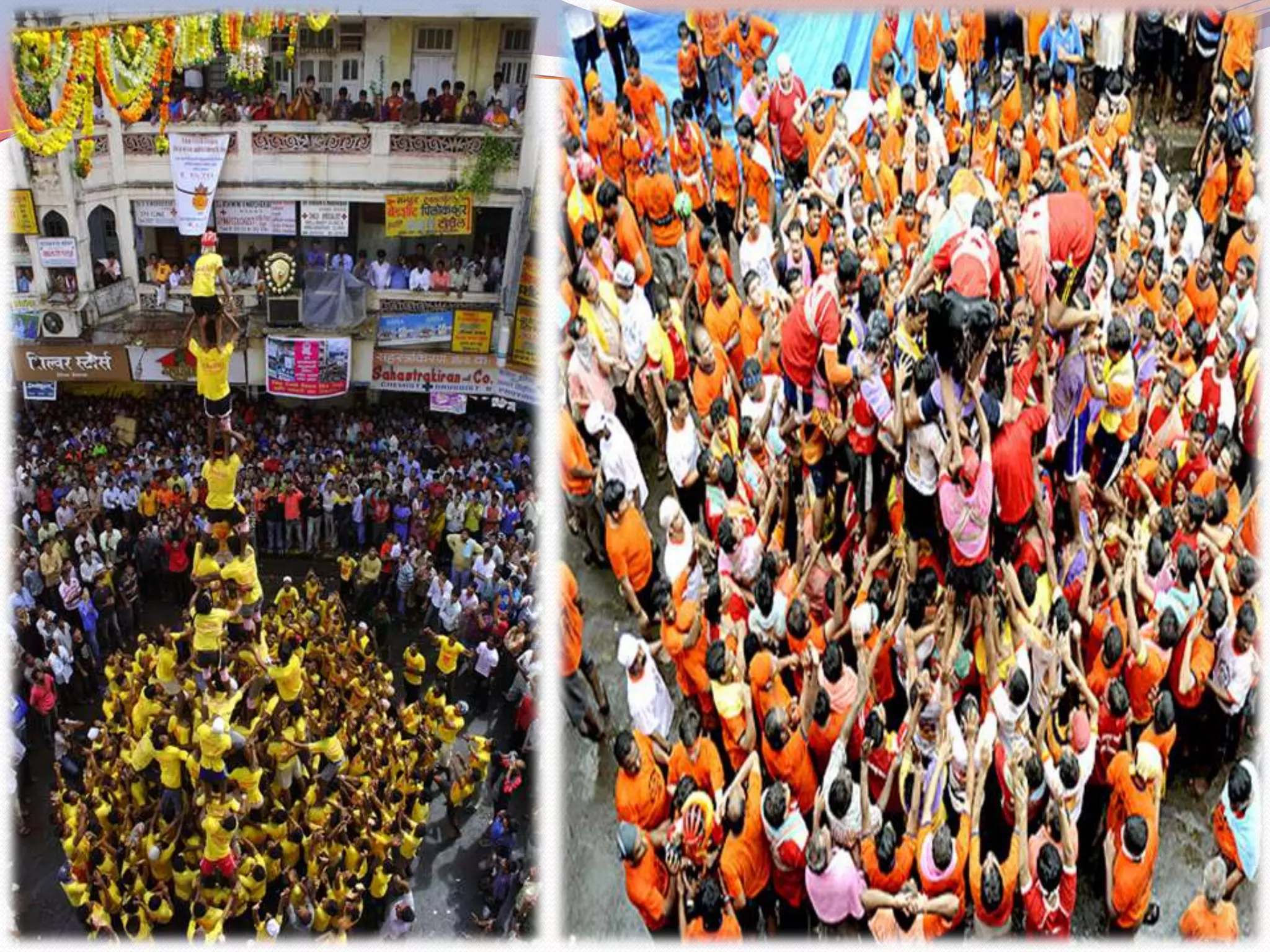
Hathi Ghoda Palkhi Jai Kanaihya lal ki..!


                                            28
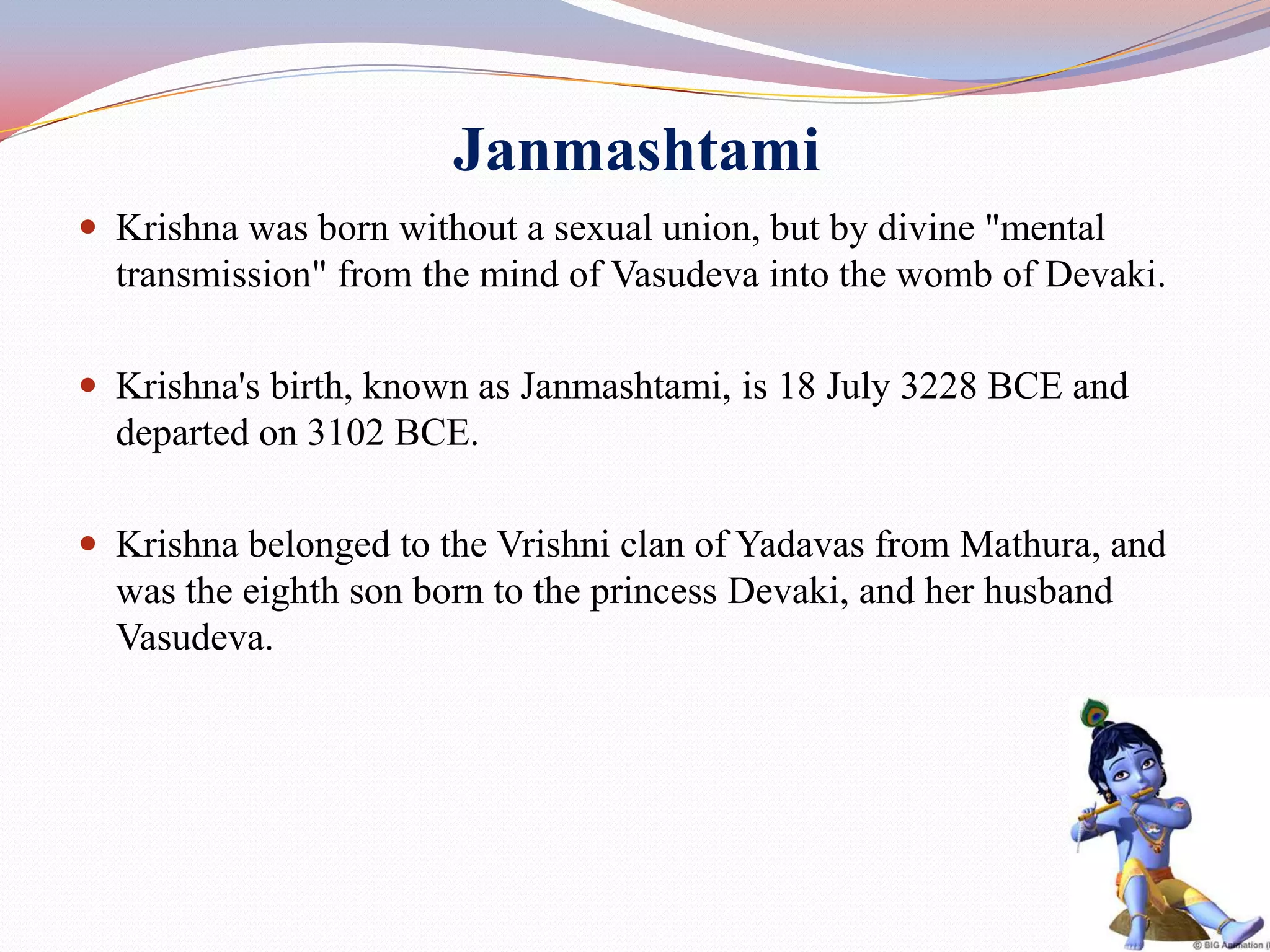
Janmashtami
 Krishna was born without a sexual union, but by divine "mental
  transmission" from the mind of Vasudeva into the womb of Devaki.

 Krishna's birth, known as Janmashtami, is 18 July 3228 BCE and
  departed on 3102 BCE.

 Krishna belonged to the Vrishni clan of Yadavas from Mathura, and
  was the eighth son born to the princess Devaki, and her husband
  Vasudeva.


                                                                      29
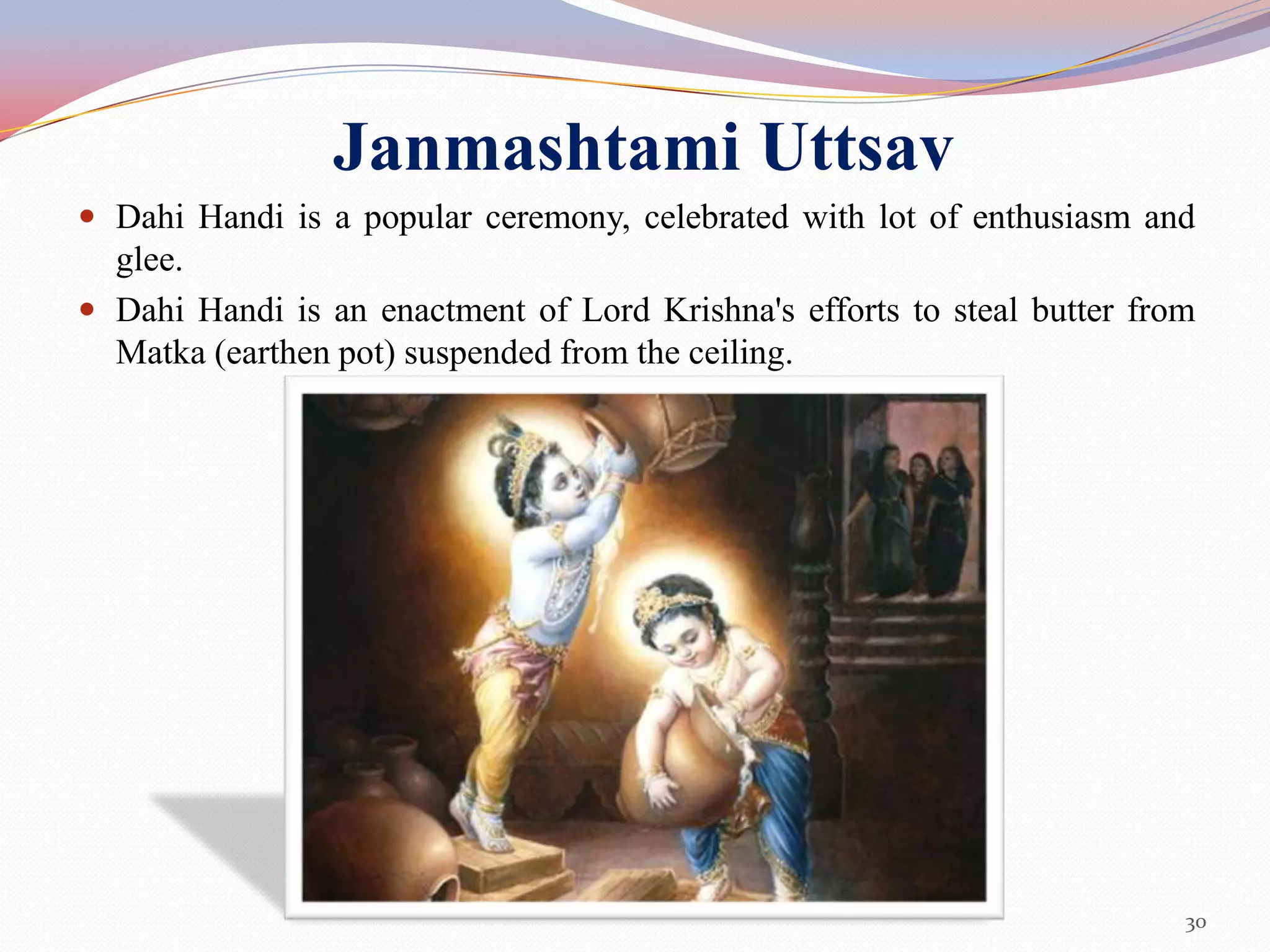
Janmashtami Uttsav
 Dahi Handi is a popular ceremony, celebrated with lot of enthusiasm and
  glee.
 Dahi Handi is an enactment of Lord Krishna's efforts to steal butter from
  Matka (earthen pot) suspended from the ceiling.


                                                                          30
31
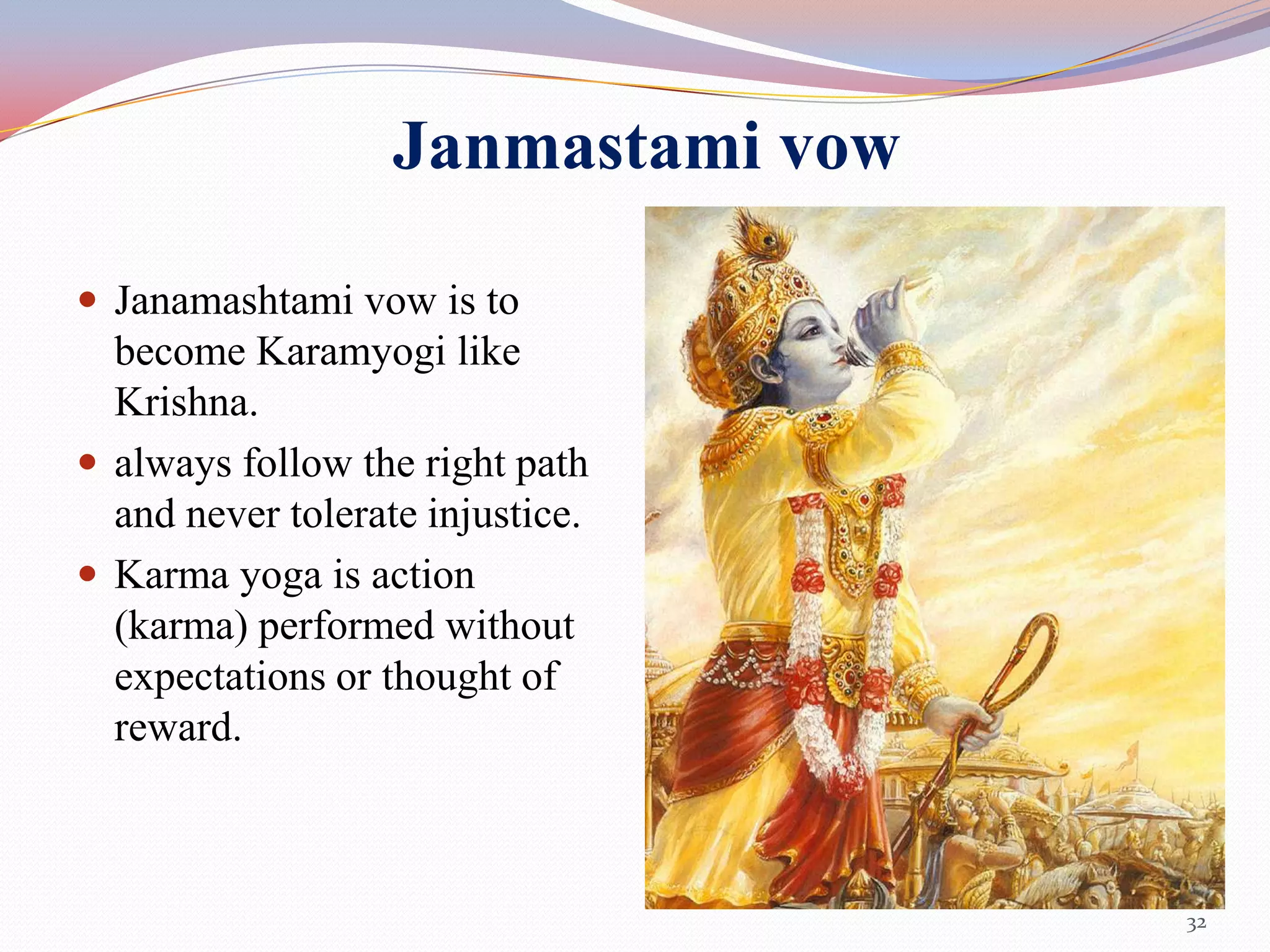
Janmastami vow

 Janamashtami vow is to
  become Karamyogi like
  Krishna.
 always follow the right path
  and never tolerate injustice.
 Karma yoga is action
  (karma) performed without
  expectations or thought of
  reward.


                                    32
ONAM
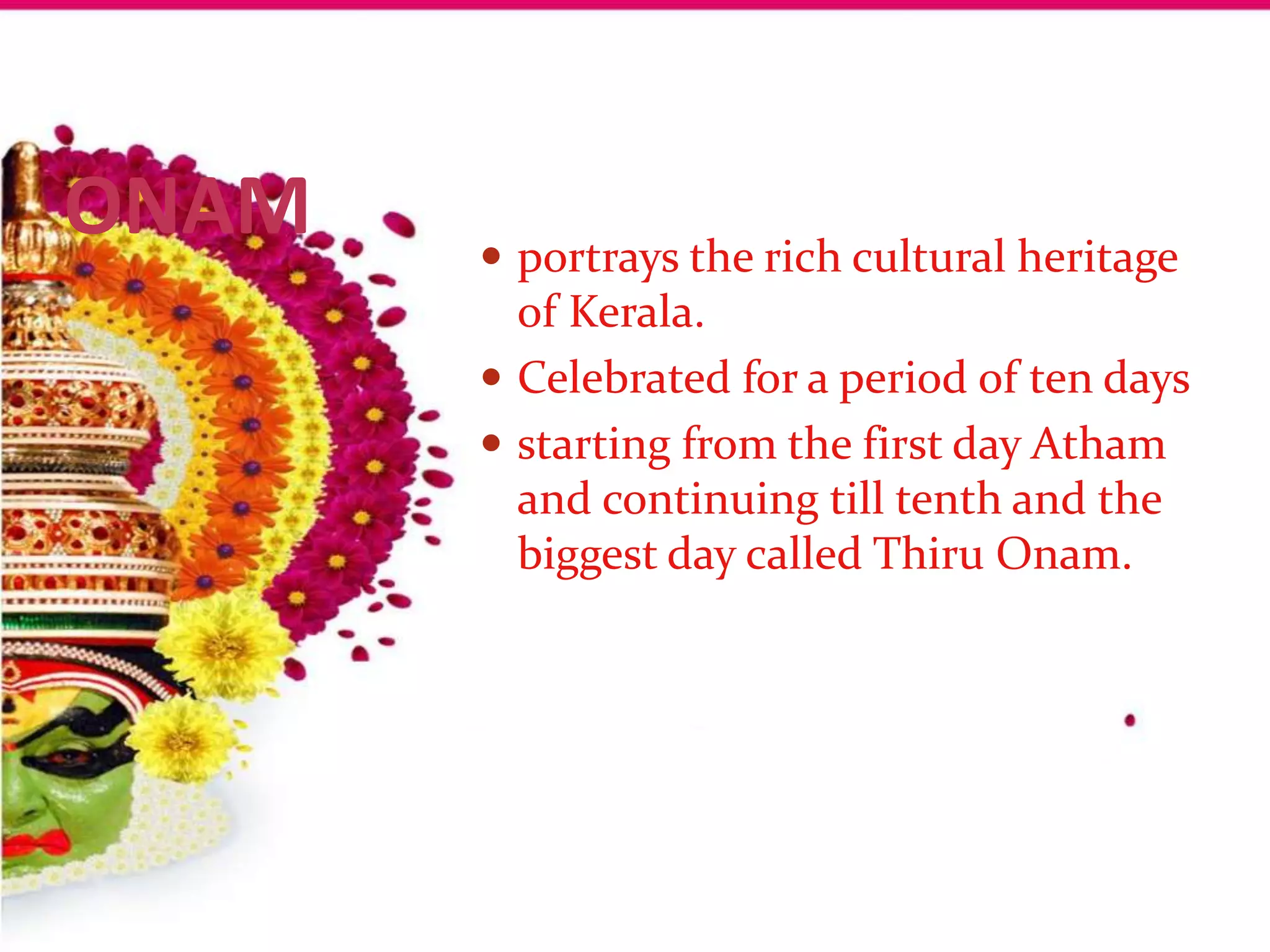
ONAM    portrays the rich cultural heritage
         of Kerala.
        Celebrated for a period of ten days
        starting from the first day Atham
         and continuing till tenth and the
         biggest day called Thiru Onam.
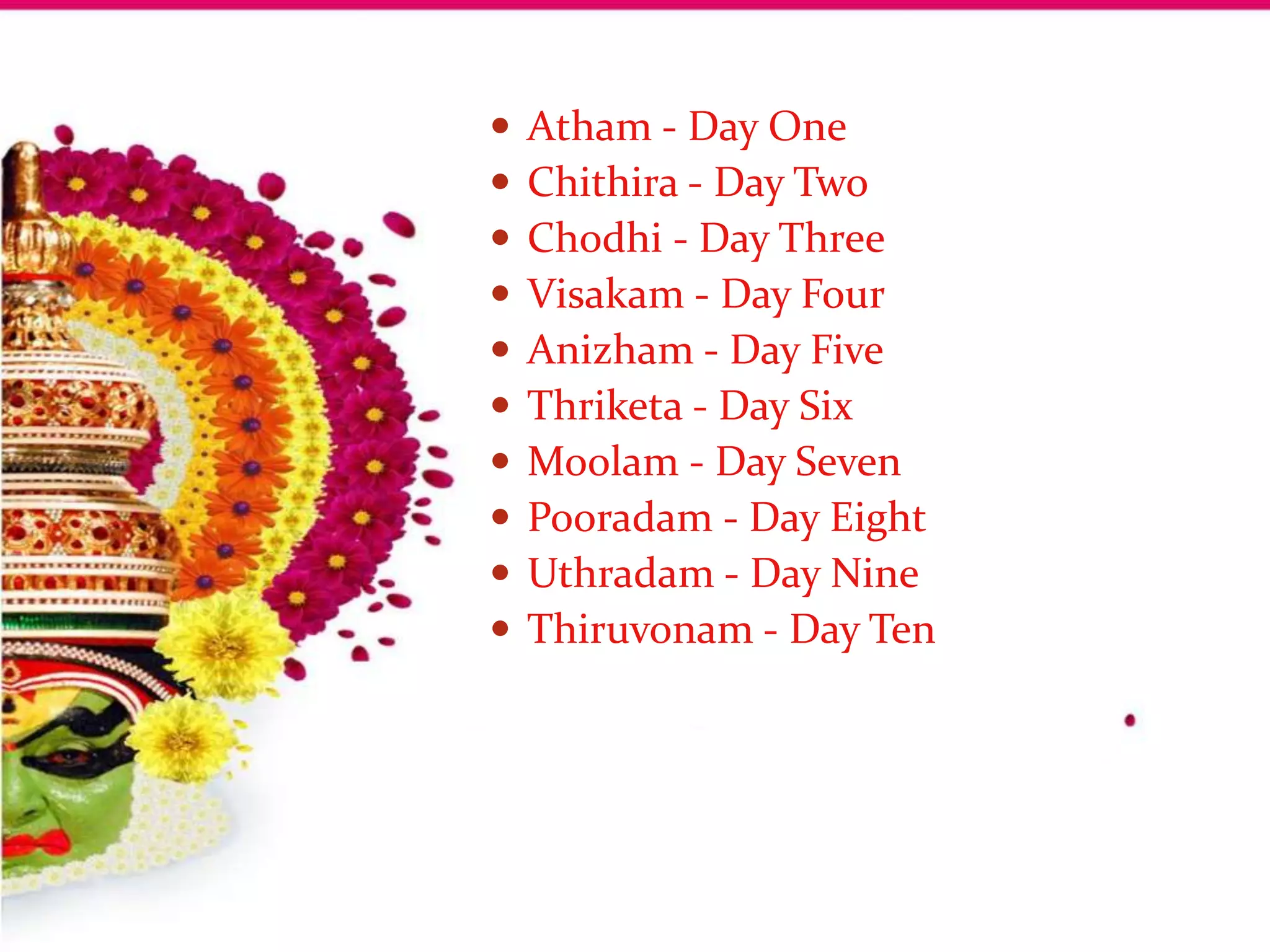
   Atham - Day One
   Chithira - Day Two
   Chodhi - Day Three
   Visakam - Day Four
   Anizham - Day Five
   Thriketa - Day Six
   Moolam - Day Seven
   Pooradam - Day Eight
   Uthradam - Day Nine
   Thiruvonam - Day Ten
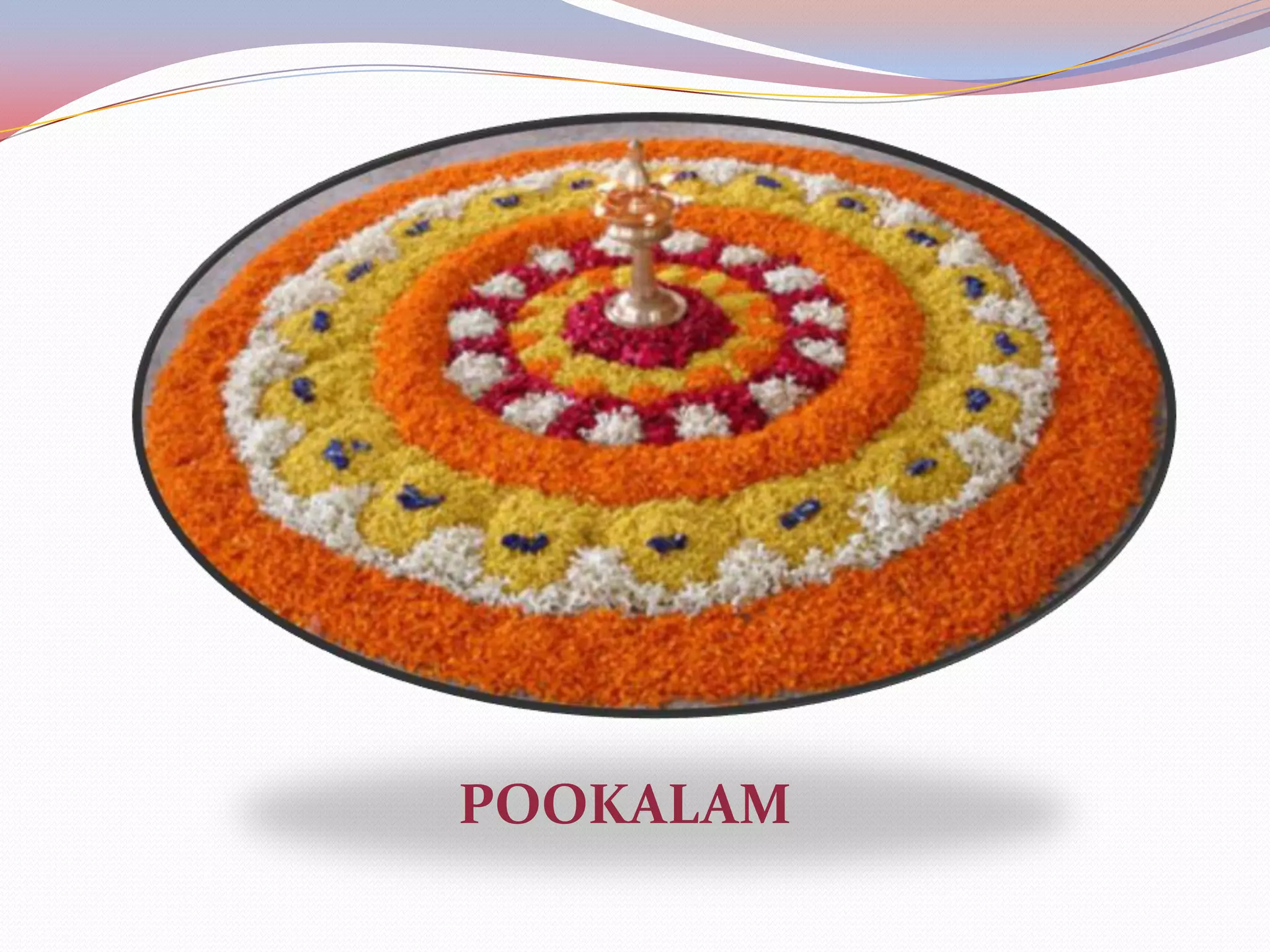
POOKALAM
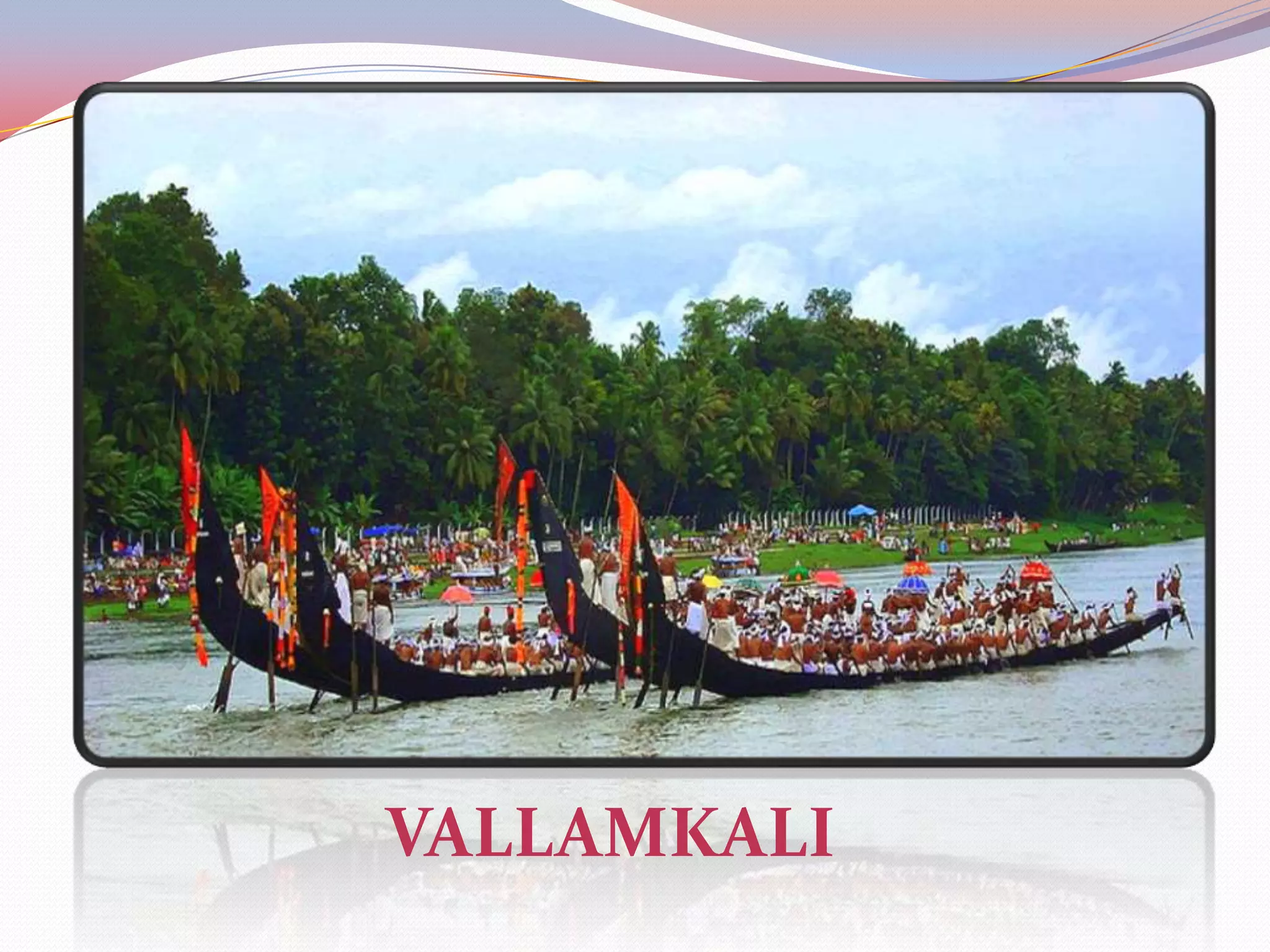
VALLAMKALI
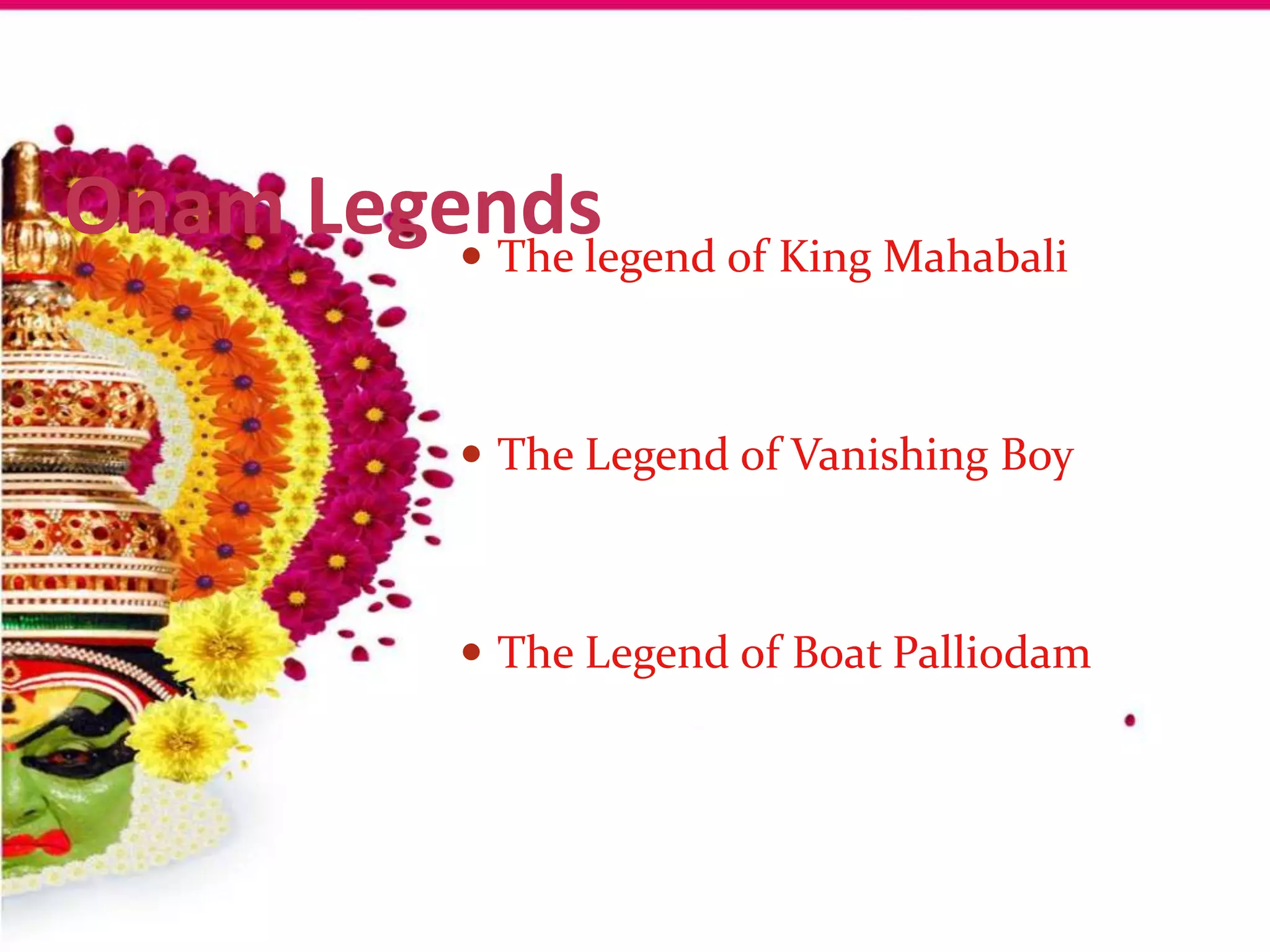
Onam Legends of King Mahabali
          The legend


            The Legend of Vanishing Boy


            The Legend of Boat Palliodam
Vakratunda Mahakaaya
                          Suryakoti Samaprabha
                       Nirvighnam Kuru Mey Deva
                        Sarva Kaaryeshu Sarvada


The Lord with the curved trunk and a mighty body, who has the magnificance of a
Million suns, I pray to you Oh Lord, to remove the obstacles from all the actions I
                                intend to perform.
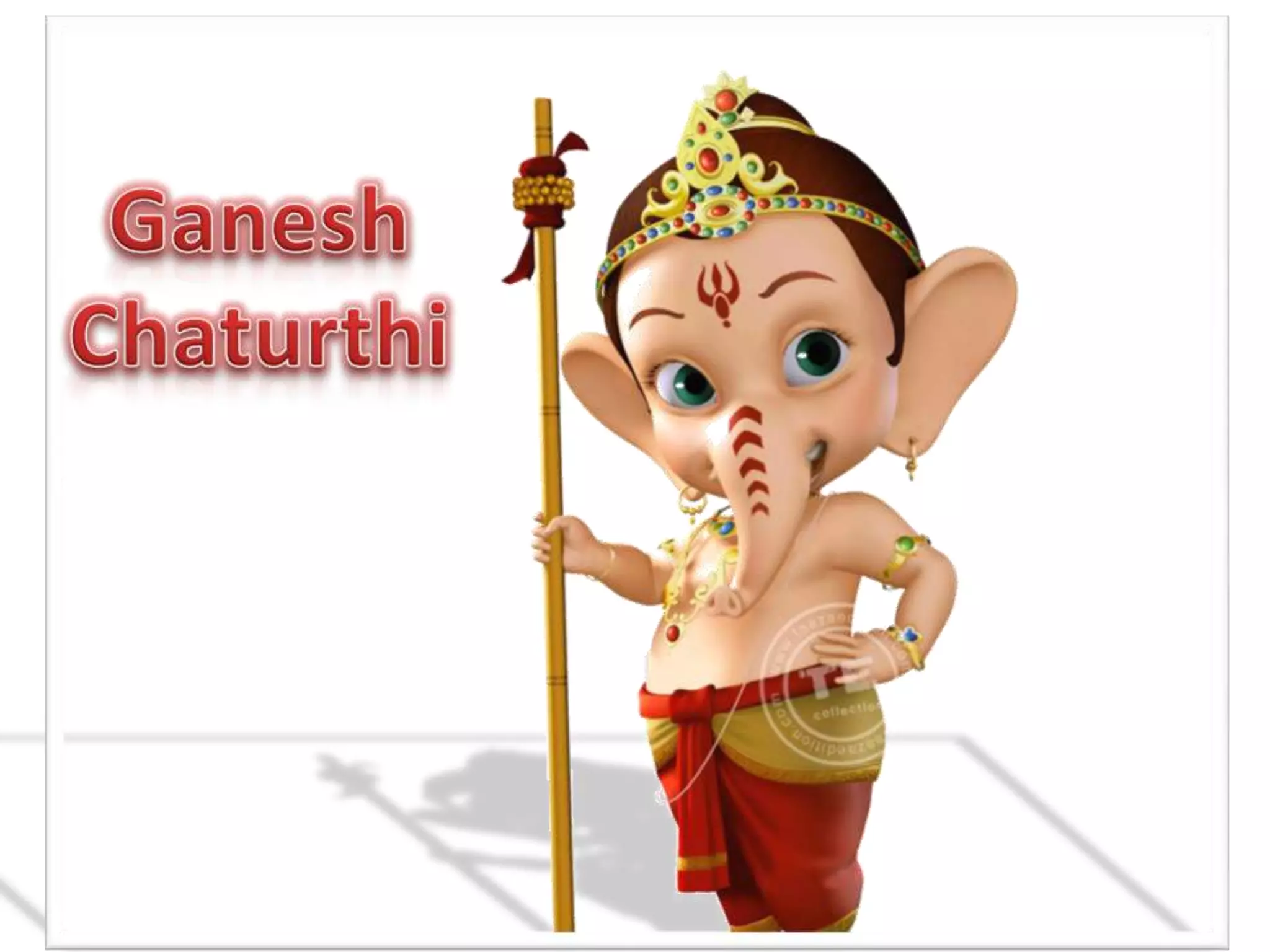
Ganesh Chaturthi
 Ganesh Chaturthi, one of the most sacred Hindu festivals.


 Celebrates the birth of Lord Ganesha - the supreme God of wisdom and
  prosperity.

 Lord Ganesh was born on a fourth day (chaturthi) of the bright fortnight of
  the Hindu lunar month of Magh.

 „Ganesh Chaturthi‟ or „Vinayak Chaturthi‟, is celebrated as birthday of Lord
  Ganesha.

 It is observed during the Hindu month of Bhadra (mid-August – mid-
  September).

 He is son of Lord Shiva and Goddess Parvati, the Divine Mother.
                                                                                 41
History of Ganesh Chaturthi

 Bal Gangadhar Tilak, brought back the tradition of Ganesh Chaturthi and
  reshaped the festival from private family celebrations into a grand public event.

 "to bridge the gap between the Brahmins and the non-Brahmins.


 To unite all social classes -"the god for Everyman".


 It served as a meeting place for common people of all castes and communities.


 An important festival during the Peshwa era, Ganesha Chaturthi acquired
  organized form all over India largely due to Lokmanya's efforts


                                                                               42
Celebration
 Today, Ganesh Chaturthi is celebrated in the states of India


 The festival is so popular that the preparations begin months in advance. Days
  before the actual worship.

 Elaborate arrangements are made for lighting, decoration, mirrors and flowers


 During the festival days, the Lord is worshipped with great devotion and prayer
  services are performed daily.

 The duration of the Lord's stay varies from place to place; once the worship is
  complete, the statues are carried on decorated floats to be immersed in the sea after
  one, three, five, seven and ten days.


                                                                                          43
Celebration
 This procession and immersion is accompanied with dancing and the sound
  of exciting drum-beats, devotional songs and exploding firecrackers.

 As the idol is immersed amidst loud chants “Ganpati Bappa Moraya
  mangal murti morya”

 The festival comes to an end with pleas to the Lord to return the next year
  with chants of "Ganpati bappa morya, pudcha varshi laukar ya" (Hail Lord
  Ganesh, return again soon next year).

 In the 21st century, with the world turning fast into a global village, Ganesh
  Chaturthi is now celebrated all over the world, wherever there is a presence
  of a Hindu community.


                                                                                   44
Sarvamangalamangalye Shive sarvathasaadhike,
Sharanye triyambake gauri Naraayani namostute!


                                                 45
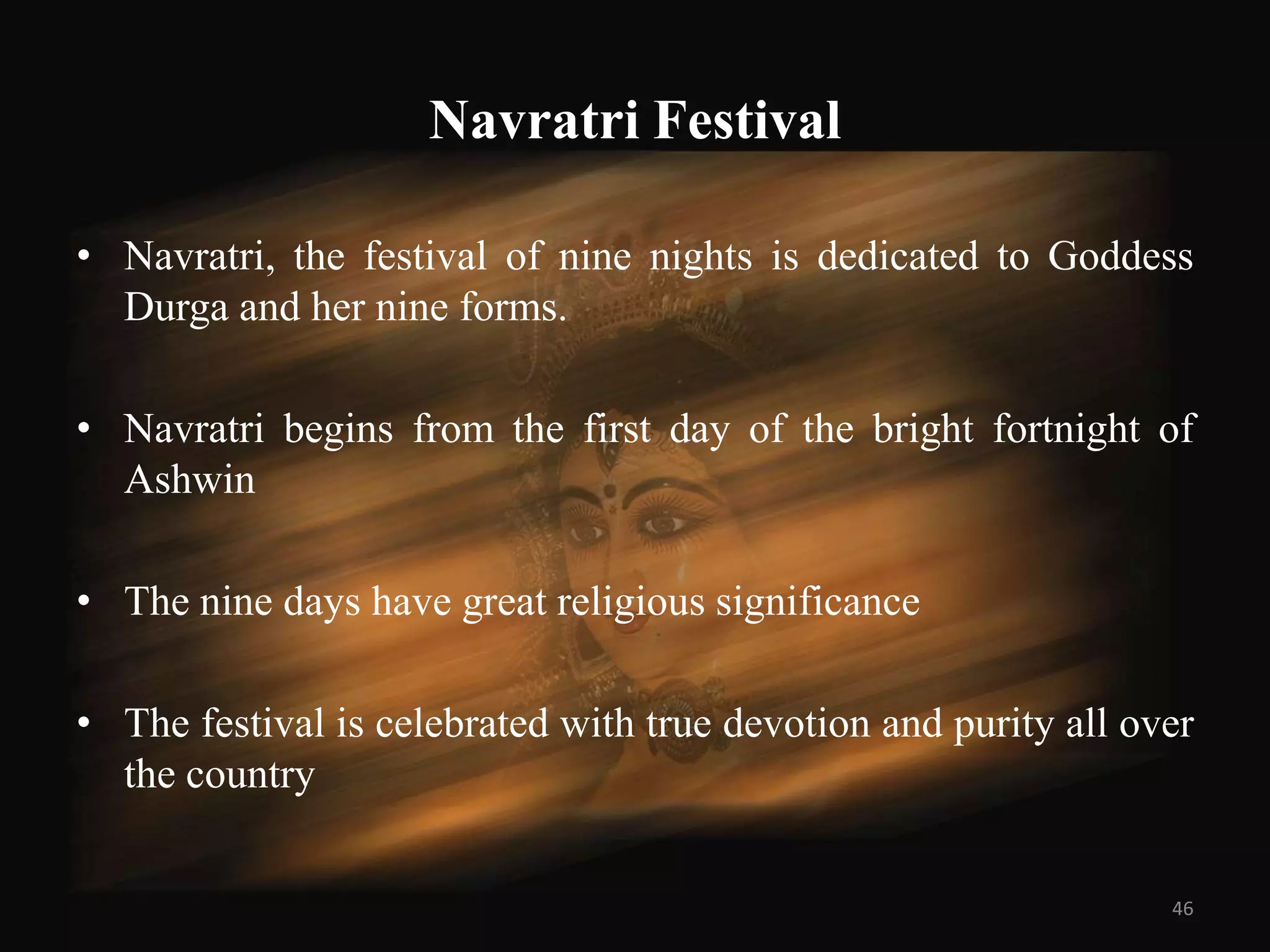
Navratri Festival

• Navratri, the festival of nine nights is dedicated to Goddess
  Durga and her nine forms.

• Navratri begins from the first day of the bright fortnight of
  Ashwin

• The nine days have great religious significance

• The festival is celebrated with true devotion and purity all over
  the country


                                                                 46
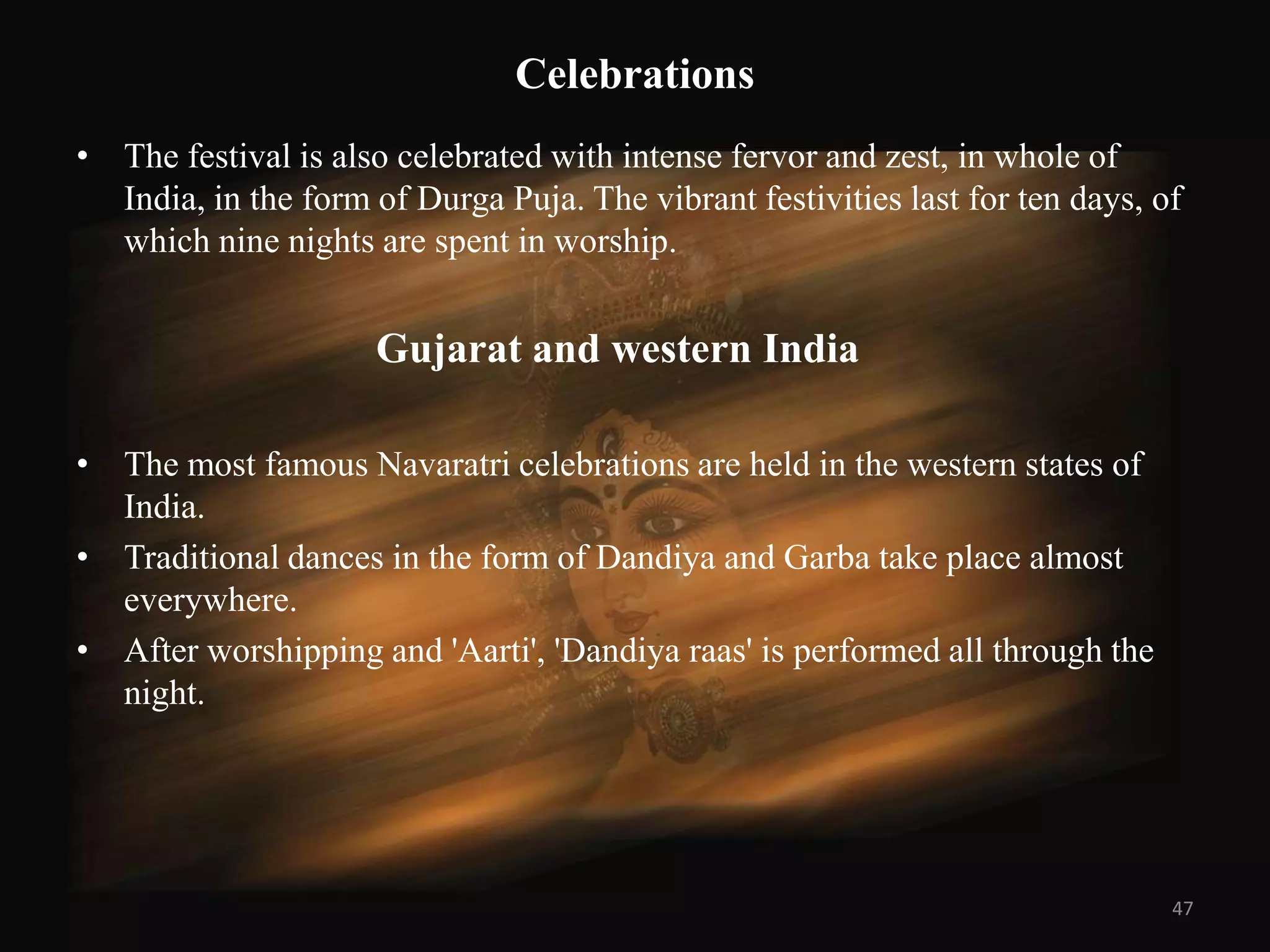
Celebrations
• The festival is also celebrated with intense fervor and zest, in whole of
  India, in the form of Durga Puja. The vibrant festivities last for ten days, of
  which nine nights are spent in worship.


                     Gujarat and western India

• The most famous Navaratri celebrations are held in the western states of
  India.
• Traditional dances in the form of Dandiya and Garba take place almost
  everywhere.
• After worshipping and 'Aarti', 'Dandiya raas' is performed all through the
  night.


                                                                                47
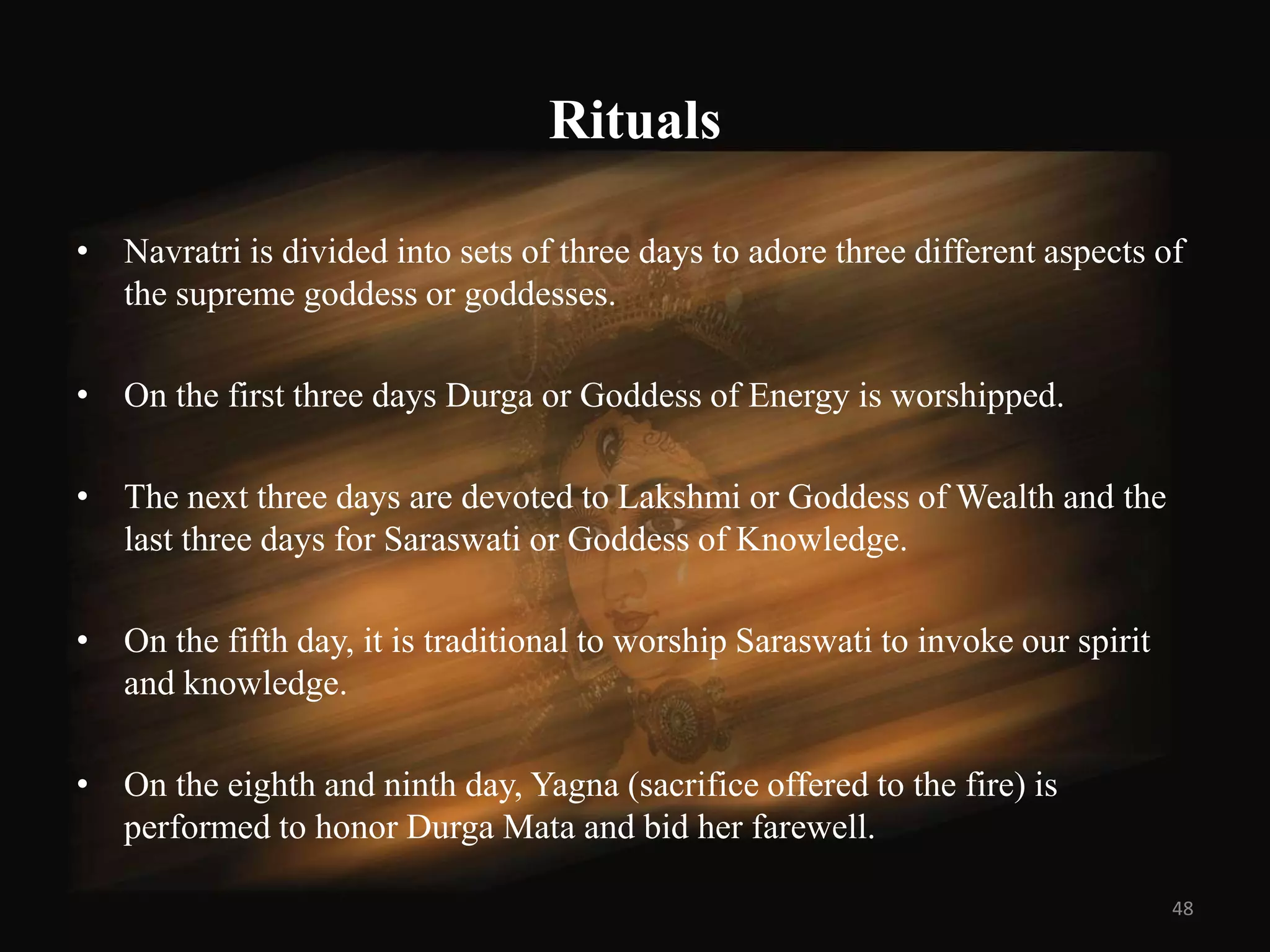
Rituals

• Navratri is divided into sets of three days to adore three different aspects of
  the supreme goddess or goddesses.

• On the first three days Durga or Goddess of Energy is worshipped.

• The next three days are devoted to Lakshmi or Goddess of Wealth and the
  last three days for Saraswati or Goddess of Knowledge.

• On the fifth day, it is traditional to worship Saraswati to invoke our spirit
  and knowledge.

• On the eighth and ninth day, Yagna (sacrifice offered to the fire) is
  performed to honor Durga Mata and bid her farewell.

                                                                                  48
Nine Days of Navratri

   FIRST DAY
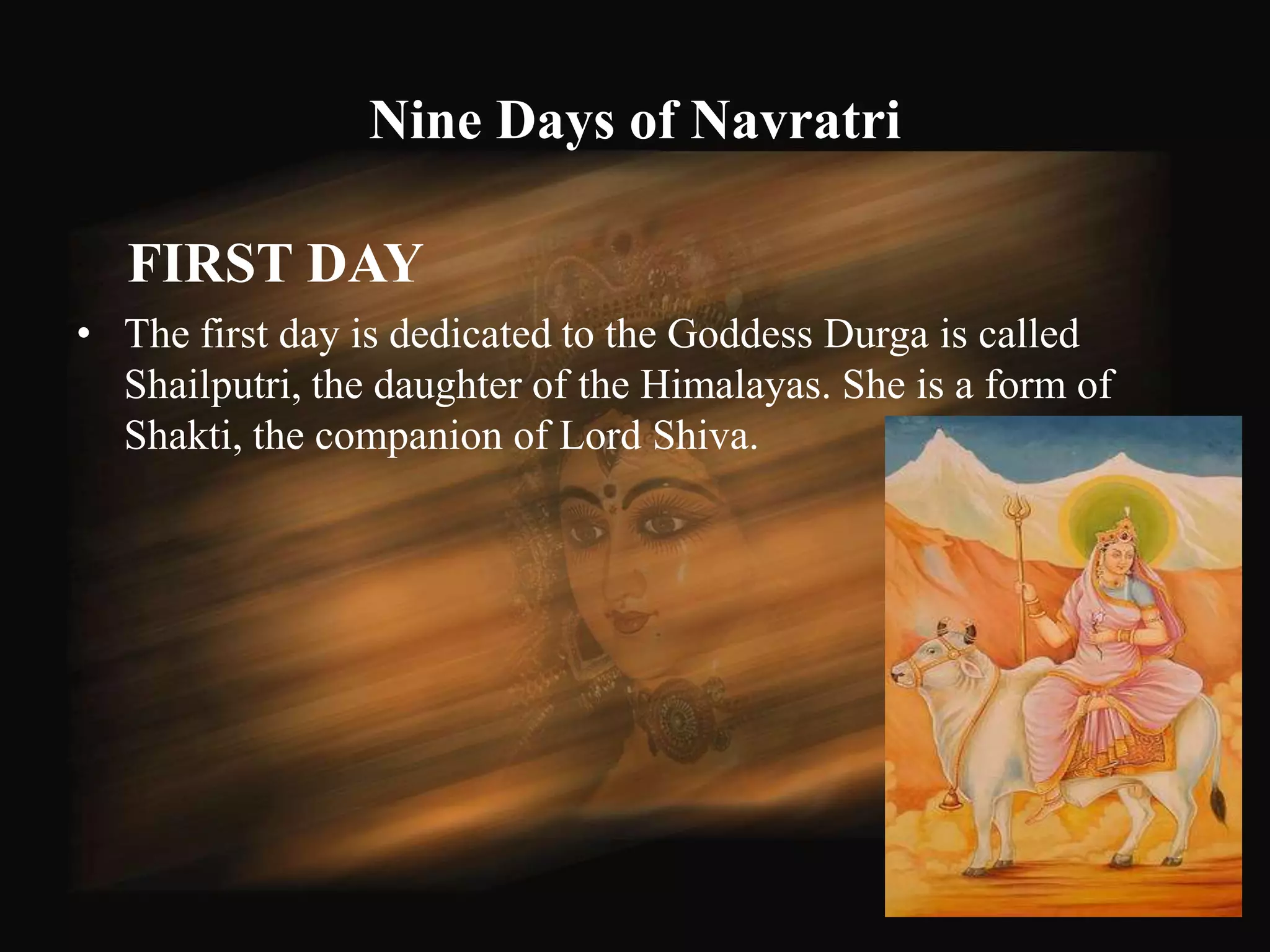
• The first day is dedicated to the Goddess Durga is called
  Shailputri, the daughter of the Himalayas. She is a form of
  Shakti, the companion of Lord Shiva.


                                                                49
SECOND DAY
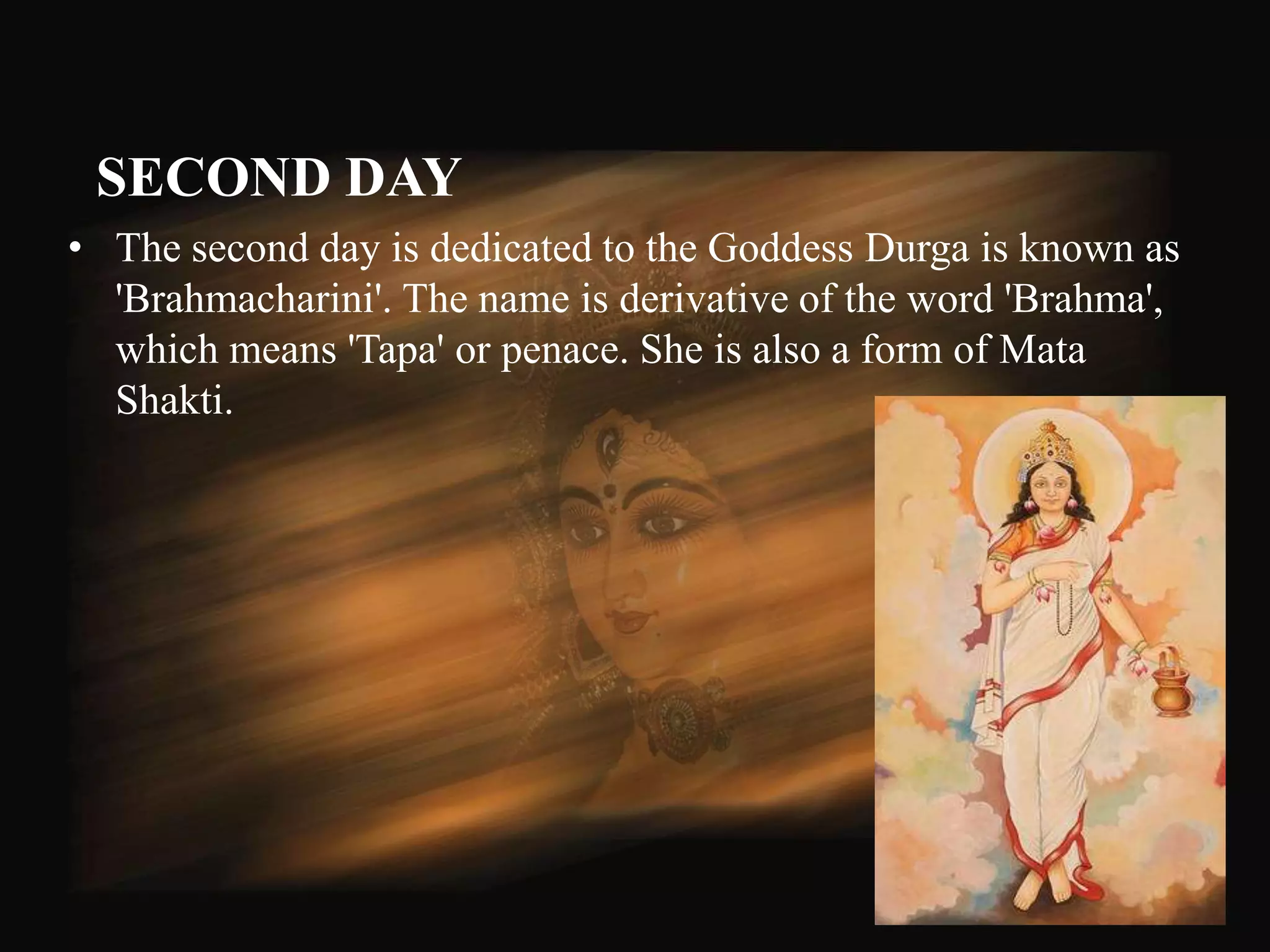
• The second day is dedicated to the Goddess Durga is known as
  'Brahmacharini'. The name is derivative of the word 'Brahma',
  which means 'Tapa' or penace. She is also a form of Mata
  Shakti.


                                                              50
Third Day
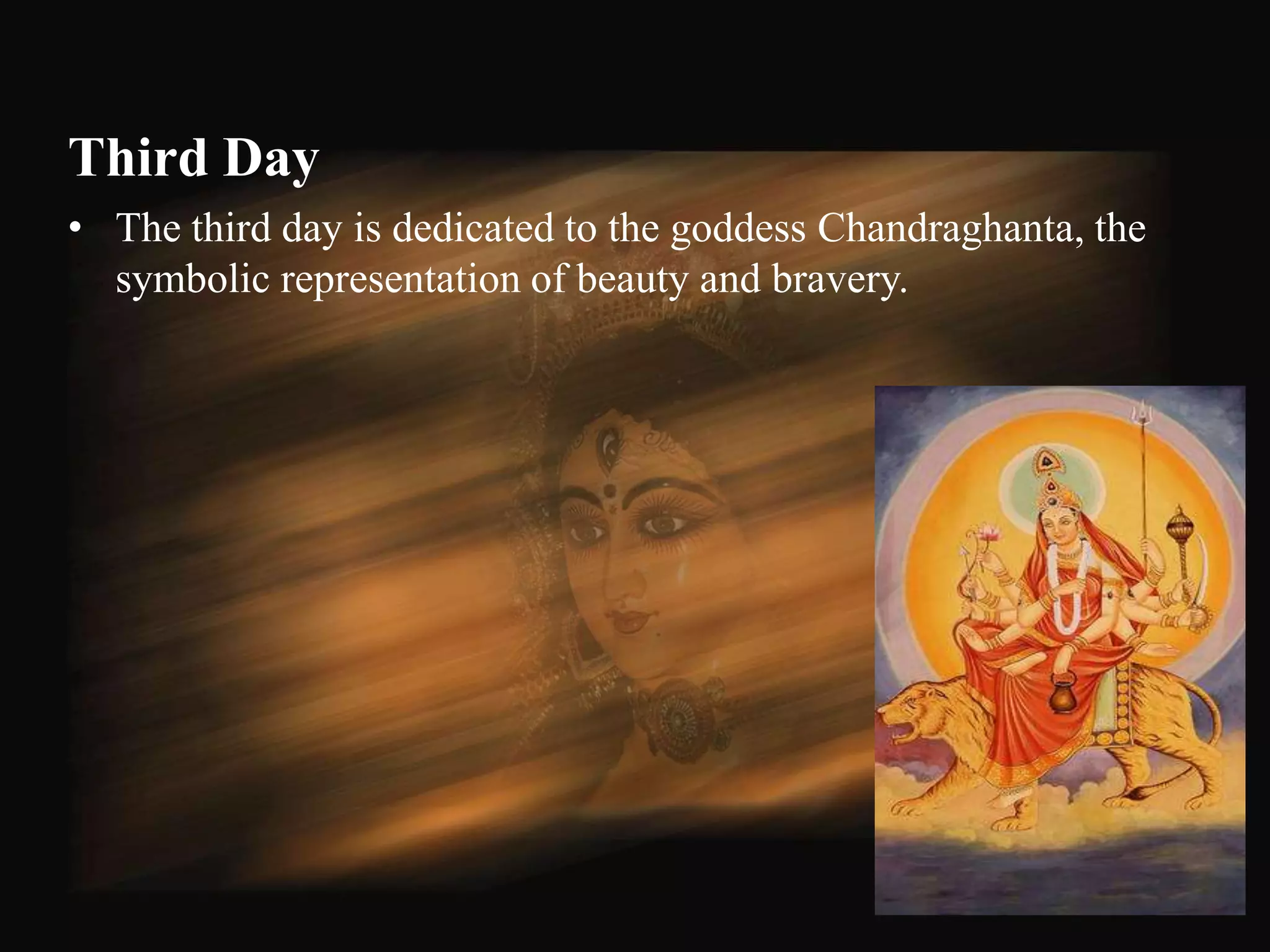
• The third day is dedicated to the goddess Chandraghanta, the
  symbolic representation of beauty and bravery.


                                                                 51
Fourth Day
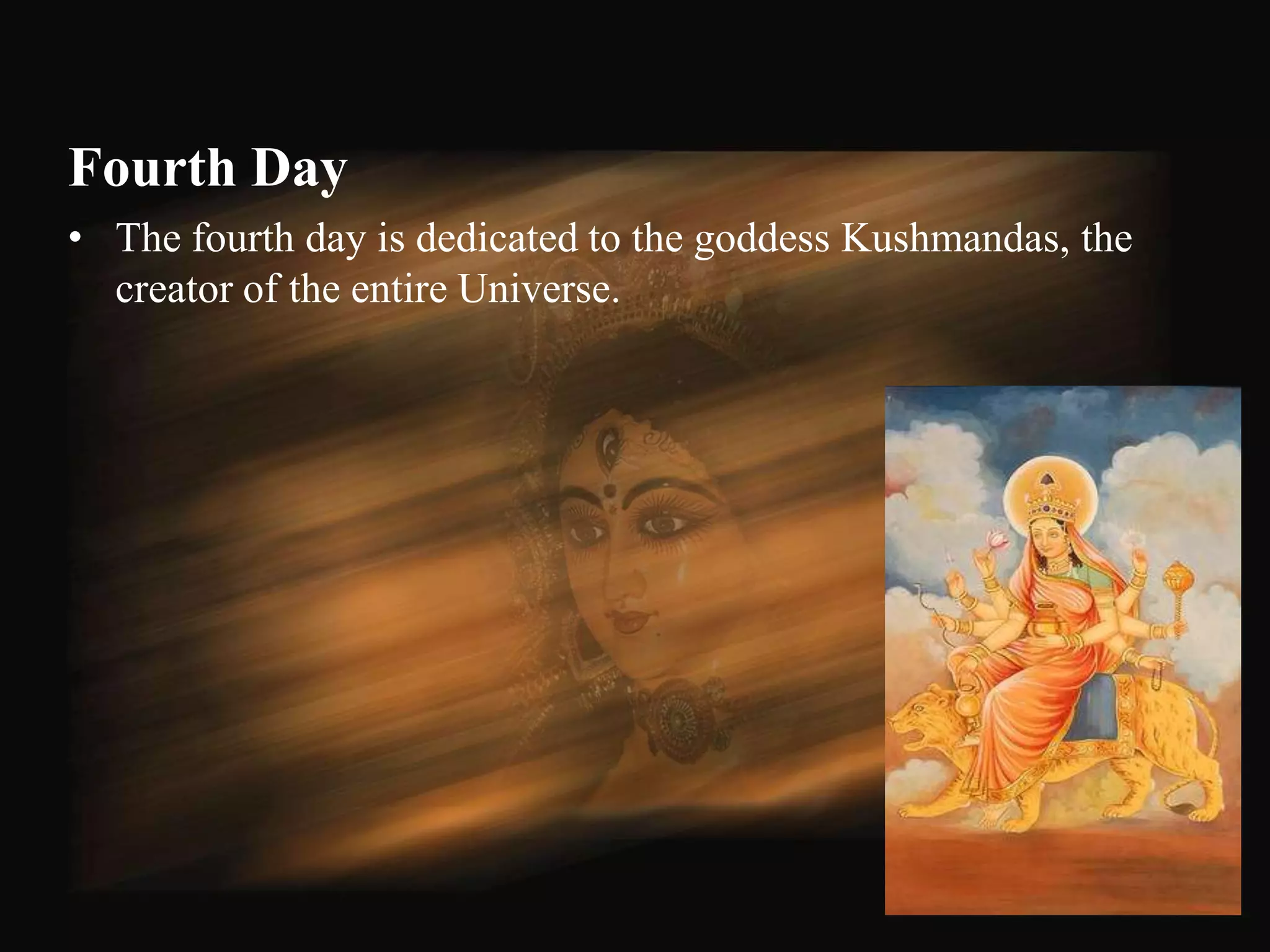
• The fourth day is dedicated to the goddess Kushmandas, the
  creator of the entire Universe.


                                                               52
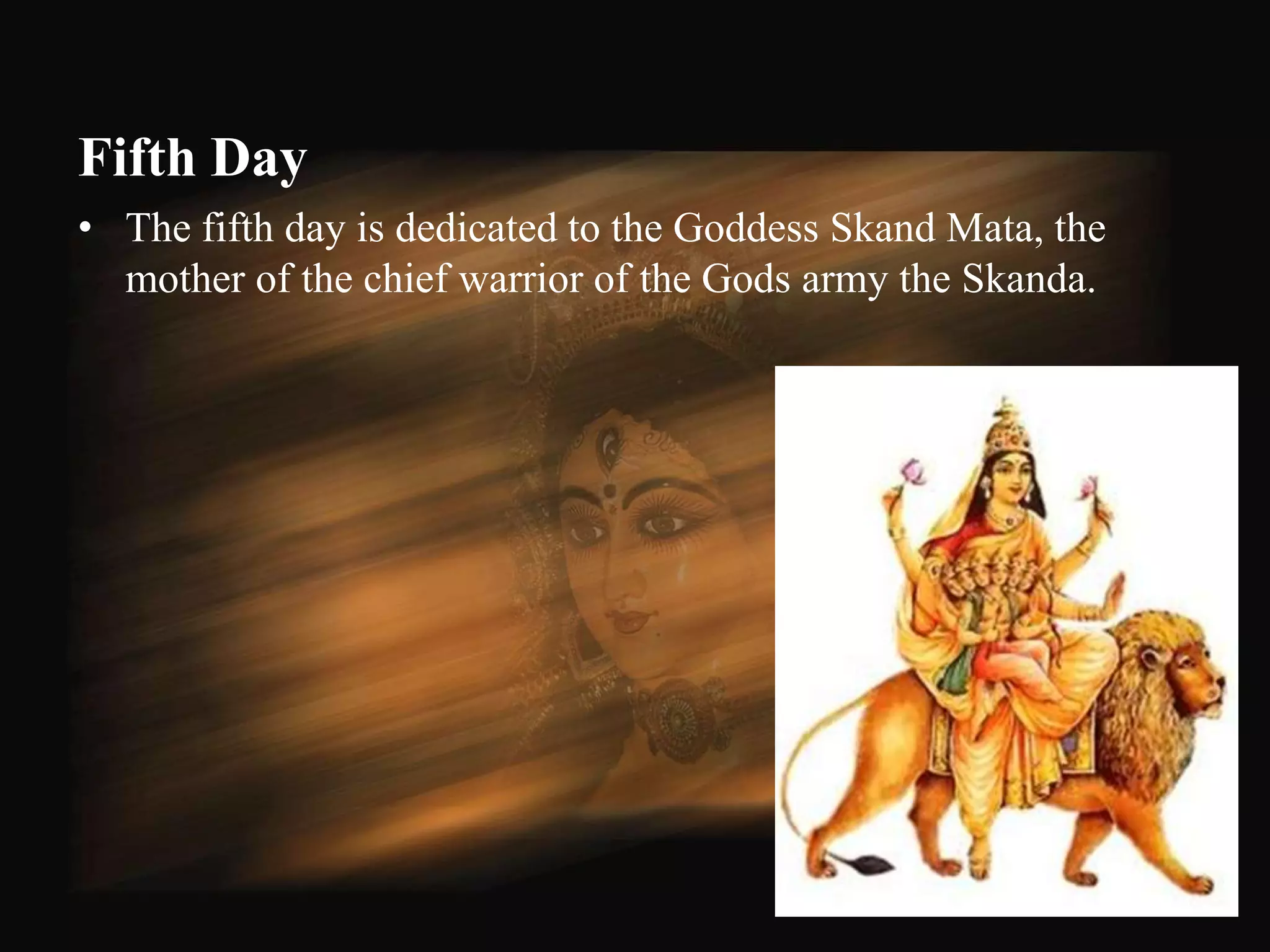
Fifth Day
• The fifth day is dedicated to the Goddess Skand Mata, the
  mother of the chief warrior of the Gods army the Skanda.


                                                              53
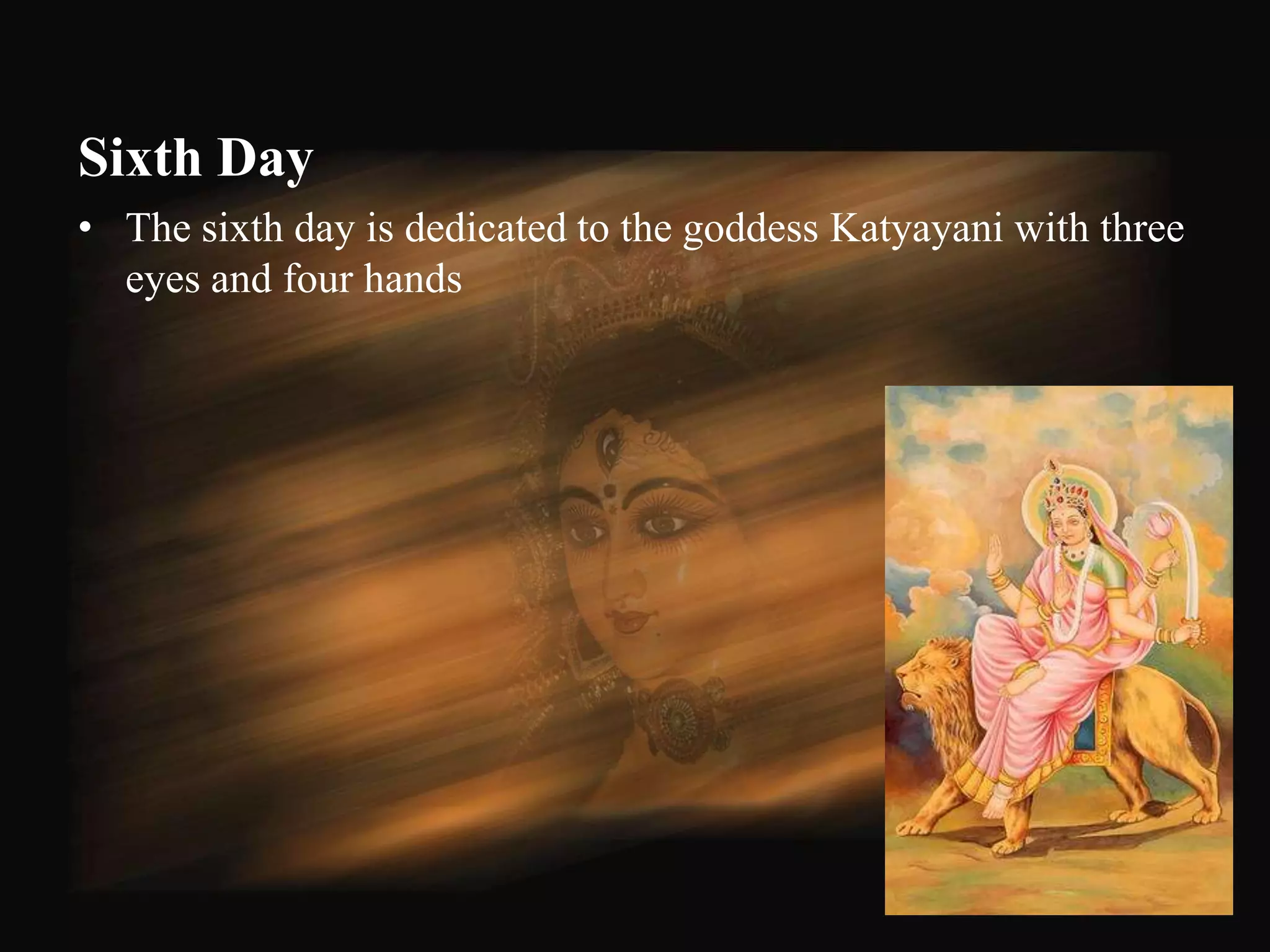
Sixth Day
• The sixth day is dedicated to the goddess Katyayani with three
  eyes and four hands


                                                               54
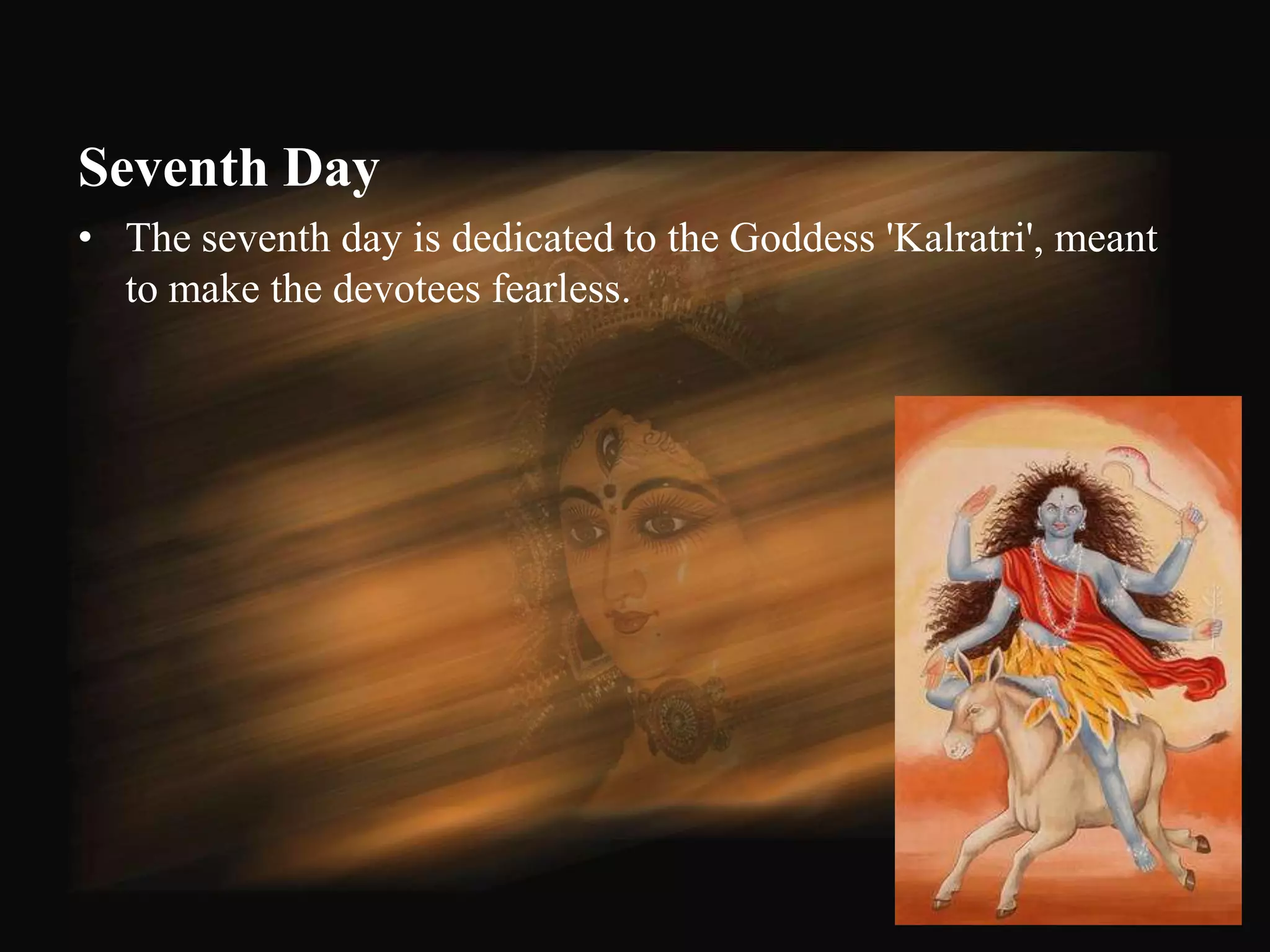
Seventh Day
• The seventh day is dedicated to the Goddess 'Kalratri', meant
  to make the devotees fearless.


                                                                  55
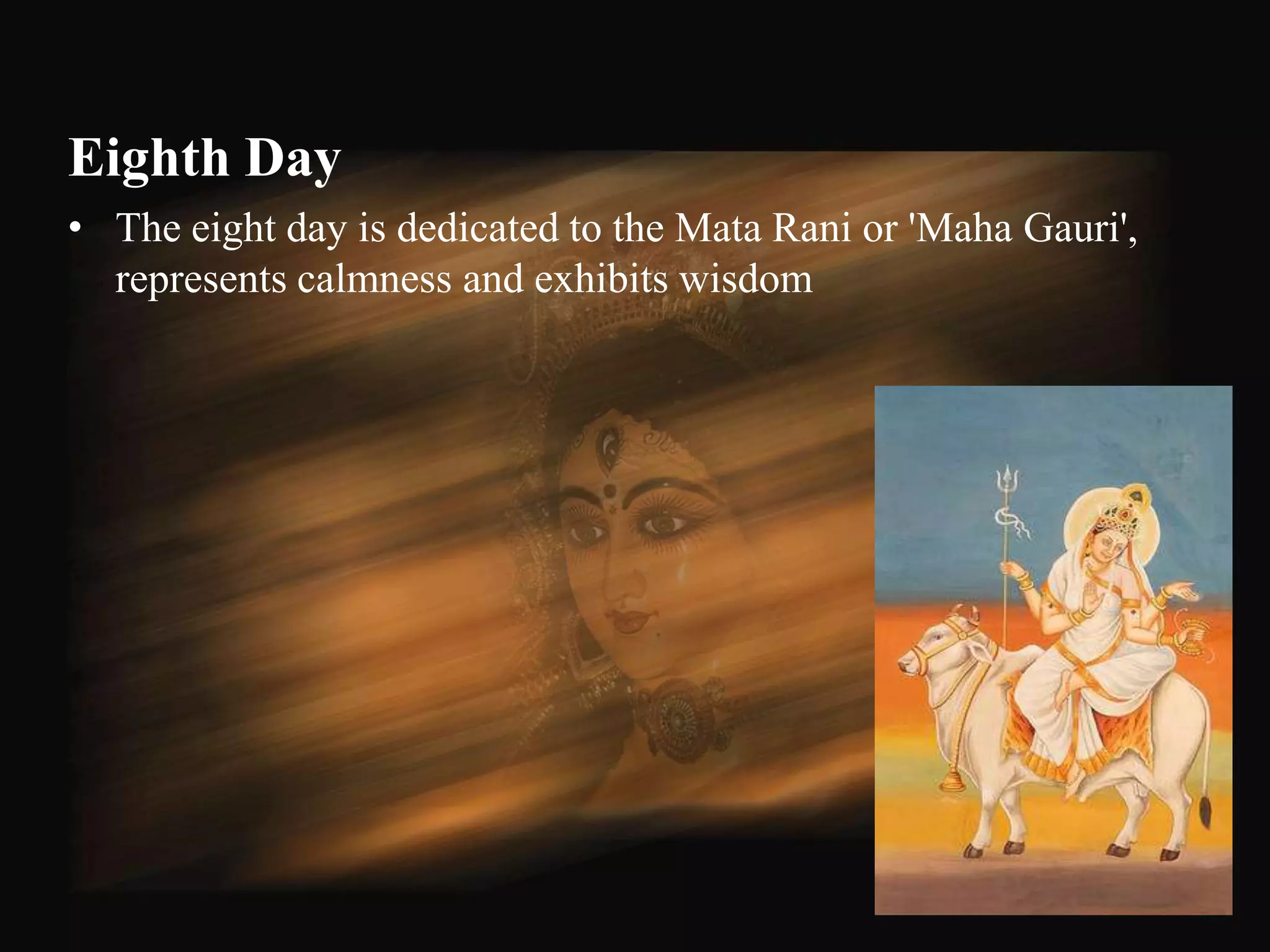
Eighth Day
• The eight day is dedicated to the Mata Rani or 'Maha Gauri',
  represents calmness and exhibits wisdom


                                                                 56
Ninth Day
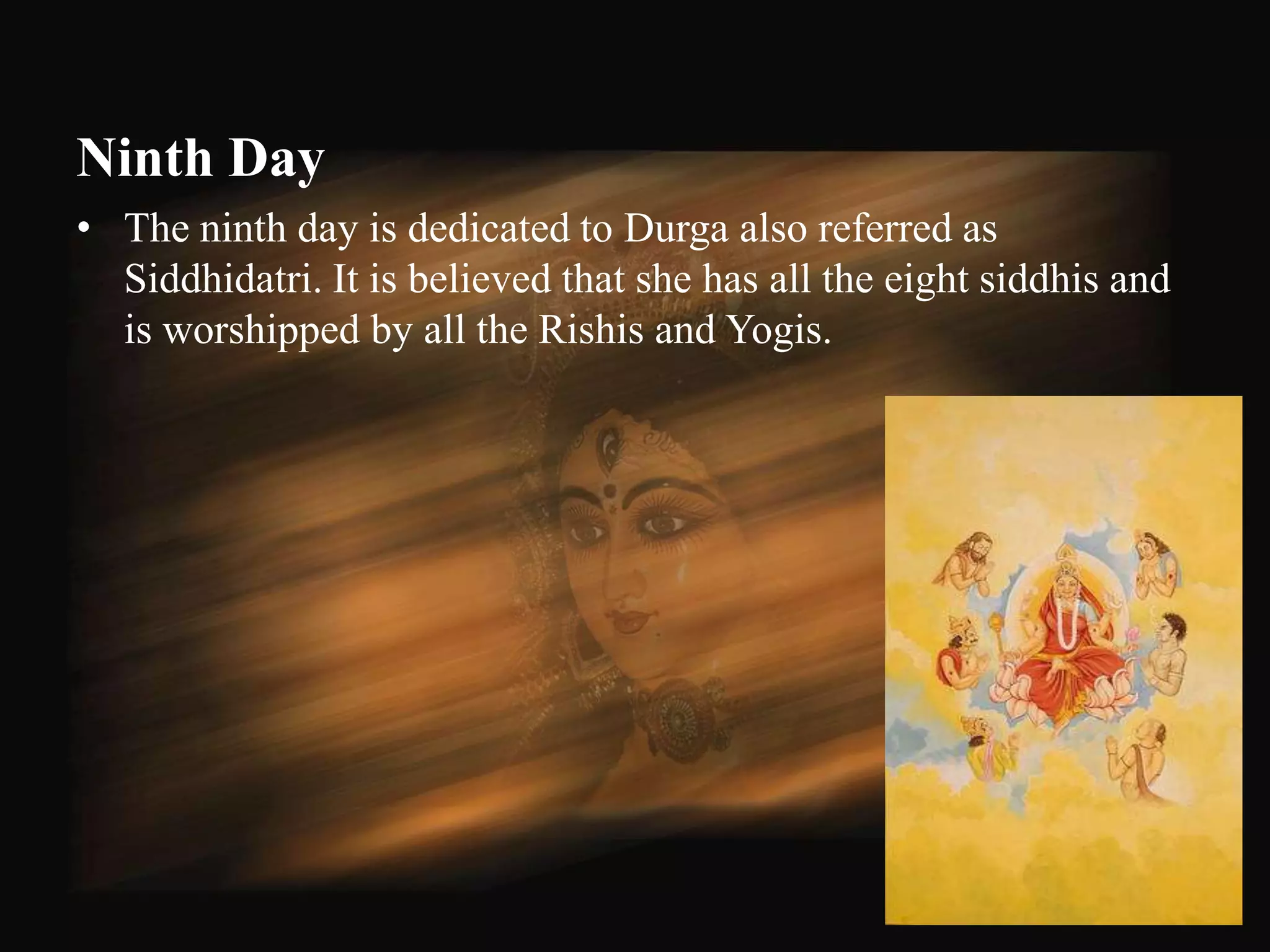
• The ninth day is dedicated to Durga also referred as
  Siddhidatri. It is believed that she has all the eight siddhis and
  is worshipped by all the Rishis and Yogis.


                                                                       57
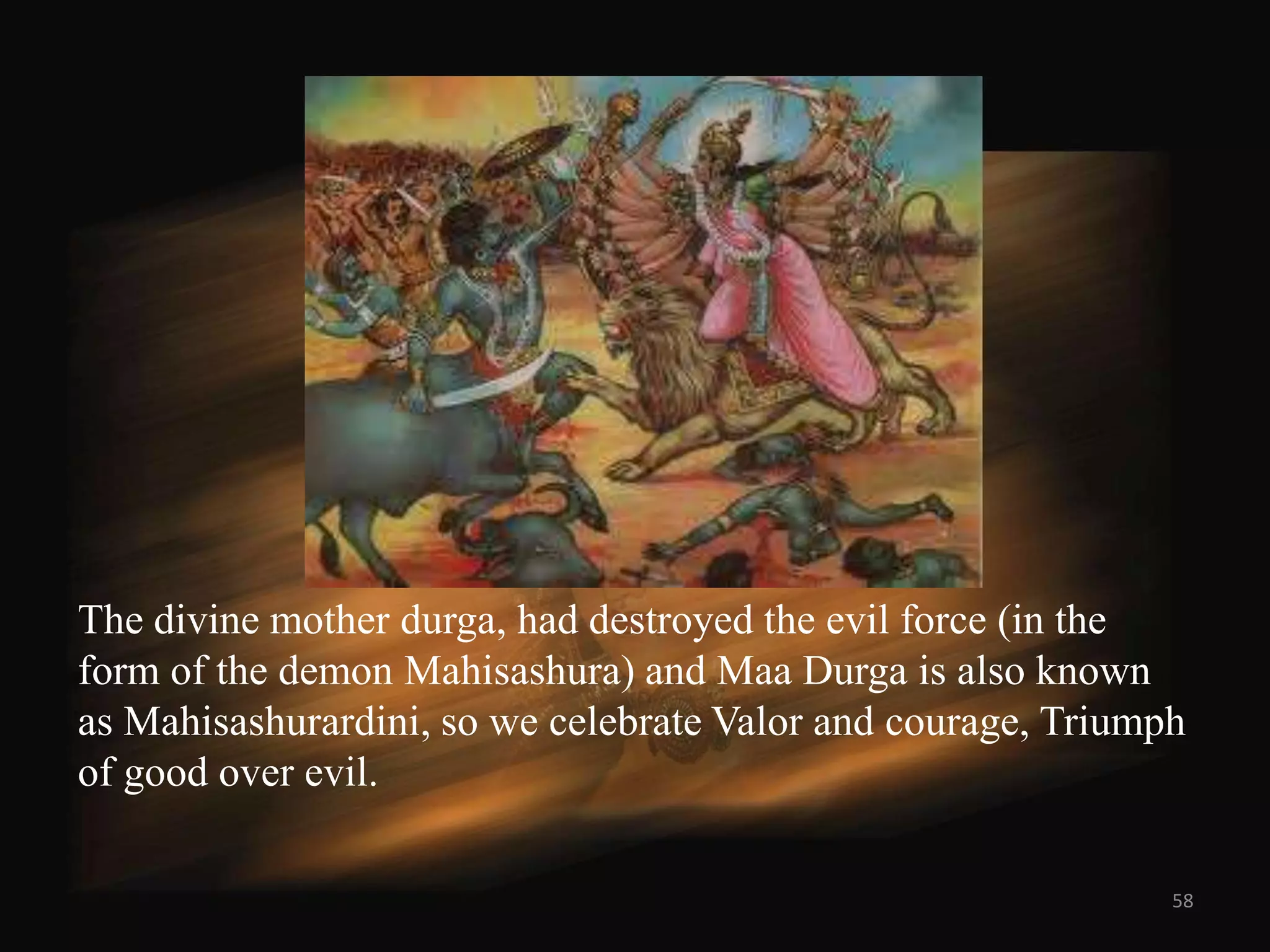
The divine mother durga, had destroyed the evil force (in the
form of the demon Mahisashura) and Maa Durga is also known
as Mahisashurardini, so we celebrate Valor and courage, Triumph
of good over evil.

                                                              58
The Bengali Society
• West Bengal – fourth most populous state of India
• Kolkata served as capital of British India for several years – British
   influence in architecture and society is evident
• Also, intellectual hub of India - Rabindranath Tagore, Swami
   Vivekanad etc
• Religion – 72.5% Hindusim
• Durga Pooja is the biggest festival of the state celebrated over 6
   days
• Tertiary sector biggest contributor to economy – 57.8% of STP
Durga Pooja
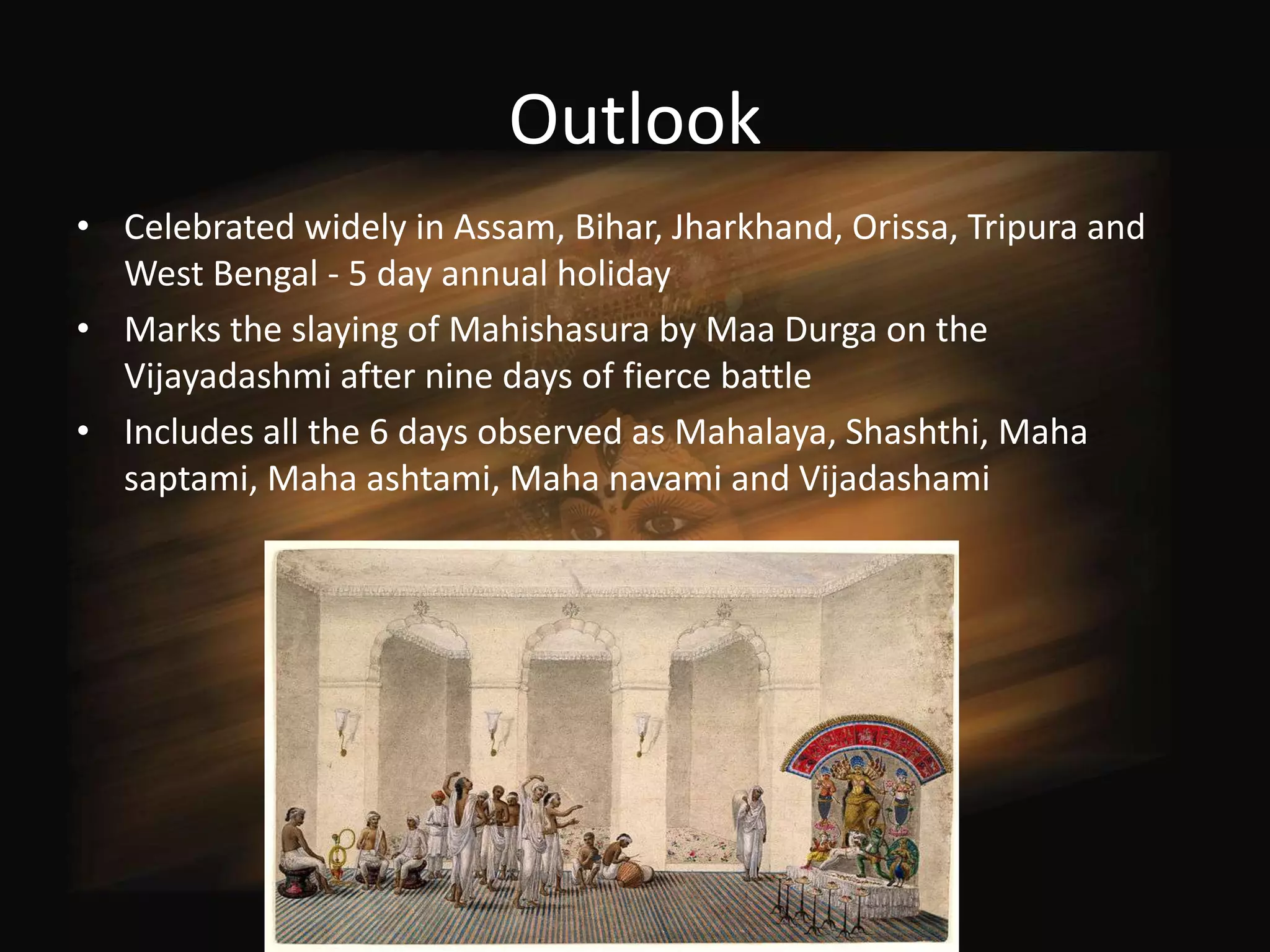
Outlook
• Celebrated widely in Assam, Bihar, Jharkhand, Orissa, Tripura and
  West Bengal - 5 day annual holiday
• Marks the slaying of Mahishasura by Maa Durga on the
  Vijayadashmi after nine days of fierce battle
• Includes all the 6 days observed as Mahalaya, Shashthi, Maha
  saptami, Maha ashtami, Maha navami and Vijadashami
Significance
• Gained importance during British raj

• Reformists identified India with Durga

• Symbol of Indian Independence Movement

• Became an important meeting opportunity for freedom

  fighters

• Identifiable with Dussera celebrations in many parts of the

  country
History
• As per scriptures – actual worship – Chaitra/Basanta

• Popular form Sharadiya (autumnal) – Akal Bodhon

• First such Puja organised in honour of Lord Clive in the year 1757.

• He wanted to thank the lord but lack of a church forced him to take

   part in the local celebrations

• Wealthy mercantile and Zamindar families in Bengal

   made British Officers of the East India Company guests of honour in

   the Pujas.
Customs
• Starts off with the Mahishasurmardini – radio programme

• Pandals housing Durga idols are put up

• At the end of six days, idol is taken for immersion in a
  procession

• Chants of Hope - 'aashchhe bochhor abar ‘ & Durga Maa ki Jai

• Environmental Hazards
Dussehra
• Dasara/ Dussehra is derived from Sanskrit
  Dasha-hara meaning "remover of bad fate"
  meaning remover of ten heads of
  Ravana's.
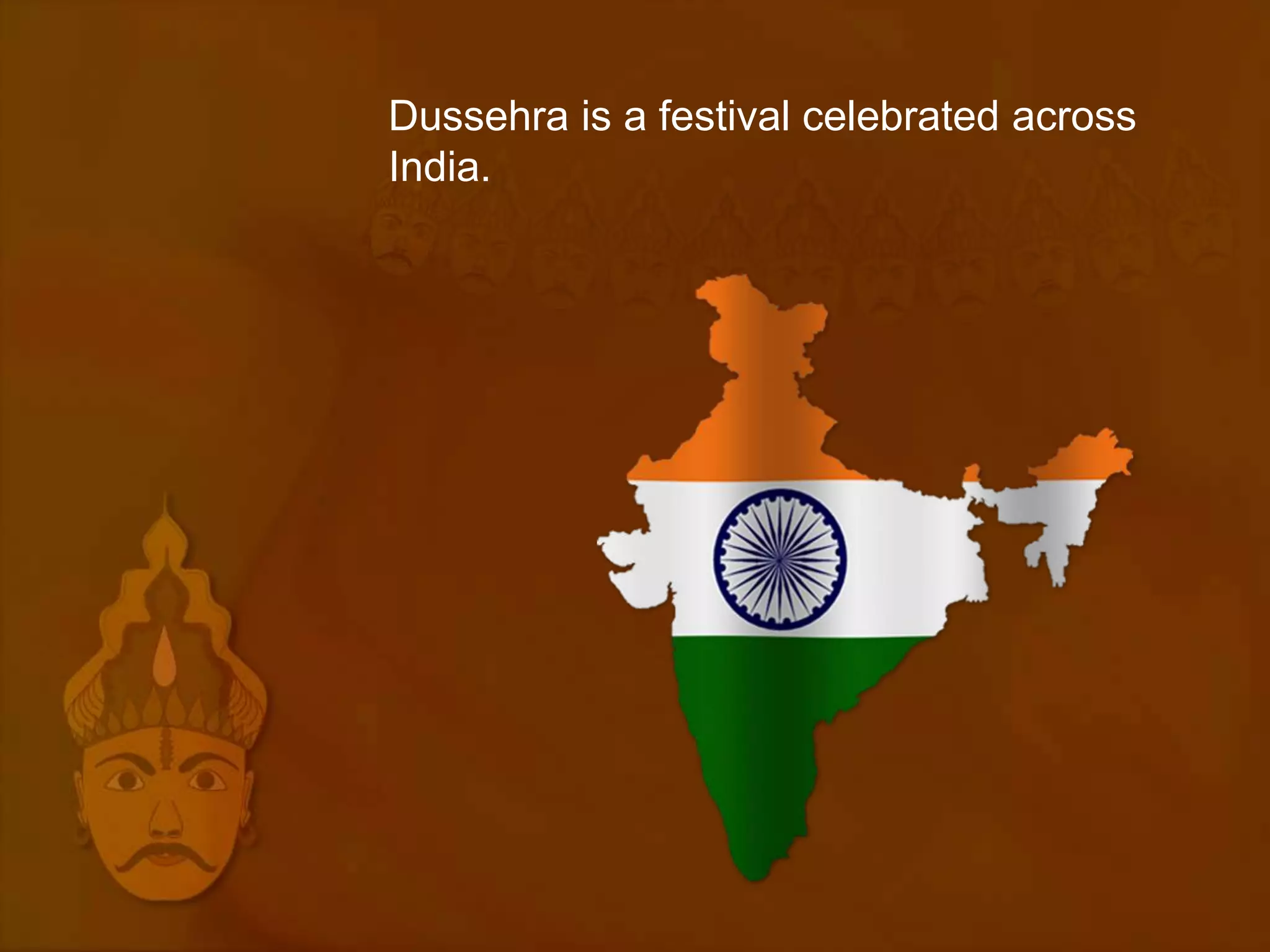
Dussehra is a festival celebrated across
India.
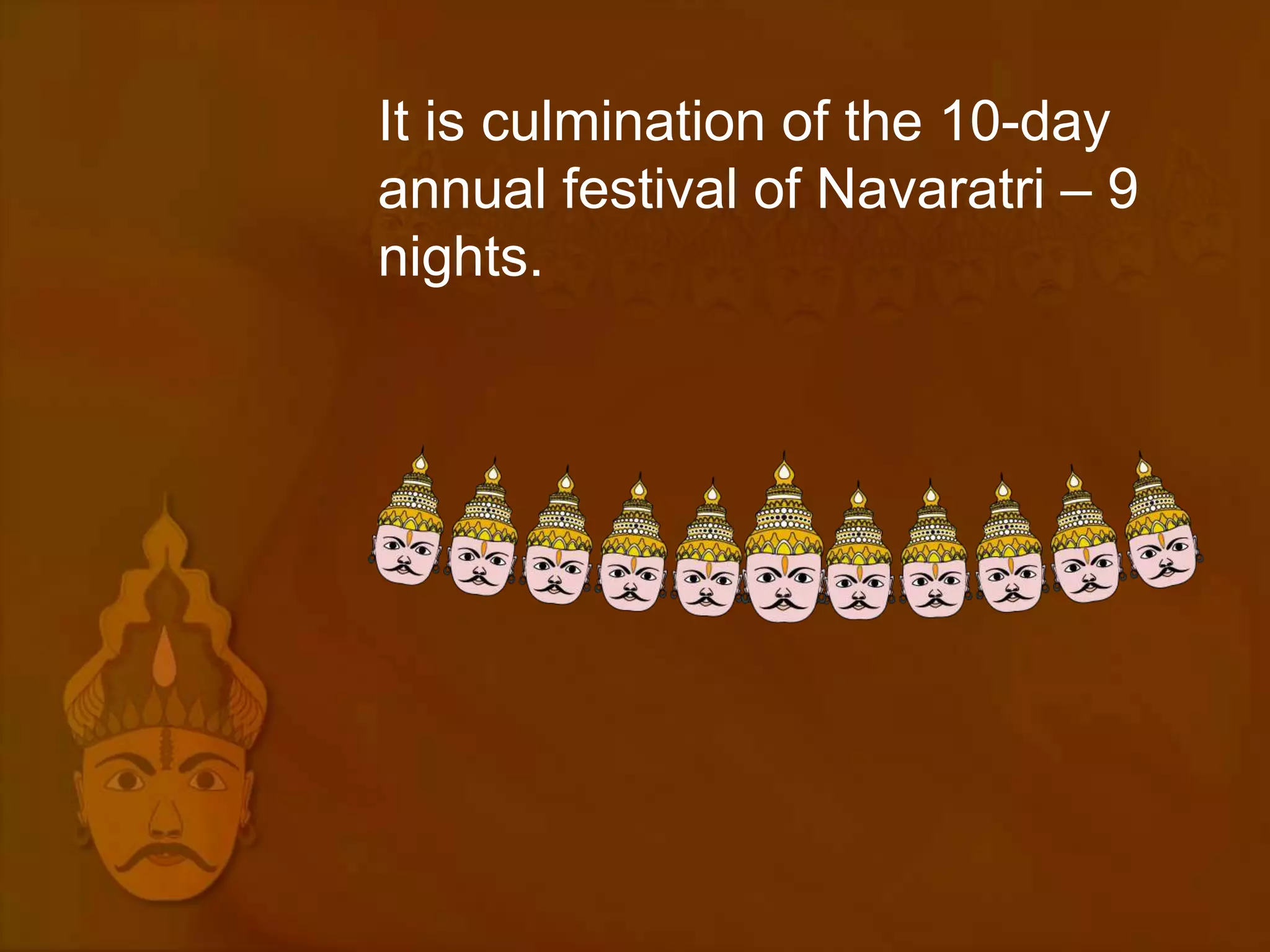
It is culmination of the 10-day
annual festival of Navaratri – 9
nights.
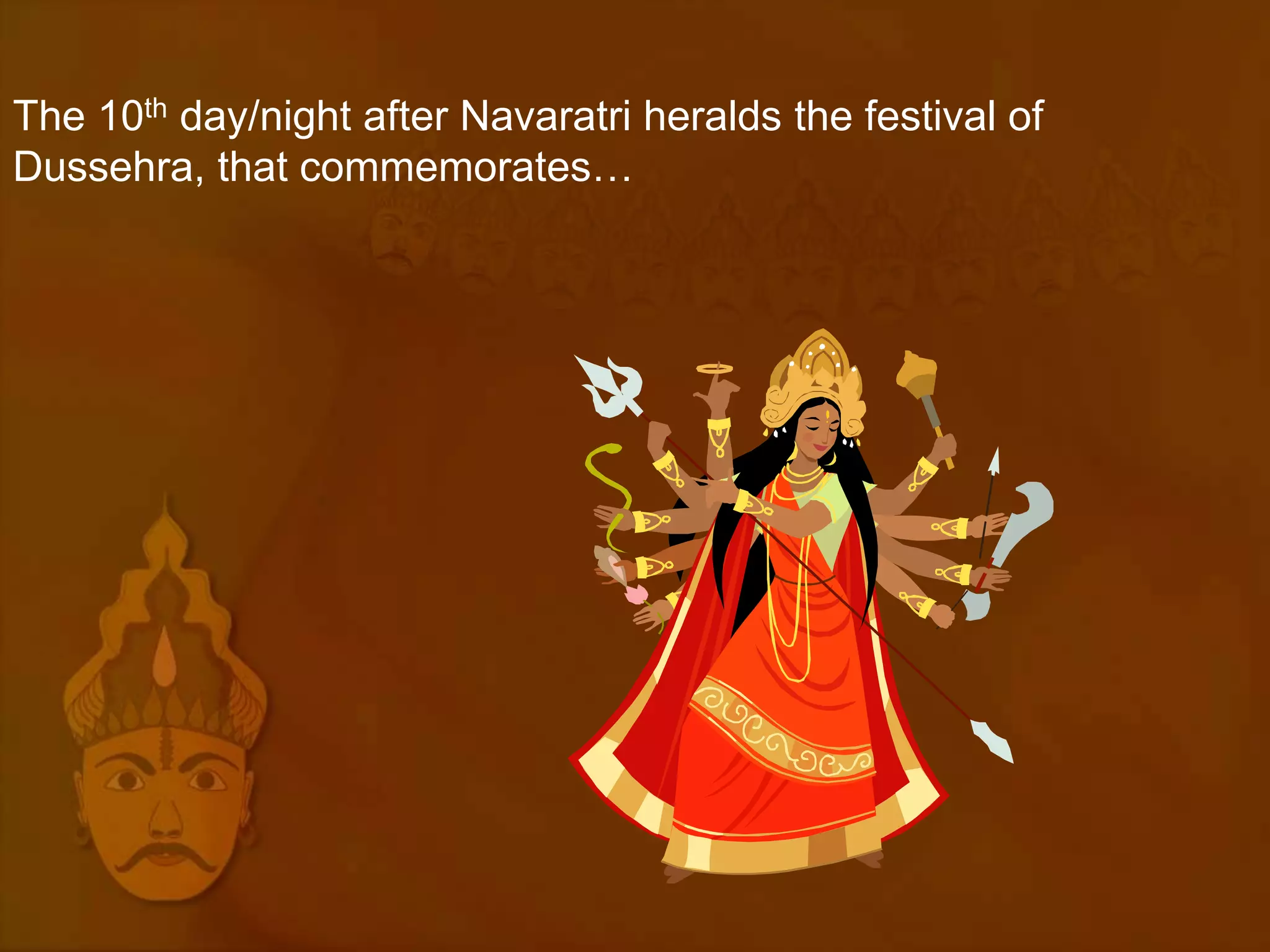
The 10th day/night after Navaratri heralds the festival of
Dussehra, that commemorates…
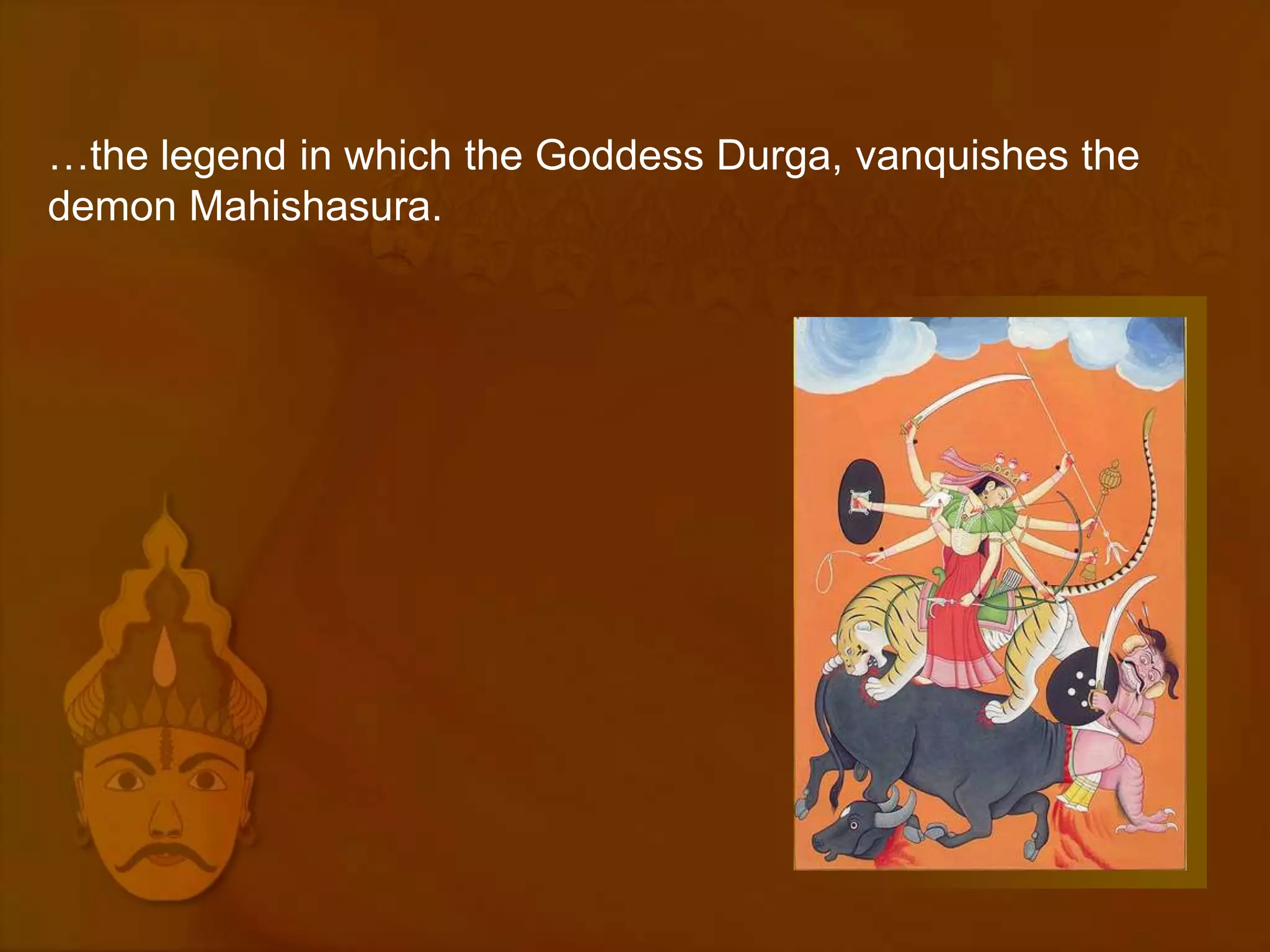
…the legend in which the Goddess Durga, vanquishes the
demon Mahishasura.
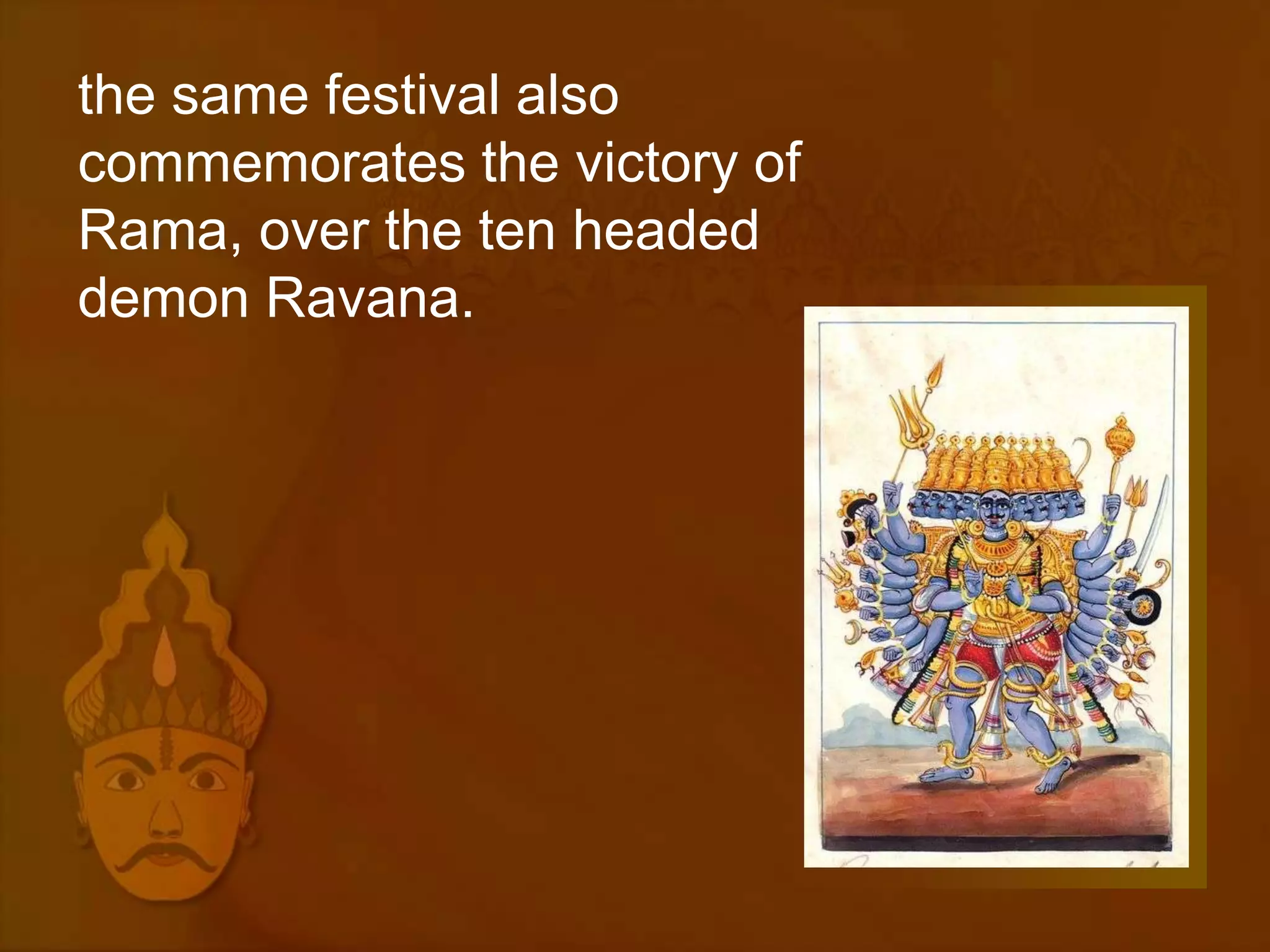
the same festival also
commemorates the victory of
Rama, over the ten headed
demon Ravana.
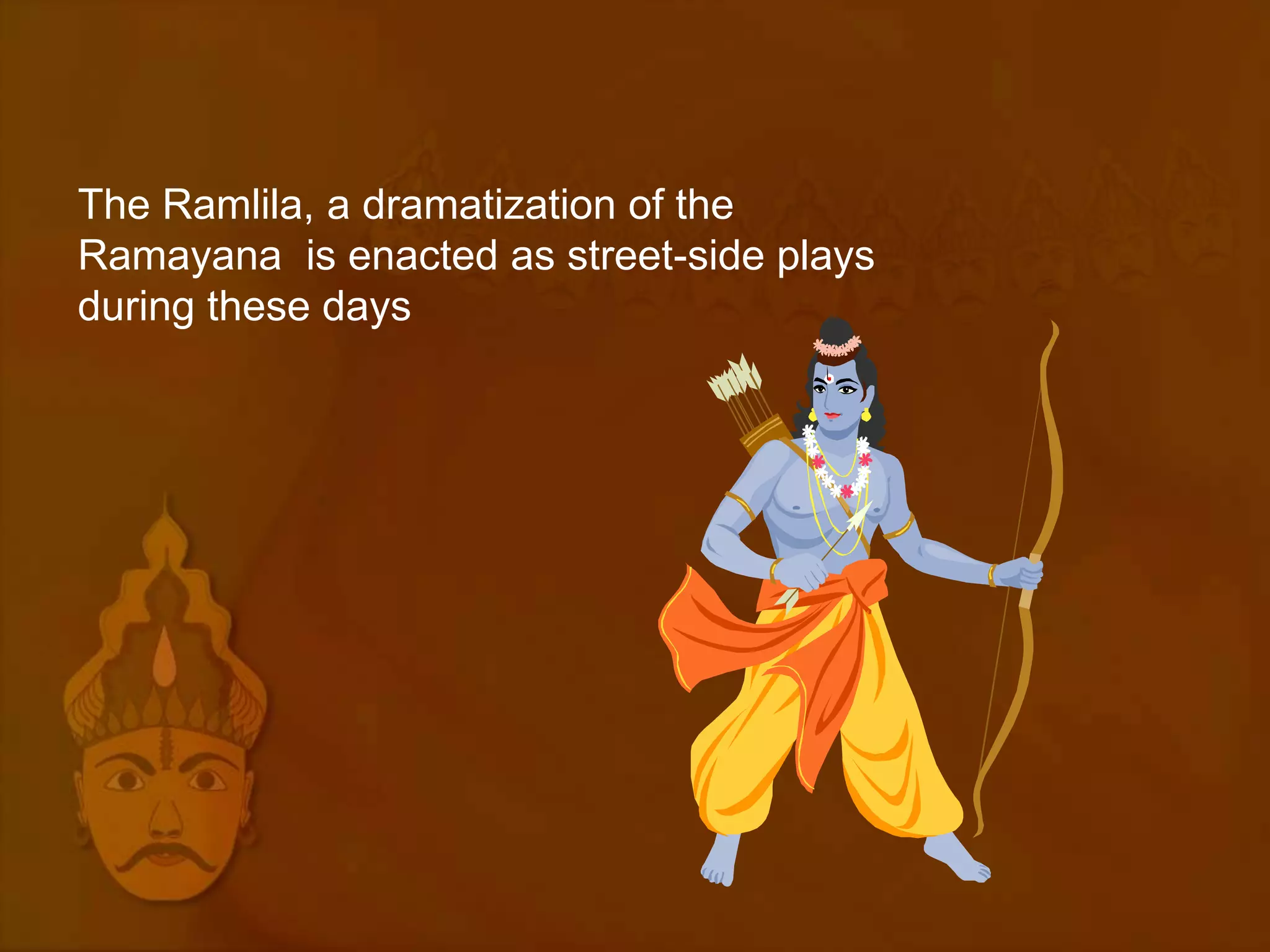
The Ramlila, a dramatization of the
Ramayana is enacted as street-side plays
during these days
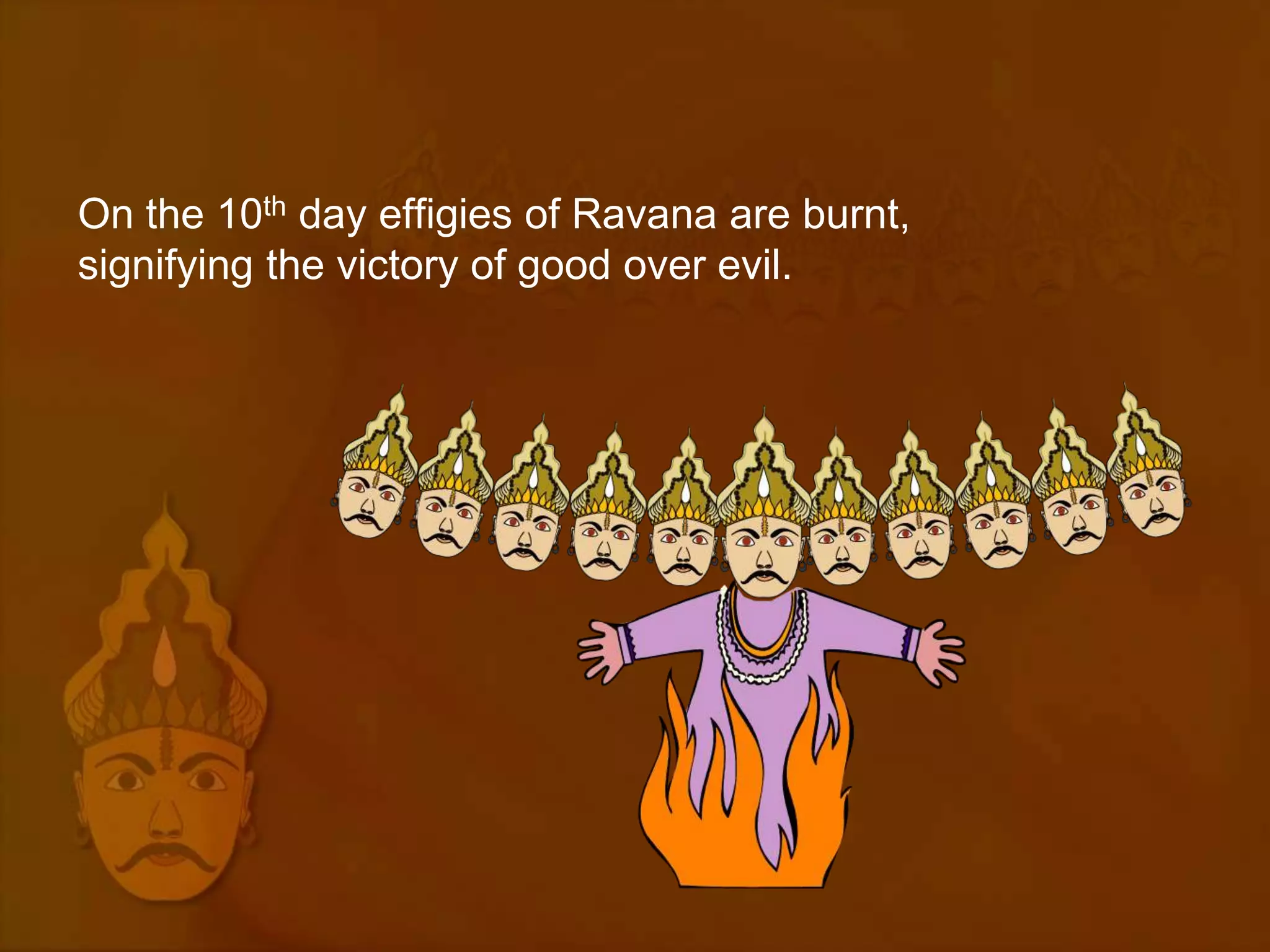
On the 10th day effigies of Ravana are burnt,
signifying the victory of good over evil.
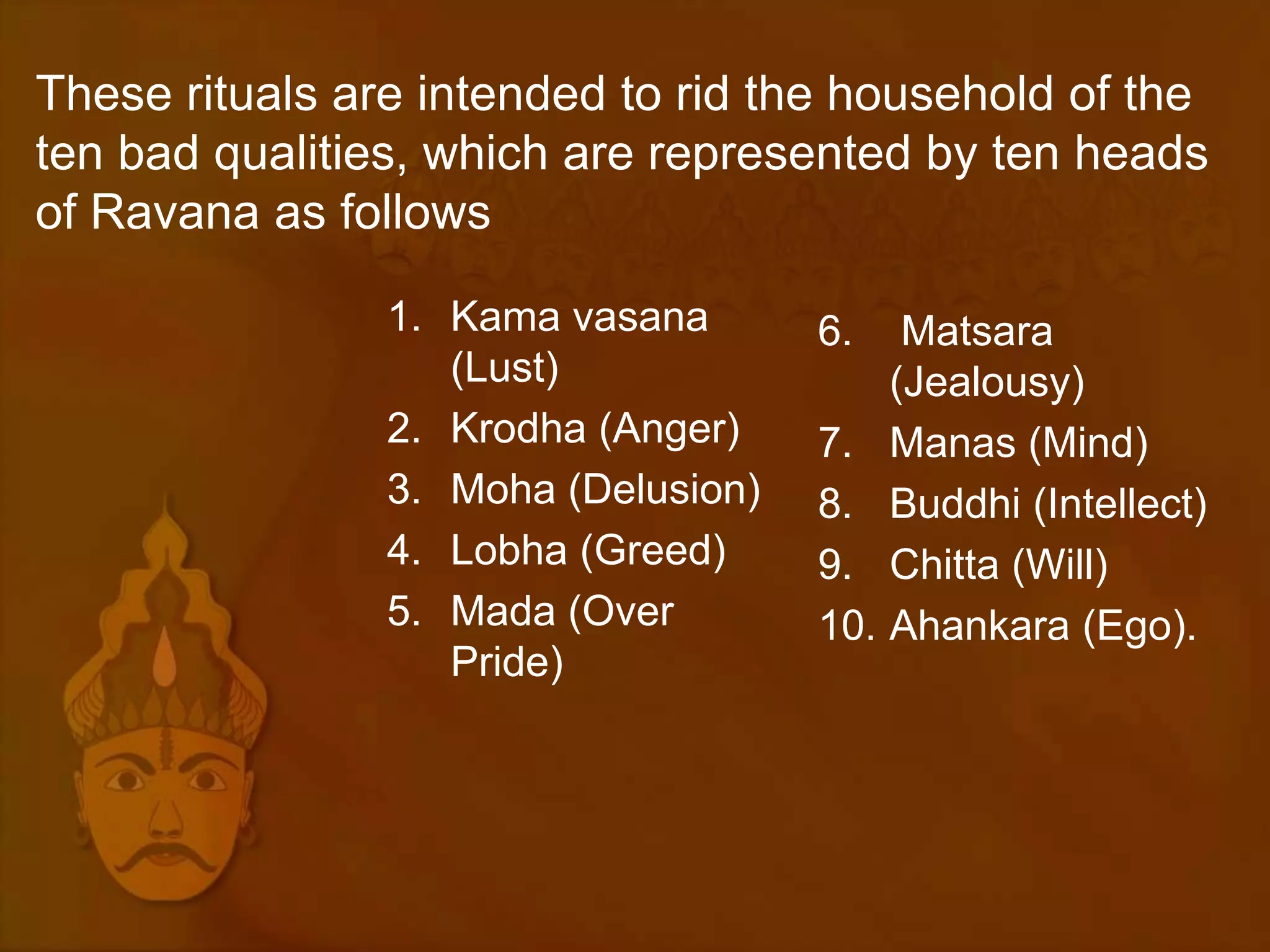
These rituals are intended to rid the household of the
ten bad qualities, which are represented by ten heads
of Ravana as follows

                1. Kama vasana       6.     Matsara
                   (Lust)                  (Jealousy)
                2. Krodha (Anger)    7.    Manas (Mind)
                3. Moha (Delusion)   8.    Buddhi (Intellect)
                4. Lobha (Greed)     9.    Chitta (Will)
                5. Mada (Over        10.   Ahankara (Ego).
                   Pride)
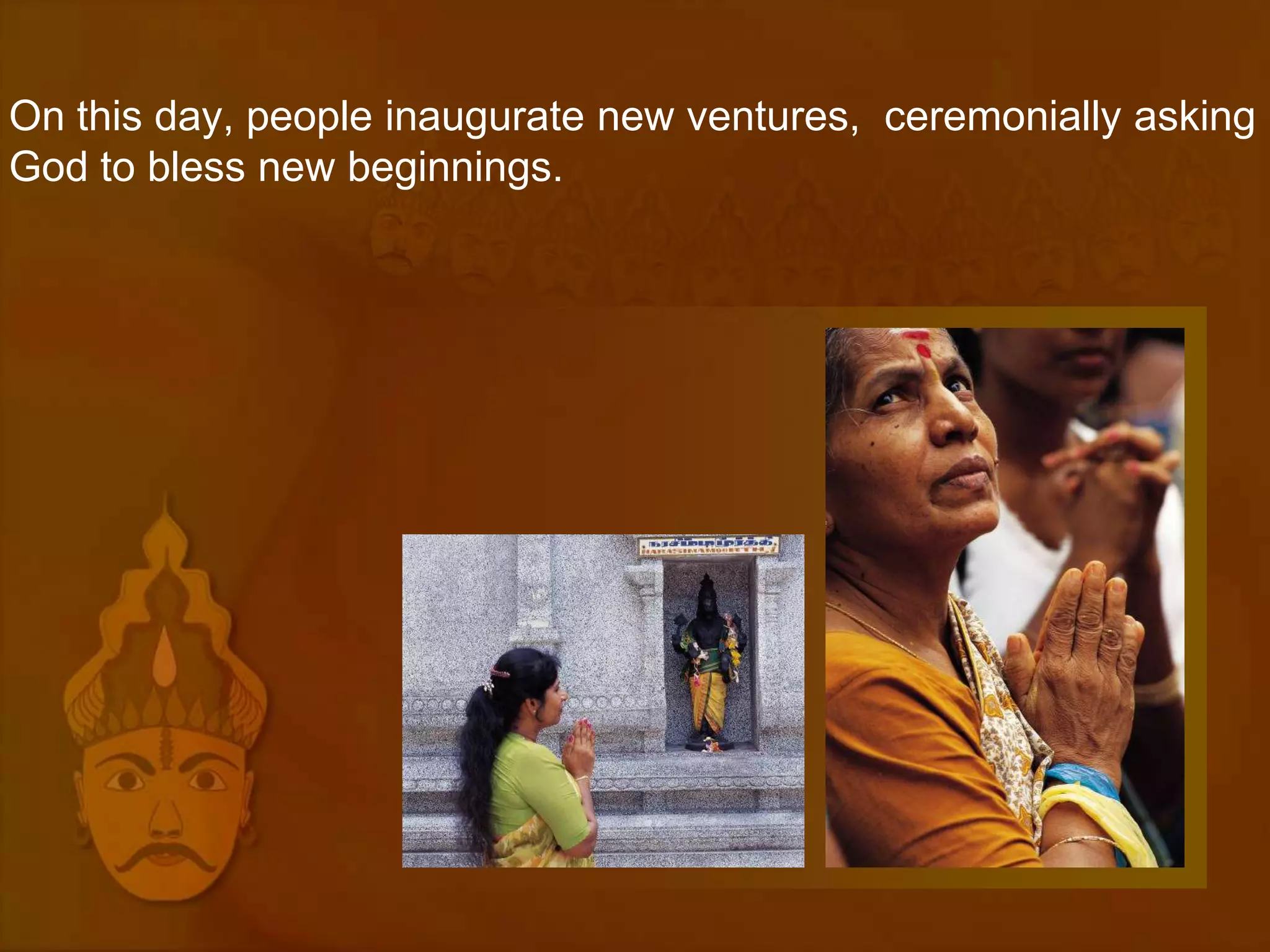
On this day, people inaugurate new ventures, ceremonially asking
God to bless new beginnings.
Significance
•   King Rama's coronation
•   Goddess Lakshmi‟s Birthday
•   Krishna Killed Narakaasur
•   Vishnu Rescued Lakshmi
•   The Return of the Pandavas
•   Special Day for the Sikhs
•   Special Day for the Jains
•   Coronation of Vikramaditya
•   Special Day for the Arya Samaj
•   Hindu New Year day
•   Harvest Festival
A Five Days Festival
• Day 1: Dhanteras

• Day 2: Choti Diwali / Naraka Chaturdashi / Kali Chaudas

• Day 3: Diwali / Lakshmi Puja

• Day 4: Padwa / Bali Pratipada / Govardhan Puja /Annakoot

• Day 5: Bhaiduj
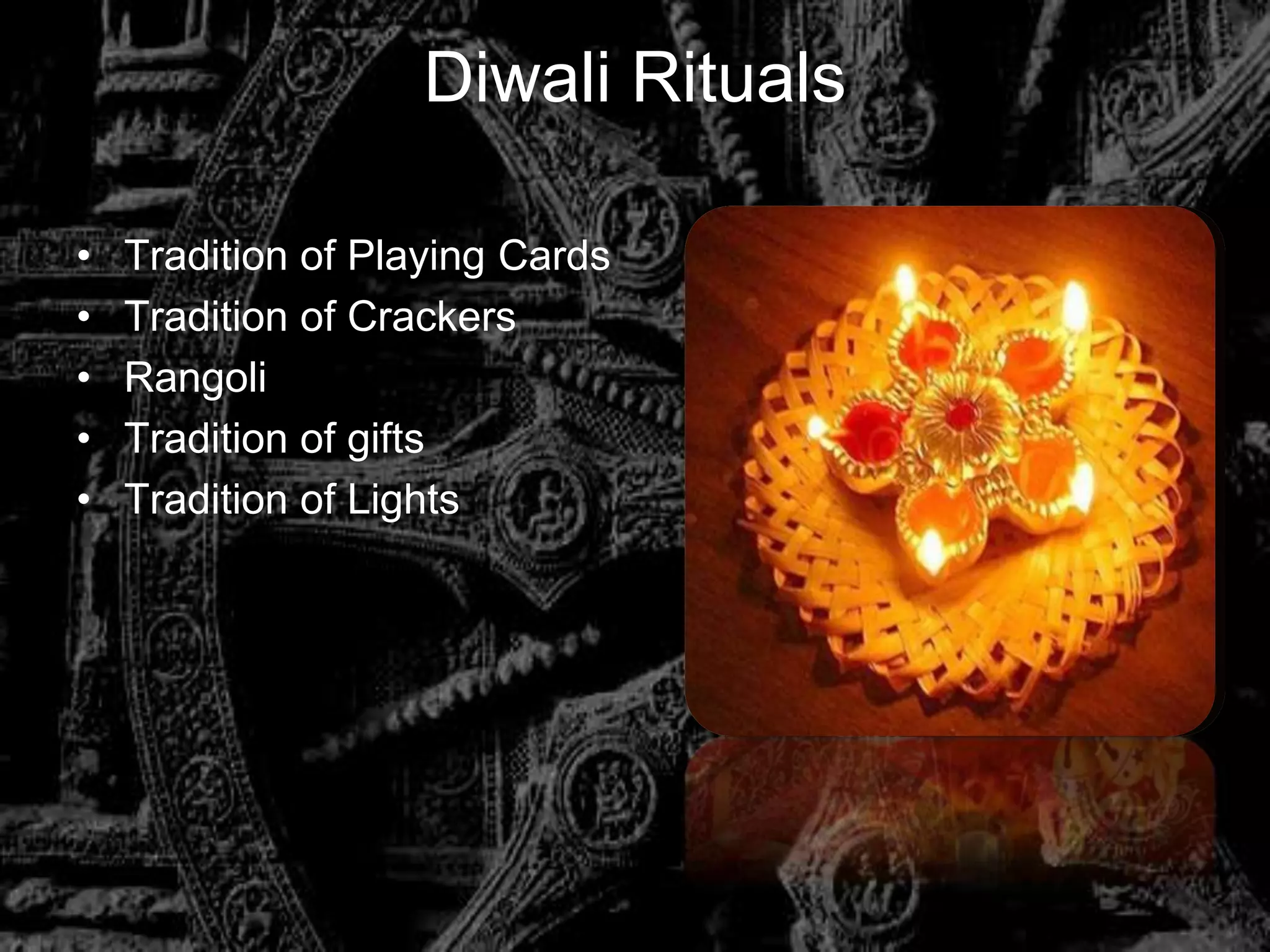
Diwali Rituals

•   Tradition of Playing Cards
•   Tradition of Crackers
•   Rangoli
•   Tradition of gifts
•   Tradition of Lights
ISLAM
• Islam is religion of peace
• Islam means „submission to God‟, „peace‟ and „way of
  peace‟
• based on Holy Quran and sunnat (saying) of Holly
  Prophet Muhammad
• Islam is the second largest religion
• There are two main sects in religion of Islam i.e. Sunni
  and Shia
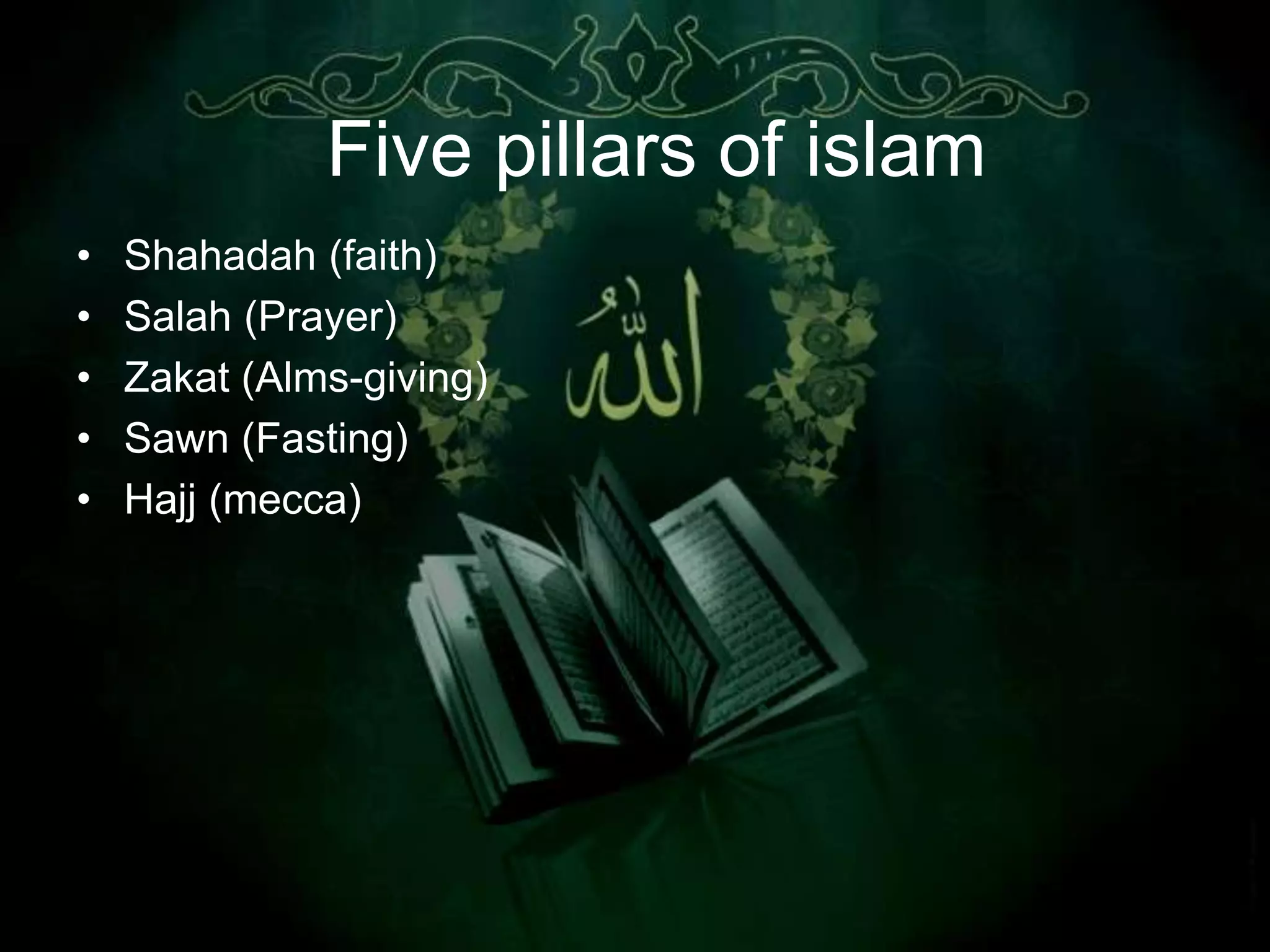
Five pillars of islam
•   Shahadah (faith)
•   Salah (Prayer)
•   Zakat (Alms-giving)
•   Sawn (Fasting)
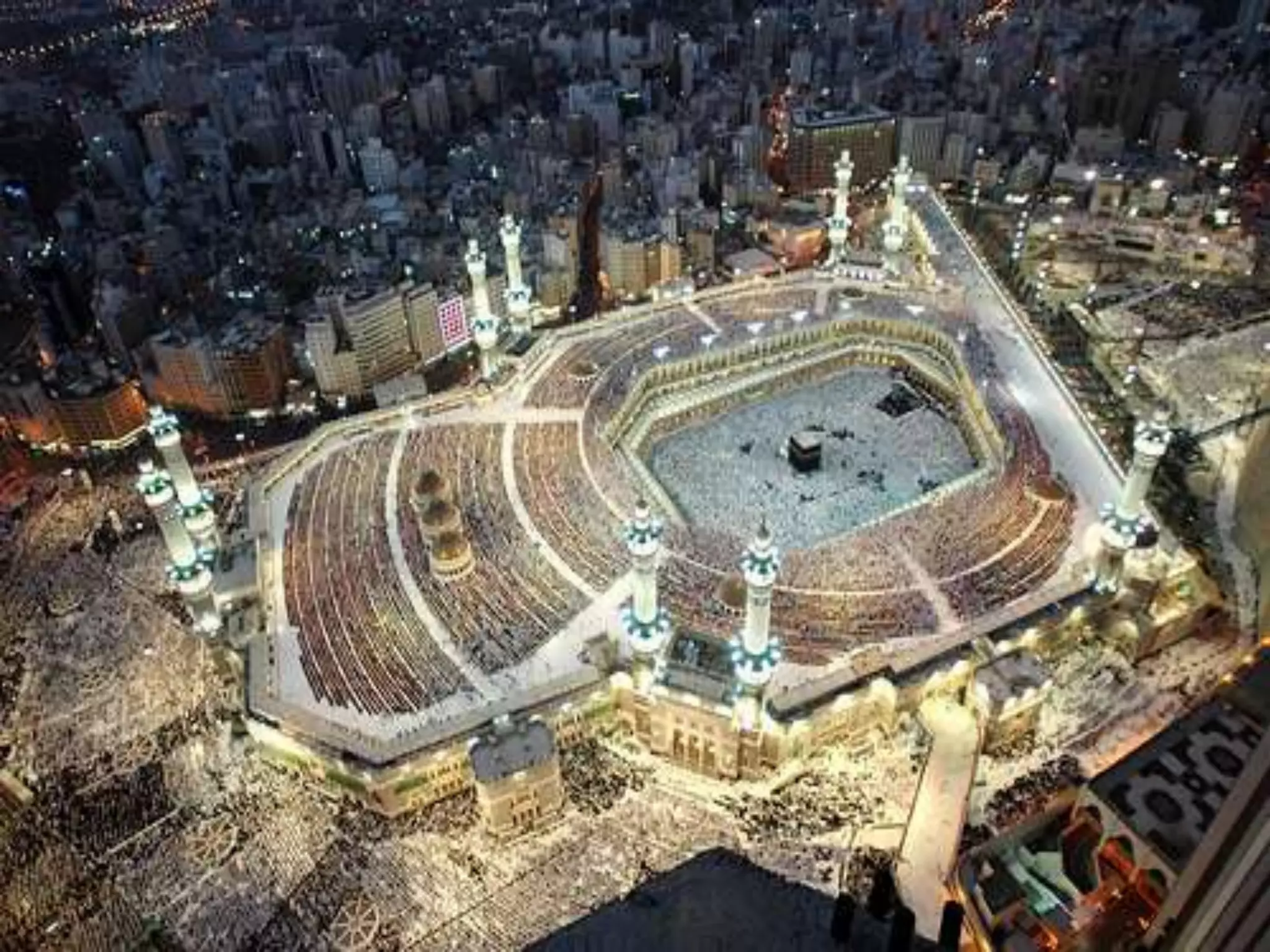
•   Hajj (mecca)
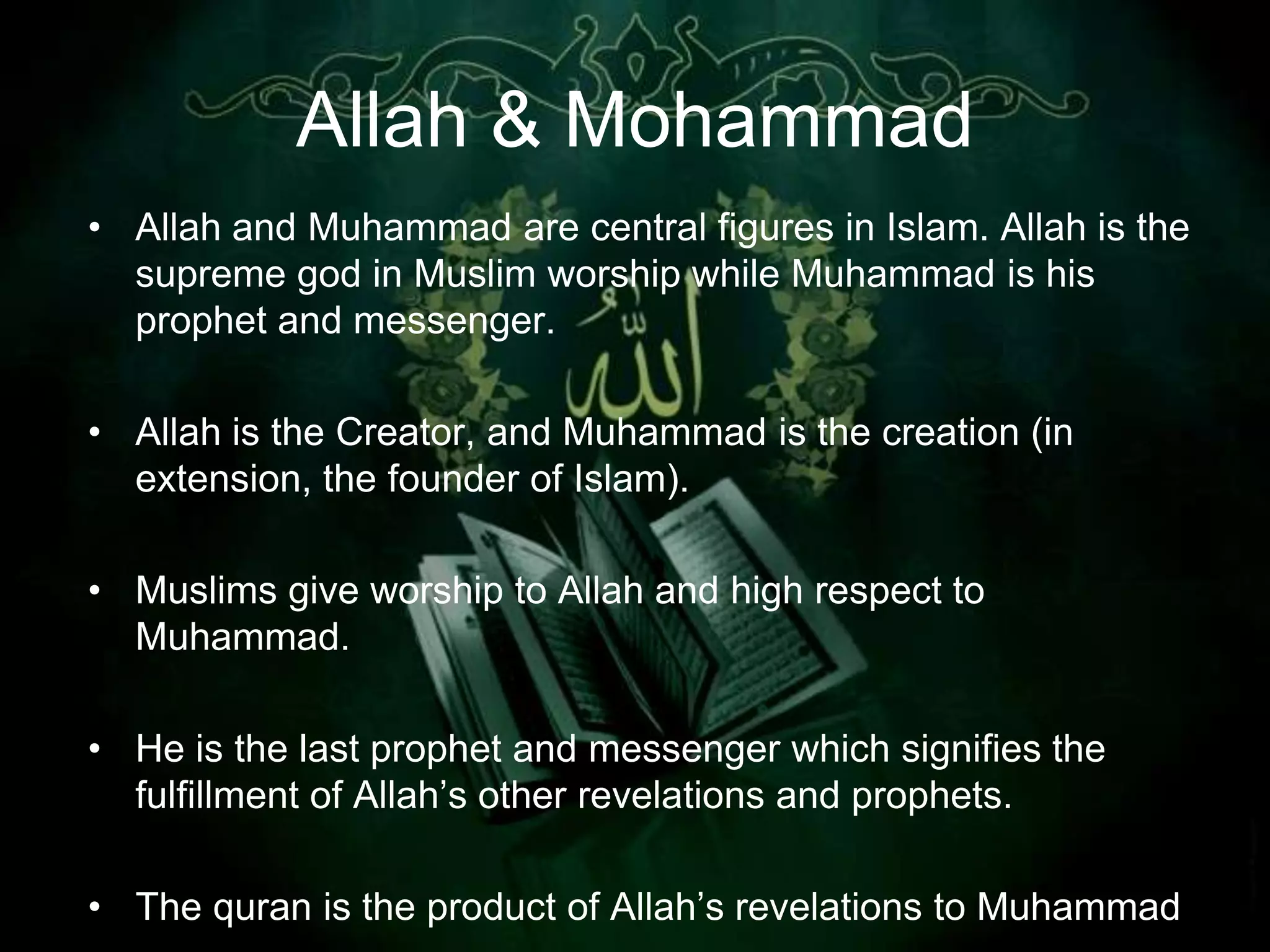
Allah & Mohammad
• Allah and Muhammad are central figures in Islam. Allah is the
  supreme god in Muslim worship while Muhammad is his
  prophet and messenger.

• Allah is the Creator, and Muhammad is the creation (in
  extension, the founder of Islam).

• Muslims give worship to Allah and high respect to
  Muhammad.

• He is the last prophet and messenger which signifies the
  fulfillment of Allah‟s other revelations and prophets.

• The quran is the product of Allah‟s revelations to Muhammad
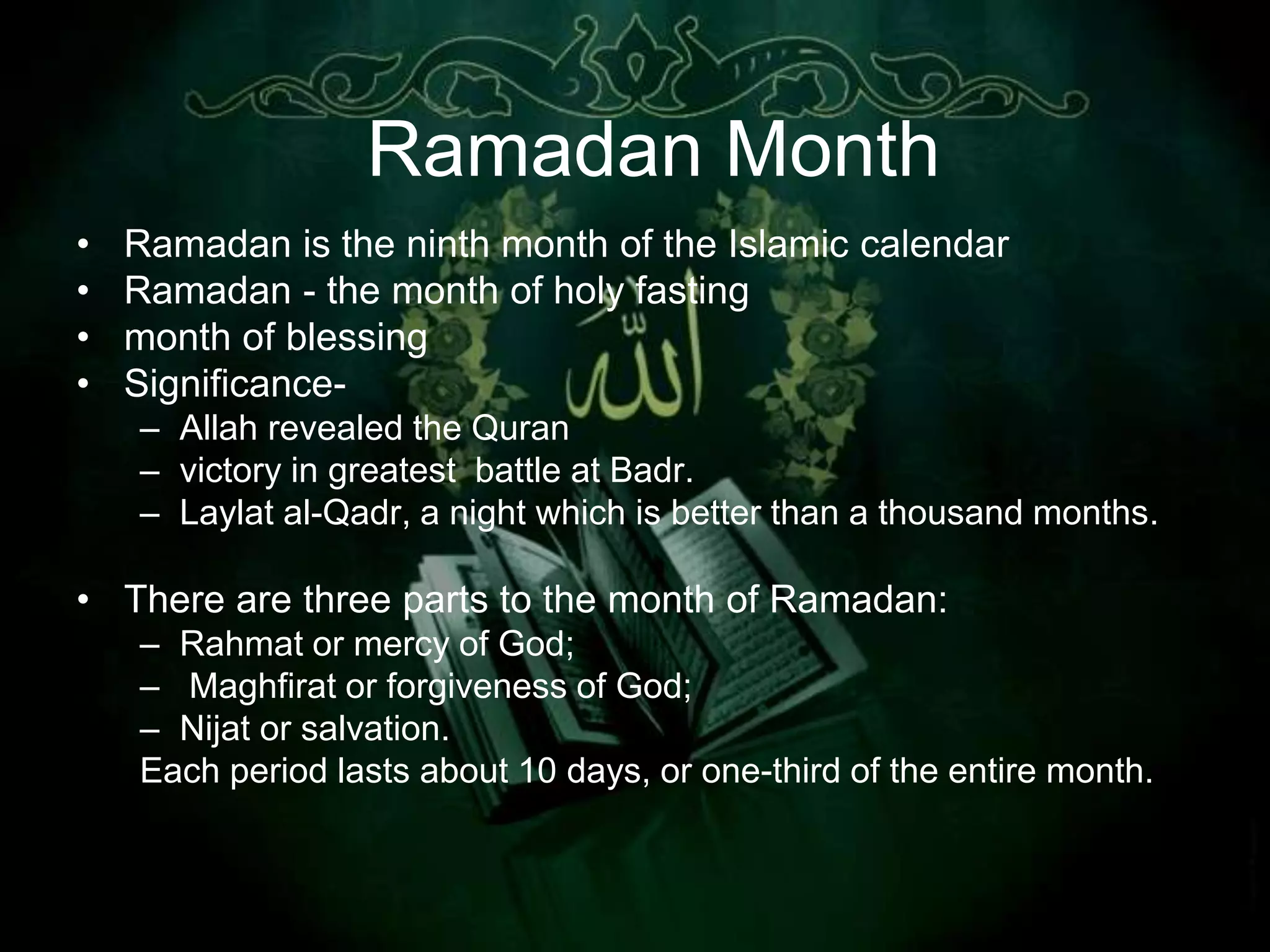
Ramadan Month
•   Ramadan is the ninth month of the Islamic calendar
•   Ramadan - the month of holy fasting
•   month of blessing
•   Significance-
    – Allah revealed the Quran
    – victory in greatest battle at Badr.
    – Laylat al-Qadr, a night which is better than a thousand months.

• There are three parts to the month of Ramadan:
    – Rahmat or mercy of God;
    – Maghfirat or forgiveness of God;
    – Nijat or salvation.
    Each period lasts about 10 days, or one-third of the entire month.
A practices during Ramadan
•   Fasting
•   Prayer and Reading of quran
•   Iftar
•   Charity
•   Laylat al-Qadr
Eid ul fitr
• "Festival of Breaking the Fast“

• EID-UL-FITR is celebrated on the first day of Shaw'waal, at the
  completion of Ramadan.

• Many Muslims may also prepare festive meals to share, wear new
  clothes, visit relatives and give presents to children. Cards can also
  be sent, often featuring the words “Eid Mubbarak”

• The devotees gather in the mosques to pray, friends and relatives
  meet and exchange greetings. Prayers, family get-togethers and
  feasts are the major highlights of the festival.

• A time for increased religious devotion and self-examination.
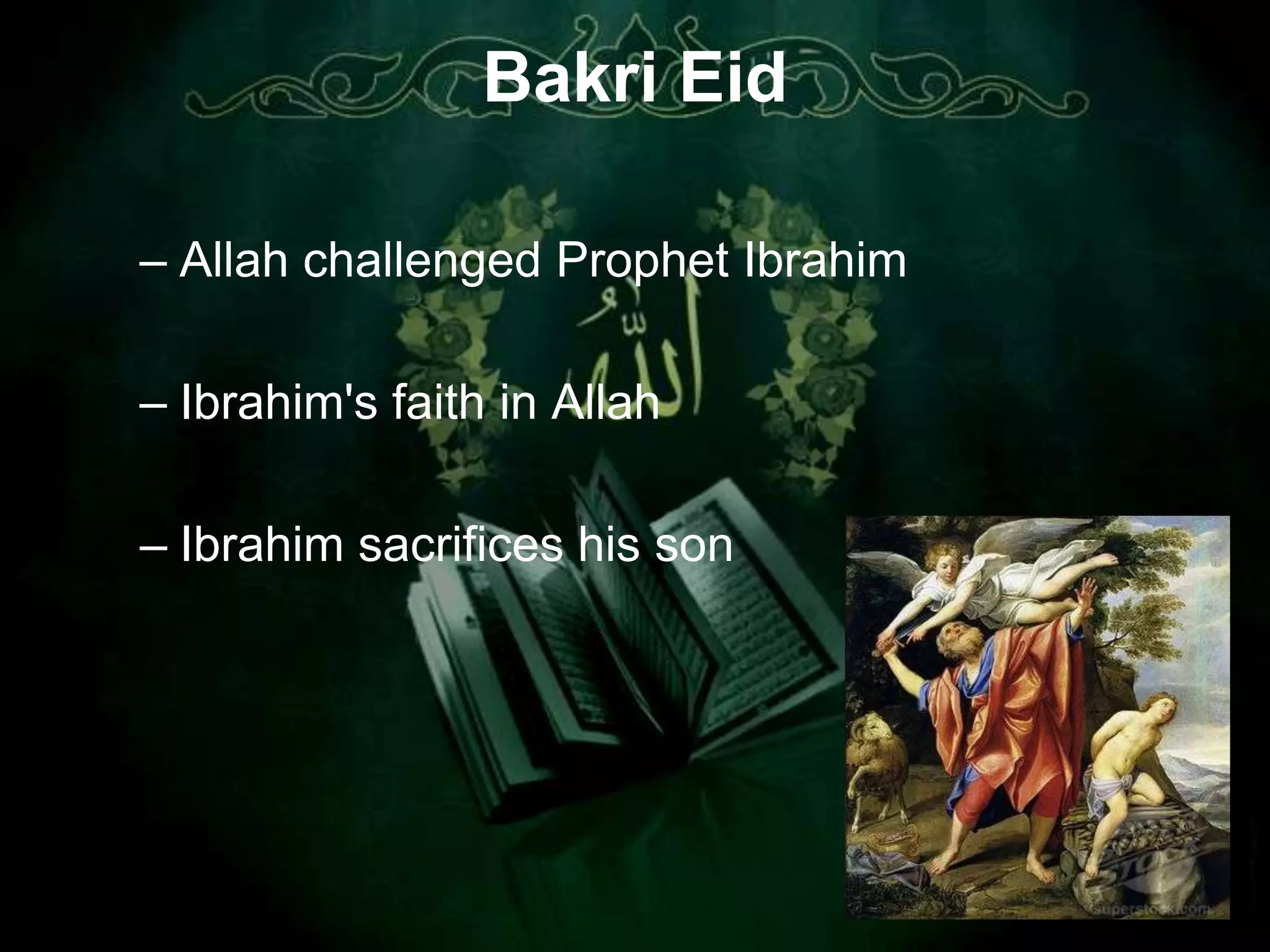
Bakri Eid

– Allah challenged Prophet Ibrahim

– Ibrahim's faith in Allah

– Ibrahim sacrifices his son
Eid al adha

• The month of Dhul Hijja. (10th day)

• Eid-Ul-Adha (the Feast of Sacrifice or Day
  of Sacrifice) is observed after the Hajj - the
  annual pilgrimage to Makkah (Mecca) in
  Saudi Arabia.
Christmas
Christmas celebrates the birth of Jesus Christ,
who according to the Christian religion, is the
son of God and the founder of the Christian
religion
Christmas
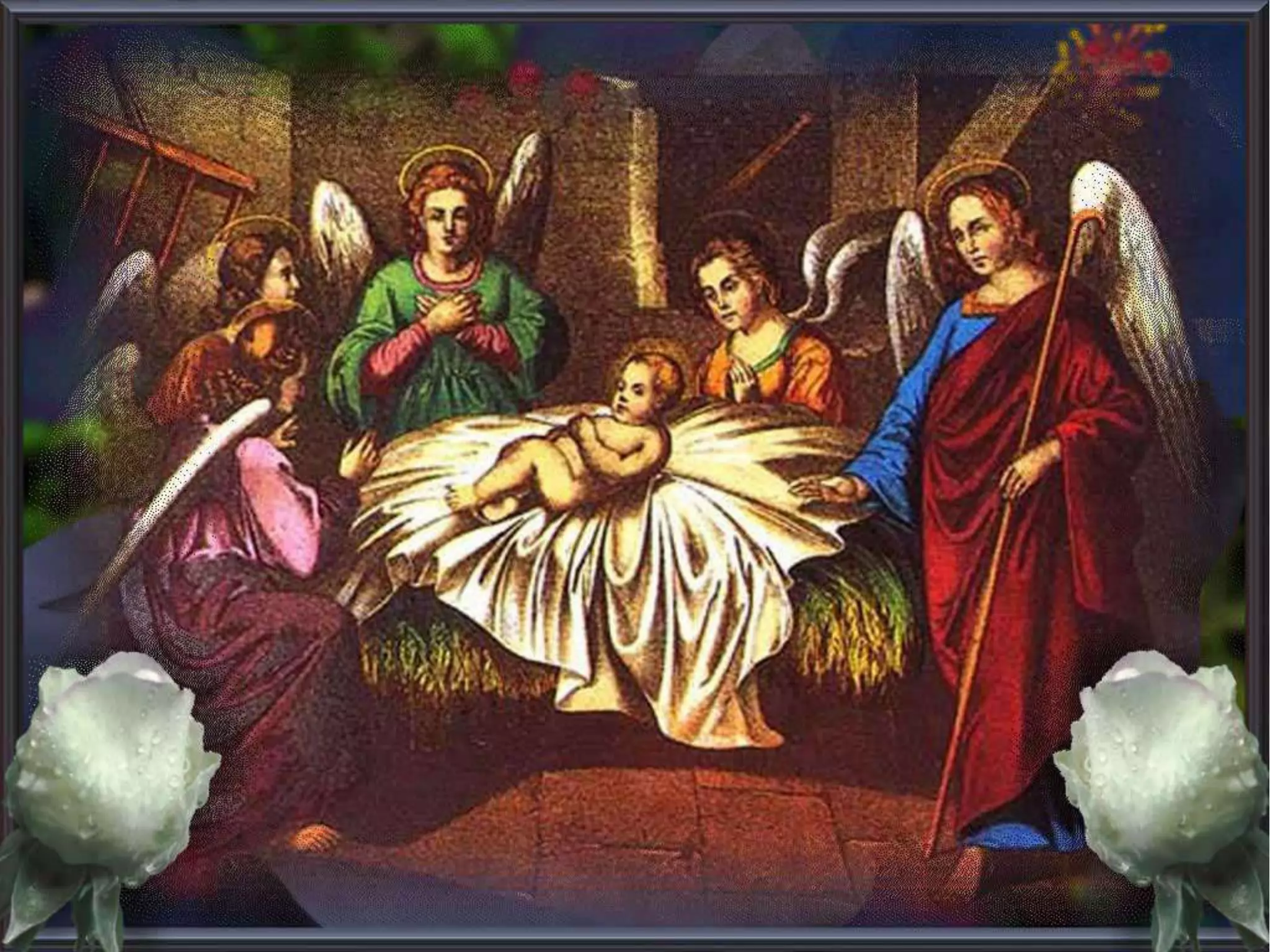
Joseph and Mary had to travel to Bethlehem,
the native village of Joseph, because of the
census ordered by Caesar.
Finding no place to sleep in Bethlehem, Mary
gave birth in a stable.
Christmas
 Choice of the date
      • Pagan celebration for Mithra, persian god of light
      • Day of the winter solstice
      • In 330, the roman emperor Constantine decided to
        establish Christmas on the 25th of December to
        counter the pagan celebration
      • The real birth of Jesus Christ happened in the year 7 or
        8 BC
      • The festival is celebrated as a mark of respect to Lord
        Jesus, who is considered as the son of God and founder
        of the Christian religion
Christmas
 Etymology:
     – Latin languages: Noel, Natale, Navidad come from
       « de natalis » (day of birth)
     – English: Cristes Maesse, ‘ mass of christ ’
 Meaning of the symbols
   • Christmas crib: representation of Jesus’ birth
   • Advent: liturgical period to prepare the arrival of Jesus
   • Midnight mass
Jesus came to earth,
      To show us how to live,
      How to put others first,
    How to love and how to give.
    Then He set about His work,
     That God sent Him to do;
He took our punishment on Himself;
     He made us clean and new.
   He could have saved Himself,
     Calling angels from above,
But He chose to pay our price for sin;
       He paid it out of love.
Our Lord died on Good Friday,
  But the cross did not destroy
His resurrection on Easter morn
 That fills our hearts with joy.
Now we know our earthly death,
     Like His, is just a rest.
   We'll be forever with Him
 In heaven, where life is best.
 So we live our lives for Jesus,
  Think of Him in all we do.
 Thank you Savior; Thank you
              Lord.
     Help us love like you!
Significance
• Humanity receives its new lease on life, its liberation from
  both death and, thus, the fear of death.

• If Christ didn't rise from the dead, then there is no
  justification for our faith
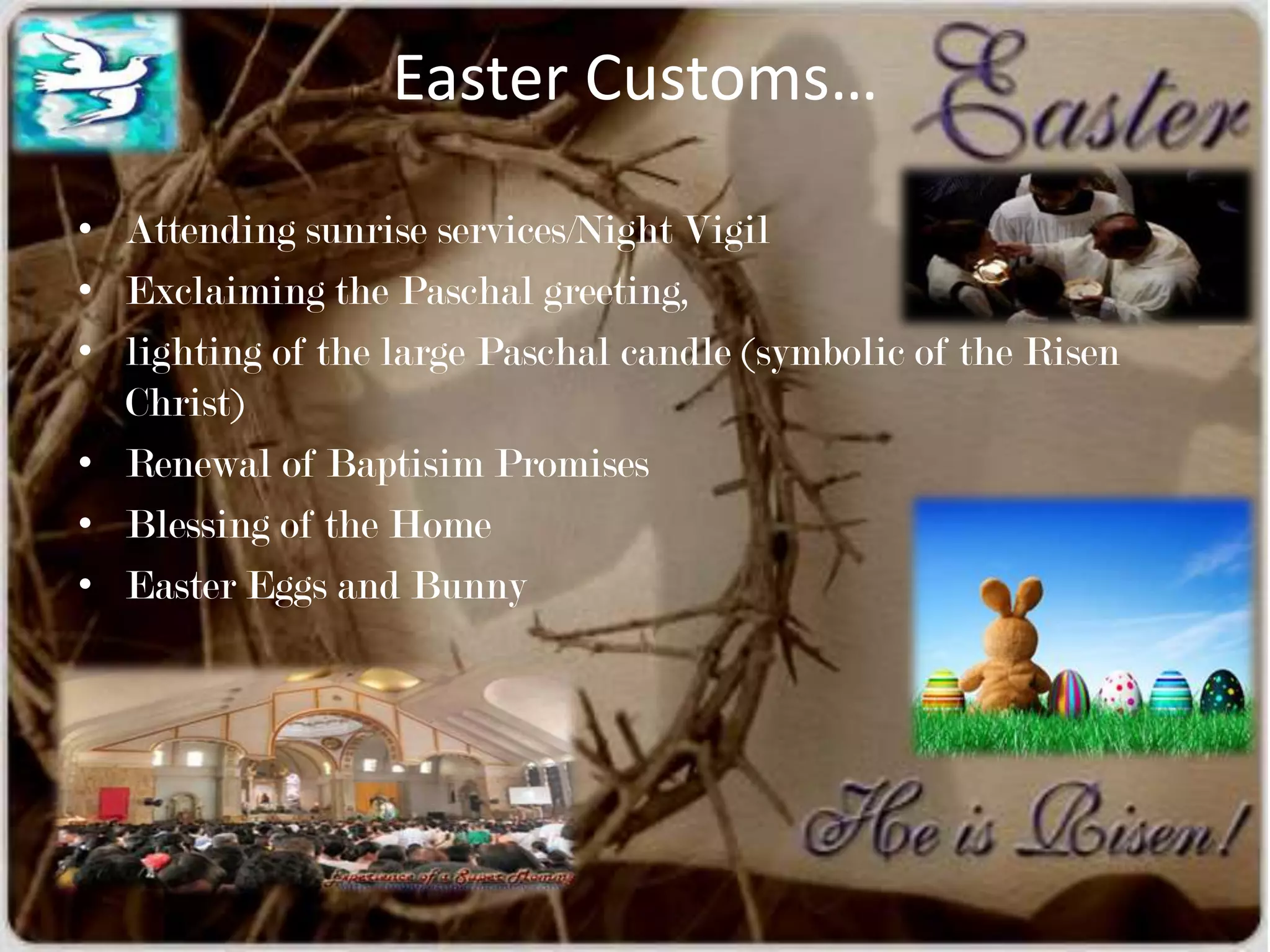
Easter Customs…

• Attending sunrise services/Night Vigil
• Exclaiming the Paschal greeting,
• lighting of the large Paschal candle (symbolic of the Risen
  Christ)
• Renewal of Baptisim Promises
• Blessing of the Home
• Easter Eggs and Bunny
Across Religions…

What is celebrated?
     • Christian religion: the résurrection of Jesus
     • Jewish religion: the célébration of the Exodus, when
       Moses freed the Jewish people
     • Pagan célébration to lionize the return of spring

Festivals and society

  • 3.
    Origin  Many storiesattached  The day when Parvati prayed for Shiva’s well being  The day when Shiva drank the poison that came out of Samudra Manthan  The day when Shiva and Shakti married  Includes Shiva Worship - offering Bael leaves, washing the Shiv Ling and a 24 hour strict fast
  • 4.
    Mahashivratri Worship  Accordingto the Shiva Purana, the Mahashivaratri worship must incorporate six items:  Bathing the Shiv Linga with water, milk and honey - representing purification of the soul;  The vermilion paste applied on the Shiv Linga after bathing it, representing virtue;  Offering of fruits, which is conducive to longevity and gratification of desires;  Burning incense, yielding wealth;  The lighting of the lamp which is conducive to the attainment of knowledge;  And betel leaves marking satisfaction with worldly pleasures.
  • 5.
  • 6.
    Pongal  Harvest Festivalin Tamilnadu  Festival of Farmers  Falls typically on the 14th or 15th June (in the month of Thai in Tamil calendar)
  • 7.
    History of Pongal Ancient festival of Tamils  originated as a Dravidian Harvest festival and has a mention in Sanskrit Puranas  The celebrations of Sangam Era led to today's Pongal celebrations
  • 8.
     First Day: Bhogi Festival In honor of lord Indra – the supreme ruler of clouds that give rains  Second Day : Perum Pongal Offering of payasam (rice boiled in milk) to Sun god  Third Day : Mattu Pongal Worship of cattle  Fourth Day : Kaanum Pongal A day of relaxation and socializing
  • 9.
     symbolizes theveneration of the first fruit.  Indian Thanks giving to nature
  • 10.
  • 11.
    Legends and Mythology Thelegend of demon King Hiranyakashyap An ogress Dhundhi The death of evil minded Pootana. In South India-The worship Kaamadeva
  • 12.
    Holika Dahan Season of Bloom Play Of Colours Expression of love&Brotherhood Ecstasy of Bhang
  • 13.
    Mythological Cultural Significance Significance Significance Biological Social Significance Significance
  • 14.
    Holi-To The Society Celebrates together with a spirit of bonhomie and brotherhood Revitalizing relationships and strengthening emotional bonds between people
  • 15.
    The Jain Society •Basic principle: non-violence towards all living beings • Also referred to as shramana dharma (self-reliant) or the "path of the nirgranthas" (those without attachments or aversions) • Follow teachings of the 24 tirthankars last being Mahavir • Jains have the highest literacy rate as well as per capita income in India • One of the best known Jain temples is the Babu Amichand Panalal Adishwarji Jain Temple, Walkeshwar (Malabar Hill) • Vikram Sarabhai, Sanjay Leela Bhansali, V Shantaram, Gautam Adani are some of the famous Jain personalities
  • 16.
    Mahavir • Means “TheGreat Hero” in English, he was 24th and the last Tirthankar. • He established the central tenants of Jainism • Born as Prince Vardhaman, he renounced his kingdom and family at the age of 30. • Attained moksha at the age of 72 before which he established the five pillars of Jainism namely: ahimsa, satya, asteya, brahmacharya and aparigraha • The birth of Mahavir is celebrated as Mahavir Jayanti
  • 17.
  • 18.
    History • Bhagwan Mahavirwas born on 13th day under rising moon of Chaitra to King Siddhartha and Queen Trishla • The day falling in the month of March or April is celebrated as Mahavir Jayanti • It is believed that life forms in all three worlds were cheerful and gods descended from heavens to pay homage • Mahavir denounced any sort of killing and believed most virtuous life is spent sitting and fasting • Jains resolve to follow his teaching on his birth anniversary
  • 19.
    Celebrations • Followers visitthe temples and offer ceremonial bath, known as 'abhishek', to Mahavira's idol • Temples are lavishly decorated with flags and chariot processions carried out • The four kinds of donations recommended for every Jain on this day include: Gyan daan: sharing of knowledge Abhay daan: protecting people from bad actions Aushad daan: donating medicines Ahaar daan: giving food • Sermons are also held in shrines or temples to preach the philosophy of spiritual freedom and virtue.
  • 21.
    Buddha Paurnima • Celebratesin remembrance of Lord Gautam Buddha – The great spiritual teacher in India • Buddha Purnima falls on the full moon day in the Hindu month of Vaisakh • Also known as Vesak
  • 22.
    Buddha Paurnima Marksthree important events of Lord Buddha’s life : • Birth : Life in Palace, The four sights, Renunciation • Enlightenment : Struggle for truth, achieved state of Buddha (the awakened one) • nirvana (salvation): The final stage of life - extinction of desire
  • 23.
    • Buddha's teachings: Suffering is unavoidable • All living beings have the Buddha nature and can become Buddhas. • Buddha Paurnima - Hint to us to develop our inner strength
  • 25.
    RAKSHA BANDHAN  Celebration of relations  came into origin about 6000 years back  Day of reaffirming the bonds of affection  Celebrated on full moon day of Hindu month Shravan  The name 'Raksha Bandhan' suggests 'a bond of protection'.  Sisters tie the silk thread called Rakhi on their brother's wrist and pray for their well being and brothers promise to take care of their sisters.
  • 26.
     Origin ofRaksha Bandhan : Goddess Lakshmi tied Rakhi to King Bali for first time  Stories of Rakhi : Lord Krishna and Draupathi Rani Karnawati and Emperor Humayun Alexander the great and king Puru
  • 27.
    THE SIGNIFICANCE  day to celebrate the sacred relation of a brother and a sister.  binding the family together in an emotional bond of love.  festival encompasses true sense of peace and brotherhood  can bring the much-needed relief from the ongoing violence and mistrust.
  • 28.
    Hathi Ghoda PalkhiJai Kanaihya lal ki..! 28
  • 29.
    Janmashtami  Krishna wasborn without a sexual union, but by divine "mental transmission" from the mind of Vasudeva into the womb of Devaki.  Krishna's birth, known as Janmashtami, is 18 July 3228 BCE and departed on 3102 BCE.  Krishna belonged to the Vrishni clan of Yadavas from Mathura, and was the eighth son born to the princess Devaki, and her husband Vasudeva. 29
  • 30.
    Janmashtami Uttsav  DahiHandi is a popular ceremony, celebrated with lot of enthusiasm and glee.  Dahi Handi is an enactment of Lord Krishna's efforts to steal butter from Matka (earthen pot) suspended from the ceiling. 30
  • 31.
  • 32.
    Janmastami vow  Janamashtamivow is to become Karamyogi like Krishna.  always follow the right path and never tolerate injustice.  Karma yoga is action (karma) performed without expectations or thought of reward. 32
  • 33.
  • 34.
    ONAM  portrays the rich cultural heritage of Kerala.  Celebrated for a period of ten days  starting from the first day Atham and continuing till tenth and the biggest day called Thiru Onam.
  • 35.
    Atham - Day One  Chithira - Day Two  Chodhi - Day Three  Visakam - Day Four  Anizham - Day Five  Thriketa - Day Six  Moolam - Day Seven  Pooradam - Day Eight  Uthradam - Day Nine  Thiruvonam - Day Ten
  • 36.
  • 37.
  • 38.
    Onam Legends ofKing Mahabali  The legend  The Legend of Vanishing Boy  The Legend of Boat Palliodam
  • 40.
    Vakratunda Mahakaaya Suryakoti Samaprabha Nirvighnam Kuru Mey Deva Sarva Kaaryeshu Sarvada The Lord with the curved trunk and a mighty body, who has the magnificance of a Million suns, I pray to you Oh Lord, to remove the obstacles from all the actions I intend to perform.
  • 41.
    Ganesh Chaturthi  GaneshChaturthi, one of the most sacred Hindu festivals.  Celebrates the birth of Lord Ganesha - the supreme God of wisdom and prosperity.  Lord Ganesh was born on a fourth day (chaturthi) of the bright fortnight of the Hindu lunar month of Magh.  „Ganesh Chaturthi‟ or „Vinayak Chaturthi‟, is celebrated as birthday of Lord Ganesha.  It is observed during the Hindu month of Bhadra (mid-August – mid- September).  He is son of Lord Shiva and Goddess Parvati, the Divine Mother. 41
  • 42.
    History of GaneshChaturthi  Bal Gangadhar Tilak, brought back the tradition of Ganesh Chaturthi and reshaped the festival from private family celebrations into a grand public event.  "to bridge the gap between the Brahmins and the non-Brahmins.  To unite all social classes -"the god for Everyman".  It served as a meeting place for common people of all castes and communities.  An important festival during the Peshwa era, Ganesha Chaturthi acquired organized form all over India largely due to Lokmanya's efforts 42
  • 43.
    Celebration  Today, GaneshChaturthi is celebrated in the states of India  The festival is so popular that the preparations begin months in advance. Days before the actual worship.  Elaborate arrangements are made for lighting, decoration, mirrors and flowers  During the festival days, the Lord is worshipped with great devotion and prayer services are performed daily.  The duration of the Lord's stay varies from place to place; once the worship is complete, the statues are carried on decorated floats to be immersed in the sea after one, three, five, seven and ten days. 43
  • 44.
    Celebration  This processionand immersion is accompanied with dancing and the sound of exciting drum-beats, devotional songs and exploding firecrackers.  As the idol is immersed amidst loud chants “Ganpati Bappa Moraya mangal murti morya”  The festival comes to an end with pleas to the Lord to return the next year with chants of "Ganpati bappa morya, pudcha varshi laukar ya" (Hail Lord Ganesh, return again soon next year).  In the 21st century, with the world turning fast into a global village, Ganesh Chaturthi is now celebrated all over the world, wherever there is a presence of a Hindu community. 44
  • 45.
    Sarvamangalamangalye Shive sarvathasaadhike, Sharanyetriyambake gauri Naraayani namostute! 45
  • 46.
    Navratri Festival • Navratri,the festival of nine nights is dedicated to Goddess Durga and her nine forms. • Navratri begins from the first day of the bright fortnight of Ashwin • The nine days have great religious significance • The festival is celebrated with true devotion and purity all over the country 46
  • 47.
    Celebrations • The festivalis also celebrated with intense fervor and zest, in whole of India, in the form of Durga Puja. The vibrant festivities last for ten days, of which nine nights are spent in worship. Gujarat and western India • The most famous Navaratri celebrations are held in the western states of India. • Traditional dances in the form of Dandiya and Garba take place almost everywhere. • After worshipping and 'Aarti', 'Dandiya raas' is performed all through the night. 47
  • 48.
    Rituals • Navratri isdivided into sets of three days to adore three different aspects of the supreme goddess or goddesses. • On the first three days Durga or Goddess of Energy is worshipped. • The next three days are devoted to Lakshmi or Goddess of Wealth and the last three days for Saraswati or Goddess of Knowledge. • On the fifth day, it is traditional to worship Saraswati to invoke our spirit and knowledge. • On the eighth and ninth day, Yagna (sacrifice offered to the fire) is performed to honor Durga Mata and bid her farewell. 48
  • 49.
    Nine Days ofNavratri FIRST DAY • The first day is dedicated to the Goddess Durga is called Shailputri, the daughter of the Himalayas. She is a form of Shakti, the companion of Lord Shiva. 49
  • 50.
    SECOND DAY • Thesecond day is dedicated to the Goddess Durga is known as 'Brahmacharini'. The name is derivative of the word 'Brahma', which means 'Tapa' or penace. She is also a form of Mata Shakti. 50
  • 51.
    Third Day • Thethird day is dedicated to the goddess Chandraghanta, the symbolic representation of beauty and bravery. 51
  • 52.
    Fourth Day • Thefourth day is dedicated to the goddess Kushmandas, the creator of the entire Universe. 52
  • 53.
    Fifth Day • Thefifth day is dedicated to the Goddess Skand Mata, the mother of the chief warrior of the Gods army the Skanda. 53
  • 54.
    Sixth Day • Thesixth day is dedicated to the goddess Katyayani with three eyes and four hands 54
  • 55.
    Seventh Day • Theseventh day is dedicated to the Goddess 'Kalratri', meant to make the devotees fearless. 55
  • 56.
    Eighth Day • Theeight day is dedicated to the Mata Rani or 'Maha Gauri', represents calmness and exhibits wisdom 56
  • 57.
    Ninth Day • Theninth day is dedicated to Durga also referred as Siddhidatri. It is believed that she has all the eight siddhis and is worshipped by all the Rishis and Yogis. 57
  • 58.
    The divine motherdurga, had destroyed the evil force (in the form of the demon Mahisashura) and Maa Durga is also known as Mahisashurardini, so we celebrate Valor and courage, Triumph of good over evil. 58
  • 59.
    The Bengali Society •West Bengal – fourth most populous state of India • Kolkata served as capital of British India for several years – British influence in architecture and society is evident • Also, intellectual hub of India - Rabindranath Tagore, Swami Vivekanad etc • Religion – 72.5% Hindusim • Durga Pooja is the biggest festival of the state celebrated over 6 days • Tertiary sector biggest contributor to economy – 57.8% of STP
  • 60.
  • 61.
    Outlook • Celebrated widelyin Assam, Bihar, Jharkhand, Orissa, Tripura and West Bengal - 5 day annual holiday • Marks the slaying of Mahishasura by Maa Durga on the Vijayadashmi after nine days of fierce battle • Includes all the 6 days observed as Mahalaya, Shashthi, Maha saptami, Maha ashtami, Maha navami and Vijadashami
  • 62.
    Significance • Gained importanceduring British raj • Reformists identified India with Durga • Symbol of Indian Independence Movement • Became an important meeting opportunity for freedom fighters • Identifiable with Dussera celebrations in many parts of the country
  • 63.
    History • As perscriptures – actual worship – Chaitra/Basanta • Popular form Sharadiya (autumnal) – Akal Bodhon • First such Puja organised in honour of Lord Clive in the year 1757. • He wanted to thank the lord but lack of a church forced him to take part in the local celebrations • Wealthy mercantile and Zamindar families in Bengal made British Officers of the East India Company guests of honour in the Pujas.
  • 64.
    Customs • Starts offwith the Mahishasurmardini – radio programme • Pandals housing Durga idols are put up • At the end of six days, idol is taken for immersion in a procession • Chants of Hope - 'aashchhe bochhor abar ‘ & Durga Maa ki Jai • Environmental Hazards
  • 65.
  • 66.
    • Dasara/ Dussehrais derived from Sanskrit Dasha-hara meaning "remover of bad fate" meaning remover of ten heads of Ravana's.
  • 67.
    Dussehra is afestival celebrated across India.
  • 68.
    It is culminationof the 10-day annual festival of Navaratri – 9 nights.
  • 69.
    The 10th day/nightafter Navaratri heralds the festival of Dussehra, that commemorates…
  • 70.
    …the legend inwhich the Goddess Durga, vanquishes the demon Mahishasura.
  • 71.
    the same festivalalso commemorates the victory of Rama, over the ten headed demon Ravana.
  • 72.
    The Ramlila, adramatization of the Ramayana is enacted as street-side plays during these days
  • 73.
    On the 10thday effigies of Ravana are burnt, signifying the victory of good over evil.
  • 74.
    These rituals areintended to rid the household of the ten bad qualities, which are represented by ten heads of Ravana as follows 1. Kama vasana 6. Matsara (Lust) (Jealousy) 2. Krodha (Anger) 7. Manas (Mind) 3. Moha (Delusion) 8. Buddhi (Intellect) 4. Lobha (Greed) 9. Chitta (Will) 5. Mada (Over 10. Ahankara (Ego). Pride)
  • 75.
    On this day,people inaugurate new ventures, ceremonially asking God to bless new beginnings.
  • 77.
    Significance • King Rama's coronation • Goddess Lakshmi‟s Birthday • Krishna Killed Narakaasur • Vishnu Rescued Lakshmi • The Return of the Pandavas • Special Day for the Sikhs • Special Day for the Jains • Coronation of Vikramaditya • Special Day for the Arya Samaj • Hindu New Year day • Harvest Festival
  • 78.
    A Five DaysFestival • Day 1: Dhanteras • Day 2: Choti Diwali / Naraka Chaturdashi / Kali Chaudas • Day 3: Diwali / Lakshmi Puja • Day 4: Padwa / Bali Pratipada / Govardhan Puja /Annakoot • Day 5: Bhaiduj
  • 79.
    Diwali Rituals • Tradition of Playing Cards • Tradition of Crackers • Rangoli • Tradition of gifts • Tradition of Lights
  • 80.
    ISLAM • Islam isreligion of peace • Islam means „submission to God‟, „peace‟ and „way of peace‟ • based on Holy Quran and sunnat (saying) of Holly Prophet Muhammad • Islam is the second largest religion • There are two main sects in religion of Islam i.e. Sunni and Shia
  • 81.
    Five pillars ofislam • Shahadah (faith) • Salah (Prayer) • Zakat (Alms-giving) • Sawn (Fasting) • Hajj (mecca)
  • 83.
    Allah & Mohammad •Allah and Muhammad are central figures in Islam. Allah is the supreme god in Muslim worship while Muhammad is his prophet and messenger. • Allah is the Creator, and Muhammad is the creation (in extension, the founder of Islam). • Muslims give worship to Allah and high respect to Muhammad. • He is the last prophet and messenger which signifies the fulfillment of Allah‟s other revelations and prophets. • The quran is the product of Allah‟s revelations to Muhammad
  • 84.
    Ramadan Month • Ramadan is the ninth month of the Islamic calendar • Ramadan - the month of holy fasting • month of blessing • Significance- – Allah revealed the Quran – victory in greatest battle at Badr. – Laylat al-Qadr, a night which is better than a thousand months. • There are three parts to the month of Ramadan: – Rahmat or mercy of God; – Maghfirat or forgiveness of God; – Nijat or salvation. Each period lasts about 10 days, or one-third of the entire month.
  • 85.
    A practices duringRamadan • Fasting • Prayer and Reading of quran • Iftar • Charity • Laylat al-Qadr
  • 86.
    Eid ul fitr •"Festival of Breaking the Fast“ • EID-UL-FITR is celebrated on the first day of Shaw'waal, at the completion of Ramadan. • Many Muslims may also prepare festive meals to share, wear new clothes, visit relatives and give presents to children. Cards can also be sent, often featuring the words “Eid Mubbarak” • The devotees gather in the mosques to pray, friends and relatives meet and exchange greetings. Prayers, family get-togethers and feasts are the major highlights of the festival. • A time for increased religious devotion and self-examination.
  • 87.
    Bakri Eid – Allahchallenged Prophet Ibrahim – Ibrahim's faith in Allah – Ibrahim sacrifices his son
  • 88.
    Eid al adha •The month of Dhul Hijja. (10th day) • Eid-Ul-Adha (the Feast of Sacrifice or Day of Sacrifice) is observed after the Hajj - the annual pilgrimage to Makkah (Mecca) in Saudi Arabia.
  • 89.
    Christmas Christmas celebrates thebirth of Jesus Christ, who according to the Christian religion, is the son of God and the founder of the Christian religion
  • 90.
    Christmas Joseph and Maryhad to travel to Bethlehem, the native village of Joseph, because of the census ordered by Caesar. Finding no place to sleep in Bethlehem, Mary gave birth in a stable.
  • 92.
    Christmas  Choice ofthe date • Pagan celebration for Mithra, persian god of light • Day of the winter solstice • In 330, the roman emperor Constantine decided to establish Christmas on the 25th of December to counter the pagan celebration • The real birth of Jesus Christ happened in the year 7 or 8 BC • The festival is celebrated as a mark of respect to Lord Jesus, who is considered as the son of God and founder of the Christian religion
  • 93.
    Christmas  Etymology: – Latin languages: Noel, Natale, Navidad come from « de natalis » (day of birth) – English: Cristes Maesse, ‘ mass of christ ’  Meaning of the symbols • Christmas crib: representation of Jesus’ birth • Advent: liturgical period to prepare the arrival of Jesus • Midnight mass
  • 94.
    Jesus came toearth, To show us how to live, How to put others first, How to love and how to give. Then He set about His work, That God sent Him to do; He took our punishment on Himself; He made us clean and new. He could have saved Himself, Calling angels from above, But He chose to pay our price for sin; He paid it out of love.
  • 95.
    Our Lord diedon Good Friday, But the cross did not destroy His resurrection on Easter morn That fills our hearts with joy. Now we know our earthly death, Like His, is just a rest. We'll be forever with Him In heaven, where life is best. So we live our lives for Jesus, Think of Him in all we do. Thank you Savior; Thank you Lord. Help us love like you!
  • 96.
    Significance • Humanity receivesits new lease on life, its liberation from both death and, thus, the fear of death. • If Christ didn't rise from the dead, then there is no justification for our faith
  • 97.
    Easter Customs… • Attendingsunrise services/Night Vigil • Exclaiming the Paschal greeting, • lighting of the large Paschal candle (symbolic of the Risen Christ) • Renewal of Baptisim Promises • Blessing of the Home • Easter Eggs and Bunny
  • 98.
    Across Religions… What iscelebrated? • Christian religion: the résurrection of Jesus • Jewish religion: the célébration of the Exodus, when Moses freed the Jewish people • Pagan célébration to lionize the return of spring

Editor's Notes

  • #65 Popular since 1950s
  • #78 http://www.festivalsofindia.in/Religions/Hindu.aspx
  • #82 http://www.islam-guide.com/ch3-16.htmhttp://mysteryoftheinquity.wordpress.com/2011/04/04/the-black-stone-at-mecca/http://en.wikipedia.org/wiki/Five_Pillars_of_Islam
  • #84 Muhammad was born in Mecca to a prominent and powerful family. He was orphaned early and was raised and protected by his grandfather. He had a family; a wife, two sons, and four daughters.Respect is also given to other prophets that came before Muhammad. This is recognized by adding the phrase “peace be upon him” when their names are mentioned.He received visions (known as Ayah or Signs of God) from Allah or from the angel Gabriel. The being proclaimed that there is one and only one God. Other visions and revelations followed. The transcribed version of these revelations is the Koran. In this view, Muhammad is also known as the “recipient of the Koran.” The Koran is the primary source for Muslim faith and lifestyle.Read more: Difference Between Muhammad and Allah | Difference Between | Muhammad vs Allahhttp://www.differencebetween.net/miscellaneous/religion-miscellaneous/islam-religion-miscellaneous/difference-between-muhammad-and-allah/#ixzz202LOH1AM
  • #85 http://websindex.blogspot.in/2011/08/bismillah-hir-rahman-nir-raheem.html
  • #86 During Ramadan Muslims have meal twice a day. before the sunrise(suhoor) -after the sunset(Iftar). Muslims fast during the daytime. Muslims spend most of their time in remembering Allah by reciting Ramadan Dua and visiting mosque. recite Tarawih(Congregation) prayerLailatulQadr, also called as the night of power, when Muslims spend their entire night praying to Allah.the practices of Ramadan are meant to purify oneself from thoughts and deeds which are counter to Islam. By removing material desires, one is able to focus fully on devotion and service to God. Many Muslims go beyond the physical ritual of fasting and attempt to purge themselves of impure thoughts and motivations -- anger, cursing, greed, etc. As part of this, service to the community and to those in need is a major emphasis of activity throughout the month.
  • #87 If a Muslim has not given zakat al-fitr during Ramadan, he or she can give this on Eid-al-Fitr. Zakat al-fitr is a form of charity consisting of a quantity of food, such as barley, dates, raisins or wheat flour, or its monetary equivalent given to the poor. Many Muslims may also prepare festive meals to share, wear new clothes, visit relatives and give presents or candy to children. Cards can also be sent, often featuring the words “EidMubbarak”The devotees gather in the mosques to pray, friends and relatives meet and exchange greetings. Prayers, family get-togethers and feasts are the major highlights of the festival.Unlike most festivals, Ramadan doesn’t fall on any particular day. Ramadan is the ninth month of the Islamic year. It is usually a time for increased religious devotion and self-examination.
  • #89 A duty of each Muslim, as described in the Five Pillars of Islam, is to go on Hajj at least once once during their lifetime, unless they are prevented by finances or ill health. "The Hajj consists of several ceremonies, meant to symbolize the essential concepts of the Islamic faith, and to commemorate the trials of prophet Abraham and his family...The pilgrimage also enables Muslims from all around the world, of different colors, languages, races, and ethnicities, to come together in a spirit of universal brotherhood and sisterhood to worship the One God together."
  • #93 > In fact, the Bible did not mention any date for Jesusbirth. Wejust know thatithappenedat the time of a hugecensusunderCeasar
  • #94 > The crib that was established by Saint Francis of Assisi in 1223 was a living nativity scene