Fermentation
Technology
1
Shubham
Dubey
Tybsc
Microbiology
2
What is fermentation?
• Pasteur’s definition: “life without
air”, anaerobe red ox reactions in
organisms
• New definition: a form of metabolism
in which the end products could be
further oxidized
For example: a yeast cell obtains 2
molecules of ATP per molecule of
glucose when it ferments it to ethanol
3
4
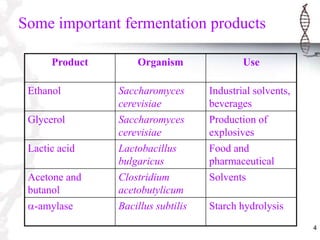
Some important fermentation products
Product Organism Use
Ethanol Saccharomyces
cerevisiae
Industrial solvents,
beverages
Glycerol Saccharomyces
cerevisiae
Production of
explosives
Lactic acid Lactobacillus
bulgaricus
Food and
pharmaceutical
Acetone and
butanol
Clostridium
acetobutylicum
Solvents
-amylase Bacillus subtilis Starch hydrolysis
5
Some
important
fermentation
products
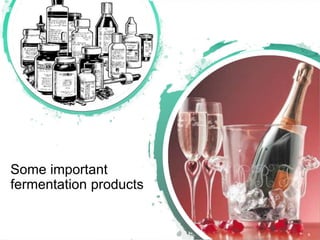
Some important
fermentation products
6
Fermenter
• The heart of the fermentation process is
the fermenter.
• In general:
• Stirred vessel, H/D  3
• Volume 1-1000 m3 (80 % filled)
• Biomass up to 100 kg dry weight/m3
• Product 10 mg/l –200 g/l
7
Types of fermenter
• Simple fermenters (batch and continuous)
• Fed batch fermenter
• Air-lift or bubble fermenter
• Cyclone column fermenter
• Tower fermenter
• Other more advanced systems, etc
The size is few liters (laboratory use) - >500 m3 (industrial applications)
8
Cross section
of a fermenter
for Penicillin
production
9
Fermentation medium
10
Define medium 
nutritional, hormonal,
and substratum
requirement of cells
In most cases, the
medium is independent
of the bioreactor
design and process
parameters
The type: complex and
synthetic medium
(mineral medium)
Even small
modifications in the
medium could change
cell line stability,
product quality, yield,
operational
parameters, and
downstream
processing.
Medium composition
• Fermentation medium consists of:
• Macronutrients (C, H, N, S, P, Mg
sources  water, sugars, lipid, amino
acids, salt minerals)
• Micronutrients (trace elements/
metals, vitamins)
• Additional factors: growth factors,
attachment proteins, transport proteins,
etc)
• For aerobic culture, oxygen is sparged
11
Inoculums
• Incoculum is the substance/ cell culture
that is introduced to the medium. The cell
then grow in the medium, conducting
metabolisms.
• Inoculum is prepared for the inoculation
before the fermentation starts.
• It needs to be optimized for better
performance:
• Adaptation in the medium
• Mutation (DNA recombinant, radiation,
chemical addition)
12
13
Microbial rates of consumption or production
C, N, P, S source
H2O
H+
O2
heat
product
CO2
biomass
What are the
value of rates?
Rates of
consumption or
production are
obtained from
mass balance
over reactors
• Mass balance over reactors
• Transport + conversion =
accumulation
• (in – out) + (production –
consumption) = accumulation
• Batch: transport in = transport
out = 0
• Chemostat: accumulation =
0, steady state
• Fed batch: transport out = 0
14
Coupled anabolism/catabolism
• C-source (anabolism) and electron-donor (catabolism) are often the
same (e.g. organic substrate)
• Only a fraction of the substrate ends in biomass as C-source, while the
rest is catabolized as electron-donor to provide energy for anabolism and
maintenance
• YSX is the result of anabolic/catabolic coupling.
15
16
Anabolism
Amino acids  protein
Sugars  carbohydrate
Fatty acids  lipids
Nucleotides  DNA, RNA
Sum of all reactions gives the anabolic reaction
(…)C-source + (…)N-source + (…) P-source + O-source
C1H1.8O0.5N0.2 + (…)H2O + (…)CO2
Thermodynamically, energy is needed. Also for cells
maintenance
energy
17
Catabolism
• Catabolism generates the energy needed for
anabolism and maintenance. It consist of electron
donor couple and electron donor acceptor couple
• For example:
• Glucose + (…)O2  (…)HCO3
- + H2O
• donor couple: glucose/HCO3
-
• acceptor couple: O2/H2O
• Glucose  (…)HCO3
- + (…)ethanol
• donor couple: glucose/HCO3
-
• acceptor couple: CO2/ethanol
• The catabolism produces Gibbs energy
(Gcat.reaction)

fermentation technology

  • 1.
  • 2.
  • 3.
    What is fermentation? •Pasteur’s definition: “life without air”, anaerobe red ox reactions in organisms • New definition: a form of metabolism in which the end products could be further oxidized For example: a yeast cell obtains 2 molecules of ATP per molecule of glucose when it ferments it to ethanol 3
  • 4.
    4 Some important fermentationproducts Product Organism Use Ethanol Saccharomyces cerevisiae Industrial solvents, beverages Glycerol Saccharomyces cerevisiae Production of explosives Lactic acid Lactobacillus bulgaricus Food and pharmaceutical Acetone and butanol Clostridium acetobutylicum Solvents -amylase Bacillus subtilis Starch hydrolysis
  • 5.
  • 6.
  • 7.
    Fermenter • The heartof the fermentation process is the fermenter. • In general: • Stirred vessel, H/D  3 • Volume 1-1000 m3 (80 % filled) • Biomass up to 100 kg dry weight/m3 • Product 10 mg/l –200 g/l 7
  • 8.
    Types of fermenter •Simple fermenters (batch and continuous) • Fed batch fermenter • Air-lift or bubble fermenter • Cyclone column fermenter • Tower fermenter • Other more advanced systems, etc The size is few liters (laboratory use) - >500 m3 (industrial applications) 8
  • 9.
    Cross section of afermenter for Penicillin production 9
  • 10.
    Fermentation medium 10 Define medium nutritional, hormonal, and substratum requirement of cells In most cases, the medium is independent of the bioreactor design and process parameters The type: complex and synthetic medium (mineral medium) Even small modifications in the medium could change cell line stability, product quality, yield, operational parameters, and downstream processing.
  • 11.
    Medium composition • Fermentationmedium consists of: • Macronutrients (C, H, N, S, P, Mg sources  water, sugars, lipid, amino acids, salt minerals) • Micronutrients (trace elements/ metals, vitamins) • Additional factors: growth factors, attachment proteins, transport proteins, etc) • For aerobic culture, oxygen is sparged 11
  • 12.
    Inoculums • Incoculum isthe substance/ cell culture that is introduced to the medium. The cell then grow in the medium, conducting metabolisms. • Inoculum is prepared for the inoculation before the fermentation starts. • It needs to be optimized for better performance: • Adaptation in the medium • Mutation (DNA recombinant, radiation, chemical addition) 12
  • 13.
    13 Microbial rates ofconsumption or production C, N, P, S source H2O H+ O2 heat product CO2 biomass
  • 14.
    What are the valueof rates? Rates of consumption or production are obtained from mass balance over reactors • Mass balance over reactors • Transport + conversion = accumulation • (in – out) + (production – consumption) = accumulation • Batch: transport in = transport out = 0 • Chemostat: accumulation = 0, steady state • Fed batch: transport out = 0 14
  • 15.
    Coupled anabolism/catabolism • C-source(anabolism) and electron-donor (catabolism) are often the same (e.g. organic substrate) • Only a fraction of the substrate ends in biomass as C-source, while the rest is catabolized as electron-donor to provide energy for anabolism and maintenance • YSX is the result of anabolic/catabolic coupling. 15
  • 16.
    16 Anabolism Amino acids protein Sugars  carbohydrate Fatty acids  lipids Nucleotides  DNA, RNA Sum of all reactions gives the anabolic reaction (…)C-source + (…)N-source + (…) P-source + O-source C1H1.8O0.5N0.2 + (…)H2O + (…)CO2 Thermodynamically, energy is needed. Also for cells maintenance energy
  • 17.
    17 Catabolism • Catabolism generatesthe energy needed for anabolism and maintenance. It consist of electron donor couple and electron donor acceptor couple • For example: • Glucose + (…)O2  (…)HCO3 - + H2O • donor couple: glucose/HCO3 - • acceptor couple: O2/H2O • Glucose  (…)HCO3 - + (…)ethanol • donor couple: glucose/HCO3 - • acceptor couple: CO2/ethanol • The catabolism produces Gibbs energy (Gcat.reaction)