Mindful Movement &
Meditation
How & Why Yoga Helps
those with Fibromyalgia
E.B. Ferdig
E-RYT500, certified yoga therapist
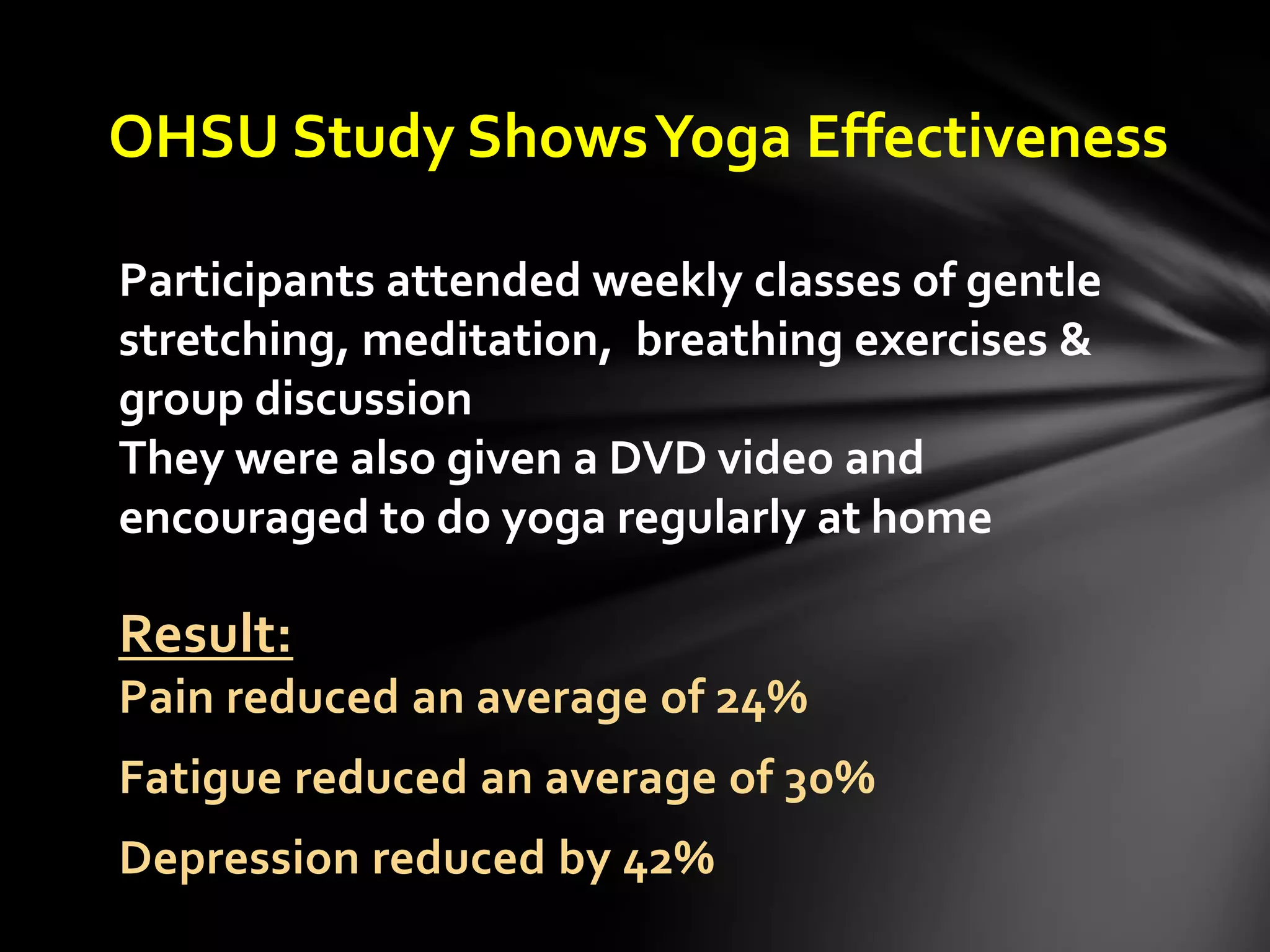
OHSU Study ShowsYoga Effectiveness
Result:
Pain reduced an average of 24%
Fatigue reduced an average of 30%
Depression reduced by 42%
Participants attended weekly classes of gentle
stretching, meditation, breathing exercises &
group discussion
They were also given a DVD video and
encouraged to do yoga regularly at home
How & why does yoga help?
 Yoga is varied & can be adapted to the student
Primarily a mental practice, but also can be:
Physical
Emotional
Energetic
Spiritual
We can take what we need & leave the rest
For yoga to work, we need to do it. To do it, we need to
have experience of it being helpful, so we might build new
habits.
Benefits of Breathing
 If we can breathe, we can do yoga
 The pain that comes with Fibromyalgia keeps
many people in “fight or flight” mode
 By breathing very slowly for just one minute,
we can take brain from fight or flight mode, to
“executive functioning,” so we can make good
decisions (or just relax)
The Pain Loop
Moving Mindfully
Movement is important:
our joints need movement for lubrication for healthy
function
Tight muscles restrict our movement in the world
and cause more tight muscles
Strong and flexible muscles help us prevent injury
With fibromyalgia, we often don’t know what kind of
movement will hurt – especially later on
Working slowly and carefully, and observing like a
reporter will help establish safe boundaries
Yoga improves
mood
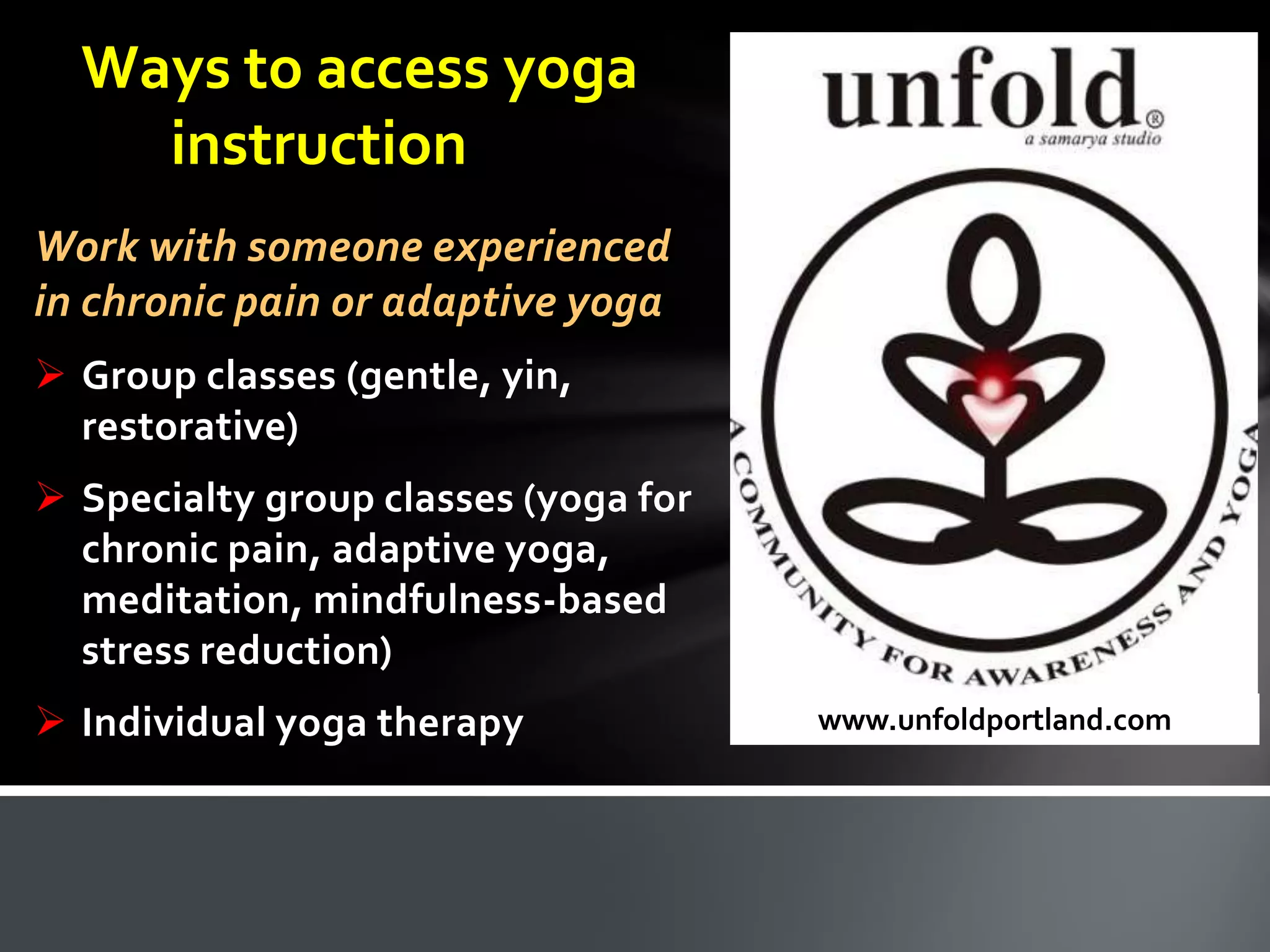
 Yoga has been proven in studies to
improve mood. Several study shows
increased GABA (hormone brain that
inhibits stress feelings) levels
 Any style of yoga – but always a
combination of movement,
mindfulness, meditation, relaxation and
breath.
 As little as 20 min/day
 Must be done regularly to have effect
Ways to access yoga
instruction
Work with someone experienced
in chronic pain or adaptive yoga
 Group classes (gentle, yin,
restorative)
 Specialty group classes (yoga for
chronic pain, adaptive yoga,
meditation, mindfulness-based
stress reduction)
 Individual yoga therapy www.unfoldportland.com
Studies referenced in presentation
1) James W. Carson, Kimberly M. Carson, Kim D. Jones, Robert M.
Bennett, Cheryl L. Wright, Scott D. Mist.
A pilot randomized controlled trial of theYoga of Awareness program
in the management of fibromyalgia
Pain, 2010; 151 (2): 530
2) Streeter CC1, Jensen JE, Perlmutter RM, Cabral HJ,Tian H,Terhune DB
Yoga Asana sessions increase brain GABA levels: a pilot study
J Altern Complement Med. 2007 May;13(4):419-26
3) Ciraulo DA, Renshaw PF.. Michalsen A, Grossman P, Acil A, Langhorst
J, Ludtke R, EschT.
Rapid stress reduction and anxiolysis among distressed women as a
consequence of a three-month intensive yoga
Med Sci Monit. 2005;11:555–61.
Mindful Movement & Meditation

Mindful Movement & Meditation

  • 1.
    Mindful Movement & Meditation How& Why Yoga Helps those with Fibromyalgia E.B. Ferdig E-RYT500, certified yoga therapist
  • 2.
    OHSU Study ShowsYogaEffectiveness Result: Pain reduced an average of 24% Fatigue reduced an average of 30% Depression reduced by 42% Participants attended weekly classes of gentle stretching, meditation, breathing exercises & group discussion They were also given a DVD video and encouraged to do yoga regularly at home
  • 3.
    How & whydoes yoga help?  Yoga is varied & can be adapted to the student Primarily a mental practice, but also can be: Physical Emotional Energetic Spiritual We can take what we need & leave the rest For yoga to work, we need to do it. To do it, we need to have experience of it being helpful, so we might build new habits.
  • 4.
    Benefits of Breathing If we can breathe, we can do yoga  The pain that comes with Fibromyalgia keeps many people in “fight or flight” mode  By breathing very slowly for just one minute, we can take brain from fight or flight mode, to “executive functioning,” so we can make good decisions (or just relax)
  • 5.
  • 6.
    Moving Mindfully Movement isimportant: our joints need movement for lubrication for healthy function Tight muscles restrict our movement in the world and cause more tight muscles Strong and flexible muscles help us prevent injury With fibromyalgia, we often don’t know what kind of movement will hurt – especially later on Working slowly and carefully, and observing like a reporter will help establish safe boundaries
  • 7.
    Yoga improves mood  Yogahas been proven in studies to improve mood. Several study shows increased GABA (hormone brain that inhibits stress feelings) levels  Any style of yoga – but always a combination of movement, mindfulness, meditation, relaxation and breath.  As little as 20 min/day  Must be done regularly to have effect
  • 8.
    Ways to accessyoga instruction Work with someone experienced in chronic pain or adaptive yoga  Group classes (gentle, yin, restorative)  Specialty group classes (yoga for chronic pain, adaptive yoga, meditation, mindfulness-based stress reduction)  Individual yoga therapy www.unfoldportland.com
  • 9.
    Studies referenced inpresentation 1) James W. Carson, Kimberly M. Carson, Kim D. Jones, Robert M. Bennett, Cheryl L. Wright, Scott D. Mist. A pilot randomized controlled trial of theYoga of Awareness program in the management of fibromyalgia Pain, 2010; 151 (2): 530 2) Streeter CC1, Jensen JE, Perlmutter RM, Cabral HJ,Tian H,Terhune DB Yoga Asana sessions increase brain GABA levels: a pilot study J Altern Complement Med. 2007 May;13(4):419-26 3) Ciraulo DA, Renshaw PF.. Michalsen A, Grossman P, Acil A, Langhorst J, Ludtke R, EschT. Rapid stress reduction and anxiolysis among distressed women as a consequence of a three-month intensive yoga Med Sci Monit. 2005;11:555–61.