Onna-Bugeisha
Women Warriors of Japan
By Tin Mei Yarrington
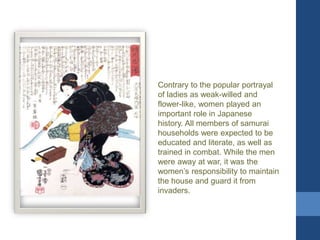
Contrary to the popular portrayal
of ladies as weak-willed and
flower-like, women played an
important role in Japanese
history. All members of samurai
households were expected to be
educated and literate, as well as
trained in combat. While the men
were away at war, it was the
women’s responsibility to maintain
the house and guard it from
invaders.
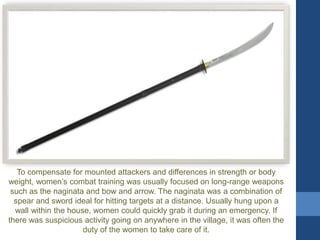
To compensate for mounted attackers and differences in strength or body
weight, women’s combat training was usually focused on long-range weapons
such as the naginata and bow and arrow. The naginata was a combination of
spear and sword ideal for hitting targets at a distance. Usually hung upon a
wall within the house, women could quickly grab it during an emergency. If
there was suspicious activity going on anywhere in the village, it was often the
duty of the women to take care of it.
Female Warriors of the Genpei
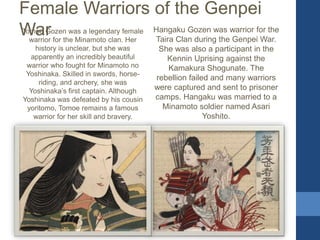
WarTomoe Gozen was a legendary female
warrior for the Minamoto clan. Her
history is unclear, but she was
apparently an incredibly beautiful
warrior who fought for Minamoto no
Yoshinaka. Skilled in swords, horse-
riding, and archery, she was
Yoshinaka’s first captain. Although
Yoshinaka was defeated by his cousin
yoritomo, Tomoe remains a famous
warrior for her skill and bravery.
Hangaku Gozen was warrior for the
Taira Clan during the Genpei War.
She was also a participant in the
Kennin Uprising against the
Kamakura Shogunate. The
rebellion failed and many warriors
were captured and sent to prisoner
camps. Hangaku was married to a
Minamoto soldier named Asari
Yoshito.
Women of the Boshin War
Futaba Yamakawa was daughter of
Naoe Yamakawa, a samurai of the
Aizu Clan. She fought during the
Boshin War and lived afterwards as
a supporter of women’s education.
She began working at the Tokyo
Women’s Normal School in 1877
and died in 1909.
Nakano Takeko was a warrior who
fought in the Battle of Aizu. She led
a corps of female warriors called
the Aizu Joshitai into battle and was
shot in the chest. Upon her request,
her sister buried her head under a
tree at Hokaiji Temple to keep it
from becoming an enemy trophy.
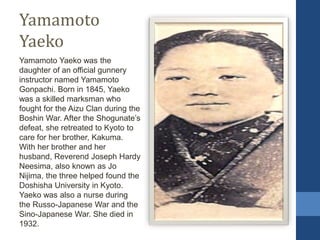
Yamamoto
Yaeko
Yamamoto Yaeko was the
daughter of an official gunnery
instructor named Yamamoto
Gonpachi. Born in 1845, Yaeko
was a skilled marksman who
fought for the Aizu Clan during the
Boshin War. After the Shogunate’s
defeat, she retreated to Kyoto to
care for her brother, Kakuma.
With her brother and her
husband, Reverend Joseph Hardy
Neesima, also known as Jo
Nijima, the three helped found the
Doshisha University in Kyoto.
Yaeko was also a nurse during
the Russo-Japanese War and the
Sino-Japanese War. She died in
1932.
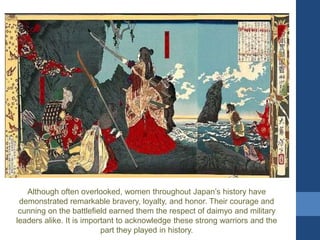
Although often overlooked, women throughout Japan’s history have
demonstrated remarkable bravery, loyalty, and honor. Their courage and
cunning on the battlefield earned them the respect of daimyo and military
leaders alike. It is important to acknowledge these strong warriors and the
part they played in history.
Sources
Allen, Bruce Ware. "Nakano Takeko, 1847-1868: Last of the Samurai." A History Blog.
Wordpress, 5 Feb. 2013. Web. 26 Sept. 2015.
Amdur, Ellis. "Women Warriors of Japan." Koryu.com. Koryu Books, 2002. Web. 26 Sept.
2015.
Shintaku, Melanie. "Women Warriors - Female Samurai in Ancient in Japan." Ten Shin Ichi
Ryu Traditional Japanese Martial Arts. N.p., n.d. Web. 26 Sept. 2015.
Spann, Susan. "Onna-Bugeisha: The Female Samurai Warriors." Murder Is Everywhere.
N.p., 12 Apr. 2015. Web. 26 Sept. 2015.
Suchek, Kim. "Remembering Warrior Women of Japan." Stripes.Okinawa. Stars and Stripes,
7 Mar. 2013. Web. 26 Sept. 2015.
Szczepanski, Kallie. "Samurai Women of Japan." About Education. About.com, n.d. Web. 26
Sept. 2015.
Szczepanski, Kallie. "The Boshin War in Japan." About Education. About.com, n.d. Web. 26
Sept. 2015.
Woodbury, Eugene. "Yaeko Yamamoto." Eugene's Blog. Blogspot, 18 Feb. 2013. Web. 26
Sept. 2015.
"Yamakawa, Futaba." Portraits of Modern Japanese Historical Figures. National Diet Library,
n.d. Web. 26 Sept. 2015.

Female samurai presentation

  • 1.
    Onna-Bugeisha Women Warriors ofJapan By Tin Mei Yarrington
  • 2.
    Contrary to thepopular portrayal of ladies as weak-willed and flower-like, women played an important role in Japanese history. All members of samurai households were expected to be educated and literate, as well as trained in combat. While the men were away at war, it was the women’s responsibility to maintain the house and guard it from invaders.
  • 3.
    To compensate formounted attackers and differences in strength or body weight, women’s combat training was usually focused on long-range weapons such as the naginata and bow and arrow. The naginata was a combination of spear and sword ideal for hitting targets at a distance. Usually hung upon a wall within the house, women could quickly grab it during an emergency. If there was suspicious activity going on anywhere in the village, it was often the duty of the women to take care of it.
  • 4.
    Female Warriors ofthe Genpei WarTomoe Gozen was a legendary female warrior for the Minamoto clan. Her history is unclear, but she was apparently an incredibly beautiful warrior who fought for Minamoto no Yoshinaka. Skilled in swords, horse- riding, and archery, she was Yoshinaka’s first captain. Although Yoshinaka was defeated by his cousin yoritomo, Tomoe remains a famous warrior for her skill and bravery. Hangaku Gozen was warrior for the Taira Clan during the Genpei War. She was also a participant in the Kennin Uprising against the Kamakura Shogunate. The rebellion failed and many warriors were captured and sent to prisoner camps. Hangaku was married to a Minamoto soldier named Asari Yoshito.
  • 5.
    Women of theBoshin War Futaba Yamakawa was daughter of Naoe Yamakawa, a samurai of the Aizu Clan. She fought during the Boshin War and lived afterwards as a supporter of women’s education. She began working at the Tokyo Women’s Normal School in 1877 and died in 1909. Nakano Takeko was a warrior who fought in the Battle of Aizu. She led a corps of female warriors called the Aizu Joshitai into battle and was shot in the chest. Upon her request, her sister buried her head under a tree at Hokaiji Temple to keep it from becoming an enemy trophy.
  • 6.
    Yamamoto Yaeko Yamamoto Yaeko wasthe daughter of an official gunnery instructor named Yamamoto Gonpachi. Born in 1845, Yaeko was a skilled marksman who fought for the Aizu Clan during the Boshin War. After the Shogunate’s defeat, she retreated to Kyoto to care for her brother, Kakuma. With her brother and her husband, Reverend Joseph Hardy Neesima, also known as Jo Nijima, the three helped found the Doshisha University in Kyoto. Yaeko was also a nurse during the Russo-Japanese War and the Sino-Japanese War. She died in 1932.
  • 7.
    Although often overlooked,women throughout Japan’s history have demonstrated remarkable bravery, loyalty, and honor. Their courage and cunning on the battlefield earned them the respect of daimyo and military leaders alike. It is important to acknowledge these strong warriors and the part they played in history.
  • 8.
    Sources Allen, Bruce Ware."Nakano Takeko, 1847-1868: Last of the Samurai." A History Blog. Wordpress, 5 Feb. 2013. Web. 26 Sept. 2015. Amdur, Ellis. "Women Warriors of Japan." Koryu.com. Koryu Books, 2002. Web. 26 Sept. 2015. Shintaku, Melanie. "Women Warriors - Female Samurai in Ancient in Japan." Ten Shin Ichi Ryu Traditional Japanese Martial Arts. N.p., n.d. Web. 26 Sept. 2015. Spann, Susan. "Onna-Bugeisha: The Female Samurai Warriors." Murder Is Everywhere. N.p., 12 Apr. 2015. Web. 26 Sept. 2015. Suchek, Kim. "Remembering Warrior Women of Japan." Stripes.Okinawa. Stars and Stripes, 7 Mar. 2013. Web. 26 Sept. 2015. Szczepanski, Kallie. "Samurai Women of Japan." About Education. About.com, n.d. Web. 26 Sept. 2015. Szczepanski, Kallie. "The Boshin War in Japan." About Education. About.com, n.d. Web. 26 Sept. 2015. Woodbury, Eugene. "Yaeko Yamamoto." Eugene's Blog. Blogspot, 18 Feb. 2013. Web. 26 Sept. 2015. "Yamakawa, Futaba." Portraits of Modern Japanese Historical Figures. National Diet Library, n.d. Web. 26 Sept. 2015.