Entrepreneur BehaviorEntrepreneur Behavior
(APT 2013)(APT 2013)
WAN MOHD YUSUFF BIN WANWAN MOHD YUSUFF BIN WAN
IBRAHIMIBRAHIM
©2014©2014
INTRODUCTION TO THEINTRODUCTION TO THE
COURSECOURSE
APT 2013APT 2013 22
APT 2013APT 2013 33
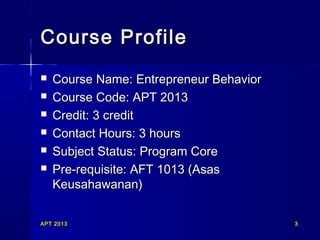
Course ProfileCourse Profile
 Course Name: Entrepreneur BehaviorCourse Name: Entrepreneur Behavior
 Course Code: APT 2013Course Code: APT 2013
 Credit: 3 creditCredit: 3 credit
 Contact Hours: 3 hoursContact Hours: 3 hours
 Subject Status: Program CoreSubject Status: Program Core
 Pre-requisite: AFT 1013 (AsasPre-requisite: AFT 1013 (Asas
Keusahawanan)Keusahawanan)
APT 2013APT 2013 44
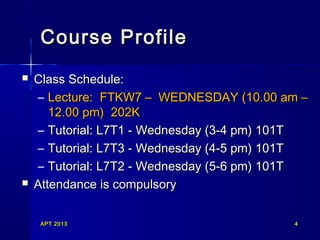
Course ProfileCourse Profile
 Class Schedule:Class Schedule:
– Lecture: FTKW7 – WEDNESDAY (10.00 am –Lecture: FTKW7 – WEDNESDAY (10.00 am –
12.00 pm) 202K12.00 pm) 202K
– Tutorial: L7T1 - Wednesday (3-4 pm) 101TTutorial: L7T1 - Wednesday (3-4 pm) 101T
– Tutorial: L7T3 - Wednesday (4-5 pm) 101TTutorial: L7T3 - Wednesday (4-5 pm) 101T
– Tutorial: L7T2 - Wednesday (5-6 pm) 101TTutorial: L7T2 - Wednesday (5-6 pm) 101T
 Attendance is compulsoryAttendance is compulsory
APT 2013APT 2013 55
Lecturer ProfileLecturer Profile
WAN MOHD YUSUFF BIN WAN IBRAHIM
QUALIFICATION:
•MASTER IN BUSINESS MANAGEMENT
•DEGREE IN BUSINESS MANAGEMENT & COMMUNICATION
MARKETING
•DIPLOMA IN BUSINESS MANAGEMENT
EXPERIENCE:
•2 years in teaching
•2 years in managing business
•2 years in TM customer service
•3 years in owned business
APT 2013APT 2013 66
Course ObjectivesCourse Objectives
The course aims to:The course aims to:
1.1. provide students with the knowledge on theories ofprovide students with the knowledge on theories of
entrepreneurial behavior and motivationentrepreneurial behavior and motivation
2.2. equip students with the knowledge of essential behaviorsequip students with the knowledge of essential behaviors
found among successful entrepreneursfound among successful entrepreneurs
3.3. expose students with the reality of the entrepreneurialexpose students with the reality of the entrepreneurial
behavior at the business sitebehavior at the business site
4.4. allow the students to discover and compare their ownallow the students to discover and compare their own
behaviors with behaviors of successful entrepreneursbehaviors with behaviors of successful entrepreneurs
5.5. encourage students to apply these behaviors in their dailyencourage students to apply these behaviors in their daily
liveslives
APT 2013APT 2013 77
Learning OutcomesLearning Outcomes
At the end of the course, students will be able to:At the end of the course, students will be able to:
1.1. explain the different types of entrepreneurial behaviorsexplain the different types of entrepreneurial behaviors
that are essential for successful entrepreneursthat are essential for successful entrepreneurs
2.2. apply the entrepreneurial thinking (mindset) that triggersapply the entrepreneurial thinking (mindset) that triggers
certain behaviorcertain behavior
3.3. exhibit entrepreneurial behaviors in real life situationsexhibit entrepreneurial behaviors in real life situations
4.4. differentiate between entrepreneurial and non-differentiate between entrepreneurial and non-
entrepreneurial behaviorsentrepreneurial behaviors
5.5. apply the entrepreneurial behaviors and skills in theirapply the entrepreneurial behaviors and skills in their
daily working livesdaily working lives
APT 2013APT 2013 © 2013 Dr. Rafi/Dr. Wan Nadzrol© 2013 Dr. Rafi/Dr. Wan Nadzrol 88
Course OutlineCourse Outline
 The entrepreneurial mindsetThe entrepreneurial mindset
 Models of entrepreneurial motivationModels of entrepreneurial motivation
 Entrepreneurial behaviorEntrepreneurial behavior
 Opportunity identification skillsOpportunity identification skills
 Organizing and resourcing skillsOrganizing and resourcing skills
 Business communication skillsBusiness communication skills
 Leadership skillsLeadership skills
 Networking skillsNetworking skills
 Presentation of entrepreneur’s profilePresentation of entrepreneur’s profile
APT 2013APT 2013 © 2013 Dr. Rafi/Dr. Wan Nadzrol© 2013 Dr. Rafi/Dr. Wan Nadzrol 99
Methods of DeliveryMethods of Delivery
 Lectures and tutorialsLectures and tutorials
 Case studiesCase studies
 Field workField work
 AssignmentsAssignments
APT 2013APT 2013 1010
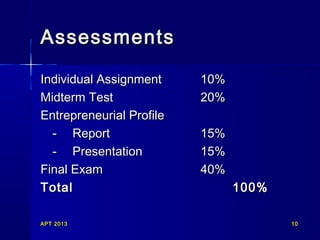
AssessmentsAssessments
Individual AssignmentIndividual Assignment 10%10%
Midterm TestMidterm Test 20%20%
Entrepreneurial ProfileEntrepreneurial Profile
-- ReportReport 15%15%
-- PresentationPresentation 15%15%
Final ExamFinal Exam 40%40%
TotalTotal 100%100%
APT 2013APT 2013 1111
ReferencesReferences
1.1. Butler, J.E., (2007),Butler, J.E., (2007), Opportunity Identification and EntrepreneurialOpportunity Identification and Entrepreneurial
BehaviorBehavior, IAP, IAP
2.2. McMillan, I.C. and Rita Gunther Mac Grath (2000),McMillan, I.C. and Rita Gunther Mac Grath (2000), TheThe
Entrepreneurial Mindset: Strategies for Continuosly CreatingEntrepreneurial Mindset: Strategies for Continuosly Creating
Opportunity in An Age of UncertaintyOpportunity in An Age of Uncertainty, Harvard Business School, Harvard Business School
PressPress
3.3. Barbara J. Bird (1989),Barbara J. Bird (1989), Entrepreneurial BehaviorEntrepreneurial Behavior, Glensview, Illinois:, Glensview, Illinois:
Scott, ForesmanScott, Foresman
4.4. Scarborough, N.M. and Zimmerer, T.W., (2006),Scarborough, N.M. and Zimmerer, T.W., (2006), Effective SmallEffective Small
Business Management: An Entrepreneurial ApproachBusiness Management: An Entrepreneurial Approach, 8, 8thth
Edition,Edition,
Pearson Prentice HallPearson Prentice Hall
5.5. Carol C. Dweck (2006),Carol C. Dweck (2006), Mindset: The New Psychology of SuccessMindset: The New Psychology of Success,,
Random HouseRandom House
APT 2013APT 2013 1212
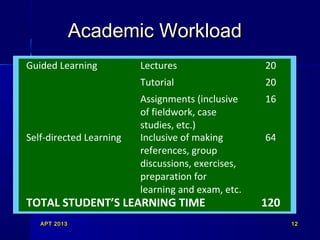
Guided Learning Lectures 20
Tutorial 20
Assignments (inclusive
of fieldwork, case
studies, etc.)
16
Self-directed Learning Inclusive of making
references, group
discussions, exercises,
preparation for
learning and exam, etc.
64
TOTAL STUDENT’S LEARNING TIME 120
Academic WorkloadAcademic Workload
APT 2013APT 2013 © 2013 Dr. Rafi/Dr. Wan Nadzrol© 2013 Dr. Rafi/Dr. Wan Nadzrol 1313

T1 introduction 2013

  • 1.
    Entrepreneur BehaviorEntrepreneur Behavior (APT2013)(APT 2013) WAN MOHD YUSUFF BIN WANWAN MOHD YUSUFF BIN WAN IBRAHIMIBRAHIM ©2014©2014
  • 2.
    INTRODUCTION TO THEINTRODUCTIONTO THE COURSECOURSE APT 2013APT 2013 22
  • 3.
    APT 2013APT 201333 Course ProfileCourse Profile  Course Name: Entrepreneur BehaviorCourse Name: Entrepreneur Behavior  Course Code: APT 2013Course Code: APT 2013  Credit: 3 creditCredit: 3 credit  Contact Hours: 3 hoursContact Hours: 3 hours  Subject Status: Program CoreSubject Status: Program Core  Pre-requisite: AFT 1013 (AsasPre-requisite: AFT 1013 (Asas Keusahawanan)Keusahawanan)
  • 4.
    APT 2013APT 201344 Course ProfileCourse Profile  Class Schedule:Class Schedule: – Lecture: FTKW7 – WEDNESDAY (10.00 am –Lecture: FTKW7 – WEDNESDAY (10.00 am – 12.00 pm) 202K12.00 pm) 202K – Tutorial: L7T1 - Wednesday (3-4 pm) 101TTutorial: L7T1 - Wednesday (3-4 pm) 101T – Tutorial: L7T3 - Wednesday (4-5 pm) 101TTutorial: L7T3 - Wednesday (4-5 pm) 101T – Tutorial: L7T2 - Wednesday (5-6 pm) 101TTutorial: L7T2 - Wednesday (5-6 pm) 101T  Attendance is compulsoryAttendance is compulsory
  • 5.
    APT 2013APT 201355 Lecturer ProfileLecturer Profile WAN MOHD YUSUFF BIN WAN IBRAHIM QUALIFICATION: •MASTER IN BUSINESS MANAGEMENT •DEGREE IN BUSINESS MANAGEMENT & COMMUNICATION MARKETING •DIPLOMA IN BUSINESS MANAGEMENT EXPERIENCE: •2 years in teaching •2 years in managing business •2 years in TM customer service •3 years in owned business
  • 6.
    APT 2013APT 201366 Course ObjectivesCourse Objectives The course aims to:The course aims to: 1.1. provide students with the knowledge on theories ofprovide students with the knowledge on theories of entrepreneurial behavior and motivationentrepreneurial behavior and motivation 2.2. equip students with the knowledge of essential behaviorsequip students with the knowledge of essential behaviors found among successful entrepreneursfound among successful entrepreneurs 3.3. expose students with the reality of the entrepreneurialexpose students with the reality of the entrepreneurial behavior at the business sitebehavior at the business site 4.4. allow the students to discover and compare their ownallow the students to discover and compare their own behaviors with behaviors of successful entrepreneursbehaviors with behaviors of successful entrepreneurs 5.5. encourage students to apply these behaviors in their dailyencourage students to apply these behaviors in their daily liveslives
  • 7.
    APT 2013APT 201377 Learning OutcomesLearning Outcomes At the end of the course, students will be able to:At the end of the course, students will be able to: 1.1. explain the different types of entrepreneurial behaviorsexplain the different types of entrepreneurial behaviors that are essential for successful entrepreneursthat are essential for successful entrepreneurs 2.2. apply the entrepreneurial thinking (mindset) that triggersapply the entrepreneurial thinking (mindset) that triggers certain behaviorcertain behavior 3.3. exhibit entrepreneurial behaviors in real life situationsexhibit entrepreneurial behaviors in real life situations 4.4. differentiate between entrepreneurial and non-differentiate between entrepreneurial and non- entrepreneurial behaviorsentrepreneurial behaviors 5.5. apply the entrepreneurial behaviors and skills in theirapply the entrepreneurial behaviors and skills in their daily working livesdaily working lives
  • 8.
    APT 2013APT 2013© 2013 Dr. Rafi/Dr. Wan Nadzrol© 2013 Dr. Rafi/Dr. Wan Nadzrol 88 Course OutlineCourse Outline  The entrepreneurial mindsetThe entrepreneurial mindset  Models of entrepreneurial motivationModels of entrepreneurial motivation  Entrepreneurial behaviorEntrepreneurial behavior  Opportunity identification skillsOpportunity identification skills  Organizing and resourcing skillsOrganizing and resourcing skills  Business communication skillsBusiness communication skills  Leadership skillsLeadership skills  Networking skillsNetworking skills  Presentation of entrepreneur’s profilePresentation of entrepreneur’s profile
  • 9.
    APT 2013APT 2013© 2013 Dr. Rafi/Dr. Wan Nadzrol© 2013 Dr. Rafi/Dr. Wan Nadzrol 99 Methods of DeliveryMethods of Delivery  Lectures and tutorialsLectures and tutorials  Case studiesCase studies  Field workField work  AssignmentsAssignments
  • 10.
    APT 2013APT 20131010 AssessmentsAssessments Individual AssignmentIndividual Assignment 10%10% Midterm TestMidterm Test 20%20% Entrepreneurial ProfileEntrepreneurial Profile -- ReportReport 15%15% -- PresentationPresentation 15%15% Final ExamFinal Exam 40%40% TotalTotal 100%100%
  • 11.
    APT 2013APT 20131111 ReferencesReferences 1.1. Butler, J.E., (2007),Butler, J.E., (2007), Opportunity Identification and EntrepreneurialOpportunity Identification and Entrepreneurial BehaviorBehavior, IAP, IAP 2.2. McMillan, I.C. and Rita Gunther Mac Grath (2000),McMillan, I.C. and Rita Gunther Mac Grath (2000), TheThe Entrepreneurial Mindset: Strategies for Continuosly CreatingEntrepreneurial Mindset: Strategies for Continuosly Creating Opportunity in An Age of UncertaintyOpportunity in An Age of Uncertainty, Harvard Business School, Harvard Business School PressPress 3.3. Barbara J. Bird (1989),Barbara J. Bird (1989), Entrepreneurial BehaviorEntrepreneurial Behavior, Glensview, Illinois:, Glensview, Illinois: Scott, ForesmanScott, Foresman 4.4. Scarborough, N.M. and Zimmerer, T.W., (2006),Scarborough, N.M. and Zimmerer, T.W., (2006), Effective SmallEffective Small Business Management: An Entrepreneurial ApproachBusiness Management: An Entrepreneurial Approach, 8, 8thth Edition,Edition, Pearson Prentice HallPearson Prentice Hall 5.5. Carol C. Dweck (2006),Carol C. Dweck (2006), Mindset: The New Psychology of SuccessMindset: The New Psychology of Success,, Random HouseRandom House
  • 12.
    APT 2013APT 20131212 Guided Learning Lectures 20 Tutorial 20 Assignments (inclusive of fieldwork, case studies, etc.) 16 Self-directed Learning Inclusive of making references, group discussions, exercises, preparation for learning and exam, etc. 64 TOTAL STUDENT’S LEARNING TIME 120 Academic WorkloadAcademic Workload
  • 13.
    APT 2013APT 2013© 2013 Dr. Rafi/Dr. Wan Nadzrol© 2013 Dr. Rafi/Dr. Wan Nadzrol 1313