Research on Humanities and Social Sciences www.iiste.org 
ISSN (Paper)2224-5766 ISSN (Online)2225-0484 (Online) 
Vol.4, No.18, 2014 
Female Genital Mutilation/Cutting among Ghanaian Women: The 
Determinants 
Michael Ofori Fosu* Ir. Peter Romeo Nyarko Martin Anokye 
Lecturer, Department of Mathematics and Statistics, P.O Box 854, Kumasi Polytechnic Ghana 
*Email: mikeoffos@yahoo.com 
Abstract 
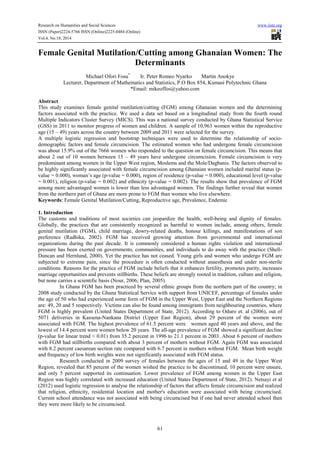
This study examines female genital mutilation/cutting (FGM) among Ghanaian women and the determining 
factors associated with the practice. We used a data set based on a longitudinal study from the fourth round 
Multiple Indicators Cluster Survey (MICS). This was a national survey conducted by Ghana Statistical Service 
(GSS) in 2011 to monitor progress of women and children. A sample of 10,963 women within the reproductive 
age (15 – 49) years across the country between 2009 and 2011 were selected for the survey. 
A multiple logistic regression and bootstrap techniques were used to determine the relationship of socio-demographic 
factors and female circumcision. The estimated women who had undergone female circumcision 
was about 15.9% out of the 7666 women who responded to the question on female circumcision. This means that 
about 2 out of 10 women between 15 – 49 years have undergone circumcision. Female circumcision is very 
predominant among women in the Upper West region, Moslems and the Mole/Dagbanis. The factors observed to 
be highly significantly associated with female circumcision among Ghanaian women included marital status (p-value 
= 0.000), woman’s age (p-value = 0.000), region of residence (p-value = 0.000), educational level (p-value 
= 0.001), religion (p-value = 0.002) and ethnicity (p-value = 0.002). The results show that prevalence of FGM 
among more advantaged women is lower than less advantaged women. The findings further reveal that women 
from the northern part of Ghana are more prone to FGM than women who live elsewhere. 
Keywords: Female Genital Mutilation/Cutting, Reproductive age, Prevalence, Endemic 
1. Introduction 
The customs and traditions of most societies can jeopardize the health, well-being and dignity of females. 
Globally, the practices that are consistently recognized as harmful to women include, among others, female 
genital mutilation (FGM), child marriage, dowry-related deaths, honour killings, and manifestations of son 
preference (Radhika, 2002). FGM has received growing attention from governmental and international 
organizations during the past decade. It is commonly considered a human rights violation and international 
pressure has been exerted on governments, communities, and individuals to do away with the practice (Shell- 
Duncan and Hernlund, 2000). Yet the practice has not ceased. Young girls and women who undergo FGM are 
subjected to extreme pain, since the procedure is often conducted without anaesthesia and under non-sterile 
conditions. Reasons for the practice of FGM include beliefs that it enhances fertility, promotes purity, increases 
marriage opportunities and prevents stillbirths. These beliefs are strongly rooted in tradition, culture and religion, 
but none carries a scientific basis (Nour, 2006; Plan, 2005). 
In Ghana FGM has been practiced by several ethnic groups from the northern part of the country; in 
2008 study conducted by the Ghana Statistical Service with support from UNICEF, percentage of females under 
the age of 50 who had experienced some form of FGM in the Upper West, Upper East and the Northern Regions 
are: 49, 20 and 5 respectively. Victims can also be found among immigrants from neighbouring countries, where 
FGM is highly prevalent (United States Department of State, 2012). According to Oduro et. al (2006), out of 
5071 deliveries in Kassena-Nankana District (Upper East Region), about 29 percent of the women were 
associated with FGM. The highest prevalence of 61.5 percent were women aged 40 years and above, and the 
lowest of 14.4 percent were women below 20 years. The all-age prevalence of FGM showed a significant decline 
(p-value for linear trend < 0.01) from 35.2 percent in 1996 to 21.1 percent in 2003. About 6 percent of mothers 
with FGM had stillbirths compared with about 3 percent of mothers without FGM. Again FGM was associated 
with 8.2 percent caesarean section rate compared with 6.7 percent in mothers without FGM. Mean birth weight 
and frequency of low birth weights were not significantly associated with FGM status. 
Research conducted in 2009 survey of females between the ages of 15 and 49 in the Upper West 
Region, revealed that 85 percent of the women wished the practice to be discontinued, 10 percent were unsure, 
and only 5 percent supported its continuation. Lower prevalence of FGM among women in the Upper East 
Region was highly correlated with increased education (United States Department of State, 2012). Netsayi et al 
(2012) used logistic regression to analyse the relationship of factors that affects female circumcision and realized 
that religion, ethnicity, residential location and mother's education were associated with being circumcised. 
Current school attendance was not associated with being circumcised but if one had never attended school then 
they were more likely to be circumcised. 
61
Research on Humanities and Social Sciences www.iiste.org 
ISSN (Paper)2224-5766 ISSN (Online)2225-0484 (Online) 
Vol.4, No.18, 2014 
1.1 Associated Risks of FGM 
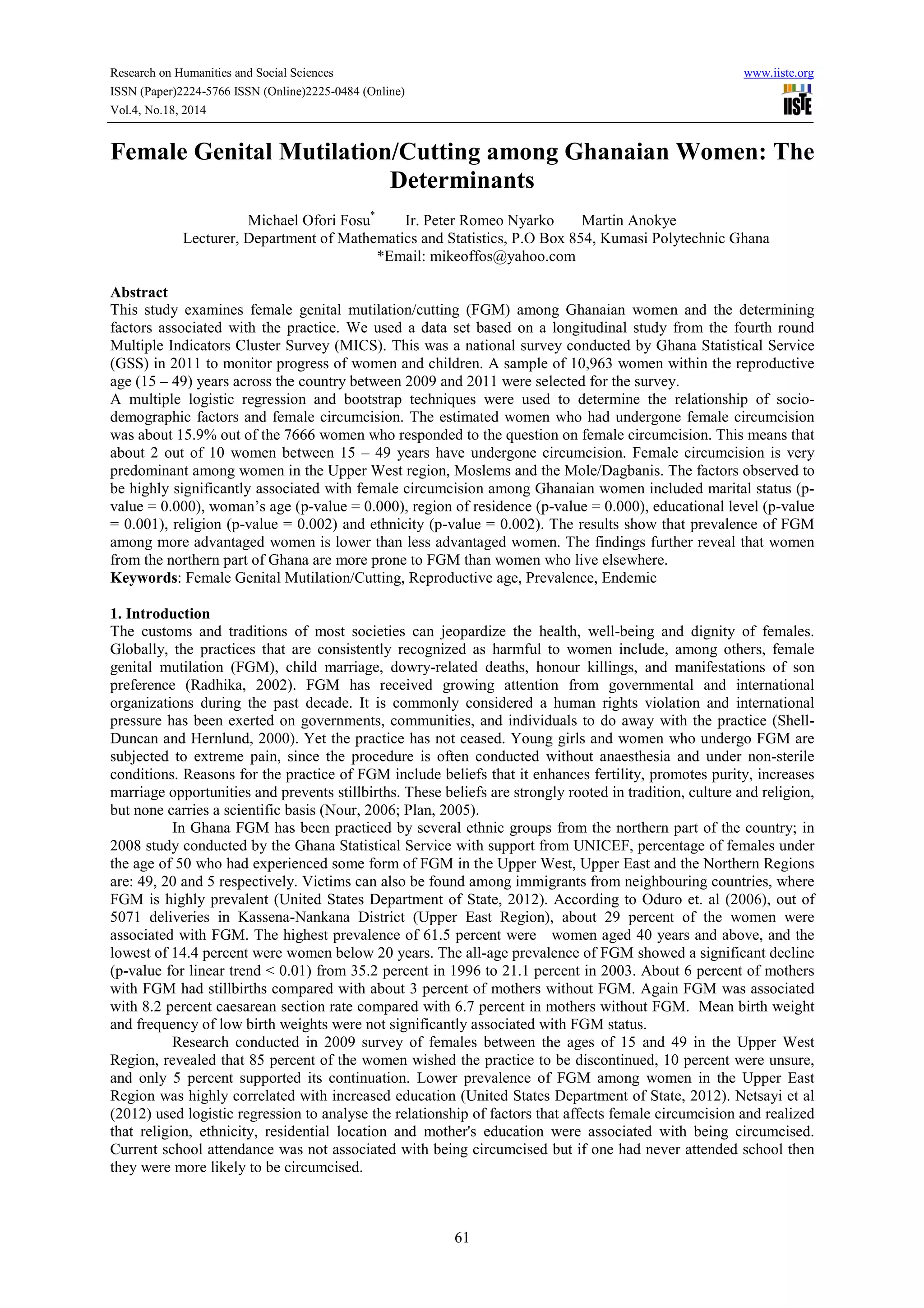
The short-term complications of FGM include but not limited to, excessive bleeding, infection and severe pain 
(Innocenti Digest, 2005). In the long run, FGM heightens pregnancy and childbirth related risks of women. The 
increased risk may be attributable to vulva and vaginal scarring associated with FGM, which can obstruct 
delivery. In addition, genital and urinary-tract infections caused by FGM can also lead to problems during 
delivery (WHO, 2006). 
It also believed that the immediate and long-term health consequences of FGM vary according to the type and 
severity of the procedure performed. Immediate complications include severe pain, urine retention, shock, 
haemorrhage, infection and sometimes lead to death. Additional consequences include cysts, abscesses, keloid 
scarring, damage to the urethra, dyspareunia and sexual dysfunction. Personal accounts of mutilation reveal 
feelings of anxiety, terror, humiliation and betrayal, all of which would be likely to have long-term negative 
psychological effects (Zara, 2002). 
In recent times, there have been concerns about the potential risk of transmission of the human 
immunodeficiency virus due to the practice (WHO, 1996). Victims of FGM suffer feelings of in-completeness, 
anxiety and depression (Mahran, 1981). 
1.2 Prevalence Rate in Other Parts of the World 
FGM is practiced in Africa, the Middle East, Indonesia and Malaysia (William and Smith 2012) as well as some 
migrants in Europe, United States and Australia. It is also seen in some populations of South Asia. The highest 
known prevalence rates are in 30 African countries, in a band that stretches from Senegal in West Africa and to 
Ethiopia on the east coast, as well as from Egypt in the north to Tanzania in the south (Doherty, 2012) According 
to a 2013 UNICEF report on select countries, FGM is known to be prevalent in 27 African countries, Yemen and 
Iraqi Kurdistan, where 125 million women and girls have undergone FGM (Berivan et al. 2013). FGM affects 
the lives and well-being of 92 percent of women of childbearing age in Mali (Yoder et al., 2004). Although it is 
not mandated by any major religion, FGM is deeply embedded in Malian culture; 80 percent of women who 
were circumcised believed that the practice should continue (Mali 144, 2003). 
In recent years the increase in immigration of individuals from countries which practice FGM, has led 
to the introduction of FGM in European and North American societies. However, FGM prevalence rate has been 
difficult to quantify among immigrants to European countries (Leye, et. al. 2006). A case study which 
investigated FGM in groups of migrant women from Northern Africa to European countries like Scandinavia, 
noted that a majority of these women had been circumcised before their migration to Europe (Elgaali et. al., 
2005). It has also been established that African communities in European countries continue the practice of FGM 
on their daughters after migrating to Europe. 
1.3 FGM Eradication Programme 
A variety of strategies have been implemented to discourage the practice. In 1994, Ghana enacted into law to 
criminalize the practice. Since then, successful prosecutions of persons performing FGM have been reported 
from the Upper West and Upper East Regions. In 2007, Parliament further strengthened the law against FGM by 
increasing the maximum penalty to 10 years of imprisonment (United Nations Human Rights Council, 2008). In 
November 2003 a court in Upper West region in Ghana jailed a 45 year old woman farmer for 5 years for 
circumcising 3 girls including a three week old baby (Irin, 2004). 
The Malian government has not criminalized the practice of FGM, but it has taken steps to change 
popular attitudes toward the practice. In 2002, the president of Mali issued an order creating a government 
program aimed at stopping the practice of FGM (Mali, 2002). In Togo, the prevalence of FGM is estimated at 50 
percent of girls and women. The practice was criminalized in 1998. Included in the legislation that outlawed the 
practice were provisions requiring all health-care facilities to report cases of FGM to law enforcement authorities 
(Togo, 1998). 
In 1994 there were several anecdotal reports of FGM practice amongst migrant communities in 
Australia. By 1997, all Australian states and territories had made FGM a criminal offence. It is also a criminal 
offence to take or propose to take a child outside Australia to have FGM performed on her (RCOG, 1997). The 
incidence of FGM in Australia is not clearly known due to the fact that cases are unreported to authorities and 
are uncovered only when women and girls are taken to hospital due to complications with the procedure (Sunday 
Telegraph, 2006). 
This study therefore seeks to examine the determinants for FGM among girls and women in Ghana. 
How the practice is affected by such factors as: wealth index quintiles, region, area of residence, ethnicity, 
religion and mothers’ characteristics including; education, marital status, and age among others. This is 
influenced by the question asked: whether a woman has ever been circumcised or not 
62
Research on Humanities and Social Sciences www.iiste.org 
ISSN (Paper)2224-5766 ISSN (Online)2225-0484 (Online) 
Vol.4, No.18, 2014 
2. Data 
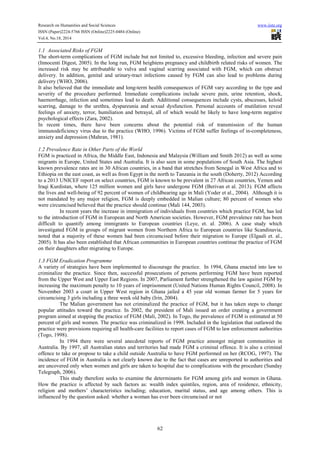
The 2011 Multiple Indicator Cluster Survey (MICS) data was used in this study. This is a fourth round of the 
survey which is conducted every five years to monitor the situation of children and women in Ghana. In this 
survey about 10,963 women who were within the reproductive age (15 – 49 years) were selected across the ten 
Regions of Ghana. The subjects were interviewed reference to two years preceding the survey. The selection 
procedure was based on a representative probability sample of households nationwide from a frame of Ghana 
2010 Population and Housing Census Enumeration Areas (EA’s). For comparability, the MICS used an 
internationally standardized sampling of two-stage stratified sample design. At the first stage, a number of EA’s 
were selected from the regions which were considered as clusters. The households in each region were then 
selected using systematic sampling with probability proportional to size in the second stage. Of the 12,150 
households selected for the sample, 11, 925 households were contacted and duly interviewed. In the households 
interviewed, 10,963 women aged 15 – 49 years were identified for interview. 
3. Methodology 
This paper uses a data set based on the 2011 MICS. The survey was carried out on a sample of 11,925 
households from a selected household of 11,970 in all the ten administrative regions of Ghana giving about 
100% response rate. The households were selected due to the sizes of the regions. The survey used both 
qualitative and quantitative methods of data collection aimed at providing basic data for measuring the progress 
of children and women in the country. Data used for analysis in this paper was based on information on all 
female circumcisions that had occurred two years prior to the survey period. Statistical package for social 
scientists (SPSS version 20) and SAS system version 9.1 were used for extraction and the eventual analysis of 
data. Descriptive statistics and frequencies of the background characteristics of the women interviewed were 
generated. The association between the independent and dependent variable was established using chi-square 
analysis procedures. The dependent variable selected was the outcome of a question asked: whether a woman has 
ever been circumcised. The independent variables include Wealth index quintiles, region, area of residence, 
ethnicity, religion and mothers’ characteristics including; education, marital status, and age. A critical level of 
significance of 5 percent (p<0.05) was used to identify the most statistically significant determinants of 
circumcision/cutting among the women. 
The binary logistic regression model was used to study whether the independent factors affected a female 
circumcision or not. The bootstrap model which is quite general and also can provide more accurate inferences 
when the data are not well behaved or when the sample size is small was further used. 
3.1 model specification 
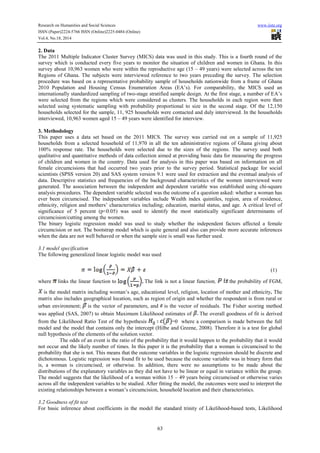
The following generalized linear logistic model was used 
63 
(1) 
where links the linear function to The link is not a linear function, the probability of FGM, 
is the model matrix including woman’s age, educational level, religion, location of mother and ethnicity. The 
matrix also includes geographical location, such as region of origin and whether the respondent is from rural or 
urban environment; is the vector of parameters, and is the vector of residuals. The Fisher scoring method 
was applied (SAS, 2007) to obtain Maximum Likelihood estimates of The overall goodness of fit is derived 
from the Likelihood Ratio Test of the hypothesis =0 where a comparison is made between the full 
model and the model that contains only the intercept (Hilbe and Greene, 2008). Therefore it is a test for global 
null hypothesis of the elements of the solution vector. 
The odds of an event is the ratio of the probability that it would happen to the probability that it would 
not occur and the likely number of times. In this paper it is the probability that a woman is circumcised to the 
probability that she is not. This means that the outcome variables in the logistic regression should be discrete and 
dichotomous. Logistic regression was found fit to be used because the outcome variable was in binary form that 
is, a woman is circumcised, or otherwise. In addition, there were no assumptions to be made about the 
distributions of the explanatory variables as they did not have to be linear or equal in variance within the group. 
The model suggests that the likelihood of a woman within 15 – 49 years being circumcised or otherwise varies 
across all the independent variables to be studied. After fitting the model, the outcomes were used to interpret the 
existing relationships between a woman’s circumcision, household location and their characteristics. 
3.2 Goodness of fit test 
For basic inference about coefficients in the model the standard trinity of Likelihood-based tests, Likelihood
Research on Humanities and Social Sciences www.iiste.org 
ISSN (Paper)2224-5766 ISSN (Online)2225-0484 (Online) 
Vol.4, No.18, 2014 
ratio, Wald and Lagrange Multiplier (LM), are easily computed. For testing a hypothesis, linear or nonlinear, of 
the form; 
64 
=0 (2) 
the likelihood-ratio statistic is the obvious choice. This requires estimation of subject to the restrictions of the 
null hypothesis, for example subject to the exclusions of a null hypothesis that states that certain variables should 
have zero coefficients. That is, they should not appear in the model. Then the likelihood-ratio statistic; 
(3) 
where is the log-likelihood computed using the full or unrestricted estimator, is the counterpart 
based on the restricted estimator and the degrees of freedom J, the number of restrictions. Each predictor, 
including the constant, can have a calculated Wald Statistic defined as: 
[βj / SE(βj)]2, (4) 
which is distributed as [βj / SE(βj)]2 defines both the z or t statistic, respectively distributed as t or normal. 
For computation of Wald Statistics, one needs the asymptotic covariance matrix of the coefficients. 
4. Results 
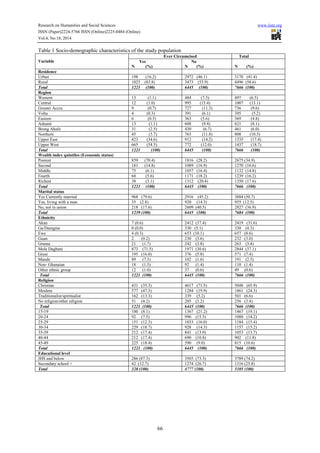
Table 1 shows the descriptive statistics about the characteristics of the women interviewed. Out of the 7,666 
women who responded to the question on circumcision, about 1,221 indicated that they have undergone 
circumcision before, giving a prevalence rate of about 15.9%. This means that about 2 out of 10 women between 
15 – 49 years have undergone circumcision. More women (83.8%) in rural areas than in urban areas (16.2%) 
have undergone circumcision. Women from the Upper West Region of Ghana are more likely to undergo 
circumcision (54.5%) and those from Volta Region, the least likely to be circumcised (0.3%). Women from 
Upper East and the Northern Regions also have high rates of about 34.6% and 3.7% respectively. This means 
that women from the northern sector of Ghana have higher proportion of female circumcision. Women from 
rural households, those from the poorest households and those who have a maximum of Middle/Junior High 
School (JHS) education are more likely than more advantaged women to undergo circumcision. For example, the 
proportion of circumcision among women who have a maximum of middle/JHS education is 87.3%, compared 
to 12.7% of women who have a minimum of secondary school education. Women from the wealthiest 
households are less likely to undergo circumcision than women from the poorest households (about 3.1% versus 
70.4%). The possibility of a woman undergoing circumcision is higher among Moslems than any other religion. 
Again, female circumcision appears to be high among older women than the young ones. We speculate that 
modern parents are trying to ignore this practice than it used to be. Circumcision among currently married 
women is quite alarming. More women (79.6%) in this category have undergone circumcision than those living 
with men and those who are not married. Female circumcision appears to have an ethnic connotation. The results 
show that it is more endemic among the Mole/Dagbanis’ (71.5%) and the Grusis’ (16.0%) than any other ethnic 
group. In fact the practise is almost negligible among the Gas’. Tables 2 and 3 depict the results of multivariate 
logistic regression analysis of household and women’s characteristics associated with female circumcision 
among women within the reproductive age. The factors observed to be highly significantly associated with 
female circumcision included marital status (p-value = 0.000), mothers’ age (p-value = 0.000), region (p-value = 
0.000), educational level (p-value = 0.001), religion (p-value = 0.002) and ethnicity (p-value = 0.002). 
Confounder control by multiple logistic regression analysis revealed that significant factors (in 
ascending order of odds ratio) were region, age, marital status, educational level, ethnicity and religion. 
5. Discussion 
The descriptive statistics show that women in rural areas tend to undergo circumcision than women in urban 
areas. Circumcision among women who have higher education is lower than women who are not educated or 
have low levels of education. Here, we speculate that those educated women may have parents who have 
knowledge about effects and implications of female genital mutilation/cutting. Women whose economic status is 
high are also few among the circumcised women probably because they are more empowered than those who 
live below the poverty line. Women who are currently married are in the majority among the circumcised 
women than those who are not married. We again speculate that this may have a cultural connotation especially 
in the northern part of the country where among some ethnic groups it serves as a triumph card for marriage. 
This is clearly the case among the Mole/Dagbanis’ which has a large chunk of women circumcised (71.5%). 
Female circumcision among women in the three northern regions of Ghana is quite alarming. The figure for
Research on Humanities and Social Sciences www.iiste.org 
ISSN (Paper)2224-5766 ISSN (Online)2225-0484 (Online) 
Vol.4, No.18, 2014 
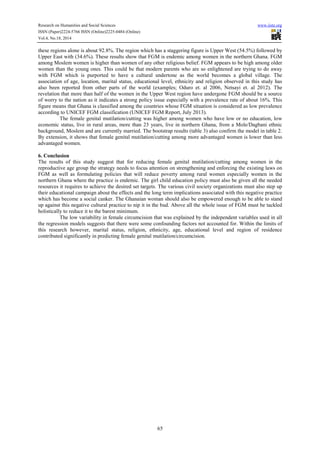
these regions alone is about 92.8%. The region which has a staggering figure is Upper West (54.5%) followed by 
Upper East with (34.6%). These results show that FGM is endemic among women in the northern Ghana. FGM 
among Moslem women is higher than women of any other religious belief. FGM appears to be high among older 
women than the young ones. This could be that modern parents who are so enlightened are trying to do away 
with FGM which is purported to have a cultural undertone as the world becomes a global village. The 
association of age, location, marital status, educational level, ethnicity and religion observed in this study has 
also been reported from other parts of the world (examples; Oduro et. al 2006, Netsayi et. al 2012). The 
revelation that more than half of the women in the Upper West region have undergone FGM should be a source 
of worry to the nation as it indicates a strong policy issue especially with a prevalence rate of about 16%. This 
figure means that Ghana is classified among the countries whose FGM situation is considered as low prevalence 
according to UNICEF FGM classification (UNICEF FGM Report, July 2013). 
The female genital mutilation/cutting was higher among women who have low or no education, low 
economic status, live in rural areas, more than 23 years, live in northern Ghana, from a Mole/Dagbani ethnic 
background, Moslem and are currently married. The bootstrap results (table 3) also confirm the model in table 2. 
By extension, it shows that female genital mutilation/cutting among more advantaged women is lower than less 
advantaged women. 
6. Conclusion 
The results of this study suggest that for reducing female genital mutilation/cutting among women in the 
reproductive age group the strategy needs to focus attention on strengthening and enforcing the existing laws on 
FGM as well as formulating policies that will reduce poverty among rural women especially women in the 
northern Ghana where the practice is endemic. The girl child education policy must also be given all the needed 
resources it requires to achieve the desired set targets. The various civil society organizations must also step up 
their educational campaign about the effects and the long term implications associated with this negative practice 
which has become a social canker. The Ghanaian woman should also be empowered enough to be able to stand 
up against this negative cultural practice to nip it in the bud. Above all the whole issue of FGM must be tackled 
holistically to reduce it to the barest minimum. 
The low variability in female circumcision that was explained by the independent variables used in all 
the regression models suggests that there were some confounding factors not accounted for. Within the limits of 
this research however, marital status, religion, ethnicity, age, educational level and region of residence 
contributed significantly in predicting female genital mutilation/circumcision. 
65
Research on Humanities and Social Sciences www.iiste.org 
ISSN (Paper)2224-5766 ISSN (Online)2225-0484 (Online) 
Vol.4, No.18, 2014 
Table 1 Socio-demographic characteristics of the study population 
66 
Variable 
Ever Circumcised Total 
Yes 
N (%) 
No 
N (%) 
N (%) 
Residence 
Urban 198 (16.2) 2972 (46.1) 3170 (41.4) 
Rural 1023 (83.8) 3473 (53.9) 4496 (58.6) 
Total 1221 (100) 6445 (100) 7666 (100) 
Region 
Western 13 (1.1) 484 (7.5) 497 (6.5) 
Central 12 (1.0) 995 (15.4) 1007 (13.1) 
Greater Accra 9 (0.7) 727 (11.3) 736 (9.6) 
Volta 4 (0.3) 391 (6.1) 395 (5.2) 
Eastern 6 (0.5) 363 (5.6) 369 (4.8) 
Ashanti 13 (1.1) 608 (9.4) 621 (8.1) 
Brong Ahafo 31 (2.5) 430 (6.7) 461 (6.0) 
Northern 45 (3.7) 763 (11.8) 808 (10.5) 
Upper East 423 (34.6) 912 (14.2) 1335 (17.4) 
Upper West 665 (54.5) 772 (12.0) 1437 (18.7) 
Total 1221 (100) 6445 (100) 7666 (100) 
Wealth index quintiles (Economic status) 
Poorest 859 (70.4) 1816 (28.2) 2675 (34.9) 
Second 181 (14.8) 1089 (16.9) 1270 (16.6) 
Middle 75 (6.1) 1057 (16.4) 1132 (14.8) 
Fourth 68 (5.6) 1171 (18.2) 1239 (16.2) 
Richest 38 (3.1) 1312 (20.4) 1350 (17.6) 
Total 1221 (100) 6445 (100) 7666 (100) 
Marital status 
Yes Currently married 968 (79.6) 2916 (45.2) 3884 (50.7) 
Yes, living with a man 35 (2.8) 920 (14.3) 955 (12.5) 
No, not in union 218 (17.6) 2609 (40.5) 2827 (36.9) 
Total 1239 (100) 6445 (100) 7684 (100) 
Ethnicity 
Akan 7 (0.6) 2412 (37.4) 2419 (31.6) 
Ga/Damgme 0 (0.0) 330 (5.1) 330 (4.3) 
Ewe 4 (0.3) 653 (10.1) 657 (8.6) 
Guan 2 (0.2) 230 (3.6) 232 (3.0) 
Gruma 21 (1.7) 242 (3.8) 263 (3.4) 
Mole Dagbani 873 (71.5) 1971 (30.6) 2844 (37.1) 
Grusi 195 (16.0) 376 (5.8) 571 (7.4) 
Mande 89 (7.3) 102 (1.6) 191 (2.5) 
Non- Ghanaian 18 (1.5) 92 (1.4) 110 (1.4) 
Other ethnic group 12 (1.0) 37 (0.6) 49 (0.6) 
Total 1221 (100) 6445 (100) 7666 (100) 
Religion 
Christian 431 (35.3) 4617 (71.5) 5048 (65.9) 
Moslem 577 (47.3) 1284 (19.9) 1861 (24.3) 
Traditionalist/spiritualist 162 (13.3) 339 (5.2) 501 (6.6) 
No religion/other religion 51 (4.2) 205 (3.2) 256 (3.4) 
Total 1221 (100) 6445 (100) 7666 (100) 
15-19 100 (8.1) 1367 (21.2) 1467 (19.1) 
20-24 92 (7.5) 996 (15.5) 1088 (14.2) 
25-29 151 (12.3) 1033 (16.0) 1184 (15.4) 
30-34 229 (18.7) 928 (14.3) 1157 (15.2) 
35-39 212 (17.4) 841 (13.0) 1053 (13.7) 
40-44 212 (17.4) 690 (10.8) 902 (11.8) 
45-49 225 (18.4) 590 (9.0) 815 (10.6) 
Total 1221 (100) 6445 (100) 7666 (100) 
Educational level 
JHS and below 286 (87.3) 3503 (73.3) 3789 (74.2) 
Secondary school + 42 (12.7) 1274 (26.7) 1316 (25.8) 
Total 328 (100) 4777 (100) 5105 (100)
Research on Humanities and Social Sciences www.iiste.org 
ISSN (Paper)2224-5766 ISSN (Online)2225-0484 (Online) 
Vol.4, No.18, 2014 
Table 2 Logistic regression model 
Variable B S.E. Wald df Sig. Exp(B) 95% C.I.for 
67 
EXP(B) 
Lower Upper 
Age -.040 .008 22.414 1 .000 .961 .945 .977 
Educational level .242 .076 10.222 1 .001 1.273 1.098 1.477 
Religion -.012 .004 9.254 1 .002 .988 .980 .996 
Ethnicity -.026 .008 9.420 1 .002 .975 .959 .991 
Marital status .346 .084 17.128 1 .000 1.413 1.200 1.665 
Residence -.123 .204 .364 1 .546 .884 .593 1.319 
Region -.695 .048 212.873 1 .000 .499 .455 .548 
Wealth index quintiles .068 .076 .788 1 .375 1.070 .922 1.242 
Constant 8.627 .796 117.607 1 .000 5581.589 
Table 3 Bootstrap model for parameter estimates 
Parameter B Bootstrapa 
Bias Std. Error Sig. (2-tailed) 95% Confidence Interval 
Lower Upper 
Age -.040 .000 .009 .001 -.058 -.021 
Educational level .242 .004 .082 .003 .094 .418 
Religion -.012 .000 .004 .001 -.020 -.005 
Ethnicity -.026 -.001 .009 .005 -.048 -.012 
Marital status .346 .001 .087 .001 .171 .511 
Residence -.123 .001 .191 .502 -.520 .249 
Region -.695 -.011 .073 .001 -.862 -.572 
Wealth index quintiles .068 .001 .072 .339 -.072 .210 
Constant 8.627 .124 1.021 .001 6.739 10.927 
a. Unless otherwise noted, bootstrap results are based on 1000 bootstrap samples 
References 
A.R. Oduro, P. Ansah, A. Hodgson, T.M. Afful, F. Baiden, P. Adongoand K.A. Koram (2006) Trends In The 
Prevalence Of Female Genital Muti-Lation And Its Effect On Delivery Outcomes In The Kassena-Nankana 
District Of Northern Ghana.Ghana Medical Journal, Vol. 40, No. 3 
Ben Doherty (2012).Female circumcision fear as fundamentalists roll back women's rights. The Sydney Morning 
Herald, January 25, 2012. 
Elgaali, Mahoud, Helena Strevens, and Per-Anders Mårdh (2005).Female Genital Mutilation – an Exported 
Medical Hazard.The European Journal of Contraception and Reproductive Health Care10.2: 93–97 
Innocenti Digest (2005). Changing a Harmful Social Convention: Female Genital 
Mutilation/Cutting.http://www.uniceficdc.org/publications/pdf/fgm-gb-2005.pdf. 
Leye, Els, Richard Powell, GerdaNienhuis, Patricia Claeys, and MarleenTemmerman (2006).Health Care in 
Europe for Women with Genital Mutilation.Health Care for Women International (27.4): 362–378. 
Mahran M.(1981). Medical dangers of female circumcision.IPPF Med Bull 1981; 15: 1-3. 
Mali 144 (2003).Ministère De La Promotion De La Femme, De L’enfant Et De La Famille [Ministry For The 
Advancement Of Women, Children, And The Family], Plan National D’eradication De L’excision A L’horizon 
2007 [National Plan For The Eradication Of Excision By 2007], at 3 (July 29, 1998), in CENTER FOR 
REPRODUCTIVERIGHTS, WOMEN OF THE WORLD. 
Mali (2002).Ordinance No. 02-053 portant creation du programme national de luttecontre la pratique de 
l’excision[Ordinance creating aNational Program to Fight the Practice of Female GenitalMutilation]. June 4, 
2002 (Mali) 
NetsayiNorisMudege,ThaddaeusEgondi,DonatienBeguy andEliyaMsiyaphazi Zulu(2012).The determinants of 
female circumcision among adolescents from communities that practice female circumcision in two Nairobi 
informal settlements. International Journal of Health Sociology:Policy, Promotion, Equity and Practice, Vol. 21, 
issue 2, PP: 242 – 250 
Nour NM. (2008). Female genital cutting: a persisting practice. Rev ObstetGynecol 2008; 1: 135-9 pmid: 
19015765. 
Obermeyer, Carla Makhlouf. (1999). Female genital surgeries: The known, the unknown, and the unknowable. 
Medical Anthropology Quarterly 13(1): 79–106. 
Radhika, Coomaraswamy (2002). Integration of the Human Rights of Women and the Gender Perspective,
Research on Humanities and Social Sciences www.iiste.org 
ISSN (Paper)2224-5766 ISSN (Online)2225-0484 (Online) 
Vol.4, No.18, 2014 
Violence Against Women: Cultural Practices in the Family that are Violent Towards Women. Report of 
theSpecial Rapporteur on violence against women, its causes and consequences, submitted inaccordance with 
Commission on Human Rights resolution 2001/49, 58th Sess., Agenda Item 12(a), U.N. Doc. E/CN.4/2002/83 
(2002). 
Royal Australian College of Obstetricians and Gynaecologists (RCOG 1997), Female Genital Mutilation: 
Information for Australian Health Professionals, Royal Australian College of Obstetricians and Gynaecologists 
Shell-Duncan, Bettina and YlvaHernlund(2000).Female circumcison in Africa: Dimensions of the practice and 
debates. In Female Circumcision in Africa: Culture,Controversy, and Change. Eds. Bettina Shell-Duncan and 
YlvaHernlund. Boulder, CO: Lyne Reinner. Pp. 1–40. 
Stanley P. Yoder, NoureddineAbderrahim and ArlindaZhuzhuni.(2004). Female Genital Cutting In The 
Demographic And Health Surveys: A Critical And Comparative Analysis.Dhs Comparative Reports No.7: 26, 
Tbl.4.1: 
The Sunday Telegraph (2006). Girls mutilated for 'tradition. 5 November 2006. 
Togo (1998).Loi No. 98-016 portant interdiction des mutilations genitals feminines au Togo [Law prohibiting 
female genital mutilationin Togo], Nov. 17, 1998, art.7, Journal Officiel De LaRepubliqueTogolaise 2-3 (Nov. 
21, 1998) (Togo). 
United States Department of State (2012).Country Reports on Human RightsPractices for 2011Ghana 
http://www.state.gov/j/drl/rls/hrrpt/humanrightsreport/index.htm#wrapper. Assessed June 23 2014. 
United Nations Human Rights Council (2008).Report of the SpecialRapporteur on Violence against Women, Its 
Causes and Consequences, YakinErtürk : addendum : mission to Ghana 
WHO (2006).Female Genital Mutilation and ObstetricOutcome: WHO Collaborative Prospective Study in Six 
AfricanCountries. 367 LANCET 1835, 1839 (2006) 
William G. Clarence-Smith (2012). Female Circumcision in Southeast Asia since the Coming of Islam, in 
ChitraRaghavan and James P. Levine (eds.), Self-Determination and Women’s Rights in Muslim Societies, 
Brandeis University Press; ISBN 978-1611682809; see pages 124-146 
World Health Organization(1996).Female Genital Mutilation.Report of a WHO Technical Working Group, 
Geneva. 
www.irin news .org. (2004) Ghana women call for stiffer female circumcision laws. 
Plan (2005).Tradition and rights: female genital cutting in West Africa. http://plan-international.org/where-we-work/ 
africa/publications/tradition-and-rights-female-genital-cutting-in-west-africa, accessed 23 June 2014. 
Yasin, Berivan A.,Namir G Al-Tawil, Tariq S Al-Hadithi. (2013). Female genital mutilation among Iraqi 
Kurdish women: a cross-sectional study from Erbil city, BMC Public Health, 13, Multiple Indicator Cluster 
Survey, UNICEF, 25 May 2012. 
Zara Spencer (2002).The Criminalisation Of Female Genital Mutilation In Queensland. Murdoch University 
Electronic Journal of Law, Vol. 9, No. 3 http://www.murdoch.edu.au/elaw/issues/v9n3/spencer93_text.html. 
Assesed 30th Jan., 2014 
. 
68
The IISTE is a pioneer in the Open-Access hosting service and academic event 
management. The aim of the firm is Accelerating Global Knowledge Sharing. 
More information about the firm can be found on the homepage: 
http://www.iiste.org 
CALL FOR JOURNAL PAPERS 
There are more than 30 peer-reviewed academic journals hosted under the hosting 
platform. 
Prospective authors of journals can find the submission instruction on the 
following page: http://www.iiste.org/journals/ All the journals articles are available 
online to the readers all over the world without financial, legal, or technical barriers 
other than those inseparable from gaining access to the internet itself. Paper version 
of the journals is also available upon request of readers and authors. 
MORE RESOURCES 
Book publication information: http://www.iiste.org/book/ 
IISTE Knowledge Sharing Partners 
EBSCO, Index Copernicus, Ulrich's Periodicals Directory, JournalTOCS, PKP Open 
Archives Harvester, Bielefeld Academic Search Engine, Elektronische 
Zeitschriftenbibliothek EZB, Open J-Gate, OCLC WorldCat, Universe Digtial 
Library , NewJour, Google Scholar

Female genital mutilation

  • 1.
    Research on Humanitiesand Social Sciences www.iiste.org ISSN (Paper)2224-5766 ISSN (Online)2225-0484 (Online) Vol.4, No.18, 2014 Female Genital Mutilation/Cutting among Ghanaian Women: The Determinants Michael Ofori Fosu* Ir. Peter Romeo Nyarko Martin Anokye Lecturer, Department of Mathematics and Statistics, P.O Box 854, Kumasi Polytechnic Ghana *Email: mikeoffos@yahoo.com Abstract This study examines female genital mutilation/cutting (FGM) among Ghanaian women and the determining factors associated with the practice. We used a data set based on a longitudinal study from the fourth round Multiple Indicators Cluster Survey (MICS). This was a national survey conducted by Ghana Statistical Service (GSS) in 2011 to monitor progress of women and children. A sample of 10,963 women within the reproductive age (15 – 49) years across the country between 2009 and 2011 were selected for the survey. A multiple logistic regression and bootstrap techniques were used to determine the relationship of socio-demographic factors and female circumcision. The estimated women who had undergone female circumcision was about 15.9% out of the 7666 women who responded to the question on female circumcision. This means that about 2 out of 10 women between 15 – 49 years have undergone circumcision. Female circumcision is very predominant among women in the Upper West region, Moslems and the Mole/Dagbanis. The factors observed to be highly significantly associated with female circumcision among Ghanaian women included marital status (p-value = 0.000), woman’s age (p-value = 0.000), region of residence (p-value = 0.000), educational level (p-value = 0.001), religion (p-value = 0.002) and ethnicity (p-value = 0.002). The results show that prevalence of FGM among more advantaged women is lower than less advantaged women. The findings further reveal that women from the northern part of Ghana are more prone to FGM than women who live elsewhere. Keywords: Female Genital Mutilation/Cutting, Reproductive age, Prevalence, Endemic 1. Introduction The customs and traditions of most societies can jeopardize the health, well-being and dignity of females. Globally, the practices that are consistently recognized as harmful to women include, among others, female genital mutilation (FGM), child marriage, dowry-related deaths, honour killings, and manifestations of son preference (Radhika, 2002). FGM has received growing attention from governmental and international organizations during the past decade. It is commonly considered a human rights violation and international pressure has been exerted on governments, communities, and individuals to do away with the practice (Shell- Duncan and Hernlund, 2000). Yet the practice has not ceased. Young girls and women who undergo FGM are subjected to extreme pain, since the procedure is often conducted without anaesthesia and under non-sterile conditions. Reasons for the practice of FGM include beliefs that it enhances fertility, promotes purity, increases marriage opportunities and prevents stillbirths. These beliefs are strongly rooted in tradition, culture and religion, but none carries a scientific basis (Nour, 2006; Plan, 2005). In Ghana FGM has been practiced by several ethnic groups from the northern part of the country; in 2008 study conducted by the Ghana Statistical Service with support from UNICEF, percentage of females under the age of 50 who had experienced some form of FGM in the Upper West, Upper East and the Northern Regions are: 49, 20 and 5 respectively. Victims can also be found among immigrants from neighbouring countries, where FGM is highly prevalent (United States Department of State, 2012). According to Oduro et. al (2006), out of 5071 deliveries in Kassena-Nankana District (Upper East Region), about 29 percent of the women were associated with FGM. The highest prevalence of 61.5 percent were women aged 40 years and above, and the lowest of 14.4 percent were women below 20 years. The all-age prevalence of FGM showed a significant decline (p-value for linear trend < 0.01) from 35.2 percent in 1996 to 21.1 percent in 2003. About 6 percent of mothers with FGM had stillbirths compared with about 3 percent of mothers without FGM. Again FGM was associated with 8.2 percent caesarean section rate compared with 6.7 percent in mothers without FGM. Mean birth weight and frequency of low birth weights were not significantly associated with FGM status. Research conducted in 2009 survey of females between the ages of 15 and 49 in the Upper West Region, revealed that 85 percent of the women wished the practice to be discontinued, 10 percent were unsure, and only 5 percent supported its continuation. Lower prevalence of FGM among women in the Upper East Region was highly correlated with increased education (United States Department of State, 2012). Netsayi et al (2012) used logistic regression to analyse the relationship of factors that affects female circumcision and realized that religion, ethnicity, residential location and mother's education were associated with being circumcised. Current school attendance was not associated with being circumcised but if one had never attended school then they were more likely to be circumcised. 61
  • 2.
    Research on Humanitiesand Social Sciences www.iiste.org ISSN (Paper)2224-5766 ISSN (Online)2225-0484 (Online) Vol.4, No.18, 2014 1.1 Associated Risks of FGM The short-term complications of FGM include but not limited to, excessive bleeding, infection and severe pain (Innocenti Digest, 2005). In the long run, FGM heightens pregnancy and childbirth related risks of women. The increased risk may be attributable to vulva and vaginal scarring associated with FGM, which can obstruct delivery. In addition, genital and urinary-tract infections caused by FGM can also lead to problems during delivery (WHO, 2006). It also believed that the immediate and long-term health consequences of FGM vary according to the type and severity of the procedure performed. Immediate complications include severe pain, urine retention, shock, haemorrhage, infection and sometimes lead to death. Additional consequences include cysts, abscesses, keloid scarring, damage to the urethra, dyspareunia and sexual dysfunction. Personal accounts of mutilation reveal feelings of anxiety, terror, humiliation and betrayal, all of which would be likely to have long-term negative psychological effects (Zara, 2002). In recent times, there have been concerns about the potential risk of transmission of the human immunodeficiency virus due to the practice (WHO, 1996). Victims of FGM suffer feelings of in-completeness, anxiety and depression (Mahran, 1981). 1.2 Prevalence Rate in Other Parts of the World FGM is practiced in Africa, the Middle East, Indonesia and Malaysia (William and Smith 2012) as well as some migrants in Europe, United States and Australia. It is also seen in some populations of South Asia. The highest known prevalence rates are in 30 African countries, in a band that stretches from Senegal in West Africa and to Ethiopia on the east coast, as well as from Egypt in the north to Tanzania in the south (Doherty, 2012) According to a 2013 UNICEF report on select countries, FGM is known to be prevalent in 27 African countries, Yemen and Iraqi Kurdistan, where 125 million women and girls have undergone FGM (Berivan et al. 2013). FGM affects the lives and well-being of 92 percent of women of childbearing age in Mali (Yoder et al., 2004). Although it is not mandated by any major religion, FGM is deeply embedded in Malian culture; 80 percent of women who were circumcised believed that the practice should continue (Mali 144, 2003). In recent years the increase in immigration of individuals from countries which practice FGM, has led to the introduction of FGM in European and North American societies. However, FGM prevalence rate has been difficult to quantify among immigrants to European countries (Leye, et. al. 2006). A case study which investigated FGM in groups of migrant women from Northern Africa to European countries like Scandinavia, noted that a majority of these women had been circumcised before their migration to Europe (Elgaali et. al., 2005). It has also been established that African communities in European countries continue the practice of FGM on their daughters after migrating to Europe. 1.3 FGM Eradication Programme A variety of strategies have been implemented to discourage the practice. In 1994, Ghana enacted into law to criminalize the practice. Since then, successful prosecutions of persons performing FGM have been reported from the Upper West and Upper East Regions. In 2007, Parliament further strengthened the law against FGM by increasing the maximum penalty to 10 years of imprisonment (United Nations Human Rights Council, 2008). In November 2003 a court in Upper West region in Ghana jailed a 45 year old woman farmer for 5 years for circumcising 3 girls including a three week old baby (Irin, 2004). The Malian government has not criminalized the practice of FGM, but it has taken steps to change popular attitudes toward the practice. In 2002, the president of Mali issued an order creating a government program aimed at stopping the practice of FGM (Mali, 2002). In Togo, the prevalence of FGM is estimated at 50 percent of girls and women. The practice was criminalized in 1998. Included in the legislation that outlawed the practice were provisions requiring all health-care facilities to report cases of FGM to law enforcement authorities (Togo, 1998). In 1994 there were several anecdotal reports of FGM practice amongst migrant communities in Australia. By 1997, all Australian states and territories had made FGM a criminal offence. It is also a criminal offence to take or propose to take a child outside Australia to have FGM performed on her (RCOG, 1997). The incidence of FGM in Australia is not clearly known due to the fact that cases are unreported to authorities and are uncovered only when women and girls are taken to hospital due to complications with the procedure (Sunday Telegraph, 2006). This study therefore seeks to examine the determinants for FGM among girls and women in Ghana. How the practice is affected by such factors as: wealth index quintiles, region, area of residence, ethnicity, religion and mothers’ characteristics including; education, marital status, and age among others. This is influenced by the question asked: whether a woman has ever been circumcised or not 62
  • 3.
    Research on Humanitiesand Social Sciences www.iiste.org ISSN (Paper)2224-5766 ISSN (Online)2225-0484 (Online) Vol.4, No.18, 2014 2. Data The 2011 Multiple Indicator Cluster Survey (MICS) data was used in this study. This is a fourth round of the survey which is conducted every five years to monitor the situation of children and women in Ghana. In this survey about 10,963 women who were within the reproductive age (15 – 49 years) were selected across the ten Regions of Ghana. The subjects were interviewed reference to two years preceding the survey. The selection procedure was based on a representative probability sample of households nationwide from a frame of Ghana 2010 Population and Housing Census Enumeration Areas (EA’s). For comparability, the MICS used an internationally standardized sampling of two-stage stratified sample design. At the first stage, a number of EA’s were selected from the regions which were considered as clusters. The households in each region were then selected using systematic sampling with probability proportional to size in the second stage. Of the 12,150 households selected for the sample, 11, 925 households were contacted and duly interviewed. In the households interviewed, 10,963 women aged 15 – 49 years were identified for interview. 3. Methodology This paper uses a data set based on the 2011 MICS. The survey was carried out on a sample of 11,925 households from a selected household of 11,970 in all the ten administrative regions of Ghana giving about 100% response rate. The households were selected due to the sizes of the regions. The survey used both qualitative and quantitative methods of data collection aimed at providing basic data for measuring the progress of children and women in the country. Data used for analysis in this paper was based on information on all female circumcisions that had occurred two years prior to the survey period. Statistical package for social scientists (SPSS version 20) and SAS system version 9.1 were used for extraction and the eventual analysis of data. Descriptive statistics and frequencies of the background characteristics of the women interviewed were generated. The association between the independent and dependent variable was established using chi-square analysis procedures. The dependent variable selected was the outcome of a question asked: whether a woman has ever been circumcised. The independent variables include Wealth index quintiles, region, area of residence, ethnicity, religion and mothers’ characteristics including; education, marital status, and age. A critical level of significance of 5 percent (p<0.05) was used to identify the most statistically significant determinants of circumcision/cutting among the women. The binary logistic regression model was used to study whether the independent factors affected a female circumcision or not. The bootstrap model which is quite general and also can provide more accurate inferences when the data are not well behaved or when the sample size is small was further used. 3.1 model specification The following generalized linear logistic model was used 63 (1) where links the linear function to The link is not a linear function, the probability of FGM, is the model matrix including woman’s age, educational level, religion, location of mother and ethnicity. The matrix also includes geographical location, such as region of origin and whether the respondent is from rural or urban environment; is the vector of parameters, and is the vector of residuals. The Fisher scoring method was applied (SAS, 2007) to obtain Maximum Likelihood estimates of The overall goodness of fit is derived from the Likelihood Ratio Test of the hypothesis =0 where a comparison is made between the full model and the model that contains only the intercept (Hilbe and Greene, 2008). Therefore it is a test for global null hypothesis of the elements of the solution vector. The odds of an event is the ratio of the probability that it would happen to the probability that it would not occur and the likely number of times. In this paper it is the probability that a woman is circumcised to the probability that she is not. This means that the outcome variables in the logistic regression should be discrete and dichotomous. Logistic regression was found fit to be used because the outcome variable was in binary form that is, a woman is circumcised, or otherwise. In addition, there were no assumptions to be made about the distributions of the explanatory variables as they did not have to be linear or equal in variance within the group. The model suggests that the likelihood of a woman within 15 – 49 years being circumcised or otherwise varies across all the independent variables to be studied. After fitting the model, the outcomes were used to interpret the existing relationships between a woman’s circumcision, household location and their characteristics. 3.2 Goodness of fit test For basic inference about coefficients in the model the standard trinity of Likelihood-based tests, Likelihood
  • 4.
    Research on Humanitiesand Social Sciences www.iiste.org ISSN (Paper)2224-5766 ISSN (Online)2225-0484 (Online) Vol.4, No.18, 2014 ratio, Wald and Lagrange Multiplier (LM), are easily computed. For testing a hypothesis, linear or nonlinear, of the form; 64 =0 (2) the likelihood-ratio statistic is the obvious choice. This requires estimation of subject to the restrictions of the null hypothesis, for example subject to the exclusions of a null hypothesis that states that certain variables should have zero coefficients. That is, they should not appear in the model. Then the likelihood-ratio statistic; (3) where is the log-likelihood computed using the full or unrestricted estimator, is the counterpart based on the restricted estimator and the degrees of freedom J, the number of restrictions. Each predictor, including the constant, can have a calculated Wald Statistic defined as: [βj / SE(βj)]2, (4) which is distributed as [βj / SE(βj)]2 defines both the z or t statistic, respectively distributed as t or normal. For computation of Wald Statistics, one needs the asymptotic covariance matrix of the coefficients. 4. Results Table 1 shows the descriptive statistics about the characteristics of the women interviewed. Out of the 7,666 women who responded to the question on circumcision, about 1,221 indicated that they have undergone circumcision before, giving a prevalence rate of about 15.9%. This means that about 2 out of 10 women between 15 – 49 years have undergone circumcision. More women (83.8%) in rural areas than in urban areas (16.2%) have undergone circumcision. Women from the Upper West Region of Ghana are more likely to undergo circumcision (54.5%) and those from Volta Region, the least likely to be circumcised (0.3%). Women from Upper East and the Northern Regions also have high rates of about 34.6% and 3.7% respectively. This means that women from the northern sector of Ghana have higher proportion of female circumcision. Women from rural households, those from the poorest households and those who have a maximum of Middle/Junior High School (JHS) education are more likely than more advantaged women to undergo circumcision. For example, the proportion of circumcision among women who have a maximum of middle/JHS education is 87.3%, compared to 12.7% of women who have a minimum of secondary school education. Women from the wealthiest households are less likely to undergo circumcision than women from the poorest households (about 3.1% versus 70.4%). The possibility of a woman undergoing circumcision is higher among Moslems than any other religion. Again, female circumcision appears to be high among older women than the young ones. We speculate that modern parents are trying to ignore this practice than it used to be. Circumcision among currently married women is quite alarming. More women (79.6%) in this category have undergone circumcision than those living with men and those who are not married. Female circumcision appears to have an ethnic connotation. The results show that it is more endemic among the Mole/Dagbanis’ (71.5%) and the Grusis’ (16.0%) than any other ethnic group. In fact the practise is almost negligible among the Gas’. Tables 2 and 3 depict the results of multivariate logistic regression analysis of household and women’s characteristics associated with female circumcision among women within the reproductive age. The factors observed to be highly significantly associated with female circumcision included marital status (p-value = 0.000), mothers’ age (p-value = 0.000), region (p-value = 0.000), educational level (p-value = 0.001), religion (p-value = 0.002) and ethnicity (p-value = 0.002). Confounder control by multiple logistic regression analysis revealed that significant factors (in ascending order of odds ratio) were region, age, marital status, educational level, ethnicity and religion. 5. Discussion The descriptive statistics show that women in rural areas tend to undergo circumcision than women in urban areas. Circumcision among women who have higher education is lower than women who are not educated or have low levels of education. Here, we speculate that those educated women may have parents who have knowledge about effects and implications of female genital mutilation/cutting. Women whose economic status is high are also few among the circumcised women probably because they are more empowered than those who live below the poverty line. Women who are currently married are in the majority among the circumcised women than those who are not married. We again speculate that this may have a cultural connotation especially in the northern part of the country where among some ethnic groups it serves as a triumph card for marriage. This is clearly the case among the Mole/Dagbanis’ which has a large chunk of women circumcised (71.5%). Female circumcision among women in the three northern regions of Ghana is quite alarming. The figure for
  • 5.
    Research on Humanitiesand Social Sciences www.iiste.org ISSN (Paper)2224-5766 ISSN (Online)2225-0484 (Online) Vol.4, No.18, 2014 these regions alone is about 92.8%. The region which has a staggering figure is Upper West (54.5%) followed by Upper East with (34.6%). These results show that FGM is endemic among women in the northern Ghana. FGM among Moslem women is higher than women of any other religious belief. FGM appears to be high among older women than the young ones. This could be that modern parents who are so enlightened are trying to do away with FGM which is purported to have a cultural undertone as the world becomes a global village. The association of age, location, marital status, educational level, ethnicity and religion observed in this study has also been reported from other parts of the world (examples; Oduro et. al 2006, Netsayi et. al 2012). The revelation that more than half of the women in the Upper West region have undergone FGM should be a source of worry to the nation as it indicates a strong policy issue especially with a prevalence rate of about 16%. This figure means that Ghana is classified among the countries whose FGM situation is considered as low prevalence according to UNICEF FGM classification (UNICEF FGM Report, July 2013). The female genital mutilation/cutting was higher among women who have low or no education, low economic status, live in rural areas, more than 23 years, live in northern Ghana, from a Mole/Dagbani ethnic background, Moslem and are currently married. The bootstrap results (table 3) also confirm the model in table 2. By extension, it shows that female genital mutilation/cutting among more advantaged women is lower than less advantaged women. 6. Conclusion The results of this study suggest that for reducing female genital mutilation/cutting among women in the reproductive age group the strategy needs to focus attention on strengthening and enforcing the existing laws on FGM as well as formulating policies that will reduce poverty among rural women especially women in the northern Ghana where the practice is endemic. The girl child education policy must also be given all the needed resources it requires to achieve the desired set targets. The various civil society organizations must also step up their educational campaign about the effects and the long term implications associated with this negative practice which has become a social canker. The Ghanaian woman should also be empowered enough to be able to stand up against this negative cultural practice to nip it in the bud. Above all the whole issue of FGM must be tackled holistically to reduce it to the barest minimum. The low variability in female circumcision that was explained by the independent variables used in all the regression models suggests that there were some confounding factors not accounted for. Within the limits of this research however, marital status, religion, ethnicity, age, educational level and region of residence contributed significantly in predicting female genital mutilation/circumcision. 65
  • 6.
    Research on Humanitiesand Social Sciences www.iiste.org ISSN (Paper)2224-5766 ISSN (Online)2225-0484 (Online) Vol.4, No.18, 2014 Table 1 Socio-demographic characteristics of the study population 66 Variable Ever Circumcised Total Yes N (%) No N (%) N (%) Residence Urban 198 (16.2) 2972 (46.1) 3170 (41.4) Rural 1023 (83.8) 3473 (53.9) 4496 (58.6) Total 1221 (100) 6445 (100) 7666 (100) Region Western 13 (1.1) 484 (7.5) 497 (6.5) Central 12 (1.0) 995 (15.4) 1007 (13.1) Greater Accra 9 (0.7) 727 (11.3) 736 (9.6) Volta 4 (0.3) 391 (6.1) 395 (5.2) Eastern 6 (0.5) 363 (5.6) 369 (4.8) Ashanti 13 (1.1) 608 (9.4) 621 (8.1) Brong Ahafo 31 (2.5) 430 (6.7) 461 (6.0) Northern 45 (3.7) 763 (11.8) 808 (10.5) Upper East 423 (34.6) 912 (14.2) 1335 (17.4) Upper West 665 (54.5) 772 (12.0) 1437 (18.7) Total 1221 (100) 6445 (100) 7666 (100) Wealth index quintiles (Economic status) Poorest 859 (70.4) 1816 (28.2) 2675 (34.9) Second 181 (14.8) 1089 (16.9) 1270 (16.6) Middle 75 (6.1) 1057 (16.4) 1132 (14.8) Fourth 68 (5.6) 1171 (18.2) 1239 (16.2) Richest 38 (3.1) 1312 (20.4) 1350 (17.6) Total 1221 (100) 6445 (100) 7666 (100) Marital status Yes Currently married 968 (79.6) 2916 (45.2) 3884 (50.7) Yes, living with a man 35 (2.8) 920 (14.3) 955 (12.5) No, not in union 218 (17.6) 2609 (40.5) 2827 (36.9) Total 1239 (100) 6445 (100) 7684 (100) Ethnicity Akan 7 (0.6) 2412 (37.4) 2419 (31.6) Ga/Damgme 0 (0.0) 330 (5.1) 330 (4.3) Ewe 4 (0.3) 653 (10.1) 657 (8.6) Guan 2 (0.2) 230 (3.6) 232 (3.0) Gruma 21 (1.7) 242 (3.8) 263 (3.4) Mole Dagbani 873 (71.5) 1971 (30.6) 2844 (37.1) Grusi 195 (16.0) 376 (5.8) 571 (7.4) Mande 89 (7.3) 102 (1.6) 191 (2.5) Non- Ghanaian 18 (1.5) 92 (1.4) 110 (1.4) Other ethnic group 12 (1.0) 37 (0.6) 49 (0.6) Total 1221 (100) 6445 (100) 7666 (100) Religion Christian 431 (35.3) 4617 (71.5) 5048 (65.9) Moslem 577 (47.3) 1284 (19.9) 1861 (24.3) Traditionalist/spiritualist 162 (13.3) 339 (5.2) 501 (6.6) No religion/other religion 51 (4.2) 205 (3.2) 256 (3.4) Total 1221 (100) 6445 (100) 7666 (100) 15-19 100 (8.1) 1367 (21.2) 1467 (19.1) 20-24 92 (7.5) 996 (15.5) 1088 (14.2) 25-29 151 (12.3) 1033 (16.0) 1184 (15.4) 30-34 229 (18.7) 928 (14.3) 1157 (15.2) 35-39 212 (17.4) 841 (13.0) 1053 (13.7) 40-44 212 (17.4) 690 (10.8) 902 (11.8) 45-49 225 (18.4) 590 (9.0) 815 (10.6) Total 1221 (100) 6445 (100) 7666 (100) Educational level JHS and below 286 (87.3) 3503 (73.3) 3789 (74.2) Secondary school + 42 (12.7) 1274 (26.7) 1316 (25.8) Total 328 (100) 4777 (100) 5105 (100)
  • 7.
    Research on Humanitiesand Social Sciences www.iiste.org ISSN (Paper)2224-5766 ISSN (Online)2225-0484 (Online) Vol.4, No.18, 2014 Table 2 Logistic regression model Variable B S.E. Wald df Sig. Exp(B) 95% C.I.for 67 EXP(B) Lower Upper Age -.040 .008 22.414 1 .000 .961 .945 .977 Educational level .242 .076 10.222 1 .001 1.273 1.098 1.477 Religion -.012 .004 9.254 1 .002 .988 .980 .996 Ethnicity -.026 .008 9.420 1 .002 .975 .959 .991 Marital status .346 .084 17.128 1 .000 1.413 1.200 1.665 Residence -.123 .204 .364 1 .546 .884 .593 1.319 Region -.695 .048 212.873 1 .000 .499 .455 .548 Wealth index quintiles .068 .076 .788 1 .375 1.070 .922 1.242 Constant 8.627 .796 117.607 1 .000 5581.589 Table 3 Bootstrap model for parameter estimates Parameter B Bootstrapa Bias Std. Error Sig. (2-tailed) 95% Confidence Interval Lower Upper Age -.040 .000 .009 .001 -.058 -.021 Educational level .242 .004 .082 .003 .094 .418 Religion -.012 .000 .004 .001 -.020 -.005 Ethnicity -.026 -.001 .009 .005 -.048 -.012 Marital status .346 .001 .087 .001 .171 .511 Residence -.123 .001 .191 .502 -.520 .249 Region -.695 -.011 .073 .001 -.862 -.572 Wealth index quintiles .068 .001 .072 .339 -.072 .210 Constant 8.627 .124 1.021 .001 6.739 10.927 a. Unless otherwise noted, bootstrap results are based on 1000 bootstrap samples References A.R. Oduro, P. Ansah, A. Hodgson, T.M. Afful, F. Baiden, P. Adongoand K.A. Koram (2006) Trends In The Prevalence Of Female Genital Muti-Lation And Its Effect On Delivery Outcomes In The Kassena-Nankana District Of Northern Ghana.Ghana Medical Journal, Vol. 40, No. 3 Ben Doherty (2012).Female circumcision fear as fundamentalists roll back women's rights. The Sydney Morning Herald, January 25, 2012. Elgaali, Mahoud, Helena Strevens, and Per-Anders Mårdh (2005).Female Genital Mutilation – an Exported Medical Hazard.The European Journal of Contraception and Reproductive Health Care10.2: 93–97 Innocenti Digest (2005). Changing a Harmful Social Convention: Female Genital Mutilation/Cutting.http://www.uniceficdc.org/publications/pdf/fgm-gb-2005.pdf. Leye, Els, Richard Powell, GerdaNienhuis, Patricia Claeys, and MarleenTemmerman (2006).Health Care in Europe for Women with Genital Mutilation.Health Care for Women International (27.4): 362–378. Mahran M.(1981). Medical dangers of female circumcision.IPPF Med Bull 1981; 15: 1-3. Mali 144 (2003).Ministère De La Promotion De La Femme, De L’enfant Et De La Famille [Ministry For The Advancement Of Women, Children, And The Family], Plan National D’eradication De L’excision A L’horizon 2007 [National Plan For The Eradication Of Excision By 2007], at 3 (July 29, 1998), in CENTER FOR REPRODUCTIVERIGHTS, WOMEN OF THE WORLD. Mali (2002).Ordinance No. 02-053 portant creation du programme national de luttecontre la pratique de l’excision[Ordinance creating aNational Program to Fight the Practice of Female GenitalMutilation]. June 4, 2002 (Mali) NetsayiNorisMudege,ThaddaeusEgondi,DonatienBeguy andEliyaMsiyaphazi Zulu(2012).The determinants of female circumcision among adolescents from communities that practice female circumcision in two Nairobi informal settlements. International Journal of Health Sociology:Policy, Promotion, Equity and Practice, Vol. 21, issue 2, PP: 242 – 250 Nour NM. (2008). Female genital cutting: a persisting practice. Rev ObstetGynecol 2008; 1: 135-9 pmid: 19015765. Obermeyer, Carla Makhlouf. (1999). Female genital surgeries: The known, the unknown, and the unknowable. Medical Anthropology Quarterly 13(1): 79–106. Radhika, Coomaraswamy (2002). Integration of the Human Rights of Women and the Gender Perspective,
  • 8.
    Research on Humanitiesand Social Sciences www.iiste.org ISSN (Paper)2224-5766 ISSN (Online)2225-0484 (Online) Vol.4, No.18, 2014 Violence Against Women: Cultural Practices in the Family that are Violent Towards Women. Report of theSpecial Rapporteur on violence against women, its causes and consequences, submitted inaccordance with Commission on Human Rights resolution 2001/49, 58th Sess., Agenda Item 12(a), U.N. Doc. E/CN.4/2002/83 (2002). Royal Australian College of Obstetricians and Gynaecologists (RCOG 1997), Female Genital Mutilation: Information for Australian Health Professionals, Royal Australian College of Obstetricians and Gynaecologists Shell-Duncan, Bettina and YlvaHernlund(2000).Female circumcison in Africa: Dimensions of the practice and debates. In Female Circumcision in Africa: Culture,Controversy, and Change. Eds. Bettina Shell-Duncan and YlvaHernlund. Boulder, CO: Lyne Reinner. Pp. 1–40. Stanley P. Yoder, NoureddineAbderrahim and ArlindaZhuzhuni.(2004). Female Genital Cutting In The Demographic And Health Surveys: A Critical And Comparative Analysis.Dhs Comparative Reports No.7: 26, Tbl.4.1: The Sunday Telegraph (2006). Girls mutilated for 'tradition. 5 November 2006. Togo (1998).Loi No. 98-016 portant interdiction des mutilations genitals feminines au Togo [Law prohibiting female genital mutilationin Togo], Nov. 17, 1998, art.7, Journal Officiel De LaRepubliqueTogolaise 2-3 (Nov. 21, 1998) (Togo). United States Department of State (2012).Country Reports on Human RightsPractices for 2011Ghana http://www.state.gov/j/drl/rls/hrrpt/humanrightsreport/index.htm#wrapper. Assessed June 23 2014. United Nations Human Rights Council (2008).Report of the SpecialRapporteur on Violence against Women, Its Causes and Consequences, YakinErtürk : addendum : mission to Ghana WHO (2006).Female Genital Mutilation and ObstetricOutcome: WHO Collaborative Prospective Study in Six AfricanCountries. 367 LANCET 1835, 1839 (2006) William G. Clarence-Smith (2012). Female Circumcision in Southeast Asia since the Coming of Islam, in ChitraRaghavan and James P. Levine (eds.), Self-Determination and Women’s Rights in Muslim Societies, Brandeis University Press; ISBN 978-1611682809; see pages 124-146 World Health Organization(1996).Female Genital Mutilation.Report of a WHO Technical Working Group, Geneva. www.irin news .org. (2004) Ghana women call for stiffer female circumcision laws. Plan (2005).Tradition and rights: female genital cutting in West Africa. http://plan-international.org/where-we-work/ africa/publications/tradition-and-rights-female-genital-cutting-in-west-africa, accessed 23 June 2014. Yasin, Berivan A.,Namir G Al-Tawil, Tariq S Al-Hadithi. (2013). Female genital mutilation among Iraqi Kurdish women: a cross-sectional study from Erbil city, BMC Public Health, 13, Multiple Indicator Cluster Survey, UNICEF, 25 May 2012. Zara Spencer (2002).The Criminalisation Of Female Genital Mutilation In Queensland. Murdoch University Electronic Journal of Law, Vol. 9, No. 3 http://www.murdoch.edu.au/elaw/issues/v9n3/spencer93_text.html. Assesed 30th Jan., 2014 . 68
  • 9.
    The IISTE isa pioneer in the Open-Access hosting service and academic event management. The aim of the firm is Accelerating Global Knowledge Sharing. More information about the firm can be found on the homepage: http://www.iiste.org CALL FOR JOURNAL PAPERS There are more than 30 peer-reviewed academic journals hosted under the hosting platform. Prospective authors of journals can find the submission instruction on the following page: http://www.iiste.org/journals/ All the journals articles are available online to the readers all over the world without financial, legal, or technical barriers other than those inseparable from gaining access to the internet itself. Paper version of the journals is also available upon request of readers and authors. MORE RESOURCES Book publication information: http://www.iiste.org/book/ IISTE Knowledge Sharing Partners EBSCO, Index Copernicus, Ulrich's Periodicals Directory, JournalTOCS, PKP Open Archives Harvester, Bielefeld Academic Search Engine, Elektronische Zeitschriftenbibliothek EZB, Open J-Gate, OCLC WorldCat, Universe Digtial Library , NewJour, Google Scholar