Female
Genital
Mutilation
For young people in the UK
Stand Up! Speak Out!
Information 		
Services &
Support Guide
About FORWARD							3
Purpose of the ISS guide						4
Part 1: General FGM information
What is FGM?							5
Where is FGM practiced?						6
What is the origin of FGM?						 8
Why is FGM practiced?						9
What are some of the myths about FGM?				 10
What’s religion got to do with FGM?				 11
FGM in the UK							12
What are the health effects of FGM?				 13
Part 2: Information on specialist health and support services
Where can you find specialist FGM services?			 14
What if you are worried that someone is at risk of FGM? 		 15
What will happen when you report FGM to professionals?		 16
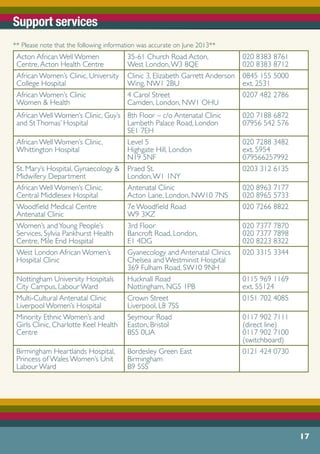
Support Services							 17
Part 3: FGM Campaign in the UK
What is FORWARD doing to address FGM in the UK?		 18
Additional Information
Other FGM support organisations + Additional Contacts		 21
Glossary and Abbreviations						 23
Acknowledgements							 24
2
Table of Contents
3
About FORWARD
FORWARD (Foundation for Women’s Health, Research and Development) is
an African Diaspora women-led campaign and support charity. FORWARD is
dedicated to advancing and safeguarding the health and rights of African girls
and women. FORWARD was founded in 1985 and operates mainly in the
UK and Africa.We focus on tackling female genital mutilation (FGM) and child
marriage.We have a vision where women and girls live in dignity, are healthy,
have choices and equal opportunities. Our programme strategies include
campaign and policy work; public education and training, advice and support,
information and research; and community engagement.
Young People Speak Out
Young People Speak Out is a project within FORWARD’sYouth Programme.
It trains young people from black and minority ethnic (BME) communities to
become campaigners and peer-educators on violence against women and girls,
including FGM.The programme provides a safe space for young women and
men aged 16-24 years, to develop their ideas, gain skills and explore ways to
support themselves and those at risk.The programme uses youth-friendly and
culturally sensitive methods including participatory training, workshops, film
screenings and creative and interactive events to raise awareness.
For more information about this programme please contact theYouth
Programme team on 020 8960 4000 or email:
youth@forwarduk.org.uk
4
Purpose of the ISS Guide for Young People
This guide has been developed as a youth friendly FGM resource for use in
youth settings, including schools. It targets young people between 12 and 18
years old and forms part of FORWARD’s schools resource pack.
The first section provides basic information on FGM and related health and
social issues. It aims to increase awareness of the UK law and child protection
issues.
The second section provides information for those who require specialist health
and support services.
The final section provides information on FORWARD’s campaign to end FGM
in the UK.
5
What is Female Genital Mutilation?
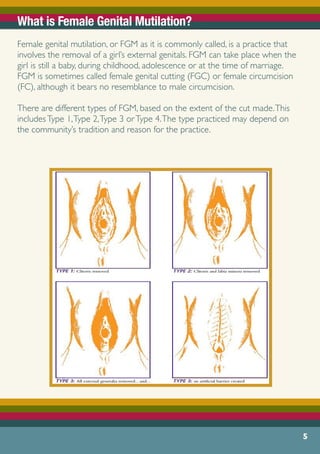
Female genital mutilation, or FGM as it is commonly called, is a practice that
involves the removal of a girl’s external genitals. FGM can take place when the
girl is still a baby, during childhood, adolescence or at the time of marriage.
FGM is sometimes called female genital cutting (FGC) or female circumcision
(FC), although it bears no resemblance to male circumcision.
There are different types of FGM, based on the extent of the cut made.This
includesType 1,Type 2,Type 3 orType 4.The type practiced may depend on
the community’s tradition and reason for the practice.
Where is FGM practised?
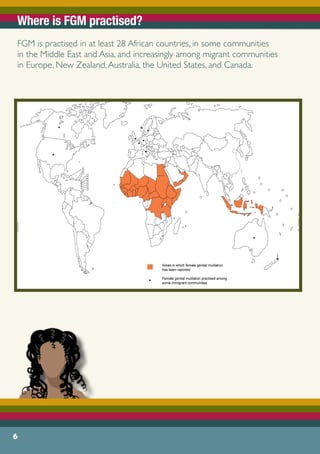
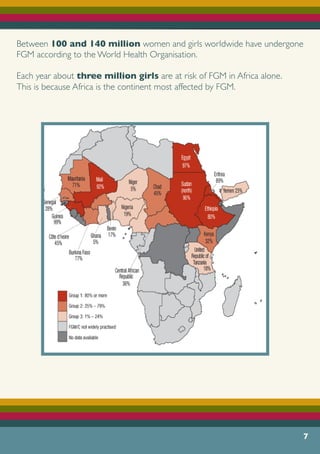
FGM is practised in at least 28 African countries, in some communities
in the Middle East and Asia, and increasingly among migrant communities
in Europe, New Zealand,Australia, the United States, and Canada.
6
7
Between 100 and 140 million women and girls worldwide have undergone
FGM according to the World Health Organisation.
Each year about three million girls are at risk of FGM in Africa alone.
This is because Africa is the continent most affected by FGM.
What is the origin of FGM?
FGM is a cultural practice that pre-dates Christianity and Islam. Nobody
knows the real origins of FGM. Some people say that it began in the days
of the Pharaohs in ancient Egypt.What we know today: FGM is a cultural
practice that causes harm, is unnecessary and is a violation of a girl’s right to
have control over her body.
Who is at risk of FGM?
Some girls who come from FGM affected communities may be at risk of
FGM, even if they live in the UK. If the mother or older sisters have already
undergone FGM, then it is highly likely that the younger girl will be at risk. As
FGM is illegal in the UK, girls may be taken abroad especially during summer
holidays, for FGM to be performed.
Not all girls from FGM affected countries have undergone FGM.There is
growing awareness about stopping FGM in many countries in Africa and
Europe. Many communities living in the UK are now stopping FGM; however
people are reluctant to say so.
8
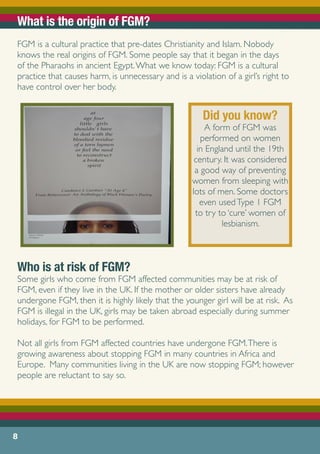
Did you know?
A form of FGM was
performed on women
in England until the 19th
century. It was considered
a good way of preventing
women from sleeping with
lots of men. Some doctors
even usedType 1 FGM
to try to ‘cure’ women of
lesbianism.
9
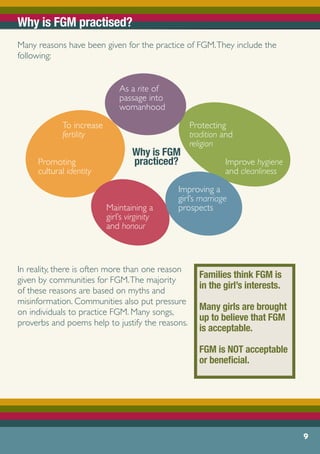
Why is FGM practised?
Many reasons have been given for the practice of FGM.They include the
following:
In reality, there is often more than one reason
given by communities for FGM.The majority
of these reasons are based on myths and
misinformation. Communities also put pressure
on individuals to practice FGM. Many songs,
proverbs and poems help to justify the reasons.
Why is FGM
practiced?
Maintaining a
girl’s virginity
and honour
As a rite of
passage into
womanhood
Improving a
girl’s marriage
prospects
Protecting
tradition and
religion
Improve hygiene
and cleanliness
To increase
fertility
Promoting
cultural identity
Families think FGM is
in the girl’s interests.
Many girls are brought
up to believe that FGM
is acceptable.
FGM is NOT acceptable
or beneficial.
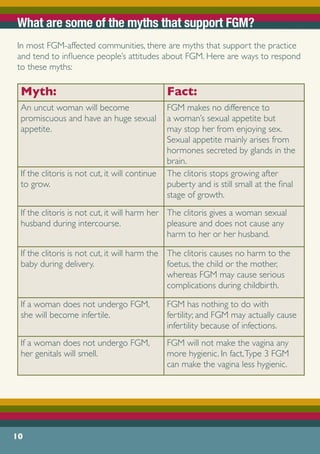
What are some of the myths that support FGM?
In most FGM-affected communities, there are myths that support the practice
and tend to influence people’s attitudes about FGM. Here are ways to respond
to these myths:
Myth: Fact:
An uncut woman will become
promiscuous and have an huge sexual
appetite.
FGM makes no difference to
a woman’s sexual appetite but
may stop her from enjoying sex.
Sexual appetite mainly arises from
hormones secreted by glands in the
brain.
If the clitoris is not cut, it will continue
to grow.
The clitoris stops growing after
puberty and is still small at the final
stage of growth.
If the clitoris is not cut, it will harm her
husband during intercourse.
The clitoris gives a woman sexual
pleasure and does not cause any
harm to her or her husband.
If the clitoris is not cut, it will harm the
baby during delivery.
The clitoris causes no harm to the
foetus, the child or the mother,
whereas FGM may cause serious
complications during childbirth.
If a woman does not undergo FGM,
she will become infertile.
FGM has nothing to do with
fertility; and FGM may actually cause
infertility because of infections.
If a woman does not undergo FGM,
her genitals will smell.
FGM will not make the vagina any
more hygienic. In fact,Type 3 FGM
can make the vagina less hygienic.
10
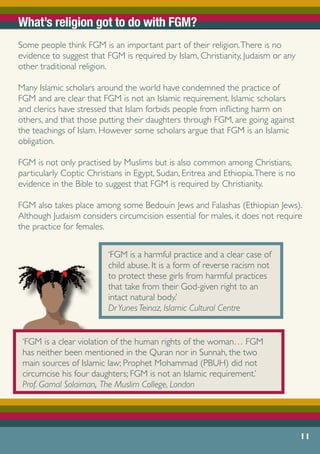
What’s religion got to do with FGM?
Some people think FGM is an important part of their religion.There is no
evidence to suggest that FGM is required by Islam, Christianity, Judaism or any
other traditional religion.
Many Islamic scholars around the world have condemned the practice of
FGM and are clear that FGM is not an Islamic requirement. Islamic scholars
and clerics have stressed that Islam forbids people from inflicting harm on
others, and that those putting their daughters through FGM, are going against
the teachings of Islam. However some scholars argue that FGM is an Islamic
obligation.
FGM is not only practised by Muslims but is also common among Christians,
particularly Coptic Christians in Egypt, Sudan, Eritrea and Ethiopia.There is no
evidence in the Bible to suggest that FGM is required by Christianity.
	
FGM also takes place among some Bedouin Jews and Falashas (Ethiopian Jews).
Although Judaism considers circumcision essential for males, it does not require
the practice for females.
‘FGM is a harmful practice and a clear case of
child abuse. It is a form of reverse racism not
to protect these girls from harmful practices
that take from their God-given right to an
intact natural body.’
DrYunes Teinaz, Islamic Cultural Centre
‘FGM is a clear violation of the human rights of the woman… FGM
has neither been mentioned in the Quran nor in Sunnah, the two
main sources of Islamic law; Prophet Mohammad (PBUH) did not
circumcise his four daughters; FGM is not an Islamic requirement.’
Prof. Gamal Solaiman, The Muslim College, London
11
FGM in the UK
In 2007 it was estimated that over 24,000 girls under the age of 15
could be at high risk of FGMType 3 in England and Wales. However, the
exact numbers of girls and women affected by FGM is not known, because
this information is not collected in the UK.The lack of data collected makes it
difficult for professionals to know the true extent of the problem of FGM.
The UK Law – FGM Act 2003
Practising FGM is a criminal offence in
the UK. The offence can result in 14
years in prison or a fine – or both.
Who is protected by the FGM law?
The FGM law protects girls and women
who are either British nationals or UK
permanent residents and prevents their
parents or guardians from taking them outside of the UK for FGM.
ALL girls, however, no matter their immigration status, are protected while they
reside in the UK from FGM and all other forms of child abuse through the UK
Child Protection laws and the FGM Act of 2003.
Local Authorities may use their powers under Section 47 of the Children Act
1989 if they believe that any child is at risk of, or has already undergone FGM.
Local Authorities can also prevent a girl from being taken abroad for FGM if
they consider the child to be at risk.
UK guidance on FGM which came out in 2011 provides information for
professionals to identify and support girls at risk of FGM. For more information
on the guidance visit: www.fco.giv.uk/fgm
FGM is a human rights violation and can harm girls and women.
Additionally, FGM can affect the education of girls and ultimately impair their
health, development and well-being.
12
The Female Genital Mutilation
Act 2003 makes it illegal to help,
support or arrange for FGM to
be performed on a girl in the
UK. It also forbids taking a girl
outside the UK to have FGM.
13
What are the health effects of FGM?
FGM is traditionally carried out by women who are often not medically trained.
FGM is also now being practised by trained medical personnel including
midwives, nurses or doctors. No matter the method or who is performing
FGM, the practice could still lead to serious health consequences.
FGM can result in physical and emotional problems, and sometimes death.
These can be short-term or long-term. Examples of health problems include:
•	 severe loss of blood;
•	 severe pain or shock;
•	 difficulties in passing urine or menstruating;
•	 urinary tract infections;
•	 increased risk of HIV infection;
•	 complications in pregnancy or childbirth;
•	 difficult or painful sex; problems with sexuality;
•	 mental health problems, e.g. post-traumatic stress disorder or anxiety
disorder, related to the trauma of FGM.
Not all girls and women who have undergone FGM experience health
problems. Others may not be aware of these problems, or may not perceive
them to be unusual or related to FGM, especially if they occur many years after
the procedure.
In the same way, not all health practitioners may link these health problems to
FGM, especially if they do not know that the patient has undergone FGM.
It is very important that if you have undergone FGM that you tell
your nurse or GP if you are having any problems, infections or
pain, so that you can get the right help and support.
14
Where can you find specialist FGM services?
Girls and women who have had FGM and experience health complications can
access specialist health services that meet their specific needs. In the UK, health
providers are increasingly becoming aware of FGM, but this may not be the
case in all areas.
GP
Your GP, or health care professional, such as a midwife or health visitor, has a
role to help with any health problems, including those associated with FGM.
Make an appointment with them if you need any health advice. You can also
ask them to refer you to an FGM specialist service.
Specialist FGM health clinics
Some hospitals and clinics also provide specialist
FGM services.These free specialist services
provide a wide range of medical support, advice
and information to girls or women that have
undergone FGM. Many of these clinics have
health care experts, including:
•	 specialist nurses or midwives
•	 consultants
•	 counsellors
•	 outreach workers from BME communities
Staff at the specialist clinics have extensive
experience in dealing with FGM and understand
the cultural reasons behind the practice.They
are not there to judge you, but are there to help.
Some specialist clinics are able to provide a
simple operation called de-infibulation.This
opens up the closed form ofType 3 FGM and
helps to restore the natural vaginal opening.
Remember, you may not always need a referral from your GP to
access services available at some of the specialist clinics.
Some clinics have restrictions about who they can see; you can find more
information about the clinics by calling FORWARD.
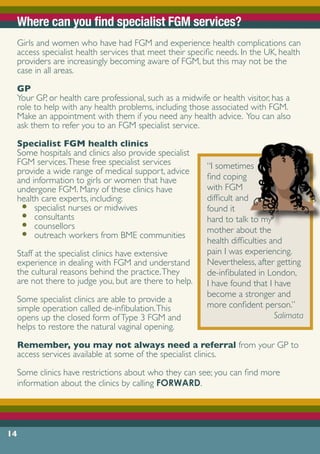
“I sometimes
find coping
with FGM
difficult and
found it
hard to talk to my
mother about the
health difficulties and
pain I was experiencing.
Nevertheless, after getting
de-infibulated in London,
I have found that I have
become a stronger and
more confident person.”
Salimata
15
What if you are worried that someone is at risk of FGM?
If you are worried that you, your friend, or your sister is at risk of FGM here
in the UK or of being taken abroad for FGM, it is very important that you do
something to stop FGM from taking place.
Remember, FGM is against the law and is harmful to girls. Sometimes the
warning signs may only be rumours, but it may be worth telling someone to be
on the safe side.You will only be seen to be helping in the long run.
Take immediate action: You can get help and advice. Do not stay silent.
•	 Talk to a trusted adult about the situation – a teacher, school nurse, GP,
family friend or close relative
•	 Call the contact numbers at the back of this information guide
•	 Contact Children andYoung People’s Services at your local council
•	 Speak to the Police Child ProtectionTeam
•	 If the girl is at immediate risk, call the police on 999
•	 If you are abroad you can still contact the nearest British Consulate,
Embassy, or High Commission for help.
“I had a friend who was circumcised
at a much older age, she was about
13 years old and it was strange for her
as she was aware of what was going on although she
made them believe that she didn’t understand. She
was forced to go to the room and got bombarded by
four women who pinned her down to the floor.This
happened to her when she went on holiday; they cut
her with no sewing.”
UKYoung Woman
What will happen when you report FGM to professionals?
If you tell a teacher or school nurse about your concerns that someone is at
risk of FGM this will be treated confidentially.This case will be referred for
specialist care or to the child protection officer in the school.
•	 You will be trusted, listened to and taken seriously
•	 You may be asked more detailed questions
•	 The teacher will not usually make any assumptions
•	 This will be dealt with in confidence
Professionals are required to treat any reported case of FGM as a child
protection issue and start a child protection referral.This means that Children’s
Services will treat this as a serious concern and organise a meeting to assess
the case.This investigation will also try to find out if other siblings in the family
are at risk. Parents may be part of this meeting to discuss the concern.
A girl will not automatically be taken away from her home.This will ONLY
happen in rare cases when the parents fail to guarantee that they will not cut
their daughter. Many professionals will be involved in a child protection case.
They include teachers, nurses, children’s services, the police and voluntary
organisations.They all have a duty to help stop FGM in the UK.
16
“I didn’t want to talk about it
[FGM]…
but when I found out the information
I found more confidence to go out
there and tell people.You can’t
be shy about it because you know you’re stopping a bad
thing and you might save your little sister. Now I know the
information I’m more confident to speak out.”
Young Somali Male
Support services
** Please note that the following information was accurate on June 2013**
Acton African Well Women
Centre,Acton Health Centre
35-61 Church Road Acton,
West London,W3 8QE
020 8383 8761
020 8383 8712
African Women’s Clinic, University
College Hospital
Clinic 3, Elizabeth Garrett Anderson
Wing, NW1 2BU
0845 155 5000
ext. 2531
African Women’s Clinic
Women & Health
4 Carol Street
Camden, London, NW1 OHU
0207 482 2786
African Well Women’s Clinic, Guy’s
and StThomas’ Hospital
8th Floor – c/o Antenatal Clinic
Lambeth Palace Road, London
SE1 7EH
020 7188 6872
07956 542 576
African Well Women’s Clinic,
Whittington Hospital
Level 5
Highgate Hill, London
N19 5NF
020 7288 3482
ext. 5954
079566257992
St. Mary’s Hospital, Gynaecology &
Midwifery Department
Praed St.
London,W1 1NY
0203 312 6135
African Well Women’s Clinic,
Central Middlesex Hospital
Antenatal Clinic
Acton Lane, London, NW10 7NS
020 8963 7177
020 8965 5733
Woodfield Medical Centre
Antenatal Clinic
7e Woodfield Road
W9 3XZ
020 7266 8822
Women’s andYoung People’s
Services, Sylvia Pankhurst Health
Centre, Mile End Hospital
3rd Floor
Bancroft Road, London,
E1 4DG
020 7377 7870
020 7377 7898
020 8223 8322
West London African Women’s
Hospital Clinic
Gyanecology and Antenatal Clinics
Chelsea and Westminist Hospital
369 Fulham Road, SW10 9NH
020 3315 3344
Nottingham University Hospitals
City Campus, Labour Ward
Hucknall Road
Nottingham, NG5 1PB
0115 969 1169
ext. 55124
Multi-Cultural Antenatal Clinic
Liverpool Women’s Hospital
Crown Street
Liverpool, L8 7SS
0151 702 4085
Minority Ethnic Women’s and
Girls Clinic, Charlotte Keel Health
Centre
Seymour Road
Easton, Bristol
BS5 0UA
0117 902 7111
(direct line)
0117 902 7100
(switchboard)
Birmingham Heartlands Hospital,
Princess of Wales Women’s Unit
Labour Ward
Bordesley Green East
Birmingham
B9 5SS
0121 424 0730
17
What is FORWARD doing to address FGM in the UK?
FORWARD (Foundation for Women’s Health, Research and Development) is
a leading African Diaspora women’s campaign and support charity dedicated
to advancing and safeguarding the sexual and reproductive health, rights and
dignity of African girls and women. FORWARD works through strategic
partnerships in Africa, Europe and UK.
We provide specialist advice and undertake innovative programmes and
projects on the issues of FGM, child marriage and other related health and
rights issues affecting African women and girls. FORWARD also campaigns
for effective policies and resources to support women and girls affected by
FGM and child marriage. FORWARD is a strong Diaspora voice in policy
development, working through networks and strategic action in the UK, Europe
and Africa.
FORWARD works directly with women and girls to raise their voices, articulate
their needs and exercise their rights.We help develop leadership and skills of
women and girls to support change.We also promote public awareness and
equip professionals with skills and tools to support change and safeguard girls at
risk.
18
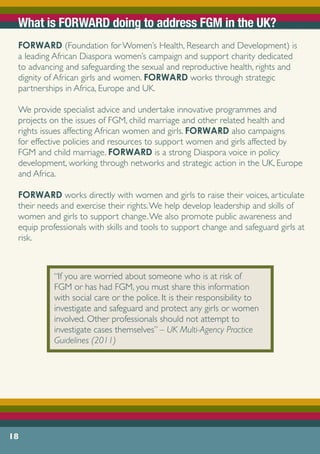
“If you are worried about someone who is at risk of
FGM or has had FGM, you must share this information
with social care or the police. It is their responsibility to
investigate and safeguard and protect any girls or women
involved. Other professionals should not attempt to
investigate cases themselves” – UK Multi-Agency Practice
Guidelines (2011)
19
Young People Speak Out (YPSO!) is a program that
empowers young people (aged 16 -24) from FGM affected countries with
the skills to advocate within their local communities against FGM and child
marriages.There are currently four areas in which theYPSO program functions:
London, Birmingham, Bristol and Rochdale.YPSO organises training for young
people on leadership, campaigning, advocacy and gender based violence skills
with the aim of empowering young people to create positive changes in their
community.
YPSO facilitates a number of activities that include: training young
people, public awareness campaigns and events, youth friendly FGM resources
and offering advice and support to those affected by FGM.Youth Advocates
withinYPSO facilitate and organise sessions in the community by working as
peer educators and peer mentors.
The youth programme believes that youth advocacy is about passion in the face
of adversity; about challenging the status quo; about challenging the expectation
that young people are unable or unwilling to stand up and make a change. It is
challenging the concept that youth are apathetic, that their voices are too timid,
too quiet, too distanced, too inexperienced, too ignorant to have any impact!
YPSO offers young people the chance to gain some skills and help create a
change in their communities.Together we can help end FGM.
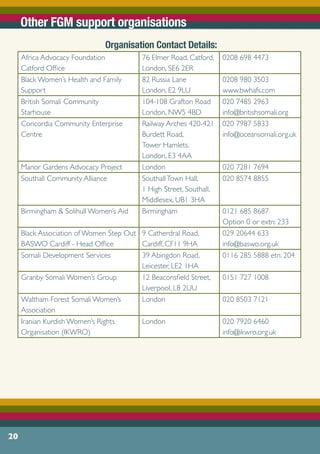
Other FGM support organisations
Organisation Contact Details:
Africa Advocacy Foundation
Catford Office
76 Elmer Road, Catford,
London, SE6 2ER
0208 698 4473
Black Women’s Health and Family
Support
82 Russia Lane
London, E2 9LU
0208 980 3503
www.bwhafs.com
British Somali Community
Starhouse
104-108 Grafton Road
London, NW5 4BD
020 7485 2963
info@britishsomali.org
Concordia Community Enterprise
Centre
Railway Arches 420-421
Burdett Road,
Tower Hamlets,
London, E3 4AA
020 7987 5833
info@oceansomali.org.uk
Manor Gardens Advocacy Project London 020 7281 7694
Southall Community Alliance SouthallTown Hall,
1 High Street, Southall,
Middlesex, UB1 3HA
020 8574 8855
Birmingham & Solihull Women’s Aid Birmingham 0121 685 8687
Option 0 or extn: 233
Black Association of Women Step Out
BASWO Cardiff - Head Office
9 Catherdral Road,
Cardiff, CF11 9HA
029 20644 633
info@baswo.org.uk
Somali Development Services 39 Abingdon Road,
Leicester, LE2 1HA
0116 285 5888 etn: 204
Granby Somali Women’s Group 12 Beaconsfield Street,
Liverpool, L8 2UU
0151 727 1008
Waltham Forest Somali Women’s
Association
London 020 8503 7121
Iranian Kurdish Women’s Rights
Organisation (IKWRO)
London 020 7920 6460
info@ikwro.org.uk
20
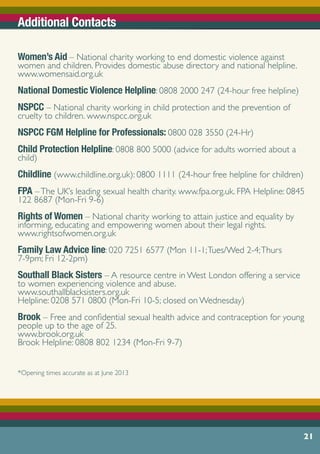
Women’s Aid – National charity working to end domestic violence against
women and children. Provides domestic abuse directory and national helpline.
www.womensaid.org.uk
		
National Domestic Violence Helpline: 0808 2000 247 (24-hour free helpline)
NSPCC – National charity working in child protection and the prevention of
cruelty to children. www.nspcc.org.uk	
NSPCC FGM Helpline for Professionals: 0800 028 3550 (24-Hr)
Child Protection Helpline: 0808 800 5000 (advice for adults worried about a
child)
Childline (www.childline.org.uk): 0800 1111 (24-hour free helpline for children)
FPA –The UK’s leading sexual health charity. www.fpa.org.uk. FPA Helpline: 0845
122 8687 (Mon-Fri 9-6)
Rights of Women – National charity working to attain justice and equality by
informing, educating and empowering women about their legal rights.
www.rightsofwomen.org.uk
Family Law Advice line: 020 7251 6577 (Mon 11-1;Tues/Wed 2-4;Thurs
7-9pm; Fri 12-2pm)
Southall Black Sisters – A resource centre in West London offering a service
to women experiencing violence and abuse.
www.southallblacksisters.org.uk				
Helpline: 0208 571 0800 (Mon-Fri 10-5; closed on Wednesday)
Brook – Free and confidential sexual health advice and contraception for young
people up to the age of 25.
www.brook.org.uk	 				
Brook Helpline: 0808 802 1234 (Mon-Fri 9-7)
*Opening times accurate as at June 2013 	
21
Additional Contacts
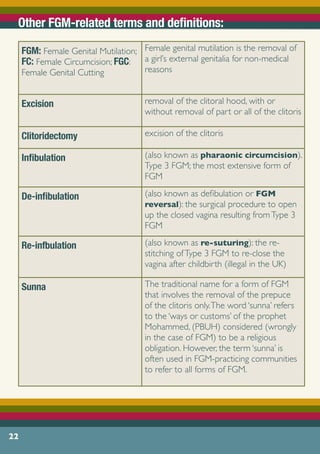
Other FGM-related terms and definitions:
FGM: Female Genital Mutilation;
FC: Female Circumcision; FGC:
Female Genital Cutting
Female genital mutilation is the removal of
a girl’s external genitalia for non-medical
reasons
Excision removal of the clitoral hood, with or
without removal of part or all of the clitoris
Clitoridectomy excision of the clitoris
Infibulation (also known as pharaonic circumcision).
Type 3 FGM; the most extensive form of
FGM
De-infibulation (also known as defibulation or FGM
reversal): the surgical procedure to open
up the closed vagina resulting fromType 3
FGM
Re-infbulation (also known as re-suturing): the re-
stitching ofType 3 FGM to re-close the
vagina after childbirth (illegal in the UK)
Sunna The traditional name for a form of FGM
that involves the removal of the prepuce
of the clitoris only.The word ‘sunna’ refers
to the ‘ways or customs’ of the prophet
Mohammed, (PBUH) considered (wrongly
in the case of FGM) to be a religious
obligation. However, the term ‘sunna’ is
often used in FGM-practicing communities
to refer to all forms of FGM.
22
23
Glossary and Abbreviations
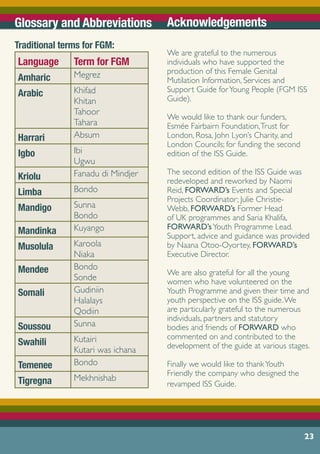
Traditional terms for FGM:
Language Term for FGM
Amharic Megrez
Arabic Khifad
Khitan
Tahoor
Tahara
Harrari Absum
Igbo Ibi
Ugwu
Kriolu Fanadu di Mindjer
Limba Bondo
Mandigo Sunna
Bondo
Mandinka Kuyango
Musolula Karoola
Niaka
Mendee Bondo
Sonde
Somali Gudiniin
Halalays
Qodiin
Soussou Sunna
Swahili Kutairi
Kutari was ichana
Temenee Bondo
Tigregna Mekhnishab
Acknowledgements
	
We are grateful to the numerous
individuals who have supported the
production of this Female Genital
Mutilation Information, Services and
Support Guide forYoung People (FGM ISS
Guide).
We would like to thank our funders,
Esmée Fairbairn Foundation,Trust for
London, Rosa, John Lyon’s Charity, and
London Councils; for funding the second
edition of the ISS Guide.
The second edition of the ISS Guide was
redeveloped and reworked by Naomi
Reid, FORWARD’s Events and Special
Projects Coordinator; Julie Christie-
Webb, FORWARD’s Former Head
of UK programmes and Saria Khalifa,
FORWARD’sYouth Programme Lead.
Support, advice and guidance was provided
by Naana Otoo-Oyortey, FORWARD’s
Executive Director.
We are also grateful for all the young
women who have volunteered on the
Youth Programme and given their time and
youth perspective on the ISS guide.We
are particularly grateful to the numerous
individuals, partners and statutory
bodies and friends of FORWARD who
commented on and contributed to the
development of the guide at various stages.
Finally we would like to thankYouth
Friendly the company who designed the
revamped ISS Guide.
24
Foundation for Women’s Health, Research and Development
(FORWARD)
Tel: +44 (0) 20 8960 4000
Fax: +44 (0)20 8960 4014
Email: youth@forwarduk.org.uk
Website: www.forwarduk.org.uk
Charity Registration Number: 292403
Company Number: 01921508
© Published in 2013 by:
Foundation for Women’s Health, Research and Development (FORWARD)

Forward FGM

  • 1.
    Female Genital Mutilation For young peoplein the UK Stand Up! Speak Out! Information Services & Support Guide
  • 2.
    About FORWARD 3 Purpose ofthe ISS guide 4 Part 1: General FGM information What is FGM? 5 Where is FGM practiced? 6 What is the origin of FGM? 8 Why is FGM practiced? 9 What are some of the myths about FGM? 10 What’s religion got to do with FGM? 11 FGM in the UK 12 What are the health effects of FGM? 13 Part 2: Information on specialist health and support services Where can you find specialist FGM services? 14 What if you are worried that someone is at risk of FGM? 15 What will happen when you report FGM to professionals? 16 Support Services 17 Part 3: FGM Campaign in the UK What is FORWARD doing to address FGM in the UK? 18 Additional Information Other FGM support organisations + Additional Contacts 21 Glossary and Abbreviations 23 Acknowledgements 24 2 Table of Contents
  • 3.
    3 About FORWARD FORWARD (Foundationfor Women’s Health, Research and Development) is an African Diaspora women-led campaign and support charity. FORWARD is dedicated to advancing and safeguarding the health and rights of African girls and women. FORWARD was founded in 1985 and operates mainly in the UK and Africa.We focus on tackling female genital mutilation (FGM) and child marriage.We have a vision where women and girls live in dignity, are healthy, have choices and equal opportunities. Our programme strategies include campaign and policy work; public education and training, advice and support, information and research; and community engagement. Young People Speak Out Young People Speak Out is a project within FORWARD’sYouth Programme. It trains young people from black and minority ethnic (BME) communities to become campaigners and peer-educators on violence against women and girls, including FGM.The programme provides a safe space for young women and men aged 16-24 years, to develop their ideas, gain skills and explore ways to support themselves and those at risk.The programme uses youth-friendly and culturally sensitive methods including participatory training, workshops, film screenings and creative and interactive events to raise awareness. For more information about this programme please contact theYouth Programme team on 020 8960 4000 or email: youth@forwarduk.org.uk
  • 4.
    4 Purpose of theISS Guide for Young People This guide has been developed as a youth friendly FGM resource for use in youth settings, including schools. It targets young people between 12 and 18 years old and forms part of FORWARD’s schools resource pack. The first section provides basic information on FGM and related health and social issues. It aims to increase awareness of the UK law and child protection issues. The second section provides information for those who require specialist health and support services. The final section provides information on FORWARD’s campaign to end FGM in the UK.
  • 5.
    5 What is FemaleGenital Mutilation? Female genital mutilation, or FGM as it is commonly called, is a practice that involves the removal of a girl’s external genitals. FGM can take place when the girl is still a baby, during childhood, adolescence or at the time of marriage. FGM is sometimes called female genital cutting (FGC) or female circumcision (FC), although it bears no resemblance to male circumcision. There are different types of FGM, based on the extent of the cut made.This includesType 1,Type 2,Type 3 orType 4.The type practiced may depend on the community’s tradition and reason for the practice.
  • 6.
    Where is FGMpractised? FGM is practised in at least 28 African countries, in some communities in the Middle East and Asia, and increasingly among migrant communities in Europe, New Zealand,Australia, the United States, and Canada. 6
  • 7.
    7 Between 100 and140 million women and girls worldwide have undergone FGM according to the World Health Organisation. Each year about three million girls are at risk of FGM in Africa alone. This is because Africa is the continent most affected by FGM.
  • 8.
    What is theorigin of FGM? FGM is a cultural practice that pre-dates Christianity and Islam. Nobody knows the real origins of FGM. Some people say that it began in the days of the Pharaohs in ancient Egypt.What we know today: FGM is a cultural practice that causes harm, is unnecessary and is a violation of a girl’s right to have control over her body. Who is at risk of FGM? Some girls who come from FGM affected communities may be at risk of FGM, even if they live in the UK. If the mother or older sisters have already undergone FGM, then it is highly likely that the younger girl will be at risk. As FGM is illegal in the UK, girls may be taken abroad especially during summer holidays, for FGM to be performed. Not all girls from FGM affected countries have undergone FGM.There is growing awareness about stopping FGM in many countries in Africa and Europe. Many communities living in the UK are now stopping FGM; however people are reluctant to say so. 8 Did you know? A form of FGM was performed on women in England until the 19th century. It was considered a good way of preventing women from sleeping with lots of men. Some doctors even usedType 1 FGM to try to ‘cure’ women of lesbianism.
  • 9.
    9 Why is FGMpractised? Many reasons have been given for the practice of FGM.They include the following: In reality, there is often more than one reason given by communities for FGM.The majority of these reasons are based on myths and misinformation. Communities also put pressure on individuals to practice FGM. Many songs, proverbs and poems help to justify the reasons. Why is FGM practiced? Maintaining a girl’s virginity and honour As a rite of passage into womanhood Improving a girl’s marriage prospects Protecting tradition and religion Improve hygiene and cleanliness To increase fertility Promoting cultural identity Families think FGM is in the girl’s interests. Many girls are brought up to believe that FGM is acceptable. FGM is NOT acceptable or beneficial.
  • 10.
    What are someof the myths that support FGM? In most FGM-affected communities, there are myths that support the practice and tend to influence people’s attitudes about FGM. Here are ways to respond to these myths: Myth: Fact: An uncut woman will become promiscuous and have an huge sexual appetite. FGM makes no difference to a woman’s sexual appetite but may stop her from enjoying sex. Sexual appetite mainly arises from hormones secreted by glands in the brain. If the clitoris is not cut, it will continue to grow. The clitoris stops growing after puberty and is still small at the final stage of growth. If the clitoris is not cut, it will harm her husband during intercourse. The clitoris gives a woman sexual pleasure and does not cause any harm to her or her husband. If the clitoris is not cut, it will harm the baby during delivery. The clitoris causes no harm to the foetus, the child or the mother, whereas FGM may cause serious complications during childbirth. If a woman does not undergo FGM, she will become infertile. FGM has nothing to do with fertility; and FGM may actually cause infertility because of infections. If a woman does not undergo FGM, her genitals will smell. FGM will not make the vagina any more hygienic. In fact,Type 3 FGM can make the vagina less hygienic. 10
  • 11.
    What’s religion gotto do with FGM? Some people think FGM is an important part of their religion.There is no evidence to suggest that FGM is required by Islam, Christianity, Judaism or any other traditional religion. Many Islamic scholars around the world have condemned the practice of FGM and are clear that FGM is not an Islamic requirement. Islamic scholars and clerics have stressed that Islam forbids people from inflicting harm on others, and that those putting their daughters through FGM, are going against the teachings of Islam. However some scholars argue that FGM is an Islamic obligation. FGM is not only practised by Muslims but is also common among Christians, particularly Coptic Christians in Egypt, Sudan, Eritrea and Ethiopia.There is no evidence in the Bible to suggest that FGM is required by Christianity. FGM also takes place among some Bedouin Jews and Falashas (Ethiopian Jews). Although Judaism considers circumcision essential for males, it does not require the practice for females. ‘FGM is a harmful practice and a clear case of child abuse. It is a form of reverse racism not to protect these girls from harmful practices that take from their God-given right to an intact natural body.’ DrYunes Teinaz, Islamic Cultural Centre ‘FGM is a clear violation of the human rights of the woman… FGM has neither been mentioned in the Quran nor in Sunnah, the two main sources of Islamic law; Prophet Mohammad (PBUH) did not circumcise his four daughters; FGM is not an Islamic requirement.’ Prof. Gamal Solaiman, The Muslim College, London 11
  • 12.
    FGM in theUK In 2007 it was estimated that over 24,000 girls under the age of 15 could be at high risk of FGMType 3 in England and Wales. However, the exact numbers of girls and women affected by FGM is not known, because this information is not collected in the UK.The lack of data collected makes it difficult for professionals to know the true extent of the problem of FGM. The UK Law – FGM Act 2003 Practising FGM is a criminal offence in the UK. The offence can result in 14 years in prison or a fine – or both. Who is protected by the FGM law? The FGM law protects girls and women who are either British nationals or UK permanent residents and prevents their parents or guardians from taking them outside of the UK for FGM. ALL girls, however, no matter their immigration status, are protected while they reside in the UK from FGM and all other forms of child abuse through the UK Child Protection laws and the FGM Act of 2003. Local Authorities may use their powers under Section 47 of the Children Act 1989 if they believe that any child is at risk of, or has already undergone FGM. Local Authorities can also prevent a girl from being taken abroad for FGM if they consider the child to be at risk. UK guidance on FGM which came out in 2011 provides information for professionals to identify and support girls at risk of FGM. For more information on the guidance visit: www.fco.giv.uk/fgm FGM is a human rights violation and can harm girls and women. Additionally, FGM can affect the education of girls and ultimately impair their health, development and well-being. 12 The Female Genital Mutilation Act 2003 makes it illegal to help, support or arrange for FGM to be performed on a girl in the UK. It also forbids taking a girl outside the UK to have FGM.
  • 13.
    13 What are thehealth effects of FGM? FGM is traditionally carried out by women who are often not medically trained. FGM is also now being practised by trained medical personnel including midwives, nurses or doctors. No matter the method or who is performing FGM, the practice could still lead to serious health consequences. FGM can result in physical and emotional problems, and sometimes death. These can be short-term or long-term. Examples of health problems include: • severe loss of blood; • severe pain or shock; • difficulties in passing urine or menstruating; • urinary tract infections; • increased risk of HIV infection; • complications in pregnancy or childbirth; • difficult or painful sex; problems with sexuality; • mental health problems, e.g. post-traumatic stress disorder or anxiety disorder, related to the trauma of FGM. Not all girls and women who have undergone FGM experience health problems. Others may not be aware of these problems, or may not perceive them to be unusual or related to FGM, especially if they occur many years after the procedure. In the same way, not all health practitioners may link these health problems to FGM, especially if they do not know that the patient has undergone FGM. It is very important that if you have undergone FGM that you tell your nurse or GP if you are having any problems, infections or pain, so that you can get the right help and support.
  • 14.
    14 Where can youfind specialist FGM services? Girls and women who have had FGM and experience health complications can access specialist health services that meet their specific needs. In the UK, health providers are increasingly becoming aware of FGM, but this may not be the case in all areas. GP Your GP, or health care professional, such as a midwife or health visitor, has a role to help with any health problems, including those associated with FGM. Make an appointment with them if you need any health advice. You can also ask them to refer you to an FGM specialist service. Specialist FGM health clinics Some hospitals and clinics also provide specialist FGM services.These free specialist services provide a wide range of medical support, advice and information to girls or women that have undergone FGM. Many of these clinics have health care experts, including: • specialist nurses or midwives • consultants • counsellors • outreach workers from BME communities Staff at the specialist clinics have extensive experience in dealing with FGM and understand the cultural reasons behind the practice.They are not there to judge you, but are there to help. Some specialist clinics are able to provide a simple operation called de-infibulation.This opens up the closed form ofType 3 FGM and helps to restore the natural vaginal opening. Remember, you may not always need a referral from your GP to access services available at some of the specialist clinics. Some clinics have restrictions about who they can see; you can find more information about the clinics by calling FORWARD. “I sometimes find coping with FGM difficult and found it hard to talk to my mother about the health difficulties and pain I was experiencing. Nevertheless, after getting de-infibulated in London, I have found that I have become a stronger and more confident person.” Salimata
  • 15.
    15 What if youare worried that someone is at risk of FGM? If you are worried that you, your friend, or your sister is at risk of FGM here in the UK or of being taken abroad for FGM, it is very important that you do something to stop FGM from taking place. Remember, FGM is against the law and is harmful to girls. Sometimes the warning signs may only be rumours, but it may be worth telling someone to be on the safe side.You will only be seen to be helping in the long run. Take immediate action: You can get help and advice. Do not stay silent. • Talk to a trusted adult about the situation – a teacher, school nurse, GP, family friend or close relative • Call the contact numbers at the back of this information guide • Contact Children andYoung People’s Services at your local council • Speak to the Police Child ProtectionTeam • If the girl is at immediate risk, call the police on 999 • If you are abroad you can still contact the nearest British Consulate, Embassy, or High Commission for help. “I had a friend who was circumcised at a much older age, she was about 13 years old and it was strange for her as she was aware of what was going on although she made them believe that she didn’t understand. She was forced to go to the room and got bombarded by four women who pinned her down to the floor.This happened to her when she went on holiday; they cut her with no sewing.” UKYoung Woman
  • 16.
    What will happenwhen you report FGM to professionals? If you tell a teacher or school nurse about your concerns that someone is at risk of FGM this will be treated confidentially.This case will be referred for specialist care or to the child protection officer in the school. • You will be trusted, listened to and taken seriously • You may be asked more detailed questions • The teacher will not usually make any assumptions • This will be dealt with in confidence Professionals are required to treat any reported case of FGM as a child protection issue and start a child protection referral.This means that Children’s Services will treat this as a serious concern and organise a meeting to assess the case.This investigation will also try to find out if other siblings in the family are at risk. Parents may be part of this meeting to discuss the concern. A girl will not automatically be taken away from her home.This will ONLY happen in rare cases when the parents fail to guarantee that they will not cut their daughter. Many professionals will be involved in a child protection case. They include teachers, nurses, children’s services, the police and voluntary organisations.They all have a duty to help stop FGM in the UK. 16 “I didn’t want to talk about it [FGM]… but when I found out the information I found more confidence to go out there and tell people.You can’t be shy about it because you know you’re stopping a bad thing and you might save your little sister. Now I know the information I’m more confident to speak out.” Young Somali Male
  • 17.
    Support services ** Pleasenote that the following information was accurate on June 2013** Acton African Well Women Centre,Acton Health Centre 35-61 Church Road Acton, West London,W3 8QE 020 8383 8761 020 8383 8712 African Women’s Clinic, University College Hospital Clinic 3, Elizabeth Garrett Anderson Wing, NW1 2BU 0845 155 5000 ext. 2531 African Women’s Clinic Women & Health 4 Carol Street Camden, London, NW1 OHU 0207 482 2786 African Well Women’s Clinic, Guy’s and StThomas’ Hospital 8th Floor – c/o Antenatal Clinic Lambeth Palace Road, London SE1 7EH 020 7188 6872 07956 542 576 African Well Women’s Clinic, Whittington Hospital Level 5 Highgate Hill, London N19 5NF 020 7288 3482 ext. 5954 079566257992 St. Mary’s Hospital, Gynaecology & Midwifery Department Praed St. London,W1 1NY 0203 312 6135 African Well Women’s Clinic, Central Middlesex Hospital Antenatal Clinic Acton Lane, London, NW10 7NS 020 8963 7177 020 8965 5733 Woodfield Medical Centre Antenatal Clinic 7e Woodfield Road W9 3XZ 020 7266 8822 Women’s andYoung People’s Services, Sylvia Pankhurst Health Centre, Mile End Hospital 3rd Floor Bancroft Road, London, E1 4DG 020 7377 7870 020 7377 7898 020 8223 8322 West London African Women’s Hospital Clinic Gyanecology and Antenatal Clinics Chelsea and Westminist Hospital 369 Fulham Road, SW10 9NH 020 3315 3344 Nottingham University Hospitals City Campus, Labour Ward Hucknall Road Nottingham, NG5 1PB 0115 969 1169 ext. 55124 Multi-Cultural Antenatal Clinic Liverpool Women’s Hospital Crown Street Liverpool, L8 7SS 0151 702 4085 Minority Ethnic Women’s and Girls Clinic, Charlotte Keel Health Centre Seymour Road Easton, Bristol BS5 0UA 0117 902 7111 (direct line) 0117 902 7100 (switchboard) Birmingham Heartlands Hospital, Princess of Wales Women’s Unit Labour Ward Bordesley Green East Birmingham B9 5SS 0121 424 0730 17
  • 18.
    What is FORWARDdoing to address FGM in the UK? FORWARD (Foundation for Women’s Health, Research and Development) is a leading African Diaspora women’s campaign and support charity dedicated to advancing and safeguarding the sexual and reproductive health, rights and dignity of African girls and women. FORWARD works through strategic partnerships in Africa, Europe and UK. We provide specialist advice and undertake innovative programmes and projects on the issues of FGM, child marriage and other related health and rights issues affecting African women and girls. FORWARD also campaigns for effective policies and resources to support women and girls affected by FGM and child marriage. FORWARD is a strong Diaspora voice in policy development, working through networks and strategic action in the UK, Europe and Africa. FORWARD works directly with women and girls to raise their voices, articulate their needs and exercise their rights.We help develop leadership and skills of women and girls to support change.We also promote public awareness and equip professionals with skills and tools to support change and safeguard girls at risk. 18 “If you are worried about someone who is at risk of FGM or has had FGM, you must share this information with social care or the police. It is their responsibility to investigate and safeguard and protect any girls or women involved. Other professionals should not attempt to investigate cases themselves” – UK Multi-Agency Practice Guidelines (2011)
  • 19.
    19 Young People SpeakOut (YPSO!) is a program that empowers young people (aged 16 -24) from FGM affected countries with the skills to advocate within their local communities against FGM and child marriages.There are currently four areas in which theYPSO program functions: London, Birmingham, Bristol and Rochdale.YPSO organises training for young people on leadership, campaigning, advocacy and gender based violence skills with the aim of empowering young people to create positive changes in their community. YPSO facilitates a number of activities that include: training young people, public awareness campaigns and events, youth friendly FGM resources and offering advice and support to those affected by FGM.Youth Advocates withinYPSO facilitate and organise sessions in the community by working as peer educators and peer mentors. The youth programme believes that youth advocacy is about passion in the face of adversity; about challenging the status quo; about challenging the expectation that young people are unable or unwilling to stand up and make a change. It is challenging the concept that youth are apathetic, that their voices are too timid, too quiet, too distanced, too inexperienced, too ignorant to have any impact! YPSO offers young people the chance to gain some skills and help create a change in their communities.Together we can help end FGM.
  • 20.
    Other FGM supportorganisations Organisation Contact Details: Africa Advocacy Foundation Catford Office 76 Elmer Road, Catford, London, SE6 2ER 0208 698 4473 Black Women’s Health and Family Support 82 Russia Lane London, E2 9LU 0208 980 3503 www.bwhafs.com British Somali Community Starhouse 104-108 Grafton Road London, NW5 4BD 020 7485 2963 info@britishsomali.org Concordia Community Enterprise Centre Railway Arches 420-421 Burdett Road, Tower Hamlets, London, E3 4AA 020 7987 5833 info@oceansomali.org.uk Manor Gardens Advocacy Project London 020 7281 7694 Southall Community Alliance SouthallTown Hall, 1 High Street, Southall, Middlesex, UB1 3HA 020 8574 8855 Birmingham & Solihull Women’s Aid Birmingham 0121 685 8687 Option 0 or extn: 233 Black Association of Women Step Out BASWO Cardiff - Head Office 9 Catherdral Road, Cardiff, CF11 9HA 029 20644 633 info@baswo.org.uk Somali Development Services 39 Abingdon Road, Leicester, LE2 1HA 0116 285 5888 etn: 204 Granby Somali Women’s Group 12 Beaconsfield Street, Liverpool, L8 2UU 0151 727 1008 Waltham Forest Somali Women’s Association London 020 8503 7121 Iranian Kurdish Women’s Rights Organisation (IKWRO) London 020 7920 6460 info@ikwro.org.uk 20
  • 21.
    Women’s Aid –National charity working to end domestic violence against women and children. Provides domestic abuse directory and national helpline. www.womensaid.org.uk National Domestic Violence Helpline: 0808 2000 247 (24-hour free helpline) NSPCC – National charity working in child protection and the prevention of cruelty to children. www.nspcc.org.uk NSPCC FGM Helpline for Professionals: 0800 028 3550 (24-Hr) Child Protection Helpline: 0808 800 5000 (advice for adults worried about a child) Childline (www.childline.org.uk): 0800 1111 (24-hour free helpline for children) FPA –The UK’s leading sexual health charity. www.fpa.org.uk. FPA Helpline: 0845 122 8687 (Mon-Fri 9-6) Rights of Women – National charity working to attain justice and equality by informing, educating and empowering women about their legal rights. www.rightsofwomen.org.uk Family Law Advice line: 020 7251 6577 (Mon 11-1;Tues/Wed 2-4;Thurs 7-9pm; Fri 12-2pm) Southall Black Sisters – A resource centre in West London offering a service to women experiencing violence and abuse. www.southallblacksisters.org.uk Helpline: 0208 571 0800 (Mon-Fri 10-5; closed on Wednesday) Brook – Free and confidential sexual health advice and contraception for young people up to the age of 25. www.brook.org.uk Brook Helpline: 0808 802 1234 (Mon-Fri 9-7) *Opening times accurate as at June 2013 21 Additional Contacts
  • 22.
    Other FGM-related termsand definitions: FGM: Female Genital Mutilation; FC: Female Circumcision; FGC: Female Genital Cutting Female genital mutilation is the removal of a girl’s external genitalia for non-medical reasons Excision removal of the clitoral hood, with or without removal of part or all of the clitoris Clitoridectomy excision of the clitoris Infibulation (also known as pharaonic circumcision). Type 3 FGM; the most extensive form of FGM De-infibulation (also known as defibulation or FGM reversal): the surgical procedure to open up the closed vagina resulting fromType 3 FGM Re-infbulation (also known as re-suturing): the re- stitching ofType 3 FGM to re-close the vagina after childbirth (illegal in the UK) Sunna The traditional name for a form of FGM that involves the removal of the prepuce of the clitoris only.The word ‘sunna’ refers to the ‘ways or customs’ of the prophet Mohammed, (PBUH) considered (wrongly in the case of FGM) to be a religious obligation. However, the term ‘sunna’ is often used in FGM-practicing communities to refer to all forms of FGM. 22
  • 23.
    23 Glossary and Abbreviations Traditionalterms for FGM: Language Term for FGM Amharic Megrez Arabic Khifad Khitan Tahoor Tahara Harrari Absum Igbo Ibi Ugwu Kriolu Fanadu di Mindjer Limba Bondo Mandigo Sunna Bondo Mandinka Kuyango Musolula Karoola Niaka Mendee Bondo Sonde Somali Gudiniin Halalays Qodiin Soussou Sunna Swahili Kutairi Kutari was ichana Temenee Bondo Tigregna Mekhnishab Acknowledgements We are grateful to the numerous individuals who have supported the production of this Female Genital Mutilation Information, Services and Support Guide forYoung People (FGM ISS Guide). We would like to thank our funders, Esmée Fairbairn Foundation,Trust for London, Rosa, John Lyon’s Charity, and London Councils; for funding the second edition of the ISS Guide. The second edition of the ISS Guide was redeveloped and reworked by Naomi Reid, FORWARD’s Events and Special Projects Coordinator; Julie Christie- Webb, FORWARD’s Former Head of UK programmes and Saria Khalifa, FORWARD’sYouth Programme Lead. Support, advice and guidance was provided by Naana Otoo-Oyortey, FORWARD’s Executive Director. We are also grateful for all the young women who have volunteered on the Youth Programme and given their time and youth perspective on the ISS guide.We are particularly grateful to the numerous individuals, partners and statutory bodies and friends of FORWARD who commented on and contributed to the development of the guide at various stages. Finally we would like to thankYouth Friendly the company who designed the revamped ISS Guide.
  • 24.
    24 Foundation for Women’sHealth, Research and Development (FORWARD) Tel: +44 (0) 20 8960 4000 Fax: +44 (0)20 8960 4014 Email: youth@forwarduk.org.uk Website: www.forwarduk.org.uk Charity Registration Number: 292403 Company Number: 01921508 © Published in 2013 by: Foundation for Women’s Health, Research and Development (FORWARD)