Feedback Amplifiers
Gain a deeper understanding of feedback amplifiers and discover how they
work and the advantages and limitations they have in electronic circuits.
by salma mostafa
Ideal Operational Amplifiers
Op-Amp Basics
Learn about the main components
of an ideal operational amplifier
and how they contribute to its high
gain and impedance.
Op-Amp Applications
Discover how op-amps are used in
electronic circuits, such as
amplifiers, filters, oscillators, and
many more.
Op-Amp Specifications
Explore the common op-amp
parameters and their impact on
the performance of feedback
amplifiers.
Feedback Concept
1
Basic Feedback
Understand the concept of feedback and how it
can be used to control gain, bandwidth, and
distortion in amplifiers.
2
Negative Feedback
Learn how negative feedback reduces the
voltage gain and output impedance of amplifiers,
and improves their linearity and stability.
3
Positive Feedback
Discover how positive feedback increases the
voltage gain and output impedance of amplifiers,
and produces oscillation and hysteresis in
certain circuits.
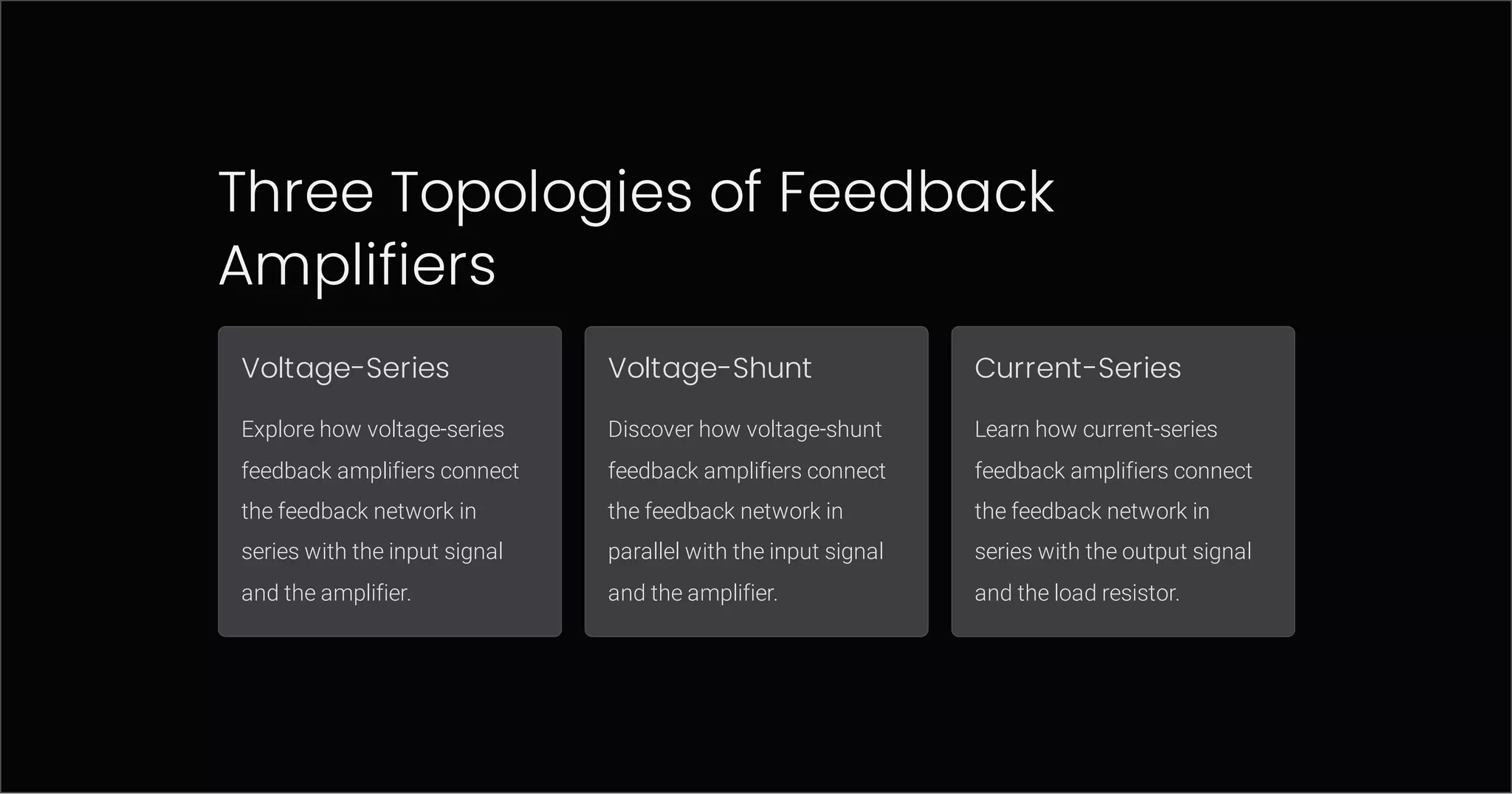
Three Topologies of Feedback
Amplifiers
Voltage-Series
Explore how voltage-series
feedback amplifiers connect
the feedback network in
series with the input signal
and the amplifier.
Voltage-Shunt
Discover how voltage-shunt
feedback amplifiers connect
the feedback network in
parallel with the input signal
and the amplifier.
Current-Series
Learn how current-series
feedback amplifiers connect
the feedback network in
series with the output signal
and the load resistor.
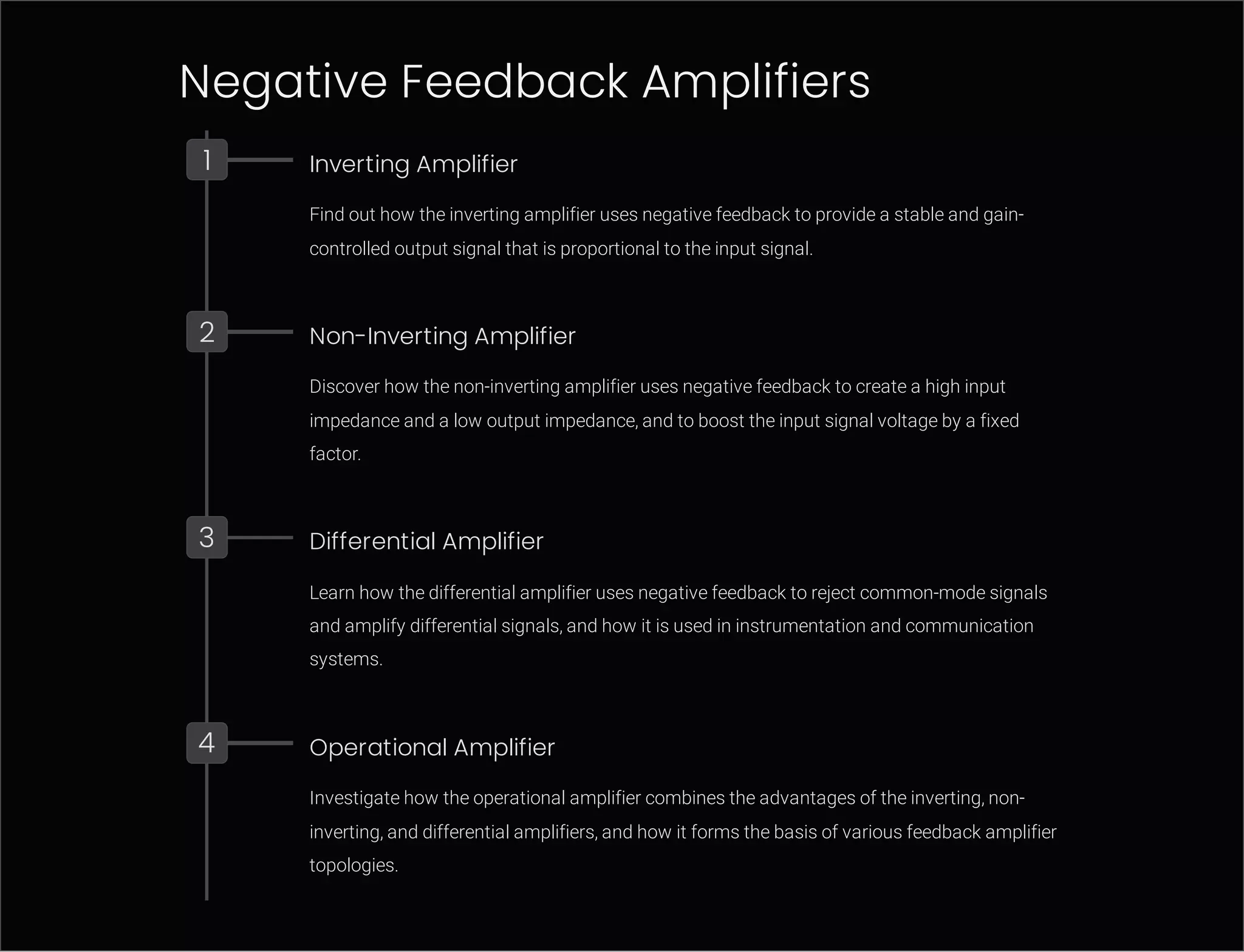
Negative Feedback Amplifiers
1 Inverting Amplifier
Find out how the inverting amplifier uses negative feedback to provide a stable and gain-
controlled output signal that is proportional to the input signal.
2 Non-Inverting Amplifier
Discover how the non-inverting amplifier uses negative feedback to create a high input
impedance and a low output impedance, and to boost the input signal voltage by a fixed
factor.
3 Differential Amplifier
Learn how the differential amplifier uses negative feedback to reject common-mode signals
and amplify differential signals, and how it is used in instrumentation and communication
systems.
4 Operational Amplifier
Investigate how the operational amplifier combines the advantages of the inverting, non-
inverting, and differential amplifiers, and how it forms the basis of various feedback amplifier
topologies.
Positive Feedback Amplifiers
Schmitt Trigger
Explore how the Schmitt trigger
uses positive feedback to generate
a clean digital output that
switches between two voltage
levels, and how it is used in
oscillators, pulse generators, and
noise filters.
Comparator
Discover how the comparator uses
positive feedback to compare two
input signals and to produce an
output that indicates which signal
is greater, and how it is used in
analog-to-digital converters, zero-
crossing detectors, and motor
controllers.
Regenerative Amplifier
Learn how the regenerative
amplifier uses positive feedback to
amplify weak signals and produce
oscillation, and how it is used in
radio-frequency and microwave
circuits.
Advantages and
Applications of Feedback
Amplifiers
1 Higher Gain and
Bandwidth
See how feedback amplifiers
can achieve higher voltage
gain and bandwidth than
open-loop amplifiers, and how
they can be used in audio,
video, and data processing
systems.
2 Lower Distortion and
Noise
Understand how feedback
amplifiers can reduce
distortion and noise by
minimizing the effects of non-
ideal components, thermal
variations, and
electromagnetic interference.
3 Improved Stability and Linearity
Realize how feedback amplifiers can increase stability and linearity by
reducing the output impedance, the phase shift, and the dependence on
temperature and frequency.
Limitations and Drawbacks of
Feedback Amplifiers
Finite Bandwidth
The feedback bandwidth is limited by the open-loop gain and the feedback factor, and may cause phase
shift, ringing, and overshoot.
Reduced Speed
The feedback loop introduces delay and rise time, and may affect the transient response, the stability,
and the phase margin.
Increased Complexity
The feedback network requires external components and careful design, and may lead to oscillation,
instability, or saturation under certain conditions.

Feedback-Amplifiers.pdf

  • 1.
    Feedback Amplifiers Gain adeeper understanding of feedback amplifiers and discover how they work and the advantages and limitations they have in electronic circuits. by salma mostafa
  • 2.
    Ideal Operational Amplifiers Op-AmpBasics Learn about the main components of an ideal operational amplifier and how they contribute to its high gain and impedance. Op-Amp Applications Discover how op-amps are used in electronic circuits, such as amplifiers, filters, oscillators, and many more. Op-Amp Specifications Explore the common op-amp parameters and their impact on the performance of feedback amplifiers.
  • 3.
    Feedback Concept 1 Basic Feedback Understandthe concept of feedback and how it can be used to control gain, bandwidth, and distortion in amplifiers. 2 Negative Feedback Learn how negative feedback reduces the voltage gain and output impedance of amplifiers, and improves their linearity and stability. 3 Positive Feedback Discover how positive feedback increases the voltage gain and output impedance of amplifiers, and produces oscillation and hysteresis in certain circuits.
  • 4.
    Three Topologies ofFeedback Amplifiers Voltage-Series Explore how voltage-series feedback amplifiers connect the feedback network in series with the input signal and the amplifier. Voltage-Shunt Discover how voltage-shunt feedback amplifiers connect the feedback network in parallel with the input signal and the amplifier. Current-Series Learn how current-series feedback amplifiers connect the feedback network in series with the output signal and the load resistor.
  • 5.
    Negative Feedback Amplifiers 1Inverting Amplifier Find out how the inverting amplifier uses negative feedback to provide a stable and gain- controlled output signal that is proportional to the input signal. 2 Non-Inverting Amplifier Discover how the non-inverting amplifier uses negative feedback to create a high input impedance and a low output impedance, and to boost the input signal voltage by a fixed factor. 3 Differential Amplifier Learn how the differential amplifier uses negative feedback to reject common-mode signals and amplify differential signals, and how it is used in instrumentation and communication systems. 4 Operational Amplifier Investigate how the operational amplifier combines the advantages of the inverting, non- inverting, and differential amplifiers, and how it forms the basis of various feedback amplifier topologies.
  • 6.
    Positive Feedback Amplifiers SchmittTrigger Explore how the Schmitt trigger uses positive feedback to generate a clean digital output that switches between two voltage levels, and how it is used in oscillators, pulse generators, and noise filters. Comparator Discover how the comparator uses positive feedback to compare two input signals and to produce an output that indicates which signal is greater, and how it is used in analog-to-digital converters, zero- crossing detectors, and motor controllers. Regenerative Amplifier Learn how the regenerative amplifier uses positive feedback to amplify weak signals and produce oscillation, and how it is used in radio-frequency and microwave circuits.
  • 7.
    Advantages and Applications ofFeedback Amplifiers 1 Higher Gain and Bandwidth See how feedback amplifiers can achieve higher voltage gain and bandwidth than open-loop amplifiers, and how they can be used in audio, video, and data processing systems. 2 Lower Distortion and Noise Understand how feedback amplifiers can reduce distortion and noise by minimizing the effects of non- ideal components, thermal variations, and electromagnetic interference. 3 Improved Stability and Linearity Realize how feedback amplifiers can increase stability and linearity by reducing the output impedance, the phase shift, and the dependence on temperature and frequency.
  • 8.
    Limitations and Drawbacksof Feedback Amplifiers Finite Bandwidth The feedback bandwidth is limited by the open-loop gain and the feedback factor, and may cause phase shift, ringing, and overshoot. Reduced Speed The feedback loop introduces delay and rise time, and may affect the transient response, the stability, and the phase margin. Increased Complexity The feedback network requires external components and careful design, and may lead to oscillation, instability, or saturation under certain conditions.