What is fedora?
History
 Fedora Linux was begun in 2002 by
  Warren Togami
 The Fedora Project was created in late
  2003
Version
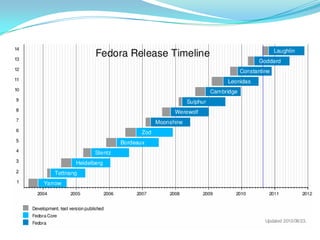
 Fedora Core 1–4
 Fedora Core 5–6
 Fedora 7
 Fedora 8
 Fedora 9
 Fedora 10
 Fedora 11
 Fedora 12
 Fedora 13
Fedora Core 1
Fedora Core 1 was the first version of Fedora
and was released on November 6, 2003. It
was codenamed Yarrow. Fedora Core 1 was
based on Red Hat Linux 9 and shipped with
version 2.4.19 of the Linux kernel, version
2.4 of the GNOME desktop environment,
and version 3.1 of KDE (the K Desktop
Environment).
Fedora Core 2
Fedora Core 2 was released on May
 18, 2004, codenamed Tettnang.
Linux 2.6, GNOME 2.6,KDE 3.2
Fedora Core 3
 Fedora Core 3 was released on
  November 8, 2004, codenamed
  Heidelberg.
 GNOME 2.8 and KDE 3.3.
 Mozilla Firefox web browser
Fedora Core 4
 Fedora Core 4 was released on June 13,
  2005, with the codename Stentz.
 Linux 2.6.11, KDE 3.4 and GNOME 2.10.
 OpenOffice.org 2.0
Fedora Core 5–6
 Fedora Core 5 was released on March 20, 2006 with the
  codename Bordeaux.
 It was the first Fedora release to include Mono and
  tools built with it such as Beagle, F-Spot and Tomboy.
 Fedora Core 6 was released on October 24, 2006,
  codenamed Zod.
 Firefox 1.5
Fedora 7-8-9-10-11-12-13
 Fedora 7 released on May 31, 2007.
 Fedora 8 released on November 8, 2007.
 Fedora 9 released on May 13, 2008.
 Fedora 10 released on November 25, 2008.
 Fedora 11 released on June 9, 2009.
 Fedora 12 released on November 17, 2009.
 Fedora 13 released on May 25, 2010.
Fedora 13
   Fedora 13, codenamed Goddard, was released on May 25, 2010.
   Automatic printer-driver installation
   Automatic language pack installation
   Redesigned user-account tool
   Color management to calibrate monitors and scanners
   Experimental 3D support for NVIDIA video cards
   A new way to install Fedora over the Internet
   SSSD authentication for users
   Updates to NFS
   Inclusion of Zarafa Open Source edition
   System rollback for the Btrfs file system
   Better SystemTap probes
   Support for the entire Java EE 6 spec in Netbeans 6.8
   KDE PulseAudio Integration
   New command-line interface for NetworkManager
THANK YOU

Fedora

  • 2.
  • 3.
    History  Fedora Linuxwas begun in 2002 by Warren Togami  The Fedora Project was created in late 2003
  • 4.
    Version  Fedora Core1–4  Fedora Core 5–6  Fedora 7  Fedora 8  Fedora 9  Fedora 10  Fedora 11  Fedora 12  Fedora 13
  • 5.
    Fedora Core 1 FedoraCore 1 was the first version of Fedora and was released on November 6, 2003. It was codenamed Yarrow. Fedora Core 1 was based on Red Hat Linux 9 and shipped with version 2.4.19 of the Linux kernel, version 2.4 of the GNOME desktop environment, and version 3.1 of KDE (the K Desktop Environment).
  • 6.
    Fedora Core 2 FedoraCore 2 was released on May 18, 2004, codenamed Tettnang. Linux 2.6, GNOME 2.6,KDE 3.2
  • 7.
    Fedora Core 3 Fedora Core 3 was released on November 8, 2004, codenamed Heidelberg.  GNOME 2.8 and KDE 3.3.  Mozilla Firefox web browser
  • 8.
    Fedora Core 4 Fedora Core 4 was released on June 13, 2005, with the codename Stentz.  Linux 2.6.11, KDE 3.4 and GNOME 2.10.  OpenOffice.org 2.0
  • 9.
    Fedora Core 5–6 Fedora Core 5 was released on March 20, 2006 with the codename Bordeaux.  It was the first Fedora release to include Mono and tools built with it such as Beagle, F-Spot and Tomboy.  Fedora Core 6 was released on October 24, 2006, codenamed Zod.  Firefox 1.5
  • 10.
    Fedora 7-8-9-10-11-12-13  Fedora7 released on May 31, 2007.  Fedora 8 released on November 8, 2007.  Fedora 9 released on May 13, 2008.  Fedora 10 released on November 25, 2008.  Fedora 11 released on June 9, 2009.  Fedora 12 released on November 17, 2009.  Fedora 13 released on May 25, 2010.
  • 11.
    Fedora 13  Fedora 13, codenamed Goddard, was released on May 25, 2010.  Automatic printer-driver installation  Automatic language pack installation  Redesigned user-account tool  Color management to calibrate monitors and scanners  Experimental 3D support for NVIDIA video cards  A new way to install Fedora over the Internet  SSSD authentication for users  Updates to NFS  Inclusion of Zarafa Open Source edition  System rollback for the Btrfs file system  Better SystemTap probes  Support for the entire Java EE 6 spec in Netbeans 6.8  KDE PulseAudio Integration  New command-line interface for NetworkManager
  • 13.