FAA P 401 MIX DESIGN
FAA Mix Design
FAA Mix Design
Based on Section 2, Design of Bituminous Paving Mixtures, Job
Mix Formula Marshall Methods
From the FAA’s Eastern Region Laboratory Procedures Manual
(March 2003)
Presented by James P. Smith Jr.
President, Advance Testing
FAA P 401 MIX DESIGN
FAA P 401 MIX DESIGN ddd
Overview
• Aggregate Pre-Qualification Testing
• Volumetric Mix Design Procedures
– Dry Batching Aggregates
– Mixing Specimens
– HMA Testing (Bulk, Rice, Stability & Flow)
– Analysis of Marshall Curves
– Anti-Stripping Test
FAA P 401 MIX DESIGN
Introduction
• P 401 hot mix asphalt design used during airport construction
• Mix Design Methodology:
– Asphalt Institute MS-2, Mix Design Methods (Best Source)
• Material requirements for the P 401 mixture will be listed in
the contract specifications and are determined by the
engineer
• The JMF developed by the contractor is prepared on
standard forms (Appendix A)
FAA P 401 MIX DESIGN
Summary of FAA Mix Design
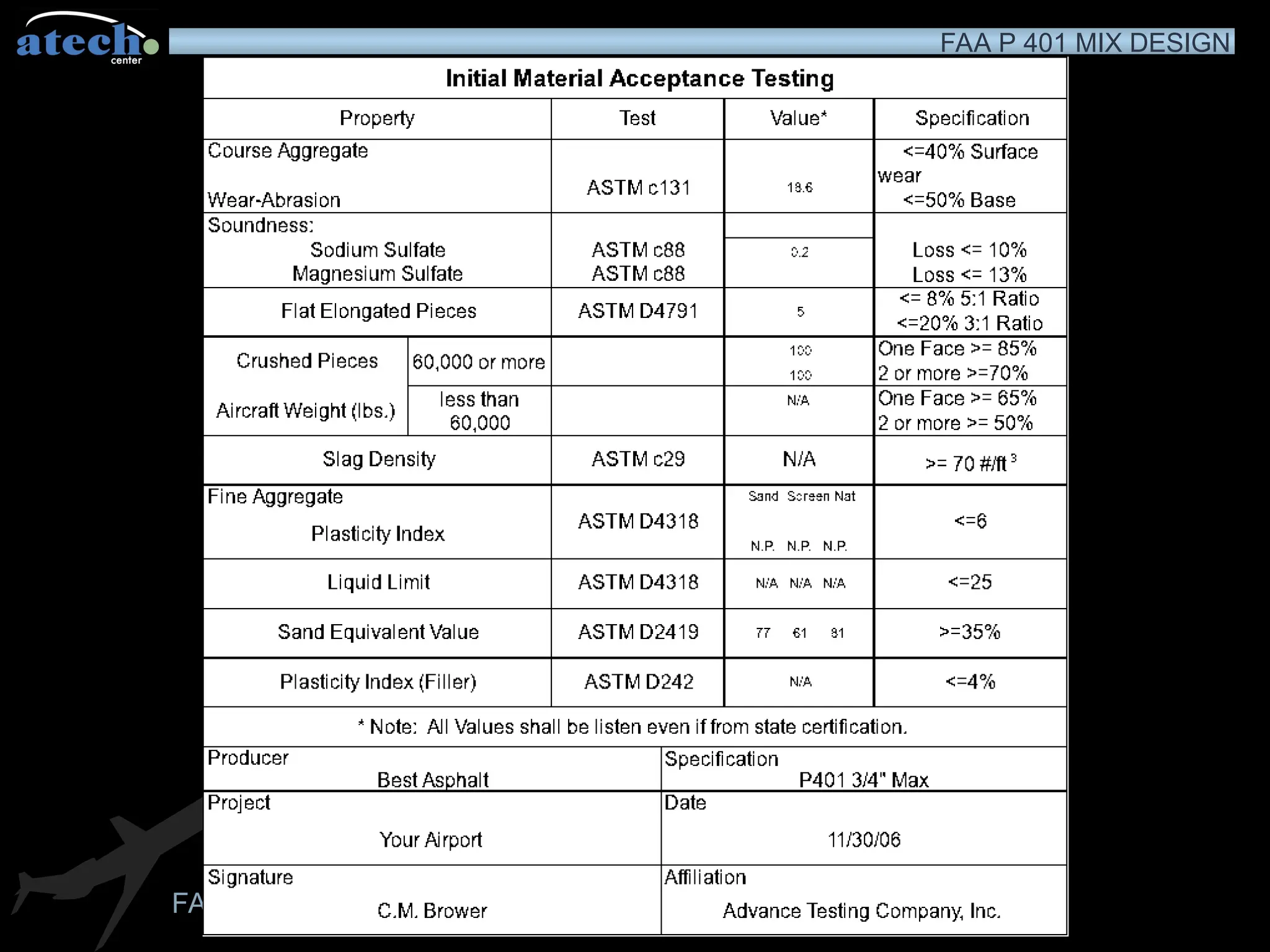
1. Aggregates properties are tested (soundness, abrasion,
crush count, liquid limit, plasticity index, sand equivalence)
and must be acceptable in accordance with requirements
2. Aggregate blends are developed that fall within the general
limits established, blends are plotted on a power 0.45
curve
3. Batches of the proposed aggregate blend are prepared,
three to five specimens are used for each asphalt content
for bulk analysis, another two need to be batched for
maximum theoretical specific gravity analysis
FAA P 401 MIX DESIGN
Summary of FAA Mix Design
4. 5 asphalt contents will be prepared, each differing by
0.5%, with the intention of bridging the optimum
asphalt content
5. Bulk specific gravity and maximum theoretical
specific gravities are measured for each asphalt
content, volumetric properties are derived through
calculation
6. Stability and flow properties are tested and measured
FAA P 401 MIX DESIGN
Summary of FAA Mix Design
7. Volumetric properties and stability and flow
measurements are plotted against asphalt content
8. Optimum asphalt content is chosen from plots and
verified with additional batches
9. TSR testing is performed at the optimum asphalt
content
FAA P 401 MIX DESIGN
DATE AIP PROJECT NO.
AIRPORT NAME AND LOCATION
CONTRACTOR NAME AND LOCATION
NAME AND LOCATION
TYPE CAPACITY
SPECIFICATIONS
P401 3/4" Max
NAME LOCATION
Your Airport
Anytown, PA
Advance Testing Company Campbell Hall, NY
CMI Drum Mix 350 Tons/Hour
Project No. 58-263
PREPARED BY
JOB MIX FORMULA
BITUMINOUS PLANT
11/30/06
Best Asphalt
Anytown, PA
Best Construction
Anytown, PA
FAA P 401 MIX DESIGN
Producer: Tilcon Conn. Inc.
Project: Groton Airport
Spec.: P-401 3/4" MAX
Date:
Center Voids Spec. 3.5 Advance Testing Company, Inc.
Producers Analysis of Materials and Job Mix Formula
Test Property Curves
11/30/06
150
151
152
153
154
155
156
4.5 5 5.5 6 6.5 7 7.5
Percent Asphalt
Unit Wt. (lbs./cu. ft.)
0.00
1.00
2.00
3.00
4.00
5.00
4.5 5 5.5 6 6.5 7 7.5
Percent Asphalt
Percent Voids Total Mix
2000.00
2200.00
2400.00
2600.00
2800.00
3000.00
3200.00
4.5 5 5.5 6 6.5 7 7.5
Percent Asphalt
Stability (lbs.)
50.00
60.00
70.00
80.00
90.00
100.00
4.5 5 5.5 6 6.5 7 7.5
Percent Asphalt
Percent Voids Filled
0.00
5.00
10.00
15.00
20.00
4.5 5 5.5 6 6.5 7 7.5
Percent Asphalt
Flow (1/100 inches) 14.00
14.50
15.00
15.50
16.00
4.5 5 5.5 6 6.5 7 7.5
Percent Asphalt
Percent Voids in Mineral
Aggregate
FAA P 401 MIX DESIGN
Preliminary Procedures
• Aggregate properties
determined as per
Appendix A
• JMF is developed using
either plant bins or
stockpiles (hot bins are
highly recommended at a
batch plant)
FAA P 401 MIX DESIGN
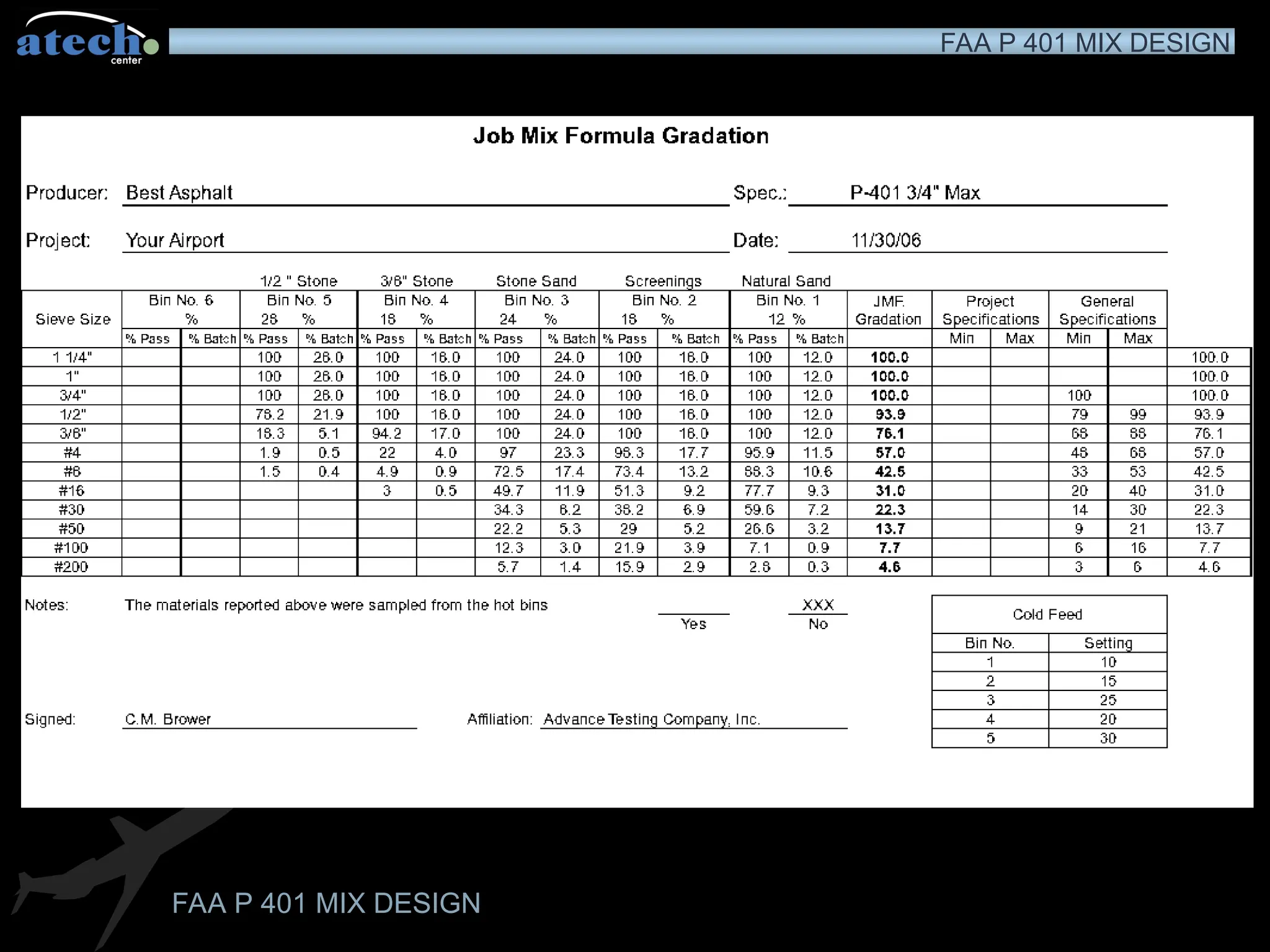
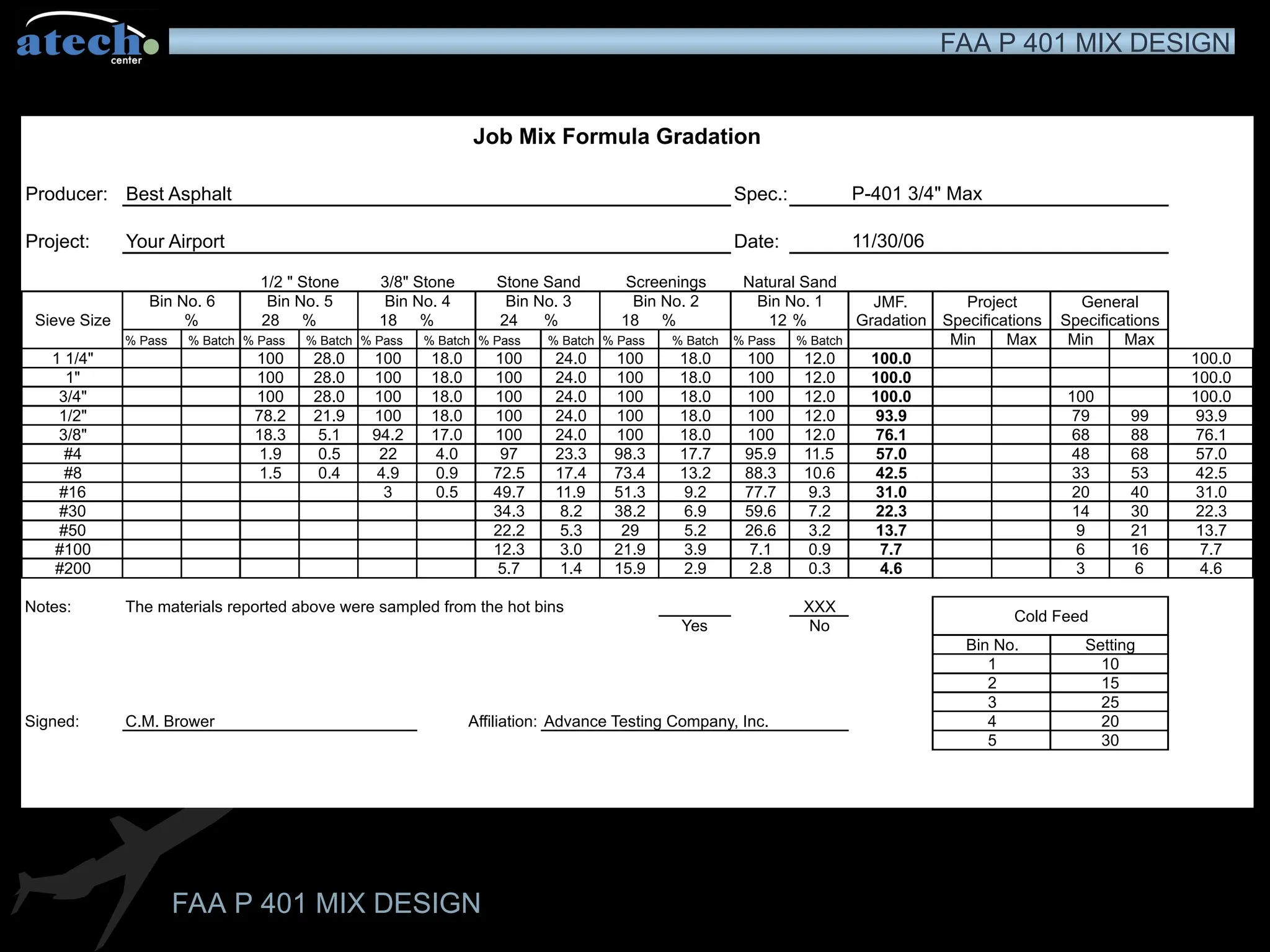
Producer: Best Asphalt Spec.:
Project: Your Airport Date:
% 28 % 18 % 24 % 18 % 12 %
% Pass % Batch % Pass % Batch % Pass % Batch % Pass % Batch % Pass % Batch % Pass % Batch Min Max Min Max
1 1/4" 100 28.0 100 18.0 100 24.0 100 18.0 100 12.0 100.0 100.0
1" 100 28.0 100 18.0 100 24.0 100 18.0 100 12.0 100.0 100.0
3/4" 100 28.0 100 18.0 100 24.0 100 18.0 100 12.0 100.0 100 100.0
1/2" 78.2 21.9 100 18.0 100 24.0 100 18.0 100 12.0 93.9 79 99 93.9
3/8" 18.3 5.1 94.2 17.0 100 24.0 100 18.0 100 12.0 76.1 68 88 76.1
#4 1.9 0.5 22 4.0 97 23.3 98.3 17.7 95.9 11.5 57.0 48 68 57.0
#8 1.5 0.4 4.9 0.9 72.5 17.4 73.4 13.2 88.3 10.6 42.5 33 53 42.5
#16 3 0.5 49.7 11.9 51.3 9.2 77.7 9.3 31.0 20 40 31.0
#30 34.3 8.2 38.2 6.9 59.6 7.2 22.3 14 30 22.3
#50 22.2 5.3 29 5.2 26.6 3.2 13.7 9 21 13.7
#100 12.3 3.0 21.9 3.9 7.1 0.9 7.7 6 16 7.7
#200 5.7 1.4 15.9 2.9 2.8 0.3 4.6 3 6 4.6
Notes: The materials reported above were sampled from the hot bins XXX
Yes No
Signed: C.M. Brower Affiliation: Advance Testing Company, Inc.
5 30
Cold Feed
20
25
15
10
1
2
3
Job Mix Formula Gradation
Bin No. Setting
Project
Specifications
General
Specifications
11/30/06
P-401 3/4" Max
Natural Sand
Screenings
1/2 " Stone
Sieve Size
Bin No. 6 Bin No. 5
4
Stone Sand
3/8" Stone
JMF.
Gradation
Bin No. 4 Bin No. 3 Bin No. 2 Bin No. 1
FAA P 401 MIX DESIGN
Wear-Abrasion (ASTM C 131)
• Measures the resistance to
wearing as aggregate is
subjected to impact and grinding
• Ensures that aggregate will not
wear excessively during
shipment and production
• Standard graded aggregate is
subjected to impact and grinding
by steel spheres inside a hollow
steel chamber
FAA P 401 MIX DESIGN
Wear-Abrasion (ASTM C 131)
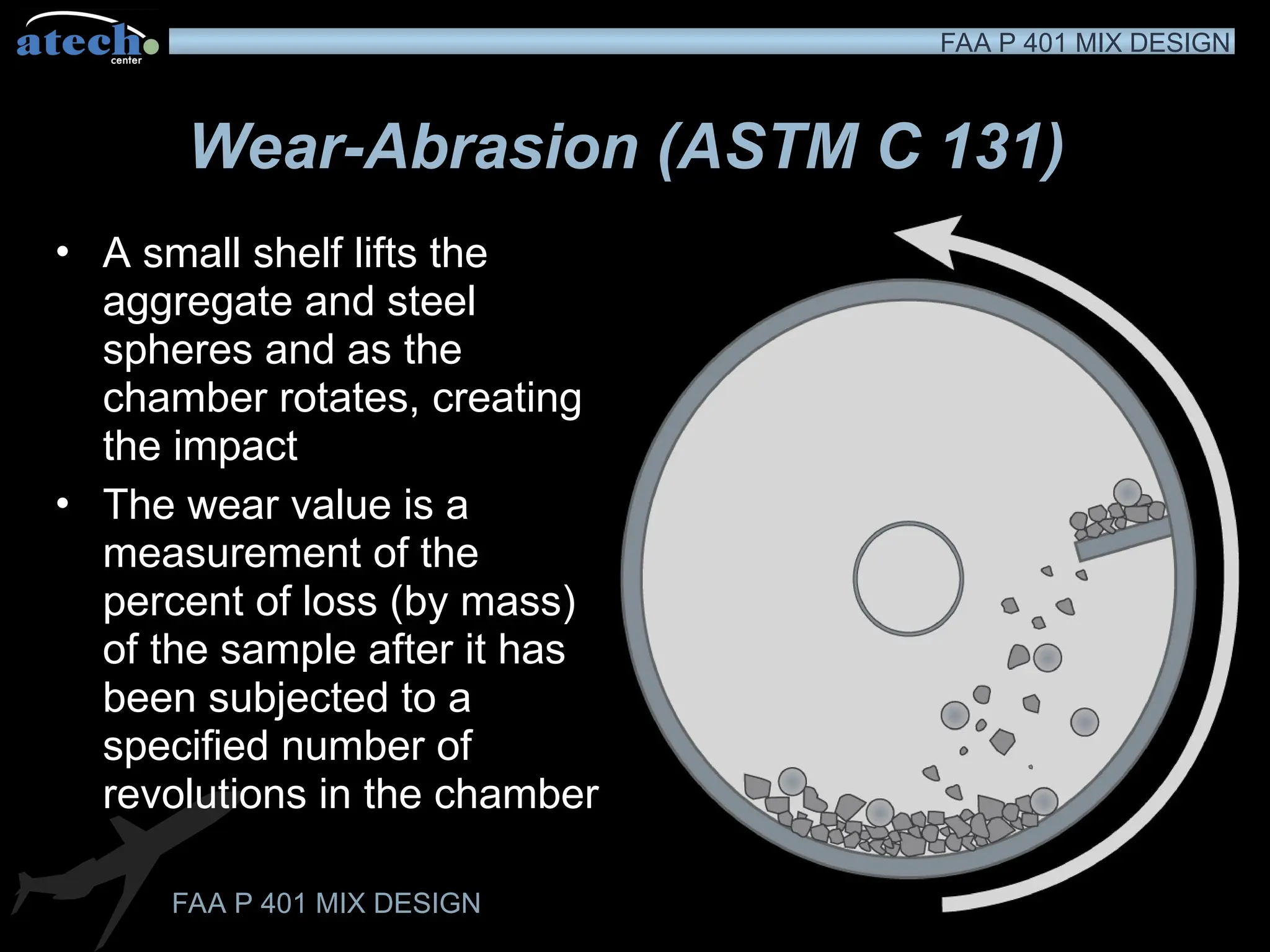
• A small shelf lifts the
aggregate and steel
spheres and as the
chamber rotates, creating
the impact
• The wear value is a
measurement of the
percent of loss (by mass)
of the sample after it has
been subjected to a
specified number of
revolutions in the chamber
FAA P 401 MIX DESIGN
Wear-Abrasion (ASTM C 131)
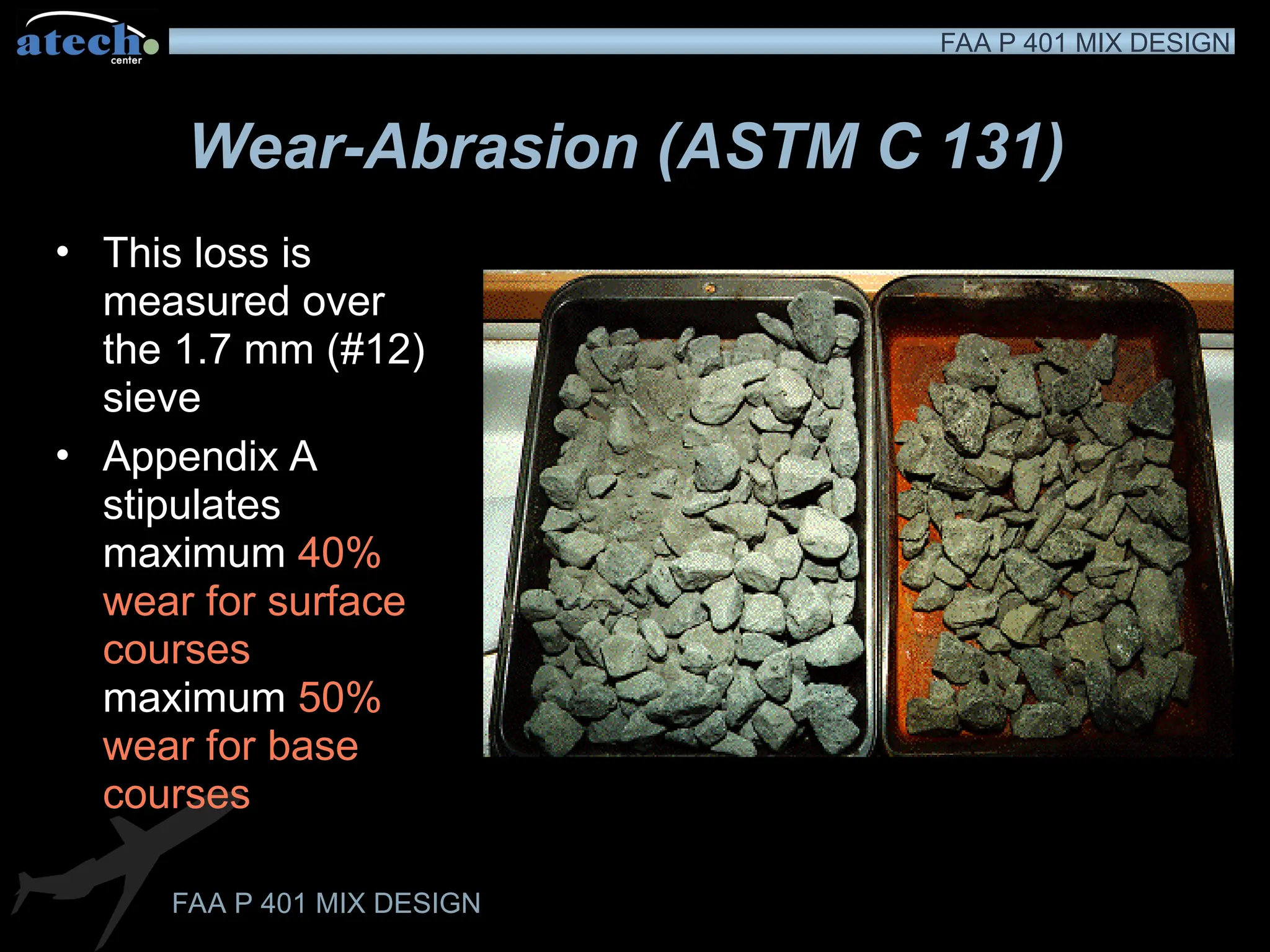
• This loss is
measured over
the 1.7 mm (#12)
sieve
• Appendix A
stipulates
maximum 40%
wear for surface
courses
maximum 50%
wear for base
courses
FAA P 401 MIX DESIGN
Soundness (ASTM C 88)
• The soundness test subjects
aggregate particles to
alternating cycles of soaking in
a salt solution (either sodium
or magnesium sulfate) and
drying in an oven regulated at
110±5˚C (230±9˚F)
• Salts permeate the voids of
the aggregate during soaking
and expand during drying,
simulating the expansive
pressures of water
FAA P 401 MIX DESIGN
Soundness (ASTM C 88)
• The soundness value is also a measure of loss of
particles after the sample has been subjected to a
specified number of soaking and drying cycles
• Appendix A stipulates the maximum loss as 10%
for sodium sulfate tests and 13% for magnesium
sulfate tests
FAA P 401 MIX DESIGN
Flat & Elongated (ASTM D 4791)
• Flat and elongated particles in an aggregate are
measured using a proportional caliper device set to
the appropriate ratios required by the agency
• Flat AND elongated test: length to thickness is
compared
FAA P 401 MIX DESIGN
Flat & Elongated (ASTM D 4791)
• Flat & Elongated
(ASTM D 4791)
– Flat or elongated particles in an
HMA mixture may degrade more
quickly than non flat or elongated
particles, thereby reducing the
durability of the pavement
– Appendix A limits the amount of
these particles in the coarse
aggregate to no more than 8% at
a 5:1 ratio and no more than 20%
at a 3:1 ratio
FAA P 401 MIX DESIGN
Crushed Pieces
• In order to produce pavements that are resistant to
deformation, it helps to use angular aggregate particles
• Angular aggregates tend to interlock and resist deformation
even after repeated loading
• The crushed pieces requirement in Appendix A is meant to
ensure the aggregate angularity is maintained
FAA P 401 MIX DESIGN
Crushed Pieces
• FAA Eastern Region Lab Procedures indicate
that a fractured face “shall be equal to at least
75% of the smallest mid-sectional area of the
piece”
• When two fractured faces are contiguous, the
angle between the planes of fractures shall be
at least 30 degrees to count as two fractured
faces
• Fractured faces shall be obtained by crushing
FAA P 401 MIX DESIGN
Crushed Pieces
• Requirements for crushed pieces in coarse
aggregate are dependent upon anticipated
loading of pavement
Aircraft
Gross Weight
One
Fractured
Face
Two
Fractured
Faces
< 27,200 kg
(60,000 lbs)
65 50
27,200 kg
≥
(60,000 lbs)
85 70
FAA P 401 MIX DESIGN
Slag Density (ASTM C 29)
• The use of air cooled blast
furnace slag as an aggregate
item (where available and
when desired) may be allowed
FAA P 401 MIX DESIGN
Liquid Limit (ASTM D 4318)
• The liquid limit test
measures the water
content of a material at
the point it passes from a
solid to a liquid state
• This test is used in
conjunction with the
plastic limit test to
determine the plasticity
index
FAA P 401 MIX DESIGN
Plasticity Index (ASTM D 4318)
• The plasticity index is a
measure of the range of
moisture contents that a
sample will act in a
plastic fashion but not in
a liquid fashion
• Generally used with
cohesive soils, this
procedure is used on fine
aggregates proposed for
use in HMA to ensure
that they exhibit minimal
plasticity
FAA P 401 MIX DESIGN
Plasticity Index (ASTM D 4318)
• A fine aggregate with plasticity
index of greater than 6 would
indicate an aggregate with an
excessive amount of cohesive
fines
• These cohesive fines might
weaken the bond between the
liquid binder and the aggregate
particles, decreasing the
durability of the HMA mixture
• When mineral filler is used in
the HMA mixture, a plasticity
test is also required
FAA P 401 MIX DESIGN
Sand Equivalent (ASTM D 2419)
• The sand equivalent value
is a measure of the
relative amount of fines in
the fine aggregate sample
• This is performed by
placing the fines in
suspension in a solution of
calcium chloride above
the sand
FAA P 401 MIX DESIGN
Sand Equivalent (ASTM D 2419)
• The sand equivalent value
itself is an expression of the
sand reading in terms of the
clay reading
• Higher sand equivalent values
therefore mean less clay like
fines
• Appendix A requires at least
45% for sand equivalent
FAA P 401 MIX DESIGN
Specific Gravity of Coarse
Aggregates (ASTM C 127)
• Specific gravity of coarse
aggregate is performed in
the lab on samples that
have soaked for 24±4
hours in water at room
temperature
• Of particular interest to the
HMA designer is the
measurement of the
stone’s bulk specific
gravity, Gsb
FAA P 401 MIX DESIGN
Bulk Specific Gravity of Coarse
Aggregates (ASTM C 127)
• The bulk specific gravity uses the bulk
volume of the aggregate particle, which
includes the volume of pore space within the
particle occupied by water
• This requires that the mass of the particles
used for the volumetric measurement is
determined in an SSD (saturated, surface
dry) condition
FAA P 401 MIX DESIGN
Specific Gravity of Fine
Aggregates (ASTM C 128)
• The specific gravity of the
fine aggregate needs to
be determined as well
• This method uses a glass
pycnometer of a known
volume to determine the
water displaced by the
sample
FAA P 401 MIX DESIGN
Specific Gravity of Fine
Aggregates (ASTM C 128)
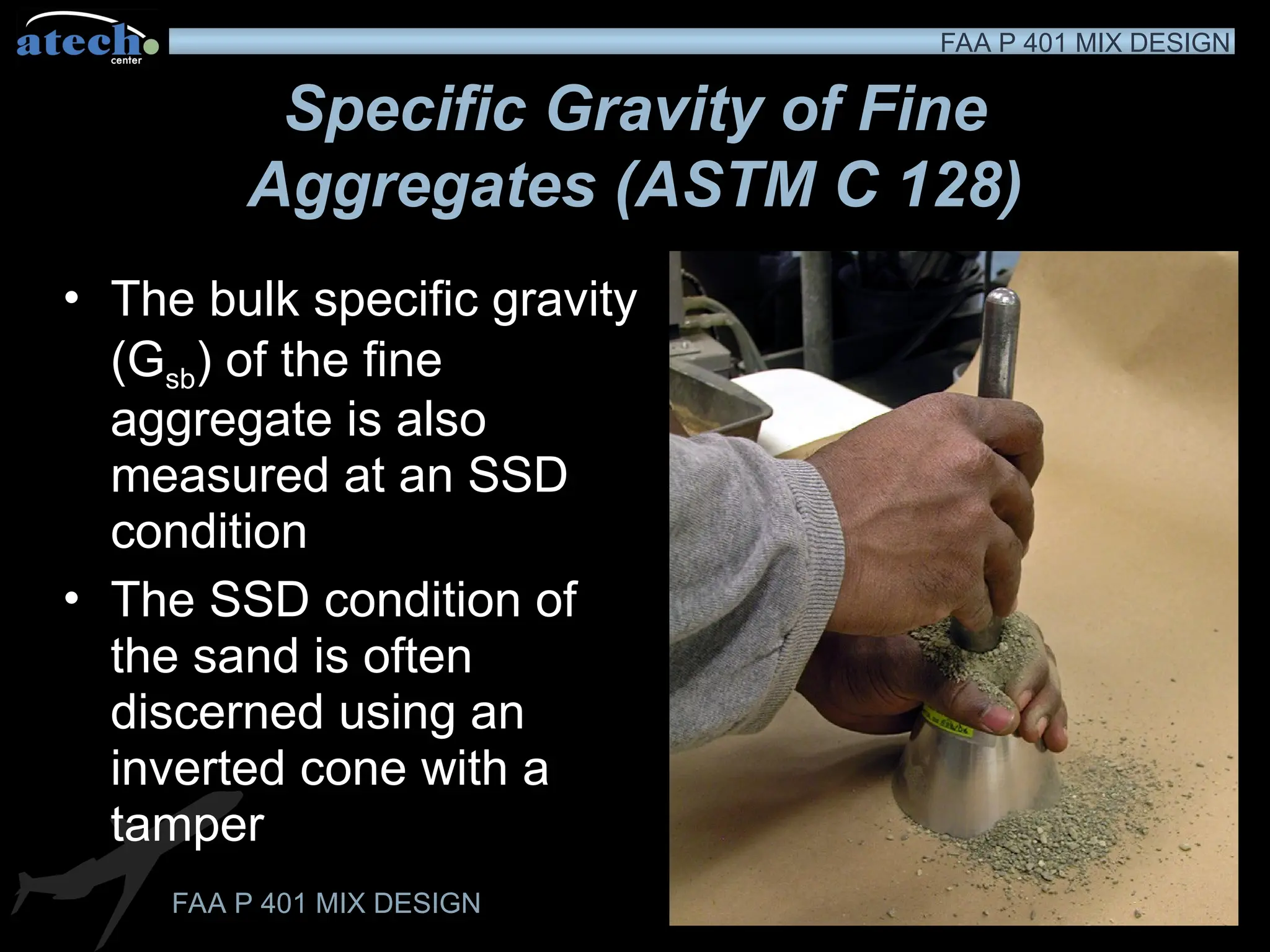
• The bulk specific gravity
(Gsb) of the fine
aggregate is also
measured at an SSD
condition
• The SSD condition of
the sand is often
discerned using an
inverted cone with a
tamper
FAA P 401 MIX DESIGN
Combined Bulk Specific Gravity
• The bulk gravities of the
combined aggregates in
the mixture have a
significant effect on the
overall density of the
mixture
• The combined bulk
gravity of all
constituents, based on
their percentage in the
blend, is used to
calculate VMA (Voids in
Mineral Aggregate)
ddd
FAA P 401 MIX DESIGN
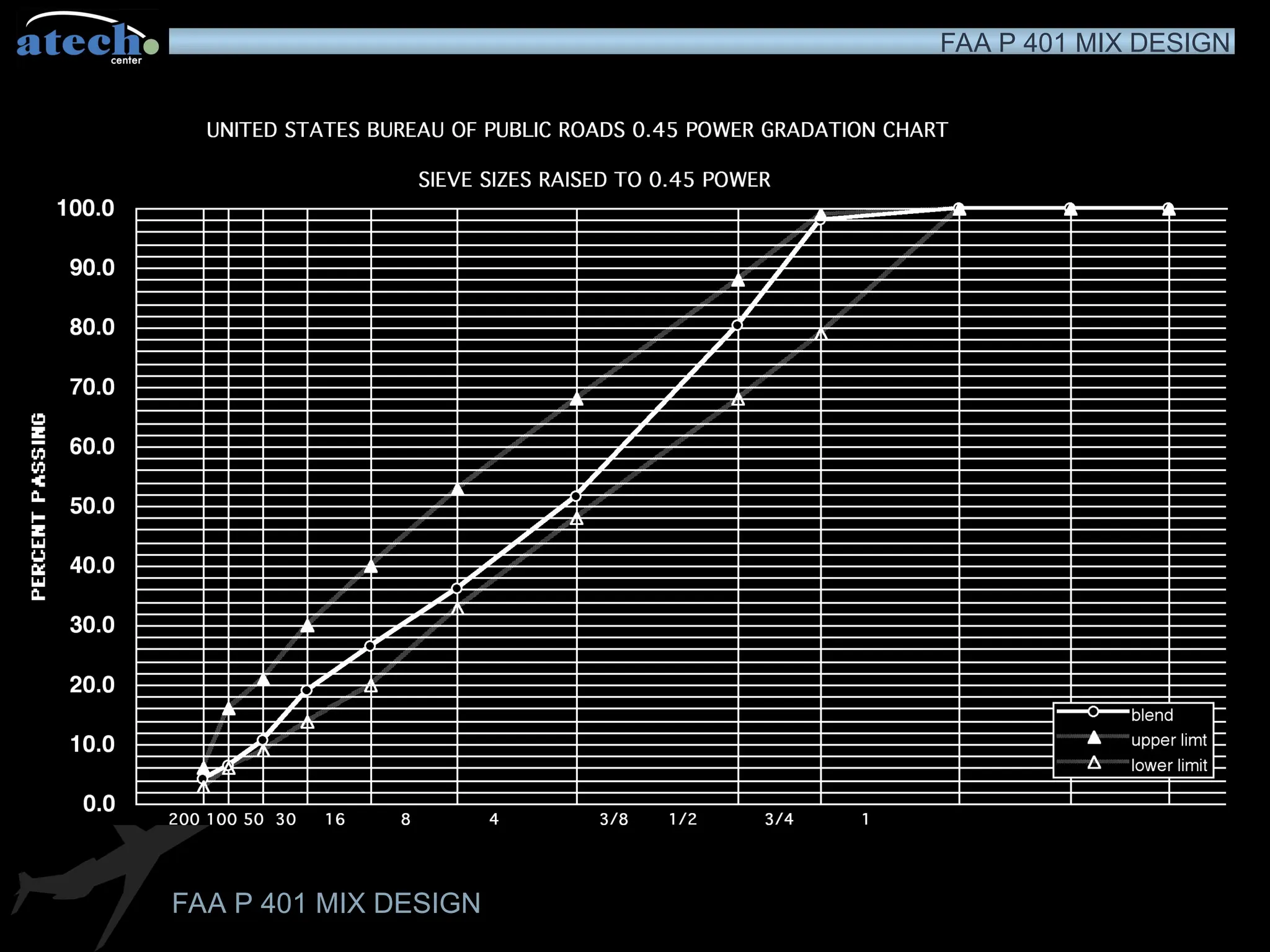
Aggregate Gradation Requirements
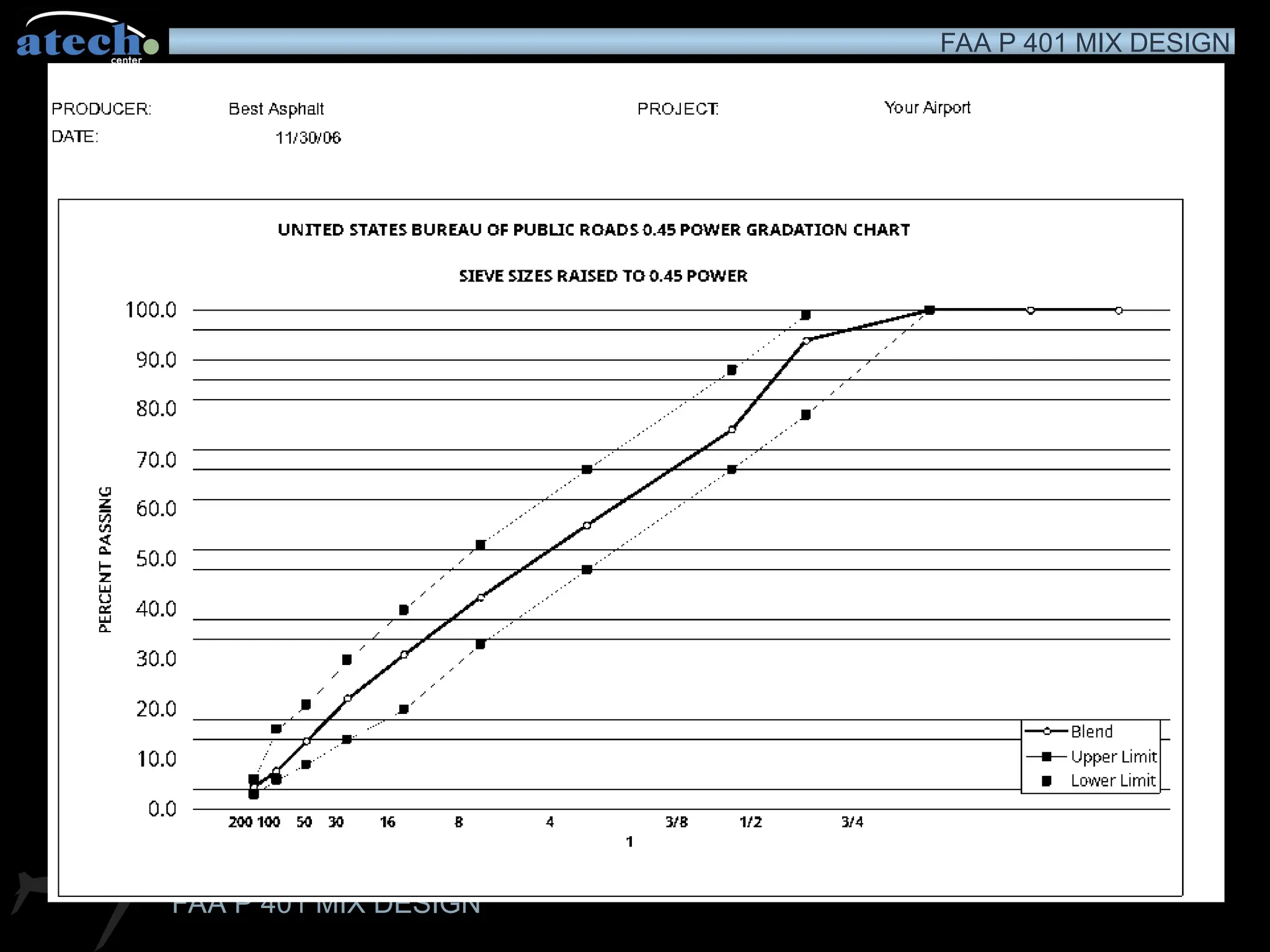
• Proposed combined gradation
(particle distribution) is plotted
on a 0.45 power gradation
chart
• Grading curve must closely
parallel the curves for the
upper and lower JMF limits
• Grading curve should display
no abrupt changes
FAA P 401 MIX DESIGN
FAA P 401 MIX DESIGN ddd
FAA P 401 MIX DESIGN
Volumetric Mix Design Overview
• Must prepare lab specimens for bulk analysis
(Gmb)and loose mix samples for theoretical
density (Gmm) over a range of asphalt contents for
testing
• Minimum of three bulk specimens per asphalt
content (4 recommended)
• Typically five or six different asphalt contents
(separated by 1/2 %) are used
• Design must display two asphalt contents above
“optimum”, and two below optimum
FAA P 401 MIX DESIGN
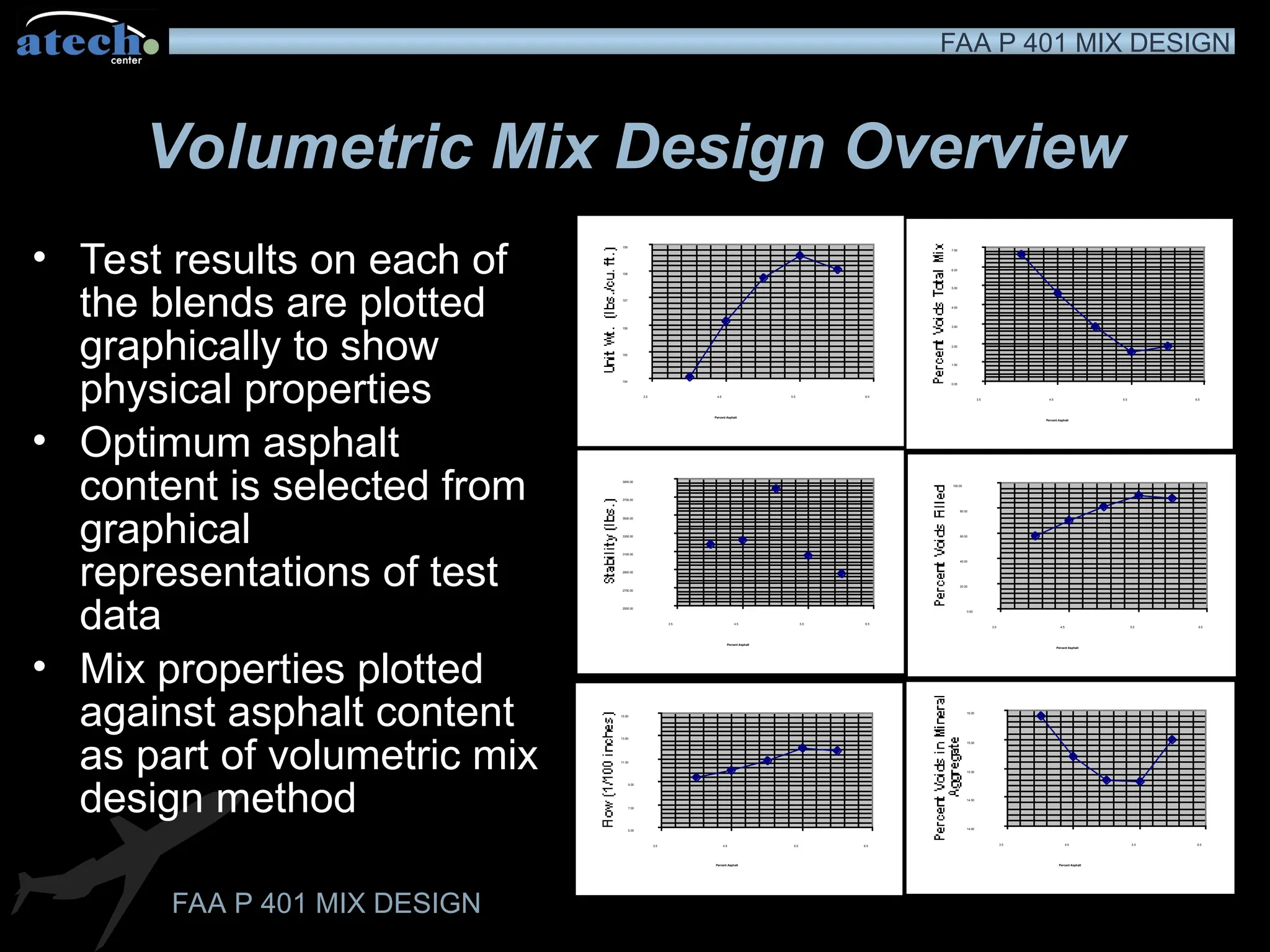
Volumetric Mix Design Overview
• Test results on each of
the blends are plotted
graphically to show
physical properties
• Optimum asphalt
content is selected from
graphical
representations of test
data
• Mix properties plotted
against asphalt content
as part of volumetric mix
design method
154
155
156
157
158
159
3.5 4.5 5.5 6.5
Percent Asphalt
0.00
1.00
2.00
3.00
4.00
5.00
6.00
7.00
3.5 4.5 5.5 6.5
Percent Asphalt
2500.00
2700.00
2900.00
3100.00
3300.00
3500.00
3700.00
3900.00
3.5 4.5 5.5 6.5
Percent Asphalt
0.00
20.00
40.00
60.00
80.00
100.00
3.5 4.5 5.5 6.5
Percent Asphalt
5.00
7.00
9.00
11.00
13.00
15.00
3.5 4.5 5.5 6.5
Percent Asphalt
14.00
14.50
15.00
15.50
16.00
3.5 4.5 5.5 6.5
Percent Asphalt
FAA P 401 MIX DESIGN
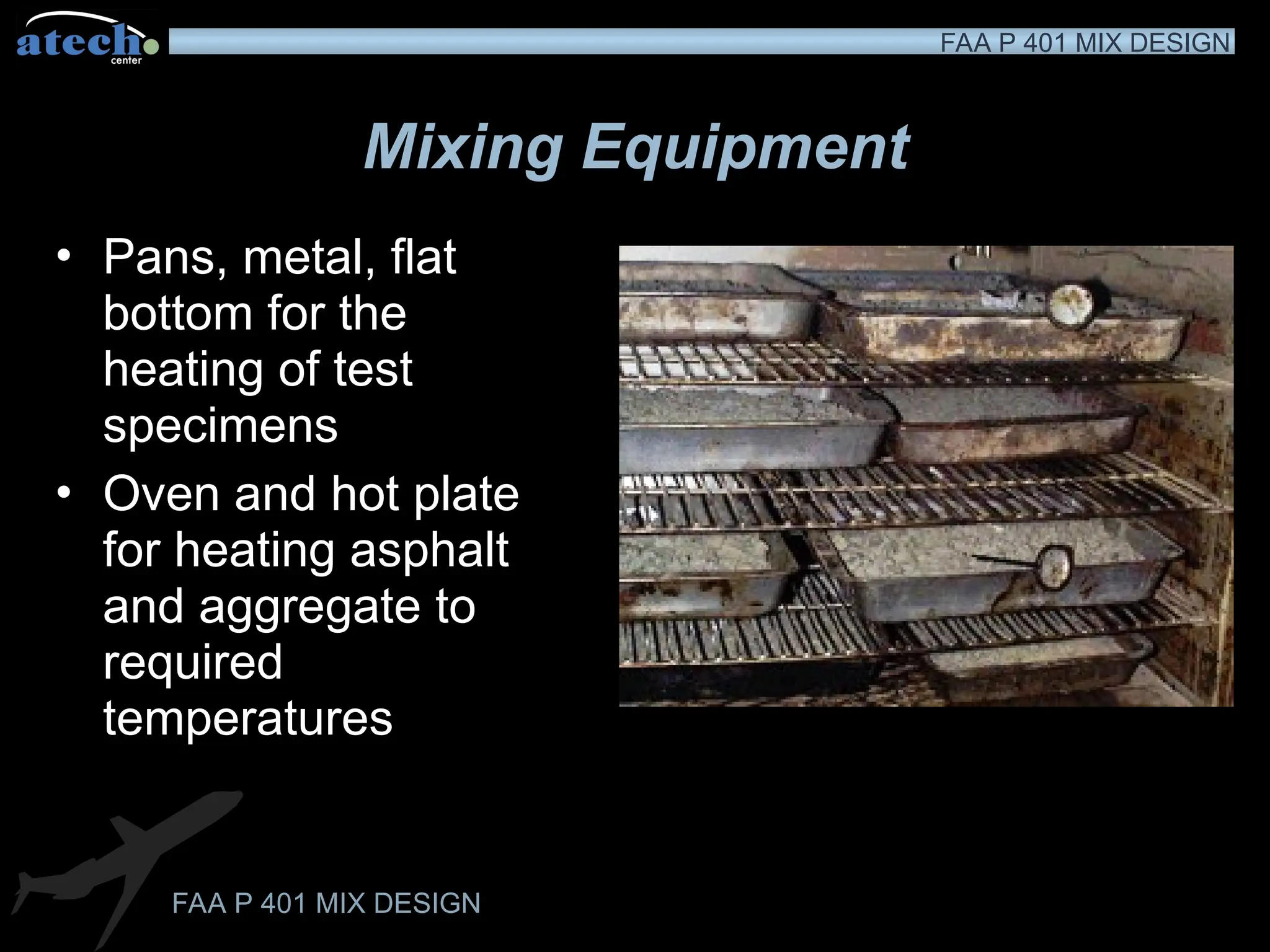
Mixing Equipment
• Pans, metal, flat
bottom for the
heating of test
specimens
• Oven and hot plate
for heating asphalt
and aggregate to
required
temperatures
FAA P 401 MIX DESIGN
Mixing Equipment
• Mixing bowl, round,
approx. 4 liter
capacity for mixing
asphalt &
aggregate
• Scoop, for batching
aggregates
FAA P 401 MIX DESIGN
Mixing Equipment
• Container for heating
asphalt (hopper with control
valve recommended)
• Thermometers, armored
glass, or metal stem (50 to
450˚ F with sensitivity of
5.0˚ F) for determining
temperature of aggregate,
asphalt, and asphalt mixture
• Balance, 4.5Kg capacity,
sensitive to 0.5g for
weighing aggregates and
asphalt
FAA P 401 MIX DESIGN
Mixing Equipment
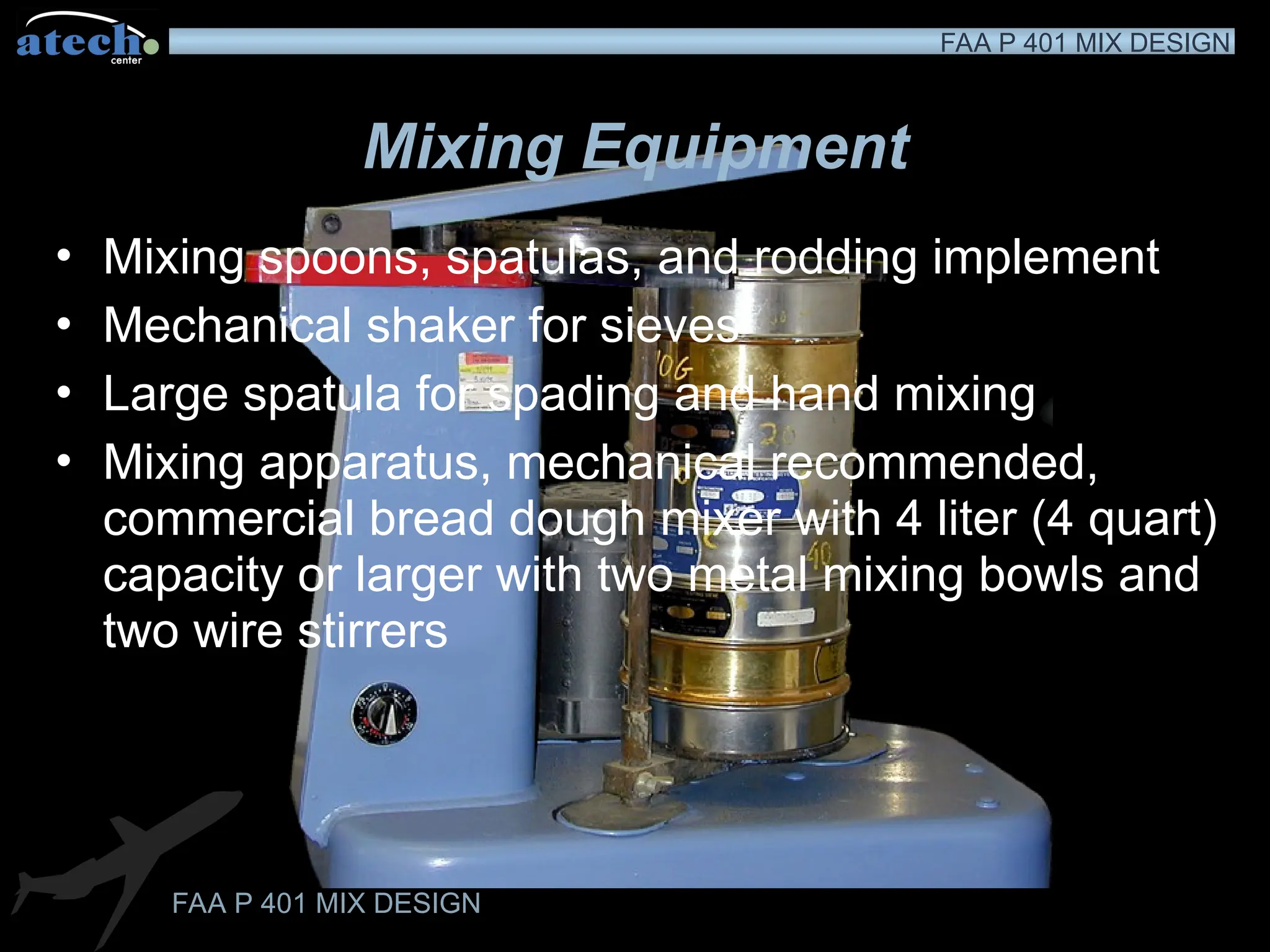
• Mixing spoons, spatulas, and rodding implement
• Mechanical shaker for sieves
• Large spatula for spading and hand mixing
• Mixing apparatus, mechanical recommended,
commercial bread dough mixer with 4 liter (4 quart)
capacity or larger with two metal mixing bowls and
two wire stirrers
FAA P 401 MIX DESIGN
Compaction Pedestal
• 8” x 8” x 8” wooden post capped with a 12” x
12” x 1” steel plate
• Wooden post: oak, yellow pine, or other
wood with dry unit weight of 42 to 48 pcf
• Wooden post secured by four angle
brackets to a solid concrete slab
• Steel plate firmly fastened to post (no
movement at all)
• Pedestal installed level, post is plumb, and
no movement during compaction process
FAA P 401 MIX DESIGN
Compaction Mold
• Base plate, forming
mold, and collar
• Forming mold has
inside diameter of 4
inches and height of
3 inches
FAA P 401 MIX DESIGN
Compaction Hammer
• Flat circular tamping face, 3 7/8
inches (98.4mm diameter)
• 10 lb (4.5 kg) weight
• 18” (457 mm) drop of hammer onto
specimen
• Spring tension device to hold
compaction mold in place on
compaction pedestal
FAA P 401 MIX DESIGN
Equipment
• Extrusion jack, for
extruding compacted
specimen from mold
• Gloves, insulated, for
handling hot
equipment
• Marking crayons for
labeling specimens
FAA P 401 MIX DESIGN
Aggregate Batching
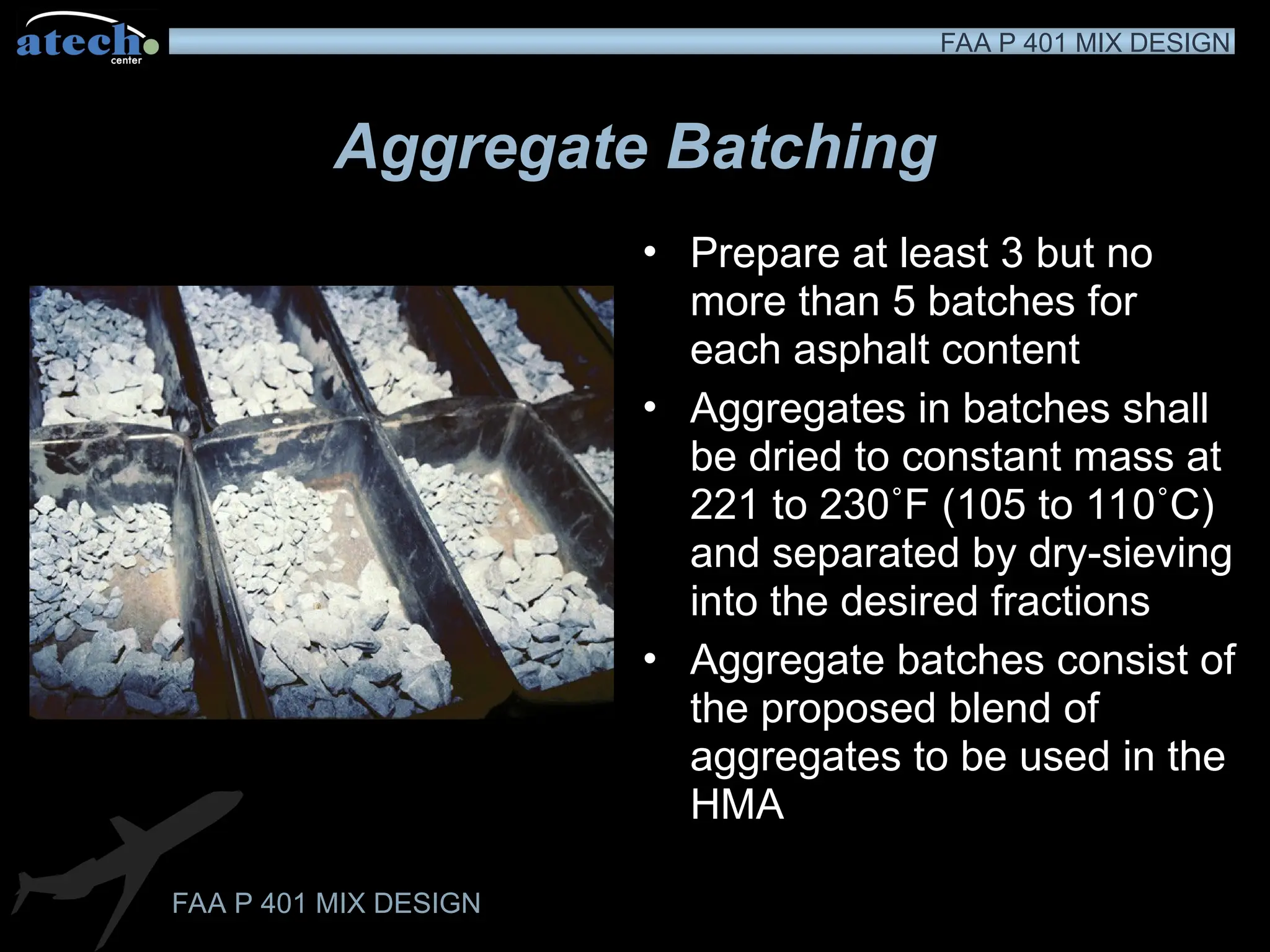
• Prepare at least 3 but no
more than 5 batches for
each asphalt content
• Aggregates in batches shall
be dried to constant mass at
221 to 230˚F (105 to 110˚C)
and separated by dry-sieving
into the desired fractions
• Aggregate batches consist of
the proposed blend of
aggregates to be used in the
HMA
FAA P 401 MIX DESIGN
Aggregate Batching
• Each particle size for each
aggregate constituent is
placed into each batch
• The size of the batches
(around 1200 g) is intended
(when mixed with the liquid
binder) to produce bulk
specimens that are 2.5±0.5
inches in height
FAA P 401 MIX DESIGN
Material Heating
• Aggregate is placed into an oven regulated 50˚F
(20˚C) higher than the mixing temperature
• Liquid binder should be heated to the mixing
temperature (not more than 1 hour prior to mixing)
and covered
• Mixing should not begin until the aggregate and
liquid binder have stabilized at the appropriate
temperature
FAA P 401 MIX DESIGN
Mixing & Compaction Temperatures
• Mixing and compaction temperatures determined
by the temperature viscosity chart
• Mixing temperature is defined as that range of
temperatures that produces a viscosity of
0.17±0.02 kPa (170±20 centistokes) in the liquid
binder (asphalt cement)
• Compaction temperature is defined as that range
of temperatures that produces a viscosity of
0.28±0.03 kPa (280±30 centistokes) in the liquid
binder (asphalt cement)
FAA P 401 MIX DESIGN
Temperature/Viscosity Chart
FAA P 401 MIX DESIGN
Preparation of Molds/Hammer
• Thoroughly clean the
specimen mold assembly
and the face of the
compaction hammer
• Heat them on a hot plate
(or in boiling water) to a
temperature between 200–
300˚F (93-149˚C)
• Use a protection disk in the
bottom of each mold prior
to charging the mold with
HMA
FAA P 401 MIX DESIGN
Mixing HMA
• Keep all materials up to temperature as
much as possible
• A hot plate may be used to keep the mixing
bowl warm, however heat should be baffled
to prevent localized overheating
• Charge heated bowl with aggregates, dry
mix thoroughly
FAA P 401 MIX DESIGN
Mixing HMA
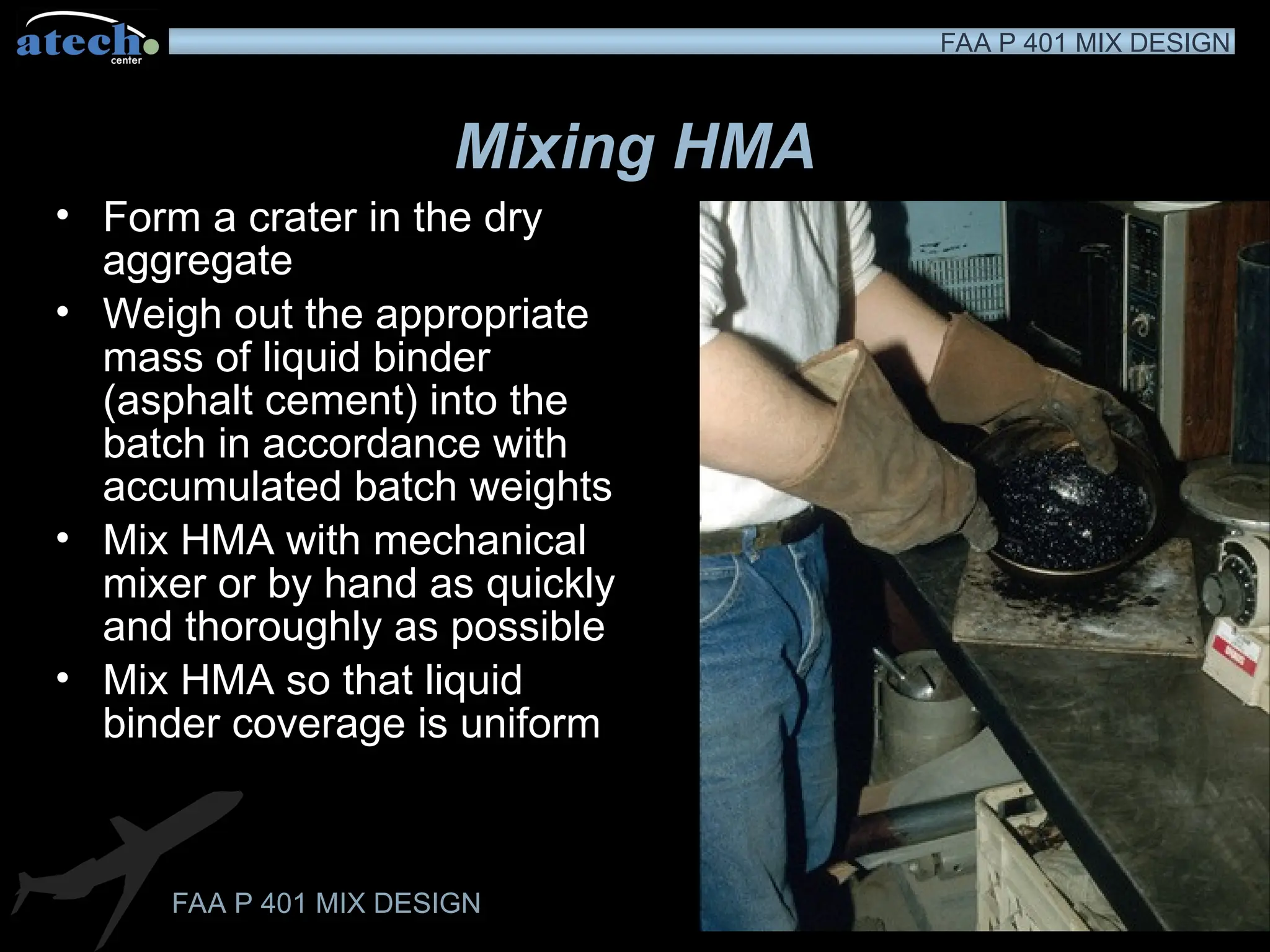
• Form a crater in the dry
aggregate
• Weigh out the appropriate
mass of liquid binder
(asphalt cement) into the
batch in accordance with
accumulated batch weights
• Mix HMA with mechanical
mixer or by hand as quickly
and thoroughly as possible
• Mix HMA so that liquid
binder coverage is uniform
FAA P 401 MIX DESIGN
Compacting Specimens
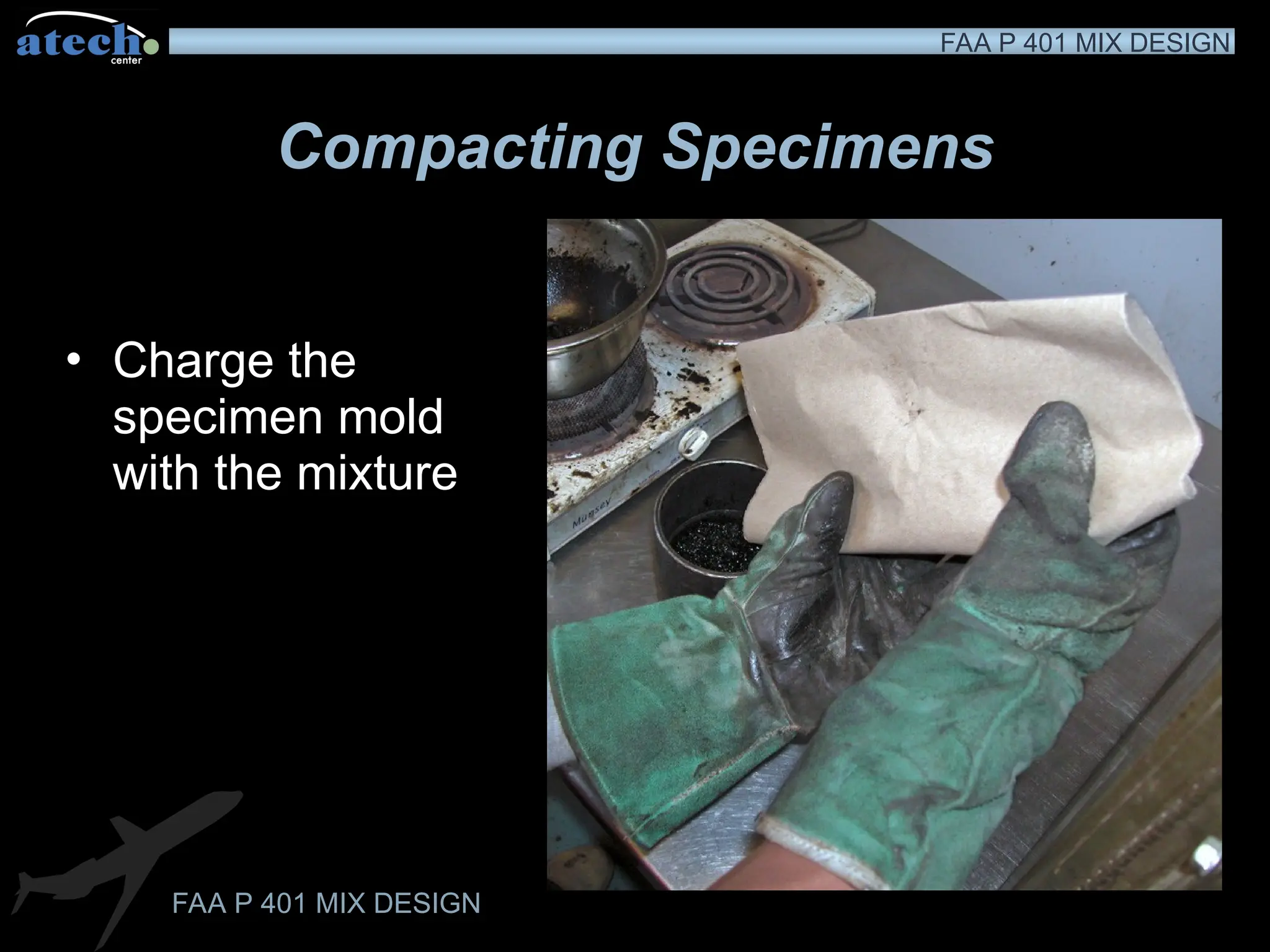
• Charge the
specimen mold
with the mixture
FAA P 401 MIX DESIGN
Compacting Specimens
• Spade the mixture
vigorously with a heated
trowel or spatula 15
times around the exterior
and 10 times over the
interior of the specimen
FAA P 401 MIX DESIGN
Compacting Specimens
• Remove the specimen
mold collar and smooth
the surface of the
sample to a slightly
rounded shape
FAA P 401 MIX DESIGN
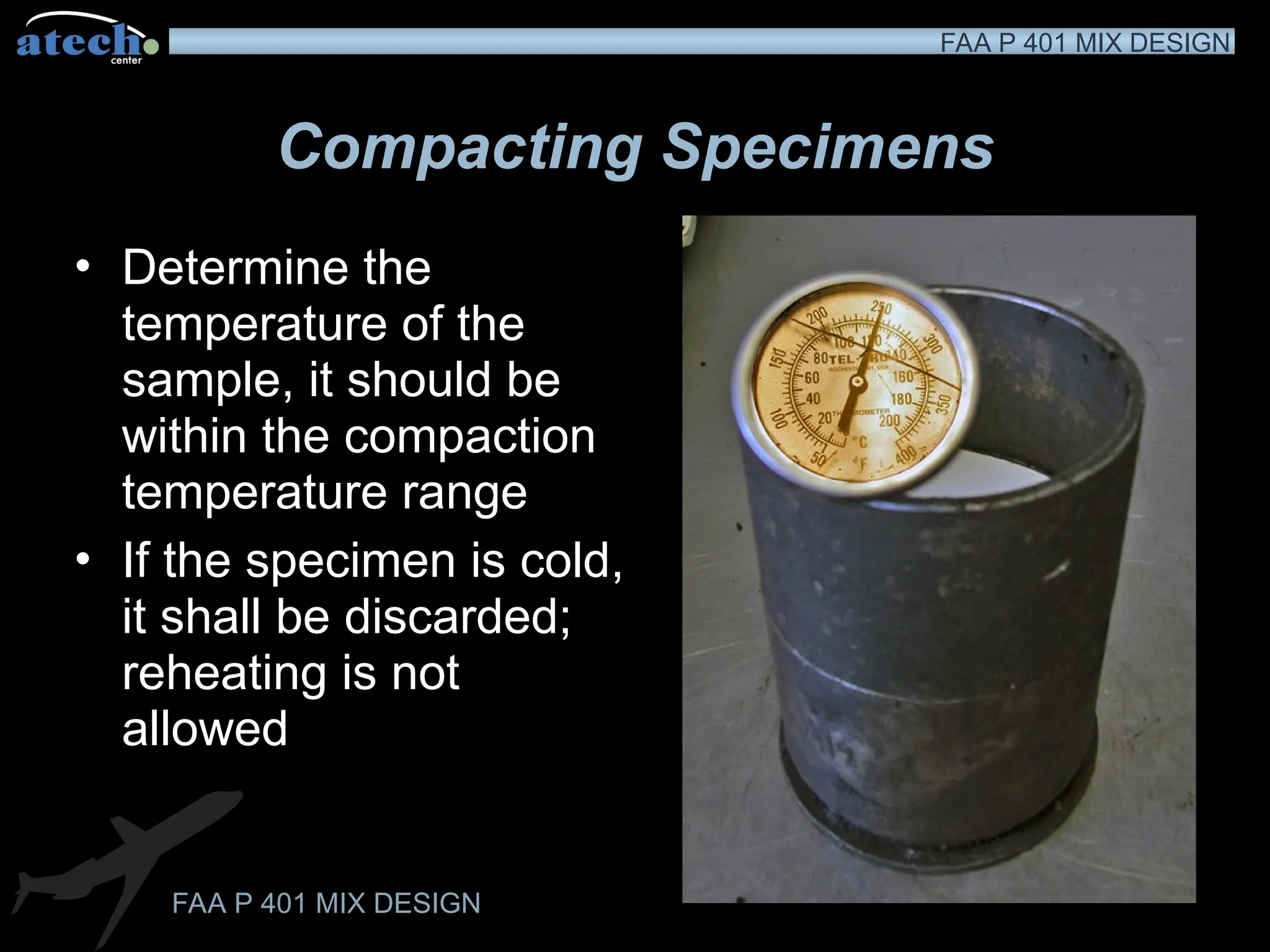
Compacting Specimens
• Determine the
temperature of the
sample, it should be
within the compaction
temperature range
• If the specimen is cold,
it shall be discarded;
reheating is not
allowed
FAA P 401 MIX DESIGN
Compacting Specimens
• Replace collar on mold, place
protection disk on top of
specimen
• Place hammer apparatus into
mold, apply appropriate
number of blows (50 or 75, as
indicated in contract
specifications)
• Turn specimen over to
compact the other side
FAA P 401 MIX DESIGN
Compacting Specimens
• When compaction
is completed,
remove specimen
from apparatus,
remove protection
disks, and allow it
to cool
FAA P 401 MIX DESIGN
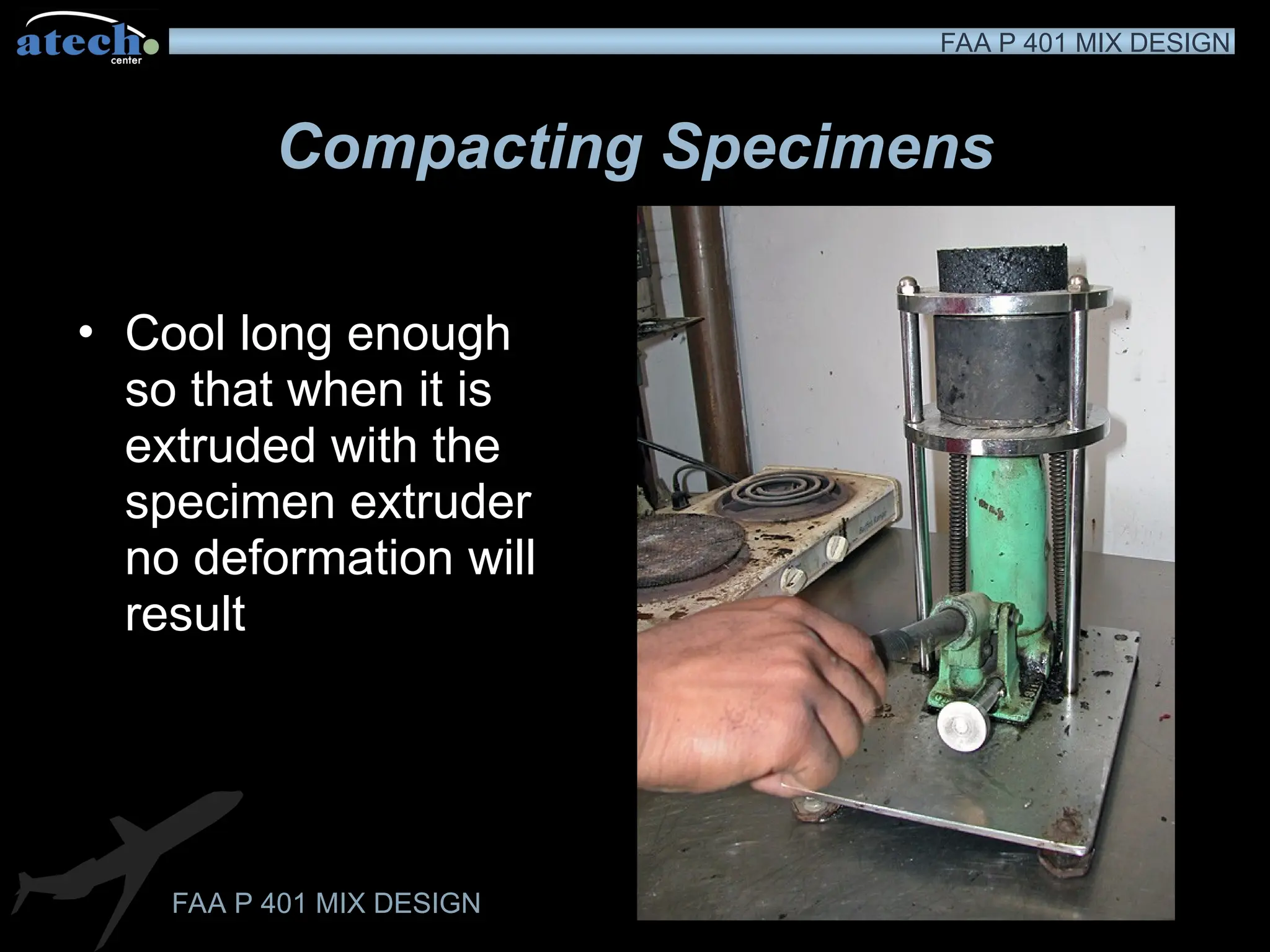
Compacting Specimens
• Cool long enough
so that when it is
extruded with the
specimen extruder
no deformation will
result
FAA P 401 MIX DESIGN
Test Procedure
• Each compacted specimen is subjected to a
bulk test, stability and flow test, and voids
analysis
• Two maximum theoretical specific gravity
samples are prepared and tested at each
asphalt content in order to determine the void
level of the bulk specimen
FAA P 401 MIX DESIGN
Bulk Test Equipment
• Balance, 2 kg. minimum capacity, sensitive to
0.1g, to enable bulk specific gravity samples to
be calculated to at least 4 significant figures
• Balance should be equipped with suspension
apparatus to permit weighing specimen in water
• Water bucket, suitable for weighing bulk
specimen (equipped with overflow outlet)
• Thermometers, for bulk test/rice test water
batch to verify 77˚F (25˚C)
FAA P 401 MIX DESIGN
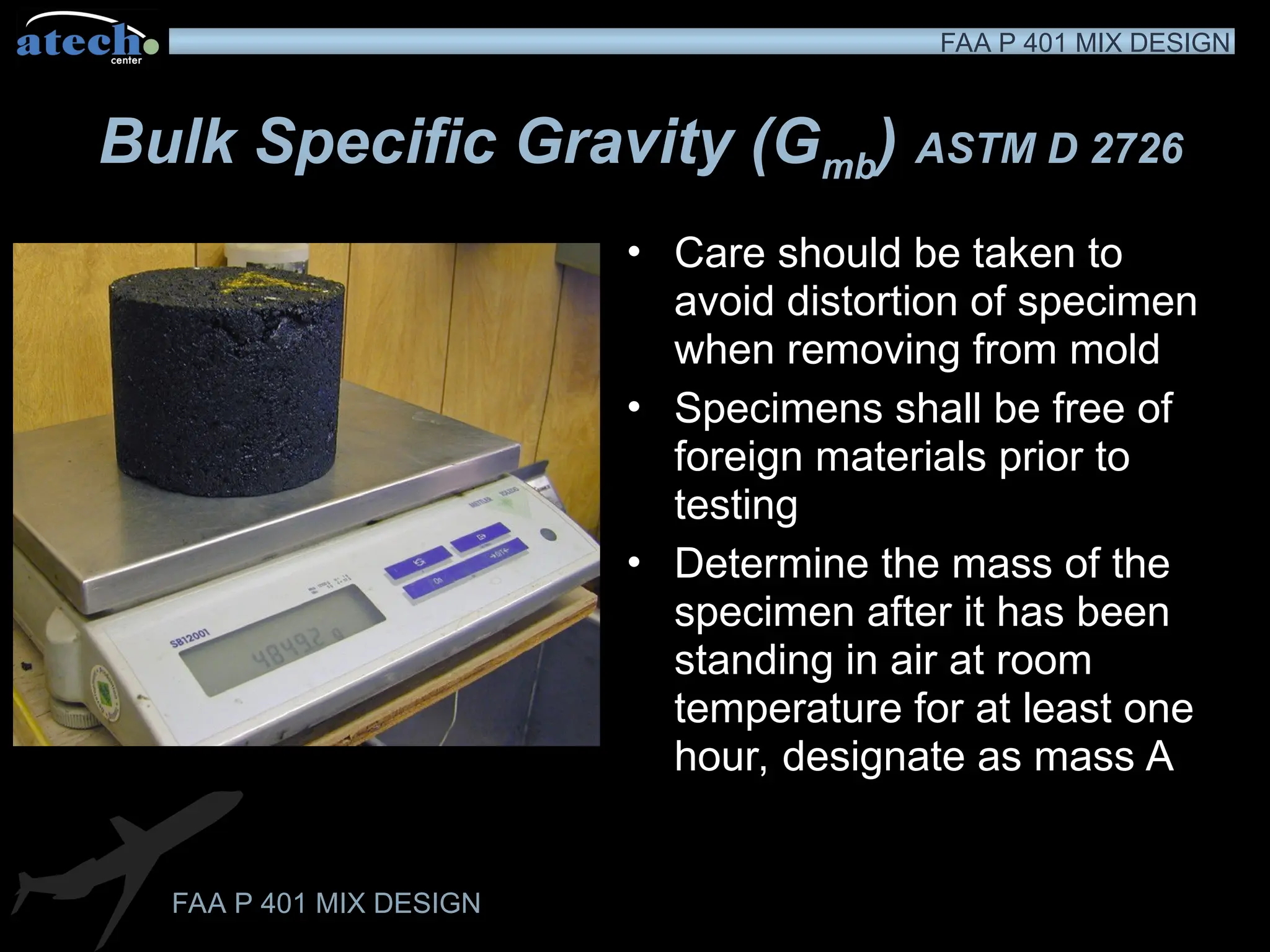
Bulk Specific Gravity (Gmb) ASTM D 2726
• Care should be taken to
avoid distortion of specimen
when removing from mold
• Specimens shall be free of
foreign materials prior to
testing
• Determine the mass of the
specimen after it has been
standing in air at room
temperature for at least one
hour, designate as mass A
ddd
FAA P 401 MIX DESIGN
Bulk Specific Gravity (Gmb) ASTM D 2726
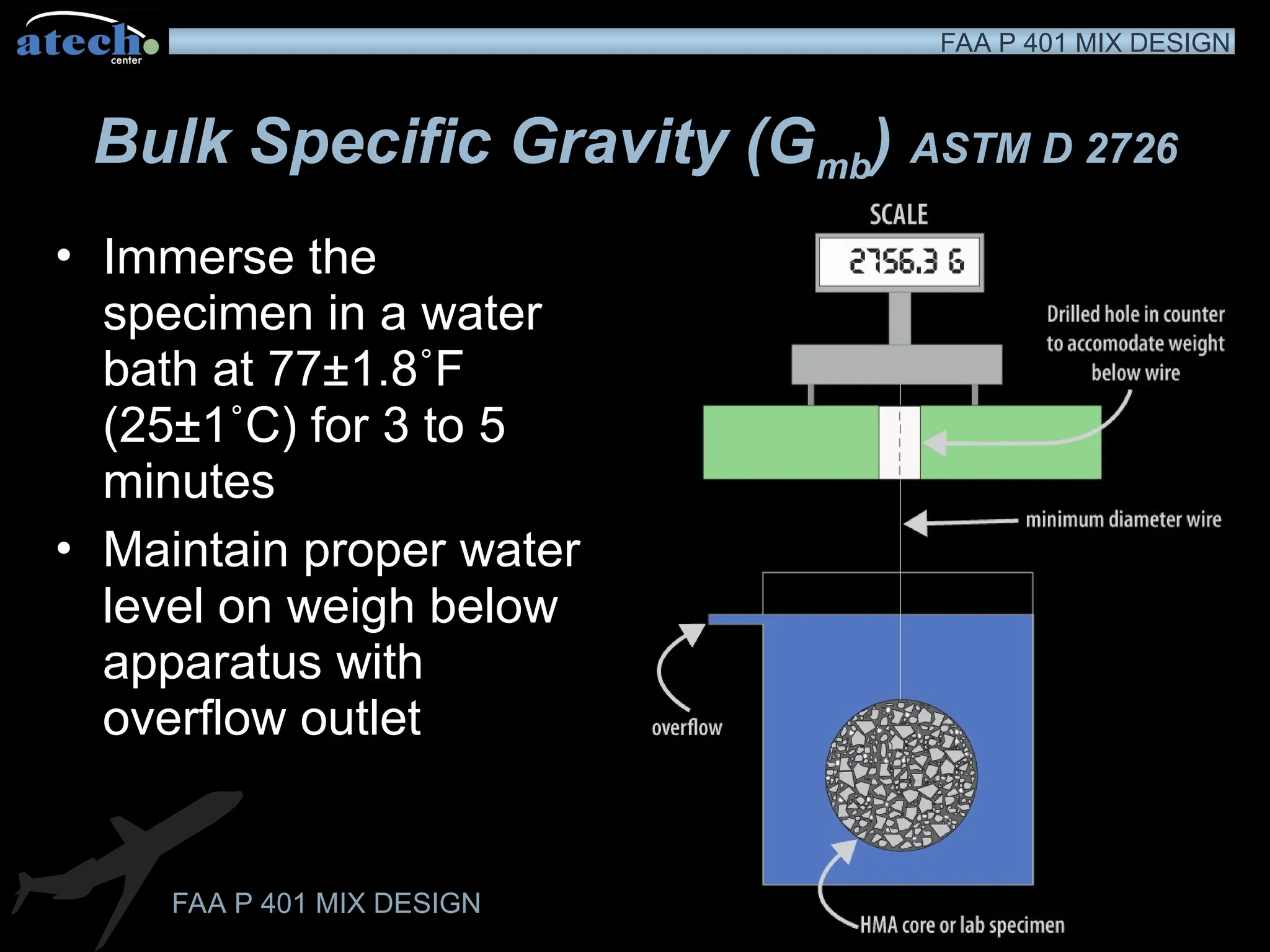
• Immerse the
specimen in a water
bath at 77±1.8˚F
(25±1˚C) for 3 to 5
minutes
• Maintain proper water
level on weigh below
apparatus with
overflow outlet
FAA P 401 MIX DESIGN
Bulk Specific Gravity (Gmb) ASTM D 2726
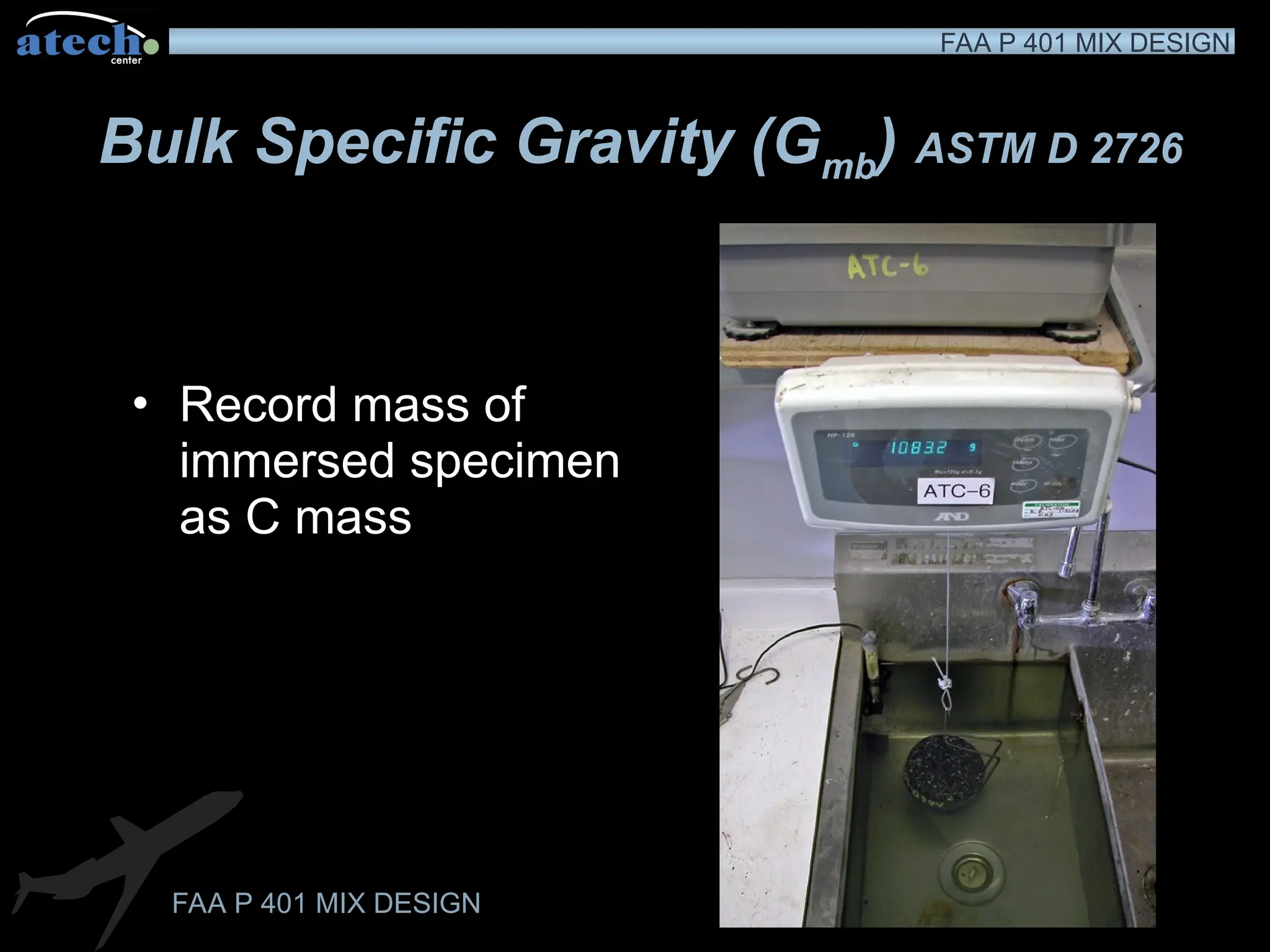
• Record mass of
immersed specimen
as C mass
FAA P 401 MIX DESIGN
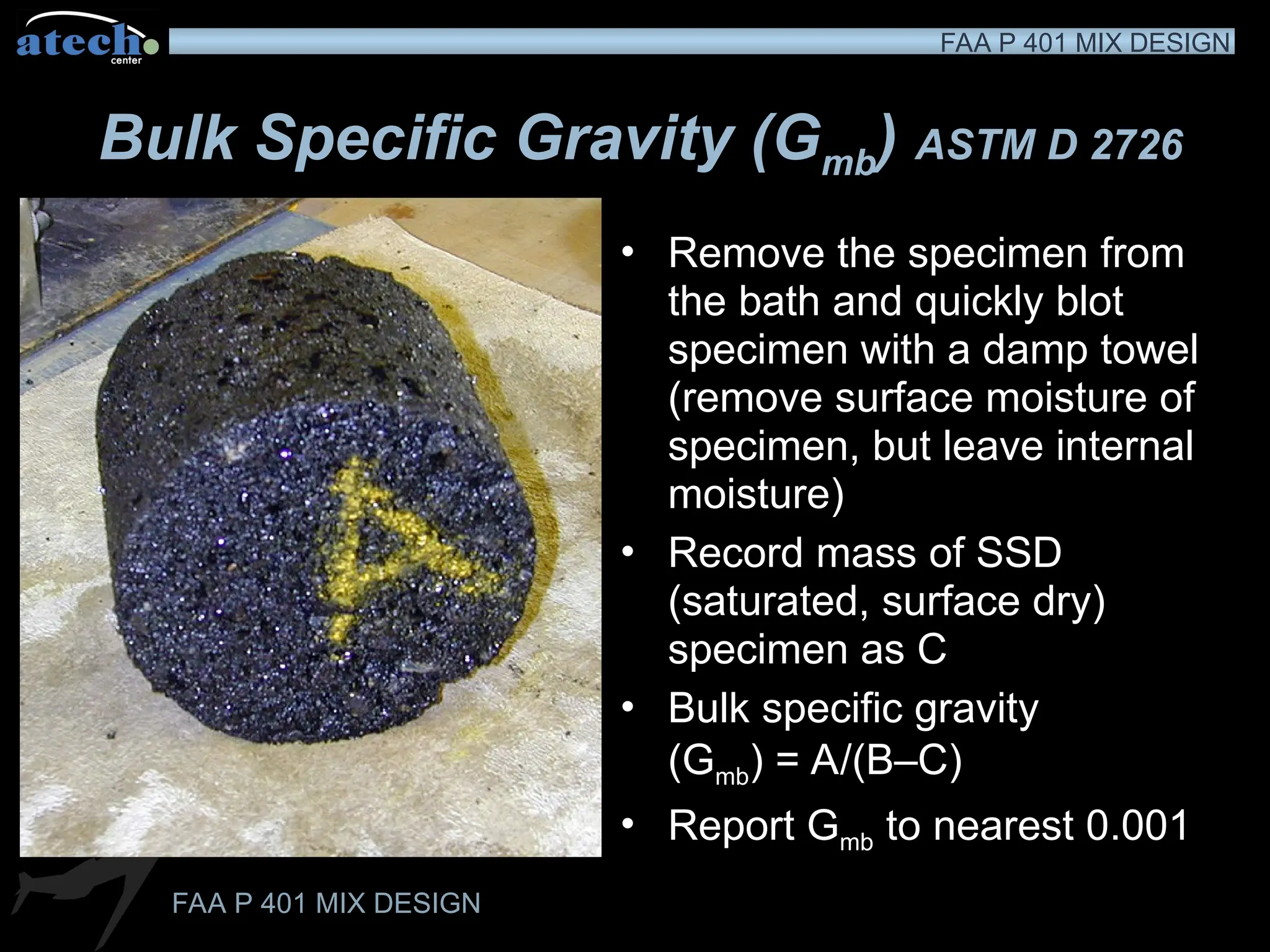
• Remove the specimen from
the bath and quickly blot
specimen with a damp towel
(remove surface moisture of
specimen, but leave internal
moisture)
• Record mass of SSD
(saturated, surface dry)
specimen as C
• Bulk specific gravity
(Gmb) = A/(B–C)
• Report Gmb to nearest 0.001
Bulk Specific Gravity (Gmb) ASTM D 2726
FAA P 401 MIX DESIGN
Stability & Flow Equipment
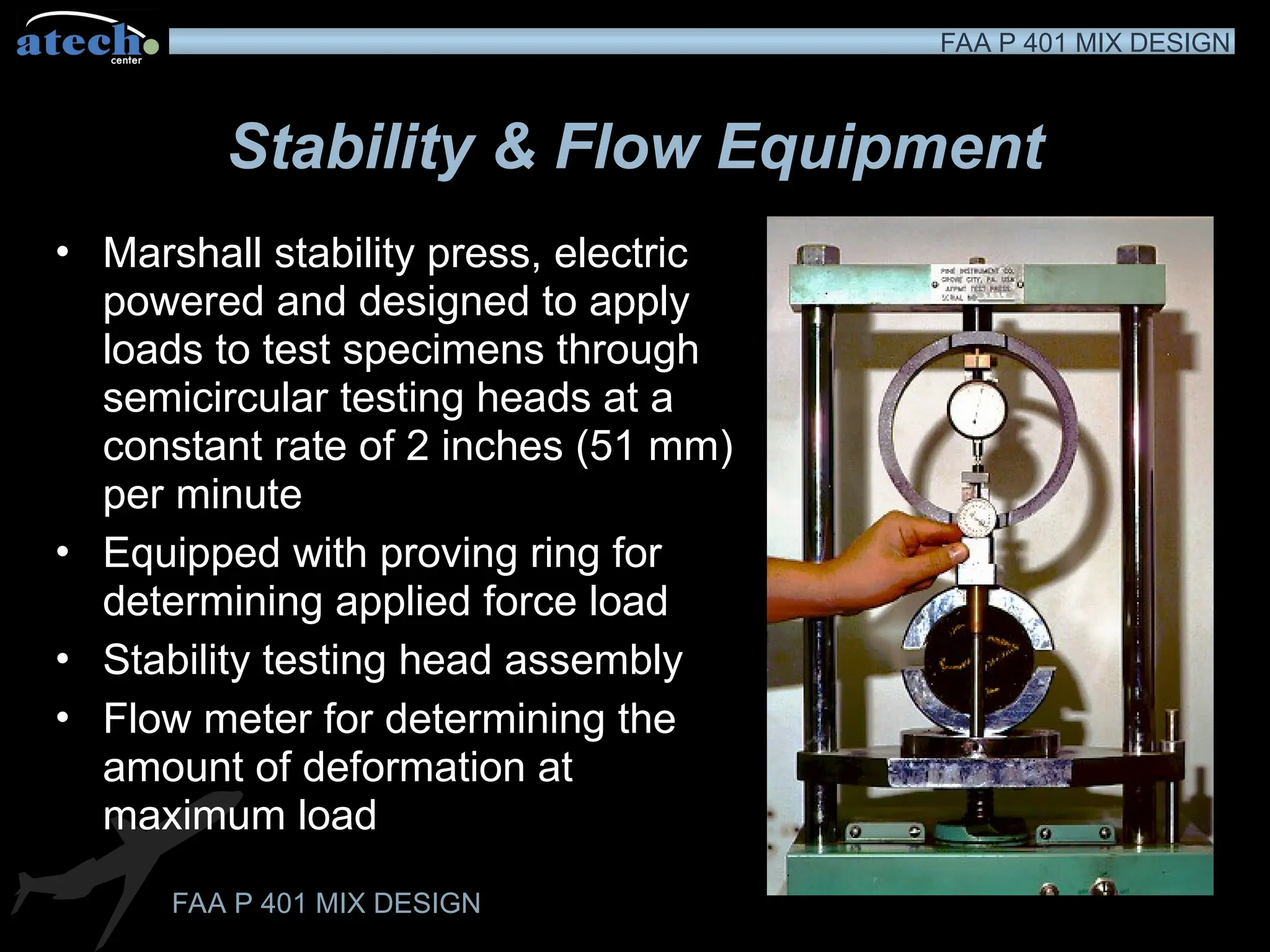
• Marshall stability press, electric
powered and designed to apply
loads to test specimens through
semicircular testing heads at a
constant rate of 2 inches (51 mm)
per minute
• Equipped with proving ring for
determining applied force load
• Stability testing head assembly
• Flow meter for determining the
amount of deformation at
maximum load
FAA P 401 MIX DESIGN
Stability & Flow Equipment
• Testing machine may have automatic plotting function
• Stability & Flow Equipment
– Water bath, at least 6 inches
deep and thermostatically
controlled to 140˚±1.8˚F
(60±1˚C), with perforated
false bottom 2 inches above
bath bottom
– Thermometers, for hot
stability bath with a range of
134-144˚F (57-62˚C)
FAA P 401 MIX DESIGN
Stability & Flow Testing
• Immerse the specimens in
water bath at 140±1.8˚F
(60±1˚C) for 30 to 40 minutes
prior to testing
• Clean inside surfaces of
testing heads, maintain
temperature of testing heads
at 70-100˚F (21-38˚C)
• Lubricate guide rods on testing
head so that they move freely
• Check that proving ring dial is
zeroed properly
• Check that flow meter is
zeroed properly
FAA P 401 MIX DESIGN
Stability & Flow Testing
• With everything in readiness, remove specimen
from hot bath, dry surface, and place on lower
testing head
• Make sure specimen is aligned and centered in
testing head properly
• Place upper testing head on specimen, fit entire
assembly into stability press
• Place flow meter on forward guide rod and adjust
to zero as necessary
FAA P 401 MIX DESIGN
Stability & Flow Testing
• Begin to apply load to
specimen at rate of 2
inches per minute
• Observe stability press
dial during loading, keep
flow meter in position
• Watch stability dial for
peak load and record
• The instant the stability
dial begins to decrease
remove the flow meter
from the guide rod
ddd
FAA P 401 MIX DESIGN
Stability & Flow Testing
• Record the flow reading
as a whole number, i.e.
15, but recall this means
that the deformation of
the specimen was 0.15
inches
• This specification
requires that the stability
and flow readings must
be obtained within 30
seconds after removal of
the specimen from the
hot water bath
FAA P 401 MIX DESIGN
Stability & Flow Testing
• If an automatic plot
was produced by the
device, record the peak
load and flow from the
peak of the curve
FAA P 401 MIX DESIGN
Stability & Flow Testing
• If a manual device was used, the stability dial
reading may need to be converted to a pounds of
force measurement based on a machine specific
conversion chart
• This measured stability may also need to be
corrected based on its height or volume
• The measured stability is multiplied by a correlation
ratio derived from the Stability Correlation Ratio
table in order to determine the corrected stability
FAA P 401 MIX DESIGN
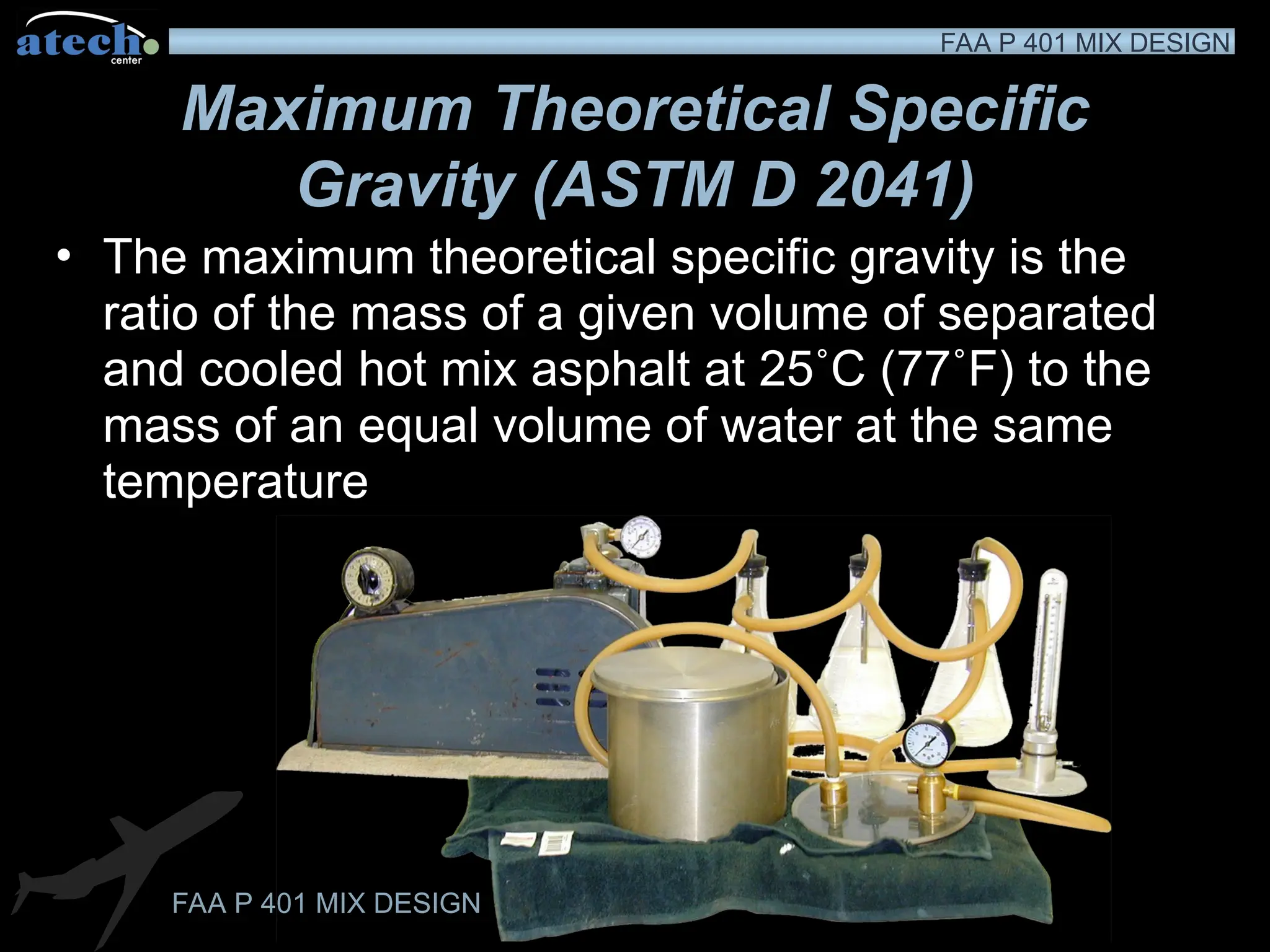
Maximum Theoretical Specific
Gravity (ASTM D 2041)
• The maximum theoretical specific gravity is the
ratio of the mass of a given volume of separated
and cooled hot mix asphalt at 25˚C (77˚F) to the
mass of an equal volume of water at the same
temperature
FAA P 401 MIX DESIGN
Maximum Theoretical Specific
Gravity (ASTM D 2041)
• The sample is subjected to a partial vacuum
(required to be 3.7 ± 0.3 kPa (25.5 to 30 mm Hg)
for 15±2 minutes) in order to remove the air
trapped between the particles of the sample
FAA P 401 MIX DESIGN
Maximum Theoretical Specific
Gravity (ASTM D 2041)
• This mass to volume measurement expresses the
density of the mixture as if it had no air voids.
• The maximum Specific Gravity (Gmm) is used in
conjunction with Bulk Specific Gravity (Gmb) to
determine Percent Air Voids (Pa) in compacted
bituminous materials
FAA P 401 MIX DESIGN
Density and Voids Analysis
• Average the bulk specific gravity values (Gmb) for
all test specimens of a given asphalt content
• Values obviously in error shall not be included in
the average (consult ASTM D 2726 for advice on
outliers)
• Determine the unit weight for each average Gmb by
multiplying the Gmb by 62.4 for pcf or 1000 for
kg/m3
FAA P 401 MIX DESIGN
Air Void (Pa) Calculation
• Air Voids (Pa) are determined
using the following formula:
• Pa = 100– [100(Gmb/Gmm)]
FAA P 401 MIX DESIGN
Air Void (Pa) Calculation
• Gmb = 2.334
• Gmm = 2.416
• Pa = 100 - [100(2.334/2.416)]
• Pa = 100 - (100 x 0.9661)
• Pa = 100 - 96.61
• Pa = 3.39
FAA P 401 MIX DESIGN
VMA (Voids in Mineral Aggregate)
Calculation
• VMA is determined using the
following formula:
VMA= 100 – [(GmbxPs)/Gsb]
FAA P 401 MIX DESIGN
VMA (Voids in Mineral Aggregate)
Calculation
• Gmb = 2.344
• Ps = 93.04
• Gsb = 2.651
• VMA = 100 - [(2.344 x 93.04)/2.651]
• VMA = 100 - (218.1/2.651)
• VMA = 100 - 82.26
• VMA = 17.74
FAA P 401 MIX DESIGN
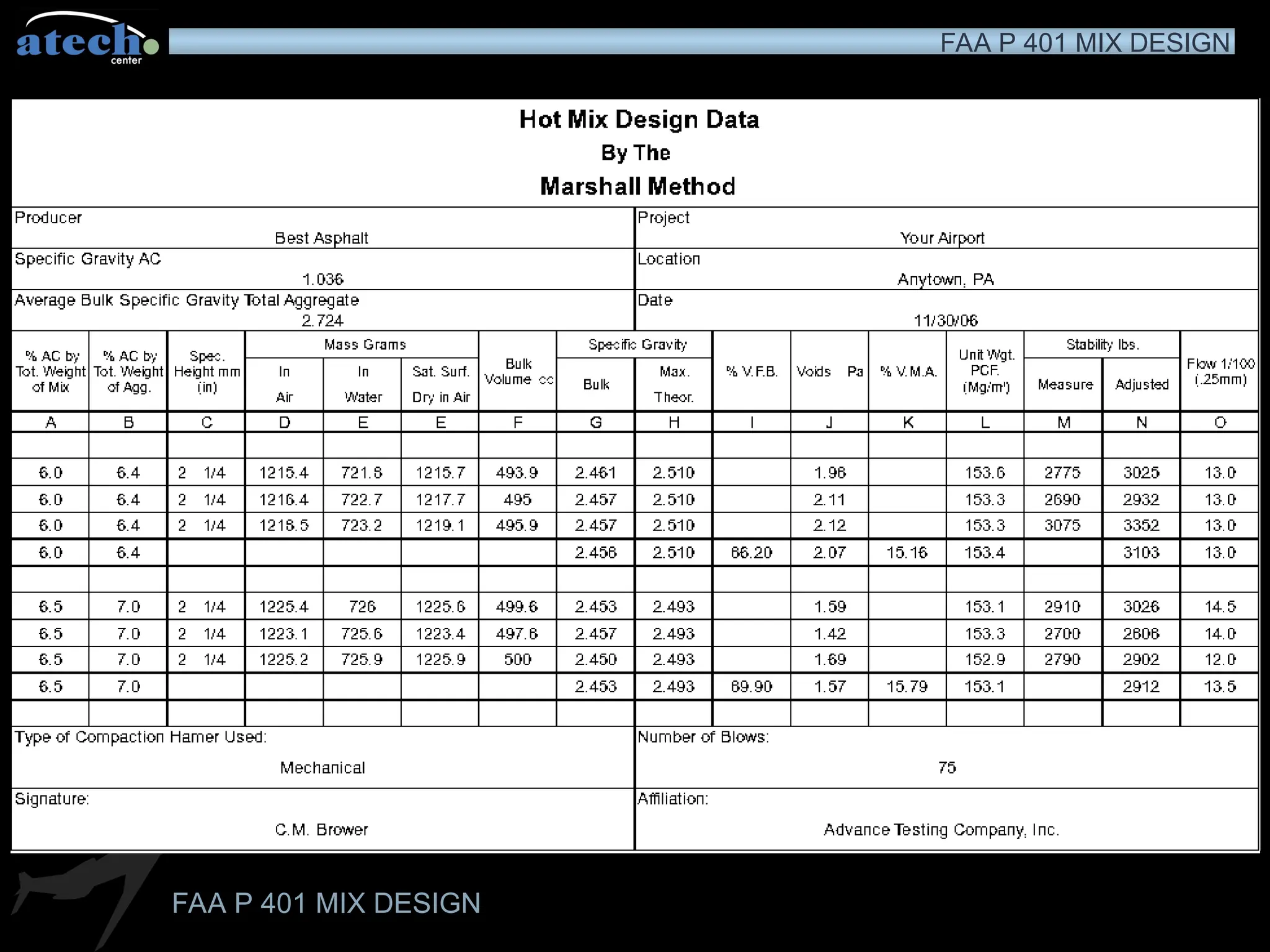
In In Sat. Surf. Max.
Air Water Dry in Air Theor.
A B C D E E' F G H I J K L M N O
5.0 5.3 2 1/4 1210.9 715.4 1213.4 498.0 2.432 2.547 4.52 151.7 2450 2548 10.0
5.0 5.3 2 1/4 1207.8 712.2 1209.3 497.1 2.430 2.547 4.59 151.6 2925 3042 11.0
5.0 5.3 2 1/4 1207.6 713.8 1209.9 496.1 2.434 2.547 4.41 151.9 2800 2912 10.0
5.0 5.3 2.432 2.547 70.40 4.50 15.19 151.7 2834 10.3
5.5 5.8 2 1/4 1212 718.8 1213.7 494.9 2.449 2.530 3.19 152.8 3010 3281 12.0
5.5 5.8 2 1/4 1210 717.4 1211.3 493.9 2.450 2.530 3.16 152.9 2725 2970 12.0
5.5 5.8 2 1/4 1210.6 717.3 1212.1 494.8 2.447 2.530 3.29 152.7 2590 2823 12.0
5.5 5.8 2.449 2.530 78.60 3.21 15.06 152.8 3025 12.0
Type of Compaction Hamer Used: Number of Blows:
Signature: Affiliation:
Mechanical 75
C.M. Brower Advance Testing Company, Inc.
Hot Mix Design Data
By The
Marshall Method
Specific Gravity Stability lbs.
Producer
Best Asphalt
Specific Gravity AC
1.036
Average Bulk Specific Gravity Total Aggregate Date
11/30/06
Location
Anytown, PA
Project
Your Airport
Bulk
Volume cc
Mass Grams
% V.F.B Voids Pa % V.M.A.
Unit Wgt.
PCF.
(Mg/m3
)
Flow 1/100
(.25mm)
Measure
2.724
Adjusted
% AC by
Tot. Weight
of Mix
% AC by
Tot. Weight
of Agg.
Spec.
Height mm
(in) Bulk
FAA P 401 MIX DESIGN
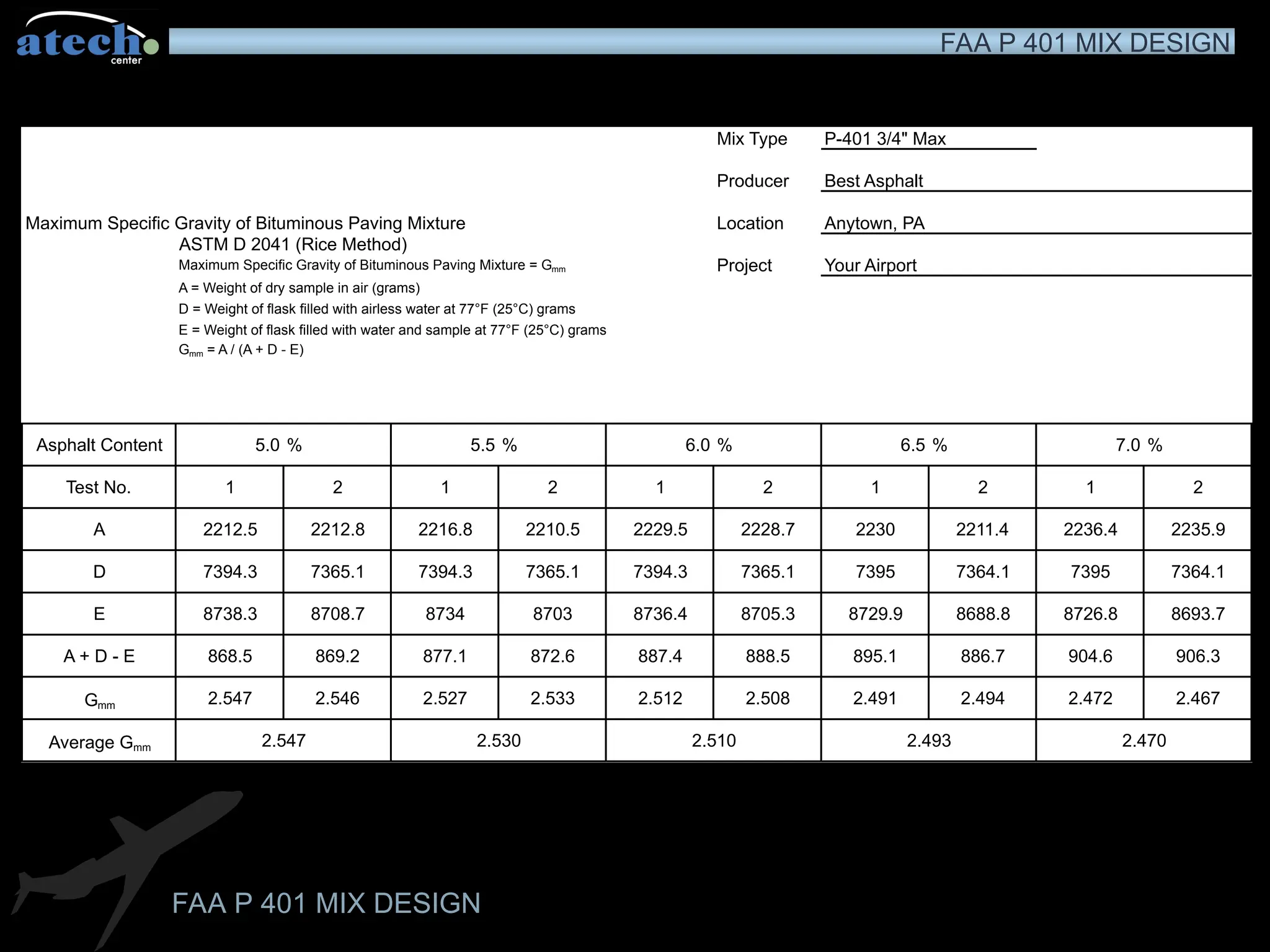
Mix Type P-401 3/4" Max
Producer Best Asphalt
Maximum Specific Gravity of Bituminous Paving Mixture Location Anytown, PA
ASTM D 2041 (Rice Method)
Maximum Specific Gravity of Bituminous Paving Mixture = Gmm Project Your Airport
A = Weight of dry sample in air (grams)
D = Weight of flask filled with airless water at 77°F (25°C) grams
E = Weight of flask filled with water and sample at 77°F (25°C) grams
Gmm = A / (A + D - E)
2.493 2.470
2.530 2.510
904.6 906.3
2.472 2.467
1 2
2236.4 2235.9
7395 7364.1
8726.8 8693.7
895.1 886.7
2.491 2.494
7395 7364.1
8729.9 8688.8
1 2
2230 2211.4
2.512 2.508
8736.4 8705.3
887.4 888.5
2229.5 2228.7
7394.3 7365.1
2.527 2.533
8734 8703
877.1 872.6
7365.1
2212.8
1 2
2216.8 2210.5
7394.3 7365.1
2.546
869.2
8708.7
2.547
A + D - E
Gmm
Average Gmm
2212.5
7394.3
8738.3
868.5
2.547
Test No.
A
D
E
6.5 % 7.0 %
%
1 2
%
1 2
Asphalt Content 5.5 % 6.0
5.0
FAA P 401 MIX DESIGN
Preparation of Graphs
• Create a graphical plot for each of the following:
– Stability (corrected) vs. Asphalt content
– Flow vs. Asphalt Content
– Unit weight vs. Asphalt Content
– Percent air voids vs. Asphalt Content
– Percent VMA vs. Asphalt Content
• For each plot connect the values with a smooth
curve that best fits all values
FAA P 401 MIX DESIGN
Test Property Aircraft Gross Weight
≥60,000 lbs
Aircraft Gross Weight
<60,000 lbs
Number of Blows 75 50
Stability, minimum
pounds (newtons)
2150 (9564) 1350 (6005)
Flow range, 0.01 in
(0.25 mm)
10-14 10-18
Air Voids, percent 2.8-4.2 2.8-4.2
Percent VMA,
minimum
Dependent on maximum particle size of HMA
mixture, see below
1/2 in (12.5 mm)
maximum size
16
3/4 in (19.0 mm)
maximum size
15
1 in (25.0 mm)
maximum size
14
1 1/4 in (31.25 mm)
maximum size
13
FAA P 401 MIX DESIGN
Analysis of Graphs
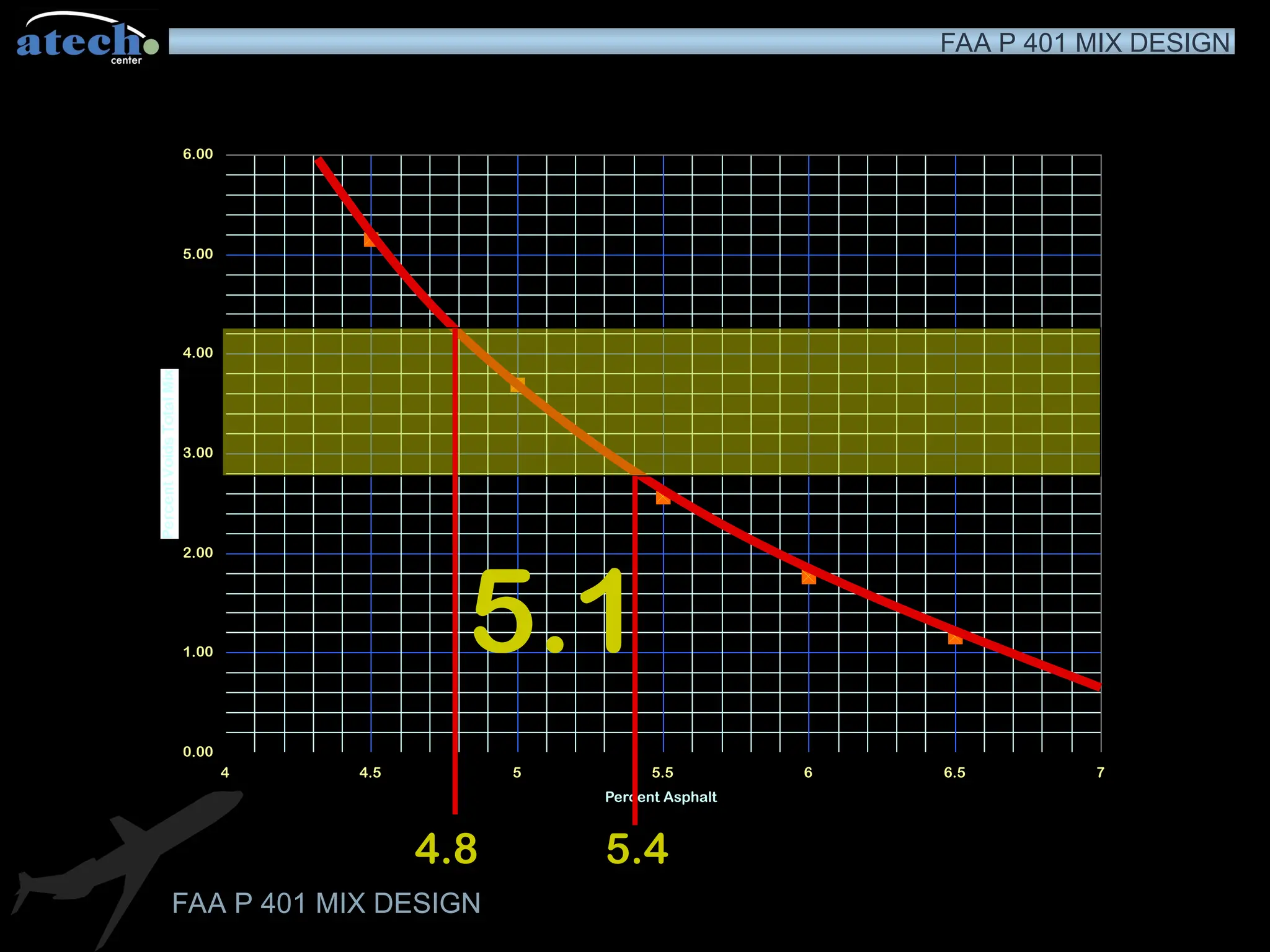
• Optimum asphalt content is determined as the
asphalt content that produces a void level in the
HMA at the mid point of the specified range (2.8 to
4.2 percent air)
• If the other plotted values do not meet the required
criteria, or are marginal, or if the mixture meets
parameters but is not compactable in the field, the
aggregate blend must be revised or a new source
of aggregates secured and a new JMF developed
FAA P 401 MIX DESIGN
0.00
1.00
2.00
3.00
4.00
5.00
6.00
4 4.5 5 5.5 6 6.5 7
Percent Asphalt
Percent Voids Total Mix
4.8 5.4
5.1
FAA P 401 MIX DESIGN
Verification of JMF
• When the selected optimum asphalt content does
not coincide with the asphalt content used in the
trial specimens, and additional set of specimens
shall be prepared
• The optimum asphalt content is added to the
specimens and they are tested as described to
verify the actual results duplicate those anticipated
from the curves
FAA P 401 MIX DESIGN
TSR (Tensile Strength Ratio)
• Once the optimum asphalt
content has been determined
and verified, samples need to
be prepared and tested for
moisture sensitivity and the
potential for stripping
• These tendencies can be
gauged using ASTM D 4867,
Standard Test for Effect of
Moisture on Asphalt Concrete
Paving Mixtures, other wise
known as the TSR (Tensile
Strength Ratio) test
FAA P 401 MIX DESIGN
TSR (Tensile Strength Ratio)
• This procedure subjects samples specially prepared at
specific void level, saturated with water under vacuum,
and “tortured” with some combination of hot water
exposure (140˚F for 24 hrs) and possibly freeze/thaw
cycles (see Note 5 in ASTM)
FAA P 401 MIX DESIGN
TSR (Tensile Strength Ratio)
• Using a set of specimens as
a control, the tortured
specimen’s ability to
withstand cracking in a
special TSR head used in
the stability press is
compared to the non-tortured
specimens
• This number (TSR) is
required by the FAA to be at
least 75% (that is, the
tortured specimens must
have at least 75% of the
tensile strength as the non-
tortured specimens)
FAA P 401 MIX DESIGN
TSR (Tensile Strength Ratio)
• In addition, the surface of the specimens is
examined for any evidence of asphalt cement
stripping from the surface of the aggregates
• If the mixture fails this procedure, anti-stripping
agent needs to be added to the mixture to produce
the desired result
FAA P 401 MIX DESIGN
Thank You for Your Attention !

federal aviation administration presentation 2008.ppt

  • 1.
    FAA P 401MIX DESIGN FAA Mix Design FAA Mix Design Based on Section 2, Design of Bituminous Paving Mixtures, Job Mix Formula Marshall Methods From the FAA’s Eastern Region Laboratory Procedures Manual (March 2003) Presented by James P. Smith Jr. President, Advance Testing
  • 2.
    FAA P 401MIX DESIGN FAA P 401 MIX DESIGN ddd Overview • Aggregate Pre-Qualification Testing • Volumetric Mix Design Procedures – Dry Batching Aggregates – Mixing Specimens – HMA Testing (Bulk, Rice, Stability & Flow) – Analysis of Marshall Curves – Anti-Stripping Test
  • 3.
    FAA P 401MIX DESIGN FAA P 401 MIX DESIGN Introduction • P 401 hot mix asphalt design used during airport construction • Mix Design Methodology: – Asphalt Institute MS-2, Mix Design Methods (Best Source) • Material requirements for the P 401 mixture will be listed in the contract specifications and are determined by the engineer • The JMF developed by the contractor is prepared on standard forms (Appendix A)
  • 4.
    FAA P 401MIX DESIGN FAA P 401 MIX DESIGN Summary of FAA Mix Design 1. Aggregates properties are tested (soundness, abrasion, crush count, liquid limit, plasticity index, sand equivalence) and must be acceptable in accordance with requirements 2. Aggregate blends are developed that fall within the general limits established, blends are plotted on a power 0.45 curve 3. Batches of the proposed aggregate blend are prepared, three to five specimens are used for each asphalt content for bulk analysis, another two need to be batched for maximum theoretical specific gravity analysis
  • 5.
    FAA P 401MIX DESIGN FAA P 401 MIX DESIGN Summary of FAA Mix Design 4. 5 asphalt contents will be prepared, each differing by 0.5%, with the intention of bridging the optimum asphalt content 5. Bulk specific gravity and maximum theoretical specific gravities are measured for each asphalt content, volumetric properties are derived through calculation 6. Stability and flow properties are tested and measured
  • 6.
    FAA P 401MIX DESIGN FAA P 401 MIX DESIGN Summary of FAA Mix Design 7. Volumetric properties and stability and flow measurements are plotted against asphalt content 8. Optimum asphalt content is chosen from plots and verified with additional batches 9. TSR testing is performed at the optimum asphalt content
  • 7.
    FAA P 401MIX DESIGN FAA P 401 MIX DESIGN DATE AIP PROJECT NO. AIRPORT NAME AND LOCATION CONTRACTOR NAME AND LOCATION NAME AND LOCATION TYPE CAPACITY SPECIFICATIONS P401 3/4" Max NAME LOCATION Your Airport Anytown, PA Advance Testing Company Campbell Hall, NY CMI Drum Mix 350 Tons/Hour Project No. 58-263 PREPARED BY JOB MIX FORMULA BITUMINOUS PLANT 11/30/06 Best Asphalt Anytown, PA Best Construction Anytown, PA
  • 8.
    FAA P 401MIX DESIGN FAA P 401 MIX DESIGN
  • 9.
    FAA P 401MIX DESIGN FAA P 401 MIX DESIGN
  • 10.
    FAA P 401MIX DESIGN FAA P 401 MIX DESIGN
  • 11.
    FAA P 401MIX DESIGN FAA P 401 MIX DESIGN
  • 12.
    FAA P 401MIX DESIGN FAA P 401 MIX DESIGN
  • 13.
    FAA P 401MIX DESIGN FAA P 401 MIX DESIGN
  • 14.
    FAA P 401MIX DESIGN FAA P 401 MIX DESIGN
  • 15.
    FAA P 401MIX DESIGN FAA P 401 MIX DESIGN
  • 16.
    FAA P 401MIX DESIGN FAA P 401 MIX DESIGN Producer: Tilcon Conn. Inc. Project: Groton Airport Spec.: P-401 3/4" MAX Date: Center Voids Spec. 3.5 Advance Testing Company, Inc. Producers Analysis of Materials and Job Mix Formula Test Property Curves 11/30/06 150 151 152 153 154 155 156 4.5 5 5.5 6 6.5 7 7.5 Percent Asphalt Unit Wt. (lbs./cu. ft.) 0.00 1.00 2.00 3.00 4.00 5.00 4.5 5 5.5 6 6.5 7 7.5 Percent Asphalt Percent Voids Total Mix 2000.00 2200.00 2400.00 2600.00 2800.00 3000.00 3200.00 4.5 5 5.5 6 6.5 7 7.5 Percent Asphalt Stability (lbs.) 50.00 60.00 70.00 80.00 90.00 100.00 4.5 5 5.5 6 6.5 7 7.5 Percent Asphalt Percent Voids Filled 0.00 5.00 10.00 15.00 20.00 4.5 5 5.5 6 6.5 7 7.5 Percent Asphalt Flow (1/100 inches) 14.00 14.50 15.00 15.50 16.00 4.5 5 5.5 6 6.5 7 7.5 Percent Asphalt Percent Voids in Mineral Aggregate
  • 17.
    FAA P 401MIX DESIGN FAA P 401 MIX DESIGN
  • 18.
    FAA P 401MIX DESIGN FAA P 401 MIX DESIGN
  • 19.
    FAA P 401MIX DESIGN FAA P 401 MIX DESIGN
  • 20.
    FAA P 401MIX DESIGN FAA P 401 MIX DESIGN Preliminary Procedures • Aggregate properties determined as per Appendix A • JMF is developed using either plant bins or stockpiles (hot bins are highly recommended at a batch plant)
  • 21.
    FAA P 401MIX DESIGN FAA P 401 MIX DESIGN Producer: Best Asphalt Spec.: Project: Your Airport Date: % 28 % 18 % 24 % 18 % 12 % % Pass % Batch % Pass % Batch % Pass % Batch % Pass % Batch % Pass % Batch % Pass % Batch Min Max Min Max 1 1/4" 100 28.0 100 18.0 100 24.0 100 18.0 100 12.0 100.0 100.0 1" 100 28.0 100 18.0 100 24.0 100 18.0 100 12.0 100.0 100.0 3/4" 100 28.0 100 18.0 100 24.0 100 18.0 100 12.0 100.0 100 100.0 1/2" 78.2 21.9 100 18.0 100 24.0 100 18.0 100 12.0 93.9 79 99 93.9 3/8" 18.3 5.1 94.2 17.0 100 24.0 100 18.0 100 12.0 76.1 68 88 76.1 #4 1.9 0.5 22 4.0 97 23.3 98.3 17.7 95.9 11.5 57.0 48 68 57.0 #8 1.5 0.4 4.9 0.9 72.5 17.4 73.4 13.2 88.3 10.6 42.5 33 53 42.5 #16 3 0.5 49.7 11.9 51.3 9.2 77.7 9.3 31.0 20 40 31.0 #30 34.3 8.2 38.2 6.9 59.6 7.2 22.3 14 30 22.3 #50 22.2 5.3 29 5.2 26.6 3.2 13.7 9 21 13.7 #100 12.3 3.0 21.9 3.9 7.1 0.9 7.7 6 16 7.7 #200 5.7 1.4 15.9 2.9 2.8 0.3 4.6 3 6 4.6 Notes: The materials reported above were sampled from the hot bins XXX Yes No Signed: C.M. Brower Affiliation: Advance Testing Company, Inc. 5 30 Cold Feed 20 25 15 10 1 2 3 Job Mix Formula Gradation Bin No. Setting Project Specifications General Specifications 11/30/06 P-401 3/4" Max Natural Sand Screenings 1/2 " Stone Sieve Size Bin No. 6 Bin No. 5 4 Stone Sand 3/8" Stone JMF. Gradation Bin No. 4 Bin No. 3 Bin No. 2 Bin No. 1
  • 22.
    FAA P 401MIX DESIGN FAA P 401 MIX DESIGN Wear-Abrasion (ASTM C 131) • Measures the resistance to wearing as aggregate is subjected to impact and grinding • Ensures that aggregate will not wear excessively during shipment and production • Standard graded aggregate is subjected to impact and grinding by steel spheres inside a hollow steel chamber
  • 23.
    FAA P 401MIX DESIGN FAA P 401 MIX DESIGN Wear-Abrasion (ASTM C 131) • A small shelf lifts the aggregate and steel spheres and as the chamber rotates, creating the impact • The wear value is a measurement of the percent of loss (by mass) of the sample after it has been subjected to a specified number of revolutions in the chamber
  • 24.
    FAA P 401MIX DESIGN FAA P 401 MIX DESIGN Wear-Abrasion (ASTM C 131) • This loss is measured over the 1.7 mm (#12) sieve • Appendix A stipulates maximum 40% wear for surface courses maximum 50% wear for base courses
  • 25.
    FAA P 401MIX DESIGN FAA P 401 MIX DESIGN Soundness (ASTM C 88) • The soundness test subjects aggregate particles to alternating cycles of soaking in a salt solution (either sodium or magnesium sulfate) and drying in an oven regulated at 110±5˚C (230±9˚F) • Salts permeate the voids of the aggregate during soaking and expand during drying, simulating the expansive pressures of water
  • 26.
    FAA P 401MIX DESIGN FAA P 401 MIX DESIGN Soundness (ASTM C 88) • The soundness value is also a measure of loss of particles after the sample has been subjected to a specified number of soaking and drying cycles • Appendix A stipulates the maximum loss as 10% for sodium sulfate tests and 13% for magnesium sulfate tests
  • 27.
    FAA P 401MIX DESIGN FAA P 401 MIX DESIGN Flat & Elongated (ASTM D 4791) • Flat and elongated particles in an aggregate are measured using a proportional caliper device set to the appropriate ratios required by the agency • Flat AND elongated test: length to thickness is compared
  • 28.
    FAA P 401MIX DESIGN FAA P 401 MIX DESIGN Flat & Elongated (ASTM D 4791) • Flat & Elongated (ASTM D 4791) – Flat or elongated particles in an HMA mixture may degrade more quickly than non flat or elongated particles, thereby reducing the durability of the pavement – Appendix A limits the amount of these particles in the coarse aggregate to no more than 8% at a 5:1 ratio and no more than 20% at a 3:1 ratio
  • 29.
    FAA P 401MIX DESIGN FAA P 401 MIX DESIGN Crushed Pieces • In order to produce pavements that are resistant to deformation, it helps to use angular aggregate particles • Angular aggregates tend to interlock and resist deformation even after repeated loading • The crushed pieces requirement in Appendix A is meant to ensure the aggregate angularity is maintained
  • 30.
    FAA P 401MIX DESIGN FAA P 401 MIX DESIGN Crushed Pieces • FAA Eastern Region Lab Procedures indicate that a fractured face “shall be equal to at least 75% of the smallest mid-sectional area of the piece” • When two fractured faces are contiguous, the angle between the planes of fractures shall be at least 30 degrees to count as two fractured faces • Fractured faces shall be obtained by crushing
  • 31.
    FAA P 401MIX DESIGN FAA P 401 MIX DESIGN Crushed Pieces • Requirements for crushed pieces in coarse aggregate are dependent upon anticipated loading of pavement Aircraft Gross Weight One Fractured Face Two Fractured Faces < 27,200 kg (60,000 lbs) 65 50 27,200 kg ≥ (60,000 lbs) 85 70
  • 32.
    FAA P 401MIX DESIGN FAA P 401 MIX DESIGN Slag Density (ASTM C 29) • The use of air cooled blast furnace slag as an aggregate item (where available and when desired) may be allowed
  • 33.
    FAA P 401MIX DESIGN FAA P 401 MIX DESIGN Liquid Limit (ASTM D 4318) • The liquid limit test measures the water content of a material at the point it passes from a solid to a liquid state • This test is used in conjunction with the plastic limit test to determine the plasticity index
  • 34.
    FAA P 401MIX DESIGN FAA P 401 MIX DESIGN Plasticity Index (ASTM D 4318) • The plasticity index is a measure of the range of moisture contents that a sample will act in a plastic fashion but not in a liquid fashion • Generally used with cohesive soils, this procedure is used on fine aggregates proposed for use in HMA to ensure that they exhibit minimal plasticity
  • 35.
    FAA P 401MIX DESIGN FAA P 401 MIX DESIGN Plasticity Index (ASTM D 4318) • A fine aggregate with plasticity index of greater than 6 would indicate an aggregate with an excessive amount of cohesive fines • These cohesive fines might weaken the bond between the liquid binder and the aggregate particles, decreasing the durability of the HMA mixture • When mineral filler is used in the HMA mixture, a plasticity test is also required
  • 36.
    FAA P 401MIX DESIGN FAA P 401 MIX DESIGN Sand Equivalent (ASTM D 2419) • The sand equivalent value is a measure of the relative amount of fines in the fine aggregate sample • This is performed by placing the fines in suspension in a solution of calcium chloride above the sand
  • 37.
    FAA P 401MIX DESIGN FAA P 401 MIX DESIGN Sand Equivalent (ASTM D 2419) • The sand equivalent value itself is an expression of the sand reading in terms of the clay reading • Higher sand equivalent values therefore mean less clay like fines • Appendix A requires at least 45% for sand equivalent
  • 38.
    FAA P 401MIX DESIGN FAA P 401 MIX DESIGN Specific Gravity of Coarse Aggregates (ASTM C 127) • Specific gravity of coarse aggregate is performed in the lab on samples that have soaked for 24±4 hours in water at room temperature • Of particular interest to the HMA designer is the measurement of the stone’s bulk specific gravity, Gsb
  • 39.
    FAA P 401MIX DESIGN FAA P 401 MIX DESIGN Bulk Specific Gravity of Coarse Aggregates (ASTM C 127) • The bulk specific gravity uses the bulk volume of the aggregate particle, which includes the volume of pore space within the particle occupied by water • This requires that the mass of the particles used for the volumetric measurement is determined in an SSD (saturated, surface dry) condition
  • 40.
    FAA P 401MIX DESIGN FAA P 401 MIX DESIGN Specific Gravity of Fine Aggregates (ASTM C 128) • The specific gravity of the fine aggregate needs to be determined as well • This method uses a glass pycnometer of a known volume to determine the water displaced by the sample
  • 41.
    FAA P 401MIX DESIGN FAA P 401 MIX DESIGN Specific Gravity of Fine Aggregates (ASTM C 128) • The bulk specific gravity (Gsb) of the fine aggregate is also measured at an SSD condition • The SSD condition of the sand is often discerned using an inverted cone with a tamper
  • 42.
    FAA P 401MIX DESIGN FAA P 401 MIX DESIGN Combined Bulk Specific Gravity • The bulk gravities of the combined aggregates in the mixture have a significant effect on the overall density of the mixture • The combined bulk gravity of all constituents, based on their percentage in the blend, is used to calculate VMA (Voids in Mineral Aggregate) ddd
  • 43.
    FAA P 401MIX DESIGN FAA P 401 MIX DESIGN Aggregate Gradation Requirements • Proposed combined gradation (particle distribution) is plotted on a 0.45 power gradation chart • Grading curve must closely parallel the curves for the upper and lower JMF limits • Grading curve should display no abrupt changes
  • 44.
    FAA P 401MIX DESIGN FAA P 401 MIX DESIGN ddd
  • 45.
    FAA P 401MIX DESIGN FAA P 401 MIX DESIGN Volumetric Mix Design Overview • Must prepare lab specimens for bulk analysis (Gmb)and loose mix samples for theoretical density (Gmm) over a range of asphalt contents for testing • Minimum of three bulk specimens per asphalt content (4 recommended) • Typically five or six different asphalt contents (separated by 1/2 %) are used • Design must display two asphalt contents above “optimum”, and two below optimum
  • 46.
    FAA P 401MIX DESIGN FAA P 401 MIX DESIGN Volumetric Mix Design Overview • Test results on each of the blends are plotted graphically to show physical properties • Optimum asphalt content is selected from graphical representations of test data • Mix properties plotted against asphalt content as part of volumetric mix design method 154 155 156 157 158 159 3.5 4.5 5.5 6.5 Percent Asphalt 0.00 1.00 2.00 3.00 4.00 5.00 6.00 7.00 3.5 4.5 5.5 6.5 Percent Asphalt 2500.00 2700.00 2900.00 3100.00 3300.00 3500.00 3700.00 3900.00 3.5 4.5 5.5 6.5 Percent Asphalt 0.00 20.00 40.00 60.00 80.00 100.00 3.5 4.5 5.5 6.5 Percent Asphalt 5.00 7.00 9.00 11.00 13.00 15.00 3.5 4.5 5.5 6.5 Percent Asphalt 14.00 14.50 15.00 15.50 16.00 3.5 4.5 5.5 6.5 Percent Asphalt
  • 47.
    FAA P 401MIX DESIGN FAA P 401 MIX DESIGN Mixing Equipment • Pans, metal, flat bottom for the heating of test specimens • Oven and hot plate for heating asphalt and aggregate to required temperatures
  • 48.
    FAA P 401MIX DESIGN FAA P 401 MIX DESIGN Mixing Equipment • Mixing bowl, round, approx. 4 liter capacity for mixing asphalt & aggregate • Scoop, for batching aggregates
  • 49.
    FAA P 401MIX DESIGN FAA P 401 MIX DESIGN Mixing Equipment • Container for heating asphalt (hopper with control valve recommended) • Thermometers, armored glass, or metal stem (50 to 450˚ F with sensitivity of 5.0˚ F) for determining temperature of aggregate, asphalt, and asphalt mixture • Balance, 4.5Kg capacity, sensitive to 0.5g for weighing aggregates and asphalt
  • 50.
    FAA P 401MIX DESIGN FAA P 401 MIX DESIGN Mixing Equipment • Mixing spoons, spatulas, and rodding implement • Mechanical shaker for sieves • Large spatula for spading and hand mixing • Mixing apparatus, mechanical recommended, commercial bread dough mixer with 4 liter (4 quart) capacity or larger with two metal mixing bowls and two wire stirrers
  • 51.
    FAA P 401MIX DESIGN FAA P 401 MIX DESIGN Compaction Pedestal • 8” x 8” x 8” wooden post capped with a 12” x 12” x 1” steel plate • Wooden post: oak, yellow pine, or other wood with dry unit weight of 42 to 48 pcf • Wooden post secured by four angle brackets to a solid concrete slab • Steel plate firmly fastened to post (no movement at all) • Pedestal installed level, post is plumb, and no movement during compaction process
  • 52.
    FAA P 401MIX DESIGN FAA P 401 MIX DESIGN Compaction Mold • Base plate, forming mold, and collar • Forming mold has inside diameter of 4 inches and height of 3 inches
  • 53.
    FAA P 401MIX DESIGN FAA P 401 MIX DESIGN Compaction Hammer • Flat circular tamping face, 3 7/8 inches (98.4mm diameter) • 10 lb (4.5 kg) weight • 18” (457 mm) drop of hammer onto specimen • Spring tension device to hold compaction mold in place on compaction pedestal
  • 54.
    FAA P 401MIX DESIGN FAA P 401 MIX DESIGN Equipment • Extrusion jack, for extruding compacted specimen from mold • Gloves, insulated, for handling hot equipment • Marking crayons for labeling specimens
  • 55.
    FAA P 401MIX DESIGN FAA P 401 MIX DESIGN Aggregate Batching • Prepare at least 3 but no more than 5 batches for each asphalt content • Aggregates in batches shall be dried to constant mass at 221 to 230˚F (105 to 110˚C) and separated by dry-sieving into the desired fractions • Aggregate batches consist of the proposed blend of aggregates to be used in the HMA
  • 56.
    FAA P 401MIX DESIGN FAA P 401 MIX DESIGN Aggregate Batching • Each particle size for each aggregate constituent is placed into each batch • The size of the batches (around 1200 g) is intended (when mixed with the liquid binder) to produce bulk specimens that are 2.5±0.5 inches in height
  • 57.
    FAA P 401MIX DESIGN FAA P 401 MIX DESIGN Material Heating • Aggregate is placed into an oven regulated 50˚F (20˚C) higher than the mixing temperature • Liquid binder should be heated to the mixing temperature (not more than 1 hour prior to mixing) and covered • Mixing should not begin until the aggregate and liquid binder have stabilized at the appropriate temperature
  • 58.
    FAA P 401MIX DESIGN FAA P 401 MIX DESIGN Mixing & Compaction Temperatures • Mixing and compaction temperatures determined by the temperature viscosity chart • Mixing temperature is defined as that range of temperatures that produces a viscosity of 0.17±0.02 kPa (170±20 centistokes) in the liquid binder (asphalt cement) • Compaction temperature is defined as that range of temperatures that produces a viscosity of 0.28±0.03 kPa (280±30 centistokes) in the liquid binder (asphalt cement)
  • 59.
    FAA P 401MIX DESIGN FAA P 401 MIX DESIGN Temperature/Viscosity Chart
  • 60.
    FAA P 401MIX DESIGN FAA P 401 MIX DESIGN Preparation of Molds/Hammer • Thoroughly clean the specimen mold assembly and the face of the compaction hammer • Heat them on a hot plate (or in boiling water) to a temperature between 200– 300˚F (93-149˚C) • Use a protection disk in the bottom of each mold prior to charging the mold with HMA
  • 61.
    FAA P 401MIX DESIGN FAA P 401 MIX DESIGN Mixing HMA • Keep all materials up to temperature as much as possible • A hot plate may be used to keep the mixing bowl warm, however heat should be baffled to prevent localized overheating • Charge heated bowl with aggregates, dry mix thoroughly
  • 62.
    FAA P 401MIX DESIGN FAA P 401 MIX DESIGN Mixing HMA • Form a crater in the dry aggregate • Weigh out the appropriate mass of liquid binder (asphalt cement) into the batch in accordance with accumulated batch weights • Mix HMA with mechanical mixer or by hand as quickly and thoroughly as possible • Mix HMA so that liquid binder coverage is uniform
  • 63.
    FAA P 401MIX DESIGN FAA P 401 MIX DESIGN Compacting Specimens • Charge the specimen mold with the mixture
  • 64.
    FAA P 401MIX DESIGN FAA P 401 MIX DESIGN Compacting Specimens • Spade the mixture vigorously with a heated trowel or spatula 15 times around the exterior and 10 times over the interior of the specimen
  • 65.
    FAA P 401MIX DESIGN FAA P 401 MIX DESIGN Compacting Specimens • Remove the specimen mold collar and smooth the surface of the sample to a slightly rounded shape
  • 66.
    FAA P 401MIX DESIGN FAA P 401 MIX DESIGN Compacting Specimens • Determine the temperature of the sample, it should be within the compaction temperature range • If the specimen is cold, it shall be discarded; reheating is not allowed
  • 67.
    FAA P 401MIX DESIGN FAA P 401 MIX DESIGN Compacting Specimens • Replace collar on mold, place protection disk on top of specimen • Place hammer apparatus into mold, apply appropriate number of blows (50 or 75, as indicated in contract specifications) • Turn specimen over to compact the other side
  • 68.
    FAA P 401MIX DESIGN FAA P 401 MIX DESIGN Compacting Specimens • When compaction is completed, remove specimen from apparatus, remove protection disks, and allow it to cool
  • 69.
    FAA P 401MIX DESIGN FAA P 401 MIX DESIGN Compacting Specimens • Cool long enough so that when it is extruded with the specimen extruder no deformation will result
  • 70.
    FAA P 401MIX DESIGN FAA P 401 MIX DESIGN Test Procedure • Each compacted specimen is subjected to a bulk test, stability and flow test, and voids analysis • Two maximum theoretical specific gravity samples are prepared and tested at each asphalt content in order to determine the void level of the bulk specimen
  • 71.
    FAA P 401MIX DESIGN FAA P 401 MIX DESIGN Bulk Test Equipment • Balance, 2 kg. minimum capacity, sensitive to 0.1g, to enable bulk specific gravity samples to be calculated to at least 4 significant figures • Balance should be equipped with suspension apparatus to permit weighing specimen in water • Water bucket, suitable for weighing bulk specimen (equipped with overflow outlet) • Thermometers, for bulk test/rice test water batch to verify 77˚F (25˚C)
  • 72.
    FAA P 401MIX DESIGN FAA P 401 MIX DESIGN Bulk Specific Gravity (Gmb) ASTM D 2726 • Care should be taken to avoid distortion of specimen when removing from mold • Specimens shall be free of foreign materials prior to testing • Determine the mass of the specimen after it has been standing in air at room temperature for at least one hour, designate as mass A ddd
  • 73.
    FAA P 401MIX DESIGN FAA P 401 MIX DESIGN Bulk Specific Gravity (Gmb) ASTM D 2726 • Immerse the specimen in a water bath at 77±1.8˚F (25±1˚C) for 3 to 5 minutes • Maintain proper water level on weigh below apparatus with overflow outlet
  • 74.
    FAA P 401MIX DESIGN FAA P 401 MIX DESIGN Bulk Specific Gravity (Gmb) ASTM D 2726 • Record mass of immersed specimen as C mass
  • 75.
    FAA P 401MIX DESIGN FAA P 401 MIX DESIGN • Remove the specimen from the bath and quickly blot specimen with a damp towel (remove surface moisture of specimen, but leave internal moisture) • Record mass of SSD (saturated, surface dry) specimen as C • Bulk specific gravity (Gmb) = A/(B–C) • Report Gmb to nearest 0.001 Bulk Specific Gravity (Gmb) ASTM D 2726
  • 76.
    FAA P 401MIX DESIGN FAA P 401 MIX DESIGN Stability & Flow Equipment • Marshall stability press, electric powered and designed to apply loads to test specimens through semicircular testing heads at a constant rate of 2 inches (51 mm) per minute • Equipped with proving ring for determining applied force load • Stability testing head assembly • Flow meter for determining the amount of deformation at maximum load
  • 77.
    FAA P 401MIX DESIGN FAA P 401 MIX DESIGN Stability & Flow Equipment • Testing machine may have automatic plotting function • Stability & Flow Equipment – Water bath, at least 6 inches deep and thermostatically controlled to 140˚±1.8˚F (60±1˚C), with perforated false bottom 2 inches above bath bottom – Thermometers, for hot stability bath with a range of 134-144˚F (57-62˚C)
  • 78.
    FAA P 401MIX DESIGN FAA P 401 MIX DESIGN Stability & Flow Testing • Immerse the specimens in water bath at 140±1.8˚F (60±1˚C) for 30 to 40 minutes prior to testing • Clean inside surfaces of testing heads, maintain temperature of testing heads at 70-100˚F (21-38˚C) • Lubricate guide rods on testing head so that they move freely • Check that proving ring dial is zeroed properly • Check that flow meter is zeroed properly
  • 79.
    FAA P 401MIX DESIGN FAA P 401 MIX DESIGN Stability & Flow Testing • With everything in readiness, remove specimen from hot bath, dry surface, and place on lower testing head • Make sure specimen is aligned and centered in testing head properly • Place upper testing head on specimen, fit entire assembly into stability press • Place flow meter on forward guide rod and adjust to zero as necessary
  • 80.
    FAA P 401MIX DESIGN FAA P 401 MIX DESIGN Stability & Flow Testing • Begin to apply load to specimen at rate of 2 inches per minute • Observe stability press dial during loading, keep flow meter in position • Watch stability dial for peak load and record • The instant the stability dial begins to decrease remove the flow meter from the guide rod ddd
  • 81.
    FAA P 401MIX DESIGN FAA P 401 MIX DESIGN Stability & Flow Testing • Record the flow reading as a whole number, i.e. 15, but recall this means that the deformation of the specimen was 0.15 inches • This specification requires that the stability and flow readings must be obtained within 30 seconds after removal of the specimen from the hot water bath
  • 82.
    FAA P 401MIX DESIGN FAA P 401 MIX DESIGN Stability & Flow Testing • If an automatic plot was produced by the device, record the peak load and flow from the peak of the curve
  • 83.
    FAA P 401MIX DESIGN FAA P 401 MIX DESIGN Stability & Flow Testing • If a manual device was used, the stability dial reading may need to be converted to a pounds of force measurement based on a machine specific conversion chart • This measured stability may also need to be corrected based on its height or volume • The measured stability is multiplied by a correlation ratio derived from the Stability Correlation Ratio table in order to determine the corrected stability
  • 84.
    FAA P 401MIX DESIGN FAA P 401 MIX DESIGN Maximum Theoretical Specific Gravity (ASTM D 2041) • The maximum theoretical specific gravity is the ratio of the mass of a given volume of separated and cooled hot mix asphalt at 25˚C (77˚F) to the mass of an equal volume of water at the same temperature
  • 85.
    FAA P 401MIX DESIGN FAA P 401 MIX DESIGN Maximum Theoretical Specific Gravity (ASTM D 2041) • The sample is subjected to a partial vacuum (required to be 3.7 ± 0.3 kPa (25.5 to 30 mm Hg) for 15±2 minutes) in order to remove the air trapped between the particles of the sample
  • 86.
    FAA P 401MIX DESIGN FAA P 401 MIX DESIGN Maximum Theoretical Specific Gravity (ASTM D 2041) • This mass to volume measurement expresses the density of the mixture as if it had no air voids. • The maximum Specific Gravity (Gmm) is used in conjunction with Bulk Specific Gravity (Gmb) to determine Percent Air Voids (Pa) in compacted bituminous materials
  • 87.
    FAA P 401MIX DESIGN FAA P 401 MIX DESIGN Density and Voids Analysis • Average the bulk specific gravity values (Gmb) for all test specimens of a given asphalt content • Values obviously in error shall not be included in the average (consult ASTM D 2726 for advice on outliers) • Determine the unit weight for each average Gmb by multiplying the Gmb by 62.4 for pcf or 1000 for kg/m3
  • 88.
    FAA P 401MIX DESIGN FAA P 401 MIX DESIGN Air Void (Pa) Calculation • Air Voids (Pa) are determined using the following formula: • Pa = 100– [100(Gmb/Gmm)]
  • 89.
    FAA P 401MIX DESIGN FAA P 401 MIX DESIGN Air Void (Pa) Calculation • Gmb = 2.334 • Gmm = 2.416 • Pa = 100 - [100(2.334/2.416)] • Pa = 100 - (100 x 0.9661) • Pa = 100 - 96.61 • Pa = 3.39
  • 90.
    FAA P 401MIX DESIGN FAA P 401 MIX DESIGN VMA (Voids in Mineral Aggregate) Calculation • VMA is determined using the following formula: VMA= 100 – [(GmbxPs)/Gsb]
  • 91.
    FAA P 401MIX DESIGN FAA P 401 MIX DESIGN VMA (Voids in Mineral Aggregate) Calculation • Gmb = 2.344 • Ps = 93.04 • Gsb = 2.651 • VMA = 100 - [(2.344 x 93.04)/2.651] • VMA = 100 - (218.1/2.651) • VMA = 100 - 82.26 • VMA = 17.74
  • 92.
    FAA P 401MIX DESIGN FAA P 401 MIX DESIGN In In Sat. Surf. Max. Air Water Dry in Air Theor. A B C D E E' F G H I J K L M N O 5.0 5.3 2 1/4 1210.9 715.4 1213.4 498.0 2.432 2.547 4.52 151.7 2450 2548 10.0 5.0 5.3 2 1/4 1207.8 712.2 1209.3 497.1 2.430 2.547 4.59 151.6 2925 3042 11.0 5.0 5.3 2 1/4 1207.6 713.8 1209.9 496.1 2.434 2.547 4.41 151.9 2800 2912 10.0 5.0 5.3 2.432 2.547 70.40 4.50 15.19 151.7 2834 10.3 5.5 5.8 2 1/4 1212 718.8 1213.7 494.9 2.449 2.530 3.19 152.8 3010 3281 12.0 5.5 5.8 2 1/4 1210 717.4 1211.3 493.9 2.450 2.530 3.16 152.9 2725 2970 12.0 5.5 5.8 2 1/4 1210.6 717.3 1212.1 494.8 2.447 2.530 3.29 152.7 2590 2823 12.0 5.5 5.8 2.449 2.530 78.60 3.21 15.06 152.8 3025 12.0 Type of Compaction Hamer Used: Number of Blows: Signature: Affiliation: Mechanical 75 C.M. Brower Advance Testing Company, Inc. Hot Mix Design Data By The Marshall Method Specific Gravity Stability lbs. Producer Best Asphalt Specific Gravity AC 1.036 Average Bulk Specific Gravity Total Aggregate Date 11/30/06 Location Anytown, PA Project Your Airport Bulk Volume cc Mass Grams % V.F.B Voids Pa % V.M.A. Unit Wgt. PCF. (Mg/m3 ) Flow 1/100 (.25mm) Measure 2.724 Adjusted % AC by Tot. Weight of Mix % AC by Tot. Weight of Agg. Spec. Height mm (in) Bulk
  • 93.
    FAA P 401MIX DESIGN FAA P 401 MIX DESIGN Mix Type P-401 3/4" Max Producer Best Asphalt Maximum Specific Gravity of Bituminous Paving Mixture Location Anytown, PA ASTM D 2041 (Rice Method) Maximum Specific Gravity of Bituminous Paving Mixture = Gmm Project Your Airport A = Weight of dry sample in air (grams) D = Weight of flask filled with airless water at 77°F (25°C) grams E = Weight of flask filled with water and sample at 77°F (25°C) grams Gmm = A / (A + D - E) 2.493 2.470 2.530 2.510 904.6 906.3 2.472 2.467 1 2 2236.4 2235.9 7395 7364.1 8726.8 8693.7 895.1 886.7 2.491 2.494 7395 7364.1 8729.9 8688.8 1 2 2230 2211.4 2.512 2.508 8736.4 8705.3 887.4 888.5 2229.5 2228.7 7394.3 7365.1 2.527 2.533 8734 8703 877.1 872.6 7365.1 2212.8 1 2 2216.8 2210.5 7394.3 7365.1 2.546 869.2 8708.7 2.547 A + D - E Gmm Average Gmm 2212.5 7394.3 8738.3 868.5 2.547 Test No. A D E 6.5 % 7.0 % % 1 2 % 1 2 Asphalt Content 5.5 % 6.0 5.0
  • 94.
    FAA P 401MIX DESIGN FAA P 401 MIX DESIGN Preparation of Graphs • Create a graphical plot for each of the following: – Stability (corrected) vs. Asphalt content – Flow vs. Asphalt Content – Unit weight vs. Asphalt Content – Percent air voids vs. Asphalt Content – Percent VMA vs. Asphalt Content • For each plot connect the values with a smooth curve that best fits all values
  • 95.
    FAA P 401MIX DESIGN FAA P 401 MIX DESIGN Test Property Aircraft Gross Weight ≥60,000 lbs Aircraft Gross Weight <60,000 lbs Number of Blows 75 50 Stability, minimum pounds (newtons) 2150 (9564) 1350 (6005) Flow range, 0.01 in (0.25 mm) 10-14 10-18 Air Voids, percent 2.8-4.2 2.8-4.2 Percent VMA, minimum Dependent on maximum particle size of HMA mixture, see below 1/2 in (12.5 mm) maximum size 16 3/4 in (19.0 mm) maximum size 15 1 in (25.0 mm) maximum size 14 1 1/4 in (31.25 mm) maximum size 13
  • 96.
    FAA P 401MIX DESIGN FAA P 401 MIX DESIGN Analysis of Graphs • Optimum asphalt content is determined as the asphalt content that produces a void level in the HMA at the mid point of the specified range (2.8 to 4.2 percent air) • If the other plotted values do not meet the required criteria, or are marginal, or if the mixture meets parameters but is not compactable in the field, the aggregate blend must be revised or a new source of aggregates secured and a new JMF developed
  • 97.
    FAA P 401MIX DESIGN FAA P 401 MIX DESIGN 0.00 1.00 2.00 3.00 4.00 5.00 6.00 4 4.5 5 5.5 6 6.5 7 Percent Asphalt Percent Voids Total Mix 4.8 5.4 5.1
  • 98.
    FAA P 401MIX DESIGN FAA P 401 MIX DESIGN Verification of JMF • When the selected optimum asphalt content does not coincide with the asphalt content used in the trial specimens, and additional set of specimens shall be prepared • The optimum asphalt content is added to the specimens and they are tested as described to verify the actual results duplicate those anticipated from the curves
  • 99.
    FAA P 401MIX DESIGN FAA P 401 MIX DESIGN TSR (Tensile Strength Ratio) • Once the optimum asphalt content has been determined and verified, samples need to be prepared and tested for moisture sensitivity and the potential for stripping • These tendencies can be gauged using ASTM D 4867, Standard Test for Effect of Moisture on Asphalt Concrete Paving Mixtures, other wise known as the TSR (Tensile Strength Ratio) test
  • 100.
    FAA P 401MIX DESIGN FAA P 401 MIX DESIGN TSR (Tensile Strength Ratio) • This procedure subjects samples specially prepared at specific void level, saturated with water under vacuum, and “tortured” with some combination of hot water exposure (140˚F for 24 hrs) and possibly freeze/thaw cycles (see Note 5 in ASTM)
  • 101.
    FAA P 401MIX DESIGN FAA P 401 MIX DESIGN TSR (Tensile Strength Ratio) • Using a set of specimens as a control, the tortured specimen’s ability to withstand cracking in a special TSR head used in the stability press is compared to the non-tortured specimens • This number (TSR) is required by the FAA to be at least 75% (that is, the tortured specimens must have at least 75% of the tensile strength as the non- tortured specimens)
  • 102.
    FAA P 401MIX DESIGN FAA P 401 MIX DESIGN TSR (Tensile Strength Ratio) • In addition, the surface of the specimens is examined for any evidence of asphalt cement stripping from the surface of the aggregates • If the mixture fails this procedure, anti-stripping agent needs to be added to the mixture to produce the desired result
  • 103.
    FAA P 401MIX DESIGN FAA P 401 MIX DESIGN Thank You for Your Attention !