Course outcome
At theend of the course students should be able to:
• Modify mix design by incorporating chemical
& mineral admixture
4.
Air-entrained mixes
• Whatis Frost damage?
• Why we incorporate entrained air into the concrete mix?
• Allowances for the effects of entrained air on strength,
workability and density.
• What are the factors affecting the effects of entrained air
on concrete properties?
DESIGN OF AIR-ENTRAINED MIXES
5.
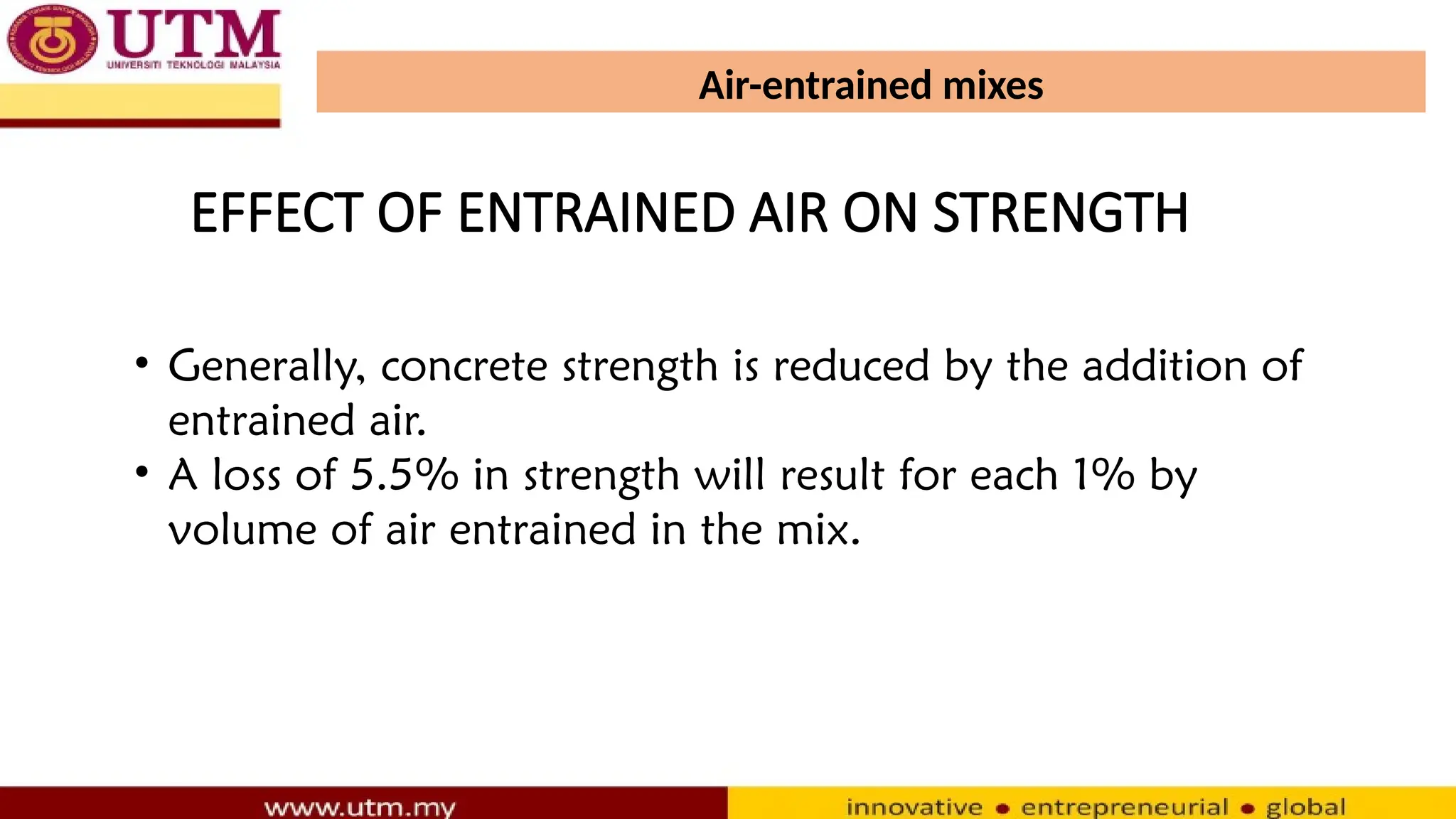
Air-entrained mixes
• Generally,concrete strength is reduced by the addition of
entrained air.
• A loss of 5.5% in strength will result for each 1% by
volume of air entrained in the mix.
EFFECT OF ENTRAINED AIR ON STRENGTH
6.
Air-entrained mixes
• Anallowance for strength reduction is incorporated to get
higher target mean strength through this relation:
[fc + M] / [1-0.055a]
Where:
fc = specified strength
M = the margin
a = percentage by volume of air entrained.
7.
Air-entrained mixes
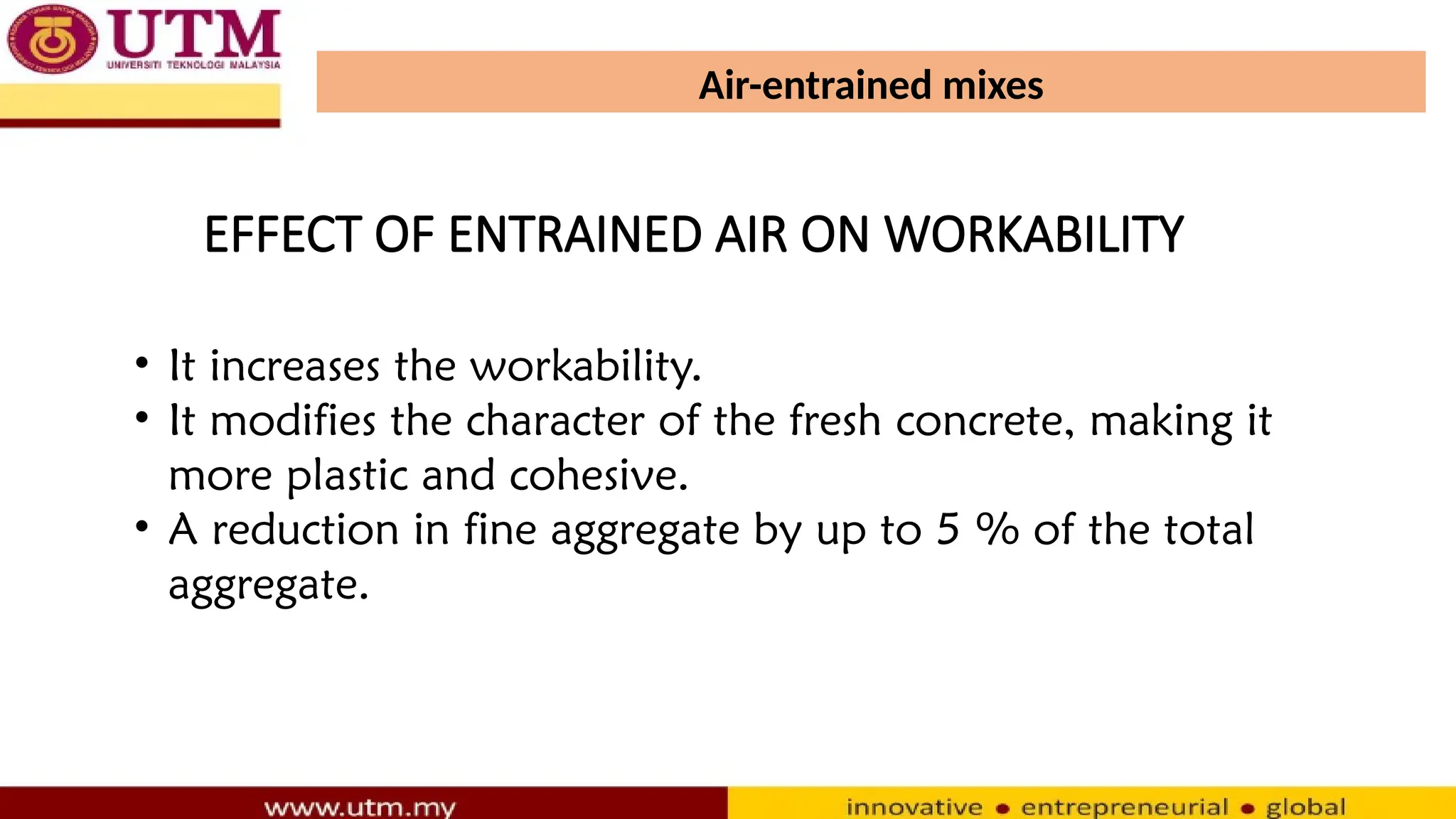
• Itincreases the workability.
• It modifies the character of the fresh concrete, making it
more plastic and cohesive.
• A reduction in fine aggregate by up to 5 % of the total
aggregate.
EFFECT OF ENTRAINED AIR ON WORKABILITY
8.
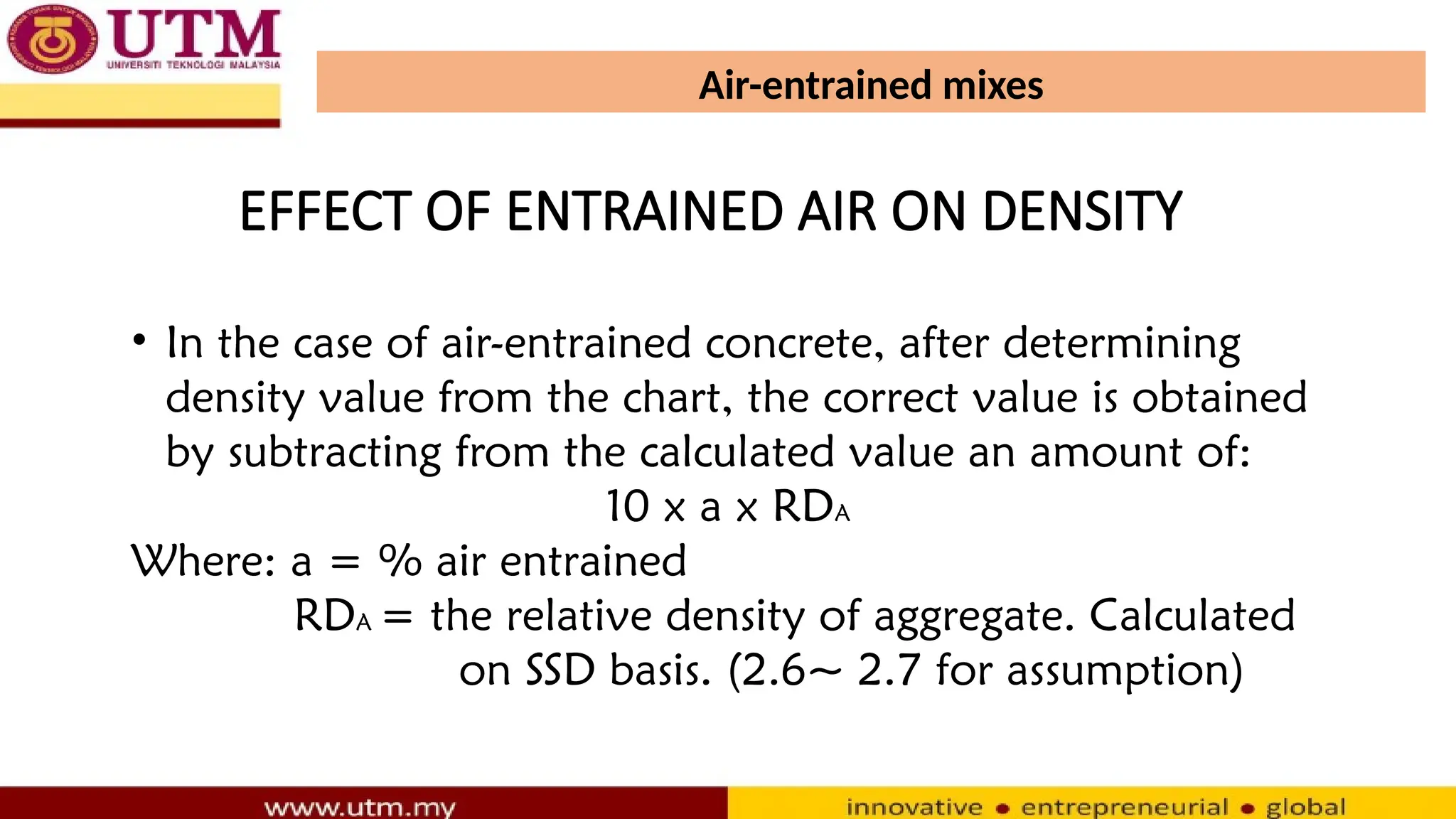
Air-entrained mixes
• Inthe case of air-entrained concrete, after determining
density value from the chart, the correct value is obtained
by subtracting from the calculated value an amount of:
10 x a x RDA
Where: a = % air entrained
RDA = the relative density of aggregate. Calculated
on SSD basis. (2.6~ 2.7 for assumption)
EFFECT OF ENTRAINED AIR ON DENSITY
9.
Air-entrained mixes
The designprocess is basically the same as normal
method except for the changes needed to be
addressed through target mean strength, free-water
content and concrete density.
MODIFICATIONS TO THE DESIGN PROCESS
Air-entrained mixes
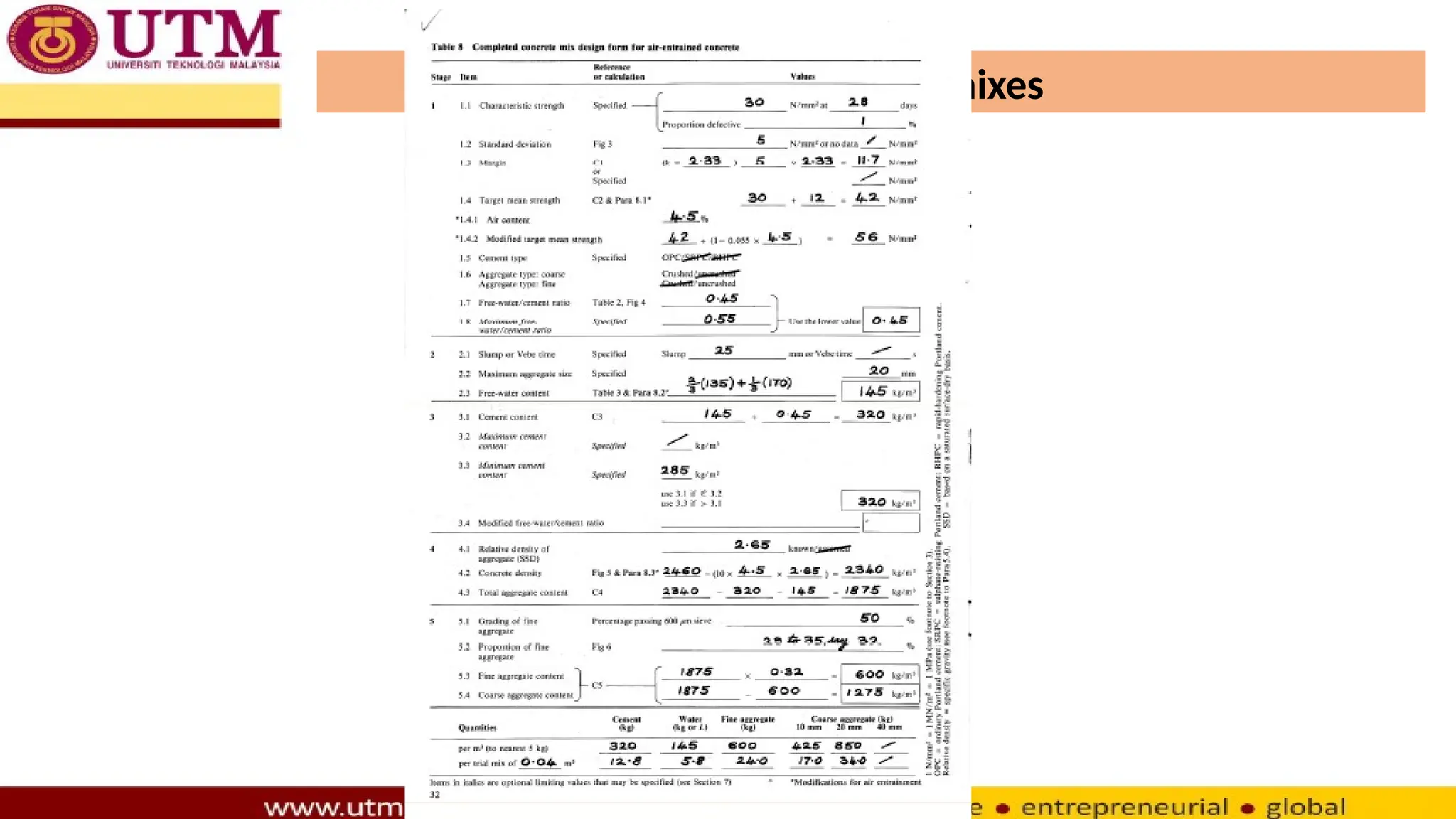
• fc= 30 N/mm2 at 28 days, defective rate 1% (k = 2.33)
• OPC
• Slump = 25mm
• Maximum aggregate size = 20 mm
• Maximum w/c ratio = 0.55
• Minimum cement content = 285 kg/m3
• Air content = 4.5%
• Previous control data gave a standard deviation of 5 N/mm2
MODIFICATION DUE TO ENTRAINED AIR
12.
Air-entrained mixes
For Aggregates:
•Coarse, crushed
• Fined, uncrushed
• Aggregate relative density = 2.65
• Fine aggregate with 50% passing 600μm sieve.
13.
Air-entrained mixes
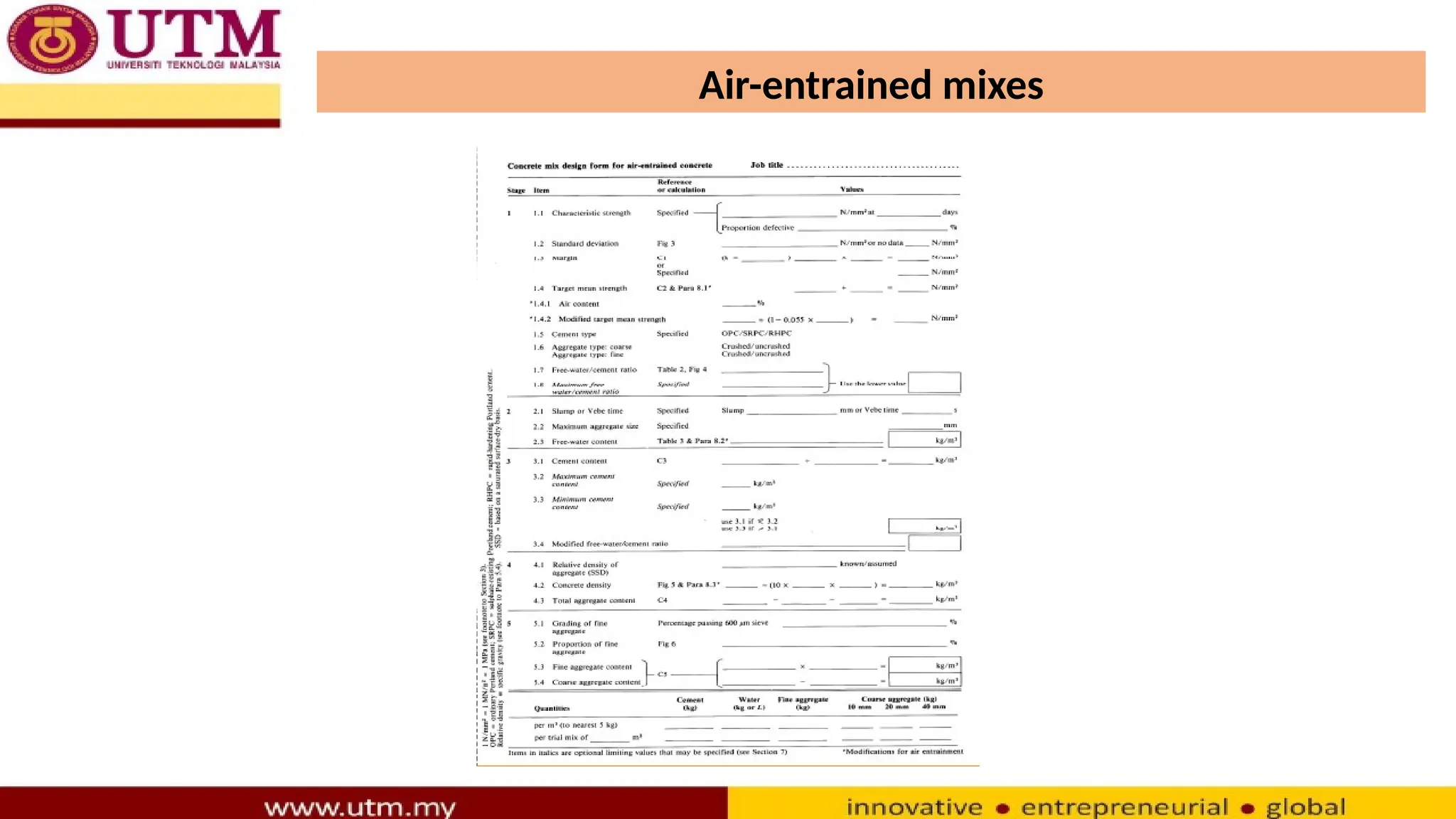
• Instage 1, item 1.4 is modified to allow for the air
content.
• In stage 2, item 2.3 involves the calculation of water
content as per Table 3. Slump required is 25 mm but as
we choose the lower w/c ratio, then a slump for 0 – 10
mm category should be taken.
• In stage 4, item 4.2, wet density of the concrete is
adjusted to allow for its air content.
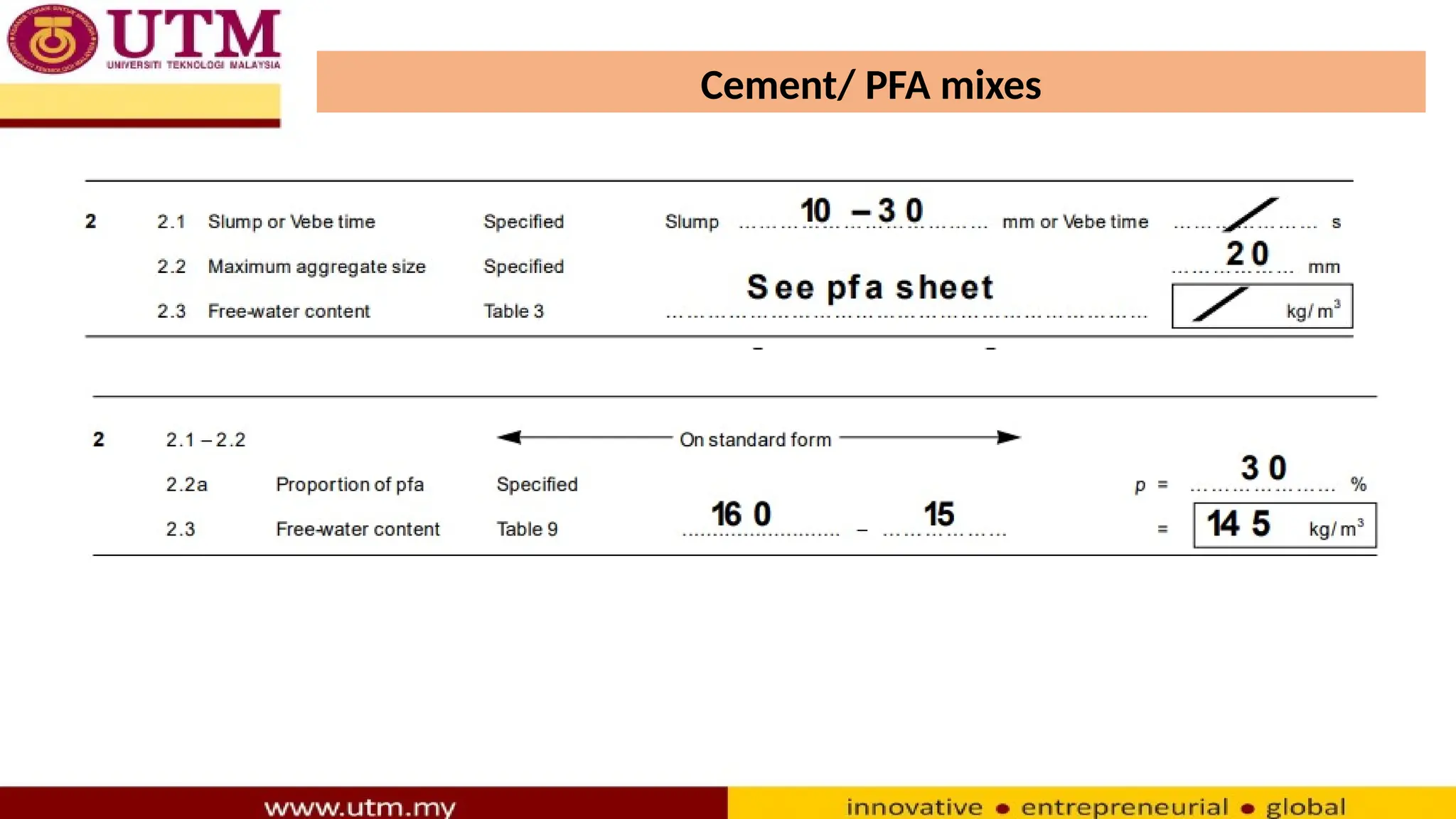
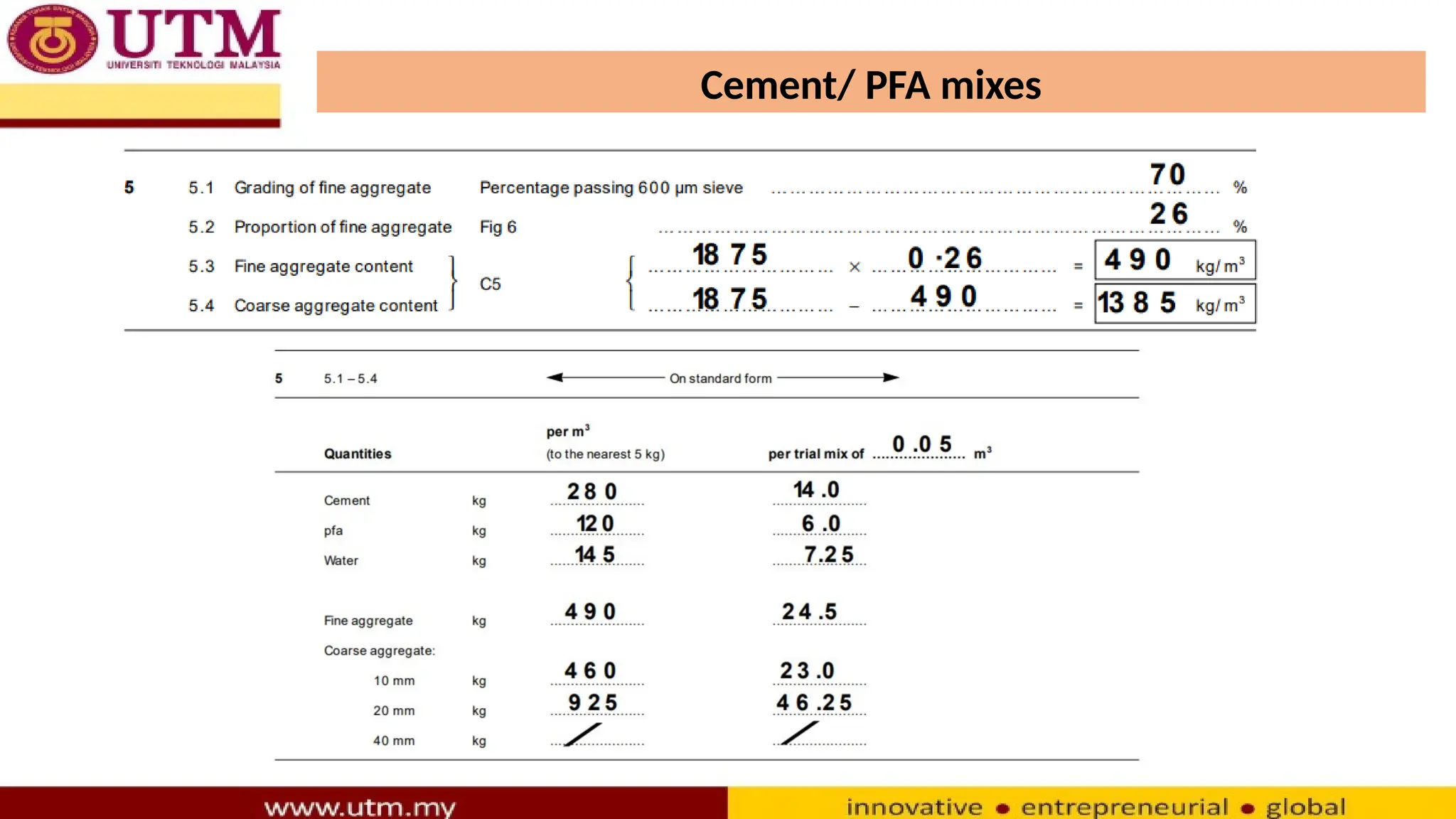
Cement/ PFA mixes
•PFA is pulverised fuel ash.
• Why use PFA in concrete mix?
It replaces some of the cement.
Reduces thermal cracking problems in massive
concrete sections.
It is good with concrete that is placed in sulphate-
bearing soil.
It is useful when there is a chance of concrete
disruption due to alkali-silica reaction (ASR)
16.
Cement/ PFA mixes
MODIFICATIONSTO THE MIX DESIGN
• 5 ITEMS NEEDED TO BE CONSIDERED:-
(i) Workability and water content.
(ii) Strength and free W/C ratio.
(iii) Cement Content.
(iv) Variability of concrete strength.
(v) Density of concrete and aggregate strength.
17.
Cement/ PFA mixes
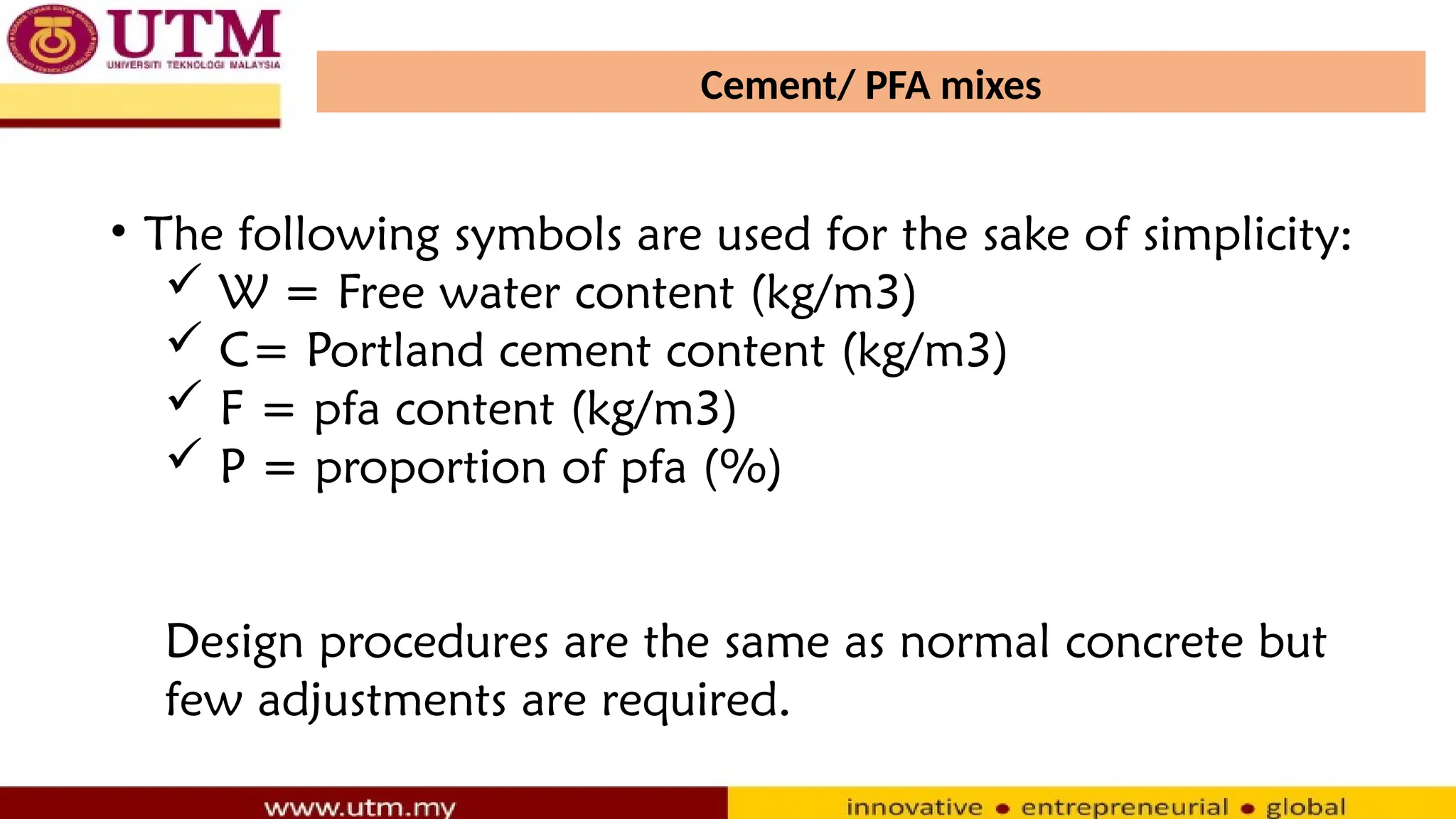
•The following symbols are used for the sake of simplicity:
W = Free water content (kg/m3)
C= Portland cement content (kg/m3)
F = pfa content (kg/m3)
P = proportion of pfa (%)
Design procedures are the same as normal concrete but
few adjustments are required.
18.
Cement/ PFA mixes
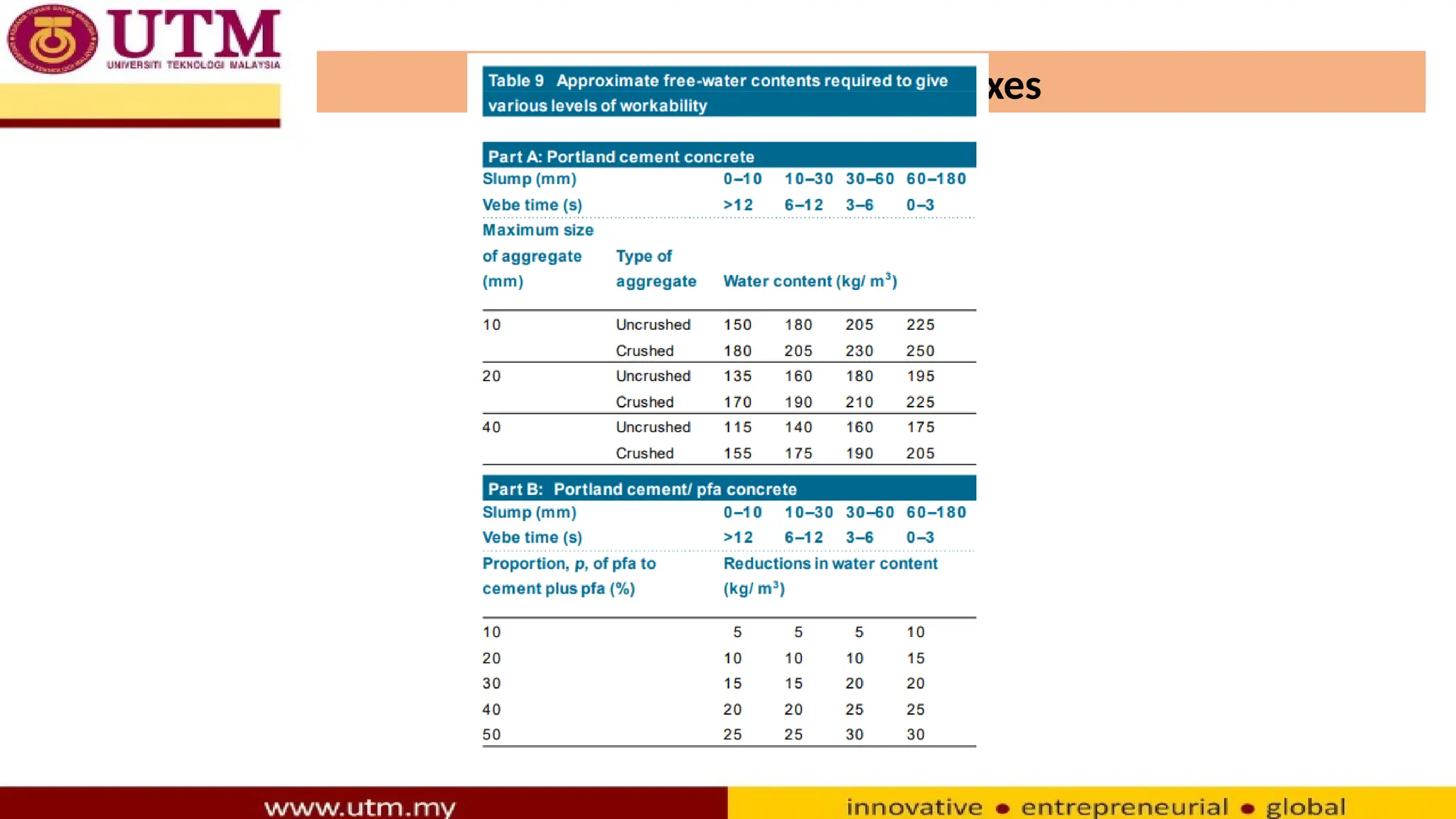
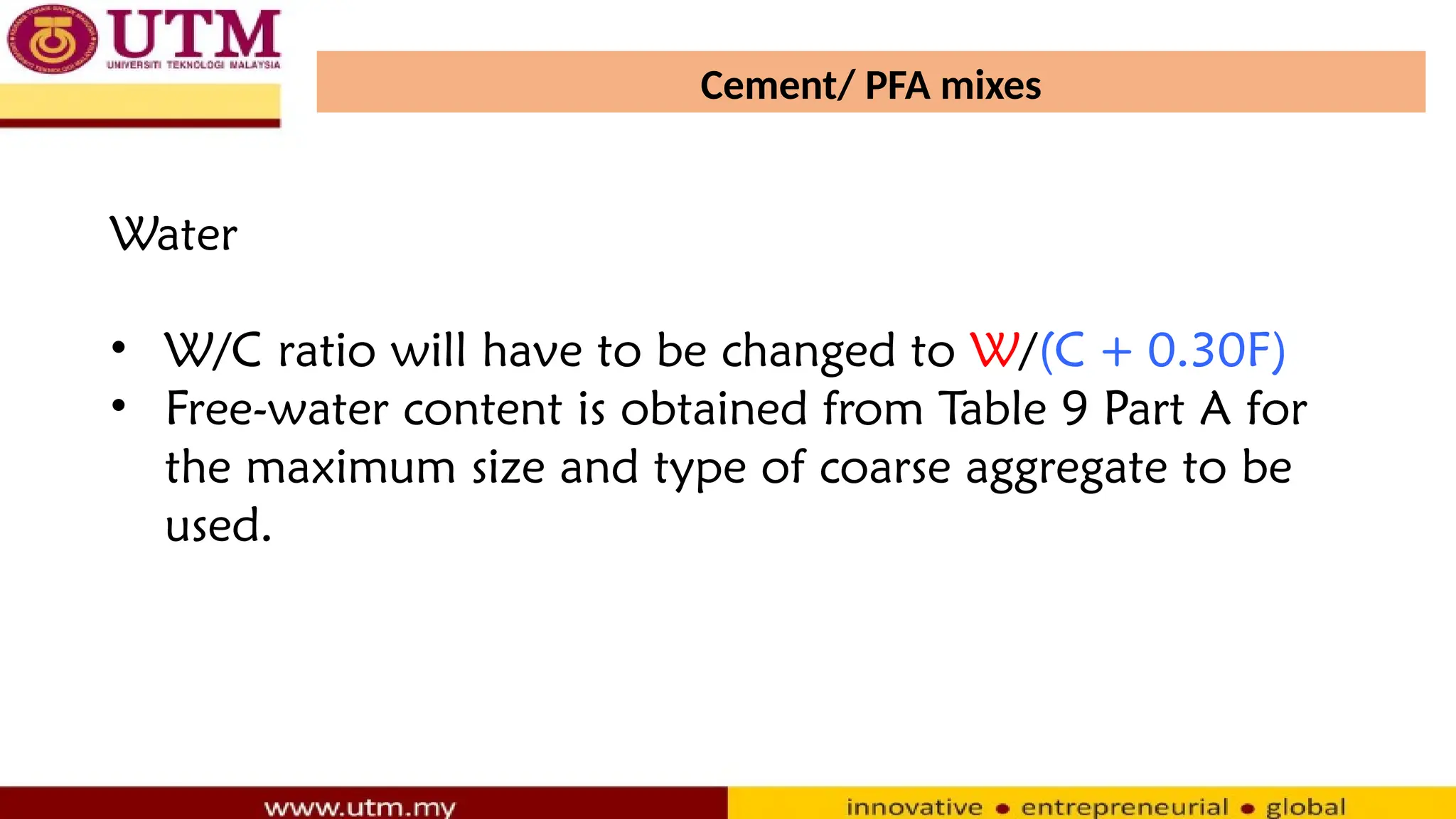
Water
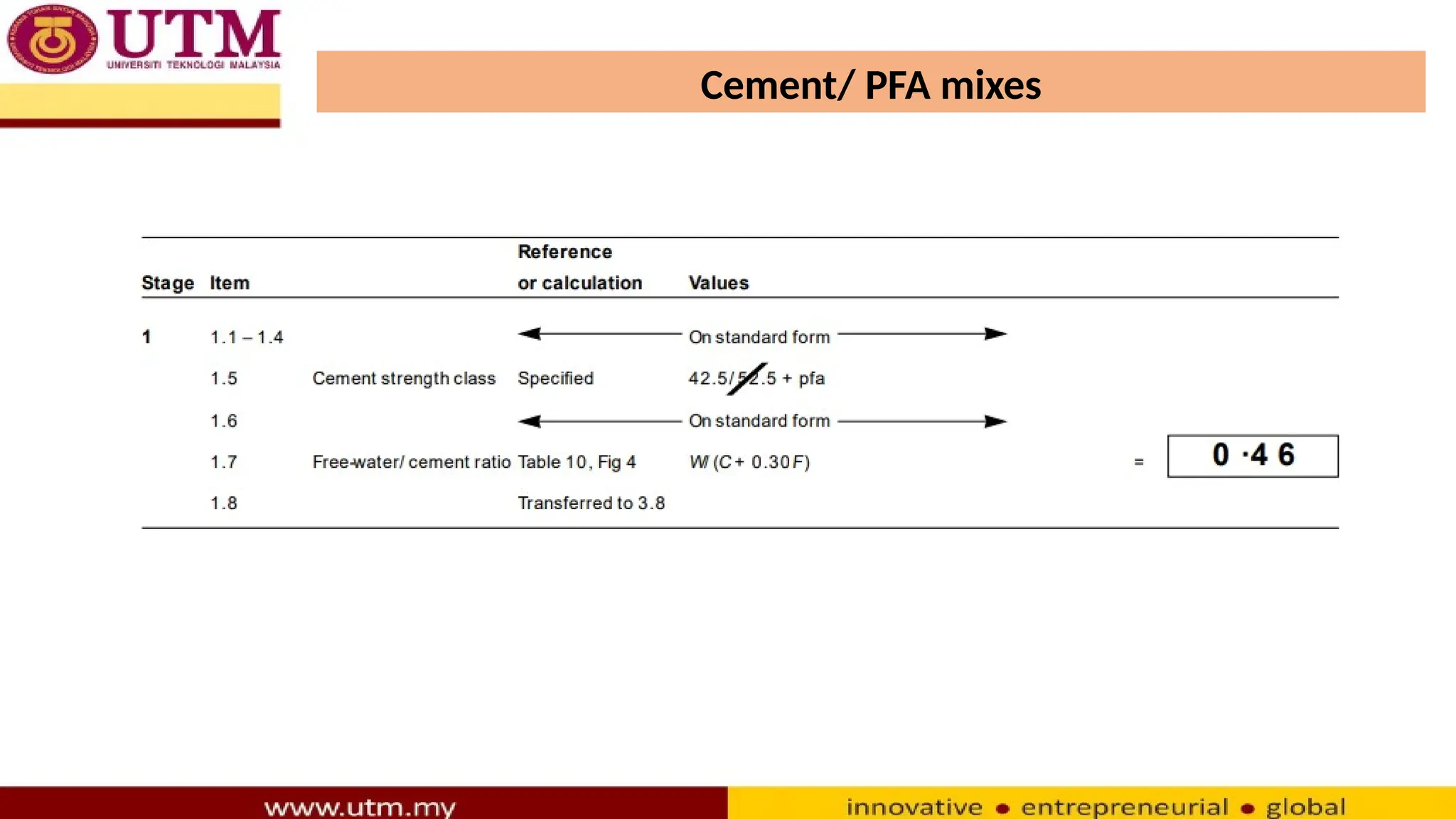
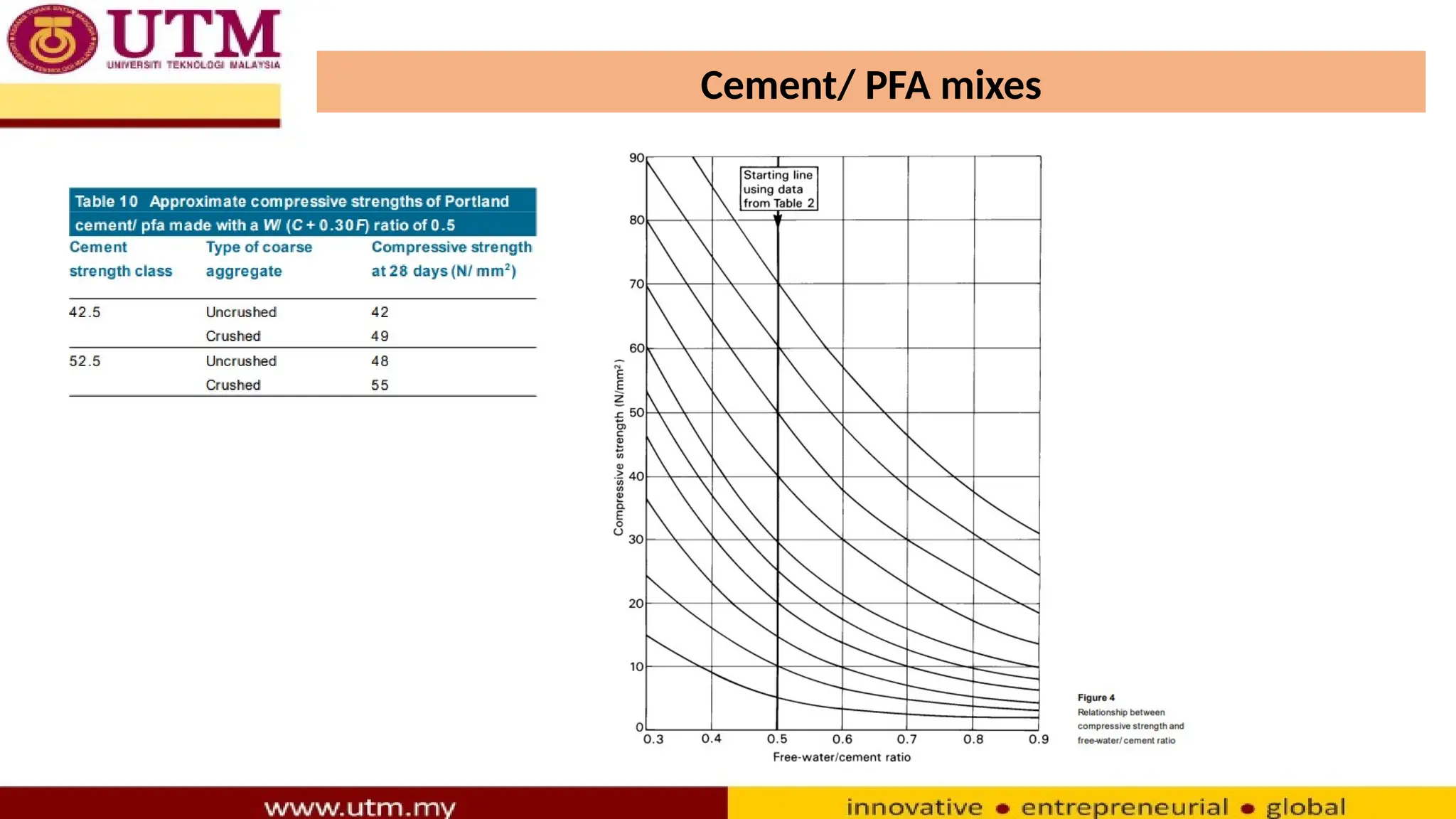
•W/C ratio will have to be changed to W/(C + 0.30F)
• Free-water content is obtained from Table 9 Part A for
the maximum size and type of coarse aggregate to be
used.
19.
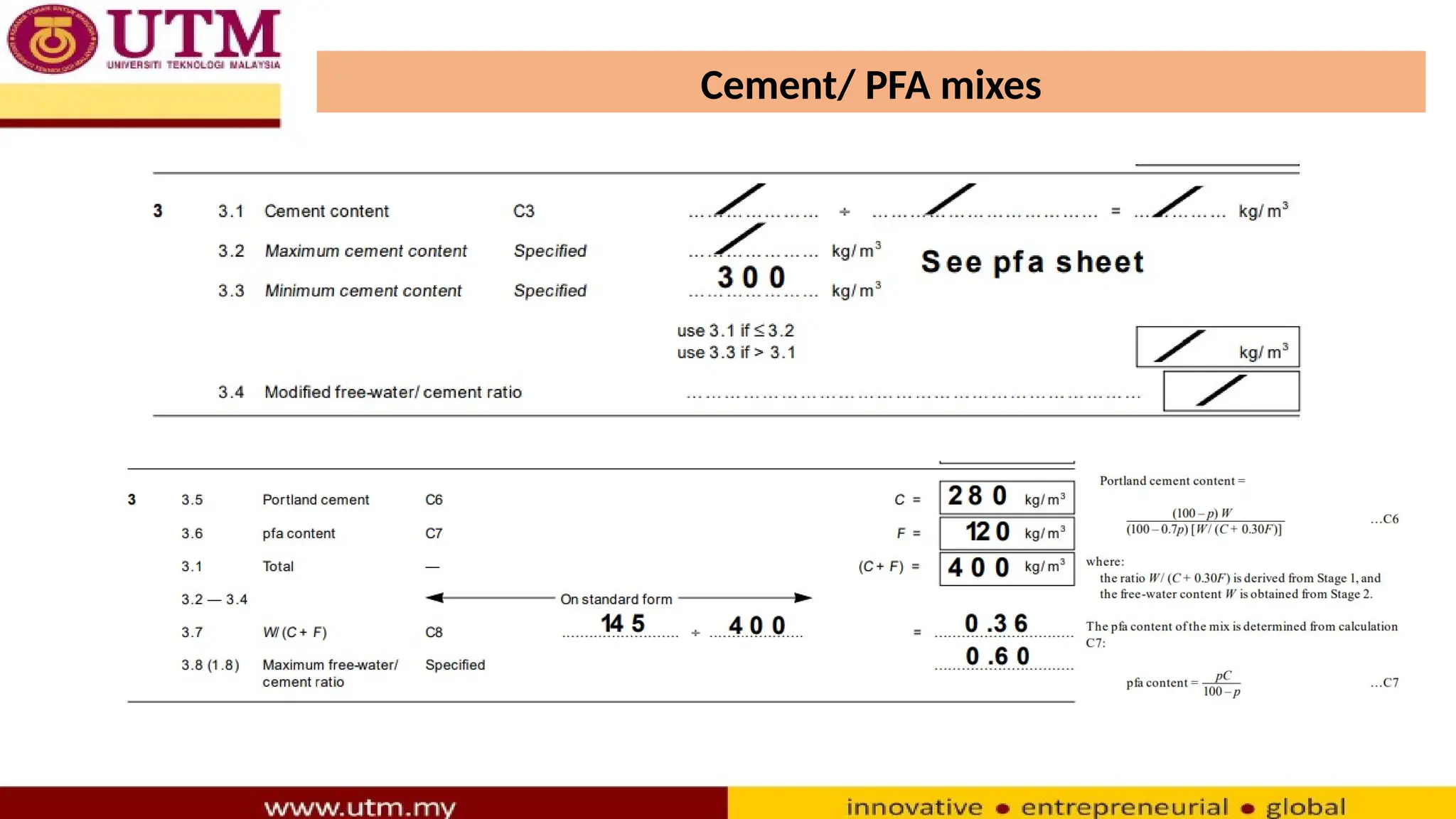
Cement/ PFA mixes
Cement
•Portland cement content is determined from:-
- C = (100-P).W/ (100-0.7P) [W/(C+0.30F)]
- Pfa content, F = PC/100-P
20.
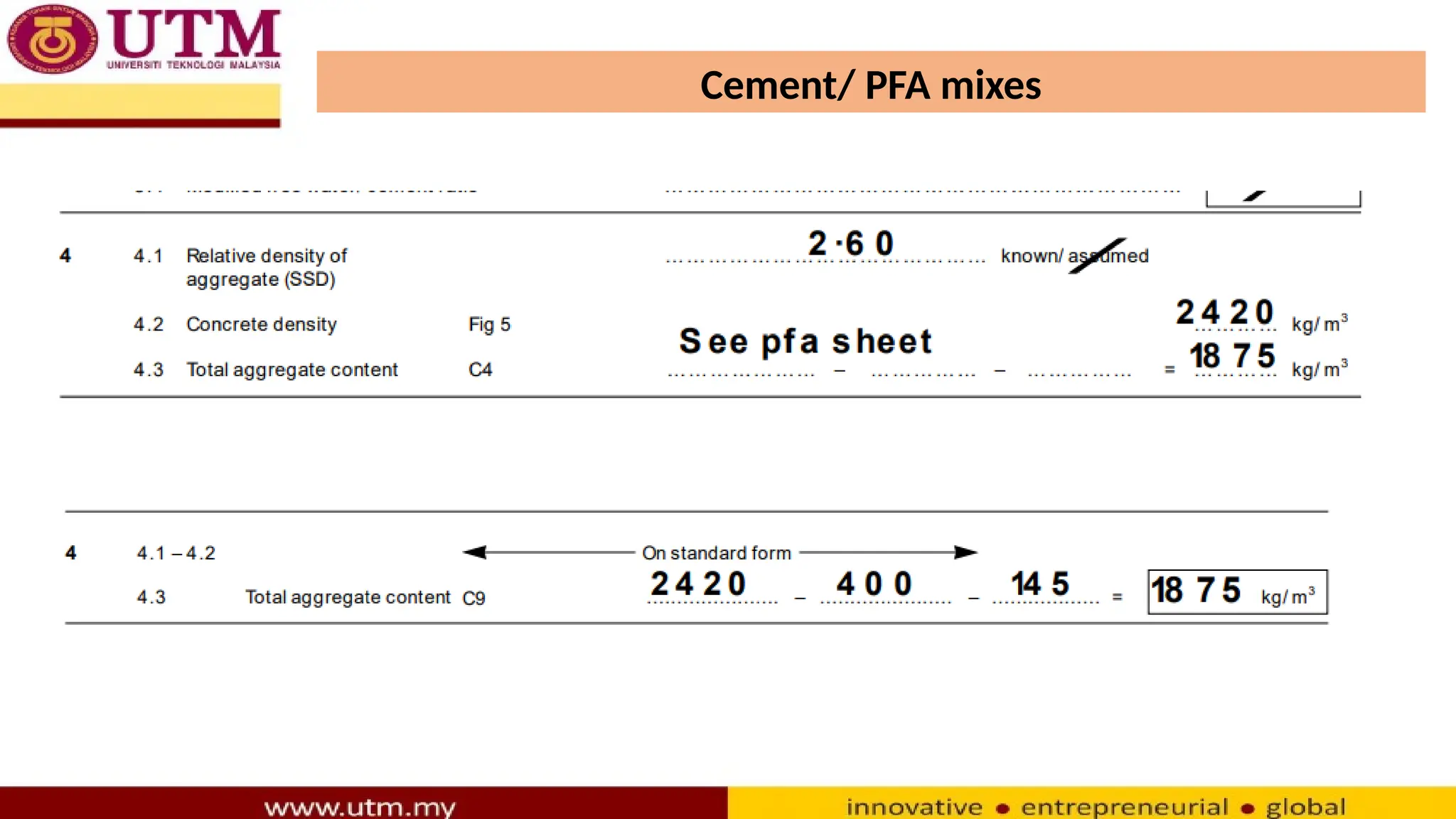
Cement/ PFA mixes
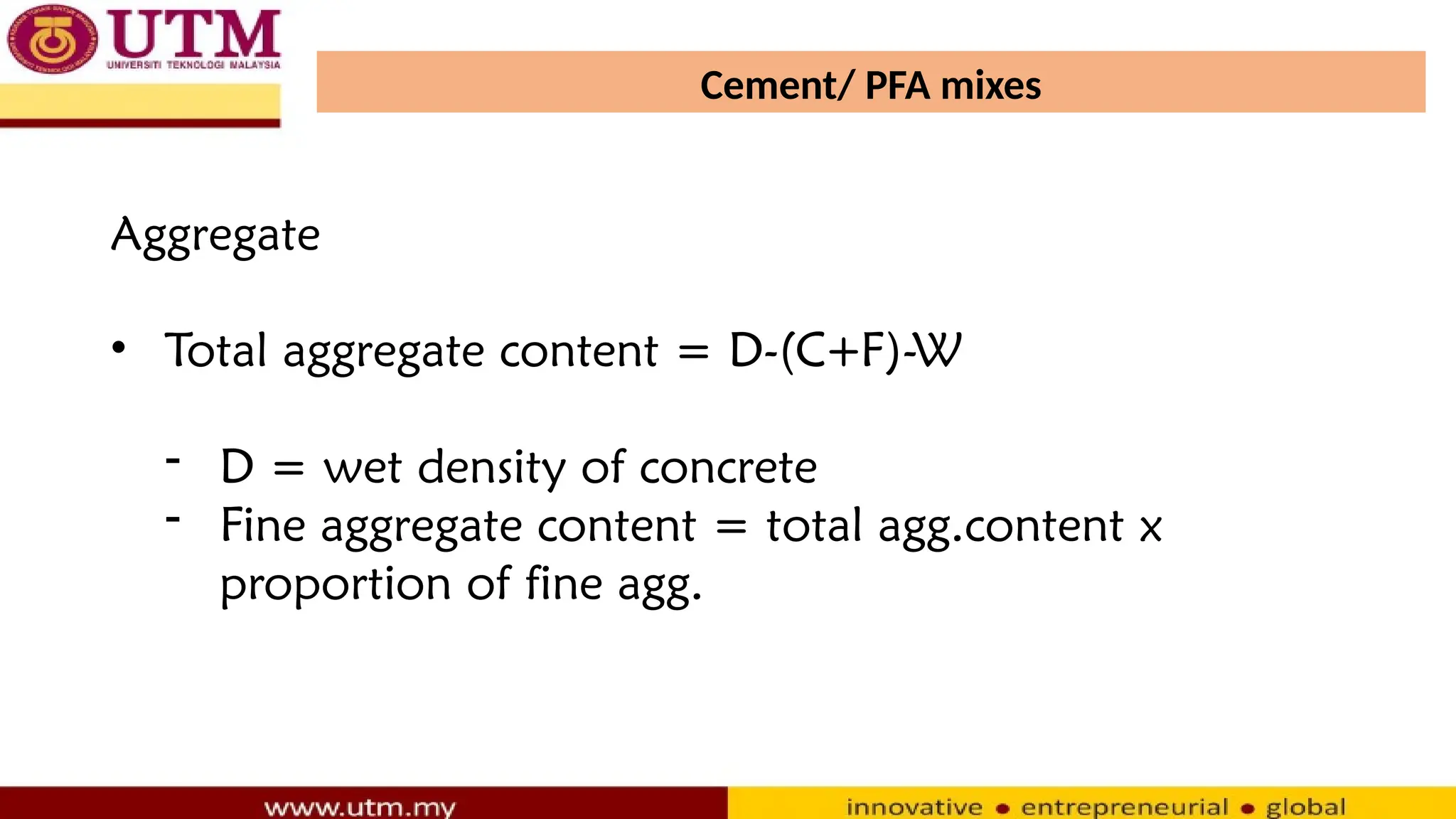
Aggregate
•Total aggregate content = D-(C+F)-W
- D = wet density of concrete
- Fine aggregate content = total agg.content x
proportion of fine agg.
21.
Assignment #2
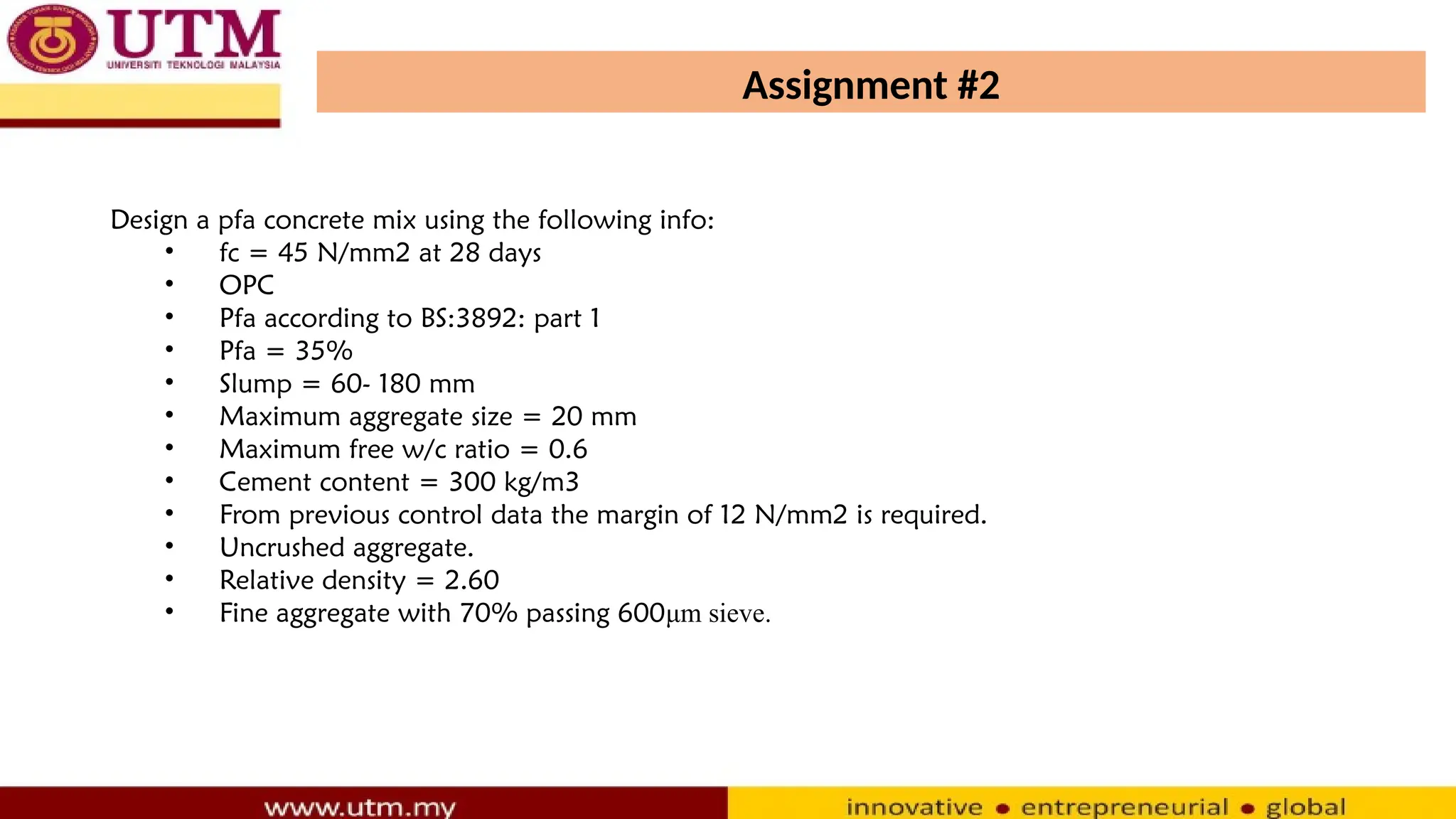
Design apfa concrete mix using the following info:
• fc = 45 N/mm2 at 28 days
• OPC
• Pfa according to BS:3892: part 1
• Pfa = 35%
• Slump = 60- 180 mm
• Maximum aggregate size = 20 mm
• Maximum free w/c ratio = 0.6
• Cement content = 300 kg/m3
• From previous control data the margin of 12 N/mm2 is required.
• Uncrushed aggregate.
• Relative density = 2.60
• Fine aggregate with 70% passing 600μm sieve.
22.
Cement/ PFA mixes
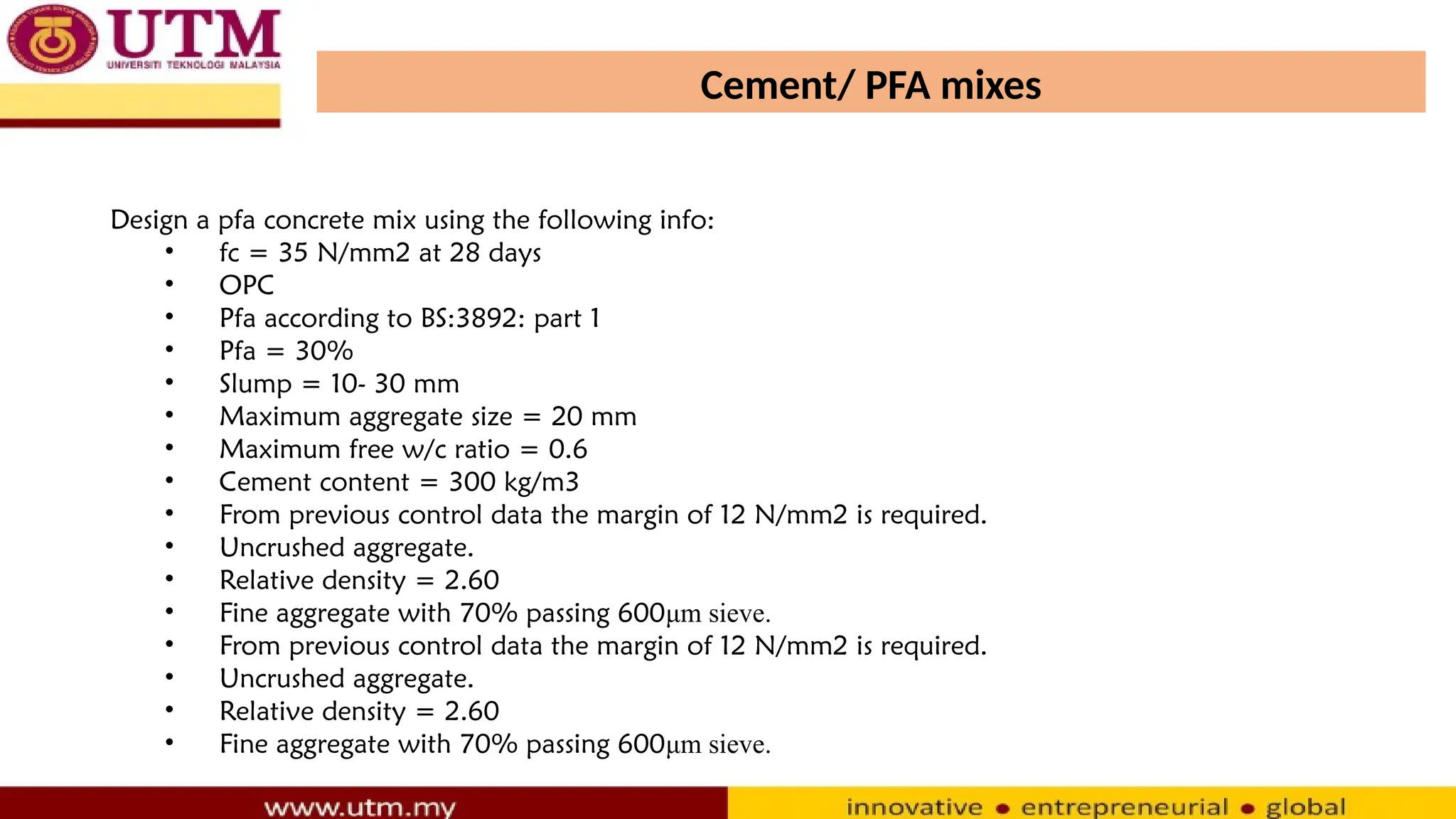
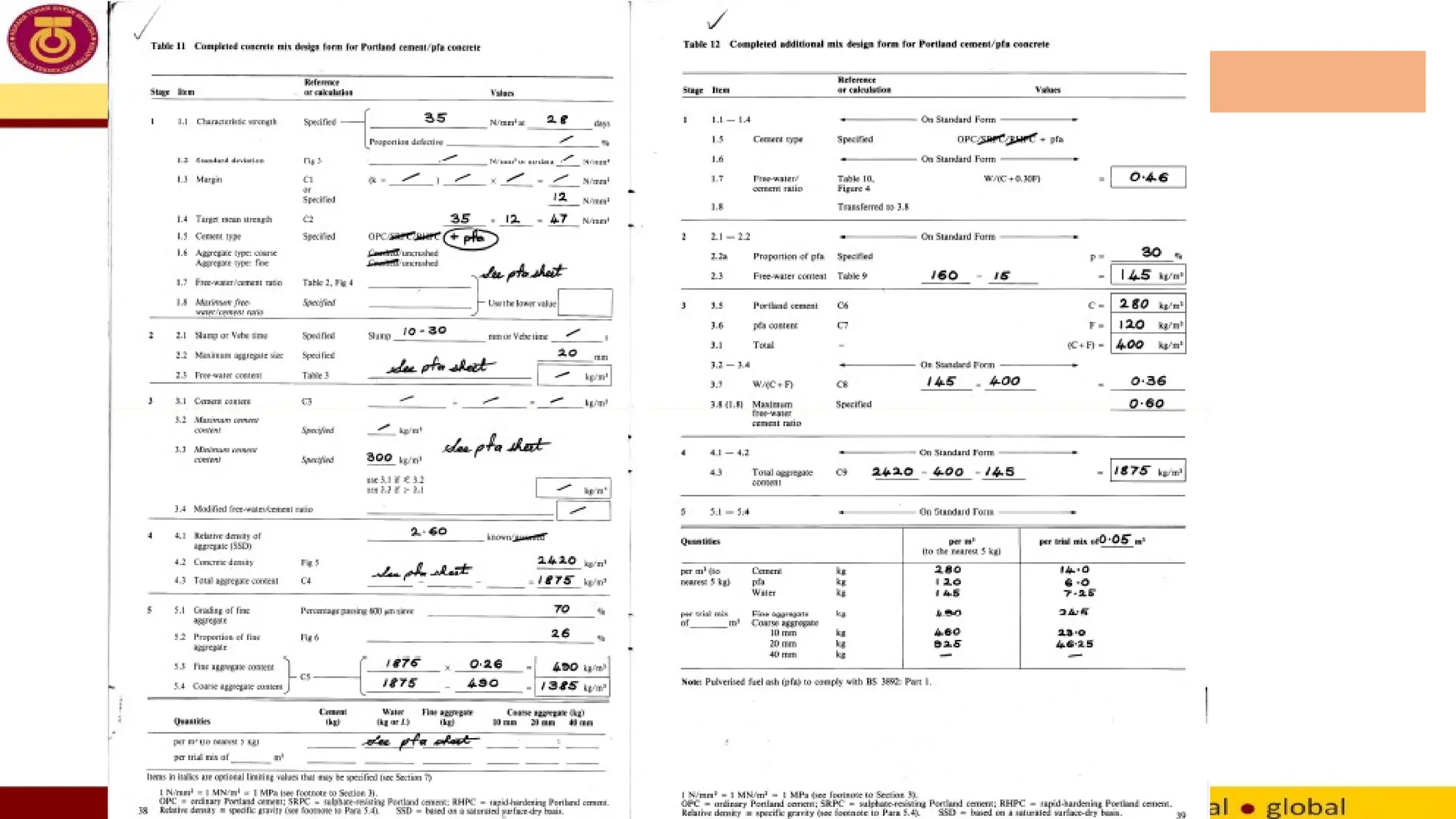
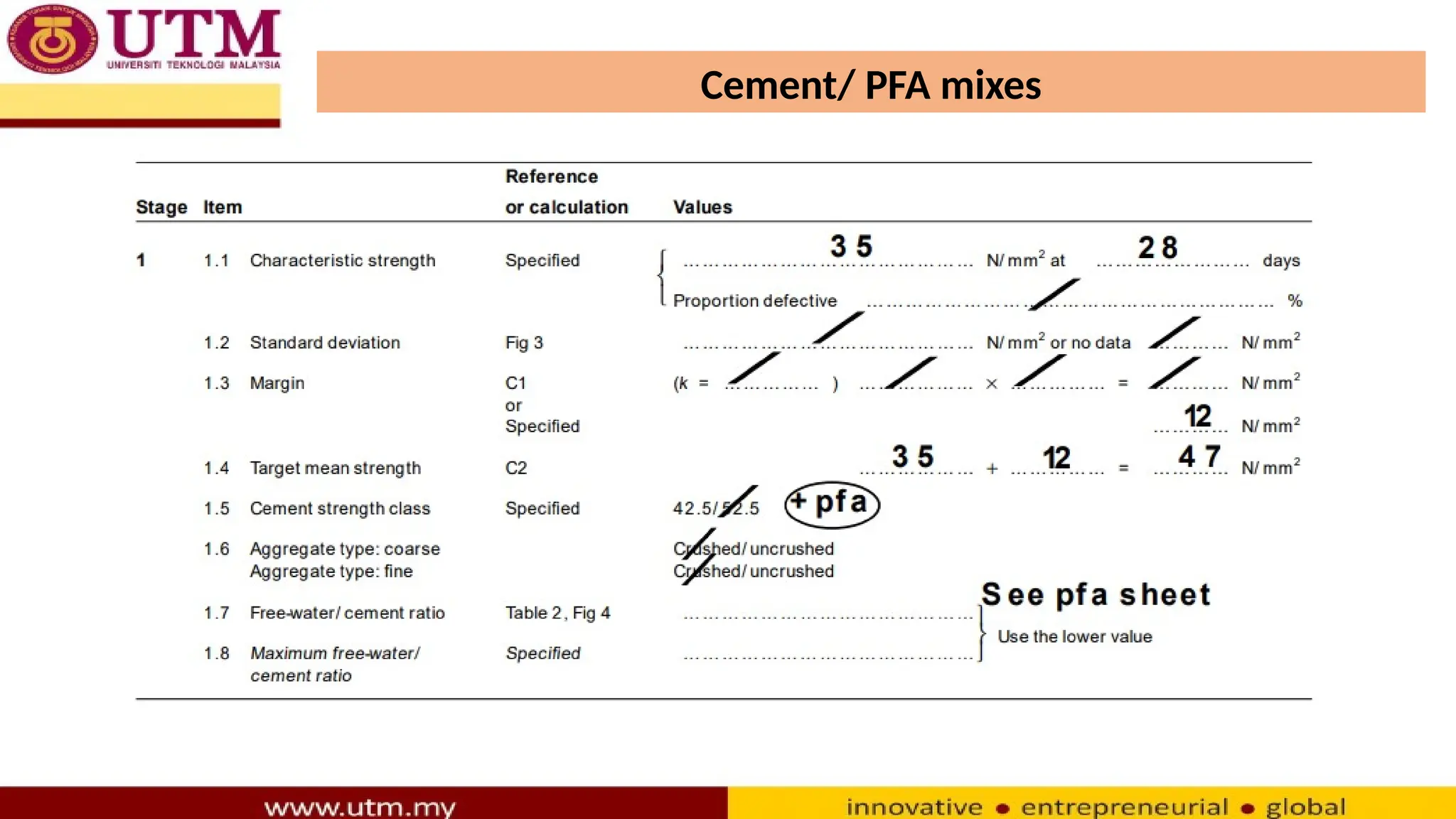
Designa pfa concrete mix using the following info:
• fc = 35 N/mm2 at 28 days
• OPC
• Pfa according to BS:3892: part 1
• Pfa = 30%
• Slump = 10- 30 mm
• Maximum aggregate size = 20 mm
• Maximum free w/c ratio = 0.6
• Cement content = 300 kg/m3
• From previous control data the margin of 12 N/mm2 is required.
• Uncrushed aggregate.
• Relative density = 2.60
• Fine aggregate with 70% passing 600μm sieve.
• From previous control data the margin of 12 N/mm2 is required.
• Uncrushed aggregate.
• Relative density = 2.60
• Fine aggregate with 70% passing 600μm sieve.
23.
Cement/ PFA mixes
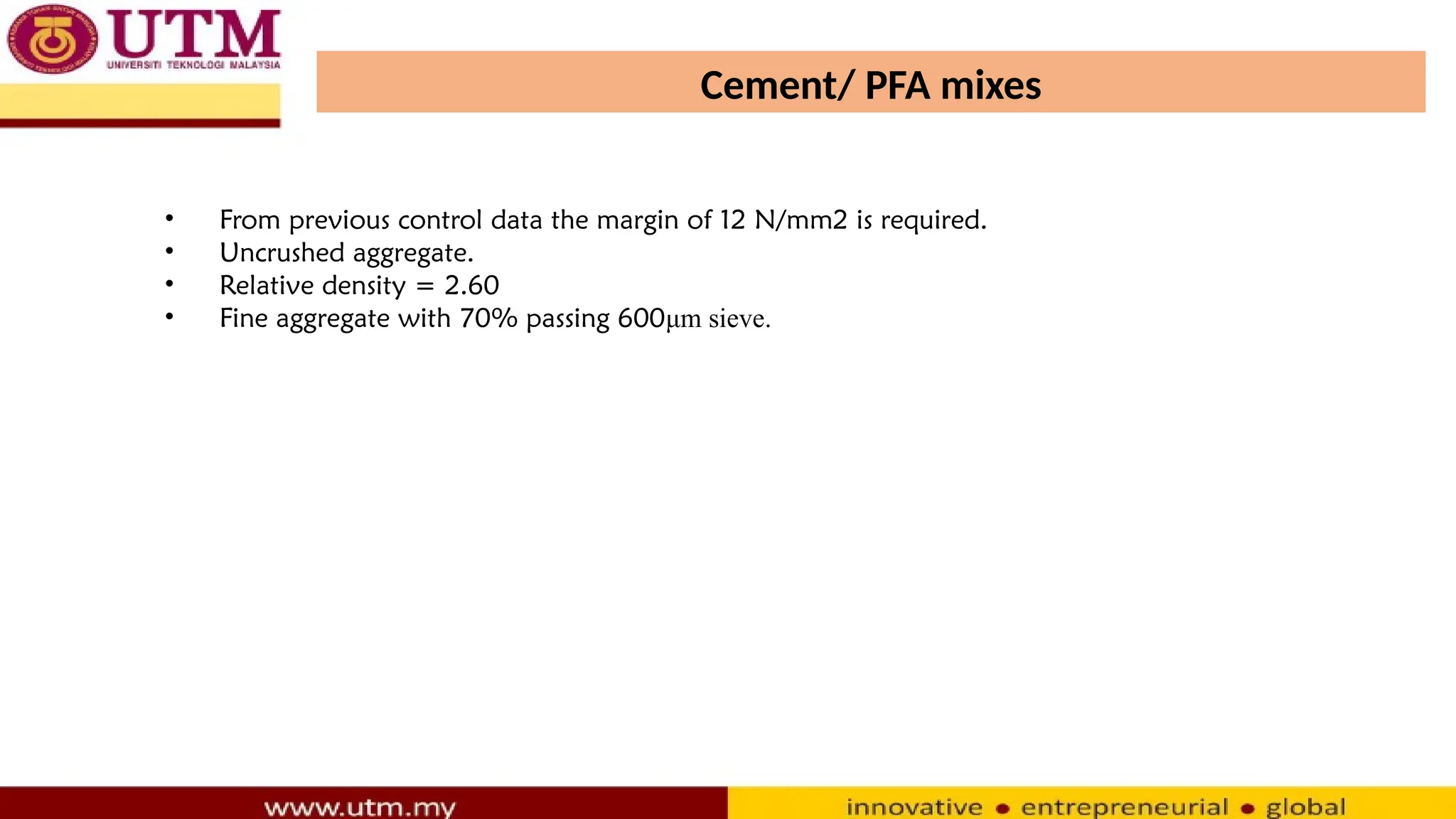
•From previous control data the margin of 12 N/mm2 is required.
• Uncrushed aggregate.
• Relative density = 2.60
• Fine aggregate with 70% passing 600μm sieve.
Cement/ GGBFS mixes
•GGBFS = ground granulated blast furnace slag.
• It is generally used as a replacement of cement on the
basis of a direct weight for weight replacement.
• Replacements are generally in the order of from 30 to
50% by weight.
• For some purposes, a replacement of 70% or more
could be used.
34.
Cement/ GGBFS mixes
Proportionof GGBFS used:
• General use, including structures (about 40%)
• Improved resistance to sulphates (70-90%)
• Improved resistance to alkali-silica reaction (50%)
• Reduced temperature rise (50-90%)
35.
Cement/ GGBFS mixes
Effectof using GGBFS on concrete properties:
• Workability and water content
- It acts like a water reducing agent.
- Roughly a reduction of 5 kg/m3 of water content can
be achieved.
• Variability of concrete strength
- On site variability of Portland cement/ GGBFS
concrete is no greater than that of Portland cement
concrete.
36.
Cement/ GGBFS mixes
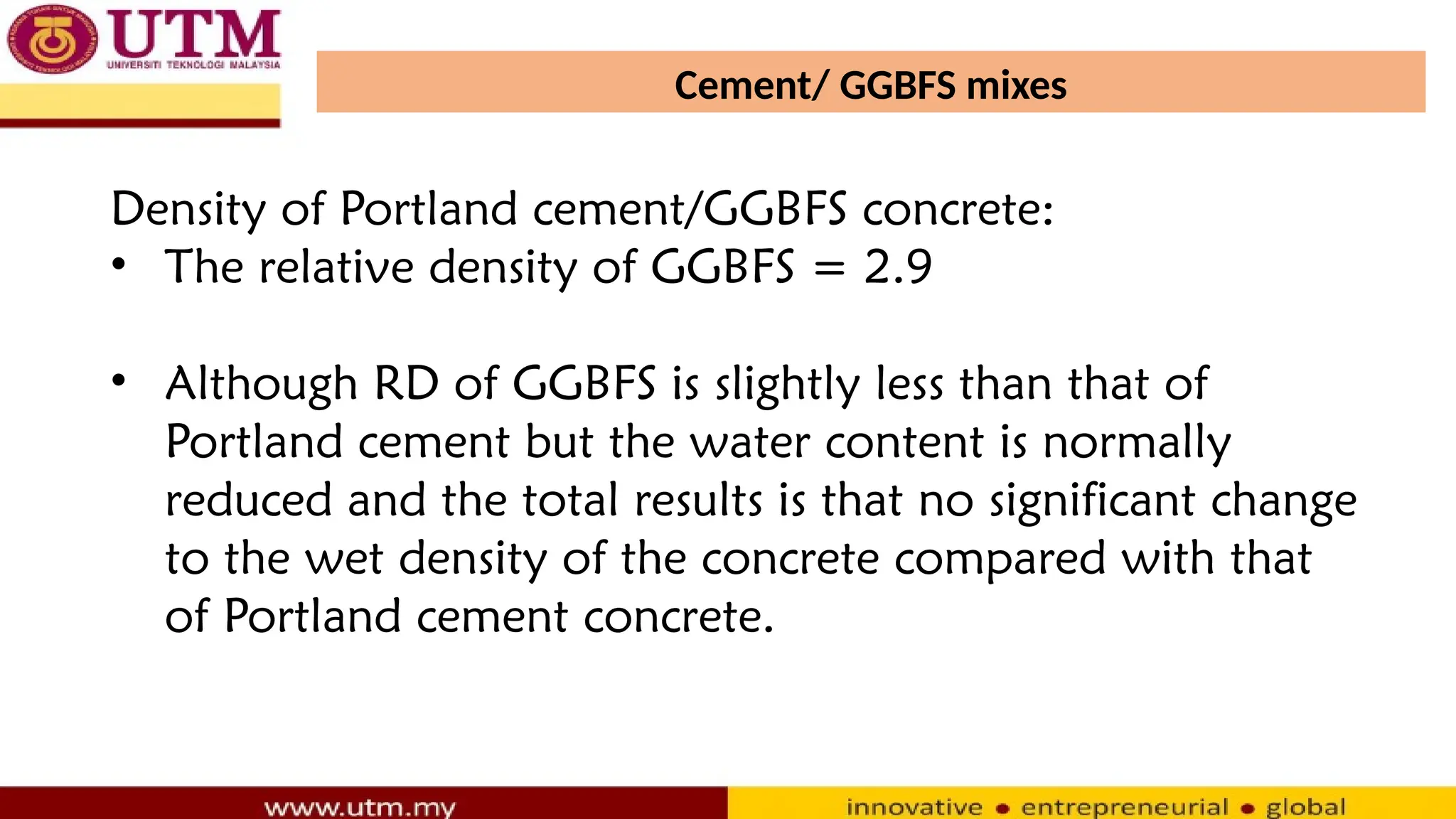
Densityof Portland cement/GGBFS concrete:
• The relative density of GGBFS = 2.9
• Although RD of GGBFS is slightly less than that of
Portland cement but the water content is normally
reduced and the total results is that no significant change
to the wet density of the concrete compared with that
of Portland cement concrete.
37.
Cement/ GGBFS mixes
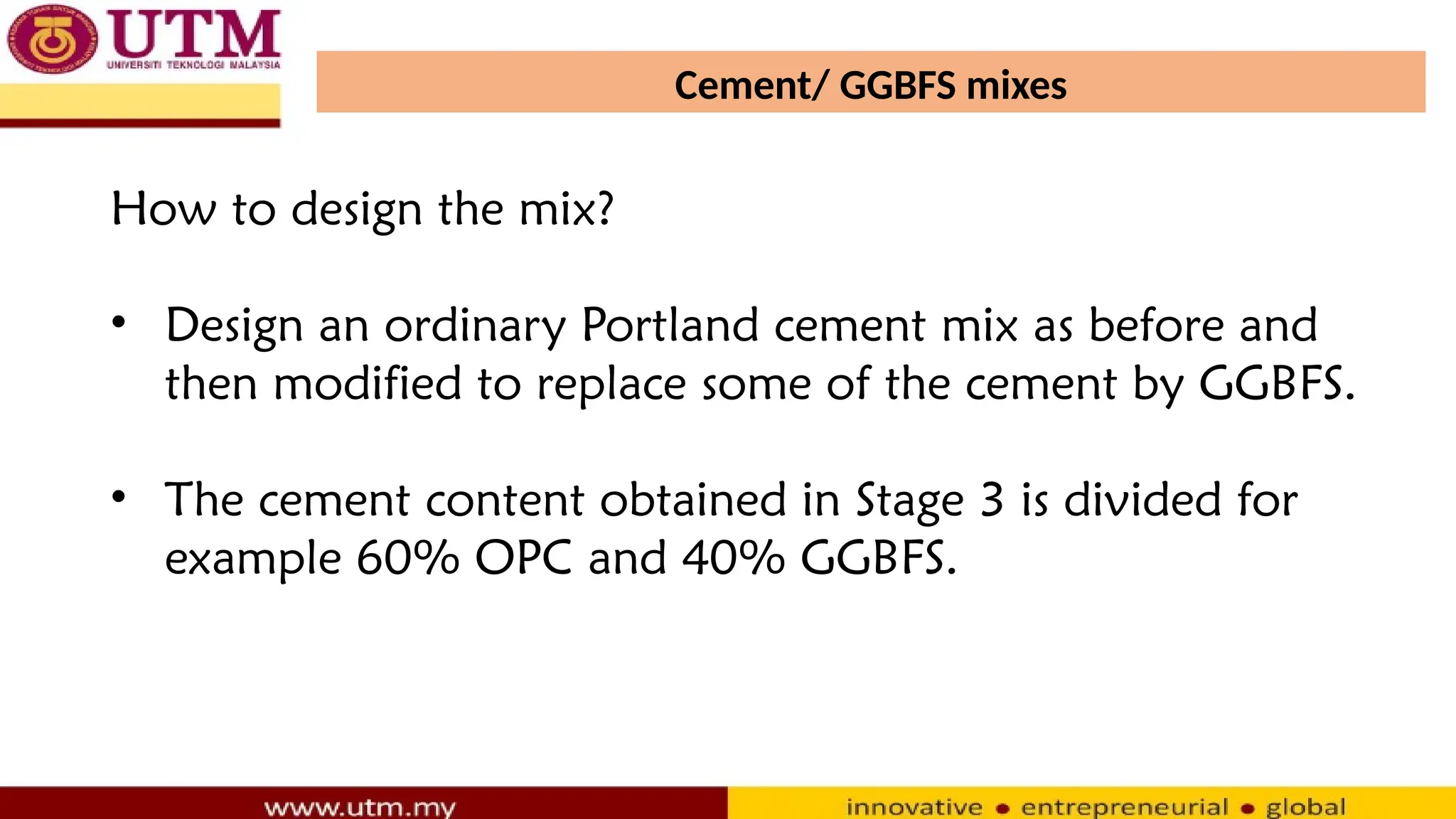
Howto design the mix?
• Design an ordinary Portland cement mix as before and
then modified to replace some of the cement by GGBFS.
• The cement content obtained in Stage 3 is divided for
example 60% OPC and 40% GGBFS.
38.
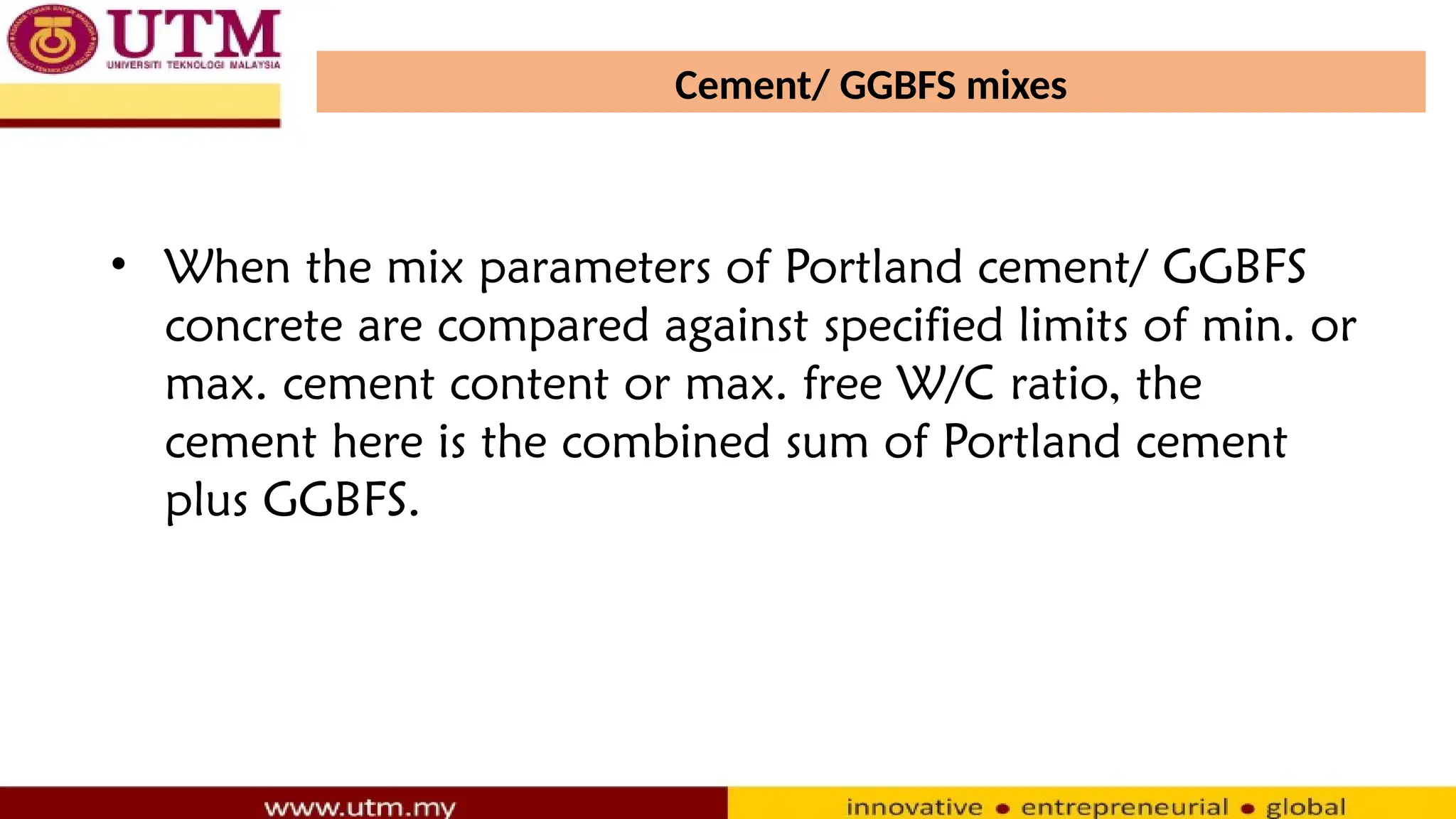
Cement/ GGBFS mixes
•When the mix parameters of Portland cement/ GGBFS
concrete are compared against specified limits of min. or
max. cement content or max. free W/C ratio, the
cement here is the combined sum of Portland cement
plus GGBFS.


![Air-entrained mixes
• An allowance for strength reduction is incorporated to get
higher target mean strength through this relation:
[fc + M] / [1-0.055a]
Where:
fc = specified strength
M = the margin
a = percentage by volume of air entrained.](https://image.slidesharecdn.com/c4modifiedreplacementmethod-250528021100-ad08d91f/75/C4-Modified-Replacement-Method-slide-share-6-2048.jpg)
![Cement/ PFA mixes
Cement
• Portland cement content is determined from:-
- C = (100-P).W/ (100-0.7P) [W/(C+0.30F)]
- Pfa content, F = PC/100-P](https://image.slidesharecdn.com/c4modifiedreplacementmethod-250528021100-ad08d91f/75/C4-Modified-Replacement-Method-slide-share-19-2048.jpg)