Wildlife Documentary: A study of the challenges and successes of wildlife documentary
production.
1
University of the West of Scotland
Broadcast Production: 2015/2016
Research Project: Honours Dissertation
“People will not protect what they don’t understand”
-(Doug Allan, 2015)
Wildlife Documentary: A study of the challenges and successes of
wildlife documentary production
By
Fiona Donaldson
BA (Hons) Broadcast Production
B00211648
Supervised by
Dr. Kathryn Burnett
Word Count:
Approx. 11,052
Roughly excluding Data, Tables and Bibliography Approx. 4,000
Wildlife Documentary: A study of the challenges and successes of wildlife documentary
production.
2
FORM 4: FINAL SUBMISSION Research Project: Broadcast Production Honours Dissertation
To be completed in full and bound into dissertation after title page.
Surname: Donaldson First Name(s): Fiona
Banner No. B00211648 Session: 2015/2106
Research Project Supervisor: Dr. Kathryn Burnett
Dissertation Title: Wildlife Documentary: A study of the challenges and successes of wildlife
documentary production
Plagiarism Statement
I certify this is all my own work and have submitted this with clear knowledge of the
university’s guidelines and policy on plagiarism:
SIGN:
Ethics Statement (see Moodle for Res. Project).
I certify this submitted this with clear knowledge of the university’s guidelines and School
of
Media, Culture and Society policy on ethics:
SIGN:
Wildlife Documentary: A study of the challenges and successes of wildlife
documentary production.
3
FORM 2: ETHICS STATEMENT Research Project: Broadcast Production Honours
Dissertation
TO BE DOWNLOADED AND COMPLETED BY ALL STUDENTS
Name: Fiona Donaldson Banner No. B00211648
Session: 2015/2016 Programme: Broadcast Production
Research Project Supervisor: Kathryn Burnett
Title: Wildlife Documentary: A study of the challenges and successes of wildlife documentary
production
There can be no undergraduate research studies enrolled on this module in the School of
Media, Culture and Society that directly involve the following:
 Research on children (under 16).
 Research involvingdeception (including covert studies)
 Research that places either the researcher or the researched ‘at risk’, (e.g. studies must be
conducted with due consideration for personal safety, health and respectful conduct).
All students must read carefully the UWS ethics guidelines and ensure that they speak with their
supervisor about their own research intentions and where appropriate clarify in writing where there
appears to be any problem in abiding by these guidelines. It is the student’s responsibility to ensure
that they have read and understood these guidelines and that they will undertake to abide by them. In
the submission of your Research Project you will be required to sign an ‘Ethical statement’ (see Form 4).
You must ensure your have made yourself fully aware of the following guidelines before you can
sign and submit this statement.
MY STUDY INVOLVES CONTACT WITH HUMAN INFORMANTS/PARTICIPANTS:
YES
IF ‘NO’ THEN PLEASE ASK YOUR SUPERVISOR TO CONFIRM THIS AND SIGN BELOW AND
FORWARD IT TO THE MODULE CO-ORDINATOR. YOU MUST ALSO SIGN.
IF ‘YES’, THAT IS YOU INTEND TO INTERVIEW INDIVIDUALS OR GROUPS, RUN FOCUS GROUPS,
OBSERVE PEOPLE, OR ADMINISTER QUESTIONNAIRES, OR ANY OTHER FORM OF DATA
COLLECTION FROM HUMAN INFORMANTS/PARTICIPANTS YOU MUST SEEK FULL ETHICAL
APPROVAL BY FILLING IN THE UWS ETHICS FORM. Please link to Moodle now and download
this form, complete and to this Form 2 here.
I have clear knowledge of the university’s guidelines and School of MCS policy on ethics and I will
undertake to conduct my research study accordingly. I have attached a complete UWS Ethics
form accordingly.
STUDENT SIGN Fiona Donaldson
SUPERVISOR SIGN
Wildlife Documentary: A study of the challenges and successes of wildlife
documentary production.
4
MCS Research Ethics Committee
APPLICATION FORM FOR ETHICAL APPROVAL (MCSREC1)
N.B. The UEC Guidelines for Ethical Research with Human Subjects must be read prior
to the completion of this form. Notes for each section of the application are provided
under Section 2 (pp. 11-12) of the Guidelines.
1 Name of principal investigator Fiona Donaldson
School/Address Broadcast Production, UWS Ayr
Position Student
2 Name of supervisor/director of
studies (for undergraduate/
postgraduate applications only)
Kathryn Burnett
School/Address UWS Ayr
Position Supervisor
3 Title of Study – Wildlife Documentary: A study of the challenges and successes of
wildlife documentary production
4 What is the primary purpose of this study?
Original research 
Audit 
Undergraduate project 
Postgraduate project 
Other (please detail) 
5 Has the proposed study been submitted to any others ethics committee? No
Has approval been given? N/A
6 Briefly, what is the justification for the research? What is the background? Why is this
an area of importance?
Undergraduate honours degree study.
7 Give a brief summary of the purpose, design and methodology of the planned
research, including a brief explanation of the theoretical framework that informs it.
My aim in this research project is to investigate and explore the production of wildlife
documentaries. I will study the history and the changes in production through time, the
reasoning behind filming and the issues that arise within these productions. I will be
constructing my study using qualitative research methods, such as purposeful
sampling, allowing me to select specific people for interviewing. My aim is to interview
around 6 chosen subjects in the field of wildlife documentary. In the interviews
conducted, my aim is to find out more about the production and if this is a reason why
the programs are becoming more popular, if they are. I also aim to cover issues in this
area of work and how they tackle these.
8 Does the research involve any physically invasive procedures? Are there any known
hazards associated with these procedures?
None as known.
Wildlife Documentary: A study of the challenges and successes of wildlife
documentary production.
5
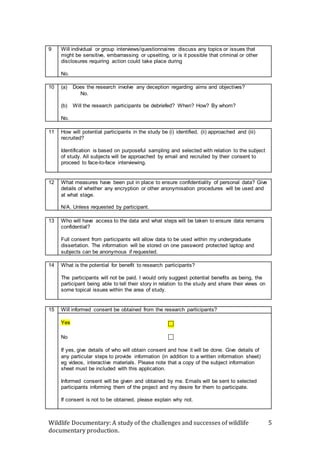
9 Will individual or group interviews/questionnaires discuss any topics or issues that
might be sensitive, embarrassing or upsetting, or is it possible that criminal or other
disclosures requiring action could take place during
No.
10 (a) Does the research involve any deception regarding aims and objectives?
No.
(b) Will the research participants be debriefed? When? How? By whom?
No.
11 How will potential participants in the study be (i) identified, (ii) approached and (iii)
recruited?
Identification is based on purposeful sampling and selected with relation to the subject
of study. All subjects will be approached by email and recruited by their consent to
proceed to face-to-face interviewing.
12 What measures have been put in place to ensure confidentiality of personal data? Give
details of whether any encryption or other anonymisation procedures will be used and
at what stage.
N/A. Unless requested by participant.
13 Who will have access to the data and what steps will be taken to ensure data remains
confidential?
Full consent from participants will allow data to be used within my undergraduate
dissertation. The information will be stored on one password protected laptop and
subjects can be anonymous if requested.
14 What is the potential for benefit to research participants?
The participants will not be paid. I would only suggest potential benefits as being, the
participant being able to tell their story in relation to the study and share their views on
some topical issues within the area of study.
15 Will informed consent be obtained from the research participants?
Yes


No 
If yes, give details of who will obtain consent and how it will be done. Give details of
any particular steps to provide information (in addition to a written information sheet)
eg videos, interactive materials. Please note that a copy of the subject information
sheet must be included with this application.
Informed consent will be given and obtained by me. Emails will be sent to selected
participants informing them of the project and my desire for them to participate.
If consent is not to be obtained, please explain why not.
Wildlife Documentary: A study of the challenges and successes of wildlife
documentary production.
6
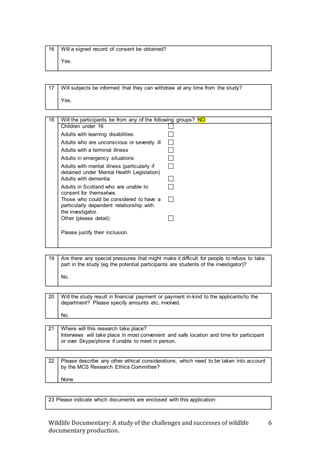
16 Will a signed record of consent be obtained?
Yes.
17 Will subjects be informed that they can withdraw at any time from the study?
Yes.
18 Will the participants be from any of the following groups? NO
Children under 16 
Adults with learning disabilities 
Adults who are unconscious or severely ill 
Adults with a terminal illness 
Adults in emergency situations 
Adults with mental illness (particularly if
detained under Mental Health Legislation)

Adults with dementia 
Adults in Scotland who are unable to
consent for themselves

Those who could be considered to have a
particularly dependent relationship with
the investigator.

Other (please detail) 
Please justify their inclusion.

19 Are there any special pressures that might make it difficult for people to refuse to take
part in the study (eg the potential participants are students of the investigator)?
No.
20 Will the study result in financial payment or payment in-kind to the applicants/to the
department? Please specify amounts etc. involved.
No.
21 Where will this research take place?
Interviews will take place in most convenient and safe location and time for participant
or over Skype/phone if unable to meet in person.
22 Please describe any other ethical considerations, which need to be taken into account
by the MCS Research Ethics Committee?
None
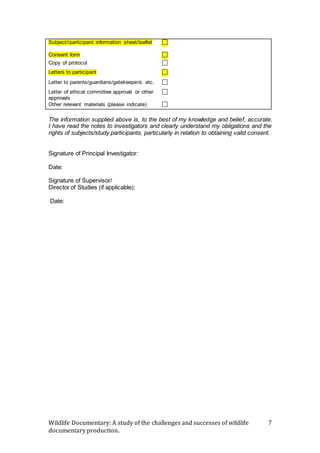
23 Please indicate which documents are enclosed with this application:
Wildlife Documentary: A study of the challenges and successes of wildlife
documentary production.
7
Subject//participant information sheet/leaflet 
Consent form 
Copy of protocol 
Letters to participant 
Letter to parents/guardians/gatekeepers etc. 
Letter of ethical committee approval or other
approvals

Other relevant materials (please indicate) 
The information supplied above is, to the best of my knowledge and belief, accurate.
I have read the notes to investigators and clearly understand my obligations and the
rights of subjects/study participants, particularly in relation to obtaining valid consent.
Signature of Principal Investigator:
Date:
Signature of Supervisor/
Director of Studies (if applicable):
Date:
Wildlife Documentary: A study of the challenges and successes of wildlife
documentary production.
8
Acknowledgements
This page is dedicated to those whom I would like to offer thanks during this
process.
To my project supervisor, Dr. Kathryn Burnett, who has supported me when in
need, yet allowed me, completely to my own devices, to run freely with this
project, without this, I fear I would not have enjoyed this process as much. Dr
Burnett gave me motivation throughout this project with her enthusiasm for my
ideas and groundwork and without that I am unsure if I would have been able to
complete the process to the best of my ability.
I would also like to give thanks to my six participants, for without them, this
would not have been possible. I am so lucky to have been in contact with such
talented, and resourceful people who, without even realising, have managed to
shape my future in ways I hadn’t even considered. For that I am thankful.
Finally, I would like to thank my family, friends and classmates who pushed me
on in times of doubt and kept me smiling until the final deadline. They made me
remember why I chose this path in education and reminded me where I would
be heading in the next steps forward.
Thank you
ForGrandma Granny – from whomI inherited my strength x
Wildlife Documentary: A study of the challenges and successes of wildlife
documentary production.
9
CONTENTS
Chapter one: Introduction 10
Chapter two: Literature Review 13
Chapter three: Methodology 21
Chapter: History of informants 27
Chapter five: Analysis 31
Chapter six: Conclusion 53
Chapter seven: Bibliography 57
Chapter eight: Appendices 60
Wildlife Documentary: A study of the challenges and successes of wildlife
documentary production.
10
Chapter 1:
Introduction
Wildlife documentary productions cover many animals and nature related topics
and issues with the main objective of such productions being to inform. With
documentary categorised as informative it is my aim in this research project to
discover if this is still the case in our ever growing and constantly changing,
technology orientated world. This research project will investigate and explore
the makers behind some of the most successful wildlife documentary
productions in the past 10 years and aims to discover their views on issues
within this style of filmmaking that I consider to be important and with a need to
be discussed and clarified. This study will look at issues surrounding wildlife
documentary productions, including animal privacy, the balance of education
and entertainment, raising awareness and the future of wildlife documentary
productions. Using a phenomenological approach, gathering qualitative data and
conducting an analysis of this data, I will aim to cover the above mentioned
issues and topics to gain some perspective from industry involved specialists,
that will allow me to compare and contrast the different views on wildlife
documentary productions and discover more about this style of filmmaking.
Through semi structured interviews with industry specialists an analysis will be
formed around the reasoning and views of these people that have dedicated their
careers and well being, sometimes with their life in danger, to make such
programmes.
The book chapter by Morgan Richards ‘Greening Wildlife Documentary’, in
‘Environmental Conflict and the Media’ (2013), discusses issues and challenges
similar to that of this study. It has been most useful in research relating to these
aims and has helpful facts and claims that will support my research. Richards’s
research and opinions on wildlife documentary have been valuable in this study.
They have created a pathway of guidance for the research aims I planned to
undertake and have become an important basis for me to relate to, something I
Wildlife Documentary: A study of the challenges and successes of wildlife
documentary production.
11
will discuss further in Chapter two. The opening quote in this book chapter is
essentially the most effective way to set the tone for the internal argument I find
myself having and now from research, can see it is one that others struggle with
too.
“The loss of wilderness is a truth so sad, so overwhelming that, to reflect
reality, it would need to be the subject of every wildlife film. That, of course,
would be neither entertaining nor ultimately dramatic. So it seems that as
filmmakers we are doomed either to fail our audience or fail our cause.”
— Stephen Mills (1997)
The cinematic and breath-taking shots in sequence are enough to make a viewer
gain interest but is there a certain loss in educational intake in these
documentaries because of the filming and level production is so powerful that
they have become more for an eye pleasing audience rather than those of more
educational outlook. Growing technology, editing and filming techniques are
pushing productions to produce higher quality images, which may be a reason
behind programmes having more of an entertainment value then educational.
This can be seen with Disney. “Disney’s breakthrough lay in its ability to
dramatize the natural world and bring wild animals and nature to life using full
colour cinematography…bringing wildlife into the mainstream.” (Richards,
2013) This study will discuss these developments throughout productions and
also the change in technology and how this effects the outlook of the final
production as it is broadcast on television or now more enticingly, on newer
mediums.
In interviews conducted, the aim is to discuss some of the main issues within
wildlife productions. There will also be questions asked to help find out more
about the production aims and to study how they are being received through
broadcasting. The interview analysis will uncover the specific reasoning for such
programmes through the eyes of the filmmakers and the decisions producers
and cameramen make, perhaps to allow the filming, with a storytelling style,
involving environmental issues within wildlife. Generally such documentaries
are made for and assumed to be of educational value. Richards stated “Wildlife
Wildlife Documentary: A study of the challenges and successes of wildlife
documentary production.
12
documentary has come to assume a key role in the public understanding of
science and environmental issues, generating popular awareness and helping to
shape public engagement with environmental politics and conflict.” (Richards,
2013) An aim of this study is to find out if wildlife documentaries succeed in this
educational aim or if the audience has simply received them as entertainment
programmes.
Another source I have relied upon throughout research, is the work of Derek
Bousé in his book ‘Wildlife films’ and his journals, ‘False intimacy: close-ups and
viewer involvement in wildlife films’ and ‘Are wildlife films really “nature
documentaries”? His work tackles some of the issues I took into account in my
research aims. Bousé states “It is easy to make entertaining pictures educational,
but to make educational pictures entertaining is a more difficult problem.”
(Bousé, 2000). There seems to be a struggle for balance within these types of
programmes and this will be discussed further in the analysis stage, as will the
work of Bousé in Chapter two.
Wildlife documentary has evolved over time, just like the worlds wildlife itself.
The progression has always been there but been steady. One of the first places
this genre spanned from was with the documentation of hunting animals in the
wild with Theodore Roosevelt in his motion picture, “Roosevelt in Africa”.
According to Mitman, the aim of the trip was to hunt, capture or kill animals in
the name of science while being filmed, in hopes this film would educate the
public on the world they lived in. It was not easy to access and film everything
they needed, so the use of photographic stills was used throughout the film.
Mitman confirms that “…Kearton spliced in a flash-picture still of a lion…”
(Mitman, 1999), which viewers complained it lacked life. Roosevelt’s failure to
fake the scenes needed to capture audiences, gave others the pathway to fill this
gap in the market by providing the same films as Roosevelt but with staged and
faked scenes that the public wanted. Mitman stated “As the Roosevelt film
proved, audiences craved drama over authenticity.” (Mitman, 1999) The work of
Gregg Mitman is also another influence into understanding where the targeted
issues may have stemmed from and I will discuss this further in Chapter two.
Wildlife Documentary: A study of the challenges and successes of wildlife
documentary production.
13
Chapter 2:
Literature Review
This chapter will discuss the academic literature and research that will be used
to define and create the knowledge and analysis for the research to build itself
upon.
Documentaries have always been seen as scientific or educational programs, a
specific genre with a specific audience. “ ’Natural history film’ and ‘wildlife film’
began to show up in trade journals around 1913. At first shot for ‘educational
purposes’.” (Bousé, 2000). There has always been a scientific educational
approach in documentary making, for the purpose of its aims in finished
productions, to inform and to educate. “Several studies have accounted for the
positive effect educational films and documentaries have on learning.” (Barbas,
Paraskevopoulos and Stamou, 2009).
In the introduction chapter, reference was made to one of the key thematic areas
of education vs. entertainment in an opening quote from the book chapter by
Morgan Richards ‘Greening Wildlife Documentary’, in ‘Environmental Conflict and
the Media’ (2013) and research aims relied heavily upon the work of Derek
Bousé and Gregg Mitman. Within this Chapter and also in Chapter three the key
thematic areas will be highlighted and discussed further, in relation to research,
supporting sources and intended analysis aims.
With a keen interest in wildlife documentary productions, I was naturally happy
to research the many varied books, documentaries and journals about these
productions in general. The difficulty came in researching the best-suited
theories for my intended approaches and aims and the more in depth
discussions about my key thematic areas. I used case studies as a guide on how
to research and analyse my findings. I also used journal libraries including
Wildlife Documentary: A study of the challenges and successes of wildlife
documentary production.
14
‘Taylor & Francis’ and ‘Sage Journals’ as well as utilising the well-stocked
university library and online articles surrounding my research.
‘Greening Wildlife Documentary’ by Morgan Richards, highlights one of my key
thematic areas and discusses how some productions have gone beyond
documenting educationally and turned to filming cinematically as a method of
production. This pushes the balance of education and entertainment over the
line towards more of an entertainment value. According to Richards “The
exclusion of environmental issues in wildlife documentary is a feature of the
generic constraints of the wildlife genre.” (Richards, 2013)
It is suggested that wildlife documentaries and series have become more
aesthetically pleasing and entertaining, which in turn is pushing the educational
and scientific factors underneath how the series looks to the viewer, which is a
result of some producer instructions for film crew as specified, “filming
instructions…related not to education but to documentary filmmaking.” (Bousé,
2000) It seems that it is not possible to have one without the other in many
genres but specifically documentary. The distinctive line that used to show the
clear-cut areas of education and entertainment separately is quickly merging
into a grey area forming more aesthetically pleasing television to retain audience
attention yet still educating those who are willing to listen and follow a series.
The work of Robert Dingwall and Meryl Aldridge in their case study ‘Television
wildlife programming as a source of popular scientific information: a case study of
evolution’ has been beneficial to the research especially regarding one of my key
thematic areas in question, education vs. entertainment. In their studies,
Aldridge and Dingwall, came to a conclusion that the change in balance, of
education and entertainment, may actually be what this genre needs for the level
of information intake to be higher, they said, “the most surprising and counter-
intuitive finding, however, is the extent to which high prestige, blue chip
programs may actually be less effective than conventionally less highly regarded
alternatives at conveying both the practice and the outcomes of science to mass
audiences.” (Aldridge and Dingwall, 2006)
Wildlife Documentary: A study of the challenges and successes of wildlife
documentary production.
15
This case study highlights one of the many differences between blue chip
programmes and other wildlife related series that have been made. One main
difference being whether or not there is presenter heavily involved in steering
the programme or not. “Wildlife programming is dominated by two sub-genres:
‘blue chip’ and ‘presenter-led.’ ” (Aldridge and Dingwall, 2006) Blue chip
programmes attempt to avoid all aspects of human culture, focussing purely on
the nature and wildlife. These productions aim to obtain audiences through
interest and learning, using what they see on screen as a hook. It is generally not
presenter lead to push the focus in one direction or another. The story is not of a
presenter and their journey but instead it is within the filming process and
scientific learning objective.
“Bousé defines blue chip as dealing with mega fauna; in an environment
of visual splendour; using a dramatic storyline; and marked by the
absences of politics, people or historical reference points. Presenter-led
or “adventure” features expanded human presence; more human/animal
interaction; dynamic editorial approaches; low costs; and quick
turnaround.”
-(Aldridge and Dingwall, 2006)
Presenter lead programmes are seen to be of “lower creative status than blue
chip with its high production values and conspicuous investment in science.”
(Aldridge and Dingwall, 2006) These two sub genres are not to be completely
separated, as it is still a fact that “blue chip programs can feature presenters”
(Aldridge and Dingwall, 2006). Sir David Attenborough is one of the main
contributors to many different wildlife and nature programs, blue chip and
presenter lead. His symbolic presence contributes to their status and his
participation views these programmes to be trustworthy of accuracy and
authenticity in the eyes of audiences. This is a type of trust that audiences may
have in nature, wildlife and real world events and most likely the news and
“research in audience trust in the accuracy of factual genres reveals an
interesting link between new and nature/wildlife programmes.” (Hill, 2005) The
news being a public service leads audiences to trust this factual content, which is
Wildlife Documentary: A study of the challenges and successes of wildlife
documentary production.
16
similar in that of wildlife and nature programming and because some of the most
successful series have been narrated by David Attenborough, he has become the
trusted voice of such programmes.
The debates in wildlife documentary filmmaking naturally pull towards the
education vs. entertainment issue but in my research I have found that there are
further debates that cover many topics, a main one that creates a key thematic
area in this research project is the worry that filming could be an invasion of
animals privacy “…the BBC acknowledges that ‘audiences are increasingly
concerned about the possible impact such filming might have on the wildlife and
their surroundings’…” (Mills, 2010) This is an on going debate as the need to
educate and raise awareness on wildlife and our planet is strong and accepted by
a wide audience within these documentaries and series productions. For this to
happen cameramen must think of innovative ways to over come the issue while
still retaining footage the desire, “…the heart of the documentary project is the
necessity for animals to be seen.” (Mills, 2010)
Although is may seem that this debate will never be settled, there is good cause
to support the reasoning behind filming wildlife and nature, for without the
education supplied by these programmes, the world may not valued as much as
it needs to be, Mills supports this by adding, “This is shown by the rationale that
often supports wildlife documentaries and the invasion of spaces by humans and
their recording technology; that showing humanity the wonders of the world is
one way to encourage environmentalism and this promotes a duty of care
towards animals.” (Mills, 2010)
On the other side of this argument there is the general fact that animals are very
intelligent and the intelligence of animals should never go unnoticed, nor should
the fact that their ‘natural behaviour’ may be affected during filming “the mere
presence of the camera can change animal behaviour – not to mention the careful
post-shot editing that has often served to heighten the ‘animal-drama’.” (Bagust,
2008) Not to affect the animals during filming is an aim that any cameraman and
production crew will have and strive to achieve throughout every production.
“Even wildlife film-makers do not get as close to animals as it appears. … With
Wildlife Documentary: A study of the challenges and successes of wildlife
documentary production.
17
long lenses, often from great distances. What defines a close-up…the framing
variable – that is, the size of the object relative to the frame.” (Bousé, 2003)
It can be suggested that there may be potential wildlife hot spots and wildlife
around the world that are being over exposed and exploited by many filmmakers
attempting to achieve the same results in filming for different productions.
Throughout many wildlife documentary productions, it has been believed that to
obtain the footage needed, some productions will go over the mark to get what
they need “…the point of Woodard's exercises was not to uncover scientific data,
but rather to film staged "dramatic" confrontations.” (Bousé, 1998) This is
another issue that can fall under the argument of animal privacy and rights.
Within the analysis chapters, I will be able to discuss this issue further with the
assistance of views and opinions from industry specialists, taken during
interview process, that have to deal with these issues in the work life every day.
During research into Disney’s True-Life Adventure films (1948-1960) I found a
good basis of argument supporting the use of over dramatized and glossy
finished productions. It is thought to be more useful for children in classes and
enhances the awareness of the natural world. Although perhaps not entirely
informative and full of educational aspects, these productions from Disney have
simplified the learning process for those who had maybe never been interested
in knowing more about wildlife and the natural world. It has proven beneficial to
this study as there is questioning over authenticity, privacy, animal rights,
audiences deception and loss of educational and scientific aspects.
Disney produced a specified format of wildlife documentary that brought it to
mainstream cinema and audiences for the first time. “True-Life Adventure series
were influential and innovative; they were also thoroughly anthropomorphic
and sentimental.” (Richards, 2013) This approach to wildlife filmmaking was not
necessarily new or ground breaking but it was in the way the Disney was able to
“…dramatize the natural world and bring wild animals and nature to life using
full colour cinematography and lavish musical scores – the full theatrical works,
designed to bring wildlife into the mainstream.” (Richards, 2013) What got
Disney noticed more and set their True-Life Adventures apart from the other
Wildlife Documentary: A study of the challenges and successes of wildlife
documentary production.
18
wildlife films out there was the “glossy finish and sense of drama… gave them a
commercial edge” (Richards, 2013) The fact that Disney was already an
established brand made the success slightly easier and they were able to link
their “Disney live action short with a Disney animated feature.” (Richards, 2013)
Audiences were more attracted to these films as “they were entertaining and
educational, but not too scientific.” (Richards, 2013) It made learning more
accessible in their own homes in a simplified format and gave families a sense of
real nature without boring or scaring them. This also opened the pathway for
raising world awareness to the public. “Disney established film as an important
propaganda tool in the enlisting of public support for environmental causes”
(Mitman, 1999). Raising awareness is another key thematic area in which this
research project, from the beginning, aimed to discuss and this will be supported
further in the analysis chapters, with the interview data from industry
specialists. Disney uncovered the market that would benefit the most from these
films. “The studio sent mass-market mailings to grade school and high schools
teachers…announcing the release of a True life adventure and the local theatre”
(Mitman, 1999). They also sent out educational pamphlets to classrooms to
accompany each film and this marketing strategy proved effective. Although for
Disney’s True-Life Adventures to be successful within this market and expand to
cover family values, the most natural of animal events had to be cut for fear of
affecting or offending audiences. “Footage of baby seals being trampled to
death…left on the cutting room floor.” (Mitman, 1999) While still intending to
create a way of learning that entertained, Disney could only achieve this by
careful editing and narration “to help soften violence” (Mitman, 1999), as Disney
wanted to present a “sentimental version of animals in the wild” (Mitman, 1999).
This research creates a more balanced argument than which we started with.
The views of industry specialists also give us this same balance within the
analysis chapters further on in this research project.
Within the education vs. entertainment argument we are able to cover the
challenges that filmmakers come across when planning for future productions.
The changes that must be made and the need to keep the industry fresh and
alive, drive new ways of filming, editing and promoting wildlife and the natural
Wildlife Documentary: A study of the challenges and successes of wildlife
documentary production.
19
world. It seems that with the ever-growing choice of programmes produced by
the ever-growing mediums of broadcasting there are demands for more from
productions, bigger, better, more unique. “Become increasingly subject to the
demands of ratings-conscious schedulers.” (Kilborn, 2006) Wildlife
programming is no exception to this. Wildlife program makers need to keep up
with these demands by developing new ideas or reinventing those already
achieved. It had been said that, “these are lean times for natural history
programming. The genre has been pushed to the verge of extinction in many
primetime slots and is being squeezed everywhere by broadcasters’ dwindling
budgets.” (Keighron, 2000) It’s a constant cycle of challenges to come up with
new innovative ideas, achieving one and developing it to broadcast and then to
have to go back to the drawing board after the hype of interest around your new
production dies down after being watched, re watched and watched again, the
pressure and demand to come up with something else soon comes back around.
At what point do these demands begin to jeopardise the aims of program
makers? And at what cost do these productions give to be noticed? “In order to
survive, wildlife program making must dress itself up more and more in the
clothes of the other entertainment formats, with which it is now competing for
slots in the schedule.” (Kilborn, 2006) This is clearly an issue that will always
surround wildlife programming but it makers have overcome this before and
will continue to, with new technology and access to wildlife creating their new
innovative ideas. The future of wildlife documentary productions creates the
final key thematic area to be discussed within this project. Over time the clear-
cut line and balance between educating and entertaining has become blurred to
allow for greater change at expanding an audience and obtaining interest. “The
question is therefore not whether TV wildlife will become part of the TV
entertainment machine. It clearly already has.” (Kilborn, 2006) If this genre is to
survive it is clear the makers must keep up with the growing demands and the
changing technology that could be the answer to the challenges of developing
new ideas. The very future of wildlife film making might well lie more in
exploiting the new ways of distributing and broadcasting that material as
Keighron says, “Just as the early bird catches the worm, the forward-thinking
Wildlife Documentary: A study of the challenges and successes of wildlife
documentary production.
20
natural history program-makers will catch the rights to exploit their footage –
across all platforms, in all formats” (Keighron, 2000).
Throughout this study it is important to me that the key thematic areas are made
known and recognised during every stage of research and analysis. These
thematic areas will stand out more in the analysis chapters of the project, as they
will be sectioned into their own sub headings allowing me to create discussion
between my research so far and data collected from different industry
specialists. Silverman stated “in qualitative thematic analysis, we seek to
understand participants meanings and illustrate the findings by extracts which
depict certain themes” (Silverman, 2014). These “themes” are our key thematic
areas, those being the main theme, education vs. entertainment, and connecting
themes, raising awareness, animal privacy and the future of wildlife
documentary productions. These are the four main areas discussed in interviews
and within research. These were areas that were given stand alone questions
during the interview process, with some probing questions in-between to keep
the interview open and semi structured allowing natural flow of conversation
and detailed accounts. This will be further discussed within the methodology
section in Chapter three.
Wildlife Documentary: A study of the challenges and successes of wildlife
documentary production.
21
Chapter 3:
Methodology
This chapter is an account of data gathering and analysing methods used and
reasons for why these particular methods were used.
In relation to the case study and literature read and discussed in chapter two, I
decided upon my methods of research and how the study should be carried out
by deciding that this would be a qualitative study as this would best serve my
purpose in research and desired outcomes. This study used relevant case study
and literature information to help base semi structured interviews with key
industry specialist within my research topic area.
This is a qualitative study with a phenomenological approach using case study
and literature research to conduct semi structured interviews with industry
specialists that have been selected through purposive sampling methods, with a
thematic analysis in mind for the collected data. I will further discuss each part of
this qualitative study in this chapter under their own sub headings. To gain the
most reliable and relatable information possible, industry specialists for the
interviews will include Doug Allan; underwater cameraman, Nigel Pope;
producer of ‘Hebrides: Islands on the edge’ and John Aitchison; cameraman and
author of ‘The Shark and the Albatross (Travels with a camera to the ends of the
earth.)’ Within this qualitative study, the aim is to source information by
conducting interviews with specifically selected industry specialists in fields of
wildlife camera work, production work and those involved in the makings of
wildlife productions in any form. It is with great passion that I research further
into wildlife documentary productions and this passion is one hopefully shared
with the chosen industry specialist as it is said that “the generativity of the
interview depends on both partners and their willingness to engage in deep
discussion about the topic of interest.” (Marshall and Rossman, 2016) In theory
to interview in person is the expectation in my research but it is in good practice
Wildlife Documentary: A study of the challenges and successes of wildlife
documentary production.
22
to keep in mind that it may not be possible with some of the selected candidates;
therefore the possibility of Skype or telephone interviews must be looked into.
Having to conduct phone interviews does not affect this particular study greatly
as “telephone interviews in qualitative researches are somewhat common”
(Lechuga, 2012). Telephone interviews will benefit this project just as much as
face to face interviews as I need not be in a particular environment with my
chosen interviewees for my desired outcome of information. While a field study
would have been greatly affective and worthwhile, it is not practical nor does it
greatly determine desired results within the interview process.
My interview questions had been clear to me at the start and only varied slightly
in word choice during interview process as the semi-structured approach
allowed for free direction of conversation throughout the interview. With the
research aim in mind and with use of literature from chapter two, I was able to
draft the right set of questions suited to my study. I aimed to have between 6-8
questions as I was interviewing only 6-8 industry specialists with intentions of
more in depth, conversational answers as opposed to short and questionnaire
type results. The final set of questions resulted in having my four key thematic
areas within them and two more probing questions, one to open up the
conversation at the beginning and the other to keep conversation flowing easily.
Wildlife Documentary: A study of the challenges and successes of wildlife
documentary production.
23
Interview Questions
Start off by asking about their interest in wildlife/nature/documentary
production? Where it came from? How it has grown? Their story of producing
how they are where they are?
(Key) Ask about their opinion on education vs. entertainment
(Key) Ask about this form of TV/broadcasting for raising awareness, the
issues?
Ask about the general process of
sourcing/filming/producing/editing/broadcasting and their involvement or
any changes within these elements over time?
(Key) Ask about animals privacy, how they respect them in their
environment, how this is portrayed. Talk about the issues raised about
intrusion.
(Key) The future of wildlife documentaries/TV shows? Next steps? Their own
future?
Wildlife Documentary: A study of the challenges and successes of wildlife
documentary production.
24
Qualitative Interviews.
As already specified, this is a qualitative study that will use qualitative research
to gain information regarding the research aim and subject in question to
construct a reliable conclusion. After finalising the research aim, exploring case
studies and literature and advice from my project supervisor, Dr Kathryn
Burnett, I knew that it was a qualitative study that I wanted to conduct to help
my investigate and explore wildlife documentary and the challenges and
successes of wildlife documentary production. Qualitative research suited my
study because I am interested in finding out the ‘how’s’ and ‘why’s’ of a subject
and it provides me with answers to questions that I am interested in. What I
needed to know in the end result lay in questions based on feelings and personal
situations that needed to be supported with ‘how’ and ‘why’ questions rather
than questions that resulted in numerological answers and stats. The four
methods within qualitative and quantitative research, according to Silverman,
2013, are, Observation, Textual analysis, Interviews or Transcripts. In qualitative
research the Observation method is “fundamental to understanding another
culture.” The textual analysis method “understands participants’ categories.” The
interview method is “‘open ended’ questions to small samples” and finally the
Transcript method is “used to understand how participants organize their talk
and body movements.” (Silverman, 2013) For my research study I knew I wanted
to talk to industry specialists about wildlife documentary productions and gain
their views on some of the issues, therefore the qualitative research method of,
interviews with open ended questions to small samples, fitted extremely well to
my study and would be able to support and produce the data needed for the
results in this study. Qualitative interviewing suits my study and has produced
the desired data as will be seen further on in the analysis chapters.
Semi-structured and Phenomenological approaches
With Qualitative interviewing being my chosen research method, the next step
was to research and continue with semi-structured interviews with a
Wildlife Documentary: A study of the challenges and successes of wildlife
documentary production.
25
phenomenological approach. Semi-structured interviews allowed me to use my
set questions as a guide which did not necessarily need to be asked in any
particular order or wording and gave me opportunity to let the interviewee talk
feely with option of using follow up ‘probing’ questions as a response or change
in direction of topic. The beauty of this technique is that no interview will be the
same or have the same structure of answers. There is flexibility and in the words
of Roulston, “although the interview guide provides the same starting point for
each semi-structured interview…each interview will vary according to what has
been said” by each individual. (Roulston, 2010) Although many other interview
techniques may have worked, I decided against structured interviews as this
may have left no room for interviewees to talk freely about personal experiences
and may have confined my data to a small set of short answers. I also chose to
shy away from unstructured interviews as this would have resulted in many
interviews with no clear direction and results would have made analysis too
hard to have a clear comparison, as “talk may not generate useful data, given that
any and every topic can be introduced at any point by either of the speakers”
(Roulston, 2010).
Within this qualitative study the use of a phenomenological approach is to
highlight a focus on people's interpretations of the world and their subjective
experiences, as in this research study I want to understand how the world of
wildlife documentary production and its issues appear to others, for example,
industry specialists. Roulston stated that the purpose of the phenomenological
interviewing technique is to “…generate detailed and in depth descriptions of
human experiences.” (Roulston, 2010) These “human experiences” would be
what interviewees would be able to talk about in relation to the key thematic
areas within questions asked during the interview process and this can be
recognised within the analysis chapters further on in the study.
Sampling
In this study, from the beginning, I had chosen to interview industry specialists
in order to generate the desired results. This is what is known as purposive
sampling. I chose my sample interviewees, directly and on purpose as they
Wildlife Documentary: A study of the challenges and successes of wildlife
documentary production.
26
worked in or were part of the industry related to wildlife documentary
productions. These were the people I wanted to hear from about their
experiences in relation to the issues I desired to find out about. It was said by
Silverman, 2013, that purposive sampling “illustrates some feature or process in
which we are interested” which suits this particular research project as wildlife
documentary production and its issues highly interest me and to document
opinions and personal experiences from industry specialists only heightened my
reasoning for choosing this research aim in the beginning.
Thematic analysis
The process of analysis could only start after interviewing had taken place and I
had transcribed said interviews. During the process of transcribing, I began my
thematic analysis by highlighting my key questions and interviewee responses to
these questions and looked for comparisons or differences to support or create
balanced argument in final analysis stage. By further exploring these highlighted
key points, I was able to relate to my use of literature from chapter two and the
details of interview questions to display my key thematic areas of the research
study just as Braun and Clarke, 2006 stated, “A theme captures something
important about the data in relation to the research question, and represents
some level of patterned response or meaning within the data set (Braun and
Clarke, 2006). Later on in chapter 5 the aim is to analyse the information gained
and use this to build an understanding of the issues and change of wildlife
documentary productions, answering questions of how production has changed,
if it has, what it is that filmmakers do to maintain and increase the popularity of
wildlife documentary and what they may see changing in the future, if anything.
As Silverman said “Qualitative methods are best suited if you want to ask ‘what’
and ‘how’ questions.” (Silverman, 2014) This is best suited to the study as the
desired outcome is for current discussion on productions and up to date
information on issues and successes of such productions.
Wildlife Documentary: A study of the challenges and successes of wildlife
documentary production.
27
Chapter 4:
History ofinformants
My first interview began with producer Nigel Pope, whom I managed to
interview in person at his office in Film City, Glasgow. Each interview opened
with the question of how they informant became to work in this industry and
their background relating to wildlife. Nigel began by explaining that he first
began work for The RSPB on nature reserves and then on children’s television
relating to wildlife and nature and that wildlife had been a part of him all his life.
“Somehow the person who was the producer on the ‘Really wild show’,
which used to be a popular children’s TV wild show, got in touch with me.”
“I was always passionate about it since I was a really small boy… I was just
very young in a push chair and that was the beginning of it really, it never
left me, so it’s been with me all my life.”
Nigel went on to talk about his most recent success, ‘Hebrides: islands on the
edge’, which has been a passion project that Nigel continued to work on over two
years.
“There are things you do which are just passion projects. And one of those
was the Hebrides: Island on the edge series. Where I’d wanted to make a
series about the west coast of Scotland for years, as it’s a place I really love,
and I’d spent some time up here as well.”
Nigel openly talked about some of the challenges he has found recently and the
investigation in detail over such issues will be discussed further in the next
chapter during analysis.
“Engaging audiences is getting harder and harder, the whole broadcast
landscape has radically changed.”
Wildlife Documentary: A study of the challenges and successes of wildlife
documentary production.
28
The remaining five interviews all took place over the phone as participants were
on filming locations, or simply situated to far to travel for interview purposes.
John Aitchison was first interview over the phone and this seemed to work just
as well being face to face with Nigel Pope and did not jeopardise the research
study. All informants were asked the same opening question.
John Aitchison is a wildlife filmmaker who works for the independent production
company Otter Films Ltd. He is also the author of The Shark and the Albatross
(travels with a camera to the ends of the earth), published recently in the UK by
Profile.
“When I left university I went to work for the RSPB, they used to make 3 half
hour films every year about birds, so it was a really good place to work.”
“From really quite young, as early as I can remember, but it didn’t dawn on
me until I was a teenager that I could get a job like this and so the job side
of it came later and it wasn’t very clear on how to get a job into this area.”
John also worked on the programme, ‘Hebrides: Islands on the edge’, with Nigel
Pope and he talked about how his position in a production may vary depending
on the story.
“I do whole programmes or work on programmes where I have been
involved in the idea, so then Id be wearing another hat which is more a
producers hat, but I might be filming on that programme, as well like ‘The
Hebrides: Islands on the edge’ and sometimes there is an in between
situation where I might come across an idea or a story which the producers
of the programme haven’t seen…I’ll be sent out to go and film that thing
because I got it to them, that happens occasionally as well.”
Doug Allan is a freelance wildlife and documentary cameraman who films both
topside and underwater. He contributed to series like, ‘The Blue Planet’, ‘Planet
Earth’, ‘Life’, ‘Human Planet’ and ‘Frozen Planet’, from which he has made over 70
filming trips.
Wildlife Documentary: A study of the challenges and successes of wildlife
documentary production.
29
“Well really I wasn’t one of these people born to be a wildlife filmmaker.
Wildlife filmmaking came along eventually after my degree. My first passion
was diving and that took me to a degree in marine biology.”
“So I went to the Antarctic when I was 24 years old and it made a serious
impression on my life, I went there once, then I went there twice, and then
back again and it was a very special place, I saw filming as a way to show
people just how spectacular it was and it was really no more than that.”
Mateo Willis has worked on a number of blue-chip productions over the last five
years including ‘Life Story’, ‘Wild Arabia’, ‘Frozen Planet’ and ‘Human Planet’. He
was part of the camera team for the ‘Frozen Planet’ episode “To the Ends of the
Earth" which won Emmy and BAFTA awards for cinematography.
“I had grown up in different parts of the world including Africa, where I’d
come across wildlife cameramen who were working on projects for the BBC
and that sort of thing so I had had an introduction to the business when I
was young and then I moved into camera work and television work later on
in life and it just seemed to be a natural fit.”
“I started off shooting for the ‘making of’ productions on the big blue-chip
series, like ‘Frozen Planet’ and ‘Human Planet’ about 6 or 7 years ago…film
the little 10 minute making of for the end of the programmes. Then that
way I got contacts with producers and other cameramen.”
Michael Pitts specializes in filming underwater and is regarded as one of
Britain's leading underwater cameramen. He has received Emmys for
cinematography on two BBC landmark series: David Attenborough's 'Private Life
of Plants' and 'Blue Planet'.
“Well I start out quite a few years ago, I was actually working as a
commercial diver in West Africa, I was always interested in diving, but I saw
Wildlife Documentary: A study of the challenges and successes of wildlife
documentary production.
30
the marine life that lived by the oil rig and so I decided to make a little
film…permission from the company I was working for, to be able to actually
spend the odd evening or afternoon diving on the oil rig which was covered
in corals and fish, the further out the rigs, the better the clarity of the water
but that’s how I got my first interest.”
“I was trying to get into filmmaking and they said, “If you have a proper
camera, we will commission you.” I had to buy a camera.”
Raymond Besant is a wildlife cameraman and photographer from the Orkney
Islands. He specialises as a long lens wildlife cameraman, filming a wide range of
programmes for the BBC Natural History Unit and BBC Scotland, most recently,
'Highlands - Scotland's Wild Heart' with Maramedia for BBC Scotland.
“It was an interest growing up and watching wildlife documentaries, birds
were my favourite. I grew up in Orkney, so there were always lots to see. I
got into photography as a teenager; just recording things I was seeing in
terms of the wildlife.”
“The interest in wildlife was always there. By the time I was in my late
twenties, I was thinking, if I really wanted to be a wildlife cameraman, I
really needed to get my finger out and figure out a way to make that
happen.”
From the beginning, sourcing my industry specialists took some time but once I
managed to interview my first three participants, they were able to recommend
previous co-workers to me and I maintained contact with 8 or 9 overall
participants and selected the 6 most appropriate to my study. This chapter has
allowed for an introduction to my participants and their passion for wildlife and
their backgrounds. The next chapter will discuss in more detail the key thematic
areas during this research study and informants views and opinions throughout
the interview process.
Wildlife Documentary: A study of the challenges and successes of wildlife
documentary production.
31
Chapter 5:
Analysis
This chapter will explore further, the key ideas and themes from within the
interviews and that also relate to academic literature form chapter two. The key
thematic areas recognised for discussion in interviewing were; Education VS
Entertainment, Animal Privacy, Raising awareness, Changes and Audience, and
The future of Wildlife documentary. Each area will be discussed using comments
and statements raised within interviews by interview participants, Doug Allan,
John Aitchison, Nigel Pope, Mateo Willis, Michael Pitts and Raymond Besant.
Each of the interview participants work within the industry of nature and
wildlife documentary and have worked and still work within many series,
documentaries and television shows, such as ‘The Frozen Planet’, ‘The Hunt’,
‘Spring/Summer/Autumn/Winter watch’, ‘Hebrides; Islands on the edge’ and ‘Blue
Planet’. This research project aims to investigate and explore the makers behind
some of the most successful wildlife documentary productions in the past 10
years and aims to discover their views on issues within this style of filmmaking
that I consider to be important and with a need to be discussed and clarified. The
outcome of interviews has allowed previous statements and discussions to be
either supported, or argued or has introduced new theories to the discussion.
The analysis will look at key thematic statements and opinions from all interview
participants and compare and contrast these views while being linked to
academic resources from research.
Part 1: Education VS Entertainment
Education VS Entertainment is one of the main areas researched within this
study, it is the discussion of how documentary may have changed in order to
maintain popularity or how audiences respond to glossy images rather than
educational information, or even how filmmakers get their ideas commissioned
Wildlife Documentary: A study of the challenges and successes of wildlife
documentary production.
32
to begin with. The main interview question was what do you think of the balance
between education and entertainment?
“I think the information content in a lot of wildlife films is less than it used
to be. I think that sometimes there are a lot of wildlife films, in my
experience, where storyline has given way to spectacle…with documentaries
20 years ago trying to teach ecology, the study of interrelationships of
animals whereas if you take ‘The Hunt’, even ‘The Frozen Planet’, they are
just really films about places, there is not the same intricacy of
storyline…Above all it has to be, it should be entertainment, it has to be
entertainment, but I think the level of information and the level of concepts
that we should be trying to get over could be much higher than it is… It
seems that is it the picture that is most important, it is not the information,
and it is all about the spectacle rather than story.” (Doug Allan)
Mateo Willis agrees with Doug Allan on the balance of entertainment over
education content within the programme.
“I think that they have slanted towards the entertainment side rather than
the educational…you need to have something that is generous enough that
will allow enough people to watch it because it has to have a critical mass
behind it.” (Mateo Willis)
Although Mateo also makes the good point of the change in times with
broadcasting mediums and how new, diverse ways of educating, are already in
place. Something I touched on during research, in chapter two. The very future of
wildlife film making might well lie more in exploiting the new ways of
distributing and broadcasting that material as Keighron says, “Just as the early
bird catches the worm, the forward-thinking natural history program-makers
will catch the rights to exploit their footage – across all platforms, in all formats”
(Keighron, 2000).
Wildlife Documentary: A study of the challenges and successes of wildlife
documentary production.
33
“What we have nowadays is programmes that are perhaps slightly less
educational but they often come with packages underneath them that
provide more information that what we would have had before…now it is
more up to the audience, if the audience wants more then they can go and
find that information. I don’t think you can force-feed them education, I
don’t think this is the right way to do it.” (Mateo Willis)
Raymond Besant makes comment that relates to Morgan Richards’, ‘Greening
Wildlife Documentary’, when he states, “the exclusion of environmental issues in
wildlife documentary is a feature of the generic constraints of the wildlife genre.”
(Richards, 2013) This book chapter was heavily relied upon during chapter two
and has proven relevant in relation to the interview analysis.
“I think there is almost a reluctance to get involved educating in the
conservation side of things because it can be quite difficult to explain
something so simply about things that are really quite complicated so you
don’t want to dumb down the subject… I think when people watch it, they do
find it genuinely amazing and interesting but I’m not sure that they then
take it any further. I think that there is that balance between trying to
engage with people who aren’t necessarily that bothered with the animals
or environment because I think a lot of these projects and programmes are
appealing to people that are already interested.” (Raymond Besant)
The distinctive line that used to show the clear-cut areas of education and
entertainment separately is quickly merging into a grey area forming more
aesthetically pleasing television to retain audience attention yet still educating
those who are willing to listen and follow a series. Bouse states that “It is easy to
make entertaining pictures educational, but to make educational pictures
entertaining is a more difficult problem.” (Bouse, 2000) This is something that
Nigel Pope touched on and made good reference to.
“The best way that anybody learns anything is by engaging in
entertainment. I think it is increasingly important to try and engage people
Wildlife Documentary: A study of the challenges and successes of wildlife
documentary production.
34
and you can engage people by entertainment. So actually I don’t think its
possible to do education without entertainment…Attenbourghs ‘Life on
earth’, which was in 1979, 40 years ago, look at that and although bits of it
feel dated, the way its shot, the way Attenbourghs’ in vision a lot, in a way it
actually feels a bit like a lecture, but the thing that makes it so watchable is
the good story and that’s he is a good storyteller… education and
entertainment go hand in hand if you want to educate someone, its got to be
entertaining, and if its an entertaining documentary its not really a
documentary without some meaningful factual content.” (Nigel Pope)
Growing technology, editing and filming techniques are pushing productions to
produce higher quality images “to dramatize the natural world and bring wild
animals and nature to life using full colour cinematography…bringing wildlife
into the mainstream.” (Richards, 2013) This is an area of discussion that John
Aitchison recognises and relates to when he comments.
“It is possible because they are so spectacular looking that they could dilute
how educational they are…you could say that some of these films are there
to be spectacular and don’t have much content, for instance one trend at the
moment is not to say where the animals are, maybe only say which
continent they are on. If the programme is about a type of habitat like
grasslands the producers seems to think that the audience is less confused if
they are unaware of where in the world these different sequences are
filmed, so the grasslands is all one place, and in my view that is entirely the
wrong thing to do, the more information that is included… in terms of
where they are is quite a fundamental thing and might not do any harm at
all to say its Africa or in the Serengeti that this happens, because it does
happen so you could say there has been some dumbing down.” (John
Aitchison)
Even the loss of simple information like where a place is can have an effect on
the usefulness of the programme. If an aim for these programmes is to educate
and raise awareness then it is unsuccessful because the audiences don’t know
where the endangered animals or places are. Although there is also the other
Wildlife Documentary: A study of the challenges and successes of wildlife
documentary production.
35
side of this agreement that may say, if people know about these places and see
them shot beautifully then they will want to visit and build on these areas and
exploit the beauty and this is something to be discussed later in the analysis
within the raising awareness section.
Michael Pitts explains the on going debate he seems to have and one that I, too
can relate to, as on one hand these programmes, according to Bouse, “…they have
become an entertaining art” (Bouse, 2000), but on the other hand have “come to
assume a key role in the public understanding of science and environmental
issues, generating popular awareness and helping to shape public engagement
with environmental politics and conflict.” (Richards, 2013)
“Look at programmes like, ‘The Hunt’, it is absolutely beautifully shot, you
see everything in super slow motion and everything, but the bottom line is
that the producers will say we are showing you something that you would
never ordinarily see… but really you watch them and it is glossy
entertainment as a opposed to education. People watch that and think that
looks absolutely beautiful, you get lulled into it, the lovely music, and its
scenic and you’re in this remote location but it is entertainment. On the
other hand I suppose you are trying to win over people, it is like running an
advert on TV, you must sell the product.” (Michael Pitts)
Doug Allan is worried about the programmes that need to be made, are the ones
that no one is willing to commission and that there is a responsibility by the BBC
as a public broadcast service. These programmes are of high educational values
that regard conservational issues that need to be acknowledged.
“We are just having the biggest climate change and probably the most
important climate change ever, show me a single programme on BBC1 or
BBC2, in the last 6 weeks that has dealt with the climate change. There isn’t
one. That, in my eyes, is a terrible, sad aggregation of responsibility and
public liability that the BBC is showing. The BBC is a public responsive
organization, they have a duty to show any issues and educate people and in
Wildlife Documentary: A study of the challenges and successes of wildlife
documentary production.
36
this case, I think, they have utterly and lawfully failed… I still think it shows
a total lack of courage at the top and a total lack of imagination at the top
for them to be saying that they don’t think they could make something
interesting or because the public isn’t interested. Well they should be doing
their part to make the public interested, because they are highly important
issues.” (Doug Allan)
It seems that the entertainment value has perhaps gone too far already and that
the BBC may stuck in a loop, having to fund programming and needing to make it
more entertaining so it can be viewed and sold more widely in order for them to
fund the next important issues. It now seems as if they make aim to make money
to fund and commission a worthy helpful programme but are too afraid it wont
be as successful and popular as something more entertaining and they don’t
make enough money to budget for the next programme.
The general outcome of this theme is that, although the balance is important
there are valid points made on both sides of the scale. Education and
entertainment do seem to need one another to survive within broadcasting and
even if this balance shifts from time to time, more so recently towards
entertainment, there are newer ways to share the burden of completing all aims
of production. After the production of BBCs blue planet and planet earth, there
has seemed to be a spike for these types of television programmes “48% of the
UK population watched at least 15 minutes of ‘Frozen Planet’ (2011), a
remarkable figure considering the fragmentation of audiences brought about by
the rise of digital broadcasting and online media.” (Richards, 2013) This rise of
digital broadcasting and online media seems to be the direction these wildlife
series are heading in. Hosting information on more accessible mediums allows
audiences to gain information when they want it. The downside to this is it may
only be of interest to those who already take on board what the documentaries
and series are made and aiming to do. Therefore by removing information from
something to make it more entertaining and offering the information elsewhere,
there is a chance that the information on a separate medium is completely lost
and audiences then see only the entertainment factor of the package, allowing
Wildlife Documentary: A study of the challenges and successes of wildlife
documentary production.
37
them believe all is well within the planet when in actual fact the reason the series
is being broadcast was initially intended to educate audiences of the problems
and dangers the nature world faces.
Wildlife Documentary: A study of the challenges and successes of wildlife
documentary production.
38
Part 2: Animal privacy
Animal privacy is an important factor within wildlife filmmaking. It is an on
going issue and will always be at the front of filmmaker’s minds. The main
interview question regarding this theme was, how do you feel about animal
privacy and what do you do in order to maintain respect of the animals and
environment?
It is clear that “the BBC acknowledges that ‘audiences are increasingly concerned
about the possible impact such filming might have on the wildlife and their
surroundings’.” (Mills, 2010) It is also clear that from the interview data, it can
be said that each participant has their own set of ethics as well as those enforced
by employers.
“Well when you go into a rainforest or you go underwater, just by that you
are disturbing that environment and you have to do it in a way which you
are respecting what lives in that forest or on that reef, you don’t start
breaking bits of the coral off or walk on the coral. You just have to treat it
with respect, its like being in a china shop like you wouldn’t go in there like
a spinning top.” (Michael Pitts)
It is also an obvious aim that it is natural behaviour that you are looking to film
so you need to aim for that and that “the mere presence of the camera can
change animal behaviour – not to mention the careful post-shot editing that has
often served to heighten the ‘animal-drama’.” (Bagust, 2008)
“I think it partly comes down to the individual involved and how they feel
about how far they will go in order to get a shot so I think I’m always pretty
wary and aware of the effects of disturbance because it can be quite subtle
sometimes… if they are doing well then they either get advice form RSPB or
someone that knows that areas that knows that particular bird or animal
that could say ‘it would be better if you just stayed a certain distance
away…you are really looking for is natural behaviour and that is not going
Wildlife Documentary: A study of the challenges and successes of wildlife
documentary production.
39
to happen if you are right on top of the animal or too close and I think
generally wildlife cameramen have a pretty good knowledge of wildlife
overall, they have an interest.” (Raymond Besant)
Although Derek Bousé makes a valid point in this argument that does not bode
well for the integrity of wildlife filmmakers and he states that “evasive filming
techniques that allow filmmaker to probe, to prod and to reveal are not
discouraged, providing for entirely different kinds of behaviours to be
shown…usually without objects from either subjects or the audience.” (Bousé,
2000)
“We tend to work with a strict set of ethics, which is partly dictated by the
organisation we work for, so say the BBC or other big independent
companies we work for, but I think what you will also find is that the
majority of cameramen will have their own set of ethics, that has stemmed
from an upbringing around wildlife, watching the animals ever since they
were kids and all the cameramen I have worked with have a pretty clearly
defined sense of what is acceptable and what is not. The holy grail of wildlife
filming is to capture natural behaviour that is not modified by human
presence, now obviously to a certain extent your never going to get pure
natural behaviour because by the mere fact of having a camera there you’re
putting something into the animals environment that is not natural…I think
there is always a fine line, you’ve got to be very careful and always keep the
animals welfare at the front of your mind and the need of your production
should never overwhelm the rights of the animal you’re filming, if you know
what I mean. The animal always comes first, in every respect. I don’t see it
as a problem and certainly as time has gone by there is more emphasis
placed on ethics and I think that is a good thing, its more and more at the
forefront of peoples minds.” (Mateo Willis)
Bousé states in his book, ‘Wildlife Films” that, “many wildlife shots are routinely
obtained through concealment, that might be seen as unethical if dealing with
Wildlife Documentary: A study of the challenges and successes of wildlife
documentary production.
40
human subjects instead of animals.” (Bousé, 2000) An example of this is the use
of hides for filming birds as John explains.
“I think it is really important and we haven’t got any right to go somewhere
and disturb or work in a business to the detriment of any animal at all…if I
am deciding what to do, how to film something, the very first priority is, will
it affect the animal? We use hides a lot for that reason when filming birds,
there are ways to use hides which are minimally disturbing… some are very
sensitive to the reflections in the glass in the lens, you’ve got to be really
cautious and if its obviously not working then I immediately pull out and I’ll
move the hide. Its vital to do that.” (John Aitchison)
Nigel Pope raises the point of over crowding in some popular filming locations,
which is worrying for the animals and the environment where they are filming
and also the fact that these locations may then become a popular area for
tourists and it has been said, “human movement around the world for leisure
purposes is seen to have significant environmental effects, particularly as ‘In
many cases it is the non-human members of our ecological community that are
hardest hit by tourism.” (Mills, 2010)
“Well we wouldn’t achieve the level quality we achieve if we went around
disturbing animals in their natural environment, what we are trying to film
is them naturally anyway so our ethical code is pretty rigorous and the way
we film stuff is generally using scientists or experts or people who see this
stuff day to day so you know we don’t just walk up and start chasing stuff
around because that wouldn’t produce the results we’re after… I think it has
gone a bit too far because certain spots have turned into wildlife
filmmakers’ circus. There is so much programming being created that yeah I
think ethically some production companies and producers are pushing it a
bit and trying to get more content out of a place that just can’t handle it.”
(Nigel Pope)
Wildlife Documentary: A study of the challenges and successes of wildlife
documentary production.
41
Doug Allan has similar thoughts and brings into consideration the use of new
technology for filming to create distance between filmmakers and the animals,
just as suggested by Bousé when he states “wildlife filmmakers regularly use
long telephoto lenses to get close ups, often resulting in an illusion of close
proximity to the subject.” (Bousé, 2000)
“You might find people thinking, ‘well a scientist does it so its ok’, but there
are some scientists whose morals and whose respect for wildlife and welfare
for the subject is clouded by the fact that it if for science so they need to get
what they went to get. It is a very grey area it depends on your own morals
and respect. If someone were really intrusive that would raise the issue. The
BBC insists that if anyone is unhappy that there is a way of raising those
issues. There are always going to be grey areas. I think that with new
technology like the cineflex camera is wonderful stabilised camera system
that allows you to unobtrusive… on the other hand the public are expecting
more and more intimate views of what we film, and it may just be that we
need to look at each case and each animal individually with their different
reactions and environments. If you are really unhappy about the effects of
filming then you notify the producer and tell them what is happening and
your concern.” (Doug Allan)
This theme was one that all the interview subjects agreed on when it comes to
filming and respecting animal privacy. It seems that being passionate for wildlife
has given them their own ethics but also the companies they work for share the
similar ethical code for filming the animals and environments. They regard
animal privacy and respecting the environment highly within their careers and
know how important is to maintain this and pass this way of working on to other
filmmakers and the audiences. Mills raises a question that I myself hadn’t
thought much about but now see it would have been a more critical question in
the interview process. “The question constantly posed by wildlife documentaries
is how animals should be filmed: they never engage with the debate as to
whether animals should be filmed at all.” This statement is one I regret I did not
Wildlife Documentary: A study of the challenges and successes of wildlife
documentary production.
42
pursue further as I feel it may have opened up even more discussion from
participants, as filming animals is 90%, if not 100% of their career.
Wildlife Documentary: A study of the challenges and successes of wildlife
documentary production.
43
Part 3: Raising Awareness
It has become clear that raising awareness is a big aim for this form of
programming and that it is an element most filmmakers will try to succeed in
making known. The main interview question regarding this theme was, what do
you think about raising awareness and do you think these programmes achieve
this?
Mills stated “Wildlife documentaries are therefore understoodas an ethical way
to ‘raise the audience’s awareness of the world around them and teach them
about the environment’.” Something most interview participants will agree on.
“I think that more so recently that they have tried to get the conservation
message as well as the fun side of it so they do quite a mix of different style
of things on the watches…’Winterwatch’ was more like a wildlife news
programme, it was really what was happening that week and this once
concentrated on the effects that the weather was having on the winter
wildlife because there had been lots of flooding and they investigated that
and they did a programme on how planting trees could help.” (Raymond
Besant)
Michael Pitts thinks that it is the younger generation that has been targeted and
that people are taking more notice of the world we live in and this may speak
truth as for raising world awareness to the public, “Disney established film as an
important propaganda tool in the enlisting of public support for environmental
causes” (Mitman, 1999).
“People say younger people are more aware now, all age groups actually,
older people now look at it and you look at what is happening to the world,
the changes that are taking place and I think everybody is more aware now
that we have a very precious planet. The barrier reefs series, I’ve just
worked on, the big one with David Attenbourgh, just won its first big award,
that programme really dealt with what is happening on the great barrier
Wildlife Documentary: A study of the challenges and successes of wildlife
documentary production.
44
reef. We all think of the great barrier reef is this beautiful reef and even that
is under pressure and the reef you see now is 50% less than what it was in
1960, because of how much coral has died, it is incredible. It looks beautiful
but actually so much of it has already gone.” (Michael Pitts)
When talking about “popular arts, for example film,” Curtis said, “Such features
make the arts a valuable tool to raise awareness and highlight particular issues.”
(Curtis, 2011) Willis agrees there is some notion of raising awareness but he also
notices that it is not a final fix, it is only a link in the chain and more could be
done to help.
“I think that the more we can perhaps share the mystery and wonder of the
natural world the more care and attention it has. I think as we become
more urbanised, people lose touch with the natural environment to a
certain extent and one of the few ways that we have in connecting with
wildlife species is with watching them on television and most of these
animals, none of us will ever get to see, because they live in the deepest of
oceans or polar regions or tops of mountains or deepest jungles and so to
see the behaviour and stories I think this allows us to understand a little bit
more about what is happening in the natural world. So when it comes to
appreciation of it and therefore perhaps taking some steps to conserve it, I
think they have some affect, I don’t think it is a one stop solution, I think it is
part of the toolbox to going in some way to doing something about it. I don’t
think there is any doubt that the natural world is in trouble, it is certainly
the one thing I have seen from growing up in it as a kid, now I go back to
film a lot of these places and there is just a shear number of people on the
planet, there is no two ways about it, everything has so much greater
pressure on it.” (Mateo Willis)
This is a point that Doug Allan also goes on to discuss and it is a catch-22 that is
in the industry and looks to always be in the industry. The aim is to make people
aware of the problems on this planet but to do this filmmakers need to show off
these problems and the planet which means stress and pressure can be put on
Wildlife Documentary: A study of the challenges and successes of wildlife
documentary production.
45
these specific areas when filmmakers go to capture their needed footage, but if
they were to refrain from doing anything at all the situation would only worsen,
quicker.
“People around the world need to be shown the wonders of the world in
order to appreciate it, people will not protect what they don’t understand, I
think there is an element of truth in that… what usually happens is that
when we show people wonderful things, more people want to see those
wonderful things for themselves, which brings more pressure on the remote
wild areas of the planet, and you feel like you can’t share this because if you
do people will go and build hotels there and I think by showing nature and
all its wonder and how wonderful it is like it has no problems, then people
don’t actually think that there is problems and you can always add on at the
end, a bit of news, that it looks like there are problems and it is hard to
integrate that into wildlife series and you don’t see things like that because
they would fade very quickly and if you show those issues that you’ve filmed,
you give it a very short shelf life and you make it harder to sell on television.
The fact that they may do some good is neither here nor there and I don’t
think they do any good and they must be blinding people from the real
issues.” (Doug Allan)
Unfortunately Doug Allan has made the most controversial point within this
study of this theme and it is one that is contradicting to his own career and work
he has done before but this shows that he has credit in being able to point out
these issues because he knows that these programmes may not working they
way they had expected or hoped and even having the opposite effect. This
something that is also pointed out by Mills in saying “it is shown by the rationale
that often supports wildlife documentaries and the invasion of spaces by humans
and their recording technology; that showing humanity the wonders of the world
is one way to encourage environmentalism.” (Mills, 2010) This is the reasoning
behind making such a footprint on the environment. It seems that a little
pressure on the world from filmmakers to help raise awareness is better than
the world having no awareness at all. It is a small price to pay and sacrifice that
Wildlife Documentary: A study of the challenges and successes of wildlife
documentary production.
46
apparently needs to be in place. On the other hand because these series, as Doug
stated above, are not hard hitting enough on the conservational aspect, the
audiences do recognise that the world is suffering and in danger as this
apparently would not make for good television.
Nigel Pope also recognizes that a newer, more diverse form needs to be
produced but he points out why it may not be possible.
“I mean one of the ways we are diversifying with the company is
increasingly we are working with partnerships with NGO, were making a
couple of programmes just now, for something called the peoples
partnership, and their environmental awareness docs, and hopefully they’re
entertaining too, they’re about Scotland…so its really critical actually, but it
needs some big gestures from broadcasters to make a difference and I don’t
see that that happening at the moment, I don’t see that from the BBC and I
think those broadcasters could go a wee bit further. The BBC would argue
that it’s not within their remit, but that’s a bit of grey area, I think other
people like David Attenbourgh would actually challenge on that.” (Nigel
Pope)
John Aitchison has similar views to Doug and Nigel as he points out only one
major independent movie has managed to come forward with a real impact on
what is going on in the natural world.
“’Racing Extinction’ is an independent movie and what I understand they
put on discovery that it’s the actual film and that’s a really hard hitting film
about conservation but also the beauty of nature and we could’ve done that
on television and we could have been doing that on television for 20 years
but we haven’t been, we’ve been keeping nature fascinating and then
separately nature in trouble and its not much of the latter really. It doesn’t
really give a coherent message in my view.” (John Aitchison)
Wildlife Documentary: A study of the challenges and successes of wildlife
documentary production.
47
Overall this theme had been the most interesting to discuss as it has a balance in
opinion and debate. Although they can all agree that in some way these
programmes do raise awareness but it seems that the subjects with more
experience and years on their career have already noticed the problem with
trying to raise awareness using this specific form of documentary. They have
noticed that the biggest message that they need to convey is missing. They can
see that something more needs to be done but this is hard to make possible
without the support from companies and bigger broadcasters.
Wildlife Documentary: A study of the challenges and successes of wildlife
documentary production.
48
Part 4: The future of wildlife documentary
The future and where wildlife documentary is heading is a factor that is
interesting to discuss. It opens up possibilities of new approaches, ideas and
generates discussion of multimedia broadcasting. The main interview question
regarding this theme was, where do you see the future of wildlife filmmaking and
how do we achieve this?
“I think yeah, there will always be future, with the licence fee of the BBC, but
its down to small independent production companies around the country…I
think the BBC with the licensing fees, they get money in Bristol and they still
make the big blue-chip series because the can still sell them worldwide, they
go to America, Germany, Australia, all over the place, they always sell those,
it is not a problem. It is the lesser programmes, the half hour programmes
on say six hours on birds of Britain, and those sorts of things don’t sell so
well…I think that the big blue-chip series are going to be much more
reduced…what they may well do is create links for YouTube and just do it
like that.” (Michael Pitts)
Nigel Pope agrees in the sense that it seems is may no longer be as confined to
television and has the potential to move with times onto more popular mediums
and recognises that there are demands for more from productions, bigger, better,
more unique and “become increasingly subject to the demands of ratings
conscious schedulers.” (Kilborn, 2006).
“Well Netflix have just commissioned one of the most expensive natural
history series ever, Amazon are watching very carefully to see what
happens, so yes I am sure there is a future for it. How it expresses itself in
terms of the shape of what is commissioned and how it is created and where
is ends up, I don’t know but yeah I think there is a market for sure.” (Nigel
Pope)
Wildlife Documentary: A study of the challenges and successes of wildlife
documentary production.
49
Raymond Besant also agrees that online is a place where everything seems more
important and noticed and it is a good way forward for the future and maybe
‘online’ something that could help save budgets as Keighron states, “the genre
has been pushed to the verge of extinction in many primetime slots and is being
squeezed everywhere by broadcasters’ dwindling budgets.” (Keighron, 2000).
“There is still a lot of content being made and I think what you’ll probably
continue to see is these kind of blue-chip series that have the programme on
the end basically rather than messages right through those programmes,
essentially they are films about animal behaviour, I think for those top end
blue-chip films you will continue to see behaviour based films with possibly
a film at the end dedicated to conservation work that is going on with the
animals in the series. I think as far as programmes like the watches go, I
think they’re probably actually a really good vehicle for getting people
involved with wildlife conservation because they have not just the
programme now but they have ‘Unsprung’ afterwards, specific things, you
have an entire team dedicated to online content so as well as the
programme, there is always stuff being updated on twitter and Facebook
pages. That is a really powerful way of getting messages across and if you
look on Twitter I think they have thousands of followers so it seems a good
vehicle to me to promote issues.” (Raymond Besant)
Although according to Richards “The landmark format proved to be a hugely
popular format. ‘Life on Earth’ attracted average UK audiences of 15 million – an
exceptionally high figure for a documentary at that time on BBC2 – and an even
larger global audience.” (Richards, 2013) Times have changed and the move
from television broadcasting to online content seems ever more likely now but
Mateo Willis is adamant that won’t make too much of a difference and that there
will always be a place for these programmes no matter what happens.
“I think that as long as there is always a natural environment, then there
will always be a market for it, there is always a need or desire from an
audience to watch natural history programmes. There is always a certain
Wildlife Documentary: A study of the challenges and successes of wildlife
documentary production.
50
element of the population that are going to want to watch natural history
programmes because they are entertaining, because they take you to a
different world that you have no experience of, because they are
educational, for a multitude of reasons. I think that the way we make the
programs and the scale and size that we make the programmes will change,
it is very much an industry that is in transition at the moment because there
are so many changes… It is not a stable industry and who knows what will
happen but there will always be a market for them.” (Mateo Willis)
John Aitchison thinks these programmes will grow more globally depending on
the intentions of filmmakers and commissioners. He has also pointed out that
Britain seems to be a bigger target for wildlife filmmaking and that audiences
seem to already be interested but what stands out in his eyes is that it is places
out with the UK that need to be gripped and influenced by these programmes to
really make a difference.
“There are two things there and one is, what the programme makers do and
the other is what the audience or commissioners do…they each have a
different aim in terms of how popular they want the thing to be, in terms of
style but also in their expectation of how many people are going to watch it
so a programme on BBC1 will be much more liked on the information than a
programme on BBC2, the one on BBC4 might have a much more intense
concentration level required where you might be listening to someone talk
about photosynthesis or something which they almost would never touch on
BBC1 their themes are going to be about hunting or babies or growing up so
in the future I think probably those divisions will stay but I suspect that as
they reach, they expand, so now if programmes made on BBC1 used to be
aired on BBC1, in the UK and online might be sold abroad on what channel
it can at that time and then in time I think it is just going to be available
globally and people can pay for it and download it and that will be that. I
suppose the most poplar programmes that will determine the trend will be
the ones that are globally popular and appeal to a much broader range of
people and to be honest the most broad range of people in the world know a
Wildlife Documentary: A study of the challenges and successes of wildlife
documentary production.
51
lot less about and a lot less interested in and care less about wildlife than
people in Britain do on average, I think. In our history in this country it has
been one of animal welfare and tolerance of animals and interest in natural
history.” (John Aitchison)
It is now apparently common knowledge that “The British have rediscovered
their age-old passion for wildlife” (Moss 2012), as John discussed when talking
about the future of wildlife programming and that it is outwith the UK that need
to become interested and gripped by such programmes.
Doug Allan stands by his views on how informative these programmes are or are
not and would like to see more education then entertainment within these
programmes, something that will actually help make people aware and make a
difference.
“Well we have beautiful, voluptuous pictures and they are becoming lovelier
than they have ever been, we are seeing more and more of these films of the
natural world and maybe we will just keep on reinventing the wheel. What
I’d like to see is a better and newer story telling technique and storytelling
being developed along with high end filming of wildlife. I would like to see
more documentaries commissioned about the issues and more scientists and
their work. I would like to see a higher level of information. The place where
you can go to learn about something is now not television, its radio. I think
there is a gap and BBC4 is trying to fill it and I think the commissioners in
general are still missing this. It is hard because these things need to be
simplified and charismatic to work but with more to it, they could be more
effective.” (Doug Allan)
Doug makes a good point in saying that radio is now becoming a better medium
than television for these issues that need to be raised as “radio material is
relatively cheap to produce”(Aldridge and Dingwall, 2003), but is still adamant
that companies and commissioners are not seeing this yet. This may be because,
according to Aldridge and Dingwall the “core domestic audience for Radio 4 is
Wildlife Documentary: A study of the challenges and successes of wildlife
documentary production.
52
taken to be mid-life, comparatively well-educated adults” (Aldridge and
Dingwall, 2003) and this may not be the audience that commissioners feel they
want to reach out too, as these audiences are already interested and the need to
create interest from those who do not already tune in.
Overall the theme of where the future is heading for these programmes is
something that no one can tell us for certain. It is in hope that the audiences
grow and these issues become noticed more but it comes down to the fact that
the information is not out there and doesn’t seem to getting pushed out there
yet. Therefore there will the cycle of trying to reinvent what has already been
done, trying to make series and programmes more popular online or via Netflix
but it essentially wont make a difference if the audiences are not receiving the
information and learning about the issues that need focused on.
The final comment I will make in this chapter is that the choice for a qualitative
study with a phenomenological approach has definitely been suitable. Using case
study and literature research to conduct semi-structured interviews with
industry specialists that have been selected through purposive sampling
methods has proven beneficial to this study and use of thematic analysis to
identify key themes and ideas has also determined the desired results for this
particularly open ended research study.
Wildlife Documentary: A study of the challenges and successes of wildlife
documentary production.
53
Chapter 6:
Conclusion
In this final chapter are my conclusions in which I will detail final statements on
previous chapters and organize the gathered information to create my final
outcome regarding wildlife documentary productions and its challenges and
successes. I will also take this opportunity to reflect on my research and take
note on aspects of this research project where I could have made changes to
benefit the outcome further.
This qualitative study set out to investigate and explore the production of
wildlife documentaries and the makers behind some of the most successful
wildlife documentary productions in the past 10 years. Intended aims were, to
discover their views on issues within this style of filmmaking that I consider to
be important and with a need to be discussed and clarified, including animal
privacy, the balance of education and entertainment, raising awareness and the
future of wildlife documentary productions. The research project reviewed and
analysed information collected through the process of phenomenological, semi-
structured interviewing with participants specialised within the field of wildlife
documentary production.
The interview data produced the individual opinions and varied views from
participants on the main key thematic areas in question. This study has shown
clearly that there is a lack of information, nowadays in programmes that were
aimed to be informative, raise awareness and help in the issues surrounding the
subject within the documentary. Filmmakers aims are to raise awareness, make
it known that there are issues out there that audiences need to take note of,
assist with and help prevent further problems in the future. Unfortunately the
catch-22 is that by making such films, they may be jeopardising the issues in
hand or sometimes making a situation worse when the programme is produced
in order to help protect and prevent further destruction.
Wildlife Documentary: A study of the challenges and successes of wildlife
documentary production.
54
It is clear now that through the previous chapters the balance of education and
entertainment has shifted, raising awareness may not be as successful as hoped,
the debate around animal privacy is one that is on-going and that only the
environment can secure a future for the animals and planet as well as the future
for wildlife documentary. This conclusion is a result of academic sources used in
chapter two and interview data detailed in chapter four.
One of the greatest outcomes of this study, for myself, has been the varied
opinions and views that have supported my initial thought but even more so,
those that have made me question some aspects of my own opinion regarding
the key thematic areas of this study. It has opened my eyes further in depth and
has allowed me to gain greater understanding of important issues within wildlife
documentary productions. I am now keen to strive on and generate further
research into creating a new direction for the future of such productions, one
that is sorely needed within this industry, one that highlights fully the
conservational issues this planet is undergoing at this moment in time. As
mentioned in part one of the analysis chapter, education vs. entertainment, Doug
Allan stressed that, “we are just having the biggest climate change and probably
the most important climate change ever…The BBC is a public responsive
organization, they have a duty to show any issues and educate people and in this
case, I think, they have utterly and lawfully failed… I still think it shows a total lack
of courage at the top and a total lack of imagination at the top for them to be
saying that they don’t think they could make something interesting or because the
public isn’t interested. Well they should be doing their part to make the public
interested, because they are highly important issues.”
I now see that, as a viewer I had always been fascinated by such programmes
and because of my own generated interest, I sought out to further educate myself
by watching as many programmes as possible and through this study, reading as
much academic literature as much as possible. I can also admit the failure of
recognising the missing conservational issues that I only ever heard about on the
news or in some articles I happen to come across. It was only after my interviews
and towards the end of this study that I really began to look further into what
Wildlife Documentary: A study of the challenges and successes of wildlife
documentary production.
55
was truly lacking in documentation and awareness within television
broadcasting of wildlife and nature, the conservational issues of this planet.
In the analysis section of this study, I chose to build on key themes and ideas to
create support and argument from each participant. Generally all participants
seemed to be on the same wavelength regarding each key theme except for some
minor personal views that would go against research or other participant
opinion. I have been lucky in that the data gathered has mainly been strong on
agreement from all participants but in hindsight, I would perhaps have sought
out slightly more varied individuals, possibly one from each station of a
production team, instead of six cameramen/producer figures. The data gathered
may have been more varied in order to raise question or balance and desired
argument highlighted in research, which would entail for a more exciting
analysis and over all outcome. In saying this, I am more than content with the
data gathered and have gained valuable skillsets from this research study and
the only problem I had to overcome was two cancellations regarding interviews,
which was easily solved by having two back up participants.
At the beginning of this study, I had a high regard for such programmes and the
aim was to raise points on some issues within this style that are questionable
and highlighting that maybe a balance has shifted but it has been recognised that
these programmes may no longer be as good and helpful as first thought to be. In
regards to Doug Allan and his comments during the analysis of raising
awareness, he stated “The fact that they may do some good is neither here nor
there and I don’t think they do any good and they must be blinding people from the
real issues.” (Doug Allan) I think this is a vital piece of information to come out of
this study as it shows that in the end you can explore and discuss all the issues
involved in such productions but in the end, the results only matter if they are
actually, truly making the desired difference, which from Doug Allan’s point of
view, they are not. In my own opinion I agree with Doug Allan and can truly say
the result of some wildlife documentary productions are from satisfactory in
covering the four key thematic areas and in hindsight, they barely even touch on,
troubling, conservational worldwide issues regarding planet earth.
Wildlife Documentary: A study of the challenges and successes of wildlife
documentary production.
56
If more time had allowed, and perhaps in the future, a follow up study could be
an option as I feel this study deserves more time and a more in depth aim and
outcome. There is so much to be discussed and explored in this area of
broadcasting that a mere one student research project has not done the vast
opportunity of information much justice. I believe through my new academic
research skills and enhanced interest in relative case studies I would be able to
engage further into a more academic account of information regarding wildlife
documentary production and acknowledge the conservational issues that are
sorely lacking coverage.
It can safely be said that this research project has altered my views that were
maintained when the project first began and that it has successfully penetrated
the surface into the world of wildlife documentary production along with its
challenges and success that have been noticed, yet more so issues, than
successes in the end.
Wildlife Documentary: A study of the challenges and successes of wildlife
documentary production.
57
Chapter 7
Bibliography
Aldridge M and Dingwall, D. (2003). ‘Teleology on Television? Implicit Models of
Evolution in Broadcast Wildlife and Nature Programmes.’ European Journal of
Communication 18(4), pp. 449, SAGE Publications. [Online] [SAGE] Available at
Aldridge M and Dingwall, D. (2006). ‘Television wildlife programming as a source
of popular scientific information: a case study of evolution,’ Public understanding
science, 15(2), pp. 137. London: SAGE Publications [Online] [SAGE] Available at
http://www.tara.tcd.ie/bitstream/handle/2262/51819/PEER_stage2_10.1177
%252F0963662506060588.pdf?sequence=1&isAllowed=y
Bagust, P. (2008), Screen natures‘: Special effects and edutainment in new‘
hybrid wildlife documentary.’ Journal of Media & Cultural Studies, 22(2), pp. 217.
[Online] [Taylor & Francis]
Available at http://dx.doi.org/10.1080/10304310701861564
Barbas, T, Paraskevopoulos, S and Stamous, G. (2009), ‘The effect of nature
documentaries on students’ environmental sensitivity: a case study,’ Learning,
Media and Technology, 34(1), pp. 61. [Online] [Taylor & Francis]
Available at article: http://dx.doi.org/10.1080/17439880902759943
Bousé, D (1998), ‘Are wildlife films really “nature documentaries”?’, Critical
Studies in Mass Communication, 15(2), pp. 60. [Online] [Taylor & Francis]
Available at http://dx.doi.org/10.1080/15295039809367038
Bousé, D (2000), ‘Wildlife films.’ USA, University of Pennsylvania press. Pp. 7, 37,
66, 58.
Wildlife Documentary: A study of the challenges and successes of wildlife
documentary production.
58
Bousé, D (2003) ‘False intimacy: close-ups and viewer involvement in wildlife
films’, Visual Studies, 18(2), pp. 130. [Online] [Taylor & Francis]
Available at http://dx.doi.org/10.1080/14725860310001631994
Braun, V. and Clarke, V. (2006) ‘Using thematic analysis in psychology.’
Qualitative Research in Psychology, 3(2). pp.82. [Online] [Taylor and Francis]
Available at http://dx.doi.org/10.1191/1478088706qp063oa
Curtis, D. J (2011) ‘Using the Arts to Raise Awareness and Communicate
Environmental Information in the Extension Context’, The Journal of Agricultural
Education and Extension, 17(2), pp. 190. [Online] [Taylor and Francis]
Available at http://dx.doi.org/10.1080/1389224X.2011.544458
Hill, A (2005). ‘Reality TV; audiences and popular factual television.’ Routledge.
Oxon. Pp. 59, 62. [Online] Available at
http://eclass.uoa.gr/modules/document/file.php/MEDIA118/reality%20tv/%C
E%92%CE%BF%CE%BF%CE%BA_reality%20tv.pdf
Keighron (2000). ‘Lessons learned from the reality formats.’
[Online] Available at
http://www.ejumpcut.org/archive/jc48.2006/AnimalTV/animaltv2.html
Kilborn, R. (2006). ‘A walk on the wild side: the changing face of TV wildlife
documentary.’ [Online] Available at
http://www.ejumpcut.org/archive/jc48.2006/AnimalTV/
Lechuga, V (2012). ‘Exploring culture from a distance: the utility of telephone
interviews in qualitative research’, International Journal of Qualitative Studies in
Education, 25(3), pp. 264 [Online] [Taylor & Francis]
Available at http://dx.doi.org/10.1080/09518398.2010.529853
Wildlife Documentary: A study of the challenges and successes of wildlife
documentary production.
59
Marshall, C and Rossman, G, B. (2016). ‘Designing Qualitative Research.’ 6th ed.
London: SAGE Publications, Inc. pp. 148.
Mills, B. (2010). ‘Television wildlife documentaries and animals' right to privacy.’
Journal of Media and Cultural Studies. 24 (2). Pp. 195, 195, 200. [Online] [Taylor
& Francis] Available at
http://www.tandfonline.com/doi/pdf/10.1080/10304310903362726?instNam
e=University+of+the+West+of+Scotland+%28UWS%29
Mitman, G (1999). ‘Reel nature.’ Cambridge, mass: Harvard uni press. Pp. 7, 9,
111, 113, 130.
Moss, S (2012). ‘Springwatch British Wildlife.’ BBC Books, HarperCollins UK pp.
2.
Richards, M (forthcoming 2013). ‘Greening Wildlife Documentary.’ in Libby
Lester and Brett Hutchins (eds) Environmental Conflict and the Media, New York:
Peter Lang. pp. 3,4,5,7,11. [Online]
Available at http://www.abc.net.au/cm/lb/5617726/data/greening-wildlife-
documentaries-data.pdf
Roulston, K (2010). ‘Reflective Interviewing.’ London: SAGE Publications, Ltd. pp.
15, 16, and 17.
Silverman, D (2013). ‘Doing Qualitative Research.’ 4th ed. London: SAGE
Publications, Inc. pp. 124, 148.
Silverman, D (2014). ‘Interpreting Qualitative Data.’ 5th ed. London: SAGE
Publications, Inc. pp. 27, 226.
Wildlife Documentary: A study of the challenges and successes of wildlife
documentary production.
60
Chapter 8
Appendices
1 Information sheet 61
2 Consent 63
3 Transcripts 70
3.1)Nigel Pope 70
3.2)John Aitchison 76
3.3)DougAllan 83
3.4)Mateo Willis 88
3.5)Michael Pitts 93
3.6)Raymond Besant 98
Wildlife Documentary: A study of the challenges and successes of wildlife
documentary production.
61
1) InformationSheet
Wildlife Documentary: A study of the challenges and successes of wildlife
documentary production.
You are being invited to take part in a research study. Before you decide whether
or not to take part, it is important for you to understand why the research is
being done and what it will involve. Please take time to read the following
information carefully.
The aim in this research project is to investigate and explore the production of
wildlife documentaries. This study will cover topical issues, such as the
education vs. entertainment debate, animal privacy, raising awareness and the
future of wildlife programming. The study will run between November and
March. Interviewing process will take place in the months of November and late
December/early January.
I am asking you to participate in this study as I feel your expertise, knowledge
and views on the subjects for discussion will highly benefit the research and
support my study. It is up to you to decide whether or not to take part. If you do
decide to take part you will be given this information sheet to keep and be asked
to sign a consent form. If you decide to take part you are still free to withdraw at
any time and without giving a reason.
If you decide to take part, the location of interviewing will be selected by where
is most convenient you will take no more than half an hour of your time. If
unable to attend face-to-face interviews then a Skype or phone call interview is
possible, if that is better suited to you timeframe or needs. This interview will
also be audio recorded, please specify if this will be a problem.
All information collected about the individual will be kept strictly confidential if
the participant wishes to be anonymous. The data will be protected on one
Wildlife Documentary: A study of the challenges and successes of wildlife
documentary production.
62
laptop and stored with password protection. If the participant is happy to be
named in the study then there will be no need for anonymity.
The data generated in the course of the research will be kept securely in paper or
electronic form for a number of years after the completion of this research
project.
The results of the research study will be produced in a dissertation, Wildlife
Documentary: A study of the challenges and successes of wildlife documentary
production. The final piece will be held in UWS Ayr library for the public. A copy
can be obtained by participants if the wish.
I am conducting this study as a BA (Hons) Broadcast Production student at the
university of the West of Scotland Ayr.
The research study has been reviewed by Kathryn Burnett, BA (Hons) Broadcast
Production supervisor, UWS Ayr.
Thank you for taking this time to review the information sheet.
10th November 2015
Contact for Further Information
Fiona Donaldson
BA (Hons) Broadcast Production UWS Ayr.
Email - donaldsonf55@yahoo.com or telephone 07944541757
Wildlife Documentary: A study of the challenges and successes of wildlife
documentary production.
63
2) Consent
All participants gave consent for the purpose of this study and were happy to be
audio recorded and full data that has been gathered to be used. As Nigel Pope
was the only participants interviews in person, his consent for is signed by hand,
the remaining five participants all sent in emails of consent.
Wildlife Documentary: A study of the challenges and successes of wildlife
documentary production.
64
Wildlife Documentary: A study of the challenges and successes of wildlife
documentary production.
65
John Aitchison
Wildlife Documentary: A study of the challenges and successes of wildlife
documentary production.
66
Doug Allan
Wildlife Documentary: A study of the challenges and successes of wildlife
documentary production.
67
Mateo Willis
Wildlife Documentary: A study of the challenges and successes of wildlife
documentary production.
68
Michael Pitts
Wildlife Documentary: A study of the challenges and successes of wildlife
documentary production.
69
Raymond Besant
Wildlife Documentary: A study of the challenges and successes of wildlife
documentary production.
70
3) Transcripts
Each transcript has colour coded highlighted paragraphs indicating change in
key themes and matching responses for ease of analysis process.
All transcripts are from audio-recorded interviews, all of which are included on
the CD rom at the back of this project in hard copy. Unfortunately Raymond
Besant’s interview is the only one missing from audio recording copies as it had
been mistaking deleted from an SD card used during the process of filming my
creative project. This is however, a lesson learned in the case of backing all files
up at the time of interview!
Nigel Pope
F) Just want to start of by finding out how you got into this area of work and how
your career began?
N) So, I got into the whole thing by accident really, I had been working for The
RSPB on nature reserves, inventing games for children to play relating to the
environment, so the could be making cardboard beaks, collecting plastacine
worms, making birds and just crazy things like that. And somehow the person
who was the producer on the Really wild show, which used to be a popular
children’s TV wild show, got in touch with me, and said “ we’ve heard about
these crazy games that you’ve invented”, and basically I went into the office and
they offered me a job as a researcher and my first job was making up wacky
games relating to wildlife for children’s TV, that was the beginning.
F) So would you say you’ve always been passionate about wildlife?
N) I have, yes, I was always passionate about it since I was a really small boy, I
had a favourite auntie that used to take me for walks, and along country lanes
and she would be pointing out blue tits, rabbits, horses and farm animals. I was
just very young in a pushchair and that was the beginning of it really, it never left
me, so it’s been with me all my life.
F) I just want to ask, where the idea came from for Islands on the edge, why you
pushed for that and made that a topical programme?
N) Well making up ideas and selling them is a big part of what we do, where it
comes from is really random. A lot of what we do is generated by having
meetings, and we have great researchers, and we have good producers, and we’ll
sit around and knock ideas backwards and forwards, and that’s one way of
developing stuff, and then there are other kinds of things you do which are just
passion projects. And one of those was the Hebrides: Island on the edge series.
Where I’d wanted to make a series about the west coast of Scotland for years, as
it’s a place I really love, and I’d spent some time up here as well working for
CBBC, and I’d actually left the natural history unit in Bristol, and was looking for
some stuff to do independently, myself and the cameraman pitched the show to
Wildlife Documentary: A study of the challenges and successes of wildlife
documentary production.
71
BBC Scotland and they commissioned it, which was a really big break but I have
to say we didn’t put masses of development time into it, it was a real passion
project. Luckily it was an instant commission. So that was jus something we’d
always fancied doing and that just set us up as an independent production
company and went on, luckily to be very successful.
F) So, are you very hands on producer? Do you do some camera work and film?
N) I am pretty hands on, I think when you’re a small production company, and
we are pretty small, part of a bigger group now but we are still quite small,
everybody has to do everything, if you interviewing a producer in the BBC you’d
find it a little more formal and who’s allowed to do what and when, but our team
at maramedia is basically about half a dozen people so we all do everything, so
we all take turns in making the tea! But we do, we take turns and I’m very hands
on, so I’m exec producer and series producer but I will also actively make bits of
the programme, write commentary script, find contributors, make phone calls,
do bits of research and yeah I’ll do a lot of things, and it would be impossible to
make a series like this if I wasn’t so we all have to do everything.
F) How would you compare Islands on the edge to anything you’ve done before?
Like Big Cat Diary?
N) Well everything sort of informs and helps with anything you do next, that’s
the really interesting part of a career in TV production, Islands on the edge was
pretty radically different to anything I’d done before, by far the longest
production I have ever made or been involved in, it was the best part of three
and half years long, that production. It was a long running thing and it was a
blue-chip show so no people in it, just pure animal behaviour, but actually in
terms of the story telling involved, its actually very similar to stuff like big cat
diary, where we very carefully crafted story lines, interwove them in a
programme, a lot of blue-chip nature shows, like the ones still going out at the
moment, stuff like The hunt or Frozen planet, are enormous, epic productions,
but they tend not to worry too much about a story line, it tends to be procession
of acts which are all superb and beautifully filmed but in our world we tend to
try work a little bit more with story because we have to because we don’t have
those sorts of budgets very often, so if we have a good story involving an otter
family or sea birds or red deer then we’ll try and interweave it over the course of
the programme but that process is informed by what we found out doing Big cat
diary and also what we found out doing Springwatch where we sort of pushed
the boundaries a little bot on how you could do British wildlife. So yeah, so there
are some core rules and values, which help with the next thing you, do but
generally the best thing in the world is to rip it up and start again if you are brave
enough to do that.
F) So would you say the storytelling process is something that should be in these
types of programmes or anything involving wildlife, do you think it should be
there?
Wildlife Documentary: A study of the challenges and successes of wildlife
documentary production.
72
N) Generally people don’t watch anything if there’s no story it would be hard to
watch any kind of entertainment show, documentary, children’s programme,
wildlife show, if there wasn’t a story of some sort. It underpins everything, If I
said The hunt doesn’t have a story then I would be too harsh as there is an uber
story throughout the whole series, which is understanding that there is more
than one-way, animals hunt other animals. So that’s a great big story and well 4
and half million people watch the show so there is obviously something keeping
them in there. And engaging audiences is getting harder and harder, the whole
broadcast landscape has radically changed, its much more driven by online, and
YouTube and digital and clips and moments and actually what you’re having to
do is try and make every single second count which is very difficult, and we try
not to have a single second of boredom where people can become disengaged
from is and across and hour of blue-chip natural history, that’s quite difficult.
You have to keep building in the hook, and the little teasers that just keep people
on the edge of their seats for the next bit. It’s very important.
F) On a basis of entertainment vs. education do you think that has throughout the
years of documentary filmmaking, do you think it has maybe pushed itself
towards more entertainment than education? Or do you think its still quite
balanced?
N) I think genres are a bit more blurred, I mean, entertainment underpins
everything, so I think ever the worlds driest teacher, in the dustiest classroom
would say that the best way that anybody learns anything is by engaging in
entertainment. I think it’s increasingly important to try and engage people and
you can engage people by entertainment. So actually I don’t think its possible to
do education without entertainment. They’re not mutually exclusive you know.
The division used to be a little bit more clean cut, less channels, it was very clear,
this is an educational programme and this is an documentary programme, this is
an entertainment programme and if you go back and look at wildlife
documentary, even 20 years ago, I don’t think people would watch it now
because, the pace is really slow, they’d find the commentary really dry, things are
moving on and developing all the time, but good story telling underpins
everything, if you go back and look at one of biggest natural history programmes
of all time, which was Attenbourghs ‘Life on earth”, which was in 1979, 40 years
ago, look at that and although bits of it feel dated, the way its shot, the way
Attenbourghs in vision a lot, in a way it actually feels a bit like a lecture, but the
thing that makes it so watchable is the good story and that’s he is a good
storyteller and it almost transcends that and the story telling is entertaining, so I
think education and entertainment go hand in hand if you want to educate
someone, its got to be entertaining, and if its an entertaining documentary its not
really a documentary without some meaningful factual content.
F) Another issues I’ve been reading about are people having problems with
animal privacy and that filmmakers and documentary makers are invading their
privacy for the sake of some shots, what are your thoughts on this?
N) Well we wouldn’t achieve the level quality we achieve if we went around
disturbing animals in their natural environment, what we are trying to film is
Wildlife Documentary: A study of the challenges and successes of wildlife
documentary production.
73
them naturally anyway so our ethical code is pretty rigorous and the way we film
stuff is generally using scientists or experts or people who see this stuff day to
day so you know we don’t just walk up and start chasing stuff around because
that wouldn’t produce the results we’re after. But yeah it can get out of hand and
you can get hotspots around the world like the Maasai Mara and certain polar
bear sights like Churchill but I think it has gone a bit to far because certain spots
have turned into wildlife filmmakers’ circus. There is so much programming
being created that yeah I think ethically some production companies and
producers are pushing it a bit and trying to get more content out of a place that
just can’t handle it.
F) But on the other side of that, do you think it is important that documentaries
and series like these are trying to raise awareness of animals and the planet? Is
that an aim that you will keep pushing towards?
N) It is yeah, I mean one of the ways we are diversifying with the company is
increasingly we are working with partnerships with NGO, were making a couple
of programmes just now, for something called the peoples partnership, and their
environmental awareness docs, and hopefully they’re entertaining too, they’re
about Scotland, and we’ve been commissioned to make that as an information
tool, the tool that opinions can be formed and used so it’s a different kind of film
and without those partnerships we can’t effectively work anyway, so yeah its
really critical actually, but it needs some big gestures form broadcasters to make
a difference and I don’t see that that happening at the moment, I don’t see that
from the BBC and I think those broadcasters could go a wee bit further. The BBC
would argue that it’s not within their remit, but that’s a bit of grey area, I think
other people like David Attenbourgh would actually challenge on that.
F) So back to broadcasting, do you think there is still a market for wildlife
documentaries and series to continue?
N) Definitely, there is a vast market, its harder and harder though to raise the
budgets that you need to make the stuff that’s a level of quality that people
expect, from the BBC. The BBC is slightly under siege in terms of how much
money the BBC can pay out to a producer in the form of license fees, increasingly
the BBC is driven by commercial pressure, if the product from the BBC is not
delivering commercially, then its more and more difficult for the BBC to actually
make them so yeah the landscape is changing but it’s a difficult environment.
F) So do you think the amount of wildlife documentaries and series have
expanded over the years? If maybe the audiences have expanded, causing more
programmes to be produced?
N) Well it amazes me how solid the audience for natural history is, it always
finds and audience, I mean audiences overall have fragmented and reduced but
natural history is one of the more solid audiences, certainly on UK channels, The
BBC, channel 5, it sort of has diversified, but the core stuff is still watching animal
behaviour in the wild so however much you want to play with it and mess
around with storytelling and introduce presenters and stuff, if that bit isn’t seen
Wildlife Documentary: A study of the challenges and successes of wildlife
documentary production.
74
properly, you know, served, portrayed, there is not much there unless its pets
and zoos which is like networks like net geo wild, most of their schedule is pets
and zoos which is very little on net geo wild that is actually wild.
F) When coming up with ideas, through to production and producing, what is
your thought process from start to end? Does is change throughout filming or do
your aims for the end change?
N) Yeah, well you kind of sweat blood to get the thing commissioned and its
agony, and then it gets commissioned, and everybody dances for joy, and then
the there is the thought of “oh, we actually need to make this now” and then you
get stuck in and then it’s a bit of rollercoaster ride. Our current production, The
Highlands, we’ve been making it for two years and we haven’t finished it but
we’ve gone along this interesting path and like I said, there’s moments where we
all jump up and cheer, there are moments where we are all drowning in misery,
and the weathers so rubbish or the animals don’t turn up, but it gradually evens
out. The nice thing about projects like Hebrides or the Highlands is that they
have what I would say are long tales, it resonates around for a long time, it is a
quality production so that does get bought and sold internationally, and are
around for quite a long time. The Hebrides is still being transmitted all around
the world which is really nice and there is the kind of legacy value as well
because series like Hebrides, tangibly increased tourism visits to the island so
economically its helped the island and its helped Scotland so there is a nice local
dimension to what we do.
F) So when it comes to filming people or animals, what are your preferences and
what is the difference for you? Is it nicer to film animals and not have to deal
with people?
N) It’s a different discipline really, in filming terms, for a natural history
programme, I’m really not a very patient person at all, I’m very impatient, so
there is aspects of natural history filmmaking, traditional blue-chip aspects, a lot
of what we do that drives me nuts, I am not much good on location for more than
a couple of days, waiting for something to happen. My natural attitude is for
children’s programmes, and presenter led stuff, and that’s probably where I feel
most at home on location, going out and shooting a short piece with a presenter
or something. Every bit of the operation has a different sort of discipline, every
animal has its own different rules, every habitat has its own different rules, its
very deeply specialised, in a way that you could work at it for a hundred years
and still really not know very much, that’s why there are so many specialists,
polar specialists, macro specialists, bird specialists, tiger specialists, and you get
each little animal that we film in Scotland and we’ve worked with it and we find
out some of the rules of how you film that animal like an animal like an otter, it’s
a very familiar animal, very attractive and very beautiful but it’s a very difficult
animal to find, it’s a very difficult animal to observe for any length of time, its
therefore very difficult to film, so the people that film that need to make rules for
the field, to understand the wind, to understand how to film them, the need to
second guess where the otter will be next and you only really learn that when
you’ve been around them so gradually the people who are very good in terms of
Wildlife Documentary: A study of the challenges and successes of wildlife
documentary production.
75
cameramen, they build up a portfolio of knowledge and it can take them years,
having said that, our main cameraman is only 25 and he is probably the best guy
in the UK to film, and the reason for that is he is been working with them since he
was 12, he is got a very interesting story actually, but he is our lead cameraman,
its quite and amazing achievement.
F) As a producer what are your next steps? And your aims next?
N) We’re trying to do another blue-chip series, I think we’d like to do more
programming where we worked with NGO alongside us, like our RSPB thing, I’d
like to another people film, we’ve got a brilliant scientist in South America that
we’ve been working with and we’ve been developing ideas for two years, I’d love
a completed film with this guy, I’m sure we will at some stage. I’d be happy for us
to carry on like that with a blue-chip series and a couple of people programmes,
we’re a kind of boutique sort of company, and that’s fine, I’m very comfortable
with that.
F) And what about wildlife series and documentary, do you there is always going
to be a future for them? Or could it be disappearing?
N) Well Netflix have just commissioned one of the most expensive natural
history series ever, Amazon are watching very carefully to see what happens, so
yes I am sure there is a future for it. How it expresses itself in terms of the shape
of what is commissioned and how it is created, I don’t know but yeah I think
there is a market for sure.
Wildlife Documentary: A study of the challenges and successes of wildlife
documentary production.
76
John Aitchison
F) Just want to start of by finding out where your interest for nature spurred
from and how you got into this area of work and how your career began?
J) I think the most important thing is that for a while I worked for the RSPB for
their film unit, I was a student so I did a geography degree, I did do some filming
as I was interested and tried to find out more about it at the time. When I left
university I went to work for the RSPB, they used to make 3 half hour films every
year about birds, so it was a really good place to work. It was a great place
because there were lots of people getting started or recently making films in
different capacities. I didn’t do any filming for them, I was a researcher, and I did
budgets and producing, but we used to be able to borrow the cameras when they
weren’t being used for anything else. I could learn what was required and then it
became clear that if I wanted to do filming as well as producing, then I needed to
practice doing it and the best way to do that was to buy a camera. I bought a
video camera in Hong Kong and made films for Wildlife international and an eco
tourism company in New Zealand and the US wildlife service in Alaska and then
eventually the BBC.
F) So have you always had an interest in wildlife from a young age anyway?
J) Yes, from really quite young, as early as I can remember, but it didn’t dawn on
me until I was a teenager that I could get a job like this and so the job side of it
came later and it wasn’t very clear on how to get a job into this area. In the past
the BBC had cameramen and they were involved in making wildlife films, but as
times gone by it has been clear that there weren’t that many people in their staff
and most of it was freelance.
F) Do you feel like it is an area of TV and broadcasting that has expanded over
time? And is it raising awareness on wildlife issues and animals?
J) I don’t think it has expanded, but the impression I get is maybe, it expands and
contracts. TV has been making films about wildlife for a long time, but are there
more films now about wildlife than there were about 20 years ago? I’m not sure,
there might be. But if you included children’s programmes on wildlife then yes
perhaps there are. In terms of the bigger programmes about wildlife for general
TV, I would think maybe the numbers are not that dissimilar now to what they
were 20years ago.
F) Do you think they are a good way of raising awareness to today’s issues?
J) Yes, I think they are a good way of raising awareness or at least raising
awareness about animals. I don’t think they’re a very good way of raising
awareness on conservation issues at all because the impression that most
programmes give is that there isn’t any conservation issue at all and if they do
cover conservation then they tend to be much less popular with the audience. If
they try and slip conservation in at the end of the series, I think everybody
knows that the first few programmes, in terms of audience, are the ones that
Wildlife Documentary: A study of the challenges and successes of wildlife
documentary production.
77
matter. It is quite common in the audience that they watch the wildlife
programmes at the beginning and not the conservation ones at end. So in my
opinion, I think its necessary to integrate conservation in the main story and
make it as compelling as the main wildlife story. It’s a hard thing to do and not
many people are brave enough to try.
F) Do you think that could be a way forward for these kinds of programmes?
J) I’d love to see it yes, I do think it’s a way forward. One film, I think it was on
last night actually, on discovery channel in this country and it is interesting that
it’s on discovery channel because they’ve gone wildly against anything with
much practical wildlife basis and having been keen on it before. They went
against it for a while but seem to be coming back to it again. It was called Racing
Extinction. It is an independent movie and what I understand they put on
discovery that it’s the actual film and that’s a really hard hitting film about
conservation but also the beauty of nature and we could’ve done that on
television and we could have been doing that on television for 20 years but we
haven’t been, we’ve been keeping nature fascinating and then separately nature
in trouble and its not much of the latter really. It doesn’t really give a coherent
message in my view.
F) Where do you fit in the process of sourcing ideas, making and producing these
series?
J) As a cameraman I’m usually quite late on in the process, what’s usually
happened is that somebody has researched the story and has decided with the
producer what could be in the film and then later on they decide who they would
like to film it, usually based on what people are good at and what they have done
before and then sometimes the phone rings and I get asked if I would like to film
lions and in that case I’ll do what I’m instructed to do by the producer.
Occasionally less often than not in that type of filming, I do whole programmes or
work on programmes where I have been involved in the idea, so then Id be
wearing another hat which is more a producers hat, but I might be filming on
that programme as well like ‘The Hebrides’ sometimes there is an in between
situation where I might come across an idea or a story which the producers of
the programme haven’t seen and I might send them over something saying ‘ have
you seen this?’ And sometimes I’ll be sent out to go and film that thing because I
got it to them that happens occasionally as well.
F) I also want to touch on the issues of animal privacy and how filmmakers
respect that and their environment or in some cases they haven’t, and where you
stand on that issue?
J) I think it is really important and we haven’t got any right to go somewhere and
disturb or work in a business to the detriment of any animal at all. There has to
be paramount in my view so if I am deciding what to do, how to film something,
the very first priority is, will it affect the animal? It might by accident, I mean I’m
not saying I’m perfect, it is possible that sometimes I’ll do something and not
know in advance that its going to work but I do my absolute upmost to insure
Wildlife Documentary: A study of the challenges and successes of wildlife
documentary production.
78
that it does not make a difference to the animal. We use hides a lot for that
reason when filming birds, there are ways to use hides which are minimally
disturbing so you might set up a hide at a distance and then move it in slowly
over a few days not actually just staying in it but watching from a distance to see
if its affecting the nesting bird. Birds are very different in how they react to hides,
and then if they accept it, which they usually do, then when I first use it, someone
else will come in with me and then walk away again after I’m in. What would
usually happen is the bird would leave the nest briefly or perhaps lay with the
eggs or young at that point and then when the obvious person has left the bird
thinks both of us have left and then I’ll be really quiet and hide and not move
much until the bird is used to me being there. But you need to be really careful,
some birds can count beyond two and would know that only one person has left
and some are very sensitive to the reflections in the glass in the lens, you’ve got
to be really cautious and if its obviously not working then I immediately pull out
and I’ll move the hide. It’s vital to do that.
F) Do you think the likes of the ‘Making of’ at the end of things like ‘The Hunt’, are
important to show that filmmakers do respect animals and that it is all shot from
a distance?
J) Yes I think it is, but they are quite short and only about one sequence in the
programme but they do have that affect I agree. The long lenses are really quite
long, its big magnifying lenses that I use and the cineflex camera as well.
Sometimes its quite difficult to make films about how you make a film, as you
include the subject and the cameraman in the same shot because long lenses do
such a good job at making them look close when in actual fact they are quite a
long way away.
F) Maybe something you’re quite happy to be a long way away from things like
Lions!
J) * laughs * yes, I agree! Although Lions are funny though because they more or
less ignore cars, so if you had a car or were standing next to a car with a lion
there, it would definitely run away. The ones we were filming were very used to
cars. They are just used to vehicles.
F) How would you normally keep yourself safe and film safely and respectively?
J) With polar bears, I never went on my own, I always went with experienced
people who knew what they were doing with bears, and we would always have a
plan so we wouldn’t walk into the middle of nowhere approaching a bear, and
we always had somewhere to withdraw to, we were armed as well. The first
thing we would do if the bear would run towards or continue to run towards us,
we would scare it away with flares. We had several ways to launch flares with a
bang and flash, and if that didn’t work then we’d have to retreat but we wouldn’t
run, and if we couldn’t retreat, we had a rifle. Occasionally a bear might get shot
but it is very unusual, they do tend to react to the flares by going away but it
Wildlife Documentary: A study of the challenges and successes of wildlife
documentary production.
79
mostly old bears with no teeth that may attack a person as it’s the only thing it
could catch.
F) With the likes of Frozen Planet or The Hunt, do you think technology has
made a big difference or is a big influence because you maybe couldn’t have
filmed the same things you can film now?
J) Yes, definitely. The stabilised camera for the hunt about close proximity but
you do need the vehicles to put the thing on, there is an aspect of it would only be
possible if the programmes are popular and if they are not then it wouldn’t
generate the money that the next programme needs to pay for a helicopter to put
the stabilised camera on or a boat, there wouldn’t be a progression into these
more technical ways of filming. I actually prefer the older form or filming myself,
with a tripod and a long lens because its more engaging with the place and the
animals whereas if you’re doing the highly technical stuff, you’re looking at being
very isolated by being in a vehicle or far away, you don’t hear the sounds, you
don’t notice the things that the animals might be noticing very much.
F) Do you think with technology ever growing and changing, there may be a
point where it goes to far? Where they want to see too close and too in detail?
J) There are changes all the time, one of the detailed changes is that the
resolution changes too, and yes there is a danger of going too far. It is not at all
impossible but if the number of wild animals dwindled and the number of people
increases then the amount of pressure to filming something increases and we
might all end up filming the same animal. Drones have the potential to intrude as
they have wider lenses and they are not able to fly for very long so there is more
pressure to get the photo or film you need while its flying, and they crash and
they’re noisy and there is definitely a level of intrusion from those, or can be if
they are not used properly. It comes down to the risks of use I think, so I think
we need to be always aware of that. Animals have a right to exist in their own
way, they’re not there to provide us with entertainment and we need to
remember that.
F) Do you always have in the back of your head, what your intended audience
needs and wants to see, pushing you to film, or do you have that as a guideline
and just film as much as you can when you can even if it wasn’t in your plans to
begin with?
J) My usual work is in television so the audience is a large global audience and
it’s an audience that might be interested in wildlife but might not know as much
about it so in a general overview, the specifics of what you need to film is not so
much geared towards the audience but geared towards what will edit together to
make and create a story, a visual story usually with words reporting it and that
something that editors have shaped and we know as cameramen and producers
what is required primarily because of what is possible to edit together to make a
good story but evolved over the entire time cinema has been around really. It is
almost like a shopping list really and in your head you have to tick the things off
as you get them or maybe on paper so you know how far you’ve got towards
Wildlife Documentary: A study of the challenges and successes of wildlife
documentary production.
80
what you were hoping to. It can be a bit of a cloudy picture really because things
that really happen are not necessarily what you might have thought would
happen or they might not happen in the right order in terms of telling the story
so you have to be piecing it together like a bit of a jigsaw so you know what the
overall picture at the end is going to look like. How you get there and what the
specific pieces of the jigsaw are is not clear really and not usually clear until the
end, sometimes not even clear at the end.
F) So if you are presented with an opportunity that you didn’t plan to film do you
go ahead and film anyway if you think it is something special that you are seeing?
J) Yes, I think so, although it is a sliding scale, if there is something absolutely
extraordinary that was completely unrelated to what I’m supposed to be filming
then I suppose I would film it, if it was unrelated to what your are supposed to be
filming and vaguely interesting but really off on a tangent you tend to think twice
about whether you film that because if it took time out from the thing you are
supposed to be doing or if it used up a bigger capacity of memory or storage
space which would compromise what are supposed to be doing then I’d make
that judgement. More often it would be something like, if I’m supposed to film a
famous species doing whatever, then something turns out to happen that is
something to do with those famous species that is interesting or might fit the
story or possible to fit to the story in some way, I’m thinking of how it could be
relevant or I could make it relevant to the story, so for instance I was filming the
lions in the Matimhara for the BBC, there was a huge emergent of flying ants,
absolutely enormous amounts of these ants coming out from the mound but
there were no lions there but there were other animals there that were being
pestered by the ants but there weren’t any lions so we couldn’t put the ants and
lions in the same picture and I didn’t know if that would be useful to the
programme or not but I filmed it and thought it was interesting and looked
amazing but it may fit into the film because it was to do with the rains which also
affect the lions but it might fit into the films because the lions were also
separately in shot of the termites coming out of the mound so the ants looked a
bit more spectacular and all the insects were coming out now because it was
raining, get back to the lions that way perhaps so I filmed it just in case.
F) The basis of my study is to research these types of programmes, series and
documentaries and if these they are always going to be educational and seen in
that way but what do you think in terms of technology changing, if they are
becoming a bit more of an entertainment package, obviously they go hand in
hand anyways but perhaps the balance has shifted and they now look so much
more spectacular than what they used to so that takes away the educational
factor?
J) That’s interesting; I suppose it is possible because they are so spectacular
looking that they could dilute how educational they are, it doesn’t necessarily
have to does it? It would be ideal if you could do one without dismissing the
other I suppose. I think we would have to be careful not to confuse two things,
which is the overall appearance of the film with how the film is being crafted and
what is says and you could say that some of these films are there to be
Wildlife Documentary: A study of the challenges and successes of wildlife
documentary production.
81
spectacular and don’t have much content, for instance one trend at the moment
is not to say where the animals are, maybe only say which continent they are on.
If the programme is about a type of habitat like grasslands the producers seems
to think that the audience is less confused if they are unaware of where in the
world these different sequences are filmed, so the grasslands is all one place, and
in my view that is entirely the wrong thing to do, the more information that is
included, not literally the more information that is included the better because
you can put in how much the animals weigh which is sometimes pointless, in
terms of where they are is quite a fundamental thing and might not do any harm
at all to say its Africa or in the Serengeti that this happens, because it does
happen so you could say there has been some dumbing down.
F) So with that in mind do you think there is a future for wildlife documentaries?
Do you think it will continue like this or do you think it could progress and
become more gelled by the two factors?
J) There are two things there and one is, what the programme makers do and the
other is what the audience or commissioners do. I don’t know which drives it. I
suspect that what happens is the commissioning people, the people like the BBC
for instance, that pay the bills and commission the programmes react based on
what has gone down well previously and you’ve got to bear in mind that some
programme are on a popular channel like BBC1 and others are on BBC2 or even
BBC4 and there are other outlets like Discovery or National Geographic or
whatever and they each have a different aim in terms of how popular they want
the thing to be, in terms of style but also in their expectation of how many people
are going to watch it so a programme on BBC1 will be much more liked on the
information than a programme on BBC2, the one on BBC4 might have a much
more intense concentration level required where you might be listening to
someone talk about photosynthesis or something which they almost would
never touch on BBC1 their themes are going to be about hunting or babies or
growing up so in the future I think probably those divisions will stay but I
suspect that as they reach, they expand, so now if programmes made on BBC1
used to be aired on BBC1, in the UK and online might be sold abroad on what
channel it can at that time and then in time I think it is just going to be available
globally and people can pay for it and download it and that will be that. So given
that our take on Britain is quite different from how people in Russia might look
at a wildlife film or people in Korea then I suppose the most poplar programmes
that will determine the trend will be the ones that are globally popular and
appeal to a much broader range of people and to be honest the most broad range
of people in the world know a lot less about and a lot less interested in and care
less about wildlife than people in Britain do on average, I think. In our history in
this country it has been one of animal welfare and tolerance of animals and
interest in natural history.
F) What about your future and your next project, what are you working on?
J) At the moment I’m mostly working on BBC programmes, there is a series
coming out next autumn, this time next year called One Planet, which is a BBC1
one series again. This lion filming I’m doing at the moment is for a BBC1 series
Wildlife Documentary: A study of the challenges and successes of wildlife
documentary production.
82
and will be on in 2018 and they haven’t set a title yet, and did some filming for a
Disney movie about penguins and in longer term I’d like to go back to producing
for a bit, producing, filming, maybe closer to home, maybe in a few years, but you
never know what the commissioning people will want or when they’ll want it. I
feel increasingly strongly and I’d like to make more difference with these films, I
want them to be more about conservation and to go that way as much as I can.
Wildlife Documentary: A study of the challenges and successes of wildlife
documentary production.
83
Doug Allan
F) Just want to start of by finding out how you got into wildlife filming and where
your interest for nature spurred?
D) Well really I wasn’t one of these people born to be a wildlife filmmaker.
Wildlife filmmaking came along eventually after my degree. My first passion was
diving and that took me to a degree in marine biology. I started snorkelling and
diving from a young age and by the time I went to university I was in my local
sub aqua club and I did my degree in marine biology and then I didn’t want to
pursue an academic career so when I got my degree, although it was a really
good degree, I turned down two jobs to go on various expeditions. I went to the
red sea to go diving and researching. Anyway, after about two years, I read an
article about a diver who had just come back from the Antarctic, helping a group
of biologists in the Antarctic, and to me that seemed appealing so I did the
Antarctic survey and interview and the first time round, I didn’t actually get it,
they chose someone else and so I went back out to the red sea four moths after
the interview and a vacancy for Antarctic came up for a diver so I went to the
Antarctica and that was when I got into filming and photography for that first
year. Then I came back from the Antarctic for an eighteen month break and
decided I wanted to go back again to do more photography so I did the same job
again but with a bit more to it and initially I was there for two and half years and
then at the very end of that contract I changed hands and met David Attenbourgh
when he was filming, they came onto our base for two days and the Antarctic
back in those days was much more remote, so I helped them for a couple of days,
and in that time I saw how a film team worked and basically I talked to them a
little bit about how the business works and some of it was freelance and things
like that and they obviously recognised that I knew my stuff about the Antarctic
and actually I recall David at one point saying “We know a lot of people who
know about the Antarctica but not a lot who know about the Antarctic” and by
the time they left, I was beginning to wonder how to get into that business and
when I came back I was offered to go back out again to a base near emperor
penguins and so I took my camera with me to do some filming of the penguins
and I contacted the BBC beforehand to find out what I could maybe get for them
and they were just about to start a series about birds, so they gave me some
advice and at that time, the Antarctic was a very hard place to access and if I
hadn’t already been out, I wouldn’t have seen that specialist niche that is out
there. So I went to the Antarctic when I was 24 years old and it made a serious
impression on my life, I went there once, then I went there twice, and then back
again and it was a very special place, I saw filming as a way to show people just
how spectacular it was and it was really no more than that. That partly explains
how I got into wildlife and how wildlife was my big interest but I was also
interested in other types of filming.
F) Another thing I want to ask is that, is this form of documentary and TV series
in wildlife and nature, do you think, raising awareness for endangered animals
and the climate change and our world? Do you think it is these programmes that
is helping us become aware of these issues?
Wildlife Documentary: A study of the challenges and successes of wildlife
documentary production.
84
D) There is an argument that is still on going, that people around the world need
to be shown the wonders of the world in order to appreciate it, people will not
protect what they don’t understand, I think there is an element of truth in that,
however I think it is a rather naïve agreement, particularly when applying to well
evolved television audiences, like the audience in America or the audience in the
UK, you used to know right away if there was a big problem with conservation or
climate change, its maybe now there is a less advanced audience of television
where it has been left and what usually happens is that when we show people
wonderful things, more people want to see those wonderful things for
themselves, which brings more pressure on the remote wild areas of the planet,
and you feel like you cant share this because if you do people will go and build
hotels there and I think by showing nature and all its wonder and how wonderful
it is like it has no problems, then people don’t actually think that there is
problems and you can always add on at the end, a bit of news, that it looks like
there are problems and it is hard to integrate that into wildlife series and you
don’t see things like that because they would fade very quickly and if you show
those issues that you’ve filmed, you give it a very short shelf life and you make it
harder to sell on television. These television shows now are made because they
are popular and they make a lot of money. They are not made with that higher
idea of showing people anything except how wonderful the world is and I think,
personally that it is just sad and they keep getting made because they are
popular and make a lot of money. The fact that they may do some good is neither
here nor there and I don’t think they do any good and they must be blinding
people from the real issues.
F) So would you say that over time they’ve gone from being educational pieces of
work to more have an entertainment factor and that the balance has shifted and
everything become bigger and more cinematic to look good and become less
educational?
D) Absolutely! Yeah, I think the information content in a lot of wildlife films is
less than it used to be. I think that sometimes there are a lot of wildlife films, in
my experience, where storyline has given way to spectacle. There isn’t really
much storyline, there is not a great deal. If you take ecology for example, there
was a show on ecology and how some animals were related to each other and
how you link a butterfly with a toad and what it was trying to teach was ecology,
the study of interrelationships of animals whereas if you take ‘The Hunt’, even
‘The Frozen Planet’, they are just really films about places, there is not the same
intricacy of storyline, its not trying to do something beyond showing a type of
animal behaviour in that part of the world. I know from watching these films that
there is a lot of skill in making, and being the producer of a high end wildlife film,
a blue-chip wildlife film, a pure wildlife film that shows behaviours which are
hard to film, there is a lot of skill in making these films but there isn’t the same
imagination or storyline development, it’s big production skills and showing
them off compared to making a good science story. Some kinds of films need
different skills and a lot of the time with wildlife the real skill is finding the
people, the scientists, who know the behaviour of the environment, really grilling
them about the right things and making the best guestimate and putting the right
camera person, in the right place, at the right time, with the right equipment to
Wildlife Documentary: A study of the challenges and successes of wildlife
documentary production.
85
get the sequence and it needs imagination to make a proper story of it. Above all
it has to be, it should be entertainment, it has to be entertainment, but I think the
level of information and the level of concepts that we should be trying to get over
could be much higher than it is. The commissioners, the producers,
underestimate the level of information that the viewers could be given, in which
the viewer will appreciate and enjoy. It seems that is it the picture that is most
important, it is not the information, and it is all about the spectacle rather than
story.
F) Do you think there is a gap in the market for something more scientific and
more educational? Or do you think there might be too much competition?
D) No, I think there is a gap in the market, I think there is something missing in
the market but I can see why its missing, because like I said, it’s the big wildlife
films that make a lot of money and they last a long time, they produce a lot of
material that goes into making other films, so to take say 5 million dollars and
make a big conservation series or something like that, that’s a big deal. On the
other hand we are just having the biggest climate change and probably the most
important climate change ever, show me a single programme on BBC1 or BBC2,
in the last 6 weeks that has dealt with the climate change. There isn’t one. That,
in my eyes, is a terrible, sad aggregation of responsibility and public liability that
the BBC is showing. The BBC is a public responsive organization, they have a
duty to show any issues and educate people and in this case, I think, they have
utterly and lawfully failed. They have failed to show anything on climate change
in the run up to this and I think it is very poor management.
F) Do you see them commissioning anything like this, and more worthwhile?
D) Well they might not have done a hard-hitting documentary about climate
change but they could’ve lined up a live debate, with the likes of David
Attenbourgh and Nigel Lawson, who still doesn’t believe in climate change, so
they could’ve done a climate change season where they had a week of climate
change programmes on issues, there is plenty on the internet, some very good
stuff out there, all sorts of discussions and debates, anything they could have had
but they haven’t done a single thing. I spoke about this over the past six months
to people and nothing; there has been nothing,
F) Do you think this has anything to do with what audiences are willing to
receive? They may be more willing to watch ‘The Hunt’ rather than something
more hard hitting about issues that us as humans are causing? This may be why
BBC are unwilling to commission?
D) I understand why BBC has commission’s programmes like ‘The Hunt’, because
they are popular and long lasting. The BBC will own that series, they will sell it
all over the world and will make a lot of money from it, it will help the BBC as a
franchise series, it is what the BBC are known to be good at doing. What saddens
me is that the BBC doesn’t see that their public remit, as well as making ‘The
Hunt’, their public remit should also cover and make documentaries about the
climate change. I realise that it is difficult because political issues for the BBC but
Wildlife Documentary: A study of the challenges and successes of wildlife
documentary production.
86
I still think it shows a total lack of courage at the top and a total lack of
imagination at the top for them to be saying that they don’t think they could
make something interesting or because the public isn’t interested. Well they
should be doing their part to make the public interested, because they are highly
important issues.
F) Moving on to another issues that comes from audiences watching these
programmes, there seems to be an on going talk of audiences worrying about
animal privacy and intrusion of filmmakers. Where to you stand on this matter
and how to you respect and prevent intrusion while filming?
D) I think there are examples of this and it raises issues. I wonder about
programmes that follow specific polar bears, and it was one issue I had with that
programme about the cubs, they followed the polar bear family and when that
program was being thought up, I was consulted about that and it was this idea
that the camera person is caged near the cubs and I said that by doing that, you’d
be as well doing nothing, as by then its unnatural as you have disturbed what is
natural to them. You might find people thinking, ‘well a scientist does it so its ok’,
but there are some scientists whose morals and whose respect for wildlife and
welfare for the subject is clouded by the fact that it if for science so they need to
get what they went to get. It is a very grey area it depends on your own morals
and respect. If someone were really intrusive that would raise the issue. The BBC
insists that if anyone is unhappy that there is a way of raising those issues. There
are always going to be grey areas. I think that with new technology like the
cineflex camera is wonderful stabilised camera system that allows you to
unobtrusive and you can tell older shots if they are used, as they can be fly over
shots of animals peacefully grazing but as you get closer then seem to run like
hell as these shots are filmed from helicopters and are noisy and now we have
drones which are smaller and a lot quieter, or cameras with longer lenses,
making it easier to access animals from a distance without as much intrusion as
there used to be and then we don’t have those issues. Then on the other hand the
public are expecting more and more intimate views of what we film, and it may
just be that we need to look at each case and each animal individually with their
different reactions and environments. If you are really unhappy about the effects
of filming then you notify the producer and tell them what is happening and your
concern.
F) Just one final question, where would you see the future of wildlife
documentary heading, if there is a future?
D) Well we have beautiful, voluptuous pictures and they are becoming lovelier
than they have ever been, we are seeing more and more of these films of the
natural world and maybe we will just keep on reinventing the wheel. What I’d
like to see is a better and newer story telling technique and storytelling being
developed along with high end filming of wildlife. I would like to see more
documentaries commissioned about the issues and more scientists and their
work. I would like to see a higher level of information. The place where you can
go to learn about something is now not television, its radio. I think there is a gap
and BBC4 is trying to fill it and I think the commissioners in general are still
Wildlife Documentary: A study of the challenges and successes of wildlife
documentary production.
87
missing this. A magazine with only wildlife stories and the science behind
wildlife would be good. It is hard because these things need to be simplified and
charismatic to work but with more to it, they could be more effective.
Wildlife Documentary: A study of the challenges and successes of wildlife
documentary production.
88
Mateo Willis
F) Just want to start by asking about your interest in wildlife documentary and
photography and how you got into it and where it came from for you?
M) I’d always grown up with wildlife and photography my dad was a keen
amateur wildlife photographer. I had grown up in different parts of the world
including Africa, where I’d come across wildlife cameramen who were working
on projects for the BBC and that sort of thing so I had had an introduction to the
business when I was young and then I moved into camera work and television
work later on in life and it just seemed to be a natural fit. I didn’t start
immediately in wildlife filming but as I went along I knew people in the business
a little bit and got my foot in the door and started that way.
F) So how much has your career grown since you started working, what is your
story since that day you got your foot in the door?
M) So I started off shooting for the ‘making of’ productions on the big blue-chip
series, for example like ‘Frozen Planet’ and ‘Human Planet’ about 6 or 7 years
ago, being able to come along and film the little 10 minute making of for the end
of the programmes. Then that way I got contacts with producers and other
cameramen and learnt the different ways of filming and how everything works
and how it comes together and then that led to more experience and
camerawork on pure wildlife sequences, particularly on a series called ‘Wild
Arabia’ that came out about four years ago or something, and because I had
grown up in the middle east from the ages of 12 onwards I knew the area very
well and that allowed me to pretty much work on the series full time for almost
two years, filming wildlife and locations that I knew so that was really my big
break into getting my foot in the door and getting some on screen credits for
wildlife filming, not just the making of and that transitions into working on the
big series called Life Stories which was on last year. I worked pretty much full
time on that and then worked on another big series called one planet and been
working on a number of series since really, quite a few of the major landmarked
series.
F) What are your views on these types of programmes and raising awareness of
animals and the planet? Do you think it is a good thing for audiences to see and
open their eyes to what is going on in the world?
M) Yeah, I certainly do, I think that the more we can perhaps share the mystery
and wonder of the natural world the more care and attention it has. I think as we
become more urbanised, people lose touch with the natural environment to a
certain extent and one of the few ways that we have in connecting with wildlife
species is with watching them on television and most of these animals, none of
us will ever get to see, because they live in the deepest of oceans or polar regions
or tops of mountains or deepest jungles and so to see the behaviour and stories I
think this allows us to understand a little bit more about what is happening in
the natural world. So when it comes to appreciation of it and therefore perhaps
taking some steps to conserve it, I think they have some affect, I don’t think it is a
Wildlife Documentary: A study of the challenges and successes of wildlife
documentary production.
89
one stop solution, I think it is part of the toolbox to going in some way to doing
something about it. I don’t think there is any doubt that the natural world is in
trouble, it is certainly the one thing I have seen from growing up in it as a kid,
now I go back to film a lot of these places and there is just a shear number of
people on the planet, there is no two ways about it, everything has so much
greater pressure on it.
F) In terms of the process of filming and broadcasting now, what would you say
are the biggest changes you’ve seen since you started out in this career?
M) The move to digital recording, solid state recording, I think it has had the
biggest effect. I came into the business just after film finished so I never shot on
film but I shot on tape, it was when digi beats were still around and the big bad
world in those days was moving up to HD. HD was the next big thing, to be
honest that was merely a scaling up of resolution, it didn’t necessitate a massive
change in technology that we used but the move that I have seen certainly, in the
last couple of series that we’ve stopped filming on tape, I haven’t filmed on tape
in years, and just shot on solid state media, hard drives and everything becomes
digital and the whole pipework becomes digital, has really massively change the
way that we were because it means that we can start creating cameras and using
cameras that are very different. We can have tiny microscopic cameras for macro
stuff or infrared cameras of go pros we use a fair bit, all the way up to the high
end digital cinema cameras that they shoot the latest Marvel comic films on, we
use the same cameras as they do so there is a massive array of cameras now that
are tailored for specific jobs, whether it is low light filming or whether it is high
speed filming or macro work or whatever. We are not constrained in the same
way we were before, the cameras are either smaller, or better quality or faster or
more moveable. We can move cameras; we can film in different locations, film
different behaviours, I think that is the single biggest change that we gone
through ever since shooting on film I’d say anyway.
F) Something I have been looking into is there is the ever arising issue of animal
privacy and intrusion. How do you go about this issue in terms of respecting the
animal and environment when you are filming?
M) We tend to work with a strict set of ethics, which is partly dictated by the
organisation we work for, so say the BBC or other big independent companies
we work for, but I think what you will also find is that the majority of cameramen
will have their own set of ethics, that has stemmed from an upbringing around
wildlife, watching the animals ever since they were kids and all the cameramen I
have worked with have a pretty clearly defined sense of what is acceptable and
what is not. The holy grail of wildlife filming is to capture natural behaviour that
is not modified by human presence, now obviously to a certain extent your never
going to get pure natural behaviour because by the mere fact of having a camera
there you’re putting something into the animals environment that is not natural
but what you are trying to do is minimise that so you might use a hide for
example if you’re filming eagles, so that you don’t disturb them on the nest or
force them off a nest, or I use a lot of remote cameras to film rare big cats like
jaguars, snow leopards, the Arabian leopard and that is because those animals
Wildlife Documentary: A study of the challenges and successes of wildlife
documentary production.
90
wouldn’t tolerate human presence close to them so they have been hunted for so
many years that their defences are up so much that they just wont tolerate
anyone close to them. I think there is always a fine line, you’ve got to be very
careful and always keep the animals welfare at the front of your mind and the
need of your production should never overwhelm the rights of the animal you’re
filming, if you know what I mean. The animal always comes first, in every
respect. I don’t see it as a problem and certainly as time has gone by there is
more emphasis placed on ethics and I think that is a good thing, its more and
more at the forefront of peoples minds. I’ve heard of dodgy practices 30 or 40
years ago, which now you would never even see on a wildlife shoot.
F) Do you approach filming animals differently now to what you would have
been your experiences now?
M) I guess I have learnt to realise the importance of understanding animal
behaviour more now than I did when I first began. The aim of coming out to film
animals is that you are often wanting to tell a very specific story, you’re not just
going out to observe just anything about the animal, more often you want to tell
a specific element of that animals life, so say for example you’re going out to film
a cheetah, you’re not just filming a cheetah spending the day on the plains, you’re
actually wanting to filming a cheetah hunt, so you want to understand that
animal and because its not strict content, no one is writing up the story, you’ve
got to understand what the animal is going to do and predict what it is going to
do so you can be in the right position, with the right lens, with the right camera,
at the right time, to film what you hope will happen. The more you can
understand the animal, the more chance you have of capturing the footage that
you need.
F) Documentaries and series like this are always seen to be educational, do you
think they have become a bit more entertain and are out of balance now
compared to what they used to be?
M) To a certain extent that is true, I think that they have slanted towards the
entertainment side rather than the educational. I think that is partly driven by
the necessity of the marketplace. If you are going to show a programme that is
going to capture enough of an audience to then allow you to make the next big
series that comes along then you need to have something that is generous
enough that will allow enough people to watch it because it has to have a critical
mass behind it and so what we have nowadays is programmes that are perhaps
slightly less educational but they often come with packages underneath them
that provide more information that what we would have had before. Say for
example, all the website work that goes into each of these big series, each of
them will have a website where you can go and look further, links to scientists,
links to further stories, web stories that accompany certain sequences that tell
you a bit about them, so in terms of programming, yes there is less information if
you could quantify that per hour of television but I think overall there is just as
much, if not more, access to that information, that you are able to provide to an
audience, the question is, does the audience want it? Now it is more up to the
audience, if the audience wants more then they can go and find that information.
Wildlife Documentary: A study of the challenges and successes of wildlife
documentary production.
91
I don’t think you can force-feed them education, I don’t think this is the right way
to do it.
F) I think that is a very good point, I hadn’t considered that side of it with the
website. So also do you think that maybe audiences may have expanded, there
seem to be more wildlife and nature programmes out there right now, do you
think this is because of an expanding audience, or a coincidence?
M) I don’t think there is an expanding audience, if anything I think the audiences
are probably slightly smaller, it is hard to know at the moment, it is hard to
measure because of the way that we consume these kinds of programmes is very
different from we used to and I don’t think the tools to measure those are quite
in place yet. For example, whether it is downloads, video on demand, for
example, we don’t watch DVDs in the same way we used to, so DVD probably
aren’t in the same region of what they once would have been. I remember
reading that ‘The Planet Earth’ series was the highest showing non fiction DVD of
all time, I could be wrong but it is certainly one the highest natural history DVDs
on sale of all time but nowadays I can’t say if a big series would be able to do the
same thing because people can just download from the internet or buy it from
the BBC store or from Netflix or whatever you can find it, so I don’t think the
audience has changed significantly but it feels like it is smaller just because it has
actually split up into a lot of different mediums to watch.
F) One or two final questions. Do you think that there will always be a market for
this type of programming and filmmaking? And how long do you see it lasting
just now?
M) I think that as long as there is always a natural environment, then there will
always be a market for it, there is always a need or desire from an audience to
watch natural history programmes. There is always a certain element of the
population that are going to want to watch natural history programmes because
they are entertaining, because they take you to a different world that you have
no experience of, because they are educational, for a multitude of reasons. I think
that the way we make the programs and the scale and size that we make the
programmes will change, it is very much an industry that is in transition at the
moment because there are so many changes. There are changes in the way that
we film the sequences and film these programmes but there is also changes in
the way that we deliver them to an audience and the audience now consume
these programmes in a very different manner. It is not a stable industry and who
knows what will happen but there will always be a market for them.
F) Where do you see your future with this career? Where do you see yourself
going and wanting to work on?
M) I think that is a very good question. I don’t have a crystal ball so I wouldn’t be
able to say for certain, but I think it would be a mistake to ignore new
technologies as they come along, for example we are starting to see the
emergence of virtual reality, the 360 content where you put on a headset and
look all around you, maybe we are going to see more of that in years to come. I
Wildlife Documentary: A study of the challenges and successes of wildlife
documentary production.
92
think it is going to become more and more interesting as we go along, there are
going to be more and more extreme ways of filming the natural world. The
problem is that we are finding less of the natural world to film. Species are
becoming harder to find, there are less places to go where you can find
undisturbed environments and that is the sad side of it.
F) One last question, if you could film anything, anywhere, without a budget,
what would you chose?
M) I’m shortly going off to film snow leopards and I’ve filmed them before and
I’ve got to say they are probably my all time favourite animal to film, they are
incredibly hard but when it does work and it does come together, no sensation is
comparable.
Wildlife Documentary: A study of the challenges and successes of wildlife
documentary production.
93
Michael Pitts
F) Just want to start by asking about your interest in wildlife documentary and
photography and how you got into it and where it came from for you?
M) Well I start out quite a few years ago, I was actually working as a commercial
diver in West Africa, I spent nearly four years out in Nigeria on the Cameroon
border. While I was working out there, I was always interested in diving, but I
saw the marine life that lived by the oil rig and so I decided to make a little film
with the permission from the company I was working for, to be able to actually
spend the odd evening or afternoon diving on the oil rig which was covered in
corals and fish, the further out the rigs, the better the clarity of the water but
that’s how I got my first interest.
F) What about your first job in broadcast and how did you begin that career?
M) Well the first proper commercial filming job I had, the very same company I
worked for had then seen that film, and that film had went on to win an award in
an amateur film competition but one of the judges for the competition worked
for Thames TV, which no longer exists, like ITV London now. They then
contacted me to see whether or not I was a professional cameraman and I
wasn’t, I was a professional diver not a professional cameraman. Then they
asked if I could send my film, which I transferred to tape and sent it to a
company in London called Survival and I was then invited up to meet them when
they saw the film was called ‘The artificial reef.’ They saw the film and said they
wanted to offer me a commission but I couldn’t use the camera I had been using
as it was not professional but I was working as a commercial diver and I had my
savings and I knew I was on the edge of it and I was trying to get into filmmaking
and they said “If you have a proper camera, we will commission you.” I had to
buy a camera and to put it into contest, I was then 33/34 and the camera I
bought was £29,000 then in 1985, with the underwater housing, the lenses, the
batteries, a film camera 16mm. The flat that was available below my flat, that had
come on the market, and it was £500 cheaper then the camera, so that puts it
into context because things have changed, cameras are actually cheaper now
than they have ever been and they might seem expensive to you but actually
what has happened is that the prices have come dramatically down in
comparison to what they were. So I bought the camera and I had one or two jobs
and the second year was very difficult because trying to break into the industry
is very difficult but you just have to persevere and I did one project in Hong Kong
and again I lost money on it. It was shooting a film for WWF Hong Kong, it was a
£20,000 budget, for a half hour film and the film cost me £21,500 to make after
nearly a years works and I lost about £1,500 and I had borrowed money from the
bank and my father lent me money and it wasn’t easy at the beginning but once I
got into year three, it started working out. I paid off my debts and then the more
work came in and the more people came to know you and that’s how it takes off.
F) The filmmaking you do and the programming out there, do you think they are
helping raising awareness for the wildlife and planet and its issues?
Wildlife Documentary: A study of the challenges and successes of wildlife
documentary production.
94
M) I think they do, people say younger people are more aware now, all age
groups actually, older people now look at it and you look at what is happening to
the world, the changes that are taking place and I think everybody is more aware
now that we have a very precious planet. The barrier reefs series, I’ve just
worked on, the big one with David Attenbourgh, just won its first big award, that
programme really dealt with what is happening on the great barrier reef. We all
think of the great barrier reef is this beautiful reef and even that is under
pressure and the reef you see now is 50% less than what it was in 1960, because
of how much coral has died, it is incredible. It looks beautiful but actually so
much of it has already gone. They carry on the way they are, with all these
pesticides on the land, a lot of it is just run off the land with farming and
fertilisers and phosphates and mining and aluminium smelter works, global
warming with the corals getting stressed through bleaching, so there are lots of
things going wrong I’m afraid, but hopefully people make a difference, together
we can make a difference. It is just doing it in time really.
F) So where do you fit in, in terms of sourcing ideas, filming, producing? Would
you take part in a bit of everything or is it solely just filming?
M) Generally, ordinarily it would be filming only. I’ve done lots of my own
productions but they are normally either shipwreck related or underwater
related but I am working on a series now, 6 programmes in Hong Kong, about the
environment and it is loosely based on Q gardens. The BBC did a series called a
year at Q and there is botanic garden in Hong Kong, and Hong Kong is a small
territory, it has 7 million people crammed into 400 square miles and they’ve got
massive problems with pollution, recycling, they don’t recycle, they’re filling
landfills up but they have to start making changes traumatically and this is what
it is all about, the series, and it is something I don’t ordinarily do but it is linking
what they have, what is happening across the bordering mainland China,
deforestation, general pressure on wildlife and illegal trade in tortoises, we’re
not touching ivory or rhino, it’s a subject that has been covered really well, we
are dealing with the more lesser known creatures that people don’t really bother
with, they think ‘Oh it is just an anteater, its not a rhino.’ Rhinos are incredibly
important but there are lots of other animals under stress. Seahorses, things you
wouldn’t even think of but there is a huge demand for them, the trouble is the
rarer they become, the more the demand goes up and the more money they can
make out of them. It is a huge problem so I am working on this project in Hong
Kong, I am going back in March for a fifth filming trip, and we’re doing six half
hour episodes, David Attenbourgh is narrating the series, I am producing it
myself and I have been working on it for the last 18 months. These things from
the original idea to getting them finished off is long, I am hoping to be finished in
September this year.
F) That sounds amazing! In terms of things like animal privacy and respecting
their environment and nature, how do you go about filming, and keeping
everything, as it should be as much as you can?
M) Well when you go into a rainforest or you go underwater, just by that you are
disturbing that environment and you have to do it in a way which you are
Wildlife Documentary: A study of the challenges and successes of wildlife
documentary production.
95
respecting what lives in that forest or on that reef, you don’t start breaking bits
of the coral off or walk on the coral. You just have to treat it with respect, its like
being in a china shop like you wouldn’t go in there like a spinning top. Funnily
enough, in the last October trip to Hong Kong, I actually couldn’t go into Hainan,
which is a small island where they have the world rarest primate gibbon and my
assistant Ian, went in alone to film the Hainan Gibbon and he went with a group
of Chinese that we had been working with and you have 26 of these gibbons left
in the world, now that population is the last remnant of a population that was,
back in the 60s, at 2000 but they have been hunted, habitats been cut down,
there is a pocket of rainforest left. It is not like the panda, where everybody loves
the panda, it doesn’t have the coverage of the panda but it still is as important. It
is about the gibbon but it is also about the habitat we are losing, it is being
chopped down illegally, poachers are in there. To actually get footage of the
gibbon it is important and people see it and think “God, why aren’t we doing
anything, why aren’t we saving these poor families, just like us.” They live in
families, and what happens when a gibbon is shot, they all go away but in 30mins
they all come back, they want to find out what has happened to their mother or
their father or the baby and then they shoot them again, the poacher can just sit
there and waits and they come back each time. You think they are just wild
animals but to me they have feelings, you can’t ever prove it but they have.
Having worked in the field above and below the surface, you learn and I hope
what I do, do is making some effect. When you show these films to audience in
the UK, people that come and watch or come to talks or watch a TV programme,
they’re converted, and you don’t have to tell them anything. They do all in their
power to conserve nature, but it’s the people like your Philippine fishermen on
50 cents a day, its telling him not to take seahorses out the wild because that is
the sort of person you have to be able to touch and it is difficult, it is a very
difficult thing. It really is difficult because he is trying to feed his family.
F) With these kinds of programmes and the issues we are trying to raise
awareness for, do you think the balance between education and entertainment
has shifted over the years? Do you think it is still in balance? Or do you agree that
it seems to have become less about education and more about entertainment?
M) Well you’re right, you can look at programmes like, “The Hunt” and it is
absolutely beautifully shot, you see everything in super slow motion and
everything but the bottom line is the producers will say we are showing you
something that you would never ordinarily see, say for example the Black
browed albatross down in the south Atlantic, feeding for fish, they are flying over
the waves, you’d never see that, or a cheetah taking on an ostrich or a lion on a
kill, all those sorts of things, but really you watch them and it is glossy
entertainment as a opposed to education. People watch that and think that looks
absolutely beautiful, you get lulled into it, the lovely music, and scenic and you’re
in this remote location but it is entertainment. On the other hand I suppose you
are trying to win over people, it is like running an advert on TV you must sell the
product. I think with younger people, especially now, audiences are turning off,
they are, younger audiences are turning off and I’m 62 now. You’ve got to think
that my sons, one of the is 19, and one is 22, you look at it all and they hardly
watch TV, what they watch is YouTube or surfing the Internet. They go to the
Wildlife Documentary: A study of the challenges and successes of wildlife
documentary production.
96
cinema, they do, do that. They love to see a movie but younger people just don’t
watch TV and you can get messages out on a three minute clips, on your phone
and you watch it like that now. What do you think?
F) Well yes, I agree, unless I am going to specifically watch something, I don’t
tend to watch TV. And if I miss something, I’ll just get it online.
M) Yes, exactly.
F) So yeah I agree, we don’t tend to watch TV and when we do it is for something
specific.
M) Yeah, exactly so what we are making for Hong Kong, six 30 minutes
programmes, the actual format to me is not quite right. You have these colossal
viewing figures, but again I think the format of what we are making for Hon Kong
and China we may have issues, because once you’ve made the programmes, you
may have spin offs and they can actually create a section on poaching or on
replanting or tree harvesting. There is a whole range of subjects and so many
different stories you can get. What they may well do is create links for YouTube
and just do it like that. And this too.
F) That leads onto my next question, in the future for these kinds of series and
documentaries’, do you think will end up online if not watched on TV?
M) I think yeah, there will always be, with the licence fee of the BBC, but its down
to small independent production companies around the country, they go to ITV
with an idea, they might want to do a film on a dead whale, in fact this actually
happened. Ben Fogal was presenting it. They had to get a whale which they got in
Scotland, it had drowned after being caught on a lobster pot line, it was a
humpback and it was then frozen and taken down to Cornwall and out to sea
with Ben Fogal and the underwater crew and the topside crew and a drone, we
had all sorts of people out there and we had two weeks to make two
programmes and again it is entertainment, its jeopardy, its out at sea and Ben
Fogal is running the links between each of the sequences, the diving team goes in
the water and there is all these sharks around. It is not a pure natural history
programme but I think the BBC with the licensing fees, they get money in Bristol
and they still make the big blue-chip series because the can still sell them
worldwide, they go to America, Germany, Australia, all over the place, they
always sell those, it is not a problem. It is the lesser programmes, the half hour
programmes on say six hours on birds of Britain, and those sorts of things don’t
sell so well. I think we have gone through, in my life span and my career, I started
out as a film cameraman when it was still old school and I remember going on
shoots and you would have a topside camera man, a sound recorder, the
producer, a diver, a researcher, lighting guy and then I’d tag on along with the
underwater cameraman, but the crew size have been so reduced now, so many
times you go out and see a cameraman, a self shooter and sometimes its not even
a cameraman, it’s a self shooting producer or director who goes and shoots it
himself on a small Canon or Sony cameras, they shoot so much stuff on them
now. Go pros, are something I see a lot of guys walking about with, you couldn’t
Wildlife Documentary: A study of the challenges and successes of wildlife
documentary production.
97
make it up! I think that the big blue-chip series are going to be much more
reduced. And this too.
F) Just to finish off, where do you see yourself in the next few years, finishing off
or starting?
M) I want to, after this project is finished and I have put it to bed and I have
walked away from it, I would love some time out because for the last 18 months I
have been working on this. As an independent producer you get issues and you
need to pick up the pieces and move on, its not like I work for a big organisation
as a cameraman, I go out there and shoot something like I did for great barrier
reef, you pack up your bags and send your invoice in and you go on the next job.
This one just never stops, it goes on all the time, you have emails, changing script
lines, we don’t like that, we don’t like this, we agreed this and lots of things
happen. The weather is bad and you cant film and when you work for the BBC
they say well you stay another week to get this done, we’ll hold you up for
another week. When you’re budgeting on your own project, it is very hard. When
I was out filming, I fell off a bridge nearly 20 feet with my camera, not only did I
almost die, but I had a £30,000 camera in my hand and ended up in hospital for
some time, MRI scans, you name it. The camera was a write off but I was lucky to
be alive. I was so lucky to have my assistant Ian, my wife flew out immediately,
and you think, if I could go back 18months, if I had seen that email come in I
would have put it straight in the trash bin! You always think that there will be a
moment, it will come to pass and you’ve done your very best and you might not
make money from it, you’re bloody lucky to break even! But you are doing
something that is beneficial to the environment, to conservation, to sustainability
and if you change a million Chinese children’s attitude to these issues, and then
you have done an amazing thing.
F) I definitely agree!
M) I’m in it now and I can’t back out! We’re editing now in Bristol, we don’t finish
editing until the end of May so quiet a while to go.
F) And then some well deserved time off?
M) Time of yes! I’ll take some time off, I am then going to write my life story that
I have already started but I am basing it around my diving logbooks. I am writing
as an underwater cameraman and talking about diving on the Great Barrier Reef,
diving on shipwrecks in Truck lagoon, diving on a cave system on Mexico, diving
in lost lakes of Palou. There is so much I could talk about but I will be focusing on
my dives.
F) That sounds amazing! Definitely the footsteps I want to follow in!
M) Well you’ll never be a millionaire, but what you will gain from it is the shear
satisfaction of seeing something few other people will ever get to see. You see
things in nature you are very lucky to see. I look at it like that and you will get
paid in other ways.
Wildlife Documentary: A study of the challenges and successes of wildlife
documentary production.
98
Raymond Besant
F) Just want to start by asking about your interest in wildlife documentary and
photography and how you got into it and where it came from for you?
R) I guess I got into it, because it was an interest growing up and watching
wildlife documentaries, birds were my favourite. I grew up in Orkney, so there
were always lots to see. I got into photography as a teenager, just recording
things I was seeing in terms of the wildlife and then of to university at Aberdeen
and did a bioscience degree. I went into photography straight after university,
just doing things at Aberdeen football club and bits and bobs for the papers then
go a staff photography job at press and journal. I did that for 10 years.
F) Has it always been more photography that you have been in to?
R) Initially it was yeah. The interest in wildlife was always there. By the time I
was in my late twenties, I was thinking, if I really wanted to be a wildlife
cameraman, I really needed to get my finger out and figure out a way to make
that happen. So I bought myself a camera, at that time it was still tape so I got a
got a camera for a couple of thousand pounds, the lower end of the scale and
practised as much as I could really. Then when I was doing that I made a film
about seabirds because there were quite a few nice colonies near where I lived.
During that time the seabirds really started to fail around that time in 2005,
there was a big crash in their population and they were unable to raise their
chicks. There was seemingly a nice story there so I ended up making a film about
a bird that eats plastic by mistake. At this stage it was more of a “Can I do this?”
type of thing so I ended up researching and filming and narrating and editing,
putting the whole thing together, and then I entered it into a couple of
competitions and did quite well in those and that gave me a foot in the door.
F) From there what was your journey to where you are now?
R) The film did well at the international wildlife film festival in Montana, it won a
few awards and there was a producer form the BBC across and he was making a
film for a natural world series, and he sat and watched the film with me and gave
comments and said he was making a film and if I wanted to be part of it, it was up
in the north west of Scotland. It was basically, we have some kit and the other
cameraman isn’t working on it just now, would you like to try getting some
footage for us. So I did that and that got me my first photography credit, and then
I carried on working at the press and journal and then was still trying to make in
roads, and it is so difficult at the beginning to get into that kind of work. At that
stage I wanted assistant work where I could learn from other cameramen but I
found that tough to get. I went down to Bristol and pitched some ideas for
Springwatch and they liked them but nothing came of it and then it was about a
year later and I got a phone call from somebody at Springwatch. They were going
to be making a one-hour special each year after the main show. Somebody had
remembered the treatments I had put in the year before and then asked if I
wanted to film something for that programme.
Wildlife Documentary: A study of the challenges and successes of wildlife
documentary production.
99
F) For the Springwatch special, was that just a one off or were you to go and do
continuing work for the show?
R) That was the first thing with Springwatch really, it was only a weeks work but
enough to get some work on another series being made. We filmed for three
weeks on that one, filming the grey seal pupping in Orkney. I was down at Bristol
and bumped into a producer called Nigel Pope, who was making the series
Hebrides with John Atchison, and I tried to get on that but it was all sewn up at
that stage, but because he was making things in Scotland, he was keen to keep in
touch. Then I got some more work on Springwatch the following year and then I
got started on some work on the Hebrides follow up, called The Highlands and
then that gave me a decent amount of work. Then last year I was on the remote
team as a cameraman on Springwatch, so I did that for six weeks and then by
doing a good job the likely hood is that you’ll get work again. I have done ok on
the watches this year, with spring watch, autumn watch and winter watch. Then
I was in Zambia for two months filming hyenas for a production group in Bristol.
F) And what was that to be part of?
R) It’s a big project we have got on the go at the moment for Blueant Media in the
states. Then not quite sure how it will work, its for the Smithsonian institute as
they have their own subscription channel and another channel for someone else
for Love nature which is the Blueant Media part but I’m not sure if it is online or
broadcast.
F) For things like Springwatch and Autumnwatch do you think there is aim of
raising awareness for animals and environment or is it just entertainment for
audiences?
R) I think it is probably a mix of both, I think that more so recently that they have
tried to get the conservation message as well as the fun side of it so they do quite
a mix of different style of things on the watches so the winter watch I just was
slightly different to others, it was more like a wildlife news programme, it was
really what was happening that week and this once concentrated on the effects
that the weather was having on the winter wildlife because there had been lots
of flooding and they investigated that and they did a programme on how planting
trees could help. On Springwatch it is more heavily involved with animal
characters and you could follow Simon the squirrel for six weeks and find out
what he was doing.
F) So for these series and programmes, even the bigger documentary styles like
‘Frozen Planet’, and ‘The Hunt’ do you think the balance of education and
entertainment has changed or do you think it is similar to what it has been over
the years?
R) I think that is a really difficult question! I think what has changed is that the
technology has changed a lot so the style of the programmes I think has changed
but I think there is almost a reluctance to get involved in the conservation side of
things because it can be quite difficult to explain something so simply about
Wildlife Documentary: A study of the challenges and successes of wildlife
documentary production.
100
things that are really quite complicated so you don’t want to dumb down the
subject but I think more so the last Hunt series was dedicated quite a
complicated subject and how people live with predators. I don’t think it is the
kind of reluctance that there was and that is maybe because the natural world is
in a pretty bad state. I’m not sure of the kind of idea that there was this kind of
justification of shooting wildlife films that would make people care about things
they were seeing on TV. I think when people watch it, they do find it genuinely
amazing and interesting but I’m not sure that they then take it any further. I
think that there is that balance between trying to engage with people who aren’t
necessarily that bothered with the animals or environment because I think a lot
of these projects and programmes are appealing to people that are already
interested.
F) In saying that, do you think there is still a future for these series and
documentaries or do you think it is something that could end up more online
than on TV, reaching a wider audience that way instead?
R) I think that ‘The Hunt’ would prove the point that there is still an appetite for
the high quality style of programmes where they are showing things that is
genuinely interpreting behaviour. Then on the flipside of that, the productions
that made ‘The Hunt’ are now making a big series for Netflix. It is still quite a new
shift, I think, I don’t know if it is a risk for them, its probably not if they are
already making the series then they must think that there is an audience that are
willing to pay for that but I think that there is a bit of wildlife content on the web
that is free but I think it is still expensive to make wildlife films well, it takes a lot
of people to do it and a lot of time on the field, that all costs a lot of money really
so I think there is still a place for wildlife on TV.
F) In terms of animal privacy and respecting the environment when filming, how
do you go about that and maintain this during filming?
R) I think it partly comes down to the individual involved and how they feel
about how far they will go in order to get a shot so I think I’m always pretty wary
and aware of the effects of disturbance because it can be quite subtle sometimes
and I do quite a lot of bird work in hides, which sometimes involves sitting up a
near a birds nest in a hide which potentially could affect whether that birds
successful or not so I think people who are wildlife cameramen or if it the
producer, if they are doing well then they either get advice form RSPB or
someone that knows that areas that knows that particular bird or animal that
could say ‘it would be better if you just stayed a certain distance away,’ I think as
well what you are really looking for is natural behaviour and that is not going to
happen if you are right on top of the animal or too close and I think generally
wildlife cameramen have a pretty good knowledge of wildlife overall, they have
an interest. In my experience I would do pretty much anything to avoid
disturbance and I think it partly comes form experience as well, knowing when
to stop, for example, filming otters on the surface and when they go underwater
you move then so that they don’t see you moving, that kind of thing. If then that
otter saw you and it will look straight at you and unless its relaxed and carries on
Wildlife Documentary: A study of the challenges and successes of wildlife
documentary production.
101
fishing then you should stop filming because you’ve reached its boundaries so
you wouldn’t then carry on chasing it round the coast to get the shots.
F) Finally, where do you see the future for these series and documentaries? Do
you see it becoming more about conservation, if that will work at all or do you
see it just being just purely wildlife?
R) There is still a lot of content being made and I think what you’ll probably
continue to see is these kind of blue-chip series that have the programme on the
end basically rather than messages right through those programmes, essentially
they are films about animal behaviour, I think for those top end blue-chip films
you will continue to see behaviour based films with possibly a film at the end
dedicated to conservation work that is going on with the animals in the series. I
think as far as programmes like the watches go, I think they’re probably actually
a really good vehicle for getting people involved with wildlife conservation
because they have not just the programme now but they have ‘Unsprung’
afterwards, specific things, you have an entire team dedicated to online content
so as well as the programme, there is always stuff being updated on twitter and
Facebook pages. That is a really powerful way of getting messages across and if
you look on Twitter I think they have thousands of followers so it seems a good
vehicle to me to promote issues.
END.

FDonaldsonResProFinal

  • 1.
    Wildlife Documentary: Astudy of the challenges and successes of wildlife documentary production. 1 University of the West of Scotland Broadcast Production: 2015/2016 Research Project: Honours Dissertation “People will not protect what they don’t understand” -(Doug Allan, 2015) Wildlife Documentary: A study of the challenges and successes of wildlife documentary production By Fiona Donaldson BA (Hons) Broadcast Production B00211648 Supervised by Dr. Kathryn Burnett Word Count: Approx. 11,052 Roughly excluding Data, Tables and Bibliography Approx. 4,000
  • 2.
    Wildlife Documentary: Astudy of the challenges and successes of wildlife documentary production. 2 FORM 4: FINAL SUBMISSION Research Project: Broadcast Production Honours Dissertation To be completed in full and bound into dissertation after title page. Surname: Donaldson First Name(s): Fiona Banner No. B00211648 Session: 2015/2106 Research Project Supervisor: Dr. Kathryn Burnett Dissertation Title: Wildlife Documentary: A study of the challenges and successes of wildlife documentary production Plagiarism Statement I certify this is all my own work and have submitted this with clear knowledge of the university’s guidelines and policy on plagiarism: SIGN: Ethics Statement (see Moodle for Res. Project). I certify this submitted this with clear knowledge of the university’s guidelines and School of Media, Culture and Society policy on ethics: SIGN:
  • 3.
    Wildlife Documentary: Astudy of the challenges and successes of wildlife documentary production. 3 FORM 2: ETHICS STATEMENT Research Project: Broadcast Production Honours Dissertation TO BE DOWNLOADED AND COMPLETED BY ALL STUDENTS Name: Fiona Donaldson Banner No. B00211648 Session: 2015/2016 Programme: Broadcast Production Research Project Supervisor: Kathryn Burnett Title: Wildlife Documentary: A study of the challenges and successes of wildlife documentary production There can be no undergraduate research studies enrolled on this module in the School of Media, Culture and Society that directly involve the following:  Research on children (under 16).  Research involvingdeception (including covert studies)  Research that places either the researcher or the researched ‘at risk’, (e.g. studies must be conducted with due consideration for personal safety, health and respectful conduct). All students must read carefully the UWS ethics guidelines and ensure that they speak with their supervisor about their own research intentions and where appropriate clarify in writing where there appears to be any problem in abiding by these guidelines. It is the student’s responsibility to ensure that they have read and understood these guidelines and that they will undertake to abide by them. In the submission of your Research Project you will be required to sign an ‘Ethical statement’ (see Form 4). You must ensure your have made yourself fully aware of the following guidelines before you can sign and submit this statement. MY STUDY INVOLVES CONTACT WITH HUMAN INFORMANTS/PARTICIPANTS: YES IF ‘NO’ THEN PLEASE ASK YOUR SUPERVISOR TO CONFIRM THIS AND SIGN BELOW AND FORWARD IT TO THE MODULE CO-ORDINATOR. YOU MUST ALSO SIGN. IF ‘YES’, THAT IS YOU INTEND TO INTERVIEW INDIVIDUALS OR GROUPS, RUN FOCUS GROUPS, OBSERVE PEOPLE, OR ADMINISTER QUESTIONNAIRES, OR ANY OTHER FORM OF DATA COLLECTION FROM HUMAN INFORMANTS/PARTICIPANTS YOU MUST SEEK FULL ETHICAL APPROVAL BY FILLING IN THE UWS ETHICS FORM. Please link to Moodle now and download this form, complete and to this Form 2 here. I have clear knowledge of the university’s guidelines and School of MCS policy on ethics and I will undertake to conduct my research study accordingly. I have attached a complete UWS Ethics form accordingly. STUDENT SIGN Fiona Donaldson SUPERVISOR SIGN
  • 4.
    Wildlife Documentary: Astudy of the challenges and successes of wildlife documentary production. 4 MCS Research Ethics Committee APPLICATION FORM FOR ETHICAL APPROVAL (MCSREC1) N.B. The UEC Guidelines for Ethical Research with Human Subjects must be read prior to the completion of this form. Notes for each section of the application are provided under Section 2 (pp. 11-12) of the Guidelines. 1 Name of principal investigator Fiona Donaldson School/Address Broadcast Production, UWS Ayr Position Student 2 Name of supervisor/director of studies (for undergraduate/ postgraduate applications only) Kathryn Burnett School/Address UWS Ayr Position Supervisor 3 Title of Study – Wildlife Documentary: A study of the challenges and successes of wildlife documentary production 4 What is the primary purpose of this study? Original research  Audit  Undergraduate project  Postgraduate project  Other (please detail)  5 Has the proposed study been submitted to any others ethics committee? No Has approval been given? N/A 6 Briefly, what is the justification for the research? What is the background? Why is this an area of importance? Undergraduate honours degree study. 7 Give a brief summary of the purpose, design and methodology of the planned research, including a brief explanation of the theoretical framework that informs it. My aim in this research project is to investigate and explore the production of wildlife documentaries. I will study the history and the changes in production through time, the reasoning behind filming and the issues that arise within these productions. I will be constructing my study using qualitative research methods, such as purposeful sampling, allowing me to select specific people for interviewing. My aim is to interview around 6 chosen subjects in the field of wildlife documentary. In the interviews conducted, my aim is to find out more about the production and if this is a reason why the programs are becoming more popular, if they are. I also aim to cover issues in this area of work and how they tackle these. 8 Does the research involve any physically invasive procedures? Are there any known hazards associated with these procedures? None as known.
  • 5.
    Wildlife Documentary: Astudy of the challenges and successes of wildlife documentary production. 5 9 Will individual or group interviews/questionnaires discuss any topics or issues that might be sensitive, embarrassing or upsetting, or is it possible that criminal or other disclosures requiring action could take place during No. 10 (a) Does the research involve any deception regarding aims and objectives? No. (b) Will the research participants be debriefed? When? How? By whom? No. 11 How will potential participants in the study be (i) identified, (ii) approached and (iii) recruited? Identification is based on purposeful sampling and selected with relation to the subject of study. All subjects will be approached by email and recruited by their consent to proceed to face-to-face interviewing. 12 What measures have been put in place to ensure confidentiality of personal data? Give details of whether any encryption or other anonymisation procedures will be used and at what stage. N/A. Unless requested by participant. 13 Who will have access to the data and what steps will be taken to ensure data remains confidential? Full consent from participants will allow data to be used within my undergraduate dissertation. The information will be stored on one password protected laptop and subjects can be anonymous if requested. 14 What is the potential for benefit to research participants? The participants will not be paid. I would only suggest potential benefits as being, the participant being able to tell their story in relation to the study and share their views on some topical issues within the area of study. 15 Will informed consent be obtained from the research participants? Yes   No  If yes, give details of who will obtain consent and how it will be done. Give details of any particular steps to provide information (in addition to a written information sheet) eg videos, interactive materials. Please note that a copy of the subject information sheet must be included with this application. Informed consent will be given and obtained by me. Emails will be sent to selected participants informing them of the project and my desire for them to participate. If consent is not to be obtained, please explain why not.
  • 6.
    Wildlife Documentary: Astudy of the challenges and successes of wildlife documentary production. 6 16 Will a signed record of consent be obtained? Yes. 17 Will subjects be informed that they can withdraw at any time from the study? Yes. 18 Will the participants be from any of the following groups? NO Children under 16  Adults with learning disabilities  Adults who are unconscious or severely ill  Adults with a terminal illness  Adults in emergency situations  Adults with mental illness (particularly if detained under Mental Health Legislation)  Adults with dementia  Adults in Scotland who are unable to consent for themselves  Those who could be considered to have a particularly dependent relationship with the investigator.  Other (please detail)  Please justify their inclusion.  19 Are there any special pressures that might make it difficult for people to refuse to take part in the study (eg the potential participants are students of the investigator)? No. 20 Will the study result in financial payment or payment in-kind to the applicants/to the department? Please specify amounts etc. involved. No. 21 Where will this research take place? Interviews will take place in most convenient and safe location and time for participant or over Skype/phone if unable to meet in person. 22 Please describe any other ethical considerations, which need to be taken into account by the MCS Research Ethics Committee? None 23 Please indicate which documents are enclosed with this application:
  • 7.
    Wildlife Documentary: Astudy of the challenges and successes of wildlife documentary production. 7 Subject//participant information sheet/leaflet  Consent form  Copy of protocol  Letters to participant  Letter to parents/guardians/gatekeepers etc.  Letter of ethical committee approval or other approvals  Other relevant materials (please indicate)  The information supplied above is, to the best of my knowledge and belief, accurate. I have read the notes to investigators and clearly understand my obligations and the rights of subjects/study participants, particularly in relation to obtaining valid consent. Signature of Principal Investigator: Date: Signature of Supervisor/ Director of Studies (if applicable): Date:
  • 8.
    Wildlife Documentary: Astudy of the challenges and successes of wildlife documentary production. 8 Acknowledgements This page is dedicated to those whom I would like to offer thanks during this process. To my project supervisor, Dr. Kathryn Burnett, who has supported me when in need, yet allowed me, completely to my own devices, to run freely with this project, without this, I fear I would not have enjoyed this process as much. Dr Burnett gave me motivation throughout this project with her enthusiasm for my ideas and groundwork and without that I am unsure if I would have been able to complete the process to the best of my ability. I would also like to give thanks to my six participants, for without them, this would not have been possible. I am so lucky to have been in contact with such talented, and resourceful people who, without even realising, have managed to shape my future in ways I hadn’t even considered. For that I am thankful. Finally, I would like to thank my family, friends and classmates who pushed me on in times of doubt and kept me smiling until the final deadline. They made me remember why I chose this path in education and reminded me where I would be heading in the next steps forward. Thank you ForGrandma Granny – from whomI inherited my strength x
  • 9.
    Wildlife Documentary: Astudy of the challenges and successes of wildlife documentary production. 9 CONTENTS Chapter one: Introduction 10 Chapter two: Literature Review 13 Chapter three: Methodology 21 Chapter: History of informants 27 Chapter five: Analysis 31 Chapter six: Conclusion 53 Chapter seven: Bibliography 57 Chapter eight: Appendices 60
  • 10.
    Wildlife Documentary: Astudy of the challenges and successes of wildlife documentary production. 10 Chapter 1: Introduction Wildlife documentary productions cover many animals and nature related topics and issues with the main objective of such productions being to inform. With documentary categorised as informative it is my aim in this research project to discover if this is still the case in our ever growing and constantly changing, technology orientated world. This research project will investigate and explore the makers behind some of the most successful wildlife documentary productions in the past 10 years and aims to discover their views on issues within this style of filmmaking that I consider to be important and with a need to be discussed and clarified. This study will look at issues surrounding wildlife documentary productions, including animal privacy, the balance of education and entertainment, raising awareness and the future of wildlife documentary productions. Using a phenomenological approach, gathering qualitative data and conducting an analysis of this data, I will aim to cover the above mentioned issues and topics to gain some perspective from industry involved specialists, that will allow me to compare and contrast the different views on wildlife documentary productions and discover more about this style of filmmaking. Through semi structured interviews with industry specialists an analysis will be formed around the reasoning and views of these people that have dedicated their careers and well being, sometimes with their life in danger, to make such programmes. The book chapter by Morgan Richards ‘Greening Wildlife Documentary’, in ‘Environmental Conflict and the Media’ (2013), discusses issues and challenges similar to that of this study. It has been most useful in research relating to these aims and has helpful facts and claims that will support my research. Richards’s research and opinions on wildlife documentary have been valuable in this study. They have created a pathway of guidance for the research aims I planned to undertake and have become an important basis for me to relate to, something I
  • 11.
    Wildlife Documentary: Astudy of the challenges and successes of wildlife documentary production. 11 will discuss further in Chapter two. The opening quote in this book chapter is essentially the most effective way to set the tone for the internal argument I find myself having and now from research, can see it is one that others struggle with too. “The loss of wilderness is a truth so sad, so overwhelming that, to reflect reality, it would need to be the subject of every wildlife film. That, of course, would be neither entertaining nor ultimately dramatic. So it seems that as filmmakers we are doomed either to fail our audience or fail our cause.” — Stephen Mills (1997) The cinematic and breath-taking shots in sequence are enough to make a viewer gain interest but is there a certain loss in educational intake in these documentaries because of the filming and level production is so powerful that they have become more for an eye pleasing audience rather than those of more educational outlook. Growing technology, editing and filming techniques are pushing productions to produce higher quality images, which may be a reason behind programmes having more of an entertainment value then educational. This can be seen with Disney. “Disney’s breakthrough lay in its ability to dramatize the natural world and bring wild animals and nature to life using full colour cinematography…bringing wildlife into the mainstream.” (Richards, 2013) This study will discuss these developments throughout productions and also the change in technology and how this effects the outlook of the final production as it is broadcast on television or now more enticingly, on newer mediums. In interviews conducted, the aim is to discuss some of the main issues within wildlife productions. There will also be questions asked to help find out more about the production aims and to study how they are being received through broadcasting. The interview analysis will uncover the specific reasoning for such programmes through the eyes of the filmmakers and the decisions producers and cameramen make, perhaps to allow the filming, with a storytelling style, involving environmental issues within wildlife. Generally such documentaries are made for and assumed to be of educational value. Richards stated “Wildlife
  • 12.
    Wildlife Documentary: Astudy of the challenges and successes of wildlife documentary production. 12 documentary has come to assume a key role in the public understanding of science and environmental issues, generating popular awareness and helping to shape public engagement with environmental politics and conflict.” (Richards, 2013) An aim of this study is to find out if wildlife documentaries succeed in this educational aim or if the audience has simply received them as entertainment programmes. Another source I have relied upon throughout research, is the work of Derek Bousé in his book ‘Wildlife films’ and his journals, ‘False intimacy: close-ups and viewer involvement in wildlife films’ and ‘Are wildlife films really “nature documentaries”? His work tackles some of the issues I took into account in my research aims. Bousé states “It is easy to make entertaining pictures educational, but to make educational pictures entertaining is a more difficult problem.” (Bousé, 2000). There seems to be a struggle for balance within these types of programmes and this will be discussed further in the analysis stage, as will the work of Bousé in Chapter two. Wildlife documentary has evolved over time, just like the worlds wildlife itself. The progression has always been there but been steady. One of the first places this genre spanned from was with the documentation of hunting animals in the wild with Theodore Roosevelt in his motion picture, “Roosevelt in Africa”. According to Mitman, the aim of the trip was to hunt, capture or kill animals in the name of science while being filmed, in hopes this film would educate the public on the world they lived in. It was not easy to access and film everything they needed, so the use of photographic stills was used throughout the film. Mitman confirms that “…Kearton spliced in a flash-picture still of a lion…” (Mitman, 1999), which viewers complained it lacked life. Roosevelt’s failure to fake the scenes needed to capture audiences, gave others the pathway to fill this gap in the market by providing the same films as Roosevelt but with staged and faked scenes that the public wanted. Mitman stated “As the Roosevelt film proved, audiences craved drama over authenticity.” (Mitman, 1999) The work of Gregg Mitman is also another influence into understanding where the targeted issues may have stemmed from and I will discuss this further in Chapter two.
  • 13.
    Wildlife Documentary: Astudy of the challenges and successes of wildlife documentary production. 13 Chapter 2: Literature Review This chapter will discuss the academic literature and research that will be used to define and create the knowledge and analysis for the research to build itself upon. Documentaries have always been seen as scientific or educational programs, a specific genre with a specific audience. “ ’Natural history film’ and ‘wildlife film’ began to show up in trade journals around 1913. At first shot for ‘educational purposes’.” (Bousé, 2000). There has always been a scientific educational approach in documentary making, for the purpose of its aims in finished productions, to inform and to educate. “Several studies have accounted for the positive effect educational films and documentaries have on learning.” (Barbas, Paraskevopoulos and Stamou, 2009). In the introduction chapter, reference was made to one of the key thematic areas of education vs. entertainment in an opening quote from the book chapter by Morgan Richards ‘Greening Wildlife Documentary’, in ‘Environmental Conflict and the Media’ (2013) and research aims relied heavily upon the work of Derek Bousé and Gregg Mitman. Within this Chapter and also in Chapter three the key thematic areas will be highlighted and discussed further, in relation to research, supporting sources and intended analysis aims. With a keen interest in wildlife documentary productions, I was naturally happy to research the many varied books, documentaries and journals about these productions in general. The difficulty came in researching the best-suited theories for my intended approaches and aims and the more in depth discussions about my key thematic areas. I used case studies as a guide on how to research and analyse my findings. I also used journal libraries including
  • 14.
    Wildlife Documentary: Astudy of the challenges and successes of wildlife documentary production. 14 ‘Taylor & Francis’ and ‘Sage Journals’ as well as utilising the well-stocked university library and online articles surrounding my research. ‘Greening Wildlife Documentary’ by Morgan Richards, highlights one of my key thematic areas and discusses how some productions have gone beyond documenting educationally and turned to filming cinematically as a method of production. This pushes the balance of education and entertainment over the line towards more of an entertainment value. According to Richards “The exclusion of environmental issues in wildlife documentary is a feature of the generic constraints of the wildlife genre.” (Richards, 2013) It is suggested that wildlife documentaries and series have become more aesthetically pleasing and entertaining, which in turn is pushing the educational and scientific factors underneath how the series looks to the viewer, which is a result of some producer instructions for film crew as specified, “filming instructions…related not to education but to documentary filmmaking.” (Bousé, 2000) It seems that it is not possible to have one without the other in many genres but specifically documentary. The distinctive line that used to show the clear-cut areas of education and entertainment separately is quickly merging into a grey area forming more aesthetically pleasing television to retain audience attention yet still educating those who are willing to listen and follow a series. The work of Robert Dingwall and Meryl Aldridge in their case study ‘Television wildlife programming as a source of popular scientific information: a case study of evolution’ has been beneficial to the research especially regarding one of my key thematic areas in question, education vs. entertainment. In their studies, Aldridge and Dingwall, came to a conclusion that the change in balance, of education and entertainment, may actually be what this genre needs for the level of information intake to be higher, they said, “the most surprising and counter- intuitive finding, however, is the extent to which high prestige, blue chip programs may actually be less effective than conventionally less highly regarded alternatives at conveying both the practice and the outcomes of science to mass audiences.” (Aldridge and Dingwall, 2006)
  • 15.
    Wildlife Documentary: Astudy of the challenges and successes of wildlife documentary production. 15 This case study highlights one of the many differences between blue chip programmes and other wildlife related series that have been made. One main difference being whether or not there is presenter heavily involved in steering the programme or not. “Wildlife programming is dominated by two sub-genres: ‘blue chip’ and ‘presenter-led.’ ” (Aldridge and Dingwall, 2006) Blue chip programmes attempt to avoid all aspects of human culture, focussing purely on the nature and wildlife. These productions aim to obtain audiences through interest and learning, using what they see on screen as a hook. It is generally not presenter lead to push the focus in one direction or another. The story is not of a presenter and their journey but instead it is within the filming process and scientific learning objective. “Bousé defines blue chip as dealing with mega fauna; in an environment of visual splendour; using a dramatic storyline; and marked by the absences of politics, people or historical reference points. Presenter-led or “adventure” features expanded human presence; more human/animal interaction; dynamic editorial approaches; low costs; and quick turnaround.” -(Aldridge and Dingwall, 2006) Presenter lead programmes are seen to be of “lower creative status than blue chip with its high production values and conspicuous investment in science.” (Aldridge and Dingwall, 2006) These two sub genres are not to be completely separated, as it is still a fact that “blue chip programs can feature presenters” (Aldridge and Dingwall, 2006). Sir David Attenborough is one of the main contributors to many different wildlife and nature programs, blue chip and presenter lead. His symbolic presence contributes to their status and his participation views these programmes to be trustworthy of accuracy and authenticity in the eyes of audiences. This is a type of trust that audiences may have in nature, wildlife and real world events and most likely the news and “research in audience trust in the accuracy of factual genres reveals an interesting link between new and nature/wildlife programmes.” (Hill, 2005) The news being a public service leads audiences to trust this factual content, which is
  • 16.
    Wildlife Documentary: Astudy of the challenges and successes of wildlife documentary production. 16 similar in that of wildlife and nature programming and because some of the most successful series have been narrated by David Attenborough, he has become the trusted voice of such programmes. The debates in wildlife documentary filmmaking naturally pull towards the education vs. entertainment issue but in my research I have found that there are further debates that cover many topics, a main one that creates a key thematic area in this research project is the worry that filming could be an invasion of animals privacy “…the BBC acknowledges that ‘audiences are increasingly concerned about the possible impact such filming might have on the wildlife and their surroundings’…” (Mills, 2010) This is an on going debate as the need to educate and raise awareness on wildlife and our planet is strong and accepted by a wide audience within these documentaries and series productions. For this to happen cameramen must think of innovative ways to over come the issue while still retaining footage the desire, “…the heart of the documentary project is the necessity for animals to be seen.” (Mills, 2010) Although is may seem that this debate will never be settled, there is good cause to support the reasoning behind filming wildlife and nature, for without the education supplied by these programmes, the world may not valued as much as it needs to be, Mills supports this by adding, “This is shown by the rationale that often supports wildlife documentaries and the invasion of spaces by humans and their recording technology; that showing humanity the wonders of the world is one way to encourage environmentalism and this promotes a duty of care towards animals.” (Mills, 2010) On the other side of this argument there is the general fact that animals are very intelligent and the intelligence of animals should never go unnoticed, nor should the fact that their ‘natural behaviour’ may be affected during filming “the mere presence of the camera can change animal behaviour – not to mention the careful post-shot editing that has often served to heighten the ‘animal-drama’.” (Bagust, 2008) Not to affect the animals during filming is an aim that any cameraman and production crew will have and strive to achieve throughout every production. “Even wildlife film-makers do not get as close to animals as it appears. … With
  • 17.
    Wildlife Documentary: Astudy of the challenges and successes of wildlife documentary production. 17 long lenses, often from great distances. What defines a close-up…the framing variable – that is, the size of the object relative to the frame.” (Bousé, 2003) It can be suggested that there may be potential wildlife hot spots and wildlife around the world that are being over exposed and exploited by many filmmakers attempting to achieve the same results in filming for different productions. Throughout many wildlife documentary productions, it has been believed that to obtain the footage needed, some productions will go over the mark to get what they need “…the point of Woodard's exercises was not to uncover scientific data, but rather to film staged "dramatic" confrontations.” (Bousé, 1998) This is another issue that can fall under the argument of animal privacy and rights. Within the analysis chapters, I will be able to discuss this issue further with the assistance of views and opinions from industry specialists, taken during interview process, that have to deal with these issues in the work life every day. During research into Disney’s True-Life Adventure films (1948-1960) I found a good basis of argument supporting the use of over dramatized and glossy finished productions. It is thought to be more useful for children in classes and enhances the awareness of the natural world. Although perhaps not entirely informative and full of educational aspects, these productions from Disney have simplified the learning process for those who had maybe never been interested in knowing more about wildlife and the natural world. It has proven beneficial to this study as there is questioning over authenticity, privacy, animal rights, audiences deception and loss of educational and scientific aspects. Disney produced a specified format of wildlife documentary that brought it to mainstream cinema and audiences for the first time. “True-Life Adventure series were influential and innovative; they were also thoroughly anthropomorphic and sentimental.” (Richards, 2013) This approach to wildlife filmmaking was not necessarily new or ground breaking but it was in the way the Disney was able to “…dramatize the natural world and bring wild animals and nature to life using full colour cinematography and lavish musical scores – the full theatrical works, designed to bring wildlife into the mainstream.” (Richards, 2013) What got Disney noticed more and set their True-Life Adventures apart from the other
  • 18.
    Wildlife Documentary: Astudy of the challenges and successes of wildlife documentary production. 18 wildlife films out there was the “glossy finish and sense of drama… gave them a commercial edge” (Richards, 2013) The fact that Disney was already an established brand made the success slightly easier and they were able to link their “Disney live action short with a Disney animated feature.” (Richards, 2013) Audiences were more attracted to these films as “they were entertaining and educational, but not too scientific.” (Richards, 2013) It made learning more accessible in their own homes in a simplified format and gave families a sense of real nature without boring or scaring them. This also opened the pathway for raising world awareness to the public. “Disney established film as an important propaganda tool in the enlisting of public support for environmental causes” (Mitman, 1999). Raising awareness is another key thematic area in which this research project, from the beginning, aimed to discuss and this will be supported further in the analysis chapters, with the interview data from industry specialists. Disney uncovered the market that would benefit the most from these films. “The studio sent mass-market mailings to grade school and high schools teachers…announcing the release of a True life adventure and the local theatre” (Mitman, 1999). They also sent out educational pamphlets to classrooms to accompany each film and this marketing strategy proved effective. Although for Disney’s True-Life Adventures to be successful within this market and expand to cover family values, the most natural of animal events had to be cut for fear of affecting or offending audiences. “Footage of baby seals being trampled to death…left on the cutting room floor.” (Mitman, 1999) While still intending to create a way of learning that entertained, Disney could only achieve this by careful editing and narration “to help soften violence” (Mitman, 1999), as Disney wanted to present a “sentimental version of animals in the wild” (Mitman, 1999). This research creates a more balanced argument than which we started with. The views of industry specialists also give us this same balance within the analysis chapters further on in this research project. Within the education vs. entertainment argument we are able to cover the challenges that filmmakers come across when planning for future productions. The changes that must be made and the need to keep the industry fresh and alive, drive new ways of filming, editing and promoting wildlife and the natural
  • 19.
    Wildlife Documentary: Astudy of the challenges and successes of wildlife documentary production. 19 world. It seems that with the ever-growing choice of programmes produced by the ever-growing mediums of broadcasting there are demands for more from productions, bigger, better, more unique. “Become increasingly subject to the demands of ratings-conscious schedulers.” (Kilborn, 2006) Wildlife programming is no exception to this. Wildlife program makers need to keep up with these demands by developing new ideas or reinventing those already achieved. It had been said that, “these are lean times for natural history programming. The genre has been pushed to the verge of extinction in many primetime slots and is being squeezed everywhere by broadcasters’ dwindling budgets.” (Keighron, 2000) It’s a constant cycle of challenges to come up with new innovative ideas, achieving one and developing it to broadcast and then to have to go back to the drawing board after the hype of interest around your new production dies down after being watched, re watched and watched again, the pressure and demand to come up with something else soon comes back around. At what point do these demands begin to jeopardise the aims of program makers? And at what cost do these productions give to be noticed? “In order to survive, wildlife program making must dress itself up more and more in the clothes of the other entertainment formats, with which it is now competing for slots in the schedule.” (Kilborn, 2006) This is clearly an issue that will always surround wildlife programming but it makers have overcome this before and will continue to, with new technology and access to wildlife creating their new innovative ideas. The future of wildlife documentary productions creates the final key thematic area to be discussed within this project. Over time the clear- cut line and balance between educating and entertaining has become blurred to allow for greater change at expanding an audience and obtaining interest. “The question is therefore not whether TV wildlife will become part of the TV entertainment machine. It clearly already has.” (Kilborn, 2006) If this genre is to survive it is clear the makers must keep up with the growing demands and the changing technology that could be the answer to the challenges of developing new ideas. The very future of wildlife film making might well lie more in exploiting the new ways of distributing and broadcasting that material as Keighron says, “Just as the early bird catches the worm, the forward-thinking
  • 20.
    Wildlife Documentary: Astudy of the challenges and successes of wildlife documentary production. 20 natural history program-makers will catch the rights to exploit their footage – across all platforms, in all formats” (Keighron, 2000). Throughout this study it is important to me that the key thematic areas are made known and recognised during every stage of research and analysis. These thematic areas will stand out more in the analysis chapters of the project, as they will be sectioned into their own sub headings allowing me to create discussion between my research so far and data collected from different industry specialists. Silverman stated “in qualitative thematic analysis, we seek to understand participants meanings and illustrate the findings by extracts which depict certain themes” (Silverman, 2014). These “themes” are our key thematic areas, those being the main theme, education vs. entertainment, and connecting themes, raising awareness, animal privacy and the future of wildlife documentary productions. These are the four main areas discussed in interviews and within research. These were areas that were given stand alone questions during the interview process, with some probing questions in-between to keep the interview open and semi structured allowing natural flow of conversation and detailed accounts. This will be further discussed within the methodology section in Chapter three.
  • 21.
    Wildlife Documentary: Astudy of the challenges and successes of wildlife documentary production. 21 Chapter 3: Methodology This chapter is an account of data gathering and analysing methods used and reasons for why these particular methods were used. In relation to the case study and literature read and discussed in chapter two, I decided upon my methods of research and how the study should be carried out by deciding that this would be a qualitative study as this would best serve my purpose in research and desired outcomes. This study used relevant case study and literature information to help base semi structured interviews with key industry specialist within my research topic area. This is a qualitative study with a phenomenological approach using case study and literature research to conduct semi structured interviews with industry specialists that have been selected through purposive sampling methods, with a thematic analysis in mind for the collected data. I will further discuss each part of this qualitative study in this chapter under their own sub headings. To gain the most reliable and relatable information possible, industry specialists for the interviews will include Doug Allan; underwater cameraman, Nigel Pope; producer of ‘Hebrides: Islands on the edge’ and John Aitchison; cameraman and author of ‘The Shark and the Albatross (Travels with a camera to the ends of the earth.)’ Within this qualitative study, the aim is to source information by conducting interviews with specifically selected industry specialists in fields of wildlife camera work, production work and those involved in the makings of wildlife productions in any form. It is with great passion that I research further into wildlife documentary productions and this passion is one hopefully shared with the chosen industry specialist as it is said that “the generativity of the interview depends on both partners and their willingness to engage in deep discussion about the topic of interest.” (Marshall and Rossman, 2016) In theory to interview in person is the expectation in my research but it is in good practice
  • 22.
    Wildlife Documentary: Astudy of the challenges and successes of wildlife documentary production. 22 to keep in mind that it may not be possible with some of the selected candidates; therefore the possibility of Skype or telephone interviews must be looked into. Having to conduct phone interviews does not affect this particular study greatly as “telephone interviews in qualitative researches are somewhat common” (Lechuga, 2012). Telephone interviews will benefit this project just as much as face to face interviews as I need not be in a particular environment with my chosen interviewees for my desired outcome of information. While a field study would have been greatly affective and worthwhile, it is not practical nor does it greatly determine desired results within the interview process. My interview questions had been clear to me at the start and only varied slightly in word choice during interview process as the semi-structured approach allowed for free direction of conversation throughout the interview. With the research aim in mind and with use of literature from chapter two, I was able to draft the right set of questions suited to my study. I aimed to have between 6-8 questions as I was interviewing only 6-8 industry specialists with intentions of more in depth, conversational answers as opposed to short and questionnaire type results. The final set of questions resulted in having my four key thematic areas within them and two more probing questions, one to open up the conversation at the beginning and the other to keep conversation flowing easily.
  • 23.
    Wildlife Documentary: Astudy of the challenges and successes of wildlife documentary production. 23 Interview Questions Start off by asking about their interest in wildlife/nature/documentary production? Where it came from? How it has grown? Their story of producing how they are where they are? (Key) Ask about their opinion on education vs. entertainment (Key) Ask about this form of TV/broadcasting for raising awareness, the issues? Ask about the general process of sourcing/filming/producing/editing/broadcasting and their involvement or any changes within these elements over time? (Key) Ask about animals privacy, how they respect them in their environment, how this is portrayed. Talk about the issues raised about intrusion. (Key) The future of wildlife documentaries/TV shows? Next steps? Their own future?
  • 24.
    Wildlife Documentary: Astudy of the challenges and successes of wildlife documentary production. 24 Qualitative Interviews. As already specified, this is a qualitative study that will use qualitative research to gain information regarding the research aim and subject in question to construct a reliable conclusion. After finalising the research aim, exploring case studies and literature and advice from my project supervisor, Dr Kathryn Burnett, I knew that it was a qualitative study that I wanted to conduct to help my investigate and explore wildlife documentary and the challenges and successes of wildlife documentary production. Qualitative research suited my study because I am interested in finding out the ‘how’s’ and ‘why’s’ of a subject and it provides me with answers to questions that I am interested in. What I needed to know in the end result lay in questions based on feelings and personal situations that needed to be supported with ‘how’ and ‘why’ questions rather than questions that resulted in numerological answers and stats. The four methods within qualitative and quantitative research, according to Silverman, 2013, are, Observation, Textual analysis, Interviews or Transcripts. In qualitative research the Observation method is “fundamental to understanding another culture.” The textual analysis method “understands participants’ categories.” The interview method is “‘open ended’ questions to small samples” and finally the Transcript method is “used to understand how participants organize their talk and body movements.” (Silverman, 2013) For my research study I knew I wanted to talk to industry specialists about wildlife documentary productions and gain their views on some of the issues, therefore the qualitative research method of, interviews with open ended questions to small samples, fitted extremely well to my study and would be able to support and produce the data needed for the results in this study. Qualitative interviewing suits my study and has produced the desired data as will be seen further on in the analysis chapters. Semi-structured and Phenomenological approaches With Qualitative interviewing being my chosen research method, the next step was to research and continue with semi-structured interviews with a
  • 25.
    Wildlife Documentary: Astudy of the challenges and successes of wildlife documentary production. 25 phenomenological approach. Semi-structured interviews allowed me to use my set questions as a guide which did not necessarily need to be asked in any particular order or wording and gave me opportunity to let the interviewee talk feely with option of using follow up ‘probing’ questions as a response or change in direction of topic. The beauty of this technique is that no interview will be the same or have the same structure of answers. There is flexibility and in the words of Roulston, “although the interview guide provides the same starting point for each semi-structured interview…each interview will vary according to what has been said” by each individual. (Roulston, 2010) Although many other interview techniques may have worked, I decided against structured interviews as this may have left no room for interviewees to talk freely about personal experiences and may have confined my data to a small set of short answers. I also chose to shy away from unstructured interviews as this would have resulted in many interviews with no clear direction and results would have made analysis too hard to have a clear comparison, as “talk may not generate useful data, given that any and every topic can be introduced at any point by either of the speakers” (Roulston, 2010). Within this qualitative study the use of a phenomenological approach is to highlight a focus on people's interpretations of the world and their subjective experiences, as in this research study I want to understand how the world of wildlife documentary production and its issues appear to others, for example, industry specialists. Roulston stated that the purpose of the phenomenological interviewing technique is to “…generate detailed and in depth descriptions of human experiences.” (Roulston, 2010) These “human experiences” would be what interviewees would be able to talk about in relation to the key thematic areas within questions asked during the interview process and this can be recognised within the analysis chapters further on in the study. Sampling In this study, from the beginning, I had chosen to interview industry specialists in order to generate the desired results. This is what is known as purposive sampling. I chose my sample interviewees, directly and on purpose as they
  • 26.
    Wildlife Documentary: Astudy of the challenges and successes of wildlife documentary production. 26 worked in or were part of the industry related to wildlife documentary productions. These were the people I wanted to hear from about their experiences in relation to the issues I desired to find out about. It was said by Silverman, 2013, that purposive sampling “illustrates some feature or process in which we are interested” which suits this particular research project as wildlife documentary production and its issues highly interest me and to document opinions and personal experiences from industry specialists only heightened my reasoning for choosing this research aim in the beginning. Thematic analysis The process of analysis could only start after interviewing had taken place and I had transcribed said interviews. During the process of transcribing, I began my thematic analysis by highlighting my key questions and interviewee responses to these questions and looked for comparisons or differences to support or create balanced argument in final analysis stage. By further exploring these highlighted key points, I was able to relate to my use of literature from chapter two and the details of interview questions to display my key thematic areas of the research study just as Braun and Clarke, 2006 stated, “A theme captures something important about the data in relation to the research question, and represents some level of patterned response or meaning within the data set (Braun and Clarke, 2006). Later on in chapter 5 the aim is to analyse the information gained and use this to build an understanding of the issues and change of wildlife documentary productions, answering questions of how production has changed, if it has, what it is that filmmakers do to maintain and increase the popularity of wildlife documentary and what they may see changing in the future, if anything. As Silverman said “Qualitative methods are best suited if you want to ask ‘what’ and ‘how’ questions.” (Silverman, 2014) This is best suited to the study as the desired outcome is for current discussion on productions and up to date information on issues and successes of such productions.
  • 27.
    Wildlife Documentary: Astudy of the challenges and successes of wildlife documentary production. 27 Chapter 4: History ofinformants My first interview began with producer Nigel Pope, whom I managed to interview in person at his office in Film City, Glasgow. Each interview opened with the question of how they informant became to work in this industry and their background relating to wildlife. Nigel began by explaining that he first began work for The RSPB on nature reserves and then on children’s television relating to wildlife and nature and that wildlife had been a part of him all his life. “Somehow the person who was the producer on the ‘Really wild show’, which used to be a popular children’s TV wild show, got in touch with me.” “I was always passionate about it since I was a really small boy… I was just very young in a push chair and that was the beginning of it really, it never left me, so it’s been with me all my life.” Nigel went on to talk about his most recent success, ‘Hebrides: islands on the edge’, which has been a passion project that Nigel continued to work on over two years. “There are things you do which are just passion projects. And one of those was the Hebrides: Island on the edge series. Where I’d wanted to make a series about the west coast of Scotland for years, as it’s a place I really love, and I’d spent some time up here as well.” Nigel openly talked about some of the challenges he has found recently and the investigation in detail over such issues will be discussed further in the next chapter during analysis. “Engaging audiences is getting harder and harder, the whole broadcast landscape has radically changed.”
  • 28.
    Wildlife Documentary: Astudy of the challenges and successes of wildlife documentary production. 28 The remaining five interviews all took place over the phone as participants were on filming locations, or simply situated to far to travel for interview purposes. John Aitchison was first interview over the phone and this seemed to work just as well being face to face with Nigel Pope and did not jeopardise the research study. All informants were asked the same opening question. John Aitchison is a wildlife filmmaker who works for the independent production company Otter Films Ltd. He is also the author of The Shark and the Albatross (travels with a camera to the ends of the earth), published recently in the UK by Profile. “When I left university I went to work for the RSPB, they used to make 3 half hour films every year about birds, so it was a really good place to work.” “From really quite young, as early as I can remember, but it didn’t dawn on me until I was a teenager that I could get a job like this and so the job side of it came later and it wasn’t very clear on how to get a job into this area.” John also worked on the programme, ‘Hebrides: Islands on the edge’, with Nigel Pope and he talked about how his position in a production may vary depending on the story. “I do whole programmes or work on programmes where I have been involved in the idea, so then Id be wearing another hat which is more a producers hat, but I might be filming on that programme, as well like ‘The Hebrides: Islands on the edge’ and sometimes there is an in between situation where I might come across an idea or a story which the producers of the programme haven’t seen…I’ll be sent out to go and film that thing because I got it to them, that happens occasionally as well.” Doug Allan is a freelance wildlife and documentary cameraman who films both topside and underwater. He contributed to series like, ‘The Blue Planet’, ‘Planet Earth’, ‘Life’, ‘Human Planet’ and ‘Frozen Planet’, from which he has made over 70 filming trips.
  • 29.
    Wildlife Documentary: Astudy of the challenges and successes of wildlife documentary production. 29 “Well really I wasn’t one of these people born to be a wildlife filmmaker. Wildlife filmmaking came along eventually after my degree. My first passion was diving and that took me to a degree in marine biology.” “So I went to the Antarctic when I was 24 years old and it made a serious impression on my life, I went there once, then I went there twice, and then back again and it was a very special place, I saw filming as a way to show people just how spectacular it was and it was really no more than that.” Mateo Willis has worked on a number of blue-chip productions over the last five years including ‘Life Story’, ‘Wild Arabia’, ‘Frozen Planet’ and ‘Human Planet’. He was part of the camera team for the ‘Frozen Planet’ episode “To the Ends of the Earth" which won Emmy and BAFTA awards for cinematography. “I had grown up in different parts of the world including Africa, where I’d come across wildlife cameramen who were working on projects for the BBC and that sort of thing so I had had an introduction to the business when I was young and then I moved into camera work and television work later on in life and it just seemed to be a natural fit.” “I started off shooting for the ‘making of’ productions on the big blue-chip series, like ‘Frozen Planet’ and ‘Human Planet’ about 6 or 7 years ago…film the little 10 minute making of for the end of the programmes. Then that way I got contacts with producers and other cameramen.” Michael Pitts specializes in filming underwater and is regarded as one of Britain's leading underwater cameramen. He has received Emmys for cinematography on two BBC landmark series: David Attenborough's 'Private Life of Plants' and 'Blue Planet'. “Well I start out quite a few years ago, I was actually working as a commercial diver in West Africa, I was always interested in diving, but I saw
  • 30.
    Wildlife Documentary: Astudy of the challenges and successes of wildlife documentary production. 30 the marine life that lived by the oil rig and so I decided to make a little film…permission from the company I was working for, to be able to actually spend the odd evening or afternoon diving on the oil rig which was covered in corals and fish, the further out the rigs, the better the clarity of the water but that’s how I got my first interest.” “I was trying to get into filmmaking and they said, “If you have a proper camera, we will commission you.” I had to buy a camera.” Raymond Besant is a wildlife cameraman and photographer from the Orkney Islands. He specialises as a long lens wildlife cameraman, filming a wide range of programmes for the BBC Natural History Unit and BBC Scotland, most recently, 'Highlands - Scotland's Wild Heart' with Maramedia for BBC Scotland. “It was an interest growing up and watching wildlife documentaries, birds were my favourite. I grew up in Orkney, so there were always lots to see. I got into photography as a teenager; just recording things I was seeing in terms of the wildlife.” “The interest in wildlife was always there. By the time I was in my late twenties, I was thinking, if I really wanted to be a wildlife cameraman, I really needed to get my finger out and figure out a way to make that happen.” From the beginning, sourcing my industry specialists took some time but once I managed to interview my first three participants, they were able to recommend previous co-workers to me and I maintained contact with 8 or 9 overall participants and selected the 6 most appropriate to my study. This chapter has allowed for an introduction to my participants and their passion for wildlife and their backgrounds. The next chapter will discuss in more detail the key thematic areas during this research study and informants views and opinions throughout the interview process.
  • 31.
    Wildlife Documentary: Astudy of the challenges and successes of wildlife documentary production. 31 Chapter 5: Analysis This chapter will explore further, the key ideas and themes from within the interviews and that also relate to academic literature form chapter two. The key thematic areas recognised for discussion in interviewing were; Education VS Entertainment, Animal Privacy, Raising awareness, Changes and Audience, and The future of Wildlife documentary. Each area will be discussed using comments and statements raised within interviews by interview participants, Doug Allan, John Aitchison, Nigel Pope, Mateo Willis, Michael Pitts and Raymond Besant. Each of the interview participants work within the industry of nature and wildlife documentary and have worked and still work within many series, documentaries and television shows, such as ‘The Frozen Planet’, ‘The Hunt’, ‘Spring/Summer/Autumn/Winter watch’, ‘Hebrides; Islands on the edge’ and ‘Blue Planet’. This research project aims to investigate and explore the makers behind some of the most successful wildlife documentary productions in the past 10 years and aims to discover their views on issues within this style of filmmaking that I consider to be important and with a need to be discussed and clarified. The outcome of interviews has allowed previous statements and discussions to be either supported, or argued or has introduced new theories to the discussion. The analysis will look at key thematic statements and opinions from all interview participants and compare and contrast these views while being linked to academic resources from research. Part 1: Education VS Entertainment Education VS Entertainment is one of the main areas researched within this study, it is the discussion of how documentary may have changed in order to maintain popularity or how audiences respond to glossy images rather than educational information, or even how filmmakers get their ideas commissioned
  • 32.
    Wildlife Documentary: Astudy of the challenges and successes of wildlife documentary production. 32 to begin with. The main interview question was what do you think of the balance between education and entertainment? “I think the information content in a lot of wildlife films is less than it used to be. I think that sometimes there are a lot of wildlife films, in my experience, where storyline has given way to spectacle…with documentaries 20 years ago trying to teach ecology, the study of interrelationships of animals whereas if you take ‘The Hunt’, even ‘The Frozen Planet’, they are just really films about places, there is not the same intricacy of storyline…Above all it has to be, it should be entertainment, it has to be entertainment, but I think the level of information and the level of concepts that we should be trying to get over could be much higher than it is… It seems that is it the picture that is most important, it is not the information, and it is all about the spectacle rather than story.” (Doug Allan) Mateo Willis agrees with Doug Allan on the balance of entertainment over education content within the programme. “I think that they have slanted towards the entertainment side rather than the educational…you need to have something that is generous enough that will allow enough people to watch it because it has to have a critical mass behind it.” (Mateo Willis) Although Mateo also makes the good point of the change in times with broadcasting mediums and how new, diverse ways of educating, are already in place. Something I touched on during research, in chapter two. The very future of wildlife film making might well lie more in exploiting the new ways of distributing and broadcasting that material as Keighron says, “Just as the early bird catches the worm, the forward-thinking natural history program-makers will catch the rights to exploit their footage – across all platforms, in all formats” (Keighron, 2000).
  • 33.
    Wildlife Documentary: Astudy of the challenges and successes of wildlife documentary production. 33 “What we have nowadays is programmes that are perhaps slightly less educational but they often come with packages underneath them that provide more information that what we would have had before…now it is more up to the audience, if the audience wants more then they can go and find that information. I don’t think you can force-feed them education, I don’t think this is the right way to do it.” (Mateo Willis) Raymond Besant makes comment that relates to Morgan Richards’, ‘Greening Wildlife Documentary’, when he states, “the exclusion of environmental issues in wildlife documentary is a feature of the generic constraints of the wildlife genre.” (Richards, 2013) This book chapter was heavily relied upon during chapter two and has proven relevant in relation to the interview analysis. “I think there is almost a reluctance to get involved educating in the conservation side of things because it can be quite difficult to explain something so simply about things that are really quite complicated so you don’t want to dumb down the subject… I think when people watch it, they do find it genuinely amazing and interesting but I’m not sure that they then take it any further. I think that there is that balance between trying to engage with people who aren’t necessarily that bothered with the animals or environment because I think a lot of these projects and programmes are appealing to people that are already interested.” (Raymond Besant) The distinctive line that used to show the clear-cut areas of education and entertainment separately is quickly merging into a grey area forming more aesthetically pleasing television to retain audience attention yet still educating those who are willing to listen and follow a series. Bouse states that “It is easy to make entertaining pictures educational, but to make educational pictures entertaining is a more difficult problem.” (Bouse, 2000) This is something that Nigel Pope touched on and made good reference to. “The best way that anybody learns anything is by engaging in entertainment. I think it is increasingly important to try and engage people
  • 34.
    Wildlife Documentary: Astudy of the challenges and successes of wildlife documentary production. 34 and you can engage people by entertainment. So actually I don’t think its possible to do education without entertainment…Attenbourghs ‘Life on earth’, which was in 1979, 40 years ago, look at that and although bits of it feel dated, the way its shot, the way Attenbourghs’ in vision a lot, in a way it actually feels a bit like a lecture, but the thing that makes it so watchable is the good story and that’s he is a good storyteller… education and entertainment go hand in hand if you want to educate someone, its got to be entertaining, and if its an entertaining documentary its not really a documentary without some meaningful factual content.” (Nigel Pope) Growing technology, editing and filming techniques are pushing productions to produce higher quality images “to dramatize the natural world and bring wild animals and nature to life using full colour cinematography…bringing wildlife into the mainstream.” (Richards, 2013) This is an area of discussion that John Aitchison recognises and relates to when he comments. “It is possible because they are so spectacular looking that they could dilute how educational they are…you could say that some of these films are there to be spectacular and don’t have much content, for instance one trend at the moment is not to say where the animals are, maybe only say which continent they are on. If the programme is about a type of habitat like grasslands the producers seems to think that the audience is less confused if they are unaware of where in the world these different sequences are filmed, so the grasslands is all one place, and in my view that is entirely the wrong thing to do, the more information that is included… in terms of where they are is quite a fundamental thing and might not do any harm at all to say its Africa or in the Serengeti that this happens, because it does happen so you could say there has been some dumbing down.” (John Aitchison) Even the loss of simple information like where a place is can have an effect on the usefulness of the programme. If an aim for these programmes is to educate and raise awareness then it is unsuccessful because the audiences don’t know where the endangered animals or places are. Although there is also the other
  • 35.
    Wildlife Documentary: Astudy of the challenges and successes of wildlife documentary production. 35 side of this agreement that may say, if people know about these places and see them shot beautifully then they will want to visit and build on these areas and exploit the beauty and this is something to be discussed later in the analysis within the raising awareness section. Michael Pitts explains the on going debate he seems to have and one that I, too can relate to, as on one hand these programmes, according to Bouse, “…they have become an entertaining art” (Bouse, 2000), but on the other hand have “come to assume a key role in the public understanding of science and environmental issues, generating popular awareness and helping to shape public engagement with environmental politics and conflict.” (Richards, 2013) “Look at programmes like, ‘The Hunt’, it is absolutely beautifully shot, you see everything in super slow motion and everything, but the bottom line is that the producers will say we are showing you something that you would never ordinarily see… but really you watch them and it is glossy entertainment as a opposed to education. People watch that and think that looks absolutely beautiful, you get lulled into it, the lovely music, and its scenic and you’re in this remote location but it is entertainment. On the other hand I suppose you are trying to win over people, it is like running an advert on TV, you must sell the product.” (Michael Pitts) Doug Allan is worried about the programmes that need to be made, are the ones that no one is willing to commission and that there is a responsibility by the BBC as a public broadcast service. These programmes are of high educational values that regard conservational issues that need to be acknowledged. “We are just having the biggest climate change and probably the most important climate change ever, show me a single programme on BBC1 or BBC2, in the last 6 weeks that has dealt with the climate change. There isn’t one. That, in my eyes, is a terrible, sad aggregation of responsibility and public liability that the BBC is showing. The BBC is a public responsive organization, they have a duty to show any issues and educate people and in
  • 36.
    Wildlife Documentary: Astudy of the challenges and successes of wildlife documentary production. 36 this case, I think, they have utterly and lawfully failed… I still think it shows a total lack of courage at the top and a total lack of imagination at the top for them to be saying that they don’t think they could make something interesting or because the public isn’t interested. Well they should be doing their part to make the public interested, because they are highly important issues.” (Doug Allan) It seems that the entertainment value has perhaps gone too far already and that the BBC may stuck in a loop, having to fund programming and needing to make it more entertaining so it can be viewed and sold more widely in order for them to fund the next important issues. It now seems as if they make aim to make money to fund and commission a worthy helpful programme but are too afraid it wont be as successful and popular as something more entertaining and they don’t make enough money to budget for the next programme. The general outcome of this theme is that, although the balance is important there are valid points made on both sides of the scale. Education and entertainment do seem to need one another to survive within broadcasting and even if this balance shifts from time to time, more so recently towards entertainment, there are newer ways to share the burden of completing all aims of production. After the production of BBCs blue planet and planet earth, there has seemed to be a spike for these types of television programmes “48% of the UK population watched at least 15 minutes of ‘Frozen Planet’ (2011), a remarkable figure considering the fragmentation of audiences brought about by the rise of digital broadcasting and online media.” (Richards, 2013) This rise of digital broadcasting and online media seems to be the direction these wildlife series are heading in. Hosting information on more accessible mediums allows audiences to gain information when they want it. The downside to this is it may only be of interest to those who already take on board what the documentaries and series are made and aiming to do. Therefore by removing information from something to make it more entertaining and offering the information elsewhere, there is a chance that the information on a separate medium is completely lost and audiences then see only the entertainment factor of the package, allowing
  • 37.
    Wildlife Documentary: Astudy of the challenges and successes of wildlife documentary production. 37 them believe all is well within the planet when in actual fact the reason the series is being broadcast was initially intended to educate audiences of the problems and dangers the nature world faces.
  • 38.
    Wildlife Documentary: Astudy of the challenges and successes of wildlife documentary production. 38 Part 2: Animal privacy Animal privacy is an important factor within wildlife filmmaking. It is an on going issue and will always be at the front of filmmaker’s minds. The main interview question regarding this theme was, how do you feel about animal privacy and what do you do in order to maintain respect of the animals and environment? It is clear that “the BBC acknowledges that ‘audiences are increasingly concerned about the possible impact such filming might have on the wildlife and their surroundings’.” (Mills, 2010) It is also clear that from the interview data, it can be said that each participant has their own set of ethics as well as those enforced by employers. “Well when you go into a rainforest or you go underwater, just by that you are disturbing that environment and you have to do it in a way which you are respecting what lives in that forest or on that reef, you don’t start breaking bits of the coral off or walk on the coral. You just have to treat it with respect, its like being in a china shop like you wouldn’t go in there like a spinning top.” (Michael Pitts) It is also an obvious aim that it is natural behaviour that you are looking to film so you need to aim for that and that “the mere presence of the camera can change animal behaviour – not to mention the careful post-shot editing that has often served to heighten the ‘animal-drama’.” (Bagust, 2008) “I think it partly comes down to the individual involved and how they feel about how far they will go in order to get a shot so I think I’m always pretty wary and aware of the effects of disturbance because it can be quite subtle sometimes… if they are doing well then they either get advice form RSPB or someone that knows that areas that knows that particular bird or animal that could say ‘it would be better if you just stayed a certain distance away…you are really looking for is natural behaviour and that is not going
  • 39.
    Wildlife Documentary: Astudy of the challenges and successes of wildlife documentary production. 39 to happen if you are right on top of the animal or too close and I think generally wildlife cameramen have a pretty good knowledge of wildlife overall, they have an interest.” (Raymond Besant) Although Derek Bousé makes a valid point in this argument that does not bode well for the integrity of wildlife filmmakers and he states that “evasive filming techniques that allow filmmaker to probe, to prod and to reveal are not discouraged, providing for entirely different kinds of behaviours to be shown…usually without objects from either subjects or the audience.” (Bousé, 2000) “We tend to work with a strict set of ethics, which is partly dictated by the organisation we work for, so say the BBC or other big independent companies we work for, but I think what you will also find is that the majority of cameramen will have their own set of ethics, that has stemmed from an upbringing around wildlife, watching the animals ever since they were kids and all the cameramen I have worked with have a pretty clearly defined sense of what is acceptable and what is not. The holy grail of wildlife filming is to capture natural behaviour that is not modified by human presence, now obviously to a certain extent your never going to get pure natural behaviour because by the mere fact of having a camera there you’re putting something into the animals environment that is not natural…I think there is always a fine line, you’ve got to be very careful and always keep the animals welfare at the front of your mind and the need of your production should never overwhelm the rights of the animal you’re filming, if you know what I mean. The animal always comes first, in every respect. I don’t see it as a problem and certainly as time has gone by there is more emphasis placed on ethics and I think that is a good thing, its more and more at the forefront of peoples minds.” (Mateo Willis) Bousé states in his book, ‘Wildlife Films” that, “many wildlife shots are routinely obtained through concealment, that might be seen as unethical if dealing with
  • 40.
    Wildlife Documentary: Astudy of the challenges and successes of wildlife documentary production. 40 human subjects instead of animals.” (Bousé, 2000) An example of this is the use of hides for filming birds as John explains. “I think it is really important and we haven’t got any right to go somewhere and disturb or work in a business to the detriment of any animal at all…if I am deciding what to do, how to film something, the very first priority is, will it affect the animal? We use hides a lot for that reason when filming birds, there are ways to use hides which are minimally disturbing… some are very sensitive to the reflections in the glass in the lens, you’ve got to be really cautious and if its obviously not working then I immediately pull out and I’ll move the hide. Its vital to do that.” (John Aitchison) Nigel Pope raises the point of over crowding in some popular filming locations, which is worrying for the animals and the environment where they are filming and also the fact that these locations may then become a popular area for tourists and it has been said, “human movement around the world for leisure purposes is seen to have significant environmental effects, particularly as ‘In many cases it is the non-human members of our ecological community that are hardest hit by tourism.” (Mills, 2010) “Well we wouldn’t achieve the level quality we achieve if we went around disturbing animals in their natural environment, what we are trying to film is them naturally anyway so our ethical code is pretty rigorous and the way we film stuff is generally using scientists or experts or people who see this stuff day to day so you know we don’t just walk up and start chasing stuff around because that wouldn’t produce the results we’re after… I think it has gone a bit too far because certain spots have turned into wildlife filmmakers’ circus. There is so much programming being created that yeah I think ethically some production companies and producers are pushing it a bit and trying to get more content out of a place that just can’t handle it.” (Nigel Pope)
  • 41.
    Wildlife Documentary: Astudy of the challenges and successes of wildlife documentary production. 41 Doug Allan has similar thoughts and brings into consideration the use of new technology for filming to create distance between filmmakers and the animals, just as suggested by Bousé when he states “wildlife filmmakers regularly use long telephoto lenses to get close ups, often resulting in an illusion of close proximity to the subject.” (Bousé, 2000) “You might find people thinking, ‘well a scientist does it so its ok’, but there are some scientists whose morals and whose respect for wildlife and welfare for the subject is clouded by the fact that it if for science so they need to get what they went to get. It is a very grey area it depends on your own morals and respect. If someone were really intrusive that would raise the issue. The BBC insists that if anyone is unhappy that there is a way of raising those issues. There are always going to be grey areas. I think that with new technology like the cineflex camera is wonderful stabilised camera system that allows you to unobtrusive… on the other hand the public are expecting more and more intimate views of what we film, and it may just be that we need to look at each case and each animal individually with their different reactions and environments. If you are really unhappy about the effects of filming then you notify the producer and tell them what is happening and your concern.” (Doug Allan) This theme was one that all the interview subjects agreed on when it comes to filming and respecting animal privacy. It seems that being passionate for wildlife has given them their own ethics but also the companies they work for share the similar ethical code for filming the animals and environments. They regard animal privacy and respecting the environment highly within their careers and know how important is to maintain this and pass this way of working on to other filmmakers and the audiences. Mills raises a question that I myself hadn’t thought much about but now see it would have been a more critical question in the interview process. “The question constantly posed by wildlife documentaries is how animals should be filmed: they never engage with the debate as to whether animals should be filmed at all.” This statement is one I regret I did not
  • 42.
    Wildlife Documentary: Astudy of the challenges and successes of wildlife documentary production. 42 pursue further as I feel it may have opened up even more discussion from participants, as filming animals is 90%, if not 100% of their career.
  • 43.
    Wildlife Documentary: Astudy of the challenges and successes of wildlife documentary production. 43 Part 3: Raising Awareness It has become clear that raising awareness is a big aim for this form of programming and that it is an element most filmmakers will try to succeed in making known. The main interview question regarding this theme was, what do you think about raising awareness and do you think these programmes achieve this? Mills stated “Wildlife documentaries are therefore understoodas an ethical way to ‘raise the audience’s awareness of the world around them and teach them about the environment’.” Something most interview participants will agree on. “I think that more so recently that they have tried to get the conservation message as well as the fun side of it so they do quite a mix of different style of things on the watches…’Winterwatch’ was more like a wildlife news programme, it was really what was happening that week and this once concentrated on the effects that the weather was having on the winter wildlife because there had been lots of flooding and they investigated that and they did a programme on how planting trees could help.” (Raymond Besant) Michael Pitts thinks that it is the younger generation that has been targeted and that people are taking more notice of the world we live in and this may speak truth as for raising world awareness to the public, “Disney established film as an important propaganda tool in the enlisting of public support for environmental causes” (Mitman, 1999). “People say younger people are more aware now, all age groups actually, older people now look at it and you look at what is happening to the world, the changes that are taking place and I think everybody is more aware now that we have a very precious planet. The barrier reefs series, I’ve just worked on, the big one with David Attenbourgh, just won its first big award, that programme really dealt with what is happening on the great barrier
  • 44.
    Wildlife Documentary: Astudy of the challenges and successes of wildlife documentary production. 44 reef. We all think of the great barrier reef is this beautiful reef and even that is under pressure and the reef you see now is 50% less than what it was in 1960, because of how much coral has died, it is incredible. It looks beautiful but actually so much of it has already gone.” (Michael Pitts) When talking about “popular arts, for example film,” Curtis said, “Such features make the arts a valuable tool to raise awareness and highlight particular issues.” (Curtis, 2011) Willis agrees there is some notion of raising awareness but he also notices that it is not a final fix, it is only a link in the chain and more could be done to help. “I think that the more we can perhaps share the mystery and wonder of the natural world the more care and attention it has. I think as we become more urbanised, people lose touch with the natural environment to a certain extent and one of the few ways that we have in connecting with wildlife species is with watching them on television and most of these animals, none of us will ever get to see, because they live in the deepest of oceans or polar regions or tops of mountains or deepest jungles and so to see the behaviour and stories I think this allows us to understand a little bit more about what is happening in the natural world. So when it comes to appreciation of it and therefore perhaps taking some steps to conserve it, I think they have some affect, I don’t think it is a one stop solution, I think it is part of the toolbox to going in some way to doing something about it. I don’t think there is any doubt that the natural world is in trouble, it is certainly the one thing I have seen from growing up in it as a kid, now I go back to film a lot of these places and there is just a shear number of people on the planet, there is no two ways about it, everything has so much greater pressure on it.” (Mateo Willis) This is a point that Doug Allan also goes on to discuss and it is a catch-22 that is in the industry and looks to always be in the industry. The aim is to make people aware of the problems on this planet but to do this filmmakers need to show off these problems and the planet which means stress and pressure can be put on
  • 45.
    Wildlife Documentary: Astudy of the challenges and successes of wildlife documentary production. 45 these specific areas when filmmakers go to capture their needed footage, but if they were to refrain from doing anything at all the situation would only worsen, quicker. “People around the world need to be shown the wonders of the world in order to appreciate it, people will not protect what they don’t understand, I think there is an element of truth in that… what usually happens is that when we show people wonderful things, more people want to see those wonderful things for themselves, which brings more pressure on the remote wild areas of the planet, and you feel like you can’t share this because if you do people will go and build hotels there and I think by showing nature and all its wonder and how wonderful it is like it has no problems, then people don’t actually think that there is problems and you can always add on at the end, a bit of news, that it looks like there are problems and it is hard to integrate that into wildlife series and you don’t see things like that because they would fade very quickly and if you show those issues that you’ve filmed, you give it a very short shelf life and you make it harder to sell on television. The fact that they may do some good is neither here nor there and I don’t think they do any good and they must be blinding people from the real issues.” (Doug Allan) Unfortunately Doug Allan has made the most controversial point within this study of this theme and it is one that is contradicting to his own career and work he has done before but this shows that he has credit in being able to point out these issues because he knows that these programmes may not working they way they had expected or hoped and even having the opposite effect. This something that is also pointed out by Mills in saying “it is shown by the rationale that often supports wildlife documentaries and the invasion of spaces by humans and their recording technology; that showing humanity the wonders of the world is one way to encourage environmentalism.” (Mills, 2010) This is the reasoning behind making such a footprint on the environment. It seems that a little pressure on the world from filmmakers to help raise awareness is better than the world having no awareness at all. It is a small price to pay and sacrifice that
  • 46.
    Wildlife Documentary: Astudy of the challenges and successes of wildlife documentary production. 46 apparently needs to be in place. On the other hand because these series, as Doug stated above, are not hard hitting enough on the conservational aspect, the audiences do recognise that the world is suffering and in danger as this apparently would not make for good television. Nigel Pope also recognizes that a newer, more diverse form needs to be produced but he points out why it may not be possible. “I mean one of the ways we are diversifying with the company is increasingly we are working with partnerships with NGO, were making a couple of programmes just now, for something called the peoples partnership, and their environmental awareness docs, and hopefully they’re entertaining too, they’re about Scotland…so its really critical actually, but it needs some big gestures from broadcasters to make a difference and I don’t see that that happening at the moment, I don’t see that from the BBC and I think those broadcasters could go a wee bit further. The BBC would argue that it’s not within their remit, but that’s a bit of grey area, I think other people like David Attenbourgh would actually challenge on that.” (Nigel Pope) John Aitchison has similar views to Doug and Nigel as he points out only one major independent movie has managed to come forward with a real impact on what is going on in the natural world. “’Racing Extinction’ is an independent movie and what I understand they put on discovery that it’s the actual film and that’s a really hard hitting film about conservation but also the beauty of nature and we could’ve done that on television and we could have been doing that on television for 20 years but we haven’t been, we’ve been keeping nature fascinating and then separately nature in trouble and its not much of the latter really. It doesn’t really give a coherent message in my view.” (John Aitchison)
  • 47.
    Wildlife Documentary: Astudy of the challenges and successes of wildlife documentary production. 47 Overall this theme had been the most interesting to discuss as it has a balance in opinion and debate. Although they can all agree that in some way these programmes do raise awareness but it seems that the subjects with more experience and years on their career have already noticed the problem with trying to raise awareness using this specific form of documentary. They have noticed that the biggest message that they need to convey is missing. They can see that something more needs to be done but this is hard to make possible without the support from companies and bigger broadcasters.
  • 48.
    Wildlife Documentary: Astudy of the challenges and successes of wildlife documentary production. 48 Part 4: The future of wildlife documentary The future and where wildlife documentary is heading is a factor that is interesting to discuss. It opens up possibilities of new approaches, ideas and generates discussion of multimedia broadcasting. The main interview question regarding this theme was, where do you see the future of wildlife filmmaking and how do we achieve this? “I think yeah, there will always be future, with the licence fee of the BBC, but its down to small independent production companies around the country…I think the BBC with the licensing fees, they get money in Bristol and they still make the big blue-chip series because the can still sell them worldwide, they go to America, Germany, Australia, all over the place, they always sell those, it is not a problem. It is the lesser programmes, the half hour programmes on say six hours on birds of Britain, and those sorts of things don’t sell so well…I think that the big blue-chip series are going to be much more reduced…what they may well do is create links for YouTube and just do it like that.” (Michael Pitts) Nigel Pope agrees in the sense that it seems is may no longer be as confined to television and has the potential to move with times onto more popular mediums and recognises that there are demands for more from productions, bigger, better, more unique and “become increasingly subject to the demands of ratings conscious schedulers.” (Kilborn, 2006). “Well Netflix have just commissioned one of the most expensive natural history series ever, Amazon are watching very carefully to see what happens, so yes I am sure there is a future for it. How it expresses itself in terms of the shape of what is commissioned and how it is created and where is ends up, I don’t know but yeah I think there is a market for sure.” (Nigel Pope)
  • 49.
    Wildlife Documentary: Astudy of the challenges and successes of wildlife documentary production. 49 Raymond Besant also agrees that online is a place where everything seems more important and noticed and it is a good way forward for the future and maybe ‘online’ something that could help save budgets as Keighron states, “the genre has been pushed to the verge of extinction in many primetime slots and is being squeezed everywhere by broadcasters’ dwindling budgets.” (Keighron, 2000). “There is still a lot of content being made and I think what you’ll probably continue to see is these kind of blue-chip series that have the programme on the end basically rather than messages right through those programmes, essentially they are films about animal behaviour, I think for those top end blue-chip films you will continue to see behaviour based films with possibly a film at the end dedicated to conservation work that is going on with the animals in the series. I think as far as programmes like the watches go, I think they’re probably actually a really good vehicle for getting people involved with wildlife conservation because they have not just the programme now but they have ‘Unsprung’ afterwards, specific things, you have an entire team dedicated to online content so as well as the programme, there is always stuff being updated on twitter and Facebook pages. That is a really powerful way of getting messages across and if you look on Twitter I think they have thousands of followers so it seems a good vehicle to me to promote issues.” (Raymond Besant) Although according to Richards “The landmark format proved to be a hugely popular format. ‘Life on Earth’ attracted average UK audiences of 15 million – an exceptionally high figure for a documentary at that time on BBC2 – and an even larger global audience.” (Richards, 2013) Times have changed and the move from television broadcasting to online content seems ever more likely now but Mateo Willis is adamant that won’t make too much of a difference and that there will always be a place for these programmes no matter what happens. “I think that as long as there is always a natural environment, then there will always be a market for it, there is always a need or desire from an audience to watch natural history programmes. There is always a certain
  • 50.
    Wildlife Documentary: Astudy of the challenges and successes of wildlife documentary production. 50 element of the population that are going to want to watch natural history programmes because they are entertaining, because they take you to a different world that you have no experience of, because they are educational, for a multitude of reasons. I think that the way we make the programs and the scale and size that we make the programmes will change, it is very much an industry that is in transition at the moment because there are so many changes… It is not a stable industry and who knows what will happen but there will always be a market for them.” (Mateo Willis) John Aitchison thinks these programmes will grow more globally depending on the intentions of filmmakers and commissioners. He has also pointed out that Britain seems to be a bigger target for wildlife filmmaking and that audiences seem to already be interested but what stands out in his eyes is that it is places out with the UK that need to be gripped and influenced by these programmes to really make a difference. “There are two things there and one is, what the programme makers do and the other is what the audience or commissioners do…they each have a different aim in terms of how popular they want the thing to be, in terms of style but also in their expectation of how many people are going to watch it so a programme on BBC1 will be much more liked on the information than a programme on BBC2, the one on BBC4 might have a much more intense concentration level required where you might be listening to someone talk about photosynthesis or something which they almost would never touch on BBC1 their themes are going to be about hunting or babies or growing up so in the future I think probably those divisions will stay but I suspect that as they reach, they expand, so now if programmes made on BBC1 used to be aired on BBC1, in the UK and online might be sold abroad on what channel it can at that time and then in time I think it is just going to be available globally and people can pay for it and download it and that will be that. I suppose the most poplar programmes that will determine the trend will be the ones that are globally popular and appeal to a much broader range of people and to be honest the most broad range of people in the world know a
  • 51.
    Wildlife Documentary: Astudy of the challenges and successes of wildlife documentary production. 51 lot less about and a lot less interested in and care less about wildlife than people in Britain do on average, I think. In our history in this country it has been one of animal welfare and tolerance of animals and interest in natural history.” (John Aitchison) It is now apparently common knowledge that “The British have rediscovered their age-old passion for wildlife” (Moss 2012), as John discussed when talking about the future of wildlife programming and that it is outwith the UK that need to become interested and gripped by such programmes. Doug Allan stands by his views on how informative these programmes are or are not and would like to see more education then entertainment within these programmes, something that will actually help make people aware and make a difference. “Well we have beautiful, voluptuous pictures and they are becoming lovelier than they have ever been, we are seeing more and more of these films of the natural world and maybe we will just keep on reinventing the wheel. What I’d like to see is a better and newer story telling technique and storytelling being developed along with high end filming of wildlife. I would like to see more documentaries commissioned about the issues and more scientists and their work. I would like to see a higher level of information. The place where you can go to learn about something is now not television, its radio. I think there is a gap and BBC4 is trying to fill it and I think the commissioners in general are still missing this. It is hard because these things need to be simplified and charismatic to work but with more to it, they could be more effective.” (Doug Allan) Doug makes a good point in saying that radio is now becoming a better medium than television for these issues that need to be raised as “radio material is relatively cheap to produce”(Aldridge and Dingwall, 2003), but is still adamant that companies and commissioners are not seeing this yet. This may be because, according to Aldridge and Dingwall the “core domestic audience for Radio 4 is
  • 52.
    Wildlife Documentary: Astudy of the challenges and successes of wildlife documentary production. 52 taken to be mid-life, comparatively well-educated adults” (Aldridge and Dingwall, 2003) and this may not be the audience that commissioners feel they want to reach out too, as these audiences are already interested and the need to create interest from those who do not already tune in. Overall the theme of where the future is heading for these programmes is something that no one can tell us for certain. It is in hope that the audiences grow and these issues become noticed more but it comes down to the fact that the information is not out there and doesn’t seem to getting pushed out there yet. Therefore there will the cycle of trying to reinvent what has already been done, trying to make series and programmes more popular online or via Netflix but it essentially wont make a difference if the audiences are not receiving the information and learning about the issues that need focused on. The final comment I will make in this chapter is that the choice for a qualitative study with a phenomenological approach has definitely been suitable. Using case study and literature research to conduct semi-structured interviews with industry specialists that have been selected through purposive sampling methods has proven beneficial to this study and use of thematic analysis to identify key themes and ideas has also determined the desired results for this particularly open ended research study.
  • 53.
    Wildlife Documentary: Astudy of the challenges and successes of wildlife documentary production. 53 Chapter 6: Conclusion In this final chapter are my conclusions in which I will detail final statements on previous chapters and organize the gathered information to create my final outcome regarding wildlife documentary productions and its challenges and successes. I will also take this opportunity to reflect on my research and take note on aspects of this research project where I could have made changes to benefit the outcome further. This qualitative study set out to investigate and explore the production of wildlife documentaries and the makers behind some of the most successful wildlife documentary productions in the past 10 years. Intended aims were, to discover their views on issues within this style of filmmaking that I consider to be important and with a need to be discussed and clarified, including animal privacy, the balance of education and entertainment, raising awareness and the future of wildlife documentary productions. The research project reviewed and analysed information collected through the process of phenomenological, semi- structured interviewing with participants specialised within the field of wildlife documentary production. The interview data produced the individual opinions and varied views from participants on the main key thematic areas in question. This study has shown clearly that there is a lack of information, nowadays in programmes that were aimed to be informative, raise awareness and help in the issues surrounding the subject within the documentary. Filmmakers aims are to raise awareness, make it known that there are issues out there that audiences need to take note of, assist with and help prevent further problems in the future. Unfortunately the catch-22 is that by making such films, they may be jeopardising the issues in hand or sometimes making a situation worse when the programme is produced in order to help protect and prevent further destruction.
  • 54.
    Wildlife Documentary: Astudy of the challenges and successes of wildlife documentary production. 54 It is clear now that through the previous chapters the balance of education and entertainment has shifted, raising awareness may not be as successful as hoped, the debate around animal privacy is one that is on-going and that only the environment can secure a future for the animals and planet as well as the future for wildlife documentary. This conclusion is a result of academic sources used in chapter two and interview data detailed in chapter four. One of the greatest outcomes of this study, for myself, has been the varied opinions and views that have supported my initial thought but even more so, those that have made me question some aspects of my own opinion regarding the key thematic areas of this study. It has opened my eyes further in depth and has allowed me to gain greater understanding of important issues within wildlife documentary productions. I am now keen to strive on and generate further research into creating a new direction for the future of such productions, one that is sorely needed within this industry, one that highlights fully the conservational issues this planet is undergoing at this moment in time. As mentioned in part one of the analysis chapter, education vs. entertainment, Doug Allan stressed that, “we are just having the biggest climate change and probably the most important climate change ever…The BBC is a public responsive organization, they have a duty to show any issues and educate people and in this case, I think, they have utterly and lawfully failed… I still think it shows a total lack of courage at the top and a total lack of imagination at the top for them to be saying that they don’t think they could make something interesting or because the public isn’t interested. Well they should be doing their part to make the public interested, because they are highly important issues.” I now see that, as a viewer I had always been fascinated by such programmes and because of my own generated interest, I sought out to further educate myself by watching as many programmes as possible and through this study, reading as much academic literature as much as possible. I can also admit the failure of recognising the missing conservational issues that I only ever heard about on the news or in some articles I happen to come across. It was only after my interviews and towards the end of this study that I really began to look further into what
  • 55.
    Wildlife Documentary: Astudy of the challenges and successes of wildlife documentary production. 55 was truly lacking in documentation and awareness within television broadcasting of wildlife and nature, the conservational issues of this planet. In the analysis section of this study, I chose to build on key themes and ideas to create support and argument from each participant. Generally all participants seemed to be on the same wavelength regarding each key theme except for some minor personal views that would go against research or other participant opinion. I have been lucky in that the data gathered has mainly been strong on agreement from all participants but in hindsight, I would perhaps have sought out slightly more varied individuals, possibly one from each station of a production team, instead of six cameramen/producer figures. The data gathered may have been more varied in order to raise question or balance and desired argument highlighted in research, which would entail for a more exciting analysis and over all outcome. In saying this, I am more than content with the data gathered and have gained valuable skillsets from this research study and the only problem I had to overcome was two cancellations regarding interviews, which was easily solved by having two back up participants. At the beginning of this study, I had a high regard for such programmes and the aim was to raise points on some issues within this style that are questionable and highlighting that maybe a balance has shifted but it has been recognised that these programmes may no longer be as good and helpful as first thought to be. In regards to Doug Allan and his comments during the analysis of raising awareness, he stated “The fact that they may do some good is neither here nor there and I don’t think they do any good and they must be blinding people from the real issues.” (Doug Allan) I think this is a vital piece of information to come out of this study as it shows that in the end you can explore and discuss all the issues involved in such productions but in the end, the results only matter if they are actually, truly making the desired difference, which from Doug Allan’s point of view, they are not. In my own opinion I agree with Doug Allan and can truly say the result of some wildlife documentary productions are from satisfactory in covering the four key thematic areas and in hindsight, they barely even touch on, troubling, conservational worldwide issues regarding planet earth.
  • 56.
    Wildlife Documentary: Astudy of the challenges and successes of wildlife documentary production. 56 If more time had allowed, and perhaps in the future, a follow up study could be an option as I feel this study deserves more time and a more in depth aim and outcome. There is so much to be discussed and explored in this area of broadcasting that a mere one student research project has not done the vast opportunity of information much justice. I believe through my new academic research skills and enhanced interest in relative case studies I would be able to engage further into a more academic account of information regarding wildlife documentary production and acknowledge the conservational issues that are sorely lacking coverage. It can safely be said that this research project has altered my views that were maintained when the project first began and that it has successfully penetrated the surface into the world of wildlife documentary production along with its challenges and success that have been noticed, yet more so issues, than successes in the end.
  • 57.
    Wildlife Documentary: Astudy of the challenges and successes of wildlife documentary production. 57 Chapter 7 Bibliography Aldridge M and Dingwall, D. (2003). ‘Teleology on Television? Implicit Models of Evolution in Broadcast Wildlife and Nature Programmes.’ European Journal of Communication 18(4), pp. 449, SAGE Publications. [Online] [SAGE] Available at Aldridge M and Dingwall, D. (2006). ‘Television wildlife programming as a source of popular scientific information: a case study of evolution,’ Public understanding science, 15(2), pp. 137. London: SAGE Publications [Online] [SAGE] Available at http://www.tara.tcd.ie/bitstream/handle/2262/51819/PEER_stage2_10.1177 %252F0963662506060588.pdf?sequence=1&isAllowed=y Bagust, P. (2008), Screen natures‘: Special effects and edutainment in new‘ hybrid wildlife documentary.’ Journal of Media & Cultural Studies, 22(2), pp. 217. [Online] [Taylor & Francis] Available at http://dx.doi.org/10.1080/10304310701861564 Barbas, T, Paraskevopoulos, S and Stamous, G. (2009), ‘The effect of nature documentaries on students’ environmental sensitivity: a case study,’ Learning, Media and Technology, 34(1), pp. 61. [Online] [Taylor & Francis] Available at article: http://dx.doi.org/10.1080/17439880902759943 Bousé, D (1998), ‘Are wildlife films really “nature documentaries”?’, Critical Studies in Mass Communication, 15(2), pp. 60. [Online] [Taylor & Francis] Available at http://dx.doi.org/10.1080/15295039809367038 Bousé, D (2000), ‘Wildlife films.’ USA, University of Pennsylvania press. Pp. 7, 37, 66, 58.
  • 58.
    Wildlife Documentary: Astudy of the challenges and successes of wildlife documentary production. 58 Bousé, D (2003) ‘False intimacy: close-ups and viewer involvement in wildlife films’, Visual Studies, 18(2), pp. 130. [Online] [Taylor & Francis] Available at http://dx.doi.org/10.1080/14725860310001631994 Braun, V. and Clarke, V. (2006) ‘Using thematic analysis in psychology.’ Qualitative Research in Psychology, 3(2). pp.82. [Online] [Taylor and Francis] Available at http://dx.doi.org/10.1191/1478088706qp063oa Curtis, D. J (2011) ‘Using the Arts to Raise Awareness and Communicate Environmental Information in the Extension Context’, The Journal of Agricultural Education and Extension, 17(2), pp. 190. [Online] [Taylor and Francis] Available at http://dx.doi.org/10.1080/1389224X.2011.544458 Hill, A (2005). ‘Reality TV; audiences and popular factual television.’ Routledge. Oxon. Pp. 59, 62. [Online] Available at http://eclass.uoa.gr/modules/document/file.php/MEDIA118/reality%20tv/%C E%92%CE%BF%CE%BF%CE%BA_reality%20tv.pdf Keighron (2000). ‘Lessons learned from the reality formats.’ [Online] Available at http://www.ejumpcut.org/archive/jc48.2006/AnimalTV/animaltv2.html Kilborn, R. (2006). ‘A walk on the wild side: the changing face of TV wildlife documentary.’ [Online] Available at http://www.ejumpcut.org/archive/jc48.2006/AnimalTV/ Lechuga, V (2012). ‘Exploring culture from a distance: the utility of telephone interviews in qualitative research’, International Journal of Qualitative Studies in Education, 25(3), pp. 264 [Online] [Taylor & Francis] Available at http://dx.doi.org/10.1080/09518398.2010.529853
  • 59.
    Wildlife Documentary: Astudy of the challenges and successes of wildlife documentary production. 59 Marshall, C and Rossman, G, B. (2016). ‘Designing Qualitative Research.’ 6th ed. London: SAGE Publications, Inc. pp. 148. Mills, B. (2010). ‘Television wildlife documentaries and animals' right to privacy.’ Journal of Media and Cultural Studies. 24 (2). Pp. 195, 195, 200. [Online] [Taylor & Francis] Available at http://www.tandfonline.com/doi/pdf/10.1080/10304310903362726?instNam e=University+of+the+West+of+Scotland+%28UWS%29 Mitman, G (1999). ‘Reel nature.’ Cambridge, mass: Harvard uni press. Pp. 7, 9, 111, 113, 130. Moss, S (2012). ‘Springwatch British Wildlife.’ BBC Books, HarperCollins UK pp. 2. Richards, M (forthcoming 2013). ‘Greening Wildlife Documentary.’ in Libby Lester and Brett Hutchins (eds) Environmental Conflict and the Media, New York: Peter Lang. pp. 3,4,5,7,11. [Online] Available at http://www.abc.net.au/cm/lb/5617726/data/greening-wildlife- documentaries-data.pdf Roulston, K (2010). ‘Reflective Interviewing.’ London: SAGE Publications, Ltd. pp. 15, 16, and 17. Silverman, D (2013). ‘Doing Qualitative Research.’ 4th ed. London: SAGE Publications, Inc. pp. 124, 148. Silverman, D (2014). ‘Interpreting Qualitative Data.’ 5th ed. London: SAGE Publications, Inc. pp. 27, 226.
  • 60.
    Wildlife Documentary: Astudy of the challenges and successes of wildlife documentary production. 60 Chapter 8 Appendices 1 Information sheet 61 2 Consent 63 3 Transcripts 70 3.1)Nigel Pope 70 3.2)John Aitchison 76 3.3)DougAllan 83 3.4)Mateo Willis 88 3.5)Michael Pitts 93 3.6)Raymond Besant 98
  • 61.
    Wildlife Documentary: Astudy of the challenges and successes of wildlife documentary production. 61 1) InformationSheet Wildlife Documentary: A study of the challenges and successes of wildlife documentary production. You are being invited to take part in a research study. Before you decide whether or not to take part, it is important for you to understand why the research is being done and what it will involve. Please take time to read the following information carefully. The aim in this research project is to investigate and explore the production of wildlife documentaries. This study will cover topical issues, such as the education vs. entertainment debate, animal privacy, raising awareness and the future of wildlife programming. The study will run between November and March. Interviewing process will take place in the months of November and late December/early January. I am asking you to participate in this study as I feel your expertise, knowledge and views on the subjects for discussion will highly benefit the research and support my study. It is up to you to decide whether or not to take part. If you do decide to take part you will be given this information sheet to keep and be asked to sign a consent form. If you decide to take part you are still free to withdraw at any time and without giving a reason. If you decide to take part, the location of interviewing will be selected by where is most convenient you will take no more than half an hour of your time. If unable to attend face-to-face interviews then a Skype or phone call interview is possible, if that is better suited to you timeframe or needs. This interview will also be audio recorded, please specify if this will be a problem. All information collected about the individual will be kept strictly confidential if the participant wishes to be anonymous. The data will be protected on one
  • 62.
    Wildlife Documentary: Astudy of the challenges and successes of wildlife documentary production. 62 laptop and stored with password protection. If the participant is happy to be named in the study then there will be no need for anonymity. The data generated in the course of the research will be kept securely in paper or electronic form for a number of years after the completion of this research project. The results of the research study will be produced in a dissertation, Wildlife Documentary: A study of the challenges and successes of wildlife documentary production. The final piece will be held in UWS Ayr library for the public. A copy can be obtained by participants if the wish. I am conducting this study as a BA (Hons) Broadcast Production student at the university of the West of Scotland Ayr. The research study has been reviewed by Kathryn Burnett, BA (Hons) Broadcast Production supervisor, UWS Ayr. Thank you for taking this time to review the information sheet. 10th November 2015 Contact for Further Information Fiona Donaldson BA (Hons) Broadcast Production UWS Ayr. Email - donaldsonf55@yahoo.com or telephone 07944541757
  • 63.
    Wildlife Documentary: Astudy of the challenges and successes of wildlife documentary production. 63 2) Consent All participants gave consent for the purpose of this study and were happy to be audio recorded and full data that has been gathered to be used. As Nigel Pope was the only participants interviews in person, his consent for is signed by hand, the remaining five participants all sent in emails of consent.
  • 64.
    Wildlife Documentary: Astudy of the challenges and successes of wildlife documentary production. 64
  • 65.
    Wildlife Documentary: Astudy of the challenges and successes of wildlife documentary production. 65 John Aitchison
  • 66.
    Wildlife Documentary: Astudy of the challenges and successes of wildlife documentary production. 66 Doug Allan
  • 67.
    Wildlife Documentary: Astudy of the challenges and successes of wildlife documentary production. 67 Mateo Willis
  • 68.
    Wildlife Documentary: Astudy of the challenges and successes of wildlife documentary production. 68 Michael Pitts
  • 69.
    Wildlife Documentary: Astudy of the challenges and successes of wildlife documentary production. 69 Raymond Besant
  • 70.
    Wildlife Documentary: Astudy of the challenges and successes of wildlife documentary production. 70 3) Transcripts Each transcript has colour coded highlighted paragraphs indicating change in key themes and matching responses for ease of analysis process. All transcripts are from audio-recorded interviews, all of which are included on the CD rom at the back of this project in hard copy. Unfortunately Raymond Besant’s interview is the only one missing from audio recording copies as it had been mistaking deleted from an SD card used during the process of filming my creative project. This is however, a lesson learned in the case of backing all files up at the time of interview! Nigel Pope F) Just want to start of by finding out how you got into this area of work and how your career began? N) So, I got into the whole thing by accident really, I had been working for The RSPB on nature reserves, inventing games for children to play relating to the environment, so the could be making cardboard beaks, collecting plastacine worms, making birds and just crazy things like that. And somehow the person who was the producer on the Really wild show, which used to be a popular children’s TV wild show, got in touch with me, and said “ we’ve heard about these crazy games that you’ve invented”, and basically I went into the office and they offered me a job as a researcher and my first job was making up wacky games relating to wildlife for children’s TV, that was the beginning. F) So would you say you’ve always been passionate about wildlife? N) I have, yes, I was always passionate about it since I was a really small boy, I had a favourite auntie that used to take me for walks, and along country lanes and she would be pointing out blue tits, rabbits, horses and farm animals. I was just very young in a pushchair and that was the beginning of it really, it never left me, so it’s been with me all my life. F) I just want to ask, where the idea came from for Islands on the edge, why you pushed for that and made that a topical programme? N) Well making up ideas and selling them is a big part of what we do, where it comes from is really random. A lot of what we do is generated by having meetings, and we have great researchers, and we have good producers, and we’ll sit around and knock ideas backwards and forwards, and that’s one way of developing stuff, and then there are other kinds of things you do which are just passion projects. And one of those was the Hebrides: Island on the edge series. Where I’d wanted to make a series about the west coast of Scotland for years, as it’s a place I really love, and I’d spent some time up here as well working for CBBC, and I’d actually left the natural history unit in Bristol, and was looking for some stuff to do independently, myself and the cameraman pitched the show to
  • 71.
    Wildlife Documentary: Astudy of the challenges and successes of wildlife documentary production. 71 BBC Scotland and they commissioned it, which was a really big break but I have to say we didn’t put masses of development time into it, it was a real passion project. Luckily it was an instant commission. So that was jus something we’d always fancied doing and that just set us up as an independent production company and went on, luckily to be very successful. F) So, are you very hands on producer? Do you do some camera work and film? N) I am pretty hands on, I think when you’re a small production company, and we are pretty small, part of a bigger group now but we are still quite small, everybody has to do everything, if you interviewing a producer in the BBC you’d find it a little more formal and who’s allowed to do what and when, but our team at maramedia is basically about half a dozen people so we all do everything, so we all take turns in making the tea! But we do, we take turns and I’m very hands on, so I’m exec producer and series producer but I will also actively make bits of the programme, write commentary script, find contributors, make phone calls, do bits of research and yeah I’ll do a lot of things, and it would be impossible to make a series like this if I wasn’t so we all have to do everything. F) How would you compare Islands on the edge to anything you’ve done before? Like Big Cat Diary? N) Well everything sort of informs and helps with anything you do next, that’s the really interesting part of a career in TV production, Islands on the edge was pretty radically different to anything I’d done before, by far the longest production I have ever made or been involved in, it was the best part of three and half years long, that production. It was a long running thing and it was a blue-chip show so no people in it, just pure animal behaviour, but actually in terms of the story telling involved, its actually very similar to stuff like big cat diary, where we very carefully crafted story lines, interwove them in a programme, a lot of blue-chip nature shows, like the ones still going out at the moment, stuff like The hunt or Frozen planet, are enormous, epic productions, but they tend not to worry too much about a story line, it tends to be procession of acts which are all superb and beautifully filmed but in our world we tend to try work a little bit more with story because we have to because we don’t have those sorts of budgets very often, so if we have a good story involving an otter family or sea birds or red deer then we’ll try and interweave it over the course of the programme but that process is informed by what we found out doing Big cat diary and also what we found out doing Springwatch where we sort of pushed the boundaries a little bot on how you could do British wildlife. So yeah, so there are some core rules and values, which help with the next thing you, do but generally the best thing in the world is to rip it up and start again if you are brave enough to do that. F) So would you say the storytelling process is something that should be in these types of programmes or anything involving wildlife, do you think it should be there?
  • 72.
    Wildlife Documentary: Astudy of the challenges and successes of wildlife documentary production. 72 N) Generally people don’t watch anything if there’s no story it would be hard to watch any kind of entertainment show, documentary, children’s programme, wildlife show, if there wasn’t a story of some sort. It underpins everything, If I said The hunt doesn’t have a story then I would be too harsh as there is an uber story throughout the whole series, which is understanding that there is more than one-way, animals hunt other animals. So that’s a great big story and well 4 and half million people watch the show so there is obviously something keeping them in there. And engaging audiences is getting harder and harder, the whole broadcast landscape has radically changed, its much more driven by online, and YouTube and digital and clips and moments and actually what you’re having to do is try and make every single second count which is very difficult, and we try not to have a single second of boredom where people can become disengaged from is and across and hour of blue-chip natural history, that’s quite difficult. You have to keep building in the hook, and the little teasers that just keep people on the edge of their seats for the next bit. It’s very important. F) On a basis of entertainment vs. education do you think that has throughout the years of documentary filmmaking, do you think it has maybe pushed itself towards more entertainment than education? Or do you think its still quite balanced? N) I think genres are a bit more blurred, I mean, entertainment underpins everything, so I think ever the worlds driest teacher, in the dustiest classroom would say that the best way that anybody learns anything is by engaging in entertainment. I think it’s increasingly important to try and engage people and you can engage people by entertainment. So actually I don’t think its possible to do education without entertainment. They’re not mutually exclusive you know. The division used to be a little bit more clean cut, less channels, it was very clear, this is an educational programme and this is an documentary programme, this is an entertainment programme and if you go back and look at wildlife documentary, even 20 years ago, I don’t think people would watch it now because, the pace is really slow, they’d find the commentary really dry, things are moving on and developing all the time, but good story telling underpins everything, if you go back and look at one of biggest natural history programmes of all time, which was Attenbourghs ‘Life on earth”, which was in 1979, 40 years ago, look at that and although bits of it feel dated, the way its shot, the way Attenbourghs in vision a lot, in a way it actually feels a bit like a lecture, but the thing that makes it so watchable is the good story and that’s he is a good storyteller and it almost transcends that and the story telling is entertaining, so I think education and entertainment go hand in hand if you want to educate someone, its got to be entertaining, and if its an entertaining documentary its not really a documentary without some meaningful factual content. F) Another issues I’ve been reading about are people having problems with animal privacy and that filmmakers and documentary makers are invading their privacy for the sake of some shots, what are your thoughts on this? N) Well we wouldn’t achieve the level quality we achieve if we went around disturbing animals in their natural environment, what we are trying to film is
  • 73.
    Wildlife Documentary: Astudy of the challenges and successes of wildlife documentary production. 73 them naturally anyway so our ethical code is pretty rigorous and the way we film stuff is generally using scientists or experts or people who see this stuff day to day so you know we don’t just walk up and start chasing stuff around because that wouldn’t produce the results we’re after. But yeah it can get out of hand and you can get hotspots around the world like the Maasai Mara and certain polar bear sights like Churchill but I think it has gone a bit to far because certain spots have turned into wildlife filmmakers’ circus. There is so much programming being created that yeah I think ethically some production companies and producers are pushing it a bit and trying to get more content out of a place that just can’t handle it. F) But on the other side of that, do you think it is important that documentaries and series like these are trying to raise awareness of animals and the planet? Is that an aim that you will keep pushing towards? N) It is yeah, I mean one of the ways we are diversifying with the company is increasingly we are working with partnerships with NGO, were making a couple of programmes just now, for something called the peoples partnership, and their environmental awareness docs, and hopefully they’re entertaining too, they’re about Scotland, and we’ve been commissioned to make that as an information tool, the tool that opinions can be formed and used so it’s a different kind of film and without those partnerships we can’t effectively work anyway, so yeah its really critical actually, but it needs some big gestures form broadcasters to make a difference and I don’t see that that happening at the moment, I don’t see that from the BBC and I think those broadcasters could go a wee bit further. The BBC would argue that it’s not within their remit, but that’s a bit of grey area, I think other people like David Attenbourgh would actually challenge on that. F) So back to broadcasting, do you think there is still a market for wildlife documentaries and series to continue? N) Definitely, there is a vast market, its harder and harder though to raise the budgets that you need to make the stuff that’s a level of quality that people expect, from the BBC. The BBC is slightly under siege in terms of how much money the BBC can pay out to a producer in the form of license fees, increasingly the BBC is driven by commercial pressure, if the product from the BBC is not delivering commercially, then its more and more difficult for the BBC to actually make them so yeah the landscape is changing but it’s a difficult environment. F) So do you think the amount of wildlife documentaries and series have expanded over the years? If maybe the audiences have expanded, causing more programmes to be produced? N) Well it amazes me how solid the audience for natural history is, it always finds and audience, I mean audiences overall have fragmented and reduced but natural history is one of the more solid audiences, certainly on UK channels, The BBC, channel 5, it sort of has diversified, but the core stuff is still watching animal behaviour in the wild so however much you want to play with it and mess around with storytelling and introduce presenters and stuff, if that bit isn’t seen
  • 74.
    Wildlife Documentary: Astudy of the challenges and successes of wildlife documentary production. 74 properly, you know, served, portrayed, there is not much there unless its pets and zoos which is like networks like net geo wild, most of their schedule is pets and zoos which is very little on net geo wild that is actually wild. F) When coming up with ideas, through to production and producing, what is your thought process from start to end? Does is change throughout filming or do your aims for the end change? N) Yeah, well you kind of sweat blood to get the thing commissioned and its agony, and then it gets commissioned, and everybody dances for joy, and then the there is the thought of “oh, we actually need to make this now” and then you get stuck in and then it’s a bit of rollercoaster ride. Our current production, The Highlands, we’ve been making it for two years and we haven’t finished it but we’ve gone along this interesting path and like I said, there’s moments where we all jump up and cheer, there are moments where we are all drowning in misery, and the weathers so rubbish or the animals don’t turn up, but it gradually evens out. The nice thing about projects like Hebrides or the Highlands is that they have what I would say are long tales, it resonates around for a long time, it is a quality production so that does get bought and sold internationally, and are around for quite a long time. The Hebrides is still being transmitted all around the world which is really nice and there is the kind of legacy value as well because series like Hebrides, tangibly increased tourism visits to the island so economically its helped the island and its helped Scotland so there is a nice local dimension to what we do. F) So when it comes to filming people or animals, what are your preferences and what is the difference for you? Is it nicer to film animals and not have to deal with people? N) It’s a different discipline really, in filming terms, for a natural history programme, I’m really not a very patient person at all, I’m very impatient, so there is aspects of natural history filmmaking, traditional blue-chip aspects, a lot of what we do that drives me nuts, I am not much good on location for more than a couple of days, waiting for something to happen. My natural attitude is for children’s programmes, and presenter led stuff, and that’s probably where I feel most at home on location, going out and shooting a short piece with a presenter or something. Every bit of the operation has a different sort of discipline, every animal has its own different rules, every habitat has its own different rules, its very deeply specialised, in a way that you could work at it for a hundred years and still really not know very much, that’s why there are so many specialists, polar specialists, macro specialists, bird specialists, tiger specialists, and you get each little animal that we film in Scotland and we’ve worked with it and we find out some of the rules of how you film that animal like an animal like an otter, it’s a very familiar animal, very attractive and very beautiful but it’s a very difficult animal to find, it’s a very difficult animal to observe for any length of time, its therefore very difficult to film, so the people that film that need to make rules for the field, to understand the wind, to understand how to film them, the need to second guess where the otter will be next and you only really learn that when you’ve been around them so gradually the people who are very good in terms of
  • 75.
    Wildlife Documentary: Astudy of the challenges and successes of wildlife documentary production. 75 cameramen, they build up a portfolio of knowledge and it can take them years, having said that, our main cameraman is only 25 and he is probably the best guy in the UK to film, and the reason for that is he is been working with them since he was 12, he is got a very interesting story actually, but he is our lead cameraman, its quite and amazing achievement. F) As a producer what are your next steps? And your aims next? N) We’re trying to do another blue-chip series, I think we’d like to do more programming where we worked with NGO alongside us, like our RSPB thing, I’d like to another people film, we’ve got a brilliant scientist in South America that we’ve been working with and we’ve been developing ideas for two years, I’d love a completed film with this guy, I’m sure we will at some stage. I’d be happy for us to carry on like that with a blue-chip series and a couple of people programmes, we’re a kind of boutique sort of company, and that’s fine, I’m very comfortable with that. F) And what about wildlife series and documentary, do you there is always going to be a future for them? Or could it be disappearing? N) Well Netflix have just commissioned one of the most expensive natural history series ever, Amazon are watching very carefully to see what happens, so yes I am sure there is a future for it. How it expresses itself in terms of the shape of what is commissioned and how it is created, I don’t know but yeah I think there is a market for sure.
  • 76.
    Wildlife Documentary: Astudy of the challenges and successes of wildlife documentary production. 76 John Aitchison F) Just want to start of by finding out where your interest for nature spurred from and how you got into this area of work and how your career began? J) I think the most important thing is that for a while I worked for the RSPB for their film unit, I was a student so I did a geography degree, I did do some filming as I was interested and tried to find out more about it at the time. When I left university I went to work for the RSPB, they used to make 3 half hour films every year about birds, so it was a really good place to work. It was a great place because there were lots of people getting started or recently making films in different capacities. I didn’t do any filming for them, I was a researcher, and I did budgets and producing, but we used to be able to borrow the cameras when they weren’t being used for anything else. I could learn what was required and then it became clear that if I wanted to do filming as well as producing, then I needed to practice doing it and the best way to do that was to buy a camera. I bought a video camera in Hong Kong and made films for Wildlife international and an eco tourism company in New Zealand and the US wildlife service in Alaska and then eventually the BBC. F) So have you always had an interest in wildlife from a young age anyway? J) Yes, from really quite young, as early as I can remember, but it didn’t dawn on me until I was a teenager that I could get a job like this and so the job side of it came later and it wasn’t very clear on how to get a job into this area. In the past the BBC had cameramen and they were involved in making wildlife films, but as times gone by it has been clear that there weren’t that many people in their staff and most of it was freelance. F) Do you feel like it is an area of TV and broadcasting that has expanded over time? And is it raising awareness on wildlife issues and animals? J) I don’t think it has expanded, but the impression I get is maybe, it expands and contracts. TV has been making films about wildlife for a long time, but are there more films now about wildlife than there were about 20 years ago? I’m not sure, there might be. But if you included children’s programmes on wildlife then yes perhaps there are. In terms of the bigger programmes about wildlife for general TV, I would think maybe the numbers are not that dissimilar now to what they were 20years ago. F) Do you think they are a good way of raising awareness to today’s issues? J) Yes, I think they are a good way of raising awareness or at least raising awareness about animals. I don’t think they’re a very good way of raising awareness on conservation issues at all because the impression that most programmes give is that there isn’t any conservation issue at all and if they do cover conservation then they tend to be much less popular with the audience. If they try and slip conservation in at the end of the series, I think everybody knows that the first few programmes, in terms of audience, are the ones that
  • 77.
    Wildlife Documentary: Astudy of the challenges and successes of wildlife documentary production. 77 matter. It is quite common in the audience that they watch the wildlife programmes at the beginning and not the conservation ones at end. So in my opinion, I think its necessary to integrate conservation in the main story and make it as compelling as the main wildlife story. It’s a hard thing to do and not many people are brave enough to try. F) Do you think that could be a way forward for these kinds of programmes? J) I’d love to see it yes, I do think it’s a way forward. One film, I think it was on last night actually, on discovery channel in this country and it is interesting that it’s on discovery channel because they’ve gone wildly against anything with much practical wildlife basis and having been keen on it before. They went against it for a while but seem to be coming back to it again. It was called Racing Extinction. It is an independent movie and what I understand they put on discovery that it’s the actual film and that’s a really hard hitting film about conservation but also the beauty of nature and we could’ve done that on television and we could have been doing that on television for 20 years but we haven’t been, we’ve been keeping nature fascinating and then separately nature in trouble and its not much of the latter really. It doesn’t really give a coherent message in my view. F) Where do you fit in the process of sourcing ideas, making and producing these series? J) As a cameraman I’m usually quite late on in the process, what’s usually happened is that somebody has researched the story and has decided with the producer what could be in the film and then later on they decide who they would like to film it, usually based on what people are good at and what they have done before and then sometimes the phone rings and I get asked if I would like to film lions and in that case I’ll do what I’m instructed to do by the producer. Occasionally less often than not in that type of filming, I do whole programmes or work on programmes where I have been involved in the idea, so then Id be wearing another hat which is more a producers hat, but I might be filming on that programme as well like ‘The Hebrides’ sometimes there is an in between situation where I might come across an idea or a story which the producers of the programme haven’t seen and I might send them over something saying ‘ have you seen this?’ And sometimes I’ll be sent out to go and film that thing because I got it to them that happens occasionally as well. F) I also want to touch on the issues of animal privacy and how filmmakers respect that and their environment or in some cases they haven’t, and where you stand on that issue? J) I think it is really important and we haven’t got any right to go somewhere and disturb or work in a business to the detriment of any animal at all. There has to be paramount in my view so if I am deciding what to do, how to film something, the very first priority is, will it affect the animal? It might by accident, I mean I’m not saying I’m perfect, it is possible that sometimes I’ll do something and not know in advance that its going to work but I do my absolute upmost to insure
  • 78.
    Wildlife Documentary: Astudy of the challenges and successes of wildlife documentary production. 78 that it does not make a difference to the animal. We use hides a lot for that reason when filming birds, there are ways to use hides which are minimally disturbing so you might set up a hide at a distance and then move it in slowly over a few days not actually just staying in it but watching from a distance to see if its affecting the nesting bird. Birds are very different in how they react to hides, and then if they accept it, which they usually do, then when I first use it, someone else will come in with me and then walk away again after I’m in. What would usually happen is the bird would leave the nest briefly or perhaps lay with the eggs or young at that point and then when the obvious person has left the bird thinks both of us have left and then I’ll be really quiet and hide and not move much until the bird is used to me being there. But you need to be really careful, some birds can count beyond two and would know that only one person has left and some are very sensitive to the reflections in the glass in the lens, you’ve got to be really cautious and if its obviously not working then I immediately pull out and I’ll move the hide. It’s vital to do that. F) Do you think the likes of the ‘Making of’ at the end of things like ‘The Hunt’, are important to show that filmmakers do respect animals and that it is all shot from a distance? J) Yes I think it is, but they are quite short and only about one sequence in the programme but they do have that affect I agree. The long lenses are really quite long, its big magnifying lenses that I use and the cineflex camera as well. Sometimes its quite difficult to make films about how you make a film, as you include the subject and the cameraman in the same shot because long lenses do such a good job at making them look close when in actual fact they are quite a long way away. F) Maybe something you’re quite happy to be a long way away from things like Lions! J) * laughs * yes, I agree! Although Lions are funny though because they more or less ignore cars, so if you had a car or were standing next to a car with a lion there, it would definitely run away. The ones we were filming were very used to cars. They are just used to vehicles. F) How would you normally keep yourself safe and film safely and respectively? J) With polar bears, I never went on my own, I always went with experienced people who knew what they were doing with bears, and we would always have a plan so we wouldn’t walk into the middle of nowhere approaching a bear, and we always had somewhere to withdraw to, we were armed as well. The first thing we would do if the bear would run towards or continue to run towards us, we would scare it away with flares. We had several ways to launch flares with a bang and flash, and if that didn’t work then we’d have to retreat but we wouldn’t run, and if we couldn’t retreat, we had a rifle. Occasionally a bear might get shot but it is very unusual, they do tend to react to the flares by going away but it
  • 79.
    Wildlife Documentary: Astudy of the challenges and successes of wildlife documentary production. 79 mostly old bears with no teeth that may attack a person as it’s the only thing it could catch. F) With the likes of Frozen Planet or The Hunt, do you think technology has made a big difference or is a big influence because you maybe couldn’t have filmed the same things you can film now? J) Yes, definitely. The stabilised camera for the hunt about close proximity but you do need the vehicles to put the thing on, there is an aspect of it would only be possible if the programmes are popular and if they are not then it wouldn’t generate the money that the next programme needs to pay for a helicopter to put the stabilised camera on or a boat, there wouldn’t be a progression into these more technical ways of filming. I actually prefer the older form or filming myself, with a tripod and a long lens because its more engaging with the place and the animals whereas if you’re doing the highly technical stuff, you’re looking at being very isolated by being in a vehicle or far away, you don’t hear the sounds, you don’t notice the things that the animals might be noticing very much. F) Do you think with technology ever growing and changing, there may be a point where it goes to far? Where they want to see too close and too in detail? J) There are changes all the time, one of the detailed changes is that the resolution changes too, and yes there is a danger of going too far. It is not at all impossible but if the number of wild animals dwindled and the number of people increases then the amount of pressure to filming something increases and we might all end up filming the same animal. Drones have the potential to intrude as they have wider lenses and they are not able to fly for very long so there is more pressure to get the photo or film you need while its flying, and they crash and they’re noisy and there is definitely a level of intrusion from those, or can be if they are not used properly. It comes down to the risks of use I think, so I think we need to be always aware of that. Animals have a right to exist in their own way, they’re not there to provide us with entertainment and we need to remember that. F) Do you always have in the back of your head, what your intended audience needs and wants to see, pushing you to film, or do you have that as a guideline and just film as much as you can when you can even if it wasn’t in your plans to begin with? J) My usual work is in television so the audience is a large global audience and it’s an audience that might be interested in wildlife but might not know as much about it so in a general overview, the specifics of what you need to film is not so much geared towards the audience but geared towards what will edit together to make and create a story, a visual story usually with words reporting it and that something that editors have shaped and we know as cameramen and producers what is required primarily because of what is possible to edit together to make a good story but evolved over the entire time cinema has been around really. It is almost like a shopping list really and in your head you have to tick the things off as you get them or maybe on paper so you know how far you’ve got towards
  • 80.
    Wildlife Documentary: Astudy of the challenges and successes of wildlife documentary production. 80 what you were hoping to. It can be a bit of a cloudy picture really because things that really happen are not necessarily what you might have thought would happen or they might not happen in the right order in terms of telling the story so you have to be piecing it together like a bit of a jigsaw so you know what the overall picture at the end is going to look like. How you get there and what the specific pieces of the jigsaw are is not clear really and not usually clear until the end, sometimes not even clear at the end. F) So if you are presented with an opportunity that you didn’t plan to film do you go ahead and film anyway if you think it is something special that you are seeing? J) Yes, I think so, although it is a sliding scale, if there is something absolutely extraordinary that was completely unrelated to what I’m supposed to be filming then I suppose I would film it, if it was unrelated to what your are supposed to be filming and vaguely interesting but really off on a tangent you tend to think twice about whether you film that because if it took time out from the thing you are supposed to be doing or if it used up a bigger capacity of memory or storage space which would compromise what are supposed to be doing then I’d make that judgement. More often it would be something like, if I’m supposed to film a famous species doing whatever, then something turns out to happen that is something to do with those famous species that is interesting or might fit the story or possible to fit to the story in some way, I’m thinking of how it could be relevant or I could make it relevant to the story, so for instance I was filming the lions in the Matimhara for the BBC, there was a huge emergent of flying ants, absolutely enormous amounts of these ants coming out from the mound but there were no lions there but there were other animals there that were being pestered by the ants but there weren’t any lions so we couldn’t put the ants and lions in the same picture and I didn’t know if that would be useful to the programme or not but I filmed it and thought it was interesting and looked amazing but it may fit into the film because it was to do with the rains which also affect the lions but it might fit into the films because the lions were also separately in shot of the termites coming out of the mound so the ants looked a bit more spectacular and all the insects were coming out now because it was raining, get back to the lions that way perhaps so I filmed it just in case. F) The basis of my study is to research these types of programmes, series and documentaries and if these they are always going to be educational and seen in that way but what do you think in terms of technology changing, if they are becoming a bit more of an entertainment package, obviously they go hand in hand anyways but perhaps the balance has shifted and they now look so much more spectacular than what they used to so that takes away the educational factor? J) That’s interesting; I suppose it is possible because they are so spectacular looking that they could dilute how educational they are, it doesn’t necessarily have to does it? It would be ideal if you could do one without dismissing the other I suppose. I think we would have to be careful not to confuse two things, which is the overall appearance of the film with how the film is being crafted and what is says and you could say that some of these films are there to be
  • 81.
    Wildlife Documentary: Astudy of the challenges and successes of wildlife documentary production. 81 spectacular and don’t have much content, for instance one trend at the moment is not to say where the animals are, maybe only say which continent they are on. If the programme is about a type of habitat like grasslands the producers seems to think that the audience is less confused if they are unaware of where in the world these different sequences are filmed, so the grasslands is all one place, and in my view that is entirely the wrong thing to do, the more information that is included, not literally the more information that is included the better because you can put in how much the animals weigh which is sometimes pointless, in terms of where they are is quite a fundamental thing and might not do any harm at all to say its Africa or in the Serengeti that this happens, because it does happen so you could say there has been some dumbing down. F) So with that in mind do you think there is a future for wildlife documentaries? Do you think it will continue like this or do you think it could progress and become more gelled by the two factors? J) There are two things there and one is, what the programme makers do and the other is what the audience or commissioners do. I don’t know which drives it. I suspect that what happens is the commissioning people, the people like the BBC for instance, that pay the bills and commission the programmes react based on what has gone down well previously and you’ve got to bear in mind that some programme are on a popular channel like BBC1 and others are on BBC2 or even BBC4 and there are other outlets like Discovery or National Geographic or whatever and they each have a different aim in terms of how popular they want the thing to be, in terms of style but also in their expectation of how many people are going to watch it so a programme on BBC1 will be much more liked on the information than a programme on BBC2, the one on BBC4 might have a much more intense concentration level required where you might be listening to someone talk about photosynthesis or something which they almost would never touch on BBC1 their themes are going to be about hunting or babies or growing up so in the future I think probably those divisions will stay but I suspect that as they reach, they expand, so now if programmes made on BBC1 used to be aired on BBC1, in the UK and online might be sold abroad on what channel it can at that time and then in time I think it is just going to be available globally and people can pay for it and download it and that will be that. So given that our take on Britain is quite different from how people in Russia might look at a wildlife film or people in Korea then I suppose the most poplar programmes that will determine the trend will be the ones that are globally popular and appeal to a much broader range of people and to be honest the most broad range of people in the world know a lot less about and a lot less interested in and care less about wildlife than people in Britain do on average, I think. In our history in this country it has been one of animal welfare and tolerance of animals and interest in natural history. F) What about your future and your next project, what are you working on? J) At the moment I’m mostly working on BBC programmes, there is a series coming out next autumn, this time next year called One Planet, which is a BBC1 one series again. This lion filming I’m doing at the moment is for a BBC1 series
  • 82.
    Wildlife Documentary: Astudy of the challenges and successes of wildlife documentary production. 82 and will be on in 2018 and they haven’t set a title yet, and did some filming for a Disney movie about penguins and in longer term I’d like to go back to producing for a bit, producing, filming, maybe closer to home, maybe in a few years, but you never know what the commissioning people will want or when they’ll want it. I feel increasingly strongly and I’d like to make more difference with these films, I want them to be more about conservation and to go that way as much as I can.
  • 83.
    Wildlife Documentary: Astudy of the challenges and successes of wildlife documentary production. 83 Doug Allan F) Just want to start of by finding out how you got into wildlife filming and where your interest for nature spurred? D) Well really I wasn’t one of these people born to be a wildlife filmmaker. Wildlife filmmaking came along eventually after my degree. My first passion was diving and that took me to a degree in marine biology. I started snorkelling and diving from a young age and by the time I went to university I was in my local sub aqua club and I did my degree in marine biology and then I didn’t want to pursue an academic career so when I got my degree, although it was a really good degree, I turned down two jobs to go on various expeditions. I went to the red sea to go diving and researching. Anyway, after about two years, I read an article about a diver who had just come back from the Antarctic, helping a group of biologists in the Antarctic, and to me that seemed appealing so I did the Antarctic survey and interview and the first time round, I didn’t actually get it, they chose someone else and so I went back out to the red sea four moths after the interview and a vacancy for Antarctic came up for a diver so I went to the Antarctica and that was when I got into filming and photography for that first year. Then I came back from the Antarctic for an eighteen month break and decided I wanted to go back again to do more photography so I did the same job again but with a bit more to it and initially I was there for two and half years and then at the very end of that contract I changed hands and met David Attenbourgh when he was filming, they came onto our base for two days and the Antarctic back in those days was much more remote, so I helped them for a couple of days, and in that time I saw how a film team worked and basically I talked to them a little bit about how the business works and some of it was freelance and things like that and they obviously recognised that I knew my stuff about the Antarctic and actually I recall David at one point saying “We know a lot of people who know about the Antarctica but not a lot who know about the Antarctic” and by the time they left, I was beginning to wonder how to get into that business and when I came back I was offered to go back out again to a base near emperor penguins and so I took my camera with me to do some filming of the penguins and I contacted the BBC beforehand to find out what I could maybe get for them and they were just about to start a series about birds, so they gave me some advice and at that time, the Antarctic was a very hard place to access and if I hadn’t already been out, I wouldn’t have seen that specialist niche that is out there. So I went to the Antarctic when I was 24 years old and it made a serious impression on my life, I went there once, then I went there twice, and then back again and it was a very special place, I saw filming as a way to show people just how spectacular it was and it was really no more than that. That partly explains how I got into wildlife and how wildlife was my big interest but I was also interested in other types of filming. F) Another thing I want to ask is that, is this form of documentary and TV series in wildlife and nature, do you think, raising awareness for endangered animals and the climate change and our world? Do you think it is these programmes that is helping us become aware of these issues?
  • 84.
    Wildlife Documentary: Astudy of the challenges and successes of wildlife documentary production. 84 D) There is an argument that is still on going, that people around the world need to be shown the wonders of the world in order to appreciate it, people will not protect what they don’t understand, I think there is an element of truth in that, however I think it is a rather naïve agreement, particularly when applying to well evolved television audiences, like the audience in America or the audience in the UK, you used to know right away if there was a big problem with conservation or climate change, its maybe now there is a less advanced audience of television where it has been left and what usually happens is that when we show people wonderful things, more people want to see those wonderful things for themselves, which brings more pressure on the remote wild areas of the planet, and you feel like you cant share this because if you do people will go and build hotels there and I think by showing nature and all its wonder and how wonderful it is like it has no problems, then people don’t actually think that there is problems and you can always add on at the end, a bit of news, that it looks like there are problems and it is hard to integrate that into wildlife series and you don’t see things like that because they would fade very quickly and if you show those issues that you’ve filmed, you give it a very short shelf life and you make it harder to sell on television. These television shows now are made because they are popular and they make a lot of money. They are not made with that higher idea of showing people anything except how wonderful the world is and I think, personally that it is just sad and they keep getting made because they are popular and make a lot of money. The fact that they may do some good is neither here nor there and I don’t think they do any good and they must be blinding people from the real issues. F) So would you say that over time they’ve gone from being educational pieces of work to more have an entertainment factor and that the balance has shifted and everything become bigger and more cinematic to look good and become less educational? D) Absolutely! Yeah, I think the information content in a lot of wildlife films is less than it used to be. I think that sometimes there are a lot of wildlife films, in my experience, where storyline has given way to spectacle. There isn’t really much storyline, there is not a great deal. If you take ecology for example, there was a show on ecology and how some animals were related to each other and how you link a butterfly with a toad and what it was trying to teach was ecology, the study of interrelationships of animals whereas if you take ‘The Hunt’, even ‘The Frozen Planet’, they are just really films about places, there is not the same intricacy of storyline, its not trying to do something beyond showing a type of animal behaviour in that part of the world. I know from watching these films that there is a lot of skill in making, and being the producer of a high end wildlife film, a blue-chip wildlife film, a pure wildlife film that shows behaviours which are hard to film, there is a lot of skill in making these films but there isn’t the same imagination or storyline development, it’s big production skills and showing them off compared to making a good science story. Some kinds of films need different skills and a lot of the time with wildlife the real skill is finding the people, the scientists, who know the behaviour of the environment, really grilling them about the right things and making the best guestimate and putting the right camera person, in the right place, at the right time, with the right equipment to
  • 85.
    Wildlife Documentary: Astudy of the challenges and successes of wildlife documentary production. 85 get the sequence and it needs imagination to make a proper story of it. Above all it has to be, it should be entertainment, it has to be entertainment, but I think the level of information and the level of concepts that we should be trying to get over could be much higher than it is. The commissioners, the producers, underestimate the level of information that the viewers could be given, in which the viewer will appreciate and enjoy. It seems that is it the picture that is most important, it is not the information, and it is all about the spectacle rather than story. F) Do you think there is a gap in the market for something more scientific and more educational? Or do you think there might be too much competition? D) No, I think there is a gap in the market, I think there is something missing in the market but I can see why its missing, because like I said, it’s the big wildlife films that make a lot of money and they last a long time, they produce a lot of material that goes into making other films, so to take say 5 million dollars and make a big conservation series or something like that, that’s a big deal. On the other hand we are just having the biggest climate change and probably the most important climate change ever, show me a single programme on BBC1 or BBC2, in the last 6 weeks that has dealt with the climate change. There isn’t one. That, in my eyes, is a terrible, sad aggregation of responsibility and public liability that the BBC is showing. The BBC is a public responsive organization, they have a duty to show any issues and educate people and in this case, I think, they have utterly and lawfully failed. They have failed to show anything on climate change in the run up to this and I think it is very poor management. F) Do you see them commissioning anything like this, and more worthwhile? D) Well they might not have done a hard-hitting documentary about climate change but they could’ve lined up a live debate, with the likes of David Attenbourgh and Nigel Lawson, who still doesn’t believe in climate change, so they could’ve done a climate change season where they had a week of climate change programmes on issues, there is plenty on the internet, some very good stuff out there, all sorts of discussions and debates, anything they could have had but they haven’t done a single thing. I spoke about this over the past six months to people and nothing; there has been nothing, F) Do you think this has anything to do with what audiences are willing to receive? They may be more willing to watch ‘The Hunt’ rather than something more hard hitting about issues that us as humans are causing? This may be why BBC are unwilling to commission? D) I understand why BBC has commission’s programmes like ‘The Hunt’, because they are popular and long lasting. The BBC will own that series, they will sell it all over the world and will make a lot of money from it, it will help the BBC as a franchise series, it is what the BBC are known to be good at doing. What saddens me is that the BBC doesn’t see that their public remit, as well as making ‘The Hunt’, their public remit should also cover and make documentaries about the climate change. I realise that it is difficult because political issues for the BBC but
  • 86.
    Wildlife Documentary: Astudy of the challenges and successes of wildlife documentary production. 86 I still think it shows a total lack of courage at the top and a total lack of imagination at the top for them to be saying that they don’t think they could make something interesting or because the public isn’t interested. Well they should be doing their part to make the public interested, because they are highly important issues. F) Moving on to another issues that comes from audiences watching these programmes, there seems to be an on going talk of audiences worrying about animal privacy and intrusion of filmmakers. Where to you stand on this matter and how to you respect and prevent intrusion while filming? D) I think there are examples of this and it raises issues. I wonder about programmes that follow specific polar bears, and it was one issue I had with that programme about the cubs, they followed the polar bear family and when that program was being thought up, I was consulted about that and it was this idea that the camera person is caged near the cubs and I said that by doing that, you’d be as well doing nothing, as by then its unnatural as you have disturbed what is natural to them. You might find people thinking, ‘well a scientist does it so its ok’, but there are some scientists whose morals and whose respect for wildlife and welfare for the subject is clouded by the fact that it if for science so they need to get what they went to get. It is a very grey area it depends on your own morals and respect. If someone were really intrusive that would raise the issue. The BBC insists that if anyone is unhappy that there is a way of raising those issues. There are always going to be grey areas. I think that with new technology like the cineflex camera is wonderful stabilised camera system that allows you to unobtrusive and you can tell older shots if they are used, as they can be fly over shots of animals peacefully grazing but as you get closer then seem to run like hell as these shots are filmed from helicopters and are noisy and now we have drones which are smaller and a lot quieter, or cameras with longer lenses, making it easier to access animals from a distance without as much intrusion as there used to be and then we don’t have those issues. Then on the other hand the public are expecting more and more intimate views of what we film, and it may just be that we need to look at each case and each animal individually with their different reactions and environments. If you are really unhappy about the effects of filming then you notify the producer and tell them what is happening and your concern. F) Just one final question, where would you see the future of wildlife documentary heading, if there is a future? D) Well we have beautiful, voluptuous pictures and they are becoming lovelier than they have ever been, we are seeing more and more of these films of the natural world and maybe we will just keep on reinventing the wheel. What I’d like to see is a better and newer story telling technique and storytelling being developed along with high end filming of wildlife. I would like to see more documentaries commissioned about the issues and more scientists and their work. I would like to see a higher level of information. The place where you can go to learn about something is now not television, its radio. I think there is a gap and BBC4 is trying to fill it and I think the commissioners in general are still
  • 87.
    Wildlife Documentary: Astudy of the challenges and successes of wildlife documentary production. 87 missing this. A magazine with only wildlife stories and the science behind wildlife would be good. It is hard because these things need to be simplified and charismatic to work but with more to it, they could be more effective.
  • 88.
    Wildlife Documentary: Astudy of the challenges and successes of wildlife documentary production. 88 Mateo Willis F) Just want to start by asking about your interest in wildlife documentary and photography and how you got into it and where it came from for you? M) I’d always grown up with wildlife and photography my dad was a keen amateur wildlife photographer. I had grown up in different parts of the world including Africa, where I’d come across wildlife cameramen who were working on projects for the BBC and that sort of thing so I had had an introduction to the business when I was young and then I moved into camera work and television work later on in life and it just seemed to be a natural fit. I didn’t start immediately in wildlife filming but as I went along I knew people in the business a little bit and got my foot in the door and started that way. F) So how much has your career grown since you started working, what is your story since that day you got your foot in the door? M) So I started off shooting for the ‘making of’ productions on the big blue-chip series, for example like ‘Frozen Planet’ and ‘Human Planet’ about 6 or 7 years ago, being able to come along and film the little 10 minute making of for the end of the programmes. Then that way I got contacts with producers and other cameramen and learnt the different ways of filming and how everything works and how it comes together and then that led to more experience and camerawork on pure wildlife sequences, particularly on a series called ‘Wild Arabia’ that came out about four years ago or something, and because I had grown up in the middle east from the ages of 12 onwards I knew the area very well and that allowed me to pretty much work on the series full time for almost two years, filming wildlife and locations that I knew so that was really my big break into getting my foot in the door and getting some on screen credits for wildlife filming, not just the making of and that transitions into working on the big series called Life Stories which was on last year. I worked pretty much full time on that and then worked on another big series called one planet and been working on a number of series since really, quite a few of the major landmarked series. F) What are your views on these types of programmes and raising awareness of animals and the planet? Do you think it is a good thing for audiences to see and open their eyes to what is going on in the world? M) Yeah, I certainly do, I think that the more we can perhaps share the mystery and wonder of the natural world the more care and attention it has. I think as we become more urbanised, people lose touch with the natural environment to a certain extent and one of the few ways that we have in connecting with wildlife species is with watching them on television and most of these animals, none of us will ever get to see, because they live in the deepest of oceans or polar regions or tops of mountains or deepest jungles and so to see the behaviour and stories I think this allows us to understand a little bit more about what is happening in the natural world. So when it comes to appreciation of it and therefore perhaps taking some steps to conserve it, I think they have some affect, I don’t think it is a
  • 89.
    Wildlife Documentary: Astudy of the challenges and successes of wildlife documentary production. 89 one stop solution, I think it is part of the toolbox to going in some way to doing something about it. I don’t think there is any doubt that the natural world is in trouble, it is certainly the one thing I have seen from growing up in it as a kid, now I go back to film a lot of these places and there is just a shear number of people on the planet, there is no two ways about it, everything has so much greater pressure on it. F) In terms of the process of filming and broadcasting now, what would you say are the biggest changes you’ve seen since you started out in this career? M) The move to digital recording, solid state recording, I think it has had the biggest effect. I came into the business just after film finished so I never shot on film but I shot on tape, it was when digi beats were still around and the big bad world in those days was moving up to HD. HD was the next big thing, to be honest that was merely a scaling up of resolution, it didn’t necessitate a massive change in technology that we used but the move that I have seen certainly, in the last couple of series that we’ve stopped filming on tape, I haven’t filmed on tape in years, and just shot on solid state media, hard drives and everything becomes digital and the whole pipework becomes digital, has really massively change the way that we were because it means that we can start creating cameras and using cameras that are very different. We can have tiny microscopic cameras for macro stuff or infrared cameras of go pros we use a fair bit, all the way up to the high end digital cinema cameras that they shoot the latest Marvel comic films on, we use the same cameras as they do so there is a massive array of cameras now that are tailored for specific jobs, whether it is low light filming or whether it is high speed filming or macro work or whatever. We are not constrained in the same way we were before, the cameras are either smaller, or better quality or faster or more moveable. We can move cameras; we can film in different locations, film different behaviours, I think that is the single biggest change that we gone through ever since shooting on film I’d say anyway. F) Something I have been looking into is there is the ever arising issue of animal privacy and intrusion. How do you go about this issue in terms of respecting the animal and environment when you are filming? M) We tend to work with a strict set of ethics, which is partly dictated by the organisation we work for, so say the BBC or other big independent companies we work for, but I think what you will also find is that the majority of cameramen will have their own set of ethics, that has stemmed from an upbringing around wildlife, watching the animals ever since they were kids and all the cameramen I have worked with have a pretty clearly defined sense of what is acceptable and what is not. The holy grail of wildlife filming is to capture natural behaviour that is not modified by human presence, now obviously to a certain extent your never going to get pure natural behaviour because by the mere fact of having a camera there you’re putting something into the animals environment that is not natural but what you are trying to do is minimise that so you might use a hide for example if you’re filming eagles, so that you don’t disturb them on the nest or force them off a nest, or I use a lot of remote cameras to film rare big cats like jaguars, snow leopards, the Arabian leopard and that is because those animals
  • 90.
    Wildlife Documentary: Astudy of the challenges and successes of wildlife documentary production. 90 wouldn’t tolerate human presence close to them so they have been hunted for so many years that their defences are up so much that they just wont tolerate anyone close to them. I think there is always a fine line, you’ve got to be very careful and always keep the animals welfare at the front of your mind and the need of your production should never overwhelm the rights of the animal you’re filming, if you know what I mean. The animal always comes first, in every respect. I don’t see it as a problem and certainly as time has gone by there is more emphasis placed on ethics and I think that is a good thing, its more and more at the forefront of peoples minds. I’ve heard of dodgy practices 30 or 40 years ago, which now you would never even see on a wildlife shoot. F) Do you approach filming animals differently now to what you would have been your experiences now? M) I guess I have learnt to realise the importance of understanding animal behaviour more now than I did when I first began. The aim of coming out to film animals is that you are often wanting to tell a very specific story, you’re not just going out to observe just anything about the animal, more often you want to tell a specific element of that animals life, so say for example you’re going out to film a cheetah, you’re not just filming a cheetah spending the day on the plains, you’re actually wanting to filming a cheetah hunt, so you want to understand that animal and because its not strict content, no one is writing up the story, you’ve got to understand what the animal is going to do and predict what it is going to do so you can be in the right position, with the right lens, with the right camera, at the right time, to film what you hope will happen. The more you can understand the animal, the more chance you have of capturing the footage that you need. F) Documentaries and series like this are always seen to be educational, do you think they have become a bit more entertain and are out of balance now compared to what they used to be? M) To a certain extent that is true, I think that they have slanted towards the entertainment side rather than the educational. I think that is partly driven by the necessity of the marketplace. If you are going to show a programme that is going to capture enough of an audience to then allow you to make the next big series that comes along then you need to have something that is generous enough that will allow enough people to watch it because it has to have a critical mass behind it and so what we have nowadays is programmes that are perhaps slightly less educational but they often come with packages underneath them that provide more information that what we would have had before. Say for example, all the website work that goes into each of these big series, each of them will have a website where you can go and look further, links to scientists, links to further stories, web stories that accompany certain sequences that tell you a bit about them, so in terms of programming, yes there is less information if you could quantify that per hour of television but I think overall there is just as much, if not more, access to that information, that you are able to provide to an audience, the question is, does the audience want it? Now it is more up to the audience, if the audience wants more then they can go and find that information.
  • 91.
    Wildlife Documentary: Astudy of the challenges and successes of wildlife documentary production. 91 I don’t think you can force-feed them education, I don’t think this is the right way to do it. F) I think that is a very good point, I hadn’t considered that side of it with the website. So also do you think that maybe audiences may have expanded, there seem to be more wildlife and nature programmes out there right now, do you think this is because of an expanding audience, or a coincidence? M) I don’t think there is an expanding audience, if anything I think the audiences are probably slightly smaller, it is hard to know at the moment, it is hard to measure because of the way that we consume these kinds of programmes is very different from we used to and I don’t think the tools to measure those are quite in place yet. For example, whether it is downloads, video on demand, for example, we don’t watch DVDs in the same way we used to, so DVD probably aren’t in the same region of what they once would have been. I remember reading that ‘The Planet Earth’ series was the highest showing non fiction DVD of all time, I could be wrong but it is certainly one the highest natural history DVDs on sale of all time but nowadays I can’t say if a big series would be able to do the same thing because people can just download from the internet or buy it from the BBC store or from Netflix or whatever you can find it, so I don’t think the audience has changed significantly but it feels like it is smaller just because it has actually split up into a lot of different mediums to watch. F) One or two final questions. Do you think that there will always be a market for this type of programming and filmmaking? And how long do you see it lasting just now? M) I think that as long as there is always a natural environment, then there will always be a market for it, there is always a need or desire from an audience to watch natural history programmes. There is always a certain element of the population that are going to want to watch natural history programmes because they are entertaining, because they take you to a different world that you have no experience of, because they are educational, for a multitude of reasons. I think that the way we make the programs and the scale and size that we make the programmes will change, it is very much an industry that is in transition at the moment because there are so many changes. There are changes in the way that we film the sequences and film these programmes but there is also changes in the way that we deliver them to an audience and the audience now consume these programmes in a very different manner. It is not a stable industry and who knows what will happen but there will always be a market for them. F) Where do you see your future with this career? Where do you see yourself going and wanting to work on? M) I think that is a very good question. I don’t have a crystal ball so I wouldn’t be able to say for certain, but I think it would be a mistake to ignore new technologies as they come along, for example we are starting to see the emergence of virtual reality, the 360 content where you put on a headset and look all around you, maybe we are going to see more of that in years to come. I
  • 92.
    Wildlife Documentary: Astudy of the challenges and successes of wildlife documentary production. 92 think it is going to become more and more interesting as we go along, there are going to be more and more extreme ways of filming the natural world. The problem is that we are finding less of the natural world to film. Species are becoming harder to find, there are less places to go where you can find undisturbed environments and that is the sad side of it. F) One last question, if you could film anything, anywhere, without a budget, what would you chose? M) I’m shortly going off to film snow leopards and I’ve filmed them before and I’ve got to say they are probably my all time favourite animal to film, they are incredibly hard but when it does work and it does come together, no sensation is comparable.
  • 93.
    Wildlife Documentary: Astudy of the challenges and successes of wildlife documentary production. 93 Michael Pitts F) Just want to start by asking about your interest in wildlife documentary and photography and how you got into it and where it came from for you? M) Well I start out quite a few years ago, I was actually working as a commercial diver in West Africa, I spent nearly four years out in Nigeria on the Cameroon border. While I was working out there, I was always interested in diving, but I saw the marine life that lived by the oil rig and so I decided to make a little film with the permission from the company I was working for, to be able to actually spend the odd evening or afternoon diving on the oil rig which was covered in corals and fish, the further out the rigs, the better the clarity of the water but that’s how I got my first interest. F) What about your first job in broadcast and how did you begin that career? M) Well the first proper commercial filming job I had, the very same company I worked for had then seen that film, and that film had went on to win an award in an amateur film competition but one of the judges for the competition worked for Thames TV, which no longer exists, like ITV London now. They then contacted me to see whether or not I was a professional cameraman and I wasn’t, I was a professional diver not a professional cameraman. Then they asked if I could send my film, which I transferred to tape and sent it to a company in London called Survival and I was then invited up to meet them when they saw the film was called ‘The artificial reef.’ They saw the film and said they wanted to offer me a commission but I couldn’t use the camera I had been using as it was not professional but I was working as a commercial diver and I had my savings and I knew I was on the edge of it and I was trying to get into filmmaking and they said “If you have a proper camera, we will commission you.” I had to buy a camera and to put it into contest, I was then 33/34 and the camera I bought was £29,000 then in 1985, with the underwater housing, the lenses, the batteries, a film camera 16mm. The flat that was available below my flat, that had come on the market, and it was £500 cheaper then the camera, so that puts it into context because things have changed, cameras are actually cheaper now than they have ever been and they might seem expensive to you but actually what has happened is that the prices have come dramatically down in comparison to what they were. So I bought the camera and I had one or two jobs and the second year was very difficult because trying to break into the industry is very difficult but you just have to persevere and I did one project in Hong Kong and again I lost money on it. It was shooting a film for WWF Hong Kong, it was a £20,000 budget, for a half hour film and the film cost me £21,500 to make after nearly a years works and I lost about £1,500 and I had borrowed money from the bank and my father lent me money and it wasn’t easy at the beginning but once I got into year three, it started working out. I paid off my debts and then the more work came in and the more people came to know you and that’s how it takes off. F) The filmmaking you do and the programming out there, do you think they are helping raising awareness for the wildlife and planet and its issues?
  • 94.
    Wildlife Documentary: Astudy of the challenges and successes of wildlife documentary production. 94 M) I think they do, people say younger people are more aware now, all age groups actually, older people now look at it and you look at what is happening to the world, the changes that are taking place and I think everybody is more aware now that we have a very precious planet. The barrier reefs series, I’ve just worked on, the big one with David Attenbourgh, just won its first big award, that programme really dealt with what is happening on the great barrier reef. We all think of the great barrier reef is this beautiful reef and even that is under pressure and the reef you see now is 50% less than what it was in 1960, because of how much coral has died, it is incredible. It looks beautiful but actually so much of it has already gone. They carry on the way they are, with all these pesticides on the land, a lot of it is just run off the land with farming and fertilisers and phosphates and mining and aluminium smelter works, global warming with the corals getting stressed through bleaching, so there are lots of things going wrong I’m afraid, but hopefully people make a difference, together we can make a difference. It is just doing it in time really. F) So where do you fit in, in terms of sourcing ideas, filming, producing? Would you take part in a bit of everything or is it solely just filming? M) Generally, ordinarily it would be filming only. I’ve done lots of my own productions but they are normally either shipwreck related or underwater related but I am working on a series now, 6 programmes in Hong Kong, about the environment and it is loosely based on Q gardens. The BBC did a series called a year at Q and there is botanic garden in Hong Kong, and Hong Kong is a small territory, it has 7 million people crammed into 400 square miles and they’ve got massive problems with pollution, recycling, they don’t recycle, they’re filling landfills up but they have to start making changes traumatically and this is what it is all about, the series, and it is something I don’t ordinarily do but it is linking what they have, what is happening across the bordering mainland China, deforestation, general pressure on wildlife and illegal trade in tortoises, we’re not touching ivory or rhino, it’s a subject that has been covered really well, we are dealing with the more lesser known creatures that people don’t really bother with, they think ‘Oh it is just an anteater, its not a rhino.’ Rhinos are incredibly important but there are lots of other animals under stress. Seahorses, things you wouldn’t even think of but there is a huge demand for them, the trouble is the rarer they become, the more the demand goes up and the more money they can make out of them. It is a huge problem so I am working on this project in Hong Kong, I am going back in March for a fifth filming trip, and we’re doing six half hour episodes, David Attenbourgh is narrating the series, I am producing it myself and I have been working on it for the last 18 months. These things from the original idea to getting them finished off is long, I am hoping to be finished in September this year. F) That sounds amazing! In terms of things like animal privacy and respecting their environment and nature, how do you go about filming, and keeping everything, as it should be as much as you can? M) Well when you go into a rainforest or you go underwater, just by that you are disturbing that environment and you have to do it in a way which you are
  • 95.
    Wildlife Documentary: Astudy of the challenges and successes of wildlife documentary production. 95 respecting what lives in that forest or on that reef, you don’t start breaking bits of the coral off or walk on the coral. You just have to treat it with respect, its like being in a china shop like you wouldn’t go in there like a spinning top. Funnily enough, in the last October trip to Hong Kong, I actually couldn’t go into Hainan, which is a small island where they have the world rarest primate gibbon and my assistant Ian, went in alone to film the Hainan Gibbon and he went with a group of Chinese that we had been working with and you have 26 of these gibbons left in the world, now that population is the last remnant of a population that was, back in the 60s, at 2000 but they have been hunted, habitats been cut down, there is a pocket of rainforest left. It is not like the panda, where everybody loves the panda, it doesn’t have the coverage of the panda but it still is as important. It is about the gibbon but it is also about the habitat we are losing, it is being chopped down illegally, poachers are in there. To actually get footage of the gibbon it is important and people see it and think “God, why aren’t we doing anything, why aren’t we saving these poor families, just like us.” They live in families, and what happens when a gibbon is shot, they all go away but in 30mins they all come back, they want to find out what has happened to their mother or their father or the baby and then they shoot them again, the poacher can just sit there and waits and they come back each time. You think they are just wild animals but to me they have feelings, you can’t ever prove it but they have. Having worked in the field above and below the surface, you learn and I hope what I do, do is making some effect. When you show these films to audience in the UK, people that come and watch or come to talks or watch a TV programme, they’re converted, and you don’t have to tell them anything. They do all in their power to conserve nature, but it’s the people like your Philippine fishermen on 50 cents a day, its telling him not to take seahorses out the wild because that is the sort of person you have to be able to touch and it is difficult, it is a very difficult thing. It really is difficult because he is trying to feed his family. F) With these kinds of programmes and the issues we are trying to raise awareness for, do you think the balance between education and entertainment has shifted over the years? Do you think it is still in balance? Or do you agree that it seems to have become less about education and more about entertainment? M) Well you’re right, you can look at programmes like, “The Hunt” and it is absolutely beautifully shot, you see everything in super slow motion and everything but the bottom line is the producers will say we are showing you something that you would never ordinarily see, say for example the Black browed albatross down in the south Atlantic, feeding for fish, they are flying over the waves, you’d never see that, or a cheetah taking on an ostrich or a lion on a kill, all those sorts of things, but really you watch them and it is glossy entertainment as a opposed to education. People watch that and think that looks absolutely beautiful, you get lulled into it, the lovely music, and scenic and you’re in this remote location but it is entertainment. On the other hand I suppose you are trying to win over people, it is like running an advert on TV you must sell the product. I think with younger people, especially now, audiences are turning off, they are, younger audiences are turning off and I’m 62 now. You’ve got to think that my sons, one of the is 19, and one is 22, you look at it all and they hardly watch TV, what they watch is YouTube or surfing the Internet. They go to the
  • 96.
    Wildlife Documentary: Astudy of the challenges and successes of wildlife documentary production. 96 cinema, they do, do that. They love to see a movie but younger people just don’t watch TV and you can get messages out on a three minute clips, on your phone and you watch it like that now. What do you think? F) Well yes, I agree, unless I am going to specifically watch something, I don’t tend to watch TV. And if I miss something, I’ll just get it online. M) Yes, exactly. F) So yeah I agree, we don’t tend to watch TV and when we do it is for something specific. M) Yeah, exactly so what we are making for Hong Kong, six 30 minutes programmes, the actual format to me is not quite right. You have these colossal viewing figures, but again I think the format of what we are making for Hon Kong and China we may have issues, because once you’ve made the programmes, you may have spin offs and they can actually create a section on poaching or on replanting or tree harvesting. There is a whole range of subjects and so many different stories you can get. What they may well do is create links for YouTube and just do it like that. And this too. F) That leads onto my next question, in the future for these kinds of series and documentaries’, do you think will end up online if not watched on TV? M) I think yeah, there will always be, with the licence fee of the BBC, but its down to small independent production companies around the country, they go to ITV with an idea, they might want to do a film on a dead whale, in fact this actually happened. Ben Fogal was presenting it. They had to get a whale which they got in Scotland, it had drowned after being caught on a lobster pot line, it was a humpback and it was then frozen and taken down to Cornwall and out to sea with Ben Fogal and the underwater crew and the topside crew and a drone, we had all sorts of people out there and we had two weeks to make two programmes and again it is entertainment, its jeopardy, its out at sea and Ben Fogal is running the links between each of the sequences, the diving team goes in the water and there is all these sharks around. It is not a pure natural history programme but I think the BBC with the licensing fees, they get money in Bristol and they still make the big blue-chip series because the can still sell them worldwide, they go to America, Germany, Australia, all over the place, they always sell those, it is not a problem. It is the lesser programmes, the half hour programmes on say six hours on birds of Britain, and those sorts of things don’t sell so well. I think we have gone through, in my life span and my career, I started out as a film cameraman when it was still old school and I remember going on shoots and you would have a topside camera man, a sound recorder, the producer, a diver, a researcher, lighting guy and then I’d tag on along with the underwater cameraman, but the crew size have been so reduced now, so many times you go out and see a cameraman, a self shooter and sometimes its not even a cameraman, it’s a self shooting producer or director who goes and shoots it himself on a small Canon or Sony cameras, they shoot so much stuff on them now. Go pros, are something I see a lot of guys walking about with, you couldn’t
  • 97.
    Wildlife Documentary: Astudy of the challenges and successes of wildlife documentary production. 97 make it up! I think that the big blue-chip series are going to be much more reduced. And this too. F) Just to finish off, where do you see yourself in the next few years, finishing off or starting? M) I want to, after this project is finished and I have put it to bed and I have walked away from it, I would love some time out because for the last 18 months I have been working on this. As an independent producer you get issues and you need to pick up the pieces and move on, its not like I work for a big organisation as a cameraman, I go out there and shoot something like I did for great barrier reef, you pack up your bags and send your invoice in and you go on the next job. This one just never stops, it goes on all the time, you have emails, changing script lines, we don’t like that, we don’t like this, we agreed this and lots of things happen. The weather is bad and you cant film and when you work for the BBC they say well you stay another week to get this done, we’ll hold you up for another week. When you’re budgeting on your own project, it is very hard. When I was out filming, I fell off a bridge nearly 20 feet with my camera, not only did I almost die, but I had a £30,000 camera in my hand and ended up in hospital for some time, MRI scans, you name it. The camera was a write off but I was lucky to be alive. I was so lucky to have my assistant Ian, my wife flew out immediately, and you think, if I could go back 18months, if I had seen that email come in I would have put it straight in the trash bin! You always think that there will be a moment, it will come to pass and you’ve done your very best and you might not make money from it, you’re bloody lucky to break even! But you are doing something that is beneficial to the environment, to conservation, to sustainability and if you change a million Chinese children’s attitude to these issues, and then you have done an amazing thing. F) I definitely agree! M) I’m in it now and I can’t back out! We’re editing now in Bristol, we don’t finish editing until the end of May so quiet a while to go. F) And then some well deserved time off? M) Time of yes! I’ll take some time off, I am then going to write my life story that I have already started but I am basing it around my diving logbooks. I am writing as an underwater cameraman and talking about diving on the Great Barrier Reef, diving on shipwrecks in Truck lagoon, diving on a cave system on Mexico, diving in lost lakes of Palou. There is so much I could talk about but I will be focusing on my dives. F) That sounds amazing! Definitely the footsteps I want to follow in! M) Well you’ll never be a millionaire, but what you will gain from it is the shear satisfaction of seeing something few other people will ever get to see. You see things in nature you are very lucky to see. I look at it like that and you will get paid in other ways.
  • 98.
    Wildlife Documentary: Astudy of the challenges and successes of wildlife documentary production. 98 Raymond Besant F) Just want to start by asking about your interest in wildlife documentary and photography and how you got into it and where it came from for you? R) I guess I got into it, because it was an interest growing up and watching wildlife documentaries, birds were my favourite. I grew up in Orkney, so there were always lots to see. I got into photography as a teenager, just recording things I was seeing in terms of the wildlife and then of to university at Aberdeen and did a bioscience degree. I went into photography straight after university, just doing things at Aberdeen football club and bits and bobs for the papers then go a staff photography job at press and journal. I did that for 10 years. F) Has it always been more photography that you have been in to? R) Initially it was yeah. The interest in wildlife was always there. By the time I was in my late twenties, I was thinking, if I really wanted to be a wildlife cameraman, I really needed to get my finger out and figure out a way to make that happen. So I bought myself a camera, at that time it was still tape so I got a got a camera for a couple of thousand pounds, the lower end of the scale and practised as much as I could really. Then when I was doing that I made a film about seabirds because there were quite a few nice colonies near where I lived. During that time the seabirds really started to fail around that time in 2005, there was a big crash in their population and they were unable to raise their chicks. There was seemingly a nice story there so I ended up making a film about a bird that eats plastic by mistake. At this stage it was more of a “Can I do this?” type of thing so I ended up researching and filming and narrating and editing, putting the whole thing together, and then I entered it into a couple of competitions and did quite well in those and that gave me a foot in the door. F) From there what was your journey to where you are now? R) The film did well at the international wildlife film festival in Montana, it won a few awards and there was a producer form the BBC across and he was making a film for a natural world series, and he sat and watched the film with me and gave comments and said he was making a film and if I wanted to be part of it, it was up in the north west of Scotland. It was basically, we have some kit and the other cameraman isn’t working on it just now, would you like to try getting some footage for us. So I did that and that got me my first photography credit, and then I carried on working at the press and journal and then was still trying to make in roads, and it is so difficult at the beginning to get into that kind of work. At that stage I wanted assistant work where I could learn from other cameramen but I found that tough to get. I went down to Bristol and pitched some ideas for Springwatch and they liked them but nothing came of it and then it was about a year later and I got a phone call from somebody at Springwatch. They were going to be making a one-hour special each year after the main show. Somebody had remembered the treatments I had put in the year before and then asked if I wanted to film something for that programme.
  • 99.
    Wildlife Documentary: Astudy of the challenges and successes of wildlife documentary production. 99 F) For the Springwatch special, was that just a one off or were you to go and do continuing work for the show? R) That was the first thing with Springwatch really, it was only a weeks work but enough to get some work on another series being made. We filmed for three weeks on that one, filming the grey seal pupping in Orkney. I was down at Bristol and bumped into a producer called Nigel Pope, who was making the series Hebrides with John Atchison, and I tried to get on that but it was all sewn up at that stage, but because he was making things in Scotland, he was keen to keep in touch. Then I got some more work on Springwatch the following year and then I got started on some work on the Hebrides follow up, called The Highlands and then that gave me a decent amount of work. Then last year I was on the remote team as a cameraman on Springwatch, so I did that for six weeks and then by doing a good job the likely hood is that you’ll get work again. I have done ok on the watches this year, with spring watch, autumn watch and winter watch. Then I was in Zambia for two months filming hyenas for a production group in Bristol. F) And what was that to be part of? R) It’s a big project we have got on the go at the moment for Blueant Media in the states. Then not quite sure how it will work, its for the Smithsonian institute as they have their own subscription channel and another channel for someone else for Love nature which is the Blueant Media part but I’m not sure if it is online or broadcast. F) For things like Springwatch and Autumnwatch do you think there is aim of raising awareness for animals and environment or is it just entertainment for audiences? R) I think it is probably a mix of both, I think that more so recently that they have tried to get the conservation message as well as the fun side of it so they do quite a mix of different style of things on the watches so the winter watch I just was slightly different to others, it was more like a wildlife news programme, it was really what was happening that week and this once concentrated on the effects that the weather was having on the winter wildlife because there had been lots of flooding and they investigated that and they did a programme on how planting trees could help. On Springwatch it is more heavily involved with animal characters and you could follow Simon the squirrel for six weeks and find out what he was doing. F) So for these series and programmes, even the bigger documentary styles like ‘Frozen Planet’, and ‘The Hunt’ do you think the balance of education and entertainment has changed or do you think it is similar to what it has been over the years? R) I think that is a really difficult question! I think what has changed is that the technology has changed a lot so the style of the programmes I think has changed but I think there is almost a reluctance to get involved in the conservation side of things because it can be quite difficult to explain something so simply about
  • 100.
    Wildlife Documentary: Astudy of the challenges and successes of wildlife documentary production. 100 things that are really quite complicated so you don’t want to dumb down the subject but I think more so the last Hunt series was dedicated quite a complicated subject and how people live with predators. I don’t think it is the kind of reluctance that there was and that is maybe because the natural world is in a pretty bad state. I’m not sure of the kind of idea that there was this kind of justification of shooting wildlife films that would make people care about things they were seeing on TV. I think when people watch it, they do find it genuinely amazing and interesting but I’m not sure that they then take it any further. I think that there is that balance between trying to engage with people who aren’t necessarily that bothered with the animals or environment because I think a lot of these projects and programmes are appealing to people that are already interested. F) In saying that, do you think there is still a future for these series and documentaries or do you think it is something that could end up more online than on TV, reaching a wider audience that way instead? R) I think that ‘The Hunt’ would prove the point that there is still an appetite for the high quality style of programmes where they are showing things that is genuinely interpreting behaviour. Then on the flipside of that, the productions that made ‘The Hunt’ are now making a big series for Netflix. It is still quite a new shift, I think, I don’t know if it is a risk for them, its probably not if they are already making the series then they must think that there is an audience that are willing to pay for that but I think that there is a bit of wildlife content on the web that is free but I think it is still expensive to make wildlife films well, it takes a lot of people to do it and a lot of time on the field, that all costs a lot of money really so I think there is still a place for wildlife on TV. F) In terms of animal privacy and respecting the environment when filming, how do you go about that and maintain this during filming? R) I think it partly comes down to the individual involved and how they feel about how far they will go in order to get a shot so I think I’m always pretty wary and aware of the effects of disturbance because it can be quite subtle sometimes and I do quite a lot of bird work in hides, which sometimes involves sitting up a near a birds nest in a hide which potentially could affect whether that birds successful or not so I think people who are wildlife cameramen or if it the producer, if they are doing well then they either get advice form RSPB or someone that knows that areas that knows that particular bird or animal that could say ‘it would be better if you just stayed a certain distance away,’ I think as well what you are really looking for is natural behaviour and that is not going to happen if you are right on top of the animal or too close and I think generally wildlife cameramen have a pretty good knowledge of wildlife overall, they have an interest. In my experience I would do pretty much anything to avoid disturbance and I think it partly comes form experience as well, knowing when to stop, for example, filming otters on the surface and when they go underwater you move then so that they don’t see you moving, that kind of thing. If then that otter saw you and it will look straight at you and unless its relaxed and carries on
  • 101.
    Wildlife Documentary: Astudy of the challenges and successes of wildlife documentary production. 101 fishing then you should stop filming because you’ve reached its boundaries so you wouldn’t then carry on chasing it round the coast to get the shots. F) Finally, where do you see the future for these series and documentaries? Do you see it becoming more about conservation, if that will work at all or do you see it just being just purely wildlife? R) There is still a lot of content being made and I think what you’ll probably continue to see is these kind of blue-chip series that have the programme on the end basically rather than messages right through those programmes, essentially they are films about animal behaviour, I think for those top end blue-chip films you will continue to see behaviour based films with possibly a film at the end dedicated to conservation work that is going on with the animals in the series. I think as far as programmes like the watches go, I think they’re probably actually a really good vehicle for getting people involved with wildlife conservation because they have not just the programme now but they have ‘Unsprung’ afterwards, specific things, you have an entire team dedicated to online content so as well as the programme, there is always stuff being updated on twitter and Facebook pages. That is a really powerful way of getting messages across and if you look on Twitter I think they have thousands of followers so it seems a good vehicle to me to promote issues. END.