Student Name: Naveen Jamal Student ID: 201110147 Instructor: Ms. Zeineb Naouar
General History
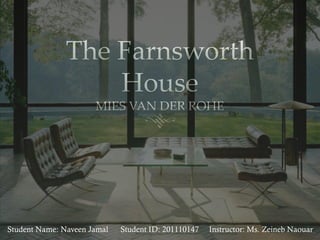
 The Farnsworth House was designed and constructed by
Ludwig Mies van der Rohe, designed by Philip Johnson .
 1945-51
 The steel and glass house was commissioned by Dr. Edith
Farnsworth.
 Widely recognized as an iconic masterpiece of International
Style of architecture.
 In September 2008, the house was flooded by rains from the
remnants of Hurricane Ike.
Architecture
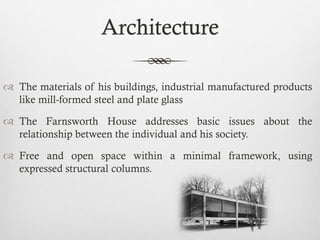
 The materials of his buildings, industrial manufactured products
like mill-formed steel and plate glass
 The Farnsworth House addresses basic issues about the
relationship between the individual and his society.
 Free and open space within a minimal framework, using
expressed structural columns.
Construction Materials
 The basic structure of Farnsworth House consists of eight
wide-flange steel stanchions.
 Farnsworth House is probably the most complete and
refined statement of glass-and-steel architecture.
 Steel frame – allowed open plan interiors.
 All the building parts are factory made.
 Used heavy steel sections.
 Laminated glass plates
Construction Materials
 Steel-jointing technique.
 Mies used conventional bolted connections in the less
visible parts of his structures, but in exposed positions
he wished his elegant steel members to be displayed
cleanly.
 Farnsworth House are rigorously restricted to
travertine (floors), wood (primavera for the core walls,
teak for the wardrobe) and plaster (ceilings).
Material Advantages
 Steel Frame structure
 High strength/weight ratio.
 Properly designed steel structures can have
high ductility, which is an important
characteristic for resisting shock loading
such as blasts or earthquakes.
 Well-defined stress level.
 Steel structures can be erected quite rapidly.
Material Advantages
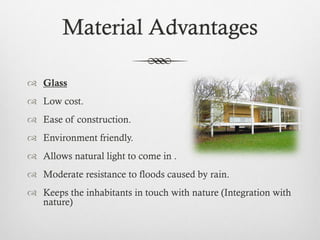
 Glass
 Low cost.
 Ease of construction.
 Environment friendly.
 Allows natural light to come in .
 Moderate resistance to floods caused by rain.
 Keeps the inhabitants in touch with nature (Integration with
nature)
Building structure
 The house is elevated 5 feet 3 inches (1.60 m) above a flood plain
by eight wide flange steel columns.
 Steel columns attached to the sides of the floor and ceiling slabs.
 The slabs' ends extend beyond the column supports, creating
cantilevers.
 A third floating slab, an attached terrace acts as a transition
between the living area and the ground.
 The house is accessed by two sets of wide steps connecting
ground to terrace and then to porch.
Concept
 He applied the concept of an unobstructed space that is
flexible for use by people.
 The interior appears to be a single open room.
 An icon of the architecture of the Modern Movement.
 The building is organized in two rectangular platforms.
 The first, accessed through four linear steps, has no walls or
a roof and acts as a terrace, being supported above the
ground by four steel pillars.
Concept
Concept
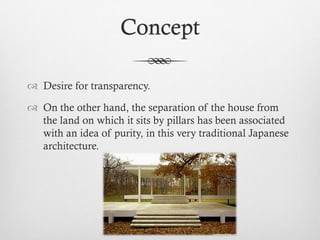
 Desire for transparency.
 On the other hand, the separation of the house from
the land on which it sits by pillars has been associated
with an idea of purity, in this very traditional Japanese
architecture.
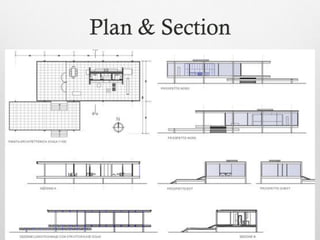
Plan & Section
Structure
 Farnsworth House is the ultimate expression of minimalism.
 The minimum elements include 8 columns, separated by a
distance of 6.60 meters, supporting the two slabs that form the
floor and ceiling.
 The interior, with a clear height of 2.85 meters, is only the
fragmented into a block of sanitary services that contains the
toilets.
 The 2.75 meter terrace slab, supported by only 4 columns and
leading to the entrance helps to emphasize the immateriality of
the house.
Structure
 The floor is set in two layers,
between which is the plumbing
and drainage system.
 The domestic plumbing
elements and also the rainwater
run-off spill into a central
circular chest.
 The roof, while mostly flat, is
slightly inclined towards the
center to force water to run
toward the edges.
Structural Analysis
 YouTube Video: “3D Farnsworth House & Design
Concepts”
 http://www.youtube.com/watch?v=lPsRc4Xhuf0
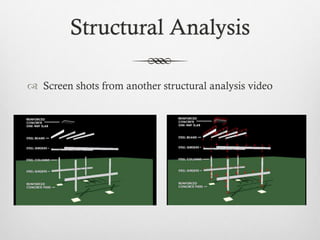
Structural Analysis
 Screen shots from another structural analysis video
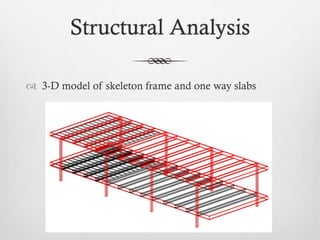
Structural Analysis
 3-D model of skeleton frame and one way slabs
Windows
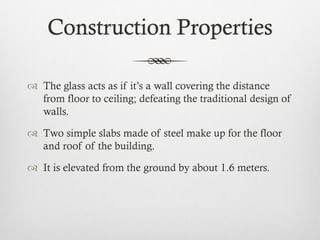
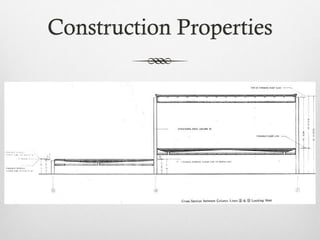
Construction Properties
 The glass acts as if it’s a wall covering the distance
from floor to ceiling; defeating the traditional design of
walls.
 Two simple slabs made of steel make up for the floor
and roof of the building.
 It is elevated from the ground by about 1.6 meters.
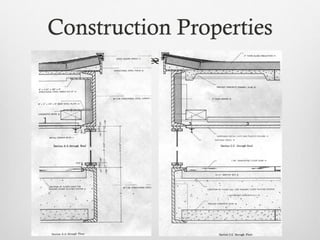
Construction Properties
 This unorthodox design of the house (the fact that it is
elevated above the ground) show the foundation the
house stands upon, the pile like foundations can be
seen with the naked eye.
 A terrace is also apparent in the design making up as
engineers would call a cantilever.
Construction Properties
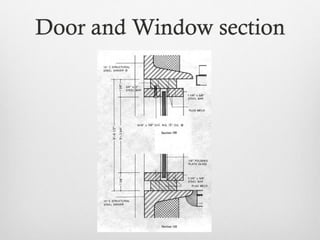
Door and Window section
Heating System Plan
Reference
 http://theglasshouse.org/programs/conversations/transparency/
overview/
 http://theglasshouse.org/history/bios/vanderrohe/
 http://www.architecturaldigest.com/architecture/2012-
09/architect-philip-johnson-glass-house-modernism-article
 http://architectuul.com/architecture/farnsworth-house
 http://www.columbia.edu/cu/gsapp/BT/GATEWAY/FARNS
WTH/farnswth.html
Thank You.

fdocuments.in_farnsworth-house-construction-details.pdf

  • 1.
    Student Name: NaveenJamal Student ID: 201110147 Instructor: Ms. Zeineb Naouar
  • 2.
    General History  TheFarnsworth House was designed and constructed by Ludwig Mies van der Rohe, designed by Philip Johnson .  1945-51  The steel and glass house was commissioned by Dr. Edith Farnsworth.  Widely recognized as an iconic masterpiece of International Style of architecture.  In September 2008, the house was flooded by rains from the remnants of Hurricane Ike.
  • 3.
    Architecture  The materialsof his buildings, industrial manufactured products like mill-formed steel and plate glass  The Farnsworth House addresses basic issues about the relationship between the individual and his society.  Free and open space within a minimal framework, using expressed structural columns.
  • 4.
    Construction Materials  Thebasic structure of Farnsworth House consists of eight wide-flange steel stanchions.  Farnsworth House is probably the most complete and refined statement of glass-and-steel architecture.  Steel frame – allowed open plan interiors.  All the building parts are factory made.  Used heavy steel sections.  Laminated glass plates
  • 5.
    Construction Materials  Steel-jointingtechnique.  Mies used conventional bolted connections in the less visible parts of his structures, but in exposed positions he wished his elegant steel members to be displayed cleanly.  Farnsworth House are rigorously restricted to travertine (floors), wood (primavera for the core walls, teak for the wardrobe) and plaster (ceilings).
  • 6.
    Material Advantages  SteelFrame structure  High strength/weight ratio.  Properly designed steel structures can have high ductility, which is an important characteristic for resisting shock loading such as blasts or earthquakes.  Well-defined stress level.  Steel structures can be erected quite rapidly.
  • 7.
    Material Advantages  Glass Low cost.  Ease of construction.  Environment friendly.  Allows natural light to come in .  Moderate resistance to floods caused by rain.  Keeps the inhabitants in touch with nature (Integration with nature)
  • 8.
    Building structure  Thehouse is elevated 5 feet 3 inches (1.60 m) above a flood plain by eight wide flange steel columns.  Steel columns attached to the sides of the floor and ceiling slabs.  The slabs' ends extend beyond the column supports, creating cantilevers.  A third floating slab, an attached terrace acts as a transition between the living area and the ground.  The house is accessed by two sets of wide steps connecting ground to terrace and then to porch.
  • 9.
    Concept  He appliedthe concept of an unobstructed space that is flexible for use by people.  The interior appears to be a single open room.  An icon of the architecture of the Modern Movement.  The building is organized in two rectangular platforms.  The first, accessed through four linear steps, has no walls or a roof and acts as a terrace, being supported above the ground by four steel pillars.
  • 10.
  • 11.
    Concept  Desire fortransparency.  On the other hand, the separation of the house from the land on which it sits by pillars has been associated with an idea of purity, in this very traditional Japanese architecture.
  • 12.
  • 13.
    Structure  Farnsworth Houseis the ultimate expression of minimalism.  The minimum elements include 8 columns, separated by a distance of 6.60 meters, supporting the two slabs that form the floor and ceiling.  The interior, with a clear height of 2.85 meters, is only the fragmented into a block of sanitary services that contains the toilets.  The 2.75 meter terrace slab, supported by only 4 columns and leading to the entrance helps to emphasize the immateriality of the house.
  • 14.
    Structure  The flooris set in two layers, between which is the plumbing and drainage system.  The domestic plumbing elements and also the rainwater run-off spill into a central circular chest.  The roof, while mostly flat, is slightly inclined towards the center to force water to run toward the edges.
  • 15.
    Structural Analysis  YouTubeVideo: “3D Farnsworth House & Design Concepts”  http://www.youtube.com/watch?v=lPsRc4Xhuf0
  • 16.
    Structural Analysis  Screenshots from another structural analysis video
  • 17.
    Structural Analysis  3-Dmodel of skeleton frame and one way slabs
  • 18.
  • 19.
    Construction Properties  Theglass acts as if it’s a wall covering the distance from floor to ceiling; defeating the traditional design of walls.  Two simple slabs made of steel make up for the floor and roof of the building.  It is elevated from the ground by about 1.6 meters.
  • 20.
  • 21.
    Construction Properties  Thisunorthodox design of the house (the fact that it is elevated above the ground) show the foundation the house stands upon, the pile like foundations can be seen with the naked eye.  A terrace is also apparent in the design making up as engineers would call a cantilever.
  • 22.
  • 23.
  • 24.
  • 25.
  • 26.
  • 27.
  • 28.
    Reference  http://theglasshouse.org/programs/conversations/transparency/ overview/  http://theglasshouse.org/history/bios/vanderrohe/ http://www.architecturaldigest.com/architecture/2012- 09/architect-philip-johnson-glass-house-modernism-article  http://architectuul.com/architecture/farnsworth-house  http://www.columbia.edu/cu/gsapp/BT/GATEWAY/FARNS WTH/farnswth.html
  • 29.