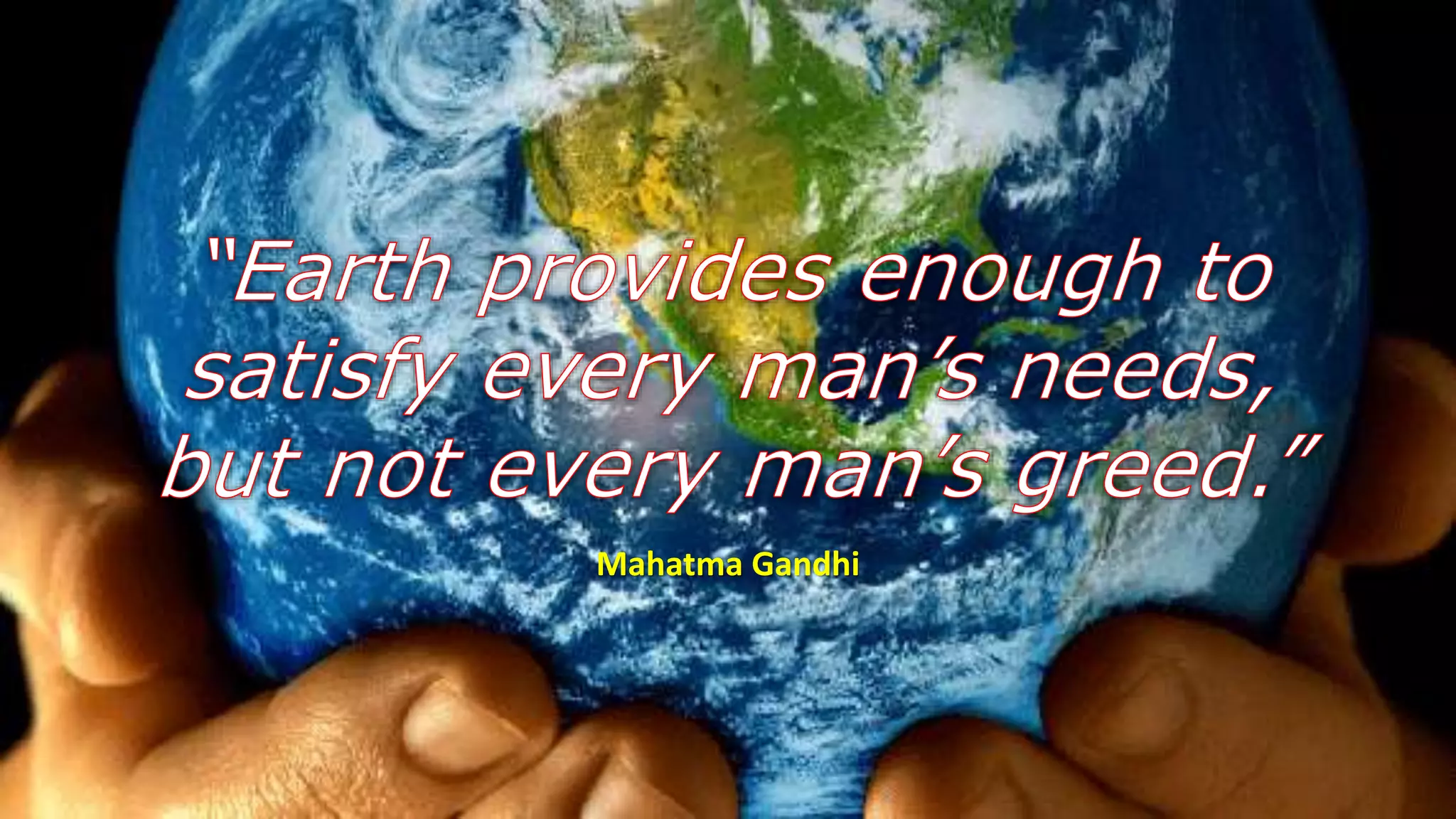
Mahatma Gandhi
What is Development?
(both for the world and for the individual human being)
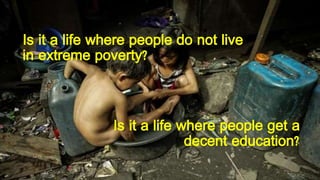
Is it a life where people do not live
in extreme poverty?
Is it a life where people get a
decent education?
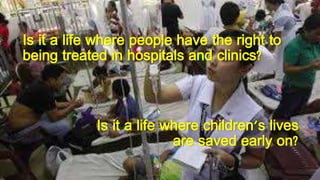
Is it a life where people have the right to
being treated in hospitals and clinics?
Is it a life where children's lives
are saved early on?
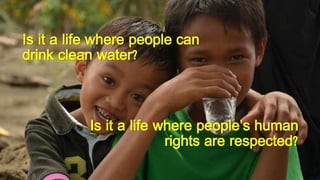
Is it a life where people can
drink clean water?
Is it a life where people’s human
rights are respected?
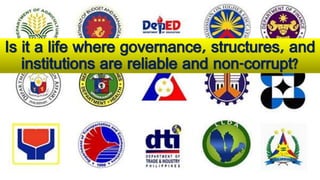
Is it a life where governance, structures, and
institutions are reliable and non-corrupt?
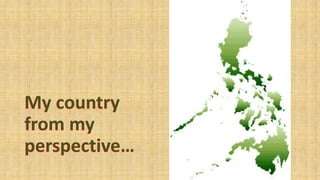
My country
from my
perspective…
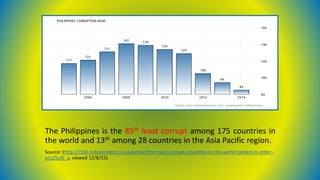
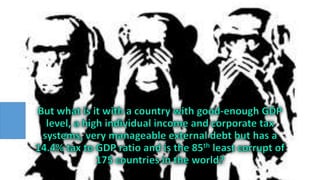
The Philippines is the 85th least corrupt among 175 countries in
the world and 13th among 28 countries in the Asia Pacific region.
Source: (http://i100.independent.co.uk/article/the-most-corrupt-countries-in-the-world-ranked-in-order--
xJUZ5u9j_x, viewed 12/6/15)
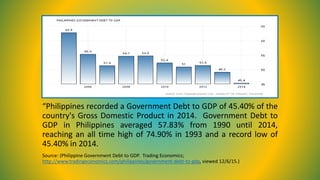
“Philippines recorded a Government Debt to GDP of 45.40% of the
country's Gross Domestic Product in 2014. Government Debt to
GDP in Philippines averaged 57.83% from 1990 until 2014,
reaching an all time high of 74.90% in 1993 and a record low of
45.40% in 2014.
Source: (Philippine Government Debt to GDP. Trading Economics;
http://www.tradingeconomics.com/philippines/government-debt-to-gdp, viewed 12/6/15.)
(Source: Trading Economics , Philippine Government Debt to GDP;
http://www.tradingeconomics.com/philippines/government-debt-to-gdp, viewed 12/6/15.)
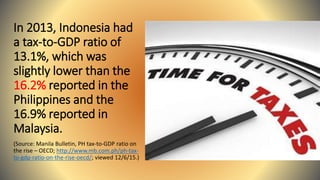
In 2013, Indonesia had
a tax-to-GDP ratio of
13.1%, which was
slightly lower than the
16.2% reported in the
Philippines and the
16.9% reported in
Malaysia.
(Source: Manila Bulletin, PH tax-to-GDP ratio on
the rise – OECD; http://www.mb.com.ph/ph-tax-
to-gdp-ratio-on-the-rise-oecd/; viewed 12/6/15.)
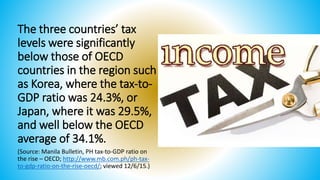
The three countries’ tax
levels were significantly
below those of OECD
countries in the region such
as Korea, where the tax-to-
GDP ratio was 24.3%, or
Japan, where it was 29.5%,
and well below the OECD
average of 34.1%.
(Source: Manila Bulletin, PH tax-to-GDP ratio on
the rise – OECD; http://www.mb.com.ph/ph-tax-
to-gdp-ratio-on-the-rise-oecd/; viewed 12/6/15.)
Tax to GDP ratio of Philippines – 14.4% as of
September 2015
(Source: Wikipedia, List of countries by tax revenue as percentage of GDP;
https://en.wikipedia.org/wiki/List_of_countries_by_tax_revenue_as_percentage_of_GDP; viewed 12/6/15)
Development is sustainable if it “meets the needs of the present
without compromising the ability of future generations to meet
their own needs.”
17 SUSTAINABLE
DEVELOPMENT GOALS
The New Development Agenda
2016-2030
(Billions to Trillions to Action)
Are these very
ambitious?
Domestic Resource Mobilization (DRM) — the process in
which countries transparently raise and spend their own
funds to provide for their people – is the long-term path
to sustainable development finance.
(USAID, DOMESTIC RESOURCE MOBILIZATION; https://www.usaid.gov/what-we-
do/economic-growth-and-trade/domestic-resource-mobilization; viewed 11/24/15)
DRM doesn’t have to mean new taxes or
higher tax rates — governments often see
their revenues rise through improved
audits or simplified filing processes.
Improvements in tax compliance and
revenues can, and often do, enable
countries to lower tax rates.
(USAID, DOMESTIC RESOURCE MOBILIZATION;
https://www.usaid.gov/what-we-do/economic-growth-and-
trade/domestic-resource-mobilization; viewed 11/24/15)
Country
Individual
Income Tax
Rate
Corruption
Rank
Sweden 57% 4
Denmark 55.41% 1
Finland 55.41% 3
Netherlands 53% 8
Zimbabwe 51.5% 156
Japan 50.84% 15
Austria 50% 23
Belgium 50% 15
Israel 50% 37
Slovenia 50% 39
Curacao 48.25% 8
Ireland 48% 17
Portugal 48% 31
Norway 47.2% 5
Spain 47% 37
Iceland 46.24% 12
Australia 45% 11
China 45% 100
Germany 45% 12
Taiwan 45% 35
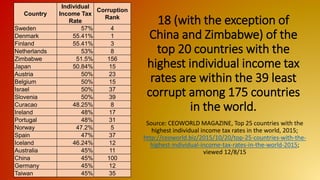
18 (with the exception of
China and Zimbabwe) of the
top 20 countries with the
highest individual income tax
rates are within the 39 least
corrupt among 175 countries
in the world.
Source: CEOWORLD MAGAZINE, Top 25 countries with the
highest individual income tax rates in the world, 2015;
http://ceoworld.biz/2015/10/20/top-25-countries-with-the-
highest-individual-income-tax-rates-in-the-world-2015;
viewed 12/8/15
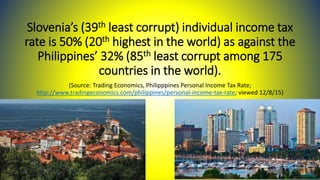
Slovenia’s (39th least corrupt) individual income tax
rate is 50% (20th highest in the world) as against the
Philippines’ 32% (85th least corrupt among 175
countries in the world).
(Source: Trading Economics, Philipppines Personal Income Tax Rate;
http://www.tradingeconomics.com/philippines/personal-income-tax-rate; viewed 12/8/15)
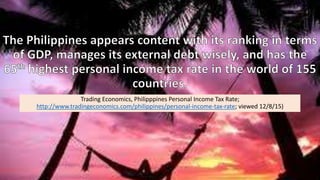
Trading Economics, Philipppines Personal Income Tax Rate;
http://www.tradingeconomics.com/philippines/personal-income-tax-rate; viewed 12/8/15)
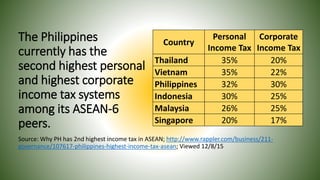
The Philippines
currently has the
second highest personal
and highest corporate
income tax systems
among its ASEAN-6
peers.
Source: Why PH has 2nd highest income tax in ASEAN; http://www.rappler.com/business/211-
governance/107617-philippines-highest-income-tax-asean; Viewed 12/8/15
Country
Personal
Income Tax
Corporate
Income Tax
Thailand 35% 20%
Vietnam 35% 22%
Philippines 32% 30%
Indonesia 30% 25%
Malaysia 26% 25%
Singapore 20% 17%
Three ingredients are essential to effective tax
administration: political will, a clear strategy, and
adequate resources.
(FDD-MOOC Coursera; Smart Tax Administration, Richard Bird, Week-2 Reading-5)
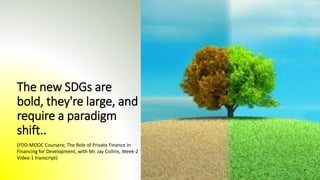
The new SDGs are
bold, they're large, and
require a paradigm
shift..
(FDD-MOOC Coursera; The Role of Private Finance in
Financing for Development, with Mr. Jay Collins, Week-2
Video-1 transcript)
you can do good
and do well at
the same time
public-private
collaboration
game-changing,
revolutionary
technology
new models, we
need innovation
and finance
(FDD-MOOC Coursera; Financing for Development, Post-2015,
Week-1 Reading-7)
For my
country to
move
forward,
three things
come to
mind…
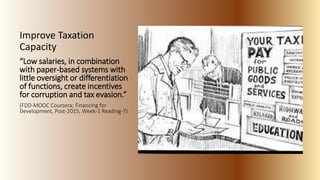
Improve Taxation
Capacity
“Low salaries, in combination
with paper-based systems with
little oversight or differentiation
of functions, create incentives
for corruption and tax evasion.”
(FDD-MOOC Coursera; Financing for
Development, Post-2015, Week-1 Reading-7)
Curb Illicit Financial Flows
“IFFs drain hard currency
reserves, heighten inflation,
reduce tax collection, discourage
investment, and weaken free
trade. These practices stifle
poverty alleviation efforts,
undermine the integrity of
government, and damage the
foundations of society.”
(FDD-MOOC Coursera; Illicit Financial Flows: A
Wake-Up Call to Action, submitted by Mario Marce,
Week-2 Reading-7)
Governance and the Rule
of Law
“…democracy, good
governance and the rule of
law as well as an enabling
environment at national and
international levels, are
essential for sustainable
development…”
(SUSTAINABLE DEVELOPMENT KNOWLEDGE
PLATFORM, Transforming our world: the 2030
Agenda for Sustainable Development, par. 9;
https://sustainabledevelopment.un.org/post2015/tr
ansformingourworld; Viewed 12/8/15)
Universality implies that all countries
will need to change, each with its own
approach, but each with a sense of the
global common good.
[Outcome document of the United Nations
Conference on Sustainable Development
(Rio+20), “The future we want”]
Otherwise, the
attainment of
the 17 SDGs will
have one less
contributor…

Fddmooc final project-mateo ty

  • 1.
  • 2.
    What is Development? (bothfor the world and for the individual human being)
  • 3.
    Is it alife where people do not live in extreme poverty? Is it a life where people get a decent education?
  • 4.
    Is it alife where people have the right to being treated in hospitals and clinics? Is it a life where children's lives are saved early on?
  • 5.
    Is it alife where people can drink clean water? Is it a life where people’s human rights are respected?
  • 6.
    Is it alife where governance, structures, and institutions are reliable and non-corrupt?
  • 7.
  • 8.
    The Philippines isthe 85th least corrupt among 175 countries in the world and 13th among 28 countries in the Asia Pacific region. Source: (http://i100.independent.co.uk/article/the-most-corrupt-countries-in-the-world-ranked-in-order-- xJUZ5u9j_x, viewed 12/6/15)
  • 9.
    “Philippines recorded aGovernment Debt to GDP of 45.40% of the country's Gross Domestic Product in 2014. Government Debt to GDP in Philippines averaged 57.83% from 1990 until 2014, reaching an all time high of 74.90% in 1993 and a record low of 45.40% in 2014. Source: (Philippine Government Debt to GDP. Trading Economics; http://www.tradingeconomics.com/philippines/government-debt-to-gdp, viewed 12/6/15.)
  • 10.
    (Source: Trading Economics, Philippine Government Debt to GDP; http://www.tradingeconomics.com/philippines/government-debt-to-gdp, viewed 12/6/15.)
  • 11.
    In 2013, Indonesiahad a tax-to-GDP ratio of 13.1%, which was slightly lower than the 16.2% reported in the Philippines and the 16.9% reported in Malaysia. (Source: Manila Bulletin, PH tax-to-GDP ratio on the rise – OECD; http://www.mb.com.ph/ph-tax- to-gdp-ratio-on-the-rise-oecd/; viewed 12/6/15.)
  • 12.
    The three countries’tax levels were significantly below those of OECD countries in the region such as Korea, where the tax-to- GDP ratio was 24.3%, or Japan, where it was 29.5%, and well below the OECD average of 34.1%. (Source: Manila Bulletin, PH tax-to-GDP ratio on the rise – OECD; http://www.mb.com.ph/ph-tax- to-gdp-ratio-on-the-rise-oecd/; viewed 12/6/15.)
  • 13.
    Tax to GDPratio of Philippines – 14.4% as of September 2015 (Source: Wikipedia, List of countries by tax revenue as percentage of GDP; https://en.wikipedia.org/wiki/List_of_countries_by_tax_revenue_as_percentage_of_GDP; viewed 12/6/15)
  • 14.
    Development is sustainableif it “meets the needs of the present without compromising the ability of future generations to meet their own needs.”
  • 15.
    17 SUSTAINABLE DEVELOPMENT GOALS TheNew Development Agenda 2016-2030 (Billions to Trillions to Action) Are these very ambitious?
  • 16.
    Domestic Resource Mobilization(DRM) — the process in which countries transparently raise and spend their own funds to provide for their people – is the long-term path to sustainable development finance. (USAID, DOMESTIC RESOURCE MOBILIZATION; https://www.usaid.gov/what-we- do/economic-growth-and-trade/domestic-resource-mobilization; viewed 11/24/15)
  • 17.
    DRM doesn’t haveto mean new taxes or higher tax rates — governments often see their revenues rise through improved audits or simplified filing processes. Improvements in tax compliance and revenues can, and often do, enable countries to lower tax rates. (USAID, DOMESTIC RESOURCE MOBILIZATION; https://www.usaid.gov/what-we-do/economic-growth-and- trade/domestic-resource-mobilization; viewed 11/24/15)
  • 19.
    Country Individual Income Tax Rate Corruption Rank Sweden 57%4 Denmark 55.41% 1 Finland 55.41% 3 Netherlands 53% 8 Zimbabwe 51.5% 156 Japan 50.84% 15 Austria 50% 23 Belgium 50% 15 Israel 50% 37 Slovenia 50% 39 Curacao 48.25% 8 Ireland 48% 17 Portugal 48% 31 Norway 47.2% 5 Spain 47% 37 Iceland 46.24% 12 Australia 45% 11 China 45% 100 Germany 45% 12 Taiwan 45% 35 18 (with the exception of China and Zimbabwe) of the top 20 countries with the highest individual income tax rates are within the 39 least corrupt among 175 countries in the world. Source: CEOWORLD MAGAZINE, Top 25 countries with the highest individual income tax rates in the world, 2015; http://ceoworld.biz/2015/10/20/top-25-countries-with-the- highest-individual-income-tax-rates-in-the-world-2015; viewed 12/8/15
  • 20.
    Slovenia’s (39th leastcorrupt) individual income tax rate is 50% (20th highest in the world) as against the Philippines’ 32% (85th least corrupt among 175 countries in the world). (Source: Trading Economics, Philipppines Personal Income Tax Rate; http://www.tradingeconomics.com/philippines/personal-income-tax-rate; viewed 12/8/15)
  • 21.
    Trading Economics, PhilipppinesPersonal Income Tax Rate; http://www.tradingeconomics.com/philippines/personal-income-tax-rate; viewed 12/8/15)
  • 22.
    The Philippines currently hasthe second highest personal and highest corporate income tax systems among its ASEAN-6 peers. Source: Why PH has 2nd highest income tax in ASEAN; http://www.rappler.com/business/211- governance/107617-philippines-highest-income-tax-asean; Viewed 12/8/15 Country Personal Income Tax Corporate Income Tax Thailand 35% 20% Vietnam 35% 22% Philippines 32% 30% Indonesia 30% 25% Malaysia 26% 25% Singapore 20% 17%
  • 24.
    Three ingredients areessential to effective tax administration: political will, a clear strategy, and adequate resources. (FDD-MOOC Coursera; Smart Tax Administration, Richard Bird, Week-2 Reading-5)
  • 25.
    The new SDGsare bold, they're large, and require a paradigm shift.. (FDD-MOOC Coursera; The Role of Private Finance in Financing for Development, with Mr. Jay Collins, Week-2 Video-1 transcript)
  • 26.
    you can dogood and do well at the same time public-private collaboration game-changing, revolutionary technology new models, we need innovation and finance
  • 27.
    (FDD-MOOC Coursera; Financingfor Development, Post-2015, Week-1 Reading-7)
  • 28.
  • 29.
    Improve Taxation Capacity “Low salaries,in combination with paper-based systems with little oversight or differentiation of functions, create incentives for corruption and tax evasion.” (FDD-MOOC Coursera; Financing for Development, Post-2015, Week-1 Reading-7)
  • 30.
    Curb Illicit FinancialFlows “IFFs drain hard currency reserves, heighten inflation, reduce tax collection, discourage investment, and weaken free trade. These practices stifle poverty alleviation efforts, undermine the integrity of government, and damage the foundations of society.” (FDD-MOOC Coursera; Illicit Financial Flows: A Wake-Up Call to Action, submitted by Mario Marce, Week-2 Reading-7)
  • 31.
    Governance and theRule of Law “…democracy, good governance and the rule of law as well as an enabling environment at national and international levels, are essential for sustainable development…” (SUSTAINABLE DEVELOPMENT KNOWLEDGE PLATFORM, Transforming our world: the 2030 Agenda for Sustainable Development, par. 9; https://sustainabledevelopment.un.org/post2015/tr ansformingourworld; Viewed 12/8/15)
  • 32.
    Universality implies thatall countries will need to change, each with its own approach, but each with a sense of the global common good. [Outcome document of the United Nations Conference on Sustainable Development (Rio+20), “The future we want”]
  • 34.
    Otherwise, the attainment of the17 SDGs will have one less contributor…