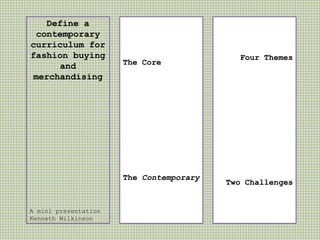
Define a
contemporary
curriculum for
fashion buying
and
merchandising
A mini presentation
Kenneth Wilkinson
The Core
The Contemporary
Four Themes
Two Challenges
The buyer’s roles
Sources of buying
inspiration
The garment technologist’s
role
The merchandiser’s role
Marketing, branding, and
promotion
Design, supply, and
product development
The retail calendar
Retail formats, channels,
and visual merchandising
Sourcing, importing, and
supply chain
management
Suppliers, sourcing, and
communication/
negotiation
Inventory and logistics
management
Trends and developments
in supply, buying, and
merchandising
The Core
The Contemporary
Adapting to market change
The global market/new
markets
Analytics/big data
(forecasting)
Digital marketing and social
media
Ethics and transparency
New distribution and
production technologies
CSR, sustainability, and
green impact on supply
Marketing today prioritizes
customer feedback
Supply models and
designers have to respond
to pressure for very cheap,
very fast fashion
(e.g. the Primark model)
Digital capabilities are
increasing demand for
responsiveness and
change: couriers, PayPal,
Amazon Prime (click and
collect) – the decline of
wholesalers, the rise of new
distribution channels
Consumer and
Product
Who wants what and how
do they want it?
Product
Development and
Operations
How can designs address
demand and be efficiently
and greenly made and
delivered?
Marketing and
Digital
How can customers be
reached and what can we
know about them?
Supply Chain
Management and
Distribution
Which methods offer the
greatest efficiencies?
Four Themes
The Customer
Journey
Phone-to-drone
Sustainability
Products and processes
Two Challenges
Sustainability in…
 Supply chain designs
 Materials and design
decisions
 Preproduction
operations
 Production operations
 Retail and recovery/
reusability
 Transport
 Facility management
A contemporary curriculum
would cover disruptive
developments: new
technologies, model-
stretching innovations, the
growth of online shopping,
the emergence of concept
stores.
Education for a world
where change is the only
constant.
The changing expectations
of customers must be
central, since these have
serious supply chain and
product development
implications.
The use of retail space is
changing too – so visual
merchandising is likely to
evolve.
Together, these demands
will require very high levels
of distribution efficiency and
online marketing capability
– these skills are likely to
become prerequisites for
survival so need to be
incorporated in any relevant
curriculum.
CustomerJourney
Sustainability
The how, not just the what,
of teaching:
case studies, information
from professionals (both
inside and outside fashion),
trade fair visits, emphasize
resourcefulness and
independent learning
The core is entirely informed by the contemporary
The curriculum has a core comprised of four themes
Two challenges are addressed throughout: the customer journey and
sustainability
The point of common intersection is the customer
CustomerJourney
Sustainability
Thank you for listening
?

Fashion interview presentation

  • 1.
    Define a contemporary curriculum for fashionbuying and merchandising A mini presentation Kenneth Wilkinson The Core The Contemporary Four Themes Two Challenges
  • 2.
    The buyer’s roles Sourcesof buying inspiration The garment technologist’s role The merchandiser’s role Marketing, branding, and promotion Design, supply, and product development The retail calendar Retail formats, channels, and visual merchandising Sourcing, importing, and supply chain management Suppliers, sourcing, and communication/ negotiation Inventory and logistics management Trends and developments in supply, buying, and merchandising The Core
  • 3.
    The Contemporary Adapting tomarket change The global market/new markets Analytics/big data (forecasting) Digital marketing and social media Ethics and transparency New distribution and production technologies CSR, sustainability, and green impact on supply Marketing today prioritizes customer feedback Supply models and designers have to respond to pressure for very cheap, very fast fashion (e.g. the Primark model) Digital capabilities are increasing demand for responsiveness and change: couriers, PayPal, Amazon Prime (click and collect) – the decline of wholesalers, the rise of new distribution channels
  • 4.
    Consumer and Product Who wantswhat and how do they want it? Product Development and Operations How can designs address demand and be efficiently and greenly made and delivered? Marketing and Digital How can customers be reached and what can we know about them? Supply Chain Management and Distribution Which methods offer the greatest efficiencies? Four Themes
  • 5.
    The Customer Journey Phone-to-drone Sustainability Products andprocesses Two Challenges Sustainability in…  Supply chain designs  Materials and design decisions  Preproduction operations  Production operations  Retail and recovery/ reusability  Transport  Facility management
  • 6.
    A contemporary curriculum wouldcover disruptive developments: new technologies, model- stretching innovations, the growth of online shopping, the emergence of concept stores. Education for a world where change is the only constant. The changing expectations of customers must be central, since these have serious supply chain and product development implications. The use of retail space is changing too – so visual merchandising is likely to evolve. Together, these demands will require very high levels of distribution efficiency and online marketing capability – these skills are likely to become prerequisites for survival so need to be incorporated in any relevant curriculum.
  • 8.
    CustomerJourney Sustainability The how, notjust the what, of teaching: case studies, information from professionals (both inside and outside fashion), trade fair visits, emphasize resourcefulness and independent learning The core is entirely informed by the contemporary The curriculum has a core comprised of four themes Two challenges are addressed throughout: the customer journey and sustainability The point of common intersection is the customer
  • 9.