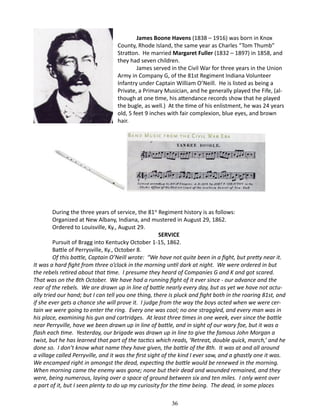
Mead
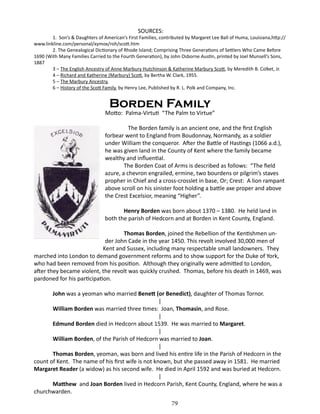
Trail Blazers
2nd edition

Compiled by
Yvonne Putnam
1
Introduction
There is a Spanish proverb, which paraphrased says: “Each person dies three times. The first
time is when the body stops functioning, the second is when (s)he is buried, and the third is when
the person’s name is spoken the last time.”
The more I learn about our family members who came before us, the more convinced I am
that each of them, in their own way, were indeed Trail Blazers, and have many qualities which are
worthy of cultivating into our own lives. They are certainly deserving of being remembered, and
shouldn’t die that last time.
In addition to my own research, this book is a compilation of a lot of other people’s work, and
I certainly do not claim it all as my own. (Of course, any mistakes found within these pages are my
doing and I admit it freely.) I’m grateful for those who have done the research and made it available.
Also, this is simply stories of our ancestor’s lives. Specific genealogical information can be found at
www.familysearch.org or I would be happy to make copies of my files.

2
Table of Contents
M= Mead Line; Y = Yarwood Line
Albro, John (Y). . . . . . . . . . . . . . . . . . . . . . . . . . . . . . . . . . . . . . . . . . . . . . . . . . . . . . . 100
Appendix . . . . . . . . . . . . . . . . . . . . . . . . . . . . . . . . . . . . . . . . . . . . . . . . . . . . . . . . . . . 101
o	 Ancient & Honorable Artillery Co. . . . . . . . . . . . . . . . . . . .	
162
o	 Bakery Prices . . . . . . . . . . . . . . . . . . . . . . . . . . . . . . . . . . . 	
129
o	 Bakery Recipes . . . . . . . . . . . . . . . . . . . . . . . . . . . . . . . . . .	
101
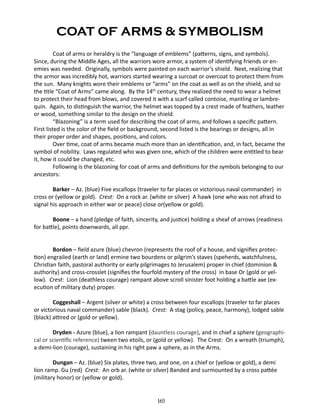
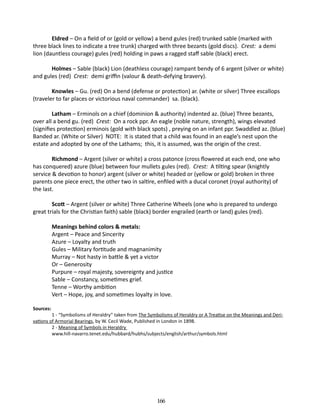
o	 Coat of Arms & Symbolism . . . . . . . . . . . . . . . . . . . . . . . .	
165
o	 Caroline Yarwood Recipes . . . . . . . . . . . . . . . . . . . . . . . . 	
138
o	 David Yarwood Story (Martyred Missionary). . . . . . . . . . 	
139
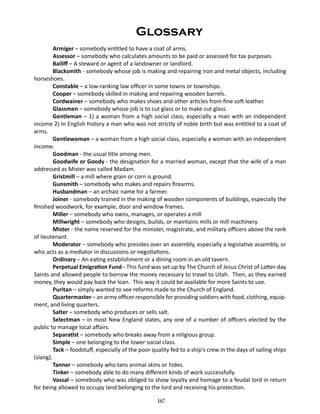
o	 Glossary . . . . . . . . . . . . . . . . . . . . . . . . . . . . . . . . . . . . . . . . 	
167
o	 Grandma’s Recipes . . . . . . . . . . . . . . . . . . . . . . . . . . . . . . . 	
132
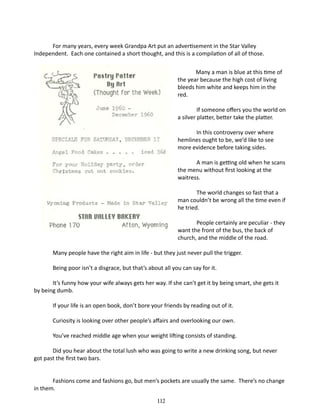
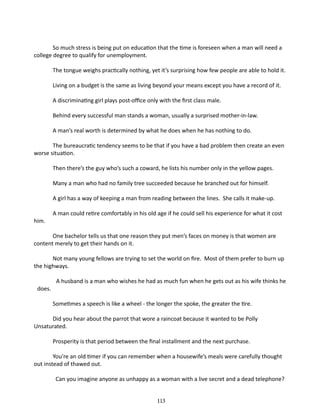
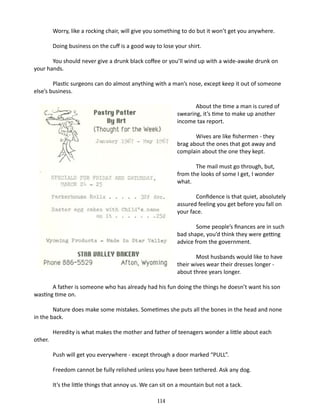
o	 Pastry Patters . . . . . . . . . . . . . . . . . . . . . . . . . . . . . . . . . . . 	
111
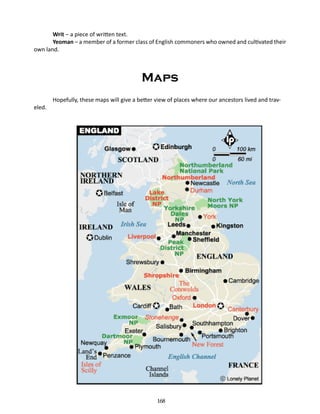
o	 Maps . . . . . . . . . . . . . . . . . . . . . . . . . . . . . . . . . . . . . . . . . . 	
168
o	 Masons . . . . . . . . . . . . . . . . . . . . . . . . . . . . . . . . . . . . . . . .	
161
o	 Our Immigrant Ancestors . . . . . . . . . . . . . . . . . . . . . . . . . .	
163	
o	 Quakers. . . . . . . . . . . . . . . . . . . . . . . . . . . . . . . . . . . . . . . . .	
162	
Barker Family (Y) . . . . . . . . . . . . . . . . . . . . . . . . . . . . . . . . . . . . . . . . . . . . . .	 . . . . . . 	 52
Boone Family (M) . . . . . . . . . . . . . . . . . . . . . . . . . . . . . . . . . . . . . . . . . . . . . .	 . . . . . .	 47
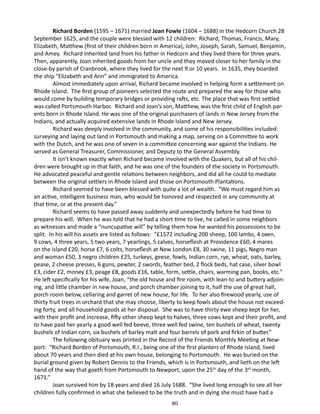
Borden Family (Y) . . . . . . . . . . . . . . . . . . . . . . . . . . . . . . . . . . . . . . . . . . . . . . . . . . . .	 79
Cassel, Arnold (M) . . . . . . . . . . . . . . . . . . . . . . . . . . . . . . . . . . . . . . . . . . . . . . . . . . . . 59
Clark Family (Y) . . . . . . . . . . . . . . . . . . . . . . . . . . . . . . . . . . . . . . . . . . . . . . . . . . . . . . 57
Coggeshall Family (Y) . . . . . . . . . . . . . . . . . . . . . . . . . . . . . . . . . . . . . . . . . . . . . . . . . 	 53
Coles Family (M) . . . . . . . . . . . . . . . . . . . . . . . . . . . . . . . . . . . . . . . . . . . . . . . . . . . . .	 86
Congdon Family (Y ) . . . . . . . . . . . . . . . . . . . . . . . . . . . . . . . . . . . . . . . . . . . . . . . . . . 	 92
Cresson, Pierre (M) . . . . . . . . . . . . . . . . . . . . . . . . . . . . . . . . . . . . . . . . . . . . . . . . . .	 59
De La Plaine, Nicholas (M) . . . . . . . . . . . . . . . . . . . . . . . . . . . . . . . . . . . . . . . . . . . . .	 61
Dixon Family (Y) . . . . . . . . . . . . . . . . . . . . . . . . . . . . . . . . . . . . . . . . . . . . . . . . . . . . .	 39
Drury Family (M) . . . . . . . . . . . . . . . . . . . . . . . . . . . . . . . . . . . . . . . . . . . . . . . . . . . . .	 38
Dungan Family (M) . . . . . . . . . . . . . . . . . . . . . . . . . . . . . . . . . . . . . . . . . . . . . . . . . . .	 57
Easton Family (Y) . . . . . . . . . . . . . . . . . . . . . . . . . . . . . . . . . . . . . . . . . . . . . . . . . . . . 	 74
Eldred Family (Y). . . . . . . . . . . . . . . . . . . . . . . . . . . . . . . . . . . . . . . . . . . . . . . . . . . . .	 61
Fowle Family (Y) . . . . . . . . . . . . . . . . . . . . . . . . . . . . . . . . . . . . . . . . . . . . . . . . . . . . .	 76
Gardiner Family (Y) . . . . . . . . . . . . . . . . . . . . . . . . . . . . . . . . . . . . . . . . . . . . . . . . . . 	 76
Greenway, John (Y) . . . . . . . . . . . . . . . . . . . . . . . . . . . . . . . . . . . . . . . . . . . . . . . . . . .	 69
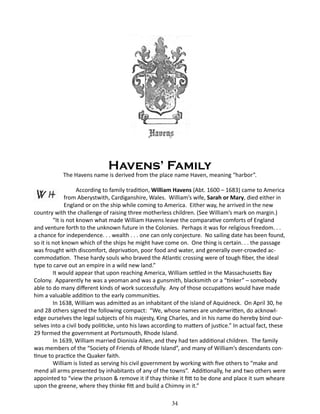
Havens Family (Y) . . . . . . . . . . . . . . . . . . . . . . . . . . . . . . . . . . . . . . . . . . . . . . . . . . . . 	34
Hobbs Family (Y) . . . . . . . . . . . . . . . . . . . . . . . . . . . . . . . . . . . . . . . . . . . . . . . . . . . . . 	 29
Holden Family (Y) . . . . . . . . . . . . . . . . . . . . . . . . . . . . . . . . . . . . . . . . . . . . . . . . . . . . . 	93
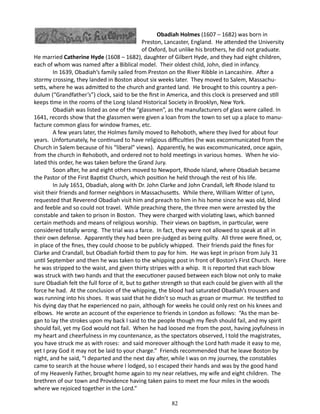
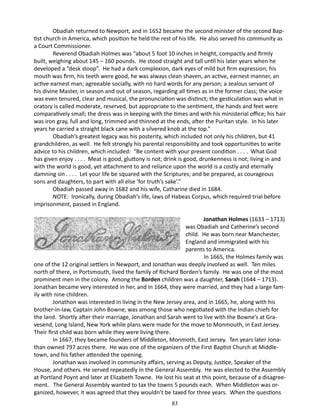
Holmes Family (Y) . . . . . . . . . . . . . . . . . . . . . . . . . . . . . . . . . . . . . . . . . . . . . .	. . . . . . . 81
Huling Family (Y) . . . . . . . . . . . . . . . . . . . . . . . . . . . . . . . . . . . . . . . . . . . . . . . . . . . . . 	 98
Knowles Family (Y) . . . . . . . . . . . . . . . . . . . . . . . . . . . . . . . . . . . . . . . . . . . . . . . . . . .	 64
Latham Family (Y) . . . . . . . . . . . . . . . . . . . . . . . . . . . . . . . . . . . . . . . . . . . . . . . . . . . . 54
Marbury & Dryden Families (Y) . . . . . . . . . . . . . . . . . . . . . . . . . . . . . . . . . . . . . . . .	 88
Maugridge Family (M) . . . . . . . . . . . . . . . . . . . . . . . . . . . . . . . . . . . . . . . . . . . . . . . . 	 46
Mead, Arthur Albert (M & Y) . . . . . . . . . . . . . . . . . . . . . . . . . . . . . . . . . . . . . . . . . . . 	 5
Mead, George Milton (M) . . . . . . . . . . . . . . . . . . . . . . . . . . . . . . . . . . . . . . . . . . . . . 	 12
Mead, Jackson Henry (M) . . . . . . . . . . . . . . . . . . . . . . . . . . . . . . . . . . . . . . . . . . . . . 	 23
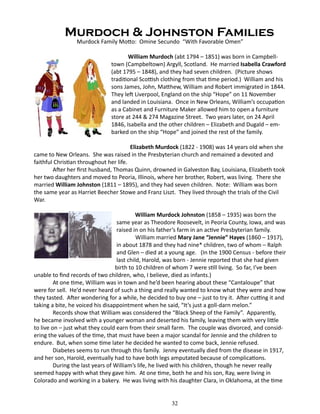
Murdoch / Johnston Family (M) . . . . . . . . . . . . . . . . . . . . . . . . . . . . . . . . . . . . . . . .	 32
Op Den Dyck Family (Y) . . . . . . . . . . . . . . . . . . . . . . . . . . . . . . . . . . . . . . . . . . . . . . .	 94
Parsons, Lorenzo (M) . . . . . . . . . . . . . . . . . . . . . . . . . . . . . . . . . . . . . . . . . . . . . . . . .	 31
Phenix Family(Y) . . . . . . . . . . . . . . . . . . . . . . . . . . . . . . . . . . . . . . . . . . . . . . . . . . . . .	 99
Perce (Percy) Family (Y) . . . . . . . . . . . . . . . . . . . . . . . . . . . . . . . . . . . . . . . . . . . . . . . 	 87

3
Potter, Robert (Y) . . . . . . . . . . . . . . . . . . . . . . . . . . . . . . . . . . . . . . . . . . . . . . . . . . .	 65
Powell, Thomas (M) . . . . . . . . . . . . . . . . . . . . . . . . . . . . . . . . . . . . . . . . . . . . . . . . . .	 85
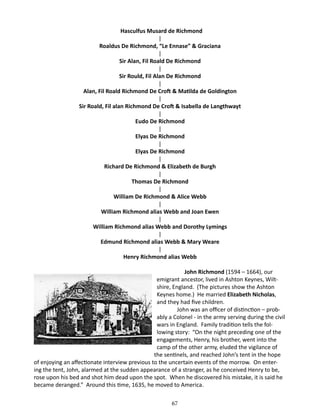
Richmond Family (Y) . . . . . . . . . . . . . . . . . . . . . . . . . . . . . . . . . . . . . . . . . . . . . . . . .	 66
Rodman Family (Y) . . . . . . . . . . . . . . . . . . . . . . . . . . . . . . . . . . . . . . . . . . . . . . . . . . 	 73
Scott Family (Y) . . . . . . . . . . . . . . . . . . . . . . . . . . . . . . . . . . . . . . . . . . . . . . . . . . . . .	 76
Smith, Richard (Y) . . . . . . . . . . . . . . . . . . . . . . . . . . . . . . . . . . . . . . . . . . . . . . . . . . .	 99
Stafford Family (Y) . . . . . . . . . . . . . . . . . . . . . . . . . . . . . . . . . . . . . . . . . . . . . . . . . . .	 91
Townsend Family (M) . . . . . . . . . . . . . . . . . . . . . . . . . . . . . . . . . . . . . . . . . . . . . . . .	 85
Walling Family (Y) . . . . . . . . . . . . . . . . . . . . . . . . . . . . . . . . . . . . . . . . . . . . . . . . . . . .	 94
Washburne Family (M) . . . . . . . . . . . . . . . . . . . . . . . . . . . . . . . . . . . . . . . . . . . . . . . .	 86
Weddle Family (Y) . . . . . . . . . . . . . . . . . . . . . . . . . . . . . . . . . . . . . . . . . . . . . .	 . . . . . .	 42
Wightman Family (Y) . . . . . . . . . . . . . . . . . . . . . . . . . . . . . . . . . . . . . . . . . . . . . . . . . 	 90
Willets Family (M) . . . . . . . . . . . . . . . . . . . . . . . . . . . . . . . . . . . . . . . . . . . . . . . . . . .	 44
Yarwood, Charles Edward L& Caroline Hobbs (Y) . . . . . . . . . . . . . . . . . . . . . . . . . 	 19
Yarwood Family (Y) . . . . . . . . . . . . . . . . . . . . . . . . . . . . . . . . . . . . . . . . . . . . . . . . . .	 24

4
Arthur Albert
& Elizabeth Yarwood Mead
Arthur Albert Mead , or “Art” as he was
called, was born 30 Jun 1908 at Kansas City, Missouri to George Milton Mead and Julia Elizabeth
Johnston Mead. He was the fourth of seven
children: George, Kenneth (both passed away
within a few days), Wilbur, Frank, Mary, and
Ruth. {He was born the same year as the actors
Jimmy Stewart and Fred MacMurray, President
Lyndon B. Johnson, and the Voice of Bugs Bunny,
Mel Blanc.}
Arthur was a shy, quiet boy who grew
into a gentle, kind man with a rare sense of dry
wit. He was a good student in school, and an
enthusiastic sports fan, completing his tenth
grade in high school. He planned to be an auto
mechanic when he grew up. At an early age, he
displayed one of his best attributes - responsibility - taking care of his younger brother and
sisters while his mother and father were working
away from home.
Arthur’s father was something of a
vagabond, and moved a lot. At that time, towns
were close together, and he would often go on a
freight train to a job or a hoped for job in a bakery. When he started to work, he would send
for his family to join him or go back and get them.
They lived longer in El Dorado, Kansas than in most of the places. The family bought a
home about 500 yards from the switchyards. All night long the switch engine could be heard
banging and clanging, moving freight cars around, and freight train and passenger trains could be
heard going by all hours of the night.
The kids walked about 1/4 mile to town for school. To get to the house, they went from a
main road down a dirt lane. Many people from the town drove down the lane, parked their cars,
and followed a path near the Mead’s home to get to the unofficial swimming hole. Always looking
for moneymaking opportunities, the kids decided to set up a stand and sell pop and gum. They
did pretty well. One time an older boy backed his car into the stand and broke it all to pieces.
Although they got the stand put back together, they decided to get even with him. The next time
he came, Arthur and Frank put nails in front and back of his tires. Needless to say, he wasn’t very
happy, but he didn’t back into the stand again, either.
One of the games they liked to play was “pinkle ponkel”. They played this game in the water, while swimming. They made a wide ring and used a bar of soap to throw in the middle of the
ring, then they’d dive for it. The one who came up with it got to throw it again.
While growing up, the kids had way too much free time with little supervision. Once, again
in El Dorado, Arthur found a switch car full of bananas. He took the other kids over to the car and
up on top of it. He opened a 2 x 2 foot lid. Since Mary and Ruth were the littlest, he and Frank
lifted them down into the car to get some bananas. Before they could do anything, Arthur was
5
yelling, “Get out. Get Out. Here comes the switch engine.” Mary held up Ruth so Art could get
hold of her hands. Before he could reach her, the engine hit the car. The girls were slammed up
against the wall. Frank and Art held on for dear life. If they had lost their grip, they would have
been thrown under the moving wheels. They didn’t get any bananas, but they got away safely.
Their Eldorado home sat on a12-acre farm and the family grew lots of vegetables. The kids
sold vegetables house-to-house in town. One day Wilbur, with an old boiler lid to protect himself,
started a tomato fight in the garden. When he threw a tomato at us it really hurt. The tomato patch
was ruined for that year.
	
At the age of 14, he drove the
car with the family from Kansas to
Oregon and California, working beside
his father wherever they could find
work to do. From El Centro, California,
the family crossed the dessert on the old plank road to Yuma, Arizona.
In 1924, he went into the Bakery business with his father at Somerton, Arizona, 15 miles
south of Yuma. The Bakery was named Mead and Son. The business was a prosperous one, known
throughout the southwest for its excellent Bakery products.
Arthur drove the Bakery truck delivering bread and pastries to Yuma and to San Louise,
Mexico. While in Mexico, he often delivered Bakery products to the Yaki Indians, who always met
him with friendly smiles, eager to buy his pastries. The day came, however, when he was not met
with smiles and eagerness, but with sullen scowls and with knives that clearly indicated for him to
unload the truck. Arthur didn’t argue, but quickly did as he was told to do. He drove away a little
frightened and did not return to the Yaki reservation again.
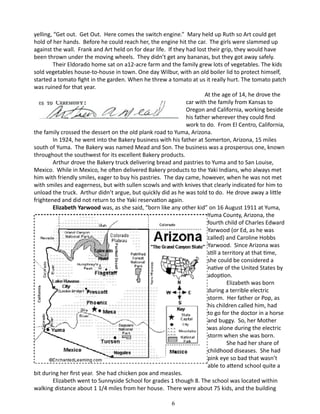
Elizabeth Yarwood was, as she said, “born like any other kid” on 16 August 1911 at Yuma,
Yuma County, Arizona, the
fourth child of Charles Edward
Yarwood (or Ed, as he was
called) and Caroline Hobbs
Yarwood. Since Arizona was
still a territory at that time,
she could be considered a
native of the United States by
adoption.
Elizabeth was born
during a terrible electric
storm. Her father or Pop, as
his children called him, had
to go for the doctor in a horse
and buggy. So, her Mother
was alone during the electric
storm when she was born.
She had her share of
childhood diseases. She had
pink eye so bad that wasn’t
able to attend school quite a
bit during her first year. She had chicken pox and measles.
Elizabeth went to Sunnyside School for grades 1 though 8. The school was located within
walking distance about 1 1/4 miles from her house. There were about 75 kids, and the building
6
was divided into three rooms.
After graduating from Sunnyside two years earlier than normal, (she was able to skip the
2nd grade and the 5th grade) she went onto high school in Yuma and graduated when she was 16
years old. She enjoyed learning Spanish. Two years was required in high school, but she took it for
four years, and could read stories and things in Spanish.
After graduating from High School, she took a post-graduate course the next year, and almost finished it. She took courses in Latin, Typing, and Advanced Shorthand.
Elizabeth grew up on the family’s 160-acre farm, located 10 miles from Yuma, 5 miles from
Somerton, and three miles from the Mexican border. Their chief crop was alfalfa seed and cotton.
They had about one acre that they planted into an orchard, and grew apricots, figs, pears, pecans,
lemons, and oranges.
They grew date trees around their house. When Elizabeth’s grandfather, William Yarwood,
came from Washington, he’d eat dates and throw the seeds down. That’s where the trees got
started.
As a child, Elizabeth and her siblings played together. They liked to ride air weed stick
horses. Later, she had a live horse - Old Babe - that she rode as much as she could. Some mornings, she would get on her horse, go down on the farm, break a big old watermelon, and eat it. Her
father didn’t care what the kids ate out of the orchards or garden as long as they didn’t waste.
At one time, Ed bought a pair of mules; one of them was so lazy, he gave it away. But, when
the other, Old Jude, got too old to work, he just turned her loose on the farm and the kids used her
for their fun. They’d hook her up to a little wagon contraption and play with her that way.
Elizabeth’s Grandma Glasscock lived down the lane about one mile. She had an upstairs,
and the kids liked to go up there and rummage through the things.
Christmas in Arizona was different than when she moved to Wyoming. They never had
Christmas trees in their homes, or electric lights. Sometimes, the girls got a doll or something like
that, but usually, it was the hair ribbon. One time Ed’s half-sister, Lizzie, came from Washington,
and she brought Elizabeth a big doll. It could wear baby clothes, and that was a prize doll.
One Christmas that was the most memorable for Elizabeth was a time her Mom was sick.
They’d had a doctor come down to the home in November. He came down every day for a few
days, but she just got worse. Ed called in another Doctor and after checking her, he said, “I’ll go
and make arrangements and you get her to the hospital.” She had appendicitis, and by the time
they got her there, gangrene was already setting in. Of course, they operated immediately, but
they didn’t give her much of a chance to live. Ed practically lived at the hospital. He would come
home morning and nights to help with the chores, then go back to the hospital. They had an awful
time trying to get someone to match her blood for a transfusion, because at that time they didn’t
have any blood banks. Despite the doctor’s prognosis, after a long siege, she gradually got better.
Then, at Christmas time, she got to come home, and it was a time of really rejoicing. That was the
best Christmas they ever had!
There was always plenty of work on a farm that size. All the water had to be pumped by
hand and, for a while, until a pump was put in closer to the house, it was carried in from the corral.
The water was very salty. They had to drag in the old tub for baths. They washed their clothes
on a washboard. Even when electricity was available in the area, they wanted such an enormous
amount to run a line to the Yarwood home, that they just went without for a while longer. In fact,
Elizabeth was married before they got electricity in their home. They used kerosene lamps most of
the time. Then carbide lights became available, along with a carbide iron. They went to church by
horse and buggy until she was about five years old, and then Ed purchased a 1916 Ford. Elizabeth
always had to help with the washing and household chores and stuff like that, but her preference
was to be out in the field, and as soon as she was old enough to help, that’s where she could be
7
found. She drove a team and the cultivator and took a man’s place until the cotton was “laid by”.
Elizabeth had a wonderful relationship with her Pop, and she always wanted to be with
him. Every time he would come in for dinner, she would run and meet him and drive his team a
little way. Then when he left from his noon break, she’d go and drive his team out to the field a
little ways for him. Her Mom would say, “Now, you’re not going out today,” but she’d sneak out.
He appreciated all the little things that were done for him.
Her parents were always kind and charitable, and Elizabeth learned to serve others through
their example. During the depression years, Pop told her Mom if beggars came to the house not to
turn them away, but she didn’t have to invite them in. He couldn’t stand to see anybody suffer or
go without.
The Yarwood family was Methodist, and attended church in Somerton. Elizabeth had a
favorite minister - Gerald Harvey. (She later named her son, Jerry, after him.) On Sunday mornings
it was always Elizabeth’s job to get the kids ready for church. Her Mom would wash the dishes and
Pop would dry them; then he would go and play the piano.
Elizabeth listened to her Pop play the piano, and she tried to pick up some by just listening.
Although she took lessons from the first book, most of what she learned, she taught herself.
Arthur and Elizabeth met on a blind date. They’d go together for a while and then quit and
then go together and then quit. One day after a little spat about something, they decided not to
see each other again. The next day, Arthur took an alternate road to Yuma, the second day he
drove by the Yarwood home pretending her house wasn’t there. On the third day, Elizabeth’s little
sister, Irene, believing a reconciliation was in order, stopped the truck in front of her home and told
him that Elizabeth wanted to see him. Arthur turned the Model T around on two wheels and sped
up the lane to the Yarwood home.
Elizabeth’s parents really liked Arthur, or as Elizabeth said, “They thought he was a white
hen’s chicken.” Arthur was 19 and Elizabeth was 17 when they got married, so they both had to
have permission. Originally they planned to get married at the Easter Sunrise service, but their
friends planned so much to do to them that they fooled them and got married early. Elizabeth
didn’t even tell her girl friend that they had changed the date. They stopped at her house and got
her and had her stay all night so she would be there. They were married 30 March 1929 at the Yarwood home. People were sure surprised when they came to the Easter Services for the marriage
and discovered them already married.
They had a little apartment to move to in Somerton for a while after they were married.
Arthur’s family moved on to other areas, so he worked at the school as a custodian. While living
there, Virginia, Marian and Marjorie were born. Virginia was a colicky baby and cried all the time.
Fortunately, Elizabeth’s mother helped out a lot. She’d work while Elizabeth would hold and rock
her and then her Mom would hold her while she worked. Then, when the twins – Marian and
Marjorie - were born, she kept them for several weeks while Elizabeth was recuperating. The night
the twins were born, it snowed in Yuma, Arizona, and they were called the snow babies.
When the twins were little, Elizabeth had to wash their clothes by hand - heat the water
outside and boil the clothes and scrub them on an old scrubbing board. But, after they moved to
Afton, she had a washer.
When Virginia was 3 years old and the twins were just 1 year old, Arthur moved his family to Soda Springs, Idaho where he went into the Bakery business with his family – his father, his
brother, Frank, and sister, Ruth – a family Bakery. Barbara was born there.
Arthur was on the road again delivering Bakery products to Montpelier, Afton, Freedom, Wayan
and back to Soda Springs. When the winter snows closed the road at Wayan, he made the long

8
trek to Star Valley by way of Montpelier.
NOTE: Mead Bakery products were the
first “boughten” bakery goods in the
Valley. When Arthur first began delivering in the area, he left one loaf of bread
in the Freedom store. When he came
back, it was still there. He picked it up
and left two that time. The next time he
made the trip through, both loaves were
sold. (Bread was less than 10¢ a loaf at
that time.)
From that shaky start, he eventually built a big business, and in 1936 they
moved the Bakery to Afton. Originally,
the entire family was part of the business, but eventually, Arthur was able to
buy the others out and he became sole
owner and operator of the Star Valley Bakery, until ill health forced him to
retire and his daughter, Virginia Leavitt,
took over. Every morning he would get
up at 3:00 and do his baking, and then
three times a week, he’d go on the truck
route to each of the stores in the smaller
communities.
Throughout the years, a lot of
school classes chose to walk through
the Bakery on field trips. Arthur, not
only gave accounts of how everything
worked, but put on quite a show, as well. Over the years, he’d acquire the ability of cutting out
donuts and with just a twist of the wrist, flipping them onto the baking sheet so they could raise.
One day, he flipped it wrong, and it landed down the neck of a woman worker. Arthur and the lady
were embarrassed and Elizabeth was more than a little irritated. Quite often, she’d say, “Arthur!”
in an impatient voice, and it made his day to know he’d irritated her. When he prepared drop
cookies, instead of using a spoon for measurement, he’d dip his hand into the batter and squeeze
out the proper amount for a cookie. He had this procedure down so well, that the cookies were all
uniform. Once when showing off for school kids, he did this, and a little girl informed him that her
mother used a spoon.
Arthur had several machines in the Bakery that were amazing. He
had a huge mixer, and the bowl was as big as some of his smaller grandkids. He had a machine that cut the rolls into proper size to be rolled and
baked. He had one that formed hotdog buns, and one that sliced bread.
His oven was probably about six feet tall and had four different racks to
bake at the same time. It was so long that he used a long shovel – type
thing to get the products from the back. It was all very interesting to see.
Elizabeth worked at the Bakery, as well, and spent many, many
years frying donuts. People came from Salt Lake City to buy their freshly
made donuts. Never will any of the modern bakeries compete with Star
9
Valley Bakery’s goods. (Advertisements in the local Newspaper were easily recognized by the Bakery logo, as shown.)
Arthur was very generous. If someone came in the Bakery, and he knew they didn’t have
much money, he would just give them day old baked goods. Sometimes, he’d call them on the
phone to come in and pick some up. His generosity also extended beyond his customers to many,
many others. He often showed kindness by bringing those less fortunate into his home for a good
meal cooked by his wife, Elizabeth.
One time, Wilbur (Bill), his brother who had left home when he was very young and hadn’t
been heard from for years, contacted him. He needed surgery and couldn’t get the necessary
money, since he was an alcoholic and didn’t have a job. Although he was discouraged against doing so, he sent the money to Bill. After recovering from the surgery, Bill got a job and paid back
every cent. After that contact was maintained between the two brothers through letters. Then, in
late 1960, a large man came into the Bakery to see Arthur. It was Wilbur. After that Bill came for a
visit every year or so, and a special relationship grew.
The family’s first home was located at 305 Lincoln. Next, they lived in the basement of the
Bakery, then at 54 E. 5th Ave. Finally, they purchased their first home at 55 W. 5th Ave. They paid
$3500 for it.
While they were living in the basement of the Bakery, Elizabeth was doing the washing
and reached up to plug in the washer. The fixture hung down from the ceiling with a light and a
plug screwed into it. But the plug wasn’t put in tight and in the process, she touched a live wire
of sorts, and it shocked her. Her weight finally pulled her off and she fell unconscious on the floor.
She said later that she remembered thinking, “Arthur will feel so bad when he finds me right down
here, dead.” For the rest of her life, she had trouble with her shoulder. Their son, Gerald Arthur,
was born while they were living there.
In 1957, after years of being one of the few non-LDS families in the area, Arthur and Eliza
beth helped start a non-denominational church in Afton,
and as it grew, they helped buy a log building and became
charter members of the Baptist Community Church. Both
were very active in the church. Elizabeth was the pianist
for a number of years, as well as treasurer on the church
board. Arthur was quiet about his religious convictions,
and yet, the picture shown, which was one he had hung
in the Bakery, pretty well represents him, as well.
Art was extremely supportive of his children in
their spiritual goals. For example, he provided the car and
the gas money for Barbara to go to the Idaho Falls temple.
It was about 10 years after the family moved from Yuma until Elizabeth was able to go
home again. After Jerry was born, she took Barbara and Jerry home for one week.
When they got their first car, a Chrysler, Arthur took Elizabeth and the younger kids to Yuma
for Thanksgiving. Pop didn’t know they were coming and they decided to surprise him. As they
turned into our lane, Elizabeth’s brother, Clark, saw them coming, but he didn’t say anything about
it. When Elizabeth walked in, Pop looked at her and couldn’t say anything for a minute. They
stayed a few days. On the way home, the kids got carsick, so Arthur stopped to let them out and
Elizabeth found oil leaking on the ground. So they stopped at Quartzite, Arizona to have the oil
pan replaced.
Then, on the way to Evanston, a car from Washington slid into them as they were passing
each other. It didn’t do much damage to either car, but it shook everyone up.
Elizabeth’s parents didn’t choose to travel very far, but after the family moved up to Star
Valley, they started coming to see them - not every year, but as often as they could.
10
time.

Arthur and Elizabeth’s daughter, Marian, passed away in 1967, after being ill for quite some-

Arthur enjoyed family cookouts with all his families. When relatives came in, everyone
would get together. In addition, the family got together each year for father’s day. He helped Elizabeth in the yard so most of the parties were held there. They had a beautiful yard and took pride
in it.
Genealogy was an interest of his. He spent much time and money in searching out his
family. He started from nothing, wrote to extended family members and put it all together. In
the process, several members of his family came to Wyoming to visit, and he thoroughly enjoyed
these. Finally, he put it away, probably because he hit a major block, but he claimed it was because
he found a horse thief in the family and it scared him off.
Arthur was well liked in the community. He was a member of the Lion’s Club, President of
the Afton Businessmen’s Association, and President of the PTA. He took an active part in obtaining
school playground equipment, as well as helping with the city park. He possessed a quiet religious
conviction, inspired with patience and love for the lonely, and filled with sympathy for the suffering.
He displayed a gentle nature by quietly encouraging others to succeed in their achievement. He was a good husband and father doing many things to show his love for them. He always
remembered his wedding anniversary by sending red roses to his wife - one rose for each year
married. The gift of roses extended far beyond the single rose to nearly four dozen roses. Arthur
and Elizabeth enjoyed 45 happy years together.
When he was in his 50s, Arthur started to get headaches and began losing his memory. As
things got worse, he was taken to Salt Lake City. The Doctor determined that the main arteries to
his brain were deteriorating and very little could be done for him. Gradually, he completely lost
his memory and needed 24 hour a day care. His grandchildren have fond memories of times when
they had the privilege of helping him with tasks, or staying with him while Elizabeth took care of
other responsibilities. A few months before his passing, he lost his sight on one eye by surgery and
his health further declined.
Even after his illness, he remained, for the most part, kind and gentle. An example of this
was demonstrated one day after he was ill, and he was angry with Virginia. He was working at the
Bakery for a few hours, and she paid him for his time. He wanted a raise and she said, “No.” He
called Barbara with his frustration. It says a lot for a man when the worse thing he could think of
to say was, “I hope she slips in the bathtub and drowns.” Needless to say, once that was relayed to
Virginia, he got his raise!
Arthur could wiggle his nose like a rabbit and wiggle his ears. The grandkids would watch
him for hours and try to imitate him, and he’d laugh. He had a special friend, his dog, Heidi.
Many times, he would walk away, and when he started to do so, Heidi would run in front of him,
come back to the house and bite Elizabeth to get her attention, then run back around Arthur. She
seemed to understand that he was unable to think clearly and took care of him the best she could.
Elizabeth insisted on keeping him home until the last few days of his life, but it was extremely difficult for her. She had difficulty understanding the condition, and trying to figure out
the best ways to take care of him.
He died 24 September 1974 and was buried at Afton.
Elizabeth was a widow for 21 years. She kept busy with grandchildren, hobbies and church
work. For many years she helped at the church’s daycare, taking care of children. She suffered a
lot from arthritis, high blood pressure, and diabetes.
She loved gardening, and put a lot of hours into flowers and a garden. She always had
strawberries and raspberries. She and some of her friends who loved pretty yards got together
11
and she was the instigator of the Garden Club. Elizabeth belonged to a women’s baseball team,
and would go to each town in the valley and play ball. She belonged to the jolly neighbor club, as
well. She did a lot of sewing, and made all her girl’s clothing. She entered them in the county fair
and got many First Prize ribbons on them. She also entered crocheting and embroidery, as well
as food items and canning - such as jams, jellies and also dill pickles. She always walked away
with prizes for her flower entries. For several years, she volunteered to work on the fair board, in
charge of the floral department.
When Elizabeth enjoyed something, she would laugh all over, and when her nose itched, as
it did quite often because of her allergies, she’d rub the palm of her hand over her nose in a circular motion.
She loved to make homemade ice cream, and her family looked forward to summer picnics
when they could enjoy the fruits of her labors.
	
Elizabeth passed away 5 May 1995 at the Star Valley Hospital in Afton, Wyoming where she
had lived for several months. She was buried in the Afton Cemetery next to Arthur.
Sources:

1. Life Sketch of Arthur Albert Mead written by Ruth M. Hale - sister.
2. Thoughts About My Dad by Barbara Mead Putnam
3. Life Story of Elizabeth Yarwood Mead

George Milton &
Julia Elizabeth Johnston Mead
	
George Milton Mead was born 24 July 1873 (the same
year as L.L. Bean – creator of Bugs Bunny) to Jackson Henry
and Adeline Parsons Mead in Muscatine County, Iowa. He
was their fourth child and first son. George was the apple of
his father’s eye. His dad was called Jack, and George - Little
Jack.
George loved his mother. One day, he bought her a
water pitcher and eight glasses. The bottom of each piece
was ringed with bits of glass that looked like a row of marbles. Since it wasn’t her birthday or any other special day, she
was especially touched, and she cried.
He stuttered when he was young. One time in school,
George was reading about Abraham Lincoln. He read, “Lincoln couldn’t put the bub, bub, bub, bung back into the bub,
bub, bub, bung hole.” The teacher thought he was doing the
stuttering on purpose and gave him a whipping.
George never really liked raspberries, and certainly
didn’t want to work in them. One time when his father told
him to weed the raspberries, he waited until his dad had gone to his bakery/grocery store, (or so
he thought) and quit hoeing. He made a running jump over the back wooden fence, right into his
dad’s arms.
While growing up, George liked to hang around the older boys, and, of course, the boys
didn’t want him around. One time when these boys were playing poker in the back room of a
store, they kicked him out and told him to go home, but he didn’t go. He hid beside the back door
and when the men emerged, he threw a large coal
cinder up at them with the intention
12
of just hitting them. Then he ran for home. The cinder hit one of the men in the eye and he was
blind in one eye for the rest of his life. The next morning when he heard about the man and his
blind eye, George was very sorry. For a long time he avoided meeting the man with one eye, but
the man never got mad. He considered the incident an accident.
When George was eight, his younger brother, Fred, was born. There was the usual sibling
rivalry, but Fred loved his brother. Much to his disgust, Fred followed him everywhere he went.
When George was in High School, he played the drums in the band. Once during a parade, when
the band was marching down the main street, there was Fred beating on an old tin bucket marching in step with his brother.
George learned the bakery trade at his father’s grocery and bakery store in Clarinda, Iowa.
He worked at and owned Bakery’s throughout his life.
When he was 16 years old, during the Spanish American War, George’s science teacher took
all the boys in his class to join Teddy Roosevelt’s Rough Riders, without necessarily having their parent’s permission. They boarded the freight train for Denver, Colorado. When the mothers found
out about the plan, they ran down to the station, but they were too late. The train was leaving
when they got there. All the women ran down the tracks behind the cars screaming and waving
for the boys to come back. When the boys saw them waving and crying, they thought it was a joke
and they leaned out of the cattle car and laughed and waved back. If George’s mother could have
gotten her hands on that teacher, she would have beaten him to a pulp. Of course, his dad didn’t
like it either, but the boys were gone and there was really nothing he could do about it.
During the train trip, the boys got so cold that when the train stopped in any town at night,
the boys jumped off the car and went to different houses. When the people heard where they
were going and what they were going to do, they were happy to fix a good supper and give them
a warm bed and fix a lunch for them the next day. Without the help from good people, they would
have never made it to Denver
When they reached the city, George had Typhoid fever. His teacher wasn’t sure what to do
with him. He couldn’t send him home because he was so sick that he probably would have died
along the way, so he left him there in a Catholic Hospital and took the rest of the boys with him to
Santiago. The Catholic sisters took good care of him and when he recovered, he never had anything but praise for the sisters.
As soon as he was well enough, he wrote home to tell his family how good the Nuns were
to him. He told them that he would soon be home, but it took him two years to get there. Instead
he began what was to be a lifetime of traveling - he traveled to Utah. Although he returned home
several times before he was married, he never could stay in any one place for very long. He really
liked the way the streets were numbered in Salt Lake City; said it was the easiest place in the world
to find his way around.
		
When he was eighteen or twenty years old, he got a
job working as a fry cook at the Brown Durby Restaurant in
Denver. It was the policy of the restaurant to give dinner to
any of its previous employees if they could identify themselves as ever working there. While living in Colorado Springs years later, George took his family up
to Denver. He satisfied the owners of the restaurant of his identity, (since his High School days he
had written a capital G and Capital E orge and a flourish on the capital M on Mead).and all six of his
family had dinner, with tablecloth and glasses.
			
Julia Elizabeth Johnston was born 13 September 1879
near Wirt - now Eliston - Iowa. She was the blue-eyed daughter of
William Murdock and Mary Jane “Jennie” Hayes Johnston. Her
father owned a farm, and she helped with chores: milking cows,
13
etc. The family was far from rich. Julia went to the schools at Mount Ayr, Iowa, and later attended
Normal College for Teachers in Des Moines, Iowa. She was really good in the subject of English.
Julia taught day school in Mount Ayr, Iowa, for three years before she married, for the modest sum of $40 per month. She devoted her time and energy to help every worthy cause along,
taking active part in all community activities. As a devoted member to the First Methodist Church,
she worked faithfully in The Ladies Aid Society and the Eastern Star, as well as other various organizations. She loved to sing.
During the time she worked as a teacher, she purchased a treasured watch. It was a beautiful, gold filigree covered watch suspended from a gold chain. When one lid was flicked open, block
Roman numerals were displayed around its face. Inside the other lid was her name written in big
script letters – JULIA JOHNSTON.
One day a young man moved into the area and started working at the local Bakery. On
April 15, 1903 at Ellenwood, Kansas, George Milton Mead and Julia Elizabeth Johnston were united
in marriage. Through the rest of their lives, although George was involved in many occupations, for
the most part, he was a Baker and Julia took care of the business end - storekeeper, writing checks
and letters, hiring employees, etc.
Getting married didn’t stop George from moving around. He was a vagabond, and moved
all the time - going on a freight train to a job or a hoped-for job in a bakery. Towns were close
together, maybe only 20 miles away and the railroad went to every town of any size. Occasionally
he traveled by horse and wagon - once by a covered wagon. When he got a job, he would save
enough money to send for the family or go back and get them so they could be together. Other
times, Julia took her savings to go to where he was working. According to his daughter, Ruth, “He
left so many times I never knew when I was kissing him hello or kissing him goodbye.” Once the
boys learned to drive, however, he started taking the family with him. Some of the states they
lived in included: Nebraska, Missouri, Kansas, Colorado, Texas, Oklahoma, California, Arizona,
Idaho, Oregon, Arkansas, and Wyoming.*
In fact, Julia always kept what she called her “moving boxes”. When they’d get to where
they were going, she’d just unpack them and put them where it was dry so they will be ready for
the next move. That way she didn’t have to look for new boxes.
Although George claimed he didn’t like the cold in San Francisco, he and Julia were on their
way there in 1905 when they heard about the big earthquake. They went as far as Fairfield, Nebraska where Wilbur was born in 1906. George and Kenneth (both passed away when they were
only a few days old) were born Hays, Kansas about 1904; Arthur was born in Kansas City, Missouri
in 1908; Frank was born in Witchita, Kansas in 1910; Mary was born in Caldwell, Kansas in 1912;
and Ruth was born in Coldwater, Kansas in 1914.
Ruth described her parents are follows: “Daddy’s as tall as our front door. Well, he’s not
that tall, but when he’s wearing his hat, he does give a tiny duck of his head when he enters the
house. He has long arms and big hands, brown hair and blue eyes. He has a temper like a lit firecracker with a short fuse. At those times when we do something wrong, he uses his hard hand on
us. When he is over being mad, he is very gentle. (He was deathly afraid of snakes.)
Mama isn’t anything like Daddy. She’s tall but she doesn’t look tall. That’s because she’s
kind of fat. Mama is pretty and has big blue eyes, and long brown hair that she winds around the
back of her head and calls it a bun. I think she calls it that because daddy is a baker and the knot
she makes looks like a bakery bun. She laughs a lot and is fun to be around.”
“Daddy never has any idea how much money we have. Mama gives him 10¢ to buy his
tobacco – Prince Albert tobacco when we are doing well, and Bull Durham when we are poorer.”
Ruth described several places the family lived: “At one place, the family lived near a ceme14
tery. The house had two rooms, a large kitchen that served as a front room, too, and a small bedroom. Daddy and mama sleep in the bedroom. All the rest of us sleep on the floor. Mama says
kids don’t need pillows; they are healthier without them. (I believed her, and thought I would be
the healthiest in the world because I never had a pillow in my life.)”
George worked nights at the local bakery. One night on his way home he thought he saw
someone in the cemetery and was afraid the man would waylay him before he got home. At that
point, he purchased a gun and learned to shoot it.
“It was mid November when we were awakened by a shot coming from the direction of
town. Frightened, we sat up on our pallets. Mama ran from the bedroom to the door and opened
it. Her long hair was braided in a single braid and fell down her back to the waist of her nightgown.
As she breathed the cold night air, clouds of respiration billowed in front of her. Clearly worried,
mama was about to close the door when she heard footsteps running on the snow, and the next
minute, daddy was pushing his way into the house. Surprisingly, he didn’t look frightened at all;
instead he wore a big smile on his face.”
On his home that night, George saw something rise slowly up off the ground. Before he
even registered what it was, he had shot a white cow.
“Norton was a small town with the usual assortment of buildings on a one-block long
street. The houses hugged Main Street, extending outward in a hit and miss fashion, for a half
mile. The only house Dad could afford to rent was outside the city limits.
It was a small three-room house with bathroom facility in the backyard. There was a well
with several cottonwood trees growing nearby. The well was only 10 steps from the house. I know
because I stepped it off one day. In addition to water, the well served another purpose. Mom
put the milk and butter, when we had any, into the pail and lowered it down the well until it just
touched the bottom of the water.
Mom drew water for all purposes needed to maintain the household. The hardest part
for her was on washdays where she filled on old boiler with water and put it over an outdoor fire
to heat it to wash our clothes. Her fingers were raw as she rubbed the clothes against the ridged
washboard.
The outside of the house was sorely in need of a paint job. The inside had been papered so
long ago that the paper was faded and torn at the ceiling and corners.
The kitchen contained a coal oil cook stove, an icebox that stood empty because we
couldn’t afford ice. The front room had a coal heating stove where [the children] slept and a small
bedroom where our parents slept.”
In 1917 or 1918, the family moved to Eldorado, Kansas, where George purchased a 12-acre
truck farm. They grew vegetables and sold them in town. He also bought 40 acres and moved
rental houses onto it, and started his own Bakery in town. He delivered bakery goods to an oilfield
about five miles away. After a while he moved the Bakery business from town to the barn at home
so they could provide better parental supervision.
The family loved their El Dorado home. They lived near a river - Walnut river - where they
could fish and swim. They attached a rope to a tree with an iron ring in the end and would swing
out over the water to dive in. During the winter after the river froze, there was ice skating. It was
here that Julia learned to swim. She made doughballs for George and the kids to use for fishing
bait. Often they enjoyed a picnic down on the riverbank.
One day George brought home a stock of bananas. A stock was about three or four feet long and
was hung by twine from the store’s ceiling. Bunches or shands were cut off and sold per banana.
The bananas he brought were still green, so he put them in a back room and told the kids to stay
out of them. By the time they were ripe no one wanted to eat them including George.
15
When the Bakery burned down, Julia would have preferred to rebuild it in the same place,
but George decided he wanted to try his hand at farming, and so they loaded the Model T car with
as many of their possessions as they could fit and still have room for the family and moved to the
Black Forest, eight miles east of Colorado Springs. Since Arthur was 14 years old, he drove the car.
This was a difficult decision for Julia, because, although she had had experience farming, George
had not, and she knew it would be more difficult than he expected.
George hired a carpenter to help him build a log house with a fireplace at one end and a
chimney on the sidewall for a cook stove. He dug a well and furnished the house with meager furniture including a coal oil lamp. He bought two cows, a team of horses, farm equipment, and built
a lean-to shed to shelter the animals.
The house was built directly over county boundaries. The kitchen was in one and the
bedrooms in another county. This caused extreme difficulty for the kids schooling. Although there
was a school within walking distance, it was decided that they should be bused to another school
further away because the bedrooms were in that county.
George and the boys worked hard in the fields, sowing the seeds and harvesting the crops.
Additionally, he had a contract to provide railroad ties and timber for the mine. But, no matter how
hard they worked, it soon became apparent that he could not provide enough to keep his family
in food. George finally gave up and went to Colorado Springs to work, once again, in a bakery. He
walked three miles to a ranch and caught a ride from there into town. Saturday was his day off,
and he always spent it with his family.
Julia, with Art driving, made frequent trips into town for groceries and always brought the
kids some candy or some kind of treat. George worked hard and managed to save a little money,
but that was all used when the weather turned cold and the kids needed coats and shoes to go to
school.
It was here, in Colorado, that the family had the best Christmas ever. Ruth tells the story,
“It was mid December when snow piled deep on the ground. Mom and Art made the last trip into
town for groceries. She used all the money we had to lay in supplies for the winter.
A few days before Christmas, Art cut a Christmas tree. He brought it into the house, and
as he nailed the base to it, he remarked that a snowstorm was blowing in. On December 24, the
storm developed into a howling blizzard. We had plenty of water and wood in the house and the
fireplace roared with a welcome warmth.
Yet, in spite of the warmth and cheery room, things were not right in the house. We all felt
it. From time to time we saw Mom crying, and we sat around feeling bad and trying to pretend we
didn’t see her.
In the middle of the afternoon, Mom brought out a sack of cranberries and a sack of popcorn. We were cheered somewhat as we strung the cranberries and corn. We ate half of what we
popped and then strung the rest and decorated the tree.
With this task completed, Art motioned us to follow him into the bedroom. He shut the
door and told us, “There won’t be any presents for Christmas.” “Why not? We always had lots of
presents before,” Mary said. “Not this time,” Art said with a knowing look. “Dad won’t be home
either.” “Why?” I asked innocently (she was seven years old). “Just look out the window.”
I went to the window and peered through the snow-spattered pane. The wind was blowing
so hard I couldn’t see the pine tree 10 feet from the house. I sighed heavily and returned to stand
beside Mary.
“I know,” Art said with enthusiasm. “We will make a pact. We are going to act like we are
happy and normal.” “Yeah,” Frank said with some sarcasm, “You and Mary quarrel and fight.” I
vowed silently that I would never quarrel again. “I am serious,” Art said. We solemnly placed our
palms on top of each other’s until eight hands were clasped together. This completed the pact.
16
When we entered the kitchen, Art and Frank acted their part, laughing and talking together.
But I wasn’t doing my part. I soberly wondered what a pact was . . . a present maybe!
I tried to sidle over to Mom to ask her what a pact was. But each time Mary cut me off.
Finally, she shoved me hard against the wall and I shoved back. We were back to normal again.
Night came early. We ate supper and sat around silently eyeing the Christmas tree when
the door burst open and a real live snowman entered the house.
“Dad!” we all gasped and clustered around him. “How did you get here?” Mom asked.
“Here, let me help you out of your wet clothes.”
Snow cracked from Dad’s face when he grinned down at us. He said, “My boss gave me two
days off. I’ll have to start back tomorrow if I can make it.” After a pause, he added, “I just about
didn’t make it. I missed the lane and when I started back, the wind was so strong I had a hard time
finding it.” “I fixed a good soup. It’s hot and it will warm you up,” Mom said.
Dad finished his supper and leaned back in his chair. “Well, where did that tree come
from?” he said in mock surprise. “Art got it,” we chorused. “Looks mighty fine,” Dad commented.
He rose and went to the fireplace. Mom followed and stood beside him. They talked in low tones.
I thought they were discussing the pact and presents and I edged closer to them. Dad said, “Nothing at all.” “No,” Mom replied, as tears ran down her cheeks. I felt a dead lump in my small chest.
No pact? No gifts?
	
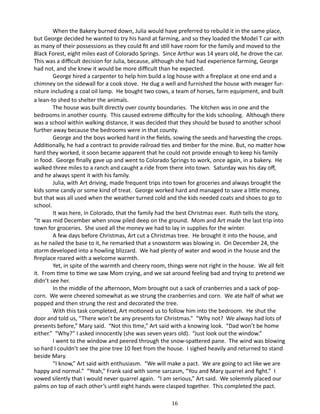
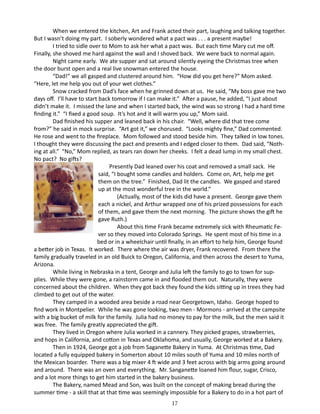
Presently Dad leaned over his coat and removed a small sack. He
said, “I bought some candles and holders. Come on, Art, help me get
them on the tree.” Finished, Dad lit the candles. We gasped and stared
up at the most wonderful tree in the world.”
(Actually, most of the kids did have a present. George gave them
each a nickel, and Arthur wrapped one of his prized possessions for each
of them, and gave them the next morning. The picture shows the gift he
gave Ruth.)
About this time Frank became extremely sick with Rheumatic Fever so they moved into Colorado Springs. He spent most of his time in a
bed or in a wheelchair until finally, in an effort to help him, George found
a better job in Texas. It worked. There where the air was dryer, Frank recovered. From there the
family gradually traveled in an old Buick to Oregon, California, and then across the desert to Yuma,
Arizona.
While living in Nebraska in a tent, George and Julia left the family to go to town for supplies. While they were gone, a rainstorm came in and flooded them out. Naturally, they were
concerned about the children. When they got back they found the kids sitting up in trees they had
climbed to get out of the water.
They camped in a wooded area beside a road near Georgetown, Idaho. George hoped to
find work in Montpelier. While he was gone looking, two men - Mormons - arrived at the campsite
with a big bucket of milk for the family. Julia had no money to pay for the milk, but the men said it
was free. The family greatly appreciated the gift.
They lived in Oregon where Julia worked in a cannery. They picked grapes, strawberries,
and hops in California, and cotton in Texas and Oklahoma, and usually, George worked at a Bakery.
Then in 1924, George got a job from Saganette Bakery in Yuma. At Christmas time, Dad
located a fully equipped bakery in Somerton about 10 miles south of Yuma and 10 miles north of
the Mexican boarder. There was a big mixer 4 ft wide and 3 feet across with big arms going around
and around. There was an oven and everything. Mr. Sanganette loaned him flour, sugar, Crisco,
and a lot more things to get him started in the bakery business.
The Bakery, named Mead and Son, was built on the concept of making bread during the
summer time - a skill that at that time was seemingly impossible for a Bakery to do in a hot part of
17
the country. Apparently, the flour had a “rope” microorganism, and when it was mixed with yeast,
although the bread looked great on the outside, when it was cut, there was a brown, gooey center.
Formaldehyde candles could be used to kill the microorganism, but the solution was very temporary – lasted about three months.
Although the details are not known, George was able to slow the yeast by putting ice
around the mixing bowl so the bread didn’t rise too quickly. Their slogan, “Somerton, the Summer Time Bread” was printed on the bread wrappers. George hired the Yuma Indian Band to go
to ElCentro and play over the radio station, and at one point, they gave bread knives as a promotion. The business was a prosperous one, known throughout the southwest for its excellent Bakery
products.
The family lived in Yuma/Somerton longer than any other place - five years - and so considered it home. Due to the depression, the business closed, and once again, George wanted to
move on. So, with Ruth driving this time, the family left for Wheeler, Texas, and then moved on
to Oakridge, Oregon, to Cottage Grove, Oregon, on to Arkansas, to California, and finally to Soda
Springs, Idaho. Arthur, who had married and stayed in Yuma, joined them there to start yet another bakery.
George Milton Mead passed away at Soda Springs, Idaho 28 July 1939 from Prostrate Cancer. At the time of his death, Julia moved to Afton, where the children had started the Star Valley
Bakery, and remained there for several years before she moved with her son, Frank, to Renton,
Washington. Later they moved to Kennydale, Washington. She suffered a stroke when she was
68 years old. Frank and his wife were very patient and kind and assisted her in every possible
way during her lingering illness. Three years later at the age of 71, she passed away at Kennydale,
Washington. She suffered from hypertension, arteriosclerosis, and finally died from a cerebral
hemorrhage. The family decided they wanted her to be buried by her husband in Soda Springs,
Idaho.

		
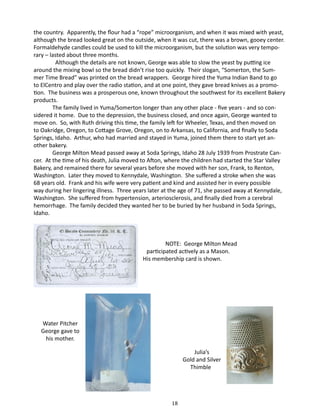
NOTE: George Milton Mead
	 participated actively as a Mason.
His membership card is shown.

Water Pitcher
George gave to
his mother.
Julia’s
Gold and Silver
Thimble

18
Ruth wrote the following tribute to her father:
HE’S ALWAYS THERE
I love my Dad,
He always looks out for me.
Even when I was just a little kid
There was nothing too good for me.
I cuddle up in his lap.
And he tells me stories like“Once there was a girl with a curl in the
middle of her forehead.
When she was good, she was very good,
But when she was bad, she was horrid.”
“But I am always good Daddy”, I said,
And fell asleep with my head on his chest.
Finally, he tucked me into my bed.
With a gentle pat on top of my head.
Sources:
1 - My Memories of Dad written by Ruth M. Hale
2 - Julia J. Mead’s Obituary from a Washington paper
3 - Mary’s Story
4 - Ruth’s Story
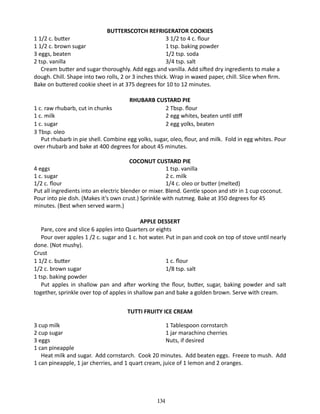
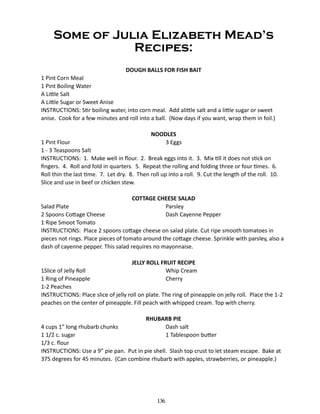
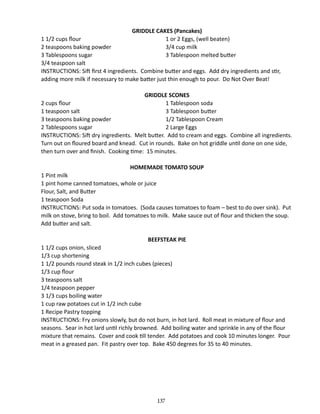
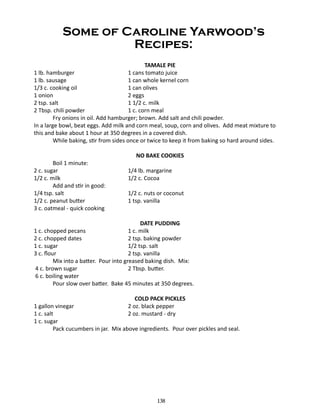
5 – Recipes collected by Mary Hofling and shared by her daughter, Margaret Linehan.
6 - Margaret Linehan’s records.
7 – Ruth Elizabeth Mead Hale’s Autobiography.

Charles Edward
& Caroline Hobbs Yarwood
Charles Edward Yarwood was born on 3 September 1863 in LaGrange County, Indiana the sixth child (fifth son) of William Yarwood and Hannah Philbean/Pillbeam. {He was born the
same year as the automobile inventor, Henry Ford, and the Circus owner, Charles Ringling.} When
Charles was about 15, the family immigrated to Washington State.
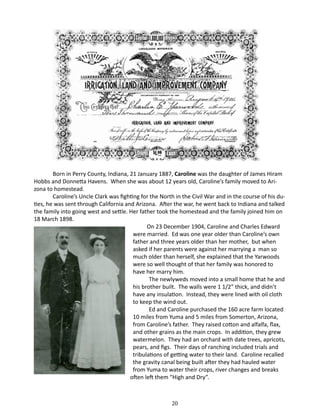
In the late 1890s, the Yarwoods invested in a company to build a dam for irrigation purposes near Yuma, Arizona. Charles, or Ed as he was called, went to help on this project, arriving in
the valley in 1898, and chose to make Yuma his home. He was known in Yuma valley that his word
as was good as a signed note. Interesting sideline: After the dam was built and irrigation waters
became available, the landowners rebelled at the price of the water. They complained to the government at Washington, D.C. The Government took over the dam and charged more money than
Yarwood and Company had charged.
19
Born in Perry County, Indiana, 21 January 1887, Caroline was the daughter of James Hiram
Hobbs and Donnetta Havens. When she was about 12 years old, Caroline’s family moved to Arizona to homestead.
Caroline’s Uncle Clark was fighting for the North in the Civil War and in the course of his duties, he was sent through California and Arizona. After the war, he went back to Indiana and talked
the family into going west and settle. Her father took the homestead and the family joined him on
18 March 1898.
	
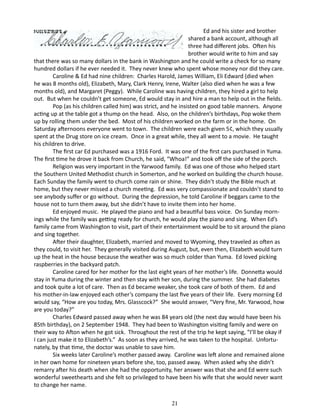
On 23 December 1904, Caroline and Charles Edward
were married. Ed was one year older than Caroline’s own
father and three years older than her mother, but when
asked if her parents were against her marrying a man so
much older than herself, she explained that the Yarwoods
were so well thought of that her family was honored to
have her marry him.
The newlyweds moved into a small home that he and
his brother built. The walls were 1 1/2” thick, and didn’t
have any insulation. Instead, they were lined with oil cloth
to keep the wind out.
Ed and Caroline purchased the 160 acre farm located
10 miles from Yuma and 5 miles from Somerton, Arizona,
from Caroline’s father. They raised cotton and alfalfa, flax,
and other grains as the main crops. In addition, they grew
watermelon. They had an orchard with date trees, apricots,
pears, and figs. Their days of ranching included trials and
tribulations of getting water to their land. Caroline recalled
the gravity canal being built after they had hauled water
from Yuma to water their crops, river changes and breaks
often left them “High and Dry”.

20
Ed and his sister and brother
shared a bank account, although all
three had different jobs. Often his
brother would write to him and say
that there was so many dollars in the bank in Washington and he could write a check for so many
hundred dollars if he ever needed it. They never knew who spent whose money nor did they care.
Caroline & Ed had nine children: Charles Harold, James William, Eli Edward (died when
he was 8 months old), Elizabeth, Mary, Clark Henry, Irene, Walter (also died when he was a few
months old), and Margaret (Peggy). While Caroline was having children, they hired a girl to help
out. But when he couldn’t get someone, Ed would stay in and hire a man to help out in the fields.
Pop (as his children called him) was strict, and he insisted on good table manners. Anyone
acting up at the table got a thump on the head. Also, on the children’s birthdays, Pop woke them
up by rolling them under the bed. Most of his children worked on the farm or in the home. On
Saturday afternoons everyone went to town. The children were each given 5¢, which they usually
spent at the Drug store on ice cream. Once in a great while, they all went to a movie. He taught
his children to drive.
The first car Ed purchased was a 1916 Ford. It was one of the first cars purchased in Yuma.
The first time he drove it back from Church, he said, “Whoa!” and took off the side of the porch.
Religion was very important in the Yarwood family. Ed was one of those who helped start
the Southern United Methodist church in Somerton, and he worked on building the church house.
Each Sunday the family went to church come rain or shine. They didn’t study the Bible much at
home, but they never missed a church meeting. Ed was very compassionate and couldn’t stand to
see anybody suffer or go without. During the depression, he told Caroline if beggars came to the
house not to turn them away, but she didn’t have to invite them into her home.
Ed enjoyed music. He played the piano and had a beautiful bass voice. On Sunday mornings while the family was getting ready for church, he would play the piano and sing. When Ed’s
family came from Washington to visit, part of their entertainment would be to sit around the piano
and sing together.
After their daughter, Elizabeth, married and moved to Wyoming, they traveled as often as
they could, to visit her. They generally visited during August, but, even then, Elizabeth would turn
up the heat in the house because the weather was so much colder than Yuma. Ed loved picking
raspberries in the backyard patch.
Caroline cared for her mother for the last eight years of her mother’s life. Donnetta would
stay in Yuma during the winter and then stay with her son, during the summer. She had diabetes
and took quite a lot of care. Then as Ed became weaker, she took care of both of them. Ed and
his mother-in-law enjoyed each other’s company the last five years of their life. Every morning Ed
would say, “How are you today, Mrs. Glasscock?” She would answer, “Very fine, Mr. Yarwood, how
are you today?”
Charles Edward passed away when he was 84 years old (the next day would have been his
85th birthday), on 2 September 1948. They had been to Washington visiting family and were on
their way to Afton when he got sick. Throughout the rest of the trip he kept saying, “I’ll be okay if
I can just make it to Elizabeth’s.” As soon as they arrived, he was taken to the hospital. Unfortunately, by that time, the doctor was unable to save him.
Six weeks later Caroline’s mother passed away. Caroline was left alone and remained alone
in her own home for nineteen years before she, too, passed away. When asked why she didn’t
remarry after his death when she had the opportunity, her answer was that she and Ed were such
wonderful sweethearts and she felt so privileged to have been his wife that she would never want
to change her name.
21
Caroline remained active throughout her life.
She was a member of many organizations including
charter membership in First Methodist Church of
Somerton, Amaranth and Order of Eastern Star, member of the Women’s Society of Christian Service of the Methodist Church, White Shrine, American
Legion Auxiliary, Wednesday Afternoon Club, and was active in Senior Citizens. She enjoyed playing Canasta and was always willing to make a table for a benefit party or inviting friends in her
home for a party.
In January 1962, Caroline was chosen as Semi-Centennial Queen -- for this honor, she must
have lived in Arizona 50 years or more and must have been a resident of Yuma County.
When Caroline was 80, during November, she didn’t feel well. So, she visited the doctor,
and he determined that she had pneumonia and decided that she should be hospitalized and have
an oxygen tent placed over her - despite her protests. It seemed as though she struggled against
being in an oxygen tent so much that she didn’t have the strength to fight off the pneumonia. On
11 November 1967, this beloved lady, Caroline H. Yarwood, passed away.
NOTE: The following was written for Caroline and was read at the Semi-Centennial celebration:
THE STORY OF CAROLINE HOBBS
Away off in Indiana, seventy-five years ago
A babe was sparked with the breath of life to grow and grow and grow.
	
Before she reached teen-age, her family brought her west
	
Because they wanted more land and the very, very best.
Their Yuma Valley homestead was shoulder deep in weeds and bramble
Which they cleared away most hastily to start the great green gamble
	
No rain was sent from heaven so they brought water in a ditch
	
From the Colorado River which was both their friend and witch.
In dry years, it was to homesteaders and crops their life blood
But when heavy rains joined melting snows, it washed them out with flood.
	
Soil, seed, water, sunshine with tilling the season through
	
Produced the heaviest of crops and quality young folks, too.
At seventeen, this Caroline Hobbs added Yarwood to her name.
She and her Charles Edward raised seven children of their quality the same.
	
That Yuma Valley still yields well from records may be seen;
	
This year, it reached the climax and produced for us a queen.
Sources:

1 - Yuma Paper - January 1962
2 - Interview of Caroline H. Yarwood by Barbara M. Putnam, her granddaughter. “Grandma Caroline Yarwood
was in Afton for a visit with my mother, Elizabeth, in August of 1967. She came in with a cousin, Janet Kehl.
Grandma wanted to go to Midvale, Utah and visit Aunt Irene for a few days, but Janet wasn’t ready to leave
so we took her as far as Logan, Utah. On the way, we talked about relatives in Washington. Some of the conversation
with Grandma was how she and her parents came to Yuma Valley in Arizona, etc.”

22
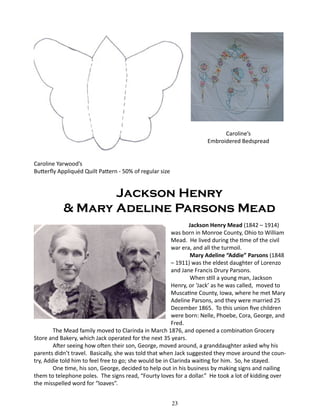
Caroline’s
Embroidered Bedspread
Caroline Yarwood’s
Butterfly Appliquéd Quilt Pattern - 50% of regular size

Jackson Henry
& Mary Adeline Parsons Mead
Jackson Henry Mead (1842 – 1914)
was born in Monroe County, Ohio to William
Mead. He lived during the time of the civil
war era, and all the turmoil.
Mary Adeline “Addie” Parsons (1848
– 1911) was the eldest daughter of Lorenzo
and Jane Francis Drury Parsons.
When still a young man, Jackson
Henry, or ‘Jack’ as he was called, moved to
Muscatine County, Iowa, where he met Mary
Adeline Parsons, and they were married 25
December 1865. To this union five children
were born: Nelle, Phoebe, Cora, George, and
Fred.
The Mead family moved to Clarinda in March 1876, and opened a combination Grocery
Store and Bakery, which Jack operated for the next 35 years.
After seeing how often their son, George, moved around, a granddaughter asked why his
parents didn’t travel. Basically, she was told that when Jack suggested they move around the country, Addie told him to feel free to go; she would be in Clarinda waiting for him. So, he stayed.
One time, his son, George, decided to help out in his business by making signs and nailing
them to telephone poles. The signs read, “Fourty loves for a dollar.” He took a lot of kidding over
the misspelled word for “loaves”.
	

23
Jack was prosperous enough to send Fred to college and then onto three years of Divinity
School so he could become a Methodist Minister. He would have sent George to college, as well,
but he wasn’t interested in going.
Addie was basically an invalid for the last 30 years of her life, but she was never heard to
utter a work of complaint in all of that time. She was a member of the Methodist Episcopal church
from her early life, but owing to her illnesses she was unable to attend church services more than
half a dozen times in the last years.
She died at their home in Clarinda, on 1406 East Garfield Street, 4 July 1911 at the age of 62
years. Although the actual funeral services were conducted by the local reverend, Mary Adeline’s
son, Reverend Fred A. Mead, a minister in the Des Moines conference, assisted in the arrangements.
After Mary Adeline’s death, Jackson Henry retired from active business, and made his home
with his youngest daughter, Cora Hazelton. For the next couple of years, he was fairly healthy.
Then in 1913, until shortly before Christmas, his health began to fail, and on January 4, he suffered
a severe heart attack. He seemed to rally, however, and by the 20th, he appeared so much better
that they thought he would recover. But this was not to be and “before another day had dawned
his spirit had gone to that land where pain and parting are no more and to meet his Savior, whom
he trusted.” He died at age 71 years.
1 - Obituary of Jackson Henry Mead
2 - Obituary of Adeline Parsons Mead

Sources:

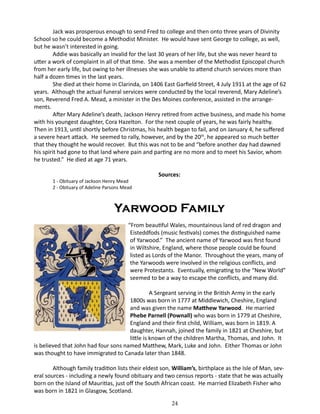
Yarwood Family
“From beautiful Wales, mountainous land of red dragon and
Eisteddfods (music festivals) comes the distinguished name
of Yarwood.” The ancient name of Yarwood was first found
in Wiltshire, England, where those people could be found
listed as Lords of the Manor. Throughout the years, many of
the Yarwoods were involved in the religious conflicts, and
were Protestants. Eventually, emigrating to the “New World”
seemed to be a way to escape the conflicts, and many did.
A Sergeant serving in the British Army in the early
1800s was born in 1777 at Middlewich, Cheshire, England
and was given the name Matthew Yarwood. He married
Phebe Parnell (Pownall) who was born in 1779 at Cheshire,
England and their first child, William, was born in 1819. A
daughter, Hannah, joined the family in 1821 at Cheshire, but
little is known of the children Martha, Thomas, and John. It
is believed that John had four sons named Matthew, Mark, Luke and John. Either Thomas or John
was thought to have immigrated to Canada later than 1848.
Although family tradition lists their eldest son, William’s, birthplace as the Isle of Man, several sources - including a newly found obituary and two census reports - state that he was actually
born on the Island of Mauritias, just off the South African coast. He married Elizabeth Fisher who
was born in 1821 in Glasgow, Scotland.
24
Elizabeth passed away in 1848 leaving William with three children: Henry, age 6, Lizzie, age
3, and a baby, Alice, only a few months old. (Their first boy, John Henry, lived only about one year.)
Soon after the death of Elizabeth, William, to get away from his grief and sorrow decided
to sail for a new life in America. His sister, Hannah, who had never married, agreed to go with him
and care for the children, as did their parents, Matthew and Phebe.
	
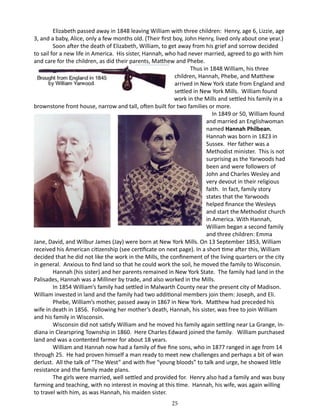
Thus in 1848 William, his three
children, Hannah, Phebe, and Matthew
arrived in New York state from England and
settled in New York Mills. William found
work in the Mills and settled his family in a
brownstone front house, narrow and tall, often built for two families or more.
	
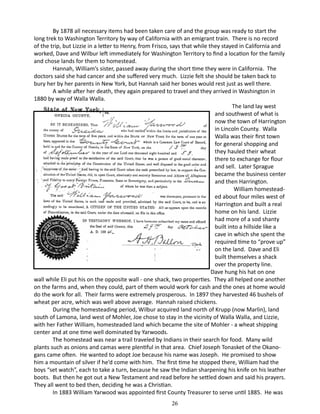
In 1849 or 50, William found
and married an Englishwoman
named Hannah Philbean.
Hannah was born in 1823 in
Sussex. Her father was a
Methodist minister. This is not
surprising as the Yarwoods had
been and were followers of
John and Charles Wesley and
very devout in their religious
faith. In fact, family story
states that the Yarwoods
helped finance the Wesleys
and start the Methodist church
in America. With Hannah,
William began a second family
and three children: Emma
Jane, David, and Wilbur James (Jay) were born at New York Mills. On 13 September 1853, William
received his American citizenship (see certificate on next page). In a short time after this, William
decided that he did not like the work in the Mills, the confinement of the living quarters or the city
in general. Anxious to find land so that he could work the soil, he moved the family to Wisconsin.
Hannah (his sister) and her parents remained in New York State. The family had land in the
Palisades, Hannah was a Milliner by trade, and also worked in the Mills.
In 1854 William’s family had settled in Malwarth County near the present city of Madison.
William invested in land and the family had two additional members join them: Joseph, and Eli.
Phebe, William’s mother, passed away in 1867 in New York. Matthew had preceded his
wife in death in 1856. Following her mother’s death, Hannah, his sister, was free to join William
and his family in Wisconsin.
Wisconsin did not satisfy William and he moved his family again settling near La Grange, Indiana in Clearspring Township in 1860. Here Charles Edward joined the family. William purchased
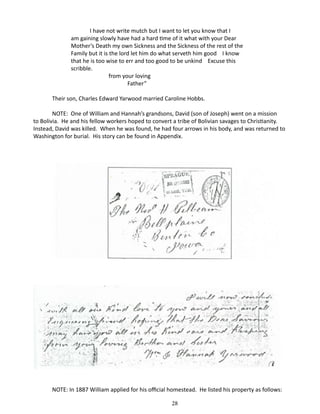
land and was a contented farmer for about 18 years.
William and Hannah now had a family of five fine sons, who in 1877 ranged in age from 14
through 25. He had proven himself a man ready to meet new challenges and perhaps a bit of wan
derlust. All the talk of “The West” and with five “young bloods” to talk and urge, he showed little
resistance and the family made plans.
The girls were married, well settled and provided for. Henry also had a family and was busy
farming and teaching, with no interest in moving at this time. Hannah, his wife, was again willing
to travel with him, as was Hannah, his maiden sister.
25
By 1878 all necessary items had been taken care of and the group was ready to start the
long trek to Washington Territory by way of California with an emigrant train. There is no record
of the trip, but Lizzie in a letter to Henry, from Frisco, says that while they stayed in California and
worked, Dave and Wilbur left immediately for Washington Territory to find a location for the family
and chose lands for them to homestead.
Hannah, William’s sister, passed away during the short time they were in California. The
doctors said she had cancer and she suffered very much. Lizzie felt she should be taken back to
bury her by her parents in New York, but Hannah said her bones would rest just as well there.
A while after her death, they again prepared to travel and they arrived in Washington in
1880 by way of Walla Walla.
	
The land lay west
and southwest of what is
now the town of Harrington
in Lincoln County. Walla
Walla was their first town
for general shopping and
they hauled their wheat
there to exchange for flour
and sell. Later Sprague
became the business center
and then Harrington.
William homesteaded about four miles west of
Harrington and built a real
home on his land. Lizzie
had more of a sod shanty
built into a hillside like a
cave in which she spent the
required time to “prove up”
on the land. Dave and Eli
built themselves a shack
over the property line.
Dave hung his hat on one
wall while Eli put his on the opposite wall - one shack, two properties. They all helped one another
on the farms and, when they could, part of them would work for cash and the ones at home would
do the work for all. Their farms were extremely prosperous. In 1897 they harvested 46 bushels of
wheat per acre, which was well above average. Hannah raised chickens.
During the homesteading period, Wilbur acquired land north of Krupp (now Marlin), land
south of Lamona, land west of Mohler, Joe chose to stay in the vicinity of Walla Walla, and Lizzie,
with her Father William, homesteaded land which became the site of Mohler - a wheat shipping
center and at one time well dominated by Yarwoods.
The homestead was near a trail traveled by Indians in their search for food. Many wild
plants such as onions and camas were plentiful in that area. Chief Joseph Tonasket of the Okanogans came often. He wanted to adopt Joe because his name was Joseph. He promised to show
him a mountain of silver if he’d come with him. The first time he stopped there, William had the
boys “set watch”, each to take a turn, because he saw the Indian sharpening his knife on his leather
boots. But then he got out a New Testament and read before he settled down and said his prayers.
They all went to bed then, deciding he was a Christian.
In 1883 William Yarwood was appointed first County Treasurer to serve until 1885. He was
26
reelected in November 1884 on the Republican ticket and followed that party the rest of his life.
He took great pride in being exact in the county financial matters. In 1886 he wrote that he’d “collected and paid out between 30 & 40 thousand dollars” and balanced within 1 cent difference.
William and Lizzie both served as teachers in Lincoln County near their homes in the years
before and after 1885. The General Store operated by the Yarwood Brothers opened 24 August
1894 and operated until 1947. They were burned out once about 1912 but rebuilt immediately. Eli
was the manager of the General Store while Dave looked after the Hardware and Lumberyard. In
1906 they were responsible for constructing the telephone lines between Mohler and Harrington.
Although it was a private line, it had connection with long distance systems, as well. Wilbur became interested in the mines in Stevens County. When Joe came to the area from Walla Walla, he
often worked for the county, constructing roads and also warehouses. He spent sometime after his
marriage in Seattle.
In the late 1890s, the Yarwoods invested in a company to build a dam for irrigation purposes near Yuma, Arizona. Charles or Ed as he was called, went to help on this project, arriving in the
valley in 1898, and chose to make Yuma his home.
When the dam was built and irrigation waters became available, the landowners rebelled at
the price of the water. They complained to the government at Washington, D.C. The Government
took over the dam and charged more money than Yarwood and Company had charged.
In 1900 Mohler could claim 2 stores, one saloon, a meat market, a hotel, a blacksmith shop,
five warehouses for wheat and other business establishments - 500,000 bushels of wheat were
marketed there. Mohler school started as a typical one room school but soon had a fine three
room schoolhouse with grades one to eleven. All were run by members of the Yarwood family.
Hannah passed away in 1891 and, since neither Lizzie nor Eli had ever married, they lived
together with their father in Mohler. The farmland was rented or leased to other farmers. Eli managed the store and was the postmaster at Mohler until his death.
In 1906 William, Lizzie, and Eli spent part of the winter in Yuma, Arizona with Ed and his
family. The following July, William died.
Parts of his obituary include: “Thus we see he has lived on two continents and in three
countries and more than half encircled the globe, but was destined to become a fixture of the “far
west”. He held offices of trust both in the east and this county . . .
“Full of years” we say, but amid the many, many changes that came to him, he was ever
faithful in Christian work until the feebleness of age overtook him.
How well we remember him in the years gone by as the leader and life of the Sabbath
school and church service. He was the ready and willing guide in our weak efforts and to him alone
are we indebted for success in those undertakings.
The good he did time and eternity will tell, but we feel that those earnest petitions he was
wont to utter have reached the Throne of Grace and been recorded and we hope the seed sown
may return the hundred fold. . . .”
William and Hannah are buried in the Harrington West Cemetery. Throughout their lives,
their faith in God and Christ provided a sure foundation as shown in the following letter written by
William shortly after Hannah’s passing:
“My Dear Children:

27
I have not write mutch but I want to let you know that I
am gaining slowly have had a hard time of it what with your Dear
Mother’s Death my own Sickness and the Sickness of the rest of the
Family but it is the lord let him do what serveth him good I know
that he is too wise to err and too good to be unkind Excuse this
scribble.
	
from your loving
		
Father”
Their son, Charles Edward Yarwood married Caroline Hobbs.
NOTE: One of William and Hannah’s grandsons, David (son of Joseph) went on a mission
to Bolivia. He and his fellow workers hoped to convert a tribe of Bolivian savages to Christianity.
Instead, David was killed. When he was found, he had four arrows in his body, and was returned to
Washington for burial. His story can be found in Appendix.

NOTE: In 1887 William applied for his official homestead. He listed his property as follows:
28
House 16 x 32 with addition 12 x 32 	$ 500.00
(1 1/2 story main building and addition one story)
80 acres fenced, posts and poles and wire	 $ 200.00
75 acres broken				
$ 225.00
3 wells						
$ 75.00
Stable 16 X 40					
$ 75.00
Root house ($25) and Chicken House ($25)	 $ 50.00
Total Value 					
$ 1,125.00
His domestic animals and livestock included: 4 horses, about 60 head of cattle, 4 or 5 dozen
chicken, 2 cats and one dog. Two stoves, 1 dozen chairs, 2 or 3 tables, 4 carpets; crockery and
glassware, pictures, clock, cupboard, 4 bedsteads, beds, and bedding were listed as the furniture
on his claim. He raised wheat, rye and barley, and hay.
Sources:

1 - The Yarwoods, 1777 – 1976, by Marie Y. Borck
2 - Obituary IN MEMORIAM OF WILLIAM YARWOOD, A Faithful Servant Gone to His Reward, A Friend’s Tribute
to Humility

Hobbs Family
Hiram Hobbs (born in 1798), was the son of Nathan Hobbs, and lived in Indiana. Sabra
Hifil/Highfield (born in 1806) was the daughter of Wilson and Margaret Highfield. They married
and had 11 children. Originally from Virginia, they moved to Indiana in about 1800.
We don’t know much about the family, but one of Hiram’s sons, Thomas, and his son were
convicted of murdering a neighbor and served time in prison. They said that it was self-defense;
that the neighbor had been harassing and threatening them throughout several months, and
finally, they were forced to stop him. Although they were found guilty and were sentenced to life
imprisonment, after serving a few years, they were both pardoned by the governor (a distant relative.)
Although death dates are unknown, both Hiram and Sabra were buried in the Kitterman
Cemetery.
James Hobbs (1839 - 1924) was born the same year as John Rockefeller and George A.
Custer. Leanah Dixon (1840 – 1884), the daughter of Shadrach and Sarah Catherine Weddle Dixon,
was born in Perry, Indiana.They married 26 Jan 1860, and were blessed with 11 children.
James Hiram Hobbs (1865 – 1918) was the third son of James Hobbs and Leanah Dixon.
He was born the same year as President William G. Harding and Rudyard Kipling. James married
Donnetta Havens (1866 – 1948), daughter of James Boone and Margaret Fuller Havens in 1884 and
they had five children.
It seems that Donnetta’s uncle, Clark Havens, was fighting for the Union during the Civil
War and in the course of his duties, he was sent through California and Arizona. The army train
stopped in Yuma for water and a man who wanted to see the west grow talked to all the soldiers
and wanted them to bring their families from the east and settle in the west. So, after the war, he
went back to Indiana and talked James into going west and settle. This wasn’t too hard to do since
their crops had been so bad for three years because of draught. Beyond that, he had Tuberculosis and was very ill. Additionally, one of their daughters wasn’t well. So it was decided that Clark
29
would go back to Yuma, Arizona, and investigate. If the land was good, he would wire his family
and they would sell what they could and go west.
	
As it was, he found good land that was to be homesteaded. When the family got the wire, they packed their belongings,
sent them by freight, and the family went on the train. On the
way, they had a dangerous, frightening experience. The engineer
lost control of the train and the brakes wouldn’t work, so they
had to help drop chains down under the wheels to stop the train.
Just as they got the train stopped, they could hear another one
coming. They were able to signal it in time to get stopped or it
surely could have ended up differently.
The rest of the trip went along fairly nice, but the family arrived before their belongings. They were welcomed into
the home of the man who ran the trading post and lived there
about three weeks. When their belongings came, they went out
to the place they were to homestead and set up a camp in open
air. The ground was so hard and dried from the winter rains
that they couldn’t sink a shovel into it, but as it got warmer, the
ground got softer. While they worked on their home, they were
very thankful for good weather. The day they moved into their
home, the ground had softened up, with six inches of loose sand,
and that very night, a very severe dust storm hit. The next morning the car was half buried, and
the sand was all gone. It was the worst storm ever seen in that Valley. If the family had been out
in the open that night, they would have all died, and so they were surely blessed.
The Hobbs homesteaded an area of 160 acres that was located 10 miles from Yuma and 5
miles from Somerton, Arizona. Their days of ranching included trials and tribulations. When they
first started cultivating the land, there were so many rattlesnakes that they wore stovepipes on
their legs for protection. Equally difficult was the problem of getting water to their land. Before
the gravity canal was built they had to haul water from Yuma to water their crops because river
changes and breaks often left them “High and Dry”. Despite the challenges, Donnetta always had a
very pretty yard. She could take a stick and put it in the ground and it would grow.
James and Donnetta ultimately sold the farm to their daughter, Caroline and her husband
Charles Edward Yarwood.
	
James died 4 November 1918 in Yuma and about
four years later, Donetta remarried Robert Glasscock.
Robert died in 1936 and Donnetta remained a widow for
the next 12 years.
Donetta lived in Carlsbad in her own little place until she got so she couldn’t take care of herself. At one time she had been hurt in an accident. She
had a broken hip and was bedfast. She got paid for damages, but she had given power of attorney
to her brother-in-law, he collected her money, and gambled it off that same night. So, she lost all
she had.
For the last eight years of her life, Donetta had diabetes and took quite a lot of care. She
lived with her son, Ed, during the summer, and with her daughter, Caroline, during the winter.
Then as her son-in-law, Charles, became weaker, Caroline took care of both of them. Every morning Ed would ask Donetta, “How are you today, Mrs. Glasscock?” She would answer, “Very fine, Mr.
Yarwood. How are you today?”
Donnetta passed away on 21 Oct 1948 in La Jolla, California.
30
Their daughter, Caroline married Charles Edward Yarwood.
Sources:

1 - US Census
2 - A Search for the Hobbs Family, by Louise H. Ross, printed privately.

Donnetta’s hand appliqued quilt block

Lorenzo & Jane Francis Parsons
Parsons Family Motto: Quid retribuam? “What shall I render?”

Lorenzo Parsons (1814 – 1864) was born in New York. He was a child during the time when
our country was building the Erie Canal. The Internal Combustion Engine, the propeller for a ship,
the telegraph, and the modern computer were invented about this time. During his lifetime, he
witnessed all of the events of the Civil War, and one of his sons, served in that war.
We don’t know much about his childhood; we don’t even know his parent’s names. He was
married three times: 1) Catherine McKinley (they had at least one son), and 2) Jane Francis Drury.
He was also engaged to marry Lucinda Curtis, but although they took out a marriage license, there
is no record that they actually got married.
Jane Francis Drury (1817-1903), the daughter of John Drury and Mary (Polly) Reynolds,
was born in Wayne County, Indiana. She was the widow of James Davis, and they had at least one
daughter. She met Lorenzo and they were married 11 August 1847 in Muscatine County, Iowa.
They had four children.
The Parsons family lived in Sweetland, Muscatine County, Iowa where they owned a farm,
and Lorenzo served as the local preacher of the Methodist Church.
On Saturday, 23 July 1864, Lorenzo was helping a Mr. Truitt on his farm. As he was taking
some corn out of a crib, he was bitten on the forefinger of his hand by a rattlesnake. The snake
was hidden in the husks, and if it sounded its rattle the noise was not heard because of the rustling
of the husks. The reptile was afterwards killed, and proved to be a small one, with only one rattle
and a “button” on its tail - indicating its age to be a year and a half. Lorenzo was apparently not
too concerned about its bite. He put some tobacco on the wound and went to work in the field,
but in less than two hours started vomiting. His arm became badly swollen and the swelling soon
extended to his body, causing intense suffering and the purging of blood. In this condition he lingered for about a week, until death ended his suffering.
Lorenzo died 29 July 1864 at about fifty years of age. Records show him to be an exemplary
Christian, a valued neighbor and a respected citizen.
Jane Francis passed away about 1903.
Their daughter, Mary Adeline Parsons married Jackson Henry Mead.
Sources:
1 - Obituary of Lorenzo Parsons, Taken from the Muscatine Journal, August 1, 1864.
2 - The Elusive Ancestor, by Margaret H. Linehan.
3 - Universal Genealogy Center
4 - Will

31
Murdoch & Johnston Families
Murdock Family Motto: Omine Secundo “With Favorable Omen”

	
William Murdoch (abt 1794 – 1851) was born in Campbelltown (Campbeltown) Argyll, Scotland. He married Isabella Crawford
(abt 1795 – 1848), and they had seven children. (Picture shows
traditional Scottish clothing from that time period.) William and his
sons James, John, Matthew, William and Robert immigrated in 1844.
They left Liverpool, England on the ship “Hope” on 11 November
and landed in Louisiana. Once in New Orleans, William’s occupation
as a Cabinet and Furniture Maker allowed him to open a furniture
store at 244 & 274 Magazine Street. Two years later, on 24 April
1846, Isabella and the other children – Elizabeth and Dugald – embarked on the ship “Hope” and joined the rest of the family.
Elizabeth Murdock (1822 - 1908) was 14 years old when she
came to New Orleans. She was raised in the Presbyterian church and remained a devoted and
faithful Christian throughout her life.
After her first husband, Thomas Quinn, drowned in Galveston Bay, Louisiana, Elizabeth took
her two daughters and moved to Peoria, Illinois, where her brother, Robert, was living. There she
married William Johnston (1811 – 1895), and they had seven children. Note: William was born
the same year as Harriet Beecher Stowe and Franz Liszt. They lived through the trials of the Civil
War.
William Murdock Johnston (1858 – 1935) was born the
same year as Theodore Roosevelt, in Peoria County, Iowa, and was
raised in on his father’s farm in an active Presbyterian family.
William married Mary Jane “Jennie” Hayes (1860 – 1917),
in about 1878 and they had nine* children, two of whom – Ralph
and Glen – died at a young age. (In the 1900 Census - before their
last child, Harold, was born - Jennie reported that she had given
birth to 10 children of whom 7 were still living. So far, I’ve been
unable to find records of two children, who, I believe, died as infants.)
At one time, William was in town and he’d been hearing about these “Cantaloupe” that
were for sell. He’d never heard of such a thing and really wanted to know what they were and how
they tasted. After wondering for a while, he decided to buy one – just to try it. After cutting it and
taking a bite, he voiced his disappointment when he said, “It’s just a goll-darn melon.”
Records show that William was considered the “Black Sheep of the Family”. Apparently,
he became involved with a younger woman and deserted his family, leaving them with very little
to live on – just what they could earn from their small farm. The couple was divorced, and considering the values of the time, that must have been a major scandal for Jennie and the children to
endure. But, when some time later he decided he wanted to come back, Jennie refused.
Diabetes seems to run through this family. Jenny eventually died from the disease in 1917,
and her son, Harold, eventually had to have both legs amputated because of complications.
During the last years of William’s life, he lived with his children, though he never really
seemed happy with what they gave him. At one time, both he and his son, Ray, were living in
Colorado and working in a bakery. He was living with his daughter Clara, in Oklahoma, at the time
	

32
of his death. Although there is a headstone with his name on it in Rosehill Cemetery in the Mt. Ayr
cemetery, he was buried there in Oklahoma.
William and Jennie’s daughter, Julia Elizabeth, married George Milton Mead.
Jennie’s Dandelion Recipe
Gather dandelions in spring while young, what you think is enough.
Mix dandelions and tear in small pieces.
Go to the smoke house and get a side of bacon.
Cut 14 pieces of bacon about 1 inch thick.
Fry in *spider till it crumbles (drain on catalogue paper).
Get: 4 cups vinegar out of keg (dark – don’t get the ** Mother).
	
2 cups cool well water
	
4 tablespoons sugar or to taste
	
4 teaspoons salt
Add vinegar, water, sugar, salt, bring to a real boil.
Pour mixture over dandelions.
Add bacon over all, mix good.
Be ready to eat this as soon as you put the hot stuff over as it gets cold quick.
*Spider: Iron frying pan with a long handle.
**Mother: A thick slimy substance developed during fermentation.
Note: Leaf lettuce could be used in place of dandelions. Or, if dandelions are used, make
sure they have not been sprayed with chemicals.
SOURCES:

1 – Some descendants of William Murdoch and Isabella Crawford, by June Shaputis, www.geocities.com/
Heartland/Plains/6025/murdock.htm
2 – Recipe handed down from Mary Jane “Jennie” Hayes Johnson to her daughter, Julie Johnston Mead, to her
daughter, Mary Mead Hofling, to her daughter, Margaret Hofling Linehan, and Margaret shared it with us.
3- US Census
4- Memories of Granddaughters, Mary and Ruth Mead.
5 – Rose Hill Cemetery Records

33
Havens’ Family

The Havens name is derived from the place name Haven, meaning “harbor”.
According to family tradition, William Havens (Abt. 1600 – 1683) came to America
from Aberystwith, Cardiganshire, Wales. William’s wife, Sarah or Mary, died either in
England or on the ship while coming to America. Either way, he arrived in the new
country with the challenge of raising three motherless children. (See William’s mark on margin.)
“It is not known what made William Havens leave the comparative comforts of England
and venture forth to the unknown future in the Colonies. Perhaps it was for religious freedom. . .
a chance for independence. . . wealth . . . one can only conjecture. No sailing date has been found,
so it is not known which of the ships he might have come on. One thing is certain. . . the passage
was frought with discomfort, deprivation, poor food and water, and generally over-crowded accommodation. These hardy souls who braved the Atlantic crossing were of tough fiber, the ideal
type to carve out an empire in a wild new land.”
It would appear that upon reaching America, William settled in the Massachusetts Bay
Colony. Apparently he was a yeoman and was a gunsmith, blacksmith or a “tinker” – somebody
able to do many different kinds of work successfully. Any of those occupations would have made
him a valuable addition to the early communities.
In 1638, William was admitted as an inhabitant of the island of Aquidneck. On April 30, he
and 28 others signed the following compact: “We, whose names are underwritten, do acknowledge ourselves the legal subjects of his majesty, King Charles, and in his name do hereby bind ourselves into a civil body politicke, unto his laws according to matters of justice.” In actual fact, these
29 formed the government at Portsmouth, Rhode Island.
In 1639, William married Dionisia Allen, and they had ten additional children. The family
was members of the “Society of Friends of Rhode Island”, and many of William’s descendants continue to practice the Quaker faith.
William is listed as serving his civil government by working with five others to “make and
mend all arms presented by inhabitants of any of the towns”. Additionally, he and two others were
appointed to “view the prisson & remove it if thay thinke it fitt to be done and place it sum wheare
upon the greene, where they thinke fitt and build a Chimny in it.”
	

34
He died 31 August 1683 in Portsmouth, Rhode Island, and left a will “for the preventing
future Trouble amongst my Children”. During his lifetime, many scientific discoveries were made in
the world: First Reflecting Telescope, Light Composition, and Theory of Gravitation.
Thomas Havens (1631 – 1704) came to America with his father, William. He married Mary
Pierce in 1658 or 1660. Thomas served as a Juryman in Aquidneck, and in Portsmouth. He also
served as the Town Sergeant. Then, in 1687 he moved to King’s Town, where he died some years
later.
Joseph Havens (1672 – 1764) married Susannah Hill, and they had eight children. His occupation is listed as that of a cordwainer (someone who makes shoes and other articles from soft
leather).
In 1709, he, along with his brothers, William and Thomas, Alexander Huling, and 9 others
bought 1,824 acres of land from the Colony Agents – the “Huling Purchase”. The current village of
Lafayette, Rhode Island is part of that purchase.
During his lifetime, both types of thermometers – Farenheit and Celcius – were invented.
Sylvester Havens (1728 – 1804) married Sarah Davis, and they had ten children. They lived
much of their lives in East Greenwich, Rhode Island, where he had quite a lot of land to farm.
The Havens family lived through the Revolutionary War era. This was, in many cases, a time
of conflict within families as some members of the family wanted a new country and other members believed that the revolution was doomed to failure and remained loyal to the crown. (Initially,
less than one third of the colonists wanted to break the tie with England.)
“On the 9th of March 1776, Silvester Havens, John Case, Nathaniel Case and Samuel Waight
were suspected of supplying the enemy with provisions and deemed to be unfriendly to the Common Cause of America. They were ordered not to travel from the town of North Kingston without
first having obtained a pass from the Committee of Inspection.” Apparently, Sylvester obeyed the
orders, because there is no record of further action being taken.
In the meantime, two of Sylvester’s sons, Samuel and Sylvester were serving on the ship
General Miffin, helping to “confiscate ships and cargo of enemies of the United States”.
Sylvester died intestate on 4 January 1804 at North Kingstown, Rhode Island.
James Havens (1769 – 1839) married Elizabeth Brown (1776 – 1825) {a descendant of Beriah Brown}, and they had seven children. They lived their lives in Rhode Island.
James Havens, Jr. (1806 – 1880) was born the same year as the poet Elizabeth Barret
Browning. He married Lucy Mary Brown (1814 – 1888), his mother’s niece, and they had eight
children.
In 1851, James, Lucy and their family migrated to Perry, Indiana where he purchased land.
Lucy’s sister, Harriet, and her family joined them. After the civil war, the families migrated to Minnesota to homestead land. In addition to farming, James was also trained as a machinist.
In 1880, James suffered from a serious illness that resulted in his having to be hospitalized
and from which he died.
	
After James’ death, Lucy moved in with her daughter Waity Warren in Angus, Iowa. A
few years later, Lucy and her sister traveled to Grants Pass, Oregon to be near Thomas, her youngest child. While there, both sisters died. Lucy is buried in the Missouri Flat Cemetery. Her stone is
inscribed: “Born on the East Coast and Died on the West Coast.”
35
James Boone Havens (1838 – 1916) was born in Knox
County, Rhode Island, the same year as Charles “Tom Thumb”
Stratton. He married Margaret Fuller (1832 – 1897) in 1858, and
they had seven children.
James served in the Civil War for three years in the Union
Army in Company G, of the 81st Regiment Indiana Volunteer
Infantry under Captain William O’Neill. He is listed as being a
Private, a Primary Musician, and he generally played the Fife, (although at one time, his attendance records show that he played
the bugle, as well.) At the time of his enlistment, he was 24 years
old, 5 feet 9 inches with fair complexion, blue eyes, and brown
hair.

During the three years of service, the 81st Regiment history is as follows:
Organized at New Albany, Indiana, and mustered in August 29, 1862.
Ordered to Louisville, Ky., August 29.
SERVICE
Pursuit of Bragg into Kentucky October 1-15, 1862.
Battle of Perrysville, Ky., October 8.
Of this battle, Captain O’Neill wrote: “We have not quite been in a fight, but pretty near it.
It was a hard fight from three o’clock in the morning until dark at night. We were ordered in but
the rebels retired about that time. I presume they heard of Companies G and K and got scared.
That was on the 8th October. We have had a running fight of it ever since - our advance and the
rear of the rebels. We are drawn up in line of battle nearly every day, but as yet we have not actually tried our hand; but I can tell you one thing, there is pluck and fight both in the roaring 81st, and
if she ever gets a chance she will prove it. I judge from the way the boys acted when we were certain we were going to enter the ring. Every one was cool; no one straggled, and every man was in
his place, examining his gun and cartridges. At least three times in one week, ever since the battle
near Perryville, have we been drawn up in line of battle, and in sight of our wary foe, but it was a
flash each time. Yesterday, our brigade was drawn up in line to give the famous John Morgan a
twist, but he has learned that part of the tactics which reads, ‘Retreat, double quick, march,’ and he
done so. I don’t know what name they have given, the battle of the 8th. It was at and all around
a village called Perryville, and it was the first sight of the kind I ever saw, and a ghastly one it was.
We encamped right in amongst the dead, expecting the battle would be renewed in the morning.
When morning came the enemy was gone; none but their dead and wounded remained, and they
were, being numerous, laying over a space of ground between six and ten miles. I only went over
a part of it, but I seen plenty to do up my curiosity for the time being. The dead, in some places
36
lay in heaps, and in other places scattered; they were shot in every conceivable way, and were left
there, most of them unburied, and were finally buried in heaps. They are butternuts in reality, as
the whole of Bragg’s army are dressed in butternut colored clothes, and are a dirty, poverty-stricken
looking set. We are picking up deserted rebels every day, who are tired of the sport and have got
their rights.
W. O’NEILL (3)
March to Nashville, Tenn., October 16-November 7, and duty there till December 26.
Reconnaissance toward Franklin December 9. Near Brentwood December 9.
Advance on Murfreesboro December 26-30. Nolensville December 26-27.
Battle of Stone’s River December 30-31, 1862, and January 1-3, 1863.
Duty at Murfreesboro till June. Reconnaissance from Salem to Versailles March 9-14.
Operations on Eagleville Pike near Murfreesboro June 4.
Middle Tennessee or Tullahoma Campaign June 22-July 7. Liberty Gap June 22-27.
Duty at Winchester till August. Passage of the Cumberland Mountains and Tennessee River
and Chickamauga (Ga.) Campaign August 16-September 22.
Battle of Chickamauga September 19-20.
Siege of Chattanooga, Tenn., September 24-October 25. Reopened Tennessee River October
26-29.
Duty at Bridgeport, Ala., till January 26, 1864, and Ooltewah till May, 1864.
Atlanta (Ga.) Campaign May 3 to September 8, 1864. Tunnel Hill May 6-7.
Demonstrations on Rocky Faced Ridge and Dalton May 8-13. Buzzard’s Roost Gap May 8-9.
Battle of Resaca May 14-15. Near Kingston May 18-19. Near Cassville May 19. Advance on
Dallas May 22-25.
Operations on line of Pumpkin Vine Creek and battles about Dallas, New Hope Church and
Allatoona Hills May 25-June 5.
Operations about Marietta and against Kenesaw Mountain June 10-July 2. Pine Hill June 1114. Lost Mountain June 15-17. Assault on Kenesaw June 27.
Ruff’s Station, Smyrna Camp Ground, July 4. Chattahoochie River July 5-17.
Peach Tree Creek July 19-20.
Siege of Atlanta July 22-August 25.
Flank movement on Jonesboro August 25-30. Battle of Jonesboro August 31-September 1.
Lovejoy Station September 2-6.
Operations against Hood in North Georgia and North Alabama September 29-November 3.
Nashville Campaign November-December. Columbia, Duck River, November 24-27. Battle
of Franklin, November 30. Battle of Nashville December 15-16. Pursuit of Hood to the Tennessee
River December 17-28.
Moved to Huntsville, Ala., and duty there till March, 1865.
Operations in East Tennessee March 15-April 22.
At Nashville till June. Mustered out June 13, 1865.
Regiment lost during service 4 Officers and 52 Enlisted men killed and mortally wounded
and 1 Officer and 188 Enlisted men by disease. Total 245. (2)
Of course, it is certain that Margaret sacrificed much for the Union’s sake during the civil
war. Not much is ever written about how the families lived while the men were gone, but we do
know a little about the Havens. When James was mustered in August 1829, they already had two
small girls, Lucy – 3 and Mary – 1, and Margaret was pregnant with another child. Caroline was
born 12 Nov 1862. James probably never saw his youngest until after the war concluded, by which
time she was three years old.
37
Margaret died in 1897, and her headstone, found in the Stapleton Cemetery states: “She
was a tender mother and an affectionate wife.” After her death, James married Mary C. Eckert.
James died in 1916, at the age of 77 years. A program printed for his funeral contained the
following poem, copyrighted by H.F. Wendell in 1898.
Gone But Not Forgotten
A precious one from us has gone,
A voice we loved is stilled;
A place is vacant in our home
Which never can be filled.
God in His wisdom has recalled
The boon his love had given.
And though the body slumber here
The soul is safe in Heaven.
Donnetta Havens, married James Hobbs.
SOURCES:

1 - William Havens of Aquidneck, Rhode Island and the Descendants of James havens of Rhode Island, Indiana, and Minnesota, by Barbara Havens Russell.
2 - A Compendium of the War of the Rebellion by Frederick H. Dyer. Copyright, 1908.
3 - www.usroots.com/~jmurphy/perry/81indcog.htm
4 – The Havens Family in New Jersey With Additional Notes of the Tilton, Fielder, Hance, Osborn, Davison, Cox
and Gifford Families by Henry C. Havens, Lawrenceville, New Jersey.

Drury Family
Motto: Droyt et devaunt, “Right and Forward”.
According to records of the Augustus Evangelical Lutheran Church in Trappe, Pennsylvania,
William Drury (1750 – 1823) was christened on 2 November 1750. He married Rachel Willets
(1757 – 1838) on 13 Nov 1776, and they were blessed with nine children.
During his young adulthood, William witnessed all of the events leading up to the American
Revolutionary War, the war itself, and all that was required to build a new nation. His name was
listed on the Pennsylvania Militia as a Private in Captain John Bishop, 3rd Company, but there is no
evidence showing whether or not they were ever activated.
The Drury family was members of the Society of Friends (Quakers). In August 1815, they
joined the church in Whitewater, Wayne County, Indiana, where they had relocated.
William died on Christmas day, 25 December 1823. It was interesting to note in his will: “I
give and bequeath to my beloved wife Rachel all my personal property of what nature of kindsoever to be at her own free will and disposal”. Many times men left some to his wife, but rarely were
they given the right to make decisions concerning the belongings.
Rachel remained a widow for about 15 years before she died.
John Drury, (1787 – 1850) was born in York County, Pennsylvania. He married
Mary Reynolds (1784 – 1870) and they had 11 children. John and Mary received a homestead in
Eliza Township, Pennsylvania, seven miles northeast of New Boston village. A pioneer farmer, he
spent most of his life there.
38
John was involved in the War of 1812 from May 8 to September 30, 1814. He served as a
private in three different companies: 1) Scofield’s Detachment, Light Dragoons, Ohio Militia with
Captain Elinathan Scofield. Records show that during this time he volunteered to Escort the Governor Meigs to Cleveland. 2) Lieutenant Colonel Dodge’s Command, Missouri Militia in Captain
Daniel M. Boone’s Company of Mounted Militia of Missouri Territory. 3) Col. McNair’s Mounted
Regiment III in Captain Nathan Boone’s Company of Mounted Militia of Missouri Territory.
		
Nathan Boone banded a group of men
together and they went under the name of
Boone’s Mounted Rangers. They were considered “the minute men of the frontier”. Some
of their jobs consisted of making exploratory
marches for the army, helping build blockhouses, and serving as spies. They had to provide
their own provisions, guns, and horses. Pay
was 75¢ a day for those on foot and $1 for
those on horseback.
John later served in the Indian War on
the Missouri River, and for many years he served as a Justice of the Peace.
Both John and Mary were buried in Eliza Creek Cemetery in Mercer County, Illinois.
	

Their daughter, Jane Francis married Lorenzo Parsons.
SOURCES:

1 – William Drury’s will
2 – Historical Encyclopedia of Illinois and History of Mercer County, edited by Col. Wm. A. Lorimer, Munsell
Publishing Company, 1903.
3 – Elusive Ancestors, by Margaret H. Linehan
4 – Universal Genealogy Center Research Report.
5 – Portrait and Biographical Album of Muscatine Iowa.

Dixon Family
William D. Dixon (1760 – 1835) was probably an immigrant from the British Isles. He married Melissa Liscom Taylor (1756 – 1857), and they had four children. The family moved to South
Carolina, then to Tennessee and, finally, in about 1813 to the Indiana territory.
Shadrach Dixon (1796 - 1869), married Catherine Hindelides, and they were parents of six
	 children. After the death of Kate (in 1835), he married Sarah
Catherine (Sally) Weddle (1817 – 1898), daughter of David Erwin
and Elizabeth Coop Weddle, and they had ten children – making a
total of 16 children in the family.
		
Shadrach was apparently of “hearty stock”. When he
came to Indiana, he homesteaded a farm near Ft. Ritner in Lawrence County. He farmed for several years before looking for a new
occupation.
Next, he built his own flatboats, loaded them with hoop
poles that he cut and fashioned himself, and the piloted the slowmoving craft down the Ohio Rivers to New Orleans where they were
39
marketed. He often carried other products, as well. On his last trip, the flatboat was loaded with
smoked meat. The barge was hard to handle in the swift current. It hit a snag and began to leak,
causing half the load of meat to spoil.
Shad, as he was called, went broke, but being a man of great perseverance, he traded his
farm and in 1852 moved to Perry County to make his home. He bought 400 acres of land and
built a large two-story log house on it. Later his house was weather boarded and two large rooms
added in the rear.
Just when the idea for the grave began to form in his mind is not known. But it wasn’t long
after he moved to Perry County that he found a large, flat, seamless rock on his farm. The slab was
about 8 inches thick and he decided it would be just right for a grave top. He called on a neighbor
who owned a yoke of oxen, to sled the slab to the house. There it was cut into the shape of a casket or coffin.
Sometime later Dixon felled a great walnut tree and worked out the boards that were to be
used to build his casket. They were stored on the rafters on the second floor of his house for seasoning. When they were well-seasoned, the boards were cut and two more neighbors, who were
handy with tools, fashioned them into Dixon’s coffin.
Then, Shadrach’s health failed and he entered a city clinic for treatment. There his arm was
amputated and he was brought home, health in fragile condition. When he returned home, he
began to worry about getting his grave dug. Sally got in touch with a stonemason and hired him
to carve out the grave. He began work on a Tuesday, and Shad, lying in his bed by an east window,
could watch the work as it progressed. It was a slow job, chiseling in the hard sandstone. By late
Saturday, Shad was sinking rapidly. So, the stonemason continued to work by the light of lanterns
as dusk faded into black night. Finally, the task was finished, a grave extending 6 feet down into
the heart of the massive stone.
A few minutes later, on 13 Jan 1889, at the age of 72, Shadrach Dixon died, content in his
knowledge that his grave was ready for use. Finishing touches were put on the stone crypt and
Shadrach’s body in the walnut coffin was placed in it. The top stone was put into place and lime
mortar was poured around the edges, sealing the vault. Then a headstone of white stone was
erected, completing his original plan. (See next page.)
His last resting place is in the center of a huge boulder measuring 50 feet across and rising 15 feet above the ground. The grave is about three quarters of a mile off Indiana 62 in Dixon’s
valley between St. Meinrad and St. Croix. There is no road leading to the grave – only a faint path
made by cattle headed for an old wooden watering trough at a spring near the grave.
Sally remained a widow for the about nine years before passing away on 9 Dec 1898.
Note: Shadrach lived through the times of the civil war, and during his lifetime saw a lot of
inventions including: Telephone, Electric Light Bulb, Motorcycle, Subway, Automobile, and Color
Photographs.
Shadrach and Sarah’s daughter, Leenah married James Hobbs.
SOURCES:

1 – “Rock of Ages . . . Perry County Farmer Buried As He Wished – In Stone, by Jack Collins of Louisville Times.
2 – Picture from Louise H. Ross, 517 Beechlawn Drive, Clarksville, IN 47129 Phone: (812) 945-3158.

40
John Greenway
John Greenway (died in 1659) came to New England on the ship “Mary and John” in 1630,
along with three daughters, Ann, Elizabeth, and Katherine. His wife, Mary (died in 1682) must
have come over later with the other girls (they had six daughters).
The Greenway family settled in Dorchester where John served as a town officer. His occupation was that of a millwright.
John and Mary’s daughter, Ann married Robert Pierce, and their daughter, Mary, married
Thomas Havens.
SOURCE:

William Havens of Aquidneck, Rhode Island and the Descendants of James Havens of Rhode Island, Indiana,
and Minnesota, by Barbara Havens Russell.

41
Weddle Family

Motto: Orna verum, “Honour the truth”
	

Not much is known
about the early Weddle
family. While most of the
Weddles in America came
from Scotland descent, our
family came from Germany. Our first known ancestor was Joseph Weddle
who was born in Weisbaden, Germany, and lived
and died in Holland.
Although we don’t know
his wife’s name, we do
know that they had five
children: John, Susan,
George, Daniel, and
Joseph.

John, Joseph’s first
son, was born about 1739 in Holland. He married Mary Walling, daughter of Elisha Walling and
Mary Blevins. They had nine children: Amos, Elias, George, Thomas, Daniel, Mary, John W. (Jack),
James R., and David Erwin, three of whom were born in Holland and the other nine were born in
Baltimore, Maryland.
As our immigrant ancestors, John, Mary and their first three sons came to the United States
in 1774. (Apparently his brothers and sister emigrated with him, as well.) He lived in Baltimore,
Maryland until 1786 then the pioneer spirit seemed to become a part of him. First he moved to
Pittsburgh, Pennsylvania, where he and his brother-in-law, Pouler Rouse, built a flat boat and went
down the Ohio to the mouth of Bear Grass at the great falls of the river where Louisville, Kentucky
now stands. They next moved from Kentucky, took a Southeast course into the state of Virginia to
what was called the Long Islands of Holston River. He settled there for several years before moving
once again. This time he moved down the Holston River into the state of Tennessee and settled
at a place afterwards called Alexander. By 1792, John Weddle had purchased 160 acres at Plum
Grove on Possum Creek, Stanley Valley, Hawkins County, Tennessee. Through his life in Tennessee,
he accumulated about 600 to 700 acres of land.
After John’s death on 5 September 1799, his children began selling their land in Tennessee
because Indiana was opened for settlement. First they went to Lawrence County, Indiana, and
then they scattered to different places.
Note: Most of John’s sons served their country in the military. One served in the Revolutionary war, several served in the War of 1812 (Elias was killed in the Battle of Horseshow Bend in
Alabama), and at least one was involved in the Indian wars.

42
David Erwin Weddle, the eighth son of John and Mary Weddle, was born 10 July 1785 in Baltimore, Maryland (the same year
as John James Audubon). He often used the letter “I” for his middle
initial as it was sometimes spelled phonetically as Irving.
David married Elizabeth Coop, daughter of John Coop, in
about 1809. They had 12 children: Rev. John A., Gabriel Lord,
Sarah Catherine (Sally), Lucinda, Aaron Farmer, Lansford, Leonard,
Nancy, Claiborn, Pleasant, an Infant, and Louisiana (Lucy Ann). Only
six lived to maturity. Three children, Lucinda, Aaron, and Lansford
were drowned in the bottom land in Tennessee; Leonard and their
11th child died in infancy and Pleasant died when she was 18.
David was involved in Indian wars in Tennessee, bought
a homestead there, then went back to his father’s in Virginia and
brought his wife to Tennessee. Soon the Indiana Territory opened
up for settlement and land was being surveyed there. So David
joined a regiment and went there to settle disputes over land with the Indians, and was undoubtedly a proficient soldier. He took his wife back to his father’s in Virginia and left his home in care of
an overseer.
After taking a homestead in Fort Lee, now Leesville, in Lawrence County, Indiana, he went
back to Virginia and moved his family back to their home in Tennessee. Then he sold this homestead and the two or three slaves he owned and moved to Indiana. We can assume that David
and Elizabeth must have been very kind people because the negro nurse cried and tried to follow
them and begged to be taken along with them. Wagons were very scarce, so David had most of his
household belongings on packhorses. They rode horseback and carried their babies with them.
One day while hunting he found a very valuable spring near where Weddleville now stands.
So he moved there and the town was named after him. It became a good-sized town, but when
the railroad came in, Medora became the main town and Weddleville dwindled in population. The
spring is still there pouring out of the crevices of limestone near the foot of a hill. In those days
wild meat was plentiful.
Elizabeth died before 1836, and David lived with Sarah Catherine (Sally) until she married.
Then he moved in with John A. On 19 January 1867 he died. Both can be found buried in old Pleasantville Cemetery in Carr Township, Jackson County, Indiana. David was a prosperous farmer, a
man of much force and sterling integrity.
		

Sarah Catherine (Sally) Weddle married Shadrach Dixon.
Sources:

1 - Genealogical Record, John Weddle, Ancestors, and Descendants, by Elizabeth W. Mueting
2 – David Erwin Weddle, homepages.rootsweb.com/~jmbhome/1weddle.html

43
Willets Family
Richard Willets (1620 – 1664) was born in the western part of the country of England, near
the Welch Border and north of the City of Bristol. Although not certain, it is believed that his parents were John Willets and Elizabeth Buver.
When Richard was 22 years old he immigrated to America. He arrived in New England
where he stayed for a short time before he moved to Hempstead, Long Island, New Netherland,
which at that time was under the Dutch Government of New Amsterdam. Later this area was to
become part of New York.
During this time, he seemed to have made quite a good living. According to the 1657 tax
records “he then had 6 gates, 6 cattle, 6 milch cows, and 28 acres of land. Only 12 men in the town
paid more taxes for public charges than he did, and none paid twice as much.” Richard worked as a
farmer, an assistant to the magistrate, surveyors of highways, and served as a Townsman.
Mary Washburne (1629 – 1713/14) was born in Bengeworth, Worcester, England. She was
the daughter of William and Jane Washburne. When she was 15 years old, she, along with her
parents immigrated to America. William’s family was among the earliest settlers of the Town of
Hempstead.
Richard and Mary met there and were married about August 1649. To this union were born
five children - four boys and one girl: Thomas, Hope (male), John, Richard, and Mary. Richard died
at the age of about 45 years - in Hempstead, New York.
Although Richard was not a Quaker as many of his neighbors were, and in fact served as
assistant to a court which gave fines to Quakers and ordered that no one even talk to them, shortly
after his death, Mary moved to Jericho, New York - a Quaker settlement. She became a very
prominent member, brought up her children in that faith, and eventually became a minister. She
died on 17 December 1713/14, almost 50 years after her husband, at the age of 85.
Thomas Willets (1650 – 1714), was born in Hempstead and married Dinah Townsend
(1651 – 1742) in Warwick, Rhode Island - the daughter of Richard Townsend and Deliverance Cole.
Richard farmed in the Warwick area for a while. Then, when Dinah was four, the family moved to
Jamaica, New York (now part of New York City). A year later they moved to Pawtucket, finally ending up in Jericho. Sometime before or during the moves, Dinah’s mother passed away. Her father
married a second time to Elizabeth Wicks, daughter of John Wicks, one of the original settlers of
Warwick who had moved because of persecution for not joining the authorities against the Quakers.
In Jericho, Thomas and Dinah met and were married in 1671. They were blessed with 9
children - 4 boys and 5 girls. The family was members of the Society of the Friends.
Thomas and his brother, Richard, obtained a grant of land on the south side of Long Island
- Secatague. Additionally, they purchased land from the Indians. Eventually, Richard sold all his
portion of the property to Thomas. Thomas and Dinah lived the rest of their lives on this land.
Thomas passed away at Secatague, New York. After being widowed for a period of 14
years, Dinah died at age 81, also at Secatague.
Thomas Willets (1682/3 – 1772), was born in Jericho, New York. He married Catherine Hallock 24 December 1706, and they had five children - 2 boys and 3 girls. Catherine passed away 12
years later, leaving him with small children - including one baby.
Rachel Powell (1697 – 1793), the daughter of Thomas and Elizabeth Townsend Phillips Powell, was born in Queens County, New York.
A short time after the death of Catherine, in 1719/20, at Westbury Monthly Meeting of
44
“Friends” Thomas married Rachel. They had five children - 2 boys and three girls - making a total
of ten children in their family.
After having lived for a number of years in Jericho, in 1736 Thomas and Rachel moved to
Oley Township, Pennsylvania. Then, in 1747, they moved to Maiden Creek Valley, Pennsylvania.
They were not to remain in that Quaker settlement for more than a few years before they decided
to push even farther northward into the Pennsylvania wilderness.
In 1750 they moved into what was then called “The New Purchase”, located in the Blue
Mountain area, and taking up land “beyond the first Ridge of Mountains of the Schuylkill”. Here
the family lived for more than five years, clearing the land for a permanent home. Most of the land
in this area had been deeded over to Pennsylvania by various Indian owners. Thomas Willets and
his family were the first settlers to take up land in that territory. They remained there until the
First Indian War began, October 16, 1755, when they were forced to leave their farm as the Indian
massacres and raids became too violent to stay. They returned to Maiden Creek valley. In 1757,
they once again tried to live in the “New Purchase area”, but could only stay a short time before,
once again, they were forced to flee. The people in Maiden Creek not only welcomed them back
each time, but helped with their support until they could get settled. Finally, in 1759, they moved
back to their “Plantation” and, despite continued Indian harassment, were able to stay there.
“The early settlers of North Pennsylvania suffered much from Indian depredations during
the French and Indian war, when all efforts at conciliating the previously friendly Indians were,
for a time, impossible. Certain tribes, and portions of others remained loyal to the English, while
others were carried away by the alluring presents and promises of the French. The settlements
along the Tulpehocken were destroyed, and Reading became intensely excited over the threatening aspect. The Quaker population was opposed to defensive war, while the people of other views
were greatly incensed at the inactivity of their neighbors, and threatened to burn the houses of the
Quakers. Settlements on both sides of Blue Mountain were devastated by fire and tomahawk and
more than 50 inhabitants of Schuylkill county, sparsely as the territory was settled, sacrificed their
lives in defense of their wilderness homes. Buildings were burned, crops were destroyed, or the
grain carried away, stock was wantonly killed or appropriated to the use of the savages, and general devastation and ruthless murder followed in the trail of Indian warfare. This period of torture
and uncertainty continued for more than 30 years terminating only when the Indians were driven
out of the area.”
Thomas was very active in the Quaker religion throughout his life, even though most of his
children were disowned from the church for transgressions of the Quaker laws. He lived in or near
Quaker communities, married twice according to Quaker custom, secured visit and removal certificates, donated land for a meetinghouse at Maiden Creek, and attended Quaker meetings even in
his 90th year.
Thomas passed away around 1772. He was able to remain active throughout his life. In
fact, according to his daughter, shortly before his death, when he was 90 years old, he was still able
to work in his garden and attend church meetings held three miles from his home. The actual date
of his death is not available. Rachel is believed to have survived her husband many years, passing
away in 1793 at the age of 96 years. Shortly before her death, she was dependent on her grandchildren for her support.
Isaiah Willets, (1732 – 1793) son of Thomas and Rachel, was born in Secatague, New York
during the same year as the famous patriot George Washington, and the composer, Joseph Haydn.
Susannah Boone (1739 – 1800) was born near Exeter, Berks County, Pennsylvania to Samuel and Elizabeth Cassel Boone, and was a first cousin to the famous Daniel Boone.
Isaiah and Susannah were married 23 October 1755, before a justice in Berks County
Pennsylvania. Both of them were Quakers until they were disowned for “marriage contrary to
45
discipline” - marrying before a non-Quaker justice. Although Susannah eventually returned to the
religion, Isaiah never did. Theirs was a large family consisting of 5 boys and 7 girls.
Isaiah pursued a number of different occupations: farmer, miller, lumberman, possibly a
land speculator, and a tanner.
After their marriage, Isaiah and Susannah purchased and worked the 126-acre “Messuage
Plantation” on Bohundy Creek on the New Purchase (Berks County, Pennsylvania). The Plantation
included a corn mill, saw mill, barns, stables, gardens, orchards, fields and woods. Over the years
they purchased more land until they had a huge area. Then on 13 May 1767, they sold out and
moved to Maryland.
During the Revolutionary War, they moved to Kentucky in order to keep from being involved in the conflict. They definitely didn’t believe in war. “They were poor, as most people were
in those days, but got along without, going from place to place, harassed by Indians, British, Whigs,
but were peaceable, good men, and would have died before they would have gone to murdering
their fellow man.” By 1778, Isaiah moved back to Pennsylvania.
He died at age 60, probably in or near York County, Pennsylvania. His granddaughter, Susan
Glancey wrote the following tribute: “He was a peaceable, good man. He was a good deal above
the average for goodness, truthfulness, and honesty.” Seven years later, Susannah died at the age
of 60.
Isaiah’s daughter, Rachel, married William Drury.
SOURCES:

1 -The Willets Family (929.273 W679b)
2 - Encyclopedia Americana, Vol 12, Friends, The Religious Society of, p. 93
3 – Smith, Grant, and Irons Families of New Jersey’s Shore Counties Including the Related Famlies of Willets
and Birdsall by James W. Hook
4 – Annals of Newtown in Queens county, New York; Containing History from Its First Settlement, Together
With Interesting Facts Concerning the Adjacent Towns by James Riker, Jr. Published by D. Fanshaw, 1852.
5 – Ancestors of Frank Herbert Davol & His Wife, Phebe Downing Willits by Josephine C. Frost.
6 – Ancestors and Descendants of James and Ann Willits of Little Egg Harbor, N.J.
7 - Isaiah & Susannah Boone Willits Page, www.geocities.com/arizona1900/IsaiahW.html

Maugridge Family
The parents of Robert Mogridge (1622 - 1640) are unknown. But we do know a little about
his life. Robert married Helen Dunsford and they had one child who died as an infant. Then, after
Helen’s death (caused, it is believed, from birth complications), he married our ancestor, Dorothy
Lovering (1626 – 1690), and they had six children. Robert died in May 1640, and Dorothy outlived
him for a lot of years.
John Mogridge (1630 – 1700) married Mary Milton (1647 – 1697), and they had six children. Both John and Mary died and were buried at Bradninch, England.
Their daughter, Mary, married George Boone III.
SOURCES:

1 - http://booneinfo.com/scroggin/mogridg2.htm
2 - http://booneinfo.com/scroggin/mogridg3.htm
3 - www.blannwattsgenealogy.com/Boonepage.htm

46
Boone Families
		
The name of “Boone” is an Anglicized or phonetic
spelling of the name “Bohun”, a French name meaning “Good”.
George Boone (Abt 1620 – 1672) lived in Stoke Canon,
Devonshire, England. Not much is known about him personally.
He married Ann Fallace, but beyond that there are no records
showing his parents, or any children other than George Boone, Jr.
George Boone II (1636 – 1696) was born in Exeter, Devonshire, England. He married Sarah Uppey (1646 – 1708/9), and
they had six children. Records state that George “died aged 60
and [Sarah] died aged 80 years, and never had an aching bone or
decay’d Tooth”.
During the time of George’s childhood, Exeter was involved in a civil war between King Charles I and Parliament.
During the winter of 1645-1646, Exeter was besieged by Parliamentary forces under the command
of Sir Thomas Fairfax. The king’s troops, led by Sir John Berkeley, surrendered the city on 9 April
1646.
Additional historical information indicates that George was 39 years old when the first
Street Lighting was made available in London.
George was a blacksmith, which was a good occupation at that time. As a result, he and
his family were given special privileges, which included entitlement to a pew in the front of their
church. And, their house was, undoubtedly, one of the better ones of the village.
George passed away May 1696 and Sarah died February 1708/1709.
George Boone III (1666-1744) was born and lived in Stoke Canon, (a small village near
Exeter) Devonshire, England. He married Mary Mogridge/Maugridge (1668 – 1740) in 1689, and
they had 10 children: George IV, Sarah, Mary (died when she was only 18 months old), Squire
(Daniel Boone’s father), Mary, John, Joseph, Benjamin, James, and Samuel (our grandfather).
George was generally considered a weaver, but he also owned a blacksmith shop. He
undoubtedly learned the art of blacksmithing from his father, and then due to the high demand of
cloth, he was probably apprenticed to a weaver in the Bradninch area.
Although originally members of the Church of England, the family converted and became
Quakers sometime between 1701 and 1704. For the most part, they were found in good standing
through many years, but records show that George put himself in a position where he had to write
a confession and to ask for forgiveness: “Dear Friends, being duly sensible of my transgressions
and sins against God, I do therefore after a long time make my humble confession – From this my
wickedness – which was the keeping of wild company and drinking by which I sometimes became
guilty of drunkenness – I fell into another gross evil, by which the honour due unto marriage was
lost, for the marriage bed was defiled. Oh, what shall I say, Lord, wash me and cleanse me, I beseech thee.”
Whether they were looking for religious tolerance or simply seeking adventure, we don’t
know, but George’s family decided to immigrate to America. Since there was, of course, no tourist
pamphlets or newsletters from journalists, or anything to provide information, before moving their
family, they sent the oldest three children, George, Sarah, and Squire, to scout out the country. A
47
few years later, after receiving a positive report, the family had saved enough money – 35 pounds
for 6 full fares and 2 half fares - for the rest of the family to sail. During the summer of 1717,
George, Mary and the remaining six children traveled to Bristol – 70 miles away – on foot, and
bought passage to Pennsylvania. Obviously, they couldn’t possibly bring many of their belongings,
and there’s no way to know what kind of sacrifices they made to begin their lives in a new country. Their ship sailed on the 17 August and arrived in America on October 10. They lived in several
different communities before finally settling in the city of Oley (later named Exeter), Berks County,
Pennsylvania. At that time, they joined the Quakers in the area and presented a certification of
recommendation from their church in England.
		
In 1720, George chose a beautiful piece
of fertile, rolling land and built a log house.
Several years later – about 13 years – he built a
new stone house. Then after having finished
building it, he refused for some reason to live
in it himself, turned it over to his children and
continued to reside in the log house until his
death. (He also built two other buildings on
the land, one of which was a stone building,
which they used as a type of refrigeration. It
was built over a spring, and the water kept the
room cool enough to store meat, vegetables,
etc.)
George was, of course, involved in community affairs. Early in his residence in Exeter, records show that he was one of 36 who signed a
petition requesting that a road be built between several of the local towns. In May 1728, George
was justice of the Peace. There was some trouble between the white settlers and a band of Shawnee Indians. One of the braves was wounded in a dispute over some meat, and naturally, the
people were deeply concerned about Indian retaliation and panic swept the area. George had
to intervene when some whites threatened to kill two Indian girls. He sent an urgent message to
the Governor asking not only for additional munitions, but someone to mediate between the two
parties, as well. Although relationships were never completely relaxed between the white man and
their Indian neighbors, basically problems were worked out peaceably because the records do not
show that there were any murders committed by the “savages” of this area. One positive thing
about this time was that the Swiss brought rifles to America.
George had a lot of land, including the current residential area of Georgetown in Washington, D.C. Within that area can be found an historical marker, which states that Georgetown was
given its name because George Boone once owned the land.
Mary Boone passed away on the 2nd of February 1740-1 at the age of 72. Three years later,
George passed away at age 78 years. Both were buried in the Friend’s Burying Ground in Exeter.
An old family Bible states that “when Grandfather died he left 8 children, 52 grandchildren, and 10
great grandchildren living, in all 70, being as many persons as the house of Jacob which came into
Egypt.”
Samuel Boone (1711 – 1745), 9th child of George and Mary, was born about 1711 in England and traveled to America with his family when he was only about six years old. In 1734, he
married Elizabeth Cassel (1710 –1796), daughter of Arnold and Susanna Cassel of Philadelphia,
and they were blessed with four children. They also owned land and lived in Exeter. After being
married a short 11 years, Samuel died at the age of 34 years. In his will he left custody of his two
sons, Isaiah and Samuel, and some of his property for their support to his brothers. Of course,
48
Elizabeth retained responsibility for the other two children. (NOTE: Although in our time, it seems
strange that Elizabeth didn’t have custody of all of her children, it should be remembered that in
her day, it was nearly impossible for a woman to financially support a family unless the husband
was incredibly well off.)
After Samuel’s death, Elizabeth married Joseph Yarnall, and they had three children.
Samuel and Elizabeth’s daughter, Susanna Boone, married Isaiah Willets.
NOTE: Not only was Samuel uncle to the famous Daniel Boone, but although not well
known, Kit Carson was Daniel’s grandson.
Another Boone family: Thomas and Susannah (Gardiner) Boone can be found on our Yarwood line. Not much is known, and at the present time, connections to the George Boone Family
have not been made. However, we know that Thomas was the son of Captain James and Mary
Boone. They lived in North Kingstown, Rhode Island on “Ten Rod Road”. Thomas and Susannah’s
daughter, Penelope, married John Brown.
SOURCES:

1 - http://booneinfo.com/scroggin/boone2.htm
2 - http://booneinfo.com/scroggin/boone3.htm
3 - http://booneinfo.com/scroggin/boone4.htm
4 – Our Boone Families: Daniel Boone’s Kinfolk by Sarah Ridge Street Rockenfield, 1987.
5 – Kentucky. A History of the State, Embracing Account of the Origin and Development of the Virginia
Colony; Its Expansion Westward, and the Settlement of the Frontier Beyond the Alleghanies; the Erection of Kentucky
as an Independent State and Its Subsequent Development, by W.H. Perrin, J. H. Battle and G. C. Kniffin, Published by F.
A. Battey and Company, 1887.
6 – The Boone Family A Genealogical History of th Descendants of George and Mary Boone Who Came to
America in 1717, Compiled by Hazel Atterbury Spraker, Published by Genealogical Publishing Co., Inc., 1977.
7 – Daniel Boone by Reuben Gold Thwaites, Published by D. Appleton & Company, 1913.
8 – Two Hundred American Ancestors: The Progenitors of Richard William Loveless, by R.W. Loveless, published by Oshkosh Press, 1968.
9 – Historical & Biographical Annals of Berks County Pennsylvania Embracing a Concise History of the County
and a Genealogical and Biographical Record of Representative Families, compiled by Morton L. Montgomery.
10 – Annals of the Oley Valley In Berks County, PA Over Two Hundred Years of Local History of an American
Canaan by Rev. P. C. Croll, D. D., published by Reading Eagle Press, 1926.
11 – The Gardiners of Narragansett . . . by Caroline E. Robinson

Further Boone/Bohun Ancestry
There are several statements made by early Boones that the original family came from royal
descent through the De Bohun line. Though not totally proven and still controversial, genealogist Vivienne George claims to have found a book, written in 1515, along with hard-to-read Welsh
records, which shows the connection directly from George Boone III back through the royal De
Bohun line. After considering the course carefully, I’ve decided to include information about these
people, with the understanding that there is slim proof of the connection, though I feel good about
it. Whether or not George Boone’s line connects to the De Bohun family, they can be found on the
royal line that is connected through Yarwood ancestors.
The suggested line (from child to father) follows:

49
George Boone III & Mary Maugridge
|
George II & Sarah Uppey
|
George Boone & Ann Fallace
|
George Boone, Jr. & Joanne Healle
|
George Bohun, (Boon) Sr.
|
Gregory Bohun (Boon) [1517 – 1589] was born in Gwynned, North Wales and married Constance
Comyn. The couple moved to Devonshire, England as vassals of the de Clares, Earls of Devon.
|
Geoffrey Bohn II (1471 – 1520) was born in North Wales and married Anne Magerly, daughter of
Piers Magerly.
|
Geoffrey Bohn I (1450 – 1472) & Petrolina de Arderne.
|
Sir John de Bohun III (born 1431) & Avelina de Ros
|
Sir John de Bohun II (1361 – 1431) married, as his second wife, Anne Halsham.
|
Sir John de Bohun (1300 – 1367) married Cicily Filliol, as his second wife.
He was a Baron by writ of lands in England and Ireland.
He was Lord of Midhurst, Ford, Sussex, and Rustington in England and inherited his grandmother’s
lands in Ballymadd, Kildar, Ireland. He was a companion to the Earl of Arundel during the French
Wars, and was a member of Parliament as the Baron of Midhurst.
|
James de Bohun II (born in 1262) & Joan de Braose,
James inherited his father’s title and lands.
|
Sir John de Bohun (1242 – 1284) & Joan de la Chapelle,
Sir John was Lord of Midhurst, Ford, Sussex, Rustington, and inherited his father’s lands.
|
Franco de Bohun (1225 – 1273) & Sibyl de Ferrers,
daughter of William de Ferrers, the 5th Earl of Derby and Sibyl Marshal.
(Both William and Sibyl’s lineage can be found on our Yarwood Royal line.)
Franco was Lord of Midhurst, etc. and also Lord of his mother’s lands in Ireland.
He was Sealer of Writs to King Henry III.
|
Ralph de Bohun (born after 1208) & Saveric Fitz Geoffrey, countess of Sussex.
Ralph and his brother-in-law, William Fitz Geoffrey
went on a pilgrimage to St. James of Campostella, Spain and spent several years there.
He was also the benefactor of the Abbey of Grendon.
Since he was the younger brother, he didn’t inherit the house and lands.
|

50
(The Bohun Yarwood Royal line begins at this point.)
Henry de Bohun II (1162 – 1220), & Maud de FitzGeoffrey [de Mandeville],
daughter of Geoffrey PitzPiers (de Mandeville) and Beatrice de Saye.
Henry became the 1st Earl of Hereford, a title bestowed upon him by King John in 1199.
He was Lord High Constable of England, Sheriff of Kent, and one of the leaders of the barons who
forced King John to sign the Magna Charta. He was excommunicated by the Pope.
He became one of the commanders in the army of the French king, Louis le Dauphin.
He was taken prisoner by William Marshall in 1217. After this defeat, he joined other Barons in
a pilgrimage to the Holy Land in June 1220. He died at sea during this crusade somewhere in the
vicinity of Palastine, but his body was brought back and buried in the Llanthony Abbey, in Gloucestershire, England.
|
Humphery de Bohun IV (1130 – 1182) & Margaret of Huntington
Margaret’s father was Henry, Earl and Huntington and Prince of Scotland,
the son of David I “the Saint”, King of Scotland. Her mother was Adelaide (Ada) de Warren.
Humphery and Margaret lived at Lanthony, Gloucester.
Humphery would have been Earl of Hereford, but he died before the title was confirmed.
|
Humphery de Bohun III (1109-1187) & Margaret FitzWalter de Glouster de Pitres,
a descendent of Lady Godiva.
Humphery was aid and counselor to Henry I, Lord of Trowbridge and constable of England.
He was Lord Chancellor of England and accompanied the King through many of his travels. He
aided Empress Mathilda against King Steven. He was one of the barons involved in drawing up the
constitutions.When Prince Henry rebelled against his father, King Henry II, Humphery stood by the
king. With Richard de Lacy, he invaded Scotland in an attack against King William “the Lion”. They
made quite an inroad into Scotland before King William was attacked by a mutual enemy. At that
point, they decided to make a truce with the king, and they fought together.
At one point both Humphery and Margaret were taken prisoner,
but were finally released and returned to England.
|
Humphery de Bohun II “the Great” or “The Good” (1070 – 1129) & Maud de Salisbury
He served as steward to Henry I, and accompanied him on many of his travels.
|
Humphery (Honfroi) de Bohun I “the Old” or “With the Beard” (1050 - 1093) married three times,
but only the mother of his children – Ealgith of Bayeux - is known.
Humphrey was a modest Norman nobleman.
He gained his fortune at an early age by accompanying William the Conqueror – particularly during
the Invasion of the British Isles in 1066. He was rewarded with the title of Waterford (Ireland).
He was easily distinguished from other Norman knights of the period because they habitually
shaved and he wore a beard.
|
Humphrey le Goz (born about 1017) & Adeliza de Grantmesnil (Grentmezel).
The ancestry of Humphery becomes extremely difficult to unravel, so we’ll end here.
Source:

www.blannwattsgenealogy.com/Boonepage.htm

51
Barker Family

Motto: In Deo Solo Salus, “Salvation is in God Alone.”
		

The name BARKER is supposed to come from the Anglo-Saxon
name Beorc or from the Anglo-French word Berquier, meaning
Shepard. Some say the first to use the name was a tanner and used
the bark of trees in his trade.

James Barker (1623 – 1702) was born in Harwich, England,
and his mother died when he was a small infant. In 1634, James’
father, who was also named James, decided to join his daughter
in America. While on the ship “Mary and John”, his father died,
but not before he “directed that this son should be in the care of
the boy’s Aunt Christianna”. Another passenger, Nicholas Easton,
willingly took James in his care through the rest of the voyage and
delivered him safely to his aunt at Charlestown, Massachusetts. A
few years later, Christianna and Nicholas Easton were married and
then they moved to Newport, Rhode Island.
In 1644, James married Barbara Dungan (1628 – 1677), and
they had eight children, including our grandmother, Elizabeth.
As an adult, James was very involved in community affairs in Newport. Throughout his life
he served as: Corporal, Ensign, Member of General Court of Elections, Freeman, Commissioner,
and Deputy Governor. He was deeply involved – more than once – in a controversy with Connecticut. Apparently Connecticut and Rhode Island both claimed jurisdiction over some of the same
area. At one point, the Connecticut authorities entered the area and “carried away some of the
inhabitants prisoners”. At that time, James was sent as a mediator to request their release. Years
later, he was again called upon to mediate between the two colonies.
James apparently was considered a man of wisdom. In 1676, records show that it was
voted “that in the troublesome times and straits in this colony (King Philip’s war) the assembly desiring the advise and concurrence of the most judicious inhabitants of it may be had for the whole,
we desire at the next sittynge, the company and counsel of Mr. Benedict Arnold, John Clarke,
James Baker and 13 others . . . ”. (2)
In the church, James was called “a teaching brother among the Baptists many years”, and
able to assist in the ordination of Rev. Richard Dingley.
Their daughter, Elizabeth, married Nicholas Easton.
Sources:

1. The Genealogical Dictionary of Rhode Island; Comprising Three Generations of Settlers Who Came Before
1690 (With Many Families Carried to the Fourth Generation), by John Osborne Austin, printed by Joel Munsell’s Sons,
1887.
2. Barker Genealogy, by Elizabeth Frye Barker, Frye Publishing Co., 1927.
3. James Barker, www.rootsweb.com/~scwhite/barker/barker/htm
4. Ancestry of 33 Rhode Islanders (born in the 18th century), by John Osborne Austin, printed by Joel Munsell’s
Sons, 1887.

52
Coggeshall Family
Coggeshall is an early English surname of local origin, and is named after the town in St.
Albans parish. The Coat of Arms has escallops on the shield, which indicates a pilgrimage to the
Holy Land by one of the ancestors. In addition, the cross shows that one participated in a Crusade,
though records have not indicated just who that might have been.
		
John Coggeshall “the Elder” (1535 – 1601) was listed
as being a gentleman, and is said to have been a merchant in
London. He lived and died in Halstead, England. He married
twice: 1) Elizabeth, and 2) Katherine Wangford (1542 –
1608). His family had five children: two with Elizabeth and
three with Katherine.
John Coggeshall “the Younger” (1576 – 1615) married Anne Butter (1583 – 1648) and they had three children.
Not much is known about John, but there is a note in the
court records regarding Anne. When her brother, John Butter,
died, he left money for each of Anne’s children. Later, Moses
Greenewood claimed her son, John, had purchased goods and
then moved to America before paying for them, and Anne was
required to make good for it.
John Coggeshall (1591 – 1657) was a silk merchant
with an excellent reputation, and a great deal of property, as
well. In about 1618, John married Mary Hodge (1604 – 1684).
In 1632, John and 32 others, signed an Oath of Allegiance to the King of England; and
on June 22, he and Mary with their children John, Joshua and Ann sailed to America on the ship
“Lyon”, under Captain Pierce. (The vessel also brought the Indian Apostle, John Eliot, and Roger
Williams.) They were on-ship for twelve weeks before landing.
The first records in New England concerning John showed that he joined the First Church of
Roxbury with Apostle John Eliot, pastor. For some unknown reason, two years later, he withdrew
from the Roxbury church and joined the First Church of Boston, where he was soon elected a deacon. Whenever his name occurs, it invariably has the prefix “Mr.,” signifying, in those times, dignity
and quality, and indicating something more than the simple form of polite address for that day.
John’s abilities were not long in being recognized, and he was involved in numerous community responsibilities, including selectman, deputy and overseer of the powder, shot, etc. He was
one of those authorized to board in-coming vessels, look over what commodities were for sell, and
negotiate prices. He was also appointed on a committee set up to decide on taxes, and listed as
one of those who gave money for the support of public instruction.
In March 1638, John accepted the teachings of Anne Hutchinson, (considered a heretic),
was removed from his seat as Deputy for protecting Rev. John Wheelright’s reputation as an innocent, honest man, and ordered “not to speak anything to disturb the public peace upon pain
of death”. He was ultimately banished from the settlement. John and 58 others began a move to
southern areas. At Providence, they met up with Roger Williams, who had previously been banished from Massachusetts Bay by the civil authorities for his dangerous views: besides insisting that
land should have been purchased from the Indians, he maintained that magistrates had no right to
interfere in religious matters. Consequently, he founded the town of Providence and the colony of
53
Rhode Island. Providence became a haven for Anabaptists, Quakers, and others who were persecuted for their religious beliefs.
John’s first community responsibility in Providence was to serve on the committee set up
to organize the building of a place of worship. Two years later, John was elected as one of four
assistants to lay out the lands for Newport, and later when the towns of Providence, Portsmouth,
Newport, and Warwick were consolidated under one government, John was chosen first President
of the Colony. While serving in this office, he influenced the founding of two cities, two states, and
two separate and independent governments.
President Coggeshall died in the first year of his presidency at the age of 52. In summary
of his life, it is written: “John lived to see Rhode Island a corporate power under a parliamentary
charter and a regularly organized government of which he stood at the head. Of irreproachable
character, firm in his conviction of right regardless of personal sacrifices, he died as he lived: respected and honored, and his loss must have been deeply felt by the infant colony, to which he
had so long been a leader, counselor, and guide. His remains were interred in the Coggeshall burial
place.”
John’s daughter, Ann married Peter Easton, and is our direct ancestor.
NOTE: The Coggeshall family was members of the Society of Friends. In fact, in 1660,
John’s son, Joshua, was mistreated for his religious beliefs. While going into Plymouth Colony, he
was arrested and thrown into jail. His horse was confiscated and sold for 12 pounds.
SOURCES:

1 - The Coggeshalls In America, CE Goodspeed and Co. Boston, MA 1930, Authored by Charles Pierce Coggeshall and Thellwell Russell Coggeshall
2 - The Genealogical Dictionary of Rhode Island; Comprising Three Generations of Settlers Who Came Before
1690 (With Many Families Carried to the Fourth Generation), by John Osborne Austin, printed by Joel Munsell’s Sons,
1887
3 - Encyclopedia Brittanica
4 – The History of the State of Rhode Island and Providence Plantations by Thomas Williams Bicknell, LL.D.
Published by the American Historical Society, Inc., 1920.


Latham Family

Motto: Secundá alite, “With prosperous omen”;
or rather “By favour of the bird.”*
The Latham Coat of Arm has an eagle on top because, ”according to a tradition of the family, one of their
ancestors was, when an infant, carried away by an eagle,
and wonderfully spared. The story is told in several ways,
but usually refers to the eagle feeding a child.”
The first ancestor in the branch of the Latham family
to which we belong, was Henry, Lord of Latham. The original Latham castle is supposed to have been built by Henry’s
oldest son, Robert in the 12th century. In 1644, it was described as having “walls six feet thick and upon the parapets
were nine towers. In each tower were six pieces of artillery.
Within the walls was a moat 24 feet wide and six feet deep,
54
and upon the brink of the moat, between the graff and the walls, was a strong row of palisades
which surrounded the whole. In the center was a great square toward very strongly built, called
“Eagle Tower.” A drawbridge led to the house, on both sides of which were towers, the whole of
such vast extend that several thousand soldiers could be accommodated within.”
Robert de Latham, married a daughter of Orme Magnus.
Richard de Latham died in 1220. He held the manor of Dalton and one quarter of the
manor of Wrightington.
Sir Robert de Latham died before September 1286. He married Amicia, daughter of Robert de Alfreton, Lord of Afreton, Norton and Marnham. He was High Sheriff of Lancaster. He
held other positions of honor, was required in military service again Llewelyn in 1276, and fought
against the Welsh in 1282.
Sir Robert de Latham married Katherine de Knowselegh, daughter of Sir Thomas de
Knowselegh. He fought against the Scots in 1291, and in 1309, and was Commissioner of Array
in the expedition against Bruce, King of Scots. He had a charter of free warren in the manors of
Lathom and Roby in 1303.
Philip de Latham, of Astbury, was the fourth son of Sir Robert. He was buried in the Church
of Astbury.
Hugh Latham had four sons.
Thomas Latham had four children.
Nicholas Latham was living in 1483.
Thomas Latham, Gentleman, married Elizabeth, and they had five children. He was the
Keeper of the Game Park in Moulton and Kingsthorpe, under Lord Parr, Master Keeper.
John Latham married twice, and his second wife, Joan, is our grandmother. He was keeper
of the Great Park of Brigstock, Northamptonshire, which was a part of Rockingham forest and a
royal manor. At his death he left most of his lands to a younger son. The Lathams were all men of
property.
	

John Latham, was son of John and Joan, and father of Lewis.
Lewis Latham (1584 – 1655) was a member of the household and
Falconer to Prince Henry in 1612. Thirteen years later he held the same
position to King Charles I. The office of Falconer was one of importance
and distinction, and the art required careful and patient study. Falcons
were highly trained to search out and pounce upon rabbit, grouse, and
other small game, and then bring them back to their trainer. The Master
Falconer was Sir Patrick Hume, and there were 33 men, including Lewis,
who worked under his direction. For the most part, he was stationed in
London, but of course, he would be required to go wherever the kin
might want him. In 1627, he was promoted from “Under Falconer” to

From original painting by Sir Peter Lely

55
“Sergeant of the Hawks”, and paid 65 pounds per year.
Details of Lewis’ life are scanty, at best. He lived most of his life (except when in service to
the king) in Elstow, Bedford, England. He married Elizabeth, and they had nine children. After she
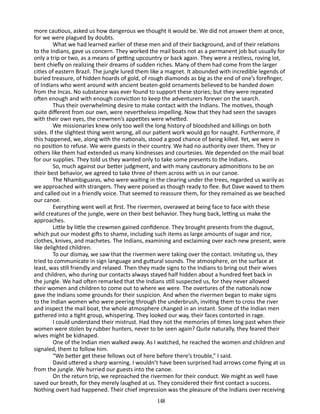
died in 1620, he married Winifred Downes.
Lewis died May 15, 1655 – at the age of 100 years. It can be assumed that Lewis was a
religious man from the following statement in his will “. . . I bequeath my soul into the hands of
Jesus Christ my blessed Saviour and Redeemer, with full and certain assurance of the free pardon
and remission of all my sins in and by and through the merits death and passion of Jesus Christ my
Saviour and Redeemer”.
Though Lewis lived and died in England, and certainly never came to America, his daughter
Frances, immigrated, and he ended up with a huge number of descendants - particularly in the
early residents of Rhode Island.
Frances Latham (1609 – 1677), is known as “The Mother of Governors” because at least 14
of her direct descendants, and many sons-in-law through the generations have become Governors
or Lieutenant Governors.
As a young girl Francis probably joined her father as he worked with the Royal Princes while
they hunted with falcons (a particularly favorite royal sport).
At the age of 17, Frances married William Dungan (1606 – 1636), Gentleman, a London
Merchant and Perfumer. He died at an early age, leaving her a widow at 26 years old with four
little children between the ages of 2 and 8 to raise. About a year after William’s death, Frances
married Jeremiah Clark (1605 – 1651), and they were blessed with 8 children. They came to Rhode
Island about 1637 and settled at Newport, in the midst of other Quakers.
When Frances was 42, Jeremy died, leaving her once again as a widow. A few years later,
she married her third husband, Reverend William Vaughan, Doctor of Civil Law, poet and scholar,
as well as the minister of the Second Baptist Church. Frances died in 1677, a few weeks after the
death of William.
Frances daughter, Barbara Dungan married Deputy Governor James Barker, and her son,
Governor Walter Clark married Hannah Scott.
SOURCES:

1 - Ancestry of Thirty-three Rhode Islanders (Born in the 18th Century), by John Osborn Austin, printed by Joel
Munsell’s Sons, 1889.
2 – The Families of Joshua Williams of Chester County, PA with Some Allied Families, compiled by Bessie P.
Douglas, Augsburg Press, Minneapolis, Minn., 1920.
3 – The Ancestral Dictionary, Edited by John Osborne Austin, Printed by E.L. Freeman and Son, Central Falls,
Rhode Island.
4 – Handbook of Mottos Borne by the Nobility, Gentry, Cities, Public Companies, Etc., by C. N. elvin, M.A.,
Genealogical Publishing Co., Inc, 1971.
5 – Genealogical and Family History of Northern New York by William Richard Cutter.

56
Dungan Family
The family of Dungan appears to be of Celtic origin. From 1599 the family seat was at
Castleton, Kildraught, now Celbridge, County Kildare, Ireland.
	
Sir John Dongan (1540 – 1592) married Margaret Forster (1555 – 1597), daughter of Walter
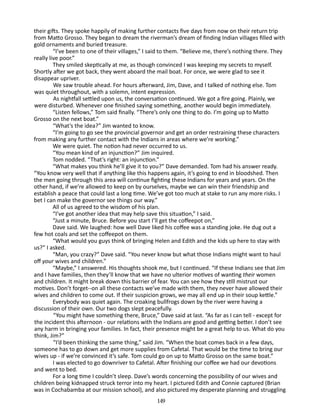
and Lady Margaret (Netterville) Forster of Dublin Ireland, and they had four children. Sir John died
when his eldest son was only twelve years old, and his wife, Margaret, died 20 years later. Both are
buried in St. John’s Church in Dublin.
Thomas Dungan (1584 – 1626) married Elizabeth in 1605, and they
had at least two children. Thomas was sent to London by his mother to
acquire an English education, where he studied to be a lawyer.
William Dungan (1606 - 1636) married Francis Latham (1609 –
1677) and they had six children. The family lived in St. Martin’s in the
Fields in England where he made a living as a perfumer. His occupation
was one of great importance and demand because the gutters in London
put off obnoxious fumes.
William never came to America though his descendants are numerous here. Ten years after their marriage, in 1636, William died at the age
of about 30 years. About one year later, Frances married Jeremiah Clarke,
Gentleman. Almost immediately they and the four Dungan children sailed
for America. They came to Rhode Island before 1638 and were some of the first settlers of Newport.
William and Francis’ daughter, Barbara married James Barker.
SOURCES:
1 - Son’s and Daughter’s of America’s First Families, contributed by Norman Wesley Merritt of White Plains,
New York, http://www.linkline.com/personal/xymox/roh/dungan.htm
2 – The Families of Joshua Williams of Chester County, PA and John McKeehan of Cumberland County, PA with
Some Allied Families, compiled by Bessie P. Douglas, published by Augsburg Press, Minneapolis, Minn., 1926.

Clarke Family
Jeremiah Clarke, or Jeremy, as he was called, (1605 - 1652) married Frances (Latham) Dungan (1609 - 1677), daughter of Lewis Latham and widow of William Dungan, in England, and they
had seven children. He brought his wife and stepchildren with him to America where they settled
in Rhode Island in 1638.
Jeremiah was one of the founders of Newport. He and eight others signed a compact stating: “It is agreed by us whose hands are underwritten, to propagate a plantation in the midst of
the island, or elsewhere, and to engage ourselves to bear equal charge, answerable to our strength
and estates in common: and that our determination shall be by major voices of judge and Elders,
the Judge to have a double voice.” He signed as an elder.
In Newport, Jeremiah held many offices, including: Treasurer, Constable (an office which at
this time only the most trustworthy members held), Lieutenant and then Captain of the Newport
Militia, Treasurer (not only for Newport, but for four other towns in the Colony, as well), Gover57
nor’s Assistant, and, then, when the governor, William Coddington, came under suspicion, he was
elected President Regent or Governor of the Colony. The most important of Jeremiah’s administration was the adoption for “An Act for the well ordering of this assembly”, and granting a charter
to the town of Providence. The first excitement of gold in the country occurred in Rhode Island
at that time. Unfortunately, after a lot of contention over whom should mine it, and so on, it was
determined that the ore was not gold.
When Jeremiah died, the following was recorded in the Friends records: “Jeremiah Clarke,
one of the first English Planters of Rhode Island, he died at Newport in said island and was buried
in the tomb that stands by the street by the waterside in Newport . . .“
After his death, Francis married once again to Rev. William Vaughan. She died in Sept.
1677, and the headstone is recorded as follows: “Here Lyeth ye Body of Mrs. Frances Vaughan,
Alius Clarke, ye mother of ye only children of Capt’n Jeremiah Clarke. She died ye 1 week in Sept.,
1677, in ye 67th year of her age.”
Walter Clarke (1640 – 1714) was the first native-born Governor of Rhode Island Colony. Like
his father and several other governors, he was a devoted member of the Quaker religion. Governor Benedict Arnold noted, “from (the Quakers) has flowed nearly all the good and perfect gifts in
the early history of Rhode Island.”
Walter’s political life began in 1667, when he was elected as an Assistant, an office in the
General Assembly, which provided him with legislative and judiciary power. After several years, he
was elected as the Governor, which office he held for six years, then continued as Deputy or Lieutenant Governor for an additional 23 years. It’s hard to imagine how long he would have continued
in such offices had he not died at that time (while serving as Deputy Governor) on 23 May 1714, at
the age of 74. All totaled, he was involved in public positions for 47 years. “His long and honorable
career shows that he was one of the noblest citizens and truest patriots of his time.”
Some of the issues facing the colony leadership during his time of service included:
In 1667 Massachusetts Bay Colony claimed some of the territory that was included within
the Rhode Island Patent and threatened invasion. The Governor and Council were authorized to
protect their land. Militias were organized; men were equipped with arms, horses, and boats; and
forts were established. All was prepared to protect their territory.
In 1668 the question of jurisdiction continued. Only this time Rhode Island and Connecticut
disagreed upon the Narragansett country.
When Walter was elected as Governor in 1676, Philip’s War had been raging for almost a
year. Rhode Island had never approved of the war and did not agree to cooperate with the other
colonies in their fight with the Indians. The Narragansett Swamp Fight, in which 1,135 men from
Massachusetts, Plymouth and Connecticut nearly annihilated the Narragansett Indians was actually an invasion of Rhode Island lands, and this definitely brought about some resentment. It soon
became obvious, however, just for self-preservation, the colony would have to be involved, and
Governor Clark was determined to protect his people. A “flotilla of sloops or gunboats” was ordered for the defense of the mainland. These boats were armed and manned with five to six men,
and were used in patrolling the island. It is believed that this is the first instance in the history of
the American colonies where naval protection was used – and it was the seed that would grow into
the United States Navy. By the end of the war, Rhode Island, although always opposed to fighting,
had suffered more than anywhere else. Many of settlements in the land were destroyed, and the
government had the trials of trying to rebuild.
In March 1676, an act was passed by the General Assembly “that no Indian in this Colony
be a slave”.
After the death of King Charles II, his brother James II took over the throne. Through his
new policies, Royal Governors were sent to America to control the colonies. In June 1686, the Gen58
eral Assembly of Rhode Island met for the last time for four years. Fortunately, through Walter’s
insight, all the important documents, including the Charter, was protected and so, in 1689 when
James II was overthrown, the charter was intact and the local government picked up again.
In addition to his political career, Walter had a regular life. We know that he earned his
living through providing boating services, renting homes, as well as profits earned from his slaughterhouse and yard. He was married four times, and his second wife, Hannah Scott (1641 – 1681),
is our grandmother. They were blessed with five children, including Hannah, who married Dr.
Thomas Rodman.
SOURCES:
1 - The Genealogical Dictionary of Rhode Island; Comprising Three Generations of Settlers Who Came Before
1690 (With Many Families Carried to the Fourth Generation), by John Osborne Austin, printed by Joel Munsell’s Sons,
1887.
2 – The History of the State of Rhode Island and Providence Plantations by Thomas Williams Bicknell, LL.D.
published by The American Historical Society, Inc., New York, 1920.
3 – Ancestry of Jeremy Clarke of Rhode Island and Dungan Genealogy, compiled by Alfred Rudulph Justice,
Franklin Printing company, Philadelphia, 1922.
4 – The Descendants of Joran Kyn of New Sweden by Gregory B. Keen, L.L. D., Philadelphia, 1913.

Arnold Cassel

Motto: Galea spes alutis, “Hope is the helmet of salvation”.
Arnold Cassel (1664 – 1720) was the son of Johannes and Mary Cassel. They were originally from Kreigshein, in the Palatinate. When Arnold was 18 years old, Halley’s Comet could be seen.
The Cassel family immigrated to America and settled in Germantown, Pennsylvania. That’s
where he met and married Susanna De la Plaine (1668 – 1727), daughter of Nicholas and Susanna
(Cresson) De la Plaine. They were blessed with nine children, including Elizabeth who married
Samuel Boone.
SOURCE:
Pierre Cresson The Huguenot of Staton Island, Pennsylvania and New Progeny, including De la Plaine and Demarest Lines, compiled by Elmer Garfield Van Name, Gloucester County Historical Society, 1968.

Pierre Cresson & Rachel Clauss
Pierre Cresson (1609 – 1679) was born at Menil Le Cresson (or Cresson Manor), Picardy,
France, the son of Pierre and Elizabeth Vuilesme Cresson. Cresson Manor is a little northeast of Abbeyville, in Picardy. The Picards were descendants of both Belgas and Celtae. Most of them were
quite tall, with well-developed frames. They are described as being proud and spirited, generous,
honest and religious. Pierre was probably related to the Cressons of Burgundy.
As a member of the Reformed religion, Pierre, along with others, took refuge in Holland.
On 5 June 1639, he married Rachel Clauss (1618 – 1692), daughter of Pierre and Jeanne Famelar
Clauss, and they were blessed with six children. During their 17 years in Holland, they lived various times in Sluis, Ryswyck and Delft. In 1657, Pierre, his wife, and his family embarked at Amsterdam for New Amstel (New Castle, Delaware) where he bought property.
While in Holland, Muy Pier Cresson, as he called himself, (Me Pierre Cresson) worked as
a gardener of the Prince of Orange and became known as Pierre le Gardinier or “de tuynier”. His
reputation as a farmer gained the attention of Governor Stuyresant, and he hired Pierre to work
59
for him on Manhattan Island. Shortly after this, he made a trip back to Holland, probably to find
additional farmers to help take of the governor’s lands, and returned in the Ship “Guilded Beaver”,
which sailed by Amsterdam on 25 April 1659.
Pierre, along with one of his sons, Jacques, was among the early settlers of Harlem. Both
were active in public affairs in the new community. Pierre was appointed Commissary (Judge)
at New Harlem 16 August 1660. The records show cases involving “Questions, Actions, and Differences arising in the said Village, between Lord and Subject, Master and Servant, Mistress and
Maid, Neighbor and Neighbor, Buyer and Seller, Lessor and Lessee, Landlord and laborer . . . also all
criminal actions, consisting of Misdeeds, Threats, Fighting or Wounding. . . .” He also served as a
fence-master.
In 1663, Indians attacked and massacred the people in Esopus. Many of those who were
harmed were friends and relatives of the people in New Harlem. Naturally, the town was in great
alarm, and immediately began to put together stockades and all that was appropriate for their
defense. Military companies were formed, the eldest and most capable persons were selected to
serve as officers, and Pierre was commissioned as a corporal.
At one point, Pierre and Glaude Delameter, a man who had leased part of Cresson land,
had a disagreement and the case was taken to court. Apparently, an oxen had died because of
Delameter’s neglect. The case became so heated that Delameter accused Pierre of being “a villain
for driving away (his own) wife”. (Actually, Rachel was spending some time in Esopus.) Although
usually completely good-natured, Pierre became so angry that he told Glaude “he ought to slap his
face”. The court finally agreed that both men were at fault and fined them both.
In 1680, Pierre sold his lands in Harlem and moved to Staten Island, where he had already
purchased land at or near Long Neck on the northwest side of the Island. A small stream, located
in his original meadow, was called after “Pieter Tuynier’s Run”.
Pierre lived a long, healthy life. When French Protestant Missionaries visited the Cressons
in 1679, they described him as “fresh and active as a young person”, and he was so overjoyed to
meet those who could speak French, that he “jumped for joy”. Pierre died on Staten Island, New
York after 3 August 1681 and his wife died sometime after 1690.
Susannah, Pierre and Rachel’s daughter, married Nicholas De La Plaine.
SOURCES:

1 – Revised History of Harlem (City of New York), Its Origin and Early Annals Prefaced by Home Scenes in the
Fatherlands; or Notices of Its Founders Before Emigration, Also Sketches of Numerous Families and the Recovered History of the Land-Titles, by James Riker, published by New Harlem Publishing Co., 1904.
2 – The Genealogical Register, Edited by William M. Mervine, Printed by The Wickersham Printing Co., Philadelphia, 1913.
3- Pierre Cresson The Huguenot of Staten Island Pennsylvania and New Yorsey Progenhy, including De la Plaine
and Demarest Lines, compiled by Elmer Garfield Van Name, Gloucester County Historical Society, 1968. 		

60
De La Plaine Family

and venerable aspect.”

		
Nicholas De La Plaine was born in 1592 in Bressuire,
Deux Sevres, Frances. He survived the persecutions of Hugenots and “lived and died in France at the age pf 105 years.”. An
original painting of him still exists, part of the copy is shown
here. Unfortunately, the only copy of the full picture was too
small to see Nicholas’ features. But it showed him writing in a
book. At the time he lived, it was extremely unusual for people
to know how to read and write. I also loved the description of
him: “having a remarkably long and thick beard, with a solemn

Nicholas de la Plaine (1634 – 1696) of the Seigneurie de la Grand Plane, near Bressuire in
France, is said to have been a Huguenot refugee, fleeing to England long before the Revolution of
1649. After a brief stay there, he came to New Amsterdam where his name appears as taking the
oath of allegiance, 13 April 1657. The records of the Reformed Dutch Church show the marriage of
Nicholas de la Plaine and Susanna Cresson, daughter of Pierre Cresson and Rachel Clauss in September 1655. They lived in Germantown, Philadelphia County, Pennsylvania.
Susanna, their daughter, married Arnold Cassell.
SOURCES:

1 – The Cox Family in America, A History of the Older Branches of the Family From Its First Representative in
This Country in 1610, by Rev.Henry Miller Cox, A.M., New York, 1912.

Eldred Family
	
The Eldred Family is descended from a very ancient family, claiming Saxon origin. Saxons were a warlike people who invaded the island
of Britain about 450 a.d., and who, after killing off the original inhabitants, settled there in large numbers.
Records show that the Saxons were great seamen and great
warriors. Their boats were 70 – 80 feet long and about 12 feet wide.
They were undecked, mastless, with a paddle in the stern for steering
and 14 - 16 oars aside. Our Saxon ancestors not only loved fighting, but
were excellent farmers, as well. They had a genius for cooperation; they
worked together just as they rowed and fought together. They shared
the same plows and helped to cultivate each other’s land. Anglo-Saxon
women are believed to have been expert weavers. They were loyal to
each other. They had a wonderful understanding of personal freedom.
The family was the most important unit of Society, and the strongest
social tie, as well.
The early Saxon settlers were pagans. Their chief God was Oden
or Woden, the god of war. Thor was the god of thunder; Fria, goddess of joy and fruitfulness;
Soetere, god of hate; and Teu, god of the dark. These names survive today in the names of the
61
days of the week: Teu is Tuesday, woden is Wednesday, Thor is Thursday, Fria is Friday, Soetere
is Saturday. Sunday and Monday, the sun’s and the moon’s day, are also of Saxon origin. Death in
battle provided an automatic admission into Valhalla, the Saxon’s heaven, where the warrior divided his time between fighting and feasting. Fortunately for us, Christianity came to Saxon Britain
in 1597 when Saint Augustine landed in Kent, and converted the king.
The name of Eldred came from two Old Saxon words: “Ael” and “Dreade” meaning “All
Dread” or something terrifying that all dreaded. By the 8th century, it was pretty well fixed as Eldred.
John Eldred (1552 – 1632), the Traveller, legally established his own coat-of-arms which the
whole Eldred Family adopted. It is, however, understood that the coat had been used since about
1450 a.d. It is described as: On a field of (gold) a bend gules (red) trunked sables (marked with
black lines to indicate a tree trunk) charged with three bezants (gold discs). The crest is a demi-lion
gules holding in paws a ragged staff sable erect.
John Eldred of Corby, Lincolnshire is the first Eldred of our branch on record. He was born
before 1419 and died in 1489. His wife’s name is not known, but we do know they had six children.
Reginald Eldred (born before 1439) married Agnes Coupe, daughter of Thomas Coupe, and
they had six children. Reginald was a yeoman (farmer) and rented the lands on which he lived. He
was probably born at Corby, but then he moved to Knattisall where he lived the rest of his life.
Thomas Eldred (born about 1460) married Agnes Lawsdall, daughter of John Lawsdall,
from Thurlby, Lincolnshire, England, and they had six children. Thomas was a husbandman (farmer) at Knattisall where he was born.
Nicholas Eldred (1496 - 1566) was a yeoman by occupation and he married Bridget. They
had four children. Nicholas died before 8 October 1566 and Bridget survived him. Note: His will
was written in Latin.
Thomas Eldred (born about 1537) married Margery Studd, daughter of Richard Studd of
Ipswich, Suffolk, England, and they had 12 children.
Thomas Eldred is referred to as “The Mariner” or “The Merchant”. Apparently, for most
of his life he was a ship chandler (a merchandiser of sea-faring supplies) in Ipswich. The greatest
accomplishment of his life was when he sailed around the world with Sir Thomas Cavendish, the
English Navigator. On a tablet on his tomb in St. Clement’s is inscribed: “He went out of Plymouth
with one Cavendish on the 2nd of July 1586 and arrived there again on the 9th of September, 1588.”
We know that he was a member of the ship’s company, but don’t know exactly what position he
filled.
Thomas owned a fine home in Ipswich. A large fireplace and the ancient paintings hung
above the mantel were particularly interesting. One of the paintings represented a globe of the
earth, with the dates of Thomas’ voyage inscribed on it. The second represented the ship in which
his voyage was made, and the third is his portrait. He’s described as “an old man with ruffled collar, spiked beard and mustaches, holding in his right hand an equinoxial dial bearing the date 1602,
and above his right shoulder a Jacob’s staff.”
Nothing is known about William Eldred’s (1574 –1624) marriage, but they had one child.
John Eldred (1600-1640) married Anna Watson (1605 – 1642), the daughter of Samuel
Watson, and they had five children.
62
Samuel Eldred (1620 - 1697) was born the year that the Mayflower landed at Plymouth
and the first Colony in New England was organized. He married Elizabeth Miller (1624 – 1711),
daughter of Daniel Miller, and they had seven children. Soon after their marriage, they sailed for
America – possibly on the ship “Tiger”. They can be found at Cambridge, Massachusetts as early
as 1641 where he is listed as a sergeant in the Ancient and Honorable Artillery Company of Boston.
The family lived in Cambridge and in the general Boston area for several years where he earned his
living as a cordwainer and as a farmer of rented lands. Records show that he was called into court
and was fined for damages his hogs caused to Charlestowne Common.
By 1660, the Eldred family had moved to Wickford, Rhode Island on the western shore of
the Narragansett Bay. Samuel was one of the committee who signed the deed in which the Narragansett Indians agreed to sell
the land to the white settlers.
Since he could not write his
name, he “made his mark”.
Samuel took the oath
as constable at Wickford in
1670, and so was very much
involved in the dispute between Connecticut, Massachusetts, and Rhode Island
since all three colonies
claimed legal jurisdiction
over the area. He took the
side of Connecticut, and as a
result of being their representative, he suffered both
persecution and imprisonment. The conflict came to a head with the murder of Walter House. Although both Connecticut
and Rhode Island authorities believed Thomas Flounders was the murderer, they each wanted
authority to prosecute him. When Samuel called a jury to take care of the case, Rhode Island had
him arrested and imprisoned. He later received recognition and reward for having sacrificed for the
colony of Connecticut.
Records show that Samuel was involved in fighting Indians – particularly in the Narragansett
Swamp Fight. He joined Captain Benjamin Church’s group to go on a “night adventure” and they
were able to capture 18 Indians. Of course, living so close to the conflict caused problems for his
family. At one point, the Governor and Council voted to give Samuel and another man “liberty to
transport ten bushels of Indian corn apiece for their distressed families.” Fortunately, after the
war ended, they were able to rebuild the farm and gain some prosperity – although it must have
required an incredible amount of work.
In 1697 Samuel deeded 100 acres and a house to his son, John, and died shortly afterwards.
Samuel, (1644 – 1720) was born in the same year as Stradavari (the well-known violin
maker) and William Penn. He was 16 when his family moved to Rhode Island, and his name appears as “Sam’ll Eldred Jun’r”, along with his father’s name on various documents. He served as a
juryman in the murder case at Wickford, which caused his father so much trouble. He married
Martha Knowles (1651 – 1728), daughter of Henry and Elizabeth (Potter) Knowles, and they were
blessed with three children. The family lived in Kings Town, Rhode Island.
63
Samuel and Martha’s daughter, Penelope married Colonel Ephraim Gardner.
Daniel Eldred was born about 1655 in Kings Town, Rhode Island, the son of Samuel Eldred
and Elizabeth Miller. He married Mary Phillips who was born in Rhode Island in1666. They were
blessed with 10 children. The Eldred The Eldred family lived in Rhode Island and Connecticut.
In 1702, he was made a Captain.
He died 13 August 1726, and his wife died shortly after that.
Their daughter, Hannah, married Richard Updike.
SOURCES:

1 – Samuel Eldred and Some of His Descendants, by Nelson B. Eldred III, edited by Walter Steesy, published in
Marietta, Georgia, 1992.
2 – Eldred and Allied Families, Compiled by E. Virginia Hunt, 1975.
3 - Genealogical Dictionary of Rhode Island, Comprising Three Generations of Settlers Who Came Before 1690
(With Many Families Carried to the Fourth Generation), by John Osborne Austin, Genealogical Publishing Company,
1969.
4 – The Eldred Family, www.crashJ_55.tripod.com/Eldridge/eldridge_hm.htmGenealogical Dictionary of
Rhode Island, Comprising Three Generations of Settlers Who Came Before 1690 (With Many Families Carried to the
Fourth Generation), by John Osborne Austin, Genealogical Publishing Company, 1969

Knowles Family

Motto: Semper paratus, “Always prepared”.
	
Henry Knowles (1609 – 1670) came to America in 1635 on the ship “Suzan & Ellen” (age 25) as an
indentured servant of Ralph Hudson – a linen draper.
It is probable that Henry was either apprenticed to
the linen draper, or that he had agreed to work at that
trade until he had worked off his passage money. The
ship sailed from London with 96 passengers about 18
May 1635, crossing the ocean in 6 to 8 weeks, and was
commanded by Edward Payne.
Henry was one of the early followers of Roger
Williams to Providence. Though, whether he went
because he agreed with William’s philosophy, for the
opportunities that could be found in a pioneer settlement, or simply because he admired the daughter
of Robert Potter (Roger William’s partner), is hard to
tell. We know that he married Susanna Potter (1620 –
1675), and they had five children.
The Knowles family lived in Rhode Island – Portsmouth and Warwick. While in Warwick he
served on the Grand Jury. One particular case concerned the death of an Indian. Although it doesn’t
say if anyone was convicted for the murder, it was determined that beating was the cause of death.
During his lifetime, interesting things occurred. In 1646, shipbuilding started in Rhode Island.
It thrived, but privateering that developed into piracy also grew, until Boston had good reason to
look down its nose at the other colony.
Henry died when he was 62 years old, in 1670 in Warwick, and Susannah passed away five
years later.
64
Henry and Susannah’s daughter, Martha, married Samuel Eldred.
SOURCES:

1 – History of Rhode Island and Providence Plantations by Thomas W. Bicknell, L.L.D.
2 – Henry Knowles Family Pedigree Chart, an Outgrowth of Knowles Family History, by Ailene Miller Knowles.
3 – Genealogical Dictionary of Rhode Island . . . by John Osborn Austin.
4 – The Knowles Family and Allied Families by Ailene Miller Williams – November 21, 1932.
5- www.knowles5849.freeserve.co.uk/Page_9x.html
6 – Immigrant Ship Transcribers Guild Passenger List

Robert Potter

Motto: Virtuti fortuna comes, “Fortune is companion to valour”.
Robert Potter (1594 – 1656) and his wife, Isabel, were among the earliest settlers in the
Massachusetts Bay Colony. They came from Coventry, England to Lynn, Massachusetts in 1634. In
1638 they moved to Newport where he was admitted as an inhabitant – and was one of those who
signed the compact, which set up the government there. He was chosen surveyor of highways and
was responsible for laying out roads in the new town. Three years later, he joined Samuel Gorton,
“the great religious disturber”. Gorton, Robert, and their associates were religious agitators. They
agreed with the Quakers in some points and disagreed with them in others. The larger problem
they posed was in their belief of how government should be handled. They didn’t believe that the
local government had correct authority, and so they did not necessarily believe that they were required to obey the law. So great were the contentions, that they were disfranchised by the colony
and ordered to leave the area.
		
Finally, in an attempt to remove themselves from jurisdiction of any
local authorities, in November 1642, Gorton and his followers purchased the
land of Showomet from the Great Chief Myantonomy and moved to that area.
Unfortunately, trouble followed. It seems that previous to selling the land to
this group, the Indians had granted the same area to the Massachusetts Bay
Colony. The settlers considered themselves subject only to the English government, and until they received authority from it, they refused to recognize any other jurisdiction.
Between trouble with the Indians and demands of the Bay Colony for jurisdiction, they were in hot
water all the time. Finally, Boston magistrates demanded that they appear for trial. They refused
and said that they felt themselves subject only to “the crown”. Unfortunately, Gorton also chose to
send a letter in which he pretty well insulted the leaders of the Massachusetts Bay Colony.
Immediately upon their refusal, Captain Cook, with 40 militiamen, was sent to apprehend
them. The settlers sent a note to the Captain warning them not to invade their town. The reply
came back that they should either surrender or they would “look upon them as men prepared
for slaughter” and would act accordingly. At this point, the women and children were hastily sent
away, while the men fortified a house and awaited the militia.
The little war started. The small company of 11 men – one of them not even carrying a gun
– hung out the English flag representing their allegiance to England. The flag was actually riddled
by the bullets. The siege lasted several days with the attackers not only shooting but attempting to
burn the building. The settlers didn’t shoot a single shot and apparently no one was killed. Finally,
recognizing the hopelessness of the situation, the settlers agreed to surrender as “freemen” with
rights, but they were actually taken as prisoners.
The men in the militia seized the cattle, destroyed or carried away everything else, and took
the settlers to Boston. Their wives and children who had been forced to hide themselves in the
65
woods, were cared for by the Indians. They suffered such great hardships that three of the women
died – one of those being Robert’s wife, Isabel. Of course, the men had no idea what had happened to their families and it would a long time before they would once again be reunited.
Once in Boston, the men were treated very unfairly. Although they were arrested for refusing to acknowledge the Bay Colony’s jurisdiction, the charges were changed to “blasphemy and
heresy”, and the trial was for “life or death”. They escaped death by only two votes!
The punishment of seven of the men was extremely cruel and unjust. Each was sent to a
different town (Robert served his time in Rowley, Massachusetts) where they were forced to wear
an iron chain bolted around the leg and required to do heavy labor. They were forbidden to speak
so they couldn’t “preach their monstrous absurd doctrines”, and were told if they did, they would
be killed. They were kept through the winter, until the general public voiced disagreement with
the cruelty of the punishment. At that time, they were banished from the colony and told not to
return “on pain of death”.
Some of them went back to England and requested protection from the Earl of Warwick.
After he befriended them, they went back to Showomet, with orders reinstating their property, and
prohibiting further persecutions, changed the name to Warwick and enjoyed their land in peace.
After returning to Warwick, Robert married Sarah, as his second wife. In 1649 he was
licensed to keep an inn; and a couple of years later, he served as commissioner to the General Assembly. He died in 1655, leaving Sarah as a widow.
Robert’s daughter, Martha, married Henry Knowles.
SOURCES:
1 – The Knowles Family and Allied Families by Ailene Miller Williams and Revised by Frank
Knowles.
2 – Potter, from US GENWEB.
3 – Genealogy of the Family of John and Wait Potter Being a Complete List of All Their
Descendants, Together with Their Ancestral Lines in America, compiled and published by Albert
Potter, M.D. and Isaac M. Potter, Lieutenant Colonel, 1885.
4 – Ancestry of Joseph Trowbridge Bailey of Philadelphia and Catherine Goddard Weaver of
Newport, Rhode Island, by Joseph Trowbridge Bailey, privately printed, 1892.
5 – History of Warwick, by Oliver Payson Fuller, BA.

Richmond Family

Motto: “Resolve Well and Persevere”
The Richmond family had its origin in Brittany, France. The
name comes from the French words riche and monte or monde,
and is first given in early English history as Rychmonde, later as
Richemounte and Richmonte, and finally, as Richmond. Our Richmond family for the first five generations used the alias Webb.
Family members served in many of the colonial wars, including the Revolutionary War.
		
Our first known ancestor Roaldus Musard de Richmond, was one of the most powerful leaders who accompanied
William the Conqueror into England. The line then goes as follows:
66
Hasculfus Musard de Richmond
|
Roaldus De Richmond, “Le Ennase” & Graciana
|
Sir Alan, Fil Roald De Richmond
|
Sir Rould, Fil Alan De Richmond
|
Alan, Fil Roald Richmond De Croft & Matilda de Goldington
|
Sir Roald, Fil alan Richmond De Croft & Isabella de Langthwayt
|
Eudo De Richmond
|
Elyas De Richmond
|
Elyas De Richmond
|
Richard De Richmond & Elizabeth de Burgh
|
Thomas De Richmond
|
William De Richmond & Alice Webb
|
William Richmond alias Webb and Joan Ewen
|
William Richmond alias Webb and Dorothy Lymings
|
Edmund Richmond alias Webb & Mary Weare
|
Henry Richmond alias Webb
		 John Richmond (1594 – 1664), our
emigrant ancestor, lived in Ashton Keynes, Wiltshire, England. (The pictures show the Ashton
Keynes home.) He married Elizabeth Nicholas,
and they had five children.
John was an officer of distinction – probably a Colonel - in the army serving during the civil
wars in England. Family tradition tells the following story: “On the night preceding one of the
engagements, Henry, his brother, went into the
camp of the other army, eluded the vigilance of
the sentinels, and reached John’s tent in the hope
of enjoying an affectionate interview previous to the uncertain events of the morrow. On entering the tent, John, alarmed at the sudden appearance of a stranger, as he conceived Henry to be,
rose upon his bed and shot him dead upon the spot. When he discovered his mistake, it is said he
became deranged.” Around this time, 1635, he moved to America.
67
In 1637, John was one of the settlers who purchased land from the Indians, which became
Taunton, Massachusetts – he owned six shares. The Richmond family was large land-owners in the
eastern part of town, and gave the name “Richmondtown” to a village in that section. John was
included on the list of men who could bear arms in
1643. Records show that he was engaged in trade
in Saco, Maine. It is believed that he returned to
England from 1643 to 1655 and was once again
involved in the civil wars being fought there. After
he returned to America, he represented Newport
at the Court of Commissioners, held at Portsmouth.
He died in Taunton, Massachusetts at the
age of 70 years.
Captain Edward Richmond, (1632 – 1696) was a well-educated gentleman. He married
Abigail Davis – despite some difficulties: After Edward and Abigail were engaged and the bans had
been published twice, her mother and stepfather took her away and forced her to marry Richard
Ussell. Court records show that Edward brought a suit against Ussell in order to “recover” Abigail.
Then, after the Assembly declared that the marriage was unlawful and they were free to marry, the
local Baptist minister, Obadiah Holmes, protested on the basis of her divorce. Finally, after being
called before the courts twice on the charges of fornication for living together, Edward appealed to
the Judge that they be allowed to marry because he wasn’t sure he would be able to ever resist the
temptation of being with Abigail. They made their home in Newport and Little Compton, Rhode
Island.
Edward owned quite a lot of land, and served in civil and military capacities. He was General Solicitor, Clerk of Court, Attorney General, Deputy, and Selectman. He was one of the incorporators of Little Compton, Rhode Island, in 1674, and owned several shares. In the military he
served as a Lieutenant in King Philip’s war and then was promoted to the office of Captain in 1690.
Records show that it was voted that “Lieutenant Edward Richmond, with his company, shall be allowed and have one-half of the produce of the seven Indians they brought in”. Apparently, at this
time, strong Indian men and women were to be sold as slaves for a period of nine years.
The only mark against his character to be found on the records was in 1686 when he was
fined for furnishing an Indian with some rum or strong liquor.
In 1682, Abigail passed away and Edward remarried Amy Bull, with whom he had two children.
When he died, Edward’s wealth was listed as follows: £326, 2 oxen, 6 cows, 4 heifers, 2
yearlings, 4 calves, 2 mares, 3 colts, 2 horses, sheep, 2 fat swine, 8 lean swine, 18 loads of hay,
pewter, cheese press, warming pan, arms, stillyards, sundry pieces of land, etc. The inscription of
the tombstone in the family cemetery on the old Richmond farm in little Compton, says: “Here
lyeth buried the body of Edward Richmond, Captain, who departed this life in ye 63d year of his
age, Nov. 1696.”

68
(Sample of Edward’s writing from his will.)
Their daughter, Abigail Richmond, married, as a second marriage, Henry Gardner.
SOURCES:

1 - The Richmond Family 1594 – 1896 by Joshua Bailey Richmond.
2 - The Genealogical Dictionary of Rhode Island; Comprising Three Generations of Settlers Who Came Before
1690 (With Many Families Carried to the Fourth Generation), by John Osborne Austin, printed by Joel Munsell’s Sons,
1887.
3 – History of Rhode Island & Providence Plantations by Thomas W. Bicknell, L.L.D.
4 – History of Bristol County, Massachusetts, compiled by D. Hamilton Hurd.
5 – Biographical, Genealogical and Descriptive History of the First Congressional District of New Jersey, Published by the Lewis Publishing Company, 1900.
6 – Richmond Family Records by Henry I, Richmond, M.A.

Gardiner Family

Motto: Virtuti et fortune, “To virtue and fortune”.
The surname Gardner, variously spelled Gardiner, and Gardener, is taken from an occupation and literally means “the gardener”. It is of ancient origin and is found quite a lot in medieval
England.
	
Sir Thomas Gardiner (1449 – 1492) was the Knight of Collynbyn Hall, West Riding of
Yorkshire England. He married Elizabeth Beaumont, child of Thomas Beaumont, Gentleman and
his wife, Elizabeth Neville. He died in the same year that Columbus discovered America. Our family joins the royal line through this Neville line.
	
Thomas Gardiner, Gentleman (1475 – 1520) was born the same year as Michelangelo. He married Joan who died in 1559. Thomas was of the Manor of Kennesley, Standon Perish,
Hertsfordshire, in 1510. He was Esquire of Sir Thomas Darcy when he was made Knight of the Bath
on 29 November 1485.
	
Henry Gardiner, Gentleman (1500- 1564) lived at the time of the explorers – Ponce
De Leon, Magellen, etc. He had an M.A. of Oxford, 19 February 1520/1. At different times during
his life, he lived in Jenysbury, Hertfordshire, and London. The name of his first wife is not known,
69
but together they had three children. After her death, Henry married Mary Haward, and they had
two children.
	
Rev. Michael Gardiner, Gentleman, (1552 – 1630) married Margaret Browne (1582
– 1623) in 1592. She was a daughter of Thomas Brown, Gentleman, and his wife, Alice Chapman,
and was also a descendant of Sir Thomas Gardiner, through his second son. They had six children:
Henrie, Michael, Thomas, Anne, John, and George. It is interesting to note that the children were
named according to the old custom: The first son named after the paternal grandfather, the second after the father and the third after the maternal grandfather.
Rev. Michael Gardiner was the 26th Rector of Holy Cross Church in Great Greenford for
about 48 years, until his death. During that time, he copied the parish register, and even at this
time, the record is legible. He was granted a Coat of Arms, which was confirmed by Sir R. St.
George, Knight of the Garter on 16 June 1630.
After their deaths, their eldest son Henrie, had a Mural Monument placed in the church in
honor of Michael and Margaret. The translation of the Latin inscription reads:
“Christ prayed for me
It is enough
He wishes that where he is I also should be
This has come to pass.
Michael Gardiner rector of this Church for 48 years, 4 months, 6 days, lived
almost 79 years. He died 22nd day of August in the year of our human salvation
1630, and his body buried below here awaits the Resurrection of the faithful.
Just as he above blessed us
On the earth
So now may Christ in Heaven
Bless us with him.
Margaret Browne daughter of Thomas Brown citizen and Tax collector of
Balm, London, wife of the same Michael lying next him lived in the bonds of matrimony about 40 and one half years. She died on the 17th day of the month of March
anno Domini 1623 having almost completed the 62nd year of her life.
Henry their eldest son in pious
Memory of his parents made it his
Care to have this monument erected.”
George Gardiner (1599 – 1677), 5th son and youngest child of Rev. Michael and Margaret
(Browne) Gardiner, was baptized in Holy Cross Church, 26 Feb 1600.
He married Sara Slaughter, and they had at least one child. They lived in London, along
with several brothers and cousins, not far from Greenford Magna, the home of his parents. About
1637 he immigrated to New England on the ship “Fellowship”. Although he probably stopped at
towns along the way, his name is first mentioned in public records in Rhode Island in 1638 where
he settled at Portsmouth for a short time before moving on to Newport. There is no record of his
first wife, so she must have died either in England or enroute to America. She certainly did not arrive in Rhode Island with him.
During the early colonial days, most men were actively involved in community affairs, and
70
George wasn’t an exception. During his life he served as Constable, Senior Sergeant of the Newport Train Band, Ensign, member of the petit Jury, member of the Grand Jury, and Commissioner.
About 1645, George married Horod (Herodias) Long (1624 – 1722). Not much is known
about Herodias’ life. (Most of the court records at that time list her name as Horod, but spelling
was not necessary considered important, and since she was unable to write or spell her name, she
couldn’t have either confirmed nor corrected it. She actually signed her name with an “X”.) Her
personal record states that at the time of her father’s death, her mother sent her to live in London,
and, sometime after that, although there isn’t any record of precisely when, both her mother and
brother died as well. While in London, when she was between 13 and 14 years of age, she married John Hicks, and a while later, they emigrated from England to America. They lived for a while
near Boston before moving to Rhode Island about 1640. This marriage was incredibly difficult for
Herodias, since Hicks was extremely unkind. The records show that he was arrested for beating
his wife, and before the case came to court, he moved completely from the area to Long Island –
taking her little inheritance with him. Eventually, the marriage was dissolved, and both of them
received a divorce. (At this time, each party had to apply for a divorce, individually, and actually
two divorces were granted for one marriage. If only one received a divorce, it did not allow the
other to remarry.)
Sometime between 1644 and 1646, George and Horod (Herodias) contracted a “common
law” marriage. At that time, particularly among Quakers, a couple could be considered legally
married if they went before two witnesses and declared that they took each other as husband and
wife. Later, she claimed that she moved in with George because she had no other way to support
herself and no family or friends to help her after Hicks left, but since they lived together for 18 – 20
years, and six children were born to them, the idea wasn’t accepted too well.
Herodias was very “erratic” and, at times, religiously fanatical. In May 1658, she, along with
others, went to Boston and Weymouth, Massachusetts to protest against the persecution of the
Quakers. She took a baby with her, along with a woman to help take care of the baby. In Boston,
she was imprisoned for fourteen days and cruelly whipped “with a three-fold knotted whip of
cords”. According to a record in Bishop’s New England Judged, says “The woman came a very sore
journey, and according to man, hardly accomplishable, through a wilderness of above sixty miles,
from Rhode Island to Boston. After the savage, inhuman and bloody execution upon her of your
cruelty, aforesaid, kneeled down and prayed the Lord to forgive you.”
Early in 1664, Herodias left George and moved to Pettaquamecot to live. She petitioned
the Commissioners of Rhode Island to force George to give her the property she took into the marriage, as well as enough to support her and her child separate from him. Beyond that, she wanted
nothing to do with him. She did not, however, ask for a divorce. Instead of which, she simply
denied that they were ever married. The case, originally sent to the Commissioner Benedict Arnold (grandfather of the infamous Benedict Arnold), then, because of the importance the decision
could make to the community, was sent to the General Assembly for trial. Horod (Herodias) was
brought before the Assembly “after there was much debate upon her petition, was asked whether
she would return to George Gardiner and live with him as a wife should doe.” The Assembly was
probably hoping that the marriage could simply be saved, but she absolutely refused. George was
then called in and asked if he would take her back, and he indicated that he was more than willing
to continue the marriage. He was also asked if he could prove that they were, in fact, married. His
answer was that they had not been married before officials, but his friend, Robert Stanton, testified that they had gone before him and his wife and entered into a “common law” marriage. Since
these type of marriages had always been accepted and the decision in this case could easily affect
future relations of other couples, the Assembly was, of course, greatly troubled about the proper
course of action and much time was spent debating. Finally, the decision was given in which they
were both severely censured for the “extreme sinfulness of their conduct”, required to pay a fine,
71
and ordered to “presume not to lead so scandalous a life, lest they feel the extremest penalty that
either is or shall be provided in such cases.” At the end of the trial, the Assembly promptly enacted
a law requiring formal marriages in the future and making any current common law marriages
legal.
Despite the outcome of the trial and the rebukes of the Assembly, George didn’t lose any
of his social standing in the community because not only was he called to the Grand Jury (and only
truly respected men could be called), but also the records refer to him as “Mister” (a title of respect) as long as he lived. George eventually married a third wife – Lydia Ballou, and they had five
children.
After the trial, Horod (Herodias) went to keep house for John Porter who was very much
older than her. By 1667, both of them were called before the Court “for that they were suspected
to Cohabit”. Neither showed up for the first court date. At the second date, Porter appeared but
claimed that Herodias was ill. The court was apparently not impressed because it was ordered that
she show up at the next date. Eventually, they were found “not guilty”, and sometime within the
next four years, they were married.
George lived and died in Newport and is supposed to be buried on his estate there. The
exact date of his death is unknown, but it is believed to have been in 1677. He was a man of education and wealth (with extensive land holdings) and took an active part in public affairs all the years
in Newport.
Henry Gardiner (1645 – 1744), the eldest child of George and Herodias Gardiner, was born
in Newport, Rhode Island.
He married Joan, but they apparently did not have any children. Then in 1694, he was
charged in court by Abigail Richmond Remington (widow of John Remington) as “being the father
of two children by her.” Henry was convicted in court and ordered to take care of and provide for
the children. On the other hand, Abigail was convicted of fornication and fined 26 shillings and
“officers fees”, which Henry paid. They eventually had three sons and possibly one daughter. After
the death of Joan, Henry did recognize Abigail as his wife and mentioned her as such in his will.
Henry served in many community capacities: Constable, Grand Jury, and on a committee to
lay out highways. He lists himself as being a member of the Church of England in Narragansett.
Henry was apparently a slave owner, because in his will he lists 7 people as possessions. At
his death in 1744 (at the age of 99 years old), his resources are listed as: £1,016 including wearing
apparel, silver money, cane, great bible, books, pewter, stillyards, warming pan, 2 woolen wheels,
2 linen wheels, 5 cows, heifer, 2 oxen, mare, Negro Betty and child, £120, Patience and child, £130,
Charity £120, Sarah £130, boy Joseph £70, etc. (The slaves were separated to different family
members in his will.)
Ephraim Gardner (1693 – 1774) married Penelope Eldred (1694 -1783), daughter of Samuel
and Martha Eldred, and they had seven children. Ephraim served as an Assistant, and obviously
was treated with respect since he was referred to as “Mr. Ephraim Gardiner”.
Ephraim and Penelope lived at the time of many new discoveries including Mercury and
Centigrade thermometers.
Colonel Ephraim died in 1774, and Penelope died several years later at the age of 89 years.
Captain Christopher Gardiner (1726 – 1812) married Mary Easton, daughter of Jonathan
and Patience (Rodman) Easton. After Mary’s death, he married as his second wife Elizabeth Fones.
He died in 1812.
During Christopher’s lifetime, America became a nation. He witnessed all of the events
preceding the war, the Revolutionary War itself, and the difficulties of the making of a new nation.
72
Christopher and Mary’s daughter, Susannah Gardner married Captain Thomas Boone (as
yet we haven’t found a connection from Thomas to Daniel Boone).
SOURCES:

1 - Gardiner-Gardner Genealogy Including the English Ancestry of George Gardiner Immigrant Ancestor of
Newport R.I. & Many of His Descendants Especially his Grandson, Stephen Gardiner of Gardner Lake, Connecticut,
compiled by Clara Gardner Miller and John Milton Stanton.
2 - The Genealogical Dictionary of Rhode Island; Comprising Three Generations of Settlers Who Came Before
1690 (With Many Families Carried to the Fourth Generation), by John Osborne Austin, printed by Joel Munsell’s Sons,
1887.
3 – History of Rhode Island and Providence Plantations by Thomas W. Bicknell, LL.D.
4 – The Gardiners of Narragansett Being a Genealogy of the Descendants of George Gardiner the Colonist
1628 by Caroline E. Robinson, Edited with Notes and Index by Daniel Goodwin, Ph.D., D.D., printed for the editor at
Providence.
5 – Representative Men and Old Families of Southeastern Massachusetts.
6 – Richmond Family Records, by Henry I. Richmond.
7 – Some Descendants of Samuel Eldred by Nelson B. Eldred III.

Rodman Family
The Rodman family name is supposed to have originated at a very early period. It was
given to “men who by the tenure or custom of their lands were to ride with or for the lord of the
manor about his business.”
The Rodman family probably came from North England, members of good family but not
noble. But the first records find John and Ann Rodman in New Ross, Ireland, where they had apparently moved to escape persecution after they were converted and became Quakers. Despite
the freedom they sought in Ireland, during this time, anyone who testified of Quaker beliefs could
expect fines and, sometimes, imprisonment. In 1655, John was arrested and sent to prison for
three months for “wearing his hat on in the Assizes”. He was then banished from the country,
probably because he refused to deny his faith, and moved to Barbadoes, West Indies - the first
place of refuge for the Quakers who were exiled. He purchased a plantation where he became
a prominent planter. A historian described the life of a planter in Barbadoes: “The inhabitants
are ranked in these three orders: Masters (who are either English, Scots, or Irish, with some few
Dutch, French, and Portugese Jews), white servants, and slaves. The masters, merchants and planters, live each like little sovereigns in their plantations. They have their servants of the household
and those of the field. Their tables are spread every day with a variety of nice dishes, and their attendants are more numerous than many of the nobility’s in England. The equipages are rich, their
liveries fine, their coaches and horses answerable, their chairs, chaises, and all the conveniences
for their traveling magnificent.”
John and Ann raised educated children, and two of them, Thomas and John, were physicians. They taught their children basic respect. At one time, their son, John, risked his life to protect his wife’s dignity. Apparently at the time, Long Island, where they lived, suffered from abuse
of French privateers. At one point, a French fleet entered the harbor and plundered the village.
“They entered the house of Dr. John Rodman, a skillful physician and devoted Quaker, and insulted
his wife, ‘a very desirable gentle-woman’ between whom and the insolent Frenchman the doctor
sprang, as the ruffian cocked his pistol at Rodman, who bared his bosom and said, ‘Thou mayest do
it if thou pleasest, but thou shalt not abuse my wife.’”
John was well educated, well to do, and a religious man. He died in Barbadoes in 1686.

73
Thomas Rodman, (1640 – 1727) son of John Rodman, was
born in Barbadoes, West Indies. He married Patience Malins,
and than after her death married Hannah Clarke, daughter of
Governor Walter and Hannah (Scott) Clark.
Thomas was an earnest and dedicated member of the Quaker religion and a clerk of their
meetings for about 30 years. He came to Newport, Rhode Island from the island of Barbadoes
with William Edmundson, a “friend” who was on a religious visit. He lived in Newport for the rest
of his life.
Thomas had many trials in his life. Not only did he lose two wives to death, he lost other
members of his family, as well. For instance, Ann, his daughter with Patience, was only four years
old when her mother died. She married at the age of 17, and her husband died about two years
later. Their only child was born less than 8 months after that. He only lived to the age of 7 before
he died at Thomas’ home. She died about two weeks after that at the age of 28.
He was definitely well qualified to have written the following advise to his son: “Doe not
look at present Injoymnets soe much as at ffutor Injoymnet for Ever. If thou art crossed in thy expectation doe not strive but leave it to ye Lord who knows that is for thy etarnell welfair and come
home where thee shall be kindly entertained according to our abilatey . . . . And Soe leaving the
whole matter desiring and hoping ye Lord will not leave the nor forsake the but give the wisdom
and patience under every affliction to whom I comitt the & take leave & desire thy welfare in ye
blessed truth. Thy affectionate ffather.”
Thomas was a well-known physician and surgeon. He specialized as an Obstetrician and
was known to go to great distances to help with difficult cases. Dr. Thomas seemed to have been a
knowledgeable man with a great deal of common sense, of good character and a kind, sympathetic
nature. He was a well-respected man of means.
Thomas died in Newport in 1727 at the age of 87 years.
	

After Thomas’ death in 1728, Hannah moved in with her daughter, Patience, and her husband Jonathan Easton.
SOURCES:

1 - The Genealogical Dictionary of Rhode Island; Comprising Three Generations of Settlers Who Came Before
1690 (With Many Families Carried to the Fourth Generation), by John Osborne Austin, printed by Joel Munsell’s Sons,
1887.
2 – Representative Men and Old Families of Southeastern Massachusetts
3 – Genealogy of the Rodman Family, 1620 to 1886 by Charles Henry Jones, printed in Philadelphia, 1886.
4 – Notes on Rodman Genealogy by William Woodbridge Rodman, printed in New Haven Connecticut for the
Author, 1887.
5 – The Genealogical Register, edited by William M. Mervine, printed by the Wickersham Printing Company,
1913.

Easton Family
Nicholas Easton, (1592 – 1675) son of John Easton of Wales, was born at Lymington, Hertsfordshire, England. By occupation, he was a Tanner. He was married three times, but the name of
his first wife (and our ancestor) is unknown.
On 25 March 1634, Nicholas, along with his sons Peter and John, embarked on a ship “Mary
and John” for New England. Originally settling at Ipswich, Massachusetts, he was chosen supervisor of the powder, shot, and other ammunition for the community. He didn’t stay long at Ipswich
74
– less than a year – before moving to Newbury. After a couple of years there he moved to New
Hampshire and built the first home in Hampton, and then moved on to Rhode Island.
Nicholas was deeply religious. Unfortunately, he didn’t agree with the Puritans beliefs. He,
with many others, followed the direction of Anne Hutchinson in criticizing many of the preachers,
believing that they should follow their conscience instead of blind obedience, and so was not welcomed long. In fact, in 1637, several of them were required to give up all weapons - guns, pistols,
shot, etc. because “the opinions of Mr. Wheelwright and Mrs. Hutchinson have seduced and led
into dangerous errors many of the people of New England.” In 1638, in New Hampshire, they were
told to either leave the colony or they would be required to appear before the court.
Fortunately, they were welcomed in Rhode Island. Nicholas was actively involved in his
church, and was listed as an “elder”. Mr. Winthrop wrote: “Those who were gone with Mrs.
Hutchinson to Aquiday fell into new errors daily. One Nicholas Easton, a tanner, taught that . . .
every elect had the Holy Ghost and also the devil in dwelling.” That was definitely contrary to the
Puritan beliefs.
Nicholas was involved in community responsibilities, as well. He served as President, Commissioner, Deputy, Deputy Governor, and Governor. Court records do show that he was fined for
coming to a public meeting without his weapon. While living in Aquidneck, he was involved in
securing land and timber privileges for setting up of a Water Mill “for the necessary use and good
of the Plantations”. Six months later, he and his son built the first house in Newport. The reason
isn’t known, but either through carelessness or hatred, the Indians built a fire in the woods nearby
and the house was destroyed.
Nicholas died 15 August 1675, and was buried next to his wife, Catherine, in the Friends
Burial Ground. Records show that he was a “strong, self-reliant pioneer in our early Colonial life,
with a career full of interesting experiences and a life marked by splendid traits and acts.”
Nicholas’ son, Peter Easton (1621 – 1694) was born in England two years after the Mayflower landed at Plymouth, and came with his father to New England when he was 12. He kept a
fairly good record about his father’s family and their “movings”, including their travels from Ipswich
to Newbury, Hampton, and finally to Rhode Island.
In 1643 Peter married Ann Coggeshall (1626 – 1688) and they had 14 children. Peter
served in many capacities in the colony including: Sergeant, Commissioner, Deputy, General Treasurer, Attorney General, and Overseer of the Poor. He was also on a committee set up to determine death records. He recorded seeing the first windmill built in 1663. He was a member of the
Society of Friends.
Nicholas Easton, (1644 – 1677) son of Peter and Ann, married Elizabeth Barker (1646 –
1676), and they had four children.
Not much is found about Nicholas, but we know that he served as constable. He was
ordered to “see safely to the water-side, where he had landed, an Indian sent to the island Awasuncke (sachem squaw of Seaconnet), with a message from her to the Governor and Council”.
Nicholas died at the age of 32. A couple of things found in his will of interest are: He left
money for “poor Quakers, and to poor of town”. He gave an Indian Squaw her freedom and made
arrangements that an “Indian child and Negro be freed at age of twenty-five”.
Nicholas Easton, (1668 – 1711) was the son of Nicholas and Elizabeth. He married Mary
Holmes (1671 – 1744), daughter of Jonathan and Sarah (Bordon) Holmes. Nicholas was listed on
his son’s gravestone as “Captain”, and it is assumed that he was probably a mariner.
When Nicholas died, he left his widow, Mary, who lived for 33 years longer.
75
Jonathan Easton (1699 – 1782) married Patience Rodman (1706 – 1739), daughter of
Thomas and Hannah Rodman, and they had five children. A land record calls him “merchant” and
“yeoman”.
During his life there were many inventions including: The Steam Engine, Bifocals, and Mercury Thermometers.
Jonathan and Hannah’s daughter, Mary, married Christopher Gardiner.
SOURCES:

1 - The Genealogical Dictionary of Rhode Island; Comprising Three Generations of Settlers Who Came Before
1690 (With Many Families Carried to the Fourth Generation), by John Osborne Austin, printed by Joel Munsell’s Sons,
1887.
2 – The History of the State of Rhode Island and Providence Plantations, by Thomas Williams Bicknell, LL.D.
3 – Some Rhode Island Descendants of Nicholas Easton, by Rosemary Canfield, Published in Pacific Grove,
California, 1995.
4 – Genealogy of the Rodman Family 1620 – 1866, by Charles Henry Jones, Philadelphia, 1886.

Fowle Family

Motto: Boutez en avant “Push Forward”.
Thomas Fowle & Johane
|
Richard Fowle (1514 - 1572) & Johane
|
Thomas Fowle (1540 – 1592) & Joane
(He was a churchwarden at Frittenden, England.)
|
Richard Fowle (1569 – 1631/2) & Mary Filkes
|
Joan Fowle married Richard Bordon
SOURCE:

Workbook of Families Allied to Wood a First Revision and Extension of the Second Half of 196 Grandparents
some Descendants of John Wood of Rhode Island and Some of Their Ancestors by Dorothy Wood Ewer

Scott Family
The Scott Surname is an old one, although authorities don’t agree on the origin of the
name. The Scott family must have been an important one, though, because at different times
more than 60 coat of Arms have been granted or confirmed to members of the family. The Arms of
our particular line are: Argent, three Catherine wheels sable a border engrailed gules.
Edward Scott of Glemsford, Suffolk, England married Sarah Carter, and they had eight children. We know that one son was a clothier, one son, George, was a merchant, and one son, Richard, was a shoemaker. So, it’s obvious that the Scotts were a family of tradespeople.
Richard Scott (1607 – 1680) married Katherine Marbury, daughter of Rev. Francis Marbury and his second wife Bridget Dryden, on 7 Jun 1632. (Katherine’s father died when she was an
76
infant, and she was raised by her mother and stepfather.) Richard and Katherine had six children
born to their family: John, Mary, Hannah, Patience, Deliverance, and Richard.
Richard Scott was a shoemaker. In 1634, he and Katherine came to America in the ship
“Griffin”, joined the church in Boston, and settled in Ipswich. A few months after his arrival, he and
another man, Eliot, “was lost in their way homewards and wandered up and down six days and eat
nothing. At length, they were found by an Indian being almost senseless for want of rest.”
Three years later, Richard joined Roger Williams, and they made the dangerous journey in
to Connecticut to try to bring about peace between two Indian tribes – the Narragansetts and the
Mohegans. Shortly after this journey, the Scotts moved to Providence, Rhode Island. Richard was
one of the 54 people who had home lots assigned to them. He shared in all the allotments of land
and acquired a large estate. In fact, he was so successful that in 1650 his tax was second to Benedict Arnold (grandfather of the infamous Benedict Arnold). He owned three houses, a large holding along the Nohassuck, and received a legacy from the estate of his brother in London, as well.
Katherine’s sister was Anne Hutchinson – the one partially responsible for the introduction
of the Baptist religion, and when she was tried and forced to leave Massachusetts, Richard immediately mediated in her behalf and made arrangements for her and her followers to be allowed to
live on Aquidneck in Rhode Island. Obviously, there was an enviable closeness in that family.
In 1656, when the Quaker faith was introduced in Providence, the Scott family was the first
to accept it. In fact, Richard Scott was the first convert in New England. Quakers, at that time, were
subject to a great deal of persecution, and the first consequence of their conversion was the loss
their long time friend, Roger Williams. Unfortunately, the members of the family were to suffer
many more religious persecutions:
≈ In June 1658, Richard & Katherine’s 11 year old daughter, Patience, went to Boston as a
witness against persecutions of Quakers. She was arrested and sent to prison for a time.
≈ Katherine was present in Boston when her future son-in-law, Christopher Holder had his
right ear cut off for the crime of being a Quaker. She was described as “a mother of many children,
one that had lived with her husband, of an unblameable conversation, and a grave, sober, ancient
woman, and of good breeding as the outward.” She protested the authorities’ acts by saying:
“That it was evident they were going to act the works of darkness, or else they would have brought
them forth publicly and have declared their offences that all may hear and fear.” For being so assertive, she was locked in prison and given “ten cruel strips with a three fold corded knotted whip”.
They then told her that if she came back they would hang her. She assured them that if she felt
that God wanted her to return, that she would do so even if it lead to her death.
≈ Some time later, their daughter, Mary, went to visit Christopher Holder in prison, and was
apprehended, put in prison, and kept there for a month.
Apparently, the persecution finally became too much for Katherine because in 1660 it
was recorded that she no longer attended Quaker meetings. The contributions of Katherine and
all those who stood firm in their religious beliefs shouldn’t be considered as unimportant. It was
through these people, that the idea of true religious freedom made its way into the American government and way of life.
Richard accepted responsibility in civil matters:
√ The Providence Compact is in his handwriting, and he was the first to sign it. He also
signed for William Reynolds and John Field who made their marks.
√ In 1640, Richard Scott and 38 others signed a compact providing for arbitration among
other things.
√ In 1655 he was made a freeman.
√ In 1666 Richard was chosen from Providence a deputy to the legislature.
√ He was a representative in the General Assembly
√ Both Richard and his son, John, took an active part in the wars with the Indians. In fact,
77
John was one of those killed during King Phillips War. Richard is listed as a volunteer in a company
of mounted troopers during that war, although he was an old man – 70 years or so. He served approximately 1 year.
One of the many battles he was involved in was located near his home and called the
Battle of Nipsachuck. Major Gookin described it: “About the 26th of July 1675, 50 Mohegans and
two Englishmen came to Boston to assist the English against Philip. On July 29th they were sent
out under Quarter-Master Swift to march to Taunton; but on the way the Governor of Plymouth
ordered them to go to Rehoboth, which he did unwittingly not then knowing anything of Philip’s
flight. But this thing was so ordered by the divine hand. For these Mohegans and Natick Indians
came to Seekonk the night before that Philip and all his company, being judged about 500 of all
sorts, men, women, and children, passed on the end of Rehoboth, within two or three miles of the
town where the Mohegans and Naticks were quartered. What forces could be speedily raised in
those parts and got to quarter to pursue Philip which were not above ten from Taunton, 34 from
Providence, and 30 from Seekonk.
“It was in the very early hours of Sunday morning, August first, that the battle was fought
between the white men thus hastily assembled and the rear guard of Philip’s fleeing company.
The victory was a clear one for the English. They killed 23 of the Indians, including some of Philip’s
chief captains, and a huge amount of booty fell into the hands of the Mohegans. . . . The Providence and Rehoboth men were hurried home to care for the wounded men and to bring back
needed supplies.”
Another part of the campaign that Richard participated in was eventually to be called “The
Hungry March”. The English were following Indians around Providence, where horses, etc. were
stolen. The supplies were so limited and so much travel was required that finally the English gave
up the trail.
There was one time that he was found in disgrace. During the entire war there was a division in Rhode Island. While Providence was being destroyed – time after time - by the Indians, and
many people were killed, the town of Newport, state seat, refused to help at all. It must have been
doubly hard on Richard because his land was destroyed and his home burned, and worst of all his
son-in-law was governor at that time. Additionally, he was disillusioned by some of the decisions
made by his superior officers. Finally, they sent him with a message to Boston, and he and some
others drank too much and they proceeded to cause a commotion in an inn kept by Mrs. Elizabeth
Belcher. They then tried, unsuccessfully, to kidnap some of the friendly Indians who were in protection there. At any rate, Richard was arrested and put into prison until two days later when he
wrote a letter of apology. After being fined, he was released and again joined the military.
It would seem that Richard’s old age was a lonely one. He returned from King Philip’s
War to the farming section north of Providence. Whether he rebuilt his own home or lived with
his daughter-in-law’s family is not known. Katherine had moved to Newport during the war, and
there’s no record showing whether or not she returned to Providence.
Richard died about 1680 in Rhode Island, and Katherine died at Newport, Rhode Island, on
2 May 1687.
Richard & Catherine’s daughter, Hannah, married Walter Clarke.

78
SOURCES:

1. Son’s & Daughters of American’s First Families, contributed by Margaret Lee Ball of Huma, Louisiana,http://
www.linkline.com/personal/xymox/roh/scott.htm
2. The Genealogical Dictionary of Rhode Island; Comprising Three Generations of Settlers Who Came Before
1690 (With Many Families Carried to the Fourth Generation), by John Osborne Austin, printed by Joel Munsell’s Sons,
1887
3 – The English Ancestry of Anne Marbury Hutchinson & Katherine Marbury Scott, by Meredith B. Colket, Jr.
4 – Richard and Katherine (Marbury) Scott, by Bertha W. Clark, 1955.
5 – The Marbury Ancestry,
6 – History of the Scott Family, by Henry Lee, Published by R. L. Polk and Company, Inc.

Borden Family

Motto: Palma-Virtuti “The Palm to Virtue”
		
The Borden family is an ancient one, and the first English
forbear went to England from Boudonnay, Normandy, as a soldier
under William the conqueror. After the Battle of Hastings (1066 a.d.),
he was given land in the County of Kent where the family became
wealthy and influential.
The Borden Coat of Arms is described as follows: “The field
azure, a chevron engrailed, ermine, two bourdens or pilgrim’s staves
propher in Chief and a cross-crosslet in base, Or; Crest: A lion rampant
above scroll on his sinister foot holding a battle axe proper and above
the Crest Excelsior, meaning “Higher”.
Henry Borden was born about 1370 – 1380. He held land in
both the parish of Hedcorn and at Borden in Kent County, England.
Thomas Borden, joined the Rebellion of the Kentishmen under John Cade in the year 1450. This revolt involved 30,000 men of
Kent and Sussex, including many respectable small landowners. They
marched into London to demand government reforms and to show support for the Duke of York,
who had been removed from his position. Although they originally were admitted to London,
after they became violent, the revolt was quickly crushed. Thomas, before his death in 1469, was
pardoned for his participation.
John was a yeoman who married Benett (or Benedict), daughter of Thomas Tornor.
|
William Borden was married three times: Joan, Thomasin, and Rose.
|
Edmund Borden died in Hedcorn about 1539. He was married to Margaret.
|
William Borden, of the Parish of Hedcorn was married to Joan.
|
Thomas Borden, yeoman, was born and lived his entire life in the Parish of Hedcorn in the
count of Kent. The name of his first wife is not known, but she passed away in 1581. He married
Margaret Reader (a widow) as his second wife. He died in April 1592 and was buried at Hedcorn.
|
Matthew and Joan Borden lived in Hedcorn Parish, Kent County, England, where he was a
churchwarden.
79
Richard Borden (1595 – 1671) married Joan Fowle (1604 – 1688) in the Hedcorn Church 28
September 1625, and the couple were blessed with 12 children: Richard, Thomas, Francis, Mary,
Elizabeth, Matthew (first of their children born in America), John, Joseph, Sarah, Samuel, Benjamin,
and Amey. Richard inherited land from his father in Hedcorn and they lived there for three years.
Then, apparently, Joan inherited goods from her uncle and they moved closer to her family in the
close-by parish of Cranbrook, where they lived for the next 9 or 10 years. In 1635, they boarded
the ship “Elizabeth and Ann” and immigrated to America.
Almost immediately upon arrival, Richard became involved in helping form a settlement on
Rhode Island. The first group of pioneers selected the route and prepared the way for those who
would come by building temporary bridges or providing rafts, etc. The place that was first settled
was called Portsmouth Harbor. Richard and Joan’s son, Matthew, was the first child of English parents born in Rhode Island. He was one of the original purchasers of lands in New Jersey from the
Indians, and actually acquired extensive lands in Rhode Island and New Jersey.
Richard was deeply involved in the community, and some of his responsibilities included:
surveying and laying out land in Portsmouth and making a map, serving on a Committee to work
with the Dutch, and he was one of seven in a committee concerning war against the Indians. He
served as General Treasurer, Commissioner, and Deputy to the General Assembly.
It isn’t known exactly when Richard became involved with the Quakers, but all of his children were brought up in that faith, and he was one of the founders of the society in Portsmouth.
He advocated peaceful and gentle relations between neighbors, and did all he could to mediate
between the original settlers in Rhode Island and those on Portsmouth Plantations.
Richard seemed to have been blessed with quite a lot of wealth. “We must regard him as
an active, intelligent business man, who would be honored and respected in any community at
that time, or at the present day.”
Richard seems to have passed away suddenly and unexpectedly before he had time to
prepare his will. When he was told that he had a short time to live, he called in some neighbors
as witnesses and made a “nuncupative will” by telling them how he wanted his possessions to be
split. In his will his assets are listed as follows: “£1572 including 200 sheep, 100 lambs, 4 oxen,
9 cows, 4 three years, 5 two years, 7 yearlings, 5 calves, horseflesh at Providence £60, 4 mares
on the island £20, horse £7, 6 colts, horseflesh at New London £8, 30 swine, 11 pigs, Negro man
and woman £50, 3 negro children £25, turkeys, geese, fowls, Indian corn, rye, wheat, oats, barley,
pease, 2 cheese presses, 6 guns, pewter, 2 swords, feather bed, 2 flock beds, hat case, silver bowl
£3, cider £2, money £3, peage £8, goods £16, table, form, settle, chairs, warming pan, books, etc.”
He left specifically for his wife, Joan, “the old house and fire room, with lean-to and buttery adjoining, and little chamber in new house, and porch chamber joining to it, half the use of great hall,
porch room below, cellaring and garret of new house, for life. To her also firewood yearly, use of
thirty fruit trees in orchard that she may choose, liberty to keep fowls about the house not exceeding forty, and all household goods at her disposal. She was to have thirty ewe sheep kept for her,
with their profit and increase, fifty other sheep kept to halves, three cows kept and their profit, and
to have paid her yearly a good well fed beeve, three well fed swine, ten bushels of wheat, twenty
bushels of Indian corn, six bushels of barley malt and four barrels of pork and firkin of butter.”
The following obituary was printed in the Record of the Friends Monthly Meeting at Newport: “Richard Borden of Portsmouth, R.I., being one of the first planters of Rhode Island, lived
about 70 years and then died at his own house, belonging to Portsmouth. He was buried on the
burial ground given by Robert Dennis to the Friends, which is in Portsmouth, and lieth on the left
hand of the way that goeth from Portsmouth to Newport, upon the 25th day of the 3rd month,
1671.”
Joan survived him by 18 years and died 16 July 1688. “She lived long enough to see all her
children fully confirmed in what she believed to be the truth and in dying she must have had a
80
happy consciousness that they would do honor to their parental training and cordially unite with
their friends in all their plans for the support of religious institutions and the promotion of sound
morals among the people at large. She died at the age of 84 years 6 months.”
Richard and Joan’s daughter, Sarah, married Jonathan Holmes.
NOTE: We share ancestors with the infamous Lizzy Borden.
SOURCES:

1 - The Genealogical Dictionary of Rhode Island; Comprising Three Generations of Settlers Who Came Before
1690 (With Many Families Carried to the Fourth Generation), by John Osborne Austin, printed by Joel Munsell’s Sons,
1887.
2 – Ancestry of 33 Rhode Islanders . . . by John A. Osborne
3 – Pedigree of Richard Borden Who Removed From the Count of Kent, Old England, 1637 – 38, and Settled at
Portmouth, Rhode Island by Thomas Allen Glenn, Prints for Private Distribution, Philadelphia, 1901.
4 – Historical and Genealogical Record of the Descendants as Far as Known of Richard and Joan Borden Who
Settled in Portsmouth, Rhode Island, May 1638 with Historical and Biographical Sketches of Some of Their Descendants, compiled by Hattie Borden Weld.
5 – Memorial Encyclopedia of the State of Massachusetts, Under the Editorial Supervision of William Richard
Cutter, A.M., published by the American Historical Society, Inc., 1918.
6 – Representative Men and Old Families of Southeastern Massachusetts,
7 – Workbook of Families Allied to Wood a First Revision and Extension of the Second Half of 196 Grandparents. Some Descendants of John Wood of Rhode Island and Some of Their Ancestors, by Dorothy Wood Ewers, 1963.
8 – Family of Matthew Borden & Joan [Borden] /babbage,clarku.edu/~djoyce/gen/Portsmouth/rr01/rr01_005.
html

Holmes Family

Motto is: Justum et tenacem propositi, “Just and firm of purpose”.
The Holmes name comes from the place where the family was founded. It signifies a meadow surrounded by water, or a low flat land at the point of two rivers. The Coat of Arms is described
as: Sable a lion rampant bendy of six argent and gules. And the crest was a demi griffin.
In old England, the Holmes family history reaches back to Randulphus or Ranulphus Houlme
(Randolph Homes), founder of the family, who came to England in 1066 as a volunteer with William the Conqueror. He was described as: “Being of ancient family and of handsome conduct, he
was noticed by William himself, and made a captain in his army; and having performed his part to
the satisfaction of the Conqueror, he was rewarded by him with an estate in Yorkshire.”
The line continues:
George Holmes (Hulmes)
|
Robert Hulme lived in Reddish in the parish of Manchester, England. He died there and
was buried at Stockport on 14 Jan 1604/5. He was described as a “very old man”. His wife, Alyce,
“wydow of robte of Reddiche” was buried at the Cathedral Church in Manchester on 7 September
1610.
Robert Hulme was baptized on 18 August 1578. He was married to Katherine Johnson
(1584 – 1630), at Stockport, England. He was described as a husbandman.
81
Obadiah Holmes (1607 – 1682) was born in
Preston, Lancaster, England. He attended the University
of Oxford, but unlike his brothers, he did not graduate.
He married Catherine Hyde (1608 – 1682), daughter of Gilbert Hyde, and they had eight children,
each of whom was named after a Biblical model. Their oldest child, John, died in infancy.
In 1639, Obadiah’s family sailed from Preston on the River Ribble in Lancashire. After a
stormy crossing, they landed in Boston about six weeks later. They moved to Salem, Massachusetts, where he was admitted to the church and granted land. He brought to this country a pendulum (“Grandfather’s”) clock, said to be the first in America, and this clock is preserved and still
keeps time in the rooms of the Long Island Historical Society in Brooklyn, New York.
Obadiah was listed as one of the “glassmen”, as the manufacturers of glass were called. In
1641, records show that the glassmen were given a loan from the town to set up a place to manufacture common glass for window frames, etc.
A few years later, the Holmes family moved to Rehoboth, where they lived for about four
years. Unfortunately, he continued to have religious difficulties (he was excommunicated from the
Church in Salem because of his “liberal” views). Apparently, he was excommunicated, once again,
from the church in Rehoboth, and ordered not to hold meetings in various homes. When he violated this order, he was taken before the Grand Jury.
Soon after, he and eight others moved to Newport, Rhode Island, where Obadiah became
the Pastor of the First Baptist Church, which position he held through the rest of his life.
In July 1651, Obadiah, along with Dr. John Clarke and John Crandall, left Rhode Island to
visit their friends and former neighbors in Massachusetts. While there, William Witter of Lynn,
requested that Reverend Obadiah visit him and preach to him in his home since he was old, blind
and feeble and so could not travel. While preaching there, the three men were arrested by the
constable and taken to prison in Boston. They were charged with violating laws, which banned
certain methods and means of religious worship. Their views on baptism, in particular, were
considered totally wrong. The trial was a farce. In fact, they were not allowed to speak at all in
their own defense. Apparently they had been pre-judged as being guilty. All three were fined, or,
in place of the fines, they could choose to be publicly whipped. Their friends paid the fines for
Clarke and Crandall, but Obadiah forbid them to pay for him. He was kept in prison from July 31
until September and then he was taken to the whipping post in front of Boston’s First Church. Here
he was stripped to the waist, and given thirty stripes with a whip. It is reported that each blow
was struck with two hands and that the executioner paused between each blow not only to make
sure Obadiah felt the full force of it, but to gather strength so that each could be given with all the
force he had. At the conclusion of the whipping, the blood had saturated Obadiah’s trousers and
was running into his shoes. It was said that he didn’t so much as groan or murmur. He testified to
his dying day that he experienced no pain, although for weeks he could only rest on his knees and
elbows. He wrote an account of the experience to friends in London as follows: “As the man began to lay the strokes upon my back I said to the people though my flesh should fail, and my spirit
should fail, yet my God would not fail. When he had loosed me from the post, having joyfulness in
my heart and cheerfulness in my countenance, as the spectators observed, I told the magistrates,
you have struck me as with roses: and said moreover although the Lord hath made it easy to me,
yet I pray God it may not be laid to your charge.” Friends recommended that he leave Boston by
night, and he said, “I departed and the next day after, while I was on my journey, the constables
came to search at the house where I lodged, so I escaped their hands and was by the good hand
of my Heavenly Father, brought home again to my near relatives, my wife and eight children. The
brethren of our town and Providence having taken pains to meet me four miles in the woods
where we rejoiced together in the Lord.”
	

82
Obadiah returned to Newport, and in 1652 became the second minister of the second Baptist church in America, which position he held the rest of his life. He also served his community as
a Court Commissioner.
Reverend Obadiah Holmes was “about 5 foot 10 inches in height, compactly and firmly
built, weighing about 145 – 160 pounds. He stood straight and tall until his later years when he
developed a “desk stoop”. He had a dark complexion, dark eyes of mild but firm expression; his
mouth was firm, his teeth were good, he was always clean shaven, an active, earnest manner, an
active earnest man; agreeable socially, with no hard words for any person; a zealous servant of
his divine Master, in season and out of season, regarding all times as in the former class; the voice
was even tenured, clear and musical, the pronunciation was distinct; the gesticulation was what in
oratory is called moderate, reserved, but appropriate to the sentiment, the hands and feet were
comparatively small; the dress was in keeping with the times and with his ministerial office; his hair
was iron gray, full and long, trimmed and thinned at the ends, after the Puritan style. In his later
years he carried a straight black cane with a silvered knob at the top.”
Obadiah’s greatest legacy was his posterity, which included not only his children, but 41
grandchildren, as well. He felt strongly his parental responsibility and took opportunities to write
advice to his children, which included: “Be content with your present condition . . . . What God
has given enjoy . . . . Meat is good, gluttony is not; drink is good, drunkenness is not; living in and
with the world is good, yet attachment to and reliance upon the world is a costly and eternally
damning sin . . . . Let your life be squared with the Scriptures; and be prepared, as courageous
sons and daughters, to part with all else ‘for truth’s sake’.”
Obadiah passed away in 1682 and his wife, Catharine died in 1684.
NOTE: Ironically, during Obadiah’s life, laws of Habeas Corpus, which required trial before
imprisonment, passed in England.
		
Jonathan Holmes (1633 – 1713)
was Obadiah and Catherine’s second
child. He was born near Manchester,
England and immigrated with his
parents to America.
In 1665, the Holmes family was
one of the 12 original settlers in Newport, and Jonathan was deeply involved as well. Ten miles
north of there, in Portsmouth, lived the family of Richard Borden’s family. He was one of the most
prominent men in the colony. Among the Borden children was a daughter, Sarah (1644 – 1713).
Jonathan became very interested in her, and in 1664, they were married, and they had a large family with nine children.
Jonathon was interested in living in the New Jersey area, and in 1665, he, along with his
brother-in-law, Captain John Bowne, was among those who negotiated with the Indian chiefs for
the land. Shortly after their marriage, Jonathan and Sarah went to live with the Bowne’s at Gravesend, Long Island, New York while plans were made for the move to Monmouth, in East Jersey.
Their first child was born while they were living there.
In 1667, they became founders of Middleton, Monmoth, East Jersey. Ten years later Jonathan owned 797 acres there. He was one of the organizers of the First Baptist Church at Middletown, and his father attended the opening.
Jonathan was involved in community affairs, serving as Deputy, Justice, Speaker of the
House, and others. He served repeatedly in the General Assembly. He was elected to the Assembly
at Portland Poynt and later at Elizabeth Towne. He lost his seat at this point, because of a disagreement. The General Assembly wanted to tax the towns 5 pounds each. When Middleton was organized, however, it was agreed that they wouldn’t be taxed for three years. When the questions
83
of taxing came up, Jonathan not only protested, he refused to commit to the oath of allegiance
to the government unless the conditions were honored. He was dismissed and his seat declared
vacant. The subject didn’t end there, however, and the citizens continued to protest the tax until
the matter was taken to the governor. Jonathan wrote an explanation to the governor, which has
been described as the First Declaration of Independence in the New World. Part of it includes:
“We are at present resolved not to intangle into any other interest pertaining to any men but shall
by the assistance of God, stick to our patent; the liberties and privileges thereof which is our interest, which was once committed to us, not to betray like treacherous men; who for filthy lucre bein
ready to betray themselves and other, but to deal faithfully with, it being a trust committed to us.”
Eventually, concessions were made and the trouble settled.
About this time, conflicts arose between the English and the Dutch, again. Shortly before,
New York had been taken over by the English. The Dutch had regrouped, moved in and retook it in
1673. Middleton was quite close to the conflict, and so, a company of soldiers was formed there.
Jonathan was appointed captain on 12 September 1673, and mustered into service the next day.
After that, he was always known as Captain Jonathan Holmes. By 1674, the Dutch gave up New
York to the English.
After living in East Jersey for about 18 years, the Holmes family moved back to the Newport, Rhode Island area. Their son, Obadiah, age 18, remained in Middleton and took care of their
possessions there. In Rhode Island, Jonathan was once again involved in community service – particularly in the General Assembly. He was involved several times on committees concerned with
taxation – rates, adjustments, and collections. He retired from Public Offices on 16 May 1707.
“Captain Jonathan Holmes, in many physical ad mental and moral characteristics, strongly
resembled his father. He was full six feet tall, straight as an Indian, even down to old age. His
movements were energetic . . . He was slender, well built, and carried a uniform weight, through
mature life of about 145 pounds. The complexion inclined to be dark, and he had dark gray eyes, .
. . His hair was not all white when he died at 80 years of age. He was prompt in the keeping of appointments, or engagements, or the doing of things, under any circumstances. “
Although he didn’t attend a university, Jonathan was well educated. Not only did he attend
public school in his youth, but he was also raised in a home of educated parents. Certainly, his
father taught his children well.
It is written of Jonathan, “There are two things, nay three, that stand forth in his history
and character – Men trusted him, he never betrayed a trust, and, the crowning characteristic of the
man furnished the reason for both, the earnest, steady effort of his whole life was to find his duty
and discharge it. He justly deserved the prominence that he attained in the early histories of two,
at least, of the colonies in which he lived.”
Sarah was a wonderful helpmeet for such a man. She was a wonderful wife, mother, and
neighbor, and her name is found in remembrance through the generations.
Sarah died in 1708, leaving Jonathan alone for about five long, lonely years before he
passed away in October 1713. They were buried at the Holmes Burying Ground in Middleton,
Rhode Island.
Jonathan and Sarah’s daughter, Mary married Nicholas Easton.

84
SOURCES:

1 - The Genealogical Dictionary of Rhode Island; Comprising Three Generations of Settlers Who Came Before
1690 (With Many Families Carried to the Fourth Generation), by John Osborne Austin, printed by Joel Munsell’s Sons,
1887.
2 – Ballard and Allied Families, Compiled by Louis Effingham De Forest, A.M., Privately Published in New York,
NY, 1924.
3 – Ancestry of 33 Rhode Islanders . . .by John O. Austin.
4 – Baptist Development in the United States, Enclycopedia Brittanica.
5 – The Holmes Tree by Charles A. Noel, published by Closson Press, Apollo, PA , 1983.
6 – The American Family of Rev. Obadiah Homes by Colonel J. T. Holmes, Columbus, Ohio, 1915.

Thomas Powell
Thomas Powell (1641 – 1721) was born in New Haven, Connecticut. He married Abigail
Wood, and they had eight children.
Thomas worked for nine years for Captain Thomas Mathews, a sea captain who delivered
goods along the shores of Long Island. He was called upon at one time to testify that he “never
knew my master’s books to be questioned”.
Thomas purchased land in Huntington, Long Island. While there, he served as Recorder,
Constable, Overseer, and Commissioner. In 1669, he acted as Attorney for Thomas Mathews.
Sometime before 1676, he became interested in and joined the Society of Friends. He died
in Westbury, Long Island.
Thomas Powell married Elizabeth Townsend, and their daughter, Rachel, married Thomas
Willets.
SOURCES:

1 – Ancestors of Frank Herbert Davol and his Wife, Phebe Downing Willits . . . by Josephine C. Frost.
2 – Thomas Powell, www.my-ged.com/db/page/dills/3382

Richard Townsend

Motto: Vitá posse priore frui, “To be able to enjoy the recollections of our former life.”
Three brothers - John, Henry, and Richard Townsend - came to America from Norwich,
Norfolk County, England. The time of their emigration is not known, but it was several years before
1645.
The Townsends moved to Warwick, Rhode Island, where all three were members of the
Provincial Assembly, besides holding positions in the city government.
Richard is found in Jamaica, Rhode Island in 1656. He married Deliverance Coles, daughter
of Robert Coles and Mary Hawxhurst, and they had two daughters. After her death, he married
Elizabeth Wicks. The date of his death is not known, but it was before 1671 because the estate
was settled at that point.
Richard and Deliverance’s daughter, Deriah or Dinah, married Thomas Willets.
SOURCES:

1 – The Willets Family,
2 - A Memorial of John, Henry and Richard Townsend, and Their Townsends.

85
Coles Family

The motto of the ancient Cole family: Esto quod esse videris “Be what you seem to be”.
Robert Coles (1597 - 1658) lived in Roxbury, Massachusetts in 1630 – about ten years after
the Mayflower had landed. One of the first records found about Robert is an entry where he was
fined for “drinking too much aboard ship Friendship”. While in Massachusetts, he lived not only in
Roxbury but in Ipswich and Salem, as well.
In 1639, he moved to Rhode Island, living first in Providence and then moving on to Warwick.
In Providence he was one of the twelve original members of First Baptist Church, so apparently he
had overcome his drinking problem.
Robert was involved in civil responsibilities:
- In 1632, he was one of the committee asked to advise the Governor of Massachusetts about
the raising of public stock.
- He was appointed with three others to settle a dispute over the dividing line between the
towns of Providence and Pawtuxet. When the conflict was over, the committee was able to report:
“We have given the fairest and equalest way to produce our peace.”
- In 1640 he and 38 others signed an agreement for a form of government.
Robert died in 1655, leaving £501 in inventory and owing £112 in debts. His wife, Mary
Hawxhurt Coles, (1602 – 1682) remarried Matthias Harvey, and soon after moved to Oyster Bay.
Robert and Mary’s daughter, Deliverance, and husband, Richard Townsend, moved with them.
SOURCES:

1 - The Genealogical Dictionary of Rhode Island; Comprising Three Generations of Settlers Who Came Before
1690 (With Many Families Carried to the Fourth Generation), by John Osborne Austin, printed by Joel Munsell’s Sons,
1887.
2 – History of Warwick by Oliver Payson Fuller, B.A.

William Washburne

Motto: Industria et probitate, “By industry and probity.”
The name Washburn comes from two words. Wash means the swift current of a stream
and bourn or bune is a brook or stream. The earliest form of the name seems to be de Wassebourne. The Washburne family originated before the Norman Conquest (11th Century). The
founder was knighted on the field of battle by William the Conqueror and endowed with the lands
of Little Washbourne and Great Washbourne, in Counties of Gloucester and Worcester.
William Washburne’s name appears in the list of freeholders at Hempstead, Long Island as
early as 1647. He was a delegate to New Amsterdam from that place, was a witness to the Indian
deed at Oyster Bay, and was one of the signers of the petition to Governor Stuyvesant for popular representation in the local Dutch government. During 1654 he represented Hempstead in the
Court at New Haven, Connecticut. He married Jane, whose maiden name is not known, and there
is evidence that they lived at Stratford, Connecticut prior to locating on Long Island.
William and Jane’s daughter, Mary, married Richard Willets.

86
SOURCES:
1 – Ancestors of Frank Herbert Davol and His Wife Phebe Downing Willits (Showing Mayflower Descent
from John Alden, James Chilton, Mary Chilton, Francis, Cooke, John Cooke, William Mullines, Alice Mullines, Priscilla
Mullines, Richard Warren, compiled for their son, Frank Herbert Davol, Jr. by Joseph C. Frost, Frederick H. Hitchcock,
Genealogical Publisher, 1925.
2 – Smith, Grant, and Irons Families . . . by James W. Hook
3 – Genealogical Notes of the Washburn Family with a Brief Sketch of the Family in England, Containing a Full
Record of the Descendants of Israel Washburn of Raynham, 1755 – 1841, arranged by Mrs. Julia Chase Washburn.
4 – A Memorial of John, Henry and Richard Townsend and Their Townsends, W.A. Townsend, Publisher, 1865.

Pearce/Percy Family
Motto: Esperance en Dieu, “Hope in God”.

“The name of Percy, often tragic, but always honorable, is more interwoven than any other
with the early minstrels and romance of England. The proximity of the Percy [family] to the border
involved them in continual hostility; which . . . was rather in the nature of a private feud than a
national war; and hence their heroes were the more capable of being individualized with dramatic
effect” and so we have quite a lot of information about this family.
Manfred the Dane was the first of the Pearce/Percy family to have left Denmark. For centuries his ancestors had made their living as Vikings – plundering and raiding. He loved the sea and
enjoyed the adventure, but he and his people, along with the King Harold Bluetooth, had converted over to Christianity, and so they knew they could no longer live in that way. Additionally, their
land was incredibly cold with a short growing season, and so they had many years of near starvation. So, in spite of his love for his land, he decided it was time to lead his people to a warmer
climate. By the spring of 1017, Manfred had settled in the province of Maece in Normandy. These
people supported William the Conqueror in his takeover of England. They took on the surname
“Percy” after the Conquest.
Manfred’s son William de Percy became Serlo de Percy.
|
Alan de Percy
|
William de Percy
|
William didn’t have a male heir to carry on the Percy name. His only heir was Agnes de
Percy (1134 – 1205). She was determined, however, that the name should not die out and so
when she married Josceline de Louvaine (1123 – 1180), a direct descendant of Charlemange, he
was required to take the “Percy” surname, and so it continued with their descendants. Of course,
Agnes brought to the marriage a lot of property in Yorkshire and Lincolnshire, and so her family
was in a position to request such a condition.
Josceline was a great knight (he was able to defend his castle successfully during one particular siege for 40 days), and so he combined his family coat of arms into that of the Percy family.
The final coat had the three ravens and the red rectangle that marked the sails of the Danish ships,
fesse humette, crest of doves with olive branches in their beaks, and the moot “Dixit et Fecit – He
said and He Did.”

87
Not much is written about their child – Henry De Percy (1156 – 1198). We know that his
wife, Isabel Brus (1160 – 1230), was related to several of the kings of Scotland.
William de Percy (1193 – 1245) married twice – 1st Joan Briwere and 2nd Eleanor or Ellen de
Baliol (1206 – 1281). Ellen brought additional lands to the Percy inheritance with her.
Henry de Percy (1235 – 1272) married Eleanor (1244 – 1282), daughter of John Plantagenet, Earl and Warren and Surrey, and descendant of Maud, Empress of Germany. Henry died while
Eleanor was carrying her son, Henry, who received the family inheritance due to the death of his
two elder brothers.
From the time of his youth, Lord Henry de Percy (1273 – 1314) was a warrior. He participated in and received honors from the battle of Dunbar, along with many battles during the reign
of King Edward the First and the wars with Scotland. He was given the title of Baron and extended
his property boundaries through the Alnwick area in England. When he died in 1314, he left his
wife Lady Eleanor Fitz-Alan (1277 – 1328) a son, Henry.
Henry de Percy (1299 – 1351), second Baron of Percy seemed to have been one of the most
“fortunate, as well as one of the most gallant and able of his race”. He was a teenager when his
father died and he inherited his possessions. Additionally, after helping King Edward II protect the
crown from the rebellious Spencers, he was granted land in Yorkshire, Warkworth, Northumberland, and Scotland, as well. Henry’s wife, Idonea de Clifford (1300 – 1365) was daughter of Robert,
Lord Clifford, and they had a large family – 10 children.
SOURCES:

1 – Pearce Genealogy Being the Record of the Posterity of Richard Pearce an Early Inhabitant of Rhode Island,
who Came from England, and Whose Genealogy Is Traced Back to 972 by Col. Frederick C. Pierce, Rockford Illinois,
1888.
2 – Pierce Genealogy being a partial Record of the Posterity of Richard Pearse, an Early Inhabitant of Portsmouth in Rhode Island, Who Came from England, and Whose Genealogy Is Traced Back to 972, by Clifford George
Hurlburt, Pub. by George E. White, 1927.
3 – The Pearces – Persons of Quality, by Jane Pearce.
4 – The Lineage of Exercise Pierce Jewett by Howard E. Wescott, Jr., 15 March 1990.

Marbury Family
John Marbury of Cramsley, Northampton, England, armiger (someone who was entitled to
wear a coat of arms), became a sheriff of Northampton in 1443.
William Marbury, esquire, was of Lewick in Northampton. He was a man of recognized
social standing and prestige. He married Anne Blount, and they had 13 children. For six years he
was assigned as the Commissioner of the Peace for Leicester, Lincoln, Northampton, and Rutland
Counties.
Robert Marbury (1490 – 1545) and Katherine Williamson (1494 – 1525), lived in Girsby in
Burgh-upon-Bain, Lincoln County during the years of exploration – Columbus, John Cabot, Ponce
De Leon, and Magellan.

88
William Marbury (1524 – 1581) married Agnes Lenton, (1528 – 1581) daughter of John
Lenton, esquire, “Old Wynkill”, and they had seven children. William attended Pembroke College,
Cambridge in Exeter. In his will, he left money to poor students at Oxford and Cambridge.
Reverend Francis Marbury, (1555 – 1611) was born in London, and given his name in honor
of his godfather, Francis Goldsmith. He married Elizabeth Moore and they had three daughters.
After Elizabeth died, Francis married Bridget Dryden (1563 – 1645), daughter of John Dryden, and
they a large family.
Francis lived during the reign of three different leaders: Queen Mary, Queen Elizabeth and
James I. He was a child during “Bloody Mary’s” persecution of the Protestants. Later, he witnessed
the persecution of the Catholics under Queen Elizabeth. Probably as a result of these experiences,
Francis seemed to have been strong-minded and determined to stand firm in his personal beliefs,
particularly when it came to the religious bigotry of the day.
As a young man, Francis showed a great intellectual ability, and was especially interested in
religion. So, following the footsteps of his father, he attended Cambridge, but he did not receive
his degree there. After leaving Cambridge, the Marbury family moved to Northamptonshire, and
at the age of 22, he was ordained deacon. Almost immediately, he upset the ecclesiastical leaders
in Northampton, and was imprisoned. Although he was released in a short time, he was ordered
not to preach in that area again. Being an obviously determined man, Francis disobeyed the order
and on 5 November 1578, he was once again taken to court where he boldly, but vainly, defended
his beliefs.
In 1585, the Marburys are found in Alford, County Lincoln, where Francis was employed as
a curate and schoolmaster. Once again, his religious teachings brought him into conflict with the
authorities and he lost his license to preach, and only through appealing to higher authorities, did
he regained his privileges. On 24 June 1605, Francis was ordained priest by Lord Edmund Scambler, Bishop of Peterborough, and became the rector in St. Martin Vintry in London - one of the
most important churches in the area. He served in several other parishes before his death in 1611
– the same year that the King James Version of the Bible was published.
Bridget, Francis’ widow, lived for a while At St. Peter, Paul’s Wharf, London until December
1620 when she married the Rev. Thomas Newman of Hertfordshire.
Francis’ daughter, Anne, learned much by listening to her father talk about religion, and it is
reasonable to assume that many of her beliefs were based on her father’s teachings. She became
one of the first New England colonists to challenge the authority of the Puritan leaders in religious
matters. Anne, and her followers, believed in following their conscience rather than blind obedience. They didn’t believe in infant baptism, and denied the need of magistrates. These people, in
actual fact, helped to establish the principle of freedom of religion.
Francis and Bridget’s daughter, Katherine married Richard Scott, and came to America.

89
Dryden
		

Dryden Coat of Arms is described as: Azure, a lion rampant,
and in chief a sphere tween two etoils, or. The Crest: On a wreath, a
demi-lion, sustaining in his right paw a sphere, as in the Arms.
Our direct Dryden line follows:
William Dryden
|
Isabel Nicholson & David Dryden
|
Elizabeth Cope & John Dryden (1584)
|
Bridget Dryden & Rev. Francis Marbury
SOURCES:

1 - Notes Upon the Ancestry of William Hutchinson and Anne Marbury, by Joseph Lemuel Chester.
2 – Selleck Memorial With Collateral Connections, by William Edwin Selleck, Privately Printed, 1916.
3 – The English Ancestry of Anne Marbury Hutchinson and Katherine Marbury Scott, by Meredith B. Colket, Jr.,

Wightman
The earliest known ancestor on the Wightman Family is Thomas Wightman who was born
about 1400 in Burbage, England. He lived at the “Old Grange”. From the portion of the home that
is still standing, it seems to have been a large home. The remains show paneling, and timbered
ceilings that would lead us to believe that it was quite a show place.
Our direct line follows:
Richard Wightman & Siceley Wodam
|
Thomas Wightman
|
Although Richard Wightman and his wife, Mary Reynolds started their married life living in “Old Grange” as had his father and grandfather, they built a new home, “the Moat House”,
which was considered the finest house in Burbage. They were so respected in the community that
they had a pew in the Burbage church, with the Wightman coat of arms having been carved in the
wood.
|
Grandfather Edward Wightman
|
John Wightman & Mawdelen or Modowenne Haytor
|
Edward Wightman (1566 - 1612) was burned for “heresy” at Litchfield in England on 11 April 1612.
He was the last in England to have been killed for religious liberty (“being the last to suffer death
for religious liberty, as is stated”).
90
|
John Wightman
|
George Wightman, (1632 – 1721/2) married Elizabeth Updike (1644 – 1722). He emigrated
from England to Newport, Rhode Island in about 1653 to join his older brother, Valentine. He
brought with him a chest, a bible, and a silver drinking cup. We know that he had some education,
had been apprenticed to and was working as a tailor, and had worked long enough to pay his own
expenses. Once he arrived in Rhode Island, George acquired some land and was successful. Eventually, he possessed lands totaling 2,000 acres. His estate is currently known as “Cedar Crest Farm”.
George stood firm in his beliefs. He was involved in difficulties between Rhode Island and
Connecticut, and in 1669 he was arrested and spent quite some time in a Connecticut prison because he remained loyal to the other colony. He was one of 42 people in Narragansett who petitioned the King of England that he “would put an end to these differences about the government
thereof, which hath been so fatal to the prosperity of the place; animosities still arising in people’s
mind as they stand affected to this or government.”
He was a Baptist and was a member of the Six-Principle Baptist Church in North Kingston
where he served as a Deacon. He served as constable, a member of the Grand Jury and a member
of the Town Council.
Elizabeth, on the other hand, was baptized and nurtured in the Dutch Church of New Amsterdam, but there was no tension in their home; apparently, they worked together in harmony.
His last wish for his children, as listed in his will, was “that all my dear children to be contented for what I have given,” and that “the God of peace be with you.”
George and Elizabeth’s daughter, Elizabeth, married Alexander Huling.
Sources:

1. Descendants of James Huling, http://www.armisdalesoftware.com/issue by David Thaler
2. Genealogical Dictionary of Rhode Island, Comprising Three Generations of Settlers Who Came Before 1690
(With Many Families Carried to the Fourth Generation) by John Osborne Austin, Genealogical Publishing Company,
1969.
3. The OpDyck Genealogy, containing the opdyck – Opdycke – Opdyke – Updike, with an Investigation into
Their Op Den Dyck Ancestors in Europe by Leonard Eckstein OpDycke, Printed by Weed, Parsons, and Co., Albany, NY,
1889.
4. George Wightman of Quidnesset, R.I., (1632 – 1721/2) and Descendants. Compiled by Mary Ross Whitman, Chicago, Illinois, 1939.

Stafford
land.

Roger Stafford, our earliest known ancestor on this line, was born in Warwickshire, Eng-

Thomas Stafford (1605 - 1677) was born in Warwickshire, England. He was a miller, and it is
said that he built the first water mill in the country for grinding corn by water at Plymouth, Massachusetts in 1626.
While in Plymouth, he married Elizabeth (whom he lists in his will as being is “well beloved
wife), and by 1638 he had joined other settlers in Newport, Rhode Island. Originally, he worked for
Nicholas Easton, but soon was granted 17 acres of land, and became his own boss and an official
“townsman”.
At that time the settlers in that area were inflicted by the “great gray wolf”. These predators
were so much a threat and had “done so much mischief in the town” that a bounty was placed on
them.
91
Joseph Stafford (1649 – sometime after 1697) was born in Newport, Rhode Island and married Sarah Holden. He was apprenticed to Thomas Smith, a Tailor, to learn a trade. In 1678, he was
recognized as a Freeman.
Joseph and Sarah’s daughter, Frances, married Benjamin Congdon.
Sources:

1. Genealogical Dictionary of Rhode Island, Comprising Three Generations of Settlers Who Came Before 1690
(With Many Families Carried to the Fourth Generation) by John Osborne Austin, Genealogical Publishing Company,
1969.
2. The Beaty’s of Kingston by Edward Stanley Barnhill.


Congdon
John Congdon (1610 – 1650), son of William Congdon and Eleanor Stockton, was born in
Pembrokeshire, Wales. He emigrated to America, and died in Virginia.
The first Congdon record in New England was of Benjamin Congdon (1650 – 1718). He was
a large landowner, who considered himself a “Planter, in both North and South Kingstown, originally having bought 230 acres of land in Narragansett, He then purchased land from the Indians at
Potaquamscut. Eventually, he was able to give a large farm to each of his sons.
In 1670 he is listed as being accepted as a freeman (or voter) in Portsmouth, Rhode Island.
Benjamin and his wife, Elizabeth, (daughter of Major John Albro) were blessed with six children.
Benjamin Congdon (1677 – 1756) married Frances Stafford, who was a descendant of several prominent families, and they had 11 children.
The family first lived at South Kingstown, but later settled on a farm on Boston Neck. His
house occupied the site of the one built later by his son John, which is now in ruins.
Benjamin and Frances’ daughter, Mary, married Ebenezer Brown.
Sources:

1. Genealogical Dictionary of Rhode Island, Comprising Three Generations of Settlers Who Came Before 1690
(With Many Families Carried to the Fourth Generation) by John Osborne Austin, Genealogical Publishing Company,
1969.
2. Universal Genealogy Center Research Reports: 1) 28 Nov 1990 and 2) 16 Jul 1991.
3. Congdon Family of Rhode Island, (Wilder’s Genealogical Reprints), Privately Reprinted by Frank J. Wilder.
Information taken from old Congdon Family Bible.
4. Some records of the Northup and Tucker Families of Rhode Island . . . by C.E. Chatfield, Minneapolis, 1914.
The Magee Press, Philadelphia.
4 – Eldred and Allied Families, Compiled by E. Virginia Hunt.

92
Holden
	
Randall Holden
(1612 – 1692) was
one of the signers of
the agreement at the
founding of the Colony
at Portsmouth, Rhode
Island, and was an unmarried man, 26 years
old, when he settled in
Aquidneck.
Randall was
involved with Samuel
Gorton, Robert Potter,
and others as religious
agitators, specifically
disagreeing with the
process of local government. As a result,
they were in conflict
with the Massachusetts colony. At last, their fort was attacked and the men were taken to Boston
for trial. Eight of the ten prisoners were sentenced and were sent to separate towns, forced to
work, and forbidden to express any of their opinions, under threat of dead. Randall was sent to
Salem, but apparently chose not to follow the orders of the court. He described the conditions that
he suffered through: “[We were] confined halfe a year in the winter season, with iron on our leggs,
and forced to worke for our subsistence”. After he was finally released from his punishment, he
was forbidden to return anywhere within the Massachusetts jurisdiction “under penalty of death”.
Eventually, through the support of the Earl of Warwick, all of the land was returned to the families.
Randall served his community as treasurer, as a member of the House of Deputies and was
reelected 19 times, and was a member of the Governor’s Council for 10 years. In 1679, he was sent
to England as the Representative of the Colony and in 1683, he was appointed by the Assembly to
draft a letter to the King. For two years, he officiated as Justice of the Court.
Randall married Frances Dungan in 1648, and they had 11 children. Their daughter, Sarah,
married Joseph Stafford.
Sources:

1. Genealogical Dictionary of Rhode Island, Comprising Three Generations of Settlers Who Came Before 1690
(With Many Families Carried to the Fourth Generation) by John Osborne Austin, Genealogical Publishing Company,
1969.
2. Universal Genealogy Center Research Report, 16 Jul 1991.
3. Ancestry of Jeremy Clark of Rhode Island & Dungan Genealogy by Alfred R. Justice.
4. The Holden Genealogy, Ancestry and Descendants of Richard and Justinian Holden and of Randall Holden,
compiled by Eben Putnam for the Family of Mr. L.E. Holden, Vol. I, Boston, 1923.
5. Some Records of the Northup and Tucker Families of Rhode Island, with Notes on Intermarrying Families,
by C.E. Chatfield, Minneapolis, 1914.

93
Walling
Thomas Walling (1627 – 1674), son of Ralph and Joyce Wallen, married Mary Abbott, and
they had four children. After her death in 1669, he married Margaret Colwell, and they had three
children.
Not much is mentioned in the records about Thomas, but at one time a neighbor, Olney,
complained to the court that Thomas “debarred him from going over certain land to said Olney’s
meadow, by which means he cannot get home his hay by reason of Walling’s blocking up the way”.
At the time of his death, Thomas’ estate included: “3 cows, 2 young bulls, 3 calves, 10
swine, 2 bibles, 2 spinning wheels, 2 guns, ironware, earthen ware, bedding, wearing clothes, a
pair of boots without tops, a pair of shoes, 2 home-made blankets, sheep’s wool, cotton wool,
Indian corn, cheese, butter, churn, tallow candles, his working tools, etc. The dwelling house with
lands and meadows adjoining. The rooms mentioned were outer room, inner room, leanto, chamber, cellar, and cellar chamber.”
Thomas Walling (1669 – 1695) was born in Providence, Rhode Island. He married Sarah
Elwell and they were blessed with 10 children.
He was one of those “who staid and went not away” in King Philip’s War, and was given
Indian captives to serve him for nine years, at which time they were freed to return to their tribes.
|
Elisha Walling & Mary Blevins
|
Mary Walling & John Weddle
Sources:

1. Genealogical Record, John Weddle: Ancestors, Descendants, Relatives by Elizabeth Weddle Mueting.
2. Genealogical Dictionary of Rhode Island, Comprising Three Generations of Settlers Who Came Before 1690
(With Many Families Carried to the Fourth Generation) by John Osborne Austin, Genealogical Publishing Company,
1969.

Op Den Dyck
The Op Den Dyck family roots originated in Wesel, located on the northeast bank of the
Rhine in Prussia (now Germany). Family names generally were derived from their residence, and
the “Op” prefix means “from”. So, basically, Op Den Dyck means “at or on the dike”.
Our line follows:
Herman Op Den Dyck
|
Henric Op Den Dyck (1295 - 1385), was apparently well educated for his time. He served in
several positions in his community: Burgomaster, City Treasurer, Purveyor of wine to the city, judge
and alderman. He also seems to have been very wealthy. Records show that at one time he actually loaned money to the city government.
Deric Op Den Dyck (1340 - 1419) married Emma (born 1342). He followed his father’s footsteps and served as Burgomaster and Town Councilor. At this time, according to custom, they city
gave yearly Christmas gifts of wine to its municipal officers. Records show that Deric received his
share of wine.
94
During this time in Wesel’s history, the market was used daily, but was especially busy on
Wednesdays and Saturdays, for all kinds of goods, and also supplied the neighboring villages. In
order that everyone could have an equal chance to get good deals, no one was allowed to buy anything before 10 o’clock in the morning.
Johann Op Den Dyck (1380 – 1439) appears in the records as Schepen, Treasurer, Town
Councillor, and as Burgonmaster 11 times. For two years he was custodian of one of the four keys
of the city chests, and he was repeatedly chosen to represent the city at the court of its feudal lord,
the Duke of Cleves, and also in foreign towns. At one time he was sent to Holland to obtain the
release of Wesel citizens who had been wrongfully imprisoned there.
He owned quite a lot of land at or near Wesel, and he and his wife, Judith, enjoyed a high
social status. The records often refer to him as “Sir” and “Honorable”. Basically, Johann was involved as a member of the City Woolen Guild, and it was in the manufacture of Wool that he made
his trade.
Although the Wesel area was mostly peaceful, the people there were still prepared to
defend their county when necessary. In 1397, while Johan was still a boy, Count Adolf of Cleves
(the feudal lord) was attacked by the Duke of Berg and several other neighboring princes. Many of
the villages were destroyed and the army actually made it as far as the Count’s castle. Before the
County was totally conquered, citizens of Wesel, hearing of their Lord’s danger, crossed the Rhine,
boldly attacked the enemy, rescued the captured knights, and won an extraordinary victory.
As an adult, Johan was listed on the muster rolls of the military records. In three of them,
he is named among the few that were prepared to appear in full armor. Only eight years before his
death – at age 70, he was listed as one who was able to fight from horseback. Unless thrown to the
ground, a warrior seated on a horse, he and his animal clad in complete steel, was nearly invincible.
	
Johann Op Den Dyck (1420 – 1504) married Ida, daughter of Englebrecht and Gilliken Renwalts.
Johan was a well-known and eminent person. His prominence in
public affairs was even greater than that of his father, and in his lifetime,
the prosperity of the family seems to have reached its height. During his
lifetime, the New World was discovered and printing was invented. The famous pictures, carved
furniture, quaintly wrought iron, dainty glass and porcelain, rich woven goods, and exquisite work
in gold and silver, that are preserved in the museums of Holland and Germany, give the impression
of the wealth and luxury of the times.
But, Johann also saw his share of war. In 1502, the Clevish city of Gelderland was attacked.
The people of the city defended themselves well despite lack of provisions, until the Weselers,
under his leadership, manned some vessels, loaded them with supplies, and hurried to the rescue.
First they destroyed the enemy ships and brought food to the starving garrison. Then, they conquered the enemy.
Johan served as a Schepen (local government official) of Wesel, Treasurer, and nine times
as Burgonmaster (Mayor). In addition, he served as an officer of St. John’s Hospital and as a Mintwarden. Among his duties was auditing the Mint-master’s accounts. He deeded land to the Church
in order to guarantee that yearly memorial services where the priests prayed for the souls of his
family would continue.
Gysbert Op Den Dyck (1447 – 1513) married Helena. He also served in his community as
one of the Town Treasurers and he held the office of Schepen after his father’s death. He acted as
an agent for the disbursement of church money, and for a long time, he received annuities from
95
the city. He was probably well-to-do.
When Lodowick Op Den Dyck (1402 – 1472) married Aletta Zailen, he received a house for
a marriage settlement. This would indicate two things: 1) Aletta’s family was wealthy and 2) Lodowick must have been considered as having social prestige.
Lodowick held the post of Werkmeister, an office similar to the modern Commissioner of
Public Works, and involving the superintendence of the fortification and building done by the city.
Since war with the Spaniards was threatened, the city chose to fortify their walls and extend them
to some outlying lands. Although Wesel was a Romanist town when he was born, before he died it
had become Protestant, and this religious change was enough to start a war in the name of Catholicism.
Gysbert Op Den Dyck (1528 – 1585) married Maria Ryswick. He was elected seven times
as Town Councillor from the Cow Gate Ward (named because at one time cows entered the city
through that gate). He worked as Supervisor of the City Poor for one year.
In 1585, Gysbert’s name appears on the account book of St. Willibrord’s among the very
few citizens on whose death the great bells of the church were rung.
Lodowick Op Den Dyck (1565 – 1615) married Gertrude van Wesek. His wife is believed to
have descended from a knightly family of the name of van Woosik.
Lodowick apparently did not hold any of the offices in which his ancestors served. By his
time, Wesel had lost much of its prosperous industries, Spain finally had captured and occupied
the city, and the community was dependent on commerce. So, he took advantage of the opportunities that arose from so many strangers in the city, and he engaged in the occupation of brewing
and was also host of the “Dragon” Inn.
Lodowick was a dedicated Protestant believer, and in fact, was taken to court for the crime
of “utterance of blasphemy against the Virgin Mary”. Although he was cleared through the testimony of his friends, he was probably too outspoken in his zeal against Catholicism.
Eventually the Op Den Dyck family moved to Holland to escape persecution.
Gysbert Updike/OpDenDyck,
(christened in 1605 in Wesel)
became known as the “American
Settler”. He came to New Amsterdam (New York) in 1638, where he
met and married Catherine Smith.
During the 30 years he lived there,
he spent a big part of that time as
an officer of the Dutch West India
Company – Commander of Fort Hope, Commissary, one of the Eight Men, Marshall, Tithe-Commissioner, frequently sat in the Council, and assisted in making Indian treaties. He owned land in New
York, all of Coney Island, (which he never occupied because of threat of the Indians) a farm at
Hempstead and another one at “Cow Neck”, (near Hampstead) Long Island. He was the host of the
principal hotel in New York, a position which was considered very important. In those days of
infrequent communication and no newspapers, the stranger was a welcome guest and the inn
because the headquarters of all news and a gathering place. Dutch inns “had in one corner a
closet, which, when opened (and, honestly, it was not unfrequently opened), disclosed sundry
decanters, glasses and black bottles; and on one side of the room a rack, in which were suspended
	

96
by their bowls a score of two of very long pipes, each one inscribed with the name of a neighbor,
its owner.”
Gysbert was well educated, and had earned his “Doctor” degree – not a physician but a title
of educational excellence. He spoke German from his birthplace, Dutch from his immigration, and
English from his marriage.
Gysbert was deeply involved the Dutch Church. When he first came to America, they worshipped in the loft of a horse-mill. He was very active in the building of a new rock-stone church,
which was 72’ long, 50’ broad, and 16’ high. It was in this building that Gysbert was married, that
he baptized his children, and actually officiated.
In most points, the Dutch Church and the Church of England agreed in principles. Unfortunately, although the Dutch kept Church and state separate, the English churchman and the puritans
wanted to govern the state. Conflicts quickly arose because of that difference.
During Gysbert’s life, there were many wars with the Indians in the area, and one of those
wars destroyed all the property belonging to his father-in-law. At one point, he lived, with his family in a well-protected home. It was a “plain one-story structure encased with slabs, surmounted
with a steep roof containing perhaps two stories of garret, and in the rear a wide outside stone
chimney and oven.” After a couple of years of war, he was instrumental in working out peace treaties with the sachems of the Mohicans, Hackensacks, etc., which brought about peace for over 10
years.
Eventually, Gysbert, Catherine, and their children moved to Narragansett, Rhode Island
where he lived for the rest of his life.
Two of our ancestors were children of Gysbert and Catherine: Lodowick, and Elizabeth
(married George Wightman).
Lodowick Updike (1646 – 1736) grew up in New Amsterdam, but his Grandfather Smith
often took him in his sloop down to his trading-house at Narragansett. So, when he was 18 years
old and the English took over New Amsterdam (and changed the name to New York), he was more
than ready to move to Wickford, Rhode Island, to his Grandfather’s trading house.
Unfortunately, Rhode Island was not without its own conflicts. There was quite a lot of
disagreement between Rhode Island and Connecticut over which government had jurisdiction and
where boundaries should exist. It took years before the disagreement was resolved.
Additionally, there were serious troubles with the Indians. By 1675, the Indians become “insolent and very injurious”, killed the cattle and plundered some houses. Soon war broke out, and
it was disastrous for the colonists. Twelve or thirteen towns had been entirely ruined, and many
others partly destroyed, and six hundred houses had been burned. On the Indian side over 2,000
were killed or taken prisoner; all captives were given to the settlers to serve as slaves for nine years
before being released.
The few settlers that stayed through the war braved dangers and hardships, and lived in
cellars and holes underground, until the war abated and they were able to rebuild. For many years
after that, every strange Indian lurking in the woods was shot at sight.
Lodowick married Abigail Newton, daughter of Thomas and Joan (Smith) Newton, and they
had seven children. He was apparently wealthy, having received his grandfather’s home in his will
in addition to the land he had purchased, and had his children educated at home by a foreign tutor.
He is found continually on the Rhode Island and Wickford records, and must have been a man of
prominence and energy.
It was after Lodowick moved to Rhode Island that the Op Den Dyck name was distorted and
changed to “Updike”, and he was the first one to actually spell it that way. His neighbors called him
“Updike”, and all the government records were written the same way.
97
Lodowick died when he was 93 years old, and Abigail lived nine years after his death. (At
the age of 63, Abigail was one of the first converts to the Evangelist church.)
Richard Updike (1691 – 1734) lived in the area of Kingstown, Rhode Island, and owned
quite a lot of land. His death was caused when he ruptured a blood vessel while lifting a heavy
stone. He and his wife, Hannah (daughter of Daniel and Mary Eldred) had six children, including
our ancestor Mary who married Captain James Boon.
Sources:

1. Genealogical Dictionary of Rhode Island, Comprising Three Generations of Settlers Who Came Before 1690
(With Many Families Carried to the Fourth Generation) by John Osborne Austin, Genealogical Publishing Company,
1969.
2. The Op Dyck Genealogy, Containint the Opdyck – Opdycke – Opdyke – Updike American Descendants of the
Wesel and Holland Familes, by Charles Wilson Opdyke, with an Investigation into Their Op Den Dyck Ancestors in Europe
by Leonard Eckstine OpDycke, printed by Weed, Parsons, & Co., Albany, NY, 1889.
3. George Wightman of Quidnesset, R.I., (1632 – 1721/2) and Descendants. Compiled by Mary Ross Whitman,
Chicago, Illinois, 1939.

Huling
Captain Alexander Huling, (1665 – 1725) son of James Huling and Margaret Wanton or Walton, was born in England and immigrated to Rhode Island by 1685. As a young man, he learned the
trade of carpenter, and it served to support his family. Four years after arriving in America, he married Elizabeth Wightman (1664 – 1756), and they had seven children.
In 1709, he and 12 other men made the so-called “Huling Purchase” of 1824 acres of land
from the Colony Agents. Alexander apparently had already built a home and had been living on part
of this land before the purchase. He donated “half an acre of land to make use for building a meeting
house for the worship and service of God. . .” The Stony Lane Baptist Church was built there.
Alexander was prominent in the Town’s affairs, and he served as Ratemaker, and Deputy to
the Court. His name is found in many recorded land transactions, and he built several substantial
buildings on his own property and on that of others.
Alexander died in 1725 and Elizabeth survived her husband about thirty one years, and was
91 years old when she passed away.
Alexander and Elizabeth’s daughter, Honor, married Alexander Brown.
Sources:

1. Descendants of James Huling, www.armisdalesoftware.com/issue by David Thaler
2. Genealogical Dictionary of Rhode Island, Comprising Three Generations of Settlers Who Came Before 1690
(With Many Families Carried to the Fourth Generation) by John Osborne Austin, Genealogical Publishing Company, 1969.
3. William Havens of Aquidneck, Rhode Island . . . by Barbara Havens Russell.
4. Some Descendants of Samuel Eldred . . .
5. George Wightman of Quidnesset, R.I., (1632 – 1721/2) and Descendants. Compiled by Mary Ross Whitman,
Chicago, Illinois, 1939.

98
Phenix
The first record of Alexander Phenix, (died in 1687) could be found when he lived at New
Amsterdam (New York), and he married Abigail Sewall, daughter of Thomas Sewall who was said to
have been of Springfield and to have had a close relative on the Mayflower, and they were blessed
with three children.
Shortly after their first child was born, the family moved to Kings Town, Rhode Island, and
settled in Narragansett. They also struggled with the conflicts between Rhode Island and Connecticut over boundaries, and Alexander was one of those who actively tried to resolve the difficulties.
Interestingly, this particular group wanted to stay with the Connecticut jurisdiction.
Abigail was a very independent woman. For some time after Alexander died in 1687, she
probably lived with her daughter, Abigail, and son-in-law, Beriah Brown. In 1709, she and John Hyams bought from the Colony Assembly 163 acres of land. Abigail built a house close to the Beriah
Manor in 1711, and since her daughter had apparently passed away, she took her grandson, Charles
Brown, to live with her. Years later she would be recorded as saying that she “had nussed him up
from infancy”.
Abigail died in 1718, at the age of 70 and was buried on her farm. She left her estate to her
grandson, Charles, then a child, who grew to manhood, married, and raised quite a family.
Our grandmother was Alexander and Abigail’s daughter, Abigail, who married Beriah Brown.
Sources:

1. Genealogical Dictionary of Rhode Island, Comprising Three Generations of Settlers Who Came Before 1690
(With Many Families Carried to the Fourth Generation) by John Osborne Austin, Genealogical Publishing Company, 1969.
2. William Havens of Aquidneck, Rhode Island . . . by Barbara Havens

Smith
		 Richard Smith (1596 – 1666) was a man
of wealth, character, activity, and energy, and was
prominent in Massachusetts, New Amsterdam,
and Rhode Island.
He was born in Gloucestershire, England. He immigrated to America so he could worship
God the way he felt he should. Once here, he lived in Taunton, Massachusetts until he once again
disagreed with the puritans there and so he decided to join Roger Williams and his followers in Kings
Town, Rhode Island.
In Rhode Island, Richard worked out an agreement with the Indians in the area, and opened
a trading house (the nearest English home was 20 miles away). Not only did he provide the natives
with an opportunity to trade their furs for supplies they needed, but he looked on it as an opportunity to share his beliefs in God with them. All those who travelled from Boston, Connecticut, and
New York passed by his trading house, and he provided free entertainment for travelers in the area.
As a result, he became a well-known, prominent proprietor.
He also had his family residence on Manhattan Island, where his children basically lived, and
he travelled between there and his trading house. He often used his sloop “Welcome” to make the
trips. In 1645 he was elected as one of the “Eight Men”, which was set up to come up with ways to
protect the colony from the Indians.
He died at his trading home.

99
Two of our ancestors were Richard’s daughters: Katharine married Gysbert OpDenDyke, and
Joan married Thomas Newton.
Sources:

1. Genealogical Dictionary of Rhode Island, Comprising Three Generations of Settlers Who Came Before 1690
(With Many Families Carried to the Fourth Generation) by John Osborne Austin, Genealogical Publishing Company, 1969.
2. The Op Dyck Genealogy, Containint the Opdyck – Opdycke – Opdyke – Updike American Descendants of the
Wesel and Holland Familes, by Charles Wilson Opdyke, with an Investigation into Their Op Den Dyck Ancestors in Europe
by Leonard Eckstine OpDycke, printed by Weed, Parsons, & Co., Albany, NY, 1889.
3. George Wightman of Quidnesset, R.I., (1632 – 1721/2) and Descendants. Compiled by Mary Ross Whitman,
Chicago, Illinois, 1939.

John Albro & Dorothy Potter
John Albro (1617 – 1712) is the progenitor of all of the colonial families in this country of the
Albro name. He was born in England, and on 30 April1634, at age 14 he sailed from Ipswich England,
in the ship “Francis”. He accompanied William Freeborn to Rhode Island where he was granted a
building lot for a home.
John married, as a second wife, Dorothy Potter, widow of Nathaniel Potter, (1617 – 1696)
and they had five children – Samuel, Elizabeth, Mary, John, and Susanna.
He was among those who first settled Portsmouth, Rhode Island, and he became a prominent citizen in the community. He became corporal, lieutenant, captain and major of the militia. In
1647 he was clerk of weights and measures. He was a member of the town council and moderator
of town meetings. In 1660-61, he was commissioner. He was a member of a Court Martial held at
Newport for the trial of certain Indians. While serving as coroner, he summoned a jury in case of an
Indian found dead upon Clay Pit lands. Verdict, “That the said Indian being much distempered with
drink was bewildered, and by the extremity of the cold lost his life.”
John was very much involved in King Phillip’s war. He and three others were responsible for
the care and disposal of a barrel of powder for supply of Portsmouth. Next, he was appointed commissioner with others to watch and ward of the island. It was voted, “that in these troublesome
times and straits in this colony, the Assembly desiring to have the advice and concurrence of the
most judicious inhabitants, if it may be had for the good of the whole, do desire at their sitting the
company and counsel” of 16 individuals, including John Albro.
John and Dorothy’s daughter, Elizabeth, married Benjamin Congdon.
Sources:

1 - Genealogical & Family History of Western New York (A Record of the Achievements of her People in the Making of a Commonwealth & the Building of a Nation), compiled under the Editorial Supervision of William Richard Cutter,
A.M., Vol. I, Lewis Historical Publishing Company, 1912.
2 - Genealogical Dictionary of Rhode Island, Comprising Three Generations of Settlers Who Came Before 1690
(With Many Families Carried to the Fourth Generation), by John Osborne Austin, Genealogical Publishing Company,
1969.
3. The Beaty’s of Kingston by Edward Stanley Barnhill.

100
appendix
Grandpa Mead’s Bakery Recipes
(Aunt Virginia gave me copies of Grandpa’s original recipes, a sample of which can be seen in
Arthur A. Mead’s life story. I used a conversion table to reduce them down to smaller batches. All
seemed to have worked except, possibly, the flour. You may need a little more flour than listed.)
HARD ROLLS I FRENCH BREAD I BREAD STICKS
2 1/2 quart water		
5 Tbsp. lard
8 Tbsp. sugar		
4 Tbsp. Yeast
5 Tbsp. salt		
16 c. flour
Mix flour, sugar, salt and lard until lard is smooth. Dissolve yeast in water. Work into dry
ingredients. Knead into firm dough. Rise about 1 1/2 hours. Punch. Knead until all air is out of it.
Let rise 1/3 to 3/4 hour. Put in pans. Bake at 375 degrees for about 40 minutes.
OATMEAL BREAD
5 c. water	
1/3 c. lard
1/2 c. brown sugar (loose pack) 	
4 Tbsp. Yeast
2 Tbsp. salt	
17 c. flour
3/4 oz. powdered milk
Soak two hours:
2 c. water 	
¾ c. honey
8 c. oatmeal
Let raise for 2 hours 45 minutes. Punch. Raise 15 minutes and put in pans. Bake at 375 degrees for
about 35 - 40 minutes.
WHITE BREAD

1/2 c. sugar	
3/4 c. lard
1/4c. salt	
4 Tbsp. yeast
1 1/2 c. powdered mi1k	
18 c. flour
3 qts. water
Mix flour, sugar, salt and lard until lard is smooth. Dissolve yeast in water. Work into dry ingredients.
Knead into firm dough. If dough is too stiff, add more water. Rise about 1 hour. Punch. Knead until all
air is out of it. Put in pans. Let rise 1/3 to 3/4 hour. Bake at 375 degrees for about 40 minutes.
FOR: Nut Bread, before putting in pans, add chopped walnuts. FOR: Raisin Bread, before putting
in pans, add raisins.
CRACKED WHEAT BREAD
2 qt. water		
yeast
3/4 c. sugar			
16 c. white flour
4 Tbsp. salt			
3/4 c. cracked wheat
¼ c. lard			
3 1/2 c. whole wheat flour
Mix flour, sugar, salt and lard until lard is smooth. Dissolve yeast in water. Work into dry ingredients.
Knead into firm dough. If dough is too stiff, add more water. Rise about 1 hour. Punch. Knead until
all air is out of it. Put in pans. Let rise 1/3 to
3/4 hour. Bake at 375 degrees for about 40
101
minutes.
100% WHOLE WHEAT BREAD

2 qt. water	
1/3 c. lard
3/4 c. sugar	
4 Tbsp. yeast
4 Tbsp. salt	
23 c. flour
3/4 c. powdered milk
Mix flour, sugar, salt and lard until lard is smooth. Dissolve yeast in water. Work into dry ingredients.
Knead into firm dough. If dough is too stiff, add more water. Rise about 1 hour. Punch. Knead until all
air is out of it. Put in pans. Let rise 1/3 to 3/4 hour. Bake at 375 degrees for about 40 minutes.
	
TOPPING FOR CRACKLE BUNS
2 c. sugar		
1/2 c. boiling water
1 1/2 c. flour
Thoroughly blend the sugar, flour, and shortening. Then add the boiling water and mix until the
ingredients are dissolved and the mass is smooth. Spread carefully over the buns. Let rise until
doubled and bake until golden brown (about 15 -20 minutes).
SWEET DOUGH
1 c. sugar			
1 1/2 tsp vanilla
2 tsp. salt			
3 eggs
1/2 c. powdered milk			
2 Tbsp. Yeast
3/4 c. shortening			
5 c. flour
1 1/2 tsp. nutmeg			
Mace & lemon (Optional)
	 Mix on highest speed of mixer for 10 - 15 minutes. Raise till dough doubles. Roll out. Put in pans.
Raise. Bake at 375 degrees for about 20 minutes.
PECAN ROLL DRESSING
4 3/4 c. brown sugar, packed		
2 tsp. Mapleline
1 c. butter			
1/2 c. water
3/4 c. honey
Mix together. Place in bottom of cake pan. Place half pieces of pecan around. Place slices of
cinnamon roll on that. Bake at 375 degrees until lightly browned - about 20 minutes. Turn upside
down on p late. Serve.
CAKE DONUTS
5 eggs
7 1/2 c. flour
4 Tbsp. baking powder
2 c. milk

1 1/2 c. sugar	
1 Tbsp. salt	
1/2 c. shortening	
1 1/2 tsp. mace (optional) 	
1 Tbsp. lemon
Cream sugar, shortening, and egg. Add milk and lemon. Add shortening. Mix well. Deep fry.
SpIces for Applesauce Donuts:
2 tsp. cinnamon (as desired) 	
2 tsp. allspice (as desired)
2 tsp. cloves (as desired) 	
2 - 3 Tbsp. Applesauce
102
ANGEL FOOD DONUTS - Glazed Donuts
4 egg whites
1 egg yolk
1 tsp. vanilla
8 1/2 c. flour
4 tsp. baking powder
2 tsp. yeast

2 c. water	
1/2 c. sugar	
1 Tbsp. potato flakes	
2 tsp. salt	
1/2 c. powdered milk	
1/4 tsp. nutmeg	
1 c. shortening	
MIx yeast and sugar into water. Dissolve. Mix shortening into dry ingredients. Add beaten egg
yolk, along with water and vanilla. Mix together. Add whipped egg whites. Roll out dough ½” thick.
Cut out doughnuts with cutter. May want to rise about 20 minutes or until light.
Fry in hot fat at 420°. Dip in glaze.’	­
	GLAZE:
2 c. powdered sugar 		
1 tsp. vanilla
1 tsp. honey 		
warm water
Combine. Dip spudnuts.
(Grandpa Mead’s original donut recipe was unavailable.)
PIE CRUST
4 3/4 c. flour		
1 1/2 c. lard
3 tsp. salt		
3/4 c. water
Mix, but do not overwork. Roll out. Put in pie shells. May leave out water and freeze ingredients.
Then before using, thaw and add water.
LEMON PIE
	 Bring to a boil:
1 quart water	
	Add:
4 Tbsp. cornstarch 	
3 lemons (juice and grated rind)
	 Cook until clear. Pour into prebaked pie shells.

8 oz. sugar
3 egg yolks

PASTRY CREAM - for Cream Pies
4 c. water			
1 c. starch
1 can milk			
3 egg yolks
1 c. sugar			
2 tsp. vanilla
	 Add different flavorings - banana, coconut, chocolate, butterscotch, etc. Pour into pre-baked pie
shells.
RAISIN PIE
	 Boil for about 5 minutes:
3 c. water 	
2 ¾ c. raisins
1/2 tsp. lemon
	Add:
1 c. sugar	
1/4 c. cornstarch
	 Pour into unbaked pie shel1s. Bake at 375 degrees for about 30 minutes or until brown.
103
FRUIT PIE FILLING - Apple. Cherry. Berry or Pineapple

	 Combine:
1 can sliced apples	
1/2 can water
	 Combine:
1/2 c. sugar		
2 Tbsp. cornstarch
	 Heat fruit and water. Mix sugar and cornstarch with a small amount of water. Pour sugar
mixture into fruit mixture. Cook until thick, stirrlng constantly.
	 Use this recipe for cherry, berry, or pineapple pies, except use 3/4 c. sugar (to taste.)
CHEDDAR KRUNCH TOPPING - FRENCH APPLE PIE
2 c. cake crumbs (vanilla wafers) 	
1/2 tsp. cinnamon
2 c. bread crumbs		
1 c. cheese, grated
1 1/3 c. macaroon coconut		
1 c. shortening
	 Mix ingredients together. Use as the top crust on an apple pie. May be stored in air tight container
in freezer.
PUMPKIN PIE
1 tsp. cinnamon
2 eggs
4 c. milk
4 c. pumpkin

1 3/4 c. sugar	
1 tsp. salt	
1/2 tsp. cornstarch	
1/2 tsp. ginger	
1 tsp. nutmeg
Mix dry ingredients. Add eggs, milk, and pumpkin. Pour into unbaked pie shells. Bake at 375
degrees for 35 - 40 minutes.
CUSTARD
	 Scald:
4 c. water	
1 can milk
	Add:
8 eggs		
1/2 tsp. vanilla
1 c. sugar		
Nutmeg, to taste
	 Pour into unbaked pie shells. Bake at 375 degrees for 35 - 40 minutes.
OATMEAL COOKIES
4 c. sugar		
1 1/2 c. raisins (ground)
1 Tbsp. salt		
7 1/2 c. flour
1 Tbsp. Mace		
7 c. oatmeal
I Tbsp. Cinnamon		
1 Tbsp. soda
2 1/4 c. shortening		
2 c. mi1k
	 Cream sugar and shortening. Add milk. Add sifted dry ingredients. Add raisins. Drop onto cookie
sheet. Bake at 375 degrees for 10 -12 minutes.

104
FIG COOKIES
3/4 c. fig jam
1/2 c. water
1 tsp. soda
4 1/2 c. flour
1 tsp. baking powder

1 c. sugar	
3/4 c. shortening 	
1 tsp. salt 	
1/2 c. honey 	
2 eggs 	
1/2 c. Dried fruit mix
	 Cream sugar, shortening, and eggs. Add honey and milk. Add sifted dry ingredients. Mix well.
Bake at 375 degrees for 10 -12 minutes.
	
GINGER CREME COOKIES
1 c. sugar		
3 egg
1 tsp. salt		
1/2 c. molasses mixed in 1/3 c. water
1 tsp, cinnamon		
3/4 c. milk
1 tsp. ginger		
4 1/2 c. flour
1 c. shortening		
1 tsp. soda
Cream sugar, shortening, and egg. Add molasses and milk. Add dry ingredients. Drop onto
cookie sheet. Bake at 375 degrees for 10 -12 minutes.
BROWN SUGAR COOKIES - Makes cut out cookies
1 c. brown sugar		
3 c. flour
3/4 c. shortening		
4 egg yolks
1/3 tsp. salt			
1 tsp. vanilla
1/3 tsp. soda
Cream sugar, shortening and egg yolks. Add vanilla and dry ingredients. Mix well. Roll out about
1/8” thick. Use cookie cutters. Place on greased cookie sheet. Bake at 375 degrees for 10 - 12
minutes.
PEANUT BUTTER COOKIES
2 c. brown sugar, firmly packed		
4 eggs
1 c. corn syrup		
1 Tbsp. soda
1 3/4 c. corn syrup		
1 Tbsp. vanilla
2 1/2 c. peanut butter		
2 Tbsp. water
4 tsp. salt		
4 3/4 c. flour
Blend brown sugar, egg, corn syrup, and peanut butter. Add dry ingredients. Mix well. Shape into
small balls and place on cookie sheet. Press down with the back of a fork in one direction and again
at right angles to form a cross. Bake at 375 degrees for about 10 minutes or until delicately browned.
DATE NUT MACAROON

	 Blend and warm:
1 c. sugar 	
3/4 c. brown sugar
Add and mix in:
1 c. pecans 	
3 1 /3 c. Marcaroon coconut (wide)
	 Drop onto cookie sheet. Bake at 375

8 egg whites

1 heaping c. chopped dates
degrees for about 10 minutes or until lightly
105
browned.
CRUNCHY JUMBLE COOKIES

	 Cream together:
2 c. sugar 	
2 tsp. vanilla
1 c. shortening	
2 eggs
	Add:
2 1/2 c. fJour		
1 1/2 c. rice crispies
1/2 tsp. soda		
2 - 3 c. chocolate chips
1/2 tsp. salt		
2 c. raisins
	 Drop on cookie sheet Bake at 375 degrees for 10- 12 minutes.
BUTTER COOKIES
3 c. sugar	
1 Tbsp. baking powder
2 1/2 c. butter	
2 tsp. salt
3 eggs 		
1 tsp. vanilla
7 1/2 c. flour
Cream sugar, butter and eggs. Add dry ingredients. Mix. Drop with pastry bag. Bake in 375 degrees
- 400° oven for 8 - 10 minutes.
CARROT COOKIES
1 c. brown sugar		
2 1/2 c. flour
1/2 c. shortening		
1 tsp. soda
2 eggs		
salt
1 c. carrots (ground)		
1 tsp. vanilla
	 Cream brown sugar, shortening, eggs and vanilla. Add carrots, and dry ingredients.
	 Raisins, coconut, or chocolate chips may be added.
BUTTERSCOTCH CHIP OR CHOCOLATE CHIP COOKIES
1 1/4 c. brown sugar, tightly packed 	
3 eggs
1 1/2 c. granuJated sugar		
1 c. milk
1 tsp. soda		
5 1/2 c. flour
1 tsp. salt		
chocolate or butterscotch chips
1 1/2 c. shortening
Cream brown sugar, granulated sugar, soda, salt and shortening. Add eggs. Mix. Add milk. Mix.
Add flour. Add, by hand, chocolate or butterscotch chips. Bake at 375° for 8 - 10 minutes.
COCONUT MACAROONS
8 egg whites		
3 c. powdered sugar
3 Tbsp. honey		
5 c. macaroon coconut
1 tsp. vanilla		
1 tsp. salt
1/4 tsp. almond flavoring		
3 Tbsp. flour
Cream egg whites, honey, vanilla, and almond flavoring. Add powdered sugar, coconut, and salt.
Mix. Heat this mixture in a double boiler on a low heat to 120°. Remove from heat and add flour.
Mix until smooth. Cool slightly and drop through pastry bag on lined pans. Bake at 375 degrees for

106
about 10 minutes.
PUMPKIN DROP COOKIES
2 tsp. salt
3 tsp. cinnamon
1 1/2 tsp. allspice
1 1/2 tsp. nutmeg
1 tsp. ginger

1 3/4 c. shortening	
3 1 /4 c. sugar	
3 eggs	
3 c. pumpkin 	
5 1/2 c. flour		
3 1/2 tsp. baking powder
Blend shortening, sugar, eggs. Add pumpkin. Mix. Stir combined dry ingredients into mix. Drop
onto baking sheet. Bake at 375 degrees for about 10 - 12 minutes. Dates, raisins, or chopped nuts
may be added.
	
LEMON OR VANILLA COOKIES
2 1/2 c. sugar		
3 eggs
2 tsp. salt		
1 c. milk
1 c. shortening		
5 1/2 c. flour
2 tsp. lemon or vanilla		
4 tsp. baking powder
	 Blend shortening, sugar, eggs. Add milk and lemon or vanilla. Add dry ingredients. Drop onto
baking sheet. Bake at 375 degrees for about 10 - 12 minutes.
ROUGH AND READY SUGAR COOKIES
1 1/2 c. sugar		
2 eggs
2 tsp. salt		
1 c. milk
3/4 c. shortening		
4 1/4 c. flour
2 tsp. vanilla		
3 tsp. baking powder
Blend shortening, sugar, eggs. Add milk and vanilla. Add dry ingredients. Drop on cookie sheet.
Mash with bottom of cup, dipped in sugar. Bake at 375 degrees for about 10- 12 minutes.
BROWNIES
2 1/4 c. sugar		
3 tsp. baking soda
2 1/4 c. shortening		
1 1/2 c. water
1/2 c. powdered milk		
vanilla, as desired
3 tsp. salt		
3 3/4 c. flour
3/4 c. honey		
1 1/3 c. cocoa
5 whole eggs		
2 c. pecans or walnuts
Cream sugar, shortening, powdered milk, salt, and honey. Add eggs. Mix. Add dry ingredients. Bake
at 375 degrees for about 30 minutes.
COCONUT BARS
5 c. sugar		
3 c. macaroon coconut
2 tsp. salt		
2 c. honey
4 Tbsp. powdered milk		
6 c. flour
2 1/2 c. shortening		
1 tsp. soda
1 Tbsp. vanilla		
1 c. water
5 eggs		
red color
Cream sugar, shortening, eggs. Add water, vanilla, and honey. Add dry ingredients. Mix until
smooth. Add coconut. Roll into about 2 inch
roll. Lay length wise of cookie sheet. Press
107
each roll down to about 1/2 inch. Bake at 350 degrees for 10 - 12 or until just lightly browned around
the edges. Cut while hot. Cool in cookie sheet.
FRUIT BARS
1 Tbsp. cinnamon
1 c. shortening

2 1/4 c. sugar	
2 tsp. salt	
Add 4 eggs. Mix.
Add:
1/2 c. molasses	
1 c. raisins
	 Add alternately:
5 1 /2 c. flour 	
1/2 c. water
1 1/2 tsp. soda
	 Mix. Pour into cookie sheet. Bake at 375 degrees for 10 - 12 or until just lightly browned around
the edges. Cut while hot. Cool in cookie sheet.
HERMITS
1/4 c. molasses
4 c. coconut
2 c. milk
7 1/2 c. flour
2 1 /2 tsp. soda

2 3/4 c. sugar	
2 tsp. salt	
1 1/2 c. shortening	
1 Tbsp. vanilla	
4 eggs	
2 c. raisins
Cream sugar, shortening and eggs. Add milk, vanilla, and molasses. Add dry ingredients. Add
coconut and raisins. Drop onto greased cookie sheet. Bake at 375 degrees for about 10 - 12
minutes.
CAKE ICING
3/4 c. water
2 Ibs. powdered sugar
1 tsp. vanilla

1/2 c. flour	
3/4 c. shortening 	
1 tsp. salt 	
1/2 c. powdered milk
	 Mix dry ingredients. Blend in shortening. Add water and vanilla. Beat until fluffy.
SPICE CAKE
1 tsp. nutmeg
1 tsp. allspice
4 tsp. cinnamon
1/2 tsp. salt
2 tsp. soda dissolve in
1/4 c. water	

1/2 c. shortening	
2 c. sugar	
2 -3 eggs	
2 c. milk	
4 c. flour	
2 tsp. baking powder	
1 tsp. cloves
Cream sugar, shortening, and eggs. Add milk. Mix. Add dry ingredients. Mix. Add soda water. Bake

108
at 375 degrees for about 35 minutes.
RICH YELLOW LAYER CAKE
1 c. shortening (part butter)		
1 Tbsp. baking powder
2 1/4 c. sugar		
1 tsp. salt
5 eggs		
1 1/2 c. milk
3 c. flour		
1 tsp. vanilla
Cream shortening and sugar. Add egg. Cream until light. Add dry ingredients and milk and
vanilla alternately. Mix until smooth. Bake 375 degrees for about 25 minutes. Makes four 8-in.
layers.
FOR ORANGE CAKE: Use this recipe but add 3 Tbsp. orange juice and peel to it.
DEVIL’S FOOD LAYER CAKE
Blend by sifting into mixing bowl:
3 c. flour	
3 tsp. salt
3/4 c. cocoa	
3 tsp. baking powder
3/4 tsp. soda	
2 1/4 c. sugar
	Add:
3/4 c. shortening
	Add:
7/8 c. milk	
1 1/2 tsp. vanilla
	 Cream on low speed until smooth. Mix in:
4 large eggs	
7/8 c. milk
	 Continue mixing on low speed until smooth. Pour into cake pans. Bake at 350 degrees for 25 – 30
minutes. Makes four 8-inch layers.
WHITE BUTTER CAKE
1/2 tsp. vanilla

2 c. sugar	
2/3 c. butter
	 Cream until light. Gradually add:
8 egg whites		
Cream thoroughly after each addition. Add:
1 1/2 c. milk	
1/2 c. sugar
			
and
4 c. flour	
2 tsp. salt
1 Tbsp. baking powder
	 Mix until smooth. Pour into cake pans. Bake at 350 degrees for 25 to 30 minutes.
JELLY ROLL
1 3/4 c. sugar		
2 Tbsp. corn syrup
1 112 tsp. salt		
1/2 c. water
3 Tbsp. powdered milk		
1/2 tsp. vanilla
5 eggs		
2 1/2 c. flour
1/4 c. water		
1/2 tsp. baking powder
	 Beat eggs and sugar until light and thick. Add water, four, salt and baking powder, sifted
together. Line a large pan with waxed paper. Pour batter in thinly and bake in 375 degrees oven 8 ­
10 minutes, being careful not to burn. Turn out on slightly damp towel, tear off paper, sprinkle with
109
powdered sugar and spread with a tart jelly. Roll up quickly while warm. Makes 1 roll.
	 For Chocolate rolls use 4 c. flour and add 1 c. cocoa. Fill with marshmallow cream.
CREAM PUFF SHELLS

	 Boil:
2 c. water	
2 c. flour
	Add:
2 1/3 c. flour
	 Stir until dry.
	 Beat in:
8 eggs
	 Add last:
1/8 tsp. powdered ammonia		
¼ c. milk
	 (1 tsp. 10% ammonia water from Drug Store [optional])
	 Drop 1/4 c. on ungreased baking sheet. Bake at 400 degree for 45 - 50 minutes. Do not take out of
oven too soon.
ICING
1 pkg. powdered sugar			
3 Tbsp. shortening
Caramelize 4 Tbsp. sugar. Add cream to moisten sugar. Cook. Pour over powdered sugar and
shortening. Add 1/4 tsp. vanilla.
	 Use with sweet ro11s, cookies, etc.
GEORGE MILTON MEAD’S BAKING POWDER RECIPE
16 oz. Cream of Tartar
8 oz. Baking Soda
4 oz. Corn Starch
Instructions: Sieve nine times. Makes 28 ounces of Baking Powder.

110
111
For many years, every week Grandpa Art put an advertisement in the Star Valley
Independent. Each one contained a short thought, and this is a compilation of all of those.
	
Many a man is blue at this time of
the year because the high cost of living
bleeds him white and keeps him in the
red.
If someone offers you the world on
a silver platter, better take the platter.
In this controversy over where
hemlines ought to be, we’d like to see
more evidence before taking sides.
A man is getting old when he scans
the menu without first looking at the
waitress.
The world changes so fast that a
man couldn’t be wrong all the time even if
he tried.
People certainly are peculiar - they
want the front of the bus, the back of
church, and the middle of the road.
Many people have the right aim in life - but they just never pull the trigger.
Being poor isn’t a disgrace, but that’s about all you can say for it.
It’s funny how your wife always gets her way. If she can’t get it by being smart, she gets it
by being dumb.
If your life is an open book, don’t bore your friends by reading out of it.
Curiosity is looking over other people’s affairs and overlooking our own.
You’ve reached middle age when your weight lifting consists of standing.
Did you hear about the total lush who was going to write a new drinking song, but never
got past the first two bars.
Fashions come and fashions go, but men’s pockets are usually the same. There’s no change
in them.
112
So much stress is being put on ed­ cation that the time is foreseen when a man will need a
u
college degree to qualify for unemployment.
The tongue weighs practically nothing, yet it’s surprising how few people are able to hold it.
Living on a budget is the same as living beyond your means except you have a record of it.
A discriminating girl plays post-office only with the first class male.
Behind every successful man stands a woman, usually a surprised mother-in-law.
A man’s real worth is determined by what he does when he has nothing to do.
The bureaucratic tendency seems to be that if you have a bad problem then create an even
worse situation.
Then there’s the guy who’s such a coward, he lists his number only in the yellow pages.
Many a man who had no family tree succeeded because he branched out for himself.
A girl has a way of keeping a man from reading between the lines. She calls it make-up.
him.

A man could retire comfortably in his old age if he could sell his experience for what it cost

One bachelor tells us that one reason they put men’s faces on money is that women are
content merely to get their hands on it.
Not many young fellows are trying to set the world on fire. Most of them prefer to burn up
the highways.
does.

A husband is a man who wishes he had as much fun when he gets out as his wife thinks he
Sometimes a speech is like a wheel - the longer the spoke, the greater the tire.
­

Did you hear about the parrot that wore a raincoat because it wanted to be Polly
Unsaturated.
Prosperity is that period between the final installment and the next purchase.
You’re an old timer if you can re­ ember when a housewife’s meals were carefully thought
m
out instead of thawed out.
Can you imagine anyone as unhappy as a woman with a live secret and a dead telephone?
113
Worry, like a rocking chair, will give you something to do but it won’t get you anywhere.
Doing business on the cuff is a good way to lose your shirt.
You should never give a drunk black coffee or you’ll wind up with a wide-awake drunk on
your hands.
Plastic surgeons can do almost anything with a man’s nose, except keep it out of someone
else’s business.
	
About the time a man is cured of
swearing, it’s time to make up another
income tax report.
Wives are like fishermen - they
brag about the ones that got away and
complain about the one they kept.
The mail must go through, but,
from the looks of some I get, I wonder
what.
Confidence is that quiet, absolutely
assured feeling you get before you fall on
your face.
Some people’s finances are in such
bad shape, you’d think they were getting
advice from the government.
Most husbands would like to have
their wives wear their dresses longer about three years longer.
A father is someone who has already had his fun doing the things he doesn’t want his son
wasting time on.
Nature does make some mistakes. Sometimes she puts all the bones in the head and none
in the back.
other.

Heredity is what makes the mother and father of teenagers wonder a little about each
Push will get you everywhere - ex­ ept through a door marked “PULL”.
c
Freedom cannot be fully relished unless you have been tethered. Ask any dog.
It’s the little things that annoy us. We can sit on a mountain but not a tack.
114
Take good care of yourself. You’ll find it hard to get a replacement.
People, like boats, toot loudest when they are in a fog.
Nothing ruins a neighborhood for the average husband like having an enthusiastic gardener
move in.
Astronauts circle the earth in less time than it takes many women to get ready to go
somewhere.
one.

An old deacon I know always calls a spade a spade -- until last week when he stumbled over
Conscience is that still, small voice that tells you somebody’s looking.

One word can often make a tremendous difference in meaning. Consider the difference
between a wise guy and a wise man.
A tiger in the tank is all right, but there are too many cars with a monkey at the wheel.
Just heard of a new insecticide on the market. It doesn’t kill flies. . . just makes them so
romantic that you can swat them two at a time.
Any time the modern child can be seen but not heard it’s a shame to wake him.
A fellow complained to us the other day that he was having trouble with his car-­ he engine
t
won’t start and the payments won’t stop.
Fishing will do a lot for a man, but it won’t make him truthful.
Not many of us can move mountains, the best we can do is throw an occasional bluff.
Washington spending gives you an idea why new laws are called bills.
When you drive over the speed limit, always watch out for all the other crazy drivers.
The secret of financial success is spending what you have left after saving, instead of saving
what you have left after spending.
Days are like suitcases. By careful arrangement, some people can pack much more into
them than others.
Money still talks, but in these days of inflation, it takes a sizeable wad of it to say something
important.
Folks used to worry because they couldn’t take it with them. In today’s tax climate their
only worry is whether it will last as long as they do.
Marriage may be inspired by music,

soft words, and perfume, but its security is
115
manifest in work, con­ ideration, and well fried bacon.
s
Two things are hard on the heart ­ running up hill and running down people.
Parenthood is hereditary. The chances are pretty good that if your parents didn’t have any
children - you won’t either.
One good way to save face is to keep the lower end of it closed.
Many people in this country get themselves into debt by trying to keep up with those who
already are.
A real optimist is a guy who spends his last buck to buy a new billfold.
Contentment is something that depends a little on position but a lot on dis­ osition.
p
People seldom notice old clothes, if you wear a big smile.
It is difficult to predict the future of an economy in which it takes more brains to figure out
your income tax than it does to actually earn it.
The woman who henpecks her husband is likely to find him listening to some other chick.
Definition of a Bar: “Something which, if you go into too many of, you’re apt to come out
singing too loudly a few of, and may be land behind some of.”
Ideal Woman: The creature most men spend their lives looking for, but in the meantime get
married.
Punctuality is the art of guessing how late the other person is going to be.
Half a loaf is better than a whole loafer.
Don’t run around complaining. You have one less leg to stand on when you kick.
They profit much who have the knack. . . of patting people on the back.
Girls briefly dressed to catch men’s eyes. . . know that it pays to advertise.
Think twice before you speak - and you’ll find that your wife has changed the subject.
A good politician is one who can step on your toes without messing up the shoe, get into
your pocket­ ook without a gun, and make you think he is the original Santa Claus.
b
A person will kill himself quicker by overeating than by overworking. . . but he’ll have a
better time doing it.
What the country needs is a ways and mean it committee.
116
Some people get lost in thought because it’s unfamiliar territory.
Most of us keep wishing for things we don’t have - but what else is there to wish for?
It is a sign of age if you feel like the morning after the night before and you haven’t been
anywhere.
The wife always has the last word in an argument. Anything a husband says after that is the
beginning of another argument.
Numerically, it comes out almost even. An oldster remembers about as many things that
didn’t happen as he for­ ets things that did.
g
You can avoid criticism by saying nothing, doing nothing, and being nothing.
Matrimony - an institute of learning where the man loses his bachelor’s degree and his wife
acquires a master’s.
Yawning is usually the act of a per­ on who inadvertently opens his mouth when he wishes
s
others would shut theirs.
Life is an unceasing battle between a man and his enemies and a woman and her friends.
If the moon isn’t made of green cheese, how come there’s such a rat race to see who gets
there first.
You can’t always tell by appearances - the early bird may have been up all night.
By the time a man gets to greener pastures, he can’t climb the fence.
poor.

Philosophy is something rich people use to convince the rest of us that it’s no disgrace to be
‘Tis better to have loved and lost than never to have filed a joint return.
The most disillusioned girls are those who married because they were tired of working.

A small town is the place where the fellow with a black eye doesn’t have to explain. They
already know.
A true friend is one who thinks you’re a good egg even when you’re busted!
Getting home late for dinner can get hubby a diet of cold shoulder and hot tongue.
The surest way to go broke is to wait for the breaks.
The only ship that will come in if you don’t do anything but sit around and wait for it is
hardship.
117
During the last century, the man who saved money was a miser, today he’s a wonder.
The meek may finally get the earth, but we’ll wager the Internal Revenue boys will be there
to collect the inheritance tax.
There’s plenty of room at the top, but there’s no place to sit down.
When the bread won’t rise nowadays, it’s time to repair the toaster.
Now they’re working on a new ciga­ ette which has a filter with a tranquilizer in it. You still
r
get lung cancer but you don’t care!
If the doctor tells you that you’re as sound as a dollar, it means you are half dead.
The most disappointed people in the world are those who get what is coming to them.
To live happily in the country one must have the soul of a poet, the mind of a philosopher,
the simple tastes of a hermit - and a good station wagon.
One advantage of being married is that you don’t make a fool of your­ elf without finding
s
out about it.
A friend is a person who will share your lot with you without asking the size of it.
Some girls like a man with a past, some like a man with a future, but they all go for a man
with a present.
	
The only exercise some folks get is jumping to conclusions, running down their friends,
sidestepping responsibility, and pushing their luck.
Don’t worry if Washington takes the shirt off your back - they’ve got a bureau of some kind
to keep it in.
Women can keep a secret just as well as men, but it generally takes more of them to do it.
Women are steadily growing more beautiful. Well, they have been steadily trying for
several thousand years.
Prosperity is something you feel, fold, and send to Washington.
One of the surest stamps of disapproval is when Mom puts her foot down.
It is often surprising to find what heights may be reached by remaining on the level.
Take a grain of salt with any advice you get for nothing - that’s about all it’s worth.
Geography may not teach us that all countries touch the U.S. but history does.
118
do it.

A great many people are already working a four-day week. It just takes them 5 or 6 days to

Everybody is for justice, if it will bring him his rewards and his neighbors what he thinks
they have coming to them.
A man’s home seems most like his castle when he pays the taxes on it.
A woman’s idea of keeping a secret is refusing to tell who told it to her.
Don’t forget that you are part of all the people who can be fooled some of the time.
Many a girl’s negative personality has been developed in a dark room.
When you are young you do a lot of wishful thinking. When you are old you do a lot of
thoughtful wishing.
One of the main troubles with the world is that there are too many fellows always ready to
reach for the stool when there is a piano to be moved.
The Golden Rule is old but it’s good as ever. It hasn’t been used often enough to result in
any appreciable wear.
back.

It doesn’t take much skill to write a love letter, but it may take considerable skill to get it

The meek-looking man is usually the one who signs the checks for the more important
looking member of the family.
A brat is a child who acts like your own but belongs to a neighbor.
A man’s home is his castle, and no king gets knocked off the throne earlier.
Usually a husband grows old alone - especially when the little woman hasn’t had a birthday
for the last ten years.
Next to being shot at and missed, nothing is quite as satisfying as an income tax refund.
It is often the case that when we manifest a great deal of faith, we are given the works.
With its concern with Left and Right, the world today has forgotten that there is an Above
and Below.
Good judgment comes from experience and experience comes from poor judgment.
In marriage it’s the woman who pays - with the money her husband dutifully provides.
Remember the woman who complained about dishpan hands? She now suf­fers from pushbutton fingers.
119
What business needs, particularly now, is more orders from customers and fewer from
government.
Most men don’t bring their boss home to dinner because she’s already there.
Most of us follow a path that some­ ne else beat out for us.
o
Nowadays our necessities are too luxurious and our luxuries are too necessary.
American money not only talks, but it does so in almost every foreign country.
The man who has done the most to arouse the working class is the man who invented the
alarm clock.
The Supreme Court of the United States gives a man the right to open his wife’s letters, but
it doesn’t give him the courage.
To those little kids, blithely trudging to school these are normal times. What scares the rest
of us is maybe they are.
It’s smart to pick your friends, but not to pieces.
Women have a passion for mathematics. They divide their ages by two, double the price of
their dresses, treble their husband’s salaries, and add 5 years to the ages of their best friends.
The trouble with the Internal Revenue is they really believe that the United States is a land
of untold wealth.
How did the fool and his money ever get together in the first place?
Seeing all these 1962 cars on the road makes you realize that you cer­ ainly have to give the
t
American people a lot of credit.
Why is it the guys who brag they can take it or leave it alone are always taking it?
A trombone player is the only fellow who ever gets anywhere by letting things slide.
Keep in mind that even if you are on the right track, you’ll get run over if you just sit there.
The huge national debt our younger generation will inherit should keep them from
indulgence - ancestor worship.
The easiest way to get into trouble is to be right at the wrong time.
It’s a great pity that, because of the force of gravity, it takes more energy to close the
mouth than to open it.
it.

Money is what you’d get on beautifully without if only other people weren’t so crazy about
120
A word to the wife is never sufficient.
You’re young only once; after that you need some other excuse.
.
A bachelor is a fellow who comes to work every morning from a different direction.
The freespenders are undaunted. They’re all for sacrifices, but can’t quite think of anything
they can do without.
Never contradict your wife. It’s your word against thousands of hers.
The average woman has a vocabulary of only 1,800 words. It is a small stock, but think of
the turnover.
One reason why the courts don’t handle more drunken driving cases - the under taker gets
them first.
Wonder what the world would be like today if all the couples who couldn’t afford to get
married hadn’t.
The part of the human body that people talk with is often many sizes too big for the part
that they think with.
Don’t try to get something for nothing and then complain about the quality.
Sandwich spread: What you get from eating between meals.
Something for nations to think about: A nuclear war won’t determine who is right - only
who is left.
The modern home is run by switches: there’s a switch for everything but the children.
The tongue weighs practically nothing yet it’s surprising how few people are able to hold it.
Wanna know the only thing wrong with that dollar that used to buy twice as much? You
didn’t have it!
Science shouldn’t take too much credit for conquering space. It was nothing.
Worry is like a rocking chair - it keeps you busy but it doesn’t get you anywhere.
A little flattery now and then makes husbands out of single men.
It takes a lot of unity to make a community.
A neck is something which, if you don’t stick it out, you won’t get in trouble up to.
Perhaps the reason that the grass on

the other side of the fence looks greener is
121
that they take better care of it.
With necklines getting lower and skirts getting shorter, it’s a good thing the modern girl
goes in for wide belts.
If at first you don’t succeed, that makes you about average.
work.

Some employees who spend time shining up the boss could do better polishing off some
Money may not buy happiness, but it certainly lets you look for it in more places.

Success nowadays is making more money to pay taxes you wouldn’t be paying if you had
not made so much money already.
Most girls don’t care whether men have blue eyes or brown eyes as long as they have
greenbacks.
places.

The trouble with a lot of young smart alecks is that they are not made too smart in the right
Definition of tact - the ability to make your guests feel at home when you wish they were.

A hobby is something you get goofy about in order to keep from going crazy about things in
general.
There is a big difference between good sound reasons and reasons that sound good.
If the grass is greener on the other side, you can bet the water bill is higher.
eye.

Nowadays, some people expect the door of opportunity to be opened with an electric
One way to get a kid to shift for himself is to buy him a sports car.
Never have so many people lived so well so far behind before.
A conversationalist is one who can tell twice as many details as any­ ody wants to hear.
b
A totalitarian state is one where everything is compulsory that is not forbidden.

Despite missiles, rockets, and jets they haven’t come up with anything that goes faster than
the buck.
Santa Claus never lets a fellow down. I know a boy who asked for a soldier suit and fifteen
years later, he got it.
One way to cover a bad past is to build a splendid future over it.
	
.
122
One nice thing about silence is that it can’t be repeated.
An old timer may remember when a girl didn’t care whether a spinning wheel had whitewalled tires or not.
Everybody says, “It’s a small world and getting smaller all the time.” Then tell me why it’s
costing more and more to run it?
When it comes to home rule, Dad may be the chief executive, but Mother is usually
speaker of the house.
With the cost of living so high today, a great many people find they can’t afford to
work for what they are worth.
If you growl around all day, don’t be surprised if you feel dog tired at night.
If your wife wants to learn to drive, don’t stand in her way.
About the only thing that comes to us without any effort is old age.
You can tell the caliber of a man by the way he shoots off his mouth.
One thing the discovery of the North pole revealed is that there’s nobody sit­ting on top of
the world.
Quite a lot of indigestion is caused by people having to eat their words.
A politician is someone who works his gums before election and gums the works
afterwards.
Money may be the root of all evil but it certainly grows into nice looking shrubbery.
Gossip appears to be letting the chat out of the bag.
All men may be born equal, but it’s what they are equal to later on that counts.
Middle-age is when your narrow waist and broad mind begin to change places.
The smart wife with plenty of horse sense never becomes a nag.
Don’t brag. It isn’t the whistle that pulls the train.
A dog’s bark may be worse than his bite, but it never seems so personal.
You begin to feel your age when you realize that the beautiful blond looking your way is
giving your son the once over.
Some girls break a date just by going out with him.
123
One of the troubles with parents who bring up children is they don’t hit bottom often
enough.
Sometimes a young man who thinks he has a girl on a string finds out too late that he has
hold of a cord with a hook on the end of it.
In some cases, when a woman makes a fool of a man, it’s an improvement.
One thing you get by patting your­ elf on the back is a lot of elbow room.
s
Learn to keep your troubles to your­ elf and you’ve found the secrets of popularity.
s
One trouble with trouble is that it generally starts out like fun.
A man’s worst fall often comes when he stumbles over his own bluff.
Wives are like cider - the longer you leave them standing around the more kick you get.
The man who frowns on girls wearing scanty beach attire has probably just removed his sun
glasses.
A man can wear his hair three ways: parted, unparted, and departed.
If you want to see a shorter winter - borrow money due in the spring.
Of course the meek shall inherit the earth; they probably haven’t enough nerve to refuse it.
Give some weeds an inch, and they’ll take a yard.
If you find life empty, try putting something into it.
The dictionary is the only place where success comes before work.
Many who insist they are not average men could do with a little improvement.
It’s hard to know exactly when one generation ends, and the next one begins. But it’s
somewhere around 9 p.m.
Far from being discouraged by shopping, most women charge ahead.
The parents of a large brood of children deserve a lot of credit, in fact, they can’t get along
with­ ut it.
o
A neurotic is a person who can’t leave being well enough alone.
A person can’t hope for success, he has to ‘hop’ for it
.
When it comes to doing for others, some people will stop at nothing.
124
A politician is somebody who can throw his hat into the ring and still talk through it.
Flattery is the art of telling a person exactly what he thinks of himself.
child.

If a growing object is both fresh and spoiled at the same time, the chances are it is a
If women’s intuition is all it’s cracked up to be, why do wives ask so many questions?
Fortunately for the country, neither party is quite as bad as the other insists it is.
Every time the average person makes both ends meet something breaks in the middle.
Living in the past has one thing in its favor. It’s cheaper.

Both sugar and vinegar are preservatives, so it seems to boil down to whether you want to
be pickled or in a jam.
What the man who has everything needs is help with the payments.
Early to bed and early to rise - till you make enough cash to do otherwise.
There are more men than women in mental hospitals, which just goes to show who’s
driving who crazy.
The trouble with being a bachelor is that by the time you’ve played the field, you’re too old
to make a pitch.
him.

Beware of the chap who reminds you that you can’t take it with you. He’ll try to take it with
A husband is someone who expects his wife to be perfect ~ and to understand why he isn’t.
Don’t ever question your wife’s judgment. After all, she married you!
Tolerance is the ability to listen enthusiastically to someone telling your favorite story.

An efficiency expert is a man who waits to make up a four-some before going through a
revolving door.
Going to a party with your wife is like going hunting with a game warden.
Gals over fifty still look nifty. ­ uys over sixty still look.
G
You’re young when it’s as easy to go upstairs as down, and you’re old when it’s as hard to
go downstairs as is it to go up.
Actions speak louder than words - ­ ut not so often.
b
125
The safest way to double your money is to fold it over and put it back in your pocket.
An atheist is a man with no invisible means of support.
A rare gift is any kind a woman receives after five years of marriage.
If time passes slowly, perhaps it’s you who makes it so.
Heredity is something you believe in when your child’s report card is all A’s.
Nothing makes the good old days better than a poor memory.
A miserable gossip is someone with no troubles to speak of.
A non-conformist is a person who keeps gloves in the glove compartment.
A small town is a place where, if you see a girl dining with a man old enough to be her
father, he is.
times.

Glasses have an amazing effect on vision - especially after they have been filled several
I can remember when radio activity was mostly static.

The reason some girls are such live wires in the summer is that they wear so little
insulation.
A convention is where people pass a lot of resolutions but few bars.
Litterbug? A guy who leaves marks of a heel on the sands of time.
You need the bread.
We kneed the dough.
People who view things with alarm usually alarm others with their views.
It’s a safe bet that people who sleep like a baby don’t have one!
It’s better to tell the truth than to try to remember what you said.


When the nuptial bells are ringing,
Come to us about bringing
A wedding cake for serving
To a couple most deserving.

Chicken-hearted people can always hatch up many excuses.
Boy: A piece of skin stretched over an appetite.
126
Is a chef a cook with superior talents?
School days are the happiest days of a person’s life - if she’s a mother.
A smart husband doesn’t get so busy bringing home the bacon that he forgets the
applesauce.
An ounce of accomplishment is worth a ton of good intention.
Taxes being what they are today - a man might as well marry for love.
We must admit the younger generation learns fast, but we are not so sure what.
fool.

Money doesn’t rnake a fool out of a man nearly as often as a girl makes money out of a
Behind every successful man you’ll find a woman who has nothing to wear.

It isn’t unlucky these days to come into possession of a $2 bill. It comes in handy to buy a
dollar’s worth of most anything.
Nothing ages your car as fast as the sight of your neighbor driving by in a new car.
Old age is when the only thing you have to brag about is how long you’ve been in business.
The divorce courts are full of people who thought mother-in-law jokes were jokes.
When a fellow gets married, his spooning days are over - from then on he has to fork it out.
The best way to save face is to stop shooting it off.
An opportunist is one who sees his duty and gets someone else to do it.
The nickel or penny aren’t worth much anymore. The dime, of course, makes a pretty fair
screwdriver.
A smart husband remembers his wife’s birthday and forgets her age.
People who live in glass houses might as well answer the doorbell.
You never know when your friends will pop in, but it’s usually when the TV is on the blink
and the refriger­ tor is empty.
a
A happily married man is the one whose personality remains the same whether his wife is
with him or not.
Birthington’s washday. We may he mixed up in our spelling, but there is no mistake in our
baking. Try a cherry pie.
127
When it comes to dieting, most folks are poor losers.
Wealthy people miss one of life’s greatest thrills - paying the last install­ ents.
m
When husbands come home late for meals they can expect a lot of scraps.
The easiest way to figure your cost of living is to add 10% to your income.
He who hesitates will have to look for another parking place.
You may have a college education, but if you’ve never had our bread rolls, you ain’t
educated.
An optimist is a man who sees a light that is not there and a pessimist is a fool who tries to
blow it out.
Some fellows are so far-sighted that they rest before they get tired.
A diplomat is a man who can bring home the bacon without spilling the beans.
A fool and his money are in the same boat with the rest of us these days.
Here’s why our pastry make a hit,
The very best goes into it.

128
Prices of Bakery Goods Taken From Old Star Valley Independents
a Weekly Newspaper
From Pasty Patter by Art
				
BREADS

1959

1960

1961

1962

1963

1964

1965

1966

1967

Small White

$0.15

$0.15

$0.16

-

-

-

-

-

-

French

$0.16

$0.16

$0.16

$0.18

$0.20

$0.20

$0.25

$0.25

$0.25

Raisins

-

$0.24

$0.24

$0.24

$0.25

$0.25

$0.25

$0.25

$0.26

Cracked Wheat

$0.18

$0.20

$0.24

$0.20

$0.24

$0.25

$0.25

$0.25

$0.26

Sandwich

$0.24

$0.24

$0.25

$0.25

$0.24

$0.25

$0.28

$0.30

$0.30

Whole Wheat

$0.20

$0.24

$0.25

$0.25

$0.28

$0.29

$0.25

$0.25

$0.26

Ranch Style

$0.24

-

-

-

-

-

-

-

-

Sesame

$0.20

$0.20

$0.24

-

$0.24

$0.25

$0.25

$0.25

$0.26

Sesame French

$0.18

-

-

-

-

-

-

-

-

Potato

-

-

-

$0.20

-

-

-

-

-

Rye

$0.20

$0.20

$0.20

$0.20

$0.20

$0.25

-

-

-

Oatmeal

-

-

-

-

$0.20

-

$0.25

$0.25

$0.26

High Gluten

-

-

-

Began

$0.30

$0.30

-

$0.32

$0.26

Apple Nut

-

-

-

-

-

$0.25

$0.28

-

-

Dutch

$0.18

-

-

-

-

$0.25

-

-

-

Butter Bread

-

$0.22

-

-

-

-

-

-

-

Saltless Bread Made on Order 1965
BREAD ROLLS
Pan Rolls

.20/
doz

$0.20

$0.20

$0.22

$0.28

-

$0.25

-

$0.32

Parkerhouse

.24/
doz

$0.24

$0.24

$0.25

$0.26

$0.30

$0.35

$0.30

$0.32

Potato

.20/
doz

-

-

-

-

-

-

-

$0.32

-

-

$0.25

-

-

$0.35

$0.32

$0.35

$0.25

$0.25

$0.25

$0.28

$0.28

$0.28

$0.30

$0.30

-

-

-

-

-

$0.35

$0.25

$0.25

.24/8

.25/8

.25/8

.27/8

.29/8

.28/8

-

.28/8

.24/8

.24/8

.25/8

.25/8

.27/8

.29/8

.28/8

-

.28/8

Apple

-

$0.50

$0.48

$0.50

$0.50

$0.50

$0.50

$0.50

$0.50

Lemon

-

-

$0.48

$0.50

$0.50

$0.50

$0.49

-

$0.50

Lemon Chiffon

-

-

-

$0.50

$0.50

$0.50

-

-

-

Pumpkin

$0.48

$0.50

$0.48

$0.50

$0.50

$0.50

$0.50

$0.50

$0.50

Mince

$0.48

$0.50

$0.48

$0.50

$0.50

$0.50

$0.50

$0.50

$0.50

Cloverleaf
Hard Roll
Whole Wheat Roll
Hamburger Buns
Hot Dog Buns

.24/
doz
.36/
doz

PIES

129
Cherry

$0.48

$0.48

$0.48

$0.50

$0.50

$0.50

$0.50

$0.50

$0.50

Strawberry
Chiffon

-

$0.58

$0.48

-

-

-

-

-

-

French Apple

$0.48

-

$0.48

-

-

$0.50

$0.50

$0.50

-

PASTRIES
Glazed Donuts

.48/
doz

$0.50

$0.48

$0.50

$0.48

$0.50

$0.52

$0.60

$0.60

Angel Food
Donuts

.40/
doz

-

$0.50

$0.50

$0.50

-

-

-

-

Applesauce
Donuts

.40/
doz

$0.40

$0.40

-

-

-

-

-

-

Cinnamon Rolls

.48/
doz

$0.48

-

$0.50

$0.50

$0.50

$0.50

$0.50

$0.50

Sweet Rolls

.20/6

-

.32/6

.25/6

.28/6

.28/6

-

-

-

Cherry Sweet Roll

-

.28/6

.28/6

-

-

-

-

-

-

Apple Sweet Roll

-

.24/6

-

.25/6

-

-

-

-

-

Orange Sweet Roll

.28/6

.28/6

.28/6

-

-

.28/6

-

-

-

Filled Sweet Roll

-

-

.35/6

-

-

-

-

-

-

.28/6

-

-

-

.28/6

-

-

-

Bear Claws

.56/
doz

Hot Cross Buns

.25/6

.28/6

.28/6

.28/6

.28/6

-

-

-

-

Dessert Cups

.16/6

-

-

-

-

-

-

-

-

Lemon Roll

-

-

-

$0.25

$0.30

-

$0.25

-

-

Jelly Roll

$0.24

-

-

-

$0.30

$0.30

$0.50

-

-

Cherry Boston
Cream

-

-

-

-

$0.49

$0.49

$0.50

-

-

Christmas Fruit
Stollen

-

-

-

$0.34

-

-

-

-

-

Dutch Apple Roll

-

-

-

.34/6

-

-

-

-

-

-

-

-

-

-

-

-

-

or Pineapple

Apple Butter
Sweet

.40/
doz

Roll
CAKES
Easter

-

-

$1.00

$1.00

-

$1.25

$1.25

$1.25

-

Mother’s Day

$1.00

$1.00

$1.00

$1 Up

-

$1.25

$1.25

$1.25

-

Father’s Day

-

$1.00

$1.00

$1 Up

-

$1.25

$1.25

$1 Up

-

Valentine

$1.00

$1.00

$1.00

$1.00

-

$1.25

$1.25

$1.25

-

Halloween

-

-

$1.00

$1.00

-

$1.25

$1.25

$1.25

-

Angel Food

-

$0.36

$0.36

$0.36

-

-

$0.45

-

-

Iced Angel Food

-

$0.38

$0.39

$0.39

$0.45

$0.49

.89/2

-

-

Star Dust Angel
Food

-

-

-

$0.80

-

-

-

-

-

Golden Spice Cake

-

-

$1.00

$1.00

-

-

-

-

-

Small Spice Cake

-

-

-

-

$0.25

-

-

-

-

130
Small Angel Food

-

-

1.00/3

$0.36

-

$0.38

-

-

-

$0.60

$0.60

-

-

$0.50

$0.60

-

-

$0.80

-

-

-

-

$0.90

-

-

Fruit Cake
(all sizes)

-

.80/lb

.80/lb

-

-

-

-

-

-

Roses-in-Snow
Cake

-

$1.00

$1.00

-

-

-

$1.20

$1.25

-

German
Chocolate Cake

-

-

-

-

-

-

$0.69

$0.69

-

Tangi Orange Cake

-

-

-

-

-

-

$1.50

$1.50

-

Lemon Cake

-

-

-

-

-

-

$0.89

-

-

Applesauce Cake

-

-

-

-

-

-

$1.25

$1.25

$1.25

Small Easter Cake
with Name

-

-

-

-

-

-

-

$0.25

-

$0.25

$0.25

$0.28

$0.29

$0.30

$0.30

$0.30

Cupcakes (spice)
Chocolate Layer
Cake

.50/
doz

COOKIES
Assorted

.45/2
doz

Valentine

.24/
doz

-

$0.35

$0.25

$0.28

$0.29

$0.30

$0.30

$0.30

Easter

.24/
doz

$0.24

$0.25

$0.25

$0.28

$0.29

$0.30

$0.30

$0.30

$0.25

$0.28

$0.29

$0.30

$0.30

$0.30

$0.25

$0.28

$0.29

$0.30

$0.30

$0.30

Halloween
Christmas

.24/
doz

.24/
doz

$0.24

.25/
doz
$0.25


131
Elizabeth Mead’s Favorite Recipes
PINEAPPLE SALAD
1 ctn. Cool Whip		
1 medium size can crushed pineapple
I can of Eagle Brand milk		
1 small can pink lemonade (Frozen)
Mix Cool Whip and milk. Add lemonade. Add pineapple. Chill for about 2 hours before serving.
CRANBERRY FLUFF
2 c. cranberries, ground		
2 bananas, diced
3/4 C. sugar		
1/4 tsp. salt
1 small ctn. Cool Whip		
1/2 c. broken walnuts or pecans
2 c. diced apples		
(optional)
	 Grind the cranberries. Add sugar and marshmallows. Cover and chill overnight. Add apples,
bananas, salt and nutmeats. Fold In Cool Whip. Chill.
PISTACHIO SALAD
1 Ig. box Pistachio instant pudding mix
1 large ctn. Cool Whip
Mix well. Add:
I 20 oz. can crushed pineapple
1 1/2 c. miniature marshma1Jows
Mix.
Variation: You can also add 1 large carton cottage cheese.
HOT MUSTARD
1/4 - 1/3 c. sugar	
dash of salt

1 /2 c. dry mustard	
1/2 c. vinegar	
1 egg
Beat egg and mix sugar and salt. Add mustard. Mix. Cook in double boiler ‘till thick. Put in pint
jar and mix with salad dressing.
APRICOT CAKE
2 c. flour (scant)	
2 tsp. soda
1 1/2 c. sugar	
2 eggs
1/2 tsp. salt	
2 c. apricots (can use fruit cocktail)
	 Mix ingredients together (not topping) and pour into well greased and floured 9 x 13 inch
pan. Bake at 350 degree until done.
	 Topping:
1/2 c. brown sugar 	
1 cube butter
3/4 c. sugar 	
1 c. coconut
I c. evaporated milk
	 Boil together milk, butter, and sugar for 2 minutes. Add coconut. Let cool slightly and spoon over
cake.

132
UGLY DUCKLING CAKE
1 yellow cake mix	
1 16 oz can fruit cocktail with juice
2 eggs	
1/2 c. coconut
	 Mix until smooth. Sprinkle 1/4 c. brown sugar on top. Bake at 350 degrees for about 25 - 30
minutes.
Frosting:
1/2 c. white sugar	
1/2 c. evaporated milk
1/2 c. butter 	
1/2 c. coconut
Bring to boiI. Place on top of hot cake.
SUGAR COOKIES
½ tsp. soda
2 tsp. baking powder
½ tsp. nutmeg
1 c. sour cream

½ c. butter	
2 c. sugar	
½ tsp. lemon extract	
3 eggs, beaten	
5 c. flour
Blend butter and sugar. Add flavorings and eggs. Add dry ingredients alternately with sour
cream. Chill, roll, and cut. Bake for 10 – 12 minutes at 375 degrees.
ORANGE COOKIES
1 1/2 c. flour		
1 1/2 sticks oleo
1 tsp. baking powder		
1 c. sugar
1 tsp. salt		
1 Tbsp. orange juice (concentrate)
	 Mix butter, sugar and eggs. Stir in dry mixture and orange juice. Mix until dough is smooth.
Cut out and bake on ungreased cookie sheet about 6 minutes.
	 Icing:
1/3 c. softened butter 	
3 Tbsp. Orange Juice (Concentrate)
3 c. powdered sugar 		
Color
1 1 /2 Tbsp. orange rlnd
	 Beat together ingredients until fluffy. Ice cookies when cold.
NUT REFRIGERATOR COOKIES
1 c. butter	
4 c. flour
2 c. brown sugar	
1 /2 tsp. soda
1 tsp. vanilla	
1 tsp. baking powder
2 eggs, beaten	
1/2 tsp. salt
1 c. nut meats, broken
Cream butter and sugar, add vanilla and eggs, add nut meats. Add sifted dry ingredients, mix well.
Form into one long roll, wrap in waxed paper, chill overnight. Cut in thin slices. Bake on buttered
cookie sheet at 375 degrees 12 to 15 minutes.

133
BUTTERSCOTCH REFRIGERATOR COOKIES
1 1/2 c. butter	
3 1/2 to 4 c. flour
1 1/2 c. brown sugar	
1 tsp. baking powder
3 eggs, beaten	
1/2 tsp. soda
2 tsp. vanilla	
3/4 tsp. salt
Cream butter and sugar thoroughly. Add eggs and vanilla. Add sifted dry ingredients to make a
dough. Chill. Shape into two rolls, 2 or 3 inches thick. Wrap in waxed paper, chill. Slice when firm.
Bake on buttered cookie sheet in at 375 degrees for 10 to 12 minutes.
RHUBARB CUSTARD PIE
2 Tbsp. flour
2 egg whites, beaten until stiff
2 egg yolks, beaten

1 c. raw rhubarb, cut in chunks	
1 c. milk	
1 c. sugar	
3 Tbsp. oleo
Put rhubarb in pie shell. Combine egg yolks, sugar, oleo, flour, and milk. Fold in egg whites. Pour
over rhubarb and bake at 400 degrees for about 45 minutes.
COCONUT CUSTARD PIE
4 eggs		
1 tsp. vanilla
1 c. sugar	
2 c. milk
1/2 c. flour	
1/4 c. oleo or butter (melted)
Put all ingredients into an electric blender or mixer. Blend. Gentle spoon and stir in 1 cup coconut.
Pour into pie dish. (Makes it’s own crust.) Sprinkle with nutmeg. Bake at 350 degrees for 45
minutes. (Best when served warm.)
APPLE DESSERT
Pare, core and slice 6 apples into Quarters or eights
Pour over apples 1 /2 c. sugar and 1 c. hot water. Put in pan and cook on top of stove until nearly
done. (Not mushy).
Crust
1 1/2 c. butter	
1 c. flour
1/2 c. brown sugar	
1/8 tsp. salt
1 tsp. baking powder
	 Put apples in shallow pan and after working the flour, butter, sugar, baking powder and salt
together, sprinkle over top of apples in shallow pan and bake a golden brown. Serve with cream.
TUTTI FRUITY ICE CREAM
3 cup milk	
1 Tablespoon cornstarch
2 cup sugar 	
1 jar marachino cherries
3 eggs 	
Nuts, if desired
1 can pineapple
Heat milk and sugar. Add cornstarch. Cook 20 minutes. Add beaten eggs. Freeze to mush. Add
1 can pineapple, 1 jar cherries, and 1 quart cream, juice of 1 lemon and 2 oranges.

134
6 eggs – whip until light color
Add 2 c. sugar and whip again
Add:
2 Tablespoon vanilla	
1 pint whipping cream	
5 bananas
Makes 8 quarts.

BANANA ICE CREAM

2 pints half and half
Milk to finish filling the ice cream freezer
ENCHILADA PIE
1 large onion
1 can tomato sauce

1 can chili (no beans) 	
1 doz. corn tortillas	
3/4 lb. cheese
Grate cheese. Dice onion. Roll cheese (a big pinch) and onion (a big pinch) in each tortilla. Place in
a greased casserole dish. Mix chili and tomato sauce and 3/4 can of water (tomato sauce can). Pour
over tortillas. Sprinkle rest of cheese over and bake at 350 degrees for about an hour 1 until onions
are cooked.
BAKED BEANS
1 onion, minced
5 slices bacon, cut up
1 tsp. prepared mustard

2 cans (qt. size) Pork & Beans 	
1/2 to 1 c. brown sugar (according	
	 to taste	
1 c. ketchup
	 Put in crock pot and cook about 4 hours. Add 1 can diced spam (smoked) the last hour.
DILL PICKLES
Cucumbers 	
Vinegar
Bay leaves	
Water
Dill	
Salt
Put in each quart jar 1 or 2 bunches of dill and layer of bay leaves on top and bottom of jar. Mix
2 quarts of vinegar and 3 quarts water. Add 2 cups of salt. Bring to boil and pour over cucumbers.
Seal.
CHILI SAUCE
2 qts. tomato, chopped fine	
1 c. sugar
3 large onions, chopped fine	
1 Tbsp. salt
1 tsp. cayenne pepper	
1/2 tsp. cinnamon
2 red peppers	
1/2 tsp. cloves
2 green peppers	
1 c. vinegar
Cook slowly for two hours until thick. Put in bottles and seal.

135
Some of Julia Elizabeth Mead’s
Recipes:
DOUGH BALLS FOR FISH BAIT
1 Pint Corn Meal
1 Pint Boiling Water
A Little Salt
A Little Sugar or Sweet Anise
INSTRUCTIONS: Stir boiling water, into corn meal. Add alittle salt and a little sugar or sweet
anise. Cook for a few minutes and roll into a ball. (Now days if you want, wrap them in foil.)
NOODLES
1 Pint Flour	
3 Eggs
1 - 3 Teaspoons Salt	
INSTRUCTIONS: 1. Make well in flour. 2. Break eggs into it. 3. Mix till it does not stick on
fingers. 4. Roll and fold in quarters. 5. Repeat the rolling and folding three or four times. 6.
Roll thin the last time. 7. Let dry. 8. Then roll up into a roll. 9. Cut the length of the roll. 10.
Slice and use in beef or chicken stew.
COTTAGE CHEESE SALAD
Parsley
Dash Cayenne Pepper

Salad Plate 	
2 Spoons Cottage Cheese 	
1 Ripe Smoot Tomato
INSTRUCTIONS: Place 2 spoons cottage cheese on salad plate. Cut ripe smooth tomatoes in
pieces not rings. Place pieces of tomato around the cottage cheese. Sprinkle with parsley, also a
dash of cayenne pepper. This salad requires no mayonnaise.
JELLY ROLL FRUIT RECIPE
Whip Cream
Cherry

1Slice of Jelly Roll 	
1 Ring of Pineapple 	
1-2 Peaches
INSTRUCTIONS: Place slice of jelly roll on plate. The ring of pineapple on jelly roll. Place the 1-2
peaches on the center of pineapple. Fill peach with whipped cream. Top with cherry.
RHUBARB PIE
Dash salt
1 Tablespoon butter

4 cups 1” long rhubarb chunks 	
1 1/2 c. sugar 	
1/3 c. flour
INSTRUCTIONS: Use a 9” pie pan. Put in pie shell. Slash top crust to let steam escape. Bake at
375 degrees for 45 minutes. (Can combine rhubarb with apples, strawberries, or pineapple.)

136
GRIDDLE CAKES (Pancakes)
1 or 2 Eggs, (well beaten)
3/4 cup milk
3 Tablespoon melted butter

1 1/2 cups flour 	
2 teaspoons baking powder 	
3 Tablespoons sugar	
3/4 teaspoon salt
INSTRUCTIONS: Sift first 4 ingredients. Combine butter and eggs. Add dry ingredients and stir,
adding more milk if necessary to make batter just thin enough to pour. Do Not Over Beat!
GRIDDLE SCONES
2 cups flour 	
1 Tablespoon soda
1 teaspoon salt 	
3 Tablespoon butter
3 teaspoons baking powder	
1/2 Tablespoon Cream
2 Tablespoons sugar	
2 Large Eggs
INSTRUCTIONS: Sift dry ingredients. Melt butter. Add to cream and eggs. Combine all ingredients.
Turn out on floured board and knead. Cut in rounds. Bake on hot griddle until done on one side,
then turn over and finish. Cooking time: 15 minutes.
HOMEMADE TOMATO SOUP
1 Pint milk 	
1 pint home canned tomatoes, whole or juice
Flour, Salt, and Butter
1 teaspoon Soda
INSTRUCTIONS: Put soda in tomatoes. (Soda causes tomatoes to foam – best to do over sink). Put
milk on stove, bring to boil. Add tomatoes to milk. Make sauce out of flour and thicken the soup.
Add butter and salt.
BEEFSTEAK PIE
1 1/2 cups onion, sliced
1/3 cup shortening
1 1/2 pounds round steak in 1/2 inch cubes (pieces)
1/3 cup flour
3 teaspoons salt
1/4 teaspoon pepper
3 1/3 cups boiling water
1 cup raw potatoes cut in 1/2 inch cube
1 Recipe Pastry topping
INSTRUCTIONS: Fry onions slowly, but do not burn, in hot lard. Roll meat in mixture of flour and
seasons. Sear in hot lard until richly browned. Add boiling water and sprinkle in any of the flour
mixture that remains. Cover and cook till tender. Add potatoes and cook 10 minutes longer. Pour
meat in a greased pan. Fit pastry over top. Bake 450 degrees for 35 to 40 minutes.

137
Some of Caroline Yarwood’s
Recipes:
TAMALE PIE
1 lb. hamburger			
1 cans tomato juice
1 lb. sausage				
1 can whole kernel corn
1/3 c. cooking oil			
1 can olives
1 onion				
2 eggs
2 tsp. salt				
1 1/2 c. milk
2 Tbsp. chili powder			
1 c. corn meal
Fry onions in oil. Add hamburger; brown. Add salt and chili powder.
In a large bowl, beat eggs. Add milk and corn meal, soup, corn and olives. Add meat mixture to
this and bake about 1 hour at 350 degrees in a covered dish.
	
While baking, stir from sides once or twice to keep it from baking so hard around sides.
Boil 1 minute:
2 c. sugar				
1/2 c. milk				
Add and stir in good:
1/4 tsp. salt				
1/2 c. peanut butter			
3 c. oatmeal - quick cooking

NO BAKE COOKIES
1/4 lb. margarine
1/2 c. Cocoa
1/2 c. nuts or coconut
1 tsp. vanilla

DATE PUDDING
1 c. chopped pecans			
1 c. milk
2 c. chopped dates			
2 tsp. baking powder
1 c. sugar				
1/2 tsp. salt
3 c. flour				
2 tsp. vanilla
Mix into a batter. Pour into greased baking dish. Mix:
4 c. brown sugar 			
2 Tbsp. butter.
6 c. boiling water
Pour slow over batter. Bake 45 minutes at 350 degrees.
COLD PACK PICKLES
2 oz. black pepper
2 oz. mustard - dry

1 gallon vinegar			
1 c. salt				
1 c. sugar
Pack cucumbers in jar. Mix above ingredients. Pour over pickles and seal.

138
Life Story of David Ora Yarwood
David Ora Yarwood was a grandson of our common ancestor, William Yarwood. Born 22
October 1918, to Joseph and Nettie Yarwood, he grew up and worked on the family farm and
cattle ranch at Mohler, Washington. He was educated in the Mohler and Harrington grade schools,
and was graduated from Harrington High School in 1936. He entered the armed forces in May
1941 and served for a little over four years in Africa, Italy, Sicily, and Europe with the 40th Combat
Engineers, 3rd Division.
Having been raised in a Methodist Christian home, Dave was actively involved in religious
groups during most of his life. In 1949, he became interested in missionary work, specifically
desiring to teach those who had never heard of Jesus Christ, and by May, he entered the New
Tribes School at Chico, California.
Missionary training included not only the expected spiritual teaching, but much of the
practical physical skills – boating, barbering, and farming as well. Next, missionaries were required
to attend a “missionary boot camp”. Modeled after military boot camps, it was designed to
prepare the missionaries to handle the tough conditions they would face in many of the primitive
areas of the world.
After completing training in the U.S., Dave flew from Washington and landed in Brazil
20 May 1950. Here he spent several months at Guayar Amerim, where he learned as much as
possible of the native tribes he would be contacting in Bolivia. He made friends with native
Bolivians, and was entertained in their homes and at camps of road workers.
Finally, prepared as much as possible, Dave flew to Cafetal, Bolivia, where he joined the
other missionaries – including Bruce E. Porterfield – and went into the jungle to begin making
contact with the “savages”.
Following is excerpts, which concern David’s mission, taken from Bruce E. Porterfield’s
book, Commandoes for Christ:
“Not long after Edith and I and the Ostewigs were back home in Cafetal, we were cheered
by the arrival of another missionary, Dave Yarwood, who had come out to help us in our work.
Dave looked like a big, ambling bear. He gave the impression of being rough, tough, and ready for
anything. But he had a heart as soft as butter. Dave was a bachelor. He had a widowed mother back
in the States, to whom he wrote faithfully. Having grown up as a farm boy in Washington State, he
was used to the out-of-doors and loved to hunt and fish. (In the months we were on the trail to­
gether, often in danger, with each other’s welfare on our con­ cience, Dave and I were to become
s
closer than most brothers.)
Dave didn’t relish sitting around idly in Cafetal. As we talked things over, it became clear
that there was at least one thing we could accomplish during this floodtime: We could locate a
piece of high ground on which to build a permanent forward base for further contact work with
the Nhambiguaras. This would over­ ome the need to return to Cafetal every couple of weeks for
c
sup­ lies.
p
About the middle of February I loaded the dugout with gaso­ine for the outboard and with
l
staple foods. Dave wanted to take with him his little black dog, a mongrel with shiny black hair
which he had picked up in Guajara Mirim and brought along to Cafetal. He called the dog “Sacky”
because it was always crawling into the sack with him. We also brought one other dog, thinking
they would help guard us against surprise attack by the Indians. When the mail boat came, to save
gas we hitched our canoe behind it. Jim and I said good-by to our families and took off upriver with
Dave.
About the third day we thought we passed the spot where we had followed the trail inland
to the Nhambiguara village. I say “thought” because the old sandbar was now deep under water
and the place was hardly recognizable. A few miles farther on we signaled the pilot to slow down
so we could cast off. Then, the outboard purring, we were on our own, our eyes alert for the first
piece of high ground. We had not gone far when we saw a reddish expanse of cliff rising about fifty
feet on the Bolivian side. This was our landmark; we had reached Paredon. Jim leaned on the tiller
and we headed for shore.
139
We made our first camp in the mud right by the riverbank. Ex­ loring would be left for
p
another day. Jim, Dave, and I were glad enough to get into our hammocks that night; at least we
were off the muddy ground and protected against the frequent downpours by being zipped into
our jungle hammocks, under our tarpaulins.
Everything was soggy. When the rains came, it was without warn­ng and in a deluge. In
i
the days that followed, as we set up our camp, we expended a good deal of energy trying to find
dry wood to keep a fire going, then stoking it up hot enough to cook on. The ground all around
us was a slithering, muddy mess. Only at night in our hammocks would we be dry. But the army
had no thought for comfort when the jungle hammock was designed. We slept in jacknife shape,
our heads and feet above the rest of our bodies. We awoke feeling more stiff and weary than
refreshed.
One morning when the rain let up we went hunting for a camp­ ite. We thought we found
s
an ideal location: the hill above the rust-red cliff from which Paredon took its name. On the high
ground the packed dirt, unlike the silt farther down, would not turn into a sea of ooze when we
tramped around on it. It was an impenetrable tangle of trees, vines, and thick foliage, but that
didn’t bother us. Several days of hard work with ax and machete would take care of that.
“Hey!” It was Jim’s voice calling. “Come take a look.” He was standing near the brow of
the cliff, the black Rio Guapore rolling by at his feet. The lowering clouds lightened for a moment,
disclosing in the distance the faint blue line of the Brazilian uplands. “Way over there. I think that’s
the Nhambiguara village where we saw the Indian that day.”
“How about that!” I exclaimed. “You’re right! And I doubt if it’s more than a day’s hike from
here.”
Heartened by our discovery, we slipped and slithered back down the hill and began
sharpening our tools for the hard job ahead.
It was now late morning and we were pretty hungry. I was going through the usual routine,
trying to find wood and tease it into burning so we could cook our noonday meal, when I heard
Dave call, “Hey, Bruce! Look over there by the jungle!”
I straightened up. I saw something which had not been there a few moments before. At
first I thought it was a shadow-long and wide-along the ground. But it could not be a shadow-for
there was no sun. Then I saw it was moving, moving at a slow, steady pace, directly toward me. The
whole ground seemed to be in mo­ on, heaving, swaying. Almost automatically, my eye went to
ti
the edge nearest me. From there little black rivulets of the mysterious shape ran out, moving more
rapidly than the main tide, but in no set direction; they zigzagged this way and that. Then I knew.
“Ants!” bellowed Dave, almost at the same moment.
“Army ants!” I echoed.
Into my mind flashed the memory of that awful evening in Cafetal when ants had come
pouring down into our house like a waterfall. In my imagination I could see the mass invasion
reaching back into the jungle-how far? “For miles, sometimes,” the Bolivians had said.
The main column was no more than fifteen feet away.
“Come on Dave, Jim-let’s get out of here!” I yelled. We ran for our dugout at the river’s
edge.
As we went, I began to get angry. We could escape with our skins. But this would mean the
end of our forward base. Once the ants had discovered our sugar - not to mention our beans­they
would settle in for good. Then we could kiss our camp good-by. And just when we had discovered
our ideal location.
I remembered our neighbor’s suggestion in Cafetal: the gasoline torch. I made up my mind
we were not going to be routed by a bunch of ants.
“Come on, fellows!” I called. “We’re going to give ‘em a fight.”
Grabbing a five-gallon can of gasoline from the dugout, I started back. “Quick! Find some
cups or cans! Get some matches!”
The crisscrossing ribbons of ants were almost at the campsite. These were the
reconnoitering troops, which sent back signals to the main army as to which way to advance. My
skin crawled as I watched. Already, in my fancy, I could feel the nasty little feet all over my body,
the myriad nips from their strong, hard pincers. Was it true, as I had heard, that enough of them
140
could eat all the flesh off a man in minutes?
Jim was holding out a metal cup, Dave a tin can. With trembling hand, I filled them with
gasoline. They threw the contents to the ground in front of the ants and tossed a lighted match
after it.
There was a pouf followed by an orange flash, and the muddy ground began to burn
merrily. The advance guard wavered. But already the fire was flickering out. The main column
moved on. More gasoline - more flames - again and again. . . We watched to see the results. I
looked at Dave and Jim. Their faces, eerily ruddy in the reflection of the flames, were masks of
fascinated awe. Finally we saw the main body pause, then march in perfect formation back into the
jungle.
Abruptly, we sat down on the nearest packing cases to mop our brows. We were sweating
- and not only from the heat. It was some time before our appetites returned. I resumed preparing
the noonday meal.
About mid-afternoon, some sixth sense caused me to glance toward the north. “Not again!”
I shouted. Sure enough, there came the same shadow. The ants were marching back from another
direc­ on - this time with a difference. No wavering ribbons came zig­ agging ahead. They had
ti
z
dispensed with the reconnoitering troops and were coming much faster. It was not sugar they were
after now; they were after us!
In the measured speed of their approach I could feel a deter­ ined malevolence, a brutal,
m
silent, menacing, single-minded pur­ ose. But this time we were ready for them.
p
I had just touched off the first flash when Dave called out: “Here comes another column
from the other side!” Indeed, they were attacking on two fronts.
For the next few minutes we splashed gasoline and kept the fire blazing in wide semicircles.
Wave after wave came up, climbing over the bodies of their incinerated comrades. They continued
on relentlessly. Ruefully, we watched our fuel supply go down and down. But slowly the message
seemed to reach the ants that they were up against a raging inferno. Again the columns reversed
them­ elves and marched off into the jungle.
s
One direction, however, they had not yet tried: the south. We ate our supper uneasily,
expecting the long shadow to reappear. At length, exhausted by our efforts, we fell into our
hammocks. But we did not sleep much that night. Every now and then one of us would shine his
flashlight through the mosquito net and along the ground to see if the silent, deadly column were
approaching.
For the next few days, as we improved the camp, we were on edge. But the ants did not
reappear. Apparently, our “scorched earth” policy had done the trick.
The weather, which had worsened, lifted a little again and so we were able to attack the
undergrowth atop the cliff. But gasoline was low, and so was food. We rationed our beans and rice
for awhile; but we grew so weak we could not do a good day’s work. Finally, we reached the point
where we had to go back to Cafetal to replenish our stores and rest up.
After two weeks at home, we returned to our task. We were stronger now, and had enough
rations to last seventeen days. The rains had diminished, and we could go about the job of building
our camp in earnest.
The hardest part was cutting the mahogany logs-they were from four to six inches in
diameter-and hauling them in from the jungle with ropes made of braided vines. We dug and
set these into the ground, making a kind of stockade which enclosed a fairly large room. Now, at
least, we would have some protection from the arrows of a surprise attack. Above this we lifted
a ridge pole the length of the “house,” held in place by a vertical log with a crotch at each end of
the house. From the center ridge pole we tied long two-inch saplings that came down at a fortyfive-degree angle to rest atop the side walls. On these riblike saplings, two feet apart, we tied the
soggy palm leaves.
When we stood back to survey our handiwork, we had to admit it wasn’t much to look at. It
would have hardly passed muster as a ramshackle barn back home. But it was an outpost.
We squatted on the cleared ground and held a council. From our vantage point we could
see that much of the low-lying jungle coun­ ry on the Brazilian side of the river was still flooded and
t
would remain so for some time to come. There would be no point in even trying to make another
141
contact until the latter part of August, five months away.
“Why don’t we try another friendly contact with the Sansimoni­ no tribe?” I suggested. “If
a
that is successful, we’ll stay with it. If not, then we can come back here. In the meantime we’ll get
some more experience out on the trail.” The others agreed.
We received plenty of experience indeed during the next three months of expedition deep
into the jungles west of Cafetal. But the Sansimonianos eluded us.
Now we knew we must put all our efforts and heart into trying to reach the Nhambiguaras
in a friendly way. We never dreamed of what we would face.
One hot August afternoon, after we were back at Paredon, Jim, Tom, Dave, and I got
into our dugout and went hunting for turtle eggs. About a month before, Tom Moreno, a young
missionary from Texas, had come upriver to join us. Tom was about twenty; he had the marvelous
stamina of youth and a winning way with everyone he met.
Turtle eggs, soft-shelled and about the size of ping-pong balls, are nearly all yolk. The
nationals consider them a great delicacy. They either eat them raw or boil them to make a cooking
oil. These methods did not appeal to us, because of the egg’s rather grainy consistency. But we had
found out they fluffed up well to make a very fine omelet, tasting much like chicken eggs with a
slight fishy flavor. Also, they were very high in protein, an in­ aluable source of energy when one is
v
working and exploring.
Over on the Brazilian side of the river lay a huge sandbar of perhaps five acres. Such
sandbars usually are formed where the river takes a bend. This one looked like an ideal place for
turtles to lay their eggs, so we beached the canoe and started our hunt.
We spread out in order to cover as much territory as possible in our search for the small,
sharp prints of the turtles’ claws, which might lead us to the spot where the eggs had been
deposited under the sand.
Suddenly Dave let out a whistle. “Hey!” he called in a low voice. “This is no turtle print!
Come here.”
We ran to where he stood, his huge bulk bent almost double. He was peering intently at the
sand. There, unmistakably, was a human footprint-and a fresh one at that.
“It was made by an Indian - I’m sure of it!” Jim whispered with awe.
Back in Cafetal, Don Juan had briefed us on how to tell the footprint of an Indian if we ever
came across one: it would be characteristic of a person who had gone barefoot all his life-very wide
at the ball of the foot, with the toe marks distinct and spread out. This one filled the bill exactly.
Turtles forgotten, we deployed and began our hunt anew. More prints turned up-then more
and more. As we followed different sets of tracks, we were surprised to find ourselves converging
at the same point on the edge of the brush. Peering into the thicket, we saw signs of a new-made
trail. Al­ hough fully mindful of the dangers, we decided to make the most of our discovery.
t
The trail was fairly easy to follow. Cold shivers ran up and down my spine as we pushed our
way through the leafy thickness, pausing every few feet, and holding our breath as we strained our
eyes and ears for any sight or sound that would betray a hostile presence. There was only silence.
A few hundred yards inland the trail came out into a spot cleared of underbrush: an Indian
campsite. It was at this very place that we had left gifts for them several days before. (I must
explain that we graded our gifts according to the importance of the contact. On first contact, we
left only simple presents - a few paring knives, a couple of tin cans we had filled with hard com, an
empty five-gal­on tin. The more valued items - a machete, an ax, sugar, or beads - we held back for
l
a later, more complete contact.)
We rejoiced over what we saw: the natives had taken our gifts. Our first gesture of
friendship had met with success. Hurriedly, we took out what we had brought along for just
this purpose - an ax, some bigger knives, more cans of food. Then, concluding that we had
accomplished enough for one day and that we had better not push things too far, we beat a retreat
back to the river.
We let two days go by before we made another sortie to the clearing. This time our joy was
even greater. Not only had the Indians taken our presents: they had left some of their own in
142
return. Leaning down
over a bare spot on
the ground, we picked
up a couple of
hundred turtle eggs;
one of their bamboo
arrows, fasci­ atingly
n
decorated with turkey
feathers; and a crude
knife with a wooden
handle.
As I examined
the knife more
carefully, my mind
filled with dis­ urbing
t
thoughts. Although
razor sharp, the
metal was curved
in the middle and
pitted with rust. All
too plainly, it had
been ham­ ered out of a shotgun barrel. How had the savage come by that gun? And what had
m
happened to the owner? Had he fallen a victim to one of those silent arrows? And had he been
eaten after­ ard, which, according to rumors, was the fate of captives?
w
I dared not pursue these thoughts any further. In spite of them, the evidence on the whole
was encouraging. At no time since we first ventured upriver had our chances of finally establishing
a friendly relationship appeared brighter.
We decided to paddle a little way, hoping to come onto some of the Indians along the bank.
We chose paddling for fear the sound of the outboard might frighten them back into the bush.
About a half hour later, as we rounded a curve in the river, Dave lifted his paddle and let
out a hissing whisper: “There they are!”
On a narrow strip of sand along the riverbank several hundred yards ahead, I spotted four
Indians. They were crouching, a pos­ ure that expressed furtiveness and fear. They seemed ready to
t
flee back into the protection of the bush at any moment. And indeed, when they saw us heading
their way, they vanished into the jungle.
We were almost abreast of the spot where they had disappeared. Dave and Jim began
shouting to them to come out. No answer­ only the whisper of the wind in the trees. At this point,
,
my emo­ ons were mixed. Fear of the unknown made me half hope they wouldn’t come out. But I
ti
struggled hard to overcome it.
We beached the canoe on the sandbar and left more gifts. Then we pulled out into the river
and waited. Still no signs of life. We were drifting with the current, so we began to paddle. We had
gone about five hundred yards when Jim, glancing over his shoulder, called out, “Hey! They’ve
come back!”
We looked. The Nhambiguaras had come out once more and were picking up the gifts. But
as we came abreast of them, they disappeared again.
By now the sun was sinking behind the trees. We were about four miles downstream from
our base, so we called it quits and started home.
That evening, as we sat around under the starry sky, the cedar log crackled and spit out
sparks from the fire. Dave asked, “I wonder. Should we take our guns tomorrow? Maybe we could
get a duck or a turkey. Or maybe it’s best if we don’t carry guns right now?”
I said, “It wouldn’t be too hot an idea to have the guns along if the savages are around.
They’d probably figure we’re out to get ‘em and pump us full of arrows.”
There were pros and cons to the question, and the discussion continued for some time.
143
I went on: “In John 18: 36 it says, ‘Jesus answered, My kingdom is not of this world: if
my kingdom were of this world, then would my servants fight, that I should not be delivered to
the Jews.’ In Acts, neither Stephen nor Paul fought back or tried to kill to defend themselves.
Personally, I’d rather be killed than kill and have that on my conscience all my life.” We made up
our minds we would follow the examples in the Word.
The following morning, Jim, Dave, and Tom set out again. I stayed behind to guard the
house. Never had I experienced a day of such overwhelming loneliness. My thoughts were with
the fel­ows. I wondered, minute-by-minute, what might be happening to them. Nor was I free
l
of anxiety over my own safety. We were camped on the opposite side. Uneasily, however, I
remembered a place we had seen upriver where the water was so shallow the Indians could easily
wade across. Every time I heard the stirring of an animal in the underbrush I jumped. Every time
our dogs barked I froze.
Just before twilight, as I was stoking up the fire to cook our beans and rice, the welcome
sound of voices came up from the path to the river. The fellows were back.
“Guess what!” Jim exclaimed, his eyes shining. “We made con­ act this afternoon.” Then he
t
went on to tell the story. “As we floated downriver, we saw about six of them, standing in the same
place where we saw them yesterday. And what do you know? They signaled us to come over. We
agreed I’d stay in the boat, while Tom and Dave swam to the sandbar. It was about two hun­ red
d
feet.”
Then Dave picked up the story: “Everything seemed to be going okay. We thought we were
making real progress. It’s amazing how we could understand each other without knowing the
other’s lan­ uage. All at once, for no reason we could see, the Indians began to get jumpy. I guess
g
they didn’t entirely trust us. We knew the time had come to take off, so we did. But just before we
left, we arranged - by pantomiming sleep and the angle of the sun-to meet them again at the same
place at eight o’clock the next morn­ng. We’ve got ourselves a date. So--when’s supper ready? Boy,
i
am I hungry!”
I didn’t get much sleep that night. At daybreak we packed some more presents in case we
were fortunate enough to make contact. This time it was Jim’s turn to stay and guard the house. He
wore a long face when he waved us good-by. He was wishing he could go along, and I knew how he
felt.
It was the 6th of September, 1951. I noted it in my diary, for this could be an historic day.
Going downstream was easy paddling, so I had time to think-too much time. There came to my
mind Dave’s description of how nervous the Nhambiguaras were at their meeting the previous
afternoon. I tried to steal myself for the coming encounter. Again I found myself half hoping it
wouldn’t take place. I tried singing hymns in my mind. But before I could complete a single stanza,
I found my thoughts gravitating to plans for self-preservation. I didn’t want to die just yet. (I told
myself it was because I had as yet accomplished so little of the Lord’s work. The plain fact was I
just didn’t want to die.) In my mind, I worked out just what I would do if attacked. I would dive
overboard on the far side of the canoe and swim as far as I could downstream with the current
to escape the flying arrows. This was a great weakness on my part-but it was the weakness of the
flesh.
Then I recalled that at home in the States, when I had embarked on this missionary career,
I had told the Lord I would give my life, if need be, for Him. This resolve gave me strength. I would
not go back on my word.
A long stretch of river came into view. There, on the strip of sand beside the bank, about
eight Indians were waiting for us. We pulled up slowly and beached the canoe. My heart was
pounding at double time. What would they do? How would they re­ eive us? I scarcely had a
c
moment to speculate. They began swarm­ng all over us, jabbering with strange, guttural noises like
i
so many monkeys.
It was the first time I had seen any of these legendary creatures at such close range. They
were all naked; I had never encountered more magnificent physical specimens. Although slightly
shorter than we were, they were beautifully proportioned. With every quick, catlike movement,
one could see the play of their full, de­ eloped muscles under the tawny skin. Some had “Dutch
v
bob” haircuts across their broad foreheads, with their black hair hang­ng loose down their backs.
i
144
Others seemed to have short, crude crewcuts, as though they had chopped the hair with some
primitive cutting instrument.
They came right up and embraced us with crushing bear hugs. I noticed they were smiling
broadly; not knowing what else to do, I smiled back. In fact, I smiled so long and so hard my cheek
muscles ached.
Then they began feeling us all over – our hair, our eyes, our skin - as though we were alien
creatures dropped from another planet. It made me uncomfortable when they started squeezing
the flesh on my arms and legs, meanwhile chattering to one another­as though estimating how
much meat they would get from me in a stewpot!
One of them knelt down and began fooling around with my feet. I couldn’t figure out what
he had in mind, until I realized he was trying to get my shoe off. When it didn’t give, I surmised he
must have thought it a natural part of my anatomy, for after a couple of tries he gave up.
At the same time another Indian was yanking at my left hand. I remembered then, to my
regret, that I had forgotten to leave my wedding ring at home. This Indian’s eye had been attracted
by the glitter of the wide gold band. I pretended to co-operate with him, for I knew that at this
delicate juncture of our relations, the slight­ st opposition could precipitate a crisis. But I did not
e
want to lose my wedding band, either. So while I pretended to help him, I kept my finger bent
slightly, making it impossible for him to budge it past the knuckle. He finally gave up.
I had scarcely solved this touchy situation when a new one pre­ ented itself. A squat,
s
stalwart Indian took a stance immediately in front of me, smiled, thrust a forefinger into my mouth,
and began probing around. This filled me with alarm, for I had false teeth. It crossed my mind that
if he found out they were loose - and could take them out, he would be so enchanted with the
discovery that he would make off with them and I would never see them again. I needed my teeth
badly to chew the tough meat that formed such an essential ingredient of our diet.
He was still probing. He might make his unfortunate discovery at any moment. There was
only one thing to do. I took a chance and bit his finger as hard as I could. The smile faded from his
face, giving way to a look of pain and angry surprise. Immediately I doubled over, laughing as hard
as I could to get across that that was my idea of a rough joke. The tactic seemed to bewilder him
completely. He turned away from me and began investigating Tom.
I was left alone for a moment. My glance wandered off beyond the knot of playful,
jabbering Indians among us to the impenetrable wall of jungle beyond the sandbar. A shiver ran up
my spine. The broad leaves swayed with a motion not caused by wind. I was cer­ ain I saw pairs of
t
black beady eyes fixed upon us. I had the feeling that while these eight or so had come out to meet
us, back there, under cover, scores of savages with bows and arrows were just waiting for us to
make one gesture that looked hostile to them. This time we had no guns. We had left them behind
purposely so as to avoid any cause for alarm. We were completely at their mercy. It behooved us to
“take it” and be on our best behavior.
Another thing bothered me. No one gave any orders. None had any distinctive mark of
authority either in bearing or in decora­ on. This could mean only that among those who had
ti
come out to meet us, none was the chief. So every man was on his own, re­ ponsible to no one but
s
himself, free to follow his impulse.
Suddenly, there came a tremendous yank at my head from be­ ind. It nearly pulled me over,
h
and I felt an excruciating pain. Turn­ng, I saw a husky savage grinning at me triumphantly. In his
i
hand he held a sizable wad of my blondish hair. My stage smile must have vanished into a rather
odd expression of surprise and pain.
But when I saw how intently the Indian was studying my face, watching for my reaction, I
quickly forced my tired muscles back into a smile. This must have had the desired effect, for - as if
to show that it was all in good clean fun - the Indian went over to one of his pals and tried to pull
out a similar wad of thick black hair. His must have been more firmly rooted than mine because it
did not yield. Not to be thwarted so easily, the jolly prankster pulled the hapless one’s head close
to his mouth and began chew­ng it off-hair by hair, as a woman bites off threads.
i
We were wondering how long this horseplay would go on. Finally, two of them drew away
from us and huddled together, whispering and casting suspicious looks in our direction. We did not
145
like this turn of events. In sign language, we explained we must leave and would be back at four
o’clock. Then, with all seemly haste, we paddled away upriver.
At the appointed hour we returned. We had no idea what to expect. A larger group was
standing there awaiting us; we saw many faces we had not seen before. This time, they made no
effort to inspect us. The curiosity of the new ones among them had probably been satisfied by
what the others told them.
We hastened to present our gifts before they could start any more horseplay. We met them
halfway on the strand. We had some bags of sugar and “farina,” a coarse cereal made from yucca,
which looks a little like Grapenuts. They just stared at it warily. We caught on and each ate some of
it ourselves to show we had no intention of poisoning them. After that they fell upon it greedily.
Since the atmosphere was friendly and relaxed, Dave brought out a pad of paper and a
pencil and got ready to write down their language sounds.
Flying around overhead were several dun-colored river birds re­ embling sea gulls, except
s
they were smaller, and had straight beaks. I pointed to one and looked questioningly at the nearest
Indian. He made a sound in his language and I wrote it down phonetically. Then, looking at the
marks, I tried to pronounce the sound he had made. This really mystified him: he thought the
marks on the paper were talking. Others insisted on making marks on the paper themselves. Then
they would stand back and wait for the marks to talk. When nothing happened, they showed their
dis­ ppointment.
a
From our first efforts it was becoming clear that we were up against one of the most
compli­ ated languages in the world, one that had probably existed for thousands of years and
c
never been written down. This was only one job we would have to accomplish before we could
begin ex­ laining the Gospel to them. Many of the sounds they uttered had no counterparts in
p
English or Spanish. They involved using the throat and the lips in an entirely different way.
On the other hand, we had but to speak a sentence in English once, and they could repeat
it right back to us without missing a syllable. We felt rather foolish. In spite of their aboriginal
customs, these were obviously a highly intelligent people. Their minds must have been honed
to remarkable sharpness over the centuries in their struggles to survive against nature, other
tribes, and the ma­ auding white man. Given the advantages of training and education, they would
r
undoubtedly be able to hold their own anywhere in the world. This discovery made us all the more
eager to befriend and convert them. They seemed really friendly toward us - at ease and free of
suspicion.
But now we began to be afflicted by the discomforts of nature. Two hours had gone by. We
had never remained so long with them before. It was hot out on the sandbar, but we didn’t as yet
dare venture into the jungle with our hosts to escape the sun. As we were sweating, thousands of
gnats settled down on us, leaving an­ oying little red welts wherever they stung.
n
Once again we took our leave, saying in sign language we would be back tomorrow. Our
friends seemed genuinely sorry to see us go. Our hearts were light. Not since we had set out to
contact the Nhambiguaras had we felt so free from fear and so hopeful that someday we would be
able to achieve our goal.
As we neared a bend, we gave a last look back. The Indians were raising their legs and
slapping at them in what looked at first like a ritual dance. Then we realized the truth. They were
merely carry­ng on the fight from which we had fled - the ceaseless war with the gnats!
i
That evening we were full of plans for our next contact. But during the night the wind
shifted, bringing with it cold, intermittent rain and chilly gusts from the south. In the next twenty
days there were only four contacts, and even those were sporadic and unsat­isfactory. Evidently
the Nhambiguaras, unprotected against the elements, did not like to leave their huts when the
weather turned damp and cold.
One really worrisome incident occurred during this interval. It happened when Dave and
Tom had taken the canoe for a couple of days’ hunting upriver. Tom heard a rustling which he took
to in­ icate the presence of wild pigs. Gun in hand, he scrambled up the bank. Just as he reached
d
the top, he heard a thud in a tree trunk close to his ear. He turned to see an arrow, still quivering,
which had struck not three inches from his head. He made it to the bottom of the embankment in
about two jumps.	
.
146
Tom and Dave were on their way back from upriver when a dozen or so Indians with bows
in their hands came running up to them on the edge of the riverbank, and started jabbering
fiercely. They did not recognize these as any they had seen before. Just then another Indian
appeared and spoke to the others in a low, calm voice. Immediately, they quieted down; Tom and
Dave brought out their gifts and tranquility returned.
For several nights afterward, this constituted the Number One topic of conversation at our
campfire bull sessions. Had the In­ ians seen him climbing the bank with his gun and thought he
d
was on his way to attack them?
At our camp at Paredon, we were kept awake on a number of occasions by the insistent
barking of our dogs. The morning after the first occurrence, we checked the surrounding muddy
areas. Strange footprints were everywhere. Then we remembered some­ hing the rubber hunters
t
had told us: if the Indians come around a camp at night, it is either to steal or to kill.
On another morning following a sleepless night, we heard the dogs barking and went out
to see what was going on. A hundred and fifty feet from the house we stumbled onto six Indians
gliding silently through the jungle underbrush. One of them gave a call. Immediately the whole
area was alive with answering calls. Then we knew there were many, many more of them lurking
where our eyes could not penetrate.
We smiled and made friendly gestures to those we could see, eventually motioning to them
to follow us back to the house. About a dozen of them came and they all sat down in a row on a
log. We had never entertained them at our own camp before, and we were curious to see their
reactions to our ways. I watched their faces in­ ently as I poured some kerosene on the wood. To
t
them kerosene was water; they must have wondered why I was doing it. Then, when I touched a
match to it and the “water” caught fire, their eyes popped. Chattering together like magpies, they
pointed in­ redulously, crowded around, and insisted on inspecting our matches, those mysterious
c
sticks which had performed such magic. These they passed around. But they still did not seem to
under­ tand what had happened.
s
The matches kept them occupied until dinner was ready. We gave them some fish we had
caught the night before to roast in the fire. Soon we had a kettle full of rice and chopped corned
beef mixed in, boiling away. A couple of the Indians were impatient and snatched out the fish. They
were too raw to be pulled apart. That didn’t make any difference. One of them laid the fish on the
ground and was able, by putting his foot on half of it, to tear it apart with two hands. He tossed a
piece to me and it fell short. Picking it up, I tried to get off what dirt I could. Again asking the Lord
to help me keep it down, I began chewing away on it.
Roasted bananas were cleaner eating. We peeled off the thick burned skin and enjoyed the
sweet soft texture.
When the rice was set aside to cool off, the Indians again became impatient. They stuck
their fingers in to get some, then let out a howl because it was steaming hot. But eventually they
cleaned it all up. We ate with our fingers, too, so as not to lose our spoons to them.
Later that evening, they suddenly slipped off into the jungle and vanished.
Two weeks later, after one of the rare contacts during the twenty­day period, we were
paddling back across the river to have our noonday dinner when we heard the sound of the diesel
approaching from downriver. Jim and I were excited, for we were sure there would be letters from
our wives, whom we had not seen in three months.
After eating, we went down to the riverbank. We were waiting there when the bell rang for
a landing. The mail boat drew up; the crewmen put the well-worn gangplank overside, and began
coming ashore. Both of our wives had written. We tore open the envelopes and felt warmed and
relieved as we read. They were anxious to join us as soon as we felt it was safe enough.
But we faced a new situation. The Indians, waiting on the far bank for our return, had been
seen by the crewmen, who were now in a high state of excitement. For years they had heard and
re­ eated lurid, bloodcurdling tales of the Nhambiguaras. Many of the men had never had a good
p
look at the Indians, who remained for them only legendary phantoms, living in concealment in the
bush. Several crewmen demanded point blank that we take them along on our contacts. Others,
147
more cautious, asked us how dangerous we thought it would be. We did not answer them at once,
for we were plagued by doubts.
What we had learned earlier of these men and of their back­ round, and of their relations
g
to the Indians, gave us concern. They worked the mail boats not as a permanent job but usually for
only a trip or two, as a means of getting upcountry or back again. They were a restless, roving lot,
bent chiefly on realizing their dreams of sudden riches. Many of them had come from the larger
cities of eastern Brazil. The jungle lured them like a magnet. It abounded with incredible legends of
buried treasure, of hidden hoards of gold, of rough diamonds as big as the end of one’s forefinger,
of Indians who went around with ancient beaten-gold ornaments believed to be handed down
from the Incas. No sub­ tance was ever found to support these stories; but they were repeated
s
often enough and with enough conviction to keep the ad­ enturers forever on the search.
v
Thus their overwhelming desire to make contact with the In­ ians. The motives, though
d
quite different from our own, were nevertheless impelling. Now that they had seen the savages
with their own eyes, the crewmen’s appetites were whetted.
We missionaries knew only too well the long history of blood­ hed and killings on both
s
sides. If the slightest thing went wrong, all our patient work would go for naught. Furthermore, if
this hap­ ened, we, along with the nationals, stood a good chance of being killed. Yet, we were in
p
no position to refuse. We were guests in their country. We had no authority over them. They or
others like them had extended us many kindnesses and courtesies. We de­ ended on the mail boat
p
for our supplies. They told us they wanted only to take some presents to the Indians.
So, much against our better judgment, and with many cautionary admonitions to be on
their best behavior, we agreed to take three of them across with us in our canoe.
The Nhambiguaras, who were waiting in the clearing under the trees, regarded us warily as
we approached with strangers. They were poised as though ready to flee. But Dave waved to them
and called out in a friendly voice. That seemed to reassure them, for they remained as we beached
our canoe.
Everything went well at first. The rivermen, overawed at being face to face with these
wild creatures of the jungle, were on their best behavior. They hung back, letting us make the
approaches.
Little by little the crewmen gained confidence. They brought presents from the dugout,
which put our modest gifts to shame, in­ luding such items as large amounts of sugar and rice,
c
clothes, knives, and machetes. The Indians, examining and exclaiming over each new present, were
like delighted children.
To our dismay, we saw that the rivermen were taking over the contact. Imitating us, they
tried to communicate in sign language and guttural sounds. The atmosphere, on the surface at
least, was still friendly and relaxed. Then they made signs to the Indians to bring out their wives
and children, who during our contacts always stayed half hidden about a hundred feet back in
the jungle. We had often remarked that the Indians still suspected us, for they never allowed
their women and children to come out to where we were. The overtures of the nationals now
gave the Indians some grounds for their suspicion. And when the rivermen began to make signs
to the Indian women who were peering through the under­ rush, inviting them to cross the river
b
and inspect the mail boat, the whole atmosphere changed in an instant. Some of the Indian men
gathered into a tight group, whispering. They looked our way, their faces contorted in rage.
I could understand their mistrust. Had they not the memories of times long past when their
women were stolen by rubber hunt­ rs, never to be seen again? Quite naturally, they feared their
e
wives might be kidnaped.
One of the Indian men walked away. As I watched, he reached the women and children and
signaled, them to follow him.
“We better get these fellows out of here before there’s trouble,” I said.
David uttered a sharp warning. I wouldn’t have been surprised had arrows come flying at us
from the jungle. We hurried our guests into the canoe.
On the return trip, we reproached the rivermen for their con­ uct. We might as well have
d
saved our breath, for they merely laughed at us. They considered their first contact a success.
Noth­ng overt had happened. Their chief impression was the pleasure of the Indians over receiving
i
148
their gifts. They spoke happily of making further contacts five days from now on their return trip
from Matto Grosso. They began to dream the riverman’s dream of finding Indian villages filled with
gold ornaments and buried treasure.
“I’ve been to one of their villages,” I said to them. “Believe me, there’s nothing there. They
really live poor.”
They smiled skeptically at me, as though convinced I was keep­ng my secrets to myself.
i
Shortly after we got back, they went aboard the mail boat. For once, we were glad to see it
disappear upriver.
We saw trouble ahead. For hours afterward, Jim, Dave, and I talked of nothing else. Tom
was quiet throughout, with a solemn, intent expression.
As nightfall settled upon us, the conversation continued. We got a fire going. Plainly, we
were disturbed. Whenever one finished saying something, another would begin immediately.
“Listen fellows,” Tom said finally. “There’s only one thing to do. I’m going up to Matto
Grosso on the next boat.”
“What’s the idea?” Jim wanted to know.
“I’m going to go see the provincial governor and get an order restraining these characters
from making any further contact with the Indians in areas where we’re working.”
We were quiet. The notion had never occurred to us.
“You mean kind of an injunction?” Jim inquired.
Tom nodded. “That’s right: an injunction.”
“What makes you think he’ll give it to you?” Dave demanded. Tom had his answer ready.
“You know very well that if anything like this happens again, it’s going to end in bloodshed. Then
the men going through this area will continue fighting these Indians for years and years. On the
other hand, if we’re allowed to keep on by ourselves, maybe we can win their friendship and
establish a peace that could last a long time. We’ve got too much at stake to run any more risks. I
bet I can make the governor see things our way.”
All of us agreed to the wisdom of his plan.
“I’ve got another idea that may help save this situation,” I said.
“Just a minute, Bruce. Before you start I’ll get the coffeepot on,”
Dave said. We laughed: how well Dave liked his coffee was a stand­ng joke. He dug out a
i
few hot coals and set the coffeepot on them.
“What would you guys think of bringing Helen and Edith and the kids up here to stay with
us?” I asked.
“Man, you crazy?” Dave said. “You never know but what those Indians might want to haul
off your wives and children.”
“Maybe,” I answered. His thoughts shook me, but I continued. “If these Indians see that Jim
and I have families, then they’ll know that we have no ulterior motives of wanting their women
and children. It might break down this barrier of fear. You can see how they still mistrust our
motives. Don’t forget--on all these con­ acts we’ve made with them, they never have allowed their
t
wives and children to come out. If their suspicion grows, we may all end up in their soup kettle.”
Everybody was quiet again. The croaking bullfrogs down by the river were having a
discussion of their own. Our two dogs slept peacefully.
“You might have something there, Bruce,” Dave said at last. “As far as I can tell - except for
the incident this afternoon - our relations with the Indians are good and getting better. I don’t see
any harm in bringing your families. In fact, their presence might be a great help to us. What do you
think, Jim?”
“I’d been thinking the same thing,” said Jim. “When the boat comes back in a few days,
someone has to go down and get more supplies from Cafetal. That would be the time to bring our
wives up - if we’re convinced it’s safe. Tom could go on up to Matto Grosso on the same boat.”
I was elected to go downriver to Cafetal. After finishing our coffee we had our devotions
and went to bed.
For a long time I couldn’t sleep. Dave’s words concerning the possibility of our wives and
children being kidnapped struck terror into my heart. I pictured Edith and Connie captured (Brian
was in Cochabamba at our mission school), and also pictured my des­ erate planning and struggling
p
149
for months in an effort to get them back. I thought, “Am I being presumptuous in saying I’ll trust
the Lord to protect them? Or should I use the common sense God gives us and not bring them?”
Yet common sense reasoned, too, that it was best to bring them. Such conflict! I tossed on my mat­
tress. “Lord,” I prayed, “take this fear out of my heart.”
It was great to be back in Cafetal and to see Edith and Connie. I reveled in the luxury of
sleeping in a real bed again. When I learned we would have to remain there several days, waiting
for the mail boat to come up from Guajara Mirim, it didn’t bother me in the least. But Edith and
Helen and even little Connie, who was now three, were eager to get going. They were looking
forward to camping out as a great adventure. After all, they’d had to endure the monotony of
daily life in this Bolivian village, whereas we were at least buoyed up by the fascination of our
developing contacts with the Nhambiguaras.
At last, far off in the distance, the thump-thump-thump of the diesel told us the mail boat
would soon be here. We were ready and waiting at the landing. Beside us were stacks of boxes
containing staple food supplies, including plenty of powdered milk for the children, gifts for the
Indians, and tins of gasoline. Our dugout, which the mail boat had towed down to Cafetal, would
also be towed again partly loaded back up to Paredon. This was customary; four or five of them
usually bobbed behind the mail boat on every trip.
Helen and Edith were keyed up over the prospect of seeing new faces and new places.
We were told that because of the difficulties of navigating during the dry season, the journey to
Paredon would take about four days, instead of the usual three. But nobody minded very much.
Helen and Edith seemed to have forgotten altogether the hardships endured on the way upriver to
Cafetal.
After the boat docked and we boarded, I strung up the jungle hammocks. Since we were
a little crowded, Helen decided to have the baby sleep with her. The nights on the river are damp
and very cool.
Our progress was slow, for the pilot had to nose his way cau­ ously around logs, rocks, and
ti
sandbars. But the time passed quickly. Our journey became a kind of social excursion. We made
friends with the other passengers, mostly Bolivian rubber workers on their way back to the jungle.
Wherever people were clustered along the bank, the boat would stop - sometimes to take on or
dis­ harge passengers or cargo, sometimes just to barter for turtle eggs or wild meat. I was hardly
c
aware of the stink of the hides any more, or even of the pounding diesel which had so disturbed
our sleep at first.
We came to the last evening of our trip. According to our cal­ ulations, we should reach our
c
camp at Paredon around midnight. We were expecting the fellows to be down at the landing with
their flashlights to meet us. Shortly after dark, Edith and Helen put the youngsters to sleep in their
hammocks. Then we sat around on the bags for awhile, talking.
About nine o’clock it began to grow chilly. The women lay in their hammocks for warmth
and rest, even if they couldn’t sleep. Helen showed us how she had learned to wad the blanket
around the baby and herself to keep warm.
I stretched out right there on some bags of rice. I did not close my eyes. All my thoughts
were of Jim, Dave, and Tom at Paredon. I wondered what they had been doing in the two weeks
since I left and whether they had made any fresh contacts. My thoughts drifted away. Before I
knew it, I fell asleep.
I have no idea how much later it was when I jerked awake by an awful jolt, followed by a
muffled crash. Still half asleep, I jumped up. Water was rushing around my legs. The boat tilted. We
were sinking. My dulled senses tried to grasp this fact. Then I heard Helen’s voice nearby cry out in
panic. “Help me! Help me! I can’t get out of this hammock.”
It was almost pitch black. Only a faint glimmer from a lantern on the diesel boat alongside
filtered now and then through the palm-thatched roof of our boat, making pale, drifting shafts of
light.
I groped my way toward Helen’s cry. “It’s okay!” I called with hearty assurance I did not feel.
“I’ll be right with you.”
150
I reached the hammock. The water was coming up fast. It was almost up to where she lay
with the baby. I probed with my feet to find something solid beneath me. The boat had listed so by
now that I kept slipping and sliding and could hardly stand erect.
With my hands I could feel Helen struggling and thrashing to free the baby and herself. I
grabbed for the blankets. I could not pull them loose: she had wadded them in all too well. The
best I could do, by pressing upward with all my strength, was to hold Helen and the baby, with my
outstretched arms, inches above the rising water.
Something hit me and I went under. Helen cried out. I got to my feet again just in time to
see a big gasoline drum swim by. Once more I seized hold of the hammock. I did not know when I
might be knocked down again - and perhaps not be able to get up next time.
Another shape floated by: a large box. Blankets for our stay up­ iver!
r
I do not know how long I stood there with my arms aching, holding up the hammock while
also scrambling to keep some kind of foothold on the slippery planking. Then I took heart: Helen
had managed to free her arms. But my strength was ebbing fast.
Only a few feet away was the diesel boat lashed alongside, a haven of safety - if only we
could reach it. The palm-leafed roof parted, letting in a little light. I saw a head and shoulders. In
Portuguese, a gruff voice said, “Here - hand the baby to me.”
I took the child from Helen’s arms and passed her over. The man’s head and shoulders
reappeared. With his help, I freed Helen and handed her over also. Finally, I climbed over into
the diesel boat. Standing there, in the faint light of the lantern, were Edith and Connie. They were
shivering but they were safe. I let out a sob of joy and thanks to the Lord.
Edith stepped forward and threw her arms around me. “Oh, thank God you’re safe,” she
cried. “I didn’t know what had be­ ome of you. I didn’t see you anywhere.”
c
One by one, all the passengers were accounted for. The diesel engine began to chug. Slowly,
it pulled the sunken mail boat into shallow waters along the riverbank.
We gathered on the embankment. It was about ten o’clock at night. What a miserable,
shivering bedraggled lot! We had no way of knowing how many of our supplies had been washed
away. But at this point we didn’t care. We were thankful our lives had been spared. A passage from
Isaiah (43:2) flashed into my mind: “When thou passest through the waters, I will be with thee; and
through the rivers, they shall not overflow thee. . . .”
About two o’clock in the morning the captain came over to where we were still standing
around, to explain that the boat had hit only a submerged sandbar. It was not damaged fatally.
As soon as morn­ng came, he said, the crew would try to get going again and would attempt to
i
salvage the lost cargo. In the meantime, there was noth­ng to be done. None of us looked forward
i
to the prospect of shiver­ng there for the rest of the night.
i
I struck up a conversation with a man standing next to me in the dark. A young and
energetic Bolivian rubber worker, he seemed less stunned by the accident than most of the
others. I told him how worried we were that the children might catch cold. I explained what a
discouraging setback it was for this to have happened when we were only three or four hours from
our destination. I showed him our canoe, tied up on the shore behind the sunken ship. He nodded
sympathetically, indicating his own smaller dugout. He was silent for a bit.
When he spoke again, his voice was vigorous. “I’ve still got my outboard motor,” he said.
“You have the big canoe. Why not attach my motor to your dugout and we’ll go upriver together to
your camp? When the mail boat’s running again, I can have it stop for me and continue my trip.”
The idea appealed to me. But I had to weigh the hazards of his trying to navigate that tricky
river by night. I talked it over with Helen and Edith. We agreed it was better than standing around
for the rest of the night, wet, cold, and miserable.
Wrapping ourselves in our wet blankets, which gave a minimum of protection against the
chilly river breezes, we took off. There were six of us. Edith and I sat on some boxes in the middle;
the Bolivian sat in the stern, steering, his eyes boring into the darkness ahead. We were no more
than a few inches above the water. Every time we changed direction at all, we shipped water. Edith
and I bailed away almost steadily.
The night, though cold, was clear. Pale stars shed just enough light to reveal the sinister
151
shapes in the river, but barely enough for us to avoid them. We set our course primarily by the
ragged line of trees against the sky.
It was almost sunrise when we were able to pick out the familiar high rust-red cliff
of Paredon. Jim, Tom, and Dave were down at the landing to welcome us, and to tell us how
worried they had been. They had been listening to the sound of the diesel, which carries as far
as twenty miles in the jungle, then, upon hearing it stop, couldn’t imagine what had happened.
As we climbed the hill to the house, we told them the story. Dave got a fire going and
put some coffee on. Jim laid out some dry clothes for Helen and Edith and a dry blanket for the
children, then went out to bring some supplies from the boat. The women hung their dresses
out on the line to dry. But there was no time to take things easy. No more than half an hour after
we had arrived, Jim came running in to tell us that a bunch of Nhambiguaras had appeared just
across the river. They were making signs for us to go over. I learned this was the first important
contact since I had left, and we didn’t want to miss it. We went outside.
Edith and Helen, eager, too, for their first sight of the stone-age men, came running out
to go with us. They had quite forgotten the clothes they wore-Jim and Tom’s dry trousers and
shirts. I hesitated a minute. What would the Indians think at seeing our wives dressed like us?
Would they attempt to molest them? No, I thought, I must commit their lives into the hands of
the Lord, trusting that their presence would break down the barriers of fear and suspicion.
And so, at the first sight of our wives, an event on which we had counted so much, the
Indians would see them dressed like men! We entered the dugout and paddled across the river.
We took Connie also. Tom, doing last-minute packing to go upriver on the boat to Matto Grosso,
stayed behind and looked after the Ostewigs’ baby. The Indian men - about fifteen of them waved to us from shore. Again I glimpsed the women and children, half hidden in the jungle
underbrush. This time they were craning their necks for a look at Helen, Edith, and Connie.
We landed and immediately absorbed ourselves in the all ­mportant first moments of the
i
contact. I noticed at once that the chief still hadn’t come out. What significance did that have?
I chanced to glance in the direction of the Indian women. My heart sank. There was Connie,
about halfway between us and the Indian women and children, who were a hundred feet back
from where we stood, and she was making a beeline toward them. It was too late to stop her.
I didn’t want to show fear or to alarm the Indians by running after her - which meant running
toward their women. Connie disappeared into the jungle and emerged a moment later, leading a
couple of small Indian children by the hand. Then several women, all as naked as the day they were
born, came out after their children. Edith and Helen began to make a fuss over the Indian children,
which caused their mothers to smile. Then, in a combination of sign language and verbal sounds,
our wives at­tempted to communicate with them, just as we were doing with the men. Thanks to
Connie, the gathering took on the friendly at­ osphere of a church social.
m
Now that the Nhambiguaras knew we had wives and children of our own, they were
evidently losing their fears that we would kid­ ap theirs. This marked a great step forward in our
n
relations with them.
But later in the morning the boat crew would be along. The crew would see the Indian
women, which spelled almost certain trouble. In sign language, we warned the Indians to make
their wives and children go back into hiding when they heard the boat coming. The Indian men,
with repeated gestures and nods, indicated their agreement.
The first contact with the women went very well. It took quite awhile for the Indian women
to tell in sign language about their children, to explain the reason for certain scars, and to point
out the differences between our women and themselves.
In a few hours we heard the boat in the distance. Again we warned the natives to make
their wives go away. They did. When the boat pulled up to our landing, we were glad to see that
several of our boxes had been recovered. As before, the crew members wanted to approach the
Indians. Tom restrained them sharply. They were persistent and went across in the mail boat.
When the crew began handing out gifts to the Nhambiguara men, six of the Indian women
rushed out to receive some also. The situation grew tense, so we warned the rivermen to get going
if they didn’t want to be killed. Reluctantly, they returned to our landing.
152
We followed after them. “Now I know I’ve got to go to Matto Grosso,” Tom said as he
climbed aboard the mail boat with his old battered suitcase. “Things will keep getting worse unless
we do something quick.”
“The Lord help you to get that injunction,” I said.
While Tom was gone, we had a number of friendly contacts with the Nhambiguaras, which
included the wives and children all meeting together. They continued to gain confidence in us.
Once, on a Sunday, as we approached the group in the boat, we noticed that the women, although
as bare as plucked birds, wore long, heavy necklaces.
“Isn’t that just like women,” I chuckled, “to get all decked out in their Sunday best?”
From a distance some of their ornaments flashed yellow in the sun. Perhaps, I reflected,
it was just such glimpses that had started the rumor among the rubber workers and other
adventurers that the Indians possessed priceless ornaments of gold.
Helen and Edith wanted to give the decorations closer scrutiny. The Indian women seemed
delighted at this, and displayed them with pride. Suddenly, Edith called me over. “Come here,
honey, I want you to see these.”
When I studied the necklaces carefully, I saw they consisted entirely of buttons. They were
strung on a cord common among the Indians-one they weave from fibers of kapoc that grows wild
in the jungle. Some of them were ordinary mother-of-pearl-shirt buttons, perhaps. The ones that
had shone like gold were actually brass. I peered at one, observing it closely. It was quite old and
worn almost smooth. But the traces of English letters were still barely visible-the remnants of what
might have been Oshkosh or Sheboygan.
My blood ran cold. This was the kind of metal button formerly worn to hold up overalls.
A grisly thought passed through my mind: could these have once been worn by the three
missionaries who died here in 1925?
Now my eye lit on some larger buttons, also old and worn, but bearing traces of quite a
different design. These were unmistak­ bly buttons of the kind worn on army uniforms in World
a
War I. I thought of the British explorer, Colonel Fawcett. The photographs I had seen of him and his
men showed them wearing such uniforms. Could this be a clue as to how he had met his end? He
had disap­ eared in this very area, while fixing the boundary between Bolivia and Brazil. Far up the
p
Rio Verde, I had once seen a cement marker that I guessed he had placed there.
I glanced around me at the smiling, chattering faces. Were these harmless-looking baubles
evidence of their rumored cannibal­sm? Not daring to let my imagination roam further, I drew out
i
my pencil and pad and diverted myself by trying once more to write down some of their language
sounds.
Another day we had an experience which put our zeal as mission­ ries to the test. Leaving
a
Helen and Edith at camp with the children, Dave, Jim, and I went out to make contact in the shaded
clearing. The Indians, still showing an increasing friendliness, always made a point of bringing us
unusual gifts. Long before they reached us, we could tell by the eager, pleased expressions on their
wide, brown faces that they had prepared a particular surprise this time.
A short, muscular fellow ran ahead of the others, grinning broadly. He held a basket before
us invitingly. Then we saw what it contained: about a hundred round, fat, white worms.
“They look like maggots,” I murmured, feeling myself turn green.
“Don’t think so,” replied Jim in a low voice. “They look like the larvae of the big black
hornets.”
The Indian was urging us to try some.
“If that’s what they are,” Jim added in a low voice, “they’ve gone through quite an ordeal
to get them. They run the risk of being painfully stung. Frederico told me than an Indian will go
straight up to a big hornet’s nest very slowly and scratch at it with his fingers until all the hornets
are out and flying all around him. Then he’ll slowly break off the limb with the nest on it and walk
away. If he handles himself right, he’s okay. Even if the hornets land on him, they won’t sting him.
Unless he makes a sudden move. Then they’ll give it to him good.”
This realization made me look at the larvae with a new eye. Still, I didn’t know if I could
bring myself to swallow one. The Indian, upon noticing my hesitation, flipped one into his own
mouth.
153
Then he tried to convey to me by his expression what a delicacy it was. Quite a few Indians
had gathered around us by now to watch. It was up to us to make the next move.
“What’ll we do?” I asked helplessly.
Dave had an inspiration. “Tell you what,” he said in his low, deep voice. “We’ll each eat one.
Then we’ll make the generous gesture of giving the rest back to them. If they took all that trouble
to get them, our friends might just appreciate having them.”
A dozen pairs of eyes-all so black that one couldn’t tell where the pupil left off and the iris
began - were fixed on us. Their intentness belied the smiles on their lips. We held out our hands
in turn, and each helped ourselves to a worm. I popped mine into my mouth and downed it at
one gulp. Out of the comer of my eye, I saw to my amazement that Jim and Dave were actually
eating theirs. Now we quickly offered the basket to the Nhambiguaras. To our immense relief,
they expressed their joy at having it back. We made every effort to conceal how pleased we really
were at their reaction. I had a hard time keeping mine down. Just then, crawling on a leaf nearby,
I spotted some big, fuzzy caterpillars. Since the direction of their gastronomic interest was now all
too plain, I was afraid that if the Indians saw the caterpillars, they would offer them to us. I would
have to refuse-regardless of the consequences.
I grabbed a caterpillar and held it out to the nearest Indian. He swallowed it, fuzz and all,
smiling his appreciation. Then, lest he find one in his turn and bring it to me, I snatched every
caterpillar in sight and treated one Indian after another. Highly pleased, they were also diverted
from any further attempts to give us more larvae.
As the Nhambiguaras continued to lose their suspicions, our meetings with them grew
more satisfactory. Once they volunteered to sing for us. Sitting around in a semicircle on the
sandbar, they launched forth into a tribal chant. They sang entirely in a minor key, with a strange
monotony that sounded almost oriental. A hush came over the river. Even the birds seemed to
have stopped to listen. After every few verses the Indians would stop, let out their breath in a
hissing sound, and make a sweeping motion with their hands, as though driving off all evil spirits.
Then they would resume their monotonous chant. The effect on us was curiously eerie and de­
pressing. The evil spirits seemed all too near.
We were making real progress in our language studies. At first we concentrated on nouns.
We would point to birds, trees, parts of the body, then write down what sounds they gave us. The
words for “round, flat, colored” stones marked the start of learning the adjectives. For action verbs,
we would do all kinds of crazy things, such as hitting each other, jumping, running, and throwing.
For the sentences “I hit him” or “He hit me,” we would go into action again to learn pronouns and
the position of the subject and object of the verb. We were only beginning, we knew, for it takes
many months, even years, to compile the necessary vocabulary for the eventual imparting of the
Gospel message.
One evening the Ostewigs, Dave, and I were sitting around the campfire. Amber sparks flew
upward from the burning cedar log like a Fourth-of-July set piece. Edith came out of the house
where she had been making up our bed. “We’re almost down to the bare boards,” she said with
a laugh. “Another night or two and we’ll make it.” Some time ago, Edith and I had hit on the idea
of using our bags of dried com and beans as a mattress. Her comment meant that once more we
faced a familiar situation: our food sup­ lies were dwindling. Brian was due home soon from the
p
mission school. Perhaps, Edith suggested, we should take a break and re­ urn to Cafetal. Jim and I
t
thought so too.
“Besides,” Jim said, “we ought to have a letter from Tom on the next boat from Matto
Grosso with news of his progress. Once he’s back and we’ve got that paper in our hands,
restraining the river-men from molesting the Indians, I’ll feel a whole lot easier.”
Only Dave looked unhappy. His usually smiling face was serious. “Gee, I hate to break off
contact, even for a week or two, when everything’s going so well.”
“But is everything really going as well as we think?” I asked. This proved a good question.
We could cite the increasing number of friendly contacts, the free interchange between our
wives and children and theirs, their acceptance of our gifts, the gifts they were now bringing us in
return, the real progress we were making in learning words of their language, and therefore the
improvements in our communicating with them.
154
“But there are still a lot of things I don’t like,” I said, shaking my head. “For one thing, since
we’ve been back, the chief has never come out. Then, remember that ever since the rivermen
were here the Nhambiguaras have taken to whispering among themselves. And how about the
nights we thought they were sneak­ng around our camp?”
i
I paused, then went on: “Sometimes I wonder if we aren’t putting too much faith in their
surface friendliness and not paying enough attention to what’s going on in their minds.” I reminded
my friends of the stories Don Juan and other Bolivians told of the Indians’ genius for deceit. Then I
remembered something else. “And how about when they felt our arms and legs?”
“They’d get precious little meat off your skinny bones,” said Dave. He grinned, we all
chuckled, and this broke the somber mood. Dave got up and stretched. “Tell you what,” he said.
“You all go back to Cafetal and stock up as planned. I’ll stay here by myself while you’re gone and
keep up the contact.”
We voiced our protests, but Dave wouldn’t listen. “I don’t mind ‘baching’ it,” he said.
“I’ve done it many times in the woods in Washington and Oregon. Anyway, I’ll have the dogs for
company and the Lord will look after me.”
I felt uneasy about this arrangement. Should the Nhambiguaras turn mean, Dave, even with
the dogs and his gun to scare them off (he was an experienced hunter and a dead shot), would be
no match for them. They might be prompted to attack one man alone, where they wouldn’t risk it
with a group of us. For several days we tossed our ideas back and forth. But Dave’s determination
remained unshaken.
So, on a bright November morning - this was still 1951 - we loaded the dugout; when the
mail boat returned from upriver we hitched on and said good-by to Dave. Helen and Edith were
close to tears.
“This has been one of the happiest times of my life,” Edith said. “Even though it’s been
hard, we’ve been blessed with fellowship. And for the first time I feel I’ve been actively fulfilled in
the work to which we’ve dedicated ourselves.”
As the cliff of Paredon slipped out of sight behind us, our hearts were happy for the
progress and for having a part in this ministry. Our reservations about leaving Dave had for the
moment been over­ ome. We had no inkling of the dark days ahead.
c
“I wonder what he’s doing now?” Edith said. “I certainly hope the Indians won’t cross the
river and come up to camp while we’re away.”
The four of us were watching the jungle go by, the women in their hammocks with the
children, Jim and I seated on the cargo. Our thoughts were again of Dave.
“Remember, they don’t have any dugouts,” I said lightly, trying to reassure her. But the
thought of the shallow place upstream where they could wade across in this dry season made me
uneasy.
“I can’t help thinking I should have stayed with him,” Jim said. He was frowning.
But from the moment, two days later, when our mail boat pulled into Cafetal in the late
afternoon, we had no time to worry. Some neighbors, who had not seen us in several months,
were waiting on the bank. They couldn’t wait to hear about our adven­ ure. They pelted us with
t
questions: Had we really seen the Nham­ iguaras up close? Had they shot arrows at us? Was it
b
true they were cannibals? We answered them as best we could, as they ac­ ompanied us up to the
c
house. . . . In the evening our house was filled with visitors. Our stories about the Nhambiguaras
had to be told and retold as different ones came in, until the roll of thunder sent our guests
scurrying for home.
It was not until I had been in bed some time that my mind went back to Dave Yarwood. I
could picture him lying in his bunk, with the lantern on the packing case beside him, reading his
Bible.
His dog “Sacky” would be dozing on the ground, now and then raising his head with one ear
cocked at any strange sound.
All kinds of thoughts went through my mind: Dave Yarwood alone. . . tricky Indians, friendly
Indians. . . no chief. . . med­ lesome rivermen . . . forces of darkness. . . the power of God. . . the
d
155
meaning of human decisions. . . Even the rhythmic pounding of the downpour could not lull me to
sleep.
To quiet myself, I tried to concentrate optimistically on the bright picture of the work that
lay ahead if all went well. I could see our having friendlier contacts with the Nhambiguaras, making
progress with the language, eventually teaching them to read and write, finally being able to reach
them with the simple Gospel message and with translations into their tongue of portions of the
Scripture. And sometime - the final fulfillment - a healthy, growing, indigenous church of believers.
It had happened elsewhere: why not here?
Then more troubled thoughts invaded this glowing dream. Be­ eath their friendliness what
n
were the Indians really thinking? No chief. . . the problem of the nationals still unsettled. . . that
inexplicable, brooding atmosphere of depression we so often felt when we were in their presence.
. . . And Dave Yarwood there to face this alone.
The night air moved the big mosquito net over our bed. The storm had passed, but the air
was still muggy. Beside me, Edith stirred in her sleep. I could hear the fish splashing in the river as
clearly as if they were in the room.
I continued to think of Dave. Many of the fellows were close to me, but Dave was closest of
all. I recalled some of the things he had done for me: such as the time on the trail when my knee
went bad. “Here, boy, let me have that,” he had said, and had added my heavy pack to his own. “I
wouldn’t be doing this job for all the money in the world,” he used to say to me. “I’m doing it to
show my appreciation to the Lord because he’s done so much for me.”
I remembered the time Dave had put his arm around one of the naked Nhambiguaras
and told him in English of God’s love for the Indians, and of how He had sent His Son to shed
His blood for their redemption. The Indian put his lips to Dave’s ear after each sentence or
two and whispered back, in almost perfect Eng­ish, everything Dave would be telling him. The
l
Nhambiguaras were great mimics. The Indian’s eyes sparkled with mischief. He thought it was
some kind of huge joke. He didn’t understand a word, and of course, Dave knew it. Not that it
mattered to him­he just had to unburden his soul. And perhaps it lifted up his hopes for the time
when he would be able to tell that same story in the Nhambiguaras’ own tongue, and the Indians
would listen-and begin to understand.
Toward dawn, I drifted off into a restless slumber.
As the days passed, we waited anxiously. The mail boat . . . was due back at Cafetal in
four or five days. Since Rio Cabixi was about two ­ hirds of the way to Paredon and the closest
t
settlement to our camp, we thought there was a good chance the boat might bring us some tidings
of Dave. We also hoped that lack of news from Tom here in Cafetal meant he had perhaps gone
straight back to join Dave at Paredon. We waited anxiously for its return.
It was almost dusk. The captain was just coming off the gang­ lank as Jim and I ran up to
p
meet the boat from Rio Cabixi. He had become a good friend. A slight, dapper man, full of Latin
charm, he was quick with a ready smile that showed his flashing teeth, always with a gay quip or a
joke of some kind on his lips.
This time his face was unsmiling. His manner was stiff, almost formal. He greeted us with
the barest nod. “Come with me,” he said. “I have something to tell you.”
I saw he had no letter in his hand. Immediately I had a pre­ onition of bad news. We
m
followed him up the earthen steps.
At the top of the bank he stopped and faced us. The mosquitoes had come out of the jungle
and were buzzing away overhead. In the fading light his face looked drawn. His dark eyes stared
directly into mine. “Dave. . . your friend. . .” his voice quavered.
“Yes?” “He is dead.”
“Oh, no!”
He nodded.
I felt as though I had been struck hard in the pit of the stomach.
Jim gasped. For a few seconds none of us was able to speak. Then Jim said, “Are you sure?
It’s not one of those rumors?” The captain shook his head. “I am certain. It is no rumor.” “How did
it happen?”
156
“I do not know much,” said the captain. “But what I do know, I know for myself.” He paused
and looked out at the river as though trying to gather strength for what he had to tell us. “We were
getting ready to leave Rio Cabixi to come down here, when three men arrived from upriver in a
high state of agitation. They were tax collectors. They had planned to stay at your camp at Paredon
overnight, because, as you can imagine, tax collectors are not exactly welcome in the rubber
settlements. But when they got there, no one was around. The camp was deserted.
“In the morning, they saw vultures circling in the sky above the other bank of the river. The
men jumped in their dugout and went to have a look. On the sand by the high bank they saw the
body of a man - a big man - a foreigner.”
“That’s Dave, all right,” said Jim, his voice breaking. “Did they - did they stop to bury him?”
“No,” the captain said quickly. ‘’They were too scared the same thing might happen to
them. They cleared out as fast as they could and came right down to Rio Cabixi where I met them.”
Night had closed in. With our flashlights making bright stabs into the dark ahead of us, we
started up to our houses. We faced the hard job of breaking the news to our wives. The captain
ex­ used himself, saying he had to go. We thanked him for his kindness.
c
“I am sorry, very, very sorry,” he said. Then he shook our hands and walked away.
A lump swelled my throat until it ached. A sense of loss and desolation enveloped me. Jim
and I went in and told Helen and Edith. They wept brokenheartedly. It was a long time before we
found consolation in reminding ourselves that Dave had been promoted to the presence of the
Lord, where he was finding his reward in eternal peace and joy.
After we had bowed our heads in prayer, Jim said, “We’ve got to go there and bury him.
We’d better get our stuff together tonight so we’ll be able to leave first thing in the morning.” Our
wives’ faces showed their concern, but they were with us in our resolve.
Jim went to get some gas. I gathered together the necessary tools. No one had much sleep
that night.
After an early start, Jim, a neighbor, and I traveled all day and continued on after nightfall.
There was a moon to give us a little light. The air was damp and cool. I curled up on the crosspiece
and tried to get some sleep. Shortly after I had dozed off, I was awakened by a sudden jolt that
threw me to the bottom of the boat. A sharp pain stabbed my back. The Bolivian had fallen asleep
and the dugout had rammed into the bank.
Toward late afternoon the next day we saw the handful of palm-thatched houses that was
Rio Cabixi. My heart was so full of grief I hardly cared.
The rubber workers asked us to have supper. We wanted to push on, but there was no
refusing them.
After the meal, we sat around talking in one of their houses. When we told them of our
mission, they tried at first to prevent our going.
“So?” said one of them with a shrug. “Your friend is dead. You cannot bring him back to life.
You will be killed, too. That’s all you will accomplish.” He gave a wave of his dirty, copper-colored
hand, the indelible brand of one who works over smoking crude rubber. Several burst out into
voluble Portuguese.
We tried to explain we could never rest until Dave had a proper Christian burial, and also
that we had to stop at Paredon to bring back his personal possessions. But we could see this made
no sense to them. They probably thought we were crazy.
“You got guns?” one older man asked.
“We always carry two or three for hunting,” Jim said.
Silence.
“If they attack, you shoot?” asked another.
“No,” I said with conviction, “I would not. We do not believe in killing.”
“The Bible says, ‘Thou shalt not kill,’ “ said Jim.
“But they kill your friend,” argued the first one. “Don’t you want to be revenged?” He
slapped his brimless hat across his knee restlessly. (Hat brims catch the jungle thorns.)
“When I was a boy,” I said, “all anybody had to do was to call me a name and the fight was
on. Since then I’ve learned better. I can honestly say I have no feeling of revenge in my heart for
157
those Indians-even though they did kill Dave. That has not changed my desire to reach them with
the Gospel.”
“So!” said one tall man, leaning forward. “You mean they send arrows at you and you only
stand there and be dead, you do not shoot back?”
They exchanged wondering glances among themselves as if to say, “These men are clearly
idiots and we do not understand them. But they are all right, they are on our side, so we must do
what we can to protect them.”
The tall man muttered something in Portuguese and pulled on his boots, the typical calflength ones, with the trousers bulging from their tops. The rubber workers got up and went out. In
a few minutes they were back with their guns.
“Look, we appreciate your help,” Jim said, “but we wouldn’t want you to shoot the
Nhambiguaras either.”
The tall man bared his teeth in a sardonic grin. “Don’t worry­we won’t shoot.”
We didn’t believe it. But to question the word of these cocky men might mean starting a
fight, so we let it go. We made ready to leave together immediately.
The rubber hunters got out a flat-bottomed barge with a wooden roof and lashed it to the
side of our dugout. We started on our sad journey. The sun had already sunk in the west, leaving
only a glow­ng ember in the sky. Fog settled around us. We stretched out on boards and tried
i
to make ourselves comfortable. The damp cold was penetrating. My back was hurting from the
accident and kept me awake. I lay there listening to the drone of the outboard motor.
When we passed the sandbar where we had laid out our first gifts, it was near morning; the
night was just beginning to gray. Farther on, we came to the spot where we had made our first real
contact. Each place along the river brought special memories. At times, I could almost hear Dave’s
hearty laugh ring out. My heart ached.
About an hour after dawn, we went ashore at Paredon. A slight rain must have fallen during
the night, for the ground was soft. How desolate was the familiar scene. So often before, we had
been greeted there upon landing by the sound of someone chop­ ing wood, someone singing,
p
a dog barking, the laughter of a child, the cheerful sounds of civilization - the beachhead of our
fellow­ hip in the vast unfriendly jungle. Now all was hushed.
s
The Brazilians must have felt it, too, for they spoke no word and walked softly. Dawning
sunlight, filtering through the branches, made strange shapes around us and gave the place an
unearthly look.
Sadly, I started up the hill to our camp, then I stopped. On the step before me was a freshly
broken palm leaf. My eyes fell on a fresh footprint-one made by a bare foot, not by a shoe. Nearby
was another, then another, many others.
“They’ve been here!” exclaimed the tall Brazilian.
“That’s what they do after they kill,” said another. “I’ve heard it. They come in the night,
steal the dead one’s possessions, and burn his house down.”
“We must have come in the nick of time,” Jim said. “Maybe they heard our outboard and
ran away.”
“Maybe they’re hiding in the woods right now,” added the tall Brazilian.
The men from Rio Cabixi cocked their guns and held them at the ready. Cautiously scanning
the leaves on either side, we climbed on.
Even sadder was the silence that brooded over the log cabin where, as Edith said, we had
spent some of the happiest days of our lives.
My eyes blurred with tears as I went around, gathering up the homely everyday possessions
that spoke so eloquently of Dave: his knapsack with the twisted strap so familiar to me; his wellthumbed Bible with the tom binding; his diary, open at the page where he had made his last entry;
his lantern that he always read by. When I saw his jacket hanging from a peg, holding almost the
shape of his husky frame, I had to turn away.
The chickens clucked feebly from the yard. I went out to see how they were, and came
across “Sacky” lying on the ground on the edge of the clearing. He was so weak he could only look
up at me with pitiful eyes, and thump his tail in greeting. The other dog, lying not far away, was
in such bad shape I had to take him out in the woods and shoot him. I got a can of meat from the
158
supplies and a pan of water for Dave’s dog. He stirred and rose on unsteady legs. All the while, the
rubber workers stood guard, alert, watchful for any movement in the jungle walls.
We took Dave’s things and everything Tom had left behind and carried them down to the
canoe. It was too dangerous to risk com­ng back for them. Then we paddled across the river.
i
It did not take us long to find the place the captain had de­ cribed. I saw the black and white
s
of the turkey feathers first. . . then the shafts of two arrows. . . then all that remained of Dave - not
far from the water’s edge, I saw his body. I tried to gain strength by reminding myself that this was
only the poor house of clay, wherein had dwelt the soul of our brother in Christ - the soul that was
now resting in eternal peace. But it was hard, so hard. Jim and I brought shovels from the canoe
and began to dig a grave as deep as we could in the shady clearing.
While we struck away at the sand, the gnats, attracted by our sweat, swarmed down on
us. The Brazilians, guns in hand, spread out, ready to shoot at any movement of a leaf. They were
really jumpy now. We were thankful for their protection, which gave us at least some feeling of
security. But our hearts were troubled, too, lest an Indian appear and they shoot him down, only
to be shot by arrows in return. Our care of our comrade would have then led to another round of
bloody warfare.
Jim and I finished the grave and laid poor Dave to his final rest. The worst part was pulling
out the arrows-the two in his back which I had seen sticking up, two more from his chest. We
fashioned a rude cross out of branches cut from a nearby tree. In a choking voice, I gave a few
words of heartfelt prayer. Even the rough rubber workers felt the solemnity of the moment. They
removed their brimless hats and stood with bowed heads - although their eyes remained watchful.
When the prayer was ended, we hurried for the dugout and started the outboard.
Until this moment, I had been unable to think about anything but the situation at hand.
Now, for the first time, as we chugged down the peaceful river, with the danger receding behind
us, dark misgivings pressed in on me with all the ominousness of an ap­ roaching storm. Had we
p
done wrong in leaving Dave? Would this awful scene we had just been through have taken place
had we stayed? Or would Jim and I and our families and Tom, too, all be lying there by Dave’s
side? How can one ever know at a given moment if his decision is the right one? How can one
know what is the Lord’s will? I would have a lot of soul-searching to do, a lot of accounting to my
conscience, before peace could come again.
I can only reconstruct the events that led up to Dave’s death. But through access to his
diary, my talks with the tax collectors, and my intimate knowledge of the way he lived and thought,
I can do so with reasonable accuracy.
I will begin with an entry from his diary (I am reproducing this from memory) :
Today is December 2, a nice day. I was working around the
place this morning when I heard somebody holler up from the river in
Portuguese, “Anybody up there?”
“Yeah,” I yelled back. “Come on up.”
Along came three Brazilians. All slight and sallow. They looked
more like clerks than rough-and-ready rivermen. One of them said,
“We’re from Matto Grosso. We’re tax collectors. We’re going along the
river trying to collect taxes from the rubber workers.”
I laughed.
“Guess they don’t exactly roll out the welcome mat for you in the
rubber settlements.”
They laughed, too.
“No,” one of them said. “We don’t let them know we’re coming.
Otherwise they’d hide as much of their rubber as possible from us.”
I fixed them a cup of coffee. I’m glad I know now how to make it
the way they like it - brewed to the right potency and thickness.
We sat drinking our coffee. It was good to have people around
for a change. Then I heard that long, low whistle coming from across
the river. I put my cup down, went outside, and whistled back. I got an
answering whistle. The tax collectors were sure curious. They wanted to
159
know what was going on.
“Indians,” I said. “That’s their signal they want me to come across
the river and meet them.”
The Brazilians’ eyes popped. They’d been traveling up and down
the Guapore for years and they’d never seen one. They begged me to
take them along. I gave them a good talking-to first and they promised
they’d behave themselves. They seemed like quiet, mild-mannered men
and I thought they would, so I let them get into the dugout.
Seven Nhambiguaras were out on the sandbar waiting for us.
Five of them were ones I recognized from former contacts. But two of
them were new. They acted sort of surly but I didn’t think anything of
this. The new ones often did. We talked for awhile in sign language and
traded gifts. The tax collectors were excited. Now they’d have some­ hing
t
they could talk about when they went back to Matto Grosso. Pretty soon
one of the Brazilians said to me, “Hey-that hard guy over there--is he the
chief?”
I told him I didn’t know because we’d never seen the chief. Then
I started paying attention. This one was sure giving orders as if he was
the chief. This was big stuff - for the first time, maybe, I was really seeing
Number One. I tried to make signs to the others, asking if this was the
headman. If they knew what I was saying, they didn’t let on.
But this chief - if he was one - didn’t get any more friendly. I
thought we’d better pull out of there and we did.
Soon after we got to camp, my visitors went off, saying they might
be back in a day or two. In the afternoon I heard the whistle again. This
time one of the new men - not the chief, the other one - wanted to trade
his bow and arrow for a machete. I paddled over to camp and got one.
I’m sure glad that everything is going so well. I hope the Ostewigs
and the Porterfields come back soon. We have only a month or so in
which to work before the rainy season begins. Then the lowlands on
the Brazilian side by the river will be flooded and it will be hard to make
contact.
Another entry:
December 4. This was a beautiful day. It was nice and cool in the
morning. The birds were singing and that old woodpecker was trying to
knock his brains out against a tree. I enjoyed reading my Bible and talking
to the Lord. He seems very close.
Oh, what a life! It’s so peaceful and uncomplicated out here
beyond civilization. No noise, no smells from motors; no whistles, bells,
or alarm clocks to keep reminding you how fast time is flying. No rush, no
harsh words. No bills, no rent to think about. No upsetting news from the
outside world.
Nine tribesmen came out today. I made real progress. Picked up
quite a few more words. The two new ones were there again, including
the one who speaks with authority. That one: is he really the chief? I
would give anything to know. I asked questions in sign language. But I
did not get any answer I could understand. There were also two more
new ones. The new ones, including the one who may be the chief, hung
back. They did not join in the contact. I thought they were asking: Where
are the Brazilians? But I couldn’t be sure. On the whole, though, the
atmosphere was friendly. We’ll see what happens to­ orrow. . .
m
That was the last entry in Dave’s diary. What happened after that I can only piece together,
for there were no witnesses until the tax collectors discovered his body. In the cabin at Paredon we
found a half-opened can of Spam and a pan of rice on the wood stove. Dave, then, must have been
getting ready to eat his noonday dinner when he heard the signal to cross the river.
There he must have walked into an ambush. One arrow was fancier than the others,
160
with more decorations, more feathers; it could have belonged to the chief. That, plus one other,
was em­ edded in his chest. Two more arrows were in his back. Dave must have been shot from
b
ambush, therefore, as he crossed the shady clearing. Then, as he turned to run back to his canoe,
he must have been shot again.
Why? Did the chief think he was one of the nationals, or that he was working with the
nationals? Was the chief determined to get his revenge on them for (as he thought) trying to
kidnap their wives? Or was such a fate planned for all of us right along? Had their friendship been
merely a pretense to get all the gifts they could out of us before finishing us off? These questions-questions to which there were no answers-tormented me for weeks.
When news of Dave’s death reached the States, the reaction, as one might expect, was
mixed. Some thought it but one more example of foolhardy missionaries who ran needless risks.
Many others felt a prick of conscience that in their lives of comfort they had paid so little attention
to those who were carrying forward the work of evangelizing the lost in the front lines. In time, it
became clear to the world that Dave, by his death, had won his everlasting place on the heroic roll
of Christian martyrs.”
David pretty well described his dedication to his mission and to his Savior with this
statement which he wrote when he closed his Oct 22 letter: “Oh, that we might see the power of
the New Testament church as well as the pattern. ‘Till the last tribe is reached - David”

Freemasons
and Order of the Eastern Star
Several of our ancestors, including George Milton and Julia Mead, and Charles Edward and
Caroline Yarwood, belonged to the Freemasons and Eastern Star. So, I thought it would be good to
find out what these organizations are.
Masons belong to the oldest and largest fraternal (open only to men) organization in the
world. This group is “dedicated to the Brotherhood of Man under the Fatherhood of God. Several
Masonic Principles Are: 1) Faith must be the center of our lives, 2) All men and women are children of God, 3) No one has the right to tell another person what he or she must think or believe, 4)
Each person has a responsibility to be a good citizen, obeying the law, 5) It is important to work to
make the world a better place for all, and 6) Honor and integrity are keys to a meaningful life.”
The Order of the Easter Star is open to men and women, as a complementary organization
for Masons. Membership is limited to Affiliated Master Masons in good standing and their family
members - wives, daughters, mothers, sisters, nieces, etc. Members of all religions may belong to
the Order of the Eastern Star, but they must believe in a Supreme Being.
Both Masons and Eastern Star organizations are charitable groups. Shriners is one of the
well known Mason groups.

161
The Ancient and Honorable
Artillery Company
Before 1637, there was no organized military force in the colonies to provide protection. Socalled “trained bands” were formed in various towns, but these were local and had no network with
the other “bands”.
Since some of the settlers had been members of the Honourable Artillery Company of London, it was only natural that they would want to form a similar organization here in the new country.
So, in 1638 Governor Winthrop issued a charter for the Ancient and Honorable Artillery Company
of Massachusetts. It was the first Military Company chartered in the Western Hemisphere, and the
third of its kind in the world.
Once chartered, the Company met on the first Monday in June of that year on Boston Common to elect its officers - a tradition it has performed every year since that time.
This organization was the basis of US Army National Guard.

The Religious Society of Friends
The Religious Society of Friends is commonly known as Quakers. This originally disparaging nickname came from the member’s habit of quivering with religious emotion. It soon lost its
derogatory meaning and members of the society call themselves either Friends or Quakers.
History. The society was founded in England by George Fox, about 1652. It was one of several sects that started as a protest against the church by the state. The teaching was based on the
belief that there is “that of God in every man” and that by following this Spirit, “the Inner Light”, a
person can discover true belief and righteous conduct without the help of any minister.
	
Early Friends were by no means quiet and
peaceful people. They often attracted attention by
interrupting church services and by holding unauthorized meetings, a criminal offense in England.
They refused to pay tithes, and they objected to
taking oaths. They would not remove their hats as
a mark of respect, even before the king. Plain
dress, modeled after the clothes of ordinary working people, and plain speech were adopted as
protests against the meaningless formalities of the
time. The common names of months and days of
the week were considered pagan by the Friends,
who used such terms as “First Day” and “Second month”.
The Friends met with violent persecution from the Church of England and from the Puritans. Many of them were imprisoned (up to 1000 at a time), but they persevered. Finally, in 1656
the first arrived in America. Once again they found more persecution. Many were imprisoned or
deported, some were hung. At last, Roger William established a colony in Rhode Island which was
based on the principle of absolute religious freedom. Many found refuge there for some time.
In 1681 William Penn, who had joined the Friends, obtained the charter of Pennsylvania.
The colony was established in 1682 as a “holy experiment” on religious principles. Penn was notably successful in keeping friendly terms with the Indians.
162
Form of Worship. There is no paid ministry. The term “minister” has sometimes been
applied to a man, or often a woman, with an outstanding talent for speaking. Collections are not
taken at meetings for worship.
From the beginning, Friends have recognized the value of silence for encouraging meditation and promoting fellowship. Many households observe the custom of silent grace before meals.
Meetings for worship are silent until someone feels moved to speak or to pray. A meeting may be
entirely silent, and the amount of speaking depends on the local membership.
First day schools for children are customary in most meetings, and adult members often
have classes for study and discussion.
Friends have no outward form of baptism and no sacrament service, since they believe that
fellowship in God’s kingdom is a spiritual rather than an external experience. There is no ceremony
for the adoption of new members. Anyone who wishes to join the society applies for membership
and is accepted by the meeting after a thorough investigation.
Marriages are supervised by members of the meeting. The couple who wish to be married
notify the meeting of their intention, and a committee to oversee is appointed. In the presence of
their friends the couple exchange the vows of marriage, and all who are present sign the certificate
as witnesses.
Funerals are as simple as possible. Usually there is a “sitting” at home and then at the
meetinghouse with vocal and silent prayer, a reading from the Bible, and a few spontaneous
tributes from personal friends. Sometimes, no one speaks at all. Then the casket is carried to the
grave and consigned with no ritual. No one - not even the family - dress in mourning. For a long
time, no headstones were placed to mark the grave. Although sincere, there is no outward expression of grief.
Distinguishing Views. The Friends have no written creed. As individuals they may be liberal
or conservative; they may or may not believe in the divine nature of Christ. They often study the
Bible, emphasizing the value of its teaching rather than the necessity of belief in miracles.
The essence of their doctrine is the Inner Light within every human being. By following this light,
everyone may learn to distinguish the truth and to judge.

Our Immigrant Ancestors
Name	
Ship	
James Barker (died in 1633/34 on ship)	
Mary & John	
James Barker	
Mary & John	
Captain James Boon
George Boone III & Mary Maugridge		
Samuel Boone		
Thomas Boone & Susannah Gardiner		
Richard Borden & Joan Fowle 	
Elizabeth & Ann	
Benedict Brown
Arnold Cassell (Bavaria)		
Johannes & Mary Cassell (Germany)		
Jeremiah Clark		
John Coggeshall & Mary Hodge Sturgie	
Lyon	
Ann Coggeshall 	
Lyon	 1632
163

Year
1633/34
1633/34
1717	
1717
1700s
1635
Bef 1693
Bef 1678
Bef 1638
1632
Robert Coles & Mary Hawxhurst	
Friendship	
Ezekiel Cox
Pierre Cresson & Rachel (Cloos) Clauss		
Nicholas De La Plaine & Susanna Cresson		
Nicholas De La Plaine (father)
Barbara Dungan		
Nicholas Easton	
Mary & John	
Peter Easton 	
Mary & John	
Samuel& Elizabeth (Miller) Eldred	
Tiger (Boston)	
George Gardiner & Herodias Long	
Fellowship	
Ann Greenway		
William Havens & Sarah/Mary (died in England or enroute to America)
Thomas Havens

Bef 1630

Thomas Hayes 		
Obadiah Holmes & Katherine Hyde		
Captain Jonathan Holmes		
Henry Knowles (came as servant)	
Suzan & Ellen	
Frances Latham		
Elizabeth Murdoch from Scotland	
Hope	
Isabella Crawford Murdoch	
Hope	
William Murdoch	
Hope	
Daniel Miller		
Hannah Pillbeam/Philbean		
Henry Pillbeam & Elizabeth 		
Robert Potter		
John Richmond		
Capt. Edward Richmond		
John Rodman & Ann (Ireland to Barbadoes, West Indies)
Thomas Rodman (from Barbadoes)
Richard Scott & Katherine Marbury	
Griffin	
Richard Townsend		
William & Jane Washburne		
& Mary Washburne		
John & Mary Weddle		
Richard Willets		
William Yarwood		
Matthew & Phebe Yarwood						
	

Bef 1860
1633 –64
1633 –64
1635
Bef 1638
1848
1848
1844
Bef 1624
1823-33
1823-33
1630
1635
Bef 1658

164

1657
Bef 1662
Bef. 1644
1634
1634
1641
1637
Bef 1695

1634
Bef 1645
1644
1644
1774
1644
1848
1848
COAT OF ARMS & SYMBOLISM
Coat of arms or heraldry is the “language of emblems” (patterns, signs, and symbols).
Since, during the Middle Ages, all the warriors wore armor, a system of identifying friends or enemies was needed. Originally, symbols were painted on each warrior’s shield. Next, realizing that
the armor was incredibly hot, warriors started wearing a surcoat or overcoat to protect them from
the sun. Many knights wore their emblems or “arms” on the coat as well as on the shield, and so
the title “Coat of Arms” came along. By the 14th century, they realized the need to wear a helmet
to protect their head from blows, and covered it with a scarf called contoise, mantling or lambrequin. Again, to distinguish the warrior, the helmet was topped by a crest made of feathers, leather
or wood, something similar to the design on the shield.
“Blazoning” is a term used for describing the coat of arms, and follows a specific pattern.
First listed is the color of the field or background, second listed is the bearings or designs, all in
their proper order and shapes, positions, and colors.
Over time, coat of arms became much more than an identification, and, in fact, became the
symbol of nobility. Laws regulated who was given one, which of the children were entitled to bear
it, how it could be changed, etc.
Following is the blazoning for coat of arms and definitions for the symbols belonging to our
ancestors:
Barker – Az. (blue) Five escallops (traveler to far places or victorious naval commander) in
cross or (yellow or gold). Crest: On a rock ar. (white or silver) A hawk (one who was not afraid to
signal his approach in either war or peace) close or(yellow or gold).
Boone – a hand (pledge of faith, sincerity, and justice) holding a sheaf of arrows (readiness
for battle), points downwards, all ppr.
Bordon – field azure (blue) chevron (represents the roof of a house, and signifies protection) engrailed (earth or land) ermine two bourdens or pilgrim’s staves (speherds, watchfulness,
Christian faith, pastoral authority or early pilgrimages to Jerusalem) proper in chief (dominion &
authority) and cross-crosslet (signifies the fourfold mystery of the cross) in base Or (gold or yellow). Crest: Lion (deathless courage) rampant above scroll sinister foot holding a battle axe (execution of military duty) proper.
Coggeshall – Argent (silver or white) a cross between four escallops (traveler to far places
or victorious naval commander) sable (black). Crest: A stag (policy, peace, harmony), lodged sable
(black) attired or (gold or yellow).
Dryden - Azure (blue), a lion rampant (dauntless courage), and in chief a sphere (geographical or scientific reference) tween two etoils, or (gold or yellow). The Crest: On a wreath (triumph),
a demi-lion (courage), sustaining in his right paw a sphere, as in the Arms.
Dungan – Az. (blue) Six plates, three two, and one, on a chief or (yellow or gold), a demi
lion ramp. Gu (red) Crest: An orb ar. (white or silver) Banded and surmounted by a cross pattée
(military honor) or (yellow or gold).
165
Eldred – On a field of or (gold or yellow) a bend gules (red) trunked sable (marked with
three black lines to indicate a tree trunk) charged with three bezants (gold discs). Crest: a demi
lion (dauntless courage) gules (red) holding in paws a ragged staff sable (black) erect.
Holmes – Sable (black) Lion (deathless courage) rampant bendy of 6 argent (silver or white)
and gules (red) Crest: demi griffin (valour & death-defying bravery).
Knowles – Gu. (red) On a bend (defense or protection) ar. (white or silver) Three escallops
(traveler to far places or victorious naval commander) sa. (black).
Latham – Erminols on a chief (dominion & authority) indented az. (blue) Three bezants,
over all a bend gu. (red) Crest: On a rock ppr. An eagle (noble nature, strength), wings elevated
(signifies protection) erminois (gold with black spots) , preying on an infant ppr. Swaddled az. (blue)
Banded ar. (White or Silver) NOTE: It is stated that a child was found in an eagle’s nest upon the
estate and adopted by one of the Lathams; this, it is assumed, was the origin of the crest.
Richmond – Argent (silver or white) a cross patonce (cross flowered at each end, one who
has conquered) azure (blue) between four mullets gules (red). Crest: A tilting spear (knightly
service & devotion to honor) argent (silver or white) headed or (yellow or gold) broken in three
parents one piece erect, the other two in saltire, enfiled with a ducal coronet (royal authority) of
the last.
Scott – Argent (silver or white) Three Catherine Wheels (one who is prepared to undergo
great trials for the Christian faith) sable (black) border engrailed (earth or land) gules (red).
Meanings behind colors & metals:
Argent – Peace and Sincerity
Azure – Loyalty and truth
Gules – Military fortitude and magnanimity
Murray – Not hasty in battle & yet a victor
Or – Generosity
Purpure – royal majesty, sovereignty and justice
Sable – Constancy, sometimes grief.
Tenne – Worthy ambition
Vert – Hope, joy, and sometimes loyalty in love.
Sources:

1 - “Symbolisms of Heraldry” taken from The Symbolisms of Heraldry or A Treatise on the Meanings and Derivations of Armorial Bearings, by W. Cecil Wade, Published in London in 1898.
2 - Meaning of Symbols in Heraldry
www.hill-navarro.tenet.edu/hubbard/hubhs/subjects/english/arthur/symbols.html

166
Glossary
Armiger – somebody entitled to have a coat of arms.
Assessor – somebody who calculates amounts to be paid or assessed for tax purposes.
Bailiff – A steward or agent of a landowner or landlord.
Blacksmith - somebody whose job is making and repairing iron and metal objects, including
horseshoes.
Constable – a low-ranking law officer in some towns or townships.
Cooper – somebody skilled in making and repairing wooden barrels.
Cordwainer – somebody who makes shoes and other articles from fine soft leather.
Glassmen – somebody whose job is to cut glass or to make cut glass.
Gentleman – 1) a woman from a high social class, especially a man with an independent
income 2) In English history a man who was not strictly of noble birth but was entitled to a coat of
arms.
Gentlewoman – a woman from a high social class, especially a woman with an independent
income.
Goodman - the usual title among men.
Goodwife or Goody - the designation for a married woman, except that the wife of a man
addressed as Mister was called Madam.
Gristmill – a mill where grain or corn is ground.
Gunsmith – somebody who makes and repairs firearms.
Husbandman – an archaic name for a farmer.
Joiner - somebody trained in the making of wooden components of buildings, especially the
finished woodwork, for example, door and window frames.
Miller – somebody who owns, manages, or operates a mill
Millwright – somebody who designs, builds, or maintains mills or mill machinery.
Mister - the name reserved for the minister, magistrate, and military officers above the rank
of lieutenant.
Moderator – somebody who presides over an assembly, especially a legislative assembly, or
who acts as a mediator in discussions or negotiations.
Ordinary – An eating establishment or a dining room in an old tavern.
Perpetual Emigration Fund - This fund was set up by The Church of Jesus Christ of Latter-day
Saints and allowed people to borrow the money necessary to travel to Utah. Then, as they earned
money, they would pay back the loan. This way it could be available for more Saints to use.
Puritan – simply wanted to see reforms made to the Church of England.
Quartermaster – an army officer responsible for providing soldiers with food, clothing, equipment, and living quarters.
Salter – somebody who produces or sells salt.
Selectman – in most New England states, any one of a number of officers elected by the
public to manage local affairs.
Separatist – somebody who breaks away from a religious group.
Simple – one belonging to the lower social class.
Tack – foodstuff, especially of the poor quality fed to a ship’s crew in the days of sailing ships
(slang).
Tanner – somebody who tans animal skins or hides.
Tinker – somebody able to do many different kinds of work successfully.
Vassal – somebody who was obliged to show loyalty and homage to a feudal lord in return
for being allowed to occupy land belonging to the lord and receiving his protection.
167
Writ – a piece of written text.
Yeoman – a member of a former class of English commoners who owned and cultivated their
own land.

Maps
eled.

Hopefully, these maps will give a better view of places where our ancestors lived and trav-

168
13 Original Colonies

169
170
171
172
173
USA

174

Mead trail blazers book

  • 1.
  • 2.
    Introduction There is aSpanish proverb, which paraphrased says: “Each person dies three times. The first time is when the body stops functioning, the second is when (s)he is buried, and the third is when the person’s name is spoken the last time.” The more I learn about our family members who came before us, the more convinced I am that each of them, in their own way, were indeed Trail Blazers, and have many qualities which are worthy of cultivating into our own lives. They are certainly deserving of being remembered, and shouldn’t die that last time. In addition to my own research, this book is a compilation of a lot of other people’s work, and I certainly do not claim it all as my own. (Of course, any mistakes found within these pages are my doing and I admit it freely.) I’m grateful for those who have done the research and made it available. Also, this is simply stories of our ancestor’s lives. Specific genealogical information can be found at www.familysearch.org or I would be happy to make copies of my files. 2
  • 3.
    Table of Contents M=Mead Line; Y = Yarwood Line Albro, John (Y). . . . . . . . . . . . . . . . . . . . . . . . . . . . . . . . . . . . . . . . . . . . . . . . . . . . . . . 100 Appendix . . . . . . . . . . . . . . . . . . . . . . . . . . . . . . . . . . . . . . . . . . . . . . . . . . . . . . . . . . . 101 o Ancient & Honorable Artillery Co. . . . . . . . . . . . . . . . . . . . 162 o Bakery Prices . . . . . . . . . . . . . . . . . . . . . . . . . . . . . . . . . . . 129 o Bakery Recipes . . . . . . . . . . . . . . . . . . . . . . . . . . . . . . . . . . 101 o Coat of Arms & Symbolism . . . . . . . . . . . . . . . . . . . . . . . . 165 o Caroline Yarwood Recipes . . . . . . . . . . . . . . . . . . . . . . . . 138 o David Yarwood Story (Martyred Missionary). . . . . . . . . . 139 o Glossary . . . . . . . . . . . . . . . . . . . . . . . . . . . . . . . . . . . . . . . . 167 o Grandma’s Recipes . . . . . . . . . . . . . . . . . . . . . . . . . . . . . . . 132 o Pastry Patters . . . . . . . . . . . . . . . . . . . . . . . . . . . . . . . . . . . 111 o Maps . . . . . . . . . . . . . . . . . . . . . . . . . . . . . . . . . . . . . . . . . . 168 o Masons . . . . . . . . . . . . . . . . . . . . . . . . . . . . . . . . . . . . . . . . 161 o Our Immigrant Ancestors . . . . . . . . . . . . . . . . . . . . . . . . . . 163 o Quakers. . . . . . . . . . . . . . . . . . . . . . . . . . . . . . . . . . . . . . . . . 162 Barker Family (Y) . . . . . . . . . . . . . . . . . . . . . . . . . . . . . . . . . . . . . . . . . . . . . . . . . . . . 52 Boone Family (M) . . . . . . . . . . . . . . . . . . . . . . . . . . . . . . . . . . . . . . . . . . . . . . . . . . . . 47 Borden Family (Y) . . . . . . . . . . . . . . . . . . . . . . . . . . . . . . . . . . . . . . . . . . . . . . . . . . . . 79 Cassel, Arnold (M) . . . . . . . . . . . . . . . . . . . . . . . . . . . . . . . . . . . . . . . . . . . . . . . . . . . . 59 Clark Family (Y) . . . . . . . . . . . . . . . . . . . . . . . . . . . . . . . . . . . . . . . . . . . . . . . . . . . . . . 57 Coggeshall Family (Y) . . . . . . . . . . . . . . . . . . . . . . . . . . . . . . . . . . . . . . . . . . . . . . . . . 53 Coles Family (M) . . . . . . . . . . . . . . . . . . . . . . . . . . . . . . . . . . . . . . . . . . . . . . . . . . . . . 86 Congdon Family (Y ) . . . . . . . . . . . . . . . . . . . . . . . . . . . . . . . . . . . . . . . . . . . . . . . . . . 92 Cresson, Pierre (M) . . . . . . . . . . . . . . . . . . . . . . . . . . . . . . . . . . . . . . . . . . . . . . . . . . 59 De La Plaine, Nicholas (M) . . . . . . . . . . . . . . . . . . . . . . . . . . . . . . . . . . . . . . . . . . . . . 61 Dixon Family (Y) . . . . . . . . . . . . . . . . . . . . . . . . . . . . . . . . . . . . . . . . . . . . . . . . . . . . . 39 Drury Family (M) . . . . . . . . . . . . . . . . . . . . . . . . . . . . . . . . . . . . . . . . . . . . . . . . . . . . . 38 Dungan Family (M) . . . . . . . . . . . . . . . . . . . . . . . . . . . . . . . . . . . . . . . . . . . . . . . . . . . 57 Easton Family (Y) . . . . . . . . . . . . . . . . . . . . . . . . . . . . . . . . . . . . . . . . . . . . . . . . . . . . 74 Eldred Family (Y). . . . . . . . . . . . . . . . . . . . . . . . . . . . . . . . . . . . . . . . . . . . . . . . . . . . . 61 Fowle Family (Y) . . . . . . . . . . . . . . . . . . . . . . . . . . . . . . . . . . . . . . . . . . . . . . . . . . . . . 76 Gardiner Family (Y) . . . . . . . . . . . . . . . . . . . . . . . . . . . . . . . . . . . . . . . . . . . . . . . . . . 76 Greenway, John (Y) . . . . . . . . . . . . . . . . . . . . . . . . . . . . . . . . . . . . . . . . . . . . . . . . . . . 69 Havens Family (Y) . . . . . . . . . . . . . . . . . . . . . . . . . . . . . . . . . . . . . . . . . . . . . . . . . . . . 34 Hobbs Family (Y) . . . . . . . . . . . . . . . . . . . . . . . . . . . . . . . . . . . . . . . . . . . . . . . . . . . . . 29 Holden Family (Y) . . . . . . . . . . . . . . . . . . . . . . . . . . . . . . . . . . . . . . . . . . . . . . . . . . . . . 93 Holmes Family (Y) . . . . . . . . . . . . . . . . . . . . . . . . . . . . . . . . . . . . . . . . . . . . . . . . . . . . . 81 Huling Family (Y) . . . . . . . . . . . . . . . . . . . . . . . . . . . . . . . . . . . . . . . . . . . . . . . . . . . . . 98 Knowles Family (Y) . . . . . . . . . . . . . . . . . . . . . . . . . . . . . . . . . . . . . . . . . . . . . . . . . . . 64 Latham Family (Y) . . . . . . . . . . . . . . . . . . . . . . . . . . . . . . . . . . . . . . . . . . . . . . . . . . . . 54 Marbury & Dryden Families (Y) . . . . . . . . . . . . . . . . . . . . . . . . . . . . . . . . . . . . . . . . 88 Maugridge Family (M) . . . . . . . . . . . . . . . . . . . . . . . . . . . . . . . . . . . . . . . . . . . . . . . . 46 Mead, Arthur Albert (M & Y) . . . . . . . . . . . . . . . . . . . . . . . . . . . . . . . . . . . . . . . . . . . 5 Mead, George Milton (M) . . . . . . . . . . . . . . . . . . . . . . . . . . . . . . . . . . . . . . . . . . . . . 12 Mead, Jackson Henry (M) . . . . . . . . . . . . . . . . . . . . . . . . . . . . . . . . . . . . . . . . . . . . . 23 Murdoch / Johnston Family (M) . . . . . . . . . . . . . . . . . . . . . . . . . . . . . . . . . . . . . . . . 32 Op Den Dyck Family (Y) . . . . . . . . . . . . . . . . . . . . . . . . . . . . . . . . . . . . . . . . . . . . . . . 94 Parsons, Lorenzo (M) . . . . . . . . . . . . . . . . . . . . . . . . . . . . . . . . . . . . . . . . . . . . . . . . . 31 Phenix Family(Y) . . . . . . . . . . . . . . . . . . . . . . . . . . . . . . . . . . . . . . . . . . . . . . . . . . . . . 99 Perce (Percy) Family (Y) . . . . . . . . . . . . . . . . . . . . . . . . . . . . . . . . . . . . . . . . . . . . . . . 87 3
  • 4.
    Potter, Robert (Y). . . . . . . . . . . . . . . . . . . . . . . . . . . . . . . . . . . . . . . . . . . . . . . . . . . 65 Powell, Thomas (M) . . . . . . . . . . . . . . . . . . . . . . . . . . . . . . . . . . . . . . . . . . . . . . . . . . 85 Richmond Family (Y) . . . . . . . . . . . . . . . . . . . . . . . . . . . . . . . . . . . . . . . . . . . . . . . . . 66 Rodman Family (Y) . . . . . . . . . . . . . . . . . . . . . . . . . . . . . . . . . . . . . . . . . . . . . . . . . . 73 Scott Family (Y) . . . . . . . . . . . . . . . . . . . . . . . . . . . . . . . . . . . . . . . . . . . . . . . . . . . . . 76 Smith, Richard (Y) . . . . . . . . . . . . . . . . . . . . . . . . . . . . . . . . . . . . . . . . . . . . . . . . . . . 99 Stafford Family (Y) . . . . . . . . . . . . . . . . . . . . . . . . . . . . . . . . . . . . . . . . . . . . . . . . . . . 91 Townsend Family (M) . . . . . . . . . . . . . . . . . . . . . . . . . . . . . . . . . . . . . . . . . . . . . . . . 85 Walling Family (Y) . . . . . . . . . . . . . . . . . . . . . . . . . . . . . . . . . . . . . . . . . . . . . . . . . . . . 94 Washburne Family (M) . . . . . . . . . . . . . . . . . . . . . . . . . . . . . . . . . . . . . . . . . . . . . . . . 86 Weddle Family (Y) . . . . . . . . . . . . . . . . . . . . . . . . . . . . . . . . . . . . . . . . . . . . . . . . . . . . 42 Wightman Family (Y) . . . . . . . . . . . . . . . . . . . . . . . . . . . . . . . . . . . . . . . . . . . . . . . . . 90 Willets Family (M) . . . . . . . . . . . . . . . . . . . . . . . . . . . . . . . . . . . . . . . . . . . . . . . . . . . 44 Yarwood, Charles Edward L& Caroline Hobbs (Y) . . . . . . . . . . . . . . . . . . . . . . . . . 19 Yarwood Family (Y) . . . . . . . . . . . . . . . . . . . . . . . . . . . . . . . . . . . . . . . . . . . . . . . . . . 24 4
  • 5.
    Arthur Albert & ElizabethYarwood Mead Arthur Albert Mead , or “Art” as he was called, was born 30 Jun 1908 at Kansas City, Missouri to George Milton Mead and Julia Elizabeth Johnston Mead. He was the fourth of seven children: George, Kenneth (both passed away within a few days), Wilbur, Frank, Mary, and Ruth. {He was born the same year as the actors Jimmy Stewart and Fred MacMurray, President Lyndon B. Johnson, and the Voice of Bugs Bunny, Mel Blanc.} Arthur was a shy, quiet boy who grew into a gentle, kind man with a rare sense of dry wit. He was a good student in school, and an enthusiastic sports fan, completing his tenth grade in high school. He planned to be an auto mechanic when he grew up. At an early age, he displayed one of his best attributes - responsibility - taking care of his younger brother and sisters while his mother and father were working away from home. Arthur’s father was something of a vagabond, and moved a lot. At that time, towns were close together, and he would often go on a freight train to a job or a hoped for job in a bakery. When he started to work, he would send for his family to join him or go back and get them. They lived longer in El Dorado, Kansas than in most of the places. The family bought a home about 500 yards from the switchyards. All night long the switch engine could be heard banging and clanging, moving freight cars around, and freight train and passenger trains could be heard going by all hours of the night. The kids walked about 1/4 mile to town for school. To get to the house, they went from a main road down a dirt lane. Many people from the town drove down the lane, parked their cars, and followed a path near the Mead’s home to get to the unofficial swimming hole. Always looking for moneymaking opportunities, the kids decided to set up a stand and sell pop and gum. They did pretty well. One time an older boy backed his car into the stand and broke it all to pieces. Although they got the stand put back together, they decided to get even with him. The next time he came, Arthur and Frank put nails in front and back of his tires. Needless to say, he wasn’t very happy, but he didn’t back into the stand again, either. One of the games they liked to play was “pinkle ponkel”. They played this game in the water, while swimming. They made a wide ring and used a bar of soap to throw in the middle of the ring, then they’d dive for it. The one who came up with it got to throw it again. While growing up, the kids had way too much free time with little supervision. Once, again in El Dorado, Arthur found a switch car full of bananas. He took the other kids over to the car and up on top of it. He opened a 2 x 2 foot lid. Since Mary and Ruth were the littlest, he and Frank lifted them down into the car to get some bananas. Before they could do anything, Arthur was 5
  • 6.
    yelling, “Get out.Get Out. Here comes the switch engine.” Mary held up Ruth so Art could get hold of her hands. Before he could reach her, the engine hit the car. The girls were slammed up against the wall. Frank and Art held on for dear life. If they had lost their grip, they would have been thrown under the moving wheels. They didn’t get any bananas, but they got away safely. Their Eldorado home sat on a12-acre farm and the family grew lots of vegetables. The kids sold vegetables house-to-house in town. One day Wilbur, with an old boiler lid to protect himself, started a tomato fight in the garden. When he threw a tomato at us it really hurt. The tomato patch was ruined for that year. At the age of 14, he drove the car with the family from Kansas to Oregon and California, working beside his father wherever they could find work to do. From El Centro, California, the family crossed the dessert on the old plank road to Yuma, Arizona. In 1924, he went into the Bakery business with his father at Somerton, Arizona, 15 miles south of Yuma. The Bakery was named Mead and Son. The business was a prosperous one, known throughout the southwest for its excellent Bakery products. Arthur drove the Bakery truck delivering bread and pastries to Yuma and to San Louise, Mexico. While in Mexico, he often delivered Bakery products to the Yaki Indians, who always met him with friendly smiles, eager to buy his pastries. The day came, however, when he was not met with smiles and eagerness, but with sullen scowls and with knives that clearly indicated for him to unload the truck. Arthur didn’t argue, but quickly did as he was told to do. He drove away a little frightened and did not return to the Yaki reservation again. Elizabeth Yarwood was, as she said, “born like any other kid” on 16 August 1911 at Yuma, Yuma County, Arizona, the fourth child of Charles Edward Yarwood (or Ed, as he was called) and Caroline Hobbs Yarwood. Since Arizona was still a territory at that time, she could be considered a native of the United States by adoption. Elizabeth was born during a terrible electric storm. Her father or Pop, as his children called him, had to go for the doctor in a horse and buggy. So, her Mother was alone during the electric storm when she was born. She had her share of childhood diseases. She had pink eye so bad that wasn’t able to attend school quite a bit during her first year. She had chicken pox and measles. Elizabeth went to Sunnyside School for grades 1 though 8. The school was located within walking distance about 1 1/4 miles from her house. There were about 75 kids, and the building 6
  • 7.
    was divided intothree rooms. After graduating from Sunnyside two years earlier than normal, (she was able to skip the 2nd grade and the 5th grade) she went onto high school in Yuma and graduated when she was 16 years old. She enjoyed learning Spanish. Two years was required in high school, but she took it for four years, and could read stories and things in Spanish. After graduating from High School, she took a post-graduate course the next year, and almost finished it. She took courses in Latin, Typing, and Advanced Shorthand. Elizabeth grew up on the family’s 160-acre farm, located 10 miles from Yuma, 5 miles from Somerton, and three miles from the Mexican border. Their chief crop was alfalfa seed and cotton. They had about one acre that they planted into an orchard, and grew apricots, figs, pears, pecans, lemons, and oranges. They grew date trees around their house. When Elizabeth’s grandfather, William Yarwood, came from Washington, he’d eat dates and throw the seeds down. That’s where the trees got started. As a child, Elizabeth and her siblings played together. They liked to ride air weed stick horses. Later, she had a live horse - Old Babe - that she rode as much as she could. Some mornings, she would get on her horse, go down on the farm, break a big old watermelon, and eat it. Her father didn’t care what the kids ate out of the orchards or garden as long as they didn’t waste. At one time, Ed bought a pair of mules; one of them was so lazy, he gave it away. But, when the other, Old Jude, got too old to work, he just turned her loose on the farm and the kids used her for their fun. They’d hook her up to a little wagon contraption and play with her that way. Elizabeth’s Grandma Glasscock lived down the lane about one mile. She had an upstairs, and the kids liked to go up there and rummage through the things. Christmas in Arizona was different than when she moved to Wyoming. They never had Christmas trees in their homes, or electric lights. Sometimes, the girls got a doll or something like that, but usually, it was the hair ribbon. One time Ed’s half-sister, Lizzie, came from Washington, and she brought Elizabeth a big doll. It could wear baby clothes, and that was a prize doll. One Christmas that was the most memorable for Elizabeth was a time her Mom was sick. They’d had a doctor come down to the home in November. He came down every day for a few days, but she just got worse. Ed called in another Doctor and after checking her, he said, “I’ll go and make arrangements and you get her to the hospital.” She had appendicitis, and by the time they got her there, gangrene was already setting in. Of course, they operated immediately, but they didn’t give her much of a chance to live. Ed practically lived at the hospital. He would come home morning and nights to help with the chores, then go back to the hospital. They had an awful time trying to get someone to match her blood for a transfusion, because at that time they didn’t have any blood banks. Despite the doctor’s prognosis, after a long siege, she gradually got better. Then, at Christmas time, she got to come home, and it was a time of really rejoicing. That was the best Christmas they ever had! There was always plenty of work on a farm that size. All the water had to be pumped by hand and, for a while, until a pump was put in closer to the house, it was carried in from the corral. The water was very salty. They had to drag in the old tub for baths. They washed their clothes on a washboard. Even when electricity was available in the area, they wanted such an enormous amount to run a line to the Yarwood home, that they just went without for a while longer. In fact, Elizabeth was married before they got electricity in their home. They used kerosene lamps most of the time. Then carbide lights became available, along with a carbide iron. They went to church by horse and buggy until she was about five years old, and then Ed purchased a 1916 Ford. Elizabeth always had to help with the washing and household chores and stuff like that, but her preference was to be out in the field, and as soon as she was old enough to help, that’s where she could be 7
  • 8.
    found. She drovea team and the cultivator and took a man’s place until the cotton was “laid by”. Elizabeth had a wonderful relationship with her Pop, and she always wanted to be with him. Every time he would come in for dinner, she would run and meet him and drive his team a little way. Then when he left from his noon break, she’d go and drive his team out to the field a little ways for him. Her Mom would say, “Now, you’re not going out today,” but she’d sneak out. He appreciated all the little things that were done for him. Her parents were always kind and charitable, and Elizabeth learned to serve others through their example. During the depression years, Pop told her Mom if beggars came to the house not to turn them away, but she didn’t have to invite them in. He couldn’t stand to see anybody suffer or go without. The Yarwood family was Methodist, and attended church in Somerton. Elizabeth had a favorite minister - Gerald Harvey. (She later named her son, Jerry, after him.) On Sunday mornings it was always Elizabeth’s job to get the kids ready for church. Her Mom would wash the dishes and Pop would dry them; then he would go and play the piano. Elizabeth listened to her Pop play the piano, and she tried to pick up some by just listening. Although she took lessons from the first book, most of what she learned, she taught herself. Arthur and Elizabeth met on a blind date. They’d go together for a while and then quit and then go together and then quit. One day after a little spat about something, they decided not to see each other again. The next day, Arthur took an alternate road to Yuma, the second day he drove by the Yarwood home pretending her house wasn’t there. On the third day, Elizabeth’s little sister, Irene, believing a reconciliation was in order, stopped the truck in front of her home and told him that Elizabeth wanted to see him. Arthur turned the Model T around on two wheels and sped up the lane to the Yarwood home. Elizabeth’s parents really liked Arthur, or as Elizabeth said, “They thought he was a white hen’s chicken.” Arthur was 19 and Elizabeth was 17 when they got married, so they both had to have permission. Originally they planned to get married at the Easter Sunrise service, but their friends planned so much to do to them that they fooled them and got married early. Elizabeth didn’t even tell her girl friend that they had changed the date. They stopped at her house and got her and had her stay all night so she would be there. They were married 30 March 1929 at the Yarwood home. People were sure surprised when they came to the Easter Services for the marriage and discovered them already married. They had a little apartment to move to in Somerton for a while after they were married. Arthur’s family moved on to other areas, so he worked at the school as a custodian. While living there, Virginia, Marian and Marjorie were born. Virginia was a colicky baby and cried all the time. Fortunately, Elizabeth’s mother helped out a lot. She’d work while Elizabeth would hold and rock her and then her Mom would hold her while she worked. Then, when the twins – Marian and Marjorie - were born, she kept them for several weeks while Elizabeth was recuperating. The night the twins were born, it snowed in Yuma, Arizona, and they were called the snow babies. When the twins were little, Elizabeth had to wash their clothes by hand - heat the water outside and boil the clothes and scrub them on an old scrubbing board. But, after they moved to Afton, she had a washer. When Virginia was 3 years old and the twins were just 1 year old, Arthur moved his family to Soda Springs, Idaho where he went into the Bakery business with his family – his father, his brother, Frank, and sister, Ruth – a family Bakery. Barbara was born there. Arthur was on the road again delivering Bakery products to Montpelier, Afton, Freedom, Wayan and back to Soda Springs. When the winter snows closed the road at Wayan, he made the long 8
  • 9.
    trek to StarValley by way of Montpelier. NOTE: Mead Bakery products were the first “boughten” bakery goods in the Valley. When Arthur first began delivering in the area, he left one loaf of bread in the Freedom store. When he came back, it was still there. He picked it up and left two that time. The next time he made the trip through, both loaves were sold. (Bread was less than 10¢ a loaf at that time.) From that shaky start, he eventually built a big business, and in 1936 they moved the Bakery to Afton. Originally, the entire family was part of the business, but eventually, Arthur was able to buy the others out and he became sole owner and operator of the Star Valley Bakery, until ill health forced him to retire and his daughter, Virginia Leavitt, took over. Every morning he would get up at 3:00 and do his baking, and then three times a week, he’d go on the truck route to each of the stores in the smaller communities. Throughout the years, a lot of school classes chose to walk through the Bakery on field trips. Arthur, not only gave accounts of how everything worked, but put on quite a show, as well. Over the years, he’d acquire the ability of cutting out donuts and with just a twist of the wrist, flipping them onto the baking sheet so they could raise. One day, he flipped it wrong, and it landed down the neck of a woman worker. Arthur and the lady were embarrassed and Elizabeth was more than a little irritated. Quite often, she’d say, “Arthur!” in an impatient voice, and it made his day to know he’d irritated her. When he prepared drop cookies, instead of using a spoon for measurement, he’d dip his hand into the batter and squeeze out the proper amount for a cookie. He had this procedure down so well, that the cookies were all uniform. Once when showing off for school kids, he did this, and a little girl informed him that her mother used a spoon. Arthur had several machines in the Bakery that were amazing. He had a huge mixer, and the bowl was as big as some of his smaller grandkids. He had a machine that cut the rolls into proper size to be rolled and baked. He had one that formed hotdog buns, and one that sliced bread. His oven was probably about six feet tall and had four different racks to bake at the same time. It was so long that he used a long shovel – type thing to get the products from the back. It was all very interesting to see. Elizabeth worked at the Bakery, as well, and spent many, many years frying donuts. People came from Salt Lake City to buy their freshly made donuts. Never will any of the modern bakeries compete with Star 9
  • 10.
    Valley Bakery’s goods.(Advertisements in the local Newspaper were easily recognized by the Bakery logo, as shown.) Arthur was very generous. If someone came in the Bakery, and he knew they didn’t have much money, he would just give them day old baked goods. Sometimes, he’d call them on the phone to come in and pick some up. His generosity also extended beyond his customers to many, many others. He often showed kindness by bringing those less fortunate into his home for a good meal cooked by his wife, Elizabeth. One time, Wilbur (Bill), his brother who had left home when he was very young and hadn’t been heard from for years, contacted him. He needed surgery and couldn’t get the necessary money, since he was an alcoholic and didn’t have a job. Although he was discouraged against doing so, he sent the money to Bill. After recovering from the surgery, Bill got a job and paid back every cent. After that contact was maintained between the two brothers through letters. Then, in late 1960, a large man came into the Bakery to see Arthur. It was Wilbur. After that Bill came for a visit every year or so, and a special relationship grew. The family’s first home was located at 305 Lincoln. Next, they lived in the basement of the Bakery, then at 54 E. 5th Ave. Finally, they purchased their first home at 55 W. 5th Ave. They paid $3500 for it. While they were living in the basement of the Bakery, Elizabeth was doing the washing and reached up to plug in the washer. The fixture hung down from the ceiling with a light and a plug screwed into it. But the plug wasn’t put in tight and in the process, she touched a live wire of sorts, and it shocked her. Her weight finally pulled her off and she fell unconscious on the floor. She said later that she remembered thinking, “Arthur will feel so bad when he finds me right down here, dead.” For the rest of her life, she had trouble with her shoulder. Their son, Gerald Arthur, was born while they were living there. In 1957, after years of being one of the few non-LDS families in the area, Arthur and Eliza beth helped start a non-denominational church in Afton, and as it grew, they helped buy a log building and became charter members of the Baptist Community Church. Both were very active in the church. Elizabeth was the pianist for a number of years, as well as treasurer on the church board. Arthur was quiet about his religious convictions, and yet, the picture shown, which was one he had hung in the Bakery, pretty well represents him, as well. Art was extremely supportive of his children in their spiritual goals. For example, he provided the car and the gas money for Barbara to go to the Idaho Falls temple. It was about 10 years after the family moved from Yuma until Elizabeth was able to go home again. After Jerry was born, she took Barbara and Jerry home for one week. When they got their first car, a Chrysler, Arthur took Elizabeth and the younger kids to Yuma for Thanksgiving. Pop didn’t know they were coming and they decided to surprise him. As they turned into our lane, Elizabeth’s brother, Clark, saw them coming, but he didn’t say anything about it. When Elizabeth walked in, Pop looked at her and couldn’t say anything for a minute. They stayed a few days. On the way home, the kids got carsick, so Arthur stopped to let them out and Elizabeth found oil leaking on the ground. So they stopped at Quartzite, Arizona to have the oil pan replaced. Then, on the way to Evanston, a car from Washington slid into them as they were passing each other. It didn’t do much damage to either car, but it shook everyone up. Elizabeth’s parents didn’t choose to travel very far, but after the family moved up to Star Valley, they started coming to see them - not every year, but as often as they could. 10
  • 11.
    time. Arthur and Elizabeth’sdaughter, Marian, passed away in 1967, after being ill for quite some- Arthur enjoyed family cookouts with all his families. When relatives came in, everyone would get together. In addition, the family got together each year for father’s day. He helped Elizabeth in the yard so most of the parties were held there. They had a beautiful yard and took pride in it. Genealogy was an interest of his. He spent much time and money in searching out his family. He started from nothing, wrote to extended family members and put it all together. In the process, several members of his family came to Wyoming to visit, and he thoroughly enjoyed these. Finally, he put it away, probably because he hit a major block, but he claimed it was because he found a horse thief in the family and it scared him off. Arthur was well liked in the community. He was a member of the Lion’s Club, President of the Afton Businessmen’s Association, and President of the PTA. He took an active part in obtaining school playground equipment, as well as helping with the city park. He possessed a quiet religious conviction, inspired with patience and love for the lonely, and filled with sympathy for the suffering. He displayed a gentle nature by quietly encouraging others to succeed in their achievement. He was a good husband and father doing many things to show his love for them. He always remembered his wedding anniversary by sending red roses to his wife - one rose for each year married. The gift of roses extended far beyond the single rose to nearly four dozen roses. Arthur and Elizabeth enjoyed 45 happy years together. When he was in his 50s, Arthur started to get headaches and began losing his memory. As things got worse, he was taken to Salt Lake City. The Doctor determined that the main arteries to his brain were deteriorating and very little could be done for him. Gradually, he completely lost his memory and needed 24 hour a day care. His grandchildren have fond memories of times when they had the privilege of helping him with tasks, or staying with him while Elizabeth took care of other responsibilities. A few months before his passing, he lost his sight on one eye by surgery and his health further declined. Even after his illness, he remained, for the most part, kind and gentle. An example of this was demonstrated one day after he was ill, and he was angry with Virginia. He was working at the Bakery for a few hours, and she paid him for his time. He wanted a raise and she said, “No.” He called Barbara with his frustration. It says a lot for a man when the worse thing he could think of to say was, “I hope she slips in the bathtub and drowns.” Needless to say, once that was relayed to Virginia, he got his raise! Arthur could wiggle his nose like a rabbit and wiggle his ears. The grandkids would watch him for hours and try to imitate him, and he’d laugh. He had a special friend, his dog, Heidi. Many times, he would walk away, and when he started to do so, Heidi would run in front of him, come back to the house and bite Elizabeth to get her attention, then run back around Arthur. She seemed to understand that he was unable to think clearly and took care of him the best she could. Elizabeth insisted on keeping him home until the last few days of his life, but it was extremely difficult for her. She had difficulty understanding the condition, and trying to figure out the best ways to take care of him. He died 24 September 1974 and was buried at Afton. Elizabeth was a widow for 21 years. She kept busy with grandchildren, hobbies and church work. For many years she helped at the church’s daycare, taking care of children. She suffered a lot from arthritis, high blood pressure, and diabetes. She loved gardening, and put a lot of hours into flowers and a garden. She always had strawberries and raspberries. She and some of her friends who loved pretty yards got together 11
  • 12.
    and she wasthe instigator of the Garden Club. Elizabeth belonged to a women’s baseball team, and would go to each town in the valley and play ball. She belonged to the jolly neighbor club, as well. She did a lot of sewing, and made all her girl’s clothing. She entered them in the county fair and got many First Prize ribbons on them. She also entered crocheting and embroidery, as well as food items and canning - such as jams, jellies and also dill pickles. She always walked away with prizes for her flower entries. For several years, she volunteered to work on the fair board, in charge of the floral department. When Elizabeth enjoyed something, she would laugh all over, and when her nose itched, as it did quite often because of her allergies, she’d rub the palm of her hand over her nose in a circular motion. She loved to make homemade ice cream, and her family looked forward to summer picnics when they could enjoy the fruits of her labors. Elizabeth passed away 5 May 1995 at the Star Valley Hospital in Afton, Wyoming where she had lived for several months. She was buried in the Afton Cemetery next to Arthur. Sources: 1. Life Sketch of Arthur Albert Mead written by Ruth M. Hale - sister. 2. Thoughts About My Dad by Barbara Mead Putnam 3. Life Story of Elizabeth Yarwood Mead George Milton & Julia Elizabeth Johnston Mead George Milton Mead was born 24 July 1873 (the same year as L.L. Bean – creator of Bugs Bunny) to Jackson Henry and Adeline Parsons Mead in Muscatine County, Iowa. He was their fourth child and first son. George was the apple of his father’s eye. His dad was called Jack, and George - Little Jack. George loved his mother. One day, he bought her a water pitcher and eight glasses. The bottom of each piece was ringed with bits of glass that looked like a row of marbles. Since it wasn’t her birthday or any other special day, she was especially touched, and she cried. He stuttered when he was young. One time in school, George was reading about Abraham Lincoln. He read, “Lincoln couldn’t put the bub, bub, bub, bung back into the bub, bub, bub, bung hole.” The teacher thought he was doing the stuttering on purpose and gave him a whipping. George never really liked raspberries, and certainly didn’t want to work in them. One time when his father told him to weed the raspberries, he waited until his dad had gone to his bakery/grocery store, (or so he thought) and quit hoeing. He made a running jump over the back wooden fence, right into his dad’s arms. While growing up, George liked to hang around the older boys, and, of course, the boys didn’t want him around. One time when these boys were playing poker in the back room of a store, they kicked him out and told him to go home, but he didn’t go. He hid beside the back door and when the men emerged, he threw a large coal cinder up at them with the intention 12
  • 13.
    of just hittingthem. Then he ran for home. The cinder hit one of the men in the eye and he was blind in one eye for the rest of his life. The next morning when he heard about the man and his blind eye, George was very sorry. For a long time he avoided meeting the man with one eye, but the man never got mad. He considered the incident an accident. When George was eight, his younger brother, Fred, was born. There was the usual sibling rivalry, but Fred loved his brother. Much to his disgust, Fred followed him everywhere he went. When George was in High School, he played the drums in the band. Once during a parade, when the band was marching down the main street, there was Fred beating on an old tin bucket marching in step with his brother. George learned the bakery trade at his father’s grocery and bakery store in Clarinda, Iowa. He worked at and owned Bakery’s throughout his life. When he was 16 years old, during the Spanish American War, George’s science teacher took all the boys in his class to join Teddy Roosevelt’s Rough Riders, without necessarily having their parent’s permission. They boarded the freight train for Denver, Colorado. When the mothers found out about the plan, they ran down to the station, but they were too late. The train was leaving when they got there. All the women ran down the tracks behind the cars screaming and waving for the boys to come back. When the boys saw them waving and crying, they thought it was a joke and they leaned out of the cattle car and laughed and waved back. If George’s mother could have gotten her hands on that teacher, she would have beaten him to a pulp. Of course, his dad didn’t like it either, but the boys were gone and there was really nothing he could do about it. During the train trip, the boys got so cold that when the train stopped in any town at night, the boys jumped off the car and went to different houses. When the people heard where they were going and what they were going to do, they were happy to fix a good supper and give them a warm bed and fix a lunch for them the next day. Without the help from good people, they would have never made it to Denver When they reached the city, George had Typhoid fever. His teacher wasn’t sure what to do with him. He couldn’t send him home because he was so sick that he probably would have died along the way, so he left him there in a Catholic Hospital and took the rest of the boys with him to Santiago. The Catholic sisters took good care of him and when he recovered, he never had anything but praise for the sisters. As soon as he was well enough, he wrote home to tell his family how good the Nuns were to him. He told them that he would soon be home, but it took him two years to get there. Instead he began what was to be a lifetime of traveling - he traveled to Utah. Although he returned home several times before he was married, he never could stay in any one place for very long. He really liked the way the streets were numbered in Salt Lake City; said it was the easiest place in the world to find his way around. When he was eighteen or twenty years old, he got a job working as a fry cook at the Brown Durby Restaurant in Denver. It was the policy of the restaurant to give dinner to any of its previous employees if they could identify themselves as ever working there. While living in Colorado Springs years later, George took his family up to Denver. He satisfied the owners of the restaurant of his identity, (since his High School days he had written a capital G and Capital E orge and a flourish on the capital M on Mead).and all six of his family had dinner, with tablecloth and glasses. Julia Elizabeth Johnston was born 13 September 1879 near Wirt - now Eliston - Iowa. She was the blue-eyed daughter of William Murdock and Mary Jane “Jennie” Hayes Johnston. Her father owned a farm, and she helped with chores: milking cows, 13
  • 14.
    etc. The familywas far from rich. Julia went to the schools at Mount Ayr, Iowa, and later attended Normal College for Teachers in Des Moines, Iowa. She was really good in the subject of English. Julia taught day school in Mount Ayr, Iowa, for three years before she married, for the modest sum of $40 per month. She devoted her time and energy to help every worthy cause along, taking active part in all community activities. As a devoted member to the First Methodist Church, she worked faithfully in The Ladies Aid Society and the Eastern Star, as well as other various organizations. She loved to sing. During the time she worked as a teacher, she purchased a treasured watch. It was a beautiful, gold filigree covered watch suspended from a gold chain. When one lid was flicked open, block Roman numerals were displayed around its face. Inside the other lid was her name written in big script letters – JULIA JOHNSTON. One day a young man moved into the area and started working at the local Bakery. On April 15, 1903 at Ellenwood, Kansas, George Milton Mead and Julia Elizabeth Johnston were united in marriage. Through the rest of their lives, although George was involved in many occupations, for the most part, he was a Baker and Julia took care of the business end - storekeeper, writing checks and letters, hiring employees, etc. Getting married didn’t stop George from moving around. He was a vagabond, and moved all the time - going on a freight train to a job or a hoped-for job in a bakery. Towns were close together, maybe only 20 miles away and the railroad went to every town of any size. Occasionally he traveled by horse and wagon - once by a covered wagon. When he got a job, he would save enough money to send for the family or go back and get them so they could be together. Other times, Julia took her savings to go to where he was working. According to his daughter, Ruth, “He left so many times I never knew when I was kissing him hello or kissing him goodbye.” Once the boys learned to drive, however, he started taking the family with him. Some of the states they lived in included: Nebraska, Missouri, Kansas, Colorado, Texas, Oklahoma, California, Arizona, Idaho, Oregon, Arkansas, and Wyoming.* In fact, Julia always kept what she called her “moving boxes”. When they’d get to where they were going, she’d just unpack them and put them where it was dry so they will be ready for the next move. That way she didn’t have to look for new boxes. Although George claimed he didn’t like the cold in San Francisco, he and Julia were on their way there in 1905 when they heard about the big earthquake. They went as far as Fairfield, Nebraska where Wilbur was born in 1906. George and Kenneth (both passed away when they were only a few days old) were born Hays, Kansas about 1904; Arthur was born in Kansas City, Missouri in 1908; Frank was born in Witchita, Kansas in 1910; Mary was born in Caldwell, Kansas in 1912; and Ruth was born in Coldwater, Kansas in 1914. Ruth described her parents are follows: “Daddy’s as tall as our front door. Well, he’s not that tall, but when he’s wearing his hat, he does give a tiny duck of his head when he enters the house. He has long arms and big hands, brown hair and blue eyes. He has a temper like a lit firecracker with a short fuse. At those times when we do something wrong, he uses his hard hand on us. When he is over being mad, he is very gentle. (He was deathly afraid of snakes.) Mama isn’t anything like Daddy. She’s tall but she doesn’t look tall. That’s because she’s kind of fat. Mama is pretty and has big blue eyes, and long brown hair that she winds around the back of her head and calls it a bun. I think she calls it that because daddy is a baker and the knot she makes looks like a bakery bun. She laughs a lot and is fun to be around.” “Daddy never has any idea how much money we have. Mama gives him 10¢ to buy his tobacco – Prince Albert tobacco when we are doing well, and Bull Durham when we are poorer.” Ruth described several places the family lived: “At one place, the family lived near a ceme14
  • 15.
    tery. The househad two rooms, a large kitchen that served as a front room, too, and a small bedroom. Daddy and mama sleep in the bedroom. All the rest of us sleep on the floor. Mama says kids don’t need pillows; they are healthier without them. (I believed her, and thought I would be the healthiest in the world because I never had a pillow in my life.)” George worked nights at the local bakery. One night on his way home he thought he saw someone in the cemetery and was afraid the man would waylay him before he got home. At that point, he purchased a gun and learned to shoot it. “It was mid November when we were awakened by a shot coming from the direction of town. Frightened, we sat up on our pallets. Mama ran from the bedroom to the door and opened it. Her long hair was braided in a single braid and fell down her back to the waist of her nightgown. As she breathed the cold night air, clouds of respiration billowed in front of her. Clearly worried, mama was about to close the door when she heard footsteps running on the snow, and the next minute, daddy was pushing his way into the house. Surprisingly, he didn’t look frightened at all; instead he wore a big smile on his face.” On his home that night, George saw something rise slowly up off the ground. Before he even registered what it was, he had shot a white cow. “Norton was a small town with the usual assortment of buildings on a one-block long street. The houses hugged Main Street, extending outward in a hit and miss fashion, for a half mile. The only house Dad could afford to rent was outside the city limits. It was a small three-room house with bathroom facility in the backyard. There was a well with several cottonwood trees growing nearby. The well was only 10 steps from the house. I know because I stepped it off one day. In addition to water, the well served another purpose. Mom put the milk and butter, when we had any, into the pail and lowered it down the well until it just touched the bottom of the water. Mom drew water for all purposes needed to maintain the household. The hardest part for her was on washdays where she filled on old boiler with water and put it over an outdoor fire to heat it to wash our clothes. Her fingers were raw as she rubbed the clothes against the ridged washboard. The outside of the house was sorely in need of a paint job. The inside had been papered so long ago that the paper was faded and torn at the ceiling and corners. The kitchen contained a coal oil cook stove, an icebox that stood empty because we couldn’t afford ice. The front room had a coal heating stove where [the children] slept and a small bedroom where our parents slept.” In 1917 or 1918, the family moved to Eldorado, Kansas, where George purchased a 12-acre truck farm. They grew vegetables and sold them in town. He also bought 40 acres and moved rental houses onto it, and started his own Bakery in town. He delivered bakery goods to an oilfield about five miles away. After a while he moved the Bakery business from town to the barn at home so they could provide better parental supervision. The family loved their El Dorado home. They lived near a river - Walnut river - where they could fish and swim. They attached a rope to a tree with an iron ring in the end and would swing out over the water to dive in. During the winter after the river froze, there was ice skating. It was here that Julia learned to swim. She made doughballs for George and the kids to use for fishing bait. Often they enjoyed a picnic down on the riverbank. One day George brought home a stock of bananas. A stock was about three or four feet long and was hung by twine from the store’s ceiling. Bunches or shands were cut off and sold per banana. The bananas he brought were still green, so he put them in a back room and told the kids to stay out of them. By the time they were ripe no one wanted to eat them including George. 15
  • 16.
    When the Bakeryburned down, Julia would have preferred to rebuild it in the same place, but George decided he wanted to try his hand at farming, and so they loaded the Model T car with as many of their possessions as they could fit and still have room for the family and moved to the Black Forest, eight miles east of Colorado Springs. Since Arthur was 14 years old, he drove the car. This was a difficult decision for Julia, because, although she had had experience farming, George had not, and she knew it would be more difficult than he expected. George hired a carpenter to help him build a log house with a fireplace at one end and a chimney on the sidewall for a cook stove. He dug a well and furnished the house with meager furniture including a coal oil lamp. He bought two cows, a team of horses, farm equipment, and built a lean-to shed to shelter the animals. The house was built directly over county boundaries. The kitchen was in one and the bedrooms in another county. This caused extreme difficulty for the kids schooling. Although there was a school within walking distance, it was decided that they should be bused to another school further away because the bedrooms were in that county. George and the boys worked hard in the fields, sowing the seeds and harvesting the crops. Additionally, he had a contract to provide railroad ties and timber for the mine. But, no matter how hard they worked, it soon became apparent that he could not provide enough to keep his family in food. George finally gave up and went to Colorado Springs to work, once again, in a bakery. He walked three miles to a ranch and caught a ride from there into town. Saturday was his day off, and he always spent it with his family. Julia, with Art driving, made frequent trips into town for groceries and always brought the kids some candy or some kind of treat. George worked hard and managed to save a little money, but that was all used when the weather turned cold and the kids needed coats and shoes to go to school. It was here, in Colorado, that the family had the best Christmas ever. Ruth tells the story, “It was mid December when snow piled deep on the ground. Mom and Art made the last trip into town for groceries. She used all the money we had to lay in supplies for the winter. A few days before Christmas, Art cut a Christmas tree. He brought it into the house, and as he nailed the base to it, he remarked that a snowstorm was blowing in. On December 24, the storm developed into a howling blizzard. We had plenty of water and wood in the house and the fireplace roared with a welcome warmth. Yet, in spite of the warmth and cheery room, things were not right in the house. We all felt it. From time to time we saw Mom crying, and we sat around feeling bad and trying to pretend we didn’t see her. In the middle of the afternoon, Mom brought out a sack of cranberries and a sack of popcorn. We were cheered somewhat as we strung the cranberries and corn. We ate half of what we popped and then strung the rest and decorated the tree. With this task completed, Art motioned us to follow him into the bedroom. He shut the door and told us, “There won’t be any presents for Christmas.” “Why not? We always had lots of presents before,” Mary said. “Not this time,” Art said with a knowing look. “Dad won’t be home either.” “Why?” I asked innocently (she was seven years old). “Just look out the window.” I went to the window and peered through the snow-spattered pane. The wind was blowing so hard I couldn’t see the pine tree 10 feet from the house. I sighed heavily and returned to stand beside Mary. “I know,” Art said with enthusiasm. “We will make a pact. We are going to act like we are happy and normal.” “Yeah,” Frank said with some sarcasm, “You and Mary quarrel and fight.” I vowed silently that I would never quarrel again. “I am serious,” Art said. We solemnly placed our palms on top of each other’s until eight hands were clasped together. This completed the pact. 16
  • 17.
    When we enteredthe kitchen, Art and Frank acted their part, laughing and talking together. But I wasn’t doing my part. I soberly wondered what a pact was . . . a present maybe! I tried to sidle over to Mom to ask her what a pact was. But each time Mary cut me off. Finally, she shoved me hard against the wall and I shoved back. We were back to normal again. Night came early. We ate supper and sat around silently eyeing the Christmas tree when the door burst open and a real live snowman entered the house. “Dad!” we all gasped and clustered around him. “How did you get here?” Mom asked. “Here, let me help you out of your wet clothes.” Snow cracked from Dad’s face when he grinned down at us. He said, “My boss gave me two days off. I’ll have to start back tomorrow if I can make it.” After a pause, he added, “I just about didn’t make it. I missed the lane and when I started back, the wind was so strong I had a hard time finding it.” “I fixed a good soup. It’s hot and it will warm you up,” Mom said. Dad finished his supper and leaned back in his chair. “Well, where did that tree come from?” he said in mock surprise. “Art got it,” we chorused. “Looks mighty fine,” Dad commented. He rose and went to the fireplace. Mom followed and stood beside him. They talked in low tones. I thought they were discussing the pact and presents and I edged closer to them. Dad said, “Nothing at all.” “No,” Mom replied, as tears ran down her cheeks. I felt a dead lump in my small chest. No pact? No gifts? Presently Dad leaned over his coat and removed a small sack. He said, “I bought some candles and holders. Come on, Art, help me get them on the tree.” Finished, Dad lit the candles. We gasped and stared up at the most wonderful tree in the world.” (Actually, most of the kids did have a present. George gave them each a nickel, and Arthur wrapped one of his prized possessions for each of them, and gave them the next morning. The picture shows the gift he gave Ruth.) About this time Frank became extremely sick with Rheumatic Fever so they moved into Colorado Springs. He spent most of his time in a bed or in a wheelchair until finally, in an effort to help him, George found a better job in Texas. It worked. There where the air was dryer, Frank recovered. From there the family gradually traveled in an old Buick to Oregon, California, and then across the desert to Yuma, Arizona. While living in Nebraska in a tent, George and Julia left the family to go to town for supplies. While they were gone, a rainstorm came in and flooded them out. Naturally, they were concerned about the children. When they got back they found the kids sitting up in trees they had climbed to get out of the water. They camped in a wooded area beside a road near Georgetown, Idaho. George hoped to find work in Montpelier. While he was gone looking, two men - Mormons - arrived at the campsite with a big bucket of milk for the family. Julia had no money to pay for the milk, but the men said it was free. The family greatly appreciated the gift. They lived in Oregon where Julia worked in a cannery. They picked grapes, strawberries, and hops in California, and cotton in Texas and Oklahoma, and usually, George worked at a Bakery. Then in 1924, George got a job from Saganette Bakery in Yuma. At Christmas time, Dad located a fully equipped bakery in Somerton about 10 miles south of Yuma and 10 miles north of the Mexican boarder. There was a big mixer 4 ft wide and 3 feet across with big arms going around and around. There was an oven and everything. Mr. Sanganette loaned him flour, sugar, Crisco, and a lot more things to get him started in the bakery business. The Bakery, named Mead and Son, was built on the concept of making bread during the summer time - a skill that at that time was seemingly impossible for a Bakery to do in a hot part of 17
  • 18.
    the country. Apparently,the flour had a “rope” microorganism, and when it was mixed with yeast, although the bread looked great on the outside, when it was cut, there was a brown, gooey center. Formaldehyde candles could be used to kill the microorganism, but the solution was very temporary – lasted about three months. Although the details are not known, George was able to slow the yeast by putting ice around the mixing bowl so the bread didn’t rise too quickly. Their slogan, “Somerton, the Summer Time Bread” was printed on the bread wrappers. George hired the Yuma Indian Band to go to ElCentro and play over the radio station, and at one point, they gave bread knives as a promotion. The business was a prosperous one, known throughout the southwest for its excellent Bakery products. The family lived in Yuma/Somerton longer than any other place - five years - and so considered it home. Due to the depression, the business closed, and once again, George wanted to move on. So, with Ruth driving this time, the family left for Wheeler, Texas, and then moved on to Oakridge, Oregon, to Cottage Grove, Oregon, on to Arkansas, to California, and finally to Soda Springs, Idaho. Arthur, who had married and stayed in Yuma, joined them there to start yet another bakery. George Milton Mead passed away at Soda Springs, Idaho 28 July 1939 from Prostrate Cancer. At the time of his death, Julia moved to Afton, where the children had started the Star Valley Bakery, and remained there for several years before she moved with her son, Frank, to Renton, Washington. Later they moved to Kennydale, Washington. She suffered a stroke when she was 68 years old. Frank and his wife were very patient and kind and assisted her in every possible way during her lingering illness. Three years later at the age of 71, she passed away at Kennydale, Washington. She suffered from hypertension, arteriosclerosis, and finally died from a cerebral hemorrhage. The family decided they wanted her to be buried by her husband in Soda Springs, Idaho. NOTE: George Milton Mead participated actively as a Mason. His membership card is shown. Water Pitcher George gave to his mother. Julia’s Gold and Silver Thimble 18
  • 19.
    Ruth wrote thefollowing tribute to her father: HE’S ALWAYS THERE I love my Dad, He always looks out for me. Even when I was just a little kid There was nothing too good for me. I cuddle up in his lap. And he tells me stories like“Once there was a girl with a curl in the middle of her forehead. When she was good, she was very good, But when she was bad, she was horrid.” “But I am always good Daddy”, I said, And fell asleep with my head on his chest. Finally, he tucked me into my bed. With a gentle pat on top of my head. Sources: 1 - My Memories of Dad written by Ruth M. Hale 2 - Julia J. Mead’s Obituary from a Washington paper 3 - Mary’s Story 4 - Ruth’s Story 5 – Recipes collected by Mary Hofling and shared by her daughter, Margaret Linehan. 6 - Margaret Linehan’s records. 7 – Ruth Elizabeth Mead Hale’s Autobiography. Charles Edward & Caroline Hobbs Yarwood Charles Edward Yarwood was born on 3 September 1863 in LaGrange County, Indiana the sixth child (fifth son) of William Yarwood and Hannah Philbean/Pillbeam. {He was born the same year as the automobile inventor, Henry Ford, and the Circus owner, Charles Ringling.} When Charles was about 15, the family immigrated to Washington State. In the late 1890s, the Yarwoods invested in a company to build a dam for irrigation purposes near Yuma, Arizona. Charles, or Ed as he was called, went to help on this project, arriving in the valley in 1898, and chose to make Yuma his home. He was known in Yuma valley that his word as was good as a signed note. Interesting sideline: After the dam was built and irrigation waters became available, the landowners rebelled at the price of the water. They complained to the government at Washington, D.C. The Government took over the dam and charged more money than Yarwood and Company had charged. 19
  • 20.
    Born in PerryCounty, Indiana, 21 January 1887, Caroline was the daughter of James Hiram Hobbs and Donnetta Havens. When she was about 12 years old, Caroline’s family moved to Arizona to homestead. Caroline’s Uncle Clark was fighting for the North in the Civil War and in the course of his duties, he was sent through California and Arizona. After the war, he went back to Indiana and talked the family into going west and settle. Her father took the homestead and the family joined him on 18 March 1898. On 23 December 1904, Caroline and Charles Edward were married. Ed was one year older than Caroline’s own father and three years older than her mother, but when asked if her parents were against her marrying a man so much older than herself, she explained that the Yarwoods were so well thought of that her family was honored to have her marry him. The newlyweds moved into a small home that he and his brother built. The walls were 1 1/2” thick, and didn’t have any insulation. Instead, they were lined with oil cloth to keep the wind out. Ed and Caroline purchased the 160 acre farm located 10 miles from Yuma and 5 miles from Somerton, Arizona, from Caroline’s father. They raised cotton and alfalfa, flax, and other grains as the main crops. In addition, they grew watermelon. They had an orchard with date trees, apricots, pears, and figs. Their days of ranching included trials and tribulations of getting water to their land. Caroline recalled the gravity canal being built after they had hauled water from Yuma to water their crops, river changes and breaks often left them “High and Dry”. 20
  • 21.
    Ed and hissister and brother shared a bank account, although all three had different jobs. Often his brother would write to him and say that there was so many dollars in the bank in Washington and he could write a check for so many hundred dollars if he ever needed it. They never knew who spent whose money nor did they care. Caroline & Ed had nine children: Charles Harold, James William, Eli Edward (died when he was 8 months old), Elizabeth, Mary, Clark Henry, Irene, Walter (also died when he was a few months old), and Margaret (Peggy). While Caroline was having children, they hired a girl to help out. But when he couldn’t get someone, Ed would stay in and hire a man to help out in the fields. Pop (as his children called him) was strict, and he insisted on good table manners. Anyone acting up at the table got a thump on the head. Also, on the children’s birthdays, Pop woke them up by rolling them under the bed. Most of his children worked on the farm or in the home. On Saturday afternoons everyone went to town. The children were each given 5¢, which they usually spent at the Drug store on ice cream. Once in a great while, they all went to a movie. He taught his children to drive. The first car Ed purchased was a 1916 Ford. It was one of the first cars purchased in Yuma. The first time he drove it back from Church, he said, “Whoa!” and took off the side of the porch. Religion was very important in the Yarwood family. Ed was one of those who helped start the Southern United Methodist church in Somerton, and he worked on building the church house. Each Sunday the family went to church come rain or shine. They didn’t study the Bible much at home, but they never missed a church meeting. Ed was very compassionate and couldn’t stand to see anybody suffer or go without. During the depression, he told Caroline if beggars came to the house not to turn them away, but she didn’t have to invite them into her home. Ed enjoyed music. He played the piano and had a beautiful bass voice. On Sunday mornings while the family was getting ready for church, he would play the piano and sing. When Ed’s family came from Washington to visit, part of their entertainment would be to sit around the piano and sing together. After their daughter, Elizabeth, married and moved to Wyoming, they traveled as often as they could, to visit her. They generally visited during August, but, even then, Elizabeth would turn up the heat in the house because the weather was so much colder than Yuma. Ed loved picking raspberries in the backyard patch. Caroline cared for her mother for the last eight years of her mother’s life. Donnetta would stay in Yuma during the winter and then stay with her son, during the summer. She had diabetes and took quite a lot of care. Then as Ed became weaker, she took care of both of them. Ed and his mother-in-law enjoyed each other’s company the last five years of their life. Every morning Ed would say, “How are you today, Mrs. Glasscock?” She would answer, “Very fine, Mr. Yarwood, how are you today?” Charles Edward passed away when he was 84 years old (the next day would have been his 85th birthday), on 2 September 1948. They had been to Washington visiting family and were on their way to Afton when he got sick. Throughout the rest of the trip he kept saying, “I’ll be okay if I can just make it to Elizabeth’s.” As soon as they arrived, he was taken to the hospital. Unfortunately, by that time, the doctor was unable to save him. Six weeks later Caroline’s mother passed away. Caroline was left alone and remained alone in her own home for nineteen years before she, too, passed away. When asked why she didn’t remarry after his death when she had the opportunity, her answer was that she and Ed were such wonderful sweethearts and she felt so privileged to have been his wife that she would never want to change her name. 21
  • 22.
    Caroline remained activethroughout her life. She was a member of many organizations including charter membership in First Methodist Church of Somerton, Amaranth and Order of Eastern Star, member of the Women’s Society of Christian Service of the Methodist Church, White Shrine, American Legion Auxiliary, Wednesday Afternoon Club, and was active in Senior Citizens. She enjoyed playing Canasta and was always willing to make a table for a benefit party or inviting friends in her home for a party. In January 1962, Caroline was chosen as Semi-Centennial Queen -- for this honor, she must have lived in Arizona 50 years or more and must have been a resident of Yuma County. When Caroline was 80, during November, she didn’t feel well. So, she visited the doctor, and he determined that she had pneumonia and decided that she should be hospitalized and have an oxygen tent placed over her - despite her protests. It seemed as though she struggled against being in an oxygen tent so much that she didn’t have the strength to fight off the pneumonia. On 11 November 1967, this beloved lady, Caroline H. Yarwood, passed away. NOTE: The following was written for Caroline and was read at the Semi-Centennial celebration: THE STORY OF CAROLINE HOBBS Away off in Indiana, seventy-five years ago A babe was sparked with the breath of life to grow and grow and grow. Before she reached teen-age, her family brought her west Because they wanted more land and the very, very best. Their Yuma Valley homestead was shoulder deep in weeds and bramble Which they cleared away most hastily to start the great green gamble No rain was sent from heaven so they brought water in a ditch From the Colorado River which was both their friend and witch. In dry years, it was to homesteaders and crops their life blood But when heavy rains joined melting snows, it washed them out with flood. Soil, seed, water, sunshine with tilling the season through Produced the heaviest of crops and quality young folks, too. At seventeen, this Caroline Hobbs added Yarwood to her name. She and her Charles Edward raised seven children of their quality the same. That Yuma Valley still yields well from records may be seen; This year, it reached the climax and produced for us a queen. Sources: 1 - Yuma Paper - January 1962 2 - Interview of Caroline H. Yarwood by Barbara M. Putnam, her granddaughter. “Grandma Caroline Yarwood was in Afton for a visit with my mother, Elizabeth, in August of 1967. She came in with a cousin, Janet Kehl. Grandma wanted to go to Midvale, Utah and visit Aunt Irene for a few days, but Janet wasn’t ready to leave so we took her as far as Logan, Utah. On the way, we talked about relatives in Washington. Some of the conversation with Grandma was how she and her parents came to Yuma Valley in Arizona, etc.” 22
  • 23.
    Caroline’s Embroidered Bedspread Caroline Yarwood’s ButterflyAppliquéd Quilt Pattern - 50% of regular size Jackson Henry & Mary Adeline Parsons Mead Jackson Henry Mead (1842 – 1914) was born in Monroe County, Ohio to William Mead. He lived during the time of the civil war era, and all the turmoil. Mary Adeline “Addie” Parsons (1848 – 1911) was the eldest daughter of Lorenzo and Jane Francis Drury Parsons. When still a young man, Jackson Henry, or ‘Jack’ as he was called, moved to Muscatine County, Iowa, where he met Mary Adeline Parsons, and they were married 25 December 1865. To this union five children were born: Nelle, Phoebe, Cora, George, and Fred. The Mead family moved to Clarinda in March 1876, and opened a combination Grocery Store and Bakery, which Jack operated for the next 35 years. After seeing how often their son, George, moved around, a granddaughter asked why his parents didn’t travel. Basically, she was told that when Jack suggested they move around the country, Addie told him to feel free to go; she would be in Clarinda waiting for him. So, he stayed. One time, his son, George, decided to help out in his business by making signs and nailing them to telephone poles. The signs read, “Fourty loves for a dollar.” He took a lot of kidding over the misspelled word for “loaves”. 23
  • 24.
    Jack was prosperousenough to send Fred to college and then onto three years of Divinity School so he could become a Methodist Minister. He would have sent George to college, as well, but he wasn’t interested in going. Addie was basically an invalid for the last 30 years of her life, but she was never heard to utter a work of complaint in all of that time. She was a member of the Methodist Episcopal church from her early life, but owing to her illnesses she was unable to attend church services more than half a dozen times in the last years. She died at their home in Clarinda, on 1406 East Garfield Street, 4 July 1911 at the age of 62 years. Although the actual funeral services were conducted by the local reverend, Mary Adeline’s son, Reverend Fred A. Mead, a minister in the Des Moines conference, assisted in the arrangements. After Mary Adeline’s death, Jackson Henry retired from active business, and made his home with his youngest daughter, Cora Hazelton. For the next couple of years, he was fairly healthy. Then in 1913, until shortly before Christmas, his health began to fail, and on January 4, he suffered a severe heart attack. He seemed to rally, however, and by the 20th, he appeared so much better that they thought he would recover. But this was not to be and “before another day had dawned his spirit had gone to that land where pain and parting are no more and to meet his Savior, whom he trusted.” He died at age 71 years. 1 - Obituary of Jackson Henry Mead 2 - Obituary of Adeline Parsons Mead Sources: Yarwood Family “From beautiful Wales, mountainous land of red dragon and Eisteddfods (music festivals) comes the distinguished name of Yarwood.” The ancient name of Yarwood was first found in Wiltshire, England, where those people could be found listed as Lords of the Manor. Throughout the years, many of the Yarwoods were involved in the religious conflicts, and were Protestants. Eventually, emigrating to the “New World” seemed to be a way to escape the conflicts, and many did. A Sergeant serving in the British Army in the early 1800s was born in 1777 at Middlewich, Cheshire, England and was given the name Matthew Yarwood. He married Phebe Parnell (Pownall) who was born in 1779 at Cheshire, England and their first child, William, was born in 1819. A daughter, Hannah, joined the family in 1821 at Cheshire, but little is known of the children Martha, Thomas, and John. It is believed that John had four sons named Matthew, Mark, Luke and John. Either Thomas or John was thought to have immigrated to Canada later than 1848. Although family tradition lists their eldest son, William’s, birthplace as the Isle of Man, several sources - including a newly found obituary and two census reports - state that he was actually born on the Island of Mauritias, just off the South African coast. He married Elizabeth Fisher who was born in 1821 in Glasgow, Scotland. 24
  • 25.
    Elizabeth passed awayin 1848 leaving William with three children: Henry, age 6, Lizzie, age 3, and a baby, Alice, only a few months old. (Their first boy, John Henry, lived only about one year.) Soon after the death of Elizabeth, William, to get away from his grief and sorrow decided to sail for a new life in America. His sister, Hannah, who had never married, agreed to go with him and care for the children, as did their parents, Matthew and Phebe. Thus in 1848 William, his three children, Hannah, Phebe, and Matthew arrived in New York state from England and settled in New York Mills. William found work in the Mills and settled his family in a brownstone front house, narrow and tall, often built for two families or more. In 1849 or 50, William found and married an Englishwoman named Hannah Philbean. Hannah was born in 1823 in Sussex. Her father was a Methodist minister. This is not surprising as the Yarwoods had been and were followers of John and Charles Wesley and very devout in their religious faith. In fact, family story states that the Yarwoods helped finance the Wesleys and start the Methodist church in America. With Hannah, William began a second family and three children: Emma Jane, David, and Wilbur James (Jay) were born at New York Mills. On 13 September 1853, William received his American citizenship (see certificate on next page). In a short time after this, William decided that he did not like the work in the Mills, the confinement of the living quarters or the city in general. Anxious to find land so that he could work the soil, he moved the family to Wisconsin. Hannah (his sister) and her parents remained in New York State. The family had land in the Palisades, Hannah was a Milliner by trade, and also worked in the Mills. In 1854 William’s family had settled in Malwarth County near the present city of Madison. William invested in land and the family had two additional members join them: Joseph, and Eli. Phebe, William’s mother, passed away in 1867 in New York. Matthew had preceded his wife in death in 1856. Following her mother’s death, Hannah, his sister, was free to join William and his family in Wisconsin. Wisconsin did not satisfy William and he moved his family again settling near La Grange, Indiana in Clearspring Township in 1860. Here Charles Edward joined the family. William purchased land and was a contented farmer for about 18 years. William and Hannah now had a family of five fine sons, who in 1877 ranged in age from 14 through 25. He had proven himself a man ready to meet new challenges and perhaps a bit of wan derlust. All the talk of “The West” and with five “young bloods” to talk and urge, he showed little resistance and the family made plans. The girls were married, well settled and provided for. Henry also had a family and was busy farming and teaching, with no interest in moving at this time. Hannah, his wife, was again willing to travel with him, as was Hannah, his maiden sister. 25
  • 26.
    By 1878 allnecessary items had been taken care of and the group was ready to start the long trek to Washington Territory by way of California with an emigrant train. There is no record of the trip, but Lizzie in a letter to Henry, from Frisco, says that while they stayed in California and worked, Dave and Wilbur left immediately for Washington Territory to find a location for the family and chose lands for them to homestead. Hannah, William’s sister, passed away during the short time they were in California. The doctors said she had cancer and she suffered very much. Lizzie felt she should be taken back to bury her by her parents in New York, but Hannah said her bones would rest just as well there. A while after her death, they again prepared to travel and they arrived in Washington in 1880 by way of Walla Walla. The land lay west and southwest of what is now the town of Harrington in Lincoln County. Walla Walla was their first town for general shopping and they hauled their wheat there to exchange for flour and sell. Later Sprague became the business center and then Harrington. William homesteaded about four miles west of Harrington and built a real home on his land. Lizzie had more of a sod shanty built into a hillside like a cave in which she spent the required time to “prove up” on the land. Dave and Eli built themselves a shack over the property line. Dave hung his hat on one wall while Eli put his on the opposite wall - one shack, two properties. They all helped one another on the farms and, when they could, part of them would work for cash and the ones at home would do the work for all. Their farms were extremely prosperous. In 1897 they harvested 46 bushels of wheat per acre, which was well above average. Hannah raised chickens. During the homesteading period, Wilbur acquired land north of Krupp (now Marlin), land south of Lamona, land west of Mohler, Joe chose to stay in the vicinity of Walla Walla, and Lizzie, with her Father William, homesteaded land which became the site of Mohler - a wheat shipping center and at one time well dominated by Yarwoods. The homestead was near a trail traveled by Indians in their search for food. Many wild plants such as onions and camas were plentiful in that area. Chief Joseph Tonasket of the Okanogans came often. He wanted to adopt Joe because his name was Joseph. He promised to show him a mountain of silver if he’d come with him. The first time he stopped there, William had the boys “set watch”, each to take a turn, because he saw the Indian sharpening his knife on his leather boots. But then he got out a New Testament and read before he settled down and said his prayers. They all went to bed then, deciding he was a Christian. In 1883 William Yarwood was appointed first County Treasurer to serve until 1885. He was 26
  • 27.
    reelected in November1884 on the Republican ticket and followed that party the rest of his life. He took great pride in being exact in the county financial matters. In 1886 he wrote that he’d “collected and paid out between 30 & 40 thousand dollars” and balanced within 1 cent difference. William and Lizzie both served as teachers in Lincoln County near their homes in the years before and after 1885. The General Store operated by the Yarwood Brothers opened 24 August 1894 and operated until 1947. They were burned out once about 1912 but rebuilt immediately. Eli was the manager of the General Store while Dave looked after the Hardware and Lumberyard. In 1906 they were responsible for constructing the telephone lines between Mohler and Harrington. Although it was a private line, it had connection with long distance systems, as well. Wilbur became interested in the mines in Stevens County. When Joe came to the area from Walla Walla, he often worked for the county, constructing roads and also warehouses. He spent sometime after his marriage in Seattle. In the late 1890s, the Yarwoods invested in a company to build a dam for irrigation purposes near Yuma, Arizona. Charles or Ed as he was called, went to help on this project, arriving in the valley in 1898, and chose to make Yuma his home. When the dam was built and irrigation waters became available, the landowners rebelled at the price of the water. They complained to the government at Washington, D.C. The Government took over the dam and charged more money than Yarwood and Company had charged. In 1900 Mohler could claim 2 stores, one saloon, a meat market, a hotel, a blacksmith shop, five warehouses for wheat and other business establishments - 500,000 bushels of wheat were marketed there. Mohler school started as a typical one room school but soon had a fine three room schoolhouse with grades one to eleven. All were run by members of the Yarwood family. Hannah passed away in 1891 and, since neither Lizzie nor Eli had ever married, they lived together with their father in Mohler. The farmland was rented or leased to other farmers. Eli managed the store and was the postmaster at Mohler until his death. In 1906 William, Lizzie, and Eli spent part of the winter in Yuma, Arizona with Ed and his family. The following July, William died. Parts of his obituary include: “Thus we see he has lived on two continents and in three countries and more than half encircled the globe, but was destined to become a fixture of the “far west”. He held offices of trust both in the east and this county . . . “Full of years” we say, but amid the many, many changes that came to him, he was ever faithful in Christian work until the feebleness of age overtook him. How well we remember him in the years gone by as the leader and life of the Sabbath school and church service. He was the ready and willing guide in our weak efforts and to him alone are we indebted for success in those undertakings. The good he did time and eternity will tell, but we feel that those earnest petitions he was wont to utter have reached the Throne of Grace and been recorded and we hope the seed sown may return the hundred fold. . . .” William and Hannah are buried in the Harrington West Cemetery. Throughout their lives, their faith in God and Christ provided a sure foundation as shown in the following letter written by William shortly after Hannah’s passing: “My Dear Children: 27
  • 28.
    I have notwrite mutch but I want to let you know that I am gaining slowly have had a hard time of it what with your Dear Mother’s Death my own Sickness and the Sickness of the rest of the Family but it is the lord let him do what serveth him good I know that he is too wise to err and too good to be unkind Excuse this scribble. from your loving Father” Their son, Charles Edward Yarwood married Caroline Hobbs. NOTE: One of William and Hannah’s grandsons, David (son of Joseph) went on a mission to Bolivia. He and his fellow workers hoped to convert a tribe of Bolivian savages to Christianity. Instead, David was killed. When he was found, he had four arrows in his body, and was returned to Washington for burial. His story can be found in Appendix. NOTE: In 1887 William applied for his official homestead. He listed his property as follows: 28
  • 29.
    House 16 x32 with addition 12 x 32 $ 500.00 (1 1/2 story main building and addition one story) 80 acres fenced, posts and poles and wire $ 200.00 75 acres broken $ 225.00 3 wells $ 75.00 Stable 16 X 40 $ 75.00 Root house ($25) and Chicken House ($25) $ 50.00 Total Value $ 1,125.00 His domestic animals and livestock included: 4 horses, about 60 head of cattle, 4 or 5 dozen chicken, 2 cats and one dog. Two stoves, 1 dozen chairs, 2 or 3 tables, 4 carpets; crockery and glassware, pictures, clock, cupboard, 4 bedsteads, beds, and bedding were listed as the furniture on his claim. He raised wheat, rye and barley, and hay. Sources: 1 - The Yarwoods, 1777 – 1976, by Marie Y. Borck 2 - Obituary IN MEMORIAM OF WILLIAM YARWOOD, A Faithful Servant Gone to His Reward, A Friend’s Tribute to Humility Hobbs Family Hiram Hobbs (born in 1798), was the son of Nathan Hobbs, and lived in Indiana. Sabra Hifil/Highfield (born in 1806) was the daughter of Wilson and Margaret Highfield. They married and had 11 children. Originally from Virginia, they moved to Indiana in about 1800. We don’t know much about the family, but one of Hiram’s sons, Thomas, and his son were convicted of murdering a neighbor and served time in prison. They said that it was self-defense; that the neighbor had been harassing and threatening them throughout several months, and finally, they were forced to stop him. Although they were found guilty and were sentenced to life imprisonment, after serving a few years, they were both pardoned by the governor (a distant relative.) Although death dates are unknown, both Hiram and Sabra were buried in the Kitterman Cemetery. James Hobbs (1839 - 1924) was born the same year as John Rockefeller and George A. Custer. Leanah Dixon (1840 – 1884), the daughter of Shadrach and Sarah Catherine Weddle Dixon, was born in Perry, Indiana.They married 26 Jan 1860, and were blessed with 11 children. James Hiram Hobbs (1865 – 1918) was the third son of James Hobbs and Leanah Dixon. He was born the same year as President William G. Harding and Rudyard Kipling. James married Donnetta Havens (1866 – 1948), daughter of James Boone and Margaret Fuller Havens in 1884 and they had five children. It seems that Donnetta’s uncle, Clark Havens, was fighting for the Union during the Civil War and in the course of his duties, he was sent through California and Arizona. The army train stopped in Yuma for water and a man who wanted to see the west grow talked to all the soldiers and wanted them to bring their families from the east and settle in the west. So, after the war, he went back to Indiana and talked James into going west and settle. This wasn’t too hard to do since their crops had been so bad for three years because of draught. Beyond that, he had Tuberculosis and was very ill. Additionally, one of their daughters wasn’t well. So it was decided that Clark 29
  • 30.
    would go backto Yuma, Arizona, and investigate. If the land was good, he would wire his family and they would sell what they could and go west. As it was, he found good land that was to be homesteaded. When the family got the wire, they packed their belongings, sent them by freight, and the family went on the train. On the way, they had a dangerous, frightening experience. The engineer lost control of the train and the brakes wouldn’t work, so they had to help drop chains down under the wheels to stop the train. Just as they got the train stopped, they could hear another one coming. They were able to signal it in time to get stopped or it surely could have ended up differently. The rest of the trip went along fairly nice, but the family arrived before their belongings. They were welcomed into the home of the man who ran the trading post and lived there about three weeks. When their belongings came, they went out to the place they were to homestead and set up a camp in open air. The ground was so hard and dried from the winter rains that they couldn’t sink a shovel into it, but as it got warmer, the ground got softer. While they worked on their home, they were very thankful for good weather. The day they moved into their home, the ground had softened up, with six inches of loose sand, and that very night, a very severe dust storm hit. The next morning the car was half buried, and the sand was all gone. It was the worst storm ever seen in that Valley. If the family had been out in the open that night, they would have all died, and so they were surely blessed. The Hobbs homesteaded an area of 160 acres that was located 10 miles from Yuma and 5 miles from Somerton, Arizona. Their days of ranching included trials and tribulations. When they first started cultivating the land, there were so many rattlesnakes that they wore stovepipes on their legs for protection. Equally difficult was the problem of getting water to their land. Before the gravity canal was built they had to haul water from Yuma to water their crops because river changes and breaks often left them “High and Dry”. Despite the challenges, Donnetta always had a very pretty yard. She could take a stick and put it in the ground and it would grow. James and Donnetta ultimately sold the farm to their daughter, Caroline and her husband Charles Edward Yarwood. James died 4 November 1918 in Yuma and about four years later, Donetta remarried Robert Glasscock. Robert died in 1936 and Donnetta remained a widow for the next 12 years. Donetta lived in Carlsbad in her own little place until she got so she couldn’t take care of herself. At one time she had been hurt in an accident. She had a broken hip and was bedfast. She got paid for damages, but she had given power of attorney to her brother-in-law, he collected her money, and gambled it off that same night. So, she lost all she had. For the last eight years of her life, Donetta had diabetes and took quite a lot of care. She lived with her son, Ed, during the summer, and with her daughter, Caroline, during the winter. Then as her son-in-law, Charles, became weaker, Caroline took care of both of them. Every morning Ed would ask Donetta, “How are you today, Mrs. Glasscock?” She would answer, “Very fine, Mr. Yarwood. How are you today?” Donnetta passed away on 21 Oct 1948 in La Jolla, California. 30
  • 31.
    Their daughter, Carolinemarried Charles Edward Yarwood. Sources: 1 - US Census 2 - A Search for the Hobbs Family, by Louise H. Ross, printed privately. Donnetta’s hand appliqued quilt block Lorenzo & Jane Francis Parsons Parsons Family Motto: Quid retribuam? “What shall I render?” Lorenzo Parsons (1814 – 1864) was born in New York. He was a child during the time when our country was building the Erie Canal. The Internal Combustion Engine, the propeller for a ship, the telegraph, and the modern computer were invented about this time. During his lifetime, he witnessed all of the events of the Civil War, and one of his sons, served in that war. We don’t know much about his childhood; we don’t even know his parent’s names. He was married three times: 1) Catherine McKinley (they had at least one son), and 2) Jane Francis Drury. He was also engaged to marry Lucinda Curtis, but although they took out a marriage license, there is no record that they actually got married. Jane Francis Drury (1817-1903), the daughter of John Drury and Mary (Polly) Reynolds, was born in Wayne County, Indiana. She was the widow of James Davis, and they had at least one daughter. She met Lorenzo and they were married 11 August 1847 in Muscatine County, Iowa. They had four children. The Parsons family lived in Sweetland, Muscatine County, Iowa where they owned a farm, and Lorenzo served as the local preacher of the Methodist Church. On Saturday, 23 July 1864, Lorenzo was helping a Mr. Truitt on his farm. As he was taking some corn out of a crib, he was bitten on the forefinger of his hand by a rattlesnake. The snake was hidden in the husks, and if it sounded its rattle the noise was not heard because of the rustling of the husks. The reptile was afterwards killed, and proved to be a small one, with only one rattle and a “button” on its tail - indicating its age to be a year and a half. Lorenzo was apparently not too concerned about its bite. He put some tobacco on the wound and went to work in the field, but in less than two hours started vomiting. His arm became badly swollen and the swelling soon extended to his body, causing intense suffering and the purging of blood. In this condition he lingered for about a week, until death ended his suffering. Lorenzo died 29 July 1864 at about fifty years of age. Records show him to be an exemplary Christian, a valued neighbor and a respected citizen. Jane Francis passed away about 1903. Their daughter, Mary Adeline Parsons married Jackson Henry Mead. Sources: 1 - Obituary of Lorenzo Parsons, Taken from the Muscatine Journal, August 1, 1864. 2 - The Elusive Ancestor, by Margaret H. Linehan. 3 - Universal Genealogy Center 4 - Will 31
  • 32.
    Murdoch & JohnstonFamilies Murdock Family Motto: Omine Secundo “With Favorable Omen” William Murdoch (abt 1794 – 1851) was born in Campbelltown (Campbeltown) Argyll, Scotland. He married Isabella Crawford (abt 1795 – 1848), and they had seven children. (Picture shows traditional Scottish clothing from that time period.) William and his sons James, John, Matthew, William and Robert immigrated in 1844. They left Liverpool, England on the ship “Hope” on 11 November and landed in Louisiana. Once in New Orleans, William’s occupation as a Cabinet and Furniture Maker allowed him to open a furniture store at 244 & 274 Magazine Street. Two years later, on 24 April 1846, Isabella and the other children – Elizabeth and Dugald – embarked on the ship “Hope” and joined the rest of the family. Elizabeth Murdock (1822 - 1908) was 14 years old when she came to New Orleans. She was raised in the Presbyterian church and remained a devoted and faithful Christian throughout her life. After her first husband, Thomas Quinn, drowned in Galveston Bay, Louisiana, Elizabeth took her two daughters and moved to Peoria, Illinois, where her brother, Robert, was living. There she married William Johnston (1811 – 1895), and they had seven children. Note: William was born the same year as Harriet Beecher Stowe and Franz Liszt. They lived through the trials of the Civil War. William Murdock Johnston (1858 – 1935) was born the same year as Theodore Roosevelt, in Peoria County, Iowa, and was raised in on his father’s farm in an active Presbyterian family. William married Mary Jane “Jennie” Hayes (1860 – 1917), in about 1878 and they had nine* children, two of whom – Ralph and Glen – died at a young age. (In the 1900 Census - before their last child, Harold, was born - Jennie reported that she had given birth to 10 children of whom 7 were still living. So far, I’ve been unable to find records of two children, who, I believe, died as infants.) At one time, William was in town and he’d been hearing about these “Cantaloupe” that were for sell. He’d never heard of such a thing and really wanted to know what they were and how they tasted. After wondering for a while, he decided to buy one – just to try it. After cutting it and taking a bite, he voiced his disappointment when he said, “It’s just a goll-darn melon.” Records show that William was considered the “Black Sheep of the Family”. Apparently, he became involved with a younger woman and deserted his family, leaving them with very little to live on – just what they could earn from their small farm. The couple was divorced, and considering the values of the time, that must have been a major scandal for Jennie and the children to endure. But, when some time later he decided he wanted to come back, Jennie refused. Diabetes seems to run through this family. Jenny eventually died from the disease in 1917, and her son, Harold, eventually had to have both legs amputated because of complications. During the last years of William’s life, he lived with his children, though he never really seemed happy with what they gave him. At one time, both he and his son, Ray, were living in Colorado and working in a bakery. He was living with his daughter Clara, in Oklahoma, at the time 32
  • 33.
    of his death.Although there is a headstone with his name on it in Rosehill Cemetery in the Mt. Ayr cemetery, he was buried there in Oklahoma. William and Jennie’s daughter, Julia Elizabeth, married George Milton Mead. Jennie’s Dandelion Recipe Gather dandelions in spring while young, what you think is enough. Mix dandelions and tear in small pieces. Go to the smoke house and get a side of bacon. Cut 14 pieces of bacon about 1 inch thick. Fry in *spider till it crumbles (drain on catalogue paper). Get: 4 cups vinegar out of keg (dark – don’t get the ** Mother). 2 cups cool well water 4 tablespoons sugar or to taste 4 teaspoons salt Add vinegar, water, sugar, salt, bring to a real boil. Pour mixture over dandelions. Add bacon over all, mix good. Be ready to eat this as soon as you put the hot stuff over as it gets cold quick. *Spider: Iron frying pan with a long handle. **Mother: A thick slimy substance developed during fermentation. Note: Leaf lettuce could be used in place of dandelions. Or, if dandelions are used, make sure they have not been sprayed with chemicals. SOURCES: 1 – Some descendants of William Murdoch and Isabella Crawford, by June Shaputis, www.geocities.com/ Heartland/Plains/6025/murdock.htm 2 – Recipe handed down from Mary Jane “Jennie” Hayes Johnson to her daughter, Julie Johnston Mead, to her daughter, Mary Mead Hofling, to her daughter, Margaret Hofling Linehan, and Margaret shared it with us. 3- US Census 4- Memories of Granddaughters, Mary and Ruth Mead. 5 – Rose Hill Cemetery Records 33
  • 34.
    Havens’ Family The Havensname is derived from the place name Haven, meaning “harbor”. According to family tradition, William Havens (Abt. 1600 – 1683) came to America from Aberystwith, Cardiganshire, Wales. William’s wife, Sarah or Mary, died either in England or on the ship while coming to America. Either way, he arrived in the new country with the challenge of raising three motherless children. (See William’s mark on margin.) “It is not known what made William Havens leave the comparative comforts of England and venture forth to the unknown future in the Colonies. Perhaps it was for religious freedom. . . a chance for independence. . . wealth . . . one can only conjecture. No sailing date has been found, so it is not known which of the ships he might have come on. One thing is certain. . . the passage was frought with discomfort, deprivation, poor food and water, and generally over-crowded accommodation. These hardy souls who braved the Atlantic crossing were of tough fiber, the ideal type to carve out an empire in a wild new land.” It would appear that upon reaching America, William settled in the Massachusetts Bay Colony. Apparently he was a yeoman and was a gunsmith, blacksmith or a “tinker” – somebody able to do many different kinds of work successfully. Any of those occupations would have made him a valuable addition to the early communities. In 1638, William was admitted as an inhabitant of the island of Aquidneck. On April 30, he and 28 others signed the following compact: “We, whose names are underwritten, do acknowledge ourselves the legal subjects of his majesty, King Charles, and in his name do hereby bind ourselves into a civil body politicke, unto his laws according to matters of justice.” In actual fact, these 29 formed the government at Portsmouth, Rhode Island. In 1639, William married Dionisia Allen, and they had ten additional children. The family was members of the “Society of Friends of Rhode Island”, and many of William’s descendants continue to practice the Quaker faith. William is listed as serving his civil government by working with five others to “make and mend all arms presented by inhabitants of any of the towns”. Additionally, he and two others were appointed to “view the prisson & remove it if thay thinke it fitt to be done and place it sum wheare upon the greene, where they thinke fitt and build a Chimny in it.” 34
  • 35.
    He died 31August 1683 in Portsmouth, Rhode Island, and left a will “for the preventing future Trouble amongst my Children”. During his lifetime, many scientific discoveries were made in the world: First Reflecting Telescope, Light Composition, and Theory of Gravitation. Thomas Havens (1631 – 1704) came to America with his father, William. He married Mary Pierce in 1658 or 1660. Thomas served as a Juryman in Aquidneck, and in Portsmouth. He also served as the Town Sergeant. Then, in 1687 he moved to King’s Town, where he died some years later. Joseph Havens (1672 – 1764) married Susannah Hill, and they had eight children. His occupation is listed as that of a cordwainer (someone who makes shoes and other articles from soft leather). In 1709, he, along with his brothers, William and Thomas, Alexander Huling, and 9 others bought 1,824 acres of land from the Colony Agents – the “Huling Purchase”. The current village of Lafayette, Rhode Island is part of that purchase. During his lifetime, both types of thermometers – Farenheit and Celcius – were invented. Sylvester Havens (1728 – 1804) married Sarah Davis, and they had ten children. They lived much of their lives in East Greenwich, Rhode Island, where he had quite a lot of land to farm. The Havens family lived through the Revolutionary War era. This was, in many cases, a time of conflict within families as some members of the family wanted a new country and other members believed that the revolution was doomed to failure and remained loyal to the crown. (Initially, less than one third of the colonists wanted to break the tie with England.) “On the 9th of March 1776, Silvester Havens, John Case, Nathaniel Case and Samuel Waight were suspected of supplying the enemy with provisions and deemed to be unfriendly to the Common Cause of America. They were ordered not to travel from the town of North Kingston without first having obtained a pass from the Committee of Inspection.” Apparently, Sylvester obeyed the orders, because there is no record of further action being taken. In the meantime, two of Sylvester’s sons, Samuel and Sylvester were serving on the ship General Miffin, helping to “confiscate ships and cargo of enemies of the United States”. Sylvester died intestate on 4 January 1804 at North Kingstown, Rhode Island. James Havens (1769 – 1839) married Elizabeth Brown (1776 – 1825) {a descendant of Beriah Brown}, and they had seven children. They lived their lives in Rhode Island. James Havens, Jr. (1806 – 1880) was born the same year as the poet Elizabeth Barret Browning. He married Lucy Mary Brown (1814 – 1888), his mother’s niece, and they had eight children. In 1851, James, Lucy and their family migrated to Perry, Indiana where he purchased land. Lucy’s sister, Harriet, and her family joined them. After the civil war, the families migrated to Minnesota to homestead land. In addition to farming, James was also trained as a machinist. In 1880, James suffered from a serious illness that resulted in his having to be hospitalized and from which he died. After James’ death, Lucy moved in with her daughter Waity Warren in Angus, Iowa. A few years later, Lucy and her sister traveled to Grants Pass, Oregon to be near Thomas, her youngest child. While there, both sisters died. Lucy is buried in the Missouri Flat Cemetery. Her stone is inscribed: “Born on the East Coast and Died on the West Coast.” 35
  • 36.
    James Boone Havens(1838 – 1916) was born in Knox County, Rhode Island, the same year as Charles “Tom Thumb” Stratton. He married Margaret Fuller (1832 – 1897) in 1858, and they had seven children. James served in the Civil War for three years in the Union Army in Company G, of the 81st Regiment Indiana Volunteer Infantry under Captain William O’Neill. He is listed as being a Private, a Primary Musician, and he generally played the Fife, (although at one time, his attendance records show that he played the bugle, as well.) At the time of his enlistment, he was 24 years old, 5 feet 9 inches with fair complexion, blue eyes, and brown hair. During the three years of service, the 81st Regiment history is as follows: Organized at New Albany, Indiana, and mustered in August 29, 1862. Ordered to Louisville, Ky., August 29. SERVICE Pursuit of Bragg into Kentucky October 1-15, 1862. Battle of Perrysville, Ky., October 8. Of this battle, Captain O’Neill wrote: “We have not quite been in a fight, but pretty near it. It was a hard fight from three o’clock in the morning until dark at night. We were ordered in but the rebels retired about that time. I presume they heard of Companies G and K and got scared. That was on the 8th October. We have had a running fight of it ever since - our advance and the rear of the rebels. We are drawn up in line of battle nearly every day, but as yet we have not actually tried our hand; but I can tell you one thing, there is pluck and fight both in the roaring 81st, and if she ever gets a chance she will prove it. I judge from the way the boys acted when we were certain we were going to enter the ring. Every one was cool; no one straggled, and every man was in his place, examining his gun and cartridges. At least three times in one week, ever since the battle near Perryville, have we been drawn up in line of battle, and in sight of our wary foe, but it was a flash each time. Yesterday, our brigade was drawn up in line to give the famous John Morgan a twist, but he has learned that part of the tactics which reads, ‘Retreat, double quick, march,’ and he done so. I don’t know what name they have given, the battle of the 8th. It was at and all around a village called Perryville, and it was the first sight of the kind I ever saw, and a ghastly one it was. We encamped right in amongst the dead, expecting the battle would be renewed in the morning. When morning came the enemy was gone; none but their dead and wounded remained, and they were, being numerous, laying over a space of ground between six and ten miles. I only went over a part of it, but I seen plenty to do up my curiosity for the time being. The dead, in some places 36
  • 37.
    lay in heaps,and in other places scattered; they were shot in every conceivable way, and were left there, most of them unburied, and were finally buried in heaps. They are butternuts in reality, as the whole of Bragg’s army are dressed in butternut colored clothes, and are a dirty, poverty-stricken looking set. We are picking up deserted rebels every day, who are tired of the sport and have got their rights. W. O’NEILL (3) March to Nashville, Tenn., October 16-November 7, and duty there till December 26. Reconnaissance toward Franklin December 9. Near Brentwood December 9. Advance on Murfreesboro December 26-30. Nolensville December 26-27. Battle of Stone’s River December 30-31, 1862, and January 1-3, 1863. Duty at Murfreesboro till June. Reconnaissance from Salem to Versailles March 9-14. Operations on Eagleville Pike near Murfreesboro June 4. Middle Tennessee or Tullahoma Campaign June 22-July 7. Liberty Gap June 22-27. Duty at Winchester till August. Passage of the Cumberland Mountains and Tennessee River and Chickamauga (Ga.) Campaign August 16-September 22. Battle of Chickamauga September 19-20. Siege of Chattanooga, Tenn., September 24-October 25. Reopened Tennessee River October 26-29. Duty at Bridgeport, Ala., till January 26, 1864, and Ooltewah till May, 1864. Atlanta (Ga.) Campaign May 3 to September 8, 1864. Tunnel Hill May 6-7. Demonstrations on Rocky Faced Ridge and Dalton May 8-13. Buzzard’s Roost Gap May 8-9. Battle of Resaca May 14-15. Near Kingston May 18-19. Near Cassville May 19. Advance on Dallas May 22-25. Operations on line of Pumpkin Vine Creek and battles about Dallas, New Hope Church and Allatoona Hills May 25-June 5. Operations about Marietta and against Kenesaw Mountain June 10-July 2. Pine Hill June 1114. Lost Mountain June 15-17. Assault on Kenesaw June 27. Ruff’s Station, Smyrna Camp Ground, July 4. Chattahoochie River July 5-17. Peach Tree Creek July 19-20. Siege of Atlanta July 22-August 25. Flank movement on Jonesboro August 25-30. Battle of Jonesboro August 31-September 1. Lovejoy Station September 2-6. Operations against Hood in North Georgia and North Alabama September 29-November 3. Nashville Campaign November-December. Columbia, Duck River, November 24-27. Battle of Franklin, November 30. Battle of Nashville December 15-16. Pursuit of Hood to the Tennessee River December 17-28. Moved to Huntsville, Ala., and duty there till March, 1865. Operations in East Tennessee March 15-April 22. At Nashville till June. Mustered out June 13, 1865. Regiment lost during service 4 Officers and 52 Enlisted men killed and mortally wounded and 1 Officer and 188 Enlisted men by disease. Total 245. (2) Of course, it is certain that Margaret sacrificed much for the Union’s sake during the civil war. Not much is ever written about how the families lived while the men were gone, but we do know a little about the Havens. When James was mustered in August 1829, they already had two small girls, Lucy – 3 and Mary – 1, and Margaret was pregnant with another child. Caroline was born 12 Nov 1862. James probably never saw his youngest until after the war concluded, by which time she was three years old. 37
  • 38.
    Margaret died in1897, and her headstone, found in the Stapleton Cemetery states: “She was a tender mother and an affectionate wife.” After her death, James married Mary C. Eckert. James died in 1916, at the age of 77 years. A program printed for his funeral contained the following poem, copyrighted by H.F. Wendell in 1898. Gone But Not Forgotten A precious one from us has gone, A voice we loved is stilled; A place is vacant in our home Which never can be filled. God in His wisdom has recalled The boon his love had given. And though the body slumber here The soul is safe in Heaven. Donnetta Havens, married James Hobbs. SOURCES: 1 - William Havens of Aquidneck, Rhode Island and the Descendants of James havens of Rhode Island, Indiana, and Minnesota, by Barbara Havens Russell. 2 - A Compendium of the War of the Rebellion by Frederick H. Dyer. Copyright, 1908. 3 - www.usroots.com/~jmurphy/perry/81indcog.htm 4 – The Havens Family in New Jersey With Additional Notes of the Tilton, Fielder, Hance, Osborn, Davison, Cox and Gifford Families by Henry C. Havens, Lawrenceville, New Jersey. Drury Family Motto: Droyt et devaunt, “Right and Forward”. According to records of the Augustus Evangelical Lutheran Church in Trappe, Pennsylvania, William Drury (1750 – 1823) was christened on 2 November 1750. He married Rachel Willets (1757 – 1838) on 13 Nov 1776, and they were blessed with nine children. During his young adulthood, William witnessed all of the events leading up to the American Revolutionary War, the war itself, and all that was required to build a new nation. His name was listed on the Pennsylvania Militia as a Private in Captain John Bishop, 3rd Company, but there is no evidence showing whether or not they were ever activated. The Drury family was members of the Society of Friends (Quakers). In August 1815, they joined the church in Whitewater, Wayne County, Indiana, where they had relocated. William died on Christmas day, 25 December 1823. It was interesting to note in his will: “I give and bequeath to my beloved wife Rachel all my personal property of what nature of kindsoever to be at her own free will and disposal”. Many times men left some to his wife, but rarely were they given the right to make decisions concerning the belongings. Rachel remained a widow for about 15 years before she died. John Drury, (1787 – 1850) was born in York County, Pennsylvania. He married Mary Reynolds (1784 – 1870) and they had 11 children. John and Mary received a homestead in Eliza Township, Pennsylvania, seven miles northeast of New Boston village. A pioneer farmer, he spent most of his life there. 38
  • 39.
    John was involvedin the War of 1812 from May 8 to September 30, 1814. He served as a private in three different companies: 1) Scofield’s Detachment, Light Dragoons, Ohio Militia with Captain Elinathan Scofield. Records show that during this time he volunteered to Escort the Governor Meigs to Cleveland. 2) Lieutenant Colonel Dodge’s Command, Missouri Militia in Captain Daniel M. Boone’s Company of Mounted Militia of Missouri Territory. 3) Col. McNair’s Mounted Regiment III in Captain Nathan Boone’s Company of Mounted Militia of Missouri Territory. Nathan Boone banded a group of men together and they went under the name of Boone’s Mounted Rangers. They were considered “the minute men of the frontier”. Some of their jobs consisted of making exploratory marches for the army, helping build blockhouses, and serving as spies. They had to provide their own provisions, guns, and horses. Pay was 75¢ a day for those on foot and $1 for those on horseback. John later served in the Indian War on the Missouri River, and for many years he served as a Justice of the Peace. Both John and Mary were buried in Eliza Creek Cemetery in Mercer County, Illinois. Their daughter, Jane Francis married Lorenzo Parsons. SOURCES: 1 – William Drury’s will 2 – Historical Encyclopedia of Illinois and History of Mercer County, edited by Col. Wm. A. Lorimer, Munsell Publishing Company, 1903. 3 – Elusive Ancestors, by Margaret H. Linehan 4 – Universal Genealogy Center Research Report. 5 – Portrait and Biographical Album of Muscatine Iowa. Dixon Family William D. Dixon (1760 – 1835) was probably an immigrant from the British Isles. He married Melissa Liscom Taylor (1756 – 1857), and they had four children. The family moved to South Carolina, then to Tennessee and, finally, in about 1813 to the Indiana territory. Shadrach Dixon (1796 - 1869), married Catherine Hindelides, and they were parents of six children. After the death of Kate (in 1835), he married Sarah Catherine (Sally) Weddle (1817 – 1898), daughter of David Erwin and Elizabeth Coop Weddle, and they had ten children – making a total of 16 children in the family. Shadrach was apparently of “hearty stock”. When he came to Indiana, he homesteaded a farm near Ft. Ritner in Lawrence County. He farmed for several years before looking for a new occupation. Next, he built his own flatboats, loaded them with hoop poles that he cut and fashioned himself, and the piloted the slowmoving craft down the Ohio Rivers to New Orleans where they were 39
  • 40.
    marketed. He oftencarried other products, as well. On his last trip, the flatboat was loaded with smoked meat. The barge was hard to handle in the swift current. It hit a snag and began to leak, causing half the load of meat to spoil. Shad, as he was called, went broke, but being a man of great perseverance, he traded his farm and in 1852 moved to Perry County to make his home. He bought 400 acres of land and built a large two-story log house on it. Later his house was weather boarded and two large rooms added in the rear. Just when the idea for the grave began to form in his mind is not known. But it wasn’t long after he moved to Perry County that he found a large, flat, seamless rock on his farm. The slab was about 8 inches thick and he decided it would be just right for a grave top. He called on a neighbor who owned a yoke of oxen, to sled the slab to the house. There it was cut into the shape of a casket or coffin. Sometime later Dixon felled a great walnut tree and worked out the boards that were to be used to build his casket. They were stored on the rafters on the second floor of his house for seasoning. When they were well-seasoned, the boards were cut and two more neighbors, who were handy with tools, fashioned them into Dixon’s coffin. Then, Shadrach’s health failed and he entered a city clinic for treatment. There his arm was amputated and he was brought home, health in fragile condition. When he returned home, he began to worry about getting his grave dug. Sally got in touch with a stonemason and hired him to carve out the grave. He began work on a Tuesday, and Shad, lying in his bed by an east window, could watch the work as it progressed. It was a slow job, chiseling in the hard sandstone. By late Saturday, Shad was sinking rapidly. So, the stonemason continued to work by the light of lanterns as dusk faded into black night. Finally, the task was finished, a grave extending 6 feet down into the heart of the massive stone. A few minutes later, on 13 Jan 1889, at the age of 72, Shadrach Dixon died, content in his knowledge that his grave was ready for use. Finishing touches were put on the stone crypt and Shadrach’s body in the walnut coffin was placed in it. The top stone was put into place and lime mortar was poured around the edges, sealing the vault. Then a headstone of white stone was erected, completing his original plan. (See next page.) His last resting place is in the center of a huge boulder measuring 50 feet across and rising 15 feet above the ground. The grave is about three quarters of a mile off Indiana 62 in Dixon’s valley between St. Meinrad and St. Croix. There is no road leading to the grave – only a faint path made by cattle headed for an old wooden watering trough at a spring near the grave. Sally remained a widow for the about nine years before passing away on 9 Dec 1898. Note: Shadrach lived through the times of the civil war, and during his lifetime saw a lot of inventions including: Telephone, Electric Light Bulb, Motorcycle, Subway, Automobile, and Color Photographs. Shadrach and Sarah’s daughter, Leenah married James Hobbs. SOURCES: 1 – “Rock of Ages . . . Perry County Farmer Buried As He Wished – In Stone, by Jack Collins of Louisville Times. 2 – Picture from Louise H. Ross, 517 Beechlawn Drive, Clarksville, IN 47129 Phone: (812) 945-3158. 40
  • 41.
    John Greenway John Greenway(died in 1659) came to New England on the ship “Mary and John” in 1630, along with three daughters, Ann, Elizabeth, and Katherine. His wife, Mary (died in 1682) must have come over later with the other girls (they had six daughters). The Greenway family settled in Dorchester where John served as a town officer. His occupation was that of a millwright. John and Mary’s daughter, Ann married Robert Pierce, and their daughter, Mary, married Thomas Havens. SOURCE: William Havens of Aquidneck, Rhode Island and the Descendants of James Havens of Rhode Island, Indiana, and Minnesota, by Barbara Havens Russell. 41
  • 42.
    Weddle Family Motto: Ornaverum, “Honour the truth” Not much is known about the early Weddle family. While most of the Weddles in America came from Scotland descent, our family came from Germany. Our first known ancestor was Joseph Weddle who was born in Weisbaden, Germany, and lived and died in Holland. Although we don’t know his wife’s name, we do know that they had five children: John, Susan, George, Daniel, and Joseph. John, Joseph’s first son, was born about 1739 in Holland. He married Mary Walling, daughter of Elisha Walling and Mary Blevins. They had nine children: Amos, Elias, George, Thomas, Daniel, Mary, John W. (Jack), James R., and David Erwin, three of whom were born in Holland and the other nine were born in Baltimore, Maryland. As our immigrant ancestors, John, Mary and their first three sons came to the United States in 1774. (Apparently his brothers and sister emigrated with him, as well.) He lived in Baltimore, Maryland until 1786 then the pioneer spirit seemed to become a part of him. First he moved to Pittsburgh, Pennsylvania, where he and his brother-in-law, Pouler Rouse, built a flat boat and went down the Ohio to the mouth of Bear Grass at the great falls of the river where Louisville, Kentucky now stands. They next moved from Kentucky, took a Southeast course into the state of Virginia to what was called the Long Islands of Holston River. He settled there for several years before moving once again. This time he moved down the Holston River into the state of Tennessee and settled at a place afterwards called Alexander. By 1792, John Weddle had purchased 160 acres at Plum Grove on Possum Creek, Stanley Valley, Hawkins County, Tennessee. Through his life in Tennessee, he accumulated about 600 to 700 acres of land. After John’s death on 5 September 1799, his children began selling their land in Tennessee because Indiana was opened for settlement. First they went to Lawrence County, Indiana, and then they scattered to different places. Note: Most of John’s sons served their country in the military. One served in the Revolutionary war, several served in the War of 1812 (Elias was killed in the Battle of Horseshow Bend in Alabama), and at least one was involved in the Indian wars. 42
  • 43.
    David Erwin Weddle,the eighth son of John and Mary Weddle, was born 10 July 1785 in Baltimore, Maryland (the same year as John James Audubon). He often used the letter “I” for his middle initial as it was sometimes spelled phonetically as Irving. David married Elizabeth Coop, daughter of John Coop, in about 1809. They had 12 children: Rev. John A., Gabriel Lord, Sarah Catherine (Sally), Lucinda, Aaron Farmer, Lansford, Leonard, Nancy, Claiborn, Pleasant, an Infant, and Louisiana (Lucy Ann). Only six lived to maturity. Three children, Lucinda, Aaron, and Lansford were drowned in the bottom land in Tennessee; Leonard and their 11th child died in infancy and Pleasant died when she was 18. David was involved in Indian wars in Tennessee, bought a homestead there, then went back to his father’s in Virginia and brought his wife to Tennessee. Soon the Indiana Territory opened up for settlement and land was being surveyed there. So David joined a regiment and went there to settle disputes over land with the Indians, and was undoubtedly a proficient soldier. He took his wife back to his father’s in Virginia and left his home in care of an overseer. After taking a homestead in Fort Lee, now Leesville, in Lawrence County, Indiana, he went back to Virginia and moved his family back to their home in Tennessee. Then he sold this homestead and the two or three slaves he owned and moved to Indiana. We can assume that David and Elizabeth must have been very kind people because the negro nurse cried and tried to follow them and begged to be taken along with them. Wagons were very scarce, so David had most of his household belongings on packhorses. They rode horseback and carried their babies with them. One day while hunting he found a very valuable spring near where Weddleville now stands. So he moved there and the town was named after him. It became a good-sized town, but when the railroad came in, Medora became the main town and Weddleville dwindled in population. The spring is still there pouring out of the crevices of limestone near the foot of a hill. In those days wild meat was plentiful. Elizabeth died before 1836, and David lived with Sarah Catherine (Sally) until she married. Then he moved in with John A. On 19 January 1867 he died. Both can be found buried in old Pleasantville Cemetery in Carr Township, Jackson County, Indiana. David was a prosperous farmer, a man of much force and sterling integrity. Sarah Catherine (Sally) Weddle married Shadrach Dixon. Sources: 1 - Genealogical Record, John Weddle, Ancestors, and Descendants, by Elizabeth W. Mueting 2 – David Erwin Weddle, homepages.rootsweb.com/~jmbhome/1weddle.html 43
  • 44.
    Willets Family Richard Willets(1620 – 1664) was born in the western part of the country of England, near the Welch Border and north of the City of Bristol. Although not certain, it is believed that his parents were John Willets and Elizabeth Buver. When Richard was 22 years old he immigrated to America. He arrived in New England where he stayed for a short time before he moved to Hempstead, Long Island, New Netherland, which at that time was under the Dutch Government of New Amsterdam. Later this area was to become part of New York. During this time, he seemed to have made quite a good living. According to the 1657 tax records “he then had 6 gates, 6 cattle, 6 milch cows, and 28 acres of land. Only 12 men in the town paid more taxes for public charges than he did, and none paid twice as much.” Richard worked as a farmer, an assistant to the magistrate, surveyors of highways, and served as a Townsman. Mary Washburne (1629 – 1713/14) was born in Bengeworth, Worcester, England. She was the daughter of William and Jane Washburne. When she was 15 years old, she, along with her parents immigrated to America. William’s family was among the earliest settlers of the Town of Hempstead. Richard and Mary met there and were married about August 1649. To this union were born five children - four boys and one girl: Thomas, Hope (male), John, Richard, and Mary. Richard died at the age of about 45 years - in Hempstead, New York. Although Richard was not a Quaker as many of his neighbors were, and in fact served as assistant to a court which gave fines to Quakers and ordered that no one even talk to them, shortly after his death, Mary moved to Jericho, New York - a Quaker settlement. She became a very prominent member, brought up her children in that faith, and eventually became a minister. She died on 17 December 1713/14, almost 50 years after her husband, at the age of 85. Thomas Willets (1650 – 1714), was born in Hempstead and married Dinah Townsend (1651 – 1742) in Warwick, Rhode Island - the daughter of Richard Townsend and Deliverance Cole. Richard farmed in the Warwick area for a while. Then, when Dinah was four, the family moved to Jamaica, New York (now part of New York City). A year later they moved to Pawtucket, finally ending up in Jericho. Sometime before or during the moves, Dinah’s mother passed away. Her father married a second time to Elizabeth Wicks, daughter of John Wicks, one of the original settlers of Warwick who had moved because of persecution for not joining the authorities against the Quakers. In Jericho, Thomas and Dinah met and were married in 1671. They were blessed with 9 children - 4 boys and 5 girls. The family was members of the Society of the Friends. Thomas and his brother, Richard, obtained a grant of land on the south side of Long Island - Secatague. Additionally, they purchased land from the Indians. Eventually, Richard sold all his portion of the property to Thomas. Thomas and Dinah lived the rest of their lives on this land. Thomas passed away at Secatague, New York. After being widowed for a period of 14 years, Dinah died at age 81, also at Secatague. Thomas Willets (1682/3 – 1772), was born in Jericho, New York. He married Catherine Hallock 24 December 1706, and they had five children - 2 boys and 3 girls. Catherine passed away 12 years later, leaving him with small children - including one baby. Rachel Powell (1697 – 1793), the daughter of Thomas and Elizabeth Townsend Phillips Powell, was born in Queens County, New York. A short time after the death of Catherine, in 1719/20, at Westbury Monthly Meeting of 44
  • 45.
    “Friends” Thomas marriedRachel. They had five children - 2 boys and three girls - making a total of ten children in their family. After having lived for a number of years in Jericho, in 1736 Thomas and Rachel moved to Oley Township, Pennsylvania. Then, in 1747, they moved to Maiden Creek Valley, Pennsylvania. They were not to remain in that Quaker settlement for more than a few years before they decided to push even farther northward into the Pennsylvania wilderness. In 1750 they moved into what was then called “The New Purchase”, located in the Blue Mountain area, and taking up land “beyond the first Ridge of Mountains of the Schuylkill”. Here the family lived for more than five years, clearing the land for a permanent home. Most of the land in this area had been deeded over to Pennsylvania by various Indian owners. Thomas Willets and his family were the first settlers to take up land in that territory. They remained there until the First Indian War began, October 16, 1755, when they were forced to leave their farm as the Indian massacres and raids became too violent to stay. They returned to Maiden Creek valley. In 1757, they once again tried to live in the “New Purchase area”, but could only stay a short time before, once again, they were forced to flee. The people in Maiden Creek not only welcomed them back each time, but helped with their support until they could get settled. Finally, in 1759, they moved back to their “Plantation” and, despite continued Indian harassment, were able to stay there. “The early settlers of North Pennsylvania suffered much from Indian depredations during the French and Indian war, when all efforts at conciliating the previously friendly Indians were, for a time, impossible. Certain tribes, and portions of others remained loyal to the English, while others were carried away by the alluring presents and promises of the French. The settlements along the Tulpehocken were destroyed, and Reading became intensely excited over the threatening aspect. The Quaker population was opposed to defensive war, while the people of other views were greatly incensed at the inactivity of their neighbors, and threatened to burn the houses of the Quakers. Settlements on both sides of Blue Mountain were devastated by fire and tomahawk and more than 50 inhabitants of Schuylkill county, sparsely as the territory was settled, sacrificed their lives in defense of their wilderness homes. Buildings were burned, crops were destroyed, or the grain carried away, stock was wantonly killed or appropriated to the use of the savages, and general devastation and ruthless murder followed in the trail of Indian warfare. This period of torture and uncertainty continued for more than 30 years terminating only when the Indians were driven out of the area.” Thomas was very active in the Quaker religion throughout his life, even though most of his children were disowned from the church for transgressions of the Quaker laws. He lived in or near Quaker communities, married twice according to Quaker custom, secured visit and removal certificates, donated land for a meetinghouse at Maiden Creek, and attended Quaker meetings even in his 90th year. Thomas passed away around 1772. He was able to remain active throughout his life. In fact, according to his daughter, shortly before his death, when he was 90 years old, he was still able to work in his garden and attend church meetings held three miles from his home. The actual date of his death is not available. Rachel is believed to have survived her husband many years, passing away in 1793 at the age of 96 years. Shortly before her death, she was dependent on her grandchildren for her support. Isaiah Willets, (1732 – 1793) son of Thomas and Rachel, was born in Secatague, New York during the same year as the famous patriot George Washington, and the composer, Joseph Haydn. Susannah Boone (1739 – 1800) was born near Exeter, Berks County, Pennsylvania to Samuel and Elizabeth Cassel Boone, and was a first cousin to the famous Daniel Boone. Isaiah and Susannah were married 23 October 1755, before a justice in Berks County Pennsylvania. Both of them were Quakers until they were disowned for “marriage contrary to 45
  • 46.
    discipline” - marryingbefore a non-Quaker justice. Although Susannah eventually returned to the religion, Isaiah never did. Theirs was a large family consisting of 5 boys and 7 girls. Isaiah pursued a number of different occupations: farmer, miller, lumberman, possibly a land speculator, and a tanner. After their marriage, Isaiah and Susannah purchased and worked the 126-acre “Messuage Plantation” on Bohundy Creek on the New Purchase (Berks County, Pennsylvania). The Plantation included a corn mill, saw mill, barns, stables, gardens, orchards, fields and woods. Over the years they purchased more land until they had a huge area. Then on 13 May 1767, they sold out and moved to Maryland. During the Revolutionary War, they moved to Kentucky in order to keep from being involved in the conflict. They definitely didn’t believe in war. “They were poor, as most people were in those days, but got along without, going from place to place, harassed by Indians, British, Whigs, but were peaceable, good men, and would have died before they would have gone to murdering their fellow man.” By 1778, Isaiah moved back to Pennsylvania. He died at age 60, probably in or near York County, Pennsylvania. His granddaughter, Susan Glancey wrote the following tribute: “He was a peaceable, good man. He was a good deal above the average for goodness, truthfulness, and honesty.” Seven years later, Susannah died at the age of 60. Isaiah’s daughter, Rachel, married William Drury. SOURCES: 1 -The Willets Family (929.273 W679b) 2 - Encyclopedia Americana, Vol 12, Friends, The Religious Society of, p. 93 3 – Smith, Grant, and Irons Families of New Jersey’s Shore Counties Including the Related Famlies of Willets and Birdsall by James W. Hook 4 – Annals of Newtown in Queens county, New York; Containing History from Its First Settlement, Together With Interesting Facts Concerning the Adjacent Towns by James Riker, Jr. Published by D. Fanshaw, 1852. 5 – Ancestors of Frank Herbert Davol & His Wife, Phebe Downing Willits by Josephine C. Frost. 6 – Ancestors and Descendants of James and Ann Willits of Little Egg Harbor, N.J. 7 - Isaiah & Susannah Boone Willits Page, www.geocities.com/arizona1900/IsaiahW.html Maugridge Family The parents of Robert Mogridge (1622 - 1640) are unknown. But we do know a little about his life. Robert married Helen Dunsford and they had one child who died as an infant. Then, after Helen’s death (caused, it is believed, from birth complications), he married our ancestor, Dorothy Lovering (1626 – 1690), and they had six children. Robert died in May 1640, and Dorothy outlived him for a lot of years. John Mogridge (1630 – 1700) married Mary Milton (1647 – 1697), and they had six children. Both John and Mary died and were buried at Bradninch, England. Their daughter, Mary, married George Boone III. SOURCES: 1 - http://booneinfo.com/scroggin/mogridg2.htm 2 - http://booneinfo.com/scroggin/mogridg3.htm 3 - www.blannwattsgenealogy.com/Boonepage.htm 46
  • 47.
    Boone Families The nameof “Boone” is an Anglicized or phonetic spelling of the name “Bohun”, a French name meaning “Good”. George Boone (Abt 1620 – 1672) lived in Stoke Canon, Devonshire, England. Not much is known about him personally. He married Ann Fallace, but beyond that there are no records showing his parents, or any children other than George Boone, Jr. George Boone II (1636 – 1696) was born in Exeter, Devonshire, England. He married Sarah Uppey (1646 – 1708/9), and they had six children. Records state that George “died aged 60 and [Sarah] died aged 80 years, and never had an aching bone or decay’d Tooth”. During the time of George’s childhood, Exeter was involved in a civil war between King Charles I and Parliament. During the winter of 1645-1646, Exeter was besieged by Parliamentary forces under the command of Sir Thomas Fairfax. The king’s troops, led by Sir John Berkeley, surrendered the city on 9 April 1646. Additional historical information indicates that George was 39 years old when the first Street Lighting was made available in London. George was a blacksmith, which was a good occupation at that time. As a result, he and his family were given special privileges, which included entitlement to a pew in the front of their church. And, their house was, undoubtedly, one of the better ones of the village. George passed away May 1696 and Sarah died February 1708/1709. George Boone III (1666-1744) was born and lived in Stoke Canon, (a small village near Exeter) Devonshire, England. He married Mary Mogridge/Maugridge (1668 – 1740) in 1689, and they had 10 children: George IV, Sarah, Mary (died when she was only 18 months old), Squire (Daniel Boone’s father), Mary, John, Joseph, Benjamin, James, and Samuel (our grandfather). George was generally considered a weaver, but he also owned a blacksmith shop. He undoubtedly learned the art of blacksmithing from his father, and then due to the high demand of cloth, he was probably apprenticed to a weaver in the Bradninch area. Although originally members of the Church of England, the family converted and became Quakers sometime between 1701 and 1704. For the most part, they were found in good standing through many years, but records show that George put himself in a position where he had to write a confession and to ask for forgiveness: “Dear Friends, being duly sensible of my transgressions and sins against God, I do therefore after a long time make my humble confession – From this my wickedness – which was the keeping of wild company and drinking by which I sometimes became guilty of drunkenness – I fell into another gross evil, by which the honour due unto marriage was lost, for the marriage bed was defiled. Oh, what shall I say, Lord, wash me and cleanse me, I beseech thee.” Whether they were looking for religious tolerance or simply seeking adventure, we don’t know, but George’s family decided to immigrate to America. Since there was, of course, no tourist pamphlets or newsletters from journalists, or anything to provide information, before moving their family, they sent the oldest three children, George, Sarah, and Squire, to scout out the country. A 47
  • 48.
    few years later,after receiving a positive report, the family had saved enough money – 35 pounds for 6 full fares and 2 half fares - for the rest of the family to sail. During the summer of 1717, George, Mary and the remaining six children traveled to Bristol – 70 miles away – on foot, and bought passage to Pennsylvania. Obviously, they couldn’t possibly bring many of their belongings, and there’s no way to know what kind of sacrifices they made to begin their lives in a new country. Their ship sailed on the 17 August and arrived in America on October 10. They lived in several different communities before finally settling in the city of Oley (later named Exeter), Berks County, Pennsylvania. At that time, they joined the Quakers in the area and presented a certification of recommendation from their church in England. In 1720, George chose a beautiful piece of fertile, rolling land and built a log house. Several years later – about 13 years – he built a new stone house. Then after having finished building it, he refused for some reason to live in it himself, turned it over to his children and continued to reside in the log house until his death. (He also built two other buildings on the land, one of which was a stone building, which they used as a type of refrigeration. It was built over a spring, and the water kept the room cool enough to store meat, vegetables, etc.) George was, of course, involved in community affairs. Early in his residence in Exeter, records show that he was one of 36 who signed a petition requesting that a road be built between several of the local towns. In May 1728, George was justice of the Peace. There was some trouble between the white settlers and a band of Shawnee Indians. One of the braves was wounded in a dispute over some meat, and naturally, the people were deeply concerned about Indian retaliation and panic swept the area. George had to intervene when some whites threatened to kill two Indian girls. He sent an urgent message to the Governor asking not only for additional munitions, but someone to mediate between the two parties, as well. Although relationships were never completely relaxed between the white man and their Indian neighbors, basically problems were worked out peaceably because the records do not show that there were any murders committed by the “savages” of this area. One positive thing about this time was that the Swiss brought rifles to America. George had a lot of land, including the current residential area of Georgetown in Washington, D.C. Within that area can be found an historical marker, which states that Georgetown was given its name because George Boone once owned the land. Mary Boone passed away on the 2nd of February 1740-1 at the age of 72. Three years later, George passed away at age 78 years. Both were buried in the Friend’s Burying Ground in Exeter. An old family Bible states that “when Grandfather died he left 8 children, 52 grandchildren, and 10 great grandchildren living, in all 70, being as many persons as the house of Jacob which came into Egypt.” Samuel Boone (1711 – 1745), 9th child of George and Mary, was born about 1711 in England and traveled to America with his family when he was only about six years old. In 1734, he married Elizabeth Cassel (1710 –1796), daughter of Arnold and Susanna Cassel of Philadelphia, and they were blessed with four children. They also owned land and lived in Exeter. After being married a short 11 years, Samuel died at the age of 34 years. In his will he left custody of his two sons, Isaiah and Samuel, and some of his property for their support to his brothers. Of course, 48
  • 49.
    Elizabeth retained responsibilityfor the other two children. (NOTE: Although in our time, it seems strange that Elizabeth didn’t have custody of all of her children, it should be remembered that in her day, it was nearly impossible for a woman to financially support a family unless the husband was incredibly well off.) After Samuel’s death, Elizabeth married Joseph Yarnall, and they had three children. Samuel and Elizabeth’s daughter, Susanna Boone, married Isaiah Willets. NOTE: Not only was Samuel uncle to the famous Daniel Boone, but although not well known, Kit Carson was Daniel’s grandson. Another Boone family: Thomas and Susannah (Gardiner) Boone can be found on our Yarwood line. Not much is known, and at the present time, connections to the George Boone Family have not been made. However, we know that Thomas was the son of Captain James and Mary Boone. They lived in North Kingstown, Rhode Island on “Ten Rod Road”. Thomas and Susannah’s daughter, Penelope, married John Brown. SOURCES: 1 - http://booneinfo.com/scroggin/boone2.htm 2 - http://booneinfo.com/scroggin/boone3.htm 3 - http://booneinfo.com/scroggin/boone4.htm 4 – Our Boone Families: Daniel Boone’s Kinfolk by Sarah Ridge Street Rockenfield, 1987. 5 – Kentucky. A History of the State, Embracing Account of the Origin and Development of the Virginia Colony; Its Expansion Westward, and the Settlement of the Frontier Beyond the Alleghanies; the Erection of Kentucky as an Independent State and Its Subsequent Development, by W.H. Perrin, J. H. Battle and G. C. Kniffin, Published by F. A. Battey and Company, 1887. 6 – The Boone Family A Genealogical History of th Descendants of George and Mary Boone Who Came to America in 1717, Compiled by Hazel Atterbury Spraker, Published by Genealogical Publishing Co., Inc., 1977. 7 – Daniel Boone by Reuben Gold Thwaites, Published by D. Appleton & Company, 1913. 8 – Two Hundred American Ancestors: The Progenitors of Richard William Loveless, by R.W. Loveless, published by Oshkosh Press, 1968. 9 – Historical & Biographical Annals of Berks County Pennsylvania Embracing a Concise History of the County and a Genealogical and Biographical Record of Representative Families, compiled by Morton L. Montgomery. 10 – Annals of the Oley Valley In Berks County, PA Over Two Hundred Years of Local History of an American Canaan by Rev. P. C. Croll, D. D., published by Reading Eagle Press, 1926. 11 – The Gardiners of Narragansett . . . by Caroline E. Robinson Further Boone/Bohun Ancestry There are several statements made by early Boones that the original family came from royal descent through the De Bohun line. Though not totally proven and still controversial, genealogist Vivienne George claims to have found a book, written in 1515, along with hard-to-read Welsh records, which shows the connection directly from George Boone III back through the royal De Bohun line. After considering the course carefully, I’ve decided to include information about these people, with the understanding that there is slim proof of the connection, though I feel good about it. Whether or not George Boone’s line connects to the De Bohun family, they can be found on the royal line that is connected through Yarwood ancestors. The suggested line (from child to father) follows: 49
  • 50.
    George Boone III& Mary Maugridge | George II & Sarah Uppey | George Boone & Ann Fallace | George Boone, Jr. & Joanne Healle | George Bohun, (Boon) Sr. | Gregory Bohun (Boon) [1517 – 1589] was born in Gwynned, North Wales and married Constance Comyn. The couple moved to Devonshire, England as vassals of the de Clares, Earls of Devon. | Geoffrey Bohn II (1471 – 1520) was born in North Wales and married Anne Magerly, daughter of Piers Magerly. | Geoffrey Bohn I (1450 – 1472) & Petrolina de Arderne. | Sir John de Bohun III (born 1431) & Avelina de Ros | Sir John de Bohun II (1361 – 1431) married, as his second wife, Anne Halsham. | Sir John de Bohun (1300 – 1367) married Cicily Filliol, as his second wife. He was a Baron by writ of lands in England and Ireland. He was Lord of Midhurst, Ford, Sussex, and Rustington in England and inherited his grandmother’s lands in Ballymadd, Kildar, Ireland. He was a companion to the Earl of Arundel during the French Wars, and was a member of Parliament as the Baron of Midhurst. | James de Bohun II (born in 1262) & Joan de Braose, James inherited his father’s title and lands. | Sir John de Bohun (1242 – 1284) & Joan de la Chapelle, Sir John was Lord of Midhurst, Ford, Sussex, Rustington, and inherited his father’s lands. | Franco de Bohun (1225 – 1273) & Sibyl de Ferrers, daughter of William de Ferrers, the 5th Earl of Derby and Sibyl Marshal. (Both William and Sibyl’s lineage can be found on our Yarwood Royal line.) Franco was Lord of Midhurst, etc. and also Lord of his mother’s lands in Ireland. He was Sealer of Writs to King Henry III. | Ralph de Bohun (born after 1208) & Saveric Fitz Geoffrey, countess of Sussex. Ralph and his brother-in-law, William Fitz Geoffrey went on a pilgrimage to St. James of Campostella, Spain and spent several years there. He was also the benefactor of the Abbey of Grendon. Since he was the younger brother, he didn’t inherit the house and lands. | 50
  • 51.
    (The Bohun YarwoodRoyal line begins at this point.) Henry de Bohun II (1162 – 1220), & Maud de FitzGeoffrey [de Mandeville], daughter of Geoffrey PitzPiers (de Mandeville) and Beatrice de Saye. Henry became the 1st Earl of Hereford, a title bestowed upon him by King John in 1199. He was Lord High Constable of England, Sheriff of Kent, and one of the leaders of the barons who forced King John to sign the Magna Charta. He was excommunicated by the Pope. He became one of the commanders in the army of the French king, Louis le Dauphin. He was taken prisoner by William Marshall in 1217. After this defeat, he joined other Barons in a pilgrimage to the Holy Land in June 1220. He died at sea during this crusade somewhere in the vicinity of Palastine, but his body was brought back and buried in the Llanthony Abbey, in Gloucestershire, England. | Humphery de Bohun IV (1130 – 1182) & Margaret of Huntington Margaret’s father was Henry, Earl and Huntington and Prince of Scotland, the son of David I “the Saint”, King of Scotland. Her mother was Adelaide (Ada) de Warren. Humphery and Margaret lived at Lanthony, Gloucester. Humphery would have been Earl of Hereford, but he died before the title was confirmed. | Humphery de Bohun III (1109-1187) & Margaret FitzWalter de Glouster de Pitres, a descendent of Lady Godiva. Humphery was aid and counselor to Henry I, Lord of Trowbridge and constable of England. He was Lord Chancellor of England and accompanied the King through many of his travels. He aided Empress Mathilda against King Steven. He was one of the barons involved in drawing up the constitutions.When Prince Henry rebelled against his father, King Henry II, Humphery stood by the king. With Richard de Lacy, he invaded Scotland in an attack against King William “the Lion”. They made quite an inroad into Scotland before King William was attacked by a mutual enemy. At that point, they decided to make a truce with the king, and they fought together. At one point both Humphery and Margaret were taken prisoner, but were finally released and returned to England. | Humphery de Bohun II “the Great” or “The Good” (1070 – 1129) & Maud de Salisbury He served as steward to Henry I, and accompanied him on many of his travels. | Humphery (Honfroi) de Bohun I “the Old” or “With the Beard” (1050 - 1093) married three times, but only the mother of his children – Ealgith of Bayeux - is known. Humphrey was a modest Norman nobleman. He gained his fortune at an early age by accompanying William the Conqueror – particularly during the Invasion of the British Isles in 1066. He was rewarded with the title of Waterford (Ireland). He was easily distinguished from other Norman knights of the period because they habitually shaved and he wore a beard. | Humphrey le Goz (born about 1017) & Adeliza de Grantmesnil (Grentmezel). The ancestry of Humphery becomes extremely difficult to unravel, so we’ll end here. Source: www.blannwattsgenealogy.com/Boonepage.htm 51
  • 52.
    Barker Family Motto: InDeo Solo Salus, “Salvation is in God Alone.” The name BARKER is supposed to come from the Anglo-Saxon name Beorc or from the Anglo-French word Berquier, meaning Shepard. Some say the first to use the name was a tanner and used the bark of trees in his trade. James Barker (1623 – 1702) was born in Harwich, England, and his mother died when he was a small infant. In 1634, James’ father, who was also named James, decided to join his daughter in America. While on the ship “Mary and John”, his father died, but not before he “directed that this son should be in the care of the boy’s Aunt Christianna”. Another passenger, Nicholas Easton, willingly took James in his care through the rest of the voyage and delivered him safely to his aunt at Charlestown, Massachusetts. A few years later, Christianna and Nicholas Easton were married and then they moved to Newport, Rhode Island. In 1644, James married Barbara Dungan (1628 – 1677), and they had eight children, including our grandmother, Elizabeth. As an adult, James was very involved in community affairs in Newport. Throughout his life he served as: Corporal, Ensign, Member of General Court of Elections, Freeman, Commissioner, and Deputy Governor. He was deeply involved – more than once – in a controversy with Connecticut. Apparently Connecticut and Rhode Island both claimed jurisdiction over some of the same area. At one point, the Connecticut authorities entered the area and “carried away some of the inhabitants prisoners”. At that time, James was sent as a mediator to request their release. Years later, he was again called upon to mediate between the two colonies. James apparently was considered a man of wisdom. In 1676, records show that it was voted “that in the troublesome times and straits in this colony (King Philip’s war) the assembly desiring the advise and concurrence of the most judicious inhabitants of it may be had for the whole, we desire at the next sittynge, the company and counsel of Mr. Benedict Arnold, John Clarke, James Baker and 13 others . . . ”. (2) In the church, James was called “a teaching brother among the Baptists many years”, and able to assist in the ordination of Rev. Richard Dingley. Their daughter, Elizabeth, married Nicholas Easton. Sources: 1. The Genealogical Dictionary of Rhode Island; Comprising Three Generations of Settlers Who Came Before 1690 (With Many Families Carried to the Fourth Generation), by John Osborne Austin, printed by Joel Munsell’s Sons, 1887. 2. Barker Genealogy, by Elizabeth Frye Barker, Frye Publishing Co., 1927. 3. James Barker, www.rootsweb.com/~scwhite/barker/barker/htm 4. Ancestry of 33 Rhode Islanders (born in the 18th century), by John Osborne Austin, printed by Joel Munsell’s Sons, 1887. 52
  • 53.
    Coggeshall Family Coggeshall isan early English surname of local origin, and is named after the town in St. Albans parish. The Coat of Arms has escallops on the shield, which indicates a pilgrimage to the Holy Land by one of the ancestors. In addition, the cross shows that one participated in a Crusade, though records have not indicated just who that might have been. John Coggeshall “the Elder” (1535 – 1601) was listed as being a gentleman, and is said to have been a merchant in London. He lived and died in Halstead, England. He married twice: 1) Elizabeth, and 2) Katherine Wangford (1542 – 1608). His family had five children: two with Elizabeth and three with Katherine. John Coggeshall “the Younger” (1576 – 1615) married Anne Butter (1583 – 1648) and they had three children. Not much is known about John, but there is a note in the court records regarding Anne. When her brother, John Butter, died, he left money for each of Anne’s children. Later, Moses Greenewood claimed her son, John, had purchased goods and then moved to America before paying for them, and Anne was required to make good for it. John Coggeshall (1591 – 1657) was a silk merchant with an excellent reputation, and a great deal of property, as well. In about 1618, John married Mary Hodge (1604 – 1684). In 1632, John and 32 others, signed an Oath of Allegiance to the King of England; and on June 22, he and Mary with their children John, Joshua and Ann sailed to America on the ship “Lyon”, under Captain Pierce. (The vessel also brought the Indian Apostle, John Eliot, and Roger Williams.) They were on-ship for twelve weeks before landing. The first records in New England concerning John showed that he joined the First Church of Roxbury with Apostle John Eliot, pastor. For some unknown reason, two years later, he withdrew from the Roxbury church and joined the First Church of Boston, where he was soon elected a deacon. Whenever his name occurs, it invariably has the prefix “Mr.,” signifying, in those times, dignity and quality, and indicating something more than the simple form of polite address for that day. John’s abilities were not long in being recognized, and he was involved in numerous community responsibilities, including selectman, deputy and overseer of the powder, shot, etc. He was one of those authorized to board in-coming vessels, look over what commodities were for sell, and negotiate prices. He was also appointed on a committee set up to decide on taxes, and listed as one of those who gave money for the support of public instruction. In March 1638, John accepted the teachings of Anne Hutchinson, (considered a heretic), was removed from his seat as Deputy for protecting Rev. John Wheelright’s reputation as an innocent, honest man, and ordered “not to speak anything to disturb the public peace upon pain of death”. He was ultimately banished from the settlement. John and 58 others began a move to southern areas. At Providence, they met up with Roger Williams, who had previously been banished from Massachusetts Bay by the civil authorities for his dangerous views: besides insisting that land should have been purchased from the Indians, he maintained that magistrates had no right to interfere in religious matters. Consequently, he founded the town of Providence and the colony of 53
  • 54.
    Rhode Island. Providencebecame a haven for Anabaptists, Quakers, and others who were persecuted for their religious beliefs. John’s first community responsibility in Providence was to serve on the committee set up to organize the building of a place of worship. Two years later, John was elected as one of four assistants to lay out the lands for Newport, and later when the towns of Providence, Portsmouth, Newport, and Warwick were consolidated under one government, John was chosen first President of the Colony. While serving in this office, he influenced the founding of two cities, two states, and two separate and independent governments. President Coggeshall died in the first year of his presidency at the age of 52. In summary of his life, it is written: “John lived to see Rhode Island a corporate power under a parliamentary charter and a regularly organized government of which he stood at the head. Of irreproachable character, firm in his conviction of right regardless of personal sacrifices, he died as he lived: respected and honored, and his loss must have been deeply felt by the infant colony, to which he had so long been a leader, counselor, and guide. His remains were interred in the Coggeshall burial place.” John’s daughter, Ann married Peter Easton, and is our direct ancestor. NOTE: The Coggeshall family was members of the Society of Friends. In fact, in 1660, John’s son, Joshua, was mistreated for his religious beliefs. While going into Plymouth Colony, he was arrested and thrown into jail. His horse was confiscated and sold for 12 pounds. SOURCES: 1 - The Coggeshalls In America, CE Goodspeed and Co. Boston, MA 1930, Authored by Charles Pierce Coggeshall and Thellwell Russell Coggeshall 2 - The Genealogical Dictionary of Rhode Island; Comprising Three Generations of Settlers Who Came Before 1690 (With Many Families Carried to the Fourth Generation), by John Osborne Austin, printed by Joel Munsell’s Sons, 1887 3 - Encyclopedia Brittanica 4 – The History of the State of Rhode Island and Providence Plantations by Thomas Williams Bicknell, LL.D. Published by the American Historical Society, Inc., 1920. Latham Family Motto: Secundá alite, “With prosperous omen”; or rather “By favour of the bird.”* The Latham Coat of Arm has an eagle on top because, ”according to a tradition of the family, one of their ancestors was, when an infant, carried away by an eagle, and wonderfully spared. The story is told in several ways, but usually refers to the eagle feeding a child.” The first ancestor in the branch of the Latham family to which we belong, was Henry, Lord of Latham. The original Latham castle is supposed to have been built by Henry’s oldest son, Robert in the 12th century. In 1644, it was described as having “walls six feet thick and upon the parapets were nine towers. In each tower were six pieces of artillery. Within the walls was a moat 24 feet wide and six feet deep, 54
  • 55.
    and upon thebrink of the moat, between the graff and the walls, was a strong row of palisades which surrounded the whole. In the center was a great square toward very strongly built, called “Eagle Tower.” A drawbridge led to the house, on both sides of which were towers, the whole of such vast extend that several thousand soldiers could be accommodated within.” Robert de Latham, married a daughter of Orme Magnus. Richard de Latham died in 1220. He held the manor of Dalton and one quarter of the manor of Wrightington. Sir Robert de Latham died before September 1286. He married Amicia, daughter of Robert de Alfreton, Lord of Afreton, Norton and Marnham. He was High Sheriff of Lancaster. He held other positions of honor, was required in military service again Llewelyn in 1276, and fought against the Welsh in 1282. Sir Robert de Latham married Katherine de Knowselegh, daughter of Sir Thomas de Knowselegh. He fought against the Scots in 1291, and in 1309, and was Commissioner of Array in the expedition against Bruce, King of Scots. He had a charter of free warren in the manors of Lathom and Roby in 1303. Philip de Latham, of Astbury, was the fourth son of Sir Robert. He was buried in the Church of Astbury. Hugh Latham had four sons. Thomas Latham had four children. Nicholas Latham was living in 1483. Thomas Latham, Gentleman, married Elizabeth, and they had five children. He was the Keeper of the Game Park in Moulton and Kingsthorpe, under Lord Parr, Master Keeper. John Latham married twice, and his second wife, Joan, is our grandmother. He was keeper of the Great Park of Brigstock, Northamptonshire, which was a part of Rockingham forest and a royal manor. At his death he left most of his lands to a younger son. The Lathams were all men of property. John Latham, was son of John and Joan, and father of Lewis. Lewis Latham (1584 – 1655) was a member of the household and Falconer to Prince Henry in 1612. Thirteen years later he held the same position to King Charles I. The office of Falconer was one of importance and distinction, and the art required careful and patient study. Falcons were highly trained to search out and pounce upon rabbit, grouse, and other small game, and then bring them back to their trainer. The Master Falconer was Sir Patrick Hume, and there were 33 men, including Lewis, who worked under his direction. For the most part, he was stationed in London, but of course, he would be required to go wherever the kin might want him. In 1627, he was promoted from “Under Falconer” to From original painting by Sir Peter Lely 55
  • 56.
    “Sergeant of theHawks”, and paid 65 pounds per year. Details of Lewis’ life are scanty, at best. He lived most of his life (except when in service to the king) in Elstow, Bedford, England. He married Elizabeth, and they had nine children. After she died in 1620, he married Winifred Downes. Lewis died May 15, 1655 – at the age of 100 years. It can be assumed that Lewis was a religious man from the following statement in his will “. . . I bequeath my soul into the hands of Jesus Christ my blessed Saviour and Redeemer, with full and certain assurance of the free pardon and remission of all my sins in and by and through the merits death and passion of Jesus Christ my Saviour and Redeemer”. Though Lewis lived and died in England, and certainly never came to America, his daughter Frances, immigrated, and he ended up with a huge number of descendants - particularly in the early residents of Rhode Island. Frances Latham (1609 – 1677), is known as “The Mother of Governors” because at least 14 of her direct descendants, and many sons-in-law through the generations have become Governors or Lieutenant Governors. As a young girl Francis probably joined her father as he worked with the Royal Princes while they hunted with falcons (a particularly favorite royal sport). At the age of 17, Frances married William Dungan (1606 – 1636), Gentleman, a London Merchant and Perfumer. He died at an early age, leaving her a widow at 26 years old with four little children between the ages of 2 and 8 to raise. About a year after William’s death, Frances married Jeremiah Clark (1605 – 1651), and they were blessed with 8 children. They came to Rhode Island about 1637 and settled at Newport, in the midst of other Quakers. When Frances was 42, Jeremy died, leaving her once again as a widow. A few years later, she married her third husband, Reverend William Vaughan, Doctor of Civil Law, poet and scholar, as well as the minister of the Second Baptist Church. Frances died in 1677, a few weeks after the death of William. Frances daughter, Barbara Dungan married Deputy Governor James Barker, and her son, Governor Walter Clark married Hannah Scott. SOURCES: 1 - Ancestry of Thirty-three Rhode Islanders (Born in the 18th Century), by John Osborn Austin, printed by Joel Munsell’s Sons, 1889. 2 – The Families of Joshua Williams of Chester County, PA with Some Allied Families, compiled by Bessie P. Douglas, Augsburg Press, Minneapolis, Minn., 1920. 3 – The Ancestral Dictionary, Edited by John Osborne Austin, Printed by E.L. Freeman and Son, Central Falls, Rhode Island. 4 – Handbook of Mottos Borne by the Nobility, Gentry, Cities, Public Companies, Etc., by C. N. elvin, M.A., Genealogical Publishing Co., Inc, 1971. 5 – Genealogical and Family History of Northern New York by William Richard Cutter. 56
  • 57.
    Dungan Family The familyof Dungan appears to be of Celtic origin. From 1599 the family seat was at Castleton, Kildraught, now Celbridge, County Kildare, Ireland. Sir John Dongan (1540 – 1592) married Margaret Forster (1555 – 1597), daughter of Walter and Lady Margaret (Netterville) Forster of Dublin Ireland, and they had four children. Sir John died when his eldest son was only twelve years old, and his wife, Margaret, died 20 years later. Both are buried in St. John’s Church in Dublin. Thomas Dungan (1584 – 1626) married Elizabeth in 1605, and they had at least two children. Thomas was sent to London by his mother to acquire an English education, where he studied to be a lawyer. William Dungan (1606 - 1636) married Francis Latham (1609 – 1677) and they had six children. The family lived in St. Martin’s in the Fields in England where he made a living as a perfumer. His occupation was one of great importance and demand because the gutters in London put off obnoxious fumes. William never came to America though his descendants are numerous here. Ten years after their marriage, in 1636, William died at the age of about 30 years. About one year later, Frances married Jeremiah Clarke, Gentleman. Almost immediately they and the four Dungan children sailed for America. They came to Rhode Island before 1638 and were some of the first settlers of Newport. William and Francis’ daughter, Barbara married James Barker. SOURCES: 1 - Son’s and Daughter’s of America’s First Families, contributed by Norman Wesley Merritt of White Plains, New York, http://www.linkline.com/personal/xymox/roh/dungan.htm 2 – The Families of Joshua Williams of Chester County, PA and John McKeehan of Cumberland County, PA with Some Allied Families, compiled by Bessie P. Douglas, published by Augsburg Press, Minneapolis, Minn., 1926. Clarke Family Jeremiah Clarke, or Jeremy, as he was called, (1605 - 1652) married Frances (Latham) Dungan (1609 - 1677), daughter of Lewis Latham and widow of William Dungan, in England, and they had seven children. He brought his wife and stepchildren with him to America where they settled in Rhode Island in 1638. Jeremiah was one of the founders of Newport. He and eight others signed a compact stating: “It is agreed by us whose hands are underwritten, to propagate a plantation in the midst of the island, or elsewhere, and to engage ourselves to bear equal charge, answerable to our strength and estates in common: and that our determination shall be by major voices of judge and Elders, the Judge to have a double voice.” He signed as an elder. In Newport, Jeremiah held many offices, including: Treasurer, Constable (an office which at this time only the most trustworthy members held), Lieutenant and then Captain of the Newport Militia, Treasurer (not only for Newport, but for four other towns in the Colony, as well), Gover57
  • 58.
    nor’s Assistant, and,then, when the governor, William Coddington, came under suspicion, he was elected President Regent or Governor of the Colony. The most important of Jeremiah’s administration was the adoption for “An Act for the well ordering of this assembly”, and granting a charter to the town of Providence. The first excitement of gold in the country occurred in Rhode Island at that time. Unfortunately, after a lot of contention over whom should mine it, and so on, it was determined that the ore was not gold. When Jeremiah died, the following was recorded in the Friends records: “Jeremiah Clarke, one of the first English Planters of Rhode Island, he died at Newport in said island and was buried in the tomb that stands by the street by the waterside in Newport . . .“ After his death, Francis married once again to Rev. William Vaughan. She died in Sept. 1677, and the headstone is recorded as follows: “Here Lyeth ye Body of Mrs. Frances Vaughan, Alius Clarke, ye mother of ye only children of Capt’n Jeremiah Clarke. She died ye 1 week in Sept., 1677, in ye 67th year of her age.” Walter Clarke (1640 – 1714) was the first native-born Governor of Rhode Island Colony. Like his father and several other governors, he was a devoted member of the Quaker religion. Governor Benedict Arnold noted, “from (the Quakers) has flowed nearly all the good and perfect gifts in the early history of Rhode Island.” Walter’s political life began in 1667, when he was elected as an Assistant, an office in the General Assembly, which provided him with legislative and judiciary power. After several years, he was elected as the Governor, which office he held for six years, then continued as Deputy or Lieutenant Governor for an additional 23 years. It’s hard to imagine how long he would have continued in such offices had he not died at that time (while serving as Deputy Governor) on 23 May 1714, at the age of 74. All totaled, he was involved in public positions for 47 years. “His long and honorable career shows that he was one of the noblest citizens and truest patriots of his time.” Some of the issues facing the colony leadership during his time of service included: In 1667 Massachusetts Bay Colony claimed some of the territory that was included within the Rhode Island Patent and threatened invasion. The Governor and Council were authorized to protect their land. Militias were organized; men were equipped with arms, horses, and boats; and forts were established. All was prepared to protect their territory. In 1668 the question of jurisdiction continued. Only this time Rhode Island and Connecticut disagreed upon the Narragansett country. When Walter was elected as Governor in 1676, Philip’s War had been raging for almost a year. Rhode Island had never approved of the war and did not agree to cooperate with the other colonies in their fight with the Indians. The Narragansett Swamp Fight, in which 1,135 men from Massachusetts, Plymouth and Connecticut nearly annihilated the Narragansett Indians was actually an invasion of Rhode Island lands, and this definitely brought about some resentment. It soon became obvious, however, just for self-preservation, the colony would have to be involved, and Governor Clark was determined to protect his people. A “flotilla of sloops or gunboats” was ordered for the defense of the mainland. These boats were armed and manned with five to six men, and were used in patrolling the island. It is believed that this is the first instance in the history of the American colonies where naval protection was used – and it was the seed that would grow into the United States Navy. By the end of the war, Rhode Island, although always opposed to fighting, had suffered more than anywhere else. Many of settlements in the land were destroyed, and the government had the trials of trying to rebuild. In March 1676, an act was passed by the General Assembly “that no Indian in this Colony be a slave”. After the death of King Charles II, his brother James II took over the throne. Through his new policies, Royal Governors were sent to America to control the colonies. In June 1686, the Gen58
  • 59.
    eral Assembly ofRhode Island met for the last time for four years. Fortunately, through Walter’s insight, all the important documents, including the Charter, was protected and so, in 1689 when James II was overthrown, the charter was intact and the local government picked up again. In addition to his political career, Walter had a regular life. We know that he earned his living through providing boating services, renting homes, as well as profits earned from his slaughterhouse and yard. He was married four times, and his second wife, Hannah Scott (1641 – 1681), is our grandmother. They were blessed with five children, including Hannah, who married Dr. Thomas Rodman. SOURCES: 1 - The Genealogical Dictionary of Rhode Island; Comprising Three Generations of Settlers Who Came Before 1690 (With Many Families Carried to the Fourth Generation), by John Osborne Austin, printed by Joel Munsell’s Sons, 1887. 2 – The History of the State of Rhode Island and Providence Plantations by Thomas Williams Bicknell, LL.D. published by The American Historical Society, Inc., New York, 1920. 3 – Ancestry of Jeremy Clarke of Rhode Island and Dungan Genealogy, compiled by Alfred Rudulph Justice, Franklin Printing company, Philadelphia, 1922. 4 – The Descendants of Joran Kyn of New Sweden by Gregory B. Keen, L.L. D., Philadelphia, 1913. Arnold Cassel Motto: Galea spes alutis, “Hope is the helmet of salvation”. Arnold Cassel (1664 – 1720) was the son of Johannes and Mary Cassel. They were originally from Kreigshein, in the Palatinate. When Arnold was 18 years old, Halley’s Comet could be seen. The Cassel family immigrated to America and settled in Germantown, Pennsylvania. That’s where he met and married Susanna De la Plaine (1668 – 1727), daughter of Nicholas and Susanna (Cresson) De la Plaine. They were blessed with nine children, including Elizabeth who married Samuel Boone. SOURCE: Pierre Cresson The Huguenot of Staton Island, Pennsylvania and New Progeny, including De la Plaine and Demarest Lines, compiled by Elmer Garfield Van Name, Gloucester County Historical Society, 1968. Pierre Cresson & Rachel Clauss Pierre Cresson (1609 – 1679) was born at Menil Le Cresson (or Cresson Manor), Picardy, France, the son of Pierre and Elizabeth Vuilesme Cresson. Cresson Manor is a little northeast of Abbeyville, in Picardy. The Picards were descendants of both Belgas and Celtae. Most of them were quite tall, with well-developed frames. They are described as being proud and spirited, generous, honest and religious. Pierre was probably related to the Cressons of Burgundy. As a member of the Reformed religion, Pierre, along with others, took refuge in Holland. On 5 June 1639, he married Rachel Clauss (1618 – 1692), daughter of Pierre and Jeanne Famelar Clauss, and they were blessed with six children. During their 17 years in Holland, they lived various times in Sluis, Ryswyck and Delft. In 1657, Pierre, his wife, and his family embarked at Amsterdam for New Amstel (New Castle, Delaware) where he bought property. While in Holland, Muy Pier Cresson, as he called himself, (Me Pierre Cresson) worked as a gardener of the Prince of Orange and became known as Pierre le Gardinier or “de tuynier”. His reputation as a farmer gained the attention of Governor Stuyresant, and he hired Pierre to work 59
  • 60.
    for him onManhattan Island. Shortly after this, he made a trip back to Holland, probably to find additional farmers to help take of the governor’s lands, and returned in the Ship “Guilded Beaver”, which sailed by Amsterdam on 25 April 1659. Pierre, along with one of his sons, Jacques, was among the early settlers of Harlem. Both were active in public affairs in the new community. Pierre was appointed Commissary (Judge) at New Harlem 16 August 1660. The records show cases involving “Questions, Actions, and Differences arising in the said Village, between Lord and Subject, Master and Servant, Mistress and Maid, Neighbor and Neighbor, Buyer and Seller, Lessor and Lessee, Landlord and laborer . . . also all criminal actions, consisting of Misdeeds, Threats, Fighting or Wounding. . . .” He also served as a fence-master. In 1663, Indians attacked and massacred the people in Esopus. Many of those who were harmed were friends and relatives of the people in New Harlem. Naturally, the town was in great alarm, and immediately began to put together stockades and all that was appropriate for their defense. Military companies were formed, the eldest and most capable persons were selected to serve as officers, and Pierre was commissioned as a corporal. At one point, Pierre and Glaude Delameter, a man who had leased part of Cresson land, had a disagreement and the case was taken to court. Apparently, an oxen had died because of Delameter’s neglect. The case became so heated that Delameter accused Pierre of being “a villain for driving away (his own) wife”. (Actually, Rachel was spending some time in Esopus.) Although usually completely good-natured, Pierre became so angry that he told Glaude “he ought to slap his face”. The court finally agreed that both men were at fault and fined them both. In 1680, Pierre sold his lands in Harlem and moved to Staten Island, where he had already purchased land at or near Long Neck on the northwest side of the Island. A small stream, located in his original meadow, was called after “Pieter Tuynier’s Run”. Pierre lived a long, healthy life. When French Protestant Missionaries visited the Cressons in 1679, they described him as “fresh and active as a young person”, and he was so overjoyed to meet those who could speak French, that he “jumped for joy”. Pierre died on Staten Island, New York after 3 August 1681 and his wife died sometime after 1690. Susannah, Pierre and Rachel’s daughter, married Nicholas De La Plaine. SOURCES: 1 – Revised History of Harlem (City of New York), Its Origin and Early Annals Prefaced by Home Scenes in the Fatherlands; or Notices of Its Founders Before Emigration, Also Sketches of Numerous Families and the Recovered History of the Land-Titles, by James Riker, published by New Harlem Publishing Co., 1904. 2 – The Genealogical Register, Edited by William M. Mervine, Printed by The Wickersham Printing Co., Philadelphia, 1913. 3- Pierre Cresson The Huguenot of Staten Island Pennsylvania and New Yorsey Progenhy, including De la Plaine and Demarest Lines, compiled by Elmer Garfield Van Name, Gloucester County Historical Society, 1968. 60
  • 61.
    De La PlaineFamily and venerable aspect.” Nicholas De La Plaine was born in 1592 in Bressuire, Deux Sevres, Frances. He survived the persecutions of Hugenots and “lived and died in France at the age pf 105 years.”. An original painting of him still exists, part of the copy is shown here. Unfortunately, the only copy of the full picture was too small to see Nicholas’ features. But it showed him writing in a book. At the time he lived, it was extremely unusual for people to know how to read and write. I also loved the description of him: “having a remarkably long and thick beard, with a solemn Nicholas de la Plaine (1634 – 1696) of the Seigneurie de la Grand Plane, near Bressuire in France, is said to have been a Huguenot refugee, fleeing to England long before the Revolution of 1649. After a brief stay there, he came to New Amsterdam where his name appears as taking the oath of allegiance, 13 April 1657. The records of the Reformed Dutch Church show the marriage of Nicholas de la Plaine and Susanna Cresson, daughter of Pierre Cresson and Rachel Clauss in September 1655. They lived in Germantown, Philadelphia County, Pennsylvania. Susanna, their daughter, married Arnold Cassell. SOURCES: 1 – The Cox Family in America, A History of the Older Branches of the Family From Its First Representative in This Country in 1610, by Rev.Henry Miller Cox, A.M., New York, 1912. Eldred Family The Eldred Family is descended from a very ancient family, claiming Saxon origin. Saxons were a warlike people who invaded the island of Britain about 450 a.d., and who, after killing off the original inhabitants, settled there in large numbers. Records show that the Saxons were great seamen and great warriors. Their boats were 70 – 80 feet long and about 12 feet wide. They were undecked, mastless, with a paddle in the stern for steering and 14 - 16 oars aside. Our Saxon ancestors not only loved fighting, but were excellent farmers, as well. They had a genius for cooperation; they worked together just as they rowed and fought together. They shared the same plows and helped to cultivate each other’s land. Anglo-Saxon women are believed to have been expert weavers. They were loyal to each other. They had a wonderful understanding of personal freedom. The family was the most important unit of Society, and the strongest social tie, as well. The early Saxon settlers were pagans. Their chief God was Oden or Woden, the god of war. Thor was the god of thunder; Fria, goddess of joy and fruitfulness; Soetere, god of hate; and Teu, god of the dark. These names survive today in the names of the 61
  • 62.
    days of theweek: Teu is Tuesday, woden is Wednesday, Thor is Thursday, Fria is Friday, Soetere is Saturday. Sunday and Monday, the sun’s and the moon’s day, are also of Saxon origin. Death in battle provided an automatic admission into Valhalla, the Saxon’s heaven, where the warrior divided his time between fighting and feasting. Fortunately for us, Christianity came to Saxon Britain in 1597 when Saint Augustine landed in Kent, and converted the king. The name of Eldred came from two Old Saxon words: “Ael” and “Dreade” meaning “All Dread” or something terrifying that all dreaded. By the 8th century, it was pretty well fixed as Eldred. John Eldred (1552 – 1632), the Traveller, legally established his own coat-of-arms which the whole Eldred Family adopted. It is, however, understood that the coat had been used since about 1450 a.d. It is described as: On a field of (gold) a bend gules (red) trunked sables (marked with black lines to indicate a tree trunk) charged with three bezants (gold discs). The crest is a demi-lion gules holding in paws a ragged staff sable erect. John Eldred of Corby, Lincolnshire is the first Eldred of our branch on record. He was born before 1419 and died in 1489. His wife’s name is not known, but we do know they had six children. Reginald Eldred (born before 1439) married Agnes Coupe, daughter of Thomas Coupe, and they had six children. Reginald was a yeoman (farmer) and rented the lands on which he lived. He was probably born at Corby, but then he moved to Knattisall where he lived the rest of his life. Thomas Eldred (born about 1460) married Agnes Lawsdall, daughter of John Lawsdall, from Thurlby, Lincolnshire, England, and they had six children. Thomas was a husbandman (farmer) at Knattisall where he was born. Nicholas Eldred (1496 - 1566) was a yeoman by occupation and he married Bridget. They had four children. Nicholas died before 8 October 1566 and Bridget survived him. Note: His will was written in Latin. Thomas Eldred (born about 1537) married Margery Studd, daughter of Richard Studd of Ipswich, Suffolk, England, and they had 12 children. Thomas Eldred is referred to as “The Mariner” or “The Merchant”. Apparently, for most of his life he was a ship chandler (a merchandiser of sea-faring supplies) in Ipswich. The greatest accomplishment of his life was when he sailed around the world with Sir Thomas Cavendish, the English Navigator. On a tablet on his tomb in St. Clement’s is inscribed: “He went out of Plymouth with one Cavendish on the 2nd of July 1586 and arrived there again on the 9th of September, 1588.” We know that he was a member of the ship’s company, but don’t know exactly what position he filled. Thomas owned a fine home in Ipswich. A large fireplace and the ancient paintings hung above the mantel were particularly interesting. One of the paintings represented a globe of the earth, with the dates of Thomas’ voyage inscribed on it. The second represented the ship in which his voyage was made, and the third is his portrait. He’s described as “an old man with ruffled collar, spiked beard and mustaches, holding in his right hand an equinoxial dial bearing the date 1602, and above his right shoulder a Jacob’s staff.” Nothing is known about William Eldred’s (1574 –1624) marriage, but they had one child. John Eldred (1600-1640) married Anna Watson (1605 – 1642), the daughter of Samuel Watson, and they had five children. 62
  • 63.
    Samuel Eldred (1620- 1697) was born the year that the Mayflower landed at Plymouth and the first Colony in New England was organized. He married Elizabeth Miller (1624 – 1711), daughter of Daniel Miller, and they had seven children. Soon after their marriage, they sailed for America – possibly on the ship “Tiger”. They can be found at Cambridge, Massachusetts as early as 1641 where he is listed as a sergeant in the Ancient and Honorable Artillery Company of Boston. The family lived in Cambridge and in the general Boston area for several years where he earned his living as a cordwainer and as a farmer of rented lands. Records show that he was called into court and was fined for damages his hogs caused to Charlestowne Common. By 1660, the Eldred family had moved to Wickford, Rhode Island on the western shore of the Narragansett Bay. Samuel was one of the committee who signed the deed in which the Narragansett Indians agreed to sell the land to the white settlers. Since he could not write his name, he “made his mark”. Samuel took the oath as constable at Wickford in 1670, and so was very much involved in the dispute between Connecticut, Massachusetts, and Rhode Island since all three colonies claimed legal jurisdiction over the area. He took the side of Connecticut, and as a result of being their representative, he suffered both persecution and imprisonment. The conflict came to a head with the murder of Walter House. Although both Connecticut and Rhode Island authorities believed Thomas Flounders was the murderer, they each wanted authority to prosecute him. When Samuel called a jury to take care of the case, Rhode Island had him arrested and imprisoned. He later received recognition and reward for having sacrificed for the colony of Connecticut. Records show that Samuel was involved in fighting Indians – particularly in the Narragansett Swamp Fight. He joined Captain Benjamin Church’s group to go on a “night adventure” and they were able to capture 18 Indians. Of course, living so close to the conflict caused problems for his family. At one point, the Governor and Council voted to give Samuel and another man “liberty to transport ten bushels of Indian corn apiece for their distressed families.” Fortunately, after the war ended, they were able to rebuild the farm and gain some prosperity – although it must have required an incredible amount of work. In 1697 Samuel deeded 100 acres and a house to his son, John, and died shortly afterwards. Samuel, (1644 – 1720) was born in the same year as Stradavari (the well-known violin maker) and William Penn. He was 16 when his family moved to Rhode Island, and his name appears as “Sam’ll Eldred Jun’r”, along with his father’s name on various documents. He served as a juryman in the murder case at Wickford, which caused his father so much trouble. He married Martha Knowles (1651 – 1728), daughter of Henry and Elizabeth (Potter) Knowles, and they were blessed with three children. The family lived in Kings Town, Rhode Island. 63
  • 64.
    Samuel and Martha’sdaughter, Penelope married Colonel Ephraim Gardner. Daniel Eldred was born about 1655 in Kings Town, Rhode Island, the son of Samuel Eldred and Elizabeth Miller. He married Mary Phillips who was born in Rhode Island in1666. They were blessed with 10 children. The Eldred The Eldred family lived in Rhode Island and Connecticut. In 1702, he was made a Captain. He died 13 August 1726, and his wife died shortly after that. Their daughter, Hannah, married Richard Updike. SOURCES: 1 – Samuel Eldred and Some of His Descendants, by Nelson B. Eldred III, edited by Walter Steesy, published in Marietta, Georgia, 1992. 2 – Eldred and Allied Families, Compiled by E. Virginia Hunt, 1975. 3 - Genealogical Dictionary of Rhode Island, Comprising Three Generations of Settlers Who Came Before 1690 (With Many Families Carried to the Fourth Generation), by John Osborne Austin, Genealogical Publishing Company, 1969. 4 – The Eldred Family, www.crashJ_55.tripod.com/Eldridge/eldridge_hm.htmGenealogical Dictionary of Rhode Island, Comprising Three Generations of Settlers Who Came Before 1690 (With Many Families Carried to the Fourth Generation), by John Osborne Austin, Genealogical Publishing Company, 1969 Knowles Family Motto: Semper paratus, “Always prepared”. Henry Knowles (1609 – 1670) came to America in 1635 on the ship “Suzan & Ellen” (age 25) as an indentured servant of Ralph Hudson – a linen draper. It is probable that Henry was either apprenticed to the linen draper, or that he had agreed to work at that trade until he had worked off his passage money. The ship sailed from London with 96 passengers about 18 May 1635, crossing the ocean in 6 to 8 weeks, and was commanded by Edward Payne. Henry was one of the early followers of Roger Williams to Providence. Though, whether he went because he agreed with William’s philosophy, for the opportunities that could be found in a pioneer settlement, or simply because he admired the daughter of Robert Potter (Roger William’s partner), is hard to tell. We know that he married Susanna Potter (1620 – 1675), and they had five children. The Knowles family lived in Rhode Island – Portsmouth and Warwick. While in Warwick he served on the Grand Jury. One particular case concerned the death of an Indian. Although it doesn’t say if anyone was convicted for the murder, it was determined that beating was the cause of death. During his lifetime, interesting things occurred. In 1646, shipbuilding started in Rhode Island. It thrived, but privateering that developed into piracy also grew, until Boston had good reason to look down its nose at the other colony. Henry died when he was 62 years old, in 1670 in Warwick, and Susannah passed away five years later. 64
  • 65.
    Henry and Susannah’sdaughter, Martha, married Samuel Eldred. SOURCES: 1 – History of Rhode Island and Providence Plantations by Thomas W. Bicknell, L.L.D. 2 – Henry Knowles Family Pedigree Chart, an Outgrowth of Knowles Family History, by Ailene Miller Knowles. 3 – Genealogical Dictionary of Rhode Island . . . by John Osborn Austin. 4 – The Knowles Family and Allied Families by Ailene Miller Williams – November 21, 1932. 5- www.knowles5849.freeserve.co.uk/Page_9x.html 6 – Immigrant Ship Transcribers Guild Passenger List Robert Potter Motto: Virtuti fortuna comes, “Fortune is companion to valour”. Robert Potter (1594 – 1656) and his wife, Isabel, were among the earliest settlers in the Massachusetts Bay Colony. They came from Coventry, England to Lynn, Massachusetts in 1634. In 1638 they moved to Newport where he was admitted as an inhabitant – and was one of those who signed the compact, which set up the government there. He was chosen surveyor of highways and was responsible for laying out roads in the new town. Three years later, he joined Samuel Gorton, “the great religious disturber”. Gorton, Robert, and their associates were religious agitators. They agreed with the Quakers in some points and disagreed with them in others. The larger problem they posed was in their belief of how government should be handled. They didn’t believe that the local government had correct authority, and so they did not necessarily believe that they were required to obey the law. So great were the contentions, that they were disfranchised by the colony and ordered to leave the area. Finally, in an attempt to remove themselves from jurisdiction of any local authorities, in November 1642, Gorton and his followers purchased the land of Showomet from the Great Chief Myantonomy and moved to that area. Unfortunately, trouble followed. It seems that previous to selling the land to this group, the Indians had granted the same area to the Massachusetts Bay Colony. The settlers considered themselves subject only to the English government, and until they received authority from it, they refused to recognize any other jurisdiction. Between trouble with the Indians and demands of the Bay Colony for jurisdiction, they were in hot water all the time. Finally, Boston magistrates demanded that they appear for trial. They refused and said that they felt themselves subject only to “the crown”. Unfortunately, Gorton also chose to send a letter in which he pretty well insulted the leaders of the Massachusetts Bay Colony. Immediately upon their refusal, Captain Cook, with 40 militiamen, was sent to apprehend them. The settlers sent a note to the Captain warning them not to invade their town. The reply came back that they should either surrender or they would “look upon them as men prepared for slaughter” and would act accordingly. At this point, the women and children were hastily sent away, while the men fortified a house and awaited the militia. The little war started. The small company of 11 men – one of them not even carrying a gun – hung out the English flag representing their allegiance to England. The flag was actually riddled by the bullets. The siege lasted several days with the attackers not only shooting but attempting to burn the building. The settlers didn’t shoot a single shot and apparently no one was killed. Finally, recognizing the hopelessness of the situation, the settlers agreed to surrender as “freemen” with rights, but they were actually taken as prisoners. The men in the militia seized the cattle, destroyed or carried away everything else, and took the settlers to Boston. Their wives and children who had been forced to hide themselves in the 65
  • 66.
    woods, were caredfor by the Indians. They suffered such great hardships that three of the women died – one of those being Robert’s wife, Isabel. Of course, the men had no idea what had happened to their families and it would a long time before they would once again be reunited. Once in Boston, the men were treated very unfairly. Although they were arrested for refusing to acknowledge the Bay Colony’s jurisdiction, the charges were changed to “blasphemy and heresy”, and the trial was for “life or death”. They escaped death by only two votes! The punishment of seven of the men was extremely cruel and unjust. Each was sent to a different town (Robert served his time in Rowley, Massachusetts) where they were forced to wear an iron chain bolted around the leg and required to do heavy labor. They were forbidden to speak so they couldn’t “preach their monstrous absurd doctrines”, and were told if they did, they would be killed. They were kept through the winter, until the general public voiced disagreement with the cruelty of the punishment. At that time, they were banished from the colony and told not to return “on pain of death”. Some of them went back to England and requested protection from the Earl of Warwick. After he befriended them, they went back to Showomet, with orders reinstating their property, and prohibiting further persecutions, changed the name to Warwick and enjoyed their land in peace. After returning to Warwick, Robert married Sarah, as his second wife. In 1649 he was licensed to keep an inn; and a couple of years later, he served as commissioner to the General Assembly. He died in 1655, leaving Sarah as a widow. Robert’s daughter, Martha, married Henry Knowles. SOURCES: 1 – The Knowles Family and Allied Families by Ailene Miller Williams and Revised by Frank Knowles. 2 – Potter, from US GENWEB. 3 – Genealogy of the Family of John and Wait Potter Being a Complete List of All Their Descendants, Together with Their Ancestral Lines in America, compiled and published by Albert Potter, M.D. and Isaac M. Potter, Lieutenant Colonel, 1885. 4 – Ancestry of Joseph Trowbridge Bailey of Philadelphia and Catherine Goddard Weaver of Newport, Rhode Island, by Joseph Trowbridge Bailey, privately printed, 1892. 5 – History of Warwick, by Oliver Payson Fuller, BA. Richmond Family Motto: “Resolve Well and Persevere” The Richmond family had its origin in Brittany, France. The name comes from the French words riche and monte or monde, and is first given in early English history as Rychmonde, later as Richemounte and Richmonte, and finally, as Richmond. Our Richmond family for the first five generations used the alias Webb. Family members served in many of the colonial wars, including the Revolutionary War. Our first known ancestor Roaldus Musard de Richmond, was one of the most powerful leaders who accompanied William the Conqueror into England. The line then goes as follows: 66
  • 67.
    Hasculfus Musard deRichmond | Roaldus De Richmond, “Le Ennase” & Graciana | Sir Alan, Fil Roald De Richmond | Sir Rould, Fil Alan De Richmond | Alan, Fil Roald Richmond De Croft & Matilda de Goldington | Sir Roald, Fil alan Richmond De Croft & Isabella de Langthwayt | Eudo De Richmond | Elyas De Richmond | Elyas De Richmond | Richard De Richmond & Elizabeth de Burgh | Thomas De Richmond | William De Richmond & Alice Webb | William Richmond alias Webb and Joan Ewen | William Richmond alias Webb and Dorothy Lymings | Edmund Richmond alias Webb & Mary Weare | Henry Richmond alias Webb John Richmond (1594 – 1664), our emigrant ancestor, lived in Ashton Keynes, Wiltshire, England. (The pictures show the Ashton Keynes home.) He married Elizabeth Nicholas, and they had five children. John was an officer of distinction – probably a Colonel - in the army serving during the civil wars in England. Family tradition tells the following story: “On the night preceding one of the engagements, Henry, his brother, went into the camp of the other army, eluded the vigilance of the sentinels, and reached John’s tent in the hope of enjoying an affectionate interview previous to the uncertain events of the morrow. On entering the tent, John, alarmed at the sudden appearance of a stranger, as he conceived Henry to be, rose upon his bed and shot him dead upon the spot. When he discovered his mistake, it is said he became deranged.” Around this time, 1635, he moved to America. 67
  • 68.
    In 1637, Johnwas one of the settlers who purchased land from the Indians, which became Taunton, Massachusetts – he owned six shares. The Richmond family was large land-owners in the eastern part of town, and gave the name “Richmondtown” to a village in that section. John was included on the list of men who could bear arms in 1643. Records show that he was engaged in trade in Saco, Maine. It is believed that he returned to England from 1643 to 1655 and was once again involved in the civil wars being fought there. After he returned to America, he represented Newport at the Court of Commissioners, held at Portsmouth. He died in Taunton, Massachusetts at the age of 70 years. Captain Edward Richmond, (1632 – 1696) was a well-educated gentleman. He married Abigail Davis – despite some difficulties: After Edward and Abigail were engaged and the bans had been published twice, her mother and stepfather took her away and forced her to marry Richard Ussell. Court records show that Edward brought a suit against Ussell in order to “recover” Abigail. Then, after the Assembly declared that the marriage was unlawful and they were free to marry, the local Baptist minister, Obadiah Holmes, protested on the basis of her divorce. Finally, after being called before the courts twice on the charges of fornication for living together, Edward appealed to the Judge that they be allowed to marry because he wasn’t sure he would be able to ever resist the temptation of being with Abigail. They made their home in Newport and Little Compton, Rhode Island. Edward owned quite a lot of land, and served in civil and military capacities. He was General Solicitor, Clerk of Court, Attorney General, Deputy, and Selectman. He was one of the incorporators of Little Compton, Rhode Island, in 1674, and owned several shares. In the military he served as a Lieutenant in King Philip’s war and then was promoted to the office of Captain in 1690. Records show that it was voted that “Lieutenant Edward Richmond, with his company, shall be allowed and have one-half of the produce of the seven Indians they brought in”. Apparently, at this time, strong Indian men and women were to be sold as slaves for a period of nine years. The only mark against his character to be found on the records was in 1686 when he was fined for furnishing an Indian with some rum or strong liquor. In 1682, Abigail passed away and Edward remarried Amy Bull, with whom he had two children. When he died, Edward’s wealth was listed as follows: £326, 2 oxen, 6 cows, 4 heifers, 2 yearlings, 4 calves, 2 mares, 3 colts, 2 horses, sheep, 2 fat swine, 8 lean swine, 18 loads of hay, pewter, cheese press, warming pan, arms, stillyards, sundry pieces of land, etc. The inscription of the tombstone in the family cemetery on the old Richmond farm in little Compton, says: “Here lyeth buried the body of Edward Richmond, Captain, who departed this life in ye 63d year of his age, Nov. 1696.” 68
  • 69.
    (Sample of Edward’swriting from his will.) Their daughter, Abigail Richmond, married, as a second marriage, Henry Gardner. SOURCES: 1 - The Richmond Family 1594 – 1896 by Joshua Bailey Richmond. 2 - The Genealogical Dictionary of Rhode Island; Comprising Three Generations of Settlers Who Came Before 1690 (With Many Families Carried to the Fourth Generation), by John Osborne Austin, printed by Joel Munsell’s Sons, 1887. 3 – History of Rhode Island & Providence Plantations by Thomas W. Bicknell, L.L.D. 4 – History of Bristol County, Massachusetts, compiled by D. Hamilton Hurd. 5 – Biographical, Genealogical and Descriptive History of the First Congressional District of New Jersey, Published by the Lewis Publishing Company, 1900. 6 – Richmond Family Records by Henry I, Richmond, M.A. Gardiner Family Motto: Virtuti et fortune, “To virtue and fortune”. The surname Gardner, variously spelled Gardiner, and Gardener, is taken from an occupation and literally means “the gardener”. It is of ancient origin and is found quite a lot in medieval England. Sir Thomas Gardiner (1449 – 1492) was the Knight of Collynbyn Hall, West Riding of Yorkshire England. He married Elizabeth Beaumont, child of Thomas Beaumont, Gentleman and his wife, Elizabeth Neville. He died in the same year that Columbus discovered America. Our family joins the royal line through this Neville line. Thomas Gardiner, Gentleman (1475 – 1520) was born the same year as Michelangelo. He married Joan who died in 1559. Thomas was of the Manor of Kennesley, Standon Perish, Hertsfordshire, in 1510. He was Esquire of Sir Thomas Darcy when he was made Knight of the Bath on 29 November 1485. Henry Gardiner, Gentleman (1500- 1564) lived at the time of the explorers – Ponce De Leon, Magellen, etc. He had an M.A. of Oxford, 19 February 1520/1. At different times during his life, he lived in Jenysbury, Hertfordshire, and London. The name of his first wife is not known, 69
  • 70.
    but together theyhad three children. After her death, Henry married Mary Haward, and they had two children. Rev. Michael Gardiner, Gentleman, (1552 – 1630) married Margaret Browne (1582 – 1623) in 1592. She was a daughter of Thomas Brown, Gentleman, and his wife, Alice Chapman, and was also a descendant of Sir Thomas Gardiner, through his second son. They had six children: Henrie, Michael, Thomas, Anne, John, and George. It is interesting to note that the children were named according to the old custom: The first son named after the paternal grandfather, the second after the father and the third after the maternal grandfather. Rev. Michael Gardiner was the 26th Rector of Holy Cross Church in Great Greenford for about 48 years, until his death. During that time, he copied the parish register, and even at this time, the record is legible. He was granted a Coat of Arms, which was confirmed by Sir R. St. George, Knight of the Garter on 16 June 1630. After their deaths, their eldest son Henrie, had a Mural Monument placed in the church in honor of Michael and Margaret. The translation of the Latin inscription reads: “Christ prayed for me It is enough He wishes that where he is I also should be This has come to pass. Michael Gardiner rector of this Church for 48 years, 4 months, 6 days, lived almost 79 years. He died 22nd day of August in the year of our human salvation 1630, and his body buried below here awaits the Resurrection of the faithful. Just as he above blessed us On the earth So now may Christ in Heaven Bless us with him. Margaret Browne daughter of Thomas Brown citizen and Tax collector of Balm, London, wife of the same Michael lying next him lived in the bonds of matrimony about 40 and one half years. She died on the 17th day of the month of March anno Domini 1623 having almost completed the 62nd year of her life. Henry their eldest son in pious Memory of his parents made it his Care to have this monument erected.” George Gardiner (1599 – 1677), 5th son and youngest child of Rev. Michael and Margaret (Browne) Gardiner, was baptized in Holy Cross Church, 26 Feb 1600. He married Sara Slaughter, and they had at least one child. They lived in London, along with several brothers and cousins, not far from Greenford Magna, the home of his parents. About 1637 he immigrated to New England on the ship “Fellowship”. Although he probably stopped at towns along the way, his name is first mentioned in public records in Rhode Island in 1638 where he settled at Portsmouth for a short time before moving on to Newport. There is no record of his first wife, so she must have died either in England or enroute to America. She certainly did not arrive in Rhode Island with him. During the early colonial days, most men were actively involved in community affairs, and 70
  • 71.
    George wasn’t anexception. During his life he served as Constable, Senior Sergeant of the Newport Train Band, Ensign, member of the petit Jury, member of the Grand Jury, and Commissioner. About 1645, George married Horod (Herodias) Long (1624 – 1722). Not much is known about Herodias’ life. (Most of the court records at that time list her name as Horod, but spelling was not necessary considered important, and since she was unable to write or spell her name, she couldn’t have either confirmed nor corrected it. She actually signed her name with an “X”.) Her personal record states that at the time of her father’s death, her mother sent her to live in London, and, sometime after that, although there isn’t any record of precisely when, both her mother and brother died as well. While in London, when she was between 13 and 14 years of age, she married John Hicks, and a while later, they emigrated from England to America. They lived for a while near Boston before moving to Rhode Island about 1640. This marriage was incredibly difficult for Herodias, since Hicks was extremely unkind. The records show that he was arrested for beating his wife, and before the case came to court, he moved completely from the area to Long Island – taking her little inheritance with him. Eventually, the marriage was dissolved, and both of them received a divorce. (At this time, each party had to apply for a divorce, individually, and actually two divorces were granted for one marriage. If only one received a divorce, it did not allow the other to remarry.) Sometime between 1644 and 1646, George and Horod (Herodias) contracted a “common law” marriage. At that time, particularly among Quakers, a couple could be considered legally married if they went before two witnesses and declared that they took each other as husband and wife. Later, she claimed that she moved in with George because she had no other way to support herself and no family or friends to help her after Hicks left, but since they lived together for 18 – 20 years, and six children were born to them, the idea wasn’t accepted too well. Herodias was very “erratic” and, at times, religiously fanatical. In May 1658, she, along with others, went to Boston and Weymouth, Massachusetts to protest against the persecution of the Quakers. She took a baby with her, along with a woman to help take care of the baby. In Boston, she was imprisoned for fourteen days and cruelly whipped “with a three-fold knotted whip of cords”. According to a record in Bishop’s New England Judged, says “The woman came a very sore journey, and according to man, hardly accomplishable, through a wilderness of above sixty miles, from Rhode Island to Boston. After the savage, inhuman and bloody execution upon her of your cruelty, aforesaid, kneeled down and prayed the Lord to forgive you.” Early in 1664, Herodias left George and moved to Pettaquamecot to live. She petitioned the Commissioners of Rhode Island to force George to give her the property she took into the marriage, as well as enough to support her and her child separate from him. Beyond that, she wanted nothing to do with him. She did not, however, ask for a divorce. Instead of which, she simply denied that they were ever married. The case, originally sent to the Commissioner Benedict Arnold (grandfather of the infamous Benedict Arnold), then, because of the importance the decision could make to the community, was sent to the General Assembly for trial. Horod (Herodias) was brought before the Assembly “after there was much debate upon her petition, was asked whether she would return to George Gardiner and live with him as a wife should doe.” The Assembly was probably hoping that the marriage could simply be saved, but she absolutely refused. George was then called in and asked if he would take her back, and he indicated that he was more than willing to continue the marriage. He was also asked if he could prove that they were, in fact, married. His answer was that they had not been married before officials, but his friend, Robert Stanton, testified that they had gone before him and his wife and entered into a “common law” marriage. Since these type of marriages had always been accepted and the decision in this case could easily affect future relations of other couples, the Assembly was, of course, greatly troubled about the proper course of action and much time was spent debating. Finally, the decision was given in which they were both severely censured for the “extreme sinfulness of their conduct”, required to pay a fine, 71
  • 72.
    and ordered to“presume not to lead so scandalous a life, lest they feel the extremest penalty that either is or shall be provided in such cases.” At the end of the trial, the Assembly promptly enacted a law requiring formal marriages in the future and making any current common law marriages legal. Despite the outcome of the trial and the rebukes of the Assembly, George didn’t lose any of his social standing in the community because not only was he called to the Grand Jury (and only truly respected men could be called), but also the records refer to him as “Mister” (a title of respect) as long as he lived. George eventually married a third wife – Lydia Ballou, and they had five children. After the trial, Horod (Herodias) went to keep house for John Porter who was very much older than her. By 1667, both of them were called before the Court “for that they were suspected to Cohabit”. Neither showed up for the first court date. At the second date, Porter appeared but claimed that Herodias was ill. The court was apparently not impressed because it was ordered that she show up at the next date. Eventually, they were found “not guilty”, and sometime within the next four years, they were married. George lived and died in Newport and is supposed to be buried on his estate there. The exact date of his death is unknown, but it is believed to have been in 1677. He was a man of education and wealth (with extensive land holdings) and took an active part in public affairs all the years in Newport. Henry Gardiner (1645 – 1744), the eldest child of George and Herodias Gardiner, was born in Newport, Rhode Island. He married Joan, but they apparently did not have any children. Then in 1694, he was charged in court by Abigail Richmond Remington (widow of John Remington) as “being the father of two children by her.” Henry was convicted in court and ordered to take care of and provide for the children. On the other hand, Abigail was convicted of fornication and fined 26 shillings and “officers fees”, which Henry paid. They eventually had three sons and possibly one daughter. After the death of Joan, Henry did recognize Abigail as his wife and mentioned her as such in his will. Henry served in many community capacities: Constable, Grand Jury, and on a committee to lay out highways. He lists himself as being a member of the Church of England in Narragansett. Henry was apparently a slave owner, because in his will he lists 7 people as possessions. At his death in 1744 (at the age of 99 years old), his resources are listed as: £1,016 including wearing apparel, silver money, cane, great bible, books, pewter, stillyards, warming pan, 2 woolen wheels, 2 linen wheels, 5 cows, heifer, 2 oxen, mare, Negro Betty and child, £120, Patience and child, £130, Charity £120, Sarah £130, boy Joseph £70, etc. (The slaves were separated to different family members in his will.) Ephraim Gardner (1693 – 1774) married Penelope Eldred (1694 -1783), daughter of Samuel and Martha Eldred, and they had seven children. Ephraim served as an Assistant, and obviously was treated with respect since he was referred to as “Mr. Ephraim Gardiner”. Ephraim and Penelope lived at the time of many new discoveries including Mercury and Centigrade thermometers. Colonel Ephraim died in 1774, and Penelope died several years later at the age of 89 years. Captain Christopher Gardiner (1726 – 1812) married Mary Easton, daughter of Jonathan and Patience (Rodman) Easton. After Mary’s death, he married as his second wife Elizabeth Fones. He died in 1812. During Christopher’s lifetime, America became a nation. He witnessed all of the events preceding the war, the Revolutionary War itself, and the difficulties of the making of a new nation. 72
  • 73.
    Christopher and Mary’sdaughter, Susannah Gardner married Captain Thomas Boone (as yet we haven’t found a connection from Thomas to Daniel Boone). SOURCES: 1 - Gardiner-Gardner Genealogy Including the English Ancestry of George Gardiner Immigrant Ancestor of Newport R.I. & Many of His Descendants Especially his Grandson, Stephen Gardiner of Gardner Lake, Connecticut, compiled by Clara Gardner Miller and John Milton Stanton. 2 - The Genealogical Dictionary of Rhode Island; Comprising Three Generations of Settlers Who Came Before 1690 (With Many Families Carried to the Fourth Generation), by John Osborne Austin, printed by Joel Munsell’s Sons, 1887. 3 – History of Rhode Island and Providence Plantations by Thomas W. Bicknell, LL.D. 4 – The Gardiners of Narragansett Being a Genealogy of the Descendants of George Gardiner the Colonist 1628 by Caroline E. Robinson, Edited with Notes and Index by Daniel Goodwin, Ph.D., D.D., printed for the editor at Providence. 5 – Representative Men and Old Families of Southeastern Massachusetts. 6 – Richmond Family Records, by Henry I. Richmond. 7 – Some Descendants of Samuel Eldred by Nelson B. Eldred III. Rodman Family The Rodman family name is supposed to have originated at a very early period. It was given to “men who by the tenure or custom of their lands were to ride with or for the lord of the manor about his business.” The Rodman family probably came from North England, members of good family but not noble. But the first records find John and Ann Rodman in New Ross, Ireland, where they had apparently moved to escape persecution after they were converted and became Quakers. Despite the freedom they sought in Ireland, during this time, anyone who testified of Quaker beliefs could expect fines and, sometimes, imprisonment. In 1655, John was arrested and sent to prison for three months for “wearing his hat on in the Assizes”. He was then banished from the country, probably because he refused to deny his faith, and moved to Barbadoes, West Indies - the first place of refuge for the Quakers who were exiled. He purchased a plantation where he became a prominent planter. A historian described the life of a planter in Barbadoes: “The inhabitants are ranked in these three orders: Masters (who are either English, Scots, or Irish, with some few Dutch, French, and Portugese Jews), white servants, and slaves. The masters, merchants and planters, live each like little sovereigns in their plantations. They have their servants of the household and those of the field. Their tables are spread every day with a variety of nice dishes, and their attendants are more numerous than many of the nobility’s in England. The equipages are rich, their liveries fine, their coaches and horses answerable, their chairs, chaises, and all the conveniences for their traveling magnificent.” John and Ann raised educated children, and two of them, Thomas and John, were physicians. They taught their children basic respect. At one time, their son, John, risked his life to protect his wife’s dignity. Apparently at the time, Long Island, where they lived, suffered from abuse of French privateers. At one point, a French fleet entered the harbor and plundered the village. “They entered the house of Dr. John Rodman, a skillful physician and devoted Quaker, and insulted his wife, ‘a very desirable gentle-woman’ between whom and the insolent Frenchman the doctor sprang, as the ruffian cocked his pistol at Rodman, who bared his bosom and said, ‘Thou mayest do it if thou pleasest, but thou shalt not abuse my wife.’” John was well educated, well to do, and a religious man. He died in Barbadoes in 1686. 73
  • 74.
    Thomas Rodman, (1640– 1727) son of John Rodman, was born in Barbadoes, West Indies. He married Patience Malins, and than after her death married Hannah Clarke, daughter of Governor Walter and Hannah (Scott) Clark. Thomas was an earnest and dedicated member of the Quaker religion and a clerk of their meetings for about 30 years. He came to Newport, Rhode Island from the island of Barbadoes with William Edmundson, a “friend” who was on a religious visit. He lived in Newport for the rest of his life. Thomas had many trials in his life. Not only did he lose two wives to death, he lost other members of his family, as well. For instance, Ann, his daughter with Patience, was only four years old when her mother died. She married at the age of 17, and her husband died about two years later. Their only child was born less than 8 months after that. He only lived to the age of 7 before he died at Thomas’ home. She died about two weeks after that at the age of 28. He was definitely well qualified to have written the following advise to his son: “Doe not look at present Injoymnets soe much as at ffutor Injoymnet for Ever. If thou art crossed in thy expectation doe not strive but leave it to ye Lord who knows that is for thy etarnell welfair and come home where thee shall be kindly entertained according to our abilatey . . . . And Soe leaving the whole matter desiring and hoping ye Lord will not leave the nor forsake the but give the wisdom and patience under every affliction to whom I comitt the & take leave & desire thy welfare in ye blessed truth. Thy affectionate ffather.” Thomas was a well-known physician and surgeon. He specialized as an Obstetrician and was known to go to great distances to help with difficult cases. Dr. Thomas seemed to have been a knowledgeable man with a great deal of common sense, of good character and a kind, sympathetic nature. He was a well-respected man of means. Thomas died in Newport in 1727 at the age of 87 years. After Thomas’ death in 1728, Hannah moved in with her daughter, Patience, and her husband Jonathan Easton. SOURCES: 1 - The Genealogical Dictionary of Rhode Island; Comprising Three Generations of Settlers Who Came Before 1690 (With Many Families Carried to the Fourth Generation), by John Osborne Austin, printed by Joel Munsell’s Sons, 1887. 2 – Representative Men and Old Families of Southeastern Massachusetts 3 – Genealogy of the Rodman Family, 1620 to 1886 by Charles Henry Jones, printed in Philadelphia, 1886. 4 – Notes on Rodman Genealogy by William Woodbridge Rodman, printed in New Haven Connecticut for the Author, 1887. 5 – The Genealogical Register, edited by William M. Mervine, printed by the Wickersham Printing Company, 1913. Easton Family Nicholas Easton, (1592 – 1675) son of John Easton of Wales, was born at Lymington, Hertsfordshire, England. By occupation, he was a Tanner. He was married three times, but the name of his first wife (and our ancestor) is unknown. On 25 March 1634, Nicholas, along with his sons Peter and John, embarked on a ship “Mary and John” for New England. Originally settling at Ipswich, Massachusetts, he was chosen supervisor of the powder, shot, and other ammunition for the community. He didn’t stay long at Ipswich 74
  • 75.
    – less thana year – before moving to Newbury. After a couple of years there he moved to New Hampshire and built the first home in Hampton, and then moved on to Rhode Island. Nicholas was deeply religious. Unfortunately, he didn’t agree with the Puritans beliefs. He, with many others, followed the direction of Anne Hutchinson in criticizing many of the preachers, believing that they should follow their conscience instead of blind obedience, and so was not welcomed long. In fact, in 1637, several of them were required to give up all weapons - guns, pistols, shot, etc. because “the opinions of Mr. Wheelwright and Mrs. Hutchinson have seduced and led into dangerous errors many of the people of New England.” In 1638, in New Hampshire, they were told to either leave the colony or they would be required to appear before the court. Fortunately, they were welcomed in Rhode Island. Nicholas was actively involved in his church, and was listed as an “elder”. Mr. Winthrop wrote: “Those who were gone with Mrs. Hutchinson to Aquiday fell into new errors daily. One Nicholas Easton, a tanner, taught that . . . every elect had the Holy Ghost and also the devil in dwelling.” That was definitely contrary to the Puritan beliefs. Nicholas was involved in community responsibilities, as well. He served as President, Commissioner, Deputy, Deputy Governor, and Governor. Court records do show that he was fined for coming to a public meeting without his weapon. While living in Aquidneck, he was involved in securing land and timber privileges for setting up of a Water Mill “for the necessary use and good of the Plantations”. Six months later, he and his son built the first house in Newport. The reason isn’t known, but either through carelessness or hatred, the Indians built a fire in the woods nearby and the house was destroyed. Nicholas died 15 August 1675, and was buried next to his wife, Catherine, in the Friends Burial Ground. Records show that he was a “strong, self-reliant pioneer in our early Colonial life, with a career full of interesting experiences and a life marked by splendid traits and acts.” Nicholas’ son, Peter Easton (1621 – 1694) was born in England two years after the Mayflower landed at Plymouth, and came with his father to New England when he was 12. He kept a fairly good record about his father’s family and their “movings”, including their travels from Ipswich to Newbury, Hampton, and finally to Rhode Island. In 1643 Peter married Ann Coggeshall (1626 – 1688) and they had 14 children. Peter served in many capacities in the colony including: Sergeant, Commissioner, Deputy, General Treasurer, Attorney General, and Overseer of the Poor. He was also on a committee set up to determine death records. He recorded seeing the first windmill built in 1663. He was a member of the Society of Friends. Nicholas Easton, (1644 – 1677) son of Peter and Ann, married Elizabeth Barker (1646 – 1676), and they had four children. Not much is found about Nicholas, but we know that he served as constable. He was ordered to “see safely to the water-side, where he had landed, an Indian sent to the island Awasuncke (sachem squaw of Seaconnet), with a message from her to the Governor and Council”. Nicholas died at the age of 32. A couple of things found in his will of interest are: He left money for “poor Quakers, and to poor of town”. He gave an Indian Squaw her freedom and made arrangements that an “Indian child and Negro be freed at age of twenty-five”. Nicholas Easton, (1668 – 1711) was the son of Nicholas and Elizabeth. He married Mary Holmes (1671 – 1744), daughter of Jonathan and Sarah (Bordon) Holmes. Nicholas was listed on his son’s gravestone as “Captain”, and it is assumed that he was probably a mariner. When Nicholas died, he left his widow, Mary, who lived for 33 years longer. 75
  • 76.
    Jonathan Easton (1699– 1782) married Patience Rodman (1706 – 1739), daughter of Thomas and Hannah Rodman, and they had five children. A land record calls him “merchant” and “yeoman”. During his life there were many inventions including: The Steam Engine, Bifocals, and Mercury Thermometers. Jonathan and Hannah’s daughter, Mary, married Christopher Gardiner. SOURCES: 1 - The Genealogical Dictionary of Rhode Island; Comprising Three Generations of Settlers Who Came Before 1690 (With Many Families Carried to the Fourth Generation), by John Osborne Austin, printed by Joel Munsell’s Sons, 1887. 2 – The History of the State of Rhode Island and Providence Plantations, by Thomas Williams Bicknell, LL.D. 3 – Some Rhode Island Descendants of Nicholas Easton, by Rosemary Canfield, Published in Pacific Grove, California, 1995. 4 – Genealogy of the Rodman Family 1620 – 1866, by Charles Henry Jones, Philadelphia, 1886. Fowle Family Motto: Boutez en avant “Push Forward”. Thomas Fowle & Johane | Richard Fowle (1514 - 1572) & Johane | Thomas Fowle (1540 – 1592) & Joane (He was a churchwarden at Frittenden, England.) | Richard Fowle (1569 – 1631/2) & Mary Filkes | Joan Fowle married Richard Bordon SOURCE: Workbook of Families Allied to Wood a First Revision and Extension of the Second Half of 196 Grandparents some Descendants of John Wood of Rhode Island and Some of Their Ancestors by Dorothy Wood Ewer Scott Family The Scott Surname is an old one, although authorities don’t agree on the origin of the name. The Scott family must have been an important one, though, because at different times more than 60 coat of Arms have been granted or confirmed to members of the family. The Arms of our particular line are: Argent, three Catherine wheels sable a border engrailed gules. Edward Scott of Glemsford, Suffolk, England married Sarah Carter, and they had eight children. We know that one son was a clothier, one son, George, was a merchant, and one son, Richard, was a shoemaker. So, it’s obvious that the Scotts were a family of tradespeople. Richard Scott (1607 – 1680) married Katherine Marbury, daughter of Rev. Francis Marbury and his second wife Bridget Dryden, on 7 Jun 1632. (Katherine’s father died when she was an 76
  • 77.
    infant, and shewas raised by her mother and stepfather.) Richard and Katherine had six children born to their family: John, Mary, Hannah, Patience, Deliverance, and Richard. Richard Scott was a shoemaker. In 1634, he and Katherine came to America in the ship “Griffin”, joined the church in Boston, and settled in Ipswich. A few months after his arrival, he and another man, Eliot, “was lost in their way homewards and wandered up and down six days and eat nothing. At length, they were found by an Indian being almost senseless for want of rest.” Three years later, Richard joined Roger Williams, and they made the dangerous journey in to Connecticut to try to bring about peace between two Indian tribes – the Narragansetts and the Mohegans. Shortly after this journey, the Scotts moved to Providence, Rhode Island. Richard was one of the 54 people who had home lots assigned to them. He shared in all the allotments of land and acquired a large estate. In fact, he was so successful that in 1650 his tax was second to Benedict Arnold (grandfather of the infamous Benedict Arnold). He owned three houses, a large holding along the Nohassuck, and received a legacy from the estate of his brother in London, as well. Katherine’s sister was Anne Hutchinson – the one partially responsible for the introduction of the Baptist religion, and when she was tried and forced to leave Massachusetts, Richard immediately mediated in her behalf and made arrangements for her and her followers to be allowed to live on Aquidneck in Rhode Island. Obviously, there was an enviable closeness in that family. In 1656, when the Quaker faith was introduced in Providence, the Scott family was the first to accept it. In fact, Richard Scott was the first convert in New England. Quakers, at that time, were subject to a great deal of persecution, and the first consequence of their conversion was the loss their long time friend, Roger Williams. Unfortunately, the members of the family were to suffer many more religious persecutions: ≈ In June 1658, Richard & Katherine’s 11 year old daughter, Patience, went to Boston as a witness against persecutions of Quakers. She was arrested and sent to prison for a time. ≈ Katherine was present in Boston when her future son-in-law, Christopher Holder had his right ear cut off for the crime of being a Quaker. She was described as “a mother of many children, one that had lived with her husband, of an unblameable conversation, and a grave, sober, ancient woman, and of good breeding as the outward.” She protested the authorities’ acts by saying: “That it was evident they were going to act the works of darkness, or else they would have brought them forth publicly and have declared their offences that all may hear and fear.” For being so assertive, she was locked in prison and given “ten cruel strips with a three fold corded knotted whip”. They then told her that if she came back they would hang her. She assured them that if she felt that God wanted her to return, that she would do so even if it lead to her death. ≈ Some time later, their daughter, Mary, went to visit Christopher Holder in prison, and was apprehended, put in prison, and kept there for a month. Apparently, the persecution finally became too much for Katherine because in 1660 it was recorded that she no longer attended Quaker meetings. The contributions of Katherine and all those who stood firm in their religious beliefs shouldn’t be considered as unimportant. It was through these people, that the idea of true religious freedom made its way into the American government and way of life. Richard accepted responsibility in civil matters: √ The Providence Compact is in his handwriting, and he was the first to sign it. He also signed for William Reynolds and John Field who made their marks. √ In 1640, Richard Scott and 38 others signed a compact providing for arbitration among other things. √ In 1655 he was made a freeman. √ In 1666 Richard was chosen from Providence a deputy to the legislature. √ He was a representative in the General Assembly √ Both Richard and his son, John, took an active part in the wars with the Indians. In fact, 77
  • 78.
    John was oneof those killed during King Phillips War. Richard is listed as a volunteer in a company of mounted troopers during that war, although he was an old man – 70 years or so. He served approximately 1 year. One of the many battles he was involved in was located near his home and called the Battle of Nipsachuck. Major Gookin described it: “About the 26th of July 1675, 50 Mohegans and two Englishmen came to Boston to assist the English against Philip. On July 29th they were sent out under Quarter-Master Swift to march to Taunton; but on the way the Governor of Plymouth ordered them to go to Rehoboth, which he did unwittingly not then knowing anything of Philip’s flight. But this thing was so ordered by the divine hand. For these Mohegans and Natick Indians came to Seekonk the night before that Philip and all his company, being judged about 500 of all sorts, men, women, and children, passed on the end of Rehoboth, within two or three miles of the town where the Mohegans and Naticks were quartered. What forces could be speedily raised in those parts and got to quarter to pursue Philip which were not above ten from Taunton, 34 from Providence, and 30 from Seekonk. “It was in the very early hours of Sunday morning, August first, that the battle was fought between the white men thus hastily assembled and the rear guard of Philip’s fleeing company. The victory was a clear one for the English. They killed 23 of the Indians, including some of Philip’s chief captains, and a huge amount of booty fell into the hands of the Mohegans. . . . The Providence and Rehoboth men were hurried home to care for the wounded men and to bring back needed supplies.” Another part of the campaign that Richard participated in was eventually to be called “The Hungry March”. The English were following Indians around Providence, where horses, etc. were stolen. The supplies were so limited and so much travel was required that finally the English gave up the trail. There was one time that he was found in disgrace. During the entire war there was a division in Rhode Island. While Providence was being destroyed – time after time - by the Indians, and many people were killed, the town of Newport, state seat, refused to help at all. It must have been doubly hard on Richard because his land was destroyed and his home burned, and worst of all his son-in-law was governor at that time. Additionally, he was disillusioned by some of the decisions made by his superior officers. Finally, they sent him with a message to Boston, and he and some others drank too much and they proceeded to cause a commotion in an inn kept by Mrs. Elizabeth Belcher. They then tried, unsuccessfully, to kidnap some of the friendly Indians who were in protection there. At any rate, Richard was arrested and put into prison until two days later when he wrote a letter of apology. After being fined, he was released and again joined the military. It would seem that Richard’s old age was a lonely one. He returned from King Philip’s War to the farming section north of Providence. Whether he rebuilt his own home or lived with his daughter-in-law’s family is not known. Katherine had moved to Newport during the war, and there’s no record showing whether or not she returned to Providence. Richard died about 1680 in Rhode Island, and Katherine died at Newport, Rhode Island, on 2 May 1687. Richard & Catherine’s daughter, Hannah, married Walter Clarke. 78
  • 79.
    SOURCES: 1. Son’s &Daughters of American’s First Families, contributed by Margaret Lee Ball of Huma, Louisiana,http:// www.linkline.com/personal/xymox/roh/scott.htm 2. The Genealogical Dictionary of Rhode Island; Comprising Three Generations of Settlers Who Came Before 1690 (With Many Families Carried to the Fourth Generation), by John Osborne Austin, printed by Joel Munsell’s Sons, 1887 3 – The English Ancestry of Anne Marbury Hutchinson & Katherine Marbury Scott, by Meredith B. Colket, Jr. 4 – Richard and Katherine (Marbury) Scott, by Bertha W. Clark, 1955. 5 – The Marbury Ancestry, 6 – History of the Scott Family, by Henry Lee, Published by R. L. Polk and Company, Inc. Borden Family Motto: Palma-Virtuti “The Palm to Virtue” The Borden family is an ancient one, and the first English forbear went to England from Boudonnay, Normandy, as a soldier under William the conqueror. After the Battle of Hastings (1066 a.d.), he was given land in the County of Kent where the family became wealthy and influential. The Borden Coat of Arms is described as follows: “The field azure, a chevron engrailed, ermine, two bourdens or pilgrim’s staves propher in Chief and a cross-crosslet in base, Or; Crest: A lion rampant above scroll on his sinister foot holding a battle axe proper and above the Crest Excelsior, meaning “Higher”. Henry Borden was born about 1370 – 1380. He held land in both the parish of Hedcorn and at Borden in Kent County, England. Thomas Borden, joined the Rebellion of the Kentishmen under John Cade in the year 1450. This revolt involved 30,000 men of Kent and Sussex, including many respectable small landowners. They marched into London to demand government reforms and to show support for the Duke of York, who had been removed from his position. Although they originally were admitted to London, after they became violent, the revolt was quickly crushed. Thomas, before his death in 1469, was pardoned for his participation. John was a yeoman who married Benett (or Benedict), daughter of Thomas Tornor. | William Borden was married three times: Joan, Thomasin, and Rose. | Edmund Borden died in Hedcorn about 1539. He was married to Margaret. | William Borden, of the Parish of Hedcorn was married to Joan. | Thomas Borden, yeoman, was born and lived his entire life in the Parish of Hedcorn in the count of Kent. The name of his first wife is not known, but she passed away in 1581. He married Margaret Reader (a widow) as his second wife. He died in April 1592 and was buried at Hedcorn. | Matthew and Joan Borden lived in Hedcorn Parish, Kent County, England, where he was a churchwarden. 79
  • 80.
    Richard Borden (1595– 1671) married Joan Fowle (1604 – 1688) in the Hedcorn Church 28 September 1625, and the couple were blessed with 12 children: Richard, Thomas, Francis, Mary, Elizabeth, Matthew (first of their children born in America), John, Joseph, Sarah, Samuel, Benjamin, and Amey. Richard inherited land from his father in Hedcorn and they lived there for three years. Then, apparently, Joan inherited goods from her uncle and they moved closer to her family in the close-by parish of Cranbrook, where they lived for the next 9 or 10 years. In 1635, they boarded the ship “Elizabeth and Ann” and immigrated to America. Almost immediately upon arrival, Richard became involved in helping form a settlement on Rhode Island. The first group of pioneers selected the route and prepared the way for those who would come by building temporary bridges or providing rafts, etc. The place that was first settled was called Portsmouth Harbor. Richard and Joan’s son, Matthew, was the first child of English parents born in Rhode Island. He was one of the original purchasers of lands in New Jersey from the Indians, and actually acquired extensive lands in Rhode Island and New Jersey. Richard was deeply involved in the community, and some of his responsibilities included: surveying and laying out land in Portsmouth and making a map, serving on a Committee to work with the Dutch, and he was one of seven in a committee concerning war against the Indians. He served as General Treasurer, Commissioner, and Deputy to the General Assembly. It isn’t known exactly when Richard became involved with the Quakers, but all of his children were brought up in that faith, and he was one of the founders of the society in Portsmouth. He advocated peaceful and gentle relations between neighbors, and did all he could to mediate between the original settlers in Rhode Island and those on Portsmouth Plantations. Richard seemed to have been blessed with quite a lot of wealth. “We must regard him as an active, intelligent business man, who would be honored and respected in any community at that time, or at the present day.” Richard seems to have passed away suddenly and unexpectedly before he had time to prepare his will. When he was told that he had a short time to live, he called in some neighbors as witnesses and made a “nuncupative will” by telling them how he wanted his possessions to be split. In his will his assets are listed as follows: “£1572 including 200 sheep, 100 lambs, 4 oxen, 9 cows, 4 three years, 5 two years, 7 yearlings, 5 calves, horseflesh at Providence £60, 4 mares on the island £20, horse £7, 6 colts, horseflesh at New London £8, 30 swine, 11 pigs, Negro man and woman £50, 3 negro children £25, turkeys, geese, fowls, Indian corn, rye, wheat, oats, barley, pease, 2 cheese presses, 6 guns, pewter, 2 swords, feather bed, 2 flock beds, hat case, silver bowl £3, cider £2, money £3, peage £8, goods £16, table, form, settle, chairs, warming pan, books, etc.” He left specifically for his wife, Joan, “the old house and fire room, with lean-to and buttery adjoining, and little chamber in new house, and porch chamber joining to it, half the use of great hall, porch room below, cellaring and garret of new house, for life. To her also firewood yearly, use of thirty fruit trees in orchard that she may choose, liberty to keep fowls about the house not exceeding forty, and all household goods at her disposal. She was to have thirty ewe sheep kept for her, with their profit and increase, fifty other sheep kept to halves, three cows kept and their profit, and to have paid her yearly a good well fed beeve, three well fed swine, ten bushels of wheat, twenty bushels of Indian corn, six bushels of barley malt and four barrels of pork and firkin of butter.” The following obituary was printed in the Record of the Friends Monthly Meeting at Newport: “Richard Borden of Portsmouth, R.I., being one of the first planters of Rhode Island, lived about 70 years and then died at his own house, belonging to Portsmouth. He was buried on the burial ground given by Robert Dennis to the Friends, which is in Portsmouth, and lieth on the left hand of the way that goeth from Portsmouth to Newport, upon the 25th day of the 3rd month, 1671.” Joan survived him by 18 years and died 16 July 1688. “She lived long enough to see all her children fully confirmed in what she believed to be the truth and in dying she must have had a 80
  • 81.
    happy consciousness thatthey would do honor to their parental training and cordially unite with their friends in all their plans for the support of religious institutions and the promotion of sound morals among the people at large. She died at the age of 84 years 6 months.” Richard and Joan’s daughter, Sarah, married Jonathan Holmes. NOTE: We share ancestors with the infamous Lizzy Borden. SOURCES: 1 - The Genealogical Dictionary of Rhode Island; Comprising Three Generations of Settlers Who Came Before 1690 (With Many Families Carried to the Fourth Generation), by John Osborne Austin, printed by Joel Munsell’s Sons, 1887. 2 – Ancestry of 33 Rhode Islanders . . . by John A. Osborne 3 – Pedigree of Richard Borden Who Removed From the Count of Kent, Old England, 1637 – 38, and Settled at Portmouth, Rhode Island by Thomas Allen Glenn, Prints for Private Distribution, Philadelphia, 1901. 4 – Historical and Genealogical Record of the Descendants as Far as Known of Richard and Joan Borden Who Settled in Portsmouth, Rhode Island, May 1638 with Historical and Biographical Sketches of Some of Their Descendants, compiled by Hattie Borden Weld. 5 – Memorial Encyclopedia of the State of Massachusetts, Under the Editorial Supervision of William Richard Cutter, A.M., published by the American Historical Society, Inc., 1918. 6 – Representative Men and Old Families of Southeastern Massachusetts, 7 – Workbook of Families Allied to Wood a First Revision and Extension of the Second Half of 196 Grandparents. Some Descendants of John Wood of Rhode Island and Some of Their Ancestors, by Dorothy Wood Ewers, 1963. 8 – Family of Matthew Borden & Joan [Borden] /babbage,clarku.edu/~djoyce/gen/Portsmouth/rr01/rr01_005. html Holmes Family Motto is: Justum et tenacem propositi, “Just and firm of purpose”. The Holmes name comes from the place where the family was founded. It signifies a meadow surrounded by water, or a low flat land at the point of two rivers. The Coat of Arms is described as: Sable a lion rampant bendy of six argent and gules. And the crest was a demi griffin. In old England, the Holmes family history reaches back to Randulphus or Ranulphus Houlme (Randolph Homes), founder of the family, who came to England in 1066 as a volunteer with William the Conqueror. He was described as: “Being of ancient family and of handsome conduct, he was noticed by William himself, and made a captain in his army; and having performed his part to the satisfaction of the Conqueror, he was rewarded by him with an estate in Yorkshire.” The line continues: George Holmes (Hulmes) | Robert Hulme lived in Reddish in the parish of Manchester, England. He died there and was buried at Stockport on 14 Jan 1604/5. He was described as a “very old man”. His wife, Alyce, “wydow of robte of Reddiche” was buried at the Cathedral Church in Manchester on 7 September 1610. Robert Hulme was baptized on 18 August 1578. He was married to Katherine Johnson (1584 – 1630), at Stockport, England. He was described as a husbandman. 81
  • 82.
    Obadiah Holmes (1607– 1682) was born in Preston, Lancaster, England. He attended the University of Oxford, but unlike his brothers, he did not graduate. He married Catherine Hyde (1608 – 1682), daughter of Gilbert Hyde, and they had eight children, each of whom was named after a Biblical model. Their oldest child, John, died in infancy. In 1639, Obadiah’s family sailed from Preston on the River Ribble in Lancashire. After a stormy crossing, they landed in Boston about six weeks later. They moved to Salem, Massachusetts, where he was admitted to the church and granted land. He brought to this country a pendulum (“Grandfather’s”) clock, said to be the first in America, and this clock is preserved and still keeps time in the rooms of the Long Island Historical Society in Brooklyn, New York. Obadiah was listed as one of the “glassmen”, as the manufacturers of glass were called. In 1641, records show that the glassmen were given a loan from the town to set up a place to manufacture common glass for window frames, etc. A few years later, the Holmes family moved to Rehoboth, where they lived for about four years. Unfortunately, he continued to have religious difficulties (he was excommunicated from the Church in Salem because of his “liberal” views). Apparently, he was excommunicated, once again, from the church in Rehoboth, and ordered not to hold meetings in various homes. When he violated this order, he was taken before the Grand Jury. Soon after, he and eight others moved to Newport, Rhode Island, where Obadiah became the Pastor of the First Baptist Church, which position he held through the rest of his life. In July 1651, Obadiah, along with Dr. John Clarke and John Crandall, left Rhode Island to visit their friends and former neighbors in Massachusetts. While there, William Witter of Lynn, requested that Reverend Obadiah visit him and preach to him in his home since he was old, blind and feeble and so could not travel. While preaching there, the three men were arrested by the constable and taken to prison in Boston. They were charged with violating laws, which banned certain methods and means of religious worship. Their views on baptism, in particular, were considered totally wrong. The trial was a farce. In fact, they were not allowed to speak at all in their own defense. Apparently they had been pre-judged as being guilty. All three were fined, or, in place of the fines, they could choose to be publicly whipped. Their friends paid the fines for Clarke and Crandall, but Obadiah forbid them to pay for him. He was kept in prison from July 31 until September and then he was taken to the whipping post in front of Boston’s First Church. Here he was stripped to the waist, and given thirty stripes with a whip. It is reported that each blow was struck with two hands and that the executioner paused between each blow not only to make sure Obadiah felt the full force of it, but to gather strength so that each could be given with all the force he had. At the conclusion of the whipping, the blood had saturated Obadiah’s trousers and was running into his shoes. It was said that he didn’t so much as groan or murmur. He testified to his dying day that he experienced no pain, although for weeks he could only rest on his knees and elbows. He wrote an account of the experience to friends in London as follows: “As the man began to lay the strokes upon my back I said to the people though my flesh should fail, and my spirit should fail, yet my God would not fail. When he had loosed me from the post, having joyfulness in my heart and cheerfulness in my countenance, as the spectators observed, I told the magistrates, you have struck me as with roses: and said moreover although the Lord hath made it easy to me, yet I pray God it may not be laid to your charge.” Friends recommended that he leave Boston by night, and he said, “I departed and the next day after, while I was on my journey, the constables came to search at the house where I lodged, so I escaped their hands and was by the good hand of my Heavenly Father, brought home again to my near relatives, my wife and eight children. The brethren of our town and Providence having taken pains to meet me four miles in the woods where we rejoiced together in the Lord.” 82
  • 83.
    Obadiah returned toNewport, and in 1652 became the second minister of the second Baptist church in America, which position he held the rest of his life. He also served his community as a Court Commissioner. Reverend Obadiah Holmes was “about 5 foot 10 inches in height, compactly and firmly built, weighing about 145 – 160 pounds. He stood straight and tall until his later years when he developed a “desk stoop”. He had a dark complexion, dark eyes of mild but firm expression; his mouth was firm, his teeth were good, he was always clean shaven, an active, earnest manner, an active earnest man; agreeable socially, with no hard words for any person; a zealous servant of his divine Master, in season and out of season, regarding all times as in the former class; the voice was even tenured, clear and musical, the pronunciation was distinct; the gesticulation was what in oratory is called moderate, reserved, but appropriate to the sentiment, the hands and feet were comparatively small; the dress was in keeping with the times and with his ministerial office; his hair was iron gray, full and long, trimmed and thinned at the ends, after the Puritan style. In his later years he carried a straight black cane with a silvered knob at the top.” Obadiah’s greatest legacy was his posterity, which included not only his children, but 41 grandchildren, as well. He felt strongly his parental responsibility and took opportunities to write advice to his children, which included: “Be content with your present condition . . . . What God has given enjoy . . . . Meat is good, gluttony is not; drink is good, drunkenness is not; living in and with the world is good, yet attachment to and reliance upon the world is a costly and eternally damning sin . . . . Let your life be squared with the Scriptures; and be prepared, as courageous sons and daughters, to part with all else ‘for truth’s sake’.” Obadiah passed away in 1682 and his wife, Catharine died in 1684. NOTE: Ironically, during Obadiah’s life, laws of Habeas Corpus, which required trial before imprisonment, passed in England. Jonathan Holmes (1633 – 1713) was Obadiah and Catherine’s second child. He was born near Manchester, England and immigrated with his parents to America. In 1665, the Holmes family was one of the 12 original settlers in Newport, and Jonathan was deeply involved as well. Ten miles north of there, in Portsmouth, lived the family of Richard Borden’s family. He was one of the most prominent men in the colony. Among the Borden children was a daughter, Sarah (1644 – 1713). Jonathan became very interested in her, and in 1664, they were married, and they had a large family with nine children. Jonathon was interested in living in the New Jersey area, and in 1665, he, along with his brother-in-law, Captain John Bowne, was among those who negotiated with the Indian chiefs for the land. Shortly after their marriage, Jonathan and Sarah went to live with the Bowne’s at Gravesend, Long Island, New York while plans were made for the move to Monmouth, in East Jersey. Their first child was born while they were living there. In 1667, they became founders of Middleton, Monmoth, East Jersey. Ten years later Jonathan owned 797 acres there. He was one of the organizers of the First Baptist Church at Middletown, and his father attended the opening. Jonathan was involved in community affairs, serving as Deputy, Justice, Speaker of the House, and others. He served repeatedly in the General Assembly. He was elected to the Assembly at Portland Poynt and later at Elizabeth Towne. He lost his seat at this point, because of a disagreement. The General Assembly wanted to tax the towns 5 pounds each. When Middleton was organized, however, it was agreed that they wouldn’t be taxed for three years. When the questions 83
  • 84.
    of taxing cameup, Jonathan not only protested, he refused to commit to the oath of allegiance to the government unless the conditions were honored. He was dismissed and his seat declared vacant. The subject didn’t end there, however, and the citizens continued to protest the tax until the matter was taken to the governor. Jonathan wrote an explanation to the governor, which has been described as the First Declaration of Independence in the New World. Part of it includes: “We are at present resolved not to intangle into any other interest pertaining to any men but shall by the assistance of God, stick to our patent; the liberties and privileges thereof which is our interest, which was once committed to us, not to betray like treacherous men; who for filthy lucre bein ready to betray themselves and other, but to deal faithfully with, it being a trust committed to us.” Eventually, concessions were made and the trouble settled. About this time, conflicts arose between the English and the Dutch, again. Shortly before, New York had been taken over by the English. The Dutch had regrouped, moved in and retook it in 1673. Middleton was quite close to the conflict, and so, a company of soldiers was formed there. Jonathan was appointed captain on 12 September 1673, and mustered into service the next day. After that, he was always known as Captain Jonathan Holmes. By 1674, the Dutch gave up New York to the English. After living in East Jersey for about 18 years, the Holmes family moved back to the Newport, Rhode Island area. Their son, Obadiah, age 18, remained in Middleton and took care of their possessions there. In Rhode Island, Jonathan was once again involved in community service – particularly in the General Assembly. He was involved several times on committees concerned with taxation – rates, adjustments, and collections. He retired from Public Offices on 16 May 1707. “Captain Jonathan Holmes, in many physical ad mental and moral characteristics, strongly resembled his father. He was full six feet tall, straight as an Indian, even down to old age. His movements were energetic . . . He was slender, well built, and carried a uniform weight, through mature life of about 145 pounds. The complexion inclined to be dark, and he had dark gray eyes, . . . His hair was not all white when he died at 80 years of age. He was prompt in the keeping of appointments, or engagements, or the doing of things, under any circumstances. “ Although he didn’t attend a university, Jonathan was well educated. Not only did he attend public school in his youth, but he was also raised in a home of educated parents. Certainly, his father taught his children well. It is written of Jonathan, “There are two things, nay three, that stand forth in his history and character – Men trusted him, he never betrayed a trust, and, the crowning characteristic of the man furnished the reason for both, the earnest, steady effort of his whole life was to find his duty and discharge it. He justly deserved the prominence that he attained in the early histories of two, at least, of the colonies in which he lived.” Sarah was a wonderful helpmeet for such a man. She was a wonderful wife, mother, and neighbor, and her name is found in remembrance through the generations. Sarah died in 1708, leaving Jonathan alone for about five long, lonely years before he passed away in October 1713. They were buried at the Holmes Burying Ground in Middleton, Rhode Island. Jonathan and Sarah’s daughter, Mary married Nicholas Easton. 84
  • 85.
    SOURCES: 1 - TheGenealogical Dictionary of Rhode Island; Comprising Three Generations of Settlers Who Came Before 1690 (With Many Families Carried to the Fourth Generation), by John Osborne Austin, printed by Joel Munsell’s Sons, 1887. 2 – Ballard and Allied Families, Compiled by Louis Effingham De Forest, A.M., Privately Published in New York, NY, 1924. 3 – Ancestry of 33 Rhode Islanders . . .by John O. Austin. 4 – Baptist Development in the United States, Enclycopedia Brittanica. 5 – The Holmes Tree by Charles A. Noel, published by Closson Press, Apollo, PA , 1983. 6 – The American Family of Rev. Obadiah Homes by Colonel J. T. Holmes, Columbus, Ohio, 1915. Thomas Powell Thomas Powell (1641 – 1721) was born in New Haven, Connecticut. He married Abigail Wood, and they had eight children. Thomas worked for nine years for Captain Thomas Mathews, a sea captain who delivered goods along the shores of Long Island. He was called upon at one time to testify that he “never knew my master’s books to be questioned”. Thomas purchased land in Huntington, Long Island. While there, he served as Recorder, Constable, Overseer, and Commissioner. In 1669, he acted as Attorney for Thomas Mathews. Sometime before 1676, he became interested in and joined the Society of Friends. He died in Westbury, Long Island. Thomas Powell married Elizabeth Townsend, and their daughter, Rachel, married Thomas Willets. SOURCES: 1 – Ancestors of Frank Herbert Davol and his Wife, Phebe Downing Willits . . . by Josephine C. Frost. 2 – Thomas Powell, www.my-ged.com/db/page/dills/3382 Richard Townsend Motto: Vitá posse priore frui, “To be able to enjoy the recollections of our former life.” Three brothers - John, Henry, and Richard Townsend - came to America from Norwich, Norfolk County, England. The time of their emigration is not known, but it was several years before 1645. The Townsends moved to Warwick, Rhode Island, where all three were members of the Provincial Assembly, besides holding positions in the city government. Richard is found in Jamaica, Rhode Island in 1656. He married Deliverance Coles, daughter of Robert Coles and Mary Hawxhurst, and they had two daughters. After her death, he married Elizabeth Wicks. The date of his death is not known, but it was before 1671 because the estate was settled at that point. Richard and Deliverance’s daughter, Deriah or Dinah, married Thomas Willets. SOURCES: 1 – The Willets Family, 2 - A Memorial of John, Henry and Richard Townsend, and Their Townsends. 85
  • 86.
    Coles Family The mottoof the ancient Cole family: Esto quod esse videris “Be what you seem to be”. Robert Coles (1597 - 1658) lived in Roxbury, Massachusetts in 1630 – about ten years after the Mayflower had landed. One of the first records found about Robert is an entry where he was fined for “drinking too much aboard ship Friendship”. While in Massachusetts, he lived not only in Roxbury but in Ipswich and Salem, as well. In 1639, he moved to Rhode Island, living first in Providence and then moving on to Warwick. In Providence he was one of the twelve original members of First Baptist Church, so apparently he had overcome his drinking problem. Robert was involved in civil responsibilities: - In 1632, he was one of the committee asked to advise the Governor of Massachusetts about the raising of public stock. - He was appointed with three others to settle a dispute over the dividing line between the towns of Providence and Pawtuxet. When the conflict was over, the committee was able to report: “We have given the fairest and equalest way to produce our peace.” - In 1640 he and 38 others signed an agreement for a form of government. Robert died in 1655, leaving £501 in inventory and owing £112 in debts. His wife, Mary Hawxhurt Coles, (1602 – 1682) remarried Matthias Harvey, and soon after moved to Oyster Bay. Robert and Mary’s daughter, Deliverance, and husband, Richard Townsend, moved with them. SOURCES: 1 - The Genealogical Dictionary of Rhode Island; Comprising Three Generations of Settlers Who Came Before 1690 (With Many Families Carried to the Fourth Generation), by John Osborne Austin, printed by Joel Munsell’s Sons, 1887. 2 – History of Warwick by Oliver Payson Fuller, B.A. William Washburne Motto: Industria et probitate, “By industry and probity.” The name Washburn comes from two words. Wash means the swift current of a stream and bourn or bune is a brook or stream. The earliest form of the name seems to be de Wassebourne. The Washburne family originated before the Norman Conquest (11th Century). The founder was knighted on the field of battle by William the Conqueror and endowed with the lands of Little Washbourne and Great Washbourne, in Counties of Gloucester and Worcester. William Washburne’s name appears in the list of freeholders at Hempstead, Long Island as early as 1647. He was a delegate to New Amsterdam from that place, was a witness to the Indian deed at Oyster Bay, and was one of the signers of the petition to Governor Stuyvesant for popular representation in the local Dutch government. During 1654 he represented Hempstead in the Court at New Haven, Connecticut. He married Jane, whose maiden name is not known, and there is evidence that they lived at Stratford, Connecticut prior to locating on Long Island. William and Jane’s daughter, Mary, married Richard Willets. 86
  • 87.
    SOURCES: 1 – Ancestorsof Frank Herbert Davol and His Wife Phebe Downing Willits (Showing Mayflower Descent from John Alden, James Chilton, Mary Chilton, Francis, Cooke, John Cooke, William Mullines, Alice Mullines, Priscilla Mullines, Richard Warren, compiled for their son, Frank Herbert Davol, Jr. by Joseph C. Frost, Frederick H. Hitchcock, Genealogical Publisher, 1925. 2 – Smith, Grant, and Irons Families . . . by James W. Hook 3 – Genealogical Notes of the Washburn Family with a Brief Sketch of the Family in England, Containing a Full Record of the Descendants of Israel Washburn of Raynham, 1755 – 1841, arranged by Mrs. Julia Chase Washburn. 4 – A Memorial of John, Henry and Richard Townsend and Their Townsends, W.A. Townsend, Publisher, 1865. Pearce/Percy Family Motto: Esperance en Dieu, “Hope in God”. “The name of Percy, often tragic, but always honorable, is more interwoven than any other with the early minstrels and romance of England. The proximity of the Percy [family] to the border involved them in continual hostility; which . . . was rather in the nature of a private feud than a national war; and hence their heroes were the more capable of being individualized with dramatic effect” and so we have quite a lot of information about this family. Manfred the Dane was the first of the Pearce/Percy family to have left Denmark. For centuries his ancestors had made their living as Vikings – plundering and raiding. He loved the sea and enjoyed the adventure, but he and his people, along with the King Harold Bluetooth, had converted over to Christianity, and so they knew they could no longer live in that way. Additionally, their land was incredibly cold with a short growing season, and so they had many years of near starvation. So, in spite of his love for his land, he decided it was time to lead his people to a warmer climate. By the spring of 1017, Manfred had settled in the province of Maece in Normandy. These people supported William the Conqueror in his takeover of England. They took on the surname “Percy” after the Conquest. Manfred’s son William de Percy became Serlo de Percy. | Alan de Percy | William de Percy | William didn’t have a male heir to carry on the Percy name. His only heir was Agnes de Percy (1134 – 1205). She was determined, however, that the name should not die out and so when she married Josceline de Louvaine (1123 – 1180), a direct descendant of Charlemange, he was required to take the “Percy” surname, and so it continued with their descendants. Of course, Agnes brought to the marriage a lot of property in Yorkshire and Lincolnshire, and so her family was in a position to request such a condition. Josceline was a great knight (he was able to defend his castle successfully during one particular siege for 40 days), and so he combined his family coat of arms into that of the Percy family. The final coat had the three ravens and the red rectangle that marked the sails of the Danish ships, fesse humette, crest of doves with olive branches in their beaks, and the moot “Dixit et Fecit – He said and He Did.” 87
  • 88.
    Not much iswritten about their child – Henry De Percy (1156 – 1198). We know that his wife, Isabel Brus (1160 – 1230), was related to several of the kings of Scotland. William de Percy (1193 – 1245) married twice – 1st Joan Briwere and 2nd Eleanor or Ellen de Baliol (1206 – 1281). Ellen brought additional lands to the Percy inheritance with her. Henry de Percy (1235 – 1272) married Eleanor (1244 – 1282), daughter of John Plantagenet, Earl and Warren and Surrey, and descendant of Maud, Empress of Germany. Henry died while Eleanor was carrying her son, Henry, who received the family inheritance due to the death of his two elder brothers. From the time of his youth, Lord Henry de Percy (1273 – 1314) was a warrior. He participated in and received honors from the battle of Dunbar, along with many battles during the reign of King Edward the First and the wars with Scotland. He was given the title of Baron and extended his property boundaries through the Alnwick area in England. When he died in 1314, he left his wife Lady Eleanor Fitz-Alan (1277 – 1328) a son, Henry. Henry de Percy (1299 – 1351), second Baron of Percy seemed to have been one of the most “fortunate, as well as one of the most gallant and able of his race”. He was a teenager when his father died and he inherited his possessions. Additionally, after helping King Edward II protect the crown from the rebellious Spencers, he was granted land in Yorkshire, Warkworth, Northumberland, and Scotland, as well. Henry’s wife, Idonea de Clifford (1300 – 1365) was daughter of Robert, Lord Clifford, and they had a large family – 10 children. SOURCES: 1 – Pearce Genealogy Being the Record of the Posterity of Richard Pearce an Early Inhabitant of Rhode Island, who Came from England, and Whose Genealogy Is Traced Back to 972 by Col. Frederick C. Pierce, Rockford Illinois, 1888. 2 – Pierce Genealogy being a partial Record of the Posterity of Richard Pearse, an Early Inhabitant of Portsmouth in Rhode Island, Who Came from England, and Whose Genealogy Is Traced Back to 972, by Clifford George Hurlburt, Pub. by George E. White, 1927. 3 – The Pearces – Persons of Quality, by Jane Pearce. 4 – The Lineage of Exercise Pierce Jewett by Howard E. Wescott, Jr., 15 March 1990. Marbury Family John Marbury of Cramsley, Northampton, England, armiger (someone who was entitled to wear a coat of arms), became a sheriff of Northampton in 1443. William Marbury, esquire, was of Lewick in Northampton. He was a man of recognized social standing and prestige. He married Anne Blount, and they had 13 children. For six years he was assigned as the Commissioner of the Peace for Leicester, Lincoln, Northampton, and Rutland Counties. Robert Marbury (1490 – 1545) and Katherine Williamson (1494 – 1525), lived in Girsby in Burgh-upon-Bain, Lincoln County during the years of exploration – Columbus, John Cabot, Ponce De Leon, and Magellan. 88
  • 89.
    William Marbury (1524– 1581) married Agnes Lenton, (1528 – 1581) daughter of John Lenton, esquire, “Old Wynkill”, and they had seven children. William attended Pembroke College, Cambridge in Exeter. In his will, he left money to poor students at Oxford and Cambridge. Reverend Francis Marbury, (1555 – 1611) was born in London, and given his name in honor of his godfather, Francis Goldsmith. He married Elizabeth Moore and they had three daughters. After Elizabeth died, Francis married Bridget Dryden (1563 – 1645), daughter of John Dryden, and they a large family. Francis lived during the reign of three different leaders: Queen Mary, Queen Elizabeth and James I. He was a child during “Bloody Mary’s” persecution of the Protestants. Later, he witnessed the persecution of the Catholics under Queen Elizabeth. Probably as a result of these experiences, Francis seemed to have been strong-minded and determined to stand firm in his personal beliefs, particularly when it came to the religious bigotry of the day. As a young man, Francis showed a great intellectual ability, and was especially interested in religion. So, following the footsteps of his father, he attended Cambridge, but he did not receive his degree there. After leaving Cambridge, the Marbury family moved to Northamptonshire, and at the age of 22, he was ordained deacon. Almost immediately, he upset the ecclesiastical leaders in Northampton, and was imprisoned. Although he was released in a short time, he was ordered not to preach in that area again. Being an obviously determined man, Francis disobeyed the order and on 5 November 1578, he was once again taken to court where he boldly, but vainly, defended his beliefs. In 1585, the Marburys are found in Alford, County Lincoln, where Francis was employed as a curate and schoolmaster. Once again, his religious teachings brought him into conflict with the authorities and he lost his license to preach, and only through appealing to higher authorities, did he regained his privileges. On 24 June 1605, Francis was ordained priest by Lord Edmund Scambler, Bishop of Peterborough, and became the rector in St. Martin Vintry in London - one of the most important churches in the area. He served in several other parishes before his death in 1611 – the same year that the King James Version of the Bible was published. Bridget, Francis’ widow, lived for a while At St. Peter, Paul’s Wharf, London until December 1620 when she married the Rev. Thomas Newman of Hertfordshire. Francis’ daughter, Anne, learned much by listening to her father talk about religion, and it is reasonable to assume that many of her beliefs were based on her father’s teachings. She became one of the first New England colonists to challenge the authority of the Puritan leaders in religious matters. Anne, and her followers, believed in following their conscience rather than blind obedience. They didn’t believe in infant baptism, and denied the need of magistrates. These people, in actual fact, helped to establish the principle of freedom of religion. Francis and Bridget’s daughter, Katherine married Richard Scott, and came to America. 89
  • 90.
    Dryden Dryden Coat ofArms is described as: Azure, a lion rampant, and in chief a sphere tween two etoils, or. The Crest: On a wreath, a demi-lion, sustaining in his right paw a sphere, as in the Arms. Our direct Dryden line follows: William Dryden | Isabel Nicholson & David Dryden | Elizabeth Cope & John Dryden (1584) | Bridget Dryden & Rev. Francis Marbury SOURCES: 1 - Notes Upon the Ancestry of William Hutchinson and Anne Marbury, by Joseph Lemuel Chester. 2 – Selleck Memorial With Collateral Connections, by William Edwin Selleck, Privately Printed, 1916. 3 – The English Ancestry of Anne Marbury Hutchinson and Katherine Marbury Scott, by Meredith B. Colket, Jr., Wightman The earliest known ancestor on the Wightman Family is Thomas Wightman who was born about 1400 in Burbage, England. He lived at the “Old Grange”. From the portion of the home that is still standing, it seems to have been a large home. The remains show paneling, and timbered ceilings that would lead us to believe that it was quite a show place. Our direct line follows: Richard Wightman & Siceley Wodam | Thomas Wightman | Although Richard Wightman and his wife, Mary Reynolds started their married life living in “Old Grange” as had his father and grandfather, they built a new home, “the Moat House”, which was considered the finest house in Burbage. They were so respected in the community that they had a pew in the Burbage church, with the Wightman coat of arms having been carved in the wood. | Grandfather Edward Wightman | John Wightman & Mawdelen or Modowenne Haytor | Edward Wightman (1566 - 1612) was burned for “heresy” at Litchfield in England on 11 April 1612. He was the last in England to have been killed for religious liberty (“being the last to suffer death for religious liberty, as is stated”). 90
  • 91.
    | John Wightman | George Wightman,(1632 – 1721/2) married Elizabeth Updike (1644 – 1722). He emigrated from England to Newport, Rhode Island in about 1653 to join his older brother, Valentine. He brought with him a chest, a bible, and a silver drinking cup. We know that he had some education, had been apprenticed to and was working as a tailor, and had worked long enough to pay his own expenses. Once he arrived in Rhode Island, George acquired some land and was successful. Eventually, he possessed lands totaling 2,000 acres. His estate is currently known as “Cedar Crest Farm”. George stood firm in his beliefs. He was involved in difficulties between Rhode Island and Connecticut, and in 1669 he was arrested and spent quite some time in a Connecticut prison because he remained loyal to the other colony. He was one of 42 people in Narragansett who petitioned the King of England that he “would put an end to these differences about the government thereof, which hath been so fatal to the prosperity of the place; animosities still arising in people’s mind as they stand affected to this or government.” He was a Baptist and was a member of the Six-Principle Baptist Church in North Kingston where he served as a Deacon. He served as constable, a member of the Grand Jury and a member of the Town Council. Elizabeth, on the other hand, was baptized and nurtured in the Dutch Church of New Amsterdam, but there was no tension in their home; apparently, they worked together in harmony. His last wish for his children, as listed in his will, was “that all my dear children to be contented for what I have given,” and that “the God of peace be with you.” George and Elizabeth’s daughter, Elizabeth, married Alexander Huling. Sources: 1. Descendants of James Huling, http://www.armisdalesoftware.com/issue by David Thaler 2. Genealogical Dictionary of Rhode Island, Comprising Three Generations of Settlers Who Came Before 1690 (With Many Families Carried to the Fourth Generation) by John Osborne Austin, Genealogical Publishing Company, 1969. 3. The OpDyck Genealogy, containing the opdyck – Opdycke – Opdyke – Updike, with an Investigation into Their Op Den Dyck Ancestors in Europe by Leonard Eckstein OpDycke, Printed by Weed, Parsons, and Co., Albany, NY, 1889. 4. George Wightman of Quidnesset, R.I., (1632 – 1721/2) and Descendants. Compiled by Mary Ross Whitman, Chicago, Illinois, 1939. Stafford land. Roger Stafford, our earliest known ancestor on this line, was born in Warwickshire, Eng- Thomas Stafford (1605 - 1677) was born in Warwickshire, England. He was a miller, and it is said that he built the first water mill in the country for grinding corn by water at Plymouth, Massachusetts in 1626. While in Plymouth, he married Elizabeth (whom he lists in his will as being is “well beloved wife), and by 1638 he had joined other settlers in Newport, Rhode Island. Originally, he worked for Nicholas Easton, but soon was granted 17 acres of land, and became his own boss and an official “townsman”. At that time the settlers in that area were inflicted by the “great gray wolf”. These predators were so much a threat and had “done so much mischief in the town” that a bounty was placed on them. 91
  • 92.
    Joseph Stafford (1649– sometime after 1697) was born in Newport, Rhode Island and married Sarah Holden. He was apprenticed to Thomas Smith, a Tailor, to learn a trade. In 1678, he was recognized as a Freeman. Joseph and Sarah’s daughter, Frances, married Benjamin Congdon. Sources: 1. Genealogical Dictionary of Rhode Island, Comprising Three Generations of Settlers Who Came Before 1690 (With Many Families Carried to the Fourth Generation) by John Osborne Austin, Genealogical Publishing Company, 1969. 2. The Beaty’s of Kingston by Edward Stanley Barnhill. Congdon John Congdon (1610 – 1650), son of William Congdon and Eleanor Stockton, was born in Pembrokeshire, Wales. He emigrated to America, and died in Virginia. The first Congdon record in New England was of Benjamin Congdon (1650 – 1718). He was a large landowner, who considered himself a “Planter, in both North and South Kingstown, originally having bought 230 acres of land in Narragansett, He then purchased land from the Indians at Potaquamscut. Eventually, he was able to give a large farm to each of his sons. In 1670 he is listed as being accepted as a freeman (or voter) in Portsmouth, Rhode Island. Benjamin and his wife, Elizabeth, (daughter of Major John Albro) were blessed with six children. Benjamin Congdon (1677 – 1756) married Frances Stafford, who was a descendant of several prominent families, and they had 11 children. The family first lived at South Kingstown, but later settled on a farm on Boston Neck. His house occupied the site of the one built later by his son John, which is now in ruins. Benjamin and Frances’ daughter, Mary, married Ebenezer Brown. Sources: 1. Genealogical Dictionary of Rhode Island, Comprising Three Generations of Settlers Who Came Before 1690 (With Many Families Carried to the Fourth Generation) by John Osborne Austin, Genealogical Publishing Company, 1969. 2. Universal Genealogy Center Research Reports: 1) 28 Nov 1990 and 2) 16 Jul 1991. 3. Congdon Family of Rhode Island, (Wilder’s Genealogical Reprints), Privately Reprinted by Frank J. Wilder. Information taken from old Congdon Family Bible. 4. Some records of the Northup and Tucker Families of Rhode Island . . . by C.E. Chatfield, Minneapolis, 1914. The Magee Press, Philadelphia. 4 – Eldred and Allied Families, Compiled by E. Virginia Hunt. 92
  • 93.
    Holden Randall Holden (1612 –1692) was one of the signers of the agreement at the founding of the Colony at Portsmouth, Rhode Island, and was an unmarried man, 26 years old, when he settled in Aquidneck. Randall was involved with Samuel Gorton, Robert Potter, and others as religious agitators, specifically disagreeing with the process of local government. As a result, they were in conflict with the Massachusetts colony. At last, their fort was attacked and the men were taken to Boston for trial. Eight of the ten prisoners were sentenced and were sent to separate towns, forced to work, and forbidden to express any of their opinions, under threat of dead. Randall was sent to Salem, but apparently chose not to follow the orders of the court. He described the conditions that he suffered through: “[We were] confined halfe a year in the winter season, with iron on our leggs, and forced to worke for our subsistence”. After he was finally released from his punishment, he was forbidden to return anywhere within the Massachusetts jurisdiction “under penalty of death”. Eventually, through the support of the Earl of Warwick, all of the land was returned to the families. Randall served his community as treasurer, as a member of the House of Deputies and was reelected 19 times, and was a member of the Governor’s Council for 10 years. In 1679, he was sent to England as the Representative of the Colony and in 1683, he was appointed by the Assembly to draft a letter to the King. For two years, he officiated as Justice of the Court. Randall married Frances Dungan in 1648, and they had 11 children. Their daughter, Sarah, married Joseph Stafford. Sources: 1. Genealogical Dictionary of Rhode Island, Comprising Three Generations of Settlers Who Came Before 1690 (With Many Families Carried to the Fourth Generation) by John Osborne Austin, Genealogical Publishing Company, 1969. 2. Universal Genealogy Center Research Report, 16 Jul 1991. 3. Ancestry of Jeremy Clark of Rhode Island & Dungan Genealogy by Alfred R. Justice. 4. The Holden Genealogy, Ancestry and Descendants of Richard and Justinian Holden and of Randall Holden, compiled by Eben Putnam for the Family of Mr. L.E. Holden, Vol. I, Boston, 1923. 5. Some Records of the Northup and Tucker Families of Rhode Island, with Notes on Intermarrying Families, by C.E. Chatfield, Minneapolis, 1914. 93
  • 94.
    Walling Thomas Walling (1627– 1674), son of Ralph and Joyce Wallen, married Mary Abbott, and they had four children. After her death in 1669, he married Margaret Colwell, and they had three children. Not much is mentioned in the records about Thomas, but at one time a neighbor, Olney, complained to the court that Thomas “debarred him from going over certain land to said Olney’s meadow, by which means he cannot get home his hay by reason of Walling’s blocking up the way”. At the time of his death, Thomas’ estate included: “3 cows, 2 young bulls, 3 calves, 10 swine, 2 bibles, 2 spinning wheels, 2 guns, ironware, earthen ware, bedding, wearing clothes, a pair of boots without tops, a pair of shoes, 2 home-made blankets, sheep’s wool, cotton wool, Indian corn, cheese, butter, churn, tallow candles, his working tools, etc. The dwelling house with lands and meadows adjoining. The rooms mentioned were outer room, inner room, leanto, chamber, cellar, and cellar chamber.” Thomas Walling (1669 – 1695) was born in Providence, Rhode Island. He married Sarah Elwell and they were blessed with 10 children. He was one of those “who staid and went not away” in King Philip’s War, and was given Indian captives to serve him for nine years, at which time they were freed to return to their tribes. | Elisha Walling & Mary Blevins | Mary Walling & John Weddle Sources: 1. Genealogical Record, John Weddle: Ancestors, Descendants, Relatives by Elizabeth Weddle Mueting. 2. Genealogical Dictionary of Rhode Island, Comprising Three Generations of Settlers Who Came Before 1690 (With Many Families Carried to the Fourth Generation) by John Osborne Austin, Genealogical Publishing Company, 1969. Op Den Dyck The Op Den Dyck family roots originated in Wesel, located on the northeast bank of the Rhine in Prussia (now Germany). Family names generally were derived from their residence, and the “Op” prefix means “from”. So, basically, Op Den Dyck means “at or on the dike”. Our line follows: Herman Op Den Dyck | Henric Op Den Dyck (1295 - 1385), was apparently well educated for his time. He served in several positions in his community: Burgomaster, City Treasurer, Purveyor of wine to the city, judge and alderman. He also seems to have been very wealthy. Records show that at one time he actually loaned money to the city government. Deric Op Den Dyck (1340 - 1419) married Emma (born 1342). He followed his father’s footsteps and served as Burgomaster and Town Councilor. At this time, according to custom, they city gave yearly Christmas gifts of wine to its municipal officers. Records show that Deric received his share of wine. 94
  • 95.
    During this timein Wesel’s history, the market was used daily, but was especially busy on Wednesdays and Saturdays, for all kinds of goods, and also supplied the neighboring villages. In order that everyone could have an equal chance to get good deals, no one was allowed to buy anything before 10 o’clock in the morning. Johann Op Den Dyck (1380 – 1439) appears in the records as Schepen, Treasurer, Town Councillor, and as Burgonmaster 11 times. For two years he was custodian of one of the four keys of the city chests, and he was repeatedly chosen to represent the city at the court of its feudal lord, the Duke of Cleves, and also in foreign towns. At one time he was sent to Holland to obtain the release of Wesel citizens who had been wrongfully imprisoned there. He owned quite a lot of land at or near Wesel, and he and his wife, Judith, enjoyed a high social status. The records often refer to him as “Sir” and “Honorable”. Basically, Johann was involved as a member of the City Woolen Guild, and it was in the manufacture of Wool that he made his trade. Although the Wesel area was mostly peaceful, the people there were still prepared to defend their county when necessary. In 1397, while Johan was still a boy, Count Adolf of Cleves (the feudal lord) was attacked by the Duke of Berg and several other neighboring princes. Many of the villages were destroyed and the army actually made it as far as the Count’s castle. Before the County was totally conquered, citizens of Wesel, hearing of their Lord’s danger, crossed the Rhine, boldly attacked the enemy, rescued the captured knights, and won an extraordinary victory. As an adult, Johan was listed on the muster rolls of the military records. In three of them, he is named among the few that were prepared to appear in full armor. Only eight years before his death – at age 70, he was listed as one who was able to fight from horseback. Unless thrown to the ground, a warrior seated on a horse, he and his animal clad in complete steel, was nearly invincible. Johann Op Den Dyck (1420 – 1504) married Ida, daughter of Englebrecht and Gilliken Renwalts. Johan was a well-known and eminent person. His prominence in public affairs was even greater than that of his father, and in his lifetime, the prosperity of the family seems to have reached its height. During his lifetime, the New World was discovered and printing was invented. The famous pictures, carved furniture, quaintly wrought iron, dainty glass and porcelain, rich woven goods, and exquisite work in gold and silver, that are preserved in the museums of Holland and Germany, give the impression of the wealth and luxury of the times. But, Johann also saw his share of war. In 1502, the Clevish city of Gelderland was attacked. The people of the city defended themselves well despite lack of provisions, until the Weselers, under his leadership, manned some vessels, loaded them with supplies, and hurried to the rescue. First they destroyed the enemy ships and brought food to the starving garrison. Then, they conquered the enemy. Johan served as a Schepen (local government official) of Wesel, Treasurer, and nine times as Burgonmaster (Mayor). In addition, he served as an officer of St. John’s Hospital and as a Mintwarden. Among his duties was auditing the Mint-master’s accounts. He deeded land to the Church in order to guarantee that yearly memorial services where the priests prayed for the souls of his family would continue. Gysbert Op Den Dyck (1447 – 1513) married Helena. He also served in his community as one of the Town Treasurers and he held the office of Schepen after his father’s death. He acted as an agent for the disbursement of church money, and for a long time, he received annuities from 95
  • 96.
    the city. Hewas probably well-to-do. When Lodowick Op Den Dyck (1402 – 1472) married Aletta Zailen, he received a house for a marriage settlement. This would indicate two things: 1) Aletta’s family was wealthy and 2) Lodowick must have been considered as having social prestige. Lodowick held the post of Werkmeister, an office similar to the modern Commissioner of Public Works, and involving the superintendence of the fortification and building done by the city. Since war with the Spaniards was threatened, the city chose to fortify their walls and extend them to some outlying lands. Although Wesel was a Romanist town when he was born, before he died it had become Protestant, and this religious change was enough to start a war in the name of Catholicism. Gysbert Op Den Dyck (1528 – 1585) married Maria Ryswick. He was elected seven times as Town Councillor from the Cow Gate Ward (named because at one time cows entered the city through that gate). He worked as Supervisor of the City Poor for one year. In 1585, Gysbert’s name appears on the account book of St. Willibrord’s among the very few citizens on whose death the great bells of the church were rung. Lodowick Op Den Dyck (1565 – 1615) married Gertrude van Wesek. His wife is believed to have descended from a knightly family of the name of van Woosik. Lodowick apparently did not hold any of the offices in which his ancestors served. By his time, Wesel had lost much of its prosperous industries, Spain finally had captured and occupied the city, and the community was dependent on commerce. So, he took advantage of the opportunities that arose from so many strangers in the city, and he engaged in the occupation of brewing and was also host of the “Dragon” Inn. Lodowick was a dedicated Protestant believer, and in fact, was taken to court for the crime of “utterance of blasphemy against the Virgin Mary”. Although he was cleared through the testimony of his friends, he was probably too outspoken in his zeal against Catholicism. Eventually the Op Den Dyck family moved to Holland to escape persecution. Gysbert Updike/OpDenDyck, (christened in 1605 in Wesel) became known as the “American Settler”. He came to New Amsterdam (New York) in 1638, where he met and married Catherine Smith. During the 30 years he lived there, he spent a big part of that time as an officer of the Dutch West India Company – Commander of Fort Hope, Commissary, one of the Eight Men, Marshall, Tithe-Commissioner, frequently sat in the Council, and assisted in making Indian treaties. He owned land in New York, all of Coney Island, (which he never occupied because of threat of the Indians) a farm at Hempstead and another one at “Cow Neck”, (near Hampstead) Long Island. He was the host of the principal hotel in New York, a position which was considered very important. In those days of infrequent communication and no newspapers, the stranger was a welcome guest and the inn because the headquarters of all news and a gathering place. Dutch inns “had in one corner a closet, which, when opened (and, honestly, it was not unfrequently opened), disclosed sundry decanters, glasses and black bottles; and on one side of the room a rack, in which were suspended 96
  • 97.
    by their bowlsa score of two of very long pipes, each one inscribed with the name of a neighbor, its owner.” Gysbert was well educated, and had earned his “Doctor” degree – not a physician but a title of educational excellence. He spoke German from his birthplace, Dutch from his immigration, and English from his marriage. Gysbert was deeply involved the Dutch Church. When he first came to America, they worshipped in the loft of a horse-mill. He was very active in the building of a new rock-stone church, which was 72’ long, 50’ broad, and 16’ high. It was in this building that Gysbert was married, that he baptized his children, and actually officiated. In most points, the Dutch Church and the Church of England agreed in principles. Unfortunately, although the Dutch kept Church and state separate, the English churchman and the puritans wanted to govern the state. Conflicts quickly arose because of that difference. During Gysbert’s life, there were many wars with the Indians in the area, and one of those wars destroyed all the property belonging to his father-in-law. At one point, he lived, with his family in a well-protected home. It was a “plain one-story structure encased with slabs, surmounted with a steep roof containing perhaps two stories of garret, and in the rear a wide outside stone chimney and oven.” After a couple of years of war, he was instrumental in working out peace treaties with the sachems of the Mohicans, Hackensacks, etc., which brought about peace for over 10 years. Eventually, Gysbert, Catherine, and their children moved to Narragansett, Rhode Island where he lived for the rest of his life. Two of our ancestors were children of Gysbert and Catherine: Lodowick, and Elizabeth (married George Wightman). Lodowick Updike (1646 – 1736) grew up in New Amsterdam, but his Grandfather Smith often took him in his sloop down to his trading-house at Narragansett. So, when he was 18 years old and the English took over New Amsterdam (and changed the name to New York), he was more than ready to move to Wickford, Rhode Island, to his Grandfather’s trading house. Unfortunately, Rhode Island was not without its own conflicts. There was quite a lot of disagreement between Rhode Island and Connecticut over which government had jurisdiction and where boundaries should exist. It took years before the disagreement was resolved. Additionally, there were serious troubles with the Indians. By 1675, the Indians become “insolent and very injurious”, killed the cattle and plundered some houses. Soon war broke out, and it was disastrous for the colonists. Twelve or thirteen towns had been entirely ruined, and many others partly destroyed, and six hundred houses had been burned. On the Indian side over 2,000 were killed or taken prisoner; all captives were given to the settlers to serve as slaves for nine years before being released. The few settlers that stayed through the war braved dangers and hardships, and lived in cellars and holes underground, until the war abated and they were able to rebuild. For many years after that, every strange Indian lurking in the woods was shot at sight. Lodowick married Abigail Newton, daughter of Thomas and Joan (Smith) Newton, and they had seven children. He was apparently wealthy, having received his grandfather’s home in his will in addition to the land he had purchased, and had his children educated at home by a foreign tutor. He is found continually on the Rhode Island and Wickford records, and must have been a man of prominence and energy. It was after Lodowick moved to Rhode Island that the Op Den Dyck name was distorted and changed to “Updike”, and he was the first one to actually spell it that way. His neighbors called him “Updike”, and all the government records were written the same way. 97
  • 98.
    Lodowick died whenhe was 93 years old, and Abigail lived nine years after his death. (At the age of 63, Abigail was one of the first converts to the Evangelist church.) Richard Updike (1691 – 1734) lived in the area of Kingstown, Rhode Island, and owned quite a lot of land. His death was caused when he ruptured a blood vessel while lifting a heavy stone. He and his wife, Hannah (daughter of Daniel and Mary Eldred) had six children, including our ancestor Mary who married Captain James Boon. Sources: 1. Genealogical Dictionary of Rhode Island, Comprising Three Generations of Settlers Who Came Before 1690 (With Many Families Carried to the Fourth Generation) by John Osborne Austin, Genealogical Publishing Company, 1969. 2. The Op Dyck Genealogy, Containint the Opdyck – Opdycke – Opdyke – Updike American Descendants of the Wesel and Holland Familes, by Charles Wilson Opdyke, with an Investigation into Their Op Den Dyck Ancestors in Europe by Leonard Eckstine OpDycke, printed by Weed, Parsons, & Co., Albany, NY, 1889. 3. George Wightman of Quidnesset, R.I., (1632 – 1721/2) and Descendants. Compiled by Mary Ross Whitman, Chicago, Illinois, 1939. Huling Captain Alexander Huling, (1665 – 1725) son of James Huling and Margaret Wanton or Walton, was born in England and immigrated to Rhode Island by 1685. As a young man, he learned the trade of carpenter, and it served to support his family. Four years after arriving in America, he married Elizabeth Wightman (1664 – 1756), and they had seven children. In 1709, he and 12 other men made the so-called “Huling Purchase” of 1824 acres of land from the Colony Agents. Alexander apparently had already built a home and had been living on part of this land before the purchase. He donated “half an acre of land to make use for building a meeting house for the worship and service of God. . .” The Stony Lane Baptist Church was built there. Alexander was prominent in the Town’s affairs, and he served as Ratemaker, and Deputy to the Court. His name is found in many recorded land transactions, and he built several substantial buildings on his own property and on that of others. Alexander died in 1725 and Elizabeth survived her husband about thirty one years, and was 91 years old when she passed away. Alexander and Elizabeth’s daughter, Honor, married Alexander Brown. Sources: 1. Descendants of James Huling, www.armisdalesoftware.com/issue by David Thaler 2. Genealogical Dictionary of Rhode Island, Comprising Three Generations of Settlers Who Came Before 1690 (With Many Families Carried to the Fourth Generation) by John Osborne Austin, Genealogical Publishing Company, 1969. 3. William Havens of Aquidneck, Rhode Island . . . by Barbara Havens Russell. 4. Some Descendants of Samuel Eldred . . . 5. George Wightman of Quidnesset, R.I., (1632 – 1721/2) and Descendants. Compiled by Mary Ross Whitman, Chicago, Illinois, 1939. 98
  • 99.
    Phenix The first recordof Alexander Phenix, (died in 1687) could be found when he lived at New Amsterdam (New York), and he married Abigail Sewall, daughter of Thomas Sewall who was said to have been of Springfield and to have had a close relative on the Mayflower, and they were blessed with three children. Shortly after their first child was born, the family moved to Kings Town, Rhode Island, and settled in Narragansett. They also struggled with the conflicts between Rhode Island and Connecticut over boundaries, and Alexander was one of those who actively tried to resolve the difficulties. Interestingly, this particular group wanted to stay with the Connecticut jurisdiction. Abigail was a very independent woman. For some time after Alexander died in 1687, she probably lived with her daughter, Abigail, and son-in-law, Beriah Brown. In 1709, she and John Hyams bought from the Colony Assembly 163 acres of land. Abigail built a house close to the Beriah Manor in 1711, and since her daughter had apparently passed away, she took her grandson, Charles Brown, to live with her. Years later she would be recorded as saying that she “had nussed him up from infancy”. Abigail died in 1718, at the age of 70 and was buried on her farm. She left her estate to her grandson, Charles, then a child, who grew to manhood, married, and raised quite a family. Our grandmother was Alexander and Abigail’s daughter, Abigail, who married Beriah Brown. Sources: 1. Genealogical Dictionary of Rhode Island, Comprising Three Generations of Settlers Who Came Before 1690 (With Many Families Carried to the Fourth Generation) by John Osborne Austin, Genealogical Publishing Company, 1969. 2. William Havens of Aquidneck, Rhode Island . . . by Barbara Havens Smith Richard Smith (1596 – 1666) was a man of wealth, character, activity, and energy, and was prominent in Massachusetts, New Amsterdam, and Rhode Island. He was born in Gloucestershire, England. He immigrated to America so he could worship God the way he felt he should. Once here, he lived in Taunton, Massachusetts until he once again disagreed with the puritans there and so he decided to join Roger Williams and his followers in Kings Town, Rhode Island. In Rhode Island, Richard worked out an agreement with the Indians in the area, and opened a trading house (the nearest English home was 20 miles away). Not only did he provide the natives with an opportunity to trade their furs for supplies they needed, but he looked on it as an opportunity to share his beliefs in God with them. All those who travelled from Boston, Connecticut, and New York passed by his trading house, and he provided free entertainment for travelers in the area. As a result, he became a well-known, prominent proprietor. He also had his family residence on Manhattan Island, where his children basically lived, and he travelled between there and his trading house. He often used his sloop “Welcome” to make the trips. In 1645 he was elected as one of the “Eight Men”, which was set up to come up with ways to protect the colony from the Indians. He died at his trading home. 99
  • 100.
    Two of ourancestors were Richard’s daughters: Katharine married Gysbert OpDenDyke, and Joan married Thomas Newton. Sources: 1. Genealogical Dictionary of Rhode Island, Comprising Three Generations of Settlers Who Came Before 1690 (With Many Families Carried to the Fourth Generation) by John Osborne Austin, Genealogical Publishing Company, 1969. 2. The Op Dyck Genealogy, Containint the Opdyck – Opdycke – Opdyke – Updike American Descendants of the Wesel and Holland Familes, by Charles Wilson Opdyke, with an Investigation into Their Op Den Dyck Ancestors in Europe by Leonard Eckstine OpDycke, printed by Weed, Parsons, & Co., Albany, NY, 1889. 3. George Wightman of Quidnesset, R.I., (1632 – 1721/2) and Descendants. Compiled by Mary Ross Whitman, Chicago, Illinois, 1939. John Albro & Dorothy Potter John Albro (1617 – 1712) is the progenitor of all of the colonial families in this country of the Albro name. He was born in England, and on 30 April1634, at age 14 he sailed from Ipswich England, in the ship “Francis”. He accompanied William Freeborn to Rhode Island where he was granted a building lot for a home. John married, as a second wife, Dorothy Potter, widow of Nathaniel Potter, (1617 – 1696) and they had five children – Samuel, Elizabeth, Mary, John, and Susanna. He was among those who first settled Portsmouth, Rhode Island, and he became a prominent citizen in the community. He became corporal, lieutenant, captain and major of the militia. In 1647 he was clerk of weights and measures. He was a member of the town council and moderator of town meetings. In 1660-61, he was commissioner. He was a member of a Court Martial held at Newport for the trial of certain Indians. While serving as coroner, he summoned a jury in case of an Indian found dead upon Clay Pit lands. Verdict, “That the said Indian being much distempered with drink was bewildered, and by the extremity of the cold lost his life.” John was very much involved in King Phillip’s war. He and three others were responsible for the care and disposal of a barrel of powder for supply of Portsmouth. Next, he was appointed commissioner with others to watch and ward of the island. It was voted, “that in these troublesome times and straits in this colony, the Assembly desiring to have the advice and concurrence of the most judicious inhabitants, if it may be had for the good of the whole, do desire at their sitting the company and counsel” of 16 individuals, including John Albro. John and Dorothy’s daughter, Elizabeth, married Benjamin Congdon. Sources: 1 - Genealogical & Family History of Western New York (A Record of the Achievements of her People in the Making of a Commonwealth & the Building of a Nation), compiled under the Editorial Supervision of William Richard Cutter, A.M., Vol. I, Lewis Historical Publishing Company, 1912. 2 - Genealogical Dictionary of Rhode Island, Comprising Three Generations of Settlers Who Came Before 1690 (With Many Families Carried to the Fourth Generation), by John Osborne Austin, Genealogical Publishing Company, 1969. 3. The Beaty’s of Kingston by Edward Stanley Barnhill. 100
  • 101.
    appendix Grandpa Mead’s BakeryRecipes (Aunt Virginia gave me copies of Grandpa’s original recipes, a sample of which can be seen in Arthur A. Mead’s life story. I used a conversion table to reduce them down to smaller batches. All seemed to have worked except, possibly, the flour. You may need a little more flour than listed.) HARD ROLLS I FRENCH BREAD I BREAD STICKS 2 1/2 quart water 5 Tbsp. lard 8 Tbsp. sugar 4 Tbsp. Yeast 5 Tbsp. salt 16 c. flour Mix flour, sugar, salt and lard until lard is smooth. Dissolve yeast in water. Work into dry ingredients. Knead into firm dough. Rise about 1 1/2 hours. Punch. Knead until all air is out of it. Let rise 1/3 to 3/4 hour. Put in pans. Bake at 375 degrees for about 40 minutes. OATMEAL BREAD 5 c. water 1/3 c. lard 1/2 c. brown sugar (loose pack) 4 Tbsp. Yeast 2 Tbsp. salt 17 c. flour 3/4 oz. powdered milk Soak two hours: 2 c. water ¾ c. honey 8 c. oatmeal Let raise for 2 hours 45 minutes. Punch. Raise 15 minutes and put in pans. Bake at 375 degrees for about 35 - 40 minutes. WHITE BREAD 1/2 c. sugar 3/4 c. lard 1/4c. salt 4 Tbsp. yeast 1 1/2 c. powdered mi1k 18 c. flour 3 qts. water Mix flour, sugar, salt and lard until lard is smooth. Dissolve yeast in water. Work into dry ingredients. Knead into firm dough. If dough is too stiff, add more water. Rise about 1 hour. Punch. Knead until all air is out of it. Put in pans. Let rise 1/3 to 3/4 hour. Bake at 375 degrees for about 40 minutes. FOR: Nut Bread, before putting in pans, add chopped walnuts. FOR: Raisin Bread, before putting in pans, add raisins. CRACKED WHEAT BREAD 2 qt. water yeast 3/4 c. sugar 16 c. white flour 4 Tbsp. salt 3/4 c. cracked wheat ¼ c. lard 3 1/2 c. whole wheat flour Mix flour, sugar, salt and lard until lard is smooth. Dissolve yeast in water. Work into dry ingredients. Knead into firm dough. If dough is too stiff, add more water. Rise about 1 hour. Punch. Knead until all air is out of it. Put in pans. Let rise 1/3 to 3/4 hour. Bake at 375 degrees for about 40 101
  • 102.
    minutes. 100% WHOLE WHEATBREAD 2 qt. water 1/3 c. lard 3/4 c. sugar 4 Tbsp. yeast 4 Tbsp. salt 23 c. flour 3/4 c. powdered milk Mix flour, sugar, salt and lard until lard is smooth. Dissolve yeast in water. Work into dry ingredients. Knead into firm dough. If dough is too stiff, add more water. Rise about 1 hour. Punch. Knead until all air is out of it. Put in pans. Let rise 1/3 to 3/4 hour. Bake at 375 degrees for about 40 minutes. TOPPING FOR CRACKLE BUNS 2 c. sugar 1/2 c. boiling water 1 1/2 c. flour Thoroughly blend the sugar, flour, and shortening. Then add the boiling water and mix until the ingredients are dissolved and the mass is smooth. Spread carefully over the buns. Let rise until doubled and bake until golden brown (about 15 -20 minutes). SWEET DOUGH 1 c. sugar 1 1/2 tsp vanilla 2 tsp. salt 3 eggs 1/2 c. powdered milk 2 Tbsp. Yeast 3/4 c. shortening 5 c. flour 1 1/2 tsp. nutmeg Mace & lemon (Optional) Mix on highest speed of mixer for 10 - 15 minutes. Raise till dough doubles. Roll out. Put in pans. Raise. Bake at 375 degrees for about 20 minutes. PECAN ROLL DRESSING 4 3/4 c. brown sugar, packed 2 tsp. Mapleline 1 c. butter 1/2 c. water 3/4 c. honey Mix together. Place in bottom of cake pan. Place half pieces of pecan around. Place slices of cinnamon roll on that. Bake at 375 degrees until lightly browned - about 20 minutes. Turn upside down on p late. Serve. CAKE DONUTS 5 eggs 7 1/2 c. flour 4 Tbsp. baking powder 2 c. milk 1 1/2 c. sugar 1 Tbsp. salt 1/2 c. shortening 1 1/2 tsp. mace (optional) 1 Tbsp. lemon Cream sugar, shortening, and egg. Add milk and lemon. Add shortening. Mix well. Deep fry. SpIces for Applesauce Donuts: 2 tsp. cinnamon (as desired) 2 tsp. allspice (as desired) 2 tsp. cloves (as desired) 2 - 3 Tbsp. Applesauce 102
  • 103.
    ANGEL FOOD DONUTS- Glazed Donuts 4 egg whites 1 egg yolk 1 tsp. vanilla 8 1/2 c. flour 4 tsp. baking powder 2 tsp. yeast 2 c. water 1/2 c. sugar 1 Tbsp. potato flakes 2 tsp. salt 1/2 c. powdered milk 1/4 tsp. nutmeg 1 c. shortening MIx yeast and sugar into water. Dissolve. Mix shortening into dry ingredients. Add beaten egg yolk, along with water and vanilla. Mix together. Add whipped egg whites. Roll out dough ½” thick. Cut out doughnuts with cutter. May want to rise about 20 minutes or until light. Fry in hot fat at 420°. Dip in glaze.’ ­ GLAZE: 2 c. powdered sugar 1 tsp. vanilla 1 tsp. honey warm water Combine. Dip spudnuts. (Grandpa Mead’s original donut recipe was unavailable.) PIE CRUST 4 3/4 c. flour 1 1/2 c. lard 3 tsp. salt 3/4 c. water Mix, but do not overwork. Roll out. Put in pie shells. May leave out water and freeze ingredients. Then before using, thaw and add water. LEMON PIE Bring to a boil: 1 quart water Add: 4 Tbsp. cornstarch 3 lemons (juice and grated rind) Cook until clear. Pour into prebaked pie shells. 8 oz. sugar 3 egg yolks PASTRY CREAM - for Cream Pies 4 c. water 1 c. starch 1 can milk 3 egg yolks 1 c. sugar 2 tsp. vanilla Add different flavorings - banana, coconut, chocolate, butterscotch, etc. Pour into pre-baked pie shells. RAISIN PIE Boil for about 5 minutes: 3 c. water 2 ¾ c. raisins 1/2 tsp. lemon Add: 1 c. sugar 1/4 c. cornstarch Pour into unbaked pie shel1s. Bake at 375 degrees for about 30 minutes or until brown. 103
  • 104.
    FRUIT PIE FILLING- Apple. Cherry. Berry or Pineapple Combine: 1 can sliced apples 1/2 can water Combine: 1/2 c. sugar 2 Tbsp. cornstarch Heat fruit and water. Mix sugar and cornstarch with a small amount of water. Pour sugar mixture into fruit mixture. Cook until thick, stirrlng constantly. Use this recipe for cherry, berry, or pineapple pies, except use 3/4 c. sugar (to taste.) CHEDDAR KRUNCH TOPPING - FRENCH APPLE PIE 2 c. cake crumbs (vanilla wafers) 1/2 tsp. cinnamon 2 c. bread crumbs 1 c. cheese, grated 1 1/3 c. macaroon coconut 1 c. shortening Mix ingredients together. Use as the top crust on an apple pie. May be stored in air tight container in freezer. PUMPKIN PIE 1 tsp. cinnamon 2 eggs 4 c. milk 4 c. pumpkin 1 3/4 c. sugar 1 tsp. salt 1/2 tsp. cornstarch 1/2 tsp. ginger 1 tsp. nutmeg Mix dry ingredients. Add eggs, milk, and pumpkin. Pour into unbaked pie shells. Bake at 375 degrees for 35 - 40 minutes. CUSTARD Scald: 4 c. water 1 can milk Add: 8 eggs 1/2 tsp. vanilla 1 c. sugar Nutmeg, to taste Pour into unbaked pie shells. Bake at 375 degrees for 35 - 40 minutes. OATMEAL COOKIES 4 c. sugar 1 1/2 c. raisins (ground) 1 Tbsp. salt 7 1/2 c. flour 1 Tbsp. Mace 7 c. oatmeal I Tbsp. Cinnamon 1 Tbsp. soda 2 1/4 c. shortening 2 c. mi1k Cream sugar and shortening. Add milk. Add sifted dry ingredients. Add raisins. Drop onto cookie sheet. Bake at 375 degrees for 10 -12 minutes. 104
  • 105.
    FIG COOKIES 3/4 c.fig jam 1/2 c. water 1 tsp. soda 4 1/2 c. flour 1 tsp. baking powder 1 c. sugar 3/4 c. shortening 1 tsp. salt 1/2 c. honey 2 eggs 1/2 c. Dried fruit mix Cream sugar, shortening, and eggs. Add honey and milk. Add sifted dry ingredients. Mix well. Bake at 375 degrees for 10 -12 minutes. GINGER CREME COOKIES 1 c. sugar 3 egg 1 tsp. salt 1/2 c. molasses mixed in 1/3 c. water 1 tsp, cinnamon 3/4 c. milk 1 tsp. ginger 4 1/2 c. flour 1 c. shortening 1 tsp. soda Cream sugar, shortening, and egg. Add molasses and milk. Add dry ingredients. Drop onto cookie sheet. Bake at 375 degrees for 10 -12 minutes. BROWN SUGAR COOKIES - Makes cut out cookies 1 c. brown sugar 3 c. flour 3/4 c. shortening 4 egg yolks 1/3 tsp. salt 1 tsp. vanilla 1/3 tsp. soda Cream sugar, shortening and egg yolks. Add vanilla and dry ingredients. Mix well. Roll out about 1/8” thick. Use cookie cutters. Place on greased cookie sheet. Bake at 375 degrees for 10 - 12 minutes. PEANUT BUTTER COOKIES 2 c. brown sugar, firmly packed 4 eggs 1 c. corn syrup 1 Tbsp. soda 1 3/4 c. corn syrup 1 Tbsp. vanilla 2 1/2 c. peanut butter 2 Tbsp. water 4 tsp. salt 4 3/4 c. flour Blend brown sugar, egg, corn syrup, and peanut butter. Add dry ingredients. Mix well. Shape into small balls and place on cookie sheet. Press down with the back of a fork in one direction and again at right angles to form a cross. Bake at 375 degrees for about 10 minutes or until delicately browned. DATE NUT MACAROON Blend and warm: 1 c. sugar 3/4 c. brown sugar Add and mix in: 1 c. pecans 3 1 /3 c. Marcaroon coconut (wide) Drop onto cookie sheet. Bake at 375 8 egg whites 1 heaping c. chopped dates degrees for about 10 minutes or until lightly 105
  • 106.
    browned. CRUNCHY JUMBLE COOKIES Cream together: 2 c. sugar 2 tsp. vanilla 1 c. shortening 2 eggs Add: 2 1/2 c. fJour 1 1/2 c. rice crispies 1/2 tsp. soda 2 - 3 c. chocolate chips 1/2 tsp. salt 2 c. raisins Drop on cookie sheet Bake at 375 degrees for 10- 12 minutes. BUTTER COOKIES 3 c. sugar 1 Tbsp. baking powder 2 1/2 c. butter 2 tsp. salt 3 eggs 1 tsp. vanilla 7 1/2 c. flour Cream sugar, butter and eggs. Add dry ingredients. Mix. Drop with pastry bag. Bake in 375 degrees - 400° oven for 8 - 10 minutes. CARROT COOKIES 1 c. brown sugar 2 1/2 c. flour 1/2 c. shortening 1 tsp. soda 2 eggs salt 1 c. carrots (ground) 1 tsp. vanilla Cream brown sugar, shortening, eggs and vanilla. Add carrots, and dry ingredients. Raisins, coconut, or chocolate chips may be added. BUTTERSCOTCH CHIP OR CHOCOLATE CHIP COOKIES 1 1/4 c. brown sugar, tightly packed 3 eggs 1 1/2 c. granuJated sugar 1 c. milk 1 tsp. soda 5 1/2 c. flour 1 tsp. salt chocolate or butterscotch chips 1 1/2 c. shortening Cream brown sugar, granulated sugar, soda, salt and shortening. Add eggs. Mix. Add milk. Mix. Add flour. Add, by hand, chocolate or butterscotch chips. Bake at 375° for 8 - 10 minutes. COCONUT MACAROONS 8 egg whites 3 c. powdered sugar 3 Tbsp. honey 5 c. macaroon coconut 1 tsp. vanilla 1 tsp. salt 1/4 tsp. almond flavoring 3 Tbsp. flour Cream egg whites, honey, vanilla, and almond flavoring. Add powdered sugar, coconut, and salt. Mix. Heat this mixture in a double boiler on a low heat to 120°. Remove from heat and add flour. Mix until smooth. Cool slightly and drop through pastry bag on lined pans. Bake at 375 degrees for 106
  • 107.
    about 10 minutes. PUMPKINDROP COOKIES 2 tsp. salt 3 tsp. cinnamon 1 1/2 tsp. allspice 1 1/2 tsp. nutmeg 1 tsp. ginger 1 3/4 c. shortening 3 1 /4 c. sugar 3 eggs 3 c. pumpkin 5 1/2 c. flour 3 1/2 tsp. baking powder Blend shortening, sugar, eggs. Add pumpkin. Mix. Stir combined dry ingredients into mix. Drop onto baking sheet. Bake at 375 degrees for about 10 - 12 minutes. Dates, raisins, or chopped nuts may be added. LEMON OR VANILLA COOKIES 2 1/2 c. sugar 3 eggs 2 tsp. salt 1 c. milk 1 c. shortening 5 1/2 c. flour 2 tsp. lemon or vanilla 4 tsp. baking powder Blend shortening, sugar, eggs. Add milk and lemon or vanilla. Add dry ingredients. Drop onto baking sheet. Bake at 375 degrees for about 10 - 12 minutes. ROUGH AND READY SUGAR COOKIES 1 1/2 c. sugar 2 eggs 2 tsp. salt 1 c. milk 3/4 c. shortening 4 1/4 c. flour 2 tsp. vanilla 3 tsp. baking powder Blend shortening, sugar, eggs. Add milk and vanilla. Add dry ingredients. Drop on cookie sheet. Mash with bottom of cup, dipped in sugar. Bake at 375 degrees for about 10- 12 minutes. BROWNIES 2 1/4 c. sugar 3 tsp. baking soda 2 1/4 c. shortening 1 1/2 c. water 1/2 c. powdered milk vanilla, as desired 3 tsp. salt 3 3/4 c. flour 3/4 c. honey 1 1/3 c. cocoa 5 whole eggs 2 c. pecans or walnuts Cream sugar, shortening, powdered milk, salt, and honey. Add eggs. Mix. Add dry ingredients. Bake at 375 degrees for about 30 minutes. COCONUT BARS 5 c. sugar 3 c. macaroon coconut 2 tsp. salt 2 c. honey 4 Tbsp. powdered milk 6 c. flour 2 1/2 c. shortening 1 tsp. soda 1 Tbsp. vanilla 1 c. water 5 eggs red color Cream sugar, shortening, eggs. Add water, vanilla, and honey. Add dry ingredients. Mix until smooth. Add coconut. Roll into about 2 inch roll. Lay length wise of cookie sheet. Press 107
  • 108.
    each roll downto about 1/2 inch. Bake at 350 degrees for 10 - 12 or until just lightly browned around the edges. Cut while hot. Cool in cookie sheet. FRUIT BARS 1 Tbsp. cinnamon 1 c. shortening 2 1/4 c. sugar 2 tsp. salt Add 4 eggs. Mix. Add: 1/2 c. molasses 1 c. raisins Add alternately: 5 1 /2 c. flour 1/2 c. water 1 1/2 tsp. soda Mix. Pour into cookie sheet. Bake at 375 degrees for 10 - 12 or until just lightly browned around the edges. Cut while hot. Cool in cookie sheet. HERMITS 1/4 c. molasses 4 c. coconut 2 c. milk 7 1/2 c. flour 2 1 /2 tsp. soda 2 3/4 c. sugar 2 tsp. salt 1 1/2 c. shortening 1 Tbsp. vanilla 4 eggs 2 c. raisins Cream sugar, shortening and eggs. Add milk, vanilla, and molasses. Add dry ingredients. Add coconut and raisins. Drop onto greased cookie sheet. Bake at 375 degrees for about 10 - 12 minutes. CAKE ICING 3/4 c. water 2 Ibs. powdered sugar 1 tsp. vanilla 1/2 c. flour 3/4 c. shortening 1 tsp. salt 1/2 c. powdered milk Mix dry ingredients. Blend in shortening. Add water and vanilla. Beat until fluffy. SPICE CAKE 1 tsp. nutmeg 1 tsp. allspice 4 tsp. cinnamon 1/2 tsp. salt 2 tsp. soda dissolve in 1/4 c. water 1/2 c. shortening 2 c. sugar 2 -3 eggs 2 c. milk 4 c. flour 2 tsp. baking powder 1 tsp. cloves Cream sugar, shortening, and eggs. Add milk. Mix. Add dry ingredients. Mix. Add soda water. Bake 108
  • 109.
    at 375 degreesfor about 35 minutes. RICH YELLOW LAYER CAKE 1 c. shortening (part butter) 1 Tbsp. baking powder 2 1/4 c. sugar 1 tsp. salt 5 eggs 1 1/2 c. milk 3 c. flour 1 tsp. vanilla Cream shortening and sugar. Add egg. Cream until light. Add dry ingredients and milk and vanilla alternately. Mix until smooth. Bake 375 degrees for about 25 minutes. Makes four 8-in. layers. FOR ORANGE CAKE: Use this recipe but add 3 Tbsp. orange juice and peel to it. DEVIL’S FOOD LAYER CAKE Blend by sifting into mixing bowl: 3 c. flour 3 tsp. salt 3/4 c. cocoa 3 tsp. baking powder 3/4 tsp. soda 2 1/4 c. sugar Add: 3/4 c. shortening Add: 7/8 c. milk 1 1/2 tsp. vanilla Cream on low speed until smooth. Mix in: 4 large eggs 7/8 c. milk Continue mixing on low speed until smooth. Pour into cake pans. Bake at 350 degrees for 25 – 30 minutes. Makes four 8-inch layers. WHITE BUTTER CAKE 1/2 tsp. vanilla 2 c. sugar 2/3 c. butter Cream until light. Gradually add: 8 egg whites Cream thoroughly after each addition. Add: 1 1/2 c. milk 1/2 c. sugar and 4 c. flour 2 tsp. salt 1 Tbsp. baking powder Mix until smooth. Pour into cake pans. Bake at 350 degrees for 25 to 30 minutes. JELLY ROLL 1 3/4 c. sugar 2 Tbsp. corn syrup 1 112 tsp. salt 1/2 c. water 3 Tbsp. powdered milk 1/2 tsp. vanilla 5 eggs 2 1/2 c. flour 1/4 c. water 1/2 tsp. baking powder Beat eggs and sugar until light and thick. Add water, four, salt and baking powder, sifted together. Line a large pan with waxed paper. Pour batter in thinly and bake in 375 degrees oven 8 ­ 10 minutes, being careful not to burn. Turn out on slightly damp towel, tear off paper, sprinkle with 109
  • 110.
    powdered sugar andspread with a tart jelly. Roll up quickly while warm. Makes 1 roll. For Chocolate rolls use 4 c. flour and add 1 c. cocoa. Fill with marshmallow cream. CREAM PUFF SHELLS Boil: 2 c. water 2 c. flour Add: 2 1/3 c. flour Stir until dry. Beat in: 8 eggs Add last: 1/8 tsp. powdered ammonia ¼ c. milk (1 tsp. 10% ammonia water from Drug Store [optional]) Drop 1/4 c. on ungreased baking sheet. Bake at 400 degree for 45 - 50 minutes. Do not take out of oven too soon. ICING 1 pkg. powdered sugar 3 Tbsp. shortening Caramelize 4 Tbsp. sugar. Add cream to moisten sugar. Cook. Pour over powdered sugar and shortening. Add 1/4 tsp. vanilla. Use with sweet ro11s, cookies, etc. GEORGE MILTON MEAD’S BAKING POWDER RECIPE 16 oz. Cream of Tartar 8 oz. Baking Soda 4 oz. Corn Starch Instructions: Sieve nine times. Makes 28 ounces of Baking Powder. 110
  • 111.
  • 112.
    For many years,every week Grandpa Art put an advertisement in the Star Valley Independent. Each one contained a short thought, and this is a compilation of all of those. Many a man is blue at this time of the year because the high cost of living bleeds him white and keeps him in the red. If someone offers you the world on a silver platter, better take the platter. In this controversy over where hemlines ought to be, we’d like to see more evidence before taking sides. A man is getting old when he scans the menu without first looking at the waitress. The world changes so fast that a man couldn’t be wrong all the time even if he tried. People certainly are peculiar - they want the front of the bus, the back of church, and the middle of the road. Many people have the right aim in life - but they just never pull the trigger. Being poor isn’t a disgrace, but that’s about all you can say for it. It’s funny how your wife always gets her way. If she can’t get it by being smart, she gets it by being dumb. If your life is an open book, don’t bore your friends by reading out of it. Curiosity is looking over other people’s affairs and overlooking our own. You’ve reached middle age when your weight lifting consists of standing. Did you hear about the total lush who was going to write a new drinking song, but never got past the first two bars. Fashions come and fashions go, but men’s pockets are usually the same. There’s no change in them. 112
  • 113.
    So much stressis being put on ed­ cation that the time is foreseen when a man will need a u college degree to qualify for unemployment. The tongue weighs practically nothing, yet it’s surprising how few people are able to hold it. Living on a budget is the same as living beyond your means except you have a record of it. A discriminating girl plays post-office only with the first class male. Behind every successful man stands a woman, usually a surprised mother-in-law. A man’s real worth is determined by what he does when he has nothing to do. The bureaucratic tendency seems to be that if you have a bad problem then create an even worse situation. Then there’s the guy who’s such a coward, he lists his number only in the yellow pages. Many a man who had no family tree succeeded because he branched out for himself. A girl has a way of keeping a man from reading between the lines. She calls it make-up. him. A man could retire comfortably in his old age if he could sell his experience for what it cost One bachelor tells us that one reason they put men’s faces on money is that women are content merely to get their hands on it. Not many young fellows are trying to set the world on fire. Most of them prefer to burn up the highways. does. A husband is a man who wishes he had as much fun when he gets out as his wife thinks he Sometimes a speech is like a wheel - the longer the spoke, the greater the tire. ­ Did you hear about the parrot that wore a raincoat because it wanted to be Polly Unsaturated. Prosperity is that period between the final installment and the next purchase. You’re an old timer if you can re­ ember when a housewife’s meals were carefully thought m out instead of thawed out. Can you imagine anyone as unhappy as a woman with a live secret and a dead telephone? 113
  • 114.
    Worry, like arocking chair, will give you something to do but it won’t get you anywhere. Doing business on the cuff is a good way to lose your shirt. You should never give a drunk black coffee or you’ll wind up with a wide-awake drunk on your hands. Plastic surgeons can do almost anything with a man’s nose, except keep it out of someone else’s business. About the time a man is cured of swearing, it’s time to make up another income tax report. Wives are like fishermen - they brag about the ones that got away and complain about the one they kept. The mail must go through, but, from the looks of some I get, I wonder what. Confidence is that quiet, absolutely assured feeling you get before you fall on your face. Some people’s finances are in such bad shape, you’d think they were getting advice from the government. Most husbands would like to have their wives wear their dresses longer about three years longer. A father is someone who has already had his fun doing the things he doesn’t want his son wasting time on. Nature does make some mistakes. Sometimes she puts all the bones in the head and none in the back. other. Heredity is what makes the mother and father of teenagers wonder a little about each Push will get you everywhere - ex­ ept through a door marked “PULL”. c Freedom cannot be fully relished unless you have been tethered. Ask any dog. It’s the little things that annoy us. We can sit on a mountain but not a tack. 114
  • 115.
    Take good careof yourself. You’ll find it hard to get a replacement. People, like boats, toot loudest when they are in a fog. Nothing ruins a neighborhood for the average husband like having an enthusiastic gardener move in. Astronauts circle the earth in less time than it takes many women to get ready to go somewhere. one. An old deacon I know always calls a spade a spade -- until last week when he stumbled over Conscience is that still, small voice that tells you somebody’s looking. One word can often make a tremendous difference in meaning. Consider the difference between a wise guy and a wise man. A tiger in the tank is all right, but there are too many cars with a monkey at the wheel. Just heard of a new insecticide on the market. It doesn’t kill flies. . . just makes them so romantic that you can swat them two at a time. Any time the modern child can be seen but not heard it’s a shame to wake him. A fellow complained to us the other day that he was having trouble with his car-­ he engine t won’t start and the payments won’t stop. Fishing will do a lot for a man, but it won’t make him truthful. Not many of us can move mountains, the best we can do is throw an occasional bluff. Washington spending gives you an idea why new laws are called bills. When you drive over the speed limit, always watch out for all the other crazy drivers. The secret of financial success is spending what you have left after saving, instead of saving what you have left after spending. Days are like suitcases. By careful arrangement, some people can pack much more into them than others. Money still talks, but in these days of inflation, it takes a sizeable wad of it to say something important. Folks used to worry because they couldn’t take it with them. In today’s tax climate their only worry is whether it will last as long as they do. Marriage may be inspired by music, soft words, and perfume, but its security is 115
  • 116.
    manifest in work,con­ ideration, and well fried bacon. s Two things are hard on the heart ­ running up hill and running down people. Parenthood is hereditary. The chances are pretty good that if your parents didn’t have any children - you won’t either. One good way to save face is to keep the lower end of it closed. Many people in this country get themselves into debt by trying to keep up with those who already are. A real optimist is a guy who spends his last buck to buy a new billfold. Contentment is something that depends a little on position but a lot on dis­ osition. p People seldom notice old clothes, if you wear a big smile. It is difficult to predict the future of an economy in which it takes more brains to figure out your income tax than it does to actually earn it. The woman who henpecks her husband is likely to find him listening to some other chick. Definition of a Bar: “Something which, if you go into too many of, you’re apt to come out singing too loudly a few of, and may be land behind some of.” Ideal Woman: The creature most men spend their lives looking for, but in the meantime get married. Punctuality is the art of guessing how late the other person is going to be. Half a loaf is better than a whole loafer. Don’t run around complaining. You have one less leg to stand on when you kick. They profit much who have the knack. . . of patting people on the back. Girls briefly dressed to catch men’s eyes. . . know that it pays to advertise. Think twice before you speak - and you’ll find that your wife has changed the subject. A good politician is one who can step on your toes without messing up the shoe, get into your pocket­ ook without a gun, and make you think he is the original Santa Claus. b A person will kill himself quicker by overeating than by overworking. . . but he’ll have a better time doing it. What the country needs is a ways and mean it committee. 116
  • 117.
    Some people getlost in thought because it’s unfamiliar territory. Most of us keep wishing for things we don’t have - but what else is there to wish for? It is a sign of age if you feel like the morning after the night before and you haven’t been anywhere. The wife always has the last word in an argument. Anything a husband says after that is the beginning of another argument. Numerically, it comes out almost even. An oldster remembers about as many things that didn’t happen as he for­ ets things that did. g You can avoid criticism by saying nothing, doing nothing, and being nothing. Matrimony - an institute of learning where the man loses his bachelor’s degree and his wife acquires a master’s. Yawning is usually the act of a per­ on who inadvertently opens his mouth when he wishes s others would shut theirs. Life is an unceasing battle between a man and his enemies and a woman and her friends. If the moon isn’t made of green cheese, how come there’s such a rat race to see who gets there first. You can’t always tell by appearances - the early bird may have been up all night. By the time a man gets to greener pastures, he can’t climb the fence. poor. Philosophy is something rich people use to convince the rest of us that it’s no disgrace to be ‘Tis better to have loved and lost than never to have filed a joint return. The most disillusioned girls are those who married because they were tired of working. A small town is the place where the fellow with a black eye doesn’t have to explain. They already know. A true friend is one who thinks you’re a good egg even when you’re busted! Getting home late for dinner can get hubby a diet of cold shoulder and hot tongue. The surest way to go broke is to wait for the breaks. The only ship that will come in if you don’t do anything but sit around and wait for it is hardship. 117
  • 118.
    During the lastcentury, the man who saved money was a miser, today he’s a wonder. The meek may finally get the earth, but we’ll wager the Internal Revenue boys will be there to collect the inheritance tax. There’s plenty of room at the top, but there’s no place to sit down. When the bread won’t rise nowadays, it’s time to repair the toaster. Now they’re working on a new ciga­ ette which has a filter with a tranquilizer in it. You still r get lung cancer but you don’t care! If the doctor tells you that you’re as sound as a dollar, it means you are half dead. The most disappointed people in the world are those who get what is coming to them. To live happily in the country one must have the soul of a poet, the mind of a philosopher, the simple tastes of a hermit - and a good station wagon. One advantage of being married is that you don’t make a fool of your­ elf without finding s out about it. A friend is a person who will share your lot with you without asking the size of it. Some girls like a man with a past, some like a man with a future, but they all go for a man with a present. The only exercise some folks get is jumping to conclusions, running down their friends, sidestepping responsibility, and pushing their luck. Don’t worry if Washington takes the shirt off your back - they’ve got a bureau of some kind to keep it in. Women can keep a secret just as well as men, but it generally takes more of them to do it. Women are steadily growing more beautiful. Well, they have been steadily trying for several thousand years. Prosperity is something you feel, fold, and send to Washington. One of the surest stamps of disapproval is when Mom puts her foot down. It is often surprising to find what heights may be reached by remaining on the level. Take a grain of salt with any advice you get for nothing - that’s about all it’s worth. Geography may not teach us that all countries touch the U.S. but history does. 118
  • 119.
    do it. A greatmany people are already working a four-day week. It just takes them 5 or 6 days to Everybody is for justice, if it will bring him his rewards and his neighbors what he thinks they have coming to them. A man’s home seems most like his castle when he pays the taxes on it. A woman’s idea of keeping a secret is refusing to tell who told it to her. Don’t forget that you are part of all the people who can be fooled some of the time. Many a girl’s negative personality has been developed in a dark room. When you are young you do a lot of wishful thinking. When you are old you do a lot of thoughtful wishing. One of the main troubles with the world is that there are too many fellows always ready to reach for the stool when there is a piano to be moved. The Golden Rule is old but it’s good as ever. It hasn’t been used often enough to result in any appreciable wear. back. It doesn’t take much skill to write a love letter, but it may take considerable skill to get it The meek-looking man is usually the one who signs the checks for the more important looking member of the family. A brat is a child who acts like your own but belongs to a neighbor. A man’s home is his castle, and no king gets knocked off the throne earlier. Usually a husband grows old alone - especially when the little woman hasn’t had a birthday for the last ten years. Next to being shot at and missed, nothing is quite as satisfying as an income tax refund. It is often the case that when we manifest a great deal of faith, we are given the works. With its concern with Left and Right, the world today has forgotten that there is an Above and Below. Good judgment comes from experience and experience comes from poor judgment. In marriage it’s the woman who pays - with the money her husband dutifully provides. Remember the woman who complained about dishpan hands? She now suf­fers from pushbutton fingers. 119
  • 120.
    What business needs,particularly now, is more orders from customers and fewer from government. Most men don’t bring their boss home to dinner because she’s already there. Most of us follow a path that some­ ne else beat out for us. o Nowadays our necessities are too luxurious and our luxuries are too necessary. American money not only talks, but it does so in almost every foreign country. The man who has done the most to arouse the working class is the man who invented the alarm clock. The Supreme Court of the United States gives a man the right to open his wife’s letters, but it doesn’t give him the courage. To those little kids, blithely trudging to school these are normal times. What scares the rest of us is maybe they are. It’s smart to pick your friends, but not to pieces. Women have a passion for mathematics. They divide their ages by two, double the price of their dresses, treble their husband’s salaries, and add 5 years to the ages of their best friends. The trouble with the Internal Revenue is they really believe that the United States is a land of untold wealth. How did the fool and his money ever get together in the first place? Seeing all these 1962 cars on the road makes you realize that you cer­ ainly have to give the t American people a lot of credit. Why is it the guys who brag they can take it or leave it alone are always taking it? A trombone player is the only fellow who ever gets anywhere by letting things slide. Keep in mind that even if you are on the right track, you’ll get run over if you just sit there. The huge national debt our younger generation will inherit should keep them from indulgence - ancestor worship. The easiest way to get into trouble is to be right at the wrong time. It’s a great pity that, because of the force of gravity, it takes more energy to close the mouth than to open it. it. Money is what you’d get on beautifully without if only other people weren’t so crazy about 120
  • 121.
    A word tothe wife is never sufficient. You’re young only once; after that you need some other excuse. . A bachelor is a fellow who comes to work every morning from a different direction. The freespenders are undaunted. They’re all for sacrifices, but can’t quite think of anything they can do without. Never contradict your wife. It’s your word against thousands of hers. The average woman has a vocabulary of only 1,800 words. It is a small stock, but think of the turnover. One reason why the courts don’t handle more drunken driving cases - the under taker gets them first. Wonder what the world would be like today if all the couples who couldn’t afford to get married hadn’t. The part of the human body that people talk with is often many sizes too big for the part that they think with. Don’t try to get something for nothing and then complain about the quality. Sandwich spread: What you get from eating between meals. Something for nations to think about: A nuclear war won’t determine who is right - only who is left. The modern home is run by switches: there’s a switch for everything but the children. The tongue weighs practically nothing yet it’s surprising how few people are able to hold it. Wanna know the only thing wrong with that dollar that used to buy twice as much? You didn’t have it! Science shouldn’t take too much credit for conquering space. It was nothing. Worry is like a rocking chair - it keeps you busy but it doesn’t get you anywhere. A little flattery now and then makes husbands out of single men. It takes a lot of unity to make a community. A neck is something which, if you don’t stick it out, you won’t get in trouble up to. Perhaps the reason that the grass on the other side of the fence looks greener is 121
  • 122.
    that they takebetter care of it. With necklines getting lower and skirts getting shorter, it’s a good thing the modern girl goes in for wide belts. If at first you don’t succeed, that makes you about average. work. Some employees who spend time shining up the boss could do better polishing off some Money may not buy happiness, but it certainly lets you look for it in more places. Success nowadays is making more money to pay taxes you wouldn’t be paying if you had not made so much money already. Most girls don’t care whether men have blue eyes or brown eyes as long as they have greenbacks. places. The trouble with a lot of young smart alecks is that they are not made too smart in the right Definition of tact - the ability to make your guests feel at home when you wish they were. A hobby is something you get goofy about in order to keep from going crazy about things in general. There is a big difference between good sound reasons and reasons that sound good. If the grass is greener on the other side, you can bet the water bill is higher. eye. Nowadays, some people expect the door of opportunity to be opened with an electric One way to get a kid to shift for himself is to buy him a sports car. Never have so many people lived so well so far behind before. A conversationalist is one who can tell twice as many details as any­ ody wants to hear. b A totalitarian state is one where everything is compulsory that is not forbidden. Despite missiles, rockets, and jets they haven’t come up with anything that goes faster than the buck. Santa Claus never lets a fellow down. I know a boy who asked for a soldier suit and fifteen years later, he got it. One way to cover a bad past is to build a splendid future over it. . 122
  • 123.
    One nice thingabout silence is that it can’t be repeated. An old timer may remember when a girl didn’t care whether a spinning wheel had whitewalled tires or not. Everybody says, “It’s a small world and getting smaller all the time.” Then tell me why it’s costing more and more to run it? When it comes to home rule, Dad may be the chief executive, but Mother is usually speaker of the house. With the cost of living so high today, a great many people find they can’t afford to work for what they are worth. If you growl around all day, don’t be surprised if you feel dog tired at night. If your wife wants to learn to drive, don’t stand in her way. About the only thing that comes to us without any effort is old age. You can tell the caliber of a man by the way he shoots off his mouth. One thing the discovery of the North pole revealed is that there’s nobody sit­ting on top of the world. Quite a lot of indigestion is caused by people having to eat their words. A politician is someone who works his gums before election and gums the works afterwards. Money may be the root of all evil but it certainly grows into nice looking shrubbery. Gossip appears to be letting the chat out of the bag. All men may be born equal, but it’s what they are equal to later on that counts. Middle-age is when your narrow waist and broad mind begin to change places. The smart wife with plenty of horse sense never becomes a nag. Don’t brag. It isn’t the whistle that pulls the train. A dog’s bark may be worse than his bite, but it never seems so personal. You begin to feel your age when you realize that the beautiful blond looking your way is giving your son the once over. Some girls break a date just by going out with him. 123
  • 124.
    One of thetroubles with parents who bring up children is they don’t hit bottom often enough. Sometimes a young man who thinks he has a girl on a string finds out too late that he has hold of a cord with a hook on the end of it. In some cases, when a woman makes a fool of a man, it’s an improvement. One thing you get by patting your­ elf on the back is a lot of elbow room. s Learn to keep your troubles to your­ elf and you’ve found the secrets of popularity. s One trouble with trouble is that it generally starts out like fun. A man’s worst fall often comes when he stumbles over his own bluff. Wives are like cider - the longer you leave them standing around the more kick you get. The man who frowns on girls wearing scanty beach attire has probably just removed his sun glasses. A man can wear his hair three ways: parted, unparted, and departed. If you want to see a shorter winter - borrow money due in the spring. Of course the meek shall inherit the earth; they probably haven’t enough nerve to refuse it. Give some weeds an inch, and they’ll take a yard. If you find life empty, try putting something into it. The dictionary is the only place where success comes before work. Many who insist they are not average men could do with a little improvement. It’s hard to know exactly when one generation ends, and the next one begins. But it’s somewhere around 9 p.m. Far from being discouraged by shopping, most women charge ahead. The parents of a large brood of children deserve a lot of credit, in fact, they can’t get along with­ ut it. o A neurotic is a person who can’t leave being well enough alone. A person can’t hope for success, he has to ‘hop’ for it . When it comes to doing for others, some people will stop at nothing. 124
  • 125.
    A politician issomebody who can throw his hat into the ring and still talk through it. Flattery is the art of telling a person exactly what he thinks of himself. child. If a growing object is both fresh and spoiled at the same time, the chances are it is a If women’s intuition is all it’s cracked up to be, why do wives ask so many questions? Fortunately for the country, neither party is quite as bad as the other insists it is. Every time the average person makes both ends meet something breaks in the middle. Living in the past has one thing in its favor. It’s cheaper. Both sugar and vinegar are preservatives, so it seems to boil down to whether you want to be pickled or in a jam. What the man who has everything needs is help with the payments. Early to bed and early to rise - till you make enough cash to do otherwise. There are more men than women in mental hospitals, which just goes to show who’s driving who crazy. The trouble with being a bachelor is that by the time you’ve played the field, you’re too old to make a pitch. him. Beware of the chap who reminds you that you can’t take it with you. He’ll try to take it with A husband is someone who expects his wife to be perfect ~ and to understand why he isn’t. Don’t ever question your wife’s judgment. After all, she married you! Tolerance is the ability to listen enthusiastically to someone telling your favorite story. An efficiency expert is a man who waits to make up a four-some before going through a revolving door. Going to a party with your wife is like going hunting with a game warden. Gals over fifty still look nifty. ­ uys over sixty still look. G You’re young when it’s as easy to go upstairs as down, and you’re old when it’s as hard to go downstairs as is it to go up. Actions speak louder than words - ­ ut not so often. b 125
  • 126.
    The safest wayto double your money is to fold it over and put it back in your pocket. An atheist is a man with no invisible means of support. A rare gift is any kind a woman receives after five years of marriage. If time passes slowly, perhaps it’s you who makes it so. Heredity is something you believe in when your child’s report card is all A’s. Nothing makes the good old days better than a poor memory. A miserable gossip is someone with no troubles to speak of. A non-conformist is a person who keeps gloves in the glove compartment. A small town is a place where, if you see a girl dining with a man old enough to be her father, he is. times. Glasses have an amazing effect on vision - especially after they have been filled several I can remember when radio activity was mostly static. The reason some girls are such live wires in the summer is that they wear so little insulation. A convention is where people pass a lot of resolutions but few bars. Litterbug? A guy who leaves marks of a heel on the sands of time. You need the bread. We kneed the dough. People who view things with alarm usually alarm others with their views. It’s a safe bet that people who sleep like a baby don’t have one! It’s better to tell the truth than to try to remember what you said. When the nuptial bells are ringing, Come to us about bringing A wedding cake for serving To a couple most deserving. Chicken-hearted people can always hatch up many excuses. Boy: A piece of skin stretched over an appetite. 126
  • 127.
    Is a chefa cook with superior talents? School days are the happiest days of a person’s life - if she’s a mother. A smart husband doesn’t get so busy bringing home the bacon that he forgets the applesauce. An ounce of accomplishment is worth a ton of good intention. Taxes being what they are today - a man might as well marry for love. We must admit the younger generation learns fast, but we are not so sure what. fool. Money doesn’t rnake a fool out of a man nearly as often as a girl makes money out of a Behind every successful man you’ll find a woman who has nothing to wear. It isn’t unlucky these days to come into possession of a $2 bill. It comes in handy to buy a dollar’s worth of most anything. Nothing ages your car as fast as the sight of your neighbor driving by in a new car. Old age is when the only thing you have to brag about is how long you’ve been in business. The divorce courts are full of people who thought mother-in-law jokes were jokes. When a fellow gets married, his spooning days are over - from then on he has to fork it out. The best way to save face is to stop shooting it off. An opportunist is one who sees his duty and gets someone else to do it. The nickel or penny aren’t worth much anymore. The dime, of course, makes a pretty fair screwdriver. A smart husband remembers his wife’s birthday and forgets her age. People who live in glass houses might as well answer the doorbell. You never know when your friends will pop in, but it’s usually when the TV is on the blink and the refriger­ tor is empty. a A happily married man is the one whose personality remains the same whether his wife is with him or not. Birthington’s washday. We may he mixed up in our spelling, but there is no mistake in our baking. Try a cherry pie. 127
  • 128.
    When it comesto dieting, most folks are poor losers. Wealthy people miss one of life’s greatest thrills - paying the last install­ ents. m When husbands come home late for meals they can expect a lot of scraps. The easiest way to figure your cost of living is to add 10% to your income. He who hesitates will have to look for another parking place. You may have a college education, but if you’ve never had our bread rolls, you ain’t educated. An optimist is a man who sees a light that is not there and a pessimist is a fool who tries to blow it out. Some fellows are so far-sighted that they rest before they get tired. A diplomat is a man who can bring home the bacon without spilling the beans. A fool and his money are in the same boat with the rest of us these days. Here’s why our pastry make a hit, The very best goes into it. 128
  • 129.
    Prices of BakeryGoods Taken From Old Star Valley Independents a Weekly Newspaper From Pasty Patter by Art BREADS 1959 1960 1961 1962 1963 1964 1965 1966 1967 Small White $0.15 $0.15 $0.16 - - - - - - French $0.16 $0.16 $0.16 $0.18 $0.20 $0.20 $0.25 $0.25 $0.25 Raisins - $0.24 $0.24 $0.24 $0.25 $0.25 $0.25 $0.25 $0.26 Cracked Wheat $0.18 $0.20 $0.24 $0.20 $0.24 $0.25 $0.25 $0.25 $0.26 Sandwich $0.24 $0.24 $0.25 $0.25 $0.24 $0.25 $0.28 $0.30 $0.30 Whole Wheat $0.20 $0.24 $0.25 $0.25 $0.28 $0.29 $0.25 $0.25 $0.26 Ranch Style $0.24 - - - - - - - - Sesame $0.20 $0.20 $0.24 - $0.24 $0.25 $0.25 $0.25 $0.26 Sesame French $0.18 - - - - - - - - Potato - - - $0.20 - - - - - Rye $0.20 $0.20 $0.20 $0.20 $0.20 $0.25 - - - Oatmeal - - - - $0.20 - $0.25 $0.25 $0.26 High Gluten - - - Began $0.30 $0.30 - $0.32 $0.26 Apple Nut - - - - - $0.25 $0.28 - - Dutch $0.18 - - - - $0.25 - - - Butter Bread - $0.22 - - - - - - - Saltless Bread Made on Order 1965 BREAD ROLLS Pan Rolls .20/ doz $0.20 $0.20 $0.22 $0.28 - $0.25 - $0.32 Parkerhouse .24/ doz $0.24 $0.24 $0.25 $0.26 $0.30 $0.35 $0.30 $0.32 Potato .20/ doz - - - - - - - $0.32 - - $0.25 - - $0.35 $0.32 $0.35 $0.25 $0.25 $0.25 $0.28 $0.28 $0.28 $0.30 $0.30 - - - - - $0.35 $0.25 $0.25 .24/8 .25/8 .25/8 .27/8 .29/8 .28/8 - .28/8 .24/8 .24/8 .25/8 .25/8 .27/8 .29/8 .28/8 - .28/8 Apple - $0.50 $0.48 $0.50 $0.50 $0.50 $0.50 $0.50 $0.50 Lemon - - $0.48 $0.50 $0.50 $0.50 $0.49 - $0.50 Lemon Chiffon - - - $0.50 $0.50 $0.50 - - - Pumpkin $0.48 $0.50 $0.48 $0.50 $0.50 $0.50 $0.50 $0.50 $0.50 Mince $0.48 $0.50 $0.48 $0.50 $0.50 $0.50 $0.50 $0.50 $0.50 Cloverleaf Hard Roll Whole Wheat Roll Hamburger Buns Hot Dog Buns .24/ doz .36/ doz PIES 129
  • 130.
    Cherry $0.48 $0.48 $0.48 $0.50 $0.50 $0.50 $0.50 $0.50 $0.50 Strawberry Chiffon - $0.58 $0.48 - - - - - - French Apple $0.48 - $0.48 - - $0.50 $0.50 $0.50 - PASTRIES Glazed Donuts .48/ doz $0.50 $0.48 $0.50 $0.48 $0.50 $0.52 $0.60 $0.60 AngelFood Donuts .40/ doz - $0.50 $0.50 $0.50 - - - - Applesauce Donuts .40/ doz $0.40 $0.40 - - - - - - Cinnamon Rolls .48/ doz $0.48 - $0.50 $0.50 $0.50 $0.50 $0.50 $0.50 Sweet Rolls .20/6 - .32/6 .25/6 .28/6 .28/6 - - - Cherry Sweet Roll - .28/6 .28/6 - - - - - - Apple Sweet Roll - .24/6 - .25/6 - - - - - Orange Sweet Roll .28/6 .28/6 .28/6 - - .28/6 - - - Filled Sweet Roll - - .35/6 - - - - - - .28/6 - - - .28/6 - - - Bear Claws .56/ doz Hot Cross Buns .25/6 .28/6 .28/6 .28/6 .28/6 - - - - Dessert Cups .16/6 - - - - - - - - Lemon Roll - - - $0.25 $0.30 - $0.25 - - Jelly Roll $0.24 - - - $0.30 $0.30 $0.50 - - Cherry Boston Cream - - - - $0.49 $0.49 $0.50 - - Christmas Fruit Stollen - - - $0.34 - - - - - Dutch Apple Roll - - - .34/6 - - - - - - - - - - - - - or Pineapple Apple Butter Sweet .40/ doz Roll CAKES Easter - - $1.00 $1.00 - $1.25 $1.25 $1.25 - Mother’s Day $1.00 $1.00 $1.00 $1 Up - $1.25 $1.25 $1.25 - Father’s Day - $1.00 $1.00 $1 Up - $1.25 $1.25 $1 Up - Valentine $1.00 $1.00 $1.00 $1.00 - $1.25 $1.25 $1.25 - Halloween - - $1.00 $1.00 - $1.25 $1.25 $1.25 - Angel Food - $0.36 $0.36 $0.36 - - $0.45 - - Iced Angel Food - $0.38 $0.39 $0.39 $0.45 $0.49 .89/2 - - Star Dust Angel Food - - - $0.80 - - - - - Golden Spice Cake - - $1.00 $1.00 - - - - - Small Spice Cake - - - - $0.25 - - - - 130
  • 131.
    Small Angel Food - - 1.00/3 $0.36 - $0.38 - - - $0.60 $0.60 - - $0.50 $0.60 - - $0.80 - - - - $0.90 - - FruitCake (all sizes) - .80/lb .80/lb - - - - - - Roses-in-Snow Cake - $1.00 $1.00 - - - $1.20 $1.25 - German Chocolate Cake - - - - - - $0.69 $0.69 - Tangi Orange Cake - - - - - - $1.50 $1.50 - Lemon Cake - - - - - - $0.89 - - Applesauce Cake - - - - - - $1.25 $1.25 $1.25 Small Easter Cake with Name - - - - - - - $0.25 - $0.25 $0.25 $0.28 $0.29 $0.30 $0.30 $0.30 Cupcakes (spice) Chocolate Layer Cake .50/ doz COOKIES Assorted .45/2 doz Valentine .24/ doz - $0.35 $0.25 $0.28 $0.29 $0.30 $0.30 $0.30 Easter .24/ doz $0.24 $0.25 $0.25 $0.28 $0.29 $0.30 $0.30 $0.30 $0.25 $0.28 $0.29 $0.30 $0.30 $0.30 $0.25 $0.28 $0.29 $0.30 $0.30 $0.30 Halloween Christmas .24/ doz .24/ doz $0.24 .25/ doz $0.25 131
  • 132.
    Elizabeth Mead’s FavoriteRecipes PINEAPPLE SALAD 1 ctn. Cool Whip 1 medium size can crushed pineapple I can of Eagle Brand milk 1 small can pink lemonade (Frozen) Mix Cool Whip and milk. Add lemonade. Add pineapple. Chill for about 2 hours before serving. CRANBERRY FLUFF 2 c. cranberries, ground 2 bananas, diced 3/4 C. sugar 1/4 tsp. salt 1 small ctn. Cool Whip 1/2 c. broken walnuts or pecans 2 c. diced apples (optional) Grind the cranberries. Add sugar and marshmallows. Cover and chill overnight. Add apples, bananas, salt and nutmeats. Fold In Cool Whip. Chill. PISTACHIO SALAD 1 Ig. box Pistachio instant pudding mix 1 large ctn. Cool Whip Mix well. Add: I 20 oz. can crushed pineapple 1 1/2 c. miniature marshma1Jows Mix. Variation: You can also add 1 large carton cottage cheese. HOT MUSTARD 1/4 - 1/3 c. sugar dash of salt 1 /2 c. dry mustard 1/2 c. vinegar 1 egg Beat egg and mix sugar and salt. Add mustard. Mix. Cook in double boiler ‘till thick. Put in pint jar and mix with salad dressing. APRICOT CAKE 2 c. flour (scant) 2 tsp. soda 1 1/2 c. sugar 2 eggs 1/2 tsp. salt 2 c. apricots (can use fruit cocktail) Mix ingredients together (not topping) and pour into well greased and floured 9 x 13 inch pan. Bake at 350 degree until done. Topping: 1/2 c. brown sugar 1 cube butter 3/4 c. sugar 1 c. coconut I c. evaporated milk Boil together milk, butter, and sugar for 2 minutes. Add coconut. Let cool slightly and spoon over cake. 132
  • 133.
    UGLY DUCKLING CAKE 1yellow cake mix 1 16 oz can fruit cocktail with juice 2 eggs 1/2 c. coconut Mix until smooth. Sprinkle 1/4 c. brown sugar on top. Bake at 350 degrees for about 25 - 30 minutes. Frosting: 1/2 c. white sugar 1/2 c. evaporated milk 1/2 c. butter 1/2 c. coconut Bring to boiI. Place on top of hot cake. SUGAR COOKIES ½ tsp. soda 2 tsp. baking powder ½ tsp. nutmeg 1 c. sour cream ½ c. butter 2 c. sugar ½ tsp. lemon extract 3 eggs, beaten 5 c. flour Blend butter and sugar. Add flavorings and eggs. Add dry ingredients alternately with sour cream. Chill, roll, and cut. Bake for 10 – 12 minutes at 375 degrees. ORANGE COOKIES 1 1/2 c. flour 1 1/2 sticks oleo 1 tsp. baking powder 1 c. sugar 1 tsp. salt 1 Tbsp. orange juice (concentrate) Mix butter, sugar and eggs. Stir in dry mixture and orange juice. Mix until dough is smooth. Cut out and bake on ungreased cookie sheet about 6 minutes. Icing: 1/3 c. softened butter 3 Tbsp. Orange Juice (Concentrate) 3 c. powdered sugar Color 1 1 /2 Tbsp. orange rlnd Beat together ingredients until fluffy. Ice cookies when cold. NUT REFRIGERATOR COOKIES 1 c. butter 4 c. flour 2 c. brown sugar 1 /2 tsp. soda 1 tsp. vanilla 1 tsp. baking powder 2 eggs, beaten 1/2 tsp. salt 1 c. nut meats, broken Cream butter and sugar, add vanilla and eggs, add nut meats. Add sifted dry ingredients, mix well. Form into one long roll, wrap in waxed paper, chill overnight. Cut in thin slices. Bake on buttered cookie sheet at 375 degrees 12 to 15 minutes. 133
  • 134.
    BUTTERSCOTCH REFRIGERATOR COOKIES 11/2 c. butter 3 1/2 to 4 c. flour 1 1/2 c. brown sugar 1 tsp. baking powder 3 eggs, beaten 1/2 tsp. soda 2 tsp. vanilla 3/4 tsp. salt Cream butter and sugar thoroughly. Add eggs and vanilla. Add sifted dry ingredients to make a dough. Chill. Shape into two rolls, 2 or 3 inches thick. Wrap in waxed paper, chill. Slice when firm. Bake on buttered cookie sheet in at 375 degrees for 10 to 12 minutes. RHUBARB CUSTARD PIE 2 Tbsp. flour 2 egg whites, beaten until stiff 2 egg yolks, beaten 1 c. raw rhubarb, cut in chunks 1 c. milk 1 c. sugar 3 Tbsp. oleo Put rhubarb in pie shell. Combine egg yolks, sugar, oleo, flour, and milk. Fold in egg whites. Pour over rhubarb and bake at 400 degrees for about 45 minutes. COCONUT CUSTARD PIE 4 eggs 1 tsp. vanilla 1 c. sugar 2 c. milk 1/2 c. flour 1/4 c. oleo or butter (melted) Put all ingredients into an electric blender or mixer. Blend. Gentle spoon and stir in 1 cup coconut. Pour into pie dish. (Makes it’s own crust.) Sprinkle with nutmeg. Bake at 350 degrees for 45 minutes. (Best when served warm.) APPLE DESSERT Pare, core and slice 6 apples into Quarters or eights Pour over apples 1 /2 c. sugar and 1 c. hot water. Put in pan and cook on top of stove until nearly done. (Not mushy). Crust 1 1/2 c. butter 1 c. flour 1/2 c. brown sugar 1/8 tsp. salt 1 tsp. baking powder Put apples in shallow pan and after working the flour, butter, sugar, baking powder and salt together, sprinkle over top of apples in shallow pan and bake a golden brown. Serve with cream. TUTTI FRUITY ICE CREAM 3 cup milk 1 Tablespoon cornstarch 2 cup sugar 1 jar marachino cherries 3 eggs Nuts, if desired 1 can pineapple Heat milk and sugar. Add cornstarch. Cook 20 minutes. Add beaten eggs. Freeze to mush. Add 1 can pineapple, 1 jar cherries, and 1 quart cream, juice of 1 lemon and 2 oranges. 134
  • 135.
    6 eggs –whip until light color Add 2 c. sugar and whip again Add: 2 Tablespoon vanilla 1 pint whipping cream 5 bananas Makes 8 quarts. BANANA ICE CREAM 2 pints half and half Milk to finish filling the ice cream freezer ENCHILADA PIE 1 large onion 1 can tomato sauce 1 can chili (no beans) 1 doz. corn tortillas 3/4 lb. cheese Grate cheese. Dice onion. Roll cheese (a big pinch) and onion (a big pinch) in each tortilla. Place in a greased casserole dish. Mix chili and tomato sauce and 3/4 can of water (tomato sauce can). Pour over tortillas. Sprinkle rest of cheese over and bake at 350 degrees for about an hour 1 until onions are cooked. BAKED BEANS 1 onion, minced 5 slices bacon, cut up 1 tsp. prepared mustard 2 cans (qt. size) Pork & Beans 1/2 to 1 c. brown sugar (according to taste 1 c. ketchup Put in crock pot and cook about 4 hours. Add 1 can diced spam (smoked) the last hour. DILL PICKLES Cucumbers Vinegar Bay leaves Water Dill Salt Put in each quart jar 1 or 2 bunches of dill and layer of bay leaves on top and bottom of jar. Mix 2 quarts of vinegar and 3 quarts water. Add 2 cups of salt. Bring to boil and pour over cucumbers. Seal. CHILI SAUCE 2 qts. tomato, chopped fine 1 c. sugar 3 large onions, chopped fine 1 Tbsp. salt 1 tsp. cayenne pepper 1/2 tsp. cinnamon 2 red peppers 1/2 tsp. cloves 2 green peppers 1 c. vinegar Cook slowly for two hours until thick. Put in bottles and seal. 135
  • 136.
    Some of JuliaElizabeth Mead’s Recipes: DOUGH BALLS FOR FISH BAIT 1 Pint Corn Meal 1 Pint Boiling Water A Little Salt A Little Sugar or Sweet Anise INSTRUCTIONS: Stir boiling water, into corn meal. Add alittle salt and a little sugar or sweet anise. Cook for a few minutes and roll into a ball. (Now days if you want, wrap them in foil.) NOODLES 1 Pint Flour 3 Eggs 1 - 3 Teaspoons Salt INSTRUCTIONS: 1. Make well in flour. 2. Break eggs into it. 3. Mix till it does not stick on fingers. 4. Roll and fold in quarters. 5. Repeat the rolling and folding three or four times. 6. Roll thin the last time. 7. Let dry. 8. Then roll up into a roll. 9. Cut the length of the roll. 10. Slice and use in beef or chicken stew. COTTAGE CHEESE SALAD Parsley Dash Cayenne Pepper Salad Plate 2 Spoons Cottage Cheese 1 Ripe Smoot Tomato INSTRUCTIONS: Place 2 spoons cottage cheese on salad plate. Cut ripe smooth tomatoes in pieces not rings. Place pieces of tomato around the cottage cheese. Sprinkle with parsley, also a dash of cayenne pepper. This salad requires no mayonnaise. JELLY ROLL FRUIT RECIPE Whip Cream Cherry 1Slice of Jelly Roll 1 Ring of Pineapple 1-2 Peaches INSTRUCTIONS: Place slice of jelly roll on plate. The ring of pineapple on jelly roll. Place the 1-2 peaches on the center of pineapple. Fill peach with whipped cream. Top with cherry. RHUBARB PIE Dash salt 1 Tablespoon butter 4 cups 1” long rhubarb chunks 1 1/2 c. sugar 1/3 c. flour INSTRUCTIONS: Use a 9” pie pan. Put in pie shell. Slash top crust to let steam escape. Bake at 375 degrees for 45 minutes. (Can combine rhubarb with apples, strawberries, or pineapple.) 136
  • 137.
    GRIDDLE CAKES (Pancakes) 1or 2 Eggs, (well beaten) 3/4 cup milk 3 Tablespoon melted butter 1 1/2 cups flour 2 teaspoons baking powder 3 Tablespoons sugar 3/4 teaspoon salt INSTRUCTIONS: Sift first 4 ingredients. Combine butter and eggs. Add dry ingredients and stir, adding more milk if necessary to make batter just thin enough to pour. Do Not Over Beat! GRIDDLE SCONES 2 cups flour 1 Tablespoon soda 1 teaspoon salt 3 Tablespoon butter 3 teaspoons baking powder 1/2 Tablespoon Cream 2 Tablespoons sugar 2 Large Eggs INSTRUCTIONS: Sift dry ingredients. Melt butter. Add to cream and eggs. Combine all ingredients. Turn out on floured board and knead. Cut in rounds. Bake on hot griddle until done on one side, then turn over and finish. Cooking time: 15 minutes. HOMEMADE TOMATO SOUP 1 Pint milk 1 pint home canned tomatoes, whole or juice Flour, Salt, and Butter 1 teaspoon Soda INSTRUCTIONS: Put soda in tomatoes. (Soda causes tomatoes to foam – best to do over sink). Put milk on stove, bring to boil. Add tomatoes to milk. Make sauce out of flour and thicken the soup. Add butter and salt. BEEFSTEAK PIE 1 1/2 cups onion, sliced 1/3 cup shortening 1 1/2 pounds round steak in 1/2 inch cubes (pieces) 1/3 cup flour 3 teaspoons salt 1/4 teaspoon pepper 3 1/3 cups boiling water 1 cup raw potatoes cut in 1/2 inch cube 1 Recipe Pastry topping INSTRUCTIONS: Fry onions slowly, but do not burn, in hot lard. Roll meat in mixture of flour and seasons. Sear in hot lard until richly browned. Add boiling water and sprinkle in any of the flour mixture that remains. Cover and cook till tender. Add potatoes and cook 10 minutes longer. Pour meat in a greased pan. Fit pastry over top. Bake 450 degrees for 35 to 40 minutes. 137
  • 138.
    Some of CarolineYarwood’s Recipes: TAMALE PIE 1 lb. hamburger 1 cans tomato juice 1 lb. sausage 1 can whole kernel corn 1/3 c. cooking oil 1 can olives 1 onion 2 eggs 2 tsp. salt 1 1/2 c. milk 2 Tbsp. chili powder 1 c. corn meal Fry onions in oil. Add hamburger; brown. Add salt and chili powder. In a large bowl, beat eggs. Add milk and corn meal, soup, corn and olives. Add meat mixture to this and bake about 1 hour at 350 degrees in a covered dish. While baking, stir from sides once or twice to keep it from baking so hard around sides. Boil 1 minute: 2 c. sugar 1/2 c. milk Add and stir in good: 1/4 tsp. salt 1/2 c. peanut butter 3 c. oatmeal - quick cooking NO BAKE COOKIES 1/4 lb. margarine 1/2 c. Cocoa 1/2 c. nuts or coconut 1 tsp. vanilla DATE PUDDING 1 c. chopped pecans 1 c. milk 2 c. chopped dates 2 tsp. baking powder 1 c. sugar 1/2 tsp. salt 3 c. flour 2 tsp. vanilla Mix into a batter. Pour into greased baking dish. Mix: 4 c. brown sugar 2 Tbsp. butter. 6 c. boiling water Pour slow over batter. Bake 45 minutes at 350 degrees. COLD PACK PICKLES 2 oz. black pepper 2 oz. mustard - dry 1 gallon vinegar 1 c. salt 1 c. sugar Pack cucumbers in jar. Mix above ingredients. Pour over pickles and seal. 138
  • 139.
    Life Story ofDavid Ora Yarwood David Ora Yarwood was a grandson of our common ancestor, William Yarwood. Born 22 October 1918, to Joseph and Nettie Yarwood, he grew up and worked on the family farm and cattle ranch at Mohler, Washington. He was educated in the Mohler and Harrington grade schools, and was graduated from Harrington High School in 1936. He entered the armed forces in May 1941 and served for a little over four years in Africa, Italy, Sicily, and Europe with the 40th Combat Engineers, 3rd Division. Having been raised in a Methodist Christian home, Dave was actively involved in religious groups during most of his life. In 1949, he became interested in missionary work, specifically desiring to teach those who had never heard of Jesus Christ, and by May, he entered the New Tribes School at Chico, California. Missionary training included not only the expected spiritual teaching, but much of the practical physical skills – boating, barbering, and farming as well. Next, missionaries were required to attend a “missionary boot camp”. Modeled after military boot camps, it was designed to prepare the missionaries to handle the tough conditions they would face in many of the primitive areas of the world. After completing training in the U.S., Dave flew from Washington and landed in Brazil 20 May 1950. Here he spent several months at Guayar Amerim, where he learned as much as possible of the native tribes he would be contacting in Bolivia. He made friends with native Bolivians, and was entertained in their homes and at camps of road workers. Finally, prepared as much as possible, Dave flew to Cafetal, Bolivia, where he joined the other missionaries – including Bruce E. Porterfield – and went into the jungle to begin making contact with the “savages”. Following is excerpts, which concern David’s mission, taken from Bruce E. Porterfield’s book, Commandoes for Christ: “Not long after Edith and I and the Ostewigs were back home in Cafetal, we were cheered by the arrival of another missionary, Dave Yarwood, who had come out to help us in our work. Dave looked like a big, ambling bear. He gave the impression of being rough, tough, and ready for anything. But he had a heart as soft as butter. Dave was a bachelor. He had a widowed mother back in the States, to whom he wrote faithfully. Having grown up as a farm boy in Washington State, he was used to the out-of-doors and loved to hunt and fish. (In the months we were on the trail to­ gether, often in danger, with each other’s welfare on our con­ cience, Dave and I were to become s closer than most brothers.) Dave didn’t relish sitting around idly in Cafetal. As we talked things over, it became clear that there was at least one thing we could accomplish during this floodtime: We could locate a piece of high ground on which to build a permanent forward base for further contact work with the Nhambiguaras. This would over­ ome the need to return to Cafetal every couple of weeks for c sup­ lies. p About the middle of February I loaded the dugout with gaso­ine for the outboard and with l staple foods. Dave wanted to take with him his little black dog, a mongrel with shiny black hair which he had picked up in Guajara Mirim and brought along to Cafetal. He called the dog “Sacky” because it was always crawling into the sack with him. We also brought one other dog, thinking they would help guard us against surprise attack by the Indians. When the mail boat came, to save gas we hitched our canoe behind it. Jim and I said good-by to our families and took off upriver with Dave. About the third day we thought we passed the spot where we had followed the trail inland to the Nhambiguara village. I say “thought” because the old sandbar was now deep under water and the place was hardly recognizable. A few miles farther on we signaled the pilot to slow down so we could cast off. Then, the outboard purring, we were on our own, our eyes alert for the first piece of high ground. We had not gone far when we saw a reddish expanse of cliff rising about fifty feet on the Bolivian side. This was our landmark; we had reached Paredon. Jim leaned on the tiller and we headed for shore. 139
  • 140.
    We made ourfirst camp in the mud right by the riverbank. Ex­ loring would be left for p another day. Jim, Dave, and I were glad enough to get into our hammocks that night; at least we were off the muddy ground and protected against the frequent downpours by being zipped into our jungle hammocks, under our tarpaulins. Everything was soggy. When the rains came, it was without warn­ng and in a deluge. In i the days that followed, as we set up our camp, we expended a good deal of energy trying to find dry wood to keep a fire going, then stoking it up hot enough to cook on. The ground all around us was a slithering, muddy mess. Only at night in our hammocks would we be dry. But the army had no thought for comfort when the jungle hammock was designed. We slept in jacknife shape, our heads and feet above the rest of our bodies. We awoke feeling more stiff and weary than refreshed. One morning when the rain let up we went hunting for a camp­ ite. We thought we found s an ideal location: the hill above the rust-red cliff from which Paredon took its name. On the high ground the packed dirt, unlike the silt farther down, would not turn into a sea of ooze when we tramped around on it. It was an impenetrable tangle of trees, vines, and thick foliage, but that didn’t bother us. Several days of hard work with ax and machete would take care of that. “Hey!” It was Jim’s voice calling. “Come take a look.” He was standing near the brow of the cliff, the black Rio Guapore rolling by at his feet. The lowering clouds lightened for a moment, disclosing in the distance the faint blue line of the Brazilian uplands. “Way over there. I think that’s the Nhambiguara village where we saw the Indian that day.” “How about that!” I exclaimed. “You’re right! And I doubt if it’s more than a day’s hike from here.” Heartened by our discovery, we slipped and slithered back down the hill and began sharpening our tools for the hard job ahead. It was now late morning and we were pretty hungry. I was going through the usual routine, trying to find wood and tease it into burning so we could cook our noonday meal, when I heard Dave call, “Hey, Bruce! Look over there by the jungle!” I straightened up. I saw something which had not been there a few moments before. At first I thought it was a shadow-long and wide-along the ground. But it could not be a shadow-for there was no sun. Then I saw it was moving, moving at a slow, steady pace, directly toward me. The whole ground seemed to be in mo­ on, heaving, swaying. Almost automatically, my eye went to ti the edge nearest me. From there little black rivulets of the mysterious shape ran out, moving more rapidly than the main tide, but in no set direction; they zigzagged this way and that. Then I knew. “Ants!” bellowed Dave, almost at the same moment. “Army ants!” I echoed. Into my mind flashed the memory of that awful evening in Cafetal when ants had come pouring down into our house like a waterfall. In my imagination I could see the mass invasion reaching back into the jungle-how far? “For miles, sometimes,” the Bolivians had said. The main column was no more than fifteen feet away. “Come on Dave, Jim-let’s get out of here!” I yelled. We ran for our dugout at the river’s edge. As we went, I began to get angry. We could escape with our skins. But this would mean the end of our forward base. Once the ants had discovered our sugar - not to mention our beans­they would settle in for good. Then we could kiss our camp good-by. And just when we had discovered our ideal location. I remembered our neighbor’s suggestion in Cafetal: the gasoline torch. I made up my mind we were not going to be routed by a bunch of ants. “Come on, fellows!” I called. “We’re going to give ‘em a fight.” Grabbing a five-gallon can of gasoline from the dugout, I started back. “Quick! Find some cups or cans! Get some matches!” The crisscrossing ribbons of ants were almost at the campsite. These were the reconnoitering troops, which sent back signals to the main army as to which way to advance. My skin crawled as I watched. Already, in my fancy, I could feel the nasty little feet all over my body, the myriad nips from their strong, hard pincers. Was it true, as I had heard, that enough of them 140
  • 141.
    could eat allthe flesh off a man in minutes? Jim was holding out a metal cup, Dave a tin can. With trembling hand, I filled them with gasoline. They threw the contents to the ground in front of the ants and tossed a lighted match after it. There was a pouf followed by an orange flash, and the muddy ground began to burn merrily. The advance guard wavered. But already the fire was flickering out. The main column moved on. More gasoline - more flames - again and again. . . We watched to see the results. I looked at Dave and Jim. Their faces, eerily ruddy in the reflection of the flames, were masks of fascinated awe. Finally we saw the main body pause, then march in perfect formation back into the jungle. Abruptly, we sat down on the nearest packing cases to mop our brows. We were sweating - and not only from the heat. It was some time before our appetites returned. I resumed preparing the noonday meal. About mid-afternoon, some sixth sense caused me to glance toward the north. “Not again!” I shouted. Sure enough, there came the same shadow. The ants were marching back from another direc­ on - this time with a difference. No wavering ribbons came zig­ agging ahead. They had ti z dispensed with the reconnoitering troops and were coming much faster. It was not sugar they were after now; they were after us! In the measured speed of their approach I could feel a deter­ ined malevolence, a brutal, m silent, menacing, single-minded pur­ ose. But this time we were ready for them. p I had just touched off the first flash when Dave called out: “Here comes another column from the other side!” Indeed, they were attacking on two fronts. For the next few minutes we splashed gasoline and kept the fire blazing in wide semicircles. Wave after wave came up, climbing over the bodies of their incinerated comrades. They continued on relentlessly. Ruefully, we watched our fuel supply go down and down. But slowly the message seemed to reach the ants that they were up against a raging inferno. Again the columns reversed them­ elves and marched off into the jungle. s One direction, however, they had not yet tried: the south. We ate our supper uneasily, expecting the long shadow to reappear. At length, exhausted by our efforts, we fell into our hammocks. But we did not sleep much that night. Every now and then one of us would shine his flashlight through the mosquito net and along the ground to see if the silent, deadly column were approaching. For the next few days, as we improved the camp, we were on edge. But the ants did not reappear. Apparently, our “scorched earth” policy had done the trick. The weather, which had worsened, lifted a little again and so we were able to attack the undergrowth atop the cliff. But gasoline was low, and so was food. We rationed our beans and rice for awhile; but we grew so weak we could not do a good day’s work. Finally, we reached the point where we had to go back to Cafetal to replenish our stores and rest up. After two weeks at home, we returned to our task. We were stronger now, and had enough rations to last seventeen days. The rains had diminished, and we could go about the job of building our camp in earnest. The hardest part was cutting the mahogany logs-they were from four to six inches in diameter-and hauling them in from the jungle with ropes made of braided vines. We dug and set these into the ground, making a kind of stockade which enclosed a fairly large room. Now, at least, we would have some protection from the arrows of a surprise attack. Above this we lifted a ridge pole the length of the “house,” held in place by a vertical log with a crotch at each end of the house. From the center ridge pole we tied long two-inch saplings that came down at a fortyfive-degree angle to rest atop the side walls. On these riblike saplings, two feet apart, we tied the soggy palm leaves. When we stood back to survey our handiwork, we had to admit it wasn’t much to look at. It would have hardly passed muster as a ramshackle barn back home. But it was an outpost. We squatted on the cleared ground and held a council. From our vantage point we could see that much of the low-lying jungle coun­ ry on the Brazilian side of the river was still flooded and t would remain so for some time to come. There would be no point in even trying to make another 141
  • 142.
    contact until thelatter part of August, five months away. “Why don’t we try another friendly contact with the Sansimoni­ no tribe?” I suggested. “If a that is successful, we’ll stay with it. If not, then we can come back here. In the meantime we’ll get some more experience out on the trail.” The others agreed. We received plenty of experience indeed during the next three months of expedition deep into the jungles west of Cafetal. But the Sansimonianos eluded us. Now we knew we must put all our efforts and heart into trying to reach the Nhambiguaras in a friendly way. We never dreamed of what we would face. One hot August afternoon, after we were back at Paredon, Jim, Tom, Dave, and I got into our dugout and went hunting for turtle eggs. About a month before, Tom Moreno, a young missionary from Texas, had come upriver to join us. Tom was about twenty; he had the marvelous stamina of youth and a winning way with everyone he met. Turtle eggs, soft-shelled and about the size of ping-pong balls, are nearly all yolk. The nationals consider them a great delicacy. They either eat them raw or boil them to make a cooking oil. These methods did not appeal to us, because of the egg’s rather grainy consistency. But we had found out they fluffed up well to make a very fine omelet, tasting much like chicken eggs with a slight fishy flavor. Also, they were very high in protein, an in­ aluable source of energy when one is v working and exploring. Over on the Brazilian side of the river lay a huge sandbar of perhaps five acres. Such sandbars usually are formed where the river takes a bend. This one looked like an ideal place for turtles to lay their eggs, so we beached the canoe and started our hunt. We spread out in order to cover as much territory as possible in our search for the small, sharp prints of the turtles’ claws, which might lead us to the spot where the eggs had been deposited under the sand. Suddenly Dave let out a whistle. “Hey!” he called in a low voice. “This is no turtle print! Come here.” We ran to where he stood, his huge bulk bent almost double. He was peering intently at the sand. There, unmistakably, was a human footprint-and a fresh one at that. “It was made by an Indian - I’m sure of it!” Jim whispered with awe. Back in Cafetal, Don Juan had briefed us on how to tell the footprint of an Indian if we ever came across one: it would be characteristic of a person who had gone barefoot all his life-very wide at the ball of the foot, with the toe marks distinct and spread out. This one filled the bill exactly. Turtles forgotten, we deployed and began our hunt anew. More prints turned up-then more and more. As we followed different sets of tracks, we were surprised to find ourselves converging at the same point on the edge of the brush. Peering into the thicket, we saw signs of a new-made trail. Al­ hough fully mindful of the dangers, we decided to make the most of our discovery. t The trail was fairly easy to follow. Cold shivers ran up and down my spine as we pushed our way through the leafy thickness, pausing every few feet, and holding our breath as we strained our eyes and ears for any sight or sound that would betray a hostile presence. There was only silence. A few hundred yards inland the trail came out into a spot cleared of underbrush: an Indian campsite. It was at this very place that we had left gifts for them several days before. (I must explain that we graded our gifts according to the importance of the contact. On first contact, we left only simple presents - a few paring knives, a couple of tin cans we had filled with hard com, an empty five-gal­on tin. The more valued items - a machete, an ax, sugar, or beads - we held back for l a later, more complete contact.) We rejoiced over what we saw: the natives had taken our gifts. Our first gesture of friendship had met with success. Hurriedly, we took out what we had brought along for just this purpose - an ax, some bigger knives, more cans of food. Then, concluding that we had accomplished enough for one day and that we had better not push things too far, we beat a retreat back to the river. We let two days go by before we made another sortie to the clearing. This time our joy was even greater. Not only had the Indians taken our presents: they had left some of their own in 142
  • 143.
    return. Leaning down overa bare spot on the ground, we picked up a couple of hundred turtle eggs; one of their bamboo arrows, fasci­ atingly n decorated with turkey feathers; and a crude knife with a wooden handle. As I examined the knife more carefully, my mind filled with dis­ urbing t thoughts. Although razor sharp, the metal was curved in the middle and pitted with rust. All too plainly, it had been ham­ ered out of a shotgun barrel. How had the savage come by that gun? And what had m happened to the owner? Had he fallen a victim to one of those silent arrows? And had he been eaten after­ ard, which, according to rumors, was the fate of captives? w I dared not pursue these thoughts any further. In spite of them, the evidence on the whole was encouraging. At no time since we first ventured upriver had our chances of finally establishing a friendly relationship appeared brighter. We decided to paddle a little way, hoping to come onto some of the Indians along the bank. We chose paddling for fear the sound of the outboard might frighten them back into the bush. About a half hour later, as we rounded a curve in the river, Dave lifted his paddle and let out a hissing whisper: “There they are!” On a narrow strip of sand along the riverbank several hundred yards ahead, I spotted four Indians. They were crouching, a pos­ ure that expressed furtiveness and fear. They seemed ready to t flee back into the protection of the bush at any moment. And indeed, when they saw us heading their way, they vanished into the jungle. We were almost abreast of the spot where they had disappeared. Dave and Jim began shouting to them to come out. No answer­ only the whisper of the wind in the trees. At this point, , my emo­ ons were mixed. Fear of the unknown made me half hope they wouldn’t come out. But I ti struggled hard to overcome it. We beached the canoe on the sandbar and left more gifts. Then we pulled out into the river and waited. Still no signs of life. We were drifting with the current, so we began to paddle. We had gone about five hundred yards when Jim, glancing over his shoulder, called out, “Hey! They’ve come back!” We looked. The Nhambiguaras had come out once more and were picking up the gifts. But as we came abreast of them, they disappeared again. By now the sun was sinking behind the trees. We were about four miles downstream from our base, so we called it quits and started home. That evening, as we sat around under the starry sky, the cedar log crackled and spit out sparks from the fire. Dave asked, “I wonder. Should we take our guns tomorrow? Maybe we could get a duck or a turkey. Or maybe it’s best if we don’t carry guns right now?” I said, “It wouldn’t be too hot an idea to have the guns along if the savages are around. They’d probably figure we’re out to get ‘em and pump us full of arrows.” There were pros and cons to the question, and the discussion continued for some time. 143
  • 144.
    I went on:“In John 18: 36 it says, ‘Jesus answered, My kingdom is not of this world: if my kingdom were of this world, then would my servants fight, that I should not be delivered to the Jews.’ In Acts, neither Stephen nor Paul fought back or tried to kill to defend themselves. Personally, I’d rather be killed than kill and have that on my conscience all my life.” We made up our minds we would follow the examples in the Word. The following morning, Jim, Dave, and Tom set out again. I stayed behind to guard the house. Never had I experienced a day of such overwhelming loneliness. My thoughts were with the fel­ows. I wondered, minute-by-minute, what might be happening to them. Nor was I free l of anxiety over my own safety. We were camped on the opposite side. Uneasily, however, I remembered a place we had seen upriver where the water was so shallow the Indians could easily wade across. Every time I heard the stirring of an animal in the underbrush I jumped. Every time our dogs barked I froze. Just before twilight, as I was stoking up the fire to cook our beans and rice, the welcome sound of voices came up from the path to the river. The fellows were back. “Guess what!” Jim exclaimed, his eyes shining. “We made con­ act this afternoon.” Then he t went on to tell the story. “As we floated downriver, we saw about six of them, standing in the same place where we saw them yesterday. And what do you know? They signaled us to come over. We agreed I’d stay in the boat, while Tom and Dave swam to the sandbar. It was about two hun­ red d feet.” Then Dave picked up the story: “Everything seemed to be going okay. We thought we were making real progress. It’s amazing how we could understand each other without knowing the other’s lan­ uage. All at once, for no reason we could see, the Indians began to get jumpy. I guess g they didn’t entirely trust us. We knew the time had come to take off, so we did. But just before we left, we arranged - by pantomiming sleep and the angle of the sun-to meet them again at the same place at eight o’clock the next morn­ng. We’ve got ourselves a date. So--when’s supper ready? Boy, i am I hungry!” I didn’t get much sleep that night. At daybreak we packed some more presents in case we were fortunate enough to make contact. This time it was Jim’s turn to stay and guard the house. He wore a long face when he waved us good-by. He was wishing he could go along, and I knew how he felt. It was the 6th of September, 1951. I noted it in my diary, for this could be an historic day. Going downstream was easy paddling, so I had time to think-too much time. There came to my mind Dave’s description of how nervous the Nhambiguaras were at their meeting the previous afternoon. I tried to steal myself for the coming encounter. Again I found myself half hoping it wouldn’t take place. I tried singing hymns in my mind. But before I could complete a single stanza, I found my thoughts gravitating to plans for self-preservation. I didn’t want to die just yet. (I told myself it was because I had as yet accomplished so little of the Lord’s work. The plain fact was I just didn’t want to die.) In my mind, I worked out just what I would do if attacked. I would dive overboard on the far side of the canoe and swim as far as I could downstream with the current to escape the flying arrows. This was a great weakness on my part-but it was the weakness of the flesh. Then I recalled that at home in the States, when I had embarked on this missionary career, I had told the Lord I would give my life, if need be, for Him. This resolve gave me strength. I would not go back on my word. A long stretch of river came into view. There, on the strip of sand beside the bank, about eight Indians were waiting for us. We pulled up slowly and beached the canoe. My heart was pounding at double time. What would they do? How would they re­ eive us? I scarcely had a c moment to speculate. They began swarm­ng all over us, jabbering with strange, guttural noises like i so many monkeys. It was the first time I had seen any of these legendary creatures at such close range. They were all naked; I had never encountered more magnificent physical specimens. Although slightly shorter than we were, they were beautifully proportioned. With every quick, catlike movement, one could see the play of their full, de­ eloped muscles under the tawny skin. Some had “Dutch v bob” haircuts across their broad foreheads, with their black hair hang­ng loose down their backs. i 144
  • 145.
    Others seemed tohave short, crude crewcuts, as though they had chopped the hair with some primitive cutting instrument. They came right up and embraced us with crushing bear hugs. I noticed they were smiling broadly; not knowing what else to do, I smiled back. In fact, I smiled so long and so hard my cheek muscles ached. Then they began feeling us all over – our hair, our eyes, our skin - as though we were alien creatures dropped from another planet. It made me uncomfortable when they started squeezing the flesh on my arms and legs, meanwhile chattering to one another­as though estimating how much meat they would get from me in a stewpot! One of them knelt down and began fooling around with my feet. I couldn’t figure out what he had in mind, until I realized he was trying to get my shoe off. When it didn’t give, I surmised he must have thought it a natural part of my anatomy, for after a couple of tries he gave up. At the same time another Indian was yanking at my left hand. I remembered then, to my regret, that I had forgotten to leave my wedding ring at home. This Indian’s eye had been attracted by the glitter of the wide gold band. I pretended to co-operate with him, for I knew that at this delicate juncture of our relations, the slight­ st opposition could precipitate a crisis. But I did not e want to lose my wedding band, either. So while I pretended to help him, I kept my finger bent slightly, making it impossible for him to budge it past the knuckle. He finally gave up. I had scarcely solved this touchy situation when a new one pre­ ented itself. A squat, s stalwart Indian took a stance immediately in front of me, smiled, thrust a forefinger into my mouth, and began probing around. This filled me with alarm, for I had false teeth. It crossed my mind that if he found out they were loose - and could take them out, he would be so enchanted with the discovery that he would make off with them and I would never see them again. I needed my teeth badly to chew the tough meat that formed such an essential ingredient of our diet. He was still probing. He might make his unfortunate discovery at any moment. There was only one thing to do. I took a chance and bit his finger as hard as I could. The smile faded from his face, giving way to a look of pain and angry surprise. Immediately I doubled over, laughing as hard as I could to get across that that was my idea of a rough joke. The tactic seemed to bewilder him completely. He turned away from me and began investigating Tom. I was left alone for a moment. My glance wandered off beyond the knot of playful, jabbering Indians among us to the impenetrable wall of jungle beyond the sandbar. A shiver ran up my spine. The broad leaves swayed with a motion not caused by wind. I was cer­ ain I saw pairs of t black beady eyes fixed upon us. I had the feeling that while these eight or so had come out to meet us, back there, under cover, scores of savages with bows and arrows were just waiting for us to make one gesture that looked hostile to them. This time we had no guns. We had left them behind purposely so as to avoid any cause for alarm. We were completely at their mercy. It behooved us to “take it” and be on our best behavior. Another thing bothered me. No one gave any orders. None had any distinctive mark of authority either in bearing or in decora­ on. This could mean only that among those who had ti come out to meet us, none was the chief. So every man was on his own, re­ ponsible to no one but s himself, free to follow his impulse. Suddenly, there came a tremendous yank at my head from be­ ind. It nearly pulled me over, h and I felt an excruciating pain. Turn­ng, I saw a husky savage grinning at me triumphantly. In his i hand he held a sizable wad of my blondish hair. My stage smile must have vanished into a rather odd expression of surprise and pain. But when I saw how intently the Indian was studying my face, watching for my reaction, I quickly forced my tired muscles back into a smile. This must have had the desired effect, for - as if to show that it was all in good clean fun - the Indian went over to one of his pals and tried to pull out a similar wad of thick black hair. His must have been more firmly rooted than mine because it did not yield. Not to be thwarted so easily, the jolly prankster pulled the hapless one’s head close to his mouth and began chew­ng it off-hair by hair, as a woman bites off threads. i We were wondering how long this horseplay would go on. Finally, two of them drew away from us and huddled together, whispering and casting suspicious looks in our direction. We did not 145
  • 146.
    like this turnof events. In sign language, we explained we must leave and would be back at four o’clock. Then, with all seemly haste, we paddled away upriver. At the appointed hour we returned. We had no idea what to expect. A larger group was standing there awaiting us; we saw many faces we had not seen before. This time, they made no effort to inspect us. The curiosity of the new ones among them had probably been satisfied by what the others told them. We hastened to present our gifts before they could start any more horseplay. We met them halfway on the strand. We had some bags of sugar and “farina,” a coarse cereal made from yucca, which looks a little like Grapenuts. They just stared at it warily. We caught on and each ate some of it ourselves to show we had no intention of poisoning them. After that they fell upon it greedily. Since the atmosphere was friendly and relaxed, Dave brought out a pad of paper and a pencil and got ready to write down their language sounds. Flying around overhead were several dun-colored river birds re­ embling sea gulls, except s they were smaller, and had straight beaks. I pointed to one and looked questioningly at the nearest Indian. He made a sound in his language and I wrote it down phonetically. Then, looking at the marks, I tried to pronounce the sound he had made. This really mystified him: he thought the marks on the paper were talking. Others insisted on making marks on the paper themselves. Then they would stand back and wait for the marks to talk. When nothing happened, they showed their dis­ ppointment. a From our first efforts it was becoming clear that we were up against one of the most compli­ ated languages in the world, one that had probably existed for thousands of years and c never been written down. This was only one job we would have to accomplish before we could begin ex­ laining the Gospel to them. Many of the sounds they uttered had no counterparts in p English or Spanish. They involved using the throat and the lips in an entirely different way. On the other hand, we had but to speak a sentence in English once, and they could repeat it right back to us without missing a syllable. We felt rather foolish. In spite of their aboriginal customs, these were obviously a highly intelligent people. Their minds must have been honed to remarkable sharpness over the centuries in their struggles to survive against nature, other tribes, and the ma­ auding white man. Given the advantages of training and education, they would r undoubtedly be able to hold their own anywhere in the world. This discovery made us all the more eager to befriend and convert them. They seemed really friendly toward us - at ease and free of suspicion. But now we began to be afflicted by the discomforts of nature. Two hours had gone by. We had never remained so long with them before. It was hot out on the sandbar, but we didn’t as yet dare venture into the jungle with our hosts to escape the sun. As we were sweating, thousands of gnats settled down on us, leaving an­ oying little red welts wherever they stung. n Once again we took our leave, saying in sign language we would be back tomorrow. Our friends seemed genuinely sorry to see us go. Our hearts were light. Not since we had set out to contact the Nhambiguaras had we felt so free from fear and so hopeful that someday we would be able to achieve our goal. As we neared a bend, we gave a last look back. The Indians were raising their legs and slapping at them in what looked at first like a ritual dance. Then we realized the truth. They were merely carry­ng on the fight from which we had fled - the ceaseless war with the gnats! i That evening we were full of plans for our next contact. But during the night the wind shifted, bringing with it cold, intermittent rain and chilly gusts from the south. In the next twenty days there were only four contacts, and even those were sporadic and unsat­isfactory. Evidently the Nhambiguaras, unprotected against the elements, did not like to leave their huts when the weather turned damp and cold. One really worrisome incident occurred during this interval. It happened when Dave and Tom had taken the canoe for a couple of days’ hunting upriver. Tom heard a rustling which he took to in­ icate the presence of wild pigs. Gun in hand, he scrambled up the bank. Just as he reached d the top, he heard a thud in a tree trunk close to his ear. He turned to see an arrow, still quivering, which had struck not three inches from his head. He made it to the bottom of the embankment in about two jumps. . 146
  • 147.
    Tom and Davewere on their way back from upriver when a dozen or so Indians with bows in their hands came running up to them on the edge of the riverbank, and started jabbering fiercely. They did not recognize these as any they had seen before. Just then another Indian appeared and spoke to the others in a low, calm voice. Immediately, they quieted down; Tom and Dave brought out their gifts and tranquility returned. For several nights afterward, this constituted the Number One topic of conversation at our campfire bull sessions. Had the In­ ians seen him climbing the bank with his gun and thought he d was on his way to attack them? At our camp at Paredon, we were kept awake on a number of occasions by the insistent barking of our dogs. The morning after the first occurrence, we checked the surrounding muddy areas. Strange footprints were everywhere. Then we remembered some­ hing the rubber hunters t had told us: if the Indians come around a camp at night, it is either to steal or to kill. On another morning following a sleepless night, we heard the dogs barking and went out to see what was going on. A hundred and fifty feet from the house we stumbled onto six Indians gliding silently through the jungle underbrush. One of them gave a call. Immediately the whole area was alive with answering calls. Then we knew there were many, many more of them lurking where our eyes could not penetrate. We smiled and made friendly gestures to those we could see, eventually motioning to them to follow us back to the house. About a dozen of them came and they all sat down in a row on a log. We had never entertained them at our own camp before, and we were curious to see their reactions to our ways. I watched their faces in­ ently as I poured some kerosene on the wood. To t them kerosene was water; they must have wondered why I was doing it. Then, when I touched a match to it and the “water” caught fire, their eyes popped. Chattering together like magpies, they pointed in­ redulously, crowded around, and insisted on inspecting our matches, those mysterious c sticks which had performed such magic. These they passed around. But they still did not seem to under­ tand what had happened. s The matches kept them occupied until dinner was ready. We gave them some fish we had caught the night before to roast in the fire. Soon we had a kettle full of rice and chopped corned beef mixed in, boiling away. A couple of the Indians were impatient and snatched out the fish. They were too raw to be pulled apart. That didn’t make any difference. One of them laid the fish on the ground and was able, by putting his foot on half of it, to tear it apart with two hands. He tossed a piece to me and it fell short. Picking it up, I tried to get off what dirt I could. Again asking the Lord to help me keep it down, I began chewing away on it. Roasted bananas were cleaner eating. We peeled off the thick burned skin and enjoyed the sweet soft texture. When the rice was set aside to cool off, the Indians again became impatient. They stuck their fingers in to get some, then let out a howl because it was steaming hot. But eventually they cleaned it all up. We ate with our fingers, too, so as not to lose our spoons to them. Later that evening, they suddenly slipped off into the jungle and vanished. Two weeks later, after one of the rare contacts during the twenty­day period, we were paddling back across the river to have our noonday dinner when we heard the sound of the diesel approaching from downriver. Jim and I were excited, for we were sure there would be letters from our wives, whom we had not seen in three months. After eating, we went down to the riverbank. We were waiting there when the bell rang for a landing. The mail boat drew up; the crewmen put the well-worn gangplank overside, and began coming ashore. Both of our wives had written. We tore open the envelopes and felt warmed and relieved as we read. They were anxious to join us as soon as we felt it was safe enough. But we faced a new situation. The Indians, waiting on the far bank for our return, had been seen by the crewmen, who were now in a high state of excitement. For years they had heard and re­ eated lurid, bloodcurdling tales of the Nhambiguaras. Many of the men had never had a good p look at the Indians, who remained for them only legendary phantoms, living in concealment in the bush. Several crewmen demanded point blank that we take them along on our contacts. Others, 147
  • 148.
    more cautious, askedus how dangerous we thought it would be. We did not answer them at once, for we were plagued by doubts. What we had learned earlier of these men and of their back­ round, and of their relations g to the Indians, gave us concern. They worked the mail boats not as a permanent job but usually for only a trip or two, as a means of getting upcountry or back again. They were a restless, roving lot, bent chiefly on realizing their dreams of sudden riches. Many of them had come from the larger cities of eastern Brazil. The jungle lured them like a magnet. It abounded with incredible legends of buried treasure, of hidden hoards of gold, of rough diamonds as big as the end of one’s forefinger, of Indians who went around with ancient beaten-gold ornaments believed to be handed down from the Incas. No sub­ tance was ever found to support these stories; but they were repeated s often enough and with enough conviction to keep the ad­ enturers forever on the search. v Thus their overwhelming desire to make contact with the In­ ians. The motives, though d quite different from our own, were nevertheless impelling. Now that they had seen the savages with their own eyes, the crewmen’s appetites were whetted. We missionaries knew only too well the long history of blood­ hed and killings on both s sides. If the slightest thing went wrong, all our patient work would go for naught. Furthermore, if this hap­ ened, we, along with the nationals, stood a good chance of being killed. Yet, we were in p no position to refuse. We were guests in their country. We had no authority over them. They or others like them had extended us many kindnesses and courtesies. We de­ ended on the mail boat p for our supplies. They told us they wanted only to take some presents to the Indians. So, much against our better judgment, and with many cautionary admonitions to be on their best behavior, we agreed to take three of them across with us in our canoe. The Nhambiguaras, who were waiting in the clearing under the trees, regarded us warily as we approached with strangers. They were poised as though ready to flee. But Dave waved to them and called out in a friendly voice. That seemed to reassure them, for they remained as we beached our canoe. Everything went well at first. The rivermen, overawed at being face to face with these wild creatures of the jungle, were on their best behavior. They hung back, letting us make the approaches. Little by little the crewmen gained confidence. They brought presents from the dugout, which put our modest gifts to shame, in­ luding such items as large amounts of sugar and rice, c clothes, knives, and machetes. The Indians, examining and exclaiming over each new present, were like delighted children. To our dismay, we saw that the rivermen were taking over the contact. Imitating us, they tried to communicate in sign language and guttural sounds. The atmosphere, on the surface at least, was still friendly and relaxed. Then they made signs to the Indians to bring out their wives and children, who during our contacts always stayed half hidden about a hundred feet back in the jungle. We had often remarked that the Indians still suspected us, for they never allowed their women and children to come out to where we were. The overtures of the nationals now gave the Indians some grounds for their suspicion. And when the rivermen began to make signs to the Indian women who were peering through the under­ rush, inviting them to cross the river b and inspect the mail boat, the whole atmosphere changed in an instant. Some of the Indian men gathered into a tight group, whispering. They looked our way, their faces contorted in rage. I could understand their mistrust. Had they not the memories of times long past when their women were stolen by rubber hunt­ rs, never to be seen again? Quite naturally, they feared their e wives might be kidnaped. One of the Indian men walked away. As I watched, he reached the women and children and signaled, them to follow him. “We better get these fellows out of here before there’s trouble,” I said. David uttered a sharp warning. I wouldn’t have been surprised had arrows come flying at us from the jungle. We hurried our guests into the canoe. On the return trip, we reproached the rivermen for their con­ uct. We might as well have d saved our breath, for they merely laughed at us. They considered their first contact a success. Noth­ng overt had happened. Their chief impression was the pleasure of the Indians over receiving i 148
  • 149.
    their gifts. Theyspoke happily of making further contacts five days from now on their return trip from Matto Grosso. They began to dream the riverman’s dream of finding Indian villages filled with gold ornaments and buried treasure. “I’ve been to one of their villages,” I said to them. “Believe me, there’s nothing there. They really live poor.” They smiled skeptically at me, as though convinced I was keep­ng my secrets to myself. i Shortly after we got back, they went aboard the mail boat. For once, we were glad to see it disappear upriver. We saw trouble ahead. For hours afterward, Jim, Dave, and I talked of nothing else. Tom was quiet throughout, with a solemn, intent expression. As nightfall settled upon us, the conversation continued. We got a fire going. Plainly, we were disturbed. Whenever one finished saying something, another would begin immediately. “Listen fellows,” Tom said finally. “There’s only one thing to do. I’m going up to Matto Grosso on the next boat.” “What’s the idea?” Jim wanted to know. “I’m going to go see the provincial governor and get an order restraining these characters from making any further contact with the Indians in areas where we’re working.” We were quiet. The notion had never occurred to us. “You mean kind of an injunction?” Jim inquired. Tom nodded. “That’s right: an injunction.” “What makes you think he’ll give it to you?” Dave demanded. Tom had his answer ready. “You know very well that if anything like this happens again, it’s going to end in bloodshed. Then the men going through this area will continue fighting these Indians for years and years. On the other hand, if we’re allowed to keep on by ourselves, maybe we can win their friendship and establish a peace that could last a long time. We’ve got too much at stake to run any more risks. I bet I can make the governor see things our way.” All of us agreed to the wisdom of his plan. “I’ve got another idea that may help save this situation,” I said. “Just a minute, Bruce. Before you start I’ll get the coffeepot on,” Dave said. We laughed: how well Dave liked his coffee was a stand­ng joke. He dug out a i few hot coals and set the coffeepot on them. “What would you guys think of bringing Helen and Edith and the kids up here to stay with us?” I asked. “Man, you crazy?” Dave said. “You never know but what those Indians might want to haul off your wives and children.” “Maybe,” I answered. His thoughts shook me, but I continued. “If these Indians see that Jim and I have families, then they’ll know that we have no ulterior motives of wanting their women and children. It might break down this barrier of fear. You can see how they still mistrust our motives. Don’t forget--on all these con­ acts we’ve made with them, they never have allowed their t wives and children to come out. If their suspicion grows, we may all end up in their soup kettle.” Everybody was quiet again. The croaking bullfrogs down by the river were having a discussion of their own. Our two dogs slept peacefully. “You might have something there, Bruce,” Dave said at last. “As far as I can tell - except for the incident this afternoon - our relations with the Indians are good and getting better. I don’t see any harm in bringing your families. In fact, their presence might be a great help to us. What do you think, Jim?” “I’d been thinking the same thing,” said Jim. “When the boat comes back in a few days, someone has to go down and get more supplies from Cafetal. That would be the time to bring our wives up - if we’re convinced it’s safe. Tom could go on up to Matto Grosso on the same boat.” I was elected to go downriver to Cafetal. After finishing our coffee we had our devotions and went to bed. For a long time I couldn’t sleep. Dave’s words concerning the possibility of our wives and children being kidnapped struck terror into my heart. I pictured Edith and Connie captured (Brian was in Cochabamba at our mission school), and also pictured my des­ erate planning and struggling p 149
  • 150.
    for months inan effort to get them back. I thought, “Am I being presumptuous in saying I’ll trust the Lord to protect them? Or should I use the common sense God gives us and not bring them?” Yet common sense reasoned, too, that it was best to bring them. Such conflict! I tossed on my mat­ tress. “Lord,” I prayed, “take this fear out of my heart.” It was great to be back in Cafetal and to see Edith and Connie. I reveled in the luxury of sleeping in a real bed again. When I learned we would have to remain there several days, waiting for the mail boat to come up from Guajara Mirim, it didn’t bother me in the least. But Edith and Helen and even little Connie, who was now three, were eager to get going. They were looking forward to camping out as a great adventure. After all, they’d had to endure the monotony of daily life in this Bolivian village, whereas we were at least buoyed up by the fascination of our developing contacts with the Nhambiguaras. At last, far off in the distance, the thump-thump-thump of the diesel told us the mail boat would soon be here. We were ready and waiting at the landing. Beside us were stacks of boxes containing staple food supplies, including plenty of powdered milk for the children, gifts for the Indians, and tins of gasoline. Our dugout, which the mail boat had towed down to Cafetal, would also be towed again partly loaded back up to Paredon. This was customary; four or five of them usually bobbed behind the mail boat on every trip. Helen and Edith were keyed up over the prospect of seeing new faces and new places. We were told that because of the difficulties of navigating during the dry season, the journey to Paredon would take about four days, instead of the usual three. But nobody minded very much. Helen and Edith seemed to have forgotten altogether the hardships endured on the way upriver to Cafetal. After the boat docked and we boarded, I strung up the jungle hammocks. Since we were a little crowded, Helen decided to have the baby sleep with her. The nights on the river are damp and very cool. Our progress was slow, for the pilot had to nose his way cau­ ously around logs, rocks, and ti sandbars. But the time passed quickly. Our journey became a kind of social excursion. We made friends with the other passengers, mostly Bolivian rubber workers on their way back to the jungle. Wherever people were clustered along the bank, the boat would stop - sometimes to take on or dis­ harge passengers or cargo, sometimes just to barter for turtle eggs or wild meat. I was hardly c aware of the stink of the hides any more, or even of the pounding diesel which had so disturbed our sleep at first. We came to the last evening of our trip. According to our cal­ ulations, we should reach our c camp at Paredon around midnight. We were expecting the fellows to be down at the landing with their flashlights to meet us. Shortly after dark, Edith and Helen put the youngsters to sleep in their hammocks. Then we sat around on the bags for awhile, talking. About nine o’clock it began to grow chilly. The women lay in their hammocks for warmth and rest, even if they couldn’t sleep. Helen showed us how she had learned to wad the blanket around the baby and herself to keep warm. I stretched out right there on some bags of rice. I did not close my eyes. All my thoughts were of Jim, Dave, and Tom at Paredon. I wondered what they had been doing in the two weeks since I left and whether they had made any fresh contacts. My thoughts drifted away. Before I knew it, I fell asleep. I have no idea how much later it was when I jerked awake by an awful jolt, followed by a muffled crash. Still half asleep, I jumped up. Water was rushing around my legs. The boat tilted. We were sinking. My dulled senses tried to grasp this fact. Then I heard Helen’s voice nearby cry out in panic. “Help me! Help me! I can’t get out of this hammock.” It was almost pitch black. Only a faint glimmer from a lantern on the diesel boat alongside filtered now and then through the palm-thatched roof of our boat, making pale, drifting shafts of light. I groped my way toward Helen’s cry. “It’s okay!” I called with hearty assurance I did not feel. “I’ll be right with you.” 150
  • 151.
    I reached thehammock. The water was coming up fast. It was almost up to where she lay with the baby. I probed with my feet to find something solid beneath me. The boat had listed so by now that I kept slipping and sliding and could hardly stand erect. With my hands I could feel Helen struggling and thrashing to free the baby and herself. I grabbed for the blankets. I could not pull them loose: she had wadded them in all too well. The best I could do, by pressing upward with all my strength, was to hold Helen and the baby, with my outstretched arms, inches above the rising water. Something hit me and I went under. Helen cried out. I got to my feet again just in time to see a big gasoline drum swim by. Once more I seized hold of the hammock. I did not know when I might be knocked down again - and perhaps not be able to get up next time. Another shape floated by: a large box. Blankets for our stay up­ iver! r I do not know how long I stood there with my arms aching, holding up the hammock while also scrambling to keep some kind of foothold on the slippery planking. Then I took heart: Helen had managed to free her arms. But my strength was ebbing fast. Only a few feet away was the diesel boat lashed alongside, a haven of safety - if only we could reach it. The palm-leafed roof parted, letting in a little light. I saw a head and shoulders. In Portuguese, a gruff voice said, “Here - hand the baby to me.” I took the child from Helen’s arms and passed her over. The man’s head and shoulders reappeared. With his help, I freed Helen and handed her over also. Finally, I climbed over into the diesel boat. Standing there, in the faint light of the lantern, were Edith and Connie. They were shivering but they were safe. I let out a sob of joy and thanks to the Lord. Edith stepped forward and threw her arms around me. “Oh, thank God you’re safe,” she cried. “I didn’t know what had be­ ome of you. I didn’t see you anywhere.” c One by one, all the passengers were accounted for. The diesel engine began to chug. Slowly, it pulled the sunken mail boat into shallow waters along the riverbank. We gathered on the embankment. It was about ten o’clock at night. What a miserable, shivering bedraggled lot! We had no way of knowing how many of our supplies had been washed away. But at this point we didn’t care. We were thankful our lives had been spared. A passage from Isaiah (43:2) flashed into my mind: “When thou passest through the waters, I will be with thee; and through the rivers, they shall not overflow thee. . . .” About two o’clock in the morning the captain came over to where we were still standing around, to explain that the boat had hit only a submerged sandbar. It was not damaged fatally. As soon as morn­ng came, he said, the crew would try to get going again and would attempt to i salvage the lost cargo. In the meantime, there was noth­ng to be done. None of us looked forward i to the prospect of shiver­ng there for the rest of the night. i I struck up a conversation with a man standing next to me in the dark. A young and energetic Bolivian rubber worker, he seemed less stunned by the accident than most of the others. I told him how worried we were that the children might catch cold. I explained what a discouraging setback it was for this to have happened when we were only three or four hours from our destination. I showed him our canoe, tied up on the shore behind the sunken ship. He nodded sympathetically, indicating his own smaller dugout. He was silent for a bit. When he spoke again, his voice was vigorous. “I’ve still got my outboard motor,” he said. “You have the big canoe. Why not attach my motor to your dugout and we’ll go upriver together to your camp? When the mail boat’s running again, I can have it stop for me and continue my trip.” The idea appealed to me. But I had to weigh the hazards of his trying to navigate that tricky river by night. I talked it over with Helen and Edith. We agreed it was better than standing around for the rest of the night, wet, cold, and miserable. Wrapping ourselves in our wet blankets, which gave a minimum of protection against the chilly river breezes, we took off. There were six of us. Edith and I sat on some boxes in the middle; the Bolivian sat in the stern, steering, his eyes boring into the darkness ahead. We were no more than a few inches above the water. Every time we changed direction at all, we shipped water. Edith and I bailed away almost steadily. The night, though cold, was clear. Pale stars shed just enough light to reveal the sinister 151
  • 152.
    shapes in theriver, but barely enough for us to avoid them. We set our course primarily by the ragged line of trees against the sky. It was almost sunrise when we were able to pick out the familiar high rust-red cliff of Paredon. Jim, Tom, and Dave were down at the landing to welcome us, and to tell us how worried they had been. They had been listening to the sound of the diesel, which carries as far as twenty miles in the jungle, then, upon hearing it stop, couldn’t imagine what had happened. As we climbed the hill to the house, we told them the story. Dave got a fire going and put some coffee on. Jim laid out some dry clothes for Helen and Edith and a dry blanket for the children, then went out to bring some supplies from the boat. The women hung their dresses out on the line to dry. But there was no time to take things easy. No more than half an hour after we had arrived, Jim came running in to tell us that a bunch of Nhambiguaras had appeared just across the river. They were making signs for us to go over. I learned this was the first important contact since I had left, and we didn’t want to miss it. We went outside. Edith and Helen, eager, too, for their first sight of the stone-age men, came running out to go with us. They had quite forgotten the clothes they wore-Jim and Tom’s dry trousers and shirts. I hesitated a minute. What would the Indians think at seeing our wives dressed like us? Would they attempt to molest them? No, I thought, I must commit their lives into the hands of the Lord, trusting that their presence would break down the barriers of fear and suspicion. And so, at the first sight of our wives, an event on which we had counted so much, the Indians would see them dressed like men! We entered the dugout and paddled across the river. We took Connie also. Tom, doing last-minute packing to go upriver on the boat to Matto Grosso, stayed behind and looked after the Ostewigs’ baby. The Indian men - about fifteen of them waved to us from shore. Again I glimpsed the women and children, half hidden in the jungle underbrush. This time they were craning their necks for a look at Helen, Edith, and Connie. We landed and immediately absorbed ourselves in the all ­mportant first moments of the i contact. I noticed at once that the chief still hadn’t come out. What significance did that have? I chanced to glance in the direction of the Indian women. My heart sank. There was Connie, about halfway between us and the Indian women and children, who were a hundred feet back from where we stood, and she was making a beeline toward them. It was too late to stop her. I didn’t want to show fear or to alarm the Indians by running after her - which meant running toward their women. Connie disappeared into the jungle and emerged a moment later, leading a couple of small Indian children by the hand. Then several women, all as naked as the day they were born, came out after their children. Edith and Helen began to make a fuss over the Indian children, which caused their mothers to smile. Then, in a combination of sign language and verbal sounds, our wives at­tempted to communicate with them, just as we were doing with the men. Thanks to Connie, the gathering took on the friendly at­ osphere of a church social. m Now that the Nhambiguaras knew we had wives and children of our own, they were evidently losing their fears that we would kid­ ap theirs. This marked a great step forward in our n relations with them. But later in the morning the boat crew would be along. The crew would see the Indian women, which spelled almost certain trouble. In sign language, we warned the Indians to make their wives and children go back into hiding when they heard the boat coming. The Indian men, with repeated gestures and nods, indicated their agreement. The first contact with the women went very well. It took quite awhile for the Indian women to tell in sign language about their children, to explain the reason for certain scars, and to point out the differences between our women and themselves. In a few hours we heard the boat in the distance. Again we warned the natives to make their wives go away. They did. When the boat pulled up to our landing, we were glad to see that several of our boxes had been recovered. As before, the crew members wanted to approach the Indians. Tom restrained them sharply. They were persistent and went across in the mail boat. When the crew began handing out gifts to the Nhambiguara men, six of the Indian women rushed out to receive some also. The situation grew tense, so we warned the rivermen to get going if they didn’t want to be killed. Reluctantly, they returned to our landing. 152
  • 153.
    We followed afterthem. “Now I know I’ve got to go to Matto Grosso,” Tom said as he climbed aboard the mail boat with his old battered suitcase. “Things will keep getting worse unless we do something quick.” “The Lord help you to get that injunction,” I said. While Tom was gone, we had a number of friendly contacts with the Nhambiguaras, which included the wives and children all meeting together. They continued to gain confidence in us. Once, on a Sunday, as we approached the group in the boat, we noticed that the women, although as bare as plucked birds, wore long, heavy necklaces. “Isn’t that just like women,” I chuckled, “to get all decked out in their Sunday best?” From a distance some of their ornaments flashed yellow in the sun. Perhaps, I reflected, it was just such glimpses that had started the rumor among the rubber workers and other adventurers that the Indians possessed priceless ornaments of gold. Helen and Edith wanted to give the decorations closer scrutiny. The Indian women seemed delighted at this, and displayed them with pride. Suddenly, Edith called me over. “Come here, honey, I want you to see these.” When I studied the necklaces carefully, I saw they consisted entirely of buttons. They were strung on a cord common among the Indians-one they weave from fibers of kapoc that grows wild in the jungle. Some of them were ordinary mother-of-pearl-shirt buttons, perhaps. The ones that had shone like gold were actually brass. I peered at one, observing it closely. It was quite old and worn almost smooth. But the traces of English letters were still barely visible-the remnants of what might have been Oshkosh or Sheboygan. My blood ran cold. This was the kind of metal button formerly worn to hold up overalls. A grisly thought passed through my mind: could these have once been worn by the three missionaries who died here in 1925? Now my eye lit on some larger buttons, also old and worn, but bearing traces of quite a different design. These were unmistak­ bly buttons of the kind worn on army uniforms in World a War I. I thought of the British explorer, Colonel Fawcett. The photographs I had seen of him and his men showed them wearing such uniforms. Could this be a clue as to how he had met his end? He had disap­ eared in this very area, while fixing the boundary between Bolivia and Brazil. Far up the p Rio Verde, I had once seen a cement marker that I guessed he had placed there. I glanced around me at the smiling, chattering faces. Were these harmless-looking baubles evidence of their rumored cannibal­sm? Not daring to let my imagination roam further, I drew out i my pencil and pad and diverted myself by trying once more to write down some of their language sounds. Another day we had an experience which put our zeal as mission­ ries to the test. Leaving a Helen and Edith at camp with the children, Dave, Jim, and I went out to make contact in the shaded clearing. The Indians, still showing an increasing friendliness, always made a point of bringing us unusual gifts. Long before they reached us, we could tell by the eager, pleased expressions on their wide, brown faces that they had prepared a particular surprise this time. A short, muscular fellow ran ahead of the others, grinning broadly. He held a basket before us invitingly. Then we saw what it contained: about a hundred round, fat, white worms. “They look like maggots,” I murmured, feeling myself turn green. “Don’t think so,” replied Jim in a low voice. “They look like the larvae of the big black hornets.” The Indian was urging us to try some. “If that’s what they are,” Jim added in a low voice, “they’ve gone through quite an ordeal to get them. They run the risk of being painfully stung. Frederico told me than an Indian will go straight up to a big hornet’s nest very slowly and scratch at it with his fingers until all the hornets are out and flying all around him. Then he’ll slowly break off the limb with the nest on it and walk away. If he handles himself right, he’s okay. Even if the hornets land on him, they won’t sting him. Unless he makes a sudden move. Then they’ll give it to him good.” This realization made me look at the larvae with a new eye. Still, I didn’t know if I could bring myself to swallow one. The Indian, upon noticing my hesitation, flipped one into his own mouth. 153
  • 154.
    Then he triedto convey to me by his expression what a delicacy it was. Quite a few Indians had gathered around us by now to watch. It was up to us to make the next move. “What’ll we do?” I asked helplessly. Dave had an inspiration. “Tell you what,” he said in his low, deep voice. “We’ll each eat one. Then we’ll make the generous gesture of giving the rest back to them. If they took all that trouble to get them, our friends might just appreciate having them.” A dozen pairs of eyes-all so black that one couldn’t tell where the pupil left off and the iris began - were fixed on us. Their intentness belied the smiles on their lips. We held out our hands in turn, and each helped ourselves to a worm. I popped mine into my mouth and downed it at one gulp. Out of the comer of my eye, I saw to my amazement that Jim and Dave were actually eating theirs. Now we quickly offered the basket to the Nhambiguaras. To our immense relief, they expressed their joy at having it back. We made every effort to conceal how pleased we really were at their reaction. I had a hard time keeping mine down. Just then, crawling on a leaf nearby, I spotted some big, fuzzy caterpillars. Since the direction of their gastronomic interest was now all too plain, I was afraid that if the Indians saw the caterpillars, they would offer them to us. I would have to refuse-regardless of the consequences. I grabbed a caterpillar and held it out to the nearest Indian. He swallowed it, fuzz and all, smiling his appreciation. Then, lest he find one in his turn and bring it to me, I snatched every caterpillar in sight and treated one Indian after another. Highly pleased, they were also diverted from any further attempts to give us more larvae. As the Nhambiguaras continued to lose their suspicions, our meetings with them grew more satisfactory. Once they volunteered to sing for us. Sitting around in a semicircle on the sandbar, they launched forth into a tribal chant. They sang entirely in a minor key, with a strange monotony that sounded almost oriental. A hush came over the river. Even the birds seemed to have stopped to listen. After every few verses the Indians would stop, let out their breath in a hissing sound, and make a sweeping motion with their hands, as though driving off all evil spirits. Then they would resume their monotonous chant. The effect on us was curiously eerie and de­ pressing. The evil spirits seemed all too near. We were making real progress in our language studies. At first we concentrated on nouns. We would point to birds, trees, parts of the body, then write down what sounds they gave us. The words for “round, flat, colored” stones marked the start of learning the adjectives. For action verbs, we would do all kinds of crazy things, such as hitting each other, jumping, running, and throwing. For the sentences “I hit him” or “He hit me,” we would go into action again to learn pronouns and the position of the subject and object of the verb. We were only beginning, we knew, for it takes many months, even years, to compile the necessary vocabulary for the eventual imparting of the Gospel message. One evening the Ostewigs, Dave, and I were sitting around the campfire. Amber sparks flew upward from the burning cedar log like a Fourth-of-July set piece. Edith came out of the house where she had been making up our bed. “We’re almost down to the bare boards,” she said with a laugh. “Another night or two and we’ll make it.” Some time ago, Edith and I had hit on the idea of using our bags of dried com and beans as a mattress. Her comment meant that once more we faced a familiar situation: our food sup­ lies were dwindling. Brian was due home soon from the p mission school. Perhaps, Edith suggested, we should take a break and re­ urn to Cafetal. Jim and I t thought so too. “Besides,” Jim said, “we ought to have a letter from Tom on the next boat from Matto Grosso with news of his progress. Once he’s back and we’ve got that paper in our hands, restraining the river-men from molesting the Indians, I’ll feel a whole lot easier.” Only Dave looked unhappy. His usually smiling face was serious. “Gee, I hate to break off contact, even for a week or two, when everything’s going so well.” “But is everything really going as well as we think?” I asked. This proved a good question. We could cite the increasing number of friendly contacts, the free interchange between our wives and children and theirs, their acceptance of our gifts, the gifts they were now bringing us in return, the real progress we were making in learning words of their language, and therefore the improvements in our communicating with them. 154
  • 155.
    “But there arestill a lot of things I don’t like,” I said, shaking my head. “For one thing, since we’ve been back, the chief has never come out. Then, remember that ever since the rivermen were here the Nhambiguaras have taken to whispering among themselves. And how about the nights we thought they were sneak­ng around our camp?” i I paused, then went on: “Sometimes I wonder if we aren’t putting too much faith in their surface friendliness and not paying enough attention to what’s going on in their minds.” I reminded my friends of the stories Don Juan and other Bolivians told of the Indians’ genius for deceit. Then I remembered something else. “And how about when they felt our arms and legs?” “They’d get precious little meat off your skinny bones,” said Dave. He grinned, we all chuckled, and this broke the somber mood. Dave got up and stretched. “Tell you what,” he said. “You all go back to Cafetal and stock up as planned. I’ll stay here by myself while you’re gone and keep up the contact.” We voiced our protests, but Dave wouldn’t listen. “I don’t mind ‘baching’ it,” he said. “I’ve done it many times in the woods in Washington and Oregon. Anyway, I’ll have the dogs for company and the Lord will look after me.” I felt uneasy about this arrangement. Should the Nhambiguaras turn mean, Dave, even with the dogs and his gun to scare them off (he was an experienced hunter and a dead shot), would be no match for them. They might be prompted to attack one man alone, where they wouldn’t risk it with a group of us. For several days we tossed our ideas back and forth. But Dave’s determination remained unshaken. So, on a bright November morning - this was still 1951 - we loaded the dugout; when the mail boat returned from upriver we hitched on and said good-by to Dave. Helen and Edith were close to tears. “This has been one of the happiest times of my life,” Edith said. “Even though it’s been hard, we’ve been blessed with fellowship. And for the first time I feel I’ve been actively fulfilled in the work to which we’ve dedicated ourselves.” As the cliff of Paredon slipped out of sight behind us, our hearts were happy for the progress and for having a part in this ministry. Our reservations about leaving Dave had for the moment been over­ ome. We had no inkling of the dark days ahead. c “I wonder what he’s doing now?” Edith said. “I certainly hope the Indians won’t cross the river and come up to camp while we’re away.” The four of us were watching the jungle go by, the women in their hammocks with the children, Jim and I seated on the cargo. Our thoughts were again of Dave. “Remember, they don’t have any dugouts,” I said lightly, trying to reassure her. But the thought of the shallow place upstream where they could wade across in this dry season made me uneasy. “I can’t help thinking I should have stayed with him,” Jim said. He was frowning. But from the moment, two days later, when our mail boat pulled into Cafetal in the late afternoon, we had no time to worry. Some neighbors, who had not seen us in several months, were waiting on the bank. They couldn’t wait to hear about our adven­ ure. They pelted us with t questions: Had we really seen the Nham­ iguaras up close? Had they shot arrows at us? Was it b true they were cannibals? We answered them as best we could, as they ac­ ompanied us up to the c house. . . . In the evening our house was filled with visitors. Our stories about the Nhambiguaras had to be told and retold as different ones came in, until the roll of thunder sent our guests scurrying for home. It was not until I had been in bed some time that my mind went back to Dave Yarwood. I could picture him lying in his bunk, with the lantern on the packing case beside him, reading his Bible. His dog “Sacky” would be dozing on the ground, now and then raising his head with one ear cocked at any strange sound. All kinds of thoughts went through my mind: Dave Yarwood alone. . . tricky Indians, friendly Indians. . . no chief. . . med­ lesome rivermen . . . forces of darkness. . . the power of God. . . the d 155
  • 156.
    meaning of humandecisions. . . Even the rhythmic pounding of the downpour could not lull me to sleep. To quiet myself, I tried to concentrate optimistically on the bright picture of the work that lay ahead if all went well. I could see our having friendlier contacts with the Nhambiguaras, making progress with the language, eventually teaching them to read and write, finally being able to reach them with the simple Gospel message and with translations into their tongue of portions of the Scripture. And sometime - the final fulfillment - a healthy, growing, indigenous church of believers. It had happened elsewhere: why not here? Then more troubled thoughts invaded this glowing dream. Be­ eath their friendliness what n were the Indians really thinking? No chief. . . the problem of the nationals still unsettled. . . that inexplicable, brooding atmosphere of depression we so often felt when we were in their presence. . . . And Dave Yarwood there to face this alone. The night air moved the big mosquito net over our bed. The storm had passed, but the air was still muggy. Beside me, Edith stirred in her sleep. I could hear the fish splashing in the river as clearly as if they were in the room. I continued to think of Dave. Many of the fellows were close to me, but Dave was closest of all. I recalled some of the things he had done for me: such as the time on the trail when my knee went bad. “Here, boy, let me have that,” he had said, and had added my heavy pack to his own. “I wouldn’t be doing this job for all the money in the world,” he used to say to me. “I’m doing it to show my appreciation to the Lord because he’s done so much for me.” I remembered the time Dave had put his arm around one of the naked Nhambiguaras and told him in English of God’s love for the Indians, and of how He had sent His Son to shed His blood for their redemption. The Indian put his lips to Dave’s ear after each sentence or two and whispered back, in almost perfect Eng­ish, everything Dave would be telling him. The l Nhambiguaras were great mimics. The Indian’s eyes sparkled with mischief. He thought it was some kind of huge joke. He didn’t understand a word, and of course, Dave knew it. Not that it mattered to him­he just had to unburden his soul. And perhaps it lifted up his hopes for the time when he would be able to tell that same story in the Nhambiguaras’ own tongue, and the Indians would listen-and begin to understand. Toward dawn, I drifted off into a restless slumber. As the days passed, we waited anxiously. The mail boat . . . was due back at Cafetal in four or five days. Since Rio Cabixi was about two ­ hirds of the way to Paredon and the closest t settlement to our camp, we thought there was a good chance the boat might bring us some tidings of Dave. We also hoped that lack of news from Tom here in Cafetal meant he had perhaps gone straight back to join Dave at Paredon. We waited anxiously for its return. It was almost dusk. The captain was just coming off the gang­ lank as Jim and I ran up to p meet the boat from Rio Cabixi. He had become a good friend. A slight, dapper man, full of Latin charm, he was quick with a ready smile that showed his flashing teeth, always with a gay quip or a joke of some kind on his lips. This time his face was unsmiling. His manner was stiff, almost formal. He greeted us with the barest nod. “Come with me,” he said. “I have something to tell you.” I saw he had no letter in his hand. Immediately I had a pre­ onition of bad news. We m followed him up the earthen steps. At the top of the bank he stopped and faced us. The mosquitoes had come out of the jungle and were buzzing away overhead. In the fading light his face looked drawn. His dark eyes stared directly into mine. “Dave. . . your friend. . .” his voice quavered. “Yes?” “He is dead.” “Oh, no!” He nodded. I felt as though I had been struck hard in the pit of the stomach. Jim gasped. For a few seconds none of us was able to speak. Then Jim said, “Are you sure? It’s not one of those rumors?” The captain shook his head. “I am certain. It is no rumor.” “How did it happen?” 156
  • 157.
    “I do notknow much,” said the captain. “But what I do know, I know for myself.” He paused and looked out at the river as though trying to gather strength for what he had to tell us. “We were getting ready to leave Rio Cabixi to come down here, when three men arrived from upriver in a high state of agitation. They were tax collectors. They had planned to stay at your camp at Paredon overnight, because, as you can imagine, tax collectors are not exactly welcome in the rubber settlements. But when they got there, no one was around. The camp was deserted. “In the morning, they saw vultures circling in the sky above the other bank of the river. The men jumped in their dugout and went to have a look. On the sand by the high bank they saw the body of a man - a big man - a foreigner.” “That’s Dave, all right,” said Jim, his voice breaking. “Did they - did they stop to bury him?” “No,” the captain said quickly. ‘’They were too scared the same thing might happen to them. They cleared out as fast as they could and came right down to Rio Cabixi where I met them.” Night had closed in. With our flashlights making bright stabs into the dark ahead of us, we started up to our houses. We faced the hard job of breaking the news to our wives. The captain ex­ used himself, saying he had to go. We thanked him for his kindness. c “I am sorry, very, very sorry,” he said. Then he shook our hands and walked away. A lump swelled my throat until it ached. A sense of loss and desolation enveloped me. Jim and I went in and told Helen and Edith. They wept brokenheartedly. It was a long time before we found consolation in reminding ourselves that Dave had been promoted to the presence of the Lord, where he was finding his reward in eternal peace and joy. After we had bowed our heads in prayer, Jim said, “We’ve got to go there and bury him. We’d better get our stuff together tonight so we’ll be able to leave first thing in the morning.” Our wives’ faces showed their concern, but they were with us in our resolve. Jim went to get some gas. I gathered together the necessary tools. No one had much sleep that night. After an early start, Jim, a neighbor, and I traveled all day and continued on after nightfall. There was a moon to give us a little light. The air was damp and cool. I curled up on the crosspiece and tried to get some sleep. Shortly after I had dozed off, I was awakened by a sudden jolt that threw me to the bottom of the boat. A sharp pain stabbed my back. The Bolivian had fallen asleep and the dugout had rammed into the bank. Toward late afternoon the next day we saw the handful of palm-thatched houses that was Rio Cabixi. My heart was so full of grief I hardly cared. The rubber workers asked us to have supper. We wanted to push on, but there was no refusing them. After the meal, we sat around talking in one of their houses. When we told them of our mission, they tried at first to prevent our going. “So?” said one of them with a shrug. “Your friend is dead. You cannot bring him back to life. You will be killed, too. That’s all you will accomplish.” He gave a wave of his dirty, copper-colored hand, the indelible brand of one who works over smoking crude rubber. Several burst out into voluble Portuguese. We tried to explain we could never rest until Dave had a proper Christian burial, and also that we had to stop at Paredon to bring back his personal possessions. But we could see this made no sense to them. They probably thought we were crazy. “You got guns?” one older man asked. “We always carry two or three for hunting,” Jim said. Silence. “If they attack, you shoot?” asked another. “No,” I said with conviction, “I would not. We do not believe in killing.” “The Bible says, ‘Thou shalt not kill,’ “ said Jim. “But they kill your friend,” argued the first one. “Don’t you want to be revenged?” He slapped his brimless hat across his knee restlessly. (Hat brims catch the jungle thorns.) “When I was a boy,” I said, “all anybody had to do was to call me a name and the fight was on. Since then I’ve learned better. I can honestly say I have no feeling of revenge in my heart for 157
  • 158.
    those Indians-even thoughthey did kill Dave. That has not changed my desire to reach them with the Gospel.” “So!” said one tall man, leaning forward. “You mean they send arrows at you and you only stand there and be dead, you do not shoot back?” They exchanged wondering glances among themselves as if to say, “These men are clearly idiots and we do not understand them. But they are all right, they are on our side, so we must do what we can to protect them.” The tall man muttered something in Portuguese and pulled on his boots, the typical calflength ones, with the trousers bulging from their tops. The rubber workers got up and went out. In a few minutes they were back with their guns. “Look, we appreciate your help,” Jim said, “but we wouldn’t want you to shoot the Nhambiguaras either.” The tall man bared his teeth in a sardonic grin. “Don’t worry­we won’t shoot.” We didn’t believe it. But to question the word of these cocky men might mean starting a fight, so we let it go. We made ready to leave together immediately. The rubber hunters got out a flat-bottomed barge with a wooden roof and lashed it to the side of our dugout. We started on our sad journey. The sun had already sunk in the west, leaving only a glow­ng ember in the sky. Fog settled around us. We stretched out on boards and tried i to make ourselves comfortable. The damp cold was penetrating. My back was hurting from the accident and kept me awake. I lay there listening to the drone of the outboard motor. When we passed the sandbar where we had laid out our first gifts, it was near morning; the night was just beginning to gray. Farther on, we came to the spot where we had made our first real contact. Each place along the river brought special memories. At times, I could almost hear Dave’s hearty laugh ring out. My heart ached. About an hour after dawn, we went ashore at Paredon. A slight rain must have fallen during the night, for the ground was soft. How desolate was the familiar scene. So often before, we had been greeted there upon landing by the sound of someone chop­ ing wood, someone singing, p a dog barking, the laughter of a child, the cheerful sounds of civilization - the beachhead of our fellow­ hip in the vast unfriendly jungle. Now all was hushed. s The Brazilians must have felt it, too, for they spoke no word and walked softly. Dawning sunlight, filtering through the branches, made strange shapes around us and gave the place an unearthly look. Sadly, I started up the hill to our camp, then I stopped. On the step before me was a freshly broken palm leaf. My eyes fell on a fresh footprint-one made by a bare foot, not by a shoe. Nearby was another, then another, many others. “They’ve been here!” exclaimed the tall Brazilian. “That’s what they do after they kill,” said another. “I’ve heard it. They come in the night, steal the dead one’s possessions, and burn his house down.” “We must have come in the nick of time,” Jim said. “Maybe they heard our outboard and ran away.” “Maybe they’re hiding in the woods right now,” added the tall Brazilian. The men from Rio Cabixi cocked their guns and held them at the ready. Cautiously scanning the leaves on either side, we climbed on. Even sadder was the silence that brooded over the log cabin where, as Edith said, we had spent some of the happiest days of our lives. My eyes blurred with tears as I went around, gathering up the homely everyday possessions that spoke so eloquently of Dave: his knapsack with the twisted strap so familiar to me; his wellthumbed Bible with the tom binding; his diary, open at the page where he had made his last entry; his lantern that he always read by. When I saw his jacket hanging from a peg, holding almost the shape of his husky frame, I had to turn away. The chickens clucked feebly from the yard. I went out to see how they were, and came across “Sacky” lying on the ground on the edge of the clearing. He was so weak he could only look up at me with pitiful eyes, and thump his tail in greeting. The other dog, lying not far away, was in such bad shape I had to take him out in the woods and shoot him. I got a can of meat from the 158
  • 159.
    supplies and apan of water for Dave’s dog. He stirred and rose on unsteady legs. All the while, the rubber workers stood guard, alert, watchful for any movement in the jungle walls. We took Dave’s things and everything Tom had left behind and carried them down to the canoe. It was too dangerous to risk com­ng back for them. Then we paddled across the river. i It did not take us long to find the place the captain had de­ cribed. I saw the black and white s of the turkey feathers first. . . then the shafts of two arrows. . . then all that remained of Dave - not far from the water’s edge, I saw his body. I tried to gain strength by reminding myself that this was only the poor house of clay, wherein had dwelt the soul of our brother in Christ - the soul that was now resting in eternal peace. But it was hard, so hard. Jim and I brought shovels from the canoe and began to dig a grave as deep as we could in the shady clearing. While we struck away at the sand, the gnats, attracted by our sweat, swarmed down on us. The Brazilians, guns in hand, spread out, ready to shoot at any movement of a leaf. They were really jumpy now. We were thankful for their protection, which gave us at least some feeling of security. But our hearts were troubled, too, lest an Indian appear and they shoot him down, only to be shot by arrows in return. Our care of our comrade would have then led to another round of bloody warfare. Jim and I finished the grave and laid poor Dave to his final rest. The worst part was pulling out the arrows-the two in his back which I had seen sticking up, two more from his chest. We fashioned a rude cross out of branches cut from a nearby tree. In a choking voice, I gave a few words of heartfelt prayer. Even the rough rubber workers felt the solemnity of the moment. They removed their brimless hats and stood with bowed heads - although their eyes remained watchful. When the prayer was ended, we hurried for the dugout and started the outboard. Until this moment, I had been unable to think about anything but the situation at hand. Now, for the first time, as we chugged down the peaceful river, with the danger receding behind us, dark misgivings pressed in on me with all the ominousness of an ap­ roaching storm. Had we p done wrong in leaving Dave? Would this awful scene we had just been through have taken place had we stayed? Or would Jim and I and our families and Tom, too, all be lying there by Dave’s side? How can one ever know at a given moment if his decision is the right one? How can one know what is the Lord’s will? I would have a lot of soul-searching to do, a lot of accounting to my conscience, before peace could come again. I can only reconstruct the events that led up to Dave’s death. But through access to his diary, my talks with the tax collectors, and my intimate knowledge of the way he lived and thought, I can do so with reasonable accuracy. I will begin with an entry from his diary (I am reproducing this from memory) : Today is December 2, a nice day. I was working around the place this morning when I heard somebody holler up from the river in Portuguese, “Anybody up there?” “Yeah,” I yelled back. “Come on up.” Along came three Brazilians. All slight and sallow. They looked more like clerks than rough-and-ready rivermen. One of them said, “We’re from Matto Grosso. We’re tax collectors. We’re going along the river trying to collect taxes from the rubber workers.” I laughed. “Guess they don’t exactly roll out the welcome mat for you in the rubber settlements.” They laughed, too. “No,” one of them said. “We don’t let them know we’re coming. Otherwise they’d hide as much of their rubber as possible from us.” I fixed them a cup of coffee. I’m glad I know now how to make it the way they like it - brewed to the right potency and thickness. We sat drinking our coffee. It was good to have people around for a change. Then I heard that long, low whistle coming from across the river. I put my cup down, went outside, and whistled back. I got an answering whistle. The tax collectors were sure curious. They wanted to 159
  • 160.
    know what wasgoing on. “Indians,” I said. “That’s their signal they want me to come across the river and meet them.” The Brazilians’ eyes popped. They’d been traveling up and down the Guapore for years and they’d never seen one. They begged me to take them along. I gave them a good talking-to first and they promised they’d behave themselves. They seemed like quiet, mild-mannered men and I thought they would, so I let them get into the dugout. Seven Nhambiguaras were out on the sandbar waiting for us. Five of them were ones I recognized from former contacts. But two of them were new. They acted sort of surly but I didn’t think anything of this. The new ones often did. We talked for awhile in sign language and traded gifts. The tax collectors were excited. Now they’d have some­ hing t they could talk about when they went back to Matto Grosso. Pretty soon one of the Brazilians said to me, “Hey-that hard guy over there--is he the chief?” I told him I didn’t know because we’d never seen the chief. Then I started paying attention. This one was sure giving orders as if he was the chief. This was big stuff - for the first time, maybe, I was really seeing Number One. I tried to make signs to the others, asking if this was the headman. If they knew what I was saying, they didn’t let on. But this chief - if he was one - didn’t get any more friendly. I thought we’d better pull out of there and we did. Soon after we got to camp, my visitors went off, saying they might be back in a day or two. In the afternoon I heard the whistle again. This time one of the new men - not the chief, the other one - wanted to trade his bow and arrow for a machete. I paddled over to camp and got one. I’m sure glad that everything is going so well. I hope the Ostewigs and the Porterfields come back soon. We have only a month or so in which to work before the rainy season begins. Then the lowlands on the Brazilian side by the river will be flooded and it will be hard to make contact. Another entry: December 4. This was a beautiful day. It was nice and cool in the morning. The birds were singing and that old woodpecker was trying to knock his brains out against a tree. I enjoyed reading my Bible and talking to the Lord. He seems very close. Oh, what a life! It’s so peaceful and uncomplicated out here beyond civilization. No noise, no smells from motors; no whistles, bells, or alarm clocks to keep reminding you how fast time is flying. No rush, no harsh words. No bills, no rent to think about. No upsetting news from the outside world. Nine tribesmen came out today. I made real progress. Picked up quite a few more words. The two new ones were there again, including the one who speaks with authority. That one: is he really the chief? I would give anything to know. I asked questions in sign language. But I did not get any answer I could understand. There were also two more new ones. The new ones, including the one who may be the chief, hung back. They did not join in the contact. I thought they were asking: Where are the Brazilians? But I couldn’t be sure. On the whole, though, the atmosphere was friendly. We’ll see what happens to­ orrow. . . m That was the last entry in Dave’s diary. What happened after that I can only piece together, for there were no witnesses until the tax collectors discovered his body. In the cabin at Paredon we found a half-opened can of Spam and a pan of rice on the wood stove. Dave, then, must have been getting ready to eat his noonday dinner when he heard the signal to cross the river. There he must have walked into an ambush. One arrow was fancier than the others, 160
  • 161.
    with more decorations,more feathers; it could have belonged to the chief. That, plus one other, was em­ edded in his chest. Two more arrows were in his back. Dave must have been shot from b ambush, therefore, as he crossed the shady clearing. Then, as he turned to run back to his canoe, he must have been shot again. Why? Did the chief think he was one of the nationals, or that he was working with the nationals? Was the chief determined to get his revenge on them for (as he thought) trying to kidnap their wives? Or was such a fate planned for all of us right along? Had their friendship been merely a pretense to get all the gifts they could out of us before finishing us off? These questions-questions to which there were no answers-tormented me for weeks. When news of Dave’s death reached the States, the reaction, as one might expect, was mixed. Some thought it but one more example of foolhardy missionaries who ran needless risks. Many others felt a prick of conscience that in their lives of comfort they had paid so little attention to those who were carrying forward the work of evangelizing the lost in the front lines. In time, it became clear to the world that Dave, by his death, had won his everlasting place on the heroic roll of Christian martyrs.” David pretty well described his dedication to his mission and to his Savior with this statement which he wrote when he closed his Oct 22 letter: “Oh, that we might see the power of the New Testament church as well as the pattern. ‘Till the last tribe is reached - David” Freemasons and Order of the Eastern Star Several of our ancestors, including George Milton and Julia Mead, and Charles Edward and Caroline Yarwood, belonged to the Freemasons and Eastern Star. So, I thought it would be good to find out what these organizations are. Masons belong to the oldest and largest fraternal (open only to men) organization in the world. This group is “dedicated to the Brotherhood of Man under the Fatherhood of God. Several Masonic Principles Are: 1) Faith must be the center of our lives, 2) All men and women are children of God, 3) No one has the right to tell another person what he or she must think or believe, 4) Each person has a responsibility to be a good citizen, obeying the law, 5) It is important to work to make the world a better place for all, and 6) Honor and integrity are keys to a meaningful life.” The Order of the Easter Star is open to men and women, as a complementary organization for Masons. Membership is limited to Affiliated Master Masons in good standing and their family members - wives, daughters, mothers, sisters, nieces, etc. Members of all religions may belong to the Order of the Eastern Star, but they must believe in a Supreme Being. Both Masons and Eastern Star organizations are charitable groups. Shriners is one of the well known Mason groups. 161
  • 162.
    The Ancient andHonorable Artillery Company Before 1637, there was no organized military force in the colonies to provide protection. Socalled “trained bands” were formed in various towns, but these were local and had no network with the other “bands”. Since some of the settlers had been members of the Honourable Artillery Company of London, it was only natural that they would want to form a similar organization here in the new country. So, in 1638 Governor Winthrop issued a charter for the Ancient and Honorable Artillery Company of Massachusetts. It was the first Military Company chartered in the Western Hemisphere, and the third of its kind in the world. Once chartered, the Company met on the first Monday in June of that year on Boston Common to elect its officers - a tradition it has performed every year since that time. This organization was the basis of US Army National Guard. The Religious Society of Friends The Religious Society of Friends is commonly known as Quakers. This originally disparaging nickname came from the member’s habit of quivering with religious emotion. It soon lost its derogatory meaning and members of the society call themselves either Friends or Quakers. History. The society was founded in England by George Fox, about 1652. It was one of several sects that started as a protest against the church by the state. The teaching was based on the belief that there is “that of God in every man” and that by following this Spirit, “the Inner Light”, a person can discover true belief and righteous conduct without the help of any minister. Early Friends were by no means quiet and peaceful people. They often attracted attention by interrupting church services and by holding unauthorized meetings, a criminal offense in England. They refused to pay tithes, and they objected to taking oaths. They would not remove their hats as a mark of respect, even before the king. Plain dress, modeled after the clothes of ordinary working people, and plain speech were adopted as protests against the meaningless formalities of the time. The common names of months and days of the week were considered pagan by the Friends, who used such terms as “First Day” and “Second month”. The Friends met with violent persecution from the Church of England and from the Puritans. Many of them were imprisoned (up to 1000 at a time), but they persevered. Finally, in 1656 the first arrived in America. Once again they found more persecution. Many were imprisoned or deported, some were hung. At last, Roger William established a colony in Rhode Island which was based on the principle of absolute religious freedom. Many found refuge there for some time. In 1681 William Penn, who had joined the Friends, obtained the charter of Pennsylvania. The colony was established in 1682 as a “holy experiment” on religious principles. Penn was notably successful in keeping friendly terms with the Indians. 162
  • 163.
    Form of Worship.There is no paid ministry. The term “minister” has sometimes been applied to a man, or often a woman, with an outstanding talent for speaking. Collections are not taken at meetings for worship. From the beginning, Friends have recognized the value of silence for encouraging meditation and promoting fellowship. Many households observe the custom of silent grace before meals. Meetings for worship are silent until someone feels moved to speak or to pray. A meeting may be entirely silent, and the amount of speaking depends on the local membership. First day schools for children are customary in most meetings, and adult members often have classes for study and discussion. Friends have no outward form of baptism and no sacrament service, since they believe that fellowship in God’s kingdom is a spiritual rather than an external experience. There is no ceremony for the adoption of new members. Anyone who wishes to join the society applies for membership and is accepted by the meeting after a thorough investigation. Marriages are supervised by members of the meeting. The couple who wish to be married notify the meeting of their intention, and a committee to oversee is appointed. In the presence of their friends the couple exchange the vows of marriage, and all who are present sign the certificate as witnesses. Funerals are as simple as possible. Usually there is a “sitting” at home and then at the meetinghouse with vocal and silent prayer, a reading from the Bible, and a few spontaneous tributes from personal friends. Sometimes, no one speaks at all. Then the casket is carried to the grave and consigned with no ritual. No one - not even the family - dress in mourning. For a long time, no headstones were placed to mark the grave. Although sincere, there is no outward expression of grief. Distinguishing Views. The Friends have no written creed. As individuals they may be liberal or conservative; they may or may not believe in the divine nature of Christ. They often study the Bible, emphasizing the value of its teaching rather than the necessity of belief in miracles. The essence of their doctrine is the Inner Light within every human being. By following this light, everyone may learn to distinguish the truth and to judge. Our Immigrant Ancestors Name Ship James Barker (died in 1633/34 on ship) Mary & John James Barker Mary & John Captain James Boon George Boone III & Mary Maugridge Samuel Boone Thomas Boone & Susannah Gardiner Richard Borden & Joan Fowle Elizabeth & Ann Benedict Brown Arnold Cassell (Bavaria) Johannes & Mary Cassell (Germany) Jeremiah Clark John Coggeshall & Mary Hodge Sturgie Lyon Ann Coggeshall Lyon 1632 163 Year 1633/34 1633/34 1717 1717 1700s 1635 Bef 1693 Bef 1678 Bef 1638 1632
  • 164.
    Robert Coles &Mary Hawxhurst Friendship Ezekiel Cox Pierre Cresson & Rachel (Cloos) Clauss Nicholas De La Plaine & Susanna Cresson Nicholas De La Plaine (father) Barbara Dungan Nicholas Easton Mary & John Peter Easton Mary & John Samuel& Elizabeth (Miller) Eldred Tiger (Boston) George Gardiner & Herodias Long Fellowship Ann Greenway William Havens & Sarah/Mary (died in England or enroute to America) Thomas Havens Bef 1630 Thomas Hayes Obadiah Holmes & Katherine Hyde Captain Jonathan Holmes Henry Knowles (came as servant) Suzan & Ellen Frances Latham Elizabeth Murdoch from Scotland Hope Isabella Crawford Murdoch Hope William Murdoch Hope Daniel Miller Hannah Pillbeam/Philbean Henry Pillbeam & Elizabeth Robert Potter John Richmond Capt. Edward Richmond John Rodman & Ann (Ireland to Barbadoes, West Indies) Thomas Rodman (from Barbadoes) Richard Scott & Katherine Marbury Griffin Richard Townsend William & Jane Washburne & Mary Washburne John & Mary Weddle Richard Willets William Yarwood Matthew & Phebe Yarwood Bef 1860 1633 –64 1633 –64 1635 Bef 1638 1848 1848 1844 Bef 1624 1823-33 1823-33 1630 1635 Bef 1658 164 1657 Bef 1662 Bef. 1644 1634 1634 1641 1637 Bef 1695 1634 Bef 1645 1644 1644 1774 1644 1848 1848
  • 165.
    COAT OF ARMS& SYMBOLISM Coat of arms or heraldry is the “language of emblems” (patterns, signs, and symbols). Since, during the Middle Ages, all the warriors wore armor, a system of identifying friends or enemies was needed. Originally, symbols were painted on each warrior’s shield. Next, realizing that the armor was incredibly hot, warriors started wearing a surcoat or overcoat to protect them from the sun. Many knights wore their emblems or “arms” on the coat as well as on the shield, and so the title “Coat of Arms” came along. By the 14th century, they realized the need to wear a helmet to protect their head from blows, and covered it with a scarf called contoise, mantling or lambrequin. Again, to distinguish the warrior, the helmet was topped by a crest made of feathers, leather or wood, something similar to the design on the shield. “Blazoning” is a term used for describing the coat of arms, and follows a specific pattern. First listed is the color of the field or background, second listed is the bearings or designs, all in their proper order and shapes, positions, and colors. Over time, coat of arms became much more than an identification, and, in fact, became the symbol of nobility. Laws regulated who was given one, which of the children were entitled to bear it, how it could be changed, etc. Following is the blazoning for coat of arms and definitions for the symbols belonging to our ancestors: Barker – Az. (blue) Five escallops (traveler to far places or victorious naval commander) in cross or (yellow or gold). Crest: On a rock ar. (white or silver) A hawk (one who was not afraid to signal his approach in either war or peace) close or(yellow or gold). Boone – a hand (pledge of faith, sincerity, and justice) holding a sheaf of arrows (readiness for battle), points downwards, all ppr. Bordon – field azure (blue) chevron (represents the roof of a house, and signifies protection) engrailed (earth or land) ermine two bourdens or pilgrim’s staves (speherds, watchfulness, Christian faith, pastoral authority or early pilgrimages to Jerusalem) proper in chief (dominion & authority) and cross-crosslet (signifies the fourfold mystery of the cross) in base Or (gold or yellow). Crest: Lion (deathless courage) rampant above scroll sinister foot holding a battle axe (execution of military duty) proper. Coggeshall – Argent (silver or white) a cross between four escallops (traveler to far places or victorious naval commander) sable (black). Crest: A stag (policy, peace, harmony), lodged sable (black) attired or (gold or yellow). Dryden - Azure (blue), a lion rampant (dauntless courage), and in chief a sphere (geographical or scientific reference) tween two etoils, or (gold or yellow). The Crest: On a wreath (triumph), a demi-lion (courage), sustaining in his right paw a sphere, as in the Arms. Dungan – Az. (blue) Six plates, three two, and one, on a chief or (yellow or gold), a demi lion ramp. Gu (red) Crest: An orb ar. (white or silver) Banded and surmounted by a cross pattée (military honor) or (yellow or gold). 165
  • 166.
    Eldred – Ona field of or (gold or yellow) a bend gules (red) trunked sable (marked with three black lines to indicate a tree trunk) charged with three bezants (gold discs). Crest: a demi lion (dauntless courage) gules (red) holding in paws a ragged staff sable (black) erect. Holmes – Sable (black) Lion (deathless courage) rampant bendy of 6 argent (silver or white) and gules (red) Crest: demi griffin (valour & death-defying bravery). Knowles – Gu. (red) On a bend (defense or protection) ar. (white or silver) Three escallops (traveler to far places or victorious naval commander) sa. (black). Latham – Erminols on a chief (dominion & authority) indented az. (blue) Three bezants, over all a bend gu. (red) Crest: On a rock ppr. An eagle (noble nature, strength), wings elevated (signifies protection) erminois (gold with black spots) , preying on an infant ppr. Swaddled az. (blue) Banded ar. (White or Silver) NOTE: It is stated that a child was found in an eagle’s nest upon the estate and adopted by one of the Lathams; this, it is assumed, was the origin of the crest. Richmond – Argent (silver or white) a cross patonce (cross flowered at each end, one who has conquered) azure (blue) between four mullets gules (red). Crest: A tilting spear (knightly service & devotion to honor) argent (silver or white) headed or (yellow or gold) broken in three parents one piece erect, the other two in saltire, enfiled with a ducal coronet (royal authority) of the last. Scott – Argent (silver or white) Three Catherine Wheels (one who is prepared to undergo great trials for the Christian faith) sable (black) border engrailed (earth or land) gules (red). Meanings behind colors & metals: Argent – Peace and Sincerity Azure – Loyalty and truth Gules – Military fortitude and magnanimity Murray – Not hasty in battle & yet a victor Or – Generosity Purpure – royal majesty, sovereignty and justice Sable – Constancy, sometimes grief. Tenne – Worthy ambition Vert – Hope, joy, and sometimes loyalty in love. Sources: 1 - “Symbolisms of Heraldry” taken from The Symbolisms of Heraldry or A Treatise on the Meanings and Derivations of Armorial Bearings, by W. Cecil Wade, Published in London in 1898. 2 - Meaning of Symbols in Heraldry www.hill-navarro.tenet.edu/hubbard/hubhs/subjects/english/arthur/symbols.html 166
  • 167.
    Glossary Armiger – somebodyentitled to have a coat of arms. Assessor – somebody who calculates amounts to be paid or assessed for tax purposes. Bailiff – A steward or agent of a landowner or landlord. Blacksmith - somebody whose job is making and repairing iron and metal objects, including horseshoes. Constable – a low-ranking law officer in some towns or townships. Cooper – somebody skilled in making and repairing wooden barrels. Cordwainer – somebody who makes shoes and other articles from fine soft leather. Glassmen – somebody whose job is to cut glass or to make cut glass. Gentleman – 1) a woman from a high social class, especially a man with an independent income 2) In English history a man who was not strictly of noble birth but was entitled to a coat of arms. Gentlewoman – a woman from a high social class, especially a woman with an independent income. Goodman - the usual title among men. Goodwife or Goody - the designation for a married woman, except that the wife of a man addressed as Mister was called Madam. Gristmill – a mill where grain or corn is ground. Gunsmith – somebody who makes and repairs firearms. Husbandman – an archaic name for a farmer. Joiner - somebody trained in the making of wooden components of buildings, especially the finished woodwork, for example, door and window frames. Miller – somebody who owns, manages, or operates a mill Millwright – somebody who designs, builds, or maintains mills or mill machinery. Mister - the name reserved for the minister, magistrate, and military officers above the rank of lieutenant. Moderator – somebody who presides over an assembly, especially a legislative assembly, or who acts as a mediator in discussions or negotiations. Ordinary – An eating establishment or a dining room in an old tavern. Perpetual Emigration Fund - This fund was set up by The Church of Jesus Christ of Latter-day Saints and allowed people to borrow the money necessary to travel to Utah. Then, as they earned money, they would pay back the loan. This way it could be available for more Saints to use. Puritan – simply wanted to see reforms made to the Church of England. Quartermaster – an army officer responsible for providing soldiers with food, clothing, equipment, and living quarters. Salter – somebody who produces or sells salt. Selectman – in most New England states, any one of a number of officers elected by the public to manage local affairs. Separatist – somebody who breaks away from a religious group. Simple – one belonging to the lower social class. Tack – foodstuff, especially of the poor quality fed to a ship’s crew in the days of sailing ships (slang). Tanner – somebody who tans animal skins or hides. Tinker – somebody able to do many different kinds of work successfully. Vassal – somebody who was obliged to show loyalty and homage to a feudal lord in return for being allowed to occupy land belonging to the lord and receiving his protection. 167
  • 168.
    Writ – apiece of written text. Yeoman – a member of a former class of English commoners who owned and cultivated their own land. Maps eled. Hopefully, these maps will give a better view of places where our ancestors lived and trav- 168
  • 169.
  • 170.
  • 171.
  • 172.
  • 173.
  • 174.