}  Sport viewing and spectatorship growing
◦  $20 billion in yearly revenue in US
}  Fans become identified with athletes and
sports teams
}  Cultures develop around various sports
}  These cultures allow sports leagues and
teams to strategically market the fan base
}  Spectator vs. Fan
}  Spectator – a person who simply watches and
observes
}  Fan – a person who experiences a greater
sense of devotion to the sports(s) they follow
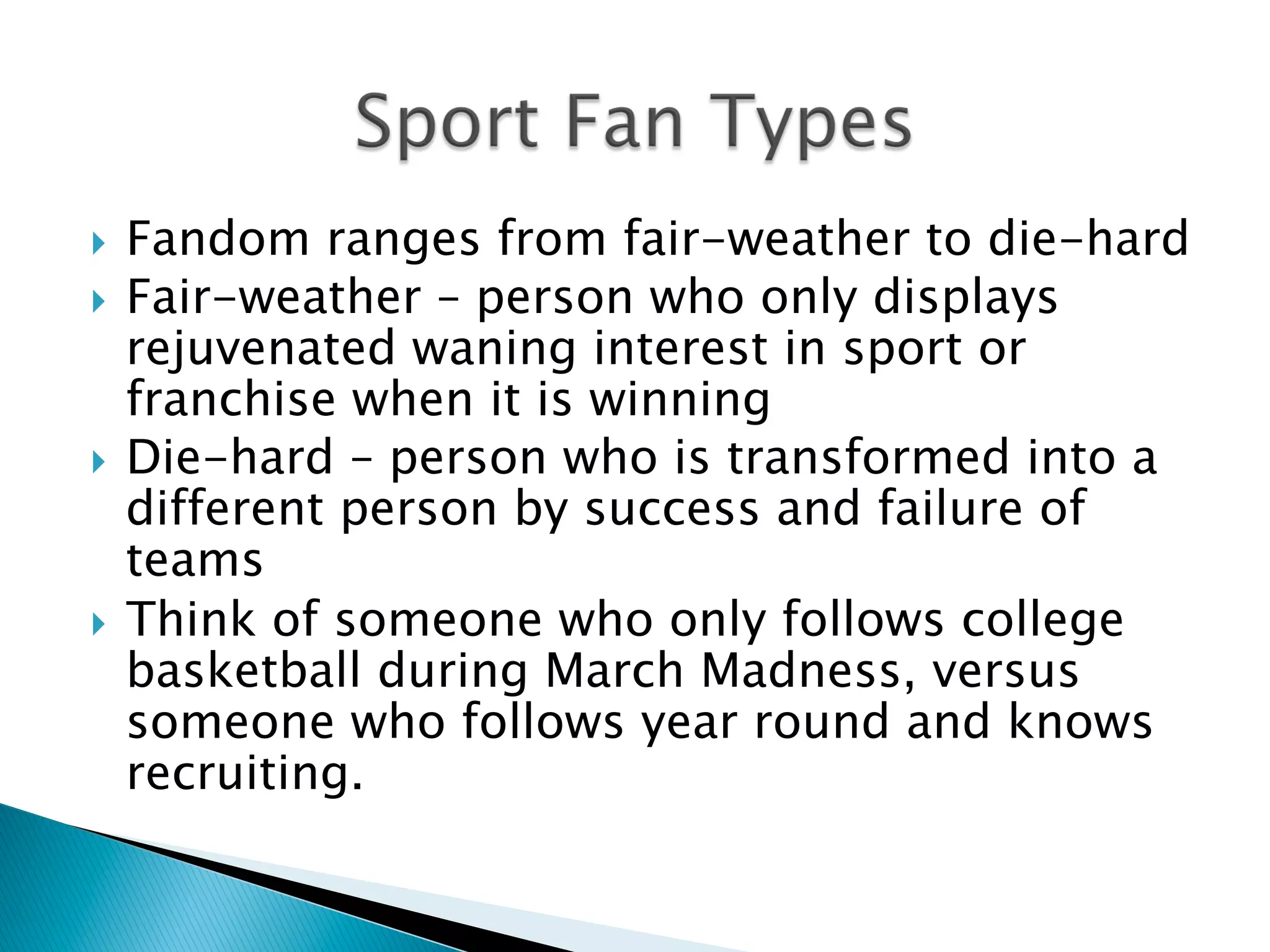
}  Fandom ranges from fair-weather to die-hard
}  Fair-weather – person who only displays
rejuvenated waning interest in sport or
franchise when it is winning
}  Die-hard – person who is transformed into a
different person by success and failure of
teams
}  Think of someone who only follows college
basketball during March Madness, versus
someone who follows year round and knows
recruiting.
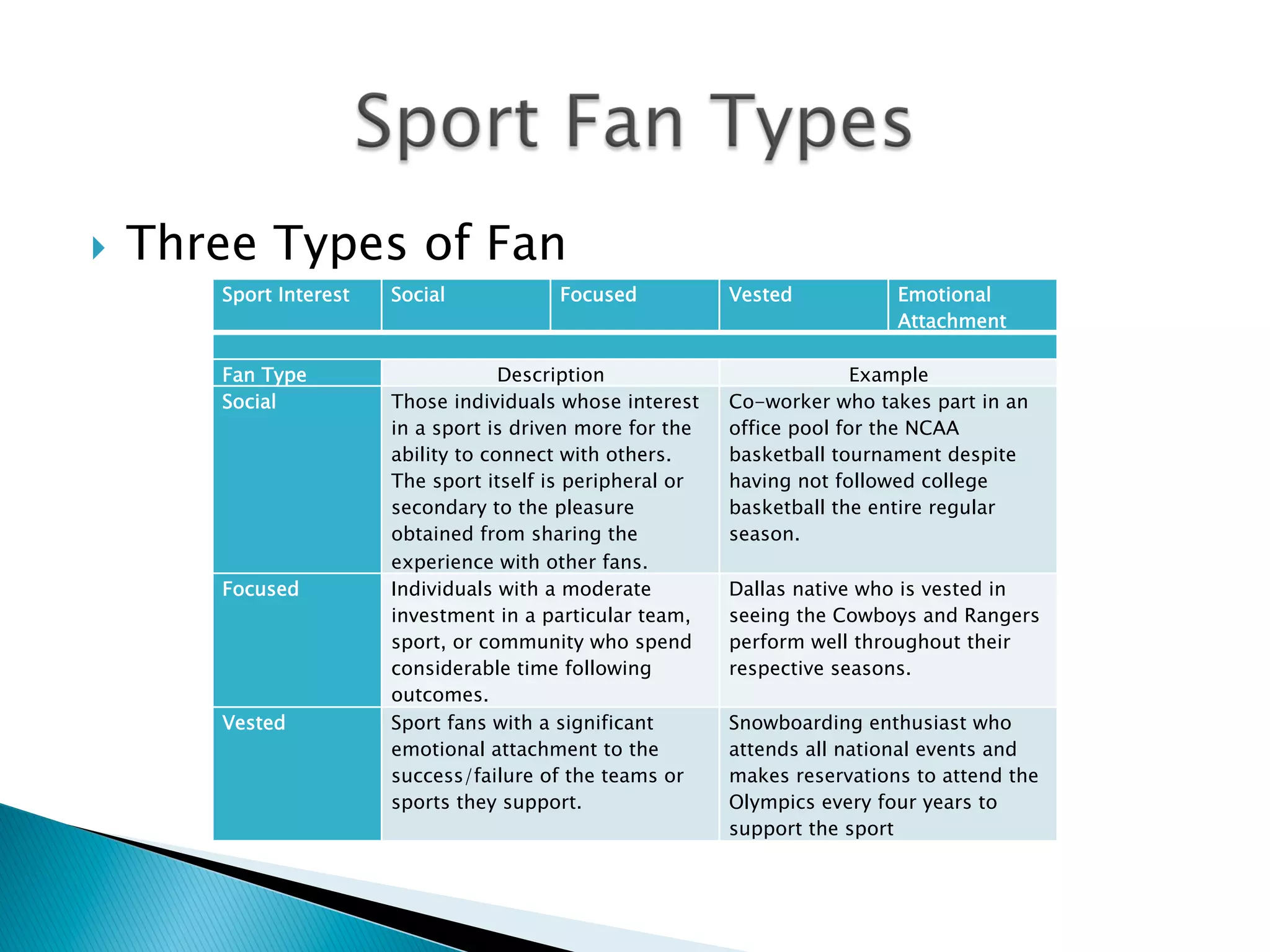
}  Three Types of Fan
Sport Interest	
   Social	
   Focused	
   Vested	
   Emotional
Attachment	
  
Fan Type	
   Description	
   Example	
  
Social	
   Those individuals whose interest
in a sport is driven more for the
ability to connect with others.
The sport itself is peripheral or
secondary to the pleasure
obtained from sharing the
experience with other fans.	
  
Co-worker who takes part in an
office pool for the NCAA
basketball tournament despite
having not followed college
basketball the entire regular
season.	
  
Focused	
   Individuals with a moderate
investment in a particular team,
sport, or community who spend
considerable time following
outcomes.	
  
Dallas native who is vested in
seeing the Cowboys and Rangers
perform well throughout their
respective seasons.	
  
Vested	
   Sport fans with a significant
emotional attachment to the
success/failure of the teams or
sports they support.	
  
Snowboarding enthusiast who
attends all national vents and
makes reservations to attend the
Olympics every four years to
support the sport	
  
Sport Interest	
   Social	
   Focused	
   Vested	
   Emotional
Attachment	
  
Fan Type	
   Description	
   Example	
  
Social	
   Those individuals whose interest
in a sport is driven more for the
ability to connect with others.
The sport itself is peripheral or
secondary to the pleasure
obtained from sharing the
experience with other fans.	
  
Co-worker who takes part in an
office pool for the NCAA
basketball tournament despite
having not followed college
basketball the entire regular
season.	
  
Focused	
   Individuals with a moderate
investment in a particular team,
sport, or community who spend
considerable time following
outcomes.	
  
Dallas native who is vested in
seeing the Cowboys and Rangers
perform well throughout their
respective seasons.	
  
Vested	
   Sport fans with a significant
emotional attachment to the
success/failure of the teams or
sports they support.	
  
Snowboarding enthusiast who
attends all national events and
makes reservations to attend the
Olympics every four years to
support the sport	
  
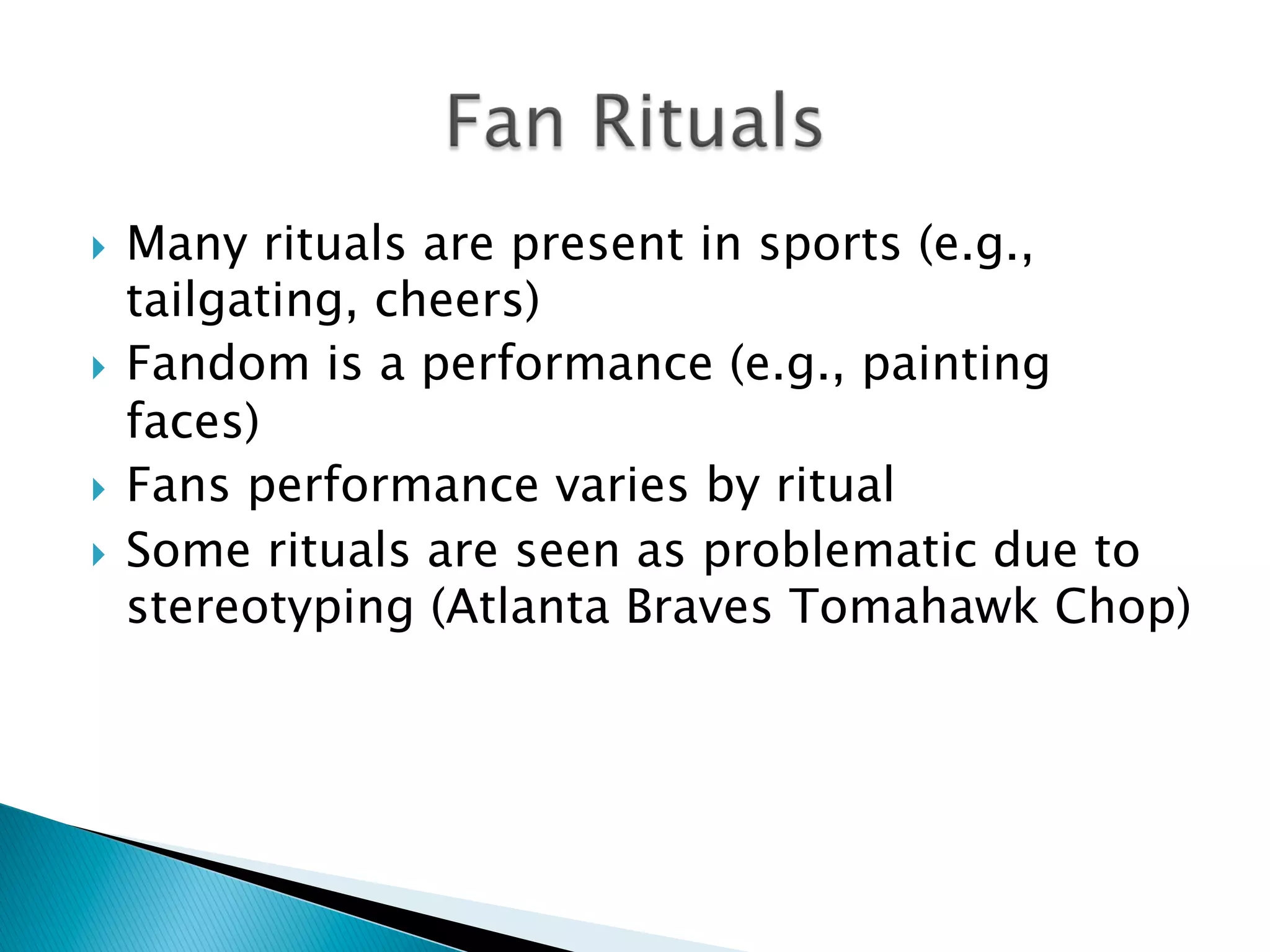
}  Many rituals are present in sports (e.g.,
tailgating, cheers)
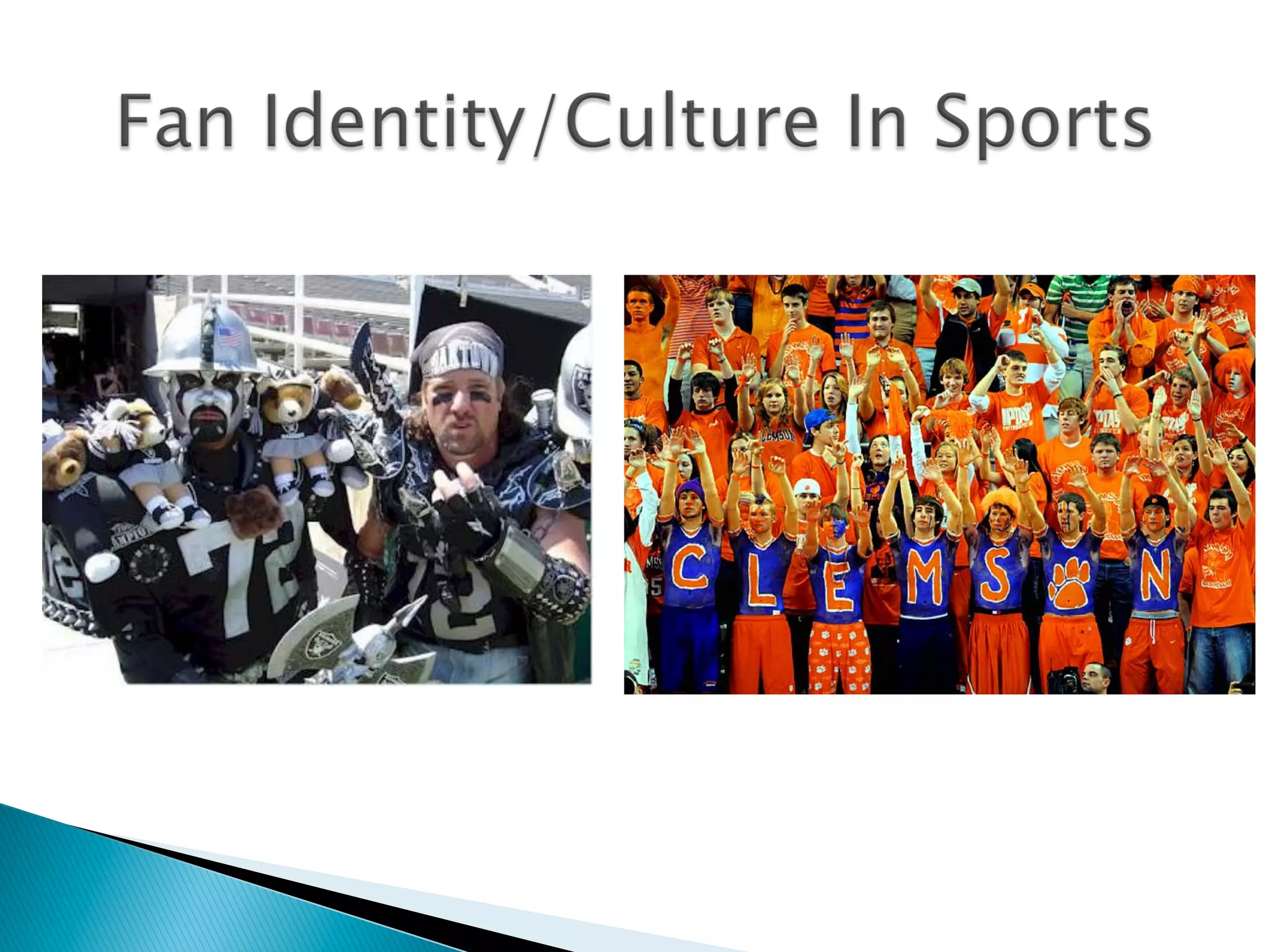
}  Fandom is a performance (e.g., painting
faces)
}  Fans performance varies by ritual
}  Some rituals are seen as problematic due to
stereotyping (Atlanta Braves Tomahawk Chop)
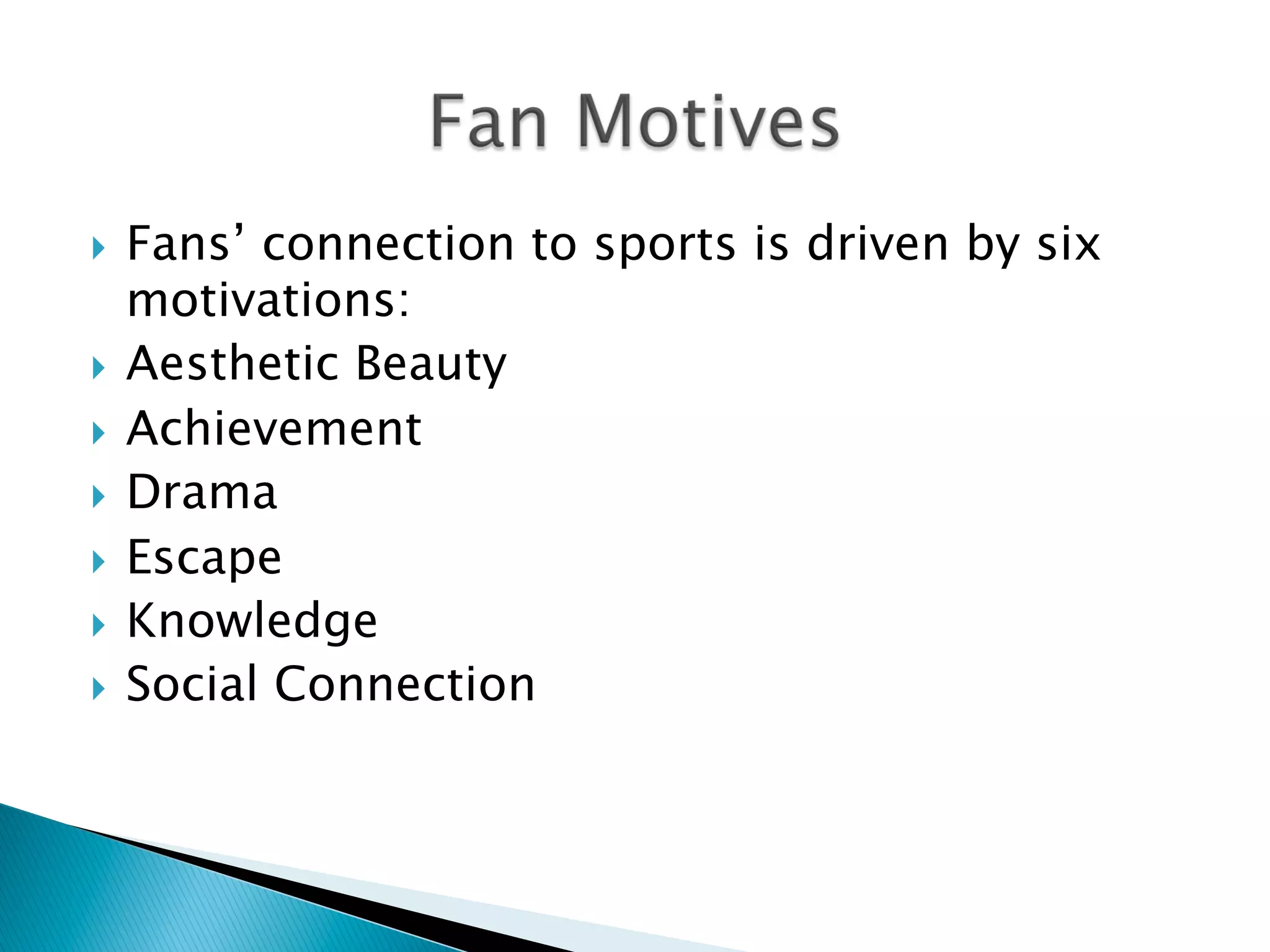
}  Fans’ connection to sports is driven by six
motivations:
}  Aesthetic Beauty
}  Achievement
}  Drama
}  Escape
}  Knowledge
}  Social Connection
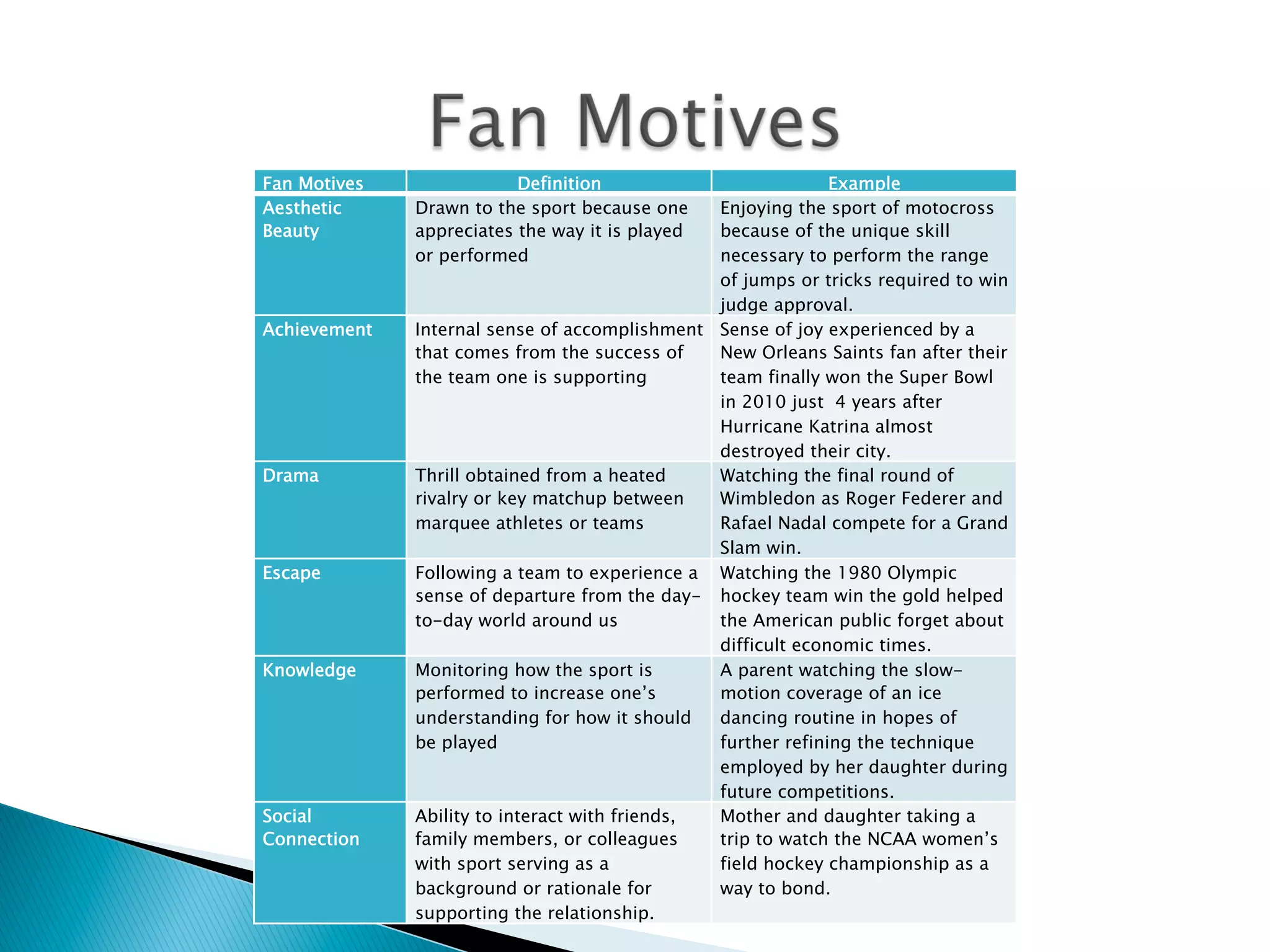
Fan Motives	
   Definition	
   Example	
  
Aesthetic
Beauty	
  
Drawn to the sport because one
appreciates the way it is played
or performed	
  
Enjoying the sport of motocross
because of the unique skill
necessary to perform the range
of jumps or tricks required to win
judge approval.	
  
Achievement	
   Internal sense of accomplishment
that comes from the success of
the team one is supporting	
  
Sense of joy experienced by a
New Orleans Saints fan after their
team finally won the Super Bowl
in 2010 just 4 years after
Hurricane Katrina almost
destroyed their city.	
  
Drama	
   Thrill obtained from a heated
rivalry or key matchup between
marquee athletes or teams	
  
Watching the final round of
Wimbledon as Roger Federer and
Rafael Nadal compete for a Grand
Slam win.	
  
Escape	
   Following a team to experience a
sense of departure from the day-
to-day world around us	
  
Watching the 1980 Olympic
hockey team win the gold helped
the American public forget about
difficult economic times.	
  
Knowledge	
   Monitoring how the sport is
performed to increase one’s
understanding for how it should
be played	
  
A parent watching the slow-
motion coverage of an ice
dancing routine in hopes of
further refining the technique
employed by her daughter during
future competitions.	
  
Social
Connection	
  
Ability to interact with friends,
family members, or colleagues
with sport serving as a
background or rationale for
supporting the relationship.	
  
Mother and daughter taking a
trip to watch the NCAA women’s
field hockey championship as a
way to bond.	
  
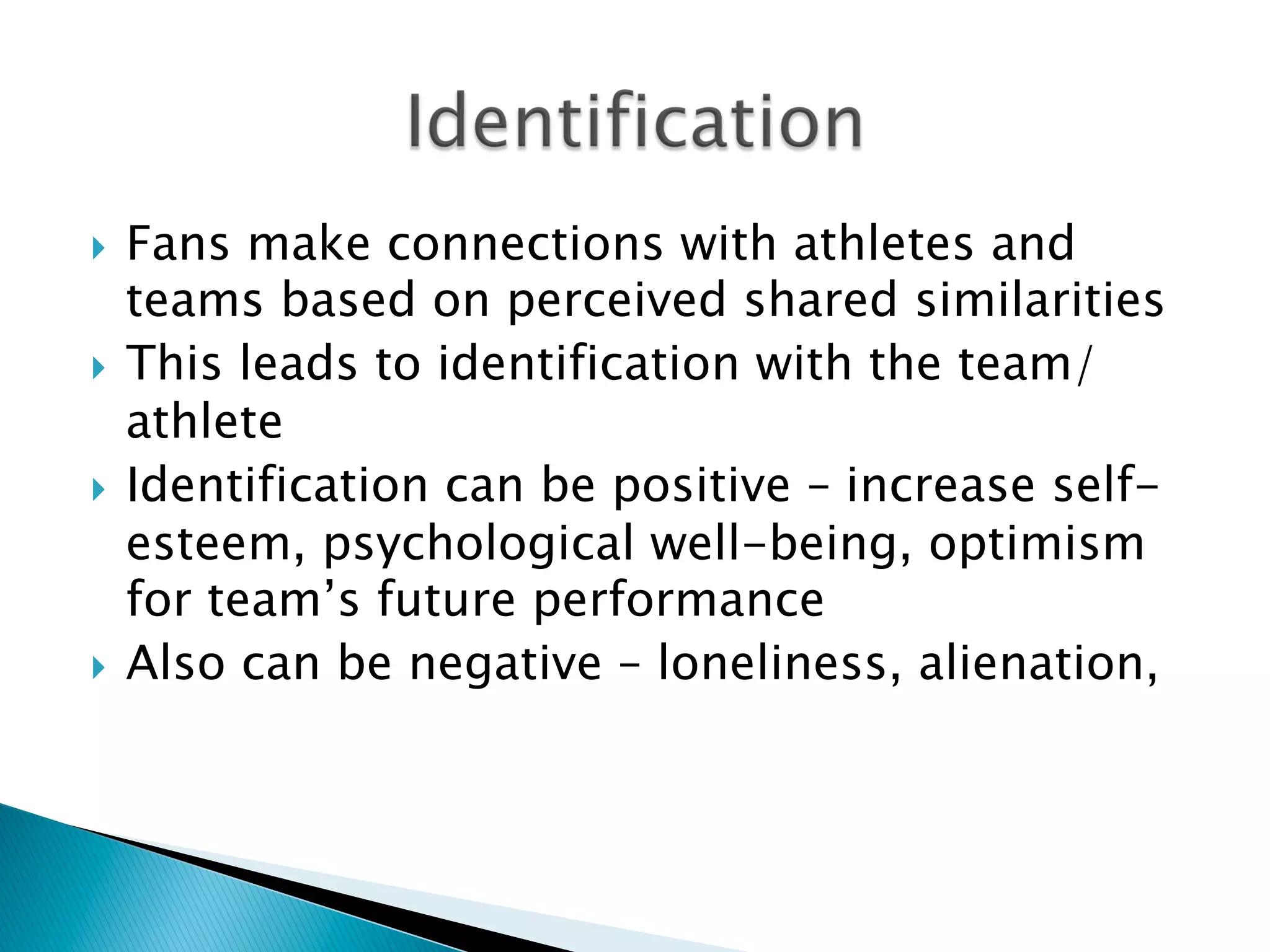
}  Fans make connections with athletes and
teams based on perceived shared similarities
}  This leads to identification with the team/
athlete
}  Identification can be positive – increase self-
esteem, psychological well-being, optimism
for team’s future performance
}  Also can be negative – loneliness, alienation,
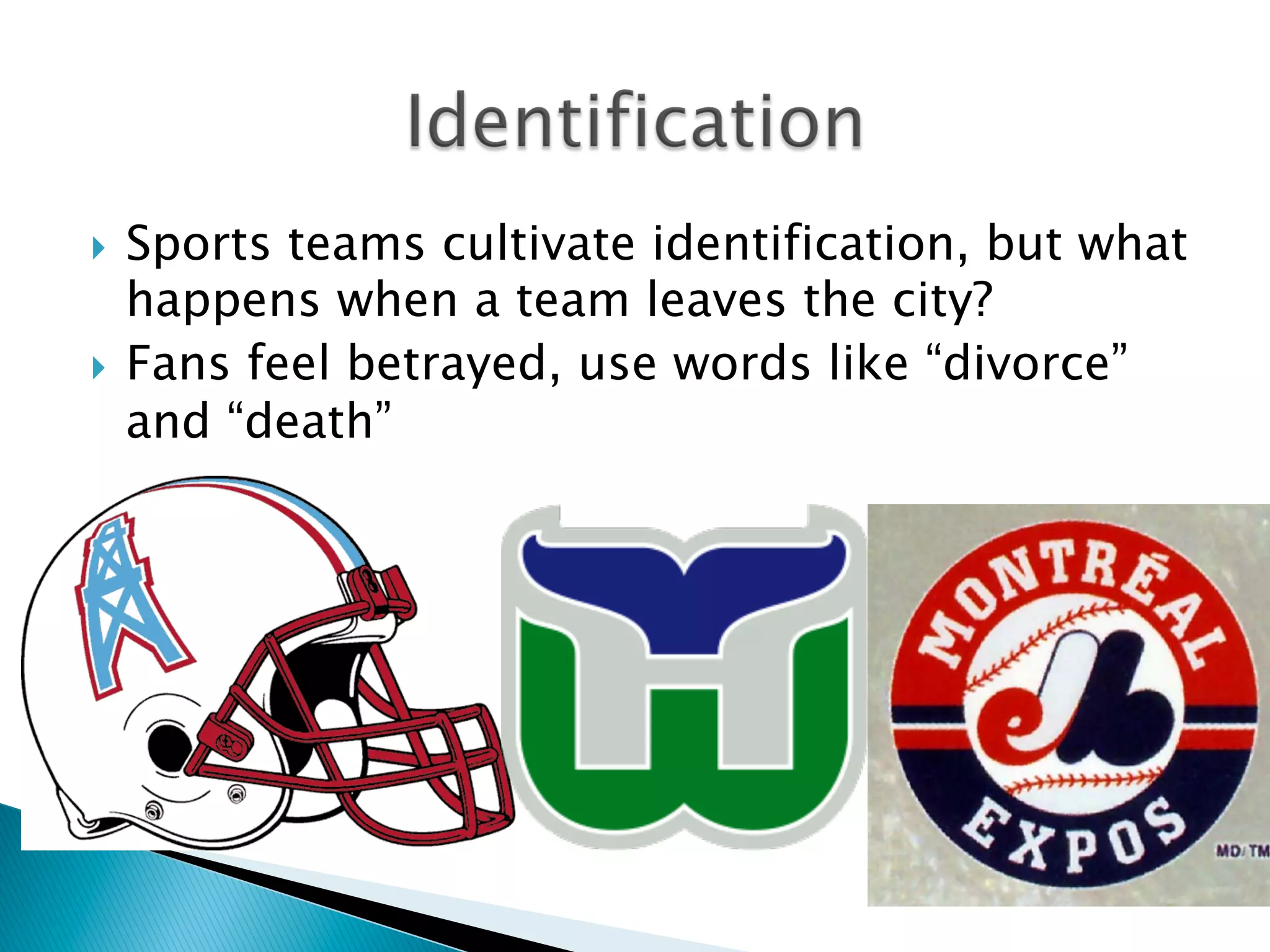
}  Sports teams cultivate identification, but what
happens when a team leaves the city?
}  Fans feel betrayed, use words like “divorce”
and “death”
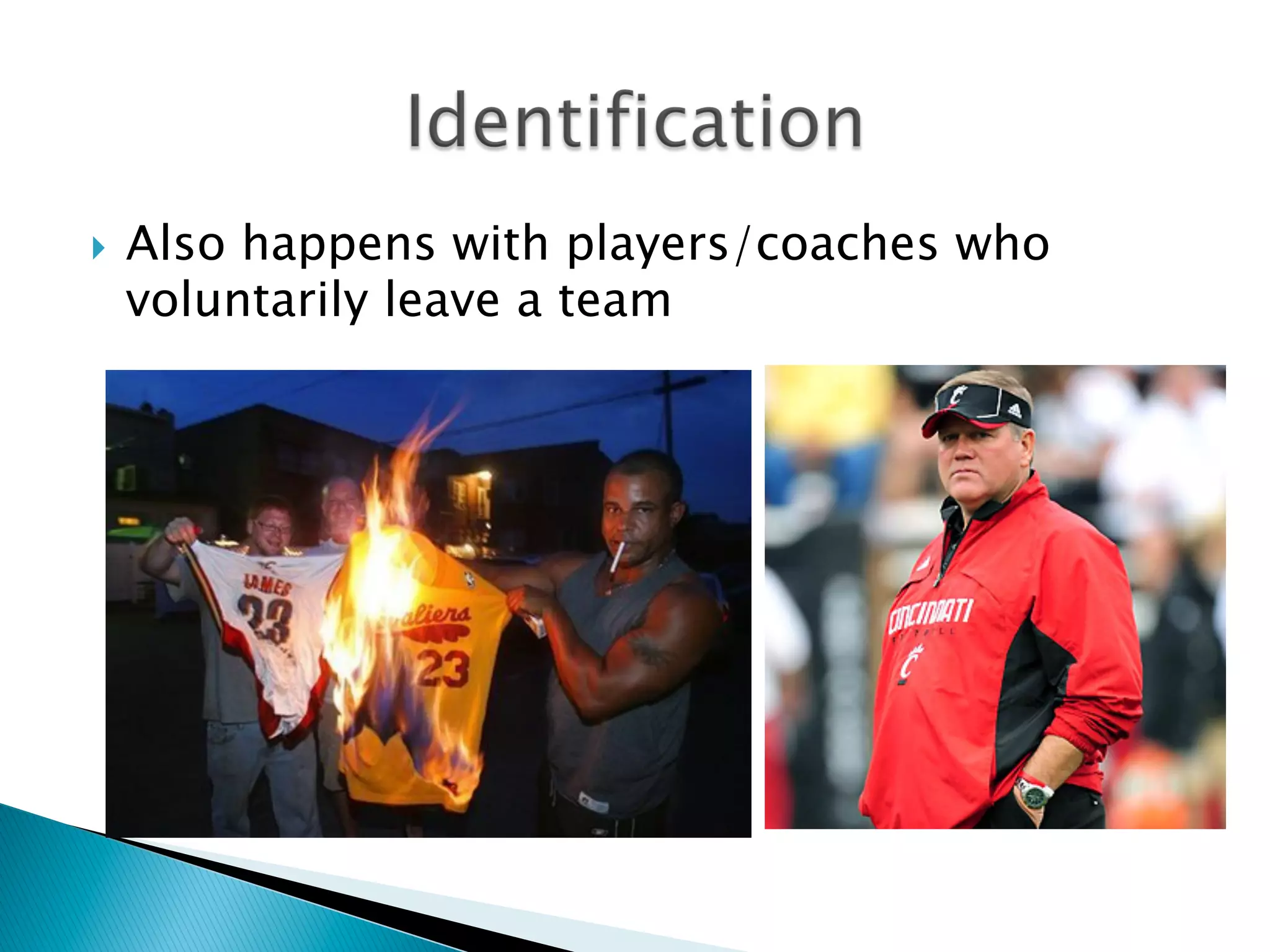
}  Also happens with players/coaches who
voluntarily leave a team
}  Play a huge role in fandom
}  Via social media, fans can now engage
athletes directly
}  Positive Outcomes
}  Negative Outcomes
}  What do we make of fans sending death
threats and other hateful messages via social
media?
}  Identity is a function of representation
}  Athletes are presented/framed to public in
various ways
}  Gender
}  Sexuality
}  Race
}  Ethnicity
}  Ability/Disability
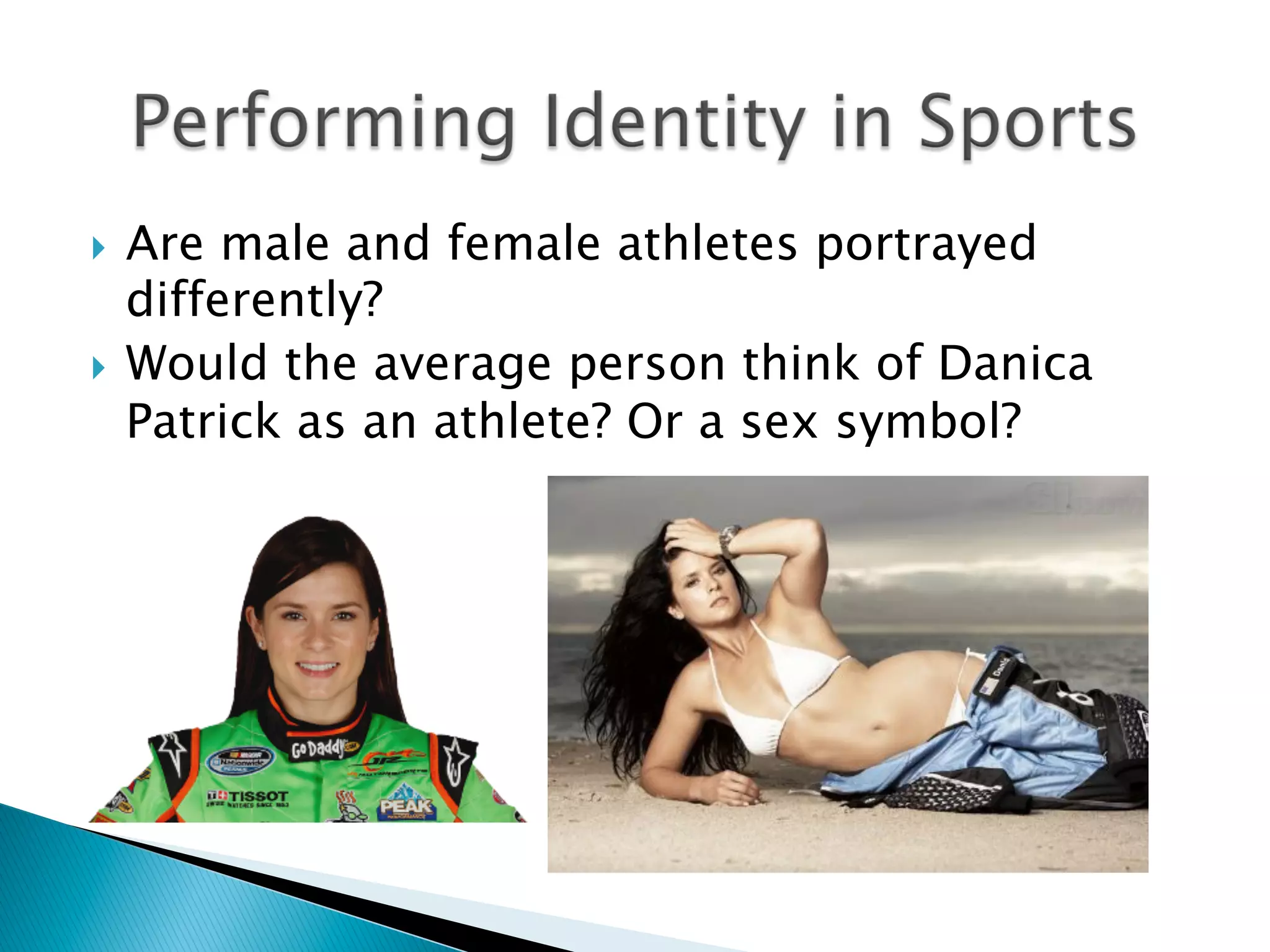
}  Are male and female athletes portrayed
differently?
}  Would the average person think of Danica
Patrick as an athlete? Or a sex symbol?
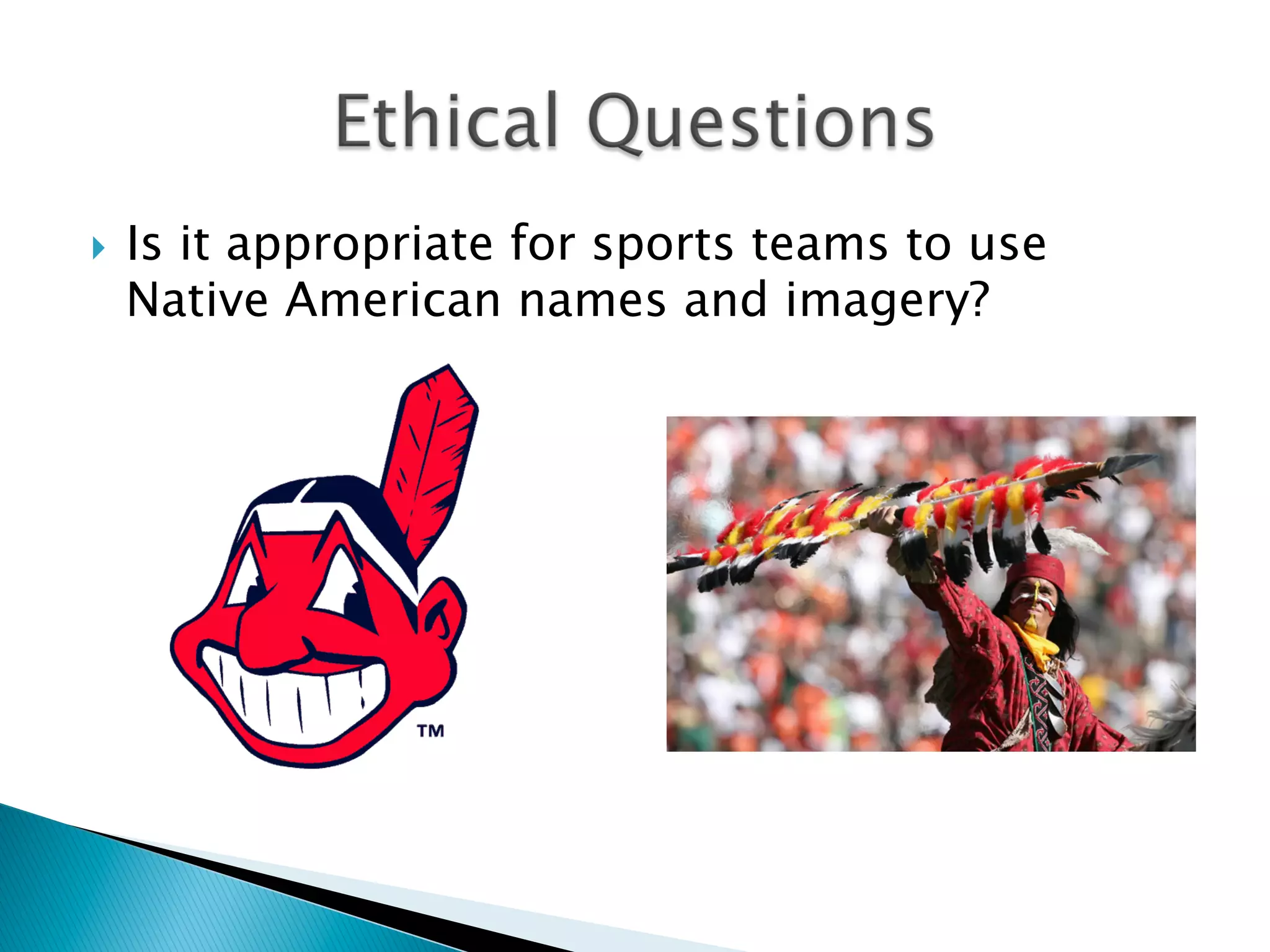
}  Is it appropriate for sports teams to use
Native American names and imagery?

Reading 2-1: Fan Identification PowerPoint

  • 2.
    }  Sport viewingand spectatorship growing ◦  $20 billion in yearly revenue in US }  Fans become identified with athletes and sports teams }  Cultures develop around various sports }  These cultures allow sports leagues and teams to strategically market the fan base
  • 4.
    }  Spectator vs.Fan }  Spectator – a person who simply watches and observes }  Fan – a person who experiences a greater sense of devotion to the sports(s) they follow
  • 5.
    }  Fandom rangesfrom fair-weather to die-hard }  Fair-weather – person who only displays rejuvenated waning interest in sport or franchise when it is winning }  Die-hard – person who is transformed into a different person by success and failure of teams }  Think of someone who only follows college basketball during March Madness, versus someone who follows year round and knows recruiting.
  • 6.
    }  Three Typesof Fan Sport Interest   Social   Focused   Vested   Emotional Attachment   Fan Type   Description   Example   Social   Those individuals whose interest in a sport is driven more for the ability to connect with others. The sport itself is peripheral or secondary to the pleasure obtained from sharing the experience with other fans.   Co-worker who takes part in an office pool for the NCAA basketball tournament despite having not followed college basketball the entire regular season.   Focused   Individuals with a moderate investment in a particular team, sport, or community who spend considerable time following outcomes.   Dallas native who is vested in seeing the Cowboys and Rangers perform well throughout their respective seasons.   Vested   Sport fans with a significant emotional attachment to the success/failure of the teams or sports they support.   Snowboarding enthusiast who attends all national vents and makes reservations to attend the Olympics every four years to support the sport   Sport Interest   Social   Focused   Vested   Emotional Attachment   Fan Type   Description   Example   Social   Those individuals whose interest in a sport is driven more for the ability to connect with others. The sport itself is peripheral or secondary to the pleasure obtained from sharing the experience with other fans.   Co-worker who takes part in an office pool for the NCAA basketball tournament despite having not followed college basketball the entire regular season.   Focused   Individuals with a moderate investment in a particular team, sport, or community who spend considerable time following outcomes.   Dallas native who is vested in seeing the Cowboys and Rangers perform well throughout their respective seasons.   Vested   Sport fans with a significant emotional attachment to the success/failure of the teams or sports they support.   Snowboarding enthusiast who attends all national events and makes reservations to attend the Olympics every four years to support the sport  
  • 7.
    }  Many ritualsare present in sports (e.g., tailgating, cheers) }  Fandom is a performance (e.g., painting faces) }  Fans performance varies by ritual }  Some rituals are seen as problematic due to stereotyping (Atlanta Braves Tomahawk Chop)
  • 8.
    }  Fans’ connectionto sports is driven by six motivations: }  Aesthetic Beauty }  Achievement }  Drama }  Escape }  Knowledge }  Social Connection
  • 9.
    Fan Motives  Definition   Example   Aesthetic Beauty   Drawn to the sport because one appreciates the way it is played or performed   Enjoying the sport of motocross because of the unique skill necessary to perform the range of jumps or tricks required to win judge approval.   Achievement   Internal sense of accomplishment that comes from the success of the team one is supporting   Sense of joy experienced by a New Orleans Saints fan after their team finally won the Super Bowl in 2010 just 4 years after Hurricane Katrina almost destroyed their city.   Drama   Thrill obtained from a heated rivalry or key matchup between marquee athletes or teams   Watching the final round of Wimbledon as Roger Federer and Rafael Nadal compete for a Grand Slam win.   Escape   Following a team to experience a sense of departure from the day- to-day world around us   Watching the 1980 Olympic hockey team win the gold helped the American public forget about difficult economic times.   Knowledge   Monitoring how the sport is performed to increase one’s understanding for how it should be played   A parent watching the slow- motion coverage of an ice dancing routine in hopes of further refining the technique employed by her daughter during future competitions.   Social Connection   Ability to interact with friends, family members, or colleagues with sport serving as a background or rationale for supporting the relationship.   Mother and daughter taking a trip to watch the NCAA women’s field hockey championship as a way to bond.  
  • 10.
    }  Fans makeconnections with athletes and teams based on perceived shared similarities }  This leads to identification with the team/ athlete }  Identification can be positive – increase self- esteem, psychological well-being, optimism for team’s future performance }  Also can be negative – loneliness, alienation,
  • 11.
    }  Sports teamscultivate identification, but what happens when a team leaves the city? }  Fans feel betrayed, use words like “divorce” and “death”
  • 12.
    }  Also happenswith players/coaches who voluntarily leave a team
  • 13.
    }  Play ahuge role in fandom }  Via social media, fans can now engage athletes directly }  Positive Outcomes }  Negative Outcomes }  What do we make of fans sending death threats and other hateful messages via social media?
  • 14.
    }  Identity isa function of representation }  Athletes are presented/framed to public in various ways }  Gender }  Sexuality }  Race }  Ethnicity }  Ability/Disability
  • 15.
    }  Are maleand female athletes portrayed differently? }  Would the average person think of Danica Patrick as an athlete? Or a sex symbol?
  • 16.
    }  Is itappropriate for sports teams to use Native American names and imagery?