FAMILY PLANNING METHODS
PRESENTER: YASIN KHATRI (MD 2025)
@MED.TUTOR.TZ @HEALTH.GRAMM
SUPERVISOR: DR. CHARLES (MD, MMED)
OUTLINE
Contraception methods (Casey, 2024)
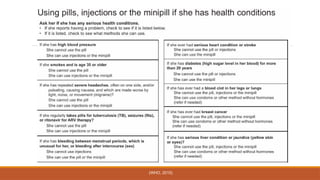
Medical eligibility criteria for conception use
Contraception counselling (Dehlendorf, 2025)
Emergency contraception (Turok, 2025)
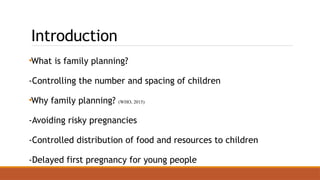
Introduction
•What is family planning?
-Controlling the number and spacing of children
•Why family planning? (WHO, 2015)
-Avoiding risky pregnancies
-Controlled distribution of food and resources to children
-Delayed first pregnancy for young people
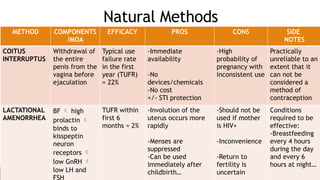
Natural Methods
METHOD COMPONENTS
/MOA
EFFICACY PROS CONS SIDE
NOTES
COITUS
INTERRUPTUS
Withdrawal of
the entire
penis from the
vagina before
ejaculation
Typical use
failure rate
in the first
year (TUFR)
= 22%
-Immediate
availability
-No
devices/chemicals
-No cost
+/- STI protection
-High
probability of
pregnancy with
inconsistent use
Practically
unreliable to an
extent that it
can not be
considered a
method of
contraception
LACTATIONAL
AMENORRHEA
BF  high
prolactin 
binds to
kisspeptin
neuron
receptors 
low GnRH 
low LH and
FSH
TUFR within
first 6
months = 2%
-Involution of the
uterus occurs more
rapidly
-Menses are
suppressed
-Can be used
immediately after
childbirth…
-Should not be
used if mother
is HIV+
-Inconvenience
-Return to
fertility is
uncertain
Conditions
required to be
effective:
-Breastfeeding
every 4 hours
during the day
and every 6
hours at night…
METHOD COMPONENT
S/MOA
EFFICACY PROS CONS SIDE
NOTES
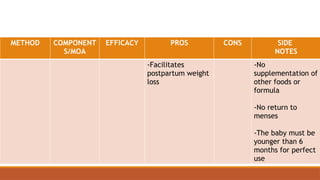
-Facilitates
postpartum weight
loss
-No
supplementation of
other foods or
formula
-No return to
menses
-The baby must be
younger than 6
months for perfect
use
Calendar Method
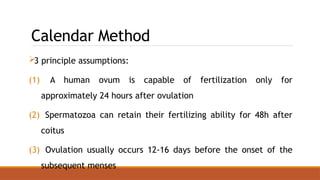
3 principle assumptions:
(1) A human ovum is capable of fertilization only for
approximately 24 hours after ovulation
(2) Spermatozoa can retain their fertilizing ability for 48h after
coitus
(3) Ovulation usually occurs 12-16 days before the onset of the
subsequent menses
Finding the fertile window
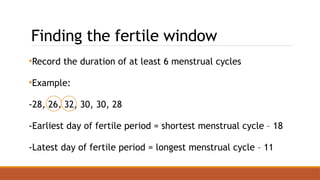
•Record the duration of at least 6 menstrual cycles
•Example:
-28, 26, 32, 30, 30, 28
-Earliest day of fertile period = shortest menstrual cycle – 18
-Latest day of fertile period = longest menstrual cycle – 11
Finding the fertile window
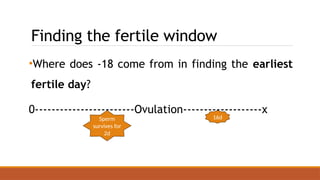
•Where does -18 come from in finding the earliest
fertile day?
0------------------------Ovulation-------------------x
16d
Sperm
survives for
2d
Finding the fertile window
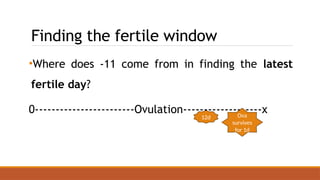
•Where does -11 come from in finding the latest
fertile day?
0------------------------Ovulation-------------------x
12d Ova
survives
for 1d
Finding the fertile window
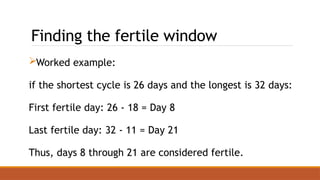
Worked example:
if the shortest cycle is 26 days and the longest is 32 days:
First fertile day: 26 - 18 = Day 8
Last fertile day: 32 - 11 = Day 21
Thus, days 8 through 21 are considered fertile.
Standard Day Method
The standard day method assume a menstrual cycle
of 26-32d and gives a fertile period from day 8-19
Cyclic beads are used as a tool for this method
Cervical Mucus Method
•High estrogen prior to ovulation  more elastic and
copious mucus until a peak day is reached  ovulation
occurs then progesterone increases  mucus becomes
scant and dry until next menses
•Intercourse is allowed 4 days after the maximal
cervical mucus until menstruation.
Symptothermal Method
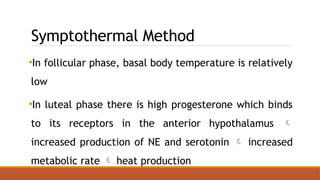
•In follicular phase, basal body temperature is relatively
low
•In luteal phase there is high progesterone which binds
to its receptors in the anterior hypothalamus 
increased production of NE and serotonin  increased
metabolic rate  heat production
Symptothermal Method
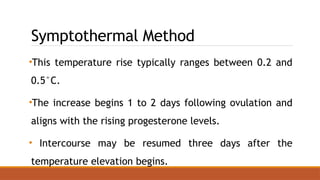
•This temperature rise typically ranges between 0.2 and
0.5°C.
•The increase begins 1 to 2 days following ovulation and
aligns with the rising progesterone levels.
• Intercourse may be resumed three days after the
temperature elevation begins.
Areas To Consider For Natural Methods
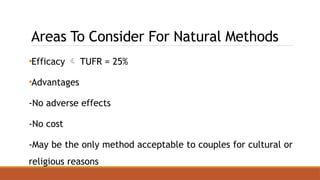
•Efficacy  TUFR = 25%
•Advantages
-No adverse effects
-No cost
-May be the only method acceptable to couples for cultural or
religious reasons
Mechanical Barriers
METHOD COMPONENTS/
MOA
EFFICACY PROS CONS SIDE
NOTES
MALE
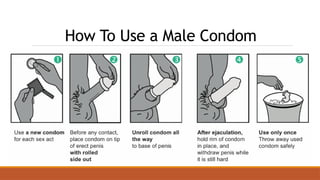
CONDOM
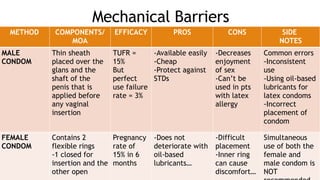
Thin sheath
placed over the
glans and the
shaft of the
penis that is
applied before
any vaginal
insertion
TUFR =
15%
But
perfect
use failure
rate = 3%
-Available easily
-Cheap
-Protect against
STDs
-Decreases
enjoyment
of sex
-Can’t be
used in pts
with latex
allergy
Common errors
-Inconsistent
use
-Using oil-based
lubricants for
latex condoms
-Incorrect
placement of
condom
FEMALE
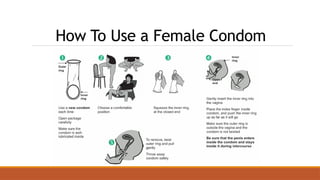
CONDOM
Contains 2
flexible rings
-1 closed for
insertion and the
other open
Pregnancy
rate of
15% in 6
months
-Does not
deteriorate with
oil-based
lubricants…
-Difficult
placement
-Inner ring
can cause
discomfort…
Simultaneous
use of both the
female and
male condom is
NOT
METHOD COMPONENTS/
MOA
EFFICACY PROS CONS SIDE
NOTES
-Provides some
protection to
the labia and
the base of the
penis during
intercourse
-If placed for a
long duration
 UTI
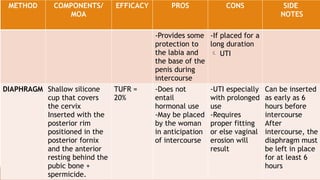
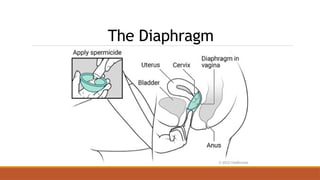
DIAPHRAGM Shallow silicone
cup that covers
the cervix
Inserted with the
posterior rim
positioned in the
posterior fornix
and the anterior
resting behind the
pubic bone +
spermicide.
TUFR =
20%
-Does not
entail
hormonal use
-May be placed
by the woman
in anticipation
of intercourse
-UTI especially
with prolonged
use
-Requires
proper fitting
or else vaginal
erosion will
result
Can be inserted
as early as 6
hours before
intercourse
After
intercourse, the
diaphragm must
be left in place
for at least 6
hours
How To Use a Male Condom
How To Use a Female Condom
The Diaphragm
Spermicidal Agents
•Consist of a base (vaginal foams, suppositories, jellies,
films, foaming tablets, and creams) combined with
either nonoxynol-9 (toxic to lactobacilli as well) or
octoxynol = surfactant  destroys sperm cell membranes
•Must be applied into the vagina prior to each coital act
Spermicidal Agents
•Efficacy  TUFR= 26%
•Advantages
-Easy to apply
-Additional lubricant function
•Disadvantages
-STI risk including HIV  disrupts normal vaginal epithelium
Spermicidal Agents
-Bacteriuria  increased vaginal colonization with
the bacteria Escherichia coli
Hormonal Contraceptives
•Mechanism of action
-Estrogen  negative feedback on HPA  decreased GnRH
 decreased FSH and LH  suppressed follicle
development and inhibited ovulation
-Progesterone  as above + thickens cervical mucus +
altered tubal motility + endometrial atrophy
Hormonal Contraceptives
•Mechanism of side/adverse effects
Estrogen
-Slowed GI motility + stimulates CTZ  nausea and
vomiting
-Alters serotonin and CGRP levels in neurons  migraine
Hormonal Contraceptives
-Stimulates hepatic production of angiotensinogen
 increased RAAS activity  vasoconstriction +
salt and water retention  hypertension
-Alterations in fat metabolism and appetite 
weight gain
Hormonal Contraceptives
-High hepatic estrogen concentration  increases
synthesis of procoagulants  prothrombotic state
-Increases cholesterol synthesis + decreased bile acid
secretion + reduced emptying  gallstones
-Binds to ERs in breast/liver  stimulates cell division 
mutation risk  breast cancer/hepatic adenoma
Hormonal Contraceptives
Progesterone
-Metabolized to ALLO  GABA-A modulation 
desensitizes GABA-A  low threshold to anxiety  mood
changes
-Alters level of serotonin in the brain 
headaches/migraine
Hormonal Contraceptives
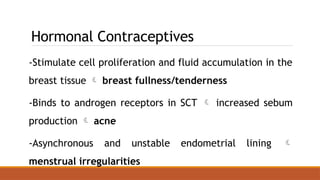
-Stimulate cell proliferation and fluid accumulation in the
breast tissue  breast fullness/tenderness
-Binds to androgen receptors in SCT  increased sebum
production  acne
-Asynchronous and unstable endometrial lining 
menstrual irregularities
Hormonal Contraceptives
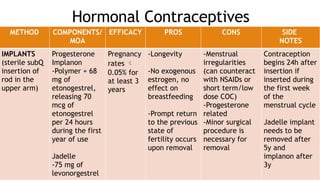
METHOD COMPONENTS/
MOA
EFFICACY PROS CONS SIDE
NOTES
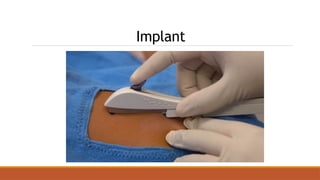
IMPLANTS
(sterile subQ
insertion of
rod in the
upper arm)
Progesterone
Implanon
-Polymer + 68
mg of
etonogestrel,
releasing 70
mcg of
etonogestrel
per 24 hours
during the first
year of use
Jadelle
-75 mg of
levonorgestrel
Pregnancy
rates 
0.05% for
at least 3
years
-Longevity
-No exogenous
estrogen, no
effect on
breastfeeding
-Prompt return
to the previous
state of
fertility occurs
upon removal
-Menstrual
irregularities
(can counteract
with NSAIDs or
short term/low
dose COC)
-Progesterone
related
-Minor surgical
procedure is
necessary for
removal
Contraception
begins 24h after
insertion if
inserted during
the first week
of the
menstrual cycle
Jadelle implant
needs to be
removed after
5y and
implanon after
3y
Implant
-Stimulate cell proliferation and fluid accumulation in the
breast tissue  breast fullness/tenderness
-Binds to androgen receptors in SCT  increased sebum
production  acne
-Asynchronous and unstable endometrial lining  menstrual
irregularities
Hormonal Contraceptives
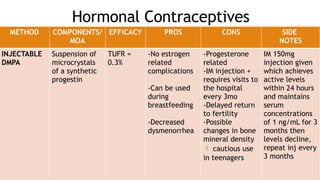
METHOD COMPONENTS/
MOA
EFFICACY PROS CONS SIDE
NOTES
INJECTABLE
DMPA
Suspension of
microcrystals
of a synthetic
progestin
TUFR =
0.3%
-No estrogen
related
complications
-Can be used
during
breastfeeding
-Decreased
dysmenorrhea
-Progesterone
related
-IM injection +
requires visits to
the hospital
every 3mo
-Delayed return
to fertility
-Possible
changes in bone
mineral density
 cautious use
in teenagers
IM 150mg
injection given
which achieves
active levels
within 24 hours
and maintains
serum
concentrations
of 1 ng/mL for 3
months then
levels decline,
repeat inj every
3 months
Hormonal Contraceptives
METHOD COMPONENTS/
MOA
EFFICACY PROS CONS SIDE
NOTES
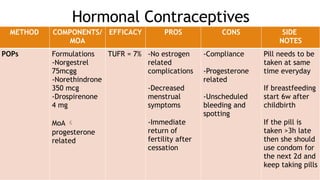
POPs Formulations
-Norgestrel
75mcgg
-Norethindrone
350 mcg
-Drospirenone
4 mg
MoA 
progesterone
related
TUFR = 7% -No estrogen
related
complications
-Decreased
menstrual
symptoms
-Immediate
return of
fertility after
cessation
-Compliance
-Progesterone
related
-Unscheduled
bleeding and
spotting
Pill needs to be
taken at same
time everyday
If breastfeeding
start 6w after
childbirth
If the pill is
taken >3h late
then she should
use condom for
the next 2d and
keep taking pills
Hormonal Contraceptives
METHOD COMPONENTS/
MOA
EFFICACY PROS CONS SIDE
NOTES
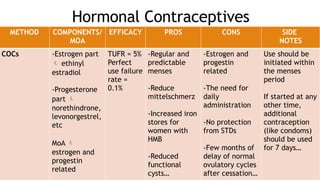
COCs -Estrogen part
 ethinyl
estradiol
-Progesterone
part 
norethindrone,
levonorgestrel,
etc
MoA 
estrogen and
progestin
related
TUFR = 5%
Perfect
use failure
rate =
0.1%
-Regular and
predictable
menses
-Reduce
mittelschmerz
-Increased iron
stores for
women with
HMB
-Reduced
functional
cysts…
-Estrogen and
progestin
related
-The need for
daily
administration
-No protection
from STDs
-Few months of
delay of normal
ovulatory cycles
after cessation…
Use should be
initiated within
the menses
period
If started at any
other time,
additional
contraception
(like condoms)
should be used
for 7 days…
Hormonal Contraceptives
METHOD COMPONENTS/
MOA
EFFICACY PROS CONS SIDE
NOTES
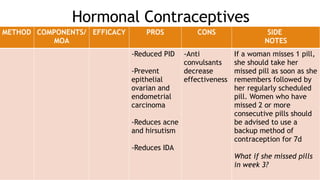
-Reduced PID
-Prevent
epithelial
ovarian and
endometrial
carcinoma
-Reduces acne
and hirsutism
-Reduces IDA
-Anti
convulsants
decrease
effectiveness
If a woman misses 1 pill,
she should take her
missed pill as soon as she
remembers followed by
her regularly scheduled
pill. Women who have
missed 2 or more
consecutive pills should
be advised to use a
backup method of
contraception for 7d
What if she missed pills
in week 3?
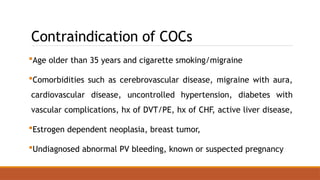
Contraindication of COCs
Age older than 35 years and cigarette smoking/migraine
Comorbidities such as cerebrovascular disease, migraine with aura,
cardiovascular disease, uncontrolled hypertension, diabetes with
vascular complications, hx of DVT/PE, hx of CHF, active liver disease,
Estrogen dependent neoplasia, breast tumor,
Undiagnosed abnormal PV bleeding, known or suspected pregnancy
Hormonal Contraceptives
METHOD COMPONENTS/
MOA
EFFICACY PROS CONS SIDE
NOTES
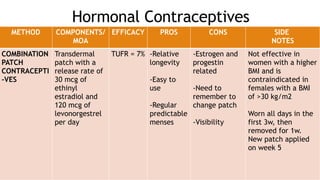
COMBINATION
PATCH
CONTRACEPTI
-VES
Transdermal
patch with a
release rate of
30 mcg of
ethinyl
estradiol and
120 mcg of
levonorgestrel
per day
TUFR = 7% -Relative
longevity
-Easy to
use
-Regular
predictable
menses
-Estrogen and
progestin
related
-Need to
remember to
change patch
-Visibility
Not effective in
women with a higher
BMI and is
contraindicated in
females with a BMI
of >30 kg/m2
Worn all days in the
first 3w, then
removed for 1w.
New patch applied
on week 5
Hormonal Contraceptives
METHOD COMPONENTS/
MOA
EFFICACY PROS CONS SIDE
NOTES
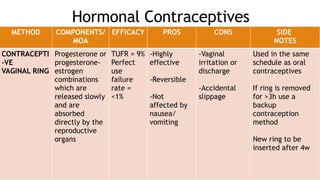
CONTRACEPTI
-VE
VAGINAL RING
Progesterone or
progesterone-
estrogen
combinations
which are
released slowly
and are
absorbed
directly by the
reproductive
organs
TUFR = 9%
Perfect
use
failure
rate =
<1%
-Highly
effective
-Reversible
-Not
affected by
nausea/
vomiting
-Vaginal
irritation or
discharge
-Accidental
slippage
Used in the same
schedule as oral
contraceptives
If ring is removed
for >3h use a
backup
contraception
method
New ring to be
inserted after 4w
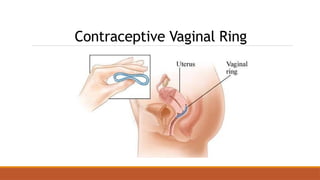
Contraceptive Vaginal Ring
IUDs
METHOD COMPONENTS/
MOA
EFFICACY PROS CONS SIDE
NOTES
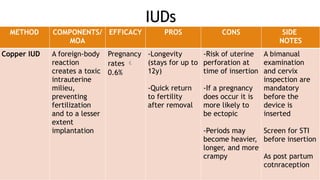
Copper IUD A foreign-body
reaction
creates a toxic
intrauterine
milieu,
preventing
fertilization
and to a lesser
extent
implantation
Pregnancy
rates 
0.6%
-Longevity
(stays for up to
12y)
-Quick return
to fertility
after removal
-Risk of uterine
perforation at
time of insertion
-If a pregnancy
does occur it is
more likely to
be ectopic
-Periods may
become heavier,
longer, and more
crampy
A bimanual
examination
and cervix
inspection are
mandatory
before the
device is
inserted
Screen for STI
before insertion
As post partum
cotnraception
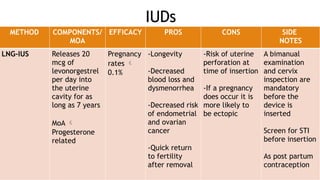
IUDs
METHOD COMPONENTS/
MOA
EFFICACY PROS CONS SIDE
NOTES
LNG-IUS Releases 20
mcg of
levonorgestrel
per day into
the uterine
cavity for as
long as 7 years
MoA 
Progesterone
related
Pregnancy
rates 
0.1%
-Longevity
-Decreased
blood loss and
dysmenorrhea
-Decreased risk
of endometrial
and ovarian
cancer
-Quick return
to fertility
after removal
-Risk of uterine
perforation at
time of insertion
-If a pregnancy
does occur it is
more likely to
be ectopic
A bimanual
examination
and cervix
inspection are
mandatory
before the
device is
inserted
Screen for STI
before insertion
As post partum
contraception
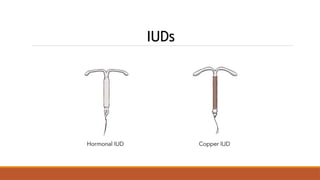
IUDs
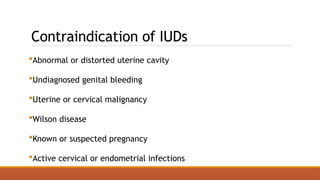
Contraindication of IUDs
Abnormal or distorted uterine cavity
Undiagnosed genital bleeding
Uterine or cervical malignancy
Wilson disease
Known or suspected pregnancy
Active cervical or endometrial infections
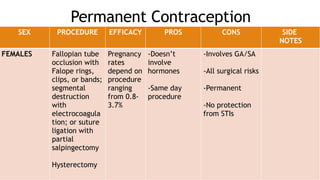
Permanent Contraception
SEX PROCEDURE EFFICACY PROS CONS SIDE
NOTES
FEMALES Fallopian tube
occlusion with
Falope rings,
clips, or bands;
segmental
destruction
with
electrocoagula
tion; or suture
ligation with
partial
salpingectomy
Hysterectomy
Pregnancy
rates
depend on
procedure
ranging
from 0.8-
3.7%
-Doesn’t
involve
hormones
-Same day
procedure
-Involves GA/SA
-All surgical risks
-Permanent
-No protection
from STIs
Permanent Contraception
SEX PROCEDURE EFFICACY PROS CONS SIDE
NOTES
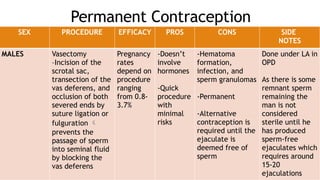
MALES Vasectomy
–Incision of the
scrotal sac,
transection of the
vas deferens, and
occlusion of both
severed ends by
suture ligation or
fulguration 
prevents the
passage of sperm
into seminal fluid
by blocking the
vas deferens
Pregnancy
rates
depend on
procedure
ranging
from 0.8-
3.7%
-Doesn’t
involve
hormones
-Quick
procedure
with
minimal
risks
-Hematoma
formation,
infection, and
sperm granulomas
-Permanent
-Alternative
contraception is
required until the
ejaculate is
deemed free of
sperm
Done under LA in
OPD
As there is some
remnant sperm
remaining the
man is not
considered
sterile until he
has produced
sperm-free
ejaculates which
requires around
15-20
ejaculations
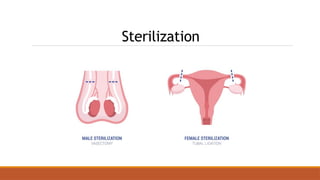
Sterilization
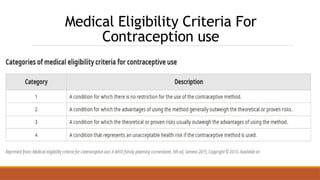
Medical Eligibility Criteria For
Contraception use
(WHO, 2015)
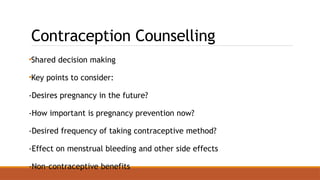
Contraception Counselling
•Shared decision making
•Key points to consider:
-Desires pregnancy in the future?
-How important is pregnancy prevention now?
-Desired frequency of taking contraceptive method?
-Effect on menstrual bleeding and other side effects
-Non-contraceptive benefits
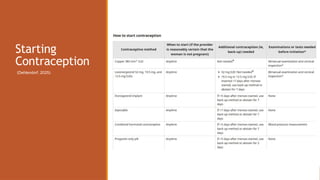
Starting
Contraception
(Dehlendorf, 2025)
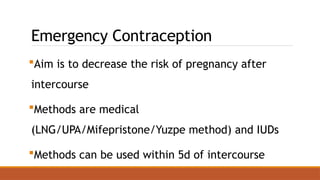
Emergency Contraception
Aim is to decrease the risk of pregnancy after
intercourse
Methods are medical
(LNG/UPA/Mifepristone/Yuzpe method) and IUDs
Methods can be used within 5d of intercourse
References:
1. Casey, F. (2024) Contraception: Practice Essentials, Overview, Periodic Abstinence, Medscape.
Available at: https://emedicine.medscape.com/article/258507-overview (Accessed: 29 May
2025).
2. Dehlendorf, C. (2025) Contraception: Counseling and selection - UpToDate, Uptodate.
Available at: https://www.uptodate.com/contents/contraception-counseling-and-selection
(Accessed: 29 May 2025).
3. Turok, D. (2025) Emergency contraception - UpToDate, Uptodate. Available at:
https://www.uptodate.com/contents/emergency-contraception (Accessed: 29 May 2025).
4. WHO (2015) Medical eligibility criteria for contraceptive use. World Health Organization.

FAMILY PLANNING METHODS: a detailed overview

  • 1.
    FAMILY PLANNING METHODS PRESENTER:YASIN KHATRI (MD 2025) @MED.TUTOR.TZ @HEALTH.GRAMM SUPERVISOR: DR. CHARLES (MD, MMED)
  • 2.
    OUTLINE Contraception methods (Casey,2024) Medical eligibility criteria for conception use Contraception counselling (Dehlendorf, 2025) Emergency contraception (Turok, 2025)
  • 3.
    Introduction •What is familyplanning? -Controlling the number and spacing of children •Why family planning? (WHO, 2015) -Avoiding risky pregnancies -Controlled distribution of food and resources to children -Delayed first pregnancy for young people
  • 4.
    Natural Methods METHOD COMPONENTS /MOA EFFICACYPROS CONS SIDE NOTES COITUS INTERRUPTUS Withdrawal of the entire penis from the vagina before ejaculation Typical use failure rate in the first year (TUFR) = 22% -Immediate availability -No devices/chemicals -No cost +/- STI protection -High probability of pregnancy with inconsistent use Practically unreliable to an extent that it can not be considered a method of contraception LACTATIONAL AMENORRHEA BF  high prolactin  binds to kisspeptin neuron receptors  low GnRH  low LH and FSH TUFR within first 6 months = 2% -Involution of the uterus occurs more rapidly -Menses are suppressed -Can be used immediately after childbirth… -Should not be used if mother is HIV+ -Inconvenience -Return to fertility is uncertain Conditions required to be effective: -Breastfeeding every 4 hours during the day and every 6 hours at night…
  • 5.
    METHOD COMPONENT S/MOA EFFICACY PROSCONS SIDE NOTES -Facilitates postpartum weight loss -No supplementation of other foods or formula -No return to menses -The baby must be younger than 6 months for perfect use
  • 6.
    Calendar Method 3 principleassumptions: (1) A human ovum is capable of fertilization only for approximately 24 hours after ovulation (2) Spermatozoa can retain their fertilizing ability for 48h after coitus (3) Ovulation usually occurs 12-16 days before the onset of the subsequent menses
  • 7.
    Finding the fertilewindow •Record the duration of at least 6 menstrual cycles •Example: -28, 26, 32, 30, 30, 28 -Earliest day of fertile period = shortest menstrual cycle – 18 -Latest day of fertile period = longest menstrual cycle – 11
  • 8.
    Finding the fertilewindow •Where does -18 come from in finding the earliest fertile day? 0------------------------Ovulation-------------------x 16d Sperm survives for 2d
  • 9.
    Finding the fertilewindow •Where does -11 come from in finding the latest fertile day? 0------------------------Ovulation-------------------x 12d Ova survives for 1d
  • 10.
    Finding the fertilewindow Worked example: if the shortest cycle is 26 days and the longest is 32 days: First fertile day: 26 - 18 = Day 8 Last fertile day: 32 - 11 = Day 21 Thus, days 8 through 21 are considered fertile.
  • 11.
    Standard Day Method Thestandard day method assume a menstrual cycle of 26-32d and gives a fertile period from day 8-19 Cyclic beads are used as a tool for this method
  • 12.
    Cervical Mucus Method •Highestrogen prior to ovulation  more elastic and copious mucus until a peak day is reached  ovulation occurs then progesterone increases  mucus becomes scant and dry until next menses •Intercourse is allowed 4 days after the maximal cervical mucus until menstruation.
  • 13.
    Symptothermal Method •In follicularphase, basal body temperature is relatively low •In luteal phase there is high progesterone which binds to its receptors in the anterior hypothalamus  increased production of NE and serotonin  increased metabolic rate  heat production
  • 14.
    Symptothermal Method •This temperaturerise typically ranges between 0.2 and 0.5°C. •The increase begins 1 to 2 days following ovulation and aligns with the rising progesterone levels. • Intercourse may be resumed three days after the temperature elevation begins.
  • 15.
    Areas To ConsiderFor Natural Methods •Efficacy  TUFR = 25% •Advantages -No adverse effects -No cost -May be the only method acceptable to couples for cultural or religious reasons
  • 16.
    Mechanical Barriers METHOD COMPONENTS/ MOA EFFICACYPROS CONS SIDE NOTES MALE CONDOM Thin sheath placed over the glans and the shaft of the penis that is applied before any vaginal insertion TUFR = 15% But perfect use failure rate = 3% -Available easily -Cheap -Protect against STDs -Decreases enjoyment of sex -Can’t be used in pts with latex allergy Common errors -Inconsistent use -Using oil-based lubricants for latex condoms -Incorrect placement of condom FEMALE CONDOM Contains 2 flexible rings -1 closed for insertion and the other open Pregnancy rate of 15% in 6 months -Does not deteriorate with oil-based lubricants… -Difficult placement -Inner ring can cause discomfort… Simultaneous use of both the female and male condom is NOT
  • 17.
    METHOD COMPONENTS/ MOA EFFICACY PROSCONS SIDE NOTES -Provides some protection to the labia and the base of the penis during intercourse -If placed for a long duration  UTI DIAPHRAGM Shallow silicone cup that covers the cervix Inserted with the posterior rim positioned in the posterior fornix and the anterior resting behind the pubic bone + spermicide. TUFR = 20% -Does not entail hormonal use -May be placed by the woman in anticipation of intercourse -UTI especially with prolonged use -Requires proper fitting or else vaginal erosion will result Can be inserted as early as 6 hours before intercourse After intercourse, the diaphragm must be left in place for at least 6 hours
  • 18.
    How To Usea Male Condom
  • 19.
    How To Usea Female Condom
  • 20.
  • 21.
    Spermicidal Agents •Consist ofa base (vaginal foams, suppositories, jellies, films, foaming tablets, and creams) combined with either nonoxynol-9 (toxic to lactobacilli as well) or octoxynol = surfactant  destroys sperm cell membranes •Must be applied into the vagina prior to each coital act
  • 22.
    Spermicidal Agents •Efficacy TUFR= 26% •Advantages -Easy to apply -Additional lubricant function •Disadvantages -STI risk including HIV  disrupts normal vaginal epithelium
  • 23.
    Spermicidal Agents -Bacteriuria increased vaginal colonization with the bacteria Escherichia coli
  • 24.
    Hormonal Contraceptives •Mechanism ofaction -Estrogen  negative feedback on HPA  decreased GnRH  decreased FSH and LH  suppressed follicle development and inhibited ovulation -Progesterone  as above + thickens cervical mucus + altered tubal motility + endometrial atrophy
  • 25.
    Hormonal Contraceptives •Mechanism ofside/adverse effects Estrogen -Slowed GI motility + stimulates CTZ  nausea and vomiting -Alters serotonin and CGRP levels in neurons  migraine
  • 26.
    Hormonal Contraceptives -Stimulates hepaticproduction of angiotensinogen  increased RAAS activity  vasoconstriction + salt and water retention  hypertension -Alterations in fat metabolism and appetite  weight gain
  • 27.
    Hormonal Contraceptives -High hepaticestrogen concentration  increases synthesis of procoagulants  prothrombotic state -Increases cholesterol synthesis + decreased bile acid secretion + reduced emptying  gallstones -Binds to ERs in breast/liver  stimulates cell division  mutation risk  breast cancer/hepatic adenoma
  • 28.
    Hormonal Contraceptives Progesterone -Metabolized toALLO  GABA-A modulation  desensitizes GABA-A  low threshold to anxiety  mood changes -Alters level of serotonin in the brain  headaches/migraine
  • 29.
    Hormonal Contraceptives -Stimulate cellproliferation and fluid accumulation in the breast tissue  breast fullness/tenderness -Binds to androgen receptors in SCT  increased sebum production  acne -Asynchronous and unstable endometrial lining  menstrual irregularities
  • 30.
    Hormonal Contraceptives METHOD COMPONENTS/ MOA EFFICACYPROS CONS SIDE NOTES IMPLANTS (sterile subQ insertion of rod in the upper arm) Progesterone Implanon -Polymer + 68 mg of etonogestrel, releasing 70 mcg of etonogestrel per 24 hours during the first year of use Jadelle -75 mg of levonorgestrel Pregnancy rates  0.05% for at least 3 years -Longevity -No exogenous estrogen, no effect on breastfeeding -Prompt return to the previous state of fertility occurs upon removal -Menstrual irregularities (can counteract with NSAIDs or short term/low dose COC) -Progesterone related -Minor surgical procedure is necessary for removal Contraception begins 24h after insertion if inserted during the first week of the menstrual cycle Jadelle implant needs to be removed after 5y and implanon after 3y
  • 31.
    Implant -Stimulate cell proliferationand fluid accumulation in the breast tissue  breast fullness/tenderness -Binds to androgen receptors in SCT  increased sebum production  acne -Asynchronous and unstable endometrial lining  menstrual irregularities
  • 32.
    Hormonal Contraceptives METHOD COMPONENTS/ MOA EFFICACYPROS CONS SIDE NOTES INJECTABLE DMPA Suspension of microcrystals of a synthetic progestin TUFR = 0.3% -No estrogen related complications -Can be used during breastfeeding -Decreased dysmenorrhea -Progesterone related -IM injection + requires visits to the hospital every 3mo -Delayed return to fertility -Possible changes in bone mineral density  cautious use in teenagers IM 150mg injection given which achieves active levels within 24 hours and maintains serum concentrations of 1 ng/mL for 3 months then levels decline, repeat inj every 3 months
  • 33.
    Hormonal Contraceptives METHOD COMPONENTS/ MOA EFFICACYPROS CONS SIDE NOTES POPs Formulations -Norgestrel 75mcgg -Norethindrone 350 mcg -Drospirenone 4 mg MoA  progesterone related TUFR = 7% -No estrogen related complications -Decreased menstrual symptoms -Immediate return of fertility after cessation -Compliance -Progesterone related -Unscheduled bleeding and spotting Pill needs to be taken at same time everyday If breastfeeding start 6w after childbirth If the pill is taken >3h late then she should use condom for the next 2d and keep taking pills
  • 34.
    Hormonal Contraceptives METHOD COMPONENTS/ MOA EFFICACYPROS CONS SIDE NOTES COCs -Estrogen part  ethinyl estradiol -Progesterone part  norethindrone, levonorgestrel, etc MoA  estrogen and progestin related TUFR = 5% Perfect use failure rate = 0.1% -Regular and predictable menses -Reduce mittelschmerz -Increased iron stores for women with HMB -Reduced functional cysts… -Estrogen and progestin related -The need for daily administration -No protection from STDs -Few months of delay of normal ovulatory cycles after cessation… Use should be initiated within the menses period If started at any other time, additional contraception (like condoms) should be used for 7 days…
  • 35.
    Hormonal Contraceptives METHOD COMPONENTS/ MOA EFFICACYPROS CONS SIDE NOTES -Reduced PID -Prevent epithelial ovarian and endometrial carcinoma -Reduces acne and hirsutism -Reduces IDA -Anti convulsants decrease effectiveness If a woman misses 1 pill, she should take her missed pill as soon as she remembers followed by her regularly scheduled pill. Women who have missed 2 or more consecutive pills should be advised to use a backup method of contraception for 7d What if she missed pills in week 3?
  • 36.
    Contraindication of COCs Ageolder than 35 years and cigarette smoking/migraine Comorbidities such as cerebrovascular disease, migraine with aura, cardiovascular disease, uncontrolled hypertension, diabetes with vascular complications, hx of DVT/PE, hx of CHF, active liver disease, Estrogen dependent neoplasia, breast tumor, Undiagnosed abnormal PV bleeding, known or suspected pregnancy
  • 37.
    Hormonal Contraceptives METHOD COMPONENTS/ MOA EFFICACYPROS CONS SIDE NOTES COMBINATION PATCH CONTRACEPTI -VES Transdermal patch with a release rate of 30 mcg of ethinyl estradiol and 120 mcg of levonorgestrel per day TUFR = 7% -Relative longevity -Easy to use -Regular predictable menses -Estrogen and progestin related -Need to remember to change patch -Visibility Not effective in women with a higher BMI and is contraindicated in females with a BMI of >30 kg/m2 Worn all days in the first 3w, then removed for 1w. New patch applied on week 5
  • 38.
    Hormonal Contraceptives METHOD COMPONENTS/ MOA EFFICACYPROS CONS SIDE NOTES CONTRACEPTI -VE VAGINAL RING Progesterone or progesterone- estrogen combinations which are released slowly and are absorbed directly by the reproductive organs TUFR = 9% Perfect use failure rate = <1% -Highly effective -Reversible -Not affected by nausea/ vomiting -Vaginal irritation or discharge -Accidental slippage Used in the same schedule as oral contraceptives If ring is removed for >3h use a backup contraception method New ring to be inserted after 4w
  • 39.
  • 40.
    IUDs METHOD COMPONENTS/ MOA EFFICACY PROSCONS SIDE NOTES Copper IUD A foreign-body reaction creates a toxic intrauterine milieu, preventing fertilization and to a lesser extent implantation Pregnancy rates  0.6% -Longevity (stays for up to 12y) -Quick return to fertility after removal -Risk of uterine perforation at time of insertion -If a pregnancy does occur it is more likely to be ectopic -Periods may become heavier, longer, and more crampy A bimanual examination and cervix inspection are mandatory before the device is inserted Screen for STI before insertion As post partum cotnraception
  • 41.
    IUDs METHOD COMPONENTS/ MOA EFFICACY PROSCONS SIDE NOTES LNG-IUS Releases 20 mcg of levonorgestrel per day into the uterine cavity for as long as 7 years MoA  Progesterone related Pregnancy rates  0.1% -Longevity -Decreased blood loss and dysmenorrhea -Decreased risk of endometrial and ovarian cancer -Quick return to fertility after removal -Risk of uterine perforation at time of insertion -If a pregnancy does occur it is more likely to be ectopic A bimanual examination and cervix inspection are mandatory before the device is inserted Screen for STI before insertion As post partum contraception
  • 42.
  • 43.
    Contraindication of IUDs Abnormalor distorted uterine cavity Undiagnosed genital bleeding Uterine or cervical malignancy Wilson disease Known or suspected pregnancy Active cervical or endometrial infections
  • 44.
    Permanent Contraception SEX PROCEDUREEFFICACY PROS CONS SIDE NOTES FEMALES Fallopian tube occlusion with Falope rings, clips, or bands; segmental destruction with electrocoagula tion; or suture ligation with partial salpingectomy Hysterectomy Pregnancy rates depend on procedure ranging from 0.8- 3.7% -Doesn’t involve hormones -Same day procedure -Involves GA/SA -All surgical risks -Permanent -No protection from STIs
  • 45.
    Permanent Contraception SEX PROCEDUREEFFICACY PROS CONS SIDE NOTES MALES Vasectomy –Incision of the scrotal sac, transection of the vas deferens, and occlusion of both severed ends by suture ligation or fulguration  prevents the passage of sperm into seminal fluid by blocking the vas deferens Pregnancy rates depend on procedure ranging from 0.8- 3.7% -Doesn’t involve hormones -Quick procedure with minimal risks -Hematoma formation, infection, and sperm granulomas -Permanent -Alternative contraception is required until the ejaculate is deemed free of sperm Done under LA in OPD As there is some remnant sperm remaining the man is not considered sterile until he has produced sperm-free ejaculates which requires around 15-20 ejaculations
  • 46.
  • 48.
    Medical Eligibility CriteriaFor Contraception use
  • 49.
  • 50.
    Contraception Counselling •Shared decisionmaking •Key points to consider: -Desires pregnancy in the future? -How important is pregnancy prevention now? -Desired frequency of taking contraceptive method? -Effect on menstrual bleeding and other side effects -Non-contraceptive benefits
  • 51.
  • 52.
    Emergency Contraception Aim isto decrease the risk of pregnancy after intercourse Methods are medical (LNG/UPA/Mifepristone/Yuzpe method) and IUDs Methods can be used within 5d of intercourse
  • 53.
    References: 1. Casey, F.(2024) Contraception: Practice Essentials, Overview, Periodic Abstinence, Medscape. Available at: https://emedicine.medscape.com/article/258507-overview (Accessed: 29 May 2025). 2. Dehlendorf, C. (2025) Contraception: Counseling and selection - UpToDate, Uptodate. Available at: https://www.uptodate.com/contents/contraception-counseling-and-selection (Accessed: 29 May 2025). 3. Turok, D. (2025) Emergency contraception - UpToDate, Uptodate. Available at: https://www.uptodate.com/contents/emergency-contraception (Accessed: 29 May 2025). 4. WHO (2015) Medical eligibility criteria for contraceptive use. World Health Organization.

Editor's Notes

  • #3 Risky = interval
  • #4 BF  oxytocin  autolysis + lochia shedding
  • #16 Simultaneous use of both the female and male condom is not recommended because they may adhere to each other, leading to slippage or displacement of either device.
  • #17 6h to make sure all sperms are killed
  • #51 Take hx of comorbidities, risk factors, gyn hx, vitals, p/e