Family Opportunity Guarantee 
Introduction 
Since the 1980s, economic inequality in the United States has skyrocketed while social mobility 
has steadily declined. A Canadian child born to poor parents today has a 14 percent chance of 
becoming a top earner--twice the odds of an American child. New York’s 12th congressional 
district is one of the wealthiest but most unequal districts in America, with a higher Gini 
coefficient than Chile. In order to increase upward mobility and lay the foundation for a new 1
American Dream, we must provide our families with economic security and level the playing 
field by investing in our children. The current structure of our economy and government 
punishes families simply for having children, as parents have to choose between working and 
caregiving. This particularly hurts single mothers and low- and middle-income communities. 
Likewise, child poverty disproportionately affects Black and Hispanic children. Structural, 
reforms are needed to transform our economy in order to level the playing field for families, 
restore upward mobility, and create a new American Dream. The set of policies we propose is 
robust: it provides health insurance to every child; expands the supply, quality, and affordability 
of caregiving; invests in early childhood development and education; and provides families 
with a child dividend. This proposal also represents a major shift in budget priorities, as 
currently only 10% of the federal budget is spent on children. If the fundamental promise of 
America is that a child born into any family can reach her potential, policies that help families 
with children flourish are the necessary foundation.  
The Problems 
Using the Supplemental Poverty Measure (SPM), 15.67% or 12,242,411 children in the United 
States currently live in poverty. In New York, 18.95% or 3,221,842 children currently live in 2
poverty. Nationally, 41% of children can be considered low-income. Put bluntly, 4 in 10 3
children live in families that can barely afford to meet their basic needs. Even more appalling, 
nearly 300,000 children spent time in a homeless shelter in 2017, while a million were forced to 
move in with family and friends. ​The United States has one of the highest child poverty rates 4
amongst Organisation for Economic Co-Operation and Development (OECD) member 
1
​DePietro​, 2018
2
​SPM
3
​SPM
4
​CBPP 
countries despite being one of the richest countries in the world. This is absolutely 5
unacceptable. Moreover, a tightening labor market is not enough to solve this problem: over 
half of low-income children live with at least one parent who works full time. ​Economically, 6
child poverty costs the US $800 billion to $1.1 trillion every year due to higher crime, poor 
health outcomes, and lower income levels when poor kids grow up. But it is the human cost 7
that is really shameful. ​Poor children are less likely to have access to affordable quality health 
coverage, have more severe health problems, and fare worse than higher-income children with 
the same pre-existing conditions. A poor child with asthma is more likely to be reported in 
poor health, spend more days in bed, and have more hospital episodes than a high-income 
child with asthma. When children are exposed to violence, lack quality educational 
experiences, and are impoverished, it harms their development and dramatically decreases 
their prospects for future success. ​More than any other time in life, childhood poverty 
dramatically reduces a person’s chance to succeed. Indeed, 90% of a child’s brain develops in 
the first 5 years. It is crucial that our children are safe, financially secure, and crucially, 8
immersed in stimulating environments during this time period. Eliminating child poverty is not 
only an economic but a moral imperative.  
I. Child Care and Early Childhood Education 
Child care in the US is disproportionately expensive relative to its peers in the OECD--only 
child care in the UK costs more. Not coincidentally, our government spends a mere 0.6% of 9
GDP on support for children and families, a quarter of the OECD average and a sixth of global 
leaders like Sweden. 64 percent of Americans between the ages of 20 and 45 surveyed 10
recently cited the costs of child care as a factor preventing them from having the number of 
children they wanted. Alarmingly, infant care in 28 US states is more expensive than in-state 
college tuition. For poor families, finding affordable child care is even more of a challenge. On 
average, families living below the federal poverty line spend 3 of every 10 dollars of their 
income on child care. By contrast, families earning twice the poverty line spend about 7 
percent on average. Costs like child care contribute substantially to poverty and inequality. 11
Nearly 40% of poor households would not be poor if they did not have children. When child 
care needs are taken care of, parents are more likely to be stably employed--helping grow the 
economy and offset the cost of child care policy. But most importantly, improving access to 
child care and pre-K education would ensure a fairer starting-point for poor children in 
America. For example, even simply reducing childhood hunger via such programs would 
improve reading and math proficiency and reduce the incidence of mental and physical health 
5
​OECD
6
​NCCP
7
McLaughlin and Rank, 2018
8
​CBPP 
9
​https://stats.oecd.org/Index.aspx?DataSetCode=NCC
10
​https://data.oecd.org/socialexp/family-benefits-public-spending.htm
11
​CBPP
problems later in life, including obesity. Placing poor children in safe and stimulating 12
environments would also provide advantages often not found in the home. As a widely-cited 
study found, a three-year-old born to a poor family has a vocabulary of 500 words, half the size 
of her richer peers. Interacting with trained teachers as well as children from all backgrounds 13
would help reduce such inequalities. Inequality in early childhood persists through the life of a 
child: children who were poor for half of their childhood were nearly 90 percent more likely to 
enter their 20s without completing high school than children who never experienced poverty.   14
In fact, the US government provided universal child care before in its history; during WWII, a 
family could send a 2- to 5-year-old child to daycare for a mere $7 per day in today’s dollars, or 
$2,500 annually. Although the program ended after the war, recent work analyzing its impact 
showed both an increase in employment for women as well as an improvement in outcomes for 
children. Policies like nationwide pre-k and a public option for child care would go a long way 15
towards mitigating the large and persistent disadvantages poor children, and moreover poor 
adults, face in their search for the American Dream. 
II. Children’s Healthcare 
In 2018, 4 million children were uninsured in the United States. The Children’s Health Insurance 
Program (CHIP) was created in 1997 to provide federal matching funds to state governments 
for children’s health insurance. Nearly all low-income children are eligible for CHIP or Medicaid 
- the challenge is in enrolling eligible children and keeping them enrolled. Furthermore, CHIP, 16
along with Medicaid has been subject to budget cuts in red states like Tennessee and Texas. In 
2018, 800,000 children lost health coverage from CHIP and Medicaid. Healthcare 17
expenditures for children are typically routine checkups and preventative medicine such as 
vaccines. States that did not expand Medicaid under the Affordable Care Act (ACA) have 18
nearly triple the uninsured rates compared to those that did expand under the ACA. Health 19
insurance expenditures are an enormous cost to parents; removing this expenditure can 
dramatically reduce poverty and increase disposable income for families across income 
brackets.  
III. Family and Medical Leave 
US workers can currently take 12 weeks of leave for family or medical purposes under the 
Family and Medical Leave Act, however, the leave is unpaid. This forces many workers to 20
12
Nord, 2009
13
Heckman, p. 25
14
​Edelman, 2014
15
​Cohen, 2015
16
​Galewitz, 2018
17
Medlock and McAuliffe, 2019
18
​Medlock and McAuliffe, 2019
19
​Galewitz, 2018
20
​DOL
make a choice: forego wages or forego time spent with a newborn or addressing a medical 
concern. The harsh reality is that many workers in the US lack the economic security to take 
unpaid leave. Mothers can’t return to work immediately after having a baby meaning they lose 
income. Many choose to return to work earlier than they prefer, giving up time they would 
spend raising and nurturing a newborn. This also affects fathers, who are often forced to not 
take any time off and potentially work overtime in order to secure more wages while the 
mother is on maternity leave. The US is the only advanced economy in the world to not offer 
paid family and medical leave. Only 17% of workers have paid family and medical leave.  21 22
Only 39% of workers have short term disability coverage. Low wage workers are less likely to 23
have paid leave.  
IV. In-Kind Transfers 
In-kind benefits often fail to meet the unique needs of individuals and families. Cash is fungible 
and can be exchanged for whatever goods or services are needed. 63 percent of families in the 
United States do not have the money needed to cover a $500 dollar emergency. Moreover, 24
in-kind benefits have a high administrative burden - they often cost more to deliver than cash 
transfers. Our current system of in-kind benefits is paternalistic in nature and causes 
rent-seeking by third parties who benefit off of these programs. For example, The Special 
Supplemental Nutrition Program for Women, Infants, and Children (​WIC​) comes with stringent 
requirements. Consider the requirements for purchasing breakfast cereals with WIC:   25
● Must contain a minimum of 28 milligrams of Iron per 100 grams of dry cereal (e.g., iron 
= 45% U.S. RDA for adults per 1 ounce dry cereal). 
● Must contain no more than 21.2 grams of sucrose and other sugars per 100 grams of 
dry cereal (i.e., not more than 6 grams of sucrose and other sugars per 1 dry ounce). 
● At least one half of the total number of breakfast cereals on a state agency’s authorized 
food list must have whole grain as the primary ingredient by weight AND meet FDA 
labeling requirements for making a health claim* as a "whole grain food with moderate 
fat content.​” 
Mothers who are using WIC in New York cannot buy reduced fat milk, flavored yogurt, canned 
baked beans, or peanut butter with added minerals like heart healthy Omega-3 fatty acids.    26
Misusing benefits like SNAP and WIC could result in benefits being taken away, hefty fines, and 
even jail time. The process to apply for these benefits is time consuming and confusing. The 27
rules and regulations on what one is allowed to purchase are also confusing and stringent, 
21
Livingston and Thomas, 2019
22
​BLS
23
​BLS
24
McGrath, 2016
25
USDA
26
NYS Department of Health
27
​FAS
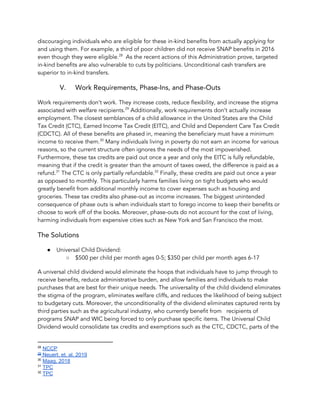
discouraging individuals who are eligible for these in-kind benefits from actually applying for 
and using them. For example, a third of poor children did not receive SNAP benefits in 2016 
even though they were eligible. As the recent actions of this Administration prove, targeted 28
in-kind benefits are also vulnerable to cuts by politicians. Unconditional cash transfers are 
superior to in-kind transfers. 
V. Work Requirements, Phase-Ins, and Phase-Outs 
Work requirements don’t work. They increase costs, reduce flexibility, and increase the stigma 
associated with welfare recipients. Additionally, work requirements don’t actually increase 29
employment. The closest semblances of a child allowance in the United States are the Child 
Tax Credit (CTC), Earned Income Tax Credit (EITC), and Child and Dependent Care Tax Credit 
(CDCTC). All of these benefits are phased in, meaning the beneficiary must have a minimum 
income to receive them. Many individuals living in poverty do not earn an income for various 30
reasons, so the current structure often ignores the needs of the most impoverished. 
Furthermore, these tax credits are paid out once a year and only the EITC is fully refundable, 
meaning that if the credit is greater than the amount of taxes owed, the difference is paid as a 
refund. The CTC is only partially refundable. Finally, these credits are paid out once a year 31 32
as opposed to monthly. This particularly harms families living on tight budgets who would 
greatly benefit from additional monthly income to cover expenses such as housing and 
groceries. These tax credits also phase-out as income increases. The biggest unintended 
consequence of phase outs is when individuals start to forego income to keep their benefits or 
choose to work off of the books. Moreover, phase-outs do not account for the cost of living, 
harming individuals from expensive cities such as New York and San Francisco the most.  
The Solutions 
● Universal Child Dividend:  
○ $500 per child per month ages 0-5; $350 per child per month ages 6-17 
A universal child dividend would eliminate the hoops that individuals have to jump through to 
receive benefits, reduce administrative burden, and allow families and individuals to make 
purchases that are best for their unique needs. The universality of the child dividend eliminates 
the stigma of the program, eliminates welfare cliffs, and reduces the likelihood of being subject 
to budgetary cuts. Moreover, the unconditionality of the dividend eliminates captured rents by 
third parties such as the agricultural industry, who currently benefit from recipients of 
programs SNAP and WIC being forced to only purchase specific items. The Universal Child 
Dividend would consolidate tax credits and exemptions such as the CTC, CDCTC, parts of the 
28
​NCCP
29
Neuert, et. al, 2019
30
​Maag, 2018
31
​TPC
32
​TPC
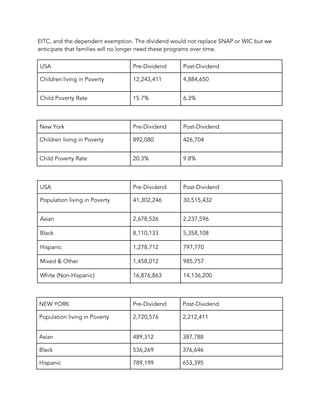
EITC, and the dependent exemption. The dividend would not replace SNAP or WIC but we 
anticipate that families will no longer need these programs over time.   
USA  Pre-Dividend  Post-Dividend 
Children living in Poverty  12,243,411  4,884,650 
Child Poverty Rate  15.7%  6.3% 
 
New York  Pre-Dividend  Post-Dividend 
Children living in Poverty  892,080  426,704 
Child Poverty Rate  20.3%  9.8% 
 
USA  Pre-Dividend  Post-Dividend 
Population living in Poverty  41,302,246  30,515,432 
Asian  2,678,526  2,237,596 
Black  8,110,133  5,358,108 
Hispanic  1,278,712  797,770 
Mixed & Other  1,458,012  985,757 
White (Non-Hispanic)  16,876,863  14,136,200 
 
NEW YORK  Pre-Dividend  Post-Dividend 
Population living in Poverty  2,720,576 
 
2,212,411 
Asian  489,312  387,788 
Black  536,269  376,646 
Hispanic  789,199  653,395 
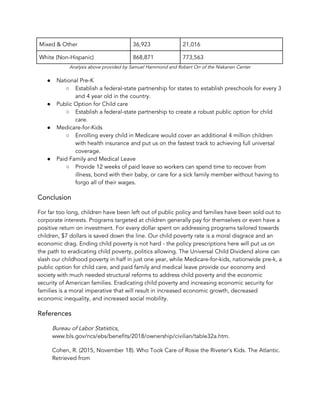
Mixed & Other  36,923  21,016 
White (Non-Hispanic)  868,871  773,563 
Analysis above provided by Samuel Hammond and Robert Orr of the Niskanen Center 
● National Pre-K 
○ Establish a federal-state partnership for states to establish preschools for every 3 
and 4 year old in the country.  
● Public Option for Child care 
○ Establish a federal-state partnership to create a robust public option for child 
care. 
● Medicare-for-Kids 
○ Enrolling every child in Medicare would cover an additional 4 million children 
with health insurance and put us on the fastest track to achieving full universal 
coverage. 
● Paid Family and Medical Leave  
○ Provide 12 weeks of paid leave so workers can spend time to recover from 
illness, bond with their baby, or care for a sick family member without having to 
forgo all of their wages. 
Conclusion 
For far too long, children have been left out of public policy and families have been sold out to 
corporate interests. Programs targeted at children generally pay for themselves or even have a 
positive return on investment. For every dollar spent on addressing programs tailored towards 
children, $7 dollars is saved down the line. Our child poverty rate is a moral disgrace and an 
economic drag. Ending child poverty is not hard - the policy prescriptions here will put us on 
the path to eradicating child poverty, politics allowing. The Universal Child Dividend alone can 
slash our childhood poverty in half in just one year, while Medicare-for-kids, nationwide pre-k, a 
public option for child care, and paid family and medical leave provide our economy and 
society with much needed structural reforms to address child poverty and the economic 
security of American families. Eradicating child poverty and increasing economic security for 
families is a moral imperative that will result in increased economic growth, decreased 
economic inequality, and increased social mobility.  
References  
Bureau of Labor Statistics​, 
www.bls.gov/ncs/ebs/benefits/2018/ownership/civilian/table32a.htm. 
Cohen, R. (2015, November 18). Who Took Care of Rosie the Riveter's Kids. The Atlantic. 
Retrieved from 
https://www.theatlantic.com/business/archive/2015/11/daycare-world-war-rosie-riveter/4
15650/ 
Change, Clio. ​Seven Lessons about Child Poverty​. The Century Foundation, 2015, ​Seven 
Lessons about Child Poverty​, tcf.org/content/report/seven-lessons-about-child-poverty/. 
Department of Labor​, www.dol.gov/general/topic/benefits-leave/fmla. 
DePietro, Andrew. “Democrats Win Control Of The Wealthiest Districts, But Also The 
Most Unequal.” ​Forbes​, Forbes Magazine, 11 Nov. 2018, 
www.forbes.com/sites/andrewdepietro/2018/11/08/democrats-wealth-inequality-congres
sional-districts/#79a2cb636c9b​. 
Edelman, Marian Wright. “‘THE HIGH MORAL AND ECONOMIC COST OF CHILD 
POVERTY IN AMERICA.’” ​Children's Defense Fund​, 16 May 2018, 
www.childrensdefense.org/child-watch-columns/health/2014/the-high-moral-and-econom
ic-cost-of-child-poverty-in-america/. 
Fox, Liana. ​The Supplemental Poverty Measure: 2018​. United States Census Bureau, 
2019, pp. 1–33, ​The Supplemental Poverty Measure: 2018​, 
www.census.gov/content/dam/Census/library/publications/2019/demo/p60-268.pdf. 
Galewitz, Phil. “Number Of U.S. Kids Who Don't Have Health Insurance Is On The Rise.” 
NPR​, NPR, 29 Nov. 2018, 
www.npr.org/sections/health-shots/2018/11/29/671666280/number-of-u-s-kids-who-dont
-have-health-insurance-is-on-the-rise. 
Hammond, Samuel, and Robert Orr. ​Toward a Universal Child Benefit​. Niskanen Center, 
2016, ​Toward a Universal Child Benefit​, 
www.niskanencenter.org/wp-content/uploads/old_uploads/2016/10/UniversalChildBenefi
t_final.pdf. 
Haskins, Ron, and Timothy Smeeding. “How to Cut Child Poverty in Half.” ​Brookings​, 
Brookings, 1 Apr. 2019, www.brookings.edu/opinions/how-to-cut-child-poverty-in-half/. 
Heckman, J. J. (2013). Giving Kids a Fair Chance. Cambridge, MA: The MIT Press. 
Koball, H., & Jiang, Y. (2018, January 23). Basic Facts about Low-Income Children. 
Retrieved from http://www.nccp.org/publications/pub_1194.html. 
Lauren E. Jones & Kevin S. Milligan & Mark Stabile, 2015. "Child Cash Benefits and 
Family Expenditures: Evidence from the National Child Benefit," NBER Working Papers 
21101, National Bureau of Economic Research, Inc. 
Livingston, Gretchen, and Deja Thomas. “Among 41 Countries, Only U.S. Lacks Paid 
Parental Leave.” ​Pew Research Center​, Pew Research Center, 16 Dec. 2019, 
www.pewresearch.org/fact-tank/2019/12/16/u-s-lacks-mandated-paid-parental-leave/. 
Maag, Elaine. ​Who Benefits from Expanding the EITC or CTC?​ 2018, ​Who Benefits from 
Expanding the EITC or CTC?​, 
www.taxpolicycenter.org/sites/default/files/publication/155520/who-benefits-from-expan
ding-the-eitc-or-ctc_understanding-the-intersection-of-the-eitc_0.pdf. 
McGrath, Maggie. “63% Of Americans Don't Have Enough Savings To Cover A $500 
Emergency.” ​Forbes​, Forbes Magazine, 6 Jan. 2016, 
www.forbes.com/sites/maggiemcgrath/2016/01/06/63-of-americans-dont-have-enough-s
avings-to-cover-a-500-emergency/#2c5d73ba4e0d. 
Medlock, James, and Colin McAuliffe . “Medicare for Kids Is A Political Winner.” ​Data For 
Progress​, Data For Progress, 22 Oct. 2019, 
www.dataforprogress.org/blog/2019/10/22/medicare-for-kids. 
Neckerman, Kathryn, et al. ​Early Childhood Poverty Tracker​. 2019, ​Early Childhood 
Poverty Tracker​, 
robinhoodorg-production.s3.amazonaws.com/uploads/2019/11/RobinHood_ECPT_Nov2
019.pdf. 
Neuert, Harrisson, et al. ​Work Requirements Don’t Work: A Behavioral Science 
Perspective​. ideas42, 2019, ​Work Requirements Don’t Work: A Behavioral Science 
Perspective​, 
www.ideas42.org/wp-content/uploads/2019/04/ideas42-Work-Requirements-Paper.pdf. 
OECD Family Database​, 2018, ​www.oecd.org/els/family/database.htm​. 
Oh, Soo, and Janet Adamy. “When the Safety Net Pays for Itself.” ​The Wall Street 
Journal​, Dow Jones & Company, 22 July 2019, 
www.wsj.com/articles/when-the-safety-net-pays-for-itself-11563800405. 
Reeves, R. V., & Krause, E. (2018, January 11). Raj Chetty in 14 charts: Big findings on 
opportunity and mobility we should all know. Retrieved from 
https://www.brookings.edu/blog/social-mobility-memos/2018/01/11/raj-chetty-in-14-char
ts-big-findings-on-opportunity-and-mobility-we-should-know/. 
Rice, Douglas, et al. ​Child Care and Housing: Big Expenses With Too Little Help 
Available​. Center on Budget and Priorities, 2019, pp. 1–10, ​Child Care and Housing: Big 
Expenses With Too Little Help Available​, 
www.cbpp.org/sites/default/files/atoms/files/4-29-19hous.pdf​. 
Shaefer, H Luke et al. “A Universal Child Allowance: A Plan to Reduce Poverty and 
Income Instability Among Children in the United States.” ​The Russell Sage Foundation 
journal of the social sciences​ : RSF vol. 4,2 (2018): 22-42. doi:10.7758/RSF.2018.4.2.02 
 
Sitaraman, Ganesh, and Anne Alstott. The Public Option: How to Expand Freedom, 
Increase Opportunity, and Promote Equality. Harvard University Press, 2019. 
United States Department of Agriculture ​, Food and Nutrition Service , 
www.fns.usda.gov/wic/wic-food-packages-regulatory-requirements-wic-eligible-foods. 
United States, Congress, Aussenberg, Randy Alison. “Errors and Fraud in the 
Supplemental Nutrition Assistance Program (SNAP).” ​Errors and Fraud in the 
Supplemental Nutrition Assistance Program (SNAP)​, Sept. 2018. 
fas.org/sgp/crs/misc/R45147.pdf. 
“What Is the Difference between Refundable and Nonrefundable Credits?” ​Tax Policy 
Center​, 
www.taxpolicycenter.org/briefing-book/what-difference-between-refundable-and-nonrefu
ndable-credits. 
“WIC Approved Foods Card.” ​New York State Department of Health​, 2016, 
www.health.ny.gov/publications/4099.pdf. 

Family Opportunity Guarantee

  • 1.
    Family Opportunity Guarantee  Introduction  Sincethe 1980s, economic inequality in the United States has skyrocketed while social mobility  has steadily declined. A Canadian child born to poor parents today has a 14 percent chance of  becoming a top earner--twice the odds of an American child. New York’s 12th congressional  district is one of the wealthiest but most unequal districts in America, with a higher Gini  coefficient than Chile. In order to increase upward mobility and lay the foundation for a new 1 American Dream, we must provide our families with economic security and level the playing  field by investing in our children. The current structure of our economy and government  punishes families simply for having children, as parents have to choose between working and  caregiving. This particularly hurts single mothers and low- and middle-income communities.  Likewise, child poverty disproportionately affects Black and Hispanic children. Structural,  reforms are needed to transform our economy in order to level the playing field for families,  restore upward mobility, and create a new American Dream. The set of policies we propose is  robust: it provides health insurance to every child; expands the supply, quality, and affordability  of caregiving; invests in early childhood development and education; and provides families  with a child dividend. This proposal also represents a major shift in budget priorities, as  currently only 10% of the federal budget is spent on children. If the fundamental promise of  America is that a child born into any family can reach her potential, policies that help families  with children flourish are the necessary foundation.   The Problems  Using the Supplemental Poverty Measure (SPM), 15.67% or 12,242,411 children in the United  States currently live in poverty. In New York, 18.95% or 3,221,842 children currently live in 2 poverty. Nationally, 41% of children can be considered low-income. Put bluntly, 4 in 10 3 children live in families that can barely afford to meet their basic needs. Even more appalling,  nearly 300,000 children spent time in a homeless shelter in 2017, while a million were forced to  move in with family and friends. ​The United States has one of the highest child poverty rates 4 amongst Organisation for Economic Co-Operation and Development (OECD) member  1 ​DePietro​, 2018 2 ​SPM 3 ​SPM 4 ​CBPP 
  • 2.
    countries despite beingone of the richest countries in the world. This is absolutely 5 unacceptable. Moreover, a tightening labor market is not enough to solve this problem: over  half of low-income children live with at least one parent who works full time. ​Economically, 6 child poverty costs the US $800 billion to $1.1 trillion every year due to higher crime, poor  health outcomes, and lower income levels when poor kids grow up. But it is the human cost 7 that is really shameful. ​Poor children are less likely to have access to affordable quality health  coverage, have more severe health problems, and fare worse than higher-income children with  the same pre-existing conditions. A poor child with asthma is more likely to be reported in  poor health, spend more days in bed, and have more hospital episodes than a high-income  child with asthma. When children are exposed to violence, lack quality educational  experiences, and are impoverished, it harms their development and dramatically decreases  their prospects for future success. ​More than any other time in life, childhood poverty  dramatically reduces a person’s chance to succeed. Indeed, 90% of a child’s brain develops in  the first 5 years. It is crucial that our children are safe, financially secure, and crucially, 8 immersed in stimulating environments during this time period. Eliminating child poverty is not  only an economic but a moral imperative.   I. Child Care and Early Childhood Education  Child care in the US is disproportionately expensive relative to its peers in the OECD--only  child care in the UK costs more. Not coincidentally, our government spends a mere 0.6% of 9 GDP on support for children and families, a quarter of the OECD average and a sixth of global  leaders like Sweden. 64 percent of Americans between the ages of 20 and 45 surveyed 10 recently cited the costs of child care as a factor preventing them from having the number of  children they wanted. Alarmingly, infant care in 28 US states is more expensive than in-state  college tuition. For poor families, finding affordable child care is even more of a challenge. On  average, families living below the federal poverty line spend 3 of every 10 dollars of their  income on child care. By contrast, families earning twice the poverty line spend about 7  percent on average. Costs like child care contribute substantially to poverty and inequality. 11 Nearly 40% of poor households would not be poor if they did not have children. When child  care needs are taken care of, parents are more likely to be stably employed--helping grow the  economy and offset the cost of child care policy. But most importantly, improving access to  child care and pre-K education would ensure a fairer starting-point for poor children in  America. For example, even simply reducing childhood hunger via such programs would  improve reading and math proficiency and reduce the incidence of mental and physical health  5 ​OECD 6 ​NCCP 7 McLaughlin and Rank, 2018 8 ​CBPP  9 ​https://stats.oecd.org/Index.aspx?DataSetCode=NCC 10 ​https://data.oecd.org/socialexp/family-benefits-public-spending.htm 11 ​CBPP
  • 3.
    problems later inlife, including obesity. Placing poor children in safe and stimulating 12 environments would also provide advantages often not found in the home. As a widely-cited  study found, a three-year-old born to a poor family has a vocabulary of 500 words, half the size  of her richer peers. Interacting with trained teachers as well as children from all backgrounds 13 would help reduce such inequalities. Inequality in early childhood persists through the life of a  child: children who were poor for half of their childhood were nearly 90 percent more likely to  enter their 20s without completing high school than children who never experienced poverty.   14 In fact, the US government provided universal child care before in its history; during WWII, a  family could send a 2- to 5-year-old child to daycare for a mere $7 per day in today’s dollars, or  $2,500 annually. Although the program ended after the war, recent work analyzing its impact  showed both an increase in employment for women as well as an improvement in outcomes for  children. Policies like nationwide pre-k and a public option for child care would go a long way 15 towards mitigating the large and persistent disadvantages poor children, and moreover poor  adults, face in their search for the American Dream.  II. Children’s Healthcare  In 2018, 4 million children were uninsured in the United States. The Children’s Health Insurance  Program (CHIP) was created in 1997 to provide federal matching funds to state governments  for children’s health insurance. Nearly all low-income children are eligible for CHIP or Medicaid  - the challenge is in enrolling eligible children and keeping them enrolled. Furthermore, CHIP, 16 along with Medicaid has been subject to budget cuts in red states like Tennessee and Texas. In  2018, 800,000 children lost health coverage from CHIP and Medicaid. Healthcare 17 expenditures for children are typically routine checkups and preventative medicine such as  vaccines. States that did not expand Medicaid under the Affordable Care Act (ACA) have 18 nearly triple the uninsured rates compared to those that did expand under the ACA. Health 19 insurance expenditures are an enormous cost to parents; removing this expenditure can  dramatically reduce poverty and increase disposable income for families across income  brackets.   III. Family and Medical Leave  US workers can currently take 12 weeks of leave for family or medical purposes under the  Family and Medical Leave Act, however, the leave is unpaid. This forces many workers to 20 12 Nord, 2009 13 Heckman, p. 25 14 ​Edelman, 2014 15 ​Cohen, 2015 16 ​Galewitz, 2018 17 Medlock and McAuliffe, 2019 18 ​Medlock and McAuliffe, 2019 19 ​Galewitz, 2018 20 ​DOL
  • 4.
    make a choice:forego wages or forego time spent with a newborn or addressing a medical  concern. The harsh reality is that many workers in the US lack the economic security to take  unpaid leave. Mothers can’t return to work immediately after having a baby meaning they lose  income. Many choose to return to work earlier than they prefer, giving up time they would  spend raising and nurturing a newborn. This also affects fathers, who are often forced to not  take any time off and potentially work overtime in order to secure more wages while the  mother is on maternity leave. The US is the only advanced economy in the world to not offer  paid family and medical leave. Only 17% of workers have paid family and medical leave.  21 22 Only 39% of workers have short term disability coverage. Low wage workers are less likely to 23 have paid leave.   IV. In-Kind Transfers  In-kind benefits often fail to meet the unique needs of individuals and families. Cash is fungible  and can be exchanged for whatever goods or services are needed. 63 percent of families in the  United States do not have the money needed to cover a $500 dollar emergency. Moreover, 24 in-kind benefits have a high administrative burden - they often cost more to deliver than cash  transfers. Our current system of in-kind benefits is paternalistic in nature and causes  rent-seeking by third parties who benefit off of these programs. For example, The Special  Supplemental Nutrition Program for Women, Infants, and Children (​WIC​) comes with stringent  requirements. Consider the requirements for purchasing breakfast cereals with WIC:   25 ● Must contain a minimum of 28 milligrams of Iron per 100 grams of dry cereal (e.g., iron  = 45% U.S. RDA for adults per 1 ounce dry cereal).  ● Must contain no more than 21.2 grams of sucrose and other sugars per 100 grams of  dry cereal (i.e., not more than 6 grams of sucrose and other sugars per 1 dry ounce).  ● At least one half of the total number of breakfast cereals on a state agency’s authorized  food list must have whole grain as the primary ingredient by weight AND meet FDA  labeling requirements for making a health claim* as a "whole grain food with moderate  fat content.​”  Mothers who are using WIC in New York cannot buy reduced fat milk, flavored yogurt, canned  baked beans, or peanut butter with added minerals like heart healthy Omega-3 fatty acids.    26 Misusing benefits like SNAP and WIC could result in benefits being taken away, hefty fines, and  even jail time. The process to apply for these benefits is time consuming and confusing. The 27 rules and regulations on what one is allowed to purchase are also confusing and stringent,  21 Livingston and Thomas, 2019 22 ​BLS 23 ​BLS 24 McGrath, 2016 25 USDA 26 NYS Department of Health 27 ​FAS
  • 5.
    discouraging individuals whoare eligible for these in-kind benefits from actually applying for  and using them. For example, a third of poor children did not receive SNAP benefits in 2016  even though they were eligible. As the recent actions of this Administration prove, targeted 28 in-kind benefits are also vulnerable to cuts by politicians. Unconditional cash transfers are  superior to in-kind transfers.  V. Work Requirements, Phase-Ins, and Phase-Outs  Work requirements don’t work. They increase costs, reduce flexibility, and increase the stigma  associated with welfare recipients. Additionally, work requirements don’t actually increase 29 employment. The closest semblances of a child allowance in the United States are the Child  Tax Credit (CTC), Earned Income Tax Credit (EITC), and Child and Dependent Care Tax Credit  (CDCTC). All of these benefits are phased in, meaning the beneficiary must have a minimum  income to receive them. Many individuals living in poverty do not earn an income for various 30 reasons, so the current structure often ignores the needs of the most impoverished.  Furthermore, these tax credits are paid out once a year and only the EITC is fully refundable,  meaning that if the credit is greater than the amount of taxes owed, the difference is paid as a  refund. The CTC is only partially refundable. Finally, these credits are paid out once a year 31 32 as opposed to monthly. This particularly harms families living on tight budgets who would  greatly benefit from additional monthly income to cover expenses such as housing and  groceries. These tax credits also phase-out as income increases. The biggest unintended  consequence of phase outs is when individuals start to forego income to keep their benefits or  choose to work off of the books. Moreover, phase-outs do not account for the cost of living,  harming individuals from expensive cities such as New York and San Francisco the most.   The Solutions  ● Universal Child Dividend:   ○ $500 per child per month ages 0-5; $350 per child per month ages 6-17  A universal child dividend would eliminate the hoops that individuals have to jump through to  receive benefits, reduce administrative burden, and allow families and individuals to make  purchases that are best for their unique needs. The universality of the child dividend eliminates  the stigma of the program, eliminates welfare cliffs, and reduces the likelihood of being subject  to budgetary cuts. Moreover, the unconditionality of the dividend eliminates captured rents by  third parties such as the agricultural industry, who currently benefit from recipients of  programs SNAP and WIC being forced to only purchase specific items. The Universal Child  Dividend would consolidate tax credits and exemptions such as the CTC, CDCTC, parts of the  28 ​NCCP 29 Neuert, et. al, 2019 30 ​Maag, 2018 31 ​TPC 32 ​TPC
  • 6.
    EITC, and thedependent exemption. The dividend would not replace SNAP or WIC but we  anticipate that families will no longer need these programs over time.    USA  Pre-Dividend  Post-Dividend  Children living in Poverty  12,243,411  4,884,650  Child Poverty Rate  15.7%  6.3%    New York  Pre-Dividend  Post-Dividend  Children living in Poverty  892,080  426,704  Child Poverty Rate  20.3%  9.8%    USA  Pre-Dividend  Post-Dividend  Population living in Poverty  41,302,246  30,515,432  Asian  2,678,526  2,237,596  Black  8,110,133  5,358,108  Hispanic  1,278,712  797,770  Mixed & Other  1,458,012  985,757  White (Non-Hispanic)  16,876,863  14,136,200    NEW YORK  Pre-Dividend  Post-Dividend  Population living in Poverty  2,720,576    2,212,411  Asian  489,312  387,788  Black  536,269  376,646  Hispanic  789,199  653,395 
  • 7.
    Mixed & Other 36,923  21,016  White (Non-Hispanic)  868,871  773,563  Analysis above provided by Samuel Hammond and Robert Orr of the Niskanen Center  ● National Pre-K  ○ Establish a federal-state partnership for states to establish preschools for every 3  and 4 year old in the country.   ● Public Option for Child care  ○ Establish a federal-state partnership to create a robust public option for child  care.  ● Medicare-for-Kids  ○ Enrolling every child in Medicare would cover an additional 4 million children  with health insurance and put us on the fastest track to achieving full universal  coverage.  ● Paid Family and Medical Leave   ○ Provide 12 weeks of paid leave so workers can spend time to recover from  illness, bond with their baby, or care for a sick family member without having to  forgo all of their wages.  Conclusion  For far too long, children have been left out of public policy and families have been sold out to  corporate interests. Programs targeted at children generally pay for themselves or even have a  positive return on investment. For every dollar spent on addressing programs tailored towards  children, $7 dollars is saved down the line. Our child poverty rate is a moral disgrace and an  economic drag. Ending child poverty is not hard - the policy prescriptions here will put us on  the path to eradicating child poverty, politics allowing. The Universal Child Dividend alone can  slash our childhood poverty in half in just one year, while Medicare-for-kids, nationwide pre-k, a  public option for child care, and paid family and medical leave provide our economy and  society with much needed structural reforms to address child poverty and the economic  security of American families. Eradicating child poverty and increasing economic security for  families is a moral imperative that will result in increased economic growth, decreased  economic inequality, and increased social mobility.   References   Bureau of Labor Statistics​,  www.bls.gov/ncs/ebs/benefits/2018/ownership/civilian/table32a.htm.  Cohen, R. (2015, November 18). Who Took Care of Rosie the Riveter's Kids. The Atlantic.  Retrieved from 
  • 8.
    https://www.theatlantic.com/business/archive/2015/11/daycare-world-war-rosie-riveter/4 15650/  Change, Clio. ​SevenLessons about Child Poverty​. The Century Foundation, 2015, ​Seven  Lessons about Child Poverty​, tcf.org/content/report/seven-lessons-about-child-poverty/.  Department of Labor​, www.dol.gov/general/topic/benefits-leave/fmla.  DePietro, Andrew. “Democrats Win Control Of The Wealthiest Districts, But Also The  Most Unequal.” ​Forbes​, Forbes Magazine, 11 Nov. 2018,  www.forbes.com/sites/andrewdepietro/2018/11/08/democrats-wealth-inequality-congres sional-districts/#79a2cb636c9b​.  Edelman, Marian Wright. “‘THE HIGH MORAL AND ECONOMIC COST OF CHILD  POVERTY IN AMERICA.’” ​Children's Defense Fund​, 16 May 2018,  www.childrensdefense.org/child-watch-columns/health/2014/the-high-moral-and-econom ic-cost-of-child-poverty-in-america/.  Fox, Liana. ​The Supplemental Poverty Measure: 2018​. United States Census Bureau,  2019, pp. 1–33, ​The Supplemental Poverty Measure: 2018​,  www.census.gov/content/dam/Census/library/publications/2019/demo/p60-268.pdf.  Galewitz, Phil. “Number Of U.S. Kids Who Don't Have Health Insurance Is On The Rise.”  NPR​, NPR, 29 Nov. 2018,  www.npr.org/sections/health-shots/2018/11/29/671666280/number-of-u-s-kids-who-dont -have-health-insurance-is-on-the-rise.  Hammond, Samuel, and Robert Orr. ​Toward a Universal Child Benefit​. Niskanen Center,  2016, ​Toward a Universal Child Benefit​,  www.niskanencenter.org/wp-content/uploads/old_uploads/2016/10/UniversalChildBenefi t_final.pdf.  Haskins, Ron, and Timothy Smeeding. “How to Cut Child Poverty in Half.” ​Brookings​,  Brookings, 1 Apr. 2019, www.brookings.edu/opinions/how-to-cut-child-poverty-in-half/.  Heckman, J. J. (2013). Giving Kids a Fair Chance. Cambridge, MA: The MIT Press.  Koball, H., & Jiang, Y. (2018, January 23). Basic Facts about Low-Income Children.  Retrieved from http://www.nccp.org/publications/pub_1194.html.  Lauren E. Jones & Kevin S. Milligan & Mark Stabile, 2015. "Child Cash Benefits and  Family Expenditures: Evidence from the National Child Benefit," NBER Working Papers  21101, National Bureau of Economic Research, Inc. 
  • 9.
    Livingston, Gretchen, andDeja Thomas. “Among 41 Countries, Only U.S. Lacks Paid  Parental Leave.” ​Pew Research Center​, Pew Research Center, 16 Dec. 2019,  www.pewresearch.org/fact-tank/2019/12/16/u-s-lacks-mandated-paid-parental-leave/.  Maag, Elaine. ​Who Benefits from Expanding the EITC or CTC?​ 2018, ​Who Benefits from  Expanding the EITC or CTC?​,  www.taxpolicycenter.org/sites/default/files/publication/155520/who-benefits-from-expan ding-the-eitc-or-ctc_understanding-the-intersection-of-the-eitc_0.pdf.  McGrath, Maggie. “63% Of Americans Don't Have Enough Savings To Cover A $500  Emergency.” ​Forbes​, Forbes Magazine, 6 Jan. 2016,  www.forbes.com/sites/maggiemcgrath/2016/01/06/63-of-americans-dont-have-enough-s avings-to-cover-a-500-emergency/#2c5d73ba4e0d.  Medlock, James, and Colin McAuliffe . “Medicare for Kids Is A Political Winner.” ​Data For  Progress​, Data For Progress, 22 Oct. 2019,  www.dataforprogress.org/blog/2019/10/22/medicare-for-kids.  Neckerman, Kathryn, et al. ​Early Childhood Poverty Tracker​. 2019, ​Early Childhood  Poverty Tracker​,  robinhoodorg-production.s3.amazonaws.com/uploads/2019/11/RobinHood_ECPT_Nov2 019.pdf.  Neuert, Harrisson, et al. ​Work Requirements Don’t Work: A Behavioral Science  Perspective​. ideas42, 2019, ​Work Requirements Don’t Work: A Behavioral Science  Perspective​,  www.ideas42.org/wp-content/uploads/2019/04/ideas42-Work-Requirements-Paper.pdf.  OECD Family Database​, 2018, ​www.oecd.org/els/family/database.htm​.  Oh, Soo, and Janet Adamy. “When the Safety Net Pays for Itself.” ​The Wall Street  Journal​, Dow Jones & Company, 22 July 2019,  www.wsj.com/articles/when-the-safety-net-pays-for-itself-11563800405.  Reeves, R. V., & Krause, E. (2018, January 11). Raj Chetty in 14 charts: Big findings on  opportunity and mobility we should all know. Retrieved from  https://www.brookings.edu/blog/social-mobility-memos/2018/01/11/raj-chetty-in-14-char ts-big-findings-on-opportunity-and-mobility-we-should-know/.  Rice, Douglas, et al. ​Child Care and Housing: Big Expenses With Too Little Help  Available​. Center on Budget and Priorities, 2019, pp. 1–10, ​Child Care and Housing: Big  Expenses With Too Little Help Available​,  www.cbpp.org/sites/default/files/atoms/files/4-29-19hous.pdf​. 
  • 10.
    Shaefer, H Lukeet al. “A Universal Child Allowance: A Plan to Reduce Poverty and  Income Instability Among Children in the United States.” ​The Russell Sage Foundation  journal of the social sciences​ : RSF vol. 4,2 (2018): 22-42. doi:10.7758/RSF.2018.4.2.02    Sitaraman, Ganesh, and Anne Alstott. The Public Option: How to Expand Freedom,  Increase Opportunity, and Promote Equality. Harvard University Press, 2019.  United States Department of Agriculture ​, Food and Nutrition Service ,  www.fns.usda.gov/wic/wic-food-packages-regulatory-requirements-wic-eligible-foods.  United States, Congress, Aussenberg, Randy Alison. “Errors and Fraud in the  Supplemental Nutrition Assistance Program (SNAP).” ​Errors and Fraud in the  Supplemental Nutrition Assistance Program (SNAP)​, Sept. 2018.  fas.org/sgp/crs/misc/R45147.pdf.  “What Is the Difference between Refundable and Nonrefundable Credits?” ​Tax Policy  Center​,  www.taxpolicycenter.org/briefing-book/what-difference-between-refundable-and-nonrefu ndable-credits.  “WIC Approved Foods Card.” ​New York State Department of Health​, 2016,  www.health.ny.gov/publications/4099.pdf.