Background Technique Studies Conclusion


Falcon: Fault Localization in
   Concurrent Programs

   Sangmin Park, Richard Vuduc,
      and Mary Jean Harrold

        College of Computing
    Georgia Institute of Technology


                                                         1
Background Technique Studies Conclusion


                 Motivation
• Godefroid, Nagappan                   Developers
                [MSR-TR08]
  found that
                                 Handle
                                 concurrency
                                 issues


• Concurrency bugs are difficult to find
  • Non-deterministic behavior
  • Large thread interleaving space
                                                                 2
Background Technique Studies Conclusion


          Existing Techniques
• Bug finding for concurrency bugs
  • Static/dynamic data race detection
    (e.g., [Ronesse99, Savage97, O’Callanhan03])
   1. Techniques target only one type of
       concurrency bug
  • Static/dynamic atomicity violation detection
   2. Techniques report benign (harmless)
    (e.g., [Flanagan03, Wang06, Flanagan08])
       results along with harmful results
  • Dynamic pattern analysis
    (e.g., [Lu06, Hammer08])
• Fault localization
  • For sequential programs
    (e.g., [Jones02, Liblit03, been applied to
     Techniques have not Liu05, Baah08])
     concurrent programs
                                                                 3
Background Technique Studies Conclusion


        Falcon Research Outline

•   Background
•   Technique: patterns + suspiciousness
•   Empirical Studies
•   Conclusion


                                                           4
Background Technique Studies Conclusion


         Concurrency Violations
Lu et al.’s [ASPLOS08] found that
                        Others: 3%


                Order and
                Atomicity        Deadlock: 30%
                violations:
                67%


                 Both occur due to undesirable
                                   undesirable
                 memory-access sequences
                 memory-access sequences


                                                                    5
Background Technique Studies Conclusion


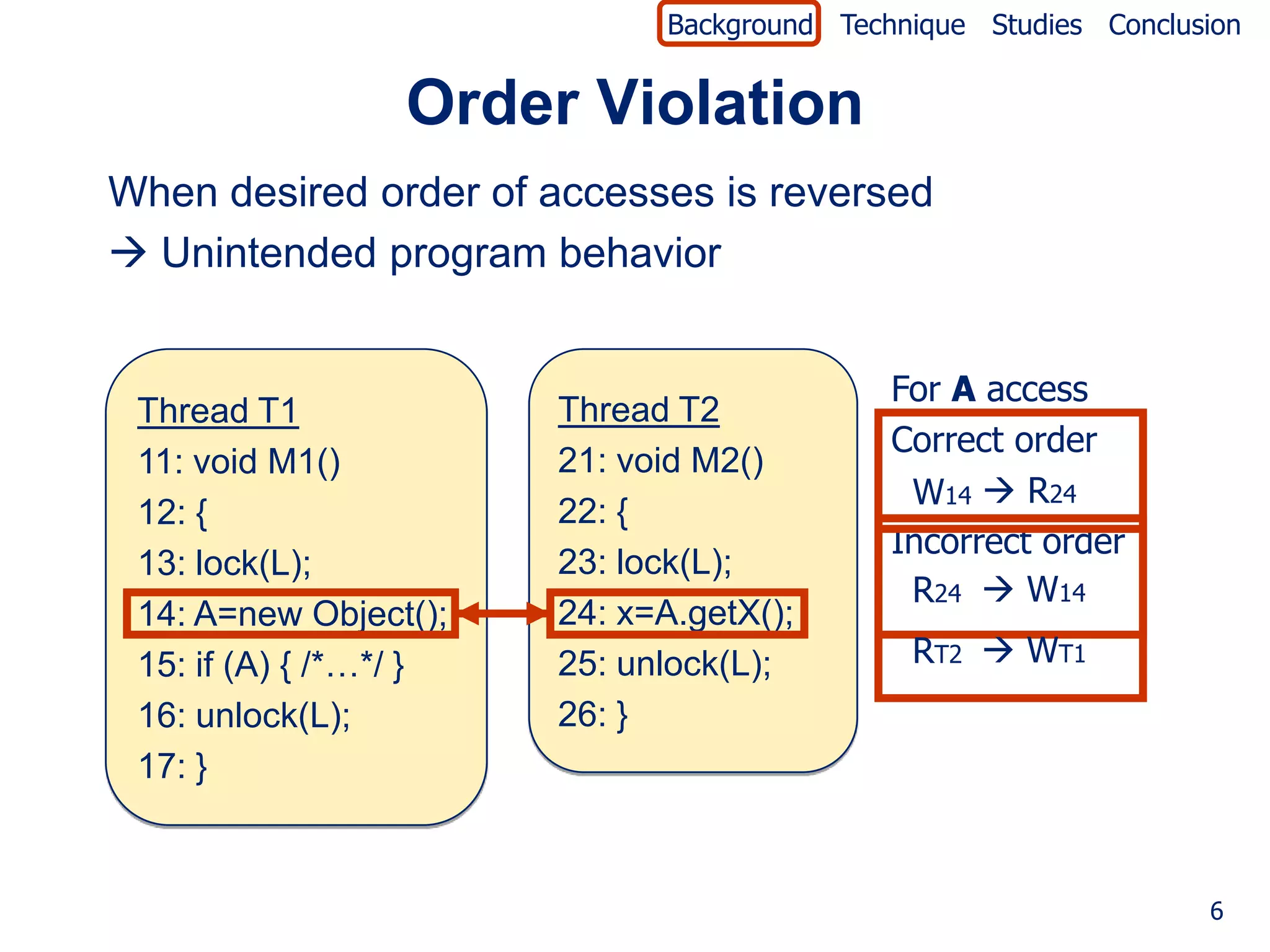
                  Order Violation
When desired order of accesses is reversed
 Unintended program behavior


                                             For A access
 Thread T1              Thread T2
                                             Correct order
 11: void M1()          21: void M2()
                                              W14  R24
 12: {                  22: {
                                             Incorrect order
 13: lock(L);           23: lock(L);
                                              R24  W14
 14: A=new Object();    24: x=A.getX();
 15: if (A) { /*…*/ }   25: unlock(L);        RT2  WT1
 16: unlock(L);         26: }
 17: }


                                                                  6
Background Technique Studies Conclusion


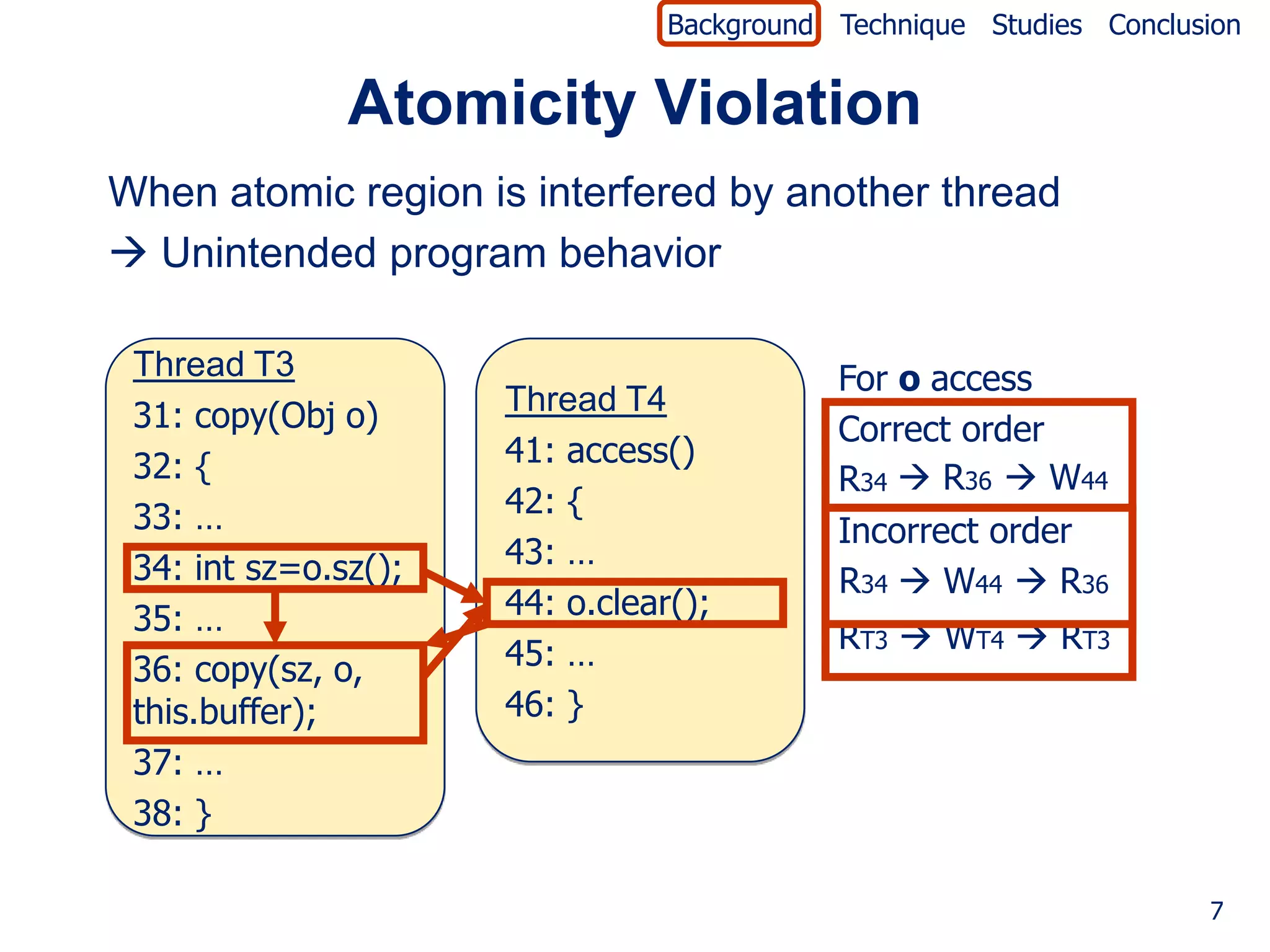
               Atomicity Violation
When atomic region is interfered by another thread
 Unintended program behavior

 Thread T3                                  For o access
 31: copy(Obj o)      Thread T4
                                            Correct order
 32: {                41: access()
                                            R34  R36  W44
 33: …                42: {
                                            Incorrect order
 34: int sz=o.sz();   43: …
                                            R34  W44  R36
 35: …                44: o.clear();
                      45: …                 RT3  WT4  RT3
 36: copy(sz, o,
 this.buffer);        46: }
 37: …
 38: }

                                                                     7
Background Technique Studies Conclusion


Patterns for Concurrency Violations
Patterns                   Patterns for atomicity violation
for order violation        [PPoPP06, ASPLOS06]

1    RT1 * WT2             1     RT1 * WT2 * RT1
2    WT1 * RT2             2     WT1 * WT2 * RT1
3    WT1 * WT2             3     WT1 * RT2 * WT1
                           4     RT1 * WT2 * WT1
                           5     WT1 * WT2 * WT1

    Note
      • Concurrency violations represented as patterns
      • Patterns not always concurrency violations

                                                                   8
Background Technique Studies Conclusion


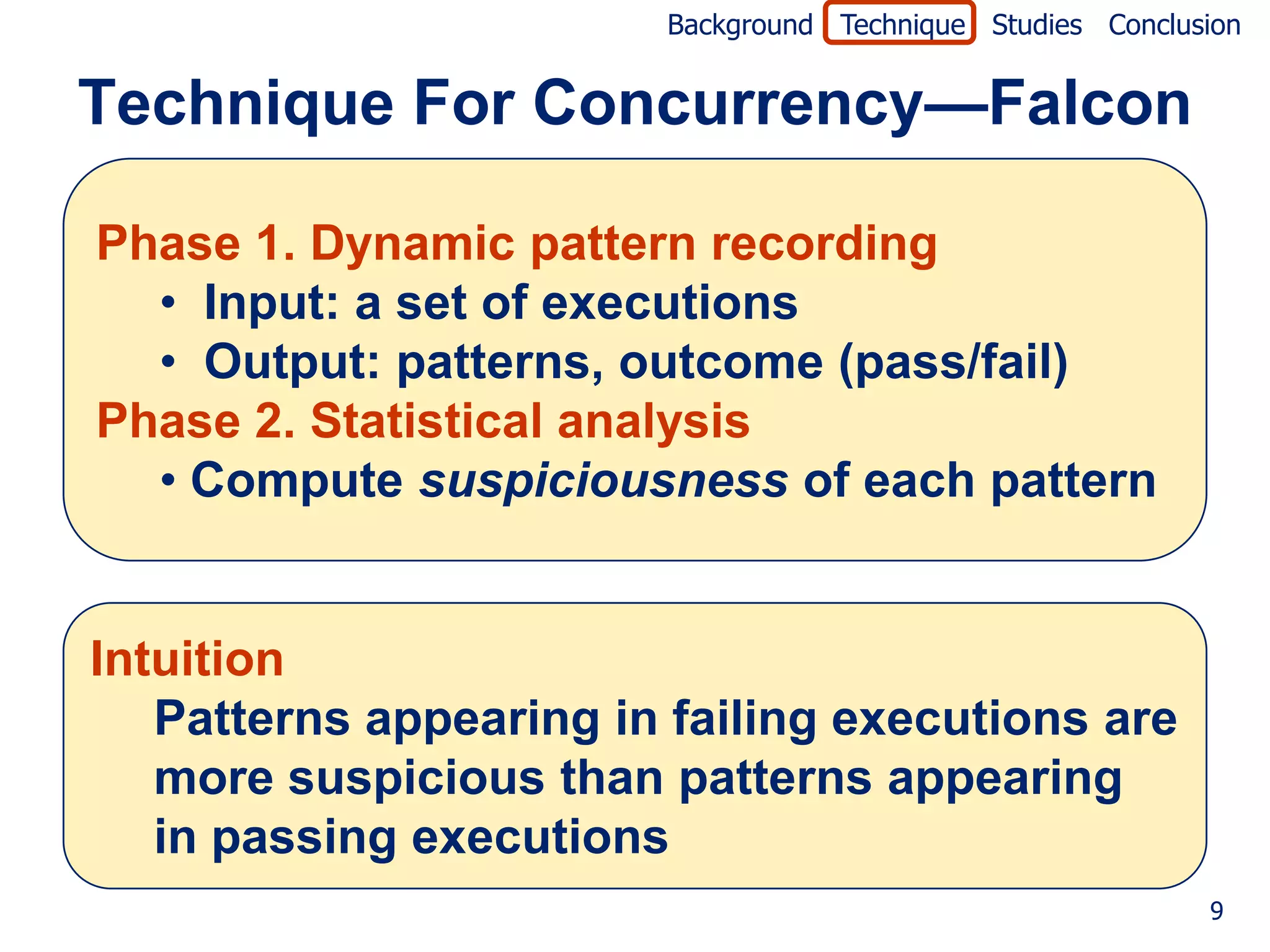
Technique For Concurrency—Falcon

Phase 1. Dynamic pattern recording
  • Input: a set of executions
  • Output: patterns, outcome (pass/fail)
Phase 2. Statistical analysis
  • Compute suspiciousness of each pattern


Intuition
   Patterns appearing in failing executions are
   more suspicious than patterns appearing
   in passing executions
                                                            9
Background Technique Studies Conclusion


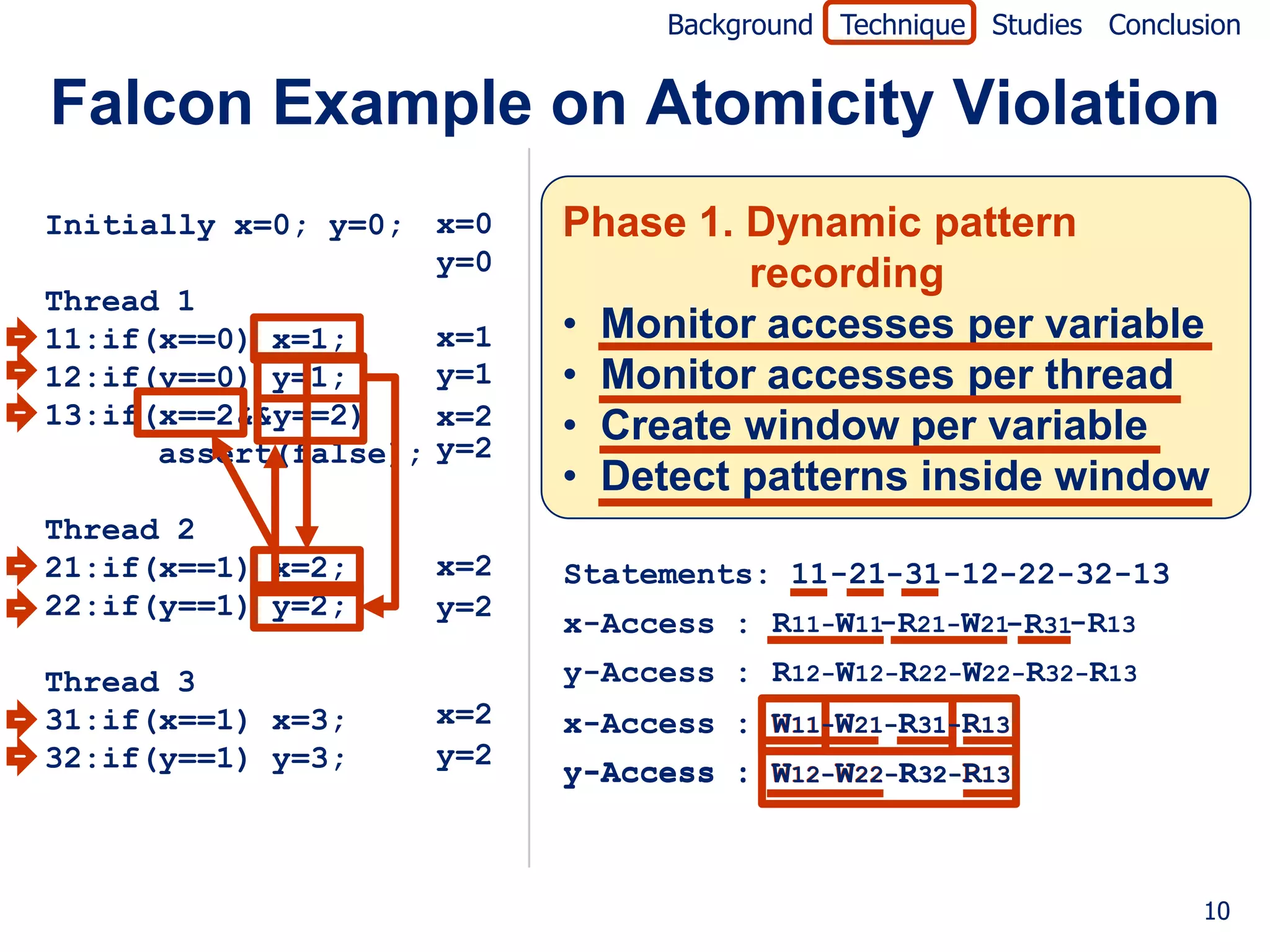
Falcon Example on Atomicity Violation
Initially x=0; y=0; x=0    Phase 1. Dynamic pattern
                     y=0            recording
Thread 1
11:if(x==0) x=1;     x=1   • Monitor accesses per variable
12:if(y==0) y=1;     y=1   • Monitor accesses per thread
13:if(x==2&&y==2)    x=2   • Create window per variable
      assert(false); y=2
                           • Detect patterns inside window
Thread 2
21:if(x==1) x=2;    x=2    Statements: 11-21-31-12-22-32-13
22:if(y==1) y=2;    y=2
                           x-Access : R11-W11-R21-W21-R31-R13
Thread 3                   y-Access : R12-W12-R22-W22-R32-R13
31:if(x==1) x=3;    x=2    x-Access : W11-W21-R31-R13
                                               31-
32:if(y==1) y=3;    y=2
                           y-Access : W12-W22-R32-R13


                                                                     10
Background Technique Studies Conclusion


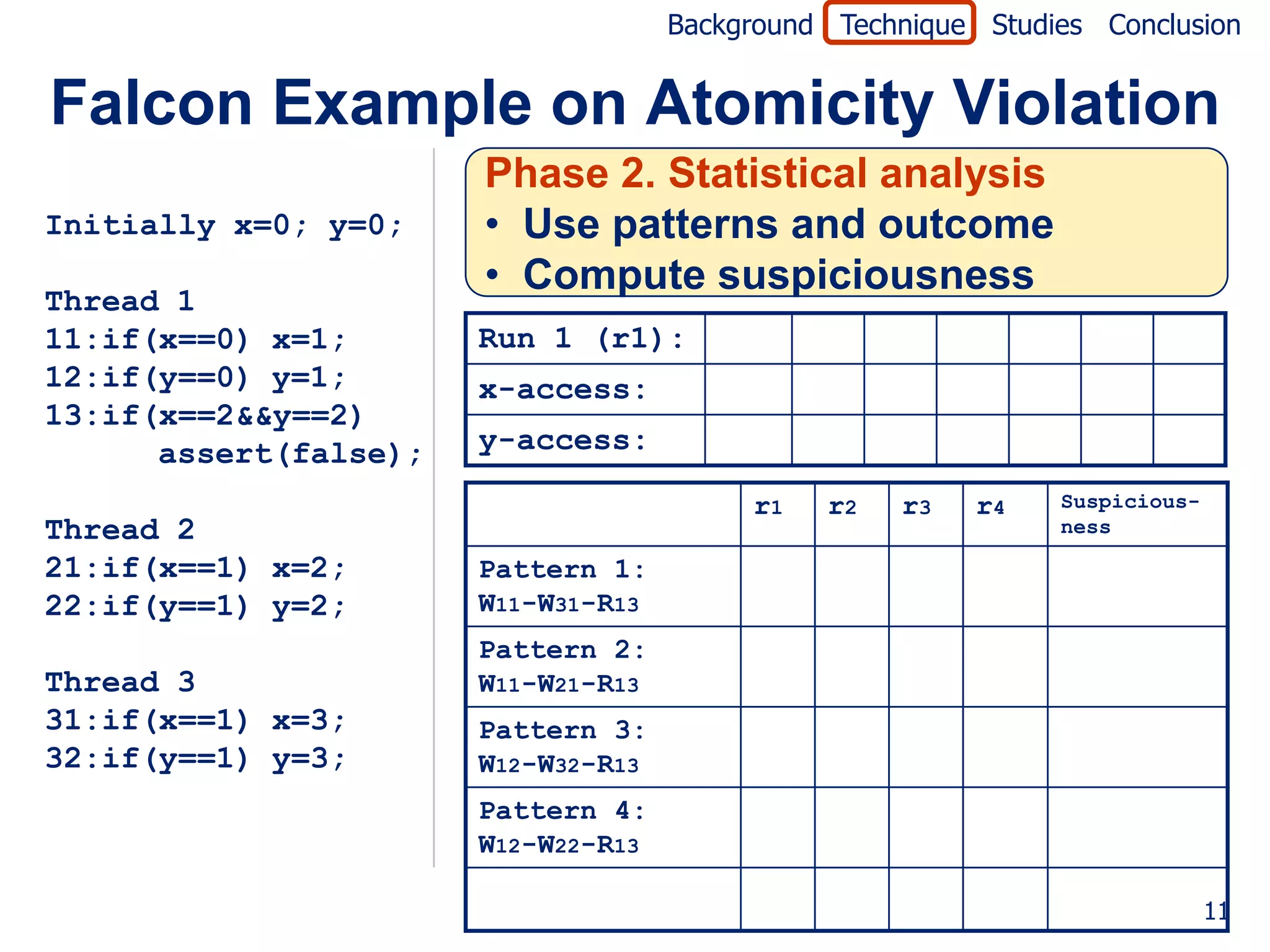
Falcon Example on Atomicity Violation
                       Phase 2. Statistical analysis
Initially x=0; y=0;    • Use patterns and outcome
                       • Compute suspiciousness
Thread 1
11:if(x==0) x=1;       Run 1 (r1):
12:if(y==0) y=1;       x-access:
13:if(x==2&&y==2)
      assert(false);   y-access:

                                          r1   r2   r3   r4    Suspicious-
Thread 2                                                       ness

21:if(x==1) x=2;       Pattern 1:
22:if(y==1) y=2;       W11-W31-R13
                       Pattern 2:
Thread 3               W11-W21-R13
31:if(x==1) x=3;       Pattern 3:
32:if(y==1) y=3;       W12-W32-R13
                       Pattern 4:
                       W12-W22-R13

                                                                             11
Background Technique Studies Conclusion


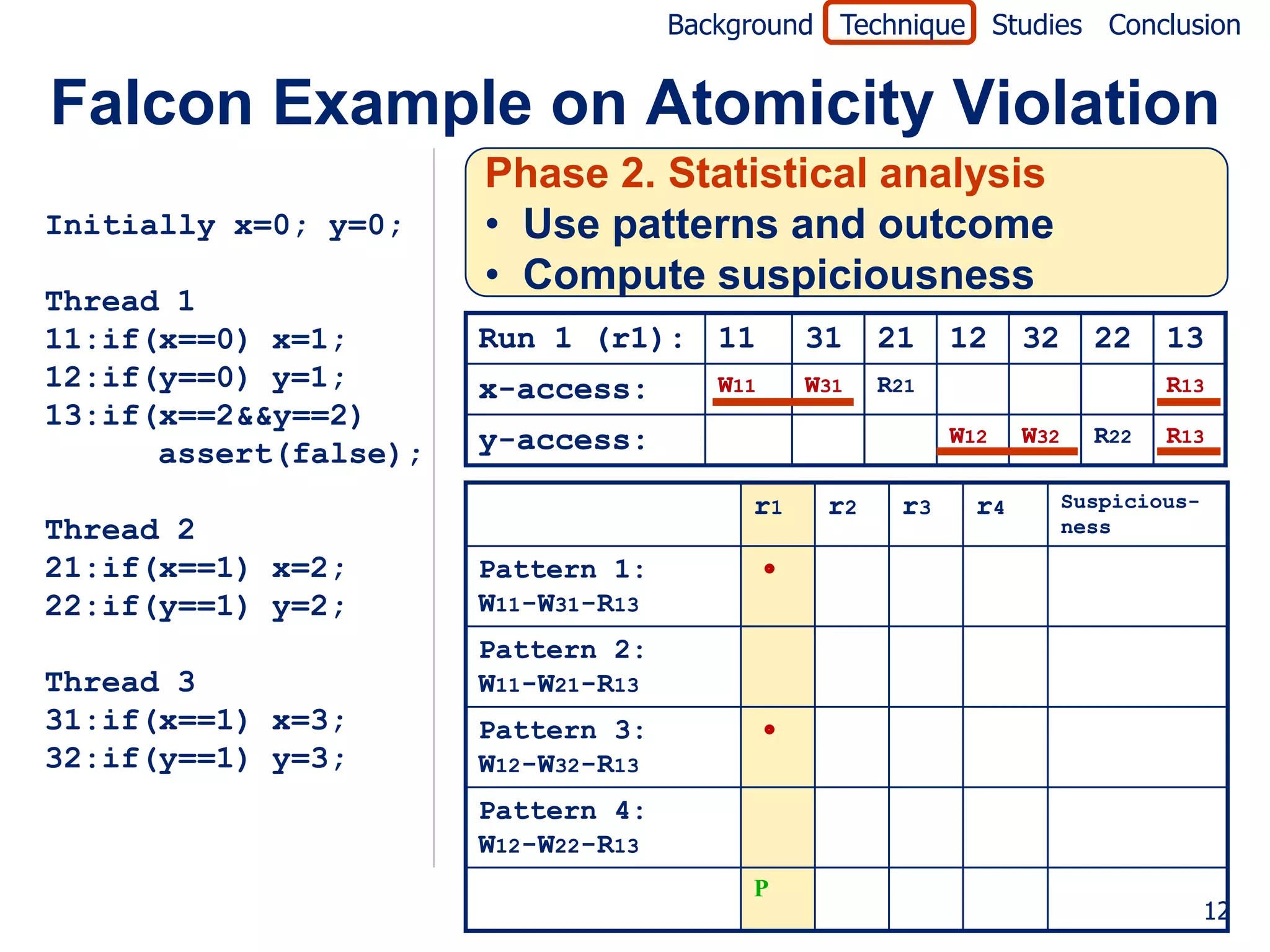
Falcon Example on Atomicity Violation
                       Phase 2. Statistical analysis
Initially x=0; y=0;    • Use patterns and outcome
                       • Compute suspiciousness
Thread 1
11:if(x==0) x=1;       Run 1 (r1): 11          31    21    12     32      22    13
12:if(y==0) y=1;       x-access:        W11    W31   R21                        R13
13:if(x==2&&y==2)
                       y-access:                           W12    W32     R22   R13
      assert(false);
                                          r1    r2    r3     r4         Suspicious-
Thread 2                                                                ness

21:if(x==1) x=2;       Pattern 1:         
22:if(y==1) y=2;       W11-W31-R13
                       Pattern 2:
Thread 3               W11-W21-R13
31:if(x==1) x=3;       Pattern 3:         
32:if(y==1) y=3;       W12-W32-R13
                       Pattern 4:
                       W12-W22-R13
                                          P
                                                                                      12
Background Technique Studies Conclusion


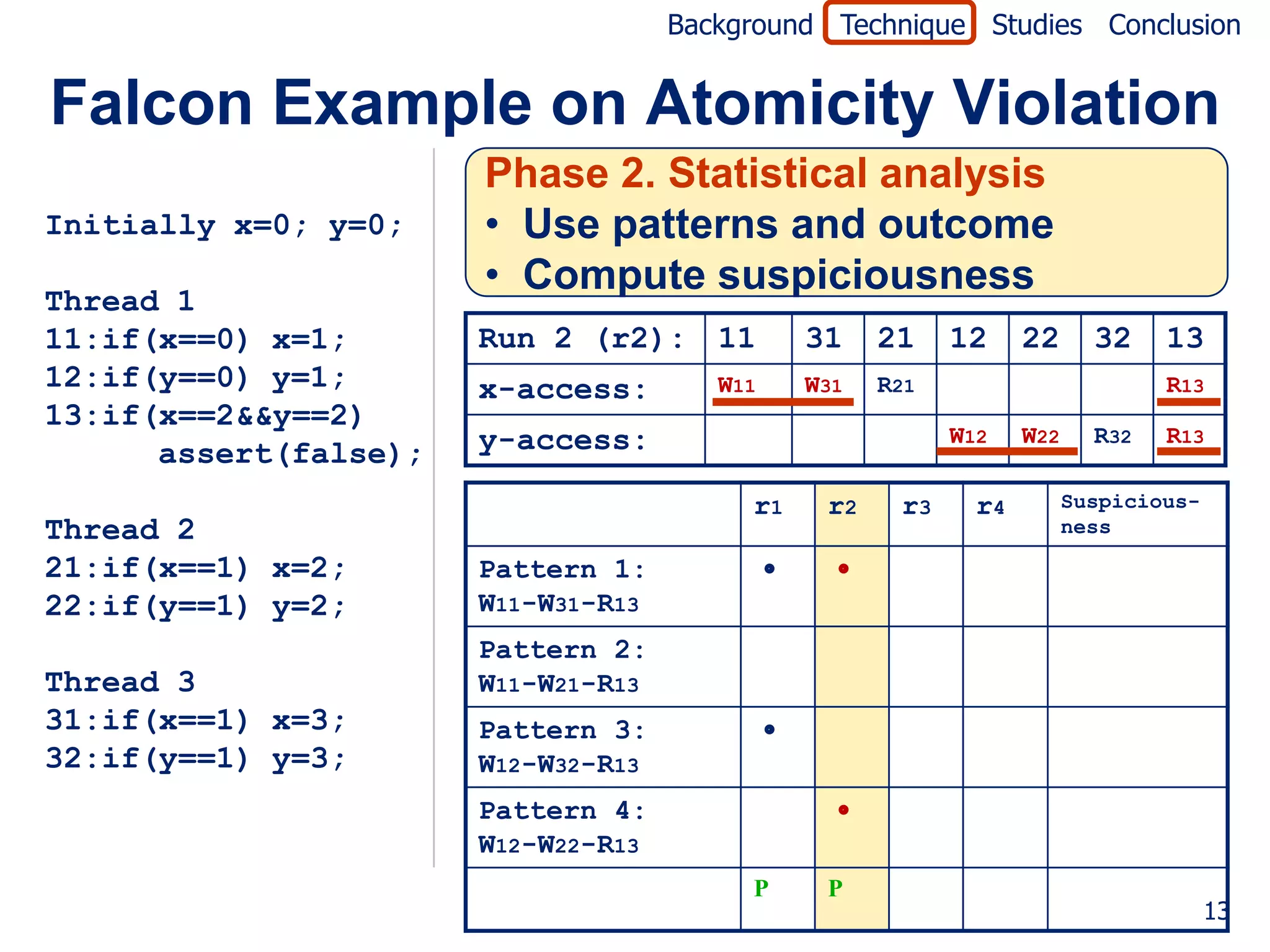
Falcon Example on Atomicity Violation
                       Phase 2. Statistical analysis
Initially x=0; y=0;    • Use patterns and outcome
                       • Compute suspiciousness
Thread 1
11:if(x==0) x=1;       Run 2 (r2): 11          31    21    12     22      32    13
12:if(y==0) y=1;       x-access:        W11    W31   R21                        R13
13:if(x==2&&y==2)
                       y-access:                           W12    W22     R32   R13
      assert(false);
                                          r1    r2    r3     r4         Suspicious-
Thread 2                                                                ness

21:if(x==1) x=2;       Pattern 1:              
22:if(y==1) y=2;       W11-W31-R13
                       Pattern 2:
Thread 3               W11-W21-R13
31:if(x==1) x=3;       Pattern 3:         
32:if(y==1) y=3;       W12-W32-R13
                       Pattern 4:               
                       W12-W22-R13
                                          P     P
                                                                                      13
Background Technique Studies Conclusion


Falcon Example on Atomicity Violation
                       Phase 2. Statistical analysis
Initially x=0; y=0;    • Use patterns and outcome
                       • Compute suspiciousness
Thread 1
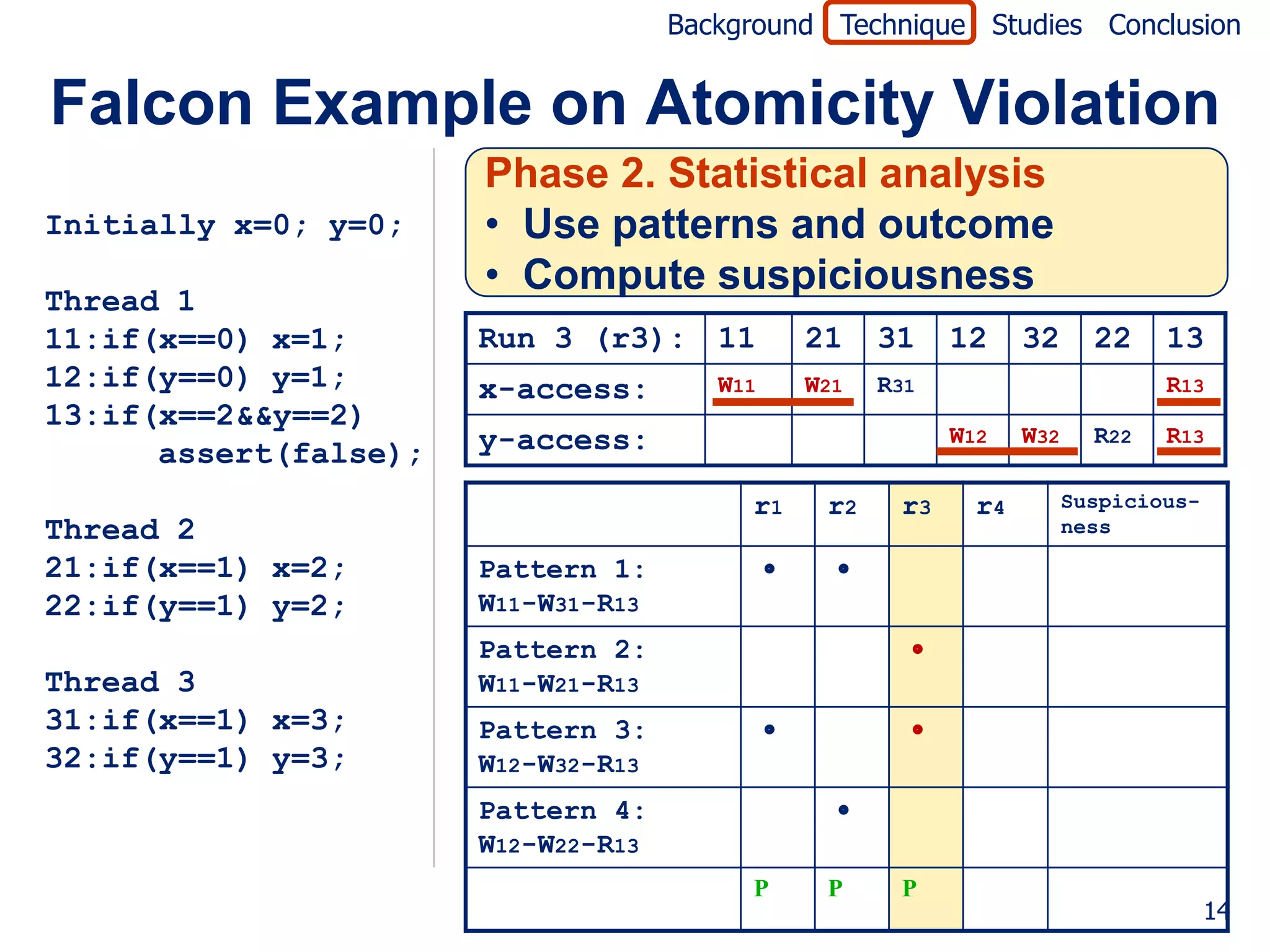
11:if(x==0) x=1;       Run 3 (r3): 11          21    31    12     32      22    13
12:if(y==0) y=1;       x-access:        W11    W21   R31                        R13
13:if(x==2&&y==2)
                       y-access:                           W12    W32     R22   R13
      assert(false);
                                          r1    r2    r3     r4         Suspicious-
Thread 2                                                                ness

21:if(x==1) x=2;       Pattern 1:              
22:if(y==1) y=2;       W11-W31-R13
                       Pattern 2:                     
Thread 3               W11-W21-R13
31:if(x==1) x=3;       Pattern 3:                    
32:if(y==1) y=3;       W12-W32-R13
                       Pattern 4:               
                       W12-W22-R13
                                          P     P     P
                                                                                      14
Background Technique Studies Conclusion


Falcon Example on Atomicity Violation
                       Phase 2. Statistical analysis
Initially x=0; y=0;    • Use patterns and outcome
                       • Compute suspiciousness
Thread 1
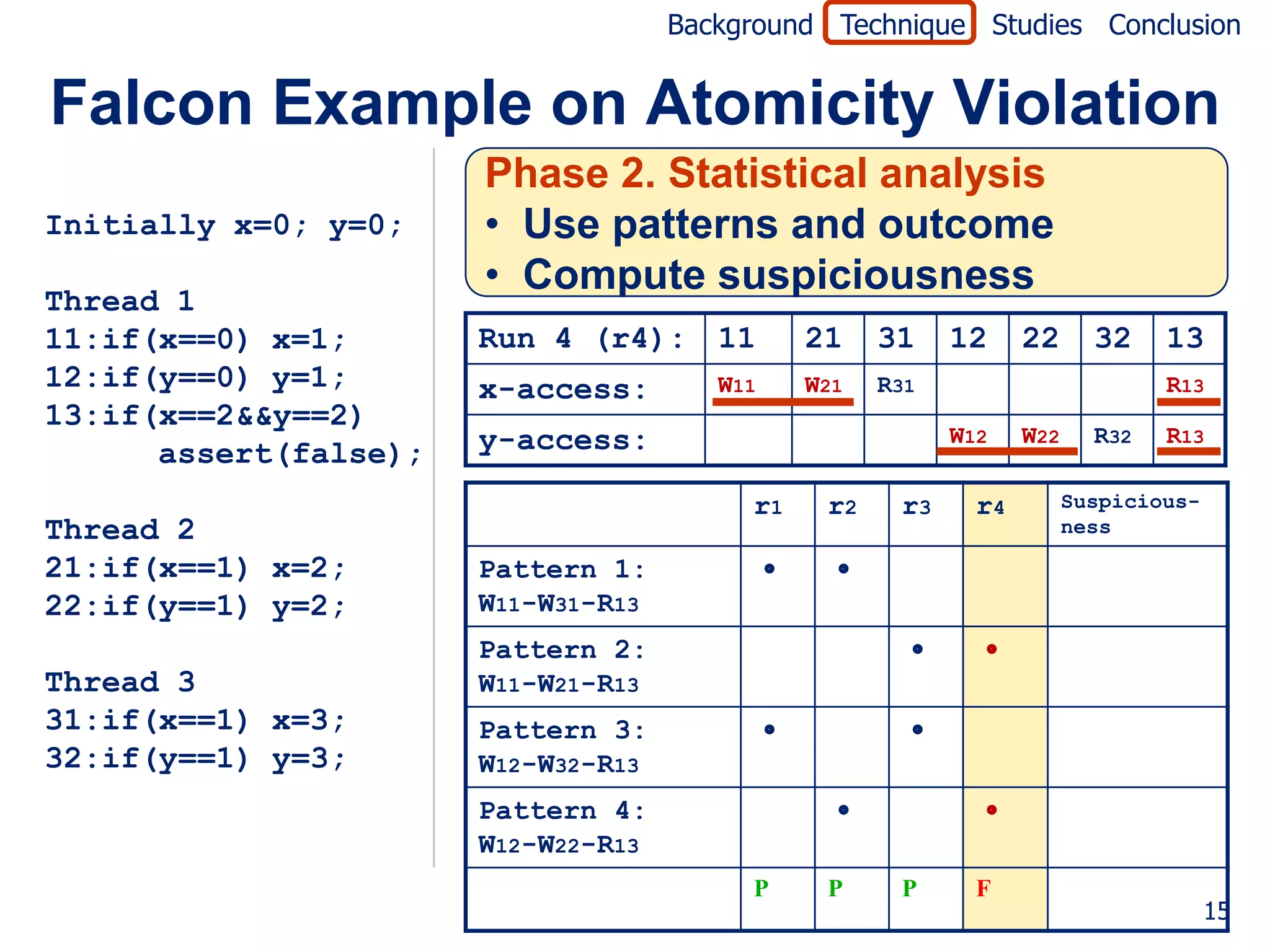
11:if(x==0) x=1;       Run 4 (r4): 11          21    31    12     22      32    13
12:if(y==0) y=1;       x-access:        W11    W21   R31                        R13
13:if(x==2&&y==2)
                       y-access:                           W12    W22     R32   R13
      assert(false);
                                          r1    r2    r3     r4         Suspicious-
Thread 2                                                                ness

21:if(x==1) x=2;       Pattern 1:              
22:if(y==1) y=2;       W11-W31-R13
                       Pattern 2:                           
Thread 3               W11-W21-R13
31:if(x==1) x=3;       Pattern 3:                    
32:if(y==1) y=3;       W12-W32-R13
                       Pattern 4:                           
                       W12-W22-R13
                                          P     P     P      F
                                                                                      15
Background Technique Studies Conclusion


Falcon Example on Atomicity Violation
Initially x=0; y=0;    Jaccard formula [Abreu07]
                                                           failed (P)
Thread 1                 suspiciousness(P) =
11:if(x==0) x=1;                                   totalfailed + passed(P)
12:if(y==0) y=1;
13:if(x==2&&y==2)                         r1   r2     r3      r4    Suspicious-
                                                                    ness
      assert(false);
                       Pattern 1:                                 0.0
                       W11-W31-R13
Thread 2
                       Pattern 2:                                 0.5
21:if(x==1) x=2;
                       W11-W21-R13
22:if(y==1) y=2;
                       Pattern 3:                                 0.0
Thread 3               W12-W32-R13
31:if(x==1) x=3;       Pattern 4:                                 0.5
32:if(y==1) y=3;       W12-W22-R13
                                          P    P      P       F


                                                                                  16
Background Technique Studies Conclusion


            Empirical Studies
• Studies
  1. Determine window size needed and
     its relationship to number of threads
  2. Evaluate technique’s effectiveness
  3. Compare technique with Cooperative Crug
     Isolation (CCI) [Thakur et al.,WODA09]
  4. Evaluate technique’s efficiency (see paper)


• Empirical setup
  • Implemented in Java
  • Evaluated on a set of subjects

                                                                17
Background Technique Studies Conclusion


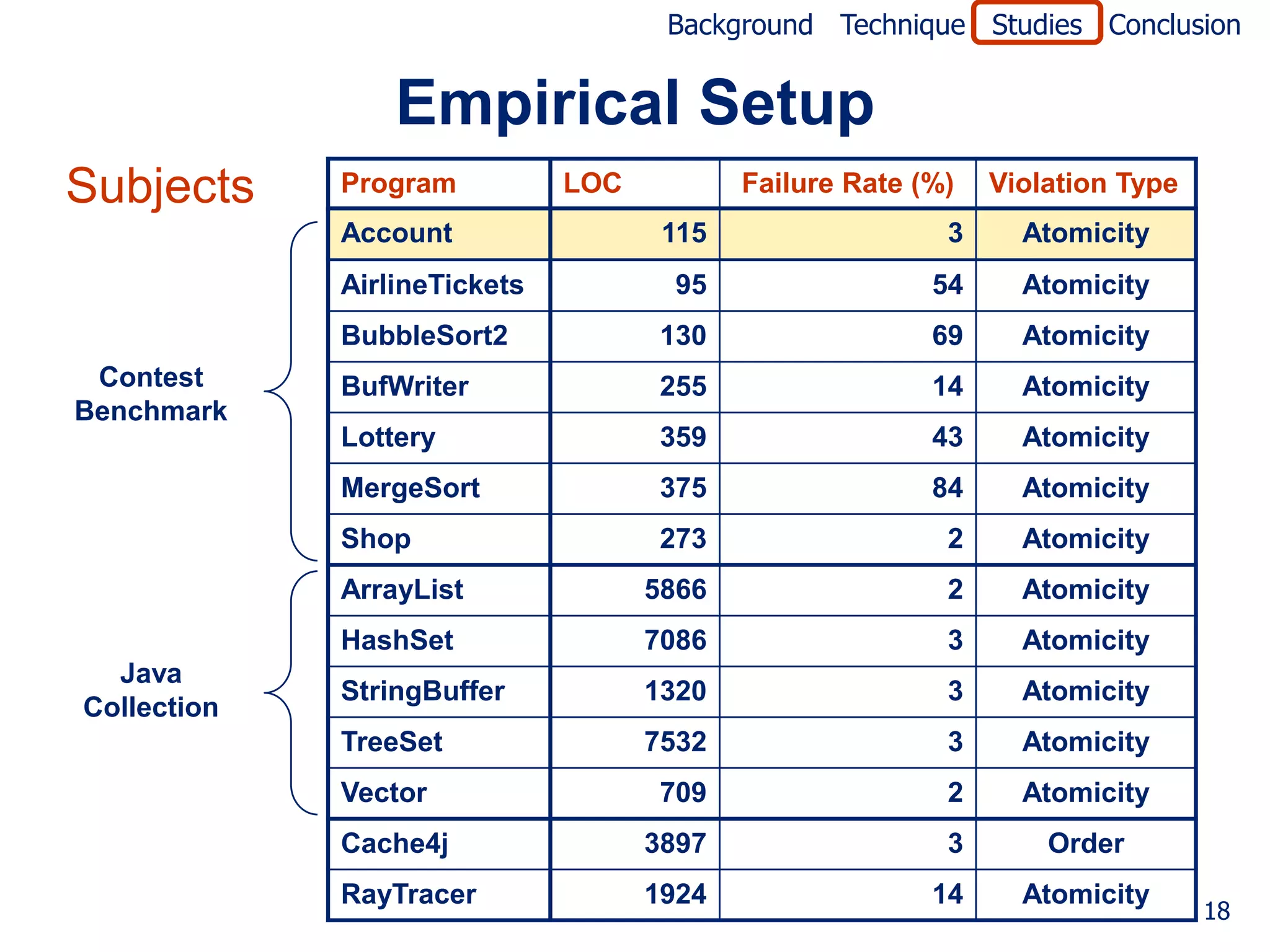
                 Empirical Setup
Subjects     Program          LOC          Failure Rate (%)   Violation Type
             Account                 115                  3     Atomicity
             AirlineTickets           95                 54     Atomicity
             BubbleSort2             130                 69     Atomicity
 Contest     BufWriter               255                 14     Atomicity
Benchmark
             Lottery                 359                 43     Atomicity
             MergeSort               375                 84     Atomicity
             Shop                    273                  2     Atomicity
             ArrayList              5866                  2     Atomicity
             HashSet                7086                  3     Atomicity
  Java
             StringBuffer           1320                  3     Atomicity
Collection
             TreeSet                7532                  3     Atomicity
             Vector                  709                  2     Atomicity
             Cache4j                3897                  3       Order
             RayTracer              1924                 14     Atomicity
                                                                               18
Background Technique Studies Conclusion


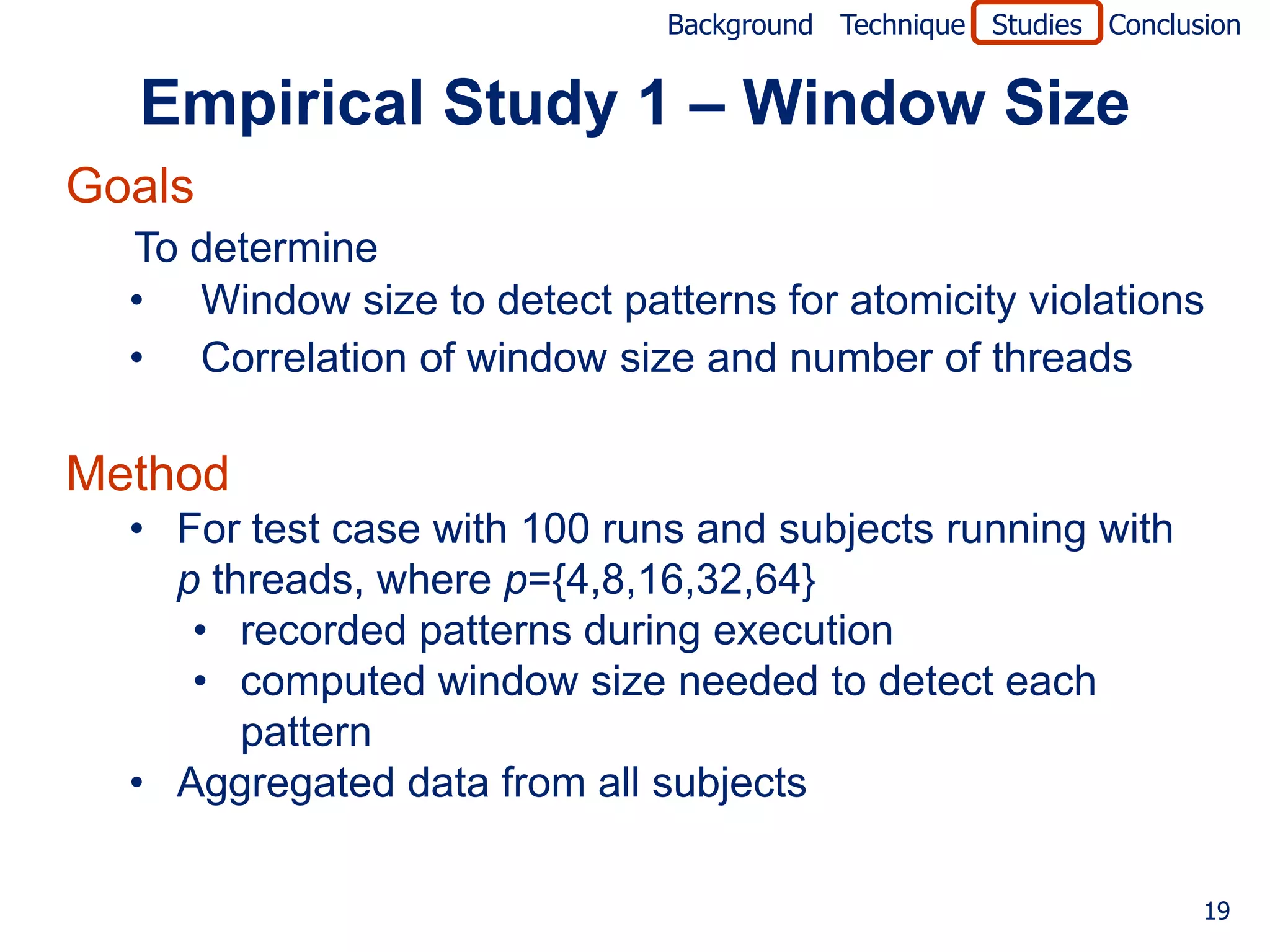
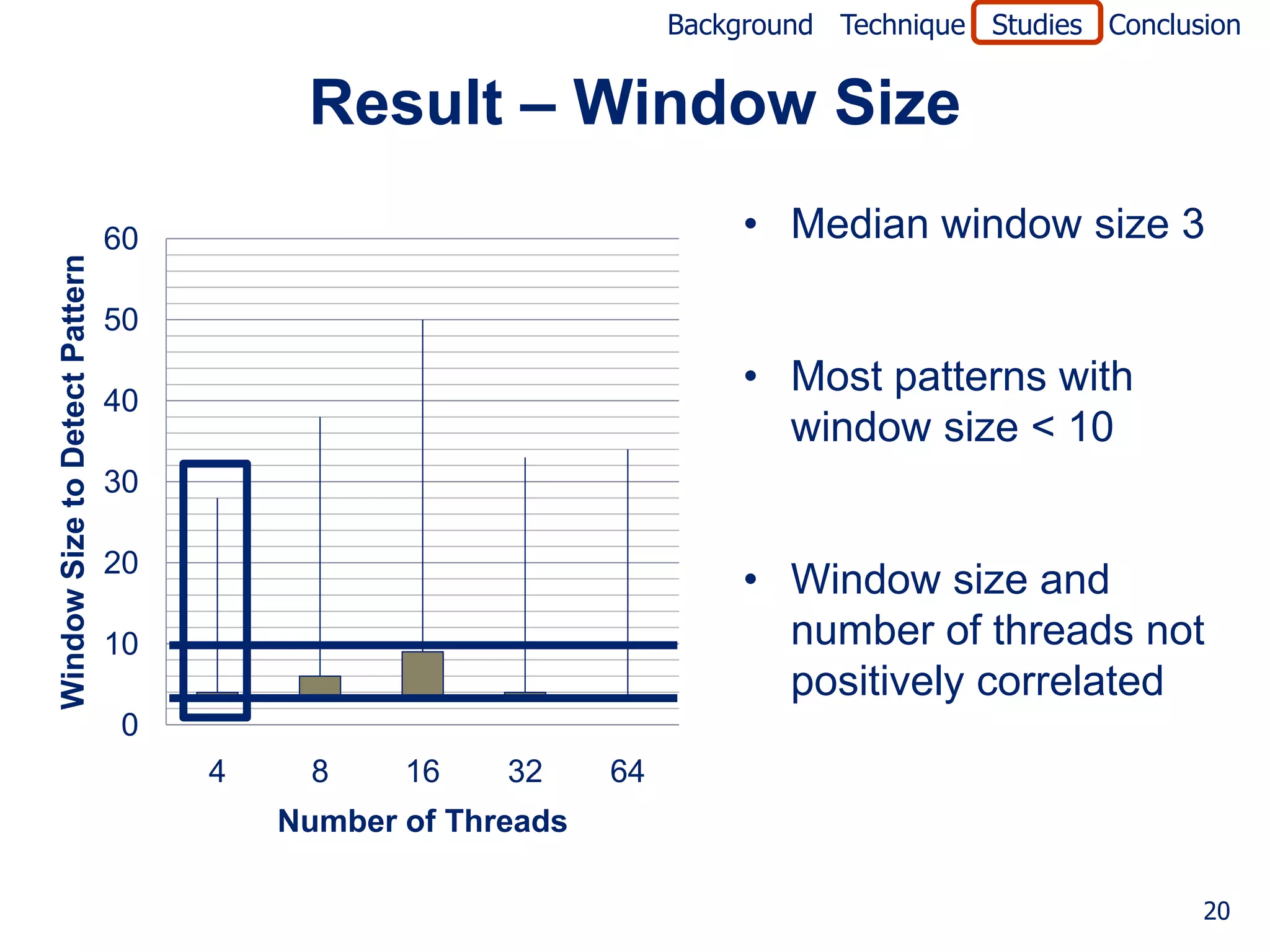
  Empirical Study 1 – Window Size
Goals
  To determine
  • Window size to detect patterns for atomicity violations
  • Correlation of window size and number of threads

Method
  • For test case with 100 runs and subjects running with
    p threads, where p={4,8,16,32,64}
     • recorded patterns during execution
     • computed window size needed to detect each
        pattern
  • Aggregated data from all subjects

                                                                  19
Background Technique Studies Conclusion


                                          Result – Window Size
                                60                                     • Median window size 3
Window Size to Detect Pattern


                                50

                                40
                                                                       • Most patterns with
                                                                         window size < 10
                                30

                                20
                                                                       • Window size and
                                10                                       number of threads not
                                                                         positively correlated
                                0
                                     4    8     16    32     64
                                         Number of Threads

                                                                                                      20
Background Technique Studies Conclusion


  Empirical Study 2 – Effectiveness
Goal
  • To measure effectiveness of suspiciousness ranking

Techniques compared
  •    Conflict Serializability (e..g, [Wang and Stoller, PPoPP06])
  •    AVIO [Lu et al., ASPLOS06]

Method
  • For test case with 100 runs and window size 5
     • Computed suspiciousness of each pattern
     • Computed fault-localization expense (number of
       patterns that must be examined to find fault)

                                                                         21
Background Technique Studies Conclusion


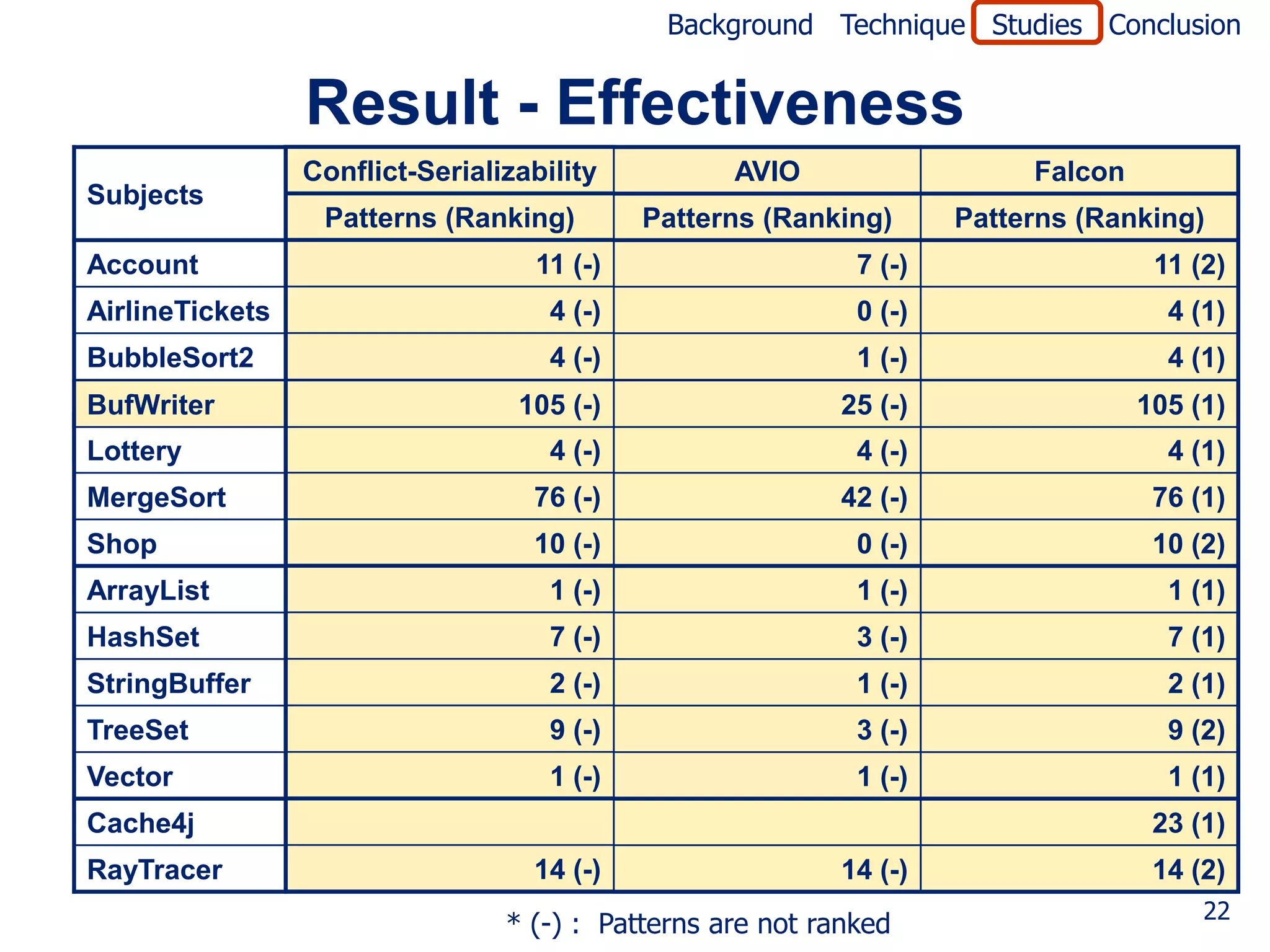
                 Result - Effectiveness
                 Conflict-Serializability          AVIO                   Falcon
Subjects
                  Patterns (Ranking)         Patterns (Ranking)      Patterns (Ranking)
Account                            11 (-)                    7 (-)                  11 (2)
AirlineTickets                       4 (-)                   0 (-)                   4 (1)
BubbleSort2                          4 (-)                   1 (-)                   4 (1)
BufWriter                         105 (-)                  25 (-)                  105 (1)
BufWriter
Lottery                               105
                                    4 (-)                    4 (-)   25                  1
                                                                                     4 (1)
MergeSort                          76 (-)                  42 (-)                   76 (1)
Shop                               10 (-)                    0 (-)                  10 (2)
ArrayList                            1 (-)                   1 (-)                   1 (1)
HashSet                              7 (-)                   3 (-)                   7 (1)
StringBuffer                         2 (-)                   1 (-)                   2 (1)
TreeSet                              9 (-)                   3 (-)                   9 (2)
Vector                               1 (-)                   1 (-)                   1 (1)
Cache4j                                                                             23 (1)
RayTracer                          14 (-)                  14 (-)                   14 (2)
                                                                                        22
                                 * (-) : Patterns are not ranked
Background Technique Studies Conclusion


      Empirical Study 3 – Case Study
Goal
  •    To compare effectiveness of Falcon to CCI*
       •   CCI observes memory accesses, outcome (pass/fail)
       •   CCI reports suspiciousness of each memory access predicate
           (i.e., memory access and previous access type pair)


Method
  • Implemented the CCI technique in the Falcon toolset
  • For test case with 100 runs and subjects
     • Executed the tool
     • Found the access and rank of actual bug


                 * Cooperative Crug Isolation [Thakur, Sen, Liblit, Lu, WODA09]
                                                                             23
Background Technique Studies Conclusion


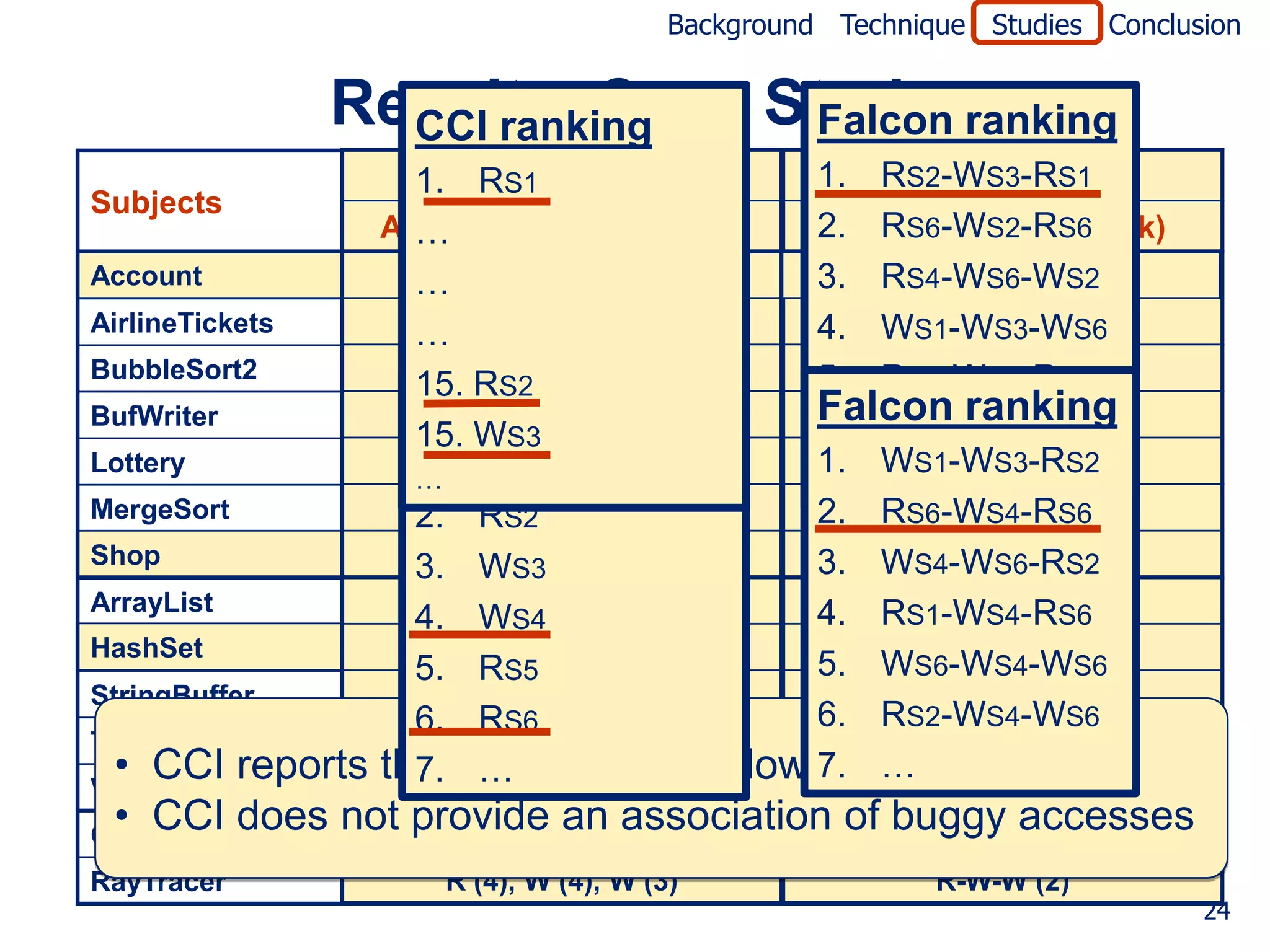
              Result – Case Study ranking
                CCI ranking   Falcon
                  1. RS1CCI               1. WS1-WS3-RS2
                                             RS2-WS3-RS1
                                                   Falcon
Subjects
                  …
                Accesses of Bug (Rank)    2. RS6-WS2-RS6
                                           Pattern of Bug (Rank)
Account           …R W W
                  12. (6),S2 (4), R (6)   3. WS4-RS6-WS2
                                             RS4R-W-R (2)
                                                  -W
AirlineTickets    …R …
                  13. (2), W (5), R (4)   4. RS1R-W-R-WS6
                                                  -WS4 (1)
                                             WS1-WS3-WS6
BubbleSort2
                  14. RS2R (7), W (2)
                    W (1),
                  15. …                      RS6W-R-W-RS6
                                                  -WS3 (1)
                                          5. WS6-WS4-RS6
BufWriter         CCI ranking
                     R (5), W (1), R (5)  Falcon ranking
                                          6. RS2R-W-R-WS6
                                                        (1)
                                                  -WS4-RS3
                                                     S3
                  15. WS6
                       R S3
Lottery           1. R (1), W (7), R (4)
                  … RS1
                                          1. WS1-WS3-RS2
                                                 R-W-R (1)
                                          7. … -WS4-WS6
                                             RS1
MergeSort         2.W (1), R (3), W (12)
                       RS2                2. RS6W-R-W-RS6
                                                  -WS4 (1)
Shop              3. (15),S3 (12), R (15)
                   R WW                          R-W-R (2)
                                          3. WS4-WS6-RS2
ArrayList
                  4. R (4),S4 (4), R (4)
                       W W                4. RS1R-W-R-RS6
                                                  -WS4 (1)
HashSet            R (15), W (15), R (1)         R-W-R (1)
                  5. RS5                  5. WS6-WS4-WS6
StringBuffer        R (14), W (2), R (1)         R-W-R (1)
                  6. RS6                  6. RS2-WS4-WS6
TreeSet            R (10), W (5), R (10)         R-W-R (2)
  • CCI reports the R (2), W (2), R (2)
Vector
                       …                  7. …
                  7. actual bug with lower ranks R-W-R (1)
 • CCI does not provide an(2)
Cache4j            W (79), R
                             association of buggy (1)
                                               W-R
                                                   accesses
RayTracer            R (4), W (4), W (3)                 R-W-W (2)
                                                                           24
Background Technique Studies Conclusion


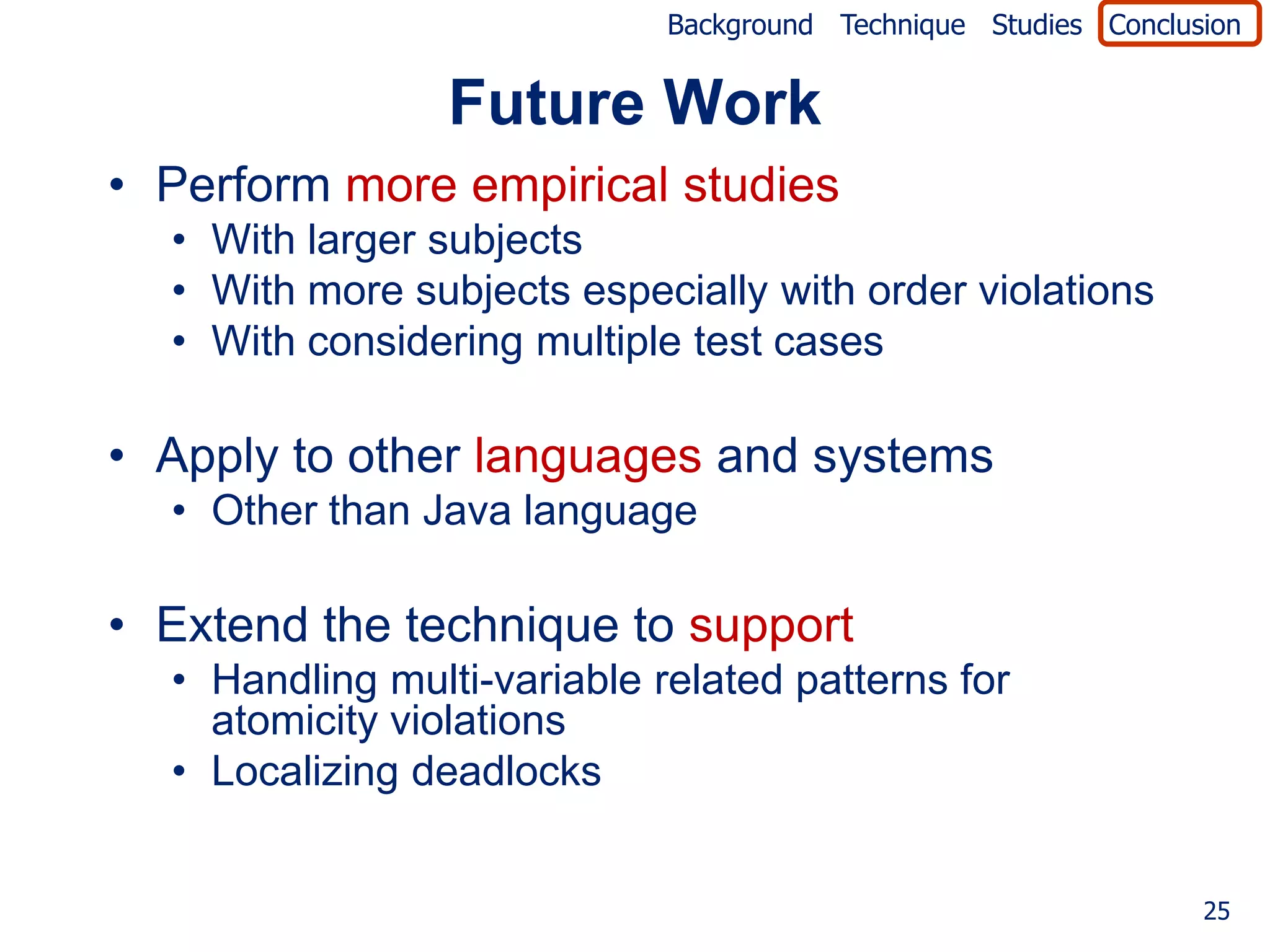
                 Future Work
• Perform more empirical studies
  • With larger subjects
  • With more subjects especially with order violations
  • With considering multiple test cases

• Apply to other languages and systems
  • Other than Java language

• Extend the technique to support
  • Handling multi-variable related patterns for
    atomicity violations
  • Localizing deadlocks


                                                                 25
Background Technique Studies Conclusion


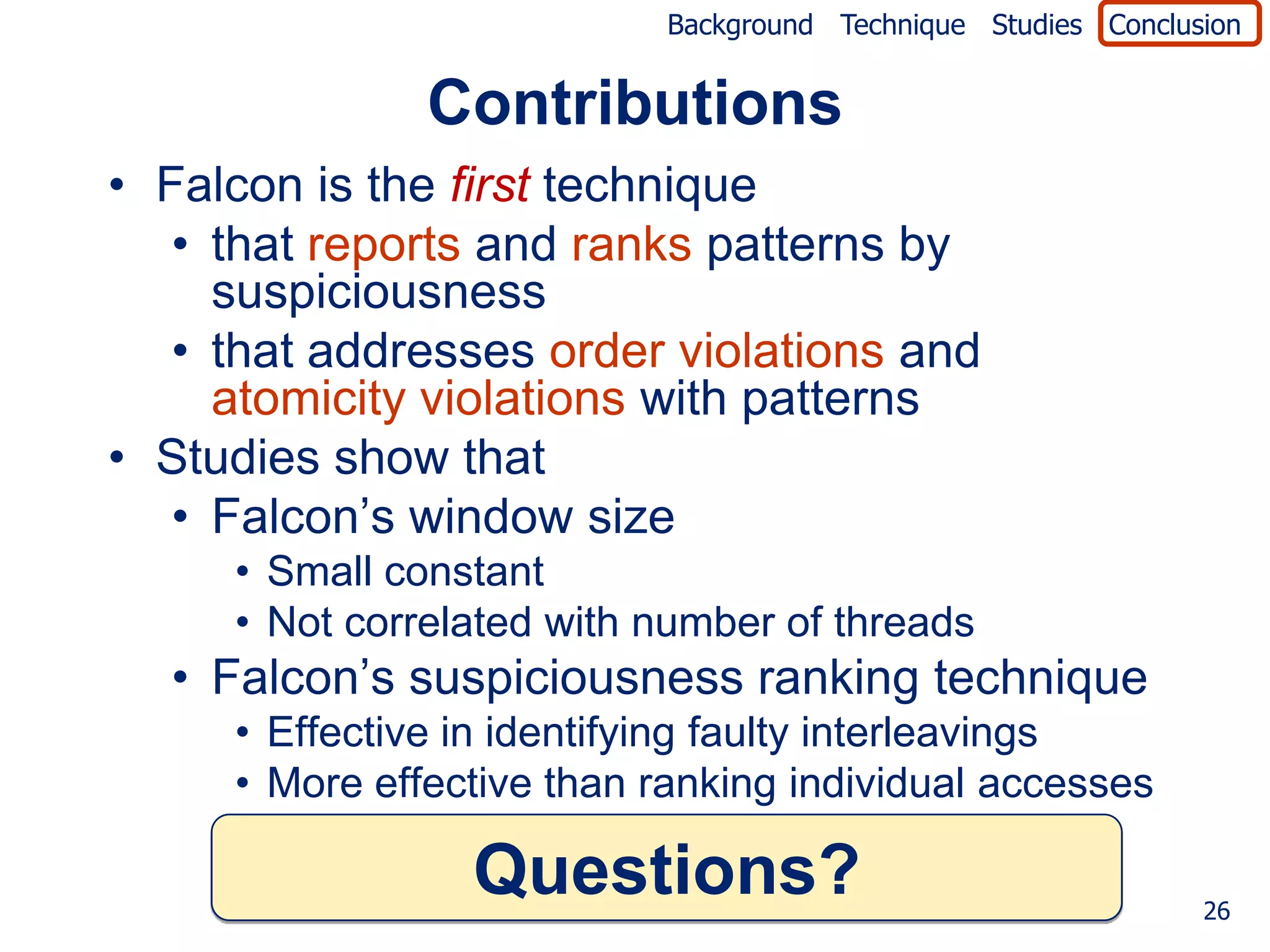
               Contributions
• Falcon is the first technique
   • that reports and ranks patterns by
     suspiciousness
   • that addresses order violations and
     atomicity violations with patterns
• Studies show that
   • Falcon’s window size
     • Small constant
     • Not correlated with number of threads
  • Falcon’s suspiciousness ranking technique
     • Effective in identifying faulty interleavings
     • More effective than ranking individual accesses

                 Questions?                                     26
Background Technique Studies Conclusion


Backup Slides


                                           27
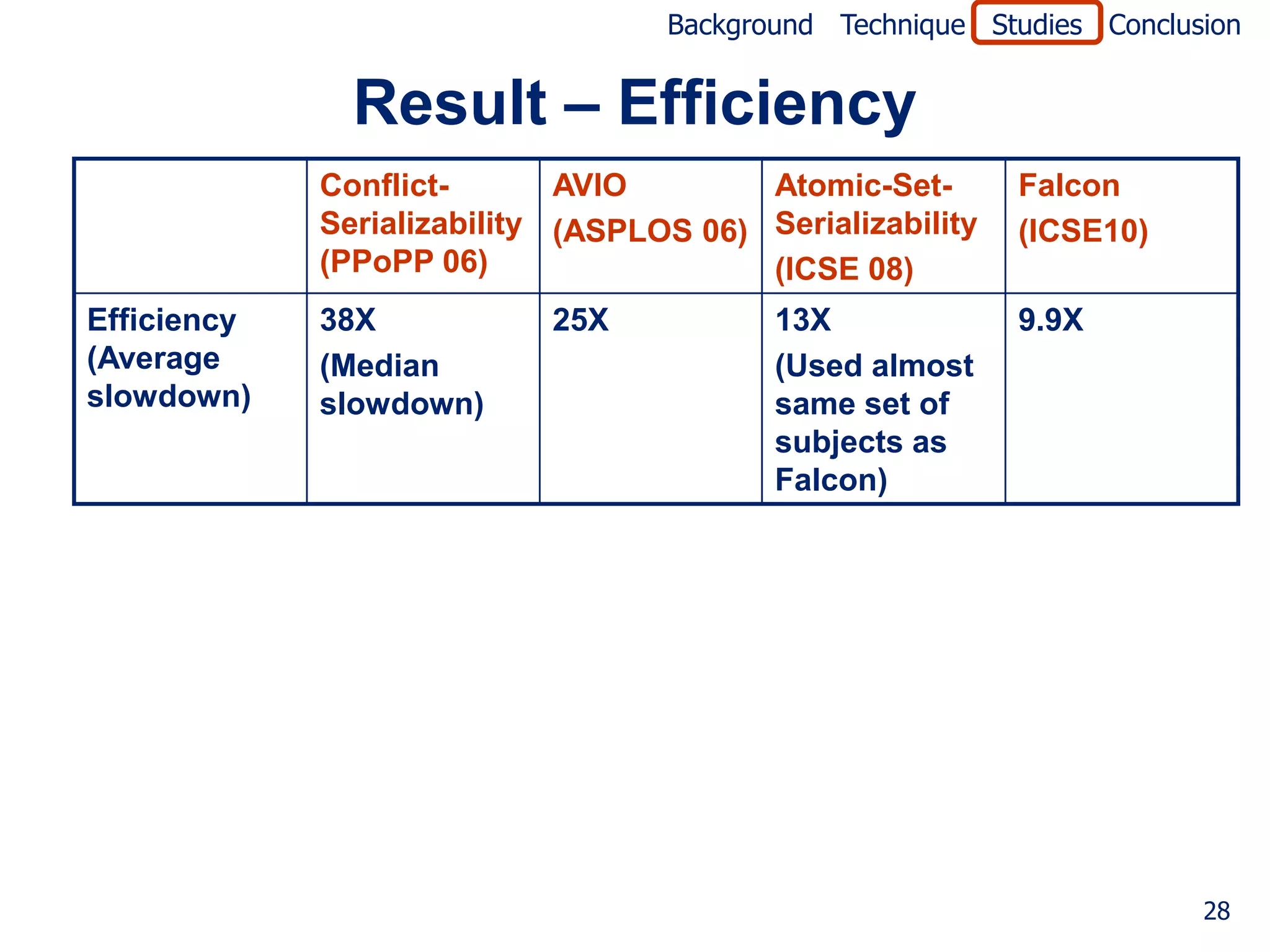
Background Technique Studies Conclusion


               Result – Efficiency
             Conflict-       AVIO        Atomic-Set-       Falcon
             Serializability (ASPLOS 06) Serializability   (ICSE10)
             (PPoPP 06)                  (ICSE 08)
Efficiency   38X            25X           13X              9.9X
(Average     (Median                      (Used almost
slowdown)    slowdown)                    same set of
                                          subjects as
                                          Falcon)


                                                                       28

Falcon: Fault Localization in Concurrent Programs

  • 1.
    Background Technique StudiesConclusion Falcon: Fault Localization in Concurrent Programs Sangmin Park, Richard Vuduc, and Mary Jean Harrold College of Computing Georgia Institute of Technology 1
  • 2.
    Background Technique StudiesConclusion Motivation • Godefroid, Nagappan Developers [MSR-TR08] found that Handle concurrency issues • Concurrency bugs are difficult to find • Non-deterministic behavior • Large thread interleaving space 2
  • 3.
    Background Technique StudiesConclusion Existing Techniques • Bug finding for concurrency bugs • Static/dynamic data race detection (e.g., [Ronesse99, Savage97, O’Callanhan03]) 1. Techniques target only one type of concurrency bug • Static/dynamic atomicity violation detection 2. Techniques report benign (harmless) (e.g., [Flanagan03, Wang06, Flanagan08]) results along with harmful results • Dynamic pattern analysis (e.g., [Lu06, Hammer08]) • Fault localization • For sequential programs (e.g., [Jones02, Liblit03, been applied to Techniques have not Liu05, Baah08]) concurrent programs 3
  • 4.
    Background Technique StudiesConclusion Falcon Research Outline • Background • Technique: patterns + suspiciousness • Empirical Studies • Conclusion 4
  • 5.
    Background Technique StudiesConclusion Concurrency Violations Lu et al.’s [ASPLOS08] found that Others: 3% Order and Atomicity Deadlock: 30% violations: 67% Both occur due to undesirable undesirable memory-access sequences memory-access sequences 5
  • 6.
    Background Technique StudiesConclusion Order Violation When desired order of accesses is reversed  Unintended program behavior For A access Thread T1 Thread T2 Correct order 11: void M1() 21: void M2() W14  R24 12: { 22: { Incorrect order 13: lock(L); 23: lock(L); R24  W14 14: A=new Object(); 24: x=A.getX(); 15: if (A) { /*…*/ } 25: unlock(L); RT2  WT1 16: unlock(L); 26: } 17: } 6
  • 7.
    Background Technique StudiesConclusion Atomicity Violation When atomic region is interfered by another thread  Unintended program behavior Thread T3 For o access 31: copy(Obj o) Thread T4 Correct order 32: { 41: access() R34  R36  W44 33: … 42: { Incorrect order 34: int sz=o.sz(); 43: … R34  W44  R36 35: … 44: o.clear(); 45: … RT3  WT4  RT3 36: copy(sz, o, this.buffer); 46: } 37: … 38: } 7
  • 8.
    Background Technique StudiesConclusion Patterns for Concurrency Violations Patterns Patterns for atomicity violation for order violation [PPoPP06, ASPLOS06] 1 RT1 * WT2 1 RT1 * WT2 * RT1 2 WT1 * RT2 2 WT1 * WT2 * RT1 3 WT1 * WT2 3 WT1 * RT2 * WT1 4 RT1 * WT2 * WT1 5 WT1 * WT2 * WT1 Note • Concurrency violations represented as patterns • Patterns not always concurrency violations 8
  • 9.
    Background Technique StudiesConclusion Technique For Concurrency—Falcon Phase 1. Dynamic pattern recording • Input: a set of executions • Output: patterns, outcome (pass/fail) Phase 2. Statistical analysis • Compute suspiciousness of each pattern Intuition Patterns appearing in failing executions are more suspicious than patterns appearing in passing executions 9
  • 10.
    Background Technique StudiesConclusion Falcon Example on Atomicity Violation Initially x=0; y=0; x=0 Phase 1. Dynamic pattern y=0 recording Thread 1 11:if(x==0) x=1; x=1 • Monitor accesses per variable 12:if(y==0) y=1; y=1 • Monitor accesses per thread 13:if(x==2&&y==2) x=2 • Create window per variable assert(false); y=2 • Detect patterns inside window Thread 2 21:if(x==1) x=2; x=2 Statements: 11-21-31-12-22-32-13 22:if(y==1) y=2; y=2 x-Access : R11-W11-R21-W21-R31-R13 Thread 3 y-Access : R12-W12-R22-W22-R32-R13 31:if(x==1) x=3; x=2 x-Access : W11-W21-R31-R13 31- 32:if(y==1) y=3; y=2 y-Access : W12-W22-R32-R13 10
  • 11.
    Background Technique StudiesConclusion Falcon Example on Atomicity Violation Phase 2. Statistical analysis Initially x=0; y=0; • Use patterns and outcome • Compute suspiciousness Thread 1 11:if(x==0) x=1; Run 1 (r1): 12:if(y==0) y=1; x-access: 13:if(x==2&&y==2) assert(false); y-access: r1 r2 r3 r4 Suspicious- Thread 2 ness 21:if(x==1) x=2; Pattern 1: 22:if(y==1) y=2; W11-W31-R13 Pattern 2: Thread 3 W11-W21-R13 31:if(x==1) x=3; Pattern 3: 32:if(y==1) y=3; W12-W32-R13 Pattern 4: W12-W22-R13 11
  • 12.
    Background Technique StudiesConclusion Falcon Example on Atomicity Violation Phase 2. Statistical analysis Initially x=0; y=0; • Use patterns and outcome • Compute suspiciousness Thread 1 11:if(x==0) x=1; Run 1 (r1): 11 31 21 12 32 22 13 12:if(y==0) y=1; x-access: W11 W31 R21 R13 13:if(x==2&&y==2) y-access: W12 W32 R22 R13 assert(false); r1 r2 r3 r4 Suspicious- Thread 2 ness 21:if(x==1) x=2; Pattern 1:  22:if(y==1) y=2; W11-W31-R13 Pattern 2: Thread 3 W11-W21-R13 31:if(x==1) x=3; Pattern 3:  32:if(y==1) y=3; W12-W32-R13 Pattern 4: W12-W22-R13 P 12
  • 13.
    Background Technique StudiesConclusion Falcon Example on Atomicity Violation Phase 2. Statistical analysis Initially x=0; y=0; • Use patterns and outcome • Compute suspiciousness Thread 1 11:if(x==0) x=1; Run 2 (r2): 11 31 21 12 22 32 13 12:if(y==0) y=1; x-access: W11 W31 R21 R13 13:if(x==2&&y==2) y-access: W12 W22 R32 R13 assert(false); r1 r2 r3 r4 Suspicious- Thread 2 ness 21:if(x==1) x=2; Pattern 1:   22:if(y==1) y=2; W11-W31-R13 Pattern 2: Thread 3 W11-W21-R13 31:if(x==1) x=3; Pattern 3:  32:if(y==1) y=3; W12-W32-R13 Pattern 4:  W12-W22-R13 P P 13
  • 14.
    Background Technique StudiesConclusion Falcon Example on Atomicity Violation Phase 2. Statistical analysis Initially x=0; y=0; • Use patterns and outcome • Compute suspiciousness Thread 1 11:if(x==0) x=1; Run 3 (r3): 11 21 31 12 32 22 13 12:if(y==0) y=1; x-access: W11 W21 R31 R13 13:if(x==2&&y==2) y-access: W12 W32 R22 R13 assert(false); r1 r2 r3 r4 Suspicious- Thread 2 ness 21:if(x==1) x=2; Pattern 1:   22:if(y==1) y=2; W11-W31-R13 Pattern 2:  Thread 3 W11-W21-R13 31:if(x==1) x=3; Pattern 3:   32:if(y==1) y=3; W12-W32-R13 Pattern 4:  W12-W22-R13 P P P 14
  • 15.
    Background Technique StudiesConclusion Falcon Example on Atomicity Violation Phase 2. Statistical analysis Initially x=0; y=0; • Use patterns and outcome • Compute suspiciousness Thread 1 11:if(x==0) x=1; Run 4 (r4): 11 21 31 12 22 32 13 12:if(y==0) y=1; x-access: W11 W21 R31 R13 13:if(x==2&&y==2) y-access: W12 W22 R32 R13 assert(false); r1 r2 r3 r4 Suspicious- Thread 2 ness 21:if(x==1) x=2; Pattern 1:   22:if(y==1) y=2; W11-W31-R13 Pattern 2:   Thread 3 W11-W21-R13 31:if(x==1) x=3; Pattern 3:   32:if(y==1) y=3; W12-W32-R13 Pattern 4:   W12-W22-R13 P P P F 15
  • 16.
    Background Technique StudiesConclusion Falcon Example on Atomicity Violation Initially x=0; y=0; Jaccard formula [Abreu07] failed (P) Thread 1 suspiciousness(P) = 11:if(x==0) x=1; totalfailed + passed(P) 12:if(y==0) y=1; 13:if(x==2&&y==2) r1 r2 r3 r4 Suspicious- ness assert(false); Pattern 1:   0.0 W11-W31-R13 Thread 2 Pattern 2:   0.5 21:if(x==1) x=2; W11-W21-R13 22:if(y==1) y=2; Pattern 3:   0.0 Thread 3 W12-W32-R13 31:if(x==1) x=3; Pattern 4:   0.5 32:if(y==1) y=3; W12-W22-R13 P P P F 16
  • 17.
    Background Technique StudiesConclusion Empirical Studies • Studies 1. Determine window size needed and its relationship to number of threads 2. Evaluate technique’s effectiveness 3. Compare technique with Cooperative Crug Isolation (CCI) [Thakur et al.,WODA09] 4. Evaluate technique’s efficiency (see paper) • Empirical setup • Implemented in Java • Evaluated on a set of subjects 17
  • 18.
    Background Technique StudiesConclusion Empirical Setup Subjects Program LOC Failure Rate (%) Violation Type Account 115 3 Atomicity AirlineTickets 95 54 Atomicity BubbleSort2 130 69 Atomicity Contest BufWriter 255 14 Atomicity Benchmark Lottery 359 43 Atomicity MergeSort 375 84 Atomicity Shop 273 2 Atomicity ArrayList 5866 2 Atomicity HashSet 7086 3 Atomicity Java StringBuffer 1320 3 Atomicity Collection TreeSet 7532 3 Atomicity Vector 709 2 Atomicity Cache4j 3897 3 Order RayTracer 1924 14 Atomicity 18
  • 19.
    Background Technique StudiesConclusion Empirical Study 1 – Window Size Goals To determine • Window size to detect patterns for atomicity violations • Correlation of window size and number of threads Method • For test case with 100 runs and subjects running with p threads, where p={4,8,16,32,64} • recorded patterns during execution • computed window size needed to detect each pattern • Aggregated data from all subjects 19
  • 20.
    Background Technique StudiesConclusion Result – Window Size 60 • Median window size 3 Window Size to Detect Pattern 50 40 • Most patterns with window size < 10 30 20 • Window size and 10 number of threads not positively correlated 0 4 8 16 32 64 Number of Threads 20
  • 21.
    Background Technique StudiesConclusion Empirical Study 2 – Effectiveness Goal • To measure effectiveness of suspiciousness ranking Techniques compared • Conflict Serializability (e..g, [Wang and Stoller, PPoPP06]) • AVIO [Lu et al., ASPLOS06] Method • For test case with 100 runs and window size 5 • Computed suspiciousness of each pattern • Computed fault-localization expense (number of patterns that must be examined to find fault) 21
  • 22.
    Background Technique StudiesConclusion Result - Effectiveness Conflict-Serializability AVIO Falcon Subjects Patterns (Ranking) Patterns (Ranking) Patterns (Ranking) Account 11 (-) 7 (-) 11 (2) AirlineTickets 4 (-) 0 (-) 4 (1) BubbleSort2 4 (-) 1 (-) 4 (1) BufWriter 105 (-) 25 (-) 105 (1) BufWriter Lottery 105 4 (-) 4 (-) 25 1 4 (1) MergeSort 76 (-) 42 (-) 76 (1) Shop 10 (-) 0 (-) 10 (2) ArrayList 1 (-) 1 (-) 1 (1) HashSet 7 (-) 3 (-) 7 (1) StringBuffer 2 (-) 1 (-) 2 (1) TreeSet 9 (-) 3 (-) 9 (2) Vector 1 (-) 1 (-) 1 (1) Cache4j 23 (1) RayTracer 14 (-) 14 (-) 14 (2) 22 * (-) : Patterns are not ranked
  • 23.
    Background Technique StudiesConclusion Empirical Study 3 – Case Study Goal • To compare effectiveness of Falcon to CCI* • CCI observes memory accesses, outcome (pass/fail) • CCI reports suspiciousness of each memory access predicate (i.e., memory access and previous access type pair) Method • Implemented the CCI technique in the Falcon toolset • For test case with 100 runs and subjects • Executed the tool • Found the access and rank of actual bug * Cooperative Crug Isolation [Thakur, Sen, Liblit, Lu, WODA09] 23
  • 24.
    Background Technique StudiesConclusion Result – Case Study ranking CCI ranking Falcon 1. RS1CCI 1. WS1-WS3-RS2 RS2-WS3-RS1 Falcon Subjects … Accesses of Bug (Rank) 2. RS6-WS2-RS6 Pattern of Bug (Rank) Account …R W W 12. (6),S2 (4), R (6) 3. WS4-RS6-WS2 RS4R-W-R (2) -W AirlineTickets …R … 13. (2), W (5), R (4) 4. RS1R-W-R-WS6 -WS4 (1) WS1-WS3-WS6 BubbleSort2 14. RS2R (7), W (2) W (1), 15. … RS6W-R-W-RS6 -WS3 (1) 5. WS6-WS4-RS6 BufWriter CCI ranking R (5), W (1), R (5) Falcon ranking 6. RS2R-W-R-WS6 (1) -WS4-RS3 S3 15. WS6 R S3 Lottery 1. R (1), W (7), R (4) … RS1 1. WS1-WS3-RS2 R-W-R (1) 7. … -WS4-WS6 RS1 MergeSort 2.W (1), R (3), W (12) RS2 2. RS6W-R-W-RS6 -WS4 (1) Shop 3. (15),S3 (12), R (15) R WW R-W-R (2) 3. WS4-WS6-RS2 ArrayList 4. R (4),S4 (4), R (4) W W 4. RS1R-W-R-RS6 -WS4 (1) HashSet R (15), W (15), R (1) R-W-R (1) 5. RS5 5. WS6-WS4-WS6 StringBuffer R (14), W (2), R (1) R-W-R (1) 6. RS6 6. RS2-WS4-WS6 TreeSet R (10), W (5), R (10) R-W-R (2) • CCI reports the R (2), W (2), R (2) Vector … 7. … 7. actual bug with lower ranks R-W-R (1) • CCI does not provide an(2) Cache4j W (79), R association of buggy (1) W-R accesses RayTracer R (4), W (4), W (3) R-W-W (2) 24
  • 25.
    Background Technique StudiesConclusion Future Work • Perform more empirical studies • With larger subjects • With more subjects especially with order violations • With considering multiple test cases • Apply to other languages and systems • Other than Java language • Extend the technique to support • Handling multi-variable related patterns for atomicity violations • Localizing deadlocks 25
  • 26.
    Background Technique StudiesConclusion Contributions • Falcon is the first technique • that reports and ranks patterns by suspiciousness • that addresses order violations and atomicity violations with patterns • Studies show that • Falcon’s window size • Small constant • Not correlated with number of threads • Falcon’s suspiciousness ranking technique • Effective in identifying faulty interleavings • More effective than ranking individual accesses Questions? 26
  • 27.
    Background Technique StudiesConclusion Backup Slides 27
  • 28.
    Background Technique StudiesConclusion Result – Efficiency Conflict- AVIO Atomic-Set- Falcon Serializability (ASPLOS 06) Serializability (ICSE10) (PPoPP 06) (ICSE 08) Efficiency 38X 25X 13X 9.9X (Average (Median (Used almost slowdown) slowdown) same set of subjects as Falcon) 28

Editor's Notes

  • #3 In computer science and telecommunication, interleaving is a way to arrange data in a non-contiguous way to increase performance.
  • #4 Sequential program., Concurrent program….?
  • #6 Color scheme Data class: 3 Nature: Qualitativehttp://colorbrewer2.org/Other bugs ASPLOS08 Example: Checking deadlock bug with timeout
  • #7 NEW SLIDE—I added RT2WT1. I thought when this appears you can say that the pattern is a read in one thread---T2—followed by a write in another thread—T1.
  • #8 NEW SLIDE: I also added this here so you can tell them again about the pattern.---R in one thread—T3—followed by a write in another thread---T4—followed by a read in the first thread—T3. By this time, they should be used to the notation.
  • #10 CHANED SLIDE