Defense End
thesis issue
● Detecting Community in Social Network by Using Nodes
Labeling Diffusion
Supervisor: Dr. bouyer
Advisor: Professor Sheikholeslami
Master Reviewer : Dr. razmara
Present Student : kamal berahmand
2
Monday October, 2016th
3
Agenda
● Complex network
● Property of complex network
● Community structure
● Application of community structure
● Related work of community structure
● My Contribution of community structure
● Experiment
● Blind spot and Future work
3
Type Of Complex Network
● Social network
● W.W.W
● Internet
● Protein-protein
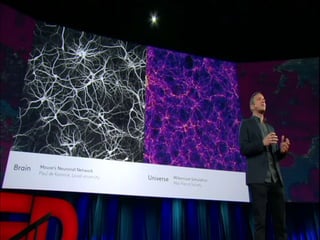
● Brain
● Bank & swift
● Finance & Economic
● Airline
● …………
4
5
Properties Of Complex Network
Non-trivial property in complex network
1.Clustering Coefficient
2.The Small-world Effect
3. Degree Distributions
4. Network Resilience
5.Community Structure
6
Macro
Miso
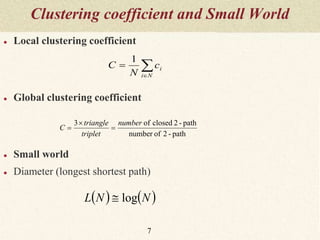
Clustering coefficient and Small World
● Local clustering coefficient
● Global clustering coefficient
● Small world
● Diameter (longest shortest path)
7
path-2ofnumber
path-2closedof3 number
triplet
triangle
C 


   NNL log


Ni
ic
N
C
1
32
1
)(  
k
kp
Distributer degree is Power Law
Robust vs. Cascade failures
node of random removal is robust
a few trigger node that can have large effects over the entire networks that the
mechanism collapsing the whole system
9
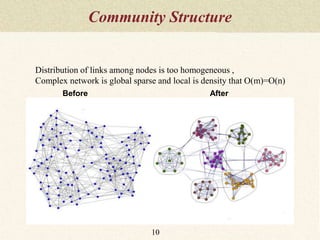
Community Structure
10
Before After
Distribution of links among nodes is too homogeneous ,
Complex network is global sparse and local is density that O(m)=O(n)
Definition of Community
Community is group of nodes which connection between nodes is
significantly higher that other nodes in the graph.
11
Vi)()( VKVK out
i
in
i    )(K
Vi
out
i
Vi
VVK in
i  

Application of Community Detection
1.scientic approach
community detection has important significance for understanding network
topology and analyzing network function
12
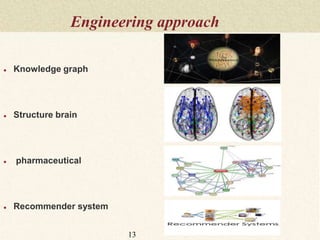
Engineering approach
● Knowledge graph
● Structure brain
● pharmaceutical
● Recommender system
13
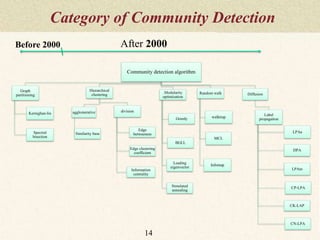
Community detection algorithm
Graph
partitioning
Kernighan-lin
Spectral
bisection
Hierarchical
clustering
agglomerative
Similarity base
division
Edge
betweeness
Edge clustering
coefficient
Information
centrality
.Modularity
optimization
Greedy
BGLL
Simulated
annealing
Leading
eigenvector
Random walk
walktrap
MCL
Infomap
Diffusion
Label
propagation
LPAa
DPA
LPAm
CP-LPA
CK-LAP
CN-LPA
14
Before 2000 After 2000
Category of Community Detection
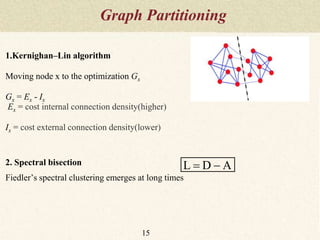
Graph Partitioning
1.Kernighan–Lin algorithm
Moving node x to the optimization Gx
Gx = Ex - Ix
Ex = cost internal connection density(higher)
Ix = cost external connection density(lower)
2. Spectral bisection
Fiedler’s spectral clustering emerges at long times
15
ADL 
1- Division (top-down approach)
● 1.Grivan and Newman(GN)
● 2.Edge clustering coefficient
● 3.Information centrality
16
 


Vwu uw
uw V
vBC
,
)(


    1,1min
)3(
,)3(
,


ji
ji
JI
kk
Z
C
   
 
K.1,...,K
'





GE
GEGE
E
E
C KL
K
2.Hierarchy (Agglomerative)
17
Index name formulae
Salton Index
yx kk
ydajxadj
yxs



)()(
),(
Jaccard Index
)()(
)()(
),(
ydajxadj
ydajxadj
yxs



Sorensen Index
),( yxs
yx kk
yadjxadj

 )()(
Adamic-Adar
Index
    


yadjxadjz zk
yxs
 log
1
),(
Local path 32
),( AAyxs 
Katz index
 




1
,.),(
L
l
yx
L
pathByxs
simrank
Local Random
Walk
    )(. tqtqts xyyxyxxy  
Common neighbor
Random walk base
similarity
Path similarity
Merge to node base similarity (on bottom-up approach )
Modularity is NP-Complete
Null model Newman
Q=(fraction of edges within communities)-(expected fraction of such edges)
18
Modularity Optimization is reduction to n
n
k
BknS 0
),(
  
ij
ijij PA
m
Q
2
1
 






ij
ji
ij
m
dd
A
m
Q
22
1
Modularity Optimization
1.Fast-Greedy
Global
2.Louvain(BGLL)
Local
19
 






ij
wv
ji
ij cc
m
dd
A
m
Q ),(
22
1

Modularity optimization
● Spectral Optimization
division into 2 communities (negative and positive elements)
)
2
(
m
kk
AB
ji
ijij 
20
• Resolution limit
2
M
M C 
Walktrap
21
 



n
k
t
jk
t
ik
kd
PP
jisimalarity
1
2
)(
),(
MCL
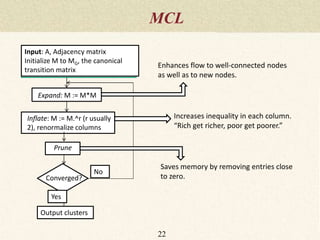
22
Expand: M := M*M
Inflate: M := M.^r (r usually
2), renormalize columns
Converged?
Input: A, Adjacency matrix
Initialize M to MG, the canonical
transition matrix
Yes
Output clusters
No
Prune
Enhances flow to well-connected nodes
as well as to new nodes.
Increases inequality in each column.
“Rich get richer, poor get poorer.”
Saves memory by removing entries close
to zero.
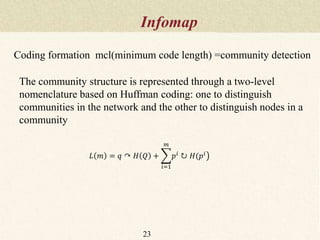
Infomap
23
The community structure is represented through a two-level
nomenclature based on Huffman coding: one to distinguish
communities in the network and the other to distinguish nodes in a
community
𝐿 𝑚 = 𝑞 ↷ 𝐻 𝑄 +
𝑖=1
𝑚
𝑝 𝑖
↻ 𝐻(𝑝 𝑖
Coding formation mcl(minimum code length) =community detection
LPA
Pros-cons LPA
Algorithm LPA
1.first initializes every node with a unique label
2. at every step each node updates Its current
label to the label shared by the maximum number
of its neighbors.
After a few iteration a single label would be
trapped inside a densely connected group of
nodes during label propagating.
Two step random
24
 vNC l
l
V maxarg
1.Select node
2.Tie break strategy
different communities may be detected in
different runs over the same network
1. time complexity liner o(m) 1.non stable
2. use of local information 2. monster
community
3. free parameter( none of
predefine any parameter)
4. none of optimization
25
2.DPA
1.LPAa
3.LPAm
   
SS nNin nC
)(
max
nii
nNi
iln wspmqxC
l



)(
arg
nii
nNi
iln wspmqxC
l
)1(arg
)(



nii
nNi
iln wsfmqxC
l



)(
arg 
Rule update
Rule update
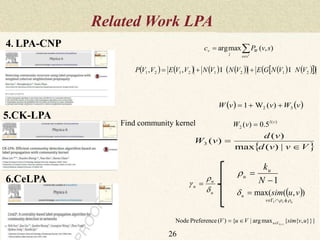
Related Work LPA
  ),(,
2
1
1
Xu
n
u
ux
xv xu
xxVuuv IIAAIIAH    







26
4. LPA-CNP
5.CK-LPA
6.CeLPA
Related Work LPA
)(
2 5.0)( vl
vW 
 Vvvd
vd
vW


|)(max
)(
)(3
   vWvvW 32 )(W1 
Find community kernel
u
u
u


  1

N
ku
u
 
uvv
u vusim




1
),(max(
}}},{{maxarg|{)(PreferenceNode )(1
uvsimVuV vu 
),(maxarg svPc
i
vs
W
l
v 


              21212121 ,, VNVNGEVNVNVVEVVP  
Social Ranking
27
Node Influence and label Influence
28
Divided node in complex network :1.core 2.hub 3.bridge 4. periphery
Node influence include hub and bridge can effect negative the improve LPA
Label influence include core
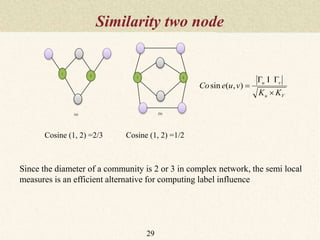
Similarity two node
29
1
2
21
(a) (b)
Vu
vu
KK
vueCo




),(sin
Cosine (1, 2) =2/3 Cosine (1, 2) =1/2
Since the diameter of a community is 2 or 3 in complex network, the semi local
measures is an efficient alternative for computing label influence
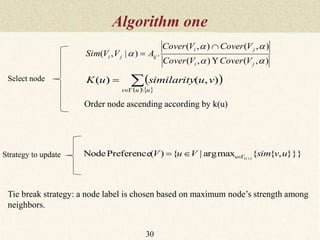
Algorithm one
30
),(),(
),(),(
.)|,(



ji
ji
ijji
VCoverVCover
VCoverVCover
AVVSim



 
   


uuv
vusimilarityuK

),()(
}}},{{maxarg|{)(PreferenceNode )(1
uvsimVuV vu 
Order node ascending according by k(u)
Select node
Strategy to update
Tie break strategy: a node label is chosen based on maximum node’s strength among
neighbors.
Example of Algorithm one
31
Iteration 1 Iteration 2 Iteration 3
No
de
Order
updatin
g
Current label New label Order
updating
Current
label
New label Updatin
g label
Current
label
New
label
1 1 1 7 1 7 7 1 7 7
2 9 9 16 9 16 16 9 16 16
3 7 7 7 7 7 7 7 7 7
4 2 2 7 2 7 7 2 7 7
5 16 16 16 16 16 16 16 16 16
6 6 6 7 6 7 7 6 7 7
7 3 3 7 3 7 7 3 7 7
8 4 4 7 4 7 7 4 7 7
9 5 5 7 5 7 7 5 7 7
10 15 15 16 15 16 16 15 16 16
11 14 14 16 14 16 16 14 16 16
12 17 17 16 17 16 16 17 16 16
13 13 13 16 13 16 16 13 16 16
14 11 11 16 11 16 16 11 16 16
15 18 18 16 18 16 16 18 16 16
16 8 8 7 8 7 7 8 7 7
17 10 10 16 10 16 16 10 16 16
18 12 12 16 12 16 16 12 16 16
8
2
1
3
6
7
5
4
18
16
17
9
15
14
13
12
10
0
11
1.5
3.89
7.05
2.84
2.80
2.80
2.87
3.92
1.82
3.53
2.37
6.30
2.76
0.9
1.43
2.0
6
2.64
1.91
0.8
6
0.78
1.02
0.9
4
Algorithm two
32
 
   


uuv
vusimilarityuK

),()(
}}},{{maxarg|{)(PreferenceNode )(1
uvsimVuV vu 
Order node ascending according by k(u)
Select node
Strategy to update
IAIAAAjiSKatz  13322
)(....),( 
3322
),( AAAjiS  
Tie break strategy: computes the sum of link strength for same labels among
neighbors, choose a label of neighbors that has maximum value after summation
meand
1

Example of Algorithm two
33
0 .5
4
1.3
2 1.8
6
1.8
9
3.
8
1.3
3
1.3
4 2.5
2.0
3 2.8
2.0
3
2.
6
1.
6
1.
9
0.
6
1.
3
1.
7
3.
9
2.0
3
0.32
ration 1 Iteration 2 Iteration 3
Nod
e Ord
er
upd
atin
g
Curre
nt
label
New
label
Order
updatin
g
Curre
nt
label
New
label
Updati
ng
label
Current
label
New
label
1 11 11 16 11 16 16 11 16 16
2 1 1 6 1 6 6 1 6 6
3 9 9 9 9 9 16 9 2 2
4 16 16 16 16 16 16 16 16 16
5 6 6 6 6 6 6 6 6 6
6 2 2 6 2 6 6 2 6 6
7
8
10
15
10
15
16
16
10
15
16
16
16
16
10
15
16
16
16
16
9 5 5 6 5 6 6 5 6 6
10 3 3 6 3 6 6 3 6 6
11 17 17 16 17 16 16 17 16 16
12 12 12 16 12 16 16 12 16 16
13 14 14 16 14 16 16 14 16 16
14 8 8 6 8 6 6 8 6 6
15 7 7 6 7 6 6 7 6 6
16 4 4 6 4 6 6 4 6 6
17 13 13 16 13 16 16 13 16 16
18 18 18 16 18 16 16 18 16 16
Complexity Time
34
1.The nodes are initially labeled in time O(n).
2.Calculating node and link strength similarity ,its time complexity is O(𝑛𝑘2
).
3.Ranking nodes based on node strength that has time complexity O (n) (due to
possibility of using radix and bucket sorting algorithm in a liner time).
4.The time complexity of label update according weight link neighbor is O(kn)
that is equal to O(m).
5.Finally, the time complexity of assigning the nodes with same label to its
community is O(n).
T(n)= ( O(n𝑘2
)+ O(k)+ O(2n)+ O(m))=O(m)
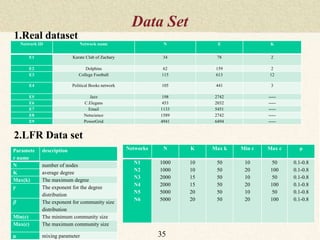
Data Set
35
Networks N K Max k Min c Max c μ
N1
N2
N3
N4
N5
N6
1000
1000
2000
2000
5000
5000
10
10
15
15
20
20
50
50
50
50
50
50
10
20
10
20
10
20
50
100
50
100
50
100
0.1-0.8
0.1-0.8
0.1-0.8
0.1-0.8
0.1-0.8
0.1-0.8
Paramete
r name
description
N number of nodes
K average degree
Max(k) The maximum degree
𝛾 The exponent for the degree
distribution
𝛽 The exponent for community size
distribution
Min(c) The minimum community size
Max(c) The maximum community size
µ mixing parameter
Network ID Network name N E K
E1 Karate Club of Zachary 34 78 2
E2 Dolphins 62 159 2
E3 College Football 115 613 12
E4 Political Books network 105 441 3
E5 Jazz 198 2742 -----
E6 C.Elegans 453 2032 -----
E7 Email 1133 5451 -----
E8 Netscience 1589 2742 -----
E9 PowerGrid 4941 6494 -----
1.Real dataset
2.LFR Data set
Evaluation Criteria
2.validation data set LFR
1.validation data set Real
 






ij
wv
ji
ij cc
m
dd
A
m
Q ),(
22
1

38
Between(0,1)
Between(0,1)
 
   BHAH
BAI
BANMI


,2
),(
Experiment(data set real)
37
Our algorithmLPABGLLInfomapFastmodulairtyDATA SET
NumberQNumberQNumberQNumberQNumberQ
30.3923±10.391±0.2530.38130.40130.380E1
30.5524±10.410±0.28050.41860.52740.495E2
130.58210±30.571±0.180100.604120.60060.549E3
6498.05±10.481 ±0.14140.52060.52240.501E4
40.3124±10.291±0.23050.44180.28050.438E5
140.4735±10.215±.159100.440400.415140.408E6
390.54212±50.500±0.200130.541660.521170.489E7
3340.933454±60.901±0.2104060.9594420.9014030.955E8
7690.823488±50.800±.1000400.9364900.816400.934E9
Result of modularity in the algorithm one
Result of modularity in the algorithm two
LP-LPALPADPAInfomapCNMData sets
NumberQNumberQNumberQNumberQNumberQ
30.4003±10.391±0.2550.39030.40130.380E1
30.5324±10.410±0.28050.49560.52740.495E2
130.48210±30.571±0.180110.604120.60060.549E3
30.5485±10.481 ±0.14150.51060.52240.501E4
190.54212±50.500±0.200410.511660.521170.489E5
2960.933454±60.901±0.2104810.8954420.9014030.955E6
357
121
0.823
0.829
488±5
925±25
0.800±0.100
0.739± 0.141
1143
1702
0.656
0.763
490
1070
0.816
0.800
40
190
0.934
0.852
E7
E8
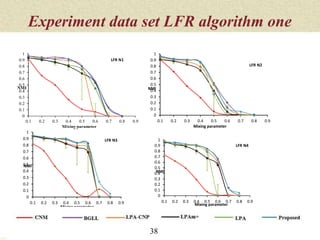
Experiment data set LFR algorithm one
38
0
0.1
0.2
0.3
0.4
0.5
0.6
0.7
0.8
0.9
1
0.1 0.2 0.3 0.4 0.5 0.6 0.7 0.8 0.9
NMI
Mixing parameter
LFR N1
0
0.1
0.2
0.3
0.4
0.5
0.6
0.7
0.8
0.9
1
0.1 0.2 0.3 0.4 0.5 0.6 0.7 0.8 0.9
NMI
Mixing parameter
LFR N2
0
0.1
0.2
0.3
0.4
0.5
0.6
0.7
0.8
0.9
1
0.1 0.2 0.3 0.4 0.5 0.6 0.7 0.8 0.9
NMI
Mixing parameter
LFR N3
0
0.1
0.2
0.3
0.4
0.5
0.6
0.7
0.8
0.9
1
0.1 0.2 0.3 0.4 0.5 0.6 0.7 0.8 0.9
NMI
Mixing parameter
LFR N4
Experiment data set LFR algorithm two
39
0
0.1
0.2
0.3
0.4
0.5
0.6
0.7
0.8
0.9
1
0.1 0.2 0.3 0.4 0.5 0.6 0.7 0.8 0.9
NMI
Mixing parameter
CNM
Infomap
DPA
LPA
LP-LPA
LFR N1
0
0.1
0.2
0.3
0.4
0.5
0.6
0.7
0.8
0.9
1
0.1 0.2 0.3 0.4 0.5 0.6 0.7 0.8 0.9
NMI
Mixing parameter
CNM
Infomap
DPA
LPA
LP-LPA
LFR N2
0
0.1
0.2
0.3
0.4
0.5
0.6
0.7
0.8
0.9
1
0.1 0.2 0.3 0.4 0.5 0.6 0.7 0.8 0.9
NMI
Mixing parameter
CNM
Infomap
DPA
LPA
LP-LPA
LFR N3
0
0.1
0.2
0.3
0.4
0.5
0.6
0.7
0.8
0.9
1
0.1 0.2 0.3 0.4 0.5 0.6 0.7 0.8 0.9
NMI
Mixing parameter
CNM
Infomap
DPA
LPA
LP-LPA
LFR N4
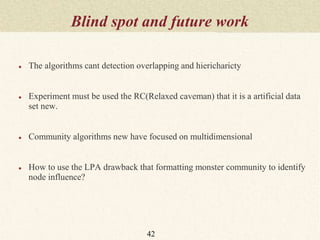
Blind spot and future work
● The algorithms cant detection overlapping and hiericharicty
● Experiment must be used the RC(Relaxed caveman) that it is a artificial data
set new.
● Community algorithms new have focused on multidimensional
● How to use the LPA drawback that formatting monster community to identify
node influence?
42
Thank you for your attention

community detection

  • 2.
    Defense End thesis issue ●Detecting Community in Social Network by Using Nodes Labeling Diffusion Supervisor: Dr. bouyer Advisor: Professor Sheikholeslami Master Reviewer : Dr. razmara Present Student : kamal berahmand 2 Monday October, 2016th 3
  • 3.
    Agenda ● Complex network ●Property of complex network ● Community structure ● Application of community structure ● Related work of community structure ● My Contribution of community structure ● Experiment ● Blind spot and Future work 3
  • 4.
    Type Of ComplexNetwork ● Social network ● W.W.W ● Internet ● Protein-protein ● Brain ● Bank & swift ● Finance & Economic ● Airline ● ………… 4
  • 5.
  • 6.
    Properties Of ComplexNetwork Non-trivial property in complex network 1.Clustering Coefficient 2.The Small-world Effect 3. Degree Distributions 4. Network Resilience 5.Community Structure 6 Macro Miso
  • 7.
    Clustering coefficient andSmall World ● Local clustering coefficient ● Global clustering coefficient ● Small world ● Diameter (longest shortest path) 7 path-2ofnumber path-2closedof3 number triplet triangle C       NNL log   Ni ic N C 1
  • 8.
  • 9.
    Robust vs. Cascadefailures node of random removal is robust a few trigger node that can have large effects over the entire networks that the mechanism collapsing the whole system 9
  • 10.
    Community Structure 10 Before After Distributionof links among nodes is too homogeneous , Complex network is global sparse and local is density that O(m)=O(n)
  • 11.
    Definition of Community Communityis group of nodes which connection between nodes is significantly higher that other nodes in the graph. 11 Vi)()( VKVK out i in i    )(K Vi out i Vi VVK in i   
  • 12.
    Application of CommunityDetection 1.scientic approach community detection has important significance for understanding network topology and analyzing network function 12
  • 13.
    Engineering approach ● Knowledgegraph ● Structure brain ● pharmaceutical ● Recommender system 13
  • 14.
    Community detection algorithm Graph partitioning Kernighan-lin Spectral bisection Hierarchical clustering agglomerative Similaritybase division Edge betweeness Edge clustering coefficient Information centrality .Modularity optimization Greedy BGLL Simulated annealing Leading eigenvector Random walk walktrap MCL Infomap Diffusion Label propagation LPAa DPA LPAm CP-LPA CK-LAP CN-LPA 14 Before 2000 After 2000 Category of Community Detection
  • 15.
    Graph Partitioning 1.Kernighan–Lin algorithm Movingnode x to the optimization Gx Gx = Ex - Ix Ex = cost internal connection density(higher) Ix = cost external connection density(lower) 2. Spectral bisection Fiedler’s spectral clustering emerges at long times 15 ADL 
  • 16.
    1- Division (top-downapproach) ● 1.Grivan and Newman(GN) ● 2.Edge clustering coefficient ● 3.Information centrality 16     Vwu uw uw V vBC , )(       1,1min )3( ,)3( ,   ji ji JI kk Z C       K.1,...,K '      GE GEGE E E C KL K
  • 17.
    2.Hierarchy (Agglomerative) 17 Index nameformulae Salton Index yx kk ydajxadj yxs    )()( ),( Jaccard Index )()( )()( ),( ydajxadj ydajxadj yxs    Sorensen Index ),( yxs yx kk yadjxadj   )()( Adamic-Adar Index        yadjxadjz zk yxs  log 1 ),( Local path 32 ),( AAyxs  Katz index       1 ,.),( L l yx L pathByxs simrank Local Random Walk     )(. tqtqts xyyxyxxy   Common neighbor Random walk base similarity Path similarity Merge to node base similarity (on bottom-up approach )
  • 18.
    Modularity is NP-Complete Nullmodel Newman Q=(fraction of edges within communities)-(expected fraction of such edges) 18 Modularity Optimization is reduction to n n k BknS 0 ),(    ij ijij PA m Q 2 1         ij ji ij m dd A m Q 22 1
  • 19.
  • 20.
    Modularity optimization ● SpectralOptimization division into 2 communities (negative and positive elements) ) 2 ( m kk AB ji ijij  20 • Resolution limit 2 M M C 
  • 21.
  • 22.
    MCL 22 Expand: M :=M*M Inflate: M := M.^r (r usually 2), renormalize columns Converged? Input: A, Adjacency matrix Initialize M to MG, the canonical transition matrix Yes Output clusters No Prune Enhances flow to well-connected nodes as well as to new nodes. Increases inequality in each column. “Rich get richer, poor get poorer.” Saves memory by removing entries close to zero.
  • 23.
    Infomap 23 The community structureis represented through a two-level nomenclature based on Huffman coding: one to distinguish communities in the network and the other to distinguish nodes in a community 𝐿 𝑚 = 𝑞 ↷ 𝐻 𝑄 + 𝑖=1 𝑚 𝑝 𝑖 ↻ 𝐻(𝑝 𝑖 Coding formation mcl(minimum code length) =community detection
  • 24.
    LPA Pros-cons LPA Algorithm LPA 1.firstinitializes every node with a unique label 2. at every step each node updates Its current label to the label shared by the maximum number of its neighbors. After a few iteration a single label would be trapped inside a densely connected group of nodes during label propagating. Two step random 24  vNC l l V maxarg 1.Select node 2.Tie break strategy different communities may be detected in different runs over the same network 1. time complexity liner o(m) 1.non stable 2. use of local information 2. monster community 3. free parameter( none of predefine any parameter) 4. none of optimization
  • 25.
    25 2.DPA 1.LPAa 3.LPAm    SS nNin nC )( max nii nNi iln wspmqxC l    )( arg nii nNi iln wspmqxC l )1(arg )(    nii nNi iln wsfmqxC l    )( arg  Rule update Rule update Related Work LPA   ),(, 2 1 1 Xu n u ux xv xu xxVuuv IIAAIIAH           
  • 26.
    26 4. LPA-CNP 5.CK-LPA 6.CeLPA Related WorkLPA )( 2 5.0)( vl vW   Vvvd vd vW   |)(max )( )(3    vWvvW 32 )(W1  Find community kernel u u u     1  N ku u   uvv u vusim     1 ),(max( }}},{{maxarg|{)(PreferenceNode )(1 uvsimVuV vu  ),(maxarg svPc i vs W l v                  21212121 ,, VNVNGEVNVNVVEVVP  
  • 27.
  • 28.
    Node Influence andlabel Influence 28 Divided node in complex network :1.core 2.hub 3.bridge 4. periphery Node influence include hub and bridge can effect negative the improve LPA Label influence include core
  • 29.
    Similarity two node 29 1 2 21 (a)(b) Vu vu KK vueCo     ),(sin Cosine (1, 2) =2/3 Cosine (1, 2) =1/2 Since the diameter of a community is 2 or 3 in complex network, the semi local measures is an efficient alternative for computing label influence
  • 30.
    Algorithm one 30 ),(),( ),(),( .)|,(    ji ji ijji VCoverVCover VCoverVCover AVVSim           uuv vusimilarityuK ),()( }}},{{maxarg|{)(PreferenceNode )(1 uvsimVuV vu  Order node ascending according by k(u) Select node Strategy to update Tie break strategy: a node label is chosen based on maximum node’s strength among neighbors.
  • 31.
    Example of Algorithmone 31 Iteration 1 Iteration 2 Iteration 3 No de Order updatin g Current label New label Order updating Current label New label Updatin g label Current label New label 1 1 1 7 1 7 7 1 7 7 2 9 9 16 9 16 16 9 16 16 3 7 7 7 7 7 7 7 7 7 4 2 2 7 2 7 7 2 7 7 5 16 16 16 16 16 16 16 16 16 6 6 6 7 6 7 7 6 7 7 7 3 3 7 3 7 7 3 7 7 8 4 4 7 4 7 7 4 7 7 9 5 5 7 5 7 7 5 7 7 10 15 15 16 15 16 16 15 16 16 11 14 14 16 14 16 16 14 16 16 12 17 17 16 17 16 16 17 16 16 13 13 13 16 13 16 16 13 16 16 14 11 11 16 11 16 16 11 16 16 15 18 18 16 18 16 16 18 16 16 16 8 8 7 8 7 7 8 7 7 17 10 10 16 10 16 16 10 16 16 18 12 12 16 12 16 16 12 16 16 8 2 1 3 6 7 5 4 18 16 17 9 15 14 13 12 10 0 11 1.5 3.89 7.05 2.84 2.80 2.80 2.87 3.92 1.82 3.53 2.37 6.30 2.76 0.9 1.43 2.0 6 2.64 1.91 0.8 6 0.78 1.02 0.9 4
  • 32.
    Algorithm two 32        uuv vusimilarityuK ),()( }}},{{maxarg|{)(PreferenceNode )(1 uvsimVuV vu  Order node ascending according by k(u) Select node Strategy to update IAIAAAjiSKatz  13322 )(....),(  3322 ),( AAAjiS   Tie break strategy: computes the sum of link strength for same labels among neighbors, choose a label of neighbors that has maximum value after summation meand 1 
  • 33.
    Example of Algorithmtwo 33 0 .5 4 1.3 2 1.8 6 1.8 9 3. 8 1.3 3 1.3 4 2.5 2.0 3 2.8 2.0 3 2. 6 1. 6 1. 9 0. 6 1. 3 1. 7 3. 9 2.0 3 0.32 ration 1 Iteration 2 Iteration 3 Nod e Ord er upd atin g Curre nt label New label Order updatin g Curre nt label New label Updati ng label Current label New label 1 11 11 16 11 16 16 11 16 16 2 1 1 6 1 6 6 1 6 6 3 9 9 9 9 9 16 9 2 2 4 16 16 16 16 16 16 16 16 16 5 6 6 6 6 6 6 6 6 6 6 2 2 6 2 6 6 2 6 6 7 8 10 15 10 15 16 16 10 15 16 16 16 16 10 15 16 16 16 16 9 5 5 6 5 6 6 5 6 6 10 3 3 6 3 6 6 3 6 6 11 17 17 16 17 16 16 17 16 16 12 12 12 16 12 16 16 12 16 16 13 14 14 16 14 16 16 14 16 16 14 8 8 6 8 6 6 8 6 6 15 7 7 6 7 6 6 7 6 6 16 4 4 6 4 6 6 4 6 6 17 13 13 16 13 16 16 13 16 16 18 18 18 16 18 16 16 18 16 16
  • 34.
    Complexity Time 34 1.The nodesare initially labeled in time O(n). 2.Calculating node and link strength similarity ,its time complexity is O(𝑛𝑘2 ). 3.Ranking nodes based on node strength that has time complexity O (n) (due to possibility of using radix and bucket sorting algorithm in a liner time). 4.The time complexity of label update according weight link neighbor is O(kn) that is equal to O(m). 5.Finally, the time complexity of assigning the nodes with same label to its community is O(n). T(n)= ( O(n𝑘2 )+ O(k)+ O(2n)+ O(m))=O(m)
  • 35.
    Data Set 35 Networks NK Max k Min c Max c μ N1 N2 N3 N4 N5 N6 1000 1000 2000 2000 5000 5000 10 10 15 15 20 20 50 50 50 50 50 50 10 20 10 20 10 20 50 100 50 100 50 100 0.1-0.8 0.1-0.8 0.1-0.8 0.1-0.8 0.1-0.8 0.1-0.8 Paramete r name description N number of nodes K average degree Max(k) The maximum degree 𝛾 The exponent for the degree distribution 𝛽 The exponent for community size distribution Min(c) The minimum community size Max(c) The maximum community size µ mixing parameter Network ID Network name N E K E1 Karate Club of Zachary 34 78 2 E2 Dolphins 62 159 2 E3 College Football 115 613 12 E4 Political Books network 105 441 3 E5 Jazz 198 2742 ----- E6 C.Elegans 453 2032 ----- E7 Email 1133 5451 ----- E8 Netscience 1589 2742 ----- E9 PowerGrid 4941 6494 ----- 1.Real dataset 2.LFR Data set
  • 36.
    Evaluation Criteria 2.validation dataset LFR 1.validation data set Real         ij wv ji ij cc m dd A m Q ),( 22 1  38 Between(0,1) Between(0,1)      BHAH BAI BANMI   ,2 ),(
  • 37.
    Experiment(data set real) 37 OuralgorithmLPABGLLInfomapFastmodulairtyDATA SET NumberQNumberQNumberQNumberQNumberQ 30.3923±10.391±0.2530.38130.40130.380E1 30.5524±10.410±0.28050.41860.52740.495E2 130.58210±30.571±0.180100.604120.60060.549E3 6498.05±10.481 ±0.14140.52060.52240.501E4 40.3124±10.291±0.23050.44180.28050.438E5 140.4735±10.215±.159100.440400.415140.408E6 390.54212±50.500±0.200130.541660.521170.489E7 3340.933454±60.901±0.2104060.9594420.9014030.955E8 7690.823488±50.800±.1000400.9364900.816400.934E9 Result of modularity in the algorithm one Result of modularity in the algorithm two LP-LPALPADPAInfomapCNMData sets NumberQNumberQNumberQNumberQNumberQ 30.4003±10.391±0.2550.39030.40130.380E1 30.5324±10.410±0.28050.49560.52740.495E2 130.48210±30.571±0.180110.604120.60060.549E3 30.5485±10.481 ±0.14150.51060.52240.501E4 190.54212±50.500±0.200410.511660.521170.489E5 2960.933454±60.901±0.2104810.8954420.9014030.955E6 357 121 0.823 0.829 488±5 925±25 0.800±0.100 0.739± 0.141 1143 1702 0.656 0.763 490 1070 0.816 0.800 40 190 0.934 0.852 E7 E8
  • 38.
    Experiment data setLFR algorithm one 38 0 0.1 0.2 0.3 0.4 0.5 0.6 0.7 0.8 0.9 1 0.1 0.2 0.3 0.4 0.5 0.6 0.7 0.8 0.9 NMI Mixing parameter LFR N1 0 0.1 0.2 0.3 0.4 0.5 0.6 0.7 0.8 0.9 1 0.1 0.2 0.3 0.4 0.5 0.6 0.7 0.8 0.9 NMI Mixing parameter LFR N2 0 0.1 0.2 0.3 0.4 0.5 0.6 0.7 0.8 0.9 1 0.1 0.2 0.3 0.4 0.5 0.6 0.7 0.8 0.9 NMI Mixing parameter LFR N3 0 0.1 0.2 0.3 0.4 0.5 0.6 0.7 0.8 0.9 1 0.1 0.2 0.3 0.4 0.5 0.6 0.7 0.8 0.9 NMI Mixing parameter LFR N4
  • 39.
    Experiment data setLFR algorithm two 39 0 0.1 0.2 0.3 0.4 0.5 0.6 0.7 0.8 0.9 1 0.1 0.2 0.3 0.4 0.5 0.6 0.7 0.8 0.9 NMI Mixing parameter CNM Infomap DPA LPA LP-LPA LFR N1 0 0.1 0.2 0.3 0.4 0.5 0.6 0.7 0.8 0.9 1 0.1 0.2 0.3 0.4 0.5 0.6 0.7 0.8 0.9 NMI Mixing parameter CNM Infomap DPA LPA LP-LPA LFR N2 0 0.1 0.2 0.3 0.4 0.5 0.6 0.7 0.8 0.9 1 0.1 0.2 0.3 0.4 0.5 0.6 0.7 0.8 0.9 NMI Mixing parameter CNM Infomap DPA LPA LP-LPA LFR N3 0 0.1 0.2 0.3 0.4 0.5 0.6 0.7 0.8 0.9 1 0.1 0.2 0.3 0.4 0.5 0.6 0.7 0.8 0.9 NMI Mixing parameter CNM Infomap DPA LPA LP-LPA LFR N4
  • 40.
    Blind spot andfuture work ● The algorithms cant detection overlapping and hiericharicty ● Experiment must be used the RC(Relaxed caveman) that it is a artificial data set new. ● Community algorithms new have focused on multidimensional ● How to use the LPA drawback that formatting monster community to identify node influence? 42
  • 41.
    Thank you foryour attention