From Data Mining
to
Knowledge Discovery:
An Introduction
Gregory Piatetsky-Shapiro
KDnuggets
2
Outline
Introduction
Data Mining Tasks
Application Examples
3
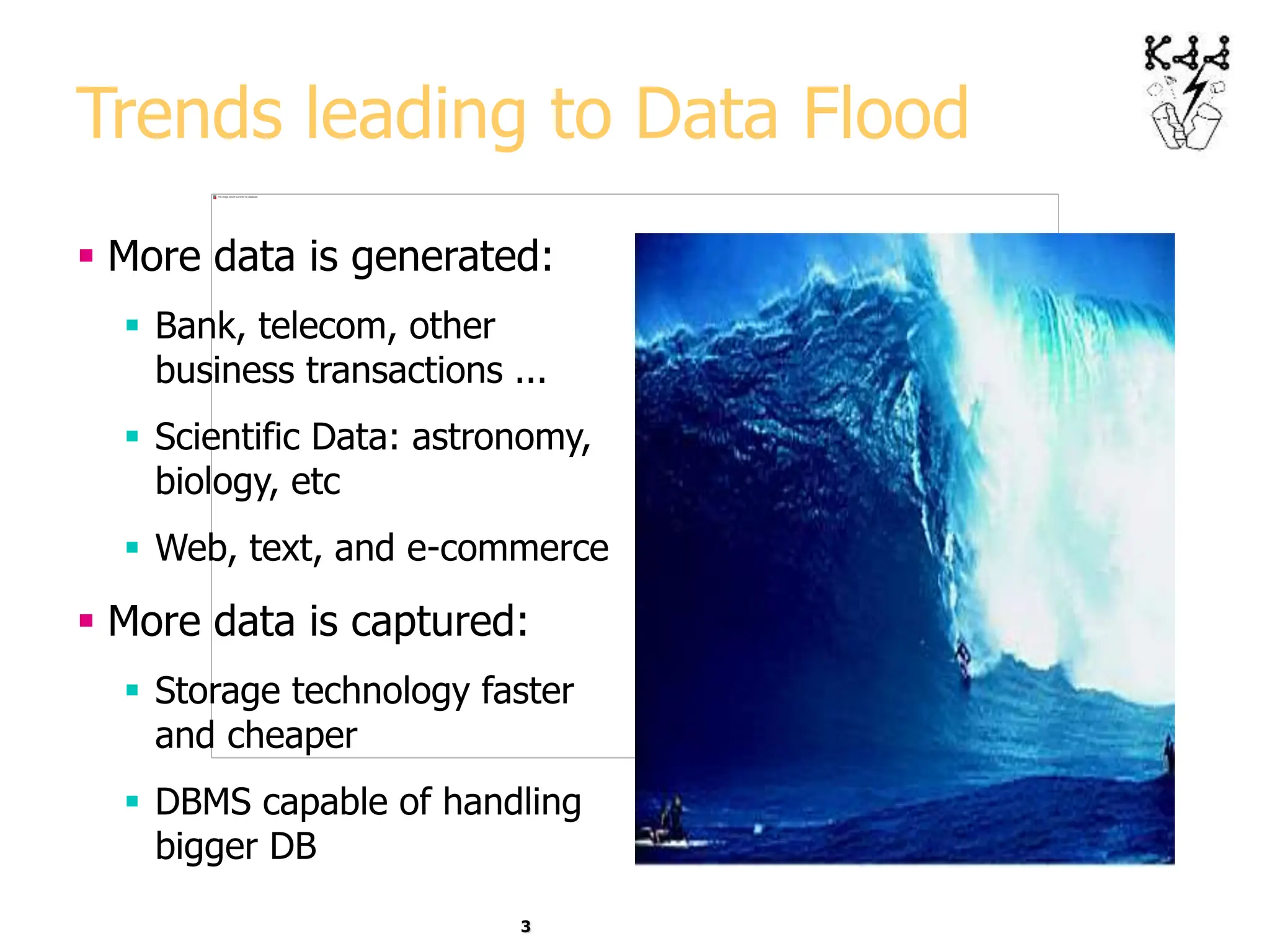
Trends leading to Data Flood
 More data is generated:
 Bank, telecom, other
business transactions ...
 Scientific Data: astronomy,
biology, etc
 Web, text, and e-commerce
 More data is captured:
 Storage technology faster
and cheaper
 DBMS capable of handling
bigger DB
4
Examples
 Europe's Very Long Baseline Interferometry
(VLBI) has 16 telescopes, each of which produces
1 Gigabit/second of astronomical data over a
25-day observation session
 storage and analysis a big problem
 Walmart reported to have 24 Tera-byte DB
 AT&T handles billions of calls per day
 data cannot be stored -- analysis is done on the fly
5
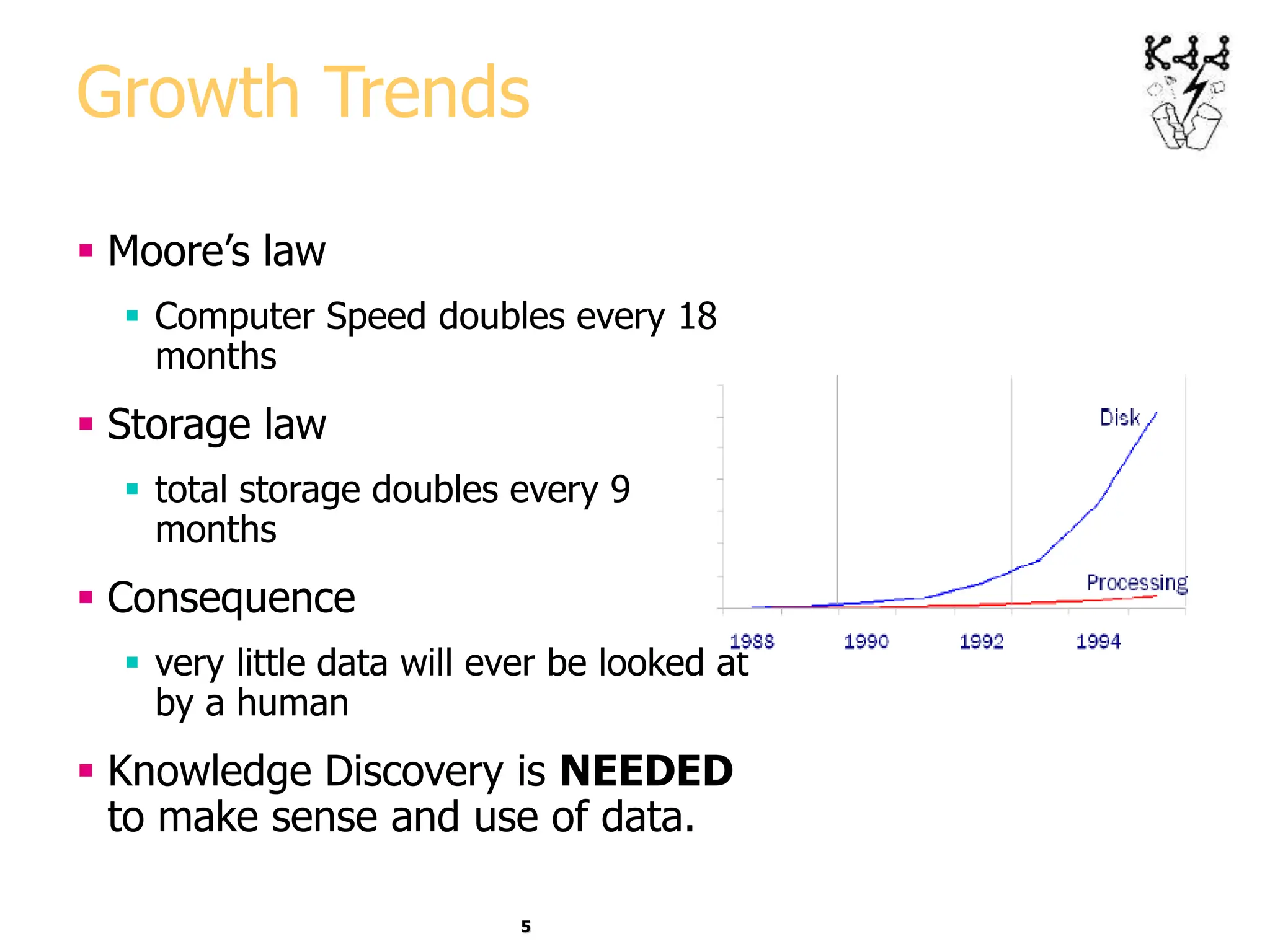
Growth Trends
 Moore’s law
 Computer Speed doubles every 18
months
 Storage law
 total storage doubles every 9
months
 Consequence
 very little data will ever be looked at
by a human
 Knowledge Discovery is NEEDED
to make sense and use of data.
6
Knowledge Discovery Definition
Knowledge Discovery in Data is the
non-trivial process of identifying
 valid
 novel
 potentially useful
 and ultimately understandable patterns in data.
from Advances in Knowledge Discovery and Data
Mining, Fayyad, Piatetsky-Shapiro, Smyth, and
Uthurusamy, (Chapter 1), AAAI/MIT Press 1996
7
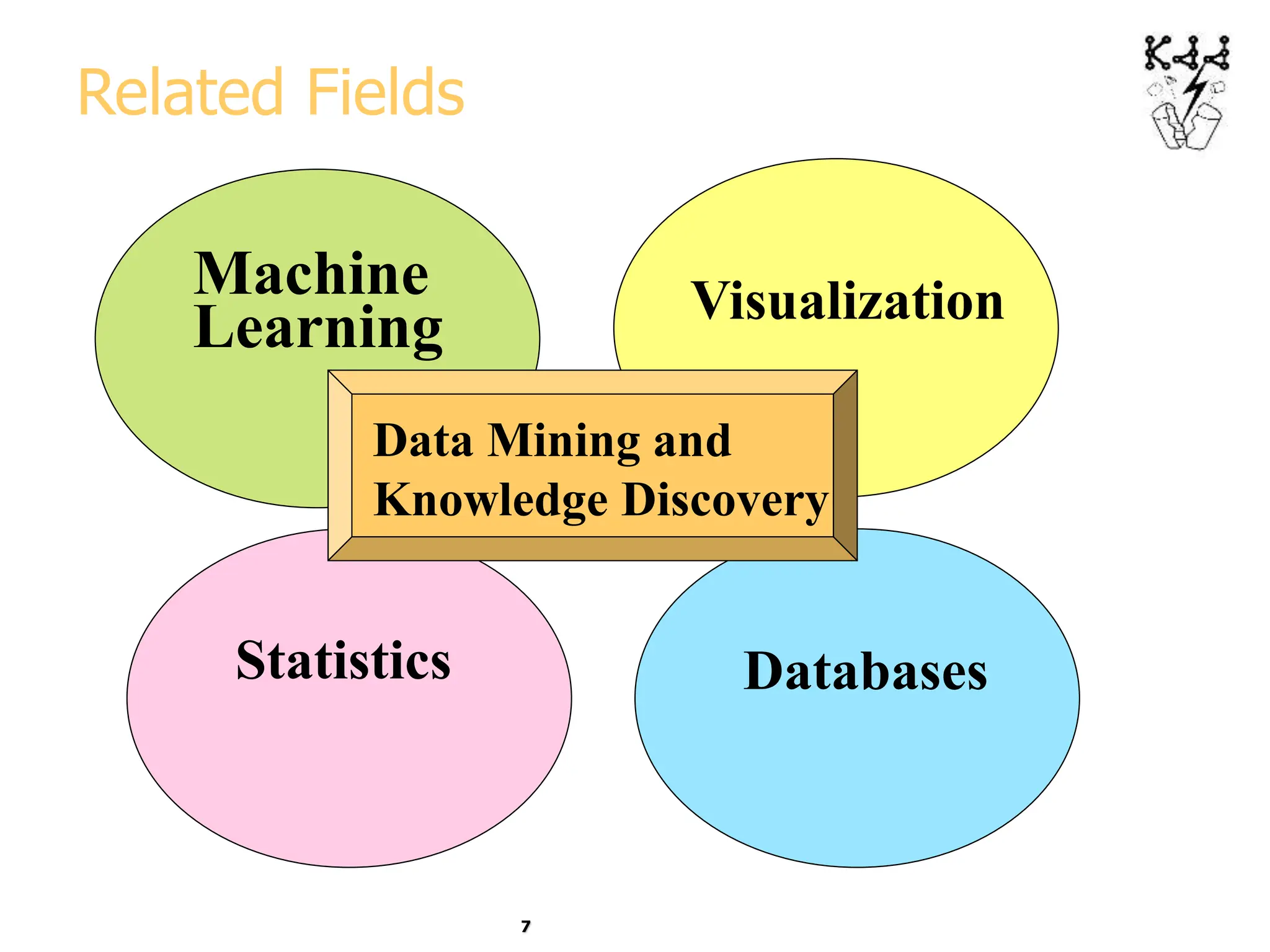
Related Fields
Statistics
Machine
Learning
Databases
Visualization
Data Mining and
Knowledge Discovery
8
__
__
__
__
__
__
__
__
__
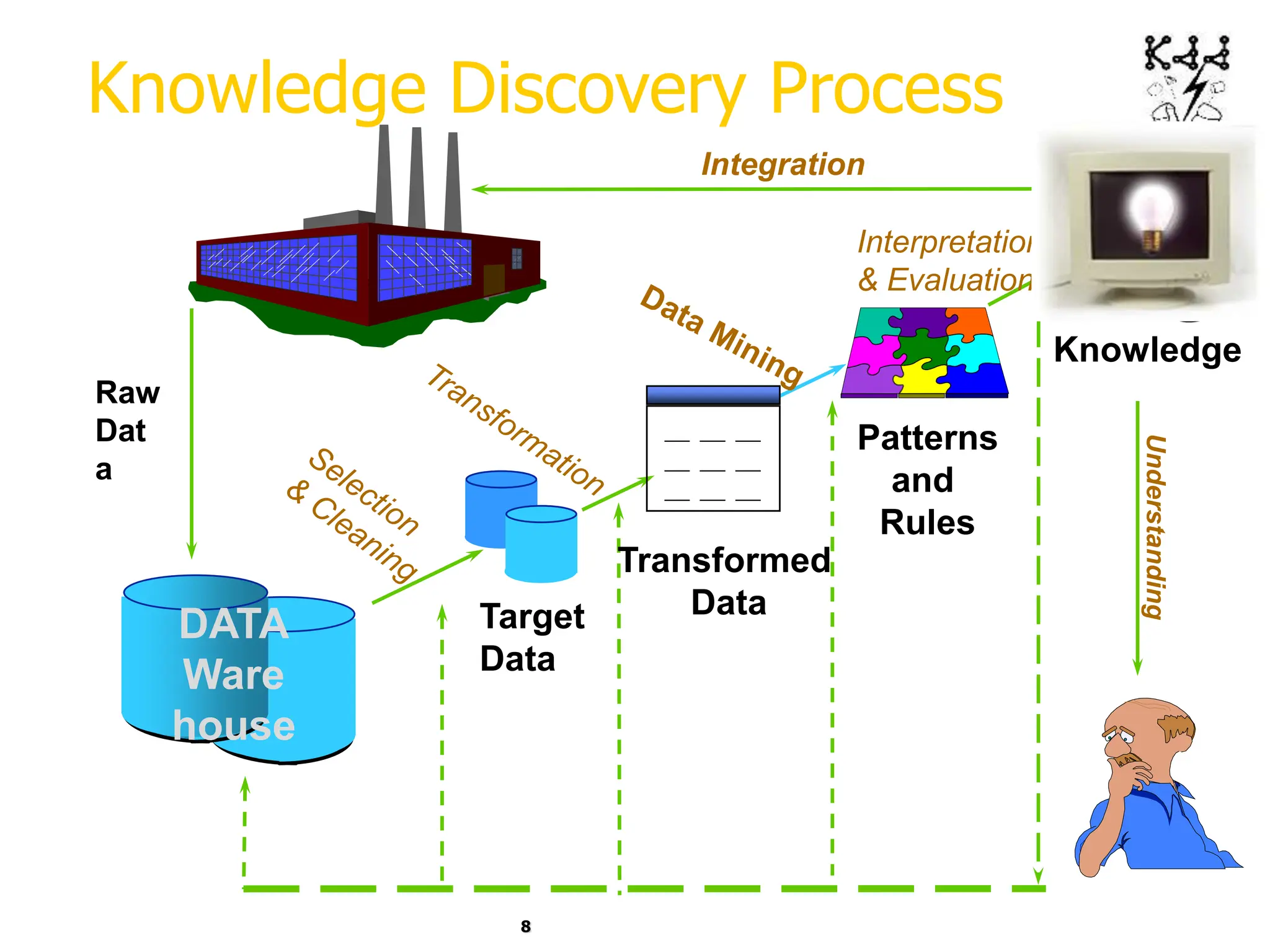
Transformed
Data
Patterns
and
Rules
Target
Data
Raw
Dat
a
Knowledge
Interpretation
& Evaluation
Integration
Understanding
Knowledge Discovery Process
DATA
Ware
house
Knowledge
9
Outline
Introduction
Data Mining Tasks
Application Examples
10
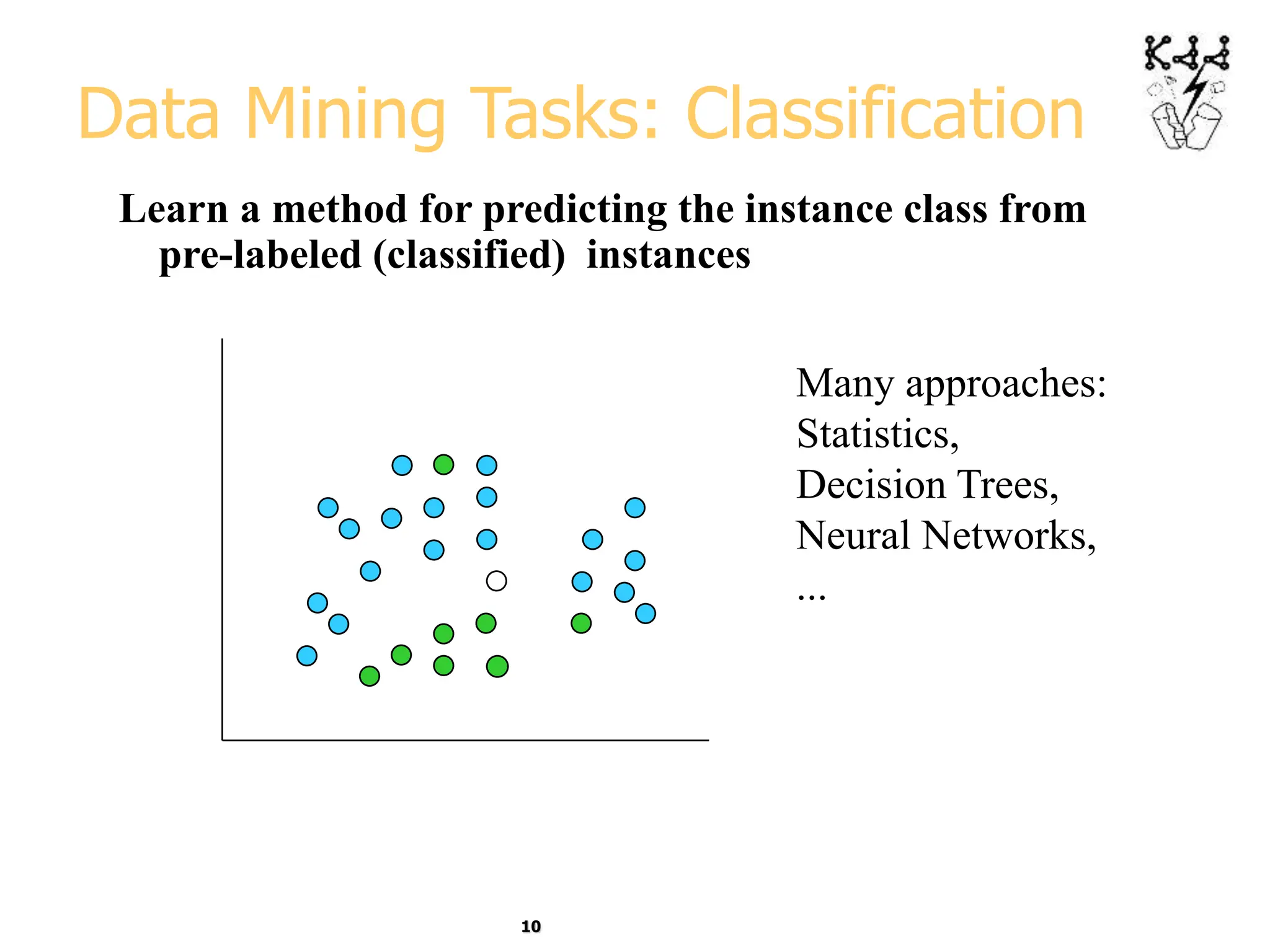
Data Mining Tasks: Classification
Learn a method for predicting the instance class from
pre-labeled (classified) instances
Many approaches:
Statistics,
Decision Trees,
Neural Networks,
...
11
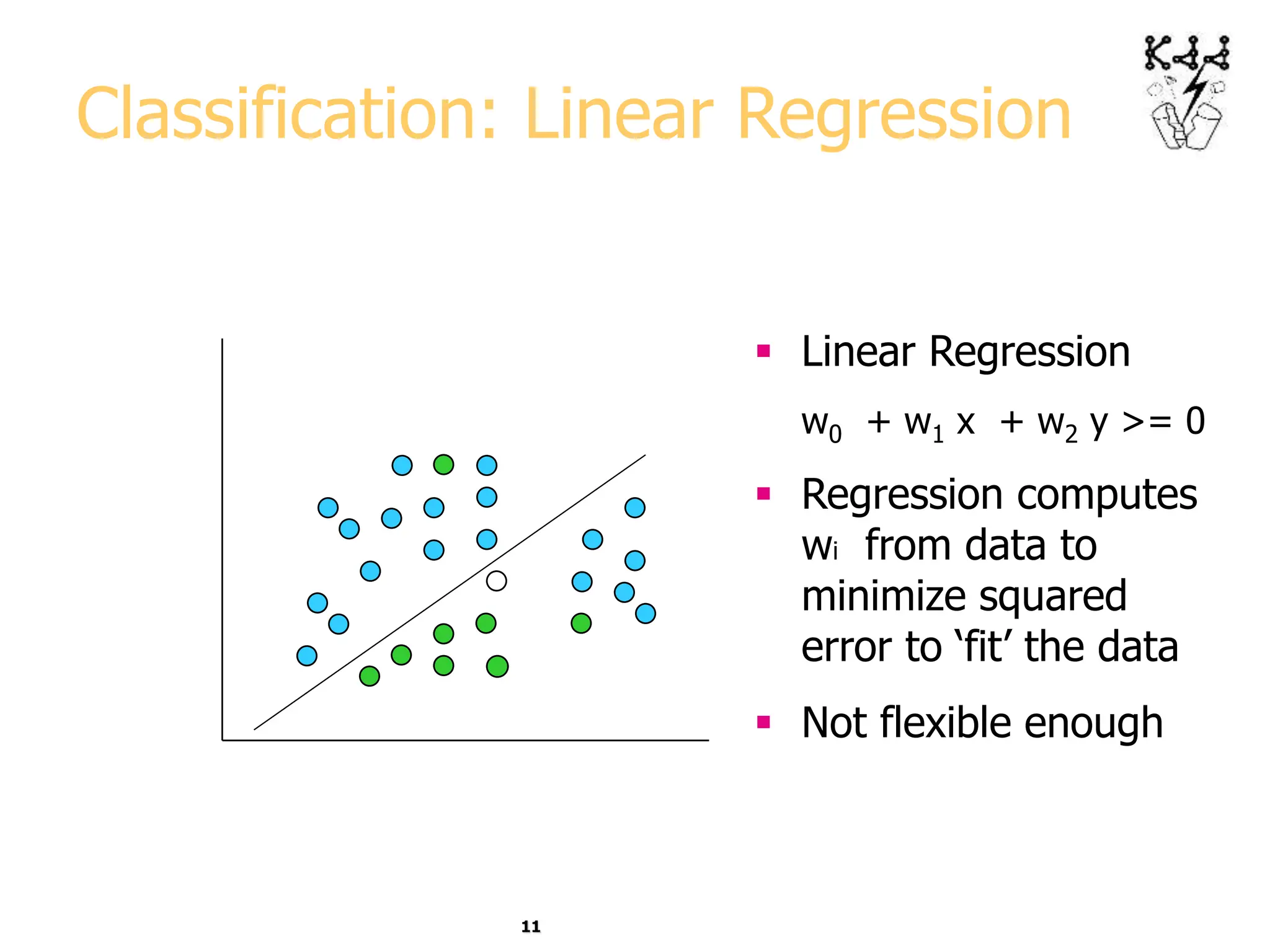
Classification: Linear Regression
 Linear Regression
w0 + w1 x + w2 y >= 0
 Regression computes
wi from data to
minimize squared
error to ‘fit’ the data
 Not flexible enough
12
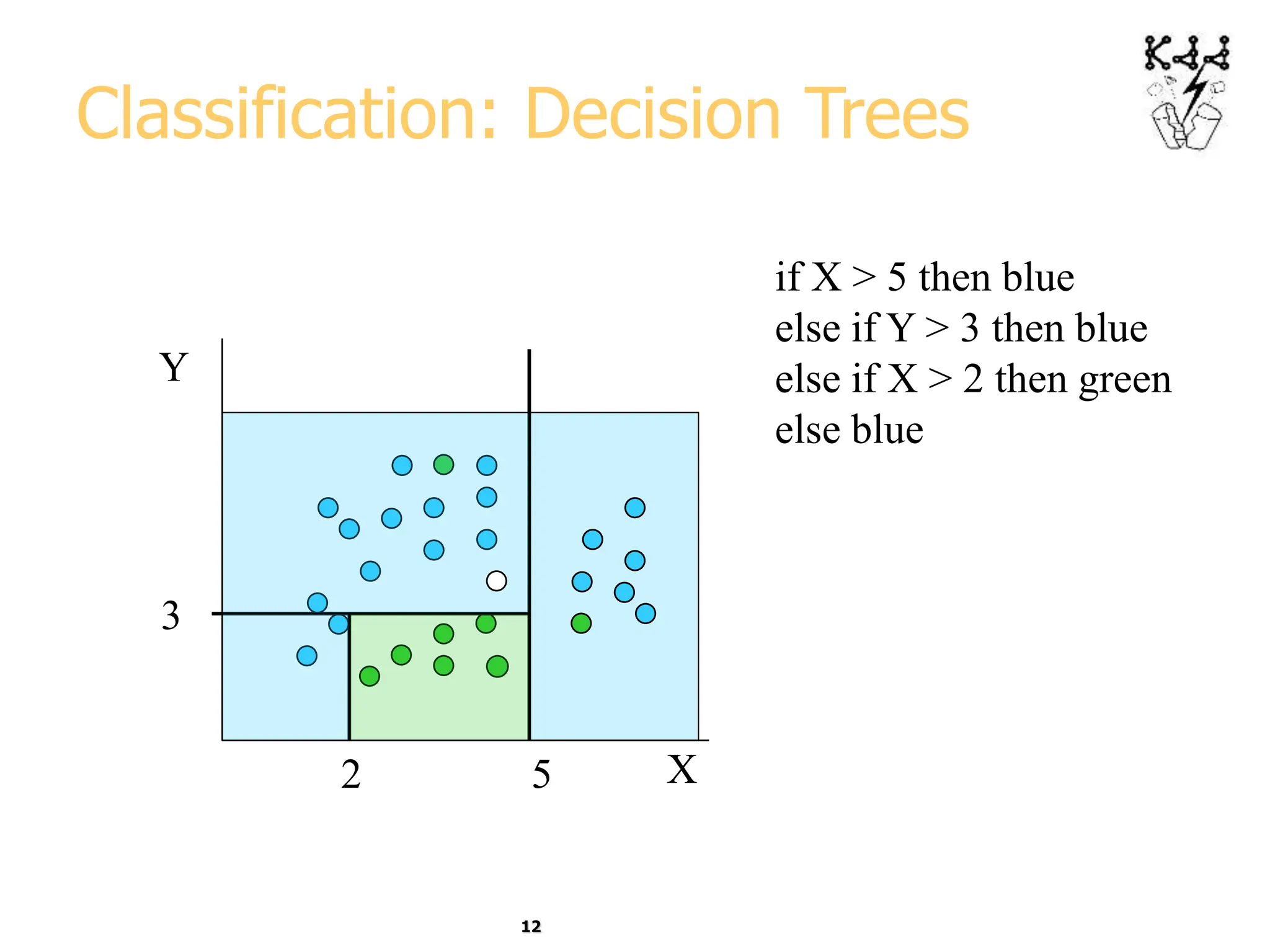
Classification: Decision Trees
X
Y
if X > 5 then blue
else if Y > 3 then blue
else if X > 2 then green
else blue
5
2
3
13
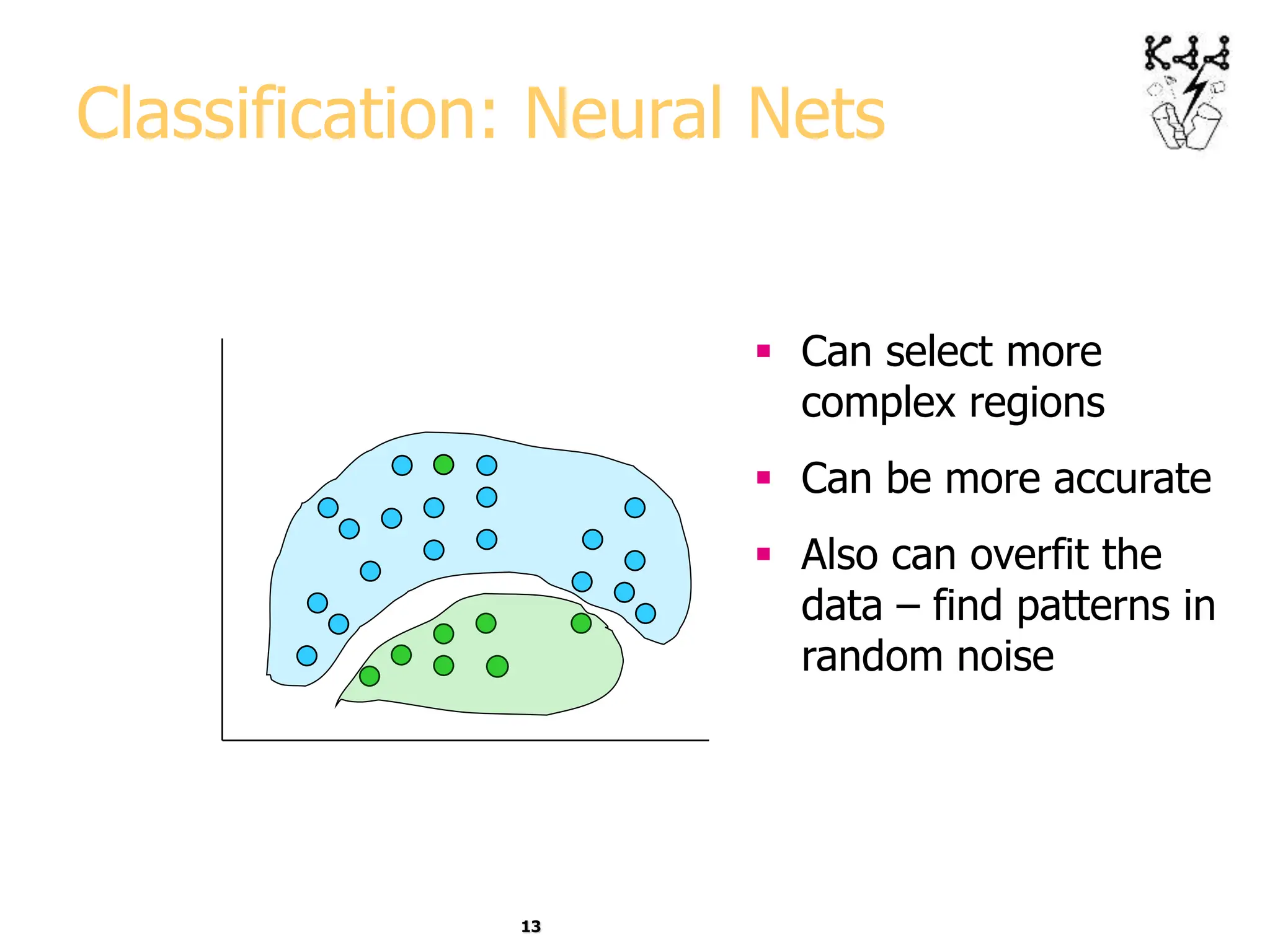
Classification: Neural Nets
 Can select more
complex regions
 Can be more accurate
 Also can overfit the
data – find patterns in
random noise
14
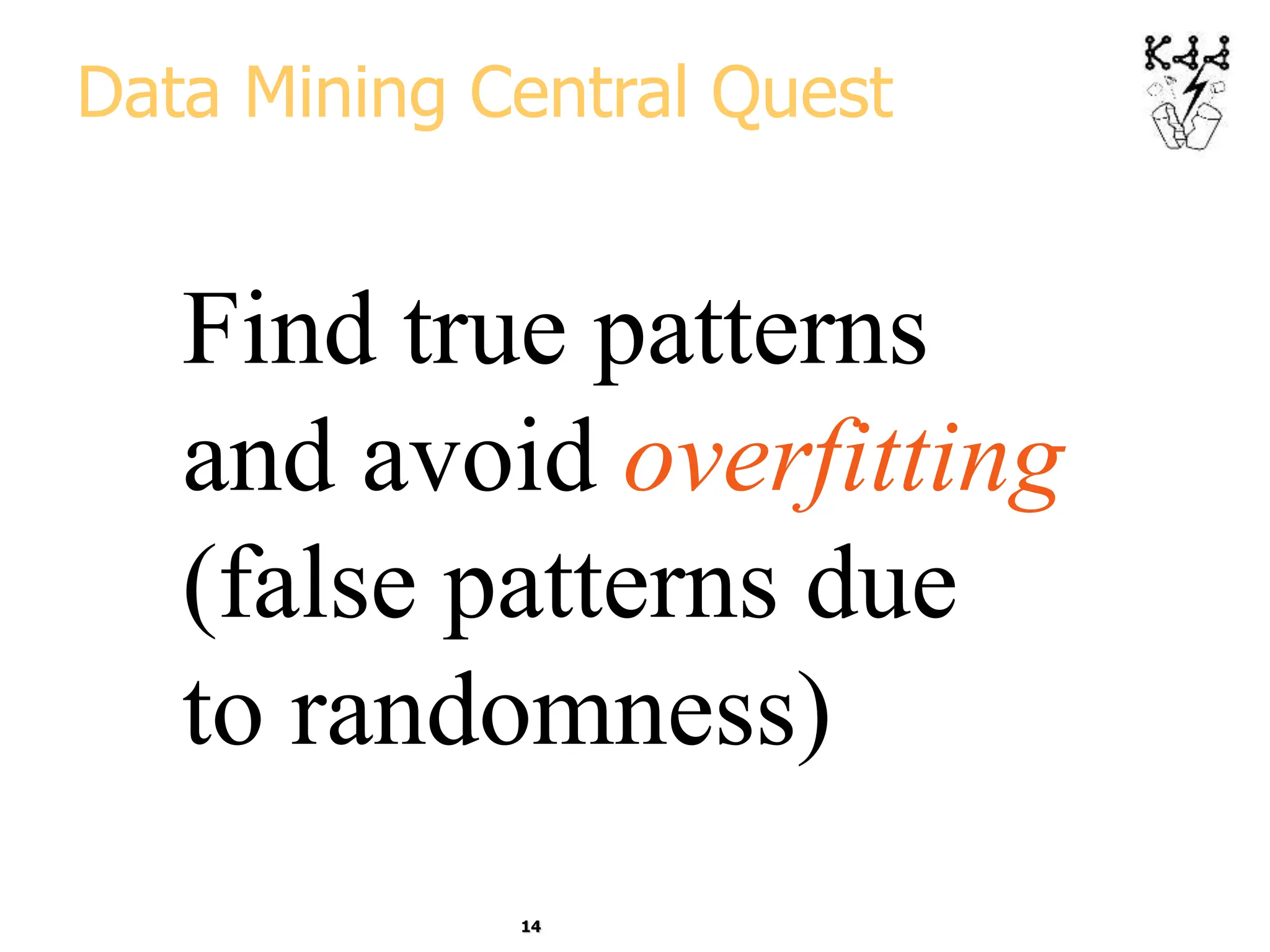
Data Mining Central Quest
Find true patterns
and avoid overfitting
(false patterns due
to randomness)
15
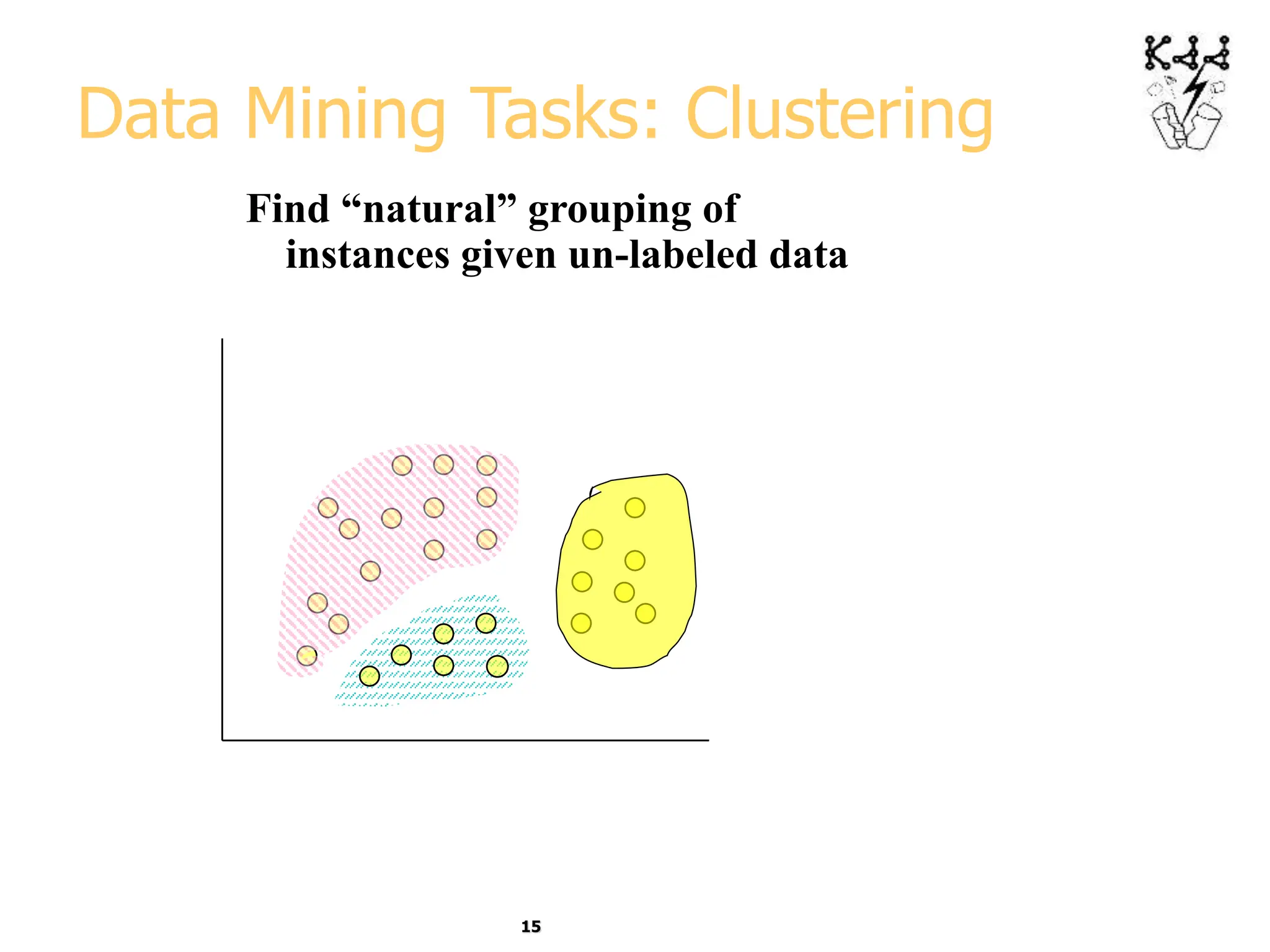
Data Mining Tasks: Clustering
Find “natural” grouping of
instances given un-labeled data
16
Major Data Mining Tasks
 Classification: predicting an item class
 Clustering: finding clusters in data
 Associations: e.g. A & B & C occur frequently
 Visualization: to facilitate human discovery
 Estimation: predicting a continuous value
 Deviation Detection: finding changes
 Link Analysis: finding relationships
 …
17
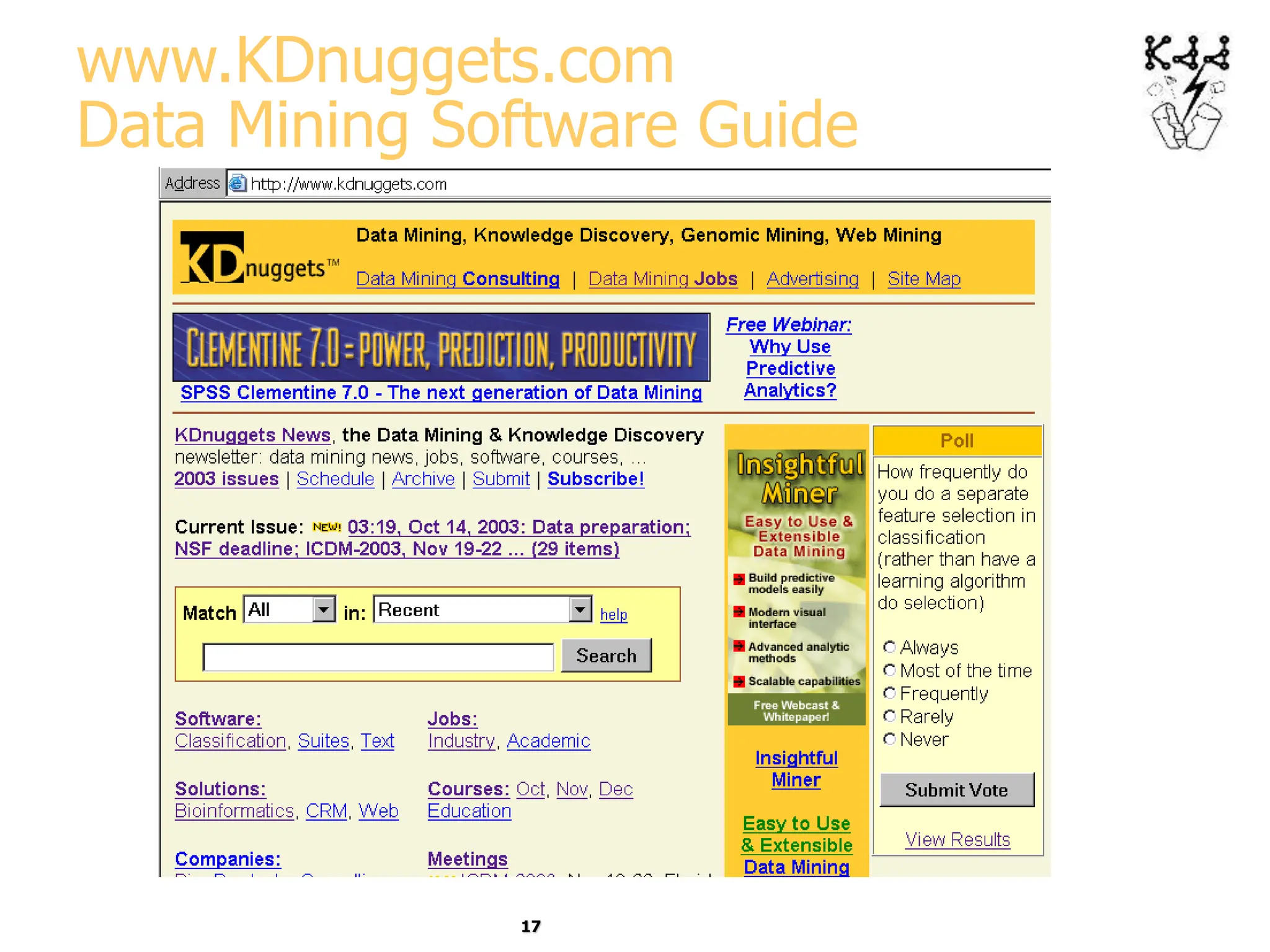
www.KDnuggets.com
Data Mining Software Guide
18
Outline
Introduction
Data Mining Tasks
Application Examples
19
Major Application Areas for
Data Mining Solutions
 Advertising
 Bioinformatics
 Customer Relationship Management (CRM)
 Database Marketing
 Fraud Detection
 eCommerce
 Health Care
 Investment/Securities
 Manufacturing, Process Control
 Sports and Entertainment
 Telecommunications
 Web
20
Case Study: Search Engines
 Early search engines used mainly keywords on a
page – were subject to manipulation
 Google success is due to its algorithm which uses
mainly links to the page
 Google founders Sergey Brin and Larry Page were
students in Stanford doing research in databases
and data mining in 1998 which led to Google
21
Case Study:
Direct Marketing and CRM
 Most major direct marketing companies are using
modeling and data mining
 Most financial companies are using customer
modeling
 Modeling is easier than changing customer
behaviour
 Some successes
 Verizon Wireless reduced churn rate from 2% to 1.5%
22
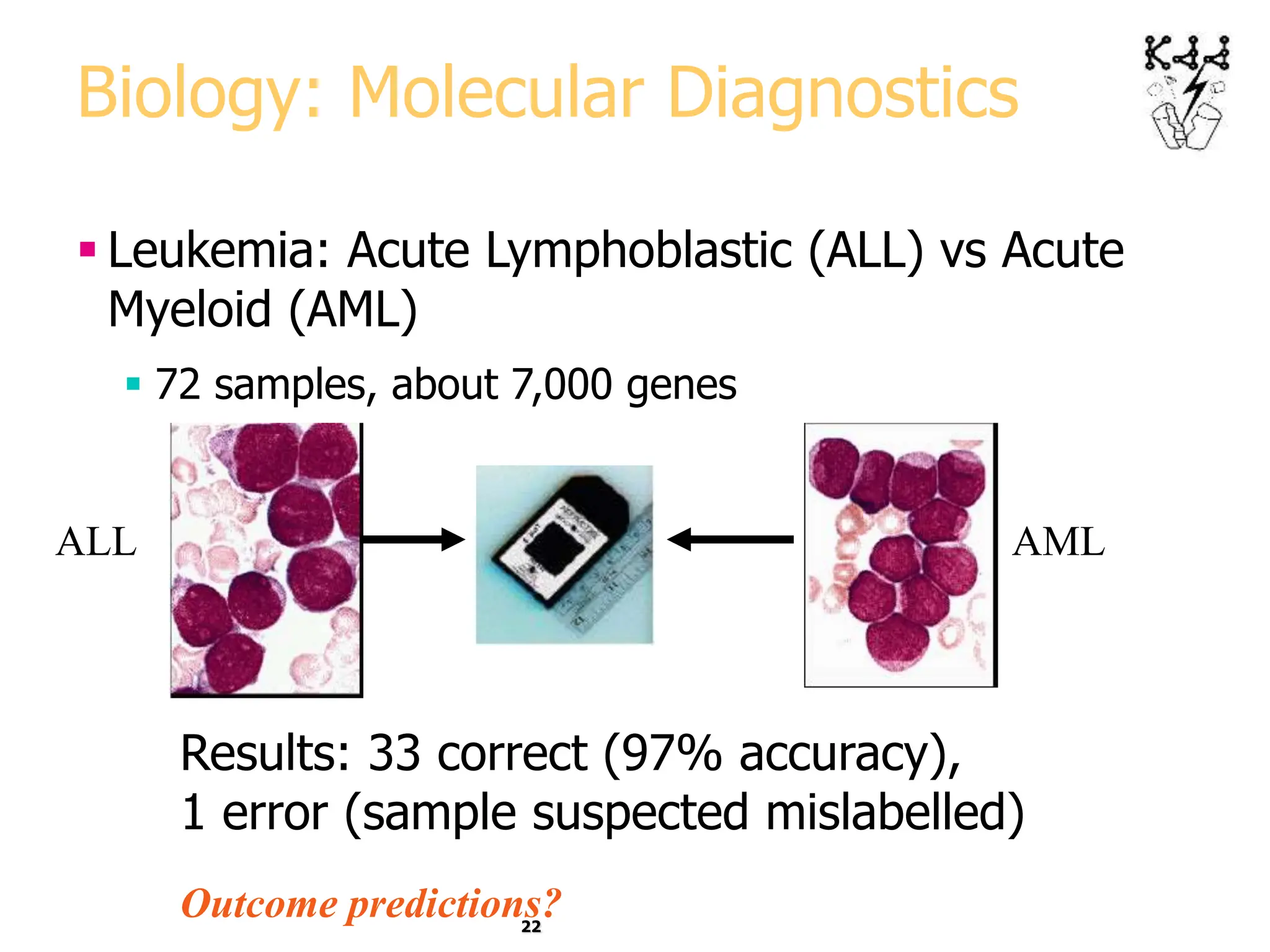
Biology: Molecular Diagnostics
 Leukemia: Acute Lymphoblastic (ALL) vs Acute
Myeloid (AML)
 72 samples, about 7,000 genes
ALL AML
Results: 33 correct (97% accuracy),
1 error (sample suspected mislabelled)
Outcome predictions?
23
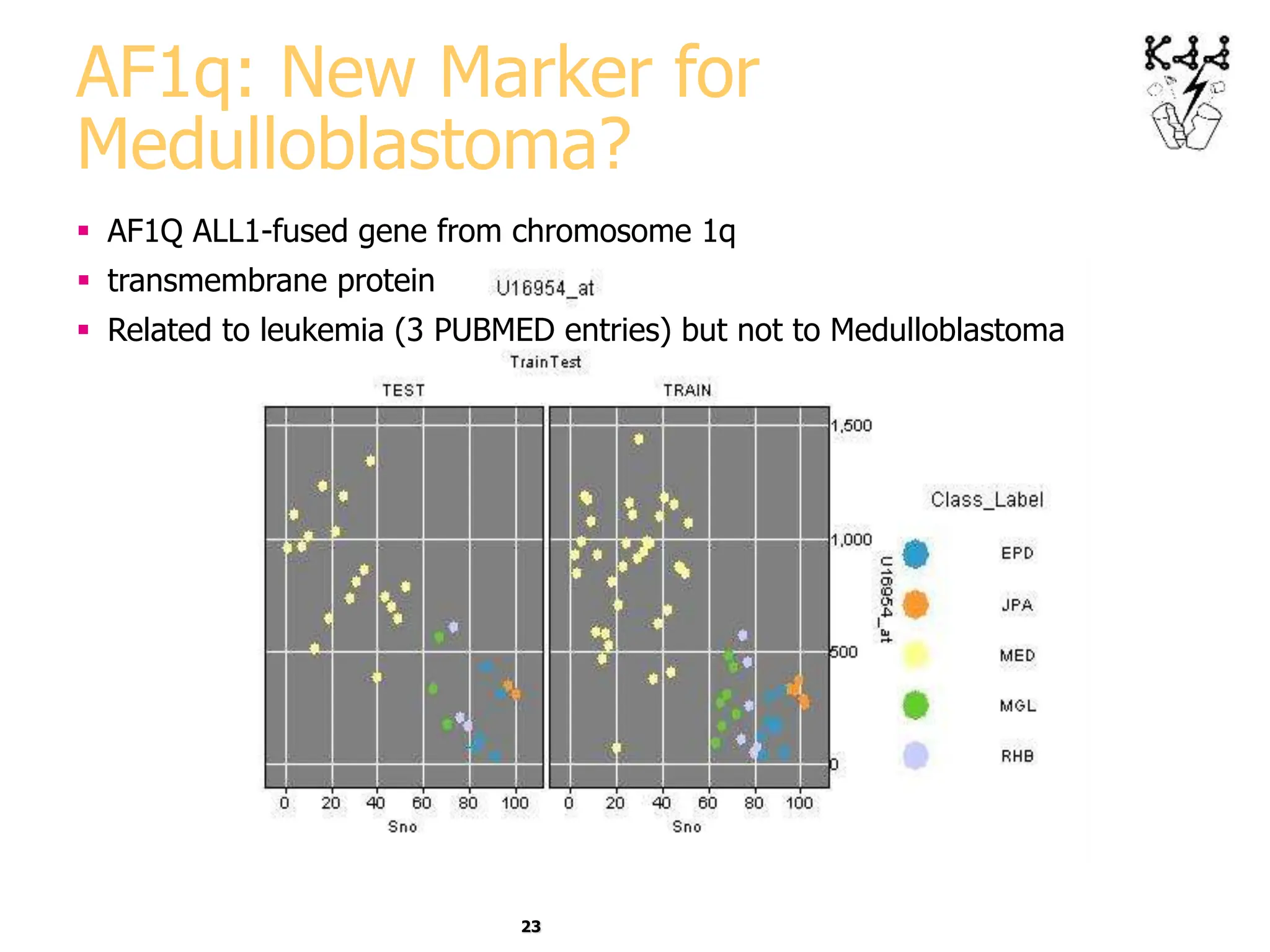
AF1q: New Marker for
Medulloblastoma?
 AF1Q ALL1-fused gene from chromosome 1q
 transmembrane protein
 Related to leukemia (3 PUBMED entries) but not to Medulloblastoma
24
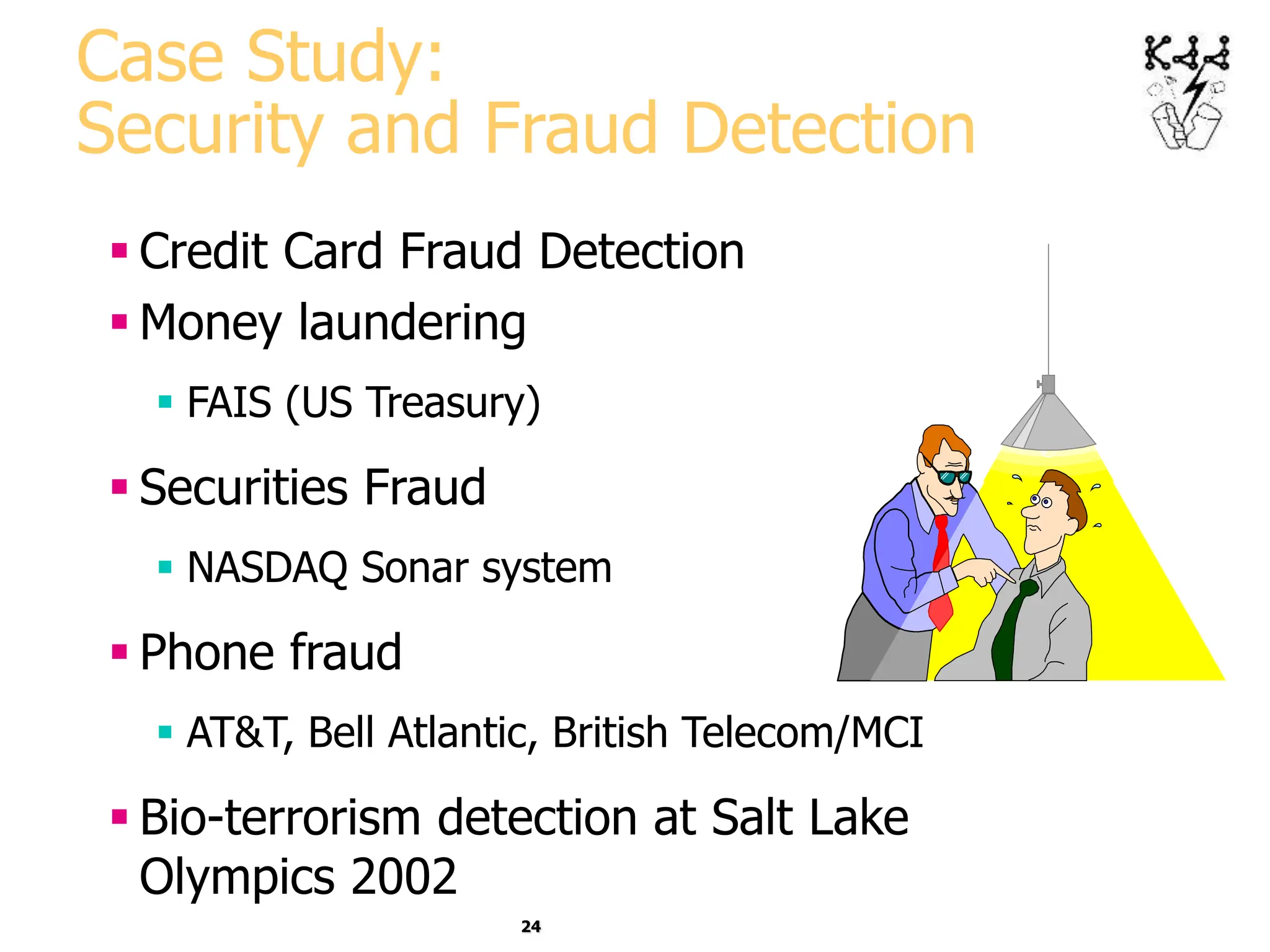
Case Study:
Security and Fraud Detection
 Credit Card Fraud Detection
 Money laundering
 FAIS (US Treasury)
 Securities Fraud
 NASDAQ Sonar system
 Phone fraud
 AT&T, Bell Atlantic, British Telecom/MCI
 Bio-terrorism detection at Salt Lake
Olympics 2002
25
Data Mining and Terrorism:
Controversy in the News
 TIA: Terrorism (formerly Total) Information
Awareness Program –
 DARPA program closed by Congress
 some functions transferred to intelligence agencies
 CAPPS II – screen all airline passengers
 controversial
 …
 Invasion of Privacy or Defensive Shield?
26
Criticism of analytic approach to
Threat Detection:
Data Mining will
 invade privacy
 generate millions of false positives
But can it be effective?
27
Can Data Mining and Statistics be
Effective for Threat Detection?
 Criticism: Databases have 5% errors, so analyzing
100 million suspects will generate 5 million false
positives
 Reality: Analytical models correlate many items of
information to reduce false positives.
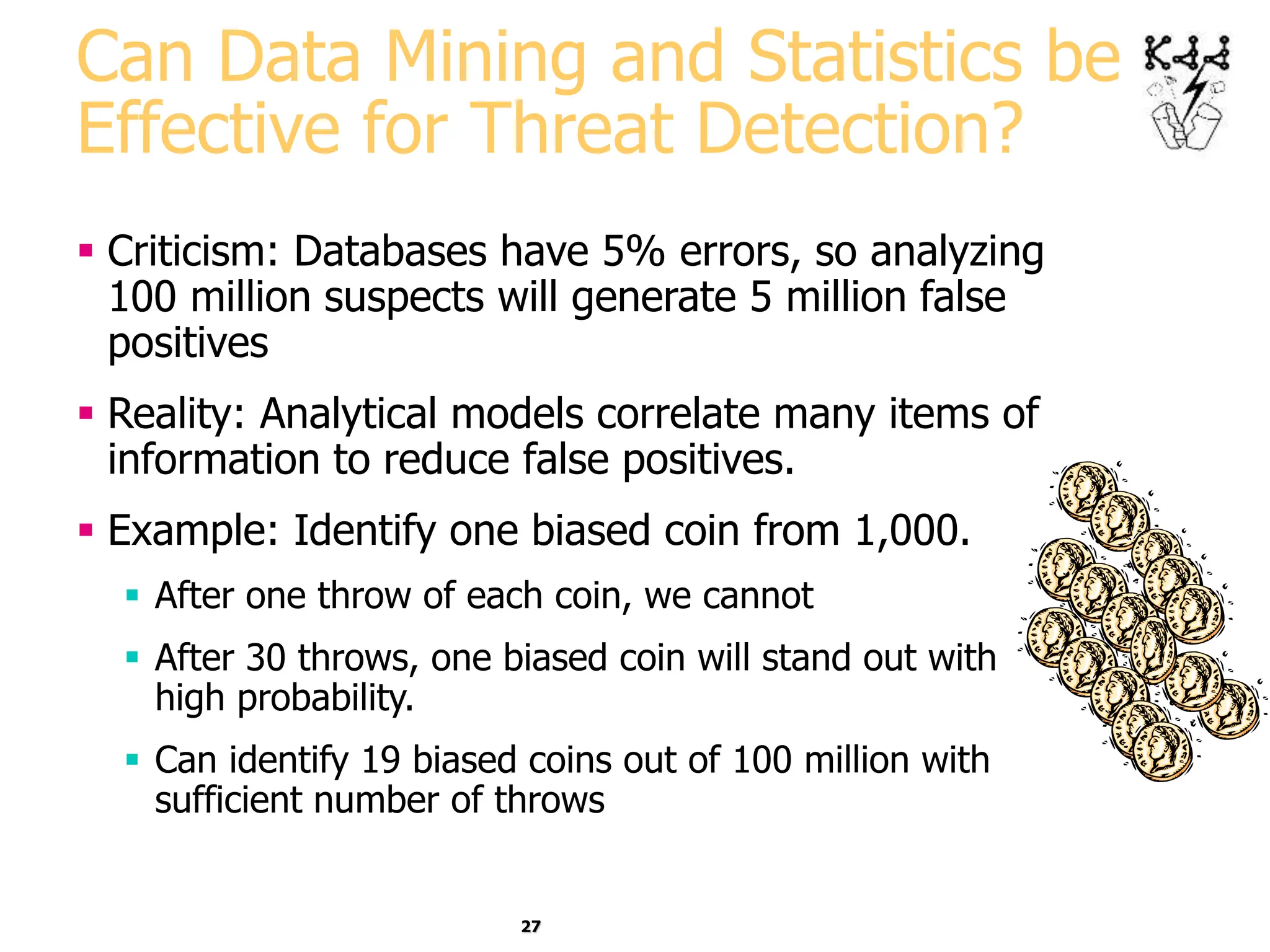
 Example: Identify one biased coin from 1,000.
 After one throw of each coin, we cannot
 After 30 throws, one biased coin will stand out with
high probability.
 Can identify 19 biased coins out of 100 million with
sufficient number of throws
28
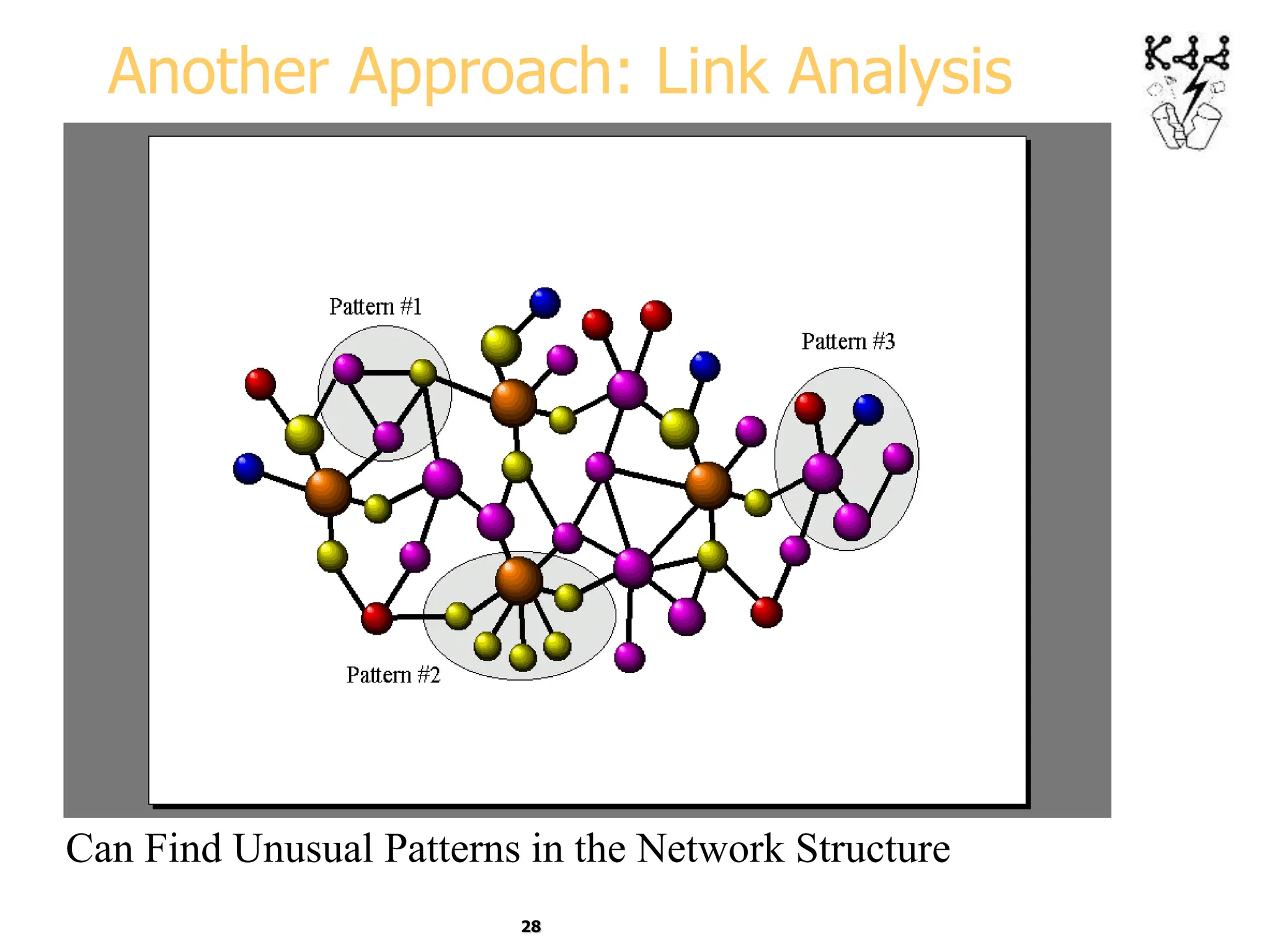
Another Approach: Link Analysis
Can Find Unusual Patterns in the Network Structure
29
Analytic technology can be effective
 Combining multiple models and link analysis can
reduce false positives
 Today there are millions of false positives with
manual analysis
 Data Mining is just one additional tool to help
analysts
 Analytic Technology has the potential to reduce
the current high rate of false positives
30
Data Mining with Privacy
 Data Mining looks for patterns, not people!
 Technical solutions can limit privacy invasion
 Replacing sensitive personal data with anon. ID
 Give randomized outputs
 Multi-party computation – distributed data
 …
 Bayardo & Srikant, Technological Solutions for
Protecting Privacy, IEEE Computer, Sep 2003
31
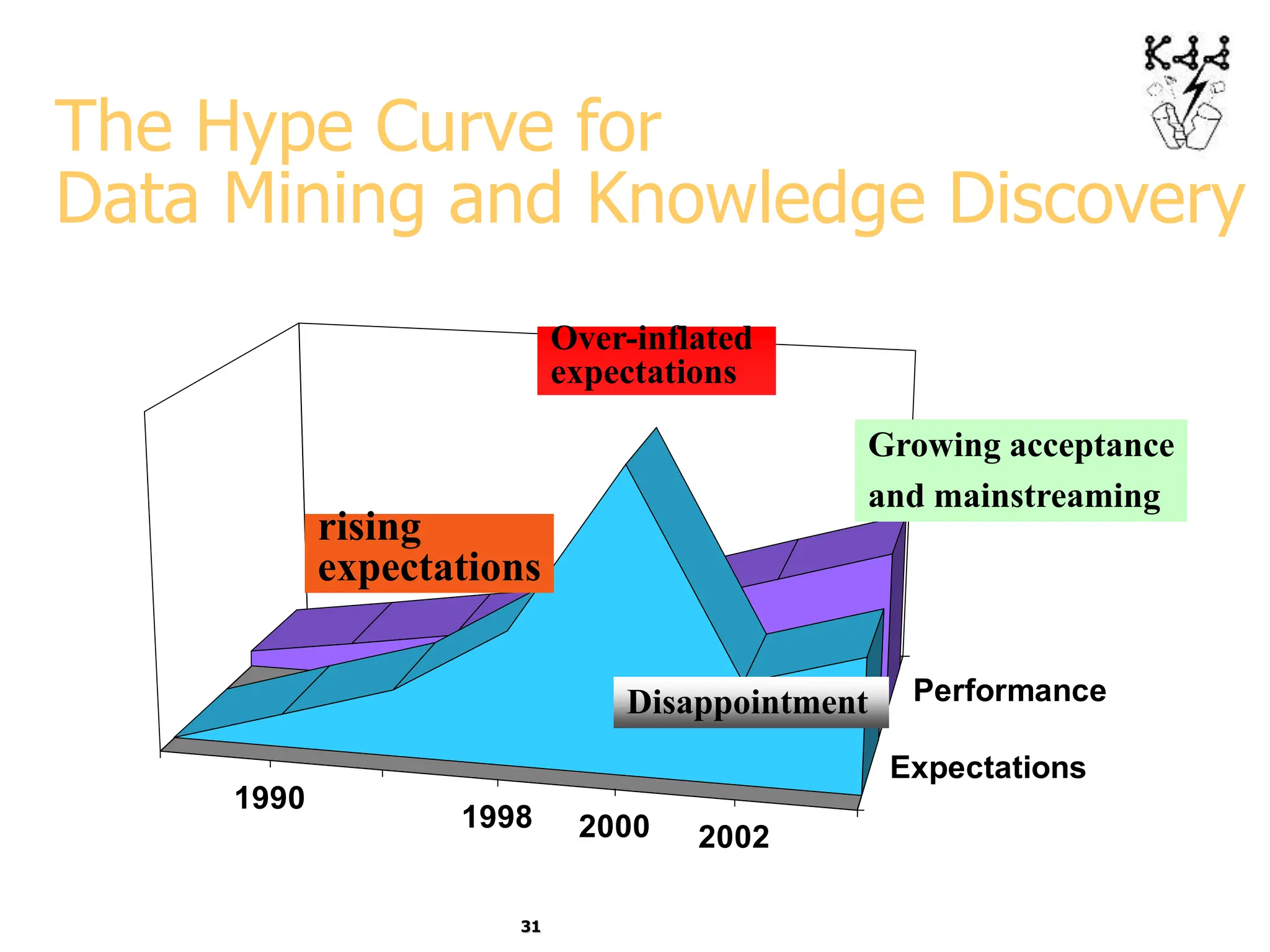
1990
1998 2000 2002
Expectations
Performance
The Hype Curve for
Data Mining and Knowledge Discovery
Over-inflated
expectations
Disappointment
Growing acceptance
and mainstreaming
rising
expectations
32
Summary
www.KDnuggets.com – the website for
Data Mining and Knowledge Discovery
Contact: Gregory Piatetsky-Shapiro
gregory@kdnuggets.com

JanData-mining-to-knowledge-discovery.ppt

  • 1.
    From Data Mining to KnowledgeDiscovery: An Introduction Gregory Piatetsky-Shapiro KDnuggets
  • 2.
  • 3.
    3 Trends leading toData Flood  More data is generated:  Bank, telecom, other business transactions ...  Scientific Data: astronomy, biology, etc  Web, text, and e-commerce  More data is captured:  Storage technology faster and cheaper  DBMS capable of handling bigger DB
  • 4.
    4 Examples  Europe's VeryLong Baseline Interferometry (VLBI) has 16 telescopes, each of which produces 1 Gigabit/second of astronomical data over a 25-day observation session  storage and analysis a big problem  Walmart reported to have 24 Tera-byte DB  AT&T handles billions of calls per day  data cannot be stored -- analysis is done on the fly
  • 5.
    5 Growth Trends  Moore’slaw  Computer Speed doubles every 18 months  Storage law  total storage doubles every 9 months  Consequence  very little data will ever be looked at by a human  Knowledge Discovery is NEEDED to make sense and use of data.
  • 6.
    6 Knowledge Discovery Definition KnowledgeDiscovery in Data is the non-trivial process of identifying  valid  novel  potentially useful  and ultimately understandable patterns in data. from Advances in Knowledge Discovery and Data Mining, Fayyad, Piatetsky-Shapiro, Smyth, and Uthurusamy, (Chapter 1), AAAI/MIT Press 1996
  • 7.
  • 8.
  • 9.
  • 10.
    10 Data Mining Tasks:Classification Learn a method for predicting the instance class from pre-labeled (classified) instances Many approaches: Statistics, Decision Trees, Neural Networks, ...
  • 11.
    11 Classification: Linear Regression Linear Regression w0 + w1 x + w2 y >= 0  Regression computes wi from data to minimize squared error to ‘fit’ the data  Not flexible enough
  • 12.
    12 Classification: Decision Trees X Y ifX > 5 then blue else if Y > 3 then blue else if X > 2 then green else blue 5 2 3
  • 13.
    13 Classification: Neural Nets Can select more complex regions  Can be more accurate  Also can overfit the data – find patterns in random noise
  • 14.
    14 Data Mining CentralQuest Find true patterns and avoid overfitting (false patterns due to randomness)
  • 15.
    15 Data Mining Tasks:Clustering Find “natural” grouping of instances given un-labeled data
  • 16.
    16 Major Data MiningTasks  Classification: predicting an item class  Clustering: finding clusters in data  Associations: e.g. A & B & C occur frequently  Visualization: to facilitate human discovery  Estimation: predicting a continuous value  Deviation Detection: finding changes  Link Analysis: finding relationships  …
  • 17.
  • 18.
  • 19.
    19 Major Application Areasfor Data Mining Solutions  Advertising  Bioinformatics  Customer Relationship Management (CRM)  Database Marketing  Fraud Detection  eCommerce  Health Care  Investment/Securities  Manufacturing, Process Control  Sports and Entertainment  Telecommunications  Web
  • 20.
    20 Case Study: SearchEngines  Early search engines used mainly keywords on a page – were subject to manipulation  Google success is due to its algorithm which uses mainly links to the page  Google founders Sergey Brin and Larry Page were students in Stanford doing research in databases and data mining in 1998 which led to Google
  • 21.
    21 Case Study: Direct Marketingand CRM  Most major direct marketing companies are using modeling and data mining  Most financial companies are using customer modeling  Modeling is easier than changing customer behaviour  Some successes  Verizon Wireless reduced churn rate from 2% to 1.5%
  • 22.
    22 Biology: Molecular Diagnostics Leukemia: Acute Lymphoblastic (ALL) vs Acute Myeloid (AML)  72 samples, about 7,000 genes ALL AML Results: 33 correct (97% accuracy), 1 error (sample suspected mislabelled) Outcome predictions?
  • 23.
    23 AF1q: New Markerfor Medulloblastoma?  AF1Q ALL1-fused gene from chromosome 1q  transmembrane protein  Related to leukemia (3 PUBMED entries) but not to Medulloblastoma
  • 24.
    24 Case Study: Security andFraud Detection  Credit Card Fraud Detection  Money laundering  FAIS (US Treasury)  Securities Fraud  NASDAQ Sonar system  Phone fraud  AT&T, Bell Atlantic, British Telecom/MCI  Bio-terrorism detection at Salt Lake Olympics 2002
  • 25.
    25 Data Mining andTerrorism: Controversy in the News  TIA: Terrorism (formerly Total) Information Awareness Program –  DARPA program closed by Congress  some functions transferred to intelligence agencies  CAPPS II – screen all airline passengers  controversial  …  Invasion of Privacy or Defensive Shield?
  • 26.
    26 Criticism of analyticapproach to Threat Detection: Data Mining will  invade privacy  generate millions of false positives But can it be effective?
  • 27.
    27 Can Data Miningand Statistics be Effective for Threat Detection?  Criticism: Databases have 5% errors, so analyzing 100 million suspects will generate 5 million false positives  Reality: Analytical models correlate many items of information to reduce false positives.  Example: Identify one biased coin from 1,000.  After one throw of each coin, we cannot  After 30 throws, one biased coin will stand out with high probability.  Can identify 19 biased coins out of 100 million with sufficient number of throws
  • 28.
    28 Another Approach: LinkAnalysis Can Find Unusual Patterns in the Network Structure
  • 29.
    29 Analytic technology canbe effective  Combining multiple models and link analysis can reduce false positives  Today there are millions of false positives with manual analysis  Data Mining is just one additional tool to help analysts  Analytic Technology has the potential to reduce the current high rate of false positives
  • 30.
    30 Data Mining withPrivacy  Data Mining looks for patterns, not people!  Technical solutions can limit privacy invasion  Replacing sensitive personal data with anon. ID  Give randomized outputs  Multi-party computation – distributed data  …  Bayardo & Srikant, Technological Solutions for Protecting Privacy, IEEE Computer, Sep 2003
  • 31.
    31 1990 1998 2000 2002 Expectations Performance TheHype Curve for Data Mining and Knowledge Discovery Over-inflated expectations Disappointment Growing acceptance and mainstreaming rising expectations
  • 32.
    32 Summary www.KDnuggets.com – thewebsite for Data Mining and Knowledge Discovery Contact: Gregory Piatetsky-Shapiro gregory@kdnuggets.com