Arrays are linear arrangements of elements of the same type stored in contiguous memory locations. An array must be declared with the maximum number of elements. Elements are accessed using indexes from 0 to size-1. Arrays can be passed to functions, but the array itself is not copied. Common array operations include insertion, deletion, retrieval of elements, and traversing the entire array.
![What is an array?
A linear arrangement of data of the
same type of elements
An array has to be declared first with
the maximum number of elements it
can store
int marks[100];
char name[20];](https://image.slidesharecdn.com/array-221221093213-d6f17630/85/Array-ppt-2-320.jpg)
![How is an array stored?
Starting from a given memory location, the
successive array elements are allocated
space in consecutive memory locations.
x: starting address of the array in memory
k: number of bytes allocated per array element
a[i] is allocated memory location at
address
Array a
x + i*k](https://image.slidesharecdn.com/array-221221093213-d6f17630/85/Array-ppt-3-320.jpg)
![Index Rule
An array index must evaluate to an int
between 0 and n-1 where n is the number of
elements in the array.
marks[76]
marks[i*2+k] // provided i*2+k is between 0 1nd 99
C Array bounds are not checked
#define S 100
marks[S] = 10;
if (0<=i && i<100)
marks[i] = 10;
else printf (“Array index %d
out of range”, i);](https://image.slidesharecdn.com/array-221221093213-d6f17630/85/Array-ppt-4-320.jpg)
![Use
An array element can be used wherever
a simple variable of the same type can
be used.
Examples :
scanf (“%d”, &marks[i]);
marks[i] = (int) (sqrt(21.089));](https://image.slidesharecdn.com/array-221221093213-d6f17630/85/Array-ppt-5-320.jpg)
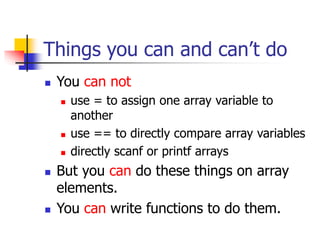
![Averaging marks
#define CLASS_SIZE 50
double marks[CLASS_SIZE] ;
double total=0.0;
int i;
printf (“Enter %d grades n”, CLASS_SIZE);
for (i=0; i<CLASS_SIZE; i++)
scanf(“%f”, &marks[i]);
for (i=0; i<CLASS_SIZE; i++) {
printf (“ %d . %fn”,i, marks[i]);
total += marks[i] ;
}
printf (“Average = %fn”, total / (double) CLASS_SIZE) ;](https://image.slidesharecdn.com/array-221221093213-d6f17630/85/Array-ppt-7-320.jpg)
![#define MtWeight 0.3
#define FinalWeight 0.7
#define MaxStudents 100
int NumStudents;
int midterm[MaxStudents];
int final[MaxStudents];
double score[MaxStudents];](https://image.slidesharecdn.com/array-221221093213-d6f17630/85/Array-ppt-9-320.jpg)
![Parallel Arrays
/* Suppose we have input the value of NumStudents,
read student i’s grades for midterm and final, and
stored them in midterm[i] and final[i]
Store a weighted average in the array score */
if (NumStudents < MaxStudents)
for (i=0; i<NumStudents; i++) {
score[i] = MtWeight* (double) midterm[i] +
FinalWeight* (double) final[i];
}
midterm
final
score](https://image.slidesharecdn.com/array-221221093213-d6f17630/85/Array-ppt-10-320.jpg)
![Reading Array Elements
/* Read in student midterm and final grades and store
them in two arrays */
#define MaxStudents 100
int midterm[MaxStudents], final[MaxStudents];
int NumStudents ; /* actual no of students */
int i, done, Smidterm, Sfinal;
printf (“Input no of students :”);
scanf(“%d”, &NumStudents) ;
if (NumStudents > MaxStudents)
printf (“Too many students”) ;
else
for (i=0; i<NumStudents; i++)
scanf(“%d%d”, &midterm[i], &final[i]);](https://image.slidesharecdn.com/array-221221093213-d6f17630/85/Array-ppt-11-320.jpg)
![Reading Arrays - II
/* Read in student midterm and final grades and store them in 2 arrays */
#define MaxStudents 100
int midterm[MaxStudents], final[MaxStudents];
int NumStudents ; /* actual no of students */
int i, done, Smidterm, Sfinal;
done=FALSE; NumStudents=0;
while (!done) {
scanf(“%d%d”, &Smidterm, &Sfinal);
if (Smidterm !=-1 || NumStudents>=MaxStudents)
done = TRUE;
else {
midterm[NumStudents] = Smidterm;
final[NumStudents] = Sfinal;
NumStudents++;
}
}](https://image.slidesharecdn.com/array-221221093213-d6f17630/85/Array-ppt-12-320.jpg)
![Size of an array
How do you keep track of the number of
elements in the array ?
1. Use an integer to store the current size of the array.
#define MAX 100
int size;
float cost[MAX] ;
2. Use a special value to mark the last element in an
array. If 10 values are stored, keep the values in
cost[0], ... , cost[9], have cost[10] = -1
3. Use the 0th array element to store the size
(cost[0]), and store the values in cost[1], ... ,
cost[cost[0]]](https://image.slidesharecdn.com/array-221221093213-d6f17630/85/Array-ppt-13-320.jpg)
![Add an element to an array
1. cost[size] = newval; size++;
2. for (i=0; cost[i] != -1; i++) ;
cost[i] = newval;
cost[i+1] = -1;
3. cost[0]++;
cost[cost[0]] = newval;](https://image.slidesharecdn.com/array-221221093213-d6f17630/85/Array-ppt-14-320.jpg)
![Array operations
#define MAXS 100
int insert (int[], int, int, int) ;
int delete (int[], int, int) ;
int getelement (int[], int, int) ;
int readarray (int[], int) ;
main () {
int a[MAXS];
int size;
size = readarray (a, 10) ;
size = insert (a, size, 4, 7) ;
x = getelement (a, size, 3) ;
size = delete (a, size, 3) ;
}](https://image.slidesharecdn.com/array-221221093213-d6f17630/85/Array-ppt-16-320.jpg)
![Array operations
#define MAXS 100
int insert (int[], int, int, int) ;
int delete (int[], int, int) ;
int getelement (int[], int, int) ;
int readarray (int[], int) ;
main () {
int a[MAXS];
int size;
size = readarray (a, 10) ;
size = insert (a, size, 4, 7) ;
x = getelement (a, size, 3) ;
size = delete (a, size, 3) ;
}
int readarray (int x[], int size) {
int i;
for (i=0; i<size; i++)
scanf(“%d”, &x[i]) ;
return size;
}
int getelement (int x[], int size, int pos){
if (pos <size) return x[pos] ;
return -1;
}
int insert (int x[], int size, int pos. int val){
for (k=size; k>pos; k--)
x[k] = x[k-1] ;
x[pos] = val ;
return size+1;
}](https://image.slidesharecdn.com/array-221221093213-d6f17630/85/Array-ppt-17-320.jpg)
![void reverse (int x[],
int size) {
}
int findmax (int x[], int
size) {
}](https://image.slidesharecdn.com/array-221221093213-d6f17630/85/Array-ppt-18-320.jpg)
![void reverse (int x[], int size) {
int i;
for (i=0; i< (size/2); i++)
temp = x[size-i-1] ;
x[size-1-1] = x[i] ;
x[i] = temp;
}
int findmax (int x[], int size) {
int i, max;
max = x[0];
for (i=1; i< size; i++)
if (x[i] > max)
max = x[i] ;
return max;
}](https://image.slidesharecdn.com/array-221221093213-d6f17630/85/Array-ppt-19-320.jpg)
![Strings
Strings are 1-dimensional arrays of type char.
By convention, a string in C is terminated by
the end-of-string sentinel 0, or null character.
String constant : “abc” is a character array of
size 4, with the last element being the null
chaaracter 0.
char s[] = “abc” ;
a b c 0](https://image.slidesharecdn.com/array-221221093213-d6f17630/85/Array-ppt-20-320.jpg)


