Page 1
CHAPTER 1: INTRODUCTION TO THE STUDY & INDUSTRY
PROFILE
1.1EXECUTIVE SUMMARY
The chemical industry is critical for the economic development of any country,
providing products and enabling technical solutions in virtually all sectors of the
economy. The Indian chemical industry can deliver on an accelerated growth
phase, provided a clearly defined vision along with a strategic roadmap is
developed to enable it. If this is not done, we may see the growing market
increasingly being served through manufacturing done outside India. The various
segments of the chemical industry (such as organic chemicals, specialty chemicals,
chlor-alkali, pesticides, colorants and alcohol based chemicals) have their own
unique set of challenges. The industry can grow only if these individual segments
overcome their challenges and move swiftly along the growth path. The
performance of these segments has been studied in the subsequent chapters and
targets/ goals have been set for the XIIth five year plan along with concrete action
plans consisting of levers that will help overcome challenges and drive growth.
Page 2
Chemical industry sectorcan be segmented as shown in exibit 1
Exibit 1 – classification ofchemical industry sector
The following factors are boosting the chemical industry sector in the years ahead:
Page 3
1.2ORGANIZATIONALSTUDY- AN OVERVIEW
Organizational studies is "the examination of how individuals construct
organizational structures, processes, and practices and how these, in turn, shape
social relations and create institutions that ultimately influence
people", organizational studies comprise different areas that deal with the different
aspects of the organizations, many of the approaches are functionalist but critical
research also provide alternative frame for understanding in the field.
The objective of undergoing this internship was to get practical exposure to the
structure and functioning of the organization. It was also meant to study the
activities of various departments such as finance, marketing, production, human
resource, etc.
The report traces the growth and development of the company and gives a skeletal
outline about the technologies adopted by the company; the report also explains the
values and gives a brief about all the department aspects and how he company
functions as whole of KUMAR ORGANIC PRODUCT LIMITED.
Page 4
1.3OBJECTIVES OF THE STUDY :
The organization study was carried out in Kumar Organics Products Limited to
achieve the following objectives:-
 To learn and understand the working of various functional departments
like Human resources, marketing, finance, production department.
 SWOT analysis to identify the major strengths and weakness of the
company for improvement.
 To relate theory with practice.
 To familiarize with the organization structure and functioning.
 To understand the extent of technology adoption in the organization for
various functions/activities.
 To understand how information is used in organization for decision
making at various levels including data flow diagram.
1.4 METHODOLOGY OF THE STUDY
Methodology implies more than simply the methods you intend to use to collect
data. The research plan has been stated as; gathering the data, refining the data, and
analyzing the data.
The success of a research depends largely on the methodology used. The
appropriate methodology will improve the validity of the findings. The following
methodologies were adopted for the study. Identification of the company – Kumar
organic product limited was selected for the organization study, considering
various factors including reputation of the firm, ease of getting permissions,
industry, location etc.
Page 5
Identification of the Objectives The specific objectives of the organization study
was identified and listed out in order of priority. This helped in conducting the
organization study in a systematic and effective manner.The study is a Descriptive
in nature.
The methods used for collecting the data for this study is obtained from the
following sources:
 PRIMARY DATA COLLECTION
The primary data includes the data collected by observation and by interviewing
company personnel at different levels of management about how the company
functions. Company personnel includes Managers of different departments and
office staffs.
 SECONDARY DATA COLLECTION
The data collected in this context is from Websites, Online Business Journals,
magazines and company’s brochure. Secondary data is the data that have been
already collected by the company and readily available from other sources.
1.5 SCOPE OF THE STUDY
The study was conducted to understand the organization structure, function and
process of various departments and their interdependence on each other for the
successful running of KOPL. This project also tells about the company from its
Page 6
inception and their products. The organizational study was carried out in KOPL for
the period of 10 working days
PERIOD OF STUDY: From 21st December 2015 to 1stJanuary 2016
1.6 LIMITATIONS OF THE STUDY :
 Due to the shortage of time the study was collected only for 10 working days
hence in depth study was not possible.
 Reluctance in disclosing the financial information and internal affairs, so the
detailed analysis of financial data is not possible
 Study restricted to Bangalore region only.
 There are Chances of bias from the data collected from the interviews of the
managers and office staff.
 Some of the managers and staff were hesitant to provide data
Page 7
1.7 GLOBAL SCENARIO OF CHEMICAL INDUSTRY
The current scope
The global chemical industry generates revenue of about $3 trillion and produces
precursors and intermediates for most other consumer industries. The chemi- cal
industry is highly regulated with major contributing regions being Europe, North
America, and Asia. With new regulations such as REACH, the industry framework
is changing to adapt to innovative solutions. The main constraints on the global
chemical industry are energy costs, feedstock changes, labor costs and regulations.
Despite these limitations, the industry is expected to grow at a fairly high rate over
the next five years and thereafter. While many of these companies have extensive
sustain- ability plans they are still lagging behind other industries.
The global chemical industry consists of a very diverse and complicated range of
products. In terms of revenue, it is one of the world’s largest markets. The majority
of consumer products that are used every day have at least some tie to the products
Page 8
of the chemical industry. There are a few large players with a lot of smaller,
specialized, companies.
Across the chemical industry, expected worth is estimated to be around $3 trillion
per year with relatively flat revenue growth in the EU and US. The compound
annual growth rate (CAGR) over the five years spanning 2006-2010 has been 5%.
At the low end, Europe only grew at about 1% in 2010 with Asia representing the
region with the largest CAGR at 10% in 2010. From the years 2010-2015, the
chemicals market is expected to gain momentum and is forecasted to grow at a 8%
compound annual growth rate.
The global chemical industry is very large and competitive. It is expected to grow
at a considerable rate in the future, especially with the development in the Asia-
Pacific. The market for chemical products is very diverse and is seen as an input in
almost all industries.
Exibit 2 Geographical breakdown of the chemical shipments in the FY14-15
Future outlook
The global cosmeceutical market will witness the emergence of various new trends
around the world. The rising rate at which cosmeceutical are being adopted is
Page 9
fuelling the demand for natural active ingredients, paving way for plant stem cells.
The report, “Global Cosmeceutical Market Outlook 2018” provides an insight into
more such trends in the coming few years which will help revolutionize the
perception about cosmeceutical. The report has been divided into various chapters
which provide a detailed account of the current and future markets. The
cosmeceutical industry has been segmented into various broad heads such as skin
care, hair care, injectables etc., which have been further broken into segments such
as anti aging, anti acne, and sun protection.
A region wise breakup has been added that provides the reader an outlook into
various geographies, their current and future markets, prevailing trends and recent
developments. The market offers huge potential among the Asian countries of
Japan, China, and India which are set to attract major players in future. Japan has
already made a niche presence in the global cosmetics market and its position in
the cosmeceutical segment is effectively improving.
1.8 INDIAN SCENARIO OF CHEMICAL INDUSTRY
The Indian chemicals industry, which earned revenues in the range of $ 155-160
billion in 2013, is likely to grow at a rate of 11-12 percent in the next two to three
years, according to Frost & Sullivan, a business consulting firm. Owing to reduced
industrial output, commodity and bulk chemicals are likely to experience slow
growth, while the specialty chemicals segment is expected to show considerable
growth.
“Personal care ingredients and additives, knowledge chemicals like Active
Pharmaceutical Ingredients (APIs), paints and coatings, and construction and water
Page 10
chemicals are some of the segments that are likely to perform well”. It plays an
important role in the overall development of the Indian economy. It contributes
about 3 per cent in the GDP of the country.
Chemical industry is one of the oldest industries in India. It not only plays a crucial
role in meeting the daily needs of the common man, but., which are required in
almost all walks of life. Over the last decade, the Indian Chemical industry has
evolved from being a basic chemical producer to becoming an innovative industry.
With investments in R&D, the industry is registering significant growth in the
knowledge sector comprising of specialty chemicals, fine chemicals and
pharmaceuticals.Indian chemical industry is expected to grow to US$100 billion by
2016.
Exhibit 3 showing the chemical clusters in India
Page 11
The positives for the Indian chemical manufacturing industries are as shown in
exibit 3
Exibit 4- Positives of chemical industry
MAKE IN INDIA FOR CHEMICAL INDUSTRY
 Third largest producer in Asia.
 Eighth largest producer worldwide.
 The estimated size of market is USD 100 Billion
 Fourth largest global producer of agro chemicals.
 India accounts for approximately 16% of the world production of dyestuff
and dye intermediates.
 Total production of the Indian chemicals industry 21.2 Million Tonnes
during 2014-15.
Page 12
 Production of polymers is around 6.53 Million Tonnes with imports of
around 3.73 Million Tonnes during 2014-15.
 Chemical Sector is most diversified, covering more than 70,000 commercial
products.
FOR REALISING THE GOALS OF 'MAKE IN INDIA', GOVT'S STRONG
EMPHASIS ON ATTRACTING INVESTMENT IN MANUFACTURING
THROUGH A CONDUCTIVE POLICY FRAME WORK.
 India is the third largest producer of chemicals in Asia and sixth by output,
in the world.
 The chemicals industry is a key constituent of the Indian economy,
accounting for about 1.38% of the nation’s GDP.
 India is currently the world’s third largest consumer of polymers and fourth
largest producer of agro-chemicals.
 India’s proximity to the Middle East, the world’s source of petrochemical
feedstock, makes for economies of scale.
 Strong government support for R&D.
 Polymers and agro-chemicals industries in India present immense growth
opportunities.
Growth of Chemical Industry
The chemical sector has witnessed growth of 13-14% in the last 5 years while
petrochemicals have registered a growth of 8-9% over the same period. The major
growth drivers, behind India’s chemical industry could be listed as follows:
Page 13
Structural advantage: With a growing market and purchasing power, the domestic
industry is likely to growth at over 10-13% in the coming years. Growing
disposable incomes and increasing urbanization are fuelling the end consumption
demand for paints, textiles, adhesives and construction, which, in turn, leads to
substantial growth opportunity for chemicals companies. High domestic
consumption: The chemicals industry in India is the largest consumer of its own
products, consuming 33% of its output. With promising growth trends in the
chemicals industry, this internal consumption is also set to rise. Diversified
industry: The Indian chemicals industry has a diversified manufacturing base that
produces world-class products. There is a substantial presence of downstream
industries in all segments. Further, this large and expanding domestic chemicals
market also boasts of a large pool of highly-trained scientific manpower.
Promising export potential: Chemicals constitute 5.4% of India’s total exports.
India already has a strong presence in the export market in the sub-segments of
dyes, pharmaceuticals and agro chemicals. India exports dyes to Germany, the UK,
the US, Switzerland, Spain, Turkey, Singapore and Japan.
1.9 INDUSTRY AND MARKET SHARE ANALYSIS
Key domestic and international players in Indian chemical industry
Domestic company Sales in FY15*
(USD billion)
Products
Tata Chemicals Limited
(TCL)
0.8 Soda ash, salt,marine
chemicals, caustic soda,
cement etc
United Phosphorous
Limited (UPL)
0.5 Agrochemicals
Page 14
Nirma Ltd 1.2 Alkyl benzene ,sulfuric
acid, Soda ash
Gujarat Heavy
chemicals ltd(GHCL)
0.2 Soda Ash
International company Sales in 2014 **
A brief of Indian players
1. TATA CHEMICALS
 Tata Chemicals Limited (TCL) is one of the leading chemical
companies in India, with significant operations in India and Africa.
Page 15
 Second largest soda ash producer in the world and the largest in India.
 A market leader in edible salt, largest player in the country.
 Most energy efficient urea fertilizer manufacturer in India.
 The turnover has increased to 10.7% more from FY07-FY14
Exihibit 5 showing Turnover of Tata Chemicals .
Diversifying their way to success
65%
11%
12%
5%
Geographicaldiversification(FY15)
Asia America Europe Africa
Page 16
2. UNITED PHOSPHORUS LIMITED (UPL)
 UPL is mainly engaged in the business of agrochemicals, other industrial
chemicals and chemical intermediates.
 Agrochemicals account for 92% of the total sales of the company, while the
industrial chemicals and intermediates segments together account for 8%.
 UPL has 21 manufacturing sites- 9 in India, 4 in France , 2 in Spain , 3 in
Argentina and one each in UK , Vietnam , Netherlands , Italy and China.
 The company has also strengthened its distribution reach and access to new
markets through strategic alliances with agrochemical manufacturers in
other countries.
 Its revenues are increased from 0.5 USD billion to 1.8 USD billion in
FY2014 that is increase of 20.3%
Exhibit 6 showing sales from FY07-FY15
Page 17
3. ASIAN PAINTS
 In 1942,Asian paints started manufacturing in Mumbai garage, now
with total installed capacity of nearly 1 million kilo-litre ,Asian paints
is amongst the largest paint manufacturing companies in the world
 Asian paints has grown at an excellent pace over the years, a CAGR
of 20.9% from FY08-14.
 The company’s seventh and largest decorative paint manufacturing
plant with an installed capacity was commissioned in Feb 2013.
Exhibit 7 showing the geography wise sales and Total sales increase .
4. INDIA GLYCOLS LIMITED
 Established in 1983, India Glycols is the only company that manufactures
green technology based bulk, specialty and performance chemicals and
natural gums, spirits , industrial gases and sugar in India.
 The company exports to more than 40 countries including US, Japan and
countries in Europe and America.
 During the FY08-2014 the company sales have grown at a CAGR of 6.2% to
USD 479 million.
Page 18
Exhibit 8 showing the turnover of India Glycols limited
1.10 PEST ANALYSIS
PEST analysis ("Political, Economic, Social and Technological") describes a
framework of macro-environmental factors used in the environmental
scanning component of strategic management. It is a part of the external analysis
when conducting a strategic analysis or doing market research, and gives an
overview of the different macro-environmental factors that the company has to
take into consideration. It is a useful strategic tool for understanding market growth
or decline, business position, potential and direction for operations.
PESTLE analysis, which is sometimes referred as PEST analysis, is a concept in
marketing principles. Moreover, this concept is used as a tool by companies to
track the environment they’re operating in or are planning to launch a new
project/product/service etc. so here is the PEST Analysis for chemical Industry.
POLITICAL FACTORS
Page 19
Political factors are basically how the government intervenes in the economy.
Specifically, political factors has areas including tax policy, labor
law, environmental law, trade restrictions, tariffs, and political stability.
The Government of India has taken several steps to ease the pressure on
Chemical industry. The following are the measures taken.
1. 100% FOREIGN DIRECT INVESTMENT (FDI) is allowed under the
automatic route in the chemicals sector, subject to all the applicable
regulations and laws.
2. REDUCTION OF CUSTOMS DUTY
 Government reduced Basic customs duty (BCD) on Ulexite Ore (Calcium
Sodium Borate) (2528) from 2.5% to 0%.
 Goverment reduced Special Additional Duty (SAD) on Naphtha (27101290)
from 4% to 2%.
 Government reduced BCD on Styrene Monomer (29025000) from 2.5% to
2%. Further, SAD on this product has been reduced from 4% to 2%.
 Government reduced BCD on Ethyleme Dichloride (29031500) from 2.5%
to 2%. Further, SAD on this product has been reduced from 4% to 2%.
 Government reduced BCD on Vinyl Chloride Monomer (29032100) from
2.5% to 2%. Further, SAD on this product has been reduced from 4% to
2%..
 Government reduced BCD on Isoprene (29012400) from 5% to 2.5%
Page 20
 Government reduced BCD on Anthraquinone for Hydrogen Peroxide from
7.5% to 2.5%
 Government reduced BCD on Butyl Acrylate from 7.5% to 5%.
 Government reduced BCD on Liquefied Butanes from 5% to 2.5%.
3. STATE INCENTIVES:
 Apart from the above, each state in India offers additional incentives for
industrial projects.
 Incentives are in areas like subsidised land cost and relaxation in stamp duty
exemption on sale/lease of land, power tariff incentives, concessional rate of
interest on loans, investment subsidies/tax incentives, backward areas
subsidies, special incentive packages for mega projects etc.
4. R& D INCENTIVE
Industry/private sponsored research programmes – a weighted tax deduction is
given under Section 35 (2AA) of the Income Tax Act. A weighted deduction of
200% is granted to assesses for any sums paid to a national laboratory, university
or institute of technology, for specified persons with a specific direction, provided
the said sum is used for scientific research within a programme approved by the
prescribed authority.
ECONOMIC FACTORS
Page 21
This would include factors like inflation, interest rates, economic growth, the
unemployment rate and policies, and the business cycle followed in the country.
The following are the economic factors affecting the chemical industry
1. A large population, huge domestic market dependence on agriculture
and strong export demand are the key growth drivers for the industry.
2. A global shift towards Asia as the world’s chemicals manufacturing
hub.
3. Per capita consumption of chemicals in India is lower as compared to
western countries, so immense scopefor new investments.
4. Rise in GDP and purchasing power generates huge growth potential
for the domestic market.
SOCIAL FACTORS
Social factors include the cultural aspects and health consciousness, population
growth rate, age distribution, career attitudes and emphasis on safety. High trends
in social factors affect the demand for a company's products and how that company
operates. It also includes factors like Human development index, demographic
factors, lifestyle trends, advertising and publicity.
 Most of the chemical industries do not advertise in television media as most
of them are B To B business. Selling the chemicals through online industry
portal to clients.
Page 22
 Most of uneducated labours feel that its hazardous working in chemical
industry. Hence less workforce labour with competitive pay.
 Health conscious people would not wish to work as there might be harmful
gases or toxic contents let out during production which would cause
respiratory track problems.
TECHNOLOGICAL FACTORS
Technological factors include technological aspect like R&D activity, automation,
technology incentives and the rate of technological change. These can
determine barriers to entry, minimum efficient production level and influence
the outsourcing decisions. Furthermore, technological shifts would affect costs,
quality, and lead to innovation.
The following are the technological factors affecting the chemical industry.
 The huge unemployment in India prevents industries from going full
automatic as the Government as well as the Labor unions voice complains
against suchestablishments
 Advanced automated machines have increased the output and reduced the
cost.
 Computerization has increased the efficiency of the industry.
 World-class engineering and strong R&D capabilities.
 Low-costmanufacturing.
 Skilled science professionals.
Page 23
1.11 PORTER’S 5 FORCES ANALYSIS
Today's business environment is extremely competitive and in economics parlance
where perfect competition exists, the profits of the firms operating in that industry will
become zero.
However, this is not possible because, firstly no company is a price taker (i.e. no
company will operate where profits are zero). Secondly, they strive to create a
competitive advantage to thrive in the competitive scenario. Michael Porter,
considered to be one of the foremost gurus' of management, developed the
famous five-force model, which influences an industry.
Exibit : Showing the porters 5 forces model for chemical industry
Page 24
CHAPTER 2: COMPANY PROFILE
One of the outstanding research based Global Specialty and Fine Chemicals
Company in the World engaged in manufacturing of specialty chemicals,
Cosmetic and coating Product Ingredients
2.1 BACKGROUND AND HISTORY
We, Kumar Organic Products Ltd., headquarter in Bangalore, Karnataka, India, is a
global company with approximate revenue of 100-500 crore sales together with
other affiliates and subsidiaries.
Kumar Organic Products Limited was established in the year 1993 at Bengaluru
and since them it is engaged in manufacturing, exporting and supplying of Oral
Care Product Ingredients, Hair Care Products Ingredients, Biotech Ingredients,
Skin Care Product Ingredients, Anti-Aging Product Ingredients, Antibacterial
Ingredients, Coating Agents & Sun Care Ingredients. Our major products are
Hyaluronic Acid, PiroctoneOlamine, Water Soluble Hair Growth Ingredients,
Avobenzone, 4-N-Butylresorcinol, Zinc Pyrithione, Minoxidil, Ethyl Hexyl
Glycerin. These are manufactured in our sophisticated facility using high grade
raw material that is procured from the reliable sources after getting it approved
Page 25
from the accredited quality testing institutions. Our skin care Product Ingredients
are highly demanded and admired amongst the customers for removing skin
impurities and making it fair and glowing.
We have a state-of-the-art infrastructure that is outfitted with all the requisite tools
and modern technology, allowing us to boast about our high production capacity.
Moreover, our infrastructure allows us to perform difficult tasks at utmost ease
even in adverse conditions. We have effectively segregated our facility into various
departments to enable smooth functioning of all the business operations as there is
no chaos and confusion amongst the workforce. We have a capacious warehouse
that sprawls over a large area and has enough space to enable a safe storage of all
the finished products. Our wide distribution network has enabled us to expand our
export market to North Europe, South East Asia, North America, East Asia and
Indian Subcontinent. Besides, we are associated with the reputed transporters who
allow us to assure timely delivery of our products. We have a better pricing policy
that makes our products available at industry leading prices making us the first
choice of the customers.
We are highly appreciated amongst the customers for our quality driven approach.
Moreover, we have adopted transparent business policies that make us an authentic
company amongst the customers. We regularly organize training sessions and
seminars to further upgrade the skills of our professionals in order to keep pace
with ever changing market demands. Customer’s concerns and enquiries are
handled with the utmost care to provide them the best solutions before they invest
their money, thereby deriving complete customer satisfaction.
Page 26
We are looking for export queries from USA, Canada, Italy, Germany, UK,
France, Spain, Netherland, Poland, Russia, Brazil, Mexico, Columbia, Argentina,
Costaica, Peru, Chile, Turkey, Africa, Dubai, UAE, China, Australia, Korea, Japan.
Brief company profile
Nature of Business Manufacturer
Additional Business  Exporter
 Supplier
 Distributor
 Wholesaler
 Trader
 Buying House
 Retailer
 Service Provider
 Importer
 Buyer-Individual
 Buyer-Company
 Association
Company Chairman K. K. Singh
Key Customers  Colgate
 Amway
 Henkel
 Godrej
 Avon
Industry Manufacturing & Trading of Oral Care Product
Ingredients, Hair Care Products Ingredients,
Biotech Ingredients, Skin Care Product Ingredients
etc.
Page 27
Head office
Corporate office
Head office -Plot no 62,road no 3 and 5,Jigani
Industrial Area, AnekalTaluk, Bangalore 560105
819/C, 13th Cross,7th Block, Near JSS College
Circle, Jayanagar, Bangalore, Karnataka, India. -
560041.
Year of Establishment 1993
Total Number of Employees 501 to 1000 People
Promoter Mr. K.K. Singh
Annual Turnover  2013-14 Rs. 100-500 CroreApprox
 2014-15 Rs. 100-500 CroreApprox
Trade & Market
Export
Percentage
60-80%
Infrastructure
LocationType Semi-Urban
Building Infrastructure Permanent
Size of Premises 1000 square feet
Statutory Profile
PAN No. AAACK6745P
RegistrationAuthority Karnataka
RegistrationNo. U85110KA1991PLC012095
Central Sales TaxNo. 29050064053C
Value Added Tax Registration
No.
29050064053V
Service Tax RegistrationNo. AAACK6745PST001
Page 28
Shipment
Mode
 By Air  By Road
 By Sea
Kumar Organic Products Ltd.'s board consists of following esteem people
Mr. K. K. Singh, Chairman
Mr. Udayan Kumar Singh, Managing Director
Mr. Unnayan Kumar Singh, Joint Managing Director
Mr. S. N. Singh, Director
2.2 VISION
Our vision is to be an outstanding research based Global Specialty and Fine
Chemicals Company committed to building a relationship with our customers, our
employees and shareholders. Our growth motivation is innovative technology,
uncompromising quality of products and excellence in service.
2.3 MISSION
Our mission is to manufacture and provide superior quality Specialty and Fine
Chemicals in general and active pharmaceutical or cosmetic ingredients in
particular to our valued customers in pharmaceutical and personal care product
industries at most.
Page 29
2.4 Objectives of the company
Every organization works with specific objectives .Kumar organic products limited
works with these objectives,
1. Profit maximization
2. To ensure strict quality control methods
3. On time delivery to clients of products
4. Minimization of waste and maximization of cost reductions
5. Creating corporate social responsibility
6. Employee welfare being concentrated
2.5 SWOT ANALYSIS OF KOPL
SWOT analysis is a technique through which managers create a quit overview of a
company’s strategic situation. It is based on the assumption that an effective
strategy derives from a sound fit between firms internal resources (strength &
weakness) and its external situation (opportunities & threats). A good fit
maximizes a firm’s strength and opportunities and minimizes its weakness and
threats.
Strengths of the company
 Strict compliance of quality ,timely delivery and quality management
services.
Page 30
 Demand of fine chemicals is more than the production capacity
therefore whatever is produced will be sold
 Better pricing policy that makes products available at
industry leading prices making us the first choice of the customers.
 Latest state-of-the-art infrastructure that is outfitted with all the
requisite tools and modern technology.
 Customer’s concerns and enquiries are handled with the utmost care
to provide them the best solutions before they invest their money,
thereby deriving complete customer satisfaction
 Leading manufacturer of KOPSAN (Triclosan) KOPTHIONE (Zinc
Pyrithione), KOPIROX (PiroctoneOlamine), KOPDIL (Minoxidil),
KOPEXIL (Amenexil), KOPGEEN (Carrageenan), KOPYRRO (6-
pyrrolidino 2, 4-diaminopyramidine 3-oxide)
Weakness of the company
 Low investment in R&D results into less innovation of product.
 Poor infrastructure and working environment.
 Cost disadvantages.
 Percentage of Non -technical workforce is more at operational level.
 Scale of production varies due to power cuts and water scarcity , they
have alternative for electricity that is generator of emergency work
capacity.
Page 31
 Employees are not involved in decision making. Sometimes
suggestions of employees has to be taken as the employee should feel
the sense of belongingness to the company, Which leads to employee
dissatisfaction at work
Opportunities of the company
 Export a large line of products to 65 countries across the globe.
 Have an effective marketing & distribution network and a research
centre with experienced and qualified scientists and advanced
analytical instruments.
 They have to concentrate more on developing skin care and hair care
products as well.
 Expansion for new sector business
Threat of the company
 Triclosan will be banned within 2 years because of its mild toxic contents.
 Alternate for Triclosan has to be developed for sustenance
2.6 PRODUCTS AND MARKETS
With the rich industry experience we manufacture, supply and export a wide range
of Oral Care Product Ingredients, Hair Care Products Ingredients, Skin Care
Product Ingredients, Food Ingredients, painting ingredients , Sun Care Ingredients
and more that are widely demanded by the clients for its skin friendliness.
Moreover, our range is made available in the market at the most cost-effective
prices.
Page 32
PERSONAL CARE
SKIN CARE PRODUCT INGREDIENTS
Our range of products includes Skin Care Product Ingredients. Our Skin Care
Product Ingredients have a wide customer base and is available at a competitive
market rates. These products are used to make skin fair and healthy.
 KOPCINOL
Alkylresorcinols widely occur in nature and are known to be biodegradable
and present in significant amounts inthe bran fractions of wheat, rye and
other cereals.Works as an antiseptic, and can therefore befound in soaps,
skin cleaners, and And used as skin whitener/lightener4-n-butylresorcinol
can also be used to preventmelanosis.
Applications :
 Effective skin whitener/ nail lightener
 Hypo pigmenting agent
 Tyrosinase inhibitor
Marketed to – Avon, Elle 18, Henkel etc
 KOPCOTRIZINOL
Diethylhexylbutamidotriazoneis an organic compound used as a sunscreen
in cosmetics. UV radiation is an important cause of sunburn, premature
aging of the skin and in the development of melanoma and other forms of
skin cancer.
Page 33
Applications:
 Provides broad spectrum protection for skin & extremely used in Sun
care preparation
 Absorbs both UV A and UV B radiations
 Has good synergy with other UV Filters.
 Gives an excellent Sun Protection Factor
 Used in cosmetic preparations like creams and lotions.
 Used in sunscreen preparation
Marketed to – Emami
 KOPROSTEINE
Koprosteine, a modified form of cysteine.which is non-toxic and stable than
cysteine and it is rapidly converted into cysteine and carbon dioxide inside the
cells. Ability of Koprosteine to bind copper ions that are essential for
tyrosinaseactivity responsible for melanin inhibition.
Page 34
Application:
Fighting against intrinsic skin ageing,For de-pigmenting or bleaching skin,For
treatment of dry skin,Hair growth promoter and for baldness,In skin protective
compounds-effective against vesicants and percutaneous chemical agents,
Moisturizer for dry skin
 KOPRUTIN
KoprutinQuercetin 3-Rhamnoglucoside is water soluble derivative synthesized
from rutin (isolated from bio flavonoid). Flavonoid are found in all vascular plants,
in various parts like Flowers, Fruits, Vegetables and Seeds. Flavonoid are
considered to be more powerful anti-oxidants than Vitamin-E, Vitamin-C and b-
Carotene.. It is the derivative of the natural sulfate metabolite of rutin and is very
easy to formulate in several cosmetic applications. It is used as anti-oxidant, anti-
aging and in many skin care and cosmetic applications.
Skin Care Applications:
Anti-Aging Compound
Hum octant, removes dirt from skin extra cellular matrix
Anti-inflammatory, ant cellulite and sun burn preventative
 KOPSULIZOLE-
A UV-B absorber used in synergizing with recognized UV-A absorbers. Used in
cosmetic preparations like creams and lotions. It also be used in sunscreen
Page 35
preparations where an adequate concentration of both filters gives rise to an
excellent sun protection factor by blocking UV- B radiation.
Application:
 Provides broad spectrum protection for skin and extremely used in Sun care
preparations.
 Absorbs UV B radiation
 Can be used in water resistant formulations
 In medicated skin care and protective skin tone preparations
SUN CARE PRODUCTS INGREDIENTS
We provide a wide range of Sun Care Ingredients. Our Sun Care
Ingredients have wide customer base and is available at a competitive
market rates. Owing to its salient and effective features, our range of
products are highly demanded in the markets.
Page 36
 KOPTRIZON
A UV-B absorber used in synergizing with recognized UV-A absorbers.
Used in cosmetic preparations like creams and lotions. It can also be used in
sunscreen preparations where an adequate concentration of both filters gives
rise to an excellent sun protection factor by blocking UV-A/ UV- B
radiation.
Application
 Provides broad spectrum protection for skin and extremely used in Sun care
preparations.
 Absorbs UV B radiation (UV max 314nm)
 Used for the formulation of Protective hair care preparation
 KOPBENZONE
Page 37
Avobenzone (INCI Butyl Methoxydi benzoyl methane) is an oil soluble
ingredient used in sunscreen products to absorb the full spectrum of UVA rays. It
is a dibenzoyl methane derivative. Avobenzone exists in the ground state as a
mixture of the enol and keto forms, favoring the chelated enol .
Applications: Sun care products, baby sun care products, daily sun protection
Marketed to – Godrej, Amway, HUL
 KOPDYNE
A bioactive ingredients extracted from saccharomyces cervisiae (Baker,s yeast)
containg tissue respiratory factor (TRF) that helps in restoring destroyed collagen
and elastin, there by reducing signs of ageing like wrinkles, lifting of sagged skin
and improving skin elasticity. Skin ageing is a consequence of superficial injury
due to intrinsic or extrinsic stess on the skin owing to which it wrinkles, dries and
often sags.
Kopdyne is found to be excellent rejuvenation ingredients, due to its ability to
stimulate oxygen uptake in human fibroblasts. In skin care applications TRF acts
as a soothing antiinflammatory and anti irritant ingredients which also has wrinkle-
minimizing and skin cell rejuvenating properties while offering smoothing and
moisturizing benefits for the skin.
 KOPCYCLAMINE
Page 38
It is a broad-spectrum antifungal agent that inhibits the growth of the yeast known
as Pityrosporum ovale or Pityrosporum orbiculare, which is associated with
conditions such as dandruff and seborrhoeic dermatitis. Ciclopirox is a synthetic
broad-spectrum antifungal agent that inhibits the growth of dermatophytes, a type
of fungus that grows on the skin, hair and nail. The FDA has approved this
compound for use in the US in Dec. 1999. An 8% solution is used for topical
therapy. Ciclopirox is available in the form of shampoo, nail solution, skin cream,
gel or lotion.
HAIR CARE PRODUCTS
Being pioneers in the industry we manufacture, supply and export a quality assured
range of Hair Care Product Ingredients.
 Kopthione 50% FPS
Zinc Pyrithione was first reported in the 1930s. It has two pyridine-derived
chelating ligands bound to zinc via oxygen and sulfur atoms. In cosmetics
and personal care products, Zinc Pyrithione functions as an antidandruff
agent, antimicrobial agent, hair conditioning agent, and preservative. Zinc
pyrithione has been used, as an anti-dandruff agent, for more than 60 years,
in concentrations up to 1-2%. It is effective against a wide variety of
pathogenic bacteria. Its other applications include treatments of psoriasis,
eczema, ringworm, fungus, athletes foot, dry skin, and atypical dermatitis.
Due to its low solubility in water, zinc pyrithione is suitable for use in
outdoorpaints and other products that provide protection against mildew and
Page 39
algae. Its decomposition by ultraviolet light is slow, providing years of
protection even against direct sunlight.
 KOPYRROL
Kopyrrol is 6-pyrrolidino 2, 4 - diaminopyramidine 3 - oxide, which supplies
nutrients necessary for hair growth through the mechanism of dilation of
blood vessels around hair follicles and it will promote the proliferation of
dermal papillae cells. Through the bloodstream, KOPYRROL works at the
level of the hair root, which is responsible for a healthy scalp and beautiful
hair.
Applications:
1.For the treatment of hair loss Kopyrrol used as topical solution i.e.
generally either 2% or 5% Kopyrrol in Propylene Glycol
Page 40
2. As a stimulant for new hair growth.
 KOPDIL
Kopdil was first used exclusively as an oral drug to treat high blood
pressure. It was found to have the interesting side-effect of hair growth and
reversing baldness. Since 1988, Minoxidil used for treating hair loss. The
mechanism of action for Minoxidil is not known, as no other vasodilator has
been shown to be effective in treating hair loss. Recently, researchers at
L’Oreal found that hair disorders cause psychological distress but are
generally poorly controlled.
Application:
In hair care formulation for prevention of male-pattern hairloss and is
effective in frontal areas of the scalp.
 KOPEXIL
Applications
 Fortifying Hair growth.
 Clinically proven.
 Used in Leave-on, serum to prevent Hair loss, Induce Hair regrowth,
Lotion, Shampoo, Conditioner, Creams, Eye Lashes and Eyebrows.
ORAL CARE PRODUCT INGREDIENTS
We manufacture, supply and export a wide assortment of Oral Care Product
Ingredients. This range consists of Triclosan and Carrageenan which is highly
demanded by the clients as it can be soluble in water easily. Besides, we assure our
clients to deliver a quality tested range.
Page 41
 KOPSAN
Triclosan is a potent wide spectrum and antibacterial and antifungal agent. It is a
chlorinated aromatic compound which has functional groups representative of both
ethers and phenols. Phenols often show antibacterial Properties. Triclosan is used
in soaps, deodorants, Toothpaste, shaving creams, mouth washes and cleansing
supplies and is included in an increasing number of consumer products. Triclosan
is very effective in reducing and controlling bacterial contamination on the hands
and on treaded products. At use concentration, Triclosan acts as a biocide, with
multiple cytoplasmic and membrane targets. At lower concentrations, Triclosan
appers bacteriostatic and is seen to target bacteria mainly by inhibiting fatty acid
synthesis.
Applications- Personal Hygiene (Skin lotions, creams), Cosmetic formulations,
Laundry products (soaps, detergent powder, cleaning strips), Dish washing
products like bars and liquids, Disinfectant, In textile and paper treatment, In door
mats, sandals.
FOOD PRESERVATIVE INGREDIANT
 KOPNOL
Alkylresorcinols widely occur in nature and are known to be biodegradable and
present in significant amounts in the bran fractions of wheat, rye and other cereals.
Works as an antiseptic, and can therefore be found in soaps, skin cleaners, and
throat lozenges. Hexylresorcinol is widely used as an antihelmintic, meaning you
Page 42
could potentially use throat lozenges to get rid of parasitic worms if they were
growing inside you. Hexylresorcinol can also be used to prevent shrimp black spot
(melanosis), an unappealing surface discoloration of shrimp caused by the
enzymatic production of pigmented compounds, as well as the browning and decay
of fresh-cut mangoes and apples.
(PAINTS) COATING AGENTS
 KOPTHIONE POWDER
Application
Outdoor paint, coating agent for air conditioner covers, sealants for
bathrooms, pools, windows and as cosmetic preservative.
 COPPER PYRITHIONE
Copper pyrithione is effective biocide used to control algae, fungi and
bacteria.
Application:
1. It is used in formulation of antifouling and marine paints.
2. As biocide and preservator for textiles, rubber, leather and fiber.
 SODIUM PYRITHIONE
Sodium pyrithione inhibits growth of fungi, yeast,mold and bacteria. Sodium
and zinc salt of pyrithione N-oxide are widely used in cosmetics and
shampoo. In acidic media, amine N-oxides are cationic and can act as a mild
conditioner
Page 43
Application:
1. It is used in formulating anti microbial property for Aerosol, Paints,
Shampoo, Sealants, Adhesive,Textiles, Plastics and Floorings.
2. Anti-Fungal agent in Metal working fluids.
3. Used in Gypsum wallboard applications as Anti-Fungal agent.
4. Used in sealants, caulks, urethane foams, patching compounds.
5. Used as mould controller by fungicidal activity in leather application.
AWARDS AND ACHIEVEMENTS BY THE COMPANY
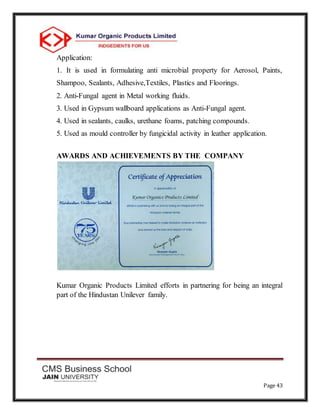
Kumar Organic Products Limited efforts in partnering for being an integral
part of the Hindustan Unilever family.
Page 44
Certificate from government of India for their foreign trade.
2.7 BALANCE SCORE CARD APPROACH
The balanced scorecard is a strategic planning and management system that is used
extensively in business and industry, government, and nonprofit organizations
worldwide to align business activities to the vision and strategy of the organization,
improve internal and external communications, and monitor organization
performance against strategic goals.
Page 45
Why Implement a Balanced Scorecard?
 Increase focus on strategy and results
 Improve organizational performance by measuring what matters
 Align organization strategy with the work people do on a day-to-day
basis
 Focus on the drivers of future performance
 Improve communication of the organization’s Vision and Strategy
 Prioritize Projects / Initiatives
Page 46
CHAPTER 3 ORGANIZATION DESIGN
3.1 Organization Design–TheoreticalPerspective
Organizational design is about enabling a group of people to combine, coordinate,
and control resources and activities in order to produce value, all in a way
appropriate to the environment in which the business competes. An organizational
structure defines how activities such as task allocation, coordination and
supervision are directed towards the achievement of organizational aims. It can
also be considered as the viewing glass or perspective through which individuals
see their organization and its environment.
3.2Choices of organizational design
3.2.1.Simple Structure
A simple structure is defined as a design with low departmentalization, wide
spans of control, centralized authority, and little formalization. This type of
design is very common in small start up businesses.
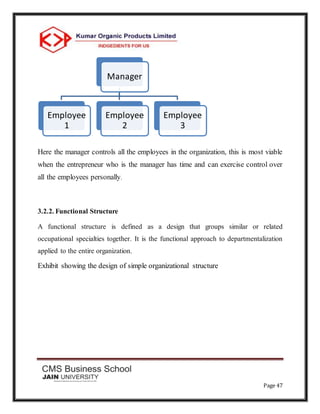
Exhibit showing the design of simple organizational structure
Page 47
Here the manager controls all the employees in the organization, this is most viable
when the entrepreneur who is the manager has time and can exercise control over
all the employees personally.
3.2.2. Functional Structure
A functional structure is defined as a design that groups similar or related
occupational specialties together. It is the functional approach to departmentalization
applied to the entire organization.
Exhibit showing the design of simple organizational structure
Manager
Employee
1
Employee
2
Employee
3
Page 48
It gives the organization a clear cut work details and has fixed outlines of
responsibilities and roles to be carried on.
3.2.3. Divisional Structure
A divisional structure is made up of separate, semi-autonomous units or divisions.
Within one corporation there may be many different divisions and each division
has its own goals to accomplish. A manager oversees their division and is
completely responsible for the success or failure of the division.
President
Vice
president
operations
plant
manager
Department
manager
Supervisor Supervisor
plant
manager
Vice
president
marketing
Regional sales
manager
District
Manager
District
manager
Vice
president
Finance
Accounting
department
manager
Supervisor Supervisor
Vice
president HR
Regional HR
head
Page 49
This kind of structure is most predominantly used when the organization is spread
over large are and have great geographic distance.
3.2.4. Team Structure
A team structure is a design in which an organization is made up of teams, and
each team works towards a common goal. Since the organization is made up of
groups to perform the functions of the company, teams must perform well because
they are held accountable for their performance.
Head office
Division 1
Production Finance Marketing HR
Division 2 Division 3
Page 50
This structure is used when multiple tasks have to done simultaneously.
3.2.5. Matrix Structure
A matrix structure is one that assigns specialists from different functional departments
to work on one or more projects. In an organization there may be different projects
going on at once.
Manager
Team
leader 1
Members
Team
leader 2
Members
Team
Leader 3
Members
Page 51
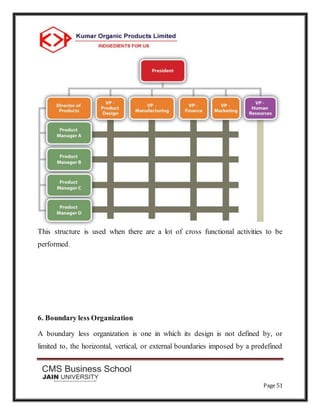
This structure is used when there are a lot of cross functional activities to be
performed.
6. Boundary less Organization
A boundary less organization is one in which its design is not defined by, or
limited to, the horizontal, vertical, or external boundaries imposed by a predefined
Page 52
structure. In other words it is an unstructured design. This structure is much more
flexible because there are no boundaries to deal with such as chain of command,
departmentalization, and organizational hierarchy.
7. Learning Organization
A learning organization is defined as an organization that has developed the
capacity to continuously learn, adapt, and change. In order to have a learning
Page 53
organization a company must have very knowledgeable employees who are able to
share their knowledge with others and be able to apply it in a work environment.
3.3 The Organization Structure of the firm
Page 54
3.4 REVIEW OF THE EXISTING ORGANIZATION
STRUCTURE
 Chairman the founder of the company is KK Singh.If there will be
expansion in business only then he interferes in the decision making.He acts
as a Final decision maker.
 In Kumar organic products limited company there are 2 Managing directors .
Their names are UK Singh being MD and Unnayan Singh being JMD.
 Director being SN Singh . He is responsible for overall work functioning in
the works site.
Chairman
Managing
director
Joint Managing
director
Director
Chief Financial
Officer
General
Manager
Finance
Manager
Accounting
Manger
Marketing
Manager
Chief executive
officer
General
manager
Production
Manager
Saftey
Manager
Stores
Manager
Quality control
manager
HR manager
Page 55
 CEO is Ramakrrishnan. He coordinates with higher management and
Director.CEO and CFO reports to the Director.
 CFO forecasts the financial requirements in the industry, Budget policies are
formed by him, financial policies made by CFO, Allocation of proper budget
to different departments
 General manager takes the production report from the operation department
advice troubleshooting methods to resolve them.
 Finance Manager works under the guidance of CFO.
 Marketing Manager formulates the strategy for the sales of the product and
concentrates on distribution , receives costumer complaints and forwards it
to quality assurance department for problem solving.
 Accounting manager looks after the books of accounts yearly balance sheet,
quarterly Accounts statement.
 HR manager reports to the General Manager. HR manager conducts the
interview, manager makes the HR policies of the company based on the
requirements of the company Production Manager
 Production manager controls the production schedules, shift schedules and
coordinating with sales and quality control departments.
 Quality control manager makes the schedule for quality test of raw materials
and products, maintains the laboratory of quality department, advices
production departments to produce their products meeting quality standards.
Page 56
 Stores manager looks after the chemical and mechanical spare parts in the
godown and report to general manager.
Safety manager advices to employees about healyh and safety.issues
personal protective equipments ,supervises and maintains fire protective
equipments,sends timely report ti pollution control board as per legal
requirements.
3.5 CRITICAL REVIEW OF THE ORGANIZATIONAL
STRUCTURE
 There are too many complexities in organizational structure.
 Roles and responsibilities of CFO and CEO clashes most of the time.
 In production department ,Accounts and purchase departments there are too
many managers.Which effects the smooth functioning of the company
Page 57
CHAPTER 4:BUSINESS LEVEL FUNCTIONS AND PROCESSES
4.1 Department details
In kumar organics products limited the work activities which are similar and which
are logically connected are grouped to form departments.At present there are 7
departments in the organization
 Finance Department
 Marketing Department
 HR Department
 Purchase Department
 Stores Department
 Quality Department
Due to the lack of time the study was carried out for the major departments which
have been selected.
4.2 DEPARTMENT FUNCTIONS
FUNCTIONS OF THE MAJOR DEPARTMENTS SELECTED
The major functional areas of the unit and the major departments which oversee
those areas are catalogued as follows:
 Marketing Department
 Finance Department
Page 58
 HR Department
 Production Department
 Quality Department
 Enterprise level initiatives.
4.2.1 MARKETING DEPARTMENT
The marketing department has overall responsibility for
growing revenue, increasing market share and contributing to
company growth and profitability.
KOPL has wide distribution network which has enabled them to
expand their export market to North Europe, South East Asia,
North America, East Asia and Indian Subcontinent. Customer’s
concerns and enquiries are handled with the utmost care to provide
them the best solutions before they invest their money, thereby
deriving complete customer satisfaction.
Page 59
Organization structure of marketing department
Fig showing the structure of marketing department
The Marketing Department is headed by a Marketing Manager .KOPL has a large
network which is directly under control of marketing department. KOPL has a very
strong marketing team. All planning and strategy formulation regarding the
marketing activities of the company are devised, implemented and monitored by
this department. The department is divided into two they are
 Sales Division
 Customer care Division
SALES DIVISION
Marketing
Manager
Sales
Manager
Sales
Assistant
Manager
Sales
Executive
Customer
Service
Manager
Customer
Service
Assistant
Manager
Sales
Executive
Page 60
This is headed by Sales Manager. Sales division mainly looks after the domestic
and export markets. Export to other countries include to North Europe, South East
Asia, North America, East Asia and Indian Subcontinent. Sales team has wide
distribution network which has enabled them to expand their export market.
Manager of sales division has to take into note where the demand should match the
supply.
CUSTOMER SERVICE DIVISION
This division is headed by customer service manager. They mainly are involved in
attending the customer complaints and queries. The complaints are been studied
and necessary actions are been taken. If there is a complaint on quality then it is
been informed to quality assurance team and necessary action is been taken.
Responsibilities of the marketing department
1) Focus on the Customer.
Marketers should spend time listening to their customers (and prospective
customers) in order to understand their needs and wants regarding a particular
product or service. Soliciting thoughts and input from internal stakeholders such as
Sales and Customer Service is also appropriate, as these departments are typically
closest to the customer
2) Monitor the Competition.
Page 61
Learning about, and understanding the competitive landscape is also an important
function of the Marketing Department. Marketers should be the “go to people”
within an organization to answer the following types of questions: Who is the
competition (both direct and indirect)? What do they communicate? Which
customers do they serve? Why do customers choose the competitor versus you?
3) Own the Brand.
The perceptions and feelings formed about an organization, its products / services,
and its performance is what is known as its “brand.” The Marketing Department is
responsible for creating meaningful messages through words, ideas, images, and
names that deliver upon the promises / benefits an organization wishes to make
with its customers. Furthermore, the Marketing Department is responsible for
ensuring that messages and images are delivered consistently, by every member of
the organization.
4) Find & Direct Outside Vendors.
Internal Marketing Departments do not create magic alone. Therefore, Marketing
needs to source and oversee a group of outside resources such as copywriters,
graphic designers, web designers, database specialists, and printers so that a
company can get the most “bang” from its marketing efforts.
Page 62
5) Create New Ideas.
Whether it’s customer acquisition campaigns, keep-in-touch programs, new
product promotions, retention efforts, or something in between, the Marketing
Department should ultimately be responsible for developing new ideas that
generate revenue for the company. This does not mean that the Marketers have to
come up with every idea on their own; however, they need to identify, cultivate,
and work with others to execute programs that will create revenue.
MARKETING MIX
Marketing refers to the four P’s:-
• Product
• Promotion
• Pricing
• Place
Product - Refer chapter 2 products page no
Promotion
Promotion activity of the products producedbyKOPL is totally taken care by
head office of the company which is situated at Jigani, Bangalore.
Promotion of the products is looked after by the company’s marketing executives.
Page 63
Pricing
Pricing is relying on the quality and quality ordered by the customers. When
customer places bulk orders for the products and services, company will quote the
low price for the orders or vice-versa. All the pricing quotation is fixed by the head
office of KOPL. Only manufacturing process will be done in the plant. The head
office will receive the cost of each order placed by the customers. It will then
check the cost of the orders and then fix the price for the orders
Place
Place refers to the space of finding the targeted customers of the produced goods
and services. Mainly company will browse the customers via internet or through
the directories, which contains information about the customers.
MARKETING PROCESS
The marketing process followed at KOPL is
• Analyzing market opportunities
• Researching and selecting target markets and positioning the offer
• Developing marketing strategy and plans
• Planning marketing programs
• Organizing implementing and controlling the marketing plans
Page 64
4.2.2 FINANCE DEPARTMENT
The part of an organization that manages its money. The business functions of a
finance department typically include planning, organizing, auditing, accounting for
and controlling its company's finances. The finance department also
usually produces the company's financial statements.
In most of financial decision making involves general manager and finance
manager who report to CFO .Quarterly, Half-yearly and annual results published as
per listing requirements Early completion of accounts, audit process; forefront in
adherence to accounting standards & other guidelines. FICO is used for external
reporting of financial Accounts.
The objectives of financial department are as under:-
• To ensure that accounting records of various divisions are properly
maintained.
Finance
manager
Assistant
Finance
Manager
Finance
Executive
Assistant
Finance
Manager
Finanace
Executive
Page 65
• To ensure that sales realization are properly accounted and remained the
marketing section from time to time over the debtors portion in order to
enable them to collect the dues.
• The account section objective is also to see that regular payments of
chemical raw materials bill .
• To see that the payments to creditors are made within stipulated time.
• Account section has to provide management timely information about the
financial position of the union and guide them as to viability of the proposals
that come in the course of business activity.
• The other objective of finance section is to keep the management / board
appraised of monthly trading and P & L a/c figures.
• To include timely submission of financial statements to auditors and ensure
smooth audit is conducted and give audit reports to management.
Types of books of accounting include;
Journal , Ledger, purchases day book, purchases returns day book, Sales day book
Page 66
4.2.3 HUMAN RESOURCES DEPARTMANT
A human resources department is a critical component of employee well-being in
any business, no matter how small. HR responsibilities include payroll, benefits,
hiring, firing, and keeping up to date with state and federal tax laws.
Any mix-up concerning these issues can cause major legal problems for your
business, as well as major employee dissatisfaction. But small businesses often
don't have the staff or the budget to properly handle the nitty-gritty details of HR.
Because of this, more and more small businesses are beginning to outsource their
HR needs.
Figure showing the structure of HR department.
HR manager reports to the General Manager. HR manager conducts the interview,
manager makes the HR policies of the company based on the requirements of the
company.HR assistant looks after the entry exit procedures of an employee.HR
HR
manager
HR
Assistant
HR
Executive
HR
Assistant
HR
Executive
Page 67
executive checks attendance of employees, Takes Disciplinary actions, Sending
memos, performance appraisals of employees,
FUNCTIONS OF THE HR DEPARTMENT
• Recruitment of candidates.
• Selection of best suited and right persons.
• Training and development of employees.
• Framing of rules.
• Creating a good working environment.
• Motivating the employees to work up to their potentials.
• Maximizing the performance of employees.
• Maintenance of records.
• Maintenance of industrial relations.
• Employee service and benefits
MAINTENANCE OF SERVICE REGISTER PERSONAL FILES
KOPL HR maintains a service register of each employee maintaining all the
service records and the below mentioned facts according to the HRD wing of the
respective organization.
• Particulars of the employees.
• Date of joining.
• History of services.
• Pay scale/ increment /advances.
Page 68
• Particulars of leave availed including leave encashment / maternity leave.
• Particulars of record of rewards, punishment or censure including
suspensions
• Name / age of family members for provide medical benefits.
• Permanent residence address and present postal address.
• Details of training program undergone.
HR PRACTICES OF KOPL
• Provident fund and pension fund.
• Gratuity.
• Compensation for accidents.
• Overtime allowances.
• Death relief fund.
• Provide loans through the banks.
• Leave encashment such as all permanent employees as on the date of
settlement will be given leave encashment in the form of following:-
• Earned leave.
• Casual leave.
• Maternity leave for women.
• Sick leave
• Commuted or half day leave.
Page 69
The primary responsibilities of the human resource department is
• RECRUITMENT AND SELECTION
Based on the manpower plan and recruitment that follow due to resignation,
termination, retirement, and transfer, concerned department heads shall give the
manpower requisition along with job description according to which human
resource department arrange for Recruitment of personnel. The sourcing of
manpower will be through advertisements, consultations, walk-in, and company
websites
Exhibit showing Recruitment process
Page 70
• INDUCTION AND PLACEMENT
The selected candidates will go through process of induction into the company’s
system and procedures. The induction and placement is given to the selected
candidates by departmental heads
Page 71
• WAGES AND SALARY ADMINISTRATION
The wages and salary as prescribed by the company’s rule will be disposed as
follows.
A. Confirmed staff : First day of next month.
B. Unconfirmed staff : Fifth day of the next month.
C. Workman : Fifth day of the next month.
• PERFORMANCE APPRAISAL
The performance of the entire trainee will be evaluated once in three months. All
other employee’s performance will be reviewed once in a year. On being found
that their performance and potential to perform is up to the expectation of the,
management, employees will be rewarded with normal increment, merit increment,
lump sum payment and promotion. Those employees whose performance is below
the management expectation will be given counseling . In spite of such counseling,
if the employees continue to perform below expectation his awards or rewards will
be differed, postponed withheld depending on the degree of his poor performance.
• PROMOTION
Promotion to higher posts to the employees is strictly and solely on merit basis and
experience. Transfer is affected on need basis and career planning in envisaged.
Page 72
• EMPLOYEE RELATIONS
The company standing orders governs the employees and the industrial relations
between the management and workman are cordial and harmonious. To maintain
this sort relationship between the employees and employer or labors and superiors,
The company has conducted so many cultural programs, debate competition,
issuing questionnaire to the employees about the company’s working environment.
It follows strict supervision on the workers absenteeism as well as find out the
reasons for the same and also tries to solve the problems of absenteeism. The
company has maintained the absence rate of the workers very effectively by
discovering optimum solution for the absenteeism and has decreased the rate of
absence from 5% to 3%.
EMPLOYEE WELFARE
The welfare measures at KOPL as follows.
• Personal protective equipments: All the staff and labor members are
provided with proper uniforms and shoes. The workmen are provided with
two pairs of shirt and pants, two pairs of socks, various types gloves,
Aprons, Gum boots to handle acids, Ear Plug, Nose mask and a pair of
leather shoes. The purpose behind this is to maintain discipline and remove
the disparity with in the group of workers and to protect employees from the
various Hazards.
Page 73
• Canteen : In order to enable all its employees to have subsidiary food,
management of KOPL has provided a canteen facility which well furnished
and provides food by giving coupons to the workmen at RS 400 per month.
• Tea / coffee: The workmen and staff members are having the facility of
getting tea and coffee at subsidized rate, served twice a day to all its
employees of the organization.
• Laundry facility: It helps the workmen to wash their uniforms and cloth
drying area.
• Loans to employees : All confirmed employees who have five years of
completed service, will be given loan which is repayable in equal
installments. Workmen also have the facility to procure the loan from
company through Canara bank where company has most of the transactions.
• Insurance: personnel department is responsible for ensuring the property of
the company towards fire policy, burglary, cash in transit and its employees
towards workman’s compensation policy, group personnel accidents,
insurance med claim, and fidelity insurance.
Page 74
• Provident fund : As usual in all the companies provident fund in given to
the employees by contributing half by the employer remaining is deducted
from the salary or wages of the workmen and staff members of the company.
• ESI Benefits: The company provides employee state insurance to the all the
employees who worked more than 31 days in previous year.
• Parking avenues: The company has provided well roofed parking slots to
the employees and workmen vehicles who usually come by bicycles and
scooters.
• Bonuses: Every employee gets bonuses during Deepavali festival
Moral boosters for Employee
1.Best employee award : The employee who strictly follows the rules and
regulations and comes at work regularly is been awarded with this award in
monetary terms
Shift timings of the organization:-
Since it’s a production unit the company maintains 4 shifts out of them 3 are
production shifts and 1 are general shift, the following are production shift
timings
• 7:30am-2:30pm
• 2:30pm-10:30pm
• 10:30pm-6:30am
Page 75
The following are the general shift timings
• 9:30am-5:30pm
EMPLOYEE TRAINING AND DEVELOPMENT
 Health safety Environment training – It is the training given to a
employee regarding the awareness of various hazardous, protecting
themselves from hazardous, Emergency handling in case of chemical
leakage, environmental awareness to avoid pollution and personal hygiene
while production process.
 Employee skill development program - It is the training given to an
employee to increase productivity of the Organization. Upgrading the
technical skill based on the changing technology.
4.2.4 PRODUCTION DEPARTMENT
The production department often works very closely with the purchasing
department. The purchasing department is responsible for understanding what
clients want and providing it to them at a price that is comfortable. The purchasing
department will tell the production department what needs to be produced, how
much it needs to cost to make it and will give an idea of how many pieces of
products are needed in order to satisfy the demand of customers. The production
Page 76
department uses labor, machinery and a variety of techniques to be able to produce
what the customers need or want. The production department also relies on the
purchasing department to get them the materials and accessories that are necessary
for the production of goods. The production department is often responsible for the
maintenance and proper care of the machinery and equipment that it uses to
produce the goods.
The production department is responsible for converting inputs into outputs
through the stages of productionprocesses. The Production Manager is responsible
for making sure that raw materials are provided and made into finished goods
effectively. He or she must make sure that work is carried out smoothly, and must
supervise procedures for making work more efficient and more enjoyable
Page 77
Figure showing the structure of Production Department
 Production manager controls the production schedules, shift schedules
and coordinating with sales and quality control departments.
 Deputy manager fixes the target for the shift and carries out all the
production as per schedule follows up with quality department for
product purity.
 Shift incharge takes the responsibility of the shift production. Gives
guidance and instructions to the operators .
 Maintenance Manager controls the maintenance of the equipments in
the company.
Page 78
 Maintenance supervisor carries out maintenance work with
technicians as per schedule. This will include the maintenance of the
production line and other necessary repairs.
4.2.5 QUALITY CONTROL DEPARTMENT
Our Quality Assurance (QA) department is an essential group of individuals who
consistently test and retest the manufactured parts to every dimensional. With a
state of the art facility and industry standards our QA department ensures perfect
quality each and every time.
Figure showing the structure of Quality department
Quality
control
Manager
Shift chemist
Lab chemist
Shift chemist
Lab chemist
Page 79
 Quality control manager makes the schedule for quality test of raw
materials and products, maintains the laboratory of quality
department, advices production departments to produce their products
meeting quality standards.
 Shift chemist and lab chemist makes analysis of products and raw
material and gives report to production department. Shift chemist and
lab chemist tells about the usage proportionate of chemical for the
particular product .
QUALITY POLICIES
• We shall make value additions to our customers by providing world class
products.
• Meet to the full satisfaction of customers.
• Quality by enhancing productivity and efficiency.
• Being internationally competitive.
• Achieve quality products with total support from all their employees.
• Checking continuous improvement.
• To listen openly to its customers.
• To design the products they want first.
• Produce the products cheaply not compromising with quality.
• To offer excellence to your customer.
To listen to empower and motivate your employees
Page 80
Manufacturing facilities of Triclosan-USP and Minoxidil-USP audited and
approved by USFDA.
Kumar Organic Products Ltd is an ISO 9001:2008 and ISO 14001:2004
certified company....
Kumar Organic ProductLtd recognized by Colgate Palmolive India.......
Kumar Organic Products Ltd awardes best manufacturer Exporter award
for medium category by FKCCI.
ISO 9001:2000 specifies requirements for a quality management system where an
organization.
Needs to demonstrate its ability to consistently provide product that meets
customer and applicable regulatory requirements, and aims to enhance customer
satisfaction through the effective application of the system, including processes for
continual improvement of the system and the assurance of conformity to customer
and applicable regulatory requirements. All requirements of this International
Standard are generic and are intended to be applicable to all organizations,
regardless of type, size and product provided.
Where any requirement(s) of this International Standard cannot be applied due to
the nature of an organization and its product, this can be considered for exclusion.
Page 81
ISO 14001:2004 specifies requirements for an environmental management system
to enable an organization to develop and implement a policy and objectives which
take into account legal requirements and other requirements to which the
organization subscribes, and information about significant environmental aspects.
It applies to those environmental aspects that the organization identifies as those
which it can control and those which it can influence. It does not itself state
specific environmental performance criteria.
Page 82
CHAPTER 5: FINDINGS, RECOMMENDATIONS AND
CONCLUSION
5.1 FINDINGS OF THE STUDY
 Strict compliance of quality, timely delivery and quality management
services at Kumar Organic Products Limited
 Demand of fine chemicals is more than the production capacity therefore
whatever is produced will be sold
 Better pricing policy that makes products available at industry leading prices
making KOPL the first choice of the customers.
 Latest state-of-the-art infrastructure that is outfitted with all the requisite
tools and modern technology.
 Customer’s concerns and enquiries are handled with the utmost care to
provide them the best solutions before they invest their money, thereby
deriving complete customer satisfaction
 Leading manufacturer of KOPSAN (Triclosan) KOPTHIONE (Zinc
Pyrithione), KOPIROX (PiroctoneOlamine), KOPDIL (Minoxidil),
KOPEXIL (Amenexil), KOPGEEN (Carrageenan), KOPYRRO (6-
pyrrolidino 2, 4-diaminopyramidine 3-oxide)
 Percentage of Non -technical workforce is more at operational level.
 Scale of production varies due to power cuts and water scarcity , they have
alternative for electricity that is generator of emergency work capacity.
 Export a large line of products to 5 countries across the globe.
Page 83
 Have an effective marketing & distribution network and a research centre
with experienced and qualified scientists and advanced analytical
instruments.
 It has well equipped plant to meet variation in the demand
 It has provided well furnished canteen facilities to all his workers.
 It has well supported co-ordinate employees to meet objectives and goals of
the company also maintain industrial peace.
 It was founded that there are more number of unskilled labourers in the
company.
 The company having good relationship with vendors of raw material and
clients.
 Kumar Organic Products Ltd is an ISO 9001:2008 and ISO 14001:2004
certified company....
 The company maintaining good environmental and quality standards with
awards for recognition.
5.2 RECOMMENDATIONS
 Employee satisfaction is to be taken care as employees are the assests of
the company. Highly satisfied Employees Leads to High productivity at
work hence there should be more Employee welfare programs created.
Welfare programs like There should be more incentive programs for
employees such as fringe benefits, rewards, food coupons, valuable
employee of the month and insurance.
Page 84
 Recreational activities- Conducting annual day function, create an
atmosphere of fun at work, have a schedule for employee engagement
activities.
 Bench mark the pay for employees based on their hierarchy levels for
same industry and provide them the salaries by comparing it with the
other similar organization so as to sustain many hardworking, active
and best employees.
 KOPL should invest more in their Research and development .
 Unskilled workforce to be provided with more training.
5.3 CONCLUSIONS
My stay at Kumar Organic products Limited was indeed very beneficial to me as it
was more of learning than just working. I got very good co-operation from all the
employees in Company during my organizational study.
The project study was successful in identifying the process and sub process
existing in the organization under study with reference to their inter functional
implication and dependencies. The project study has also brought into light the
working methodology of some key functions of finance, marketing, HRM. The
organizational completeness is visible through the study. This study as ascertained
that the organization is functioning successfully because of micro and macro level
of management principles in practice. This study is also successful growing at with
various management techniques that are visible in the organization under study by
Page 85
which new principles can be derived for continuous improvements, survival and
growth to achieve the desired level of excellence in the competitive scenario of
industrial management.
The high performance of KOPL is the effort of the management and the worker in
the organization for its high growth and increased sales and with effective
operations management.
Page 86
BIBILIOGRAPHY
WEBSITES
http://indiainbusiness.nic.in/
http://www.makeinindia.com/
https://scm.ncsu.edu/scm-whitepapers/
http://www.ibef.org
http://www.planningcommission.nic
http://www.kumarorganic.net/
http://www.indiamart.com/kumarorganicproducts/know-us.html
Online articles
http://www.ijp-online.com/

organizational study

  • 1.
    Page 1 CHAPTER 1:INTRODUCTION TO THE STUDY & INDUSTRY PROFILE 1.1EXECUTIVE SUMMARY The chemical industry is critical for the economic development of any country, providing products and enabling technical solutions in virtually all sectors of the economy. The Indian chemical industry can deliver on an accelerated growth phase, provided a clearly defined vision along with a strategic roadmap is developed to enable it. If this is not done, we may see the growing market increasingly being served through manufacturing done outside India. The various segments of the chemical industry (such as organic chemicals, specialty chemicals, chlor-alkali, pesticides, colorants and alcohol based chemicals) have their own unique set of challenges. The industry can grow only if these individual segments overcome their challenges and move swiftly along the growth path. The performance of these segments has been studied in the subsequent chapters and targets/ goals have been set for the XIIth five year plan along with concrete action plans consisting of levers that will help overcome challenges and drive growth.
  • 2.
    Page 2 Chemical industrysectorcan be segmented as shown in exibit 1 Exibit 1 – classification ofchemical industry sector The following factors are boosting the chemical industry sector in the years ahead:
  • 3.
    Page 3 1.2ORGANIZATIONALSTUDY- ANOVERVIEW Organizational studies is "the examination of how individuals construct organizational structures, processes, and practices and how these, in turn, shape social relations and create institutions that ultimately influence people", organizational studies comprise different areas that deal with the different aspects of the organizations, many of the approaches are functionalist but critical research also provide alternative frame for understanding in the field. The objective of undergoing this internship was to get practical exposure to the structure and functioning of the organization. It was also meant to study the activities of various departments such as finance, marketing, production, human resource, etc. The report traces the growth and development of the company and gives a skeletal outline about the technologies adopted by the company; the report also explains the values and gives a brief about all the department aspects and how he company functions as whole of KUMAR ORGANIC PRODUCT LIMITED.
  • 4.
    Page 4 1.3OBJECTIVES OFTHE STUDY : The organization study was carried out in Kumar Organics Products Limited to achieve the following objectives:-  To learn and understand the working of various functional departments like Human resources, marketing, finance, production department.  SWOT analysis to identify the major strengths and weakness of the company for improvement.  To relate theory with practice.  To familiarize with the organization structure and functioning.  To understand the extent of technology adoption in the organization for various functions/activities.  To understand how information is used in organization for decision making at various levels including data flow diagram. 1.4 METHODOLOGY OF THE STUDY Methodology implies more than simply the methods you intend to use to collect data. The research plan has been stated as; gathering the data, refining the data, and analyzing the data. The success of a research depends largely on the methodology used. The appropriate methodology will improve the validity of the findings. The following methodologies were adopted for the study. Identification of the company – Kumar organic product limited was selected for the organization study, considering various factors including reputation of the firm, ease of getting permissions, industry, location etc.
  • 5.
    Page 5 Identification ofthe Objectives The specific objectives of the organization study was identified and listed out in order of priority. This helped in conducting the organization study in a systematic and effective manner.The study is a Descriptive in nature. The methods used for collecting the data for this study is obtained from the following sources:  PRIMARY DATA COLLECTION The primary data includes the data collected by observation and by interviewing company personnel at different levels of management about how the company functions. Company personnel includes Managers of different departments and office staffs.  SECONDARY DATA COLLECTION The data collected in this context is from Websites, Online Business Journals, magazines and company’s brochure. Secondary data is the data that have been already collected by the company and readily available from other sources. 1.5 SCOPE OF THE STUDY The study was conducted to understand the organization structure, function and process of various departments and their interdependence on each other for the successful running of KOPL. This project also tells about the company from its
  • 6.
    Page 6 inception andtheir products. The organizational study was carried out in KOPL for the period of 10 working days PERIOD OF STUDY: From 21st December 2015 to 1stJanuary 2016 1.6 LIMITATIONS OF THE STUDY :  Due to the shortage of time the study was collected only for 10 working days hence in depth study was not possible.  Reluctance in disclosing the financial information and internal affairs, so the detailed analysis of financial data is not possible  Study restricted to Bangalore region only.  There are Chances of bias from the data collected from the interviews of the managers and office staff.  Some of the managers and staff were hesitant to provide data
  • 7.
    Page 7 1.7 GLOBALSCENARIO OF CHEMICAL INDUSTRY The current scope The global chemical industry generates revenue of about $3 trillion and produces precursors and intermediates for most other consumer industries. The chemi- cal industry is highly regulated with major contributing regions being Europe, North America, and Asia. With new regulations such as REACH, the industry framework is changing to adapt to innovative solutions. The main constraints on the global chemical industry are energy costs, feedstock changes, labor costs and regulations. Despite these limitations, the industry is expected to grow at a fairly high rate over the next five years and thereafter. While many of these companies have extensive sustain- ability plans they are still lagging behind other industries. The global chemical industry consists of a very diverse and complicated range of products. In terms of revenue, it is one of the world’s largest markets. The majority of consumer products that are used every day have at least some tie to the products
  • 8.
    Page 8 of thechemical industry. There are a few large players with a lot of smaller, specialized, companies. Across the chemical industry, expected worth is estimated to be around $3 trillion per year with relatively flat revenue growth in the EU and US. The compound annual growth rate (CAGR) over the five years spanning 2006-2010 has been 5%. At the low end, Europe only grew at about 1% in 2010 with Asia representing the region with the largest CAGR at 10% in 2010. From the years 2010-2015, the chemicals market is expected to gain momentum and is forecasted to grow at a 8% compound annual growth rate. The global chemical industry is very large and competitive. It is expected to grow at a considerable rate in the future, especially with the development in the Asia- Pacific. The market for chemical products is very diverse and is seen as an input in almost all industries. Exibit 2 Geographical breakdown of the chemical shipments in the FY14-15 Future outlook The global cosmeceutical market will witness the emergence of various new trends around the world. The rising rate at which cosmeceutical are being adopted is
  • 9.
    Page 9 fuelling thedemand for natural active ingredients, paving way for plant stem cells. The report, “Global Cosmeceutical Market Outlook 2018” provides an insight into more such trends in the coming few years which will help revolutionize the perception about cosmeceutical. The report has been divided into various chapters which provide a detailed account of the current and future markets. The cosmeceutical industry has been segmented into various broad heads such as skin care, hair care, injectables etc., which have been further broken into segments such as anti aging, anti acne, and sun protection. A region wise breakup has been added that provides the reader an outlook into various geographies, their current and future markets, prevailing trends and recent developments. The market offers huge potential among the Asian countries of Japan, China, and India which are set to attract major players in future. Japan has already made a niche presence in the global cosmetics market and its position in the cosmeceutical segment is effectively improving. 1.8 INDIAN SCENARIO OF CHEMICAL INDUSTRY The Indian chemicals industry, which earned revenues in the range of $ 155-160 billion in 2013, is likely to grow at a rate of 11-12 percent in the next two to three years, according to Frost & Sullivan, a business consulting firm. Owing to reduced industrial output, commodity and bulk chemicals are likely to experience slow growth, while the specialty chemicals segment is expected to show considerable growth. “Personal care ingredients and additives, knowledge chemicals like Active Pharmaceutical Ingredients (APIs), paints and coatings, and construction and water
  • 10.
    Page 10 chemicals aresome of the segments that are likely to perform well”. It plays an important role in the overall development of the Indian economy. It contributes about 3 per cent in the GDP of the country. Chemical industry is one of the oldest industries in India. It not only plays a crucial role in meeting the daily needs of the common man, but., which are required in almost all walks of life. Over the last decade, the Indian Chemical industry has evolved from being a basic chemical producer to becoming an innovative industry. With investments in R&D, the industry is registering significant growth in the knowledge sector comprising of specialty chemicals, fine chemicals and pharmaceuticals.Indian chemical industry is expected to grow to US$100 billion by 2016. Exhibit 3 showing the chemical clusters in India
  • 11.
    Page 11 The positivesfor the Indian chemical manufacturing industries are as shown in exibit 3 Exibit 4- Positives of chemical industry MAKE IN INDIA FOR CHEMICAL INDUSTRY  Third largest producer in Asia.  Eighth largest producer worldwide.  The estimated size of market is USD 100 Billion  Fourth largest global producer of agro chemicals.  India accounts for approximately 16% of the world production of dyestuff and dye intermediates.  Total production of the Indian chemicals industry 21.2 Million Tonnes during 2014-15.
  • 12.
    Page 12  Productionof polymers is around 6.53 Million Tonnes with imports of around 3.73 Million Tonnes during 2014-15.  Chemical Sector is most diversified, covering more than 70,000 commercial products. FOR REALISING THE GOALS OF 'MAKE IN INDIA', GOVT'S STRONG EMPHASIS ON ATTRACTING INVESTMENT IN MANUFACTURING THROUGH A CONDUCTIVE POLICY FRAME WORK.  India is the third largest producer of chemicals in Asia and sixth by output, in the world.  The chemicals industry is a key constituent of the Indian economy, accounting for about 1.38% of the nation’s GDP.  India is currently the world’s third largest consumer of polymers and fourth largest producer of agro-chemicals.  India’s proximity to the Middle East, the world’s source of petrochemical feedstock, makes for economies of scale.  Strong government support for R&D.  Polymers and agro-chemicals industries in India present immense growth opportunities. Growth of Chemical Industry The chemical sector has witnessed growth of 13-14% in the last 5 years while petrochemicals have registered a growth of 8-9% over the same period. The major growth drivers, behind India’s chemical industry could be listed as follows:
  • 13.
    Page 13 Structural advantage:With a growing market and purchasing power, the domestic industry is likely to growth at over 10-13% in the coming years. Growing disposable incomes and increasing urbanization are fuelling the end consumption demand for paints, textiles, adhesives and construction, which, in turn, leads to substantial growth opportunity for chemicals companies. High domestic consumption: The chemicals industry in India is the largest consumer of its own products, consuming 33% of its output. With promising growth trends in the chemicals industry, this internal consumption is also set to rise. Diversified industry: The Indian chemicals industry has a diversified manufacturing base that produces world-class products. There is a substantial presence of downstream industries in all segments. Further, this large and expanding domestic chemicals market also boasts of a large pool of highly-trained scientific manpower. Promising export potential: Chemicals constitute 5.4% of India’s total exports. India already has a strong presence in the export market in the sub-segments of dyes, pharmaceuticals and agro chemicals. India exports dyes to Germany, the UK, the US, Switzerland, Spain, Turkey, Singapore and Japan. 1.9 INDUSTRY AND MARKET SHARE ANALYSIS Key domestic and international players in Indian chemical industry Domestic company Sales in FY15* (USD billion) Products Tata Chemicals Limited (TCL) 0.8 Soda ash, salt,marine chemicals, caustic soda, cement etc United Phosphorous Limited (UPL) 0.5 Agrochemicals
  • 14.
    Page 14 Nirma Ltd1.2 Alkyl benzene ,sulfuric acid, Soda ash Gujarat Heavy chemicals ltd(GHCL) 0.2 Soda Ash International company Sales in 2014 ** A brief of Indian players 1. TATA CHEMICALS  Tata Chemicals Limited (TCL) is one of the leading chemical companies in India, with significant operations in India and Africa.
  • 15.
    Page 15  Secondlargest soda ash producer in the world and the largest in India.  A market leader in edible salt, largest player in the country.  Most energy efficient urea fertilizer manufacturer in India.  The turnover has increased to 10.7% more from FY07-FY14 Exihibit 5 showing Turnover of Tata Chemicals . Diversifying their way to success 65% 11% 12% 5% Geographicaldiversification(FY15) Asia America Europe Africa
  • 16.
    Page 16 2. UNITEDPHOSPHORUS LIMITED (UPL)  UPL is mainly engaged in the business of agrochemicals, other industrial chemicals and chemical intermediates.  Agrochemicals account for 92% of the total sales of the company, while the industrial chemicals and intermediates segments together account for 8%.  UPL has 21 manufacturing sites- 9 in India, 4 in France , 2 in Spain , 3 in Argentina and one each in UK , Vietnam , Netherlands , Italy and China.  The company has also strengthened its distribution reach and access to new markets through strategic alliances with agrochemical manufacturers in other countries.  Its revenues are increased from 0.5 USD billion to 1.8 USD billion in FY2014 that is increase of 20.3% Exhibit 6 showing sales from FY07-FY15
  • 17.
    Page 17 3. ASIANPAINTS  In 1942,Asian paints started manufacturing in Mumbai garage, now with total installed capacity of nearly 1 million kilo-litre ,Asian paints is amongst the largest paint manufacturing companies in the world  Asian paints has grown at an excellent pace over the years, a CAGR of 20.9% from FY08-14.  The company’s seventh and largest decorative paint manufacturing plant with an installed capacity was commissioned in Feb 2013. Exhibit 7 showing the geography wise sales and Total sales increase . 4. INDIA GLYCOLS LIMITED  Established in 1983, India Glycols is the only company that manufactures green technology based bulk, specialty and performance chemicals and natural gums, spirits , industrial gases and sugar in India.  The company exports to more than 40 countries including US, Japan and countries in Europe and America.  During the FY08-2014 the company sales have grown at a CAGR of 6.2% to USD 479 million.
  • 18.
    Page 18 Exhibit 8showing the turnover of India Glycols limited 1.10 PEST ANALYSIS PEST analysis ("Political, Economic, Social and Technological") describes a framework of macro-environmental factors used in the environmental scanning component of strategic management. It is a part of the external analysis when conducting a strategic analysis or doing market research, and gives an overview of the different macro-environmental factors that the company has to take into consideration. It is a useful strategic tool for understanding market growth or decline, business position, potential and direction for operations. PESTLE analysis, which is sometimes referred as PEST analysis, is a concept in marketing principles. Moreover, this concept is used as a tool by companies to track the environment they’re operating in or are planning to launch a new project/product/service etc. so here is the PEST Analysis for chemical Industry. POLITICAL FACTORS
  • 19.
    Page 19 Political factorsare basically how the government intervenes in the economy. Specifically, political factors has areas including tax policy, labor law, environmental law, trade restrictions, tariffs, and political stability. The Government of India has taken several steps to ease the pressure on Chemical industry. The following are the measures taken. 1. 100% FOREIGN DIRECT INVESTMENT (FDI) is allowed under the automatic route in the chemicals sector, subject to all the applicable regulations and laws. 2. REDUCTION OF CUSTOMS DUTY  Government reduced Basic customs duty (BCD) on Ulexite Ore (Calcium Sodium Borate) (2528) from 2.5% to 0%.  Goverment reduced Special Additional Duty (SAD) on Naphtha (27101290) from 4% to 2%.  Government reduced BCD on Styrene Monomer (29025000) from 2.5% to 2%. Further, SAD on this product has been reduced from 4% to 2%.  Government reduced BCD on Ethyleme Dichloride (29031500) from 2.5% to 2%. Further, SAD on this product has been reduced from 4% to 2%.  Government reduced BCD on Vinyl Chloride Monomer (29032100) from 2.5% to 2%. Further, SAD on this product has been reduced from 4% to 2%..  Government reduced BCD on Isoprene (29012400) from 5% to 2.5%
  • 20.
    Page 20  Governmentreduced BCD on Anthraquinone for Hydrogen Peroxide from 7.5% to 2.5%  Government reduced BCD on Butyl Acrylate from 7.5% to 5%.  Government reduced BCD on Liquefied Butanes from 5% to 2.5%. 3. STATE INCENTIVES:  Apart from the above, each state in India offers additional incentives for industrial projects.  Incentives are in areas like subsidised land cost and relaxation in stamp duty exemption on sale/lease of land, power tariff incentives, concessional rate of interest on loans, investment subsidies/tax incentives, backward areas subsidies, special incentive packages for mega projects etc. 4. R& D INCENTIVE Industry/private sponsored research programmes – a weighted tax deduction is given under Section 35 (2AA) of the Income Tax Act. A weighted deduction of 200% is granted to assesses for any sums paid to a national laboratory, university or institute of technology, for specified persons with a specific direction, provided the said sum is used for scientific research within a programme approved by the prescribed authority. ECONOMIC FACTORS
  • 21.
    Page 21 This wouldinclude factors like inflation, interest rates, economic growth, the unemployment rate and policies, and the business cycle followed in the country. The following are the economic factors affecting the chemical industry 1. A large population, huge domestic market dependence on agriculture and strong export demand are the key growth drivers for the industry. 2. A global shift towards Asia as the world’s chemicals manufacturing hub. 3. Per capita consumption of chemicals in India is lower as compared to western countries, so immense scopefor new investments. 4. Rise in GDP and purchasing power generates huge growth potential for the domestic market. SOCIAL FACTORS Social factors include the cultural aspects and health consciousness, population growth rate, age distribution, career attitudes and emphasis on safety. High trends in social factors affect the demand for a company's products and how that company operates. It also includes factors like Human development index, demographic factors, lifestyle trends, advertising and publicity.  Most of the chemical industries do not advertise in television media as most of them are B To B business. Selling the chemicals through online industry portal to clients.
  • 22.
    Page 22  Mostof uneducated labours feel that its hazardous working in chemical industry. Hence less workforce labour with competitive pay.  Health conscious people would not wish to work as there might be harmful gases or toxic contents let out during production which would cause respiratory track problems. TECHNOLOGICAL FACTORS Technological factors include technological aspect like R&D activity, automation, technology incentives and the rate of technological change. These can determine barriers to entry, minimum efficient production level and influence the outsourcing decisions. Furthermore, technological shifts would affect costs, quality, and lead to innovation. The following are the technological factors affecting the chemical industry.  The huge unemployment in India prevents industries from going full automatic as the Government as well as the Labor unions voice complains against suchestablishments  Advanced automated machines have increased the output and reduced the cost.  Computerization has increased the efficiency of the industry.  World-class engineering and strong R&D capabilities.  Low-costmanufacturing.  Skilled science professionals.
  • 23.
    Page 23 1.11 PORTER’S5 FORCES ANALYSIS Today's business environment is extremely competitive and in economics parlance where perfect competition exists, the profits of the firms operating in that industry will become zero. However, this is not possible because, firstly no company is a price taker (i.e. no company will operate where profits are zero). Secondly, they strive to create a competitive advantage to thrive in the competitive scenario. Michael Porter, considered to be one of the foremost gurus' of management, developed the famous five-force model, which influences an industry. Exibit : Showing the porters 5 forces model for chemical industry
  • 24.
    Page 24 CHAPTER 2:COMPANY PROFILE One of the outstanding research based Global Specialty and Fine Chemicals Company in the World engaged in manufacturing of specialty chemicals, Cosmetic and coating Product Ingredients 2.1 BACKGROUND AND HISTORY We, Kumar Organic Products Ltd., headquarter in Bangalore, Karnataka, India, is a global company with approximate revenue of 100-500 crore sales together with other affiliates and subsidiaries. Kumar Organic Products Limited was established in the year 1993 at Bengaluru and since them it is engaged in manufacturing, exporting and supplying of Oral Care Product Ingredients, Hair Care Products Ingredients, Biotech Ingredients, Skin Care Product Ingredients, Anti-Aging Product Ingredients, Antibacterial Ingredients, Coating Agents & Sun Care Ingredients. Our major products are Hyaluronic Acid, PiroctoneOlamine, Water Soluble Hair Growth Ingredients, Avobenzone, 4-N-Butylresorcinol, Zinc Pyrithione, Minoxidil, Ethyl Hexyl Glycerin. These are manufactured in our sophisticated facility using high grade raw material that is procured from the reliable sources after getting it approved
  • 25.
    Page 25 from theaccredited quality testing institutions. Our skin care Product Ingredients are highly demanded and admired amongst the customers for removing skin impurities and making it fair and glowing. We have a state-of-the-art infrastructure that is outfitted with all the requisite tools and modern technology, allowing us to boast about our high production capacity. Moreover, our infrastructure allows us to perform difficult tasks at utmost ease even in adverse conditions. We have effectively segregated our facility into various departments to enable smooth functioning of all the business operations as there is no chaos and confusion amongst the workforce. We have a capacious warehouse that sprawls over a large area and has enough space to enable a safe storage of all the finished products. Our wide distribution network has enabled us to expand our export market to North Europe, South East Asia, North America, East Asia and Indian Subcontinent. Besides, we are associated with the reputed transporters who allow us to assure timely delivery of our products. We have a better pricing policy that makes our products available at industry leading prices making us the first choice of the customers. We are highly appreciated amongst the customers for our quality driven approach. Moreover, we have adopted transparent business policies that make us an authentic company amongst the customers. We regularly organize training sessions and seminars to further upgrade the skills of our professionals in order to keep pace with ever changing market demands. Customer’s concerns and enquiries are handled with the utmost care to provide them the best solutions before they invest their money, thereby deriving complete customer satisfaction.
  • 26.
    Page 26 We arelooking for export queries from USA, Canada, Italy, Germany, UK, France, Spain, Netherland, Poland, Russia, Brazil, Mexico, Columbia, Argentina, Costaica, Peru, Chile, Turkey, Africa, Dubai, UAE, China, Australia, Korea, Japan. Brief company profile Nature of Business Manufacturer Additional Business  Exporter  Supplier  Distributor  Wholesaler  Trader  Buying House  Retailer  Service Provider  Importer  Buyer-Individual  Buyer-Company  Association Company Chairman K. K. Singh Key Customers  Colgate  Amway  Henkel  Godrej  Avon Industry Manufacturing & Trading of Oral Care Product Ingredients, Hair Care Products Ingredients, Biotech Ingredients, Skin Care Product Ingredients etc.
  • 27.
    Page 27 Head office Corporateoffice Head office -Plot no 62,road no 3 and 5,Jigani Industrial Area, AnekalTaluk, Bangalore 560105 819/C, 13th Cross,7th Block, Near JSS College Circle, Jayanagar, Bangalore, Karnataka, India. - 560041. Year of Establishment 1993 Total Number of Employees 501 to 1000 People Promoter Mr. K.K. Singh Annual Turnover  2013-14 Rs. 100-500 CroreApprox  2014-15 Rs. 100-500 CroreApprox Trade & Market Export Percentage 60-80% Infrastructure LocationType Semi-Urban Building Infrastructure Permanent Size of Premises 1000 square feet Statutory Profile PAN No. AAACK6745P RegistrationAuthority Karnataka RegistrationNo. U85110KA1991PLC012095 Central Sales TaxNo. 29050064053C Value Added Tax Registration No. 29050064053V Service Tax RegistrationNo. AAACK6745PST001
  • 28.
    Page 28 Shipment Mode  ByAir  By Road  By Sea Kumar Organic Products Ltd.'s board consists of following esteem people Mr. K. K. Singh, Chairman Mr. Udayan Kumar Singh, Managing Director Mr. Unnayan Kumar Singh, Joint Managing Director Mr. S. N. Singh, Director 2.2 VISION Our vision is to be an outstanding research based Global Specialty and Fine Chemicals Company committed to building a relationship with our customers, our employees and shareholders. Our growth motivation is innovative technology, uncompromising quality of products and excellence in service. 2.3 MISSION Our mission is to manufacture and provide superior quality Specialty and Fine Chemicals in general and active pharmaceutical or cosmetic ingredients in particular to our valued customers in pharmaceutical and personal care product industries at most.
  • 29.
    Page 29 2.4 Objectivesof the company Every organization works with specific objectives .Kumar organic products limited works with these objectives, 1. Profit maximization 2. To ensure strict quality control methods 3. On time delivery to clients of products 4. Minimization of waste and maximization of cost reductions 5. Creating corporate social responsibility 6. Employee welfare being concentrated 2.5 SWOT ANALYSIS OF KOPL SWOT analysis is a technique through which managers create a quit overview of a company’s strategic situation. It is based on the assumption that an effective strategy derives from a sound fit between firms internal resources (strength & weakness) and its external situation (opportunities & threats). A good fit maximizes a firm’s strength and opportunities and minimizes its weakness and threats. Strengths of the company  Strict compliance of quality ,timely delivery and quality management services.
  • 30.
    Page 30  Demandof fine chemicals is more than the production capacity therefore whatever is produced will be sold  Better pricing policy that makes products available at industry leading prices making us the first choice of the customers.  Latest state-of-the-art infrastructure that is outfitted with all the requisite tools and modern technology.  Customer’s concerns and enquiries are handled with the utmost care to provide them the best solutions before they invest their money, thereby deriving complete customer satisfaction  Leading manufacturer of KOPSAN (Triclosan) KOPTHIONE (Zinc Pyrithione), KOPIROX (PiroctoneOlamine), KOPDIL (Minoxidil), KOPEXIL (Amenexil), KOPGEEN (Carrageenan), KOPYRRO (6- pyrrolidino 2, 4-diaminopyramidine 3-oxide) Weakness of the company  Low investment in R&D results into less innovation of product.  Poor infrastructure and working environment.  Cost disadvantages.  Percentage of Non -technical workforce is more at operational level.  Scale of production varies due to power cuts and water scarcity , they have alternative for electricity that is generator of emergency work capacity.
  • 31.
    Page 31  Employeesare not involved in decision making. Sometimes suggestions of employees has to be taken as the employee should feel the sense of belongingness to the company, Which leads to employee dissatisfaction at work Opportunities of the company  Export a large line of products to 65 countries across the globe.  Have an effective marketing & distribution network and a research centre with experienced and qualified scientists and advanced analytical instruments.  They have to concentrate more on developing skin care and hair care products as well.  Expansion for new sector business Threat of the company  Triclosan will be banned within 2 years because of its mild toxic contents.  Alternate for Triclosan has to be developed for sustenance 2.6 PRODUCTS AND MARKETS With the rich industry experience we manufacture, supply and export a wide range of Oral Care Product Ingredients, Hair Care Products Ingredients, Skin Care Product Ingredients, Food Ingredients, painting ingredients , Sun Care Ingredients and more that are widely demanded by the clients for its skin friendliness. Moreover, our range is made available in the market at the most cost-effective prices.
  • 32.
    Page 32 PERSONAL CARE SKINCARE PRODUCT INGREDIENTS Our range of products includes Skin Care Product Ingredients. Our Skin Care Product Ingredients have a wide customer base and is available at a competitive market rates. These products are used to make skin fair and healthy.  KOPCINOL Alkylresorcinols widely occur in nature and are known to be biodegradable and present in significant amounts inthe bran fractions of wheat, rye and other cereals.Works as an antiseptic, and can therefore befound in soaps, skin cleaners, and And used as skin whitener/lightener4-n-butylresorcinol can also be used to preventmelanosis. Applications :  Effective skin whitener/ nail lightener  Hypo pigmenting agent  Tyrosinase inhibitor Marketed to – Avon, Elle 18, Henkel etc  KOPCOTRIZINOL Diethylhexylbutamidotriazoneis an organic compound used as a sunscreen in cosmetics. UV radiation is an important cause of sunburn, premature aging of the skin and in the development of melanoma and other forms of skin cancer.
  • 33.
    Page 33 Applications:  Providesbroad spectrum protection for skin & extremely used in Sun care preparation  Absorbs both UV A and UV B radiations  Has good synergy with other UV Filters.  Gives an excellent Sun Protection Factor  Used in cosmetic preparations like creams and lotions.  Used in sunscreen preparation Marketed to – Emami  KOPROSTEINE Koprosteine, a modified form of cysteine.which is non-toxic and stable than cysteine and it is rapidly converted into cysteine and carbon dioxide inside the cells. Ability of Koprosteine to bind copper ions that are essential for tyrosinaseactivity responsible for melanin inhibition.
  • 34.
    Page 34 Application: Fighting againstintrinsic skin ageing,For de-pigmenting or bleaching skin,For treatment of dry skin,Hair growth promoter and for baldness,In skin protective compounds-effective against vesicants and percutaneous chemical agents, Moisturizer for dry skin  KOPRUTIN KoprutinQuercetin 3-Rhamnoglucoside is water soluble derivative synthesized from rutin (isolated from bio flavonoid). Flavonoid are found in all vascular plants, in various parts like Flowers, Fruits, Vegetables and Seeds. Flavonoid are considered to be more powerful anti-oxidants than Vitamin-E, Vitamin-C and b- Carotene.. It is the derivative of the natural sulfate metabolite of rutin and is very easy to formulate in several cosmetic applications. It is used as anti-oxidant, anti- aging and in many skin care and cosmetic applications. Skin Care Applications: Anti-Aging Compound Hum octant, removes dirt from skin extra cellular matrix Anti-inflammatory, ant cellulite and sun burn preventative  KOPSULIZOLE- A UV-B absorber used in synergizing with recognized UV-A absorbers. Used in cosmetic preparations like creams and lotions. It also be used in sunscreen
  • 35.
    Page 35 preparations wherean adequate concentration of both filters gives rise to an excellent sun protection factor by blocking UV- B radiation. Application:  Provides broad spectrum protection for skin and extremely used in Sun care preparations.  Absorbs UV B radiation  Can be used in water resistant formulations  In medicated skin care and protective skin tone preparations SUN CARE PRODUCTS INGREDIENTS We provide a wide range of Sun Care Ingredients. Our Sun Care Ingredients have wide customer base and is available at a competitive market rates. Owing to its salient and effective features, our range of products are highly demanded in the markets.
  • 36.
    Page 36  KOPTRIZON AUV-B absorber used in synergizing with recognized UV-A absorbers. Used in cosmetic preparations like creams and lotions. It can also be used in sunscreen preparations where an adequate concentration of both filters gives rise to an excellent sun protection factor by blocking UV-A/ UV- B radiation. Application  Provides broad spectrum protection for skin and extremely used in Sun care preparations.  Absorbs UV B radiation (UV max 314nm)  Used for the formulation of Protective hair care preparation  KOPBENZONE
  • 37.
    Page 37 Avobenzone (INCIButyl Methoxydi benzoyl methane) is an oil soluble ingredient used in sunscreen products to absorb the full spectrum of UVA rays. It is a dibenzoyl methane derivative. Avobenzone exists in the ground state as a mixture of the enol and keto forms, favoring the chelated enol . Applications: Sun care products, baby sun care products, daily sun protection Marketed to – Godrej, Amway, HUL  KOPDYNE A bioactive ingredients extracted from saccharomyces cervisiae (Baker,s yeast) containg tissue respiratory factor (TRF) that helps in restoring destroyed collagen and elastin, there by reducing signs of ageing like wrinkles, lifting of sagged skin and improving skin elasticity. Skin ageing is a consequence of superficial injury due to intrinsic or extrinsic stess on the skin owing to which it wrinkles, dries and often sags. Kopdyne is found to be excellent rejuvenation ingredients, due to its ability to stimulate oxygen uptake in human fibroblasts. In skin care applications TRF acts as a soothing antiinflammatory and anti irritant ingredients which also has wrinkle- minimizing and skin cell rejuvenating properties while offering smoothing and moisturizing benefits for the skin.  KOPCYCLAMINE
  • 38.
    Page 38 It isa broad-spectrum antifungal agent that inhibits the growth of the yeast known as Pityrosporum ovale or Pityrosporum orbiculare, which is associated with conditions such as dandruff and seborrhoeic dermatitis. Ciclopirox is a synthetic broad-spectrum antifungal agent that inhibits the growth of dermatophytes, a type of fungus that grows on the skin, hair and nail. The FDA has approved this compound for use in the US in Dec. 1999. An 8% solution is used for topical therapy. Ciclopirox is available in the form of shampoo, nail solution, skin cream, gel or lotion. HAIR CARE PRODUCTS Being pioneers in the industry we manufacture, supply and export a quality assured range of Hair Care Product Ingredients.  Kopthione 50% FPS Zinc Pyrithione was first reported in the 1930s. It has two pyridine-derived chelating ligands bound to zinc via oxygen and sulfur atoms. In cosmetics and personal care products, Zinc Pyrithione functions as an antidandruff agent, antimicrobial agent, hair conditioning agent, and preservative. Zinc pyrithione has been used, as an anti-dandruff agent, for more than 60 years, in concentrations up to 1-2%. It is effective against a wide variety of pathogenic bacteria. Its other applications include treatments of psoriasis, eczema, ringworm, fungus, athletes foot, dry skin, and atypical dermatitis. Due to its low solubility in water, zinc pyrithione is suitable for use in outdoorpaints and other products that provide protection against mildew and
  • 39.
    Page 39 algae. Itsdecomposition by ultraviolet light is slow, providing years of protection even against direct sunlight.  KOPYRROL Kopyrrol is 6-pyrrolidino 2, 4 - diaminopyramidine 3 - oxide, which supplies nutrients necessary for hair growth through the mechanism of dilation of blood vessels around hair follicles and it will promote the proliferation of dermal papillae cells. Through the bloodstream, KOPYRROL works at the level of the hair root, which is responsible for a healthy scalp and beautiful hair. Applications: 1.For the treatment of hair loss Kopyrrol used as topical solution i.e. generally either 2% or 5% Kopyrrol in Propylene Glycol
  • 40.
    Page 40 2. Asa stimulant for new hair growth.  KOPDIL Kopdil was first used exclusively as an oral drug to treat high blood pressure. It was found to have the interesting side-effect of hair growth and reversing baldness. Since 1988, Minoxidil used for treating hair loss. The mechanism of action for Minoxidil is not known, as no other vasodilator has been shown to be effective in treating hair loss. Recently, researchers at L’Oreal found that hair disorders cause psychological distress but are generally poorly controlled. Application: In hair care formulation for prevention of male-pattern hairloss and is effective in frontal areas of the scalp.  KOPEXIL Applications  Fortifying Hair growth.  Clinically proven.  Used in Leave-on, serum to prevent Hair loss, Induce Hair regrowth, Lotion, Shampoo, Conditioner, Creams, Eye Lashes and Eyebrows. ORAL CARE PRODUCT INGREDIENTS We manufacture, supply and export a wide assortment of Oral Care Product Ingredients. This range consists of Triclosan and Carrageenan which is highly demanded by the clients as it can be soluble in water easily. Besides, we assure our clients to deliver a quality tested range.
  • 41.
    Page 41  KOPSAN Triclosanis a potent wide spectrum and antibacterial and antifungal agent. It is a chlorinated aromatic compound which has functional groups representative of both ethers and phenols. Phenols often show antibacterial Properties. Triclosan is used in soaps, deodorants, Toothpaste, shaving creams, mouth washes and cleansing supplies and is included in an increasing number of consumer products. Triclosan is very effective in reducing and controlling bacterial contamination on the hands and on treaded products. At use concentration, Triclosan acts as a biocide, with multiple cytoplasmic and membrane targets. At lower concentrations, Triclosan appers bacteriostatic and is seen to target bacteria mainly by inhibiting fatty acid synthesis. Applications- Personal Hygiene (Skin lotions, creams), Cosmetic formulations, Laundry products (soaps, detergent powder, cleaning strips), Dish washing products like bars and liquids, Disinfectant, In textile and paper treatment, In door mats, sandals. FOOD PRESERVATIVE INGREDIANT  KOPNOL Alkylresorcinols widely occur in nature and are known to be biodegradable and present in significant amounts in the bran fractions of wheat, rye and other cereals. Works as an antiseptic, and can therefore be found in soaps, skin cleaners, and throat lozenges. Hexylresorcinol is widely used as an antihelmintic, meaning you
  • 42.
    Page 42 could potentiallyuse throat lozenges to get rid of parasitic worms if they were growing inside you. Hexylresorcinol can also be used to prevent shrimp black spot (melanosis), an unappealing surface discoloration of shrimp caused by the enzymatic production of pigmented compounds, as well as the browning and decay of fresh-cut mangoes and apples. (PAINTS) COATING AGENTS  KOPTHIONE POWDER Application Outdoor paint, coating agent for air conditioner covers, sealants for bathrooms, pools, windows and as cosmetic preservative.  COPPER PYRITHIONE Copper pyrithione is effective biocide used to control algae, fungi and bacteria. Application: 1. It is used in formulation of antifouling and marine paints. 2. As biocide and preservator for textiles, rubber, leather and fiber.  SODIUM PYRITHIONE Sodium pyrithione inhibits growth of fungi, yeast,mold and bacteria. Sodium and zinc salt of pyrithione N-oxide are widely used in cosmetics and shampoo. In acidic media, amine N-oxides are cationic and can act as a mild conditioner
  • 43.
    Page 43 Application: 1. Itis used in formulating anti microbial property for Aerosol, Paints, Shampoo, Sealants, Adhesive,Textiles, Plastics and Floorings. 2. Anti-Fungal agent in Metal working fluids. 3. Used in Gypsum wallboard applications as Anti-Fungal agent. 4. Used in sealants, caulks, urethane foams, patching compounds. 5. Used as mould controller by fungicidal activity in leather application. AWARDS AND ACHIEVEMENTS BY THE COMPANY Kumar Organic Products Limited efforts in partnering for being an integral part of the Hindustan Unilever family.
  • 44.
    Page 44 Certificate fromgovernment of India for their foreign trade. 2.7 BALANCE SCORE CARD APPROACH The balanced scorecard is a strategic planning and management system that is used extensively in business and industry, government, and nonprofit organizations worldwide to align business activities to the vision and strategy of the organization, improve internal and external communications, and monitor organization performance against strategic goals.
  • 45.
    Page 45 Why Implementa Balanced Scorecard?  Increase focus on strategy and results  Improve organizational performance by measuring what matters  Align organization strategy with the work people do on a day-to-day basis  Focus on the drivers of future performance  Improve communication of the organization’s Vision and Strategy  Prioritize Projects / Initiatives
  • 46.
    Page 46 CHAPTER 3ORGANIZATION DESIGN 3.1 Organization Design–TheoreticalPerspective Organizational design is about enabling a group of people to combine, coordinate, and control resources and activities in order to produce value, all in a way appropriate to the environment in which the business competes. An organizational structure defines how activities such as task allocation, coordination and supervision are directed towards the achievement of organizational aims. It can also be considered as the viewing glass or perspective through which individuals see their organization and its environment. 3.2Choices of organizational design 3.2.1.Simple Structure A simple structure is defined as a design with low departmentalization, wide spans of control, centralized authority, and little formalization. This type of design is very common in small start up businesses. Exhibit showing the design of simple organizational structure
  • 47.
    Page 47 Here themanager controls all the employees in the organization, this is most viable when the entrepreneur who is the manager has time and can exercise control over all the employees personally. 3.2.2. Functional Structure A functional structure is defined as a design that groups similar or related occupational specialties together. It is the functional approach to departmentalization applied to the entire organization. Exhibit showing the design of simple organizational structure Manager Employee 1 Employee 2 Employee 3
  • 48.
    Page 48 It givesthe organization a clear cut work details and has fixed outlines of responsibilities and roles to be carried on. 3.2.3. Divisional Structure A divisional structure is made up of separate, semi-autonomous units or divisions. Within one corporation there may be many different divisions and each division has its own goals to accomplish. A manager oversees their division and is completely responsible for the success or failure of the division. President Vice president operations plant manager Department manager Supervisor Supervisor plant manager Vice president marketing Regional sales manager District Manager District manager Vice president Finance Accounting department manager Supervisor Supervisor Vice president HR Regional HR head
  • 49.
    Page 49 This kindof structure is most predominantly used when the organization is spread over large are and have great geographic distance. 3.2.4. Team Structure A team structure is a design in which an organization is made up of teams, and each team works towards a common goal. Since the organization is made up of groups to perform the functions of the company, teams must perform well because they are held accountable for their performance. Head office Division 1 Production Finance Marketing HR Division 2 Division 3
  • 50.
    Page 50 This structureis used when multiple tasks have to done simultaneously. 3.2.5. Matrix Structure A matrix structure is one that assigns specialists from different functional departments to work on one or more projects. In an organization there may be different projects going on at once. Manager Team leader 1 Members Team leader 2 Members Team Leader 3 Members
  • 51.
    Page 51 This structureis used when there are a lot of cross functional activities to be performed. 6. Boundary less Organization A boundary less organization is one in which its design is not defined by, or limited to, the horizontal, vertical, or external boundaries imposed by a predefined
  • 52.
    Page 52 structure. Inother words it is an unstructured design. This structure is much more flexible because there are no boundaries to deal with such as chain of command, departmentalization, and organizational hierarchy. 7. Learning Organization A learning organization is defined as an organization that has developed the capacity to continuously learn, adapt, and change. In order to have a learning
  • 53.
    Page 53 organization acompany must have very knowledgeable employees who are able to share their knowledge with others and be able to apply it in a work environment. 3.3 The Organization Structure of the firm
  • 54.
    Page 54 3.4 REVIEWOF THE EXISTING ORGANIZATION STRUCTURE  Chairman the founder of the company is KK Singh.If there will be expansion in business only then he interferes in the decision making.He acts as a Final decision maker.  In Kumar organic products limited company there are 2 Managing directors . Their names are UK Singh being MD and Unnayan Singh being JMD.  Director being SN Singh . He is responsible for overall work functioning in the works site. Chairman Managing director Joint Managing director Director Chief Financial Officer General Manager Finance Manager Accounting Manger Marketing Manager Chief executive officer General manager Production Manager Saftey Manager Stores Manager Quality control manager HR manager
  • 55.
    Page 55  CEOis Ramakrrishnan. He coordinates with higher management and Director.CEO and CFO reports to the Director.  CFO forecasts the financial requirements in the industry, Budget policies are formed by him, financial policies made by CFO, Allocation of proper budget to different departments  General manager takes the production report from the operation department advice troubleshooting methods to resolve them.  Finance Manager works under the guidance of CFO.  Marketing Manager formulates the strategy for the sales of the product and concentrates on distribution , receives costumer complaints and forwards it to quality assurance department for problem solving.  Accounting manager looks after the books of accounts yearly balance sheet, quarterly Accounts statement.  HR manager reports to the General Manager. HR manager conducts the interview, manager makes the HR policies of the company based on the requirements of the company Production Manager  Production manager controls the production schedules, shift schedules and coordinating with sales and quality control departments.  Quality control manager makes the schedule for quality test of raw materials and products, maintains the laboratory of quality department, advices production departments to produce their products meeting quality standards.
  • 56.
    Page 56  Storesmanager looks after the chemical and mechanical spare parts in the godown and report to general manager. Safety manager advices to employees about healyh and safety.issues personal protective equipments ,supervises and maintains fire protective equipments,sends timely report ti pollution control board as per legal requirements. 3.5 CRITICAL REVIEW OF THE ORGANIZATIONAL STRUCTURE  There are too many complexities in organizational structure.  Roles and responsibilities of CFO and CEO clashes most of the time.  In production department ,Accounts and purchase departments there are too many managers.Which effects the smooth functioning of the company
  • 57.
    Page 57 CHAPTER 4:BUSINESSLEVEL FUNCTIONS AND PROCESSES 4.1 Department details In kumar organics products limited the work activities which are similar and which are logically connected are grouped to form departments.At present there are 7 departments in the organization  Finance Department  Marketing Department  HR Department  Purchase Department  Stores Department  Quality Department Due to the lack of time the study was carried out for the major departments which have been selected. 4.2 DEPARTMENT FUNCTIONS FUNCTIONS OF THE MAJOR DEPARTMENTS SELECTED The major functional areas of the unit and the major departments which oversee those areas are catalogued as follows:  Marketing Department  Finance Department
  • 58.
    Page 58  HRDepartment  Production Department  Quality Department  Enterprise level initiatives. 4.2.1 MARKETING DEPARTMENT The marketing department has overall responsibility for growing revenue, increasing market share and contributing to company growth and profitability. KOPL has wide distribution network which has enabled them to expand their export market to North Europe, South East Asia, North America, East Asia and Indian Subcontinent. Customer’s concerns and enquiries are handled with the utmost care to provide them the best solutions before they invest their money, thereby deriving complete customer satisfaction.
  • 59.
    Page 59 Organization structureof marketing department Fig showing the structure of marketing department The Marketing Department is headed by a Marketing Manager .KOPL has a large network which is directly under control of marketing department. KOPL has a very strong marketing team. All planning and strategy formulation regarding the marketing activities of the company are devised, implemented and monitored by this department. The department is divided into two they are  Sales Division  Customer care Division SALES DIVISION Marketing Manager Sales Manager Sales Assistant Manager Sales Executive Customer Service Manager Customer Service Assistant Manager Sales Executive
  • 60.
    Page 60 This isheaded by Sales Manager. Sales division mainly looks after the domestic and export markets. Export to other countries include to North Europe, South East Asia, North America, East Asia and Indian Subcontinent. Sales team has wide distribution network which has enabled them to expand their export market. Manager of sales division has to take into note where the demand should match the supply. CUSTOMER SERVICE DIVISION This division is headed by customer service manager. They mainly are involved in attending the customer complaints and queries. The complaints are been studied and necessary actions are been taken. If there is a complaint on quality then it is been informed to quality assurance team and necessary action is been taken. Responsibilities of the marketing department 1) Focus on the Customer. Marketers should spend time listening to their customers (and prospective customers) in order to understand their needs and wants regarding a particular product or service. Soliciting thoughts and input from internal stakeholders such as Sales and Customer Service is also appropriate, as these departments are typically closest to the customer 2) Monitor the Competition.
  • 61.
    Page 61 Learning about,and understanding the competitive landscape is also an important function of the Marketing Department. Marketers should be the “go to people” within an organization to answer the following types of questions: Who is the competition (both direct and indirect)? What do they communicate? Which customers do they serve? Why do customers choose the competitor versus you? 3) Own the Brand. The perceptions and feelings formed about an organization, its products / services, and its performance is what is known as its “brand.” The Marketing Department is responsible for creating meaningful messages through words, ideas, images, and names that deliver upon the promises / benefits an organization wishes to make with its customers. Furthermore, the Marketing Department is responsible for ensuring that messages and images are delivered consistently, by every member of the organization. 4) Find & Direct Outside Vendors. Internal Marketing Departments do not create magic alone. Therefore, Marketing needs to source and oversee a group of outside resources such as copywriters, graphic designers, web designers, database specialists, and printers so that a company can get the most “bang” from its marketing efforts.
  • 62.
    Page 62 5) CreateNew Ideas. Whether it’s customer acquisition campaigns, keep-in-touch programs, new product promotions, retention efforts, or something in between, the Marketing Department should ultimately be responsible for developing new ideas that generate revenue for the company. This does not mean that the Marketers have to come up with every idea on their own; however, they need to identify, cultivate, and work with others to execute programs that will create revenue. MARKETING MIX Marketing refers to the four P’s:- • Product • Promotion • Pricing • Place Product - Refer chapter 2 products page no Promotion Promotion activity of the products producedbyKOPL is totally taken care by head office of the company which is situated at Jigani, Bangalore. Promotion of the products is looked after by the company’s marketing executives.
  • 63.
    Page 63 Pricing Pricing isrelying on the quality and quality ordered by the customers. When customer places bulk orders for the products and services, company will quote the low price for the orders or vice-versa. All the pricing quotation is fixed by the head office of KOPL. Only manufacturing process will be done in the plant. The head office will receive the cost of each order placed by the customers. It will then check the cost of the orders and then fix the price for the orders Place Place refers to the space of finding the targeted customers of the produced goods and services. Mainly company will browse the customers via internet or through the directories, which contains information about the customers. MARKETING PROCESS The marketing process followed at KOPL is • Analyzing market opportunities • Researching and selecting target markets and positioning the offer • Developing marketing strategy and plans • Planning marketing programs • Organizing implementing and controlling the marketing plans
  • 64.
    Page 64 4.2.2 FINANCEDEPARTMENT The part of an organization that manages its money. The business functions of a finance department typically include planning, organizing, auditing, accounting for and controlling its company's finances. The finance department also usually produces the company's financial statements. In most of financial decision making involves general manager and finance manager who report to CFO .Quarterly, Half-yearly and annual results published as per listing requirements Early completion of accounts, audit process; forefront in adherence to accounting standards & other guidelines. FICO is used for external reporting of financial Accounts. The objectives of financial department are as under:- • To ensure that accounting records of various divisions are properly maintained. Finance manager Assistant Finance Manager Finance Executive Assistant Finance Manager Finanace Executive
  • 65.
    Page 65 • Toensure that sales realization are properly accounted and remained the marketing section from time to time over the debtors portion in order to enable them to collect the dues. • The account section objective is also to see that regular payments of chemical raw materials bill . • To see that the payments to creditors are made within stipulated time. • Account section has to provide management timely information about the financial position of the union and guide them as to viability of the proposals that come in the course of business activity. • The other objective of finance section is to keep the management / board appraised of monthly trading and P & L a/c figures. • To include timely submission of financial statements to auditors and ensure smooth audit is conducted and give audit reports to management. Types of books of accounting include; Journal , Ledger, purchases day book, purchases returns day book, Sales day book
  • 66.
    Page 66 4.2.3 HUMANRESOURCES DEPARTMANT A human resources department is a critical component of employee well-being in any business, no matter how small. HR responsibilities include payroll, benefits, hiring, firing, and keeping up to date with state and federal tax laws. Any mix-up concerning these issues can cause major legal problems for your business, as well as major employee dissatisfaction. But small businesses often don't have the staff or the budget to properly handle the nitty-gritty details of HR. Because of this, more and more small businesses are beginning to outsource their HR needs. Figure showing the structure of HR department. HR manager reports to the General Manager. HR manager conducts the interview, manager makes the HR policies of the company based on the requirements of the company.HR assistant looks after the entry exit procedures of an employee.HR HR manager HR Assistant HR Executive HR Assistant HR Executive
  • 67.
    Page 67 executive checksattendance of employees, Takes Disciplinary actions, Sending memos, performance appraisals of employees, FUNCTIONS OF THE HR DEPARTMENT • Recruitment of candidates. • Selection of best suited and right persons. • Training and development of employees. • Framing of rules. • Creating a good working environment. • Motivating the employees to work up to their potentials. • Maximizing the performance of employees. • Maintenance of records. • Maintenance of industrial relations. • Employee service and benefits MAINTENANCE OF SERVICE REGISTER PERSONAL FILES KOPL HR maintains a service register of each employee maintaining all the service records and the below mentioned facts according to the HRD wing of the respective organization. • Particulars of the employees. • Date of joining. • History of services. • Pay scale/ increment /advances.
  • 68.
    Page 68 • Particularsof leave availed including leave encashment / maternity leave. • Particulars of record of rewards, punishment or censure including suspensions • Name / age of family members for provide medical benefits. • Permanent residence address and present postal address. • Details of training program undergone. HR PRACTICES OF KOPL • Provident fund and pension fund. • Gratuity. • Compensation for accidents. • Overtime allowances. • Death relief fund. • Provide loans through the banks. • Leave encashment such as all permanent employees as on the date of settlement will be given leave encashment in the form of following:- • Earned leave. • Casual leave. • Maternity leave for women. • Sick leave • Commuted or half day leave.
  • 69.
    Page 69 The primaryresponsibilities of the human resource department is • RECRUITMENT AND SELECTION Based on the manpower plan and recruitment that follow due to resignation, termination, retirement, and transfer, concerned department heads shall give the manpower requisition along with job description according to which human resource department arrange for Recruitment of personnel. The sourcing of manpower will be through advertisements, consultations, walk-in, and company websites Exhibit showing Recruitment process
  • 70.
    Page 70 • INDUCTIONAND PLACEMENT The selected candidates will go through process of induction into the company’s system and procedures. The induction and placement is given to the selected candidates by departmental heads
  • 71.
    Page 71 • WAGESAND SALARY ADMINISTRATION The wages and salary as prescribed by the company’s rule will be disposed as follows. A. Confirmed staff : First day of next month. B. Unconfirmed staff : Fifth day of the next month. C. Workman : Fifth day of the next month. • PERFORMANCE APPRAISAL The performance of the entire trainee will be evaluated once in three months. All other employee’s performance will be reviewed once in a year. On being found that their performance and potential to perform is up to the expectation of the, management, employees will be rewarded with normal increment, merit increment, lump sum payment and promotion. Those employees whose performance is below the management expectation will be given counseling . In spite of such counseling, if the employees continue to perform below expectation his awards or rewards will be differed, postponed withheld depending on the degree of his poor performance. • PROMOTION Promotion to higher posts to the employees is strictly and solely on merit basis and experience. Transfer is affected on need basis and career planning in envisaged.
  • 72.
    Page 72 • EMPLOYEERELATIONS The company standing orders governs the employees and the industrial relations between the management and workman are cordial and harmonious. To maintain this sort relationship between the employees and employer or labors and superiors, The company has conducted so many cultural programs, debate competition, issuing questionnaire to the employees about the company’s working environment. It follows strict supervision on the workers absenteeism as well as find out the reasons for the same and also tries to solve the problems of absenteeism. The company has maintained the absence rate of the workers very effectively by discovering optimum solution for the absenteeism and has decreased the rate of absence from 5% to 3%. EMPLOYEE WELFARE The welfare measures at KOPL as follows. • Personal protective equipments: All the staff and labor members are provided with proper uniforms and shoes. The workmen are provided with two pairs of shirt and pants, two pairs of socks, various types gloves, Aprons, Gum boots to handle acids, Ear Plug, Nose mask and a pair of leather shoes. The purpose behind this is to maintain discipline and remove the disparity with in the group of workers and to protect employees from the various Hazards.
  • 73.
    Page 73 • Canteen: In order to enable all its employees to have subsidiary food, management of KOPL has provided a canteen facility which well furnished and provides food by giving coupons to the workmen at RS 400 per month. • Tea / coffee: The workmen and staff members are having the facility of getting tea and coffee at subsidized rate, served twice a day to all its employees of the organization. • Laundry facility: It helps the workmen to wash their uniforms and cloth drying area. • Loans to employees : All confirmed employees who have five years of completed service, will be given loan which is repayable in equal installments. Workmen also have the facility to procure the loan from company through Canara bank where company has most of the transactions. • Insurance: personnel department is responsible for ensuring the property of the company towards fire policy, burglary, cash in transit and its employees towards workman’s compensation policy, group personnel accidents, insurance med claim, and fidelity insurance.
  • 74.
    Page 74 • Providentfund : As usual in all the companies provident fund in given to the employees by contributing half by the employer remaining is deducted from the salary or wages of the workmen and staff members of the company. • ESI Benefits: The company provides employee state insurance to the all the employees who worked more than 31 days in previous year. • Parking avenues: The company has provided well roofed parking slots to the employees and workmen vehicles who usually come by bicycles and scooters. • Bonuses: Every employee gets bonuses during Deepavali festival Moral boosters for Employee 1.Best employee award : The employee who strictly follows the rules and regulations and comes at work regularly is been awarded with this award in monetary terms Shift timings of the organization:- Since it’s a production unit the company maintains 4 shifts out of them 3 are production shifts and 1 are general shift, the following are production shift timings • 7:30am-2:30pm • 2:30pm-10:30pm • 10:30pm-6:30am
  • 75.
    Page 75 The followingare the general shift timings • 9:30am-5:30pm EMPLOYEE TRAINING AND DEVELOPMENT  Health safety Environment training – It is the training given to a employee regarding the awareness of various hazardous, protecting themselves from hazardous, Emergency handling in case of chemical leakage, environmental awareness to avoid pollution and personal hygiene while production process.  Employee skill development program - It is the training given to an employee to increase productivity of the Organization. Upgrading the technical skill based on the changing technology. 4.2.4 PRODUCTION DEPARTMENT The production department often works very closely with the purchasing department. The purchasing department is responsible for understanding what clients want and providing it to them at a price that is comfortable. The purchasing department will tell the production department what needs to be produced, how much it needs to cost to make it and will give an idea of how many pieces of products are needed in order to satisfy the demand of customers. The production
  • 76.
    Page 76 department useslabor, machinery and a variety of techniques to be able to produce what the customers need or want. The production department also relies on the purchasing department to get them the materials and accessories that are necessary for the production of goods. The production department is often responsible for the maintenance and proper care of the machinery and equipment that it uses to produce the goods. The production department is responsible for converting inputs into outputs through the stages of productionprocesses. The Production Manager is responsible for making sure that raw materials are provided and made into finished goods effectively. He or she must make sure that work is carried out smoothly, and must supervise procedures for making work more efficient and more enjoyable
  • 77.
    Page 77 Figure showingthe structure of Production Department  Production manager controls the production schedules, shift schedules and coordinating with sales and quality control departments.  Deputy manager fixes the target for the shift and carries out all the production as per schedule follows up with quality department for product purity.  Shift incharge takes the responsibility of the shift production. Gives guidance and instructions to the operators .  Maintenance Manager controls the maintenance of the equipments in the company.
  • 78.
    Page 78  Maintenancesupervisor carries out maintenance work with technicians as per schedule. This will include the maintenance of the production line and other necessary repairs. 4.2.5 QUALITY CONTROL DEPARTMENT Our Quality Assurance (QA) department is an essential group of individuals who consistently test and retest the manufactured parts to every dimensional. With a state of the art facility and industry standards our QA department ensures perfect quality each and every time. Figure showing the structure of Quality department Quality control Manager Shift chemist Lab chemist Shift chemist Lab chemist
  • 79.
    Page 79  Qualitycontrol manager makes the schedule for quality test of raw materials and products, maintains the laboratory of quality department, advices production departments to produce their products meeting quality standards.  Shift chemist and lab chemist makes analysis of products and raw material and gives report to production department. Shift chemist and lab chemist tells about the usage proportionate of chemical for the particular product . QUALITY POLICIES • We shall make value additions to our customers by providing world class products. • Meet to the full satisfaction of customers. • Quality by enhancing productivity and efficiency. • Being internationally competitive. • Achieve quality products with total support from all their employees. • Checking continuous improvement. • To listen openly to its customers. • To design the products they want first. • Produce the products cheaply not compromising with quality. • To offer excellence to your customer. To listen to empower and motivate your employees
  • 80.
    Page 80 Manufacturing facilitiesof Triclosan-USP and Minoxidil-USP audited and approved by USFDA. Kumar Organic Products Ltd is an ISO 9001:2008 and ISO 14001:2004 certified company.... Kumar Organic ProductLtd recognized by Colgate Palmolive India....... Kumar Organic Products Ltd awardes best manufacturer Exporter award for medium category by FKCCI. ISO 9001:2000 specifies requirements for a quality management system where an organization. Needs to demonstrate its ability to consistently provide product that meets customer and applicable regulatory requirements, and aims to enhance customer satisfaction through the effective application of the system, including processes for continual improvement of the system and the assurance of conformity to customer and applicable regulatory requirements. All requirements of this International Standard are generic and are intended to be applicable to all organizations, regardless of type, size and product provided. Where any requirement(s) of this International Standard cannot be applied due to the nature of an organization and its product, this can be considered for exclusion.
  • 81.
    Page 81 ISO 14001:2004specifies requirements for an environmental management system to enable an organization to develop and implement a policy and objectives which take into account legal requirements and other requirements to which the organization subscribes, and information about significant environmental aspects. It applies to those environmental aspects that the organization identifies as those which it can control and those which it can influence. It does not itself state specific environmental performance criteria.
  • 82.
    Page 82 CHAPTER 5:FINDINGS, RECOMMENDATIONS AND CONCLUSION 5.1 FINDINGS OF THE STUDY  Strict compliance of quality, timely delivery and quality management services at Kumar Organic Products Limited  Demand of fine chemicals is more than the production capacity therefore whatever is produced will be sold  Better pricing policy that makes products available at industry leading prices making KOPL the first choice of the customers.  Latest state-of-the-art infrastructure that is outfitted with all the requisite tools and modern technology.  Customer’s concerns and enquiries are handled with the utmost care to provide them the best solutions before they invest their money, thereby deriving complete customer satisfaction  Leading manufacturer of KOPSAN (Triclosan) KOPTHIONE (Zinc Pyrithione), KOPIROX (PiroctoneOlamine), KOPDIL (Minoxidil), KOPEXIL (Amenexil), KOPGEEN (Carrageenan), KOPYRRO (6- pyrrolidino 2, 4-diaminopyramidine 3-oxide)  Percentage of Non -technical workforce is more at operational level.  Scale of production varies due to power cuts and water scarcity , they have alternative for electricity that is generator of emergency work capacity.  Export a large line of products to 5 countries across the globe.
  • 83.
    Page 83  Havean effective marketing & distribution network and a research centre with experienced and qualified scientists and advanced analytical instruments.  It has well equipped plant to meet variation in the demand  It has provided well furnished canteen facilities to all his workers.  It has well supported co-ordinate employees to meet objectives and goals of the company also maintain industrial peace.  It was founded that there are more number of unskilled labourers in the company.  The company having good relationship with vendors of raw material and clients.  Kumar Organic Products Ltd is an ISO 9001:2008 and ISO 14001:2004 certified company....  The company maintaining good environmental and quality standards with awards for recognition. 5.2 RECOMMENDATIONS  Employee satisfaction is to be taken care as employees are the assests of the company. Highly satisfied Employees Leads to High productivity at work hence there should be more Employee welfare programs created. Welfare programs like There should be more incentive programs for employees such as fringe benefits, rewards, food coupons, valuable employee of the month and insurance.
  • 84.
    Page 84  Recreationalactivities- Conducting annual day function, create an atmosphere of fun at work, have a schedule for employee engagement activities.  Bench mark the pay for employees based on their hierarchy levels for same industry and provide them the salaries by comparing it with the other similar organization so as to sustain many hardworking, active and best employees.  KOPL should invest more in their Research and development .  Unskilled workforce to be provided with more training. 5.3 CONCLUSIONS My stay at Kumar Organic products Limited was indeed very beneficial to me as it was more of learning than just working. I got very good co-operation from all the employees in Company during my organizational study. The project study was successful in identifying the process and sub process existing in the organization under study with reference to their inter functional implication and dependencies. The project study has also brought into light the working methodology of some key functions of finance, marketing, HRM. The organizational completeness is visible through the study. This study as ascertained that the organization is functioning successfully because of micro and macro level of management principles in practice. This study is also successful growing at with various management techniques that are visible in the organization under study by
  • 85.
    Page 85 which newprinciples can be derived for continuous improvements, survival and growth to achieve the desired level of excellence in the competitive scenario of industrial management. The high performance of KOPL is the effort of the management and the worker in the organization for its high growth and increased sales and with effective operations management.
  • 86.