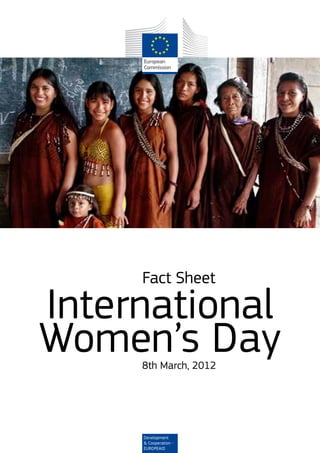
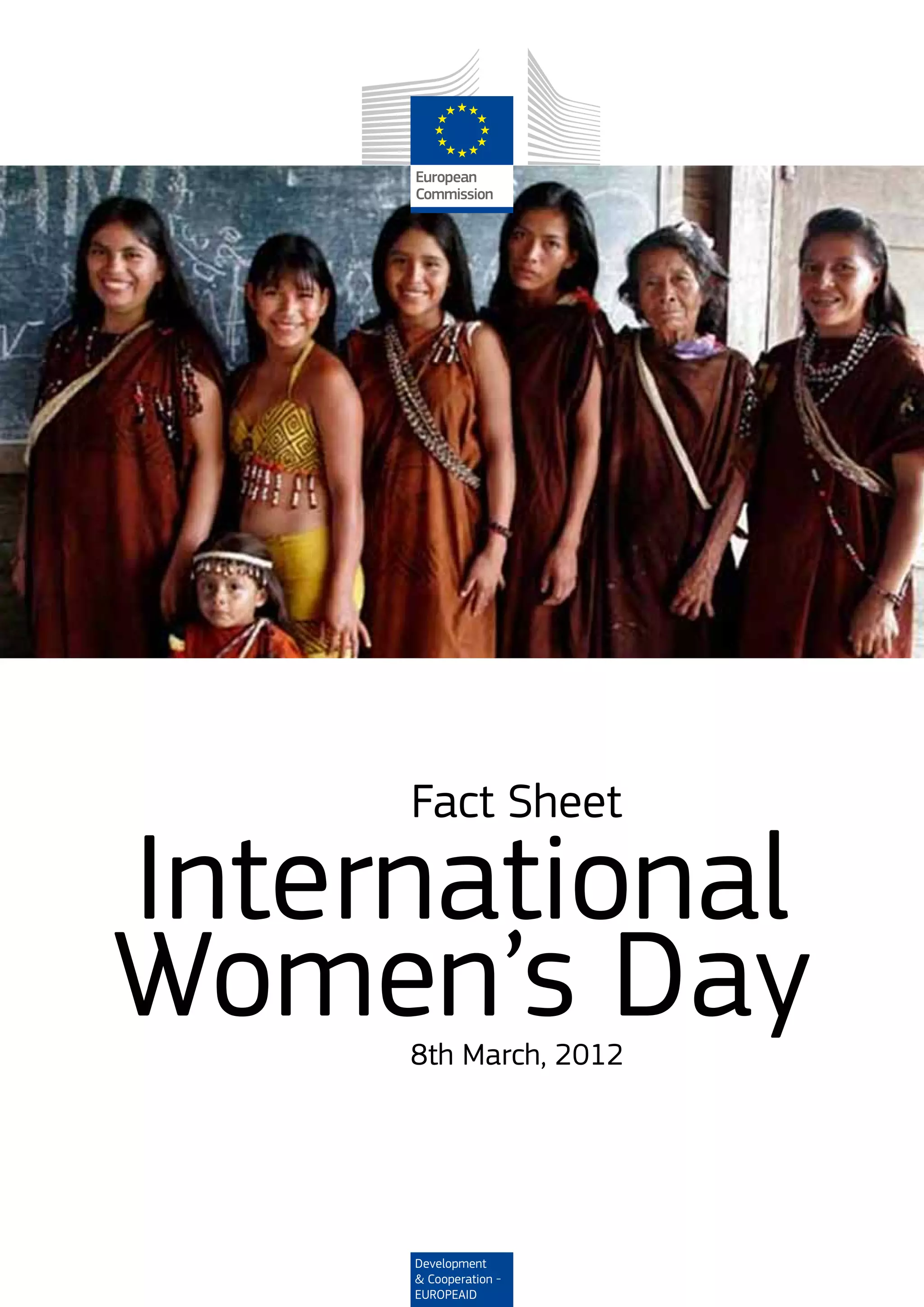
Fact Sheet

International
Women’s Day
     8th March, 2012


     Development
     & Cooperation -
            1
     EUROPEAID
Facts & figures
Since 2004, thanks to Commission support:                         EU Gender Action Plan - helping to
	 More than 85,000 new female students have been                 improve women’s lives around the
   enrolled in secondary education
	 More than 4 million births were attended by health
                                                                  world
   personnel
	 10.8 million consultations on reproductive health              The first results of the EU’s Gender Action Plan – put
                                                                  in place to improve coordination and reinforce the EU’s
                                                                  work on gender to make sure that it had more impact on
Putting women at the heart of                                     the ground – show that it is already making a difference.

everything we do                                                  Figures show that thanks to the plan, EU Delegations and
                                                                  Member States are putting in place new procedures to
As the world’s second largest donor, the Commission               ensure that gender issues are systematically taken into
has a crucial role to play in helping the development             account; both in their policy making and, frequently, also
of women and girls. We put women at the heart of                  in their budget support programmes.
everything we do and make sure that every project we
carry out; be it in agriculture, education or health, has a
clear objective - to enhance women’s engagement and
empower them.


Making the Millennium
Development Goals work for
women
The Millennium Development Goals (MDGs) initiative was
launched with women in mind - a groundbreaking €1
billion project to support maternal health, contribute to
the fight against child mortality and hunger and improve
the supply of water and sanitation.

It is designed to reward progress of the countries that
are most advanced in developing effective strategies to
meet the MDGs, and to support efforts of the others to
bridge the gap of the most off track MDGs, particularly
those related to women.


                                                              2
Thanks to an EU-UNICEF programme, four state-wide
  Gender Action Plan in Action                                action plans on child marriage have now been set up,
                                                              leading to large-scale community-led awareness raising
  In Mexico, the EU helped the government with                and media coverage about the need to bring an end to
  the reform of the justice system, including the             child marriage.
  improvement of legislation on violence against
  women.                                                      As a result of the project, a visit of prominent world
                                                              leaders from The Elders (an independent group who
  In Guatemala, a donor group was set up to follow            work together for peace and human rights, chaired by
  up on cases of sexual and gender-based violence             Archbishop Desmond Tutu) to India was also organised
  and support women’s rights defenders in the                 in 2012 to discuss strategies for accelerating the
  country.                                                    abandonment of child marriage through the ‘Girls Not
                                                              Brides’ partnership.
  In India, the EU has provided support to the
  Government of India on a programme to provide
  quality education for all children between 6 and 14,
  and, in particular, to offer free residential schools
  for girls from marginalised communities. The
  programme is helping to eliminate the gender gap
  and India has now in fact achieved gender equality
  in primary education.


Stories from the Field – How the EU
is making a difference for women
around the world
Saving thousands of girls from Child Marriage in India
In India, 47% of India’s women aged 20–24 are currently
married before the legal age of 18. Child marriage is
illegal, but in poor regions, such as the north-western
state of Rajasthan, there is enormous social and
economic pressure to defy the law. More than half of
girls there are married by age 18 – often setting up a
lifetime of health and social problems for these young
women and their children.


                                                          3
PERSONAL STORIES
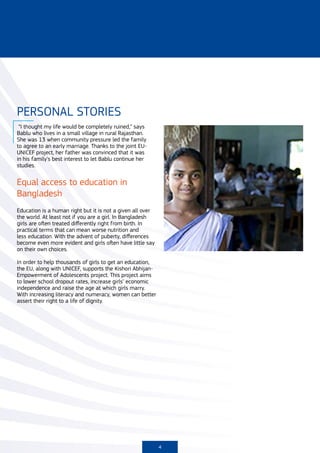
 “I thought my life would be completely ruined,” says
Bablu who lives in a small village in rural Rajasthan.
She was 13 when community pressure led the family
to agree to an early marriage. Thanks to the joint EU-
UNICEF project, her father was convinced that it was
in his family’s best interest to let Bablu continue her
studies.


Equal access to education in
Bangladesh
Education is a human right but it is not a given all over
the world. At least not if you are a girl. In Bangladesh
girls are often treated differently right from birth. In
practical terms that can mean worse nutrition and
less education. With the advent of puberty, differences
become even more evident and girls often have little say
on their own choices.

In order to help thousands of girls to get an education,
the EU, along with UNICEF, supports the Kishori Abhijan-
Empowerment of Adolescents project. This project aims
to lower school dropout rates, increase girls’ economic
independence and raise the age at which girls marry.
With increasing literacy and numeracy, women can better
assert their right to a life of dignity.


                                                            4
PERSONAL STORIES
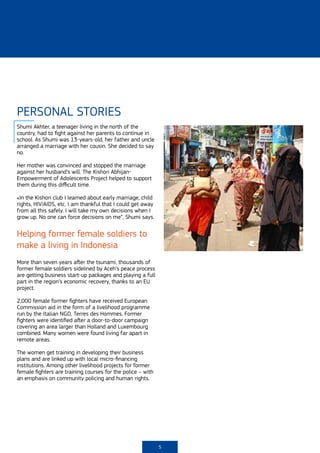
Shumi Akhter, a teenager living in the north of the
country, had to fight against her parents to continue in
school. As Shumi was 13-years-old, her father and uncle
arranged a marriage with her cousin. She decided to say
no.

Her mother was convinced and stopped the marriage
against her husband’s will. The Kishori Abhijan-
Empowerment of Adolescents Project helped to support
them during this difficult time.

«In the Kishori club I learned about early marriage, child
rights, HIV/AIDS, etc. I am thankful that I could get away
from all this safely. I will take my own decisions when I
grow up. No one can force decisions on me”, Shumi says.


Helping former female soldiers to
make a living in Indonesia
More than seven years after the tsunami, thousands of
former female soldiers sidelined by Aceh’s peace process
are getting business start-up packages and playing a full
part in the region’s economic recovery, thanks to an EU
project.

2,000 female former fighters have received European
Commission aid in the form of a livelihood programme
run by the Italian NGO, Terres des Hommes. Former
fighters were identified after a door-to-door campaign
covering an area larger than Holland and Luxembourg
combined. Many women were found living far apart in
remote areas.

The women get training in developing their business
plans and are linked up with local micro-financing
institutions. Among other livelihood projects for former
female fighters are training courses for the police – with
an emphasis on community policing and human rights.


                                                             5
PERSONAL STORIES
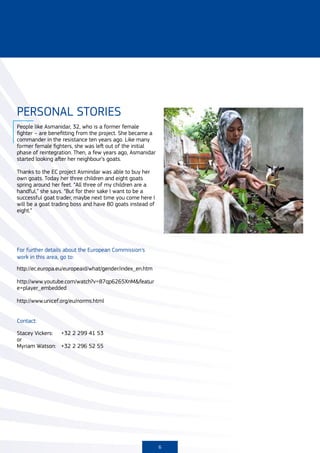
People like Asmanidar, 32, who is a former female
fighter – are benefitting from the project. She became a
commander in the resistance ten years ago. Like many
former female fighters, she was left out of the initial
phase of reintegration. Then, a few years ago, Asmanidar
started looking after her neighbour’s goats.

Thanks to the EC project Asmindar was able to buy her
own goats. Today her three children and eight goats
spring around her feet. “All three of my children are a
handful,” she says. “But for their sake I want to be a
successful goat trader, maybe next time you come here I
will be a goat trading boss and have 80 goats instead of
eight.”


For further details about the European Commission’s
work in this area, go to:
http://ec.europa.eu/europeaid/what/gender/index_en.htm

http://www.youtube.com/watch?v=87qp6265XnM&featur
e=player_embedded

http://www.unicef.org/eu/norms.html


Contact:

Stacey Vickers: 	 +32 2 299 41 53
or
Myriam Watson:	 +32 2 296 52 55


                                                           6

Fact sheet womens day

  • 1.
    Fact Sheet International Women’s Day 8th March, 2012 Development & Cooperation - 1 EUROPEAID
  • 2.
    Facts & figures Since2004, thanks to Commission support: EU Gender Action Plan - helping to  More than 85,000 new female students have been improve women’s lives around the enrolled in secondary education  More than 4 million births were attended by health world personnel  10.8 million consultations on reproductive health The first results of the EU’s Gender Action Plan – put in place to improve coordination and reinforce the EU’s work on gender to make sure that it had more impact on Putting women at the heart of the ground – show that it is already making a difference. everything we do Figures show that thanks to the plan, EU Delegations and Member States are putting in place new procedures to As the world’s second largest donor, the Commission ensure that gender issues are systematically taken into has a crucial role to play in helping the development account; both in their policy making and, frequently, also of women and girls. We put women at the heart of in their budget support programmes. everything we do and make sure that every project we carry out; be it in agriculture, education or health, has a clear objective - to enhance women’s engagement and empower them. Making the Millennium Development Goals work for women The Millennium Development Goals (MDGs) initiative was launched with women in mind - a groundbreaking €1 billion project to support maternal health, contribute to the fight against child mortality and hunger and improve the supply of water and sanitation. It is designed to reward progress of the countries that are most advanced in developing effective strategies to meet the MDGs, and to support efforts of the others to bridge the gap of the most off track MDGs, particularly those related to women. 2
  • 3.
    Thanks to anEU-UNICEF programme, four state-wide Gender Action Plan in Action action plans on child marriage have now been set up, leading to large-scale community-led awareness raising In Mexico, the EU helped the government with and media coverage about the need to bring an end to the reform of the justice system, including the child marriage. improvement of legislation on violence against women. As a result of the project, a visit of prominent world leaders from The Elders (an independent group who In Guatemala, a donor group was set up to follow work together for peace and human rights, chaired by up on cases of sexual and gender-based violence Archbishop Desmond Tutu) to India was also organised and support women’s rights defenders in the in 2012 to discuss strategies for accelerating the country. abandonment of child marriage through the ‘Girls Not Brides’ partnership. In India, the EU has provided support to the Government of India on a programme to provide quality education for all children between 6 and 14, and, in particular, to offer free residential schools for girls from marginalised communities. The programme is helping to eliminate the gender gap and India has now in fact achieved gender equality in primary education. Stories from the Field – How the EU is making a difference for women around the world Saving thousands of girls from Child Marriage in India In India, 47% of India’s women aged 20–24 are currently married before the legal age of 18. Child marriage is illegal, but in poor regions, such as the north-western state of Rajasthan, there is enormous social and economic pressure to defy the law. More than half of girls there are married by age 18 – often setting up a lifetime of health and social problems for these young women and their children. 3
  • 4.
    PERSONAL STORIES “Ithought my life would be completely ruined,” says Bablu who lives in a small village in rural Rajasthan. She was 13 when community pressure led the family to agree to an early marriage. Thanks to the joint EU- UNICEF project, her father was convinced that it was in his family’s best interest to let Bablu continue her studies. Equal access to education in Bangladesh Education is a human right but it is not a given all over the world. At least not if you are a girl. In Bangladesh girls are often treated differently right from birth. In practical terms that can mean worse nutrition and less education. With the advent of puberty, differences become even more evident and girls often have little say on their own choices. In order to help thousands of girls to get an education, the EU, along with UNICEF, supports the Kishori Abhijan- Empowerment of Adolescents project. This project aims to lower school dropout rates, increase girls’ economic independence and raise the age at which girls marry. With increasing literacy and numeracy, women can better assert their right to a life of dignity. 4
  • 5.
    PERSONAL STORIES Shumi Akhter,a teenager living in the north of the country, had to fight against her parents to continue in school. As Shumi was 13-years-old, her father and uncle arranged a marriage with her cousin. She decided to say no. Her mother was convinced and stopped the marriage against her husband’s will. The Kishori Abhijan- Empowerment of Adolescents Project helped to support them during this difficult time. «In the Kishori club I learned about early marriage, child rights, HIV/AIDS, etc. I am thankful that I could get away from all this safely. I will take my own decisions when I grow up. No one can force decisions on me”, Shumi says. Helping former female soldiers to make a living in Indonesia More than seven years after the tsunami, thousands of former female soldiers sidelined by Aceh’s peace process are getting business start-up packages and playing a full part in the region’s economic recovery, thanks to an EU project. 2,000 female former fighters have received European Commission aid in the form of a livelihood programme run by the Italian NGO, Terres des Hommes. Former fighters were identified after a door-to-door campaign covering an area larger than Holland and Luxembourg combined. Many women were found living far apart in remote areas. The women get training in developing their business plans and are linked up with local micro-financing institutions. Among other livelihood projects for former female fighters are training courses for the police – with an emphasis on community policing and human rights. 5
  • 6.
    PERSONAL STORIES People likeAsmanidar, 32, who is a former female fighter – are benefitting from the project. She became a commander in the resistance ten years ago. Like many former female fighters, she was left out of the initial phase of reintegration. Then, a few years ago, Asmanidar started looking after her neighbour’s goats. Thanks to the EC project Asmindar was able to buy her own goats. Today her three children and eight goats spring around her feet. “All three of my children are a handful,” she says. “But for their sake I want to be a successful goat trader, maybe next time you come here I will be a goat trading boss and have 80 goats instead of eight.” For further details about the European Commission’s work in this area, go to: http://ec.europa.eu/europeaid/what/gender/index_en.htm http://www.youtube.com/watch?v=87qp6265XnM&featur e=player_embedded http://www.unicef.org/eu/norms.html Contact: Stacey Vickers: +32 2 299 41 53 or Myriam Watson: +32 2 296 52 55 6