WHATSAPP’S ACQUISITION BY FACEBOOK:
A CALCULATED RISK OR LOST OPPORTUNITY?
ANALYSIS OF THE DEAL BETWEEN WHATSAPP AND FACEBOOK
BY:
ADITYA PATTNAIK
WBNUJS, KOLKATA
INTRODUCTORY
• Modern markets are characterized by mergers and
acquisitions.
• Number of benefits – improves efficiency, increases
value for the shareholders, access to newer markets etc.
• Rapid growth in communication sector and social media
industry.
• Acquisition of Whatsapp by Facebook (2014) –
estimated worth of 19 billion USD.
POINTS FOR DISCUSSION
• Origin and Evolution of the Entities – Whatsapp and Facebook
• Structure of the transaction
• Applicable regulations and clearances
• Objectives and synergies
• Finding and Analysis – Positives and Negatives
FACEBOOK – THE ACQUIRER COMPANY
• Facebook originated in Harvard University as Facesmash, developed
by Mark Zuckerberg and his three other friends. Later on it spread to
Yale and other universities in the United States.
• Attracted angel investments from PayPal and Walmart Stores.
• Currently the biggest player in the social media market around the
globe with 1.8 billion subscribers around the world.
• Incorporated in the United States at Menlo Park, California. Listed on
the New York Stock Exchange and NASDAQ. Incorporated in the year
2005.
• Follows an advertisement structure for revenue.
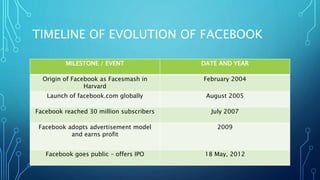
TIMELINE OF EVOLUTION OF FACEBOOK
MILESTONE / EVENT DATE AND YEAR
Origin of Facebook as Facesmash in
Harvard
February 2004
Launch of facebook.com globally August 2005
Facebook reached 30 million subscribers July 2007
Facebook adopts advertisement model
and earns profit
2009
Facebook goes public – offers IPO 18 May, 2012
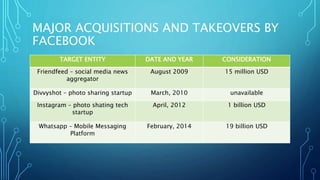
MAJOR ACQUISITIONS AND TAKEOVERS BY
FACEBOOK
TARGET ENTITY DATE AND YEAR CONSIDERATION
Friendfeed – social media news
aggregator
August 2009 15 million USD
Divvyshot – photo sharing startup March, 2010 unavailable
Instagram – photo shating tech
startup
April, 2012 1 billion USD
Whatsapp – Mobile Messaging
Platform
February, 2014 19 billion USD
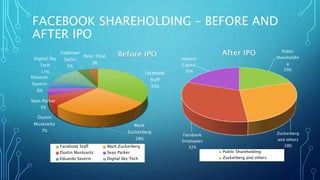
FACEBOOK SHAREHOLDING – BEFORE AND
AFTER IPO
Facebook
Staff
35%
Mark
Zuckerberg
28%
Dustin
Muskovitz
7%
Sean Parker
5%
Eduardo
Saverin
6%
Digital Sky
Tech
11%
Goldman
Sachs
5%
Peter Thiel
3%
Before IPO
Facebook Staff Mark Zuckerberg
Dustin Muskovitz Sean Parker
Eduardo Saverin Digital Sky Tech
Public
Shareholdin
g
20%
Zuckerberg
and others
28%
Facebook
Employees
32%
Venture
Capital
20%
After IPO
Public Shareholding
Zuckerberg and others
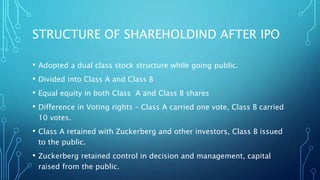
STRUCTURE OF SHAREHOLDIND AFTER IPO
• Adopted a dual class stock structure while going public.
• Divided into Class A and Class B
• Equal equity in both Class A and Class B shares
• Difference in Voting rights – Class A carried one vote, Class B carried
10 votes.
• Class A retained with Zuckerberg and other investors, Class B issued
to the public.
• Zuckerberg retained control in decision and management, capital
raised from the public.
WHATSAPP INC. – THE TARGET COMPANY
• Whatsapp - freeware, cross-platform and end-to-end encrypted
instant messaging application.
• Founded by Jan Koum and Brian Acton and incorporated in 2009.
• Headquartered at Mountain View, California.
• Initial funding raised from Sequoia Capital, doesn’t follow the
advertising model.
• Apart from Europe and USA, the primary markets are India and Latin
America.
• Has managed to remain advertisement free even after the acquisition.
• Generated money through annual subscription, stopped that too
later.
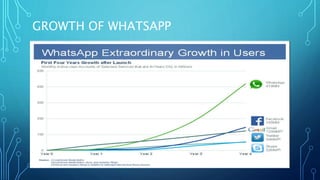
GROWTH OF WHATSAPP
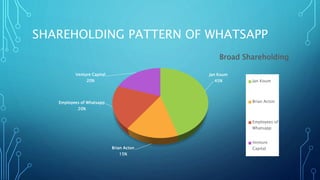
SHAREHOLDING PATTERN OF WHATSAPP
Jan Koum
45%
Brian Acton
15%
Employees of Whatsapp
20%
Venture Capital
20%
Broad Shareholding
Jan Koum
Brian Acton
Employees of
Whatsapp
Venture
Capital
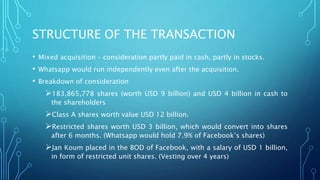
STRUCTURE OF THE TRANSACTION
• Mixed acquisition – consideration partly paid in cash, partly in stocks.
• Whatsapp would run independently even after the acquisition.
• Breakdown of consideration
183,865,778 shares (worth USD 9 billion) and USD 4 billion in cash to
the shareholders
Class A shares worth value USD 12 billion.
Restricted shares worth USD 3 billion, which would convert into shares
after 6 months. (Whatsapp would hold 7.9% of Facebook’s shares)
Jan Koum placed in the BOD of Facebook, with a salary of USD 1 billion,
in form of restricted unit shares. (Vesting over 4 years)
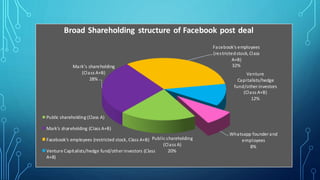
Public shareholding
(Class A)
20%
Mark's shareholding
(Class A+B)
28%
Facebook's employees
(restrictedstock, Class
A+B)
32%
Venture
Capitalists/hedge
fund/otherinvestors
(Class A+B)
12%
Whatsapp founder and
employees
8%
Broad Shareholding structure of Facebook post deal
Public shareholding (Class A)
Mark's shareholding (Class A+B)
Facebook's employees (restricted stock, Class A+B)
Venture Capitalists/hedge fund/other investors (Class
A+B)
APPLICABLE REGULATIONS
• Both the companies incorporated in US – No Foreign Exchange
Regulations.
• Transaction happening through Private agreement.
• Obligations to make an open offer would be applicable if the
Target Company is listed – Whatsapp was not listed, no
intervention of SEC.
• Facebook is listed on NASDAQ – under the ambit of SEC
regulations. Requirement of shareholders meeting, issue of
proxy, complying with required filings.
ANTI TRUST HURDLES IN US & EU
• The deal faced a number of anti trust and piracy concerns in US and
European Union, for the reason that the entities of market leaders.
• Sherman Anti-Trust Act, 1890 and Clayton Anti-Trust Act, 1914.
• Section 7 prohibits acquisition which would affect competition
substantially.
• Amendment to the Clayton Act through Hart-Scott-Radino Antitrust
improvements Act, 1976 – requirement of pre merger notification
and approval form the FTC.
• FTC cleared the approval on April 10, 2014, but issued a privacy
warning to Whatsapp not to sell personal identifiable information.
ANTI TRUST HURDLES IN EU AND OTHERS
• Needed approval from the European Commission under the
European Commission Merger Regulations and Implementation
Regulation.
• All deals which would affect the market competition in the
European Union.
• EC allowed approval as two were not close competitors and had
business in different markets from each other.
• Did not address privacy issues as it was outside their ambit.
FINDINGS AND ANALYSIS
• Objectives – to reduce competition with Whatsapp’s messenger and stop
division of user time between Facebook and Whatsapp,
• Whatsapp has been growing at a tremendous rate.
• It would help realise the dream of “internet.org” which would provide a
bundle of basic internet services.
• General trend of Facebook to acquire tech startups and allow them to
function independently.
• Gave access to Facebook to newer markets such as Latin Americas.
• Synergies – Economies of scale on operational front, cross selling in newer
markets, on revenue front. Option to monetize Whatsapp through
advertisement model.
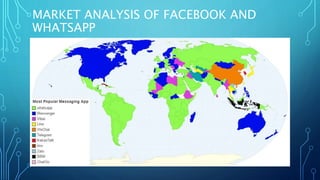
MARKET ANALYSIS OF FACEBOOK AND
WHATSAPP
CONCLUSION
• One of the biggest deals in the telecom sector in the recent years.
Both positive and negative views.
• Facebook criticized for acquiring an entity which cannot be
monetized, at such high price. No substantial benefit for Facebook.
• Whatsapp criticized for concerns of data privacy and incorporation of
advertisement model after the deal (although Whatsapp has not
incorporated it yet)
• The predicted synergies are in the process of getting realised for
which it is too early to comment on the success or failure of the deal.

Facebook - Whatsapp Acquisition Deal Analysis

  • 1.
    WHATSAPP’S ACQUISITION BYFACEBOOK: A CALCULATED RISK OR LOST OPPORTUNITY? ANALYSIS OF THE DEAL BETWEEN WHATSAPP AND FACEBOOK BY: ADITYA PATTNAIK WBNUJS, KOLKATA
  • 2.
    INTRODUCTORY • Modern marketsare characterized by mergers and acquisitions. • Number of benefits – improves efficiency, increases value for the shareholders, access to newer markets etc. • Rapid growth in communication sector and social media industry. • Acquisition of Whatsapp by Facebook (2014) – estimated worth of 19 billion USD.
  • 3.
    POINTS FOR DISCUSSION •Origin and Evolution of the Entities – Whatsapp and Facebook • Structure of the transaction • Applicable regulations and clearances • Objectives and synergies • Finding and Analysis – Positives and Negatives
  • 4.
    FACEBOOK – THEACQUIRER COMPANY • Facebook originated in Harvard University as Facesmash, developed by Mark Zuckerberg and his three other friends. Later on it spread to Yale and other universities in the United States. • Attracted angel investments from PayPal and Walmart Stores. • Currently the biggest player in the social media market around the globe with 1.8 billion subscribers around the world. • Incorporated in the United States at Menlo Park, California. Listed on the New York Stock Exchange and NASDAQ. Incorporated in the year 2005. • Follows an advertisement structure for revenue.
  • 5.
    TIMELINE OF EVOLUTIONOF FACEBOOK MILESTONE / EVENT DATE AND YEAR Origin of Facebook as Facesmash in Harvard February 2004 Launch of facebook.com globally August 2005 Facebook reached 30 million subscribers July 2007 Facebook adopts advertisement model and earns profit 2009 Facebook goes public – offers IPO 18 May, 2012
  • 6.
    MAJOR ACQUISITIONS ANDTAKEOVERS BY FACEBOOK TARGET ENTITY DATE AND YEAR CONSIDERATION Friendfeed – social media news aggregator August 2009 15 million USD Divvyshot – photo sharing startup March, 2010 unavailable Instagram – photo shating tech startup April, 2012 1 billion USD Whatsapp – Mobile Messaging Platform February, 2014 19 billion USD
  • 7.
    FACEBOOK SHAREHOLDING –BEFORE AND AFTER IPO Facebook Staff 35% Mark Zuckerberg 28% Dustin Muskovitz 7% Sean Parker 5% Eduardo Saverin 6% Digital Sky Tech 11% Goldman Sachs 5% Peter Thiel 3% Before IPO Facebook Staff Mark Zuckerberg Dustin Muskovitz Sean Parker Eduardo Saverin Digital Sky Tech Public Shareholdin g 20% Zuckerberg and others 28% Facebook Employees 32% Venture Capital 20% After IPO Public Shareholding Zuckerberg and others
  • 8.
    STRUCTURE OF SHAREHOLDINDAFTER IPO • Adopted a dual class stock structure while going public. • Divided into Class A and Class B • Equal equity in both Class A and Class B shares • Difference in Voting rights – Class A carried one vote, Class B carried 10 votes. • Class A retained with Zuckerberg and other investors, Class B issued to the public. • Zuckerberg retained control in decision and management, capital raised from the public.
  • 9.
    WHATSAPP INC. –THE TARGET COMPANY • Whatsapp - freeware, cross-platform and end-to-end encrypted instant messaging application. • Founded by Jan Koum and Brian Acton and incorporated in 2009. • Headquartered at Mountain View, California. • Initial funding raised from Sequoia Capital, doesn’t follow the advertising model. • Apart from Europe and USA, the primary markets are India and Latin America. • Has managed to remain advertisement free even after the acquisition. • Generated money through annual subscription, stopped that too later.
  • 10.
  • 11.
    SHAREHOLDING PATTERN OFWHATSAPP Jan Koum 45% Brian Acton 15% Employees of Whatsapp 20% Venture Capital 20% Broad Shareholding Jan Koum Brian Acton Employees of Whatsapp Venture Capital
  • 12.
    STRUCTURE OF THETRANSACTION • Mixed acquisition – consideration partly paid in cash, partly in stocks. • Whatsapp would run independently even after the acquisition. • Breakdown of consideration 183,865,778 shares (worth USD 9 billion) and USD 4 billion in cash to the shareholders Class A shares worth value USD 12 billion. Restricted shares worth USD 3 billion, which would convert into shares after 6 months. (Whatsapp would hold 7.9% of Facebook’s shares) Jan Koum placed in the BOD of Facebook, with a salary of USD 1 billion, in form of restricted unit shares. (Vesting over 4 years)
  • 13.
    Public shareholding (Class A) 20% Mark'sshareholding (Class A+B) 28% Facebook's employees (restrictedstock, Class A+B) 32% Venture Capitalists/hedge fund/otherinvestors (Class A+B) 12% Whatsapp founder and employees 8% Broad Shareholding structure of Facebook post deal Public shareholding (Class A) Mark's shareholding (Class A+B) Facebook's employees (restricted stock, Class A+B) Venture Capitalists/hedge fund/other investors (Class A+B)
  • 14.
    APPLICABLE REGULATIONS • Boththe companies incorporated in US – No Foreign Exchange Regulations. • Transaction happening through Private agreement. • Obligations to make an open offer would be applicable if the Target Company is listed – Whatsapp was not listed, no intervention of SEC. • Facebook is listed on NASDAQ – under the ambit of SEC regulations. Requirement of shareholders meeting, issue of proxy, complying with required filings.
  • 15.
    ANTI TRUST HURDLESIN US & EU • The deal faced a number of anti trust and piracy concerns in US and European Union, for the reason that the entities of market leaders. • Sherman Anti-Trust Act, 1890 and Clayton Anti-Trust Act, 1914. • Section 7 prohibits acquisition which would affect competition substantially. • Amendment to the Clayton Act through Hart-Scott-Radino Antitrust improvements Act, 1976 – requirement of pre merger notification and approval form the FTC. • FTC cleared the approval on April 10, 2014, but issued a privacy warning to Whatsapp not to sell personal identifiable information.
  • 16.
    ANTI TRUST HURDLESIN EU AND OTHERS • Needed approval from the European Commission under the European Commission Merger Regulations and Implementation Regulation. • All deals which would affect the market competition in the European Union. • EC allowed approval as two were not close competitors and had business in different markets from each other. • Did not address privacy issues as it was outside their ambit.
  • 17.
    FINDINGS AND ANALYSIS •Objectives – to reduce competition with Whatsapp’s messenger and stop division of user time between Facebook and Whatsapp, • Whatsapp has been growing at a tremendous rate. • It would help realise the dream of “internet.org” which would provide a bundle of basic internet services. • General trend of Facebook to acquire tech startups and allow them to function independently. • Gave access to Facebook to newer markets such as Latin Americas. • Synergies – Economies of scale on operational front, cross selling in newer markets, on revenue front. Option to monetize Whatsapp through advertisement model.
  • 18.
    MARKET ANALYSIS OFFACEBOOK AND WHATSAPP
  • 19.
    CONCLUSION • One ofthe biggest deals in the telecom sector in the recent years. Both positive and negative views. • Facebook criticized for acquiring an entity which cannot be monetized, at such high price. No substantial benefit for Facebook. • Whatsapp criticized for concerns of data privacy and incorporation of advertisement model after the deal (although Whatsapp has not incorporated it yet) • The predicted synergies are in the process of getting realised for which it is too early to comment on the success or failure of the deal.