SAVING WATER IN THE
HOME AND GARDEN
When it comes to saving water, we can all make a difference by changing our habits at
home and in the garden.

According to the Australian Bureau of Statistics, 9% of Australia's total water use occurs in
the home.

Every household in Australia uses about 294 kilolitres each year. There are differences
around the country due to climate (the Tasmanian average is 176kL per year and the
Northern Territory average is 500kL per year) but we all know that we could use water
more wisely.

Your water meter is the starting point for improving your understanding of water use.
Normally water bills show the amount of water used and give you the ability to monitor
your use. Some major cities and towns in Australia still don't have water meters, which
limits the ability of households to manage their water use better.

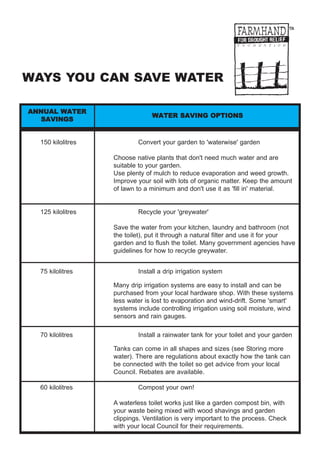
We have compiled a list of ways you can conserve water at home, using a wide variety of
sources such as water utilities and government authorities. The list is in order from the
greatest water saving down to those small changes that can still make a difference. Add up
all those options that you could do at home and you'll be amazed how much water (and
money) you could save each year.

While our water use in the garden varies, the opportunities to save the most water are
usually in the garden, such as using native plants, reducing the area of lawn to water, and
installing a rainwater tank for the garden watering.

For more information on water efficient household appliances, check out of the National
Water Conservation Rating and Labelling Scheme at www.wsaa.asn.au

We can all do our bit to save water.


               2 Holt Street, Surry Hills NSW 2010 www.farmhand.org.au ACN 102 327 284

                                   FOUNDATION PARTNERS


                                       PLATINUM PARTNERS
WAYS YOU CAN SAVE WATER

ANNUAL WATER
                                WATER SAVING OPTIONS
  SAVINGS


  150 kilolitres           Convert your garden to 'waterwise' garden

                   Choose native plants that don't need much water and are
                   suitable to your garden.
                   Use plenty of mulch to reduce evaporation and weed growth.
                   Improve your soil with lots of organic matter. Keep the amount
                   of lawn to a minimum and don't use it as 'fill in' material.


  125 kilolitres           Recycle your 'greywater'

                   Save the water from your kitchen, laundry and bathroom (not
                   the toilet), put it through a natural filter and use it for your
                   garden and to flush the toilet. Many government agencies have
                   guidelines for how to recycle greywater.


  75 kilolitres            Install a drip irrigation system

                   Many drip irrigation systems are easy to install and can be
                   purchased from your local hardware shop. With these systems
                   less water is lost to evaporation and wind-drift. Some 'smart'
                   systems include controlling irrigation using soil moisture, wind
                   sensors and rain gauges.

  70 kilolitres            Install a rainwater tank for your toilet and your garden

                   Tanks can come in all shapes and sizes (see Storing more
                   water). There are regulations about exactly how the tank can
                   be connected with the toilet so get advice from your local
                   Council. Rebates are available.

  60 kilolitres            Compost your own!

                   A waterless toilet works just like a garden compost bin, with
                   your waste being mixed with wood shavings and garden
                   clippings. Ventilation is very important to the process. Check
                   with your local Council for their requirements.
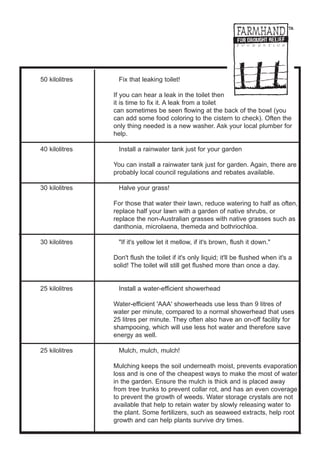
50 kilolitres     Fix that leaking toilet!

                If you can hear a leak in the toilet then
                it is time to fix it. A leak from a toilet
                can sometimes be seen flowing at the back of the bowl (you
                can add some food coloring to the cistern to check). Often the
                only thing needed is a new washer. Ask your local plumber for
                help.

40 kilolitres     Install a rainwater tank just for your garden

                You can install a rainwater tank just for garden. Again, there are
                probably local council regulations and rebates available.

30 kilolitres     Halve your grass!

                For those that water their lawn, reduce watering to half as often,
                replace half your lawn with a garden of native shrubs, or
                replace the non-Australian grasses with native grasses such as
                danthonia, microlaena, themeda and bothriochloa.

30 kilolitres     "If it's yellow let it mellow, if it's brown, flush it down."

                Don't flush the toilet if it's only liquid; it'll be flushed when it's a
                solid! The toilet will still get flushed more than once a day.


25 kilolitres     Install a water-efficient showerhead

                Water-efficient 'AAA' showerheads use less than 9 litres of
                water per minute, compared to a normal showerhead that uses
                25 litres per minute. They often also have an on-off facility for
                shampooing, which will use less hot water and therefore save
                energy as well.

25 kilolitres     Mulch, mulch, mulch!

                Mulching keeps the soil underneath moist, prevents evaporation
                loss and is one of the cheapest ways to make the most of water
                in the garden. Ensure the mulch is thick and is placed away
                from tree trunks to prevent collar rot, and has an even coverage
                to prevent the growth of weeds. Water storage crystals are not
                available that help to retain water by slowly releasing water to
                the plant. Some fertilizers, such as seaweed extracts, help root
                growth and can help plants survive dry times.
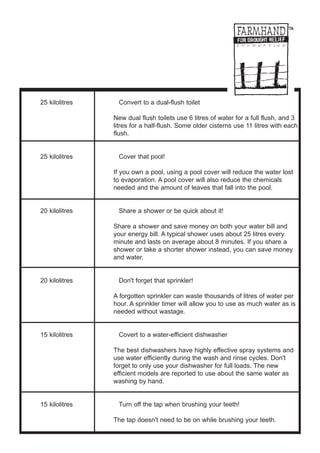
25 kilolitres    Convert to a dual-flush toilet

                New dual flush toilets use 6 litres of water for a full flush, and 3
                litres for a half-flush. Some older cisterns use 11 litres with each
                flush.


25 kilolitres    Cover that pool!

                If you own a pool, using a pool cover will reduce the water lost
                to evaporation. A pool cover will also reduce the chemicals
                needed and the amount of leaves that fall into the pool.


20 kilolitres    Share a shower or be quick about it!

                Share a shower and save money on both your water bill and
                your energy bill. A typical shower uses about 25 litres every
                minute and lasts on average about 8 minutes. If you share a
                shower or take a shorter shower instead, you can save money
                and water.


20 kilolitres    Don't forget that sprinkler!

                A forgotten sprinkler can waste thousands of litres of water per
                hour. A sprinkler timer will allow you to use as much water as is
                needed without wastage.


15 kilolitres    Covert to a water-efficient dishwasher

                The best dishwashers have highly effective spray systems and
                use water efficiently during the wash and rinse cycles. Don't
                forget to only use your dishwasher for full loads. The new
                efficient models are reported to use about the same water as
                washing by hand.


15 kilolitres    Turn off the tap when brushing your teeth!

                The tap doesn't need to be on while brushing your teeth.
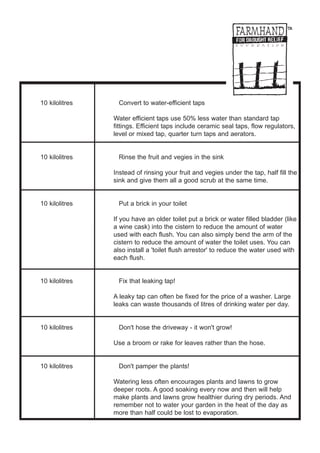
10 kilolitres     Convert to water-efficient taps

                Water efficient taps use 50% less water than standard tap
                fittings. Efficient taps include ceramic seal taps, flow regulators,
                level or mixed tap, quarter turn taps and aerators.


10 kilolitres     Rinse the fruit and vegies in the sink

                Instead of rinsing your fruit and vegies under the tap, half fill the
                sink and give them all a good scrub at the same time.


10 kilolitres     Put a brick in your toilet

                If you have an older toilet put a brick or water filled bladder (like
                a wine cask) into the cistern to reduce the amount of water
                used with each flush. You can also simply bend the arm of the
                cistern to reduce the amount of water the toilet uses. You can
                also install a 'toilet flush arrestor' to reduce the water used with
                each flush.


10 kilolitres     Fix that leaking tap!

                A leaky tap can often be fixed for the price of a washer. Large
                leaks can waste thousands of litres of drinking water per day.


10 kilolitres     Don't hose the driveway - it won't grow!

                Use a broom or rake for leaves rather than the hose.


10 kilolitres     Don't pamper the plants!

                Watering less often encourages plants and lawns to grow
                deeper roots. A good soaking every now and then will help
                make plants and lawns grow healthier during dry periods. And
                remember not to water your garden in the heat of the day as
                more than half could be lost to evaporation.

Saving Water in the Home and Garden - Farmhand for Drought Relief

  • 1.
    SAVING WATER INTHE HOME AND GARDEN When it comes to saving water, we can all make a difference by changing our habits at home and in the garden. According to the Australian Bureau of Statistics, 9% of Australia's total water use occurs in the home. Every household in Australia uses about 294 kilolitres each year. There are differences around the country due to climate (the Tasmanian average is 176kL per year and the Northern Territory average is 500kL per year) but we all know that we could use water more wisely. Your water meter is the starting point for improving your understanding of water use. Normally water bills show the amount of water used and give you the ability to monitor your use. Some major cities and towns in Australia still don't have water meters, which limits the ability of households to manage their water use better. We have compiled a list of ways you can conserve water at home, using a wide variety of sources such as water utilities and government authorities. The list is in order from the greatest water saving down to those small changes that can still make a difference. Add up all those options that you could do at home and you'll be amazed how much water (and money) you could save each year. While our water use in the garden varies, the opportunities to save the most water are usually in the garden, such as using native plants, reducing the area of lawn to water, and installing a rainwater tank for the garden watering. For more information on water efficient household appliances, check out of the National Water Conservation Rating and Labelling Scheme at www.wsaa.asn.au We can all do our bit to save water. 2 Holt Street, Surry Hills NSW 2010 www.farmhand.org.au ACN 102 327 284 FOUNDATION PARTNERS PLATINUM PARTNERS
  • 2.
    WAYS YOU CANSAVE WATER ANNUAL WATER WATER SAVING OPTIONS SAVINGS 150 kilolitres Convert your garden to 'waterwise' garden Choose native plants that don't need much water and are suitable to your garden. Use plenty of mulch to reduce evaporation and weed growth. Improve your soil with lots of organic matter. Keep the amount of lawn to a minimum and don't use it as 'fill in' material. 125 kilolitres Recycle your 'greywater' Save the water from your kitchen, laundry and bathroom (not the toilet), put it through a natural filter and use it for your garden and to flush the toilet. Many government agencies have guidelines for how to recycle greywater. 75 kilolitres Install a drip irrigation system Many drip irrigation systems are easy to install and can be purchased from your local hardware shop. With these systems less water is lost to evaporation and wind-drift. Some 'smart' systems include controlling irrigation using soil moisture, wind sensors and rain gauges. 70 kilolitres Install a rainwater tank for your toilet and your garden Tanks can come in all shapes and sizes (see Storing more water). There are regulations about exactly how the tank can be connected with the toilet so get advice from your local Council. Rebates are available. 60 kilolitres Compost your own! A waterless toilet works just like a garden compost bin, with your waste being mixed with wood shavings and garden clippings. Ventilation is very important to the process. Check with your local Council for their requirements.
  • 3.
    50 kilolitres Fix that leaking toilet! If you can hear a leak in the toilet then it is time to fix it. A leak from a toilet can sometimes be seen flowing at the back of the bowl (you can add some food coloring to the cistern to check). Often the only thing needed is a new washer. Ask your local plumber for help. 40 kilolitres Install a rainwater tank just for your garden You can install a rainwater tank just for garden. Again, there are probably local council regulations and rebates available. 30 kilolitres Halve your grass! For those that water their lawn, reduce watering to half as often, replace half your lawn with a garden of native shrubs, or replace the non-Australian grasses with native grasses such as danthonia, microlaena, themeda and bothriochloa. 30 kilolitres "If it's yellow let it mellow, if it's brown, flush it down." Don't flush the toilet if it's only liquid; it'll be flushed when it's a solid! The toilet will still get flushed more than once a day. 25 kilolitres Install a water-efficient showerhead Water-efficient 'AAA' showerheads use less than 9 litres of water per minute, compared to a normal showerhead that uses 25 litres per minute. They often also have an on-off facility for shampooing, which will use less hot water and therefore save energy as well. 25 kilolitres Mulch, mulch, mulch! Mulching keeps the soil underneath moist, prevents evaporation loss and is one of the cheapest ways to make the most of water in the garden. Ensure the mulch is thick and is placed away from tree trunks to prevent collar rot, and has an even coverage to prevent the growth of weeds. Water storage crystals are not available that help to retain water by slowly releasing water to the plant. Some fertilizers, such as seaweed extracts, help root growth and can help plants survive dry times.
  • 4.
    25 kilolitres Convert to a dual-flush toilet New dual flush toilets use 6 litres of water for a full flush, and 3 litres for a half-flush. Some older cisterns use 11 litres with each flush. 25 kilolitres Cover that pool! If you own a pool, using a pool cover will reduce the water lost to evaporation. A pool cover will also reduce the chemicals needed and the amount of leaves that fall into the pool. 20 kilolitres Share a shower or be quick about it! Share a shower and save money on both your water bill and your energy bill. A typical shower uses about 25 litres every minute and lasts on average about 8 minutes. If you share a shower or take a shorter shower instead, you can save money and water. 20 kilolitres Don't forget that sprinkler! A forgotten sprinkler can waste thousands of litres of water per hour. A sprinkler timer will allow you to use as much water as is needed without wastage. 15 kilolitres Covert to a water-efficient dishwasher The best dishwashers have highly effective spray systems and use water efficiently during the wash and rinse cycles. Don't forget to only use your dishwasher for full loads. The new efficient models are reported to use about the same water as washing by hand. 15 kilolitres Turn off the tap when brushing your teeth! The tap doesn't need to be on while brushing your teeth.
  • 5.
    10 kilolitres Convert to water-efficient taps Water efficient taps use 50% less water than standard tap fittings. Efficient taps include ceramic seal taps, flow regulators, level or mixed tap, quarter turn taps and aerators. 10 kilolitres Rinse the fruit and vegies in the sink Instead of rinsing your fruit and vegies under the tap, half fill the sink and give them all a good scrub at the same time. 10 kilolitres Put a brick in your toilet If you have an older toilet put a brick or water filled bladder (like a wine cask) into the cistern to reduce the amount of water used with each flush. You can also simply bend the arm of the cistern to reduce the amount of water the toilet uses. You can also install a 'toilet flush arrestor' to reduce the water used with each flush. 10 kilolitres Fix that leaking tap! A leaky tap can often be fixed for the price of a washer. Large leaks can waste thousands of litres of drinking water per day. 10 kilolitres Don't hose the driveway - it won't grow! Use a broom or rake for leaves rather than the hose. 10 kilolitres Don't pamper the plants! Watering less often encourages plants and lawns to grow deeper roots. A good soaking every now and then will help make plants and lawns grow healthier during dry periods. And remember not to water your garden in the heat of the day as more than half could be lost to evaporation.