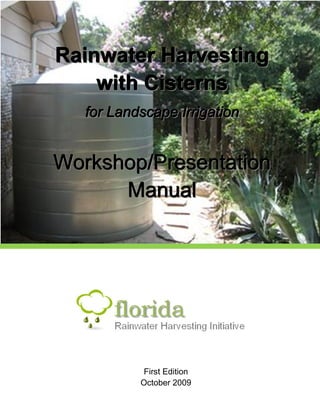






Rainwater Harvesting
        with Cisterns
       for Landscape Irrigation


    Workshop/Presentation
          Manual


                First Edition
 
               October 2009
Acknowledgements
The Rainwater Harvesting Initiative would like to thank everyone that cooperated in
assisting with this effort:

Developers
Ms. Pacia Hernandez, University of South Florida
Dr. Daniel Yeh, University of South Florida
Dr. Thomas Ruppert, University of Florida
Mr. Skip Wright, Florida Irrigation Society
Mr. Dave Bracciano, Tampa Bay Water

Reviewers
Ms. Esen Momul, University of Florida Institute of Food & Agricultural Sciences (IFAS)
Ms. Kathy Malone, University of Florida IFAS
Mr. Jeffrey Harris, Pasco County Utilities
Ms. Chris Claus, City of St. Petersburg Water Resources
Mr. Norman Davis, Hillsborough County Water Resources
Mr. Bob Peacock, Pinellas County Utilities
Ms. Jeannie Hayes, Pasco County Extension Florida Yards and Neighborhoods (FYN)
Ms. Wilma J. Holley, Pinellas County Extension FYN
Mr. Chris Dewey, Pasco County Extension FYN
Ms. Lynn Barber, Hillsborough County Extension FYN
Mr. Dale Armstrong, Pinellas County Extension FYN
Ms. Doris Heitzmann, Pinellas County Extension FYN
Ms. Dierdre Irwin, St. Johns River Water Management District
Ms. Melissa Roe, Southwest Florida Water Management District
Mr. Brent White, Southwest Florida Water Management District


                                           2
 
First Edition
    October 2009
    Clearwater, FL


         3
 
Table of Contents
1   Project Background and Definition
    Defining the need………………………………………………………………………..1
    Parties involved through initiative……………………………………………………..1
    What elements were being developed by whom…………………………………….1
    Drafting of materials…………………………………………………………...………..2
    Review mechanisms…………………………………………………………………....3
    How the program can be used………………………………………………………..3


2   How to Put on a Workshop
    Florida Rainwater Harvesting Initiative linkage ……………………………………..4
    Sponsor levels and charges…………………………………………………..…...…..4
    What do the Sponsors receive in return for Sponsorship………………….……….5
    Identifying a Minimum Number of participants……………………………..………..5
    Workshop Agenda……………………………………………………………...……....6
    Use of Workshop Presentation ………………………………………………………..6
    Obtaining the Workshop Powerpoint Presentation…...……………………………..6
    Revising Presentation Materials…………………………..…………………………..6


3   The Florida Rainwater Harvesting Initiative……………………………..…..7


4   Additional Future Coordination/Development Efforts……………………..8
    Standard Cistern Presentation for Other Water Use Opportunities
    Identifying Technical Research Needs
    Identifying Legal and Code-related Research and Development Needs
    Other


Appendices

Appendix A   Workshop Presentation Notes Pages-

Appendix B   University of South Florida Technical Report

Appendix C   University of Florida Research Results

Appendix D   Workshop Handout


                                             ii
 
iii
 
1      Project Background and Definition
Defining the need
In early 2009, Tampa Bay Water, a regional water supply Authority, began work
developing a Standardized Cistern Program Agenda, workshop structure and
presentation materials. The overarching goal of this effort is to eliminate barriers to
successful promotion of cistern systems for irrigation use in Florida and to link public
and private efforts.


The Tampa Bay region endured water supply shortage conditions over the three year
2006-2009 period. As a funding agency of the Florida Yards and Neighborhoods (FYN)
program in their tri-county area since 1994, they have witnessed the public’s interest in
installation of rain barrels and FYN’s rain barrel workshop program success. This is
also occurring through the 48 counties in Florida where the FYN programs are
instituted.


Parties involved through initiative
Tampa Bay Water provided funding to University of Florida and the University South
Florida to address these barriers and create a program that links the public to public
agencies and private industry. They also worked with Florida Irrigation Society staff on
this project.


What elements were being developed by whom
As part of Tampa Bay Water’s effort to conserve water, the agency worked with the
University of Florida, University of South Florida, the Florida Irrigation Society and
various cistern manufacturers and installers to develop a standard workshop for citizens
to promote installation and use of cisterns in the Tampa Bay region and across the state
so stored water can be used for irrigation, thus saving potable water.


The University of Florida was specifically tasked to determine what legal and code
analysis is required to adequately preclude program presenters from being liable for all
 
 
or portions of the workshop output. Local health departments were contacted
throughout the state in order to gage their reaction to the installation outdoor cisterns for
irrigation use. State and local ordinances were reviewed that may/may not deal with
cisterns.


The University of South Florida was tasked with helping to analyze technical and
engineering aspects of rainwater harvesting with cisterns. These included:


•   Water quality considerations and issues associated with rainwater harvesting with
    cisterns
•   Engineering designs on sizing, storage and treatment to enable the appropriate and
    reliable use of cistern water for intended applications
•   Relevant operation and maintenance considerations for successful cistern use
•   How rainwater harvesting with cisterns can be successfully integrated into an
    existing water supply infrastructure
•   Economic considerations for cistern strategies


The Florida Irrigation Society (FIS) assisted in the development of water use
requirements and sizing of cistern systems, while manufacturers and installers were a
part of the process of including a full-scale workshop with presentations, sponsors, and
links to actual product.

Drafting of materials
The University of South Florida coordinated with the University of Florida IFAS, FIS and
Tampa Bay Water in the elaboration of workshop materials that were to be used.
Specific issues and topics were identified as the most appropriate to present to the
public. Once a draft presentation was completed, dry-run workshops with members
from local governments, FYN (local and statewide), water management districts and
experienced cistern installers (invited) took place to collect further feedback on content
of presentation and workshop length.


                                              2
 
Review mechanisms
Once the final workshop presentation is issued, further review, update and edit may be
necessary. Errata and modifications may to be submitted to the presentation steward
(Dave Bracciano, Tampa Bay Water) by email (dbracciano@tampabaywater.org) or in
writing.


How the program can be used
The workshop will be delivered as a package to the Florida Yards and Neighborhoods
(FYN) program throughout the region and state and would be part of FYN’s workshop
on rain barrels or a stand-alone workshop. In addition to educating citizens about
cisterns, the program would seek to connect interested parties with contractors and
businesses that can assist in designing and installing cistern systems.


                                            3
 
2      How to Put on a Workshop
Florida Rainwater Harvest Initiative Linkage
The Florida Rainwater Harvest Initiative (FRHI) initial goal is to add private industry
groups/associations that can use the workshop format to promote their industry and to
help insure that expertise is funneled back and forth between educators and workshop
attendees. It is not designed to circumvent training programs, continuing education unit
development, or modify standards developed by others.


This will allow individual workshop developers to contact these entities for potential
sponsors and potential business opportunities. It provides value to these private entities
by linking the public with association membership at workshops.


About a month before the workshop is to occur, the workshop developer should contact
either or both organizations to determine if they have members that would be interested
in sponsoring the upcoming rainwater harvest workshop.
Current representative organizations and contacts are;


American Rainwater Catchment Systems Association
Florida Representative: John Hammerstrom
johnhammer@bellsouth.net
Phone Number: (305)852-8722 
http://www.arcsa.org
919 Congress Ave., Ste. 460
Austin, TX 78701

Florida Irrigation Society
www.fisstate.org
Jennifer Amarosa, Executive Administrator
administration@fisstate.org
Phone Number: (800) 441-5341/(813) 839-4601          Fax Number: (813) 839-4759
Address: P.O. Box 13502, Tampa, FL 33681


                                             4
 
Sponsor levels and charges
Since it is anticipated workshops will be put on by Florida yards and Neighborhoods,
along with the potential for other government entity use, creating a sponsorhip process
that is consistent between FRHI entities is important Although public entities have
specific funding constraints through budgeting and oversight processes, monies are
generally needed to continue and expand programs.


Having workshop sponsors is a legitimate means to promote workshops and also
recoup costs for establishing them. In some instances, workshops may be located at
facilities that require cost recovery.


Workshop implementers have two means of sponsorship; funding provided directly the
entity in the way of a check or sponsoring a giveaway between all the sponsors at the
event (no exchange of funds with the government entity). It is generally recommended
that sponsorship levels be at least in the $50 range for 25-50 participants and at least
$100 for over 50 participants. Sponsorship should be based on available space for
sponsors to advertise along the side and/or back of the workshop location.


Workshop developers should decide which process works well for their entity before
sending out request for sponsors.


What do the Sponsors receive in return for Sponsorship
Sponsors get recognized during the workshop and thanked for their efforts.
During breaks and at the end of the workshop, the public will directly interact with
sponsors to determine if there is additional interest in pursuing installation of rainwater
harvesting systems. Materials provided during the workshop will give participants a
general checklist of items that are required for successful rainwater harvesting system
installation and linkage to irrigation systems.


                                              5
 
Identifying a Minimum Number of participants
Based on discussion with Florida Yards and Neighborhoods coordinators in the Tampa
Bay region, it is expected that at least 25 participants should be signed up for the
workshop so sponsor levels can be secured as identified above. If less than 25
participants are expected, sponsors should be alerted prior to securing funding to insure
good will between the sponsors and workshop promoters.


    In some cases, rain barrel workshops have had in excess of 100 people in attendance.
It’s generally recommended that workshops be kept to less than 100 people, unless
workshop presenters have experience dealing with large groups.


Workshop Agenda
A standardized agenda has been developed for the workshop. Modifications to the
agenda can be made but note the presentation is locked in presentation mode to insure
material and content integrity. Modifications to the agenda will generally not coincide
with material presented.


To suggest modifications to the agenda or presentation materials see Revising
Presentation Materials below.


Use of Workshop Presentation
The workshop presentation, located at
http://reservoir.tampabaywater.org/sites/frhi/default.aspx is locked in the presentation
mode. The cover slide is not locked so it can be modified to coincide with the
presentation date and location. Additionally, a slide with the workshop sponsors should
be provided. If entities have a logo, it is suggested you request an electronic version,
and use it in your presentation.


Obtaining the Workshop Powerpoint Presentation
The entire document will also be distributed through members of the Florida Rainwater
Harvest Initiative and can be requested by emailing Dave Bracciano, Tampa Bay Water,


                                             6
 
at dbracciano@tampabaywater.org. All organizations that are distributing this
document are required to provide a master list of requesting entities, along with
pertinent contact information. This information will be used to determine actual
penetration rates for program implementation on an annual basis.


Revising Presentation Materials
On a quarterly basis, materials will be reviewed for modifications based on feedback to
dbracciano@tampabaywater.org. All comments specific to the presentation will be
addressed by the next quarter.


                                            7
 
3   The Florida Rainwater Harvesting Initiative


                        8
 
4       Additional Future
        Coordination/Development Efforts
Standard Cistern Presentations for Other Water Use Opportunities


Identifying Technical Research Needs


Identifying Legal and Code-related Research and Development Needs


Other


                                         9
 
APPENDIX A
 
 
1
2
3
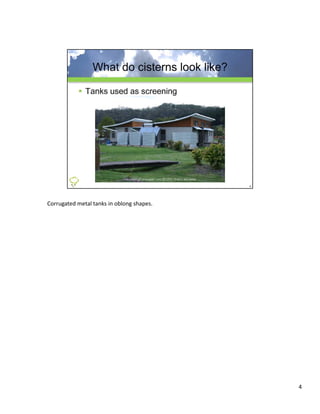
Corrugated metal tanks in oblong shapes.


                                           4
5
6
7
8
9
10
11
12
Our purpose in presenting this workshop…
Emphasis should be given that (1) these are basics – not comprehensive – of rainwater 
harvesting and (2) focus will be only on irrigation as end use.


                                                                                         13
14
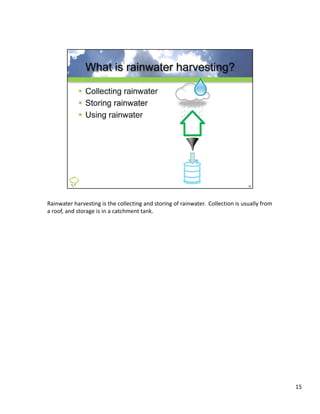
Rainwater harvesting is the collecting and storing of rainwater.  Collection is usually from 
a roof, and storage is in a catchment tank.


                                                                                                15
Some of you may be rain barrel users. How many of you do that already?  Good!  Rain 
barrels are a good start.  That means that you are already doing your part in limiting 
potable use for irrigation.  You are also more careful of how you use the rainwater that 
you collect.  

However, you may have noticed that a rain barrel’s capacity is limited.  It can only 
capture the first 55 gallons of water captured from any roof. The rest is lost.  With a 
2000 sq ft roof, it is possible to collect over 22000 gallons of rainwater, yet only 660 
gallons can be captured by a single rain barrel.  That’s only 3% of available rainwater.  
97% is lost!


                                                                                             16
Why harvest rain?  Water is a finite resource.  There is a very limited amount of 
freshwater available for use.  Most of it is trapped in ice and snow, 30% is underground 
while less than 1 percent is in our lakes and rivers.


                                                                                            17
Others may be worried about current drought conditions and how this is affecting the 
availability of water.


                                                                                        18
We read about limited water supplies every day.  The impending rise of the cost of 
potable water may be a result of limited supply.


                                                                                      19
There are environmental reasons to harvest rainwater.  One reason is that it reduces the 
amount of stormwater runoff that occurs.  This could reduce flooding issues during 
intense rain events.  By collecting rain, we reduce the amount of water that is piped 
through our storm sewers to wastewater treatment facilities.


                                                                                            20
Presenter: Interject reasons for capturing rain.  Otherwise, here are some reasons.

Irrigation for landscape. Plants love rainwater and it is the ideal source for irrigation 
when stored for summer usage. Rain naturally fertilizes plants (with nitrogen and sulfur) 
while at the same time flushing out harmful salts from the soil. Rainwater does not 
contain potential toxins and chemicals from water treatment plants or municipal 
underground pipes.

Stored rainwater is available for irrigation when water restrictions for irrigation are 
enforced and for emergency situations when municipal supplies may not be available or 
sufficient (in the case of fire or hurricanes).

Rainwater harvesting systems are considered a valuable capital improvement to 
                      g y                                    p      p
property. The return on investment varies from project to project but our clients have 
found the independence gained from owning their own systems is priceless. For new 
construction, the cost of the initial rainwater system is minimal when added to the 
overall project loan.

At times, lack of available potable water supply has limited development.  Conserving 
potable water supply can facilitate development.


                                                                                             21
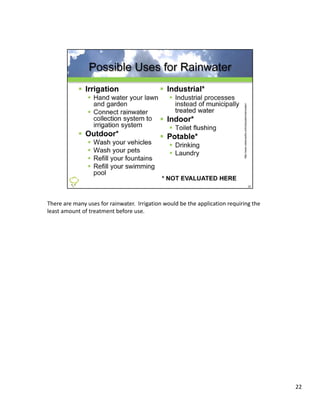
There are many uses for rainwater.  Irrigation would be the application requiring the 
least amount of treatment before use.


                                                                                         22
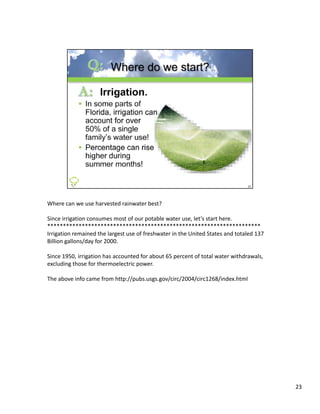
Where can we use harvested rainwater best?

Since irrigation consumes most of our potable water use, let’s start here.
********************************************************************
Irrigation remained the largest use of freshwater in the United States and totaled 137 
Irrigation remained the largest use of freshwater in the United States and totaled 137
Billion gallons/day for 2000. 

Since 1950, irrigation has accounted for about 65 percent of total water withdrawals, 
excluding those for thermoelectric power.

The above info came from http://pubs.usgs.gov/circ/2004/circ1268/index.html


                                                                                          23
A good strategy would be to, not only conserve water, but also to use an alternative 
water source (rainwater) for irrigation, and save our precious potable drinking water for 
drinking and other indoor uses.


                                                                                             24
So today, we will be focusing on rainwater harvesting for LANDSCAPE irrigation.


                                                                                  25
26
27
Big or small, residential or commercial, the harvesting system will have these 
components.

Trainer should mention each of these aspects and give a brief description of each.  Each 
part will be covered in more detail, including rain and its reliability.
part will be covered in more detail including rain and its reliability


                                                                                            28
29
The roof (highlighted in yellow) is what is used as the catchment area.  Its size dictates 
how much rainwater can be captured.


                                                                                              30
Q:             Does it matter what kind of roof I have?

A:             No.

For irrigation purposes, roof surface is not an issue.  For potable applications, this 
For irrigation purposes roof surface is not an issue For potable applications this
becomes more of an issue.  However, we aren’t addressing potable applications in this 
workshop, …only irrigation applications.

However, the smoother the surface, the better for collection.  For example, rain runs off 
quicker and thus, ‘washes’ off any unwanted particles with less rain than other roof 
types.  Also, roof slopes affect how quickly roof surfaces get washed:  steeper slopes are 
‘washed’ quicker.
 washed quicker


                                                                                              31
The next part of a rain harvesting system is conveyance.


                                                           32
Highlighted area shows location of the conveyance system:  gutters and downspouts.

These move the captured water along to the cistern.


                                                                                     33
Something to keep in mind is that, if we are installing gutters to collect water that will 
ultimately be stored, these need to be installed as a sealed system in order to keep 
mosquitoes from entering.  This is very important, because, if overlooked, it can become 
a nuisance.


                                                                                              34
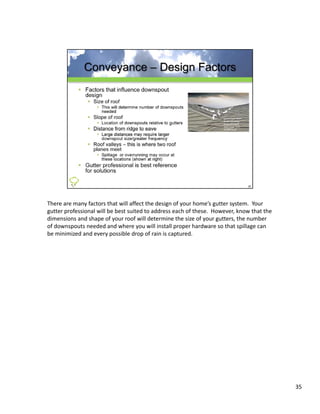
There are many factors that will affect the design of your home’s gutter system.  Your 
gutter professional will be best suited to address each of these.  However, know that the 
dimensions and shape of your roof will determine the size of your gutters, the number 
of downspouts needed and where you will install proper hardware so that spillage can 
be minimized and every possible drop of rain is captured.
be minimized and every possible drop of rain is captured


                                                                                             35
Keeping limbs and leaves away from catchment area and from clogging conveyance is 
important in keeping cistern water quality pure.

These products reduce maintenance needs while preventing debris from entering the 
cistern.
cistern

Pollen pods can be filtered out as well.


                                                                                     36
37
Filtration  should occur between the downspout and the tank.  The ultimate goal is to 
remove impurities before they reach the tank.  What impurities? (Go to the next slide)


                                                                                         38
39
There are several kinds depending on your budget‐but you need to have this!

There is the downspout filter, (extreme left) which has a fine filter screen. The next filter 
is a strainer type filter.  Both of these require regular cleaning (like lint basket in your 
dryer!) in order for it to function efficiently.  
dryer!) in order for it to function efficiently

The next two shown are examples of the ‘self cleaning type’. The benefit here is that less 
maintenance is required.  The downside is that you lose some water in the process 
and…they are more expensive.


                                                                                                 40
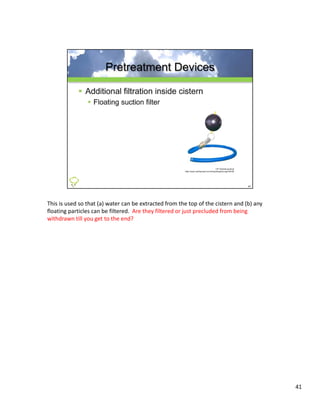
This is used so that (a) water can be extracted from the top of the cistern and (b) any 
floating particles can be filtered. Are they filtered or just precluded from being 
withdrawn till you get to the end?


                                                                                           41
This involves smaller contaminants that weren’t filtered previously, like bird dropping 
residue.


                                                                                           42
Slide is animated!


                     43
44
If we are serious about having only the cleanest water in the cistern, then, in essence, 
we need to have a first flush device at each collection point (picture this in your mind: as 
you collect water at each downspout, a 'first‐flush' device needs to be at the end of each 
downspout) OR, all the collected water needs to be flushed ‐ bigger volume  ‐ prior to 
entering cistern.  Depending on the size of catchment area, this volume can be 
entering cistern Depending on the size of catchment area this volume can be
considerable, and burying the 'first‐flush' tank may be a consideration. 


                                                                                                45
46
Read definition #1

The cistern or storage tank is generally the most expensive aspect of the system.


                                                                                    47
UV protection refers to not allowing any sunlight into tank.  Sunlight is creates desirable 
conditions for algae growth.  Therefore, black tanks are recommended.  

Tank life are subject to conditions they are exposed to, but can last 30 year or more.  
Manufacturer s can provide a more accurate lifespan for tanks.
Manufacturer’s can provide a more accurate lifespan for tanks

Both above and below ground tanks require stabilization and/or tank pad.  Consult with 
tank installer or engineer regarding structural requirements.  This may also include 
hurricane straps/bracing.


                                                                                               48
Cisterns are by no means ‘one size fits all’.  There are different shapes and materials for 
different needs and applications.  They can also be custom made.
***This is a good place to show the 5 minute video on how metal tanks are put 
together.  The link is located on the last slide of this section.***


                                                                                               49
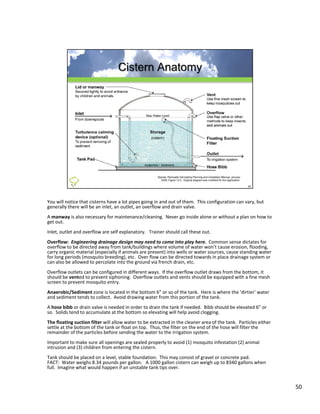
You will notice that cisterns have a lot pipes going in and out of them.  This configuration can vary, but 
generally there will be an inlet, an outlet, an overflow and drain valve.  
A manway is also necessary for maintenance/cleaning.  Never go inside alone or without a plan on how to 
get out.
Inlet, outlet and overflow are self explanatory.   Trainer should call these out.
Inlet, outlet and overflow are self explanatory. Trainer should call these out.
Overflow: Engineering drainage design may need to come into play here.  Common sense dictates for 
overflow to be directed away from tank/buildings where volume of water won’t cause erosion, flooding, 
carry organic material (especially if animals are present) into wells or water sources, cause standing water 
for long periods (mosquito breeding), etc.  Over flow can be directed towards in place drainage system or 
can also be allowed to percolate into the ground via french drain, etc.
Overflow outlets can be configured in different ways.  If the overflow outlet draws from the bottom, it 
should be vented to prevent siphoning.  Overflow outlets and vents should be equipped with a fine mesh 
screen to prevent mosquito entry.
Anaerobic/Sediment zone is located in the bottom 6” or so of the tank.  Here is where the ‘dirtier’ water 
and sediment tends to collect.  Avoid drawing water from this portion of the tank.
A hose bibb or drain valve is needed in order to drain the tank if needed.  Bibb should be elevated 6” or 
so.  Solids tend to accumulate at the bottom so elevating will help avoid clogging.
The floating suction filter will allow water to be extracted in the cleaner area of the tank.  Particles either 
settle at the bottom of the tank or float on top.  Thus, the filter on the end of the hose will filter the 
remainder of the particles before sending the water to the irrigation system.
Important to make sure all openings are sealed properly to avoid (1) mosquito infestation (2) animal 
intrusion and (3) children from entering the cistern.
Tank should be placed on a level, stable foundation.  This may consist of gravel or concrete pad.  
FACT: Water weighs 8.34 pounds per gallon.   A 1000 gallon cistern can weigh up to 8340 gallons when 
full.  Imagine what would happen if an unstable tank tips over.


                                                                                                                   50
51
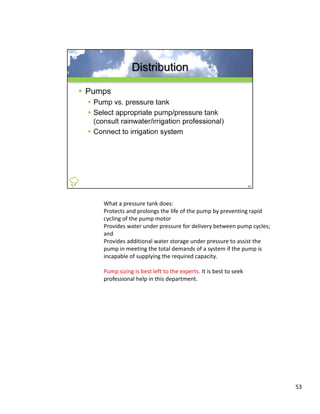
Pumps are necessary to pump water from cistern through irrigation system.  Some drip 
irrigation systems may not require a pump.


                                                                                        52
What a pressure tank does:
Protects and prolongs the life of the pump by preventing rapid 
cycling of the pump motor
Provides water under pressure for delivery between pump cycles; 
and 
and
Provides additional water storage under pressure to assist the 
pump in meeting the total demands of a system if the pump is 
incapable of supplying the required capacity. 

Pump sizing is best left to the experts. It is best to seek 
professional help in this department.


                                                                   53
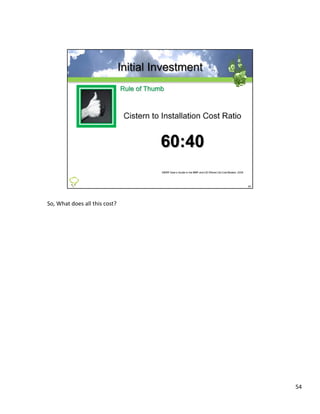
So, What does all this cost?


                               54
DRAFT   9/23/2009


              55
DRAFT   9/23/2009


              56
57
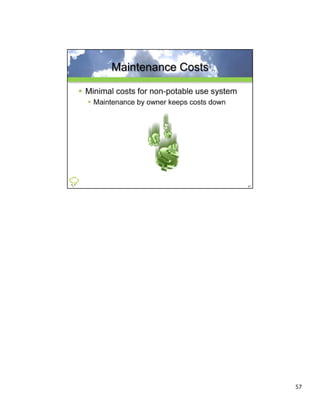
Very simple, but regular, maintenance is required.


                                                     58
59
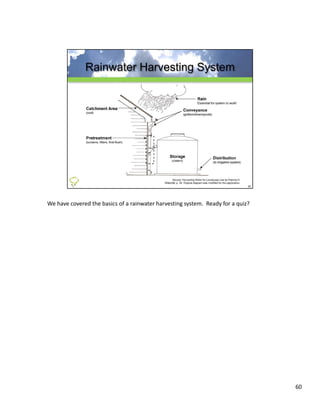
We have covered the basics of a rainwater harvesting system.  Ready for a quiz?


                                                                                  60
Each question/answer comes up after mouse click.  After question appears, optional 
‘jeopardy’ music can be played (to avoid uncomfortable silence) by clicking ‘speaker’ 
icon at bottom right of slide.


                                                                                         61
62
63
64
1
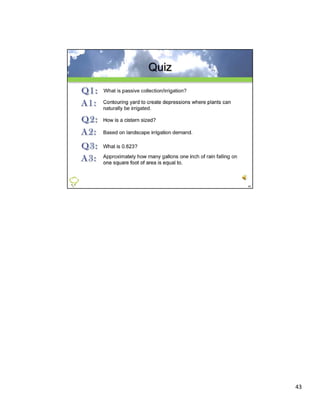
Passive irrigation – what it is, how it conserves water, and how it can work for you!


                                                                                        2
3
Demand Method ‐ Based purely on anticipated water needs
***************************************************************


Water balance method  (1) Maintain a monthly balance, (2) Start with an assumed 
Water balance method – (1) Maintain a monthly balance (2) Start with an assumed
volume (3) Add volume captured (4) Subtract monthly demand (5) Evaluate size and 
affordability of storage capacity.


Major storm method – This method is used in order to capture every drop available at a 
major storm event (or every available drop during wettest month). 
major storm event (or every available drop during wettest month).
Provides
       Pro‐ Minimum cistern volume needed to capture rainfall for this size storm
       Con‐ Not based on water usage


What is the quick calculation method? A ‘quick and dirty’ way of calculating water 
quantities.
     ii


                                                                                          4
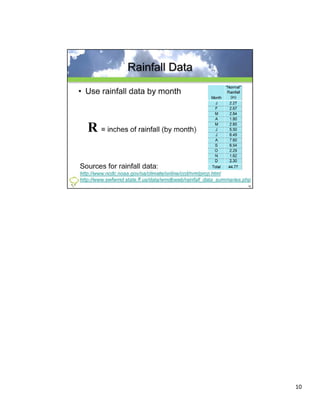
How to calculate rainfall capture potential
This means, how much rain can be collected on the roof that you have.


                                                                        5
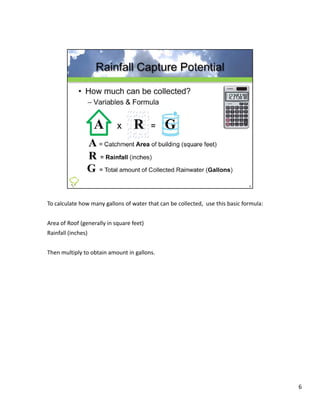
To calculate how many gallons of water that can be collected,  use this basic formula:


Area of Roof (generally in square feet)
Rainfall (inches)
Rainfall (inches)


Then multiply to obtain amount in gallons.


                                                                                         6
The area of catchment surface is only as big as the footprint of your house.  Think of 
how a raindrop sees your roof as it makes its way down.  Whether it is slanted or flat, it 
will fall within this area.  That is the area we are concerned about.  So, you can multiply 
the length and width of roof area, or use the square footage of building.
***********************************************************************
*******************************************************

For more information see http://www.harvestingrainwater.com/rainwater‐harvesting‐
inforesources/water‐harvesting‐calculations/


                                                                                               7
One ‘chunk’ of rain….

One inch deep x 1 square foot = 0.623 gallons of rainwater collected


                                                                       8
9
10
11
Ever bake a batch of cookies?  Even though the recipe states that you can bake a dozen, 
it’s never exactly that much, right?

Well, try as you may, you will probably not collect every drop of water from your roof.  
You will lose water due to evaporation from your hot roof, spillage or overrunning of 
You will lose water due to evaporation from your hot roof spillage or overrunning of
your gutters, or other factors. So, to compensate, lower factor down to .5 gallons/square 
foot per inch of rain.

******
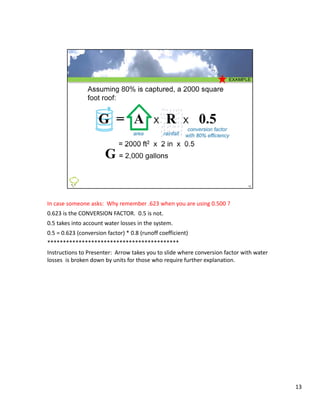
In case someone asks:  Why remember .623 when you tell them to use 0.500 ?  
0.623 is the CONVERSION FACTOR.  0.5 is not. 
0.5 takes into account water losses in the system.  
0.5 = 0.623 (conversion factor) * 0.8 (runoff coefficient)
***********************************************************************
***************************************
Runoff coefficient of 0.80 is a conservative number from Civil Engineering Reference 
Manual for the PE Exam, Eighth Edition, by Michael R. Lindeburg, PE, page A‐43.


                                                                                             12
In case someone asks:  Why remember .623 when you are using 0.500 ?  
0.623 is the CONVERSION FACTOR.  0.5 is not. 
0.5 takes into account water losses in the system.  
0.5 = 0.623 (conversion factor)  0 8 (runoff coefficient)
0 5 = 0 623 (conversion factor) * 0.8 (runoff coefficient)
******************************************
Instructions to Presenter:  Arrow takes you to slide where conversion factor with water 
losses  is broken down by units for those who require further explanation.


                                                                                           13
This is where we calculate how much water is used in irrigation.


                                                                   14
The formula for calculating water demand, in this case:  how much water will be used 
for irrigation, is very similar to our first formula for calculating water collection potential.  
We consider the area to be irrigated (in square feet), the conversion factor of 0.623.  The 
only difference is that, instead of inches of rain, we use something called ET rate.


                                                                                                     15
Check out the definition‐ Evapotranspiration (ET), defined as the evaporation from the 
soil surface and the transpiration through plant canopies (Allen et al., 1998), is the 
exchange of energy for outgoing water at the surface of the plant (Allen et al., 2005). 


The above definition may be too ‘high tech’ for the layman, so simplifying it – as in slide 
– may be best.


                                                                                               16
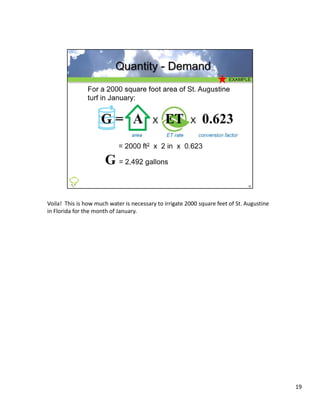
So, as an example, let’s calculate how much water is needed to irrigated 2000 square 
feet of St. Augustine sod in Florida.  Let’s calculate it for the month of January using 2” 
of water needed  for that month.


                                                                                               17
Remember this number?  Use this here.


                                        18
Voila! This is how much water is necessary to irrigate 2000 square feet of St. Augustine 
in Florida for the month of January.


                                                                                            19
20
Vendors have websites that simplify the computation of rainfall potential and water use 
demand, as shown above.  Note maximum monthly capture is approx. 5200 gallons; 
while maximum monthly usage at 3200 gallons.  Owner must decide if they want to 
purchase enough that will be used, or a little bigger to capture max roof yield.  Max roof 
yield option will allow to store that left over amount for drier months.
yield option will allow to store that left over amount for drier months


This is a good recommendation:
We need to size this based on  warm dry season irrigation needs and mention drought 
conditions.  Assume  50% of normal rainfall for dry period (say April and May).    


Sizing should be  captured at 50% of normal rainfall  versus demand required.  Deficit 
will require supplemental supply, reductions in use or modification to landscapes.


                                                                                              21
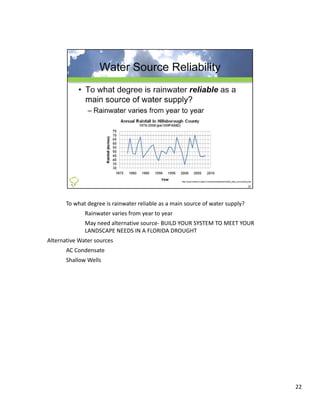
To what degree is rainwater reliable as a main source of water supply?
              Rainwater varies from year to year
              May need alternative source‐ BUILD YOUR SYSTEM TO MEET YOUR 
              LANDSCAPE NEEDS IN A FLORIDA DROUGHT
Alternative Water sources
       AC Condensate
       Shallow Wells 


                                                                                22
DRAFT                                                                                                   9/23/2009


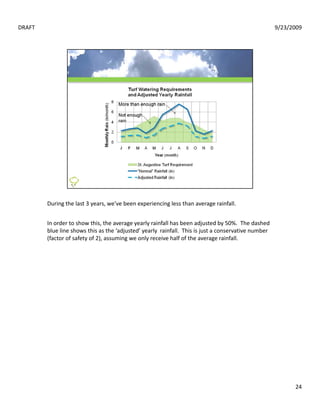
        This graph shows the amount of water (in inches) for irrigation  for a St. Augustine lawn 
        per month (shown in green) and the average rainfall for our area (the blue line).  As can 
        be seen, there are times during the year that there is more than sufficient rainfall for our 
        lawns (white space between blue line and green shading), but other times there isn’t 
        enough rain (shown where blue line dips into green shading).  
        enough rain (shown where blue line dips into green shading)


                                                                                                              23
DRAFT                                                                                                   9/23/2009


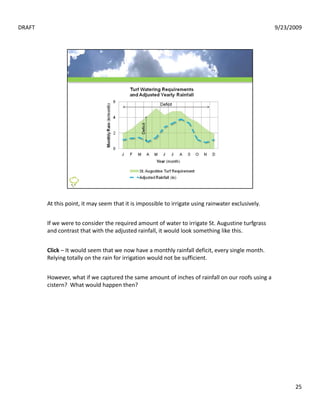
        During the last 3 years, we’ve been experiencing less than average rainfall.  


        In order to show this, the average yearly rainfall has been adjusted by 50%.  The dashed 
        blue line shows this as the ‘adjusted’ yearly  rainfall.  This is just a conservative number 
                                        j      y    y                     j
        (factor of safety of 2), assuming we only receive half of the average rainfall.


                                                                                                              24
DRAFT                                                                                               9/23/2009


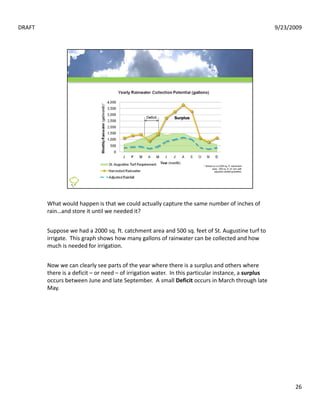
        At this point, it may seem that it is impossible to irrigate using rainwater exclusively.


        If we were to consider the required amount of water to irrigate St. Augustine turfgrass 
        and contrast that with the adjusted rainfall, it would look something like this.  
                                     j              ,                       g


        Click – It would seem that we now have a monthly rainfall deficit, every single month.  
        Relying totally on the rain for irrigation would not be sufficient.


        However, what if we captured the same amount of inches of rainfall on our roofs using a 
        cistern?  What would happen then?
        cistern? What would happen then?


                                                                                                          25
DRAFT                                                                                                 9/23/2009


        What would happen is that we could actually capture the same number of inches of 
        rain…and store it until we needed it?


        Suppose we had a 2000 sq. ft. catchment area and 500 sq. feet of St. Augustine turf to 
           pp                     q                             q               g
        irrigate.  This graph shows how many gallons of rainwater can be collected and how 
        much is needed for irrigation.  


        Now we can clearly see parts of the year where there is a surplus and others where 
        there is a deficit – or need – of irrigation water.  In this particular instance, a surplus
        occurs between June and late September.  A small Deficit occurs in March through late 
        May.


                                                                                                            26
DRAFT                                                                                                9/23/2009


        What size cistern is needed?

        Here, green represents the harvested rainwater used for irrigation and the blue, the 
        rainwater that is stored in the cistern.
        The deficit that occurs in April and May, which accounts for about 600 gallons, should be 
        added to total amount needed in April.  The minimum capacity required during April is 
        1,915 gallons (1,308 + 407 + 200) to make it through the ‘dry period’ of April and May.  
        This happens to be the maximum amount of volume stored throughout the year, as no 
        other month requires this much volume.  For this particular case, an adequately sized 
        cistern is one whose capacity is approximately 2,000 gallons.


                                                                                                           27
Adjust how much you intend to water.  Maybe just water front yard and flower bed.  Let 
the back go.


                                                                                          28
Conservation can be a big part of your overall plan in using rainwater for irrigation. 


One good method for irrigation can be passive irrigation.  What is that?   
Should we build in  FYN concepts here? Yes!
Should we build in FYN concepts here? Yes!


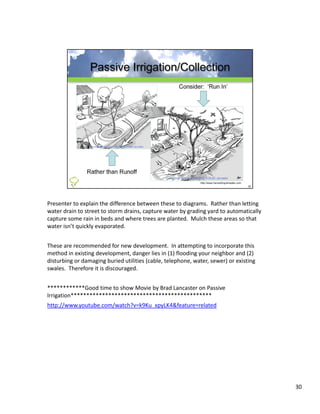
                                                                                          29
Presenter to explain the difference between these to diagrams.  Rather than letting 
water drain to street to storm drains, capture water by grading yard to automatically 
capture some rain in beds and where trees are planted.  Mulch these areas so that 
water isn’t quickly evaporated.


These are recommended for new development.  In attempting to incorporate this 
method in existing development, danger lies in (1) flooding your neighbor and (2) 
disturbing or damaging buried utilities (cable, telephone, water, sewer) or existing 
swales.  Therefore it is discouraged.


************Good time to show Movie by Brad Lancaster on Passive 
************G d ti      t h M i b B dL            t      P i
Irrigation*********************************************
http://www.youtube.com/watch?v=k9Ku_xpyLK4&feature=related


                                                                                         30
Rain garden allows runoff to re‐enter the soil, and is a place where drought‐tolerant 
plants are used to provide an aesthetically pleasing landscape.  Work with your FYN 
program to help determine how to do this.


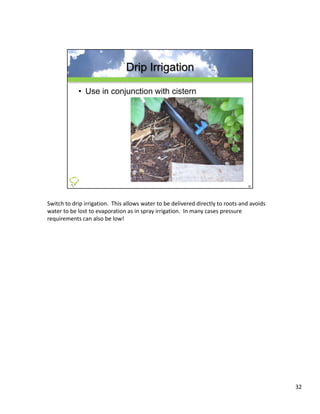
                                                                                         31
Switch to drip irrigation. This allows water to be delivered directly to roots and avoids 
water to be lost to evaporation as in spray irrigation.  In many cases pressure 
requirements can also be low!


                                                                                             32
There is no need to be afraid of the quality of rainwater.


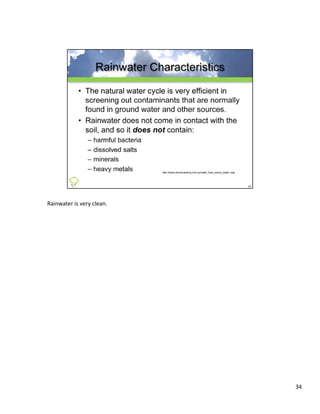
                                                             33
Rainwater is very clean.


                           34
35
How much treatment is needed?
       Non‐potable uses
               Minimal treatment
               Filter  remove sediments, etc. runoff from roof (as mentioned earlier)
               Filter – remove sediments etc runoff from roof (as mentioned earlier)
       Potable (not addressed here)
               Significant treatment
                Filtering
*******************************************
When the water is to be used just for landscape irrigation, only sediment filtration is 
typically required.  Sustainable Construction  Green Building Design and Delivery 
typically required. – Sustainable Construction – Green Building Design and Delivery –
Charles J. Kibert


                                                                                           36
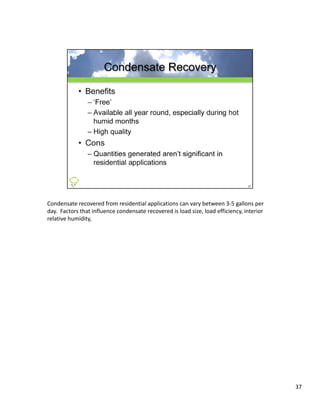
Condensate recovered from residential applications can vary between 3‐5 gallons per 
day.  Factors that influence condensate recovered is load size, load efficiency, interior 
relative humidity, 


                                                                                             37
38
39
These guides are very useful and available online.


                                                     40
41
Tell us why these sites are good to view?  
ARCSA (American Rainwater Catchment Systems Association) website has a wealth of 
information.


Harvesting Rainwater.com is easy to read information


Harvest H2O has many articles on rainwater harvesting


There are others too.  Surf around!


Speak to vendors that are here sponsoring , and use our presentation  as a starting point 
on purchasing your system.


                                                                                             42
43
44
45
46
47
48
49
APPENDIX B

    2
 
Rainwater Harvesting With Cisterns for
Landscape Irrigation
Pacia Hernandez*
University of South Florida, Department of Civil & Environmental Engineering, Tampa, FL, USA
*
 Florida Rainwater Harvesting Initiative
David Bracciano*
Tampa Bay Water, Clearwater, FL, USA
Thomas Rupert*
University of Florida, Levin College of Law, Gainesville, FL, USA
Skip Wright*
Newberg Irrigation Inc., St. Petersburg, FL, USA
Daniel H. Yeh, Ph.D., P.E., LEED AP*
University of South Florida, Dept. of Civil & Environmental Engineering, Tampa, FL, USA

ABSTRACT
The purpose of this paper is to present the technical content and sources reviewed in the
development of the Florida Rainwater Harvesting Initiative’s public training workshops. Said
workshops are to be presented by FYN (Florida Yards and Neighborhoods) program either as a
substitute or in conjunction with the Rain Barrel Workshops throughout Florida.

This paper describes the major parts of a rainwater harvesting system, the function of each, and
what components may be necessary specifically for landscape irrigation use. Estimating
irrigation demand and calculating cistern sizing based on demand are also considered.

INTRODUCTION                                                   frozen as ice and snow, or below ground.4 Not
An ample water supply meant the survival of                    only are fresh water sources limited, but drought
many ancient civilizations. The inhabitants of                 conditions, together with increasing population
the ancient middle- eastern city of Petra were                 and the lack of availability of potable water make
able to control their water supply by the use of               it even more valuable. Several regions in the
dams, cisterns and water conduits. They                        United States, including the Tampa Bay area,
developed the ability to store water during                    are currently experiencing drought conditions
prolonged droughts. Their plentiful supply of                  that are expected to persist.
water put them on the map as a hub for the
east-west trade route.1 For the ancient Mayans                 In some parts of Florida, irrigation can account
living in the city of Sayil, water was quite scarce.           for over 50% of a single family’s water use.
The water table lay 200 feet below ground which                Therefore, a logical first step in solving the water
motivated them to discover how to collect and                  shortage problem is mitigating potable water use
store rainwater. Archaeologists have discovered                for irrigation. This can be accomplished by
that each household had at least one                           educating citizens and businesses to reduce
underground cistern.2 Even below the streets of                their use of potable water for irrigation and
the famous ancient city of Alexandria lies a                   substituting an alternative water source, such as
system of cisterns.3                                           rainwater. This strategy is gaining popularity in
                                                               the Tampa Bay region. For instance, local
Today, water’s scarcity is also making it a very               citizens are on a waiting list in order to benefit
valuable resource. Only 2.5% of the world’s                    from Hillsborough County’s Extension Office free
water is freshwater. Of that 2.5%, 0.3% can be                 Rain Barrel Workshops.5
found in our lakes and rivers. The rest is either              An important lesson that rain barrel users learn
                                                               in harvesting their own water is that the typical
                                                               55 gallon rain barrel captures only a fraction of
                                                            
1
  (The Jordan Tourism Board, 2008)                                                                                         
2                                                              4
  (NOVA, 2008)                                                     (United Nations Environment Programme (UNEP))
3                                                              5
  (Dunn)                                                           (University of Florida, 2008) 


Rainwater Harvesting With Cisterns for Landscape Irrigation                                                                   1
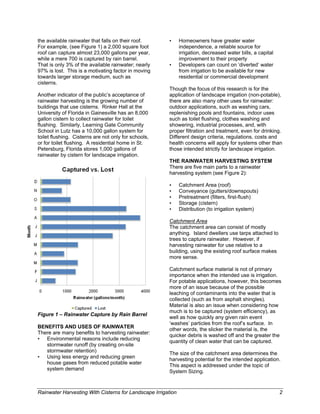
the available rainwater that falls on their roof.       •      Homeowners have greater water
For example, (see Figure 1) a 2,000 square foot                independence, a reliable source for
roof can capture almost 23,000 gallons per year,               irrigation, decreased water bills, a capital
while a mere 700 is captured by rain barrel.                   improvement to their property
That is only 3% of the available rainwater; nearly      •      Developers can count on ‘diverted’ water
97% is lost. This is a motivating factor in moving             from irrigation to be available for new
towards larger storage medium, such as                         residential or commercial development
cisterns.
                                                        Though the focus of this research is for the
Another indicator of the public’s acceptance of         application of landscape irrigation (non-potable),
rainwater harvesting is the growing number of           there are also many other uses for rainwater:
buildings that use cisterns. Rinker Hall at the         outdoor applications, such as washing cars,
University of Florida in Gainesville has an 8,000       replenishing pools and fountains, indoor uses
gallon cistern to collect rainwater for toilet          such as toilet flushing, clothes washing and
flushing. Similarly, Learning Gate Community            showering, industrial processes, and, with
School in Lutz has a 10,000 gallon system for           proper filtration and treatment, even for drinking.
toilet flushing. Cisterns are not only for schools,     Different design criteria, regulations, costs and
or for toilet flushing. A residential home in St.       health concerns will apply for systems other than
Petersburg, Florida stores 1,000 gallons of             those intended strictly for landscape irrigation.
rainwater by cistern for landscape irrigation.
                                                        THE RAINWATER HARVESTING SYSTEM
                                                        There are five main parts to a rainwater
                                                        harvesting system (see Figure 2):

                                                        •      Catchment Area (roof)
                                                        •      Conveyance (gutters/downspouts)
                                                        •      Pretreatment (filters, first-flush)
                                                        •      Storage (cistern)
Based on a 2,000 sq. ft.                                •      Distribution (to irrigation system)
catchment area with adjusted
rainfall quantities.
                                                        Catchment Area
                                                        The catchment area can consist of mostly
                                                        anything. Island dwellers use tarps attached to
                                                        trees to capture rainwater. However, if
                                                        harvesting rainwater for use relative to a
                                                        building, using the existing roof surface makes
                                                        more sense.

                                                        Catchment surface material is not of primary
                                                        importance when the intended use is irrigation.
                                                        For potable applications, however, this becomes
                                                        more of an issue because of the possible
                                                        leaching of contaminants into the water that is
                                                        collected (such as from asphalt shingles).
                                                        Material is also an issue when considering how
                                                        much is to be captured (system efficiency), as
Figure 1 – Rainwater Capture by Rain Barrel
                                                        well as how quickly any given rain event
                                                        ‘washes’ particles from the roof’s surface. In
BENEFITS AND USES OF RAINWATER                          other words, the slicker the material is, the
There are many benefits to harvesting rainwater:
                                                        quicker debris is washed off and the greater the
• Environmental reasons include reducing
                                                        quantity of clean water that can be captured.
   stormwater runoff (by creating on-site
   stormwater retention)
                                                        The size of the catchment area determines the
• Using less energy and reducing green                  harvesting potential for the intended application.
   house gases from reduced potable water
                                                        This aspect is addressed under the topic of
   system demand
                                                        System Sizing.


Rainwater Harvesting With Cisterns for Landscape Irrigation                                                   2
regularly (like the filter in a clothes dryer - after
                                                        every cycle); others are virtually self-cleaning,
                                                        and require minimal maintenance. The self-
                                                        cleaning types have two drawbacks: they (1)
                                                        tend to lose water in the process and (2) are
                                                        more expensive.

                                                        Another level of filtration that is commonly used
                                                        is the ‘roof-washer’ or a first-flush device. Its
                                                        purpose is to capture the first part of a rain
                                                        event, with the intent of diverting the dirty or
                                                        contaminated water (e.g. bird dropping residue)
                                                        from entering the tank. In doing so, the stored
                                                        water will remain relatively free from
                                                        contamination and will minimize the frequency of
                                                        cleaning the interior of the tank. Since there are
                                                        many variables that can affect how quickly a roof
Figure 2 – Anatomy of the System                        is ‘washed’ with a rain event (e.g. intensity and
                                                        time since previous rain event, slope and
Conveyance                                              porosity of catchment surface), there are
Conveyance consists of gutters and                      disagreements on how much should be flushed.
downspouts. This part of the system moves the           Some sources say 10 gallons for 1000 square
captured water from the roof, through gutters           feet of catchment surface6. Others say more.
and downspouts, down to the storage tank or             Another school of thought subscribes to no
cistern. Various materials are used with the            flushing at all. This method may be used where
most desirable being the aluminum seamless              rain is scarce and collecting every possible drop
type. Seamless is desirable for two reasons (1)         is more important than how clean the water is.
less water is lost if it is water tight and (2) less    Water quality is improved post-storage, by
opportunity of mosquitoes to penetrate the              adding a filtration system (a combination of a
system and infest the stored rainwater. As with         series of filter cartridges with ultraviolet light or
standard gutter system design, the size and             other treatment as needed and required by local
slope of the catchment surface determines the           agencies) prior to use.
number of downspouts required and the location
of downspouts relative to the gutters. The              One final level of filtration that is commonly used
distance from ridge to eave also determines the         with cisterns for irrigation is one that is within the
size of the required downspouts and the                 tank itself: the floating suction filter. This filter is
frequency a downspout is needed.                        attached at the end of a hose which floats on the
                                                        water surface and collects the water near the top
A common issue with gutters is that leaves and          of the tank. With very few particles floating on
twigs interrupt the flow of water, requiring            the surface (most of the particles accumulate at
frequent cleaning. Gutter accessories minimize          the bottom of the tank), suctioning water from
the frequency of maintenance, with the ultimate         the top of the tank would provide the cleanest
goal being the collection of the cleanest water         water possible.
possible for storage.
                                                        Storage
Pretreatment                                            The cistern is the storage component of the
Pretreatment (or filtration) usually occurs             rainwater harvesting system. It is available in an
between the downspout and the storage tank,             infinite amount of colors, sizes, shapes and
removing impurities before they reach the tank.         types of materials. If a pre-fabricated tank is
Debris and contaminants can consist of leaves,          selected, it should be black, a dark color, or UV
twigs, dust or particles (from shingles or              resistant, such that no light can penetrate it
pollution), and possibly bird droppings.                (sunlight penetration encourages algae growth
                                                        within the tank). Both above and below ground
Pre-filtration screens are screened baskets that                                                                    
hold back larger debris (such as leaves, twigs,         6
                                                          (Texas Water Development Board, Third Edition,
and pollen pods). Some must be cleaned                  2005, p. 8) 


Rainwater Harvesting With Cisterns for Landscape Irrigation                                                            3
type cisterns are available. Underground tanks          pump needs to kick on and build up pressure in
require excavation costs and more structurally          the system for use. For the pump, this would
sound walls, which may be more expensive than           mean short on-off cycles until demand is met,
installing a tank above ground. As far as costs         and thus shortening the pump’s life. A pressure
are concerned, the cistern is usually the most          tank system would provide water (under
expensive component of the rainwater                    pressure) between cycles, eliminating both the
harvesting system.                                      constant cycling and wait times between cycles.
                                                        Consulting a plumbing professional is highly
Any given cistern (above or below ground) will          recommended in selecting the best equipment
require an inlet, an outlet, an overflow and a          for each application.
manway (see Figure 3). The overflow will be
positioned close to the top of the tank in case         SYSTEM SIZING
collected rainwater exceeds the cistern’s               There are several methods for sizing a cistern:
capacity. Overflow should be routed away from           • Water Balance Method
the tank (either by piping or site grading) to a        • Major Storm Event Method
location that can accommodate the overflow              • Demand Method
volume and will not cause erosion or flooding. A
flap valve (or similar device) should be used at        The water balance method is similar to
this opening to keep out unwanted animals or            balancing a checkbook. Using the size of the
insects. The manway is essential to allow               catchment area, the amount of potential
access to the inside for cleaning/servicing the         rainwater capture would be calculated and
tank. It should be safely secured at all times to       added as the amount coming ‘in’ to the system,
keep out animals and children. The cistern is           subtracting monthly demand (amount needed for
considered a confined space; appropriate safety         irrigation as amount coming ‘out’), and
procedures should be followed.                          evaluating the size and affordability of storage
                                                        capacity.

                                                        The major storm event method sizes the cistern
                                                        by assuming to collect all available rainwater
                                                        during the heaviest storm event. For example, if
                                                        the largest storm event has been measured to
                                                        be approximately 4 inches, then the catchment
                                                        area is multiplied by the conversion factor and
                                                        runoff coefficient. Said volume would be the
                                                        cistern size.

                                                        Since the Tampa Bay region does not
                                                        experience long periods of drought (it rains most
                                                        months), the most appropriate method is the
Figure 3 – Anatomy of a Cistern                         demand method. It would determine tank size
                                                        according to the amount of anticipated water
Some recommended options for the tank could             demand. Rainfall capture potential is calculated
include a:                                              by a simple formula:
• Hose bibb - for ease in emptying the tank
• Turbulence calming device - since particles           Equation 1:     A x R=G
     and debris tends to settle at the bottom of
     the tank, this would minimize mixing when          Where
     water enters the tank.                             A = Catchment area of building (in square feet)
                                                        R = Inches of Rainfall (inches)
Distribution                                            G = Gallons of Rainwater collected (gallons)
Ultimately, the system will need to be connected
to the irrigation system. A pump is needed in
order to provide sufficient head for water to be        Size of Catchment Area
distributed to the desired location. The down           Step one would be to calculated the rainfall
side to a regular pump is that water is not             potential for the catchment area available.
‘ready-to-go’ at a moment’s notice, but rather          Calculating the area is as simple as multiplying


Rainwater Harvesting With Cisterns for Landscape Irrigation                                                4
the length times the width of the roof. The key is             can vary from 0.7 – 0.958. Because of this,
in calculating the roof footprint, regardless of               another rule of thumb is used:
how the roof is sloped.
                                                                   Rule of Thumb
                                                                   (which includes runoff coefficient for losses)

                                                                   One inch of rain falling on one square
                                                                   foot of catchment area = 0.5 gallons of
                                                                   rainwater collected.


                                                               The above rule of thumb reflects a C-Coefficient
                                                               of 0.8. A more accurate estimate for capture
                                                               potential would be:

                                                               Equation 3:                  A x R x 0.5 = G
Figure 3 – Roof Footprint 7
                                                               2000 sq. ft. x 2 in x 0.5 = 2,000 gallons
Amount of Rainfall
There is a rule of thumb that is used to quickly               Water Use Demand
calculate rainfall potential:                                  The same general equation applies with regards
                                                               to water demand, with only one difference:
    Rule of Thumb                                              instead of rainfall, ET (evapotranspiration factor)
                                                               is used.
    One inch of rain falling on one square
    foot of catchment area = 0.623 gallons                     Equation 4:                  A x ET x 0.623 = G
    of rainwater collected.
                                                               ET is the sum of evaporation and transpiration,
                                                               which is basically the amount of water a plant
                                                               needs. Each plant type requires different
We can think of a ‘slice’ or ‘chunk’ of rain that is           amounts of water in order to survive. ET rates
one inch thick and one square foot in area                     also vary geographically and over time.
equaling 0.623 gallons. Basically, this number is              A good source for ET rates for the Tampa Bay
a conversion factor that converts inches per                   region is http://www.floridaturf.com/ , which are
square foot to gallons. The equation now                       based on the Steward and Mills, 1967 study.
becomes                                                        The ET rates for the coveted St. Augustine turf
                                                               grass is shown in Figure 4.
Equation 2:                  A x R x 0.623 = G
                                                               Reliability of Rainwater
For a 2,000 square foot catchment area and 2                   The reliability of rainwater for irrigation use
inches of rain,                                                depends on several factors: sufficient quantity
                                                               of rainfall, efficiency of the system, and
2000 sq. ft. x 2 in x 0.623 = 2,492 gallons                    meticulousness of the harvester. The amount of
                                                               rain that falls on any given region varies from
However, 100% of the rain is not generally                     year to year9. Even though predictability is not
captured. There are factors, such as                           entirely possible, estimates can provide a good
evaporation, the over-running of gutters, water                sense of how much rainwater to expect to
loss due to filtration and/or first-flush, which               capture.
reduces the captured amount. The runoff
coefficients (C-Coefficients) for roof surfaces


7                                                              8
 (Texas Water Development Board, Third Edition,                    (Michael R. Lindeburg, 2001, pp. A-43)
                                                               9
2005)                                                              (NCDC, 2007)


Rainwater Harvesting With Cisterns for Landscape Irrigation                                                                   5
Water use                           for irrigating the St. Augustine turf. With the use
 Month                     (inches)                            of a cistern, captured rainwater could facilitate
 January                       2                               the use of rainwater whenever needed,
 February                     2.5                              especially during periods when rain is scarce.
 March                        3.4
 April                        4.2                                       More than enough rain
 May                          5.2
 June                         4.3                                       Not enough rain
 July                         4.8                                       (typical)
 August                       4.8
 September                    3.9
 October                      3.4
 November                     2.5
 December                     1.9
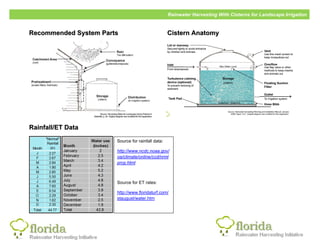
 Total                       42.8

 Means of five years'
 observations of
 evapotranspiration on St.
 Augustinegrass turf, Plantation,
 Florida (Stewart and Mills, 1967).                            Figure 6 – Turf Water Requirements and
Figure 4 – ET Rates                                            Adjusted Yearly Rainfall

Immediately following is an analysis of rainwater              During a drought period, the amount of rainfall
harvesting potential paired with irrigation                    can be significantly reduced. To illustrate, an
demand for a small plot of St. Augustine turf.                 ‘average’ rainfall year can be reduced by 50%.
                                                               This would produce a conservative ‘adjusted’
                                                               rainfall rate for calculating the anticipated rainfall
             More than enough rain
                                                               amount (see Figure 6). Deficits would now exist
                                                               throughout the year.
             Not enough rain
             (typical)                                         Consider a 2,000 square foot catchment area
                                                               that is to be used to irrigate 500 square feet of
                                                               St. Augustine turf (in Florida). Rainwater is to be
                                                               collected during a drought year in a cistern.
                                                               What is the minimum sized cistern that can
                                                               accommodate the required demand?

                                                               Figure 7 shows the irrigation demand and
                                                               collection potential relationship volumes. It
Figure 5 – Turf Water Requirements and
                                                               clearly depicts which times during the year
Average Yearly Rainfall
                                                               yields a surplus and where there is a deficit – or
                                                               need – for additional water. In this particular
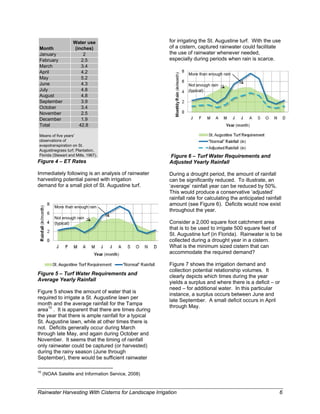
Figure 5 shows the amount of water that is
                                                               instance, a surplus occurs between June and
required to irrigate a St. Augustine lawn per
                                                               late September. A small deficit occurs in April
month and the average rainfall for the Tampa
                                                               through May.
area10 . It is apparent that there are times during
the year that there is ample rainfall for a typical
St. Augustine lawn, while at other times there is
not. Deficits generally occur during March
through late May, and again during October and
November. It seems that the timing of rainfall
only rainwater could be captured (or harvested)
during the rainy season (June through
September), there would be sufficient rainwater
                                                            
10
     (NOAA Satelite and Information Service, 2008) 


Rainwater Harvesting With Cisterns for Landscape Irrigation                                                         6
More than enough rain
         (typical)


          Not enough
          rain


                                                        Figure 9 – Average Cistern Costs by Material
Figure 7 – Yearly Rainwater Collection                  Type 11
Potential
                                                        Economic Considerations
In viewing how water is used and stored in the          The most costly portion of the initial investment
cistern, the method for sizing a cistern becomes        (including design, components and installation)
more obvious. Figure 8 depicts the same data            is the cost of the cistern. Costs for the cistern
shown in Figure 7 only shown as water levels            can vary depending on material type, above or
within the cistern. The deficit that occurs in April    below ground (needs to be more structurally
and May, which accounts for about 600 gallons,          sound) and relative distance between site and
should be added to total amount needed in April.        manufacturer (shipping). The cistern:
The minimum capacity required during April is           installation cost ratio is approximately 60:40 12.
1,915 gallons (1,308 + 407 + 200) to make it            Therefore, a complete 2,000 rainwater
through the ‘dry period’ of April and May. This         harvesting system (that would serve the
happens to be the maximum amount of volume              example considered earlier) could cost between
stored throughout the year, as no other month           $2,000 to $3,500 (see Figure 10). Costs can be
requires this much volume. For this particular          reduced by taking other water conservation
case, an adequately sized cistern is one whose          measures. Consider the size of tank and
capacity is approximately 2,000 gallons.                material selection.


Figure 8 – Cistern Rainwater Levels                     Figure 10 – Estimated Costs for a 2,000
                                                        Gallon Rainwater Harvesting System13 14
As a side note, most months show a surplus that
is stored in the cistern for the following month. A                                                                 
                                                        11
larger cistern or adding additional cisterns could         (Texas Water Development Board, Third Edition,
                                                        2005, p. Table 6.1)
yield greater rainwater potential.                      12
                                                           (Water Environment Research Foundation, 2009)
                                                        13
                                                           (Texas Water Development Board, Third Edition,
                                                        2005, p. Table 6.1)


Rainwater Harvesting With Cisterns for Landscape Irrigation                                                            7
Irrigation Options                                                                          rates have not been officially established and
There are other methods for irrigating that are                                             therefore anticipating collection potential is
efficient. Passive Irrigation/Collection is a                                               difficult. An approximate amount of condensate
rainwater collection technique that involves                                                that can be collected can vary between 3-5
contouring the landscape in a manner in which                                               gallons per day for every 1000 square feet. This
water is collected in depressions where trees or                                            amount alone is not significant enough in
flower beds are located, eliminating the need for                                           residential applications to be an alternative
manual or mechanical irrigation. Brad                                                       source.
Lancaster, a well known rainwater harvester
who lives in the Sonoran Desert, is an avid                                                 Component Reliability
promoter of this rainwater collection technique.                                            The reliability of the equipment or components
A very informative video on this topic can be                                               of the system depend mostly on regular
viewed at                                                                                   inspections and maintenance. Manufacturers
http://www.youtube.com/watch?v=k9Ku_xpyLK4                                                  provide general information on average life and
&feature=related.                                                                           recommended maintenance. Anticipated
                                                                                            replacement life for some system parts:
Retrofitting irrigation system to be of drip type
can also be a water saving option. The amount                                               Filters
of water used is minimized and precious water is                                            • Cartridges for potable systems: 3 to 6
applied at the roots rather than being sprayed                                                   months
into the air using traditional lawn sprinklers.                                             • Roof washing types: (see manufacturer’s
                                                                                                 specifications)
The application of Florida Friendly Landscaping
techniques can be most beneficial. Drought                                                  Pumps
tolerant plants can reduce the amount of turf and                                           • Approximately 3 years (see manufacturer’s
irrigation required in order to keep a beautiful                                               specifications)
landscape. Information can be found at
http://www.swfwmd.state.fl.us/yards/ .                                                      •  With a pressure vessel: generally longer
Water Quality                                                                                  than pump alone (see manufacturer’s
The quality of collected rainwater has always                                                  specifications)
been a concern, as is how it would change over                                              Tanks
time. Generally, rainwater is the ‘cleanest’                                                • Approximately 20 to 30 years, depending on
source of water. It does not come in contact                                                   material and environmental conditions (see
with the soil (as groundwater does), therefore it                                              manufacturer’s specifications)
does not contain harmful bacteria, dissolved
salts or heavy metals that would need to be                                                 Operation and Maintenance
treated or removed. The quality of harvested                                                Maintenance costs for a non-potable use system
rainwater would rely mostly on the level of care                                            can be kept low, if the owner performs the
and meticulousness that the harvester maintains                                             required maintenance.
in the system.
                                                                                            Some maintenance responsibilities include:
The end use of the water would determine the
applicable level of treatment that is required.                                             •   Check for debris in tank (tank should be
EPA’s “Managing Wet Weather with Green                                                          cleaned out about once a year)
Infrastructure Municipal Handbook, Rainwater
Harvesting Policies” (Table 3) suggests pre-                                                •   Inspect gutters and downspouts regularly
filtration and first-flush diverters as minimum                                                 (remove debris)
water quality treatment options for outdoor uses.
                                                                                            •   First flush bypass (check drain holes are
An additional source of high quality water that is                                              clear for proper function)
readily available during hot, humid summer
months is AC condensate. This water source is                                               •   Inspect downspout seals and entrances
of sufficiently high quality that it can be stored in                                           (check for leaks)
the cistern along with rainwater. Production
                                                                                         
14
     (Water Environment Research Foundation, 2009)


Rainwater Harvesting With Cisterns for Landscape Irrigation                                                                                   8
Barriers and Incentives                                        Some suggestions would be to:
There are no rules currently in place that would
prohibit the installation rainwater harvesting                 •   Research the topic. Educate yourself on the
systems in the Tampa Bay area. Non-potable                         subject.
rainwater applications have fewer code
requirements and associated costs than potable                 •   Visit demonstration sites.
ones.
                                                               •   Speak to vendors, irrigation/rainwater
Public agencies and organizations in the Tampa                     harvesting professionals.
Bay area do not currently offer any monetary
incentives for those wanting to install rainwater              •   Start small. Improvements and additions
harvesting systems in their homes. There are                       could always be made at a later time.
places in Florida where incentives are offered.
For instance, the Florida Keys Aqueduct                        SUGGESTED READING
Authority is currently offering monetary incentive             Texas Manual on Rainwater Harvesting
to residents who convert their decommissioned
septic tanks into cisterns for rainwater                       EPA’s Managing Wet Weather with Green
harvesting. 15                                                 Infrastructure Municipal Handbook Rainwater
                                                               Harvesting Policies
CONCLUSION
Using rainwater as an alternative water source                 Rainwater Harvesting for Drylands and Beyond
for irrigation is a very logical first step in                 by Brad Lancaster
conserving potable water. In educating the
public about harvesting rainwater, a second                    Rainwater Collection for the Mechanically
lesson is learned in practice: Rainwater users                 Challenged by Suzy Banks
learn to be more cautious with water usage.

Putting together a rainwater harvesting system
for irrigating landscapes is not rocket science.
The components are simple enough for
homeowners to put together on their own with
some education on the topic.

Systems can become complex depending on
system size, intended use, and location. An
excellent source of technical and professional
help in building or developing said systems is
ARCSA. ARCSA (the American Rainwater
Catchment Systems Association) provides
informal publications and networking for
rainwater users. Their website is at
www.arcsa.org.   

Since the issue of conserving potable water and
using alternative water sources (such as
rainwater) is gaining momentum throughout the
country in recent months, there is ample
information at their reach: online sources,
irrigation/rainwater harvesting professionals, and
demonstration sites.


15
      (United Press International, Inc., 2009) 


Rainwater Harvesting With Cisterns for Landscape Irrigation                                                   9
BIBLIOGRAPHY                                              Maintenance Guidelines. Retrieved 5 12, 2009, from
Allen, E. (1980). How Buildings Work: The Natural         Hawaii Rainwater Catchment Systems :
Order of Architecture . New York: Oxford University       http://www.hawaiirain.org/downloads/catchment.php
Press.
                                                          Innovative Water Solutions. (2009). Home. Retrieved
Aquascape, Inc. (2009). Why Rainwater Harvesting?         5 12, 2009, from Integrated Water Conservation
Retrieved 5 12, 2009, from RainXchange Rainwater          Solutions: http://www.watercache.com/
Harvest System:
http://www.aquascapeinc.com/why_rainwater_harvest         J. Mechell, B. K. (2009 - Draft). Rainwater Harvesting,
ing                                                       Planning and Installation. College Station, TX: Texas
                                                          AgriLife Extension Service.
ARCSA. (2009). Home. Retrieved 5 12, 2009, from
American Rainwater Catchment Systems Association:         Kibert, C. J. (2005). Sustainable Construction: Green
http://www.arcsa.org/                                     Building Design and Delivery . Hoboken, NJ: John
                                                          Wiley and Sons, Inc.
AWWA. Water Conservation Programs: A Planning
Manual. AWWA.                                             Kloss, C. (2008, December). Office of Wastewater
                                                          Management. Retrieved 5 12, 2009, from EPA
Banks, S. (2004). Rainwater Collection for the            Publications:
Mechanically Challenged. Dripping Springs: Tank           http://cfpub.epa.gov/npdes/docs.cfm?document_type
Town.                                                     _id=3&view=Fact%20Sheets%20and%20Outreach%
                                                          20Materials&program_id=6&sort=name
Blue Ridge Atlantic, Inc. (2009). Retrieved 5 12, 2009,
from BRAE Rain Harvesting Systems:                        Lancaster, B. (2009). Home. Retrieved 5 12, 2009,
http://www.braewater.com                                  from Rainwater Harvesting for Drylands and Beyond:
                                                          http://www.harvestingrainwater.com/
BuildingGreen, LLC. (2009). Alternative Water
Sources: Supply-Side Solutions for Green Buildings.       Lancaster, B. Rainwater Harvesting for Drylands and
Retrieved 5 12, 2009, from BuildingGreen.com:             Beyond Volume 1.
http://www.buildinggreen.com/auth/article.cfm/ID/3903
/                                                         Michael R. Lindeburg, P. (2001). Civil Engineering
                                                          Reference Manual for the PE Exam. Belmont, CA:
Dunn, J. (n.d.). The Cisterns of Alexandria of Ancient    Professional Publications, Inc.
Egypt. Retrieved June 1, 2009, from The Cisterns of
Alexandria of Ancient Egypt:                              NCDC. (2007, 03 03). Florida Statewide Precipitation.
http://www.touregypt.net/featurestories/alexandriacist    Retrieved 2009, from National Climatic Data Center:
erns.htm                                                  http://www.ncdc.noaa.gov/img/climate/research/2007/
                                                          mar/Reg008Dv00Elem01_03032007_pg.gif
E. W. Bob Boulware, P. (January 20, 2009).
Rainwater Catchment Design and Installation               NOAA Satelite and Information Service. (2008, 11
Standards. Retrieved 5 12, 2009, from www.arcsa.org       10). Normal Montly Precipitation. Retrieved 209, from
                                                          National Climatic Data Center:
Earthcraft Landscape Design. (2008). Benefits of          http://www.ncdc.noaa.gov/oa/climate/online/ccd/nrmlp
Rainwater Harvesting. Retrieved 5 12, 2009, from          rcp.html
Earthcraft Landscape Design:
http://www.earthcraftdesign.com/benefits.html             NOVA. (2008, March). Cracking the Mayan Code.
                                                          Retrieved June 1, 2009, from NOVA:
Floridaturf. (n.d.). home. Retrieved 5 12, 2009, from     http://www.pbs.org/wgbh/nova/mayacode/map-nf.html
floridaturf: http://www.floridaturf.com/
                                                          SafeRain First Flush Diversion Valve. (n.d.). Home.
HARVESTH20.com. (2004-2009). Home. Retrieved 5            Retrieved 5 12, 2009, from SafeRain Water Diverters
12, 2009, from The Rainwater Harvesting Community         for WAter and Cistern Tank Systems:
HarvestH20.com: http://www.harvesth2o.com/                http://saferain.com.au/vertical_valve.html

Hawaii Rainwater Catchment Systems . (2009).
Downloads: Catchment System Design &


Rainwater Harvesting With Cisterns for Landscape Irrigation                                                    10
Sandra F Mendler, W. F. (2006). The HOK Guidebook
to Sustainable Design . Hoboken, NJ: John Wiley &
Sons, Inc.

Texas Water Development Board, Third Edition.
(2005). The Texas Manual on Rainwater Harvesting.
Austin.

The Jordan Tourism Board. (2008). History and
Culter. Retrieved June 1, 2009, from Jordan -
Experiences in Petra:
http://www.visitjordan.com/visitjordan_cms/MajorAttra
ctions/Petra/HistoryCulture/tabid/86/Default.aspx

United Nations Environment Programme (UNEP).
(n.d.). UN Water Statistics - Water Resources.
Retrieved 5 12, 2009, from UN Water:
http://www.unwater.org/statistics_res.html

United Press International, Inc. (2009). Science
News, Septic tank converted to rainwater cistern.
Retrieved 08 14, 2009, from UPI.com:
http://www.upi.com/Science_News/2009/03/17/Septic
-tank-converted-to-rainwater-cistern/UPI-
66051237264523/

University of Florida. (2008). Rain Barrels -
Hillsborough County Extension. Retrieved July 25,
2009, from Solutions For Your Life:
http://hillsborough_fyn.ifas.ufl.edu/RainBarrels.html

USGBC LEED. (October 2007). USGBC LEED New
Construction & Major Renovation Reference Guide
Version 2.2. Washington, DC: USGBC LEED.

Water Environment Research Foundation. (2009).
WERF Research Profile. Retrieved 2009, from WERF
- Water Environment Research Foundation:
http://www.werf.org/AM/Template.cfm?Section=Rese
arch_Profile&Template=/CustomSource/Research/Pu
blicationProfile.cfm&id=SW2R08 


Rainwater Harvesting With Cisterns for Landscape Irrigation    11
APPENDIX C

    3
 
 
Levin College of Law                                                         230 Bruton‐Geer Hall 
Conservation Clinic                                                          PO Box 117629 
                                                                             Gainesville, FL 32611‐7629 
                                                                             352‐273‐0835 
                                                                             352‐392‐1457 Fax 
 
DATE:  3.11.09 
 
                                    MEMORANDUM 
 
 
TO:  Dave Bracciano, Tampa Bay Water 
FROM:  Thomas Ruppert, UF Levin College of Law 
 
RE:  Analysis of Potential Legal Liability for Recommending Cisterns 
 
 
Context:
Tampa Bay Water seeks to develop a program to promote the installation and use of
cisterns as a way to address the severe water shortages faced by the region Tampa Bay
Water serves. Cisterns can conserve potable water by serving as a source of irrigation
water for landscapes. Tampa Bay Water initially seeks to promote the use of cisterns
only for connection to irrigation systems, not indoor water systems. Tampa Bay Water
seeks to support development of program materials that will be incorporated into water
conservation programs given by the Florida Yards and Neighborhoods® program.


Question Presented:
May Tampa Bay Water, the Florida Yards and Neighborhoods® program, or local
governments in Florida that promote the use of cisterns be held liable for damages or
injuries that may result from the installation or use of cistern-irrigation systems
constructed as recommended by the proposed program and materials?

Short Answer:
Very likely not. Tort law theories that might allow for recovery against Tampa Bay
Water, the Florida Yards and Neighborhoods® program, or local governments contain
several hurdles any one of which a plaintiff would likely be unable to overcome. Taken
together, these barriers make it very unlikely that a party that has suffered injury due to
installation or use of a cistern-irrigation system could hold Tampa Bay Water, the
Florida Yards and Neighborhoods® program, or local governments liable.

Analysis:


The Foundation for The Gator Nation 
An Equal Opportunity Institution 
Most likely any attempt to hold Tampa Bay Water, the Florida Yards and
Neighborhoods program or a local government (TBW/FYN/LG) liable for damages or
injuries sustained due to installation or use of a cistern system based on the
recommendations of TBW/FYN/LG would need to be pleaded as a tort (civil wrong) or
as breach of an implied warranty. This analysis first considers tort law as a basis for
liability, then implied warranty, and finally examines whether sovereign immunity
would protect TBW/FYN/LG were a case somehow move forward.

Tort Law Liability
To prove a tort, the plaintiff must demonstrate: 1) that the defendant owed plaintiff a
duty of care, 2) that the defendant breached this duty of care, 3) that this breach was the
proximate cause of the damage or harm to plaintiff, and 4) that plaintiff suffered harm.

First, it appears that TBW/FYN/LG would likely not be the appropriate parties to sue.
Liability for damages resulting from use of a cistern system as recommended by
TBW/FYN/LG would likely be brought under products liability theories of strict
liability or negligence. Both of these legal theories would require that the plaintiff sue
the correct party as a defendant. The proper defendant in a products liability suit is a
manufacturer, distributor, retailer, or anyone else involved in the production and
distribution of a product.1 TBW/FYN/LG do not intend to manufacture, distribute, or
sell cisterns; rather, TBW/FYN/LG will simply supply information to those that will
undertake these activities and the public. It would also likely not be possible to claim
that TBW/FYN/LG were responsible for the actions of a contractor, distributor, or
designer on the basis that TBW/FYN/LG developed the standards to which the
contractor, distributor, or designer adhered in designing and installing the cistern.2
Thus, according to the law, a proper defendant in an action for improper design or
installation of a cistern-irrigation system is the contractor, developer, or seller.3
Therefore, TBW/FYN/LG would likely be held not to be an appropriate defendant.

Second, even were TBW/FYN/LG found to be appropriate defendants, tort liability for
TBW/FYN/LG may only arise if there is a common law or statutory duty of care with


1
    Mahl v. Dade Pipe and Plumbing Supply Co., Inc., 546 So.2d 740 (3d DCA 1989) (dismissing action where plaintiff
           presented no evidence that defendants either manufactured or distributed the allegedly faulty product);
           Restatement (3d) of Products Liability, § 1:7. See also 51 A.L.R.3d 1344, § 2(a) (1973) (“The term ‘products
           liability’ . . . is now almost universally applied to the liability of a manufacturer, processor, or nonmanufacturing
           seller for injury to the person or property of a buyer or third party caused by a product which has been sold.”
           (emphasis added). “It is obvious that to hold a producer, manufacturer, or seller liable for injury caused by a
           particular product, there must first be proof that the defendant produced, manufactured, sold, or was in some way
           responsible for the product.”)
2
    Such vicarious liability is called respondeat superior. This theory is only applicable where TBY/FYN/LG hired a
           contractor and then maintained control over the work of the contractor. TBY/FYN/LG has no intention of such a
           scenario arising.
3
    Trianon Park Cond. Assoc. v. City of Hialeah, 468 So. 2d 912, 923 (Fla. 1985)
respect to the allegedly negligent conduct.4 However, it is unlikely that a court would
find that TBW/FYN/LG owe a duty of care to a specific plaintiff since TBW/FYN/LG
issuance of guidelines for construction of a cistern-irrigation system is a discretional
governmental function that does not give rise to a specific duty of care to individuals.5
This is so because TBW/FYN/LG do not actually give a specific service to any
individual in issuance of recommendations and guidelines, but are only furthering the
policy of TBW/FYN/LG to conserve water resources for the benefit of the public. In
this case, any cistern-irrigation system recommendations or even adopted guidelines
could be compared to establishment of a building code. Case law clearly states that
adoption of a building code does not create a specific duty of care to any particular
individual.6 Furthermore, there is no duty of TBW/FYN/LG to prevent the misconduct
of a third party in the design or installation of a specific system.7 In the absence of a
duty of care to a specific individual, a claim of liability against TBW/FYN/LG would
fail.

While legislative enactments for the benefit of the general public do not create an
independent duty of care to individuals, another common law duty may apply. Case
law establishes that if a governmental body creates a dangerous situation that is not
obvious, the government has a duty to warn the public.8 While difficult, it might be
possible to argue that promoting cisterns could create a dangerous situation if the
system is installed in such a way as to create a danger that one could fall into the cistern
and drown. TBW/FYN/LG can avoid any minimal risk of liability under this theory by
warning of potential dangers in the cistern materials. In addition, the common indicates
that when a person undertakes to warn the public about a danger and creates reliance in
the public on this warning, the party warning must exercise care in the warning.9 Thus,
as long as the guidelines or recommendations of TBW/FYN/LG do not create hidden
dangerous conditions for the public or clearly warn of such dangers if they do exist,
TBW/FYN/LG owe no duty of care to specific individuals that might choose to install
cisterns.

Despite the likelihood that TBW/FYN/LG would not likely be found to be appropriate
defendants and that TBW/FYN/LG do not owe a duty of care to would-be plaintiffs,
design and use recommendations should contain the following disclaimers or
something substantially similar:
                                                           
4
    The question of immunity does not even arise until it is determined that a defendant otherwise owes a duty of care to the
          plaintiff and thus would be liable in the absence of such immunity. Wilson v. Miami-Dade County, 370
          F.Supp.2d 1250, 1253 (2005) (citing Kaisner v. Kolb, 543 So.2d 732, 734 (Fla.1989)) ; Trianon Park Cond.
          Assoc. v. City of Hialeah, 468 So. 2d 912, 917 (Fla. 1985).
5
    Trianon Park Cond. Assoc. v. City of Hialeah, 468 So. 2d 912, 917, 919 (Fla. 1985).
6
    Trianon Park Cond. Assoc. v. City of Hialeah, 468 So. 2d 912, 915 (Fla. 1985).
7
    Trianon Park Cond. Assoc. v. City of Hialeah, 468 So. 2d 912, 917 (Fla. 1985).
8
    Orlando v. Broward County, Florida, 920 So.2d 54, 58 (4th DCA 2005).
9
    See, e.g. Indian Towing Co. v. United States, 350 U.S. 61, 64-65 (1955).
“FYN and        [name of local government] recommend the use of cisterns as a source
of outdoor irrigation water in order to conserve potable water resources. The design
recommendations here are provided to property owners and contractors as minimum
recommendations. Due to variations in rainfall, soil type, and water requirements of
landscapes, FYN and        [name of local government] make no specific claims or
warranty that systems built to the minimum recommendations here will be appropriate
for a particular landscape or environment. It remains the responsibility of the
contractor and/or property owner to ensure that the cistern-irrigation system design and
installation complies with applicable state and local laws and that the system is
designed and maintained to avoid any nuisance or safety hazards. For example, local
laws often require that cisterns or other standing water not be allowed to serve as a
mosquito-breeding area. Safety also requires that cistern access be securely limited to
prevent children or adults from accessing and falling into the cistern. Furthermore,
many residential and commercial structures in Florida are subject to private restrictions
based on homeowners’ associations, condominium associations, property owners’
associations, or similar associations. Such associations often have architectural
standards requiring that ancillary services and structures—such as a cistern—must be
screened from site from adjacent lots or public areas. It is the responsibility of the
property owner to ensure that construction of a system complies with any private
restrictions to which the property in question is subject.”


Breach of Implied Warranty Claim
In addition to a tort claim, a claim could arise under a breach of warranty claim that a
system designed according to recommendations of TBW/FYN/LG does not perform as
the purchaser was led to believe, leading to damages. Under Florida's implied warranty
law, all goods that are sold must be generally fit for their intended purpose.10 If a
product is not generally fit for its intended purpose or if it does not meet the terms of its
express warranty and a person is injured by the product, that person may sue the
manufacturer for breach of warranty. In this case, an attempt to hold TBW/FYN/LG
liable would likely be based on the theory that TBW/FYN/LG is somehow responsible
for a cistern/irrigation system due to TBW/FYN/LG design recommendations. Such a
theory suffers from two fatal flaws. First, similar to the situation in general tort law of
products liability, TBW/FYN/LG are not appropriate defendants because they do not
manufacture, sell, or distribute the products that a plaintiff might claim breached an
implied warranty but only created guidelines and information to assist private
contractors and the public.11 Second, TBW/FYN/LG have no contractual relationship
with a potential plaintiff as TBW/FYN/LG are not the parties that sell the
                                                           
10
     FLA. STAT. §§ 672.315, 672.314 (2008).
11
     See supra note 1 and accompanying text. Breach of implied warranty is typically not available as part of a services
           contract. However, design and installation of a cistern-irrigation system might be considered a “hybrid”
           transaction including both goods and services that might qualify. If so, liability would still be limited to those
           with whom the plaintiff had a contractual relationship.
cistern/irrigation system; a contractual relationship (privity of contract) is a requisite for
a breach of implied warranty claim in Florida.12 Thus, the contractor or product
manufacturer would be a proper defendant but not TBW/FYN/LG

Sovereign Immunity
In the unlikely event a plaintiff were able to develop a legal theory that would
overcome the outlined hurdles to a suit against TBW/FYN/LG, sovereign immunity to
the suit would very likely apply and protect TBW/FYN/LG from suit.13 Despite the
fact that Florida has waived sovereign immunity in statute, this waiver only applies in
cases in which an individual in the same situation would be exposed to liability.14 In
this case, no private individual would be exposed to liability for recommending
someone take an action, particularly if the party recommending the action did not
contract to assist in the action and receives no direct remuneration for the
recommendation and supply of information. Furthermore, courts have determined that
despite the limited statutory waiver of immunity, governmental actors still enjoy
immunity for “planning-level” discretionary actions as opposed to “operational” or
implementation decisions.15 A decision by TBW/FYN/LG to develop materials and
presentations promoting the use of cisterns for irrigation very likely falls in a category
of governmental activities that are “basic governmental functions performed by the
legislative or executive branches of government.”16 This being the case, existing
doctrine on sovereign immunity indicates that the judicial branch should not seek to
second guess a legislative decision to entrust to experts the government service of
protecting potable water resources.17

Sovereign immunity for planning-level actions may be overcome if a plaintiff can show
that the defendant created a hidden danger and failed to warn of the danger.18 This
conclusion leads to the recommendations above for certain safety warnings regarding
the design of cisterns and their covers.

Potential Property Owner Liability
Although there exists virtually no possibility that TBW/FYN/LG could be held liable
for damages associated with installation or use of a cistern/irrigation system, property
owners may be liable for damages to guests or trespassers that suffer harm due to
improperly constructed or covered cisterns. For example, one court held that a
trespassing boy who drowned in a well covered by a concrete slab with an eighteen
                                                           
12
     FLA. STAT. §§ 672.315, 672.314 (2008).
13
     Sovereign immunity would apply to TBW/FYN/LG as each of them is an agency or subdivision of the state.
14
     FLA. STAT. § 768.28 (2008).
15
     Trianon Park Cond. Assoc. v. City of Hialeah, 468 So. 2d 912, 919 (Fla. 1985).
16
     Trianon Park Cond. Assoc. v. City of Hialeah, 468 So. 2d 912, 919 (Fla. 1985).
17
     Cf. Trianon Park Cond. Assoc. v. City of Hialeah, 468 So. 2d 912, 919 (Fla. 1985); Commercial Carrier Corp. v. Indian
            River Cty, 371 So.2d 1010, 1018 (1979) (citing Weiss v. Fote, 167 N.E.2d 63 (1960)).
18
     Orlando v. Broward County, Florida, 920 So.2d 54, 58 (Fla.App. 4 Dist.,2005).
inch square opening in the top that was covered by a car trunk was liable for the boy’s
death since the trap-like nature of the opening in the middle of the slab constituted an
ultra-hazardous condition.19 Thus, it is recommended that TBW/FYN/LG materials
note that liability of property owners for harm is negligible if a cistern is securely
covered and protected to ensure the cistern is not an attractive nuisance or danger to
anyone on the property, even trespassing children. This can be accomplished by
installing tightly-closed access to the cistern, a lock, and permanently installing ladders
or other means of escape inside the cistern.

Conclusion
TBW/FYN/LG subject themselves to virtually no risk of liability for developing a
program and materials to promote the use of cisterns as part of irrigation systems that
conserve potable water supplies. Tort law of products liability is inapplicable because
TBW/FYN/LG are not appropriate defendants as they are not directly engaged in the
manufacture, sale, or distribution of the products or services that could be faulty.
TBW/FYN/LG also do not have the requisite duty of care to individuals that would be
necessary for a plaintiff to succeed in a products liability case. TBW/FYN/LG are also
not liable for a breach of implied warranty if a cistern-irrigation system fails to perform
or causes damages. A breach of implied warranty claim requires a contractual
relationship between the plaintiff and defendant. This cannot exist since
TBW/FYN/LG do not sell their services. In addition, as with other tort law,
TBW/FYN/LG are not appropriate parties to sue for breach of implied warranty as they
are not manufacturers, sellers, or distributors of the products used.

Even were a plaintiff to somehow overcome all the previous impediments to suing
TBW/FYN/LG, the decision of TBW/FYN/LG to promote the use of cisterns for
irrigation would very likely be protected from suit by the doctrine of sovereign
immunity.


19
     Bichsel v. Blumhost, 429 S.W.2d 301 (Mo.App. 1968).
CISTERN CODE REFERENCES- University of Florida

A search of Florida Statutes revealed no uses of the word “cistern” in Florida’s statutes.
A search for “cistern” in the Florida Administrative Code revealed only two current uses
of the word, neither particularly relevant to the particular aim of Tampa Bay Water to
promote use of cisterns for outdoor irrigation. These two uses, cited below, could impact
homeowners using a cistern as a source of household (greywater) or potable water. In
addition, a current draft rule of the Florida Department of Health would set standards for
use of old septic tanks as cisterns for irrigation purposes.

A search of the codes of ordinances of 336 of Florida’s local governments revealed 124
instances of codes referring to cisterns. Many of these references discuss matters not
related to Tampa Bay Water’s interest in cisterns for outdoor irrigation or only indirectly
related. For example, the code of ordinances of Bunnell in Flagler County (cited below)
refers to cisterns in its code when it prohibits obstructions near fire hydrants, cisterns, and
other sources of water for fire fighting.

Many of the code references deal with issues tangentially related to Tampa Bay Water’s
initiative to encourage installation of cisterns for irrigation purposes. For example, the
code of ordinances of Wilton Manors, Florida requires that wells, cisterns, pools, etc. be
either fenced or securely covered. Many of the code references require that cisterns or
other water not be allowed to become nuisances or sites that breed mosquitos (see, e.g.
Ormond Beach, Volusia County, cited below).

In the Florida Keys, use of cisterns is common due to the lack of available groundwater.
Cisterns there are used for both irrigation and for potable water supplies. In fact, cisterns
are so common that codes such as Key West’s specify how to calculate waste water flows
for units that have a cistern for water supply.

A few of the code references explicitly encourage use of cisterns to conserve potable
water resources as Tampa Bay Water wishes to encourage (see, e.g. Marathon and
others). Some codes also view cisterns as a potential tool for stormwater management
(see, e.g. Dunnellon, Marion County and Sarasota County, cited below).


Florida Statutory References:
None

Florida Administrative Code References:
64E-64.005(7)(c): tangential mention of cisterns as a possible type of water supply and
how this affects calculations for septic drain field infiltration rates
28-20.100(11): allows for points to be awarded to proposed dwelling units under Monroe
County’s comprehensive plan if the dwelling unit has a minimum size of cistern for its
primary or secondary water supply.
In addition, there is currently a proposed new sub-section (4) Florida Administrative
Code section 64E-6.011. The Florida Department of Health is receiving comments on
this proposed rule from March 6, 2009 until March 27, 2009. For more information,
please see information available at
https://www.flrules.org/notice/QuickResult.asp?P0=Stat_Comm_Chpt&P1=5795&P2=90
The text of the proposed rule is as follows:

64E-6.011 Abandonment of Systems.

(1) through (3) No change.

(4) A septic tank serving a single family residence may, at the owner’s discretion, be
converted into a cistern pursuant to the following procedures:

       (a) The applicant shall obtain a system abandonment permit from the county
       health department.

       (b) The permit application shall specify the intended use of the abandoned septic
       tank.

       (c) The activities related to abandoning the onsite sewage treatment and disposal
       system shall not create a sanitary nuisance.

       (d) The septic tank shall be disconnected from the drainfield and from the
       building sewer pipe.

       (e) All work to disconnect, clean and sanitize the septic tank shall be conducted
       by a registered septic tank contractor or a state-licensed plumber or by the owner
       of the owner-occupied single family residence being served by the septic tank.

       (f) All septage, wash water, and other liquids removed from the tank shall be
       removed and handled as septage (Rule 64E-6.010, F.A.C.) by a DOH-licensed
       septage disposal service and disposed of at a DEP-regulated wastewater treatment
       facility.

       (g) The health department shall inspect the tank once it is disconnected, emptied,
       cleaned, disinfected and filled with water. The inspection shall determine whether
       all of the following conditions have been met:

               1. The tank has been disconnected from the drainfield and the building
               sewer.

               2. The tank is full of water within 12 inches of the top of the tank.

               3. The clarity of the water is such that a Secchi disk is visible at the
               bottom of the tank.
4. The pH of the water in the tank is between 6.0 and 8.0.

            5. The free chlorine residual of the water in the tank is ≤1.0 ppm.

            6. The total coliform count is ≤ 1000 per 100 ml.

            7. The fecal coliform count is ≤ 200 per 100 ml.

            8. No sanitary nuisance condition exists on the property related to the
            abandonment activities.

     (h) One inspection is included in the abandonment permit fee. The applicant shall
     pay a reinspection fee for any additional inspection visits necessary until all of the
     criteria in subparagraphs 64E-6.011(4)(g)1. through 8., F.A.C., are met and final
     approval of the abandonment is granted by the county health department.

     (i) The applicant shall be responsible for all required laboratory fees. All sampling
     shall be conducted by county health department staff during the final inspection.

     (j) The septic tank shall be converted and inspected within 90 days after
     connection of the building plumbing to the sanitary sewer.

     (k) The tank shall not be connected to any irrigation components nor shall the
     water used for irrigation purposes until final approval of the abandonment has
     been granted by the county health department.

     (l) Upon final approval of the abandonment, use of the tank or the drainfield for
     sewage storage, treatment or disposal is prohibited and constitutes a nuisance
     injurious to health as defined by Section 386.041, F.S.

     (m) Upon final approval of the abandonment, the water collected in the tank shall
     be utilized for non-potable, irrigation purposes only.

     (n) Persons contemplating this work are advised that working in and around an
     open septic tank can be dangerous. Activities related to the cleaning and
     disinfection of the septic tank could expose workers to hazards related to confined
     workspaces, methane gas, aerosolized pathogens, collapsing tanks and other
     hazards. The applicant and workers are advised to seek advice from OSHA or
     experts in occupational safety before undertaking this work.

     (o) The applicant is advised to have the tank inspected by a civil engineer or other
     person qualified to evaluate the condition of the tank and its suitability for the
     intended use.

Local Ordinance References in Florida:
Below appear some of the results of a search through local codes for references to
cisterns. Some are included here because they are directly relevant. Some that are less
directly relevant have nonetheless been added as examples of the many sections similar
to them in other codes that have been left out of this list.

BONITA SPRINGS (Lee Cty.)
Table V-I (Southwest Florida Best Management Practices): Building and home
rooftops which direct fifty percent (50%) of their runoff into cisterns for storage and
reuse shall receive credit for one (1) BMP.


BUNNELL (Flagler Cty.)
ARTICLE I. IN GENERAL

Sec. 34-1. Placement of obstructions near fire stations, fire apparatus or fire hydrants or
cisterns.
No person shall cause any obstruction to be placed within 25 feet of the entrance of any
fire station or any place where a fire apparatus is stored, or within ten feet of any fire
hydrant or cistern.
(Ord. No. 1983-12, § 10(2), 1-17-84)

CASSELBERRY (Seminole Cty.)
Section 3-11.11. Conservation of potable water supply.
The City shall assist in regulating development for purposes of complying with policies
of the St. Johns River Water Management District directed toward conservation of
potable water supply and to achieve a reduction in the current rates of water
consumption. Therefore, site plans shall be required to comply with the following potable
water supply performance criteria:
1. Where nonpotable alternative sources of irrigation water are available, potable water
supplies shall not be used to meet irrigation needs.
2. All new development shall be required to use water-saving plumbing fixtures.
3. In order to reduce demand for irrigation water (which in turn often places greater
demand upon potable water sources), at least 70 percent of all landscaping material
obtained from offsite sources for use on any site should be native plant material adapted
to soil and climatic conditions existing on the subject site. Further, at least 50 percent of
all trees used in landscaping shall be drought-tolerant native species adapted to soil and
climatic conditions existing onsite in order to lessen water demand.
4. The City shall require, to the extent lawful, reuse of water, including use of cisterns
for collecting rainwater for use in spray irrigation. In addition, the City may require
mandatory hookup to systems distributing reclaimed water within 500 feet of the site.


CRYSTAL RIVER
Sec. 6-63. Exterior maintenance standards.
The owner of a structure shall maintain the structure and premises in a safe and sanitary
condition in accordance with the following standards:
. . . . (4) All open, uncovered or insecurely covered cisterns, cellars, wells, pits,
excavations or vaults situated on any premises shall be properly secured or filled to grade
with appropriate fill material.

DUNNELLON (Marion Cty.) (Ord. 2008-01, River Corridor Protection)
(3) Stormwater run-off on the developed portion of the lot shall be treated in
accordance with the following standards to minimize pollution of the
water.
         a. The runoff to open spaces containing natural vegetation shall be sheet
flow, not channelized flow, in order to prevent erosion.
         b. One (1) of the following stormwater treatment methods shall be used
to minimize the amount of stormwater flowing directly into the
waterway.
                 i. A berm and swale shall be constructed within the river corridor
buffer area to capture stormwater flow and eliminate direct run-off
into the water; or,
                 ii. Runoff from parking lots, driveways, paved courtyards, and other
paved surfaces, roof drains or downspouts shall be directed to a
vegetated area of sufficient size for absorption of the runoff. The
vegetated area shall be designed as one (1) or more slightly
depressed planting beds with drought tolerant ground covers or
native plants; or,
                 iii. Runoff from roof drains or downspouts shall be directed to a rain
barrel or cistern designed to allow reuse of the water. These
facilities may be freestanding, designed as an integral part of the
buildings, or directed to underground storage. The reuse system
shall be shown on the proposed plan for development, and may
include irrigation, or other uses that do not require potable water.
         c. All stormwater treatment shall meet the Outstanding Florida Water
standards.
         d. No stormwater retention facilities are permissible within the buffer


FORT WALTON BEACH
Sec. 5.04.02. Nuisance Conditions.
A public nuisance includes, but is not limited to, the following actions or omissions:
. . . . (7) The pollution of any public well, cistern, stream, lake, canal, or body of water
by sewage, dead animals, industrial wastes or other noxious substances;

ISLAMORADA (Monroe Cty.)
Sec. 34-36. Exemptions.
The following activities shall be exempt from the provisions of this article:
(1) Landscape irrigation by hand watering using a self-canceling nozzle;
(2) Landscape irrigation by systems from which the sole source is treated wastewater
effluent;
(3) The operation of irrigation systems for system repair and maintenance;
(4) Flushing of water mains required for normal water main clearance and maintenance
and for maintenance of water quality; provided that, where practical, flushed water shall
be directed into pervious areas and flushed at the minimum rate necessary for cleaning
and dispersing the water in such a manner to benefit local vegetation;
(5) Landscape irrigation, by a licensed pest control operator, for purposes of watering in
fungicides, insecticides and herbicides as required by the manufacturer or by federal or
state laws;
(6) Landscape irrigation for the purpose of watering in newly planted grass and foliage
for the first 45 days after initial installation;
(7) Irrigation activity for dust emissions required by court order or administrative action;
(8) Agricultural irrigation where the use of water is permitted by a consumptive or water
use permit issued by the South Florida Water Management District;
(9) Landscape irrigation from which the sole source is a cistern; and
(10) Any irrigation approved by the village manager or his designee under section 34-
38.

Sec. 30-304. Levels of service for concurrency facilities.
All development or development of land shall be served by adequate public facilities in
accordance with the following standards:
(1) Roads. Sufficient capacity shall be available on affected roadways to accommodate
all existing and approved development at the following level of service:
a. U.S. 1 shall have sufficient available capacity to operate at or within five percent of
LOS C as measured on an annual average daily traffic (AADT) basis at all intersections
and roadway segments.
b. All other roadways for which the village is responsible shall have sufficient available
capacity to operate at or within five percent of LOS D as measured on an annual average
daily traffic (AADT) basis at all intersections and roadway segments.
(2) Solid waste. Sufficient capacity shall be available at a solid waste disposal site to
accommodate all existing and approved development for a period of at least three years
from the projected date of completion of the proposed development or use, at the
following levels of service:
a. Residential disposal quantity: 5.44 pounds per capita per day, or 12.2 pounds per day,
equivalent residential unit.
b. Nonresidential disposal quantity: 6.37 pounds per acre per day.
c. Residential collection frequency: Minimum, one time per two weeks for domestic
refuse and for yard trash.
(3) Potable water. Sufficient potable water from an approved and permitted source
shall be available to satisfy the projected water needs of the proposed development or use
at the levels of service listed below. Approved and permitted sources shall include
cisterns, wells, FKAA distribution systems, individual water condensation systems, and
any other system which complies with state standards for potable water.
(12) Structural integrity of construction. The following points are intended to
encourage high standards of structural integrity.
TABLE INSET:

 Point              +1 per application which proposes a dwelling unit designed to meet a
assignment and      minimum peak wind speed of 160 miles per hour as certified by a
criteria:           qualified engineer or architect.
                    +1 additional point per application which proposes a dwelling unit
                    designed to meet a minimum peak wind speed of 175 miles per hour as
                    certified by a qualified engineer or architect.
                    +1 per application which proposes a dwelling unit with a concrete cistern
                    with a capacity of no less than 2,500 gallons, gutters along the entire roof
                    channeling into the cistern, and a pump-out system for recovery of the
                    water.

Sec. 14-98. Exemptions.
(a) The following activities shall be exempt from the provisions of this article:
(1) Landscape irrigation by hand watering using a self-canceling nozzle;
(2) Landscape irrigation by systems from which the sole source is treated wastewater
effluent;
(3) The operation of irrigation systems for system repair and maintenance;
(4) Flushing of water mains required for normal water main clearance and maintenance
and for maintenance of water quality; provided that, where practical, flushed water shall
be directed into pervious areas, and flushed at the minimum rate necessary for cleaning
and dispersing the water in such a manner as to benefit local vegetation;
(5) Landscape irrigation, by a licensed pest control operator, for purposes of watering in
fungicides, insecticides and herbicides as required by the manufacturer or by Federal or
State laws;
(6) Landscape irrigation for the purpose of watering in newly planted grass and foliage
for the first 45 days after initial installation;
(7) Irrigation activity for dust emissions required by court order or administrative action;
(8) Agricultural irrigation where the use of water is permitted by a consumptive or water
use permit issued by the District;
(9) Landscape irrigation from which the sole source is a cistern;
(10) Slow drip irrigation systems; and
(11) Any irrigation approved by the City Manager or his designee under Section 14-99.
(b) In the event that any regulations promulgated by the District conflict with these
exemptions, the District's restrictions shall supercede these exemptions.


KEY WEST (Monroe Cty.)
Sec. 14-35. Amendments to building code.
The Florida Building Code adopted by the provisions of section 14-31 is amended in the
following respects:
Section 107.4 Schedule of permit fees is amended to read as follows:
The office of the building official of the City of Key West, Florida, shall charge and
collect for building permits at the rates set forth below:
(1) New buildings (including balconies, porches, additions, garages and accessory
buildings):
(a) For each $1,000.00 of value, or fractional part thereof, of enclosed space . . . $18.00
(b) Minimum fee . . . 60.00
(2) New structures other than buildings (including water towers, radio towers, water
plants, bridges, cisterns, seawalls, docks and boat davits):
(a) For each $1,000.00 of cost or fractional part thereof . . . 24.00
(b) Minimum fee . . . 60.00

ARTICLE IV. WELLS AND CISTERNS
Sec. 74-336. Definitions.
The following words, terms and phrases, when used in this article, shall have the
meanings ascribed to them in this section, except where the context clearly indicates a
different meaning:
Abandoned well or cistern means a well or cistern which is in a state of disrepair such
that it is mechanically not capable of use for its intended purpose.
Aquifer means a geological formation, group of formations, or part of a formation that is
capable of yielding water to a well.
Cistern means a structure or device, the intended use of which is the storage of rainwater
for household or commercial purposes.
Groundwater means water contained in or derived from an aquifer.
Owner means the person with legal title to the property on which a well exists.
Well means any excavation that is drilled, cored, bored, washed, driven, dug, jetted, or
otherwise constructed which extends into or above an aquifer and the intended use of
which is the location, acquisition, or development of groundwater for household or
commercial purposes, but such term does not include temporary dewatering of subsurface
formations for construction purposes.
(Code 1986, § 77.09)
Cross references: Definitions generally, § 1-2.

Sec. 74-337. Registration required.
Every owner of real property located within the city limits shall register any well and
cistern located on his property, excluding abandoned wells and cisterns, with the city
building department. Registration of new wells and cisterns shall be completed prior to
the start of excavation. Owners shall provide the city building department with
information regarding location on the property, diameter, depth, height, extraction or
storage capacity, current status as active or inactive, and current extraction or usage rate
if any.
(Code 1986, § 77.10)

Sec. 74-204. Meters required for commercial property with well or cistern discharging to
sewer system.
(a) Every owner of commercial licensed property upon which any well or cistern is
located and which well or cistern discharges to the sewer system shall install, at an
accessible location upon the property, a meter measuring water flow. Installation and
purchase of equipment shall be at the owner's expense to conform to the city's
specifications. If any owner fails to perform such installation, the city may do so and
shall, in that event, bill the owner's sewer account for such installation charges. Meters
shall be considered city property. City employees or agents may enter upon the premises
during business hours for such purposes and shall notify the owner prior to entry.
(b) City employees or agents shall maintain, repair, and read the meters referred to in
subsection (a) of this section, and the city shall bill the owner's sewer account for such
charges. City employees or agents may enter upon the premises during business hours for
such purposes. City employees or agents may remove meters from the property for
purposes of maintenance and repair. The city manager shall determine approved meter
types, frequency of maintenance and testing, criteria for meter location, and requirements
for meter replacement.
(Code 1986, § 74.451)

Sec. 74-205. Billing for well- and cistern-generated flows.
Monthly charges for the use of the city sewer system for flows from wells and cisterns
referred to in section 74-204 shall be based upon (i) the monthly water consumption for
each customer, derived from meter readings, or, where such information is unavailable,
(ii) estimated sewage flow. The city manager shall establish a schedule of estimated
flows for use in estimating flows where no meter readings or other accurate data are
available. The schedule shall be presented to the city commission, which may adopt and
amend it by resolution. If no schedule is adopted by the city commission, the city
manager shall set an interim schedule of estimated flow. The schedule or interim
schedule shall be used to determine monthly charges where meter reading or other
accurate data are not available.
(Code 1986, § 74.452)

Sec. 74-238. Estimates of flow, extranormal strength and base charge units.
(a) Sewage flow. Sewage flow shall be estimated by obtaining monthly water
consumption data for each sewer system user and multiplying by a factor representing the
assumed percentage of water being contributed to the sewer system. Monthly wastewater
contribution shall be estimated for each account by the city from FKAA water meter
reading data or from water meters installed on privately owned wells and cisterns.
If water furnished by the FKAA or any other water supply source or system shall be used
exclusively for irrigation purposes or for any other application from which the water does
not enter the city's sanitary sewer facilities, the user may, at the user's own expense,
install a deduct meter to separately meter such water. The city manager shall determine
approved meter types, frequency of maintenance and testing, criteria for meter location,
and requirements for meter replacement. After the city is notified by the user of the
installation of such a meter, the city shall maintain, repair, and read the meter and may
bill the owner's sewer account for such charge. The water measured by such meter will be
excluded from the calculation of chargeable sewer flow. Meters shall be considered city
property. City employees or agents may enter upon the premises during business hours
for purposes of maintenance, repair, and reading and may remove meters from the
property for purposes of maintenance and repair.
For any residential living space using unmetered wells or cisterns as the sole source of
water supply, a base charge shall be assessed for each such living space. The monthly
wastewater flow (proportional use) component of the user charge for such residential
wells and/or cisterns shall be based on an amount of water equal to the average monthly
flow for residential system users. In addition to the proportional use component, a flat
monthly well surcharge shall be assessed for each residential living space served by the
unmetered wells and/or cisterns. The well surcharge shall be assessed to account for the
exposure of the wastewater system to unmetered flows and the likelihood that wells are
contributing more than the average monthly flow for residential system users.
For any residential system user having a metered water connection to the FKAA water
system and owning wells and/or cisterns currently in use and connected to the wastewater
system, a base charge shall be assessed for the FKAA water system connection, but no
base charge shall be assessed for the wells and/or cisterns. However, a minimum flow
charge based on the estimated average monthly residential wastewater flow shall be
assessed, if the FKAA meter reading is less than the average. In addition, regardless of
the amount of metered FKAA water consumption, the flat monthly well surcharge to be
established by the city manager shall be assessed for each residential living space served
by an unmetered well or cistern connected to the city's wastewater system. Owners of
single-family residences and duplexes, including mobile homes, may but shall not be
required to install water meters on their private water supplies.
Wells and cisterns used by all nonresidential users and that are connected to the city's
wastewater system shall be metered at the user's expense in accordance with section 74-
204. The city shall bill monthly sewer service charges to such users in accordance with
section 74-205.
All wells and cisterns of all residential and nonresidential users within the city limits shall
be assumed to be active wells and cisterns connected to the city's sanitary sewer system.
The holder of record title to the property may demonstrate otherwise by filing with the
city a notarized affidavit, supported by available documentation, declaring that the well
or cistern is not active or connected and does not discharge water before or after use into
the city sanitary sewer system.
(b) Extranormal strength. The extranormal strengths of wastes shall be estimated by the
city by periodically monitoring wastes contributed to the system by users deemed as
frequently or consistently having waste discharges of strengths in excess of those defined
as being of domestic or normal strength. The monitoring of wastes shall be performed in
accordance with current industry standards and procedures for waste flow sampling and
laboratory testing. The amounts of extranormal strength waste components, expressed in
pounds of biochemical oxygen demand (BOD) and total suspended solids (TSS), to
which the extranormal strength surcharge shall be applied shall be calculated from
monitoring data. The estimated amount of such waste component shall be applicable for
12 billing periods or until an adjustment is made resulting from a user's request for
adjustment in accordance with the appeals and adjustment sections of this subdivision.
(c) Base charge units. For purposes of determining the number of base charge units
chargeable to each sewer system user, the average monthly water consumption shall be
calculated annually for residential users on the basis of a three-year rolling average.
The average monthly water consumption per residential dwelling unit shall be calculated
from FKAA water billing records, from city sewer department data files, and from the
city's water well and cistern meter readings data for all residential users of the sewer
system owning such wells and cisterns, currently in use, who have elected to install, at
their own expense, water meters. The water consumption records and meter reading data
shall be adjusted prior to calculation of the monthly average residential consumptions, to
account for nonuse, meter errors, customers' misclassifications and other data errors.
Each residential dwelling unit shall be defined as one base charge unit regardless of the
source of water for that dwelling unit.
The total annual water consumption from FKAA and city meter reading data, adjusted,
for each nonresidential user of the sewer system shall be divided by the number of water
bills rendered to such FKAA water customer, and the quotient of that division shall be
divided by the monthly average water consumption for residential users of the sewer
system, calculated as prescribed in this section. The quotient of the second division will
show the number of base charge units and fractions thereof that such sewer system user
shall be assessed; provided, however, that the number of the base charge units shall not
be less than one. The resulting number of base charge units, including fractions thereof,
shall be billed to such nonresidential users for the 12 billing periods following such
determination.
(Code 1986, § 74.42(b))

Sec. 108-957. Conservation of potable water supply.
The city shall assist in regulating development for purposes of complying with policies of
the South Florida Water Management District directed toward conservation of potable
water supply and to achieve a reduction in the current rates of water consumption.
Therefore, development plans shall be required to comply with the following potable
water supply performance criteria:
(1) Where nonpotable alternative sources of irrigation water are available, potable water
supplies shall not be used to meet irrigation needs.
(2) All new development shall be required to use water-saving plumbing fixtures.
(3) In order to reduce demand for irrigation water, which in turn often places greater
demand upon potable water sources, at least 70 percent of all landscaping material
obtained from off-site sources for use on any site should be native plant material adapted
to soil and climatic conditions existing on the subject site. Further, at least 50 percent of
all trees used in landscaping shall be drought tolerant native species adapted to soil and
climatic conditions existing on site in order to lessen water demand. Refer to section 108-
518 for recommended plant material.
(4) The city shall require, to the extent lawful, reuse of water, including use of cisterns
for collecting rainwater, for use in spray irrigation. In addition, the city may require
mandatory hookup to systems distributing reclaimed water within 500 feet of the site.

LAKE COUNTY
9.01.03 General Requirements
.....
F. Irrigation.
1. For all required Landscaped Areas irrigation Shall be used in order to establish and
maintain optimal growth of plant material.
2. In order to conserve Groundwater, Brightwater, Reclaimed Water and Rainwater
from cistern collection are recommended as primary irrigation sources.

LEON COUNTY
Sec. 10-4.301(5)(a)(i):
Systems utilizing on-line dry retention only. A volume of runoff calculated as four inches
times the total impervious area that will be situated on the site shall be retained on the site
or in an approved master stormwater facility. This calculation can exclude the wetted area
of the pond/stormwater facility. This volume of runoff shall be collected from the entire
developed portion of the site and directed to on-line dry retention storage. Retention can
occur in cisterns, ponds, shallow swales, landscaped areas, or natural areas.

Sec. 10-4.382(a)(1): same as previous in that allows use of cistern for on-line dry
retention

MARATHON (Monroe Cty.)
107.69.D(6)(d): Rain Water Collection: The City encourages the installation of
rainwater catchment systems such as cisterns or rain barrels to reduce dependency on the
use of potable water for outdoor irrigation.


MONROE COUNTY
9.5-122.3.a(16): [table with credit criteria for points for water conservation] An
application includes either: A primary water source consisting of a cistern (twelve
thousand five hundred (12,500) gallon minimum) or a reverse osmosis (RO) facility (two
hundred (200) gallon per day minimum); or a secondary water source consisting of a
cistern (two thousand five hundred (2,500) gallon minimum) or a reverse osmosis facility
(fifty (50) gallon per day minimum).

Sec. 9.5-292. Adequate facilities and development review procedures.
(a) Adequate Facilities: After February 28, 1988, all development or land shall be
served by adequate public facilities in accordance with the following standards:
(1) Roads:
a. County Road 905 within three (3) miles of a parcel proposed for development shall
have sufficient available capacity to operate at level of service D as measured on an
annual average daily traffic (AADT) basis at all intersections and/or roadway segments.
U.S. 1 shall have sufficient available capacity to operate at level of service C on an
overall basis as measured by the U.S. 1 Level of Service Task Force Methodology. In
addition, the segment or segments of U.S. 1, as identified in the U.S. 1 Level of Service
Task Force Methodology, which would be directly impacted by a proposed
development's access to U.S. 1, shall have sufficient available capacity to operate at level
of service C as measured by the U.S. 1 Level of Service Task Force Methodology.
b. All secondary roads to which traffic entering or leaving the development or use will
have direct access shall have sufficient available capacity to operate at level of service D
as measured on an annual average daily traffic (AADT) basis.
c. In areas which are served by inadequate transportation facilities on U.S. 1,
development may be approved provided that the development in combination with all
other permitted development will not decrease travel speed by more than five (5) percent
below level of service C, as measured by the U.S. 1 Level of Service Task Force
Methodology.
d. Within thirty (30) days of the receipt of the official 1989 FDOT traffic counts of U.S.
Highway 1 the county shall publish a notice informing the public of the available
transportation capacity for each road segment of U.S. 1 as described in the county's
annual public facilities capacity report. The available capacity shall be expressed in terms
of number of trips remaining until the adequate transportation facilities standard is
exceeded. The notice shall be published in the nonlegal section of the local newspapers of
greatest general circulation in the Lower, Middle and Upper Keys.
(2) Solid waste: Sufficient capacity shall be available at a solid waste disposal site to
accommodate all existing and approved development for a period of at least three (3)
years from the projected date of completion of the proposed development or use. The
Monroe County Solid Waste and Resource Recovery Authority may enter into
agreements, including agreements under Florida Statutes section 163.01, to dispose of
solid waste outside of Monroe County.
(3) Potable water: Sufficient potable water from an approved and permitted source
shall be available to satisfy the projected water needs of the proposed development or
use. Approved and permitted sources shall include cisterns, wells, FKAA distribution
systems, individual water condensation systems, and any other system which complies
with Florida standards for potable water.

Sec. 9.5-327. Potable water conservation standards.
All development shall make adequate provision for water conservation in accordance
with the following standards:
(a) Installation of toilets with a maximum flush of three and five-tenths (3.5) gallons;
(b) Showerheads and faucets with a maximum flow rate of three (3.0) gallons per
minute at sixty (60) pounds of pressure per square inch as specified in the Water
Conservation Act, section 553.14, Florida Statutes.
(c) Independent water systems shall be encouraged whenever permitted.
(Ord. No. 33-1986, § 9-703; Ord. No. 40-1987, § 97)
Annotation--The intent of amendment 97, adding subsection (c), was to allow
development that relies on cisterns and desalinization plants. It was not intended to allow
the use of wells, which is prohibited by vol. II of the comprehensive plan.
Secs. 9.5-328--9.5-334. Reserved.

Sec. 2.4-45. Exemptions.
The following activities shall be exempt from the provisions of this article:
(1) Landscape irrigation by hand watering using a self-canceling nozzle.
(2) Landscape irrigation by systems from which the sole source is treated wastewater
effluent, cistern water, or desalinated water.
(3) The operation of irrigation systems for system repair and maintenance.
(4) Flushing of water mains required for normal water main clearance and maintenance
and for maintenance of water quality; however, where practical, contractors shall direct
flushed water into pervious areas, flush at the minimum rate necessary for cleaning and
disperse the water in such a manner to benefit local vegetation.
(5) Landscape irrigation for purposes of watering in fungicides, insecticides and
herbicides as required by the manufacturer or by federal or state laws; however, this
exemption applies only to licensed pest control operators and shall be limited to
manufacturer's recommendations.
(6) Landscape irrigation for the purpose of watering in newly planted grass and foliage
for the first forty-five (45) days after initial installation.
(7) Irrigation activity for dust emissions required by court or administrative action.
(8) Agricultural irrigation where the use of water is permitted by a consumptive or water
use permit issued by the SFWMD.


ORMOND BEACH (Volusia Cty.) [many jxs have the same/similar ordinances]
Sec. 11-3. Conditions breeding mosquitoes.
(a) Prohibited. It shall be unlawful for any person to have, keep, maintain, cause or
permit within the corporate limits of the city any collection of standing or flowing water
in which mosquitoes are breeding or are likely to breed, unless such collections of water
are treated so as to effectually prevent such breeding.
(b) Defined. Collections of water in which mosquitoes breed or are likely to breed
within the meaning of this section are those contained in ditches, ponds, pools,
excavations, holes, depressions, open cesspools, privy vaults, fountains, cisterns, tanks,
shallow wells, barrels, troughs, urns, cans, boxes, bottles, tubs, buckets, defective roof
gutters, outdoor tanks of flush closets or other similar water containers.


PORT ORANGE (Volusia Cty.)
Sec. 42-57. Same--Enumerated.
Collections of water in which mosquitoes breed or are likely to breed are those contained
in ditches, ponds, pools, excavations, holes, depressions, open cesspools, privy vaults,
septic tanks, fountains, cisterns, tanks, shallow wells, barrels, troughs, urns, cans, boxes,
bottles, tubs, buckets, defective house roof gutters, tanks or flush closets, or other similar
water containers or depressions in lots where water is allowed to remain. The natural
presence of mosquito larvae in standing or running water shall be evidence that
mosquitoes are breeding there.


SARASOTA COUNTY
Sec. 126-58(d)(1)b.2.:
At his/her own expense, the property owner shall, within 90 calendar days of connection
to the Utility, either:
1. Properly Abandon any existing OSTDS in accordance with applicable County and
state laws and codes, or
2. Obtain approval from the DOH to use the abandoned septic tank as an irrigation
cistern.
Sec. 126-58(e)(1)c.: (similar to previous)

District Development Standards, Art. 6, Sec. 6.10.5.l.2.: Innovative stormwater
management designs and techniques including but not limited to porous pavement,
infiltration trenches, treatment inlet boxes, cisterns, underground vaults, etc. and
stormwater treatment mitigation may be considered for addressing stormwater treatment.
All stormwater management designs and techniques shall be certified by a Florida
registered professional engineer.


SURFSIDE (Miami-Dade Cty.) (Plumbing—Jon Lindgren 305-331-4621; building
inspector—Steve Yuman)
90-88(13)(c)3: Encourage the use of rainwater cisterns to help save water, one of our
greatest natural resources. Also, rainwater cisterns will help on reducing watering costs
and the impacts of water restrictions on the landscaping. Cisterns shall be provided below
grade and are permitted in all zoning districts.


WAKULLA COUNTY COMP. PLAN
Policy 13.1. Development shall meet the following design standards:
a. Except as otherwise provided, development shall be buffered from the following karst
features as shown below.
TABLE INSET:

                                                                         Minimum buffer
 Feature
                                                                         (feet)
•1 st & 2 nd Magnitude Springs                                           300
•Spring runs                                                             150
•Smaller springs                                                         100
•Sinkholes, with a direct connection to the aquifer                      100
•Other karst features with a direct connection to the aquifer (swallet
                                                                         100
or stream to sink)
b. The buffer shall be measured from the rim of the sinkhole or karst feature; ordinary
high water line for fresh water springs and spring runs; or mean high water line for tidally
controlled springs and spring runs;
c. The buffer required in (b) above shall retain natural vegetation within the buffer area,
except for minimal removal to allow uses such as docks or boardwalks for which
mitigation is required;
d. Non-residential development shall use joint or shared access and shared parking to
the maximum extent feasible in order to minimize impervious surfaces. Any parking lots
with more than 50 spaces shall be designed with a minimum of twenty (20) percent of the
parking spaces in pervious area;
e. Design of parking lots, sidewalks, buildings, and other impervious surfaces shall
minimize connections between impervious surfaces, through techniques such as:
Directing flows from roof drains to vegetated areas or rain barrels or cisterns for reuse;
Directing flows from paved areas to vegetated areas;
Locating impervious surfaces so that they drain to vegetated buffers or natural areas; and
Breaking up flow directions from large paved surfaces.


WILDWOOD (Sumter Cty.)
Sec. 19-366. Definitions.
As used in this division the following words and terms shall have the following
meanings:
Available means:
(1) The water supply system and sewer systems are not under a moratorium from an
appropriate federal, state or local authority.
(2) A water supply and sewer distribution and collection line exists in a public or private
easement or right-of-way or utility easement which abuts the property.
(3) The water supply system and sewer system shall meet all current requirements of
state, federal and local regulations.
(4) The sewage system has gravity fed lines as opposed to force main lines available to
the parcel; provided, however, that the sewer system shall be deemed available to any
non-single-family residential parcel regardless of the type of main available to the parcel.
Domestic water means water for drinking, culinary, bathing, sanitary, and other domestic
purposes.
Individual water supply means a well, spring, cistern or other similar source of water and
appurtenance of piped water for human consumption and other domestic purpose
excluding irrigation.


Conclusion
The law regarding use of cisterns for irrigation or for potable water systems in Florida is
still in its infancy. The area of the state in which this law has most developed is in
Monroe County, which encompasses the Florida Keys. Monroe County has ordinances
which specifically allow and encourage use of cistern systems for potable water and for
irrigation purposes. However, in these cases, the property typically has no access to any
other water, thus making moot the significant concerns about connections between a
cistern and public water supply systems.

Most county health departments interviewed had little knowledge of cisterns. Indeed,
some did not even know what a cistern is. When they had any idea, county health
departments typically asserted that if the system was only for irrigation, they would have
nothing to do with it as their charge is to regulate certain types of public water supplies
and wells. In more than one case, county department of health officials recommended
speaking with the building department of the county.
At the same time, some local governments in Florida see the potential for cisterns for
potable water conservation and stormwater management. These efforts have so far not
resulted in comprehensive plans for regulation or oversight of cistern systems.

The State of Florida’s Department of Health is moving forward on one aspect of cisterns
for irrigation: conversion of old septic tanks into cisterns for irrigation purposes. The
current draft rule on this topic, however, is limited to considering the potential health
impacts of disconnecting, cleaning and disinfecting the old septic tank.

In summary, both the State of Florida and its local jurisdictions will greatly benefit from
additional information on the use of cisterns for irrigation systems. They will also benefit
from examples of regulatory/oversight approaches from other jurisdictions, particularly in
instances in which local governments might consider giving some sort of legal
recognition to use of a cistern system in a permitting or regulatory field as, for example,
by allowing exemptions from watering restrictions for irrigation systems fed by a cistern.
Examples of Code References and Topics for Cisterns in Florida Local Governments

                  Topic Area                         Jurisdiction             Code Section(s)
Drinking Water (may be used for)              Monroe County               9.5-292(a)(3)


Cisterns as basis for exemptions from watering                                                       (305) 289-2810 Code Enforcement (3/10/09:
restrictions                                   Monroe County              2.4-45(2)                  need to speak with Rhonda Norman)
                                                                                                     305-664-6400 Left message for code officer
                                              Islamorada                  34-36(9)                   Delgado 3/10/09 [#3->#5->#2]

Water Conservation (cisterns encouraged for                               Comp plan Goal 9, Table
this purpose)                                 Bonita Springs (Lee Cty.)   V-1

                                              Casselberry (Seminole Cty.) 3-11.11
                                              Lake County                 9.01.03
                                              Marathon (Monroe Cty.)      107.69.D(6)(d)             305-743-0033 building department
                                              Surfside (Miami-Dade Cty.) 90-88(13)(c)3               (305) 861-4863 Lily S. (left message 3/10/09)

                                                                          Ord. 2008-01, River
Stormwater (cisterns may be part of system)   Dunnellon                   Corridor Protection
                                              Leon County                 10-4.301(5)(a)(i)
                                              Sarasota County              6.10.5.l.2.
                                              Wakulla County              comp plan policy 13.1(e)

Mosquitos or nuisance (must not be a nuisance
or breeding place for mosquitos)              Ormond Beach                11-3(b)
                                              Port Orange                 42-57

Registration required for new cisterns        Key West                    74-337

Permit fee required for construction          Key West                    14-35
Safety concerns (requirements to cover or fill)   Crystal River           6--63

Pollution concerns (prohibitions on polluting a
cistern or other water body)                      Ft. Walton Beach        5.04.02(7)

Abandonment of septic tanks                       State Dept. of Health   64E-6.011(1)
FKAA person: Colleen Tagle 305-747-
0466
 
Levin College of Law                                                             230 Bruton‐Geer Hall 
Conservation Clinic                                                              PO Box 117629 
                                                                                 Gainesville, FL 32611‐7629 
                                                                                 352‐273‐0835 
                                                                                 352‐392‐1457 Fax 
 
DATE:  3.12.09 
 
                                    MEMORANDUM 
 
 
TO:  Dave Bracciano, Tampa Bay Water 
FROM:  Thomas Ruppert, UF Levin College of Law and IFAS 
 

Review of White Paper “A Review of Applicable Policies and Permitting
Requirements for Non-Potable Use of Cisterns” (dated Dec. 14, 2007)

Much of the information and assertions in the paper “A Review of Applicable Policies
and Permitting Requirements for Non-Potable Use of Cisterns” is still current and
accurate. A few exceptions are first noted before moving on to consideration of
additional materials from other states not encompassed in the paper.

While it is technically true that Florida, at the state level, still does not have any official
policy or regulation on the use of cisterns for non-potable use, that is about to change.
The change, however, will affect very few cistern systems as the change applies only to
those that wish to convert a septic tank to use as a cistern for irrigation purposes. For
additional information, see the section below on Florida.

The white paper states on page 2 that “[r]esearch completed indicates rainwater
harvesting for non-potable use (irrigation) does not appear to require policies or
permitting to regulate their water use.” This assertion is not very clear and may need
qualification. While rainwater harvesting may not “need” policies, adequate policies
could certainly remove confusion and provide direction. For example, interviews with
local departments of health and building officials made clear that many are unsure how to
treat cisterns for irrigation. This confusion sometimes results in directives to comply
with standards that might be more stringent than required. In other words, a complete
lack of policy and guidance can lead to confusion and uncertainty as the need for or
extent of regulatory review and proper design of systems to comply with the review
required. Such uncertainty may not be fatal to the project of an individual who wants “to
do the right thing,” but such confusion will almost certainly mean that developers will
shun cisterns if they increase permitting uncertainty. Thus, an excellent way to promote
cisterns for irrigation in Florida is to ensure clarity as to the presence or absence of
regulatory requirements and set a clear policy promoting cisterns.


The Foundation for The Gator Nation 
An Equal Opportunity Institution 
Review of Ordinances and Laws in States Other Than Florida1

Arizona
Tuscon has established its own ordinance that requires all commercial development plans
in 2010 to include a landscape water budget, separate metering for irrigation, and an
approved rainwater harvesting system.2 A failure of such a site to supply at least 50% of
its landscape water through the rainwater catchment system each year will constitute a
violation.

Colorado
As a western state that applies the “prior-appropriation doctrine” of water rights, water in
Colorado, including rainwater falling on roofs, must be allowed to flow downstream to
those with a pre-existing right to use the water.

Hawai’i
An estimated 30,000 to 60,000 people in Hawai’i depend on cisterns for water, and yet
Hawai’i does not regulate these private water supplies.3

North Carolina
While North Carolina does not appear to have any statutes or regulations referring
directly to cisterns, the North Carolina Division of Water Quality in September of 2008
issued the document “Technical Guidance: Stormwater Treatment Credit for Rainwater
Harvesting Systems”4 that indicates that captured rainwater can receive credit as part of
stormwater treatment system and that the water can be used for landscape irrigation,
among other purposes.

Ohio

Ohio has extensive, detailed administrative code provisions detailing the construction of
cistern systems to be used as potable water5 The code specifies minimum tank sizes,
                                                           
              1
         Information for this section on other states comes primarily from the “Harvest H2O”
website at http://www.harvesth2o.com/statues_regulations.shtml.
              2
                  Ordinance 10597, Tuscon, Arizona, passed October 14, 2008.
              3
          See, GUIDELINES ON RAINWATER CATCHMENT SYSTEMS FOR HAWAI‘I 1 (2004),
available at http://www.ctahr.hawaii.edu/oc/freepubs/pdf/RM-12.pdf.
              4
          Document available at
http://h2o.enr.state.nc.us/su/documents/RainwaterHarvesting_Approved.pdf.
              5
          See, e.g. Ohio Administrative Code § 3701-28-13, available at
http://www.odh.ohio.gov/ASSETS/691262E5B7AA44838CED85C47AD8B5AC/FR28_13.pdf.
It appears that these regulations only apply to potable water systems. See Ohio Revised Statute §
6103.01 (2008).
materials standards, and other design specifications, even including “roof washers” and
“first-flush” diverters. Ohio also has a website for information on private [potable] water
systems.6

Texas

The State of Texas and many of its municipalities are actively promoting rainwater
harvesting as a source of water for landscape irrigation.

For example, Texas requires that efficiency and conservation building standards include
procedural standards for rainwater harvesting7 and has required development of health
and safety standards for rainwater harvesting.8 Effective September 2009, new state
buildings over 10,000 sq. ft. will be required to have on-site reclaimed water facilities
such as cisterns for indoor non-potable use and irrigation.9

In addition to these state laws, Texas law indicates its policy to encourage all institutions
of higher learning to develop curriculums and instruction for on-site reclaimed water
facilities such as cisterns.10 Texas also grants a sales tax exemption to equipment,
supplies, and services for rainwater harvesting systems.11

Texas law does not allow homeowners’ association covenants, conditions, and
restrictions to prohibit cisterns or rain barrels although the law does allow the association
to regulate the size, location, appearance, and shielding.12

http://rainwaterharvesting.tamu.edu

Austin: The City of Austin provides a “Texas Guide to Rainwater Harvesting” on their
website at www.cityofaustin.org/watercon/rainwaterharvesting.htm. Austin also offers
financial incentives ranging from $45 to $500 towards the cost of installation of cisterns
to supply an irrigation system. The program requires Note that the Austin, Texas
“Rainwater Harvesting Incentive Program” application contains language specifying that
“The City of Austin makes no claims as to the safety or reliability of installed equipment
or resulting water. The participant agrees that the water is to be for non-potable uses
only.”

                                                           
              6
                  Available at http://www.odh.ohio.gov/odhprograms/eh/water/water1.aspx.
              7
                  Texas Government Code § 447.004(c)(8) (2008).
              8
                  Texas Health & Safety Code § 341.042 (2008).
              9
                  Texas Government Code § 447.004(c)(1) (2009).
              10
                   Texas Education Code § 51.969 (2008).
              11
                   Texas Tax Code § 151.355 (2008).
              12
                   Texas Property Code § 202.007 (2008).
Utah
As a “prior-appropriation” water law state, Utah concluded that rainwater catchment
without a permit was illegal.13 A proposed state law would change this by allowing
catchment of up to 2,500 gallons without a permit.14

Virginia
While it has no laws or regulations on cisterns, Virginia has established a manual on
rainwater harvesting and views this as a tool to help deal with stormwater runoff
problems.15

Washington State:

Washington, like other western states, follows the western water law rule of prior
appropriation. Under this law, the state may not permit water uses that will impair the
availability of water to those with pre-existing rights to water use. Allowing capture of
rainwater, because it can reduce surface water runoff flows, may impair the rights of
existing water rights holders.16 To address this, Washington is currently working on a
stormwater rule that will create a limited exemption from the need for a water rights
permit to harvest rainwater at the same time that they develop an expedited permitting
process for rainwater harvesting systems that do not qualify for the exemption.17 San
Juan County is looking at regulating rainwater harvesting for irrigation systems.18

Washington has also passed a state law mandating a reduction in stormwater fees for
commercial buildings that install properly-sized rainwater harvesting systems.19

Florida
Florida does not have a comprehensive policy on cisterns with clear laws indicating
regulation or lack thereof. This lack of laws and regulations at the state level in Florida
has in some instances created confusion. For example, when Sarasota County, Florida
sought to construct a building in its Twin Lakes Park facility that incorporates a cistern
                                                           
              13
         Catching rain water is against the law, available at
http://www.ksl.com/?nid=148&sid=4001252.
              14
            Utah S.B. 128 Rainwater Harvesting, available at
http://le.utah.gov/%7E2009/htmdoc/sbillhtm/sb0128.htm.
              15
         Virginia Rainwater Harvesting Manual, available at
http://www.harvesth2o.com/www/www/Virginia%20Rainwater%20Harvesting%20Manual.pdf.
              16
         See Rainwater Collection in Washington State, available at
http://www.ecy.wa.gov/programs/wr/hq/rwh.html.
              17
           Department of Ecology, State of Washington, Focus on the Proposed Stormwater Rule
2 (2008), available at http://www.ecy.wa.gov/pubs/0811023.pdf.
              18
                   See information at http://www.ecy.wa.gov/programs/wr/nwro/sjc_rwc.html.
              19
                   Revised Washington Code 36.89.080 (2008).
system whose water would be used to flush toilets, Florida’s Department of
Environmental Protection (DEP) only had one rule applicable to non-potable water piped
into a building. Rule 62-610.468 of Florida’s Administrative Code is supposed to apply
only to reuse water, but DEP applied the rule because it had no other rules for non-
potable water.20 This rule requires notification to the public of reuse water and posting a
sign that states “Do Not Drink” where reuse water is used. Thus, when one visits the
LEED-Gold-certified building in Sarasota County, above each toilet is sign that says “Do
Not Drink.”

While many jurisdictions have no express permitting process for cisterns used for
irrigation purposes, some review the plans for the cistern-irrigation system as part of the
building plans while others do not. Should a person want to install a cistern and use the
water to flush toilets, some jurisdictions are applying Appendix C of Florida’s Plumbing
Code, which is titled “Gray Water Recycling Systems.”21 Since rainwater from a cistern
is not gray water, this appendix is not appropriate. In fact, the definitions section of
Appendix C of Florida’s plumbing code defines “cistern.” In addition, “Appendix F -
Proposed Construction Building Codes for Turf and Landscape Irrigation Systems” also
fails to mention cisterns although a cistern can supply water that meets the requirements
of “water supply” listed in Part II.B.1. of Appendix F.

Recommendations Moving Forward
The State of Florida should establish statutory guidance in Florida Statutes section
373.228 that it is the policy of the state to seek to conserve potable water resources and
protect surface water quality by encouraging the capture of roof runoff into properly-
designed cistern-irrigation systems. In addition, it might be advisable to also consider
adding to the general water policy statements in Florida Statutes section 373.016(2) that it
is the policy of the state to encourage the lowest-quality appropriate source of water for
each use and mention cisterns, reclaimed water, and stormwater reuse. In addition, the
                                                           
              20
          The problem of applying the wrong rule has been noted by proponents of rainwater
harvesting.
                       Harvested Rainwater is storm water that is conveyed from a building roof, stored
              in a cistern and disinfected and filtered before being used for toilet flushing. It can also be
              used for landscape irrigation.
                       Appendix J of the UPC deals with reclaimed water, but according to the above
              definition, rainwater harvesting is not reclaimed water. Plumbing officials that do not
              know how to classify rainwater harvesting systems consider it reclaimed water systems
              and therefore require plumbing engineers to design systems that conform to Appendix J
              of the UPC. This is due to the lack of guidance in the code. As rainwater catchment
              systems are becoming more prevalent in the United States, both the UPC and the IPC
              need a section dedicated to rainwater harvesting.
              From website http://www.harvesth2o.com/statues_regulations.shtml
              21
         Florida’s Building Code, of which the Plumbing Code is a part, may be found at
http://www2.iccsafe.org/states/florida%5Fcodes/.
“definitions” in section 373.203 should include definition of a cistern to ensure that there
is no confusion between a cistern system that uses roof runoff and reclaimed water or
stormwater. Other desireable policies to promote cisterns could be gleaned from the
examples in Texas and further research could develop additional examples.

Florida’s Plumbing Code should be modified to directly address cisterns in their three
possible uses: outdoor irrigation, indoor non-potable uses, and potable use.

In addition to these recommended changes, the Uniform Plumbing Code (UPC) and the
International Plumbing Code also still represent challenges. Currently Appendix J of the
UPC sets out design standards for reclaimed water. Many local government regulators do
not fully appreciate that harvested rainwater is not the same as reclaimed water. Thus,
regulators may insist on compliance with Appendix J.
 
 
Levin College of Law                                                        230 Bruton‐Geer Hall 
Conservation Clinic                                                         PO Box 117629 
                                                                            Gainesville, FL 32611‐7629 
                                                                            352‐273‐0835 
                                                                            352‐392‐1457 Fax 
 
DATE:  3.12.09 
 
                                    MEMORANDUM 
 
 
TO:  Dave Bracciano, Tampa Bay Water 
FROM:  Thomas Ruppert, UF Levin College of Law 
 
RE:  Sponsorship and Advertising Supporting Outreach Activities 
 

Tampa Bay Water and The Florida Yards and Neighborhoods Program seek to promote
conservation of potable water resources by promoting use of cisterns as a source of
irrigation water for landscapes. To this end, Tampa Bay Water and The Florida Yards
and Neighborhoods Program are developing a workshop and materials on cisterns and
their design and use as part of an irrigation system. This effort includes involvement by
private companies and contractors that offer related services. In addition, these
companies will likely advertise their products and services as part of the sponsorship of
educational programs hosted by Tampa Bay Water, The Florida Yards and Neighborhood
Programs, and local governments. The question has arisen as to how private vendors
may be involved in presentations and advertising of their products in these workshops.

Research revealed extensive materials on sponsorship of conferences by private parties.
These arrangements involve allowing vendors certain advertising opportunities in
exchange for cash, merchandise, or services that support the organizer’s conference.
However, none of the material reviewed addressed whether the conference organizer
could be assumed to be responsible for a product or held to be directly advertising a
specific product or service. All the materials located for this review were directed to
conference organizers and focused exclusively on the topic of maximizing the gross
amount of revenue of sponsorship. The only cautionary note encountered was an
admonition to avoid giving so many advertising opportunities to sponsors that the
conference would appear to be nothing more than marketing; the example was that
conference publications and sites should not be solidly plastered with logos as a car on
the NASCAR circuit as this can negatively affect the image of the
conference/presentation and it can dilute the effectiveness of the advertising opportunity
afforded each sponsor.


The Foundation for The Gator Nation 
An Equal Opportunity Institution 
Examples of reviewed materials on sponsorship:
   1. Article “Innovative Ideas for Successful Planners: Sponsorships Done Right!”
      giving advice on how to secure sponsorships:
      http://www.mpiweb.org/CMS/mpiweb/mpicontent.aspx?id=14018
   2. Article “Sponsorship and Sales: Sales Strategies and Techniques for the
      Exhibition Manager”
      http://www.mpiweb.org/CMS/MPIweb/mpicontent.aspx?id=16938
   3. Article “Build the Relationship. Reap the Rewards” about growing sponsorships
      https://www.mpiweb.org/CMS/mpiweb/mpicontent.aspx?id=14010&printview=1
   4. Detailed listing of sponsorship opportunities and prices for a European
      conference:
      http://www.mpiweb.org/cms/uploadedFiles/EMEC%202009%20Sponsorship%20
      Opportunities.pdf
   5. Sponsorship advice for sponsorship advertising directed at women:
      http://www.mpiweb.org/CMS/mpiweb/mpicontent.aspx?id=5839

The ubiquity of materials on sponsorship, absence of materials discussing potential
liability, and the common practice of doing sponsorships indicates little to no likelihood
of adverse liability for Tampa Bay Water, the Florida Yards and Neighborhoods
Program, or cooperating local governments in allowing sponsorship and advertising of
private vendors during presentations to promote installation and use of cisterns.

Nonetheless, some basic best practices and policies should be observed. For example,
Tampa Bay Water, the Florida Yards and Neighborhoods Program, and the involved local
government should never endorse specific products or service providers. The proper role
of Tampa Bay Water, the Florida Yards and Neighborhoods Program, and the involved
local government is to promote the installation and use of cistern systems through
providing informational resources. These informational resources may include various
products or service providers that can help, but it should be clear that they are not
guaranteed or specially endorsed by Tampa Bay Water, the Florida Yards and
Neighborhoods Program, or the local government. Thus, no advertising allowed at the
venue or in printed materials should be allowed to state that Tampa Bay Water, the
Florida Yards and Neighborhoods Program, or the local government
endorses/recommends a specific product or service.

To also avoid problems, representatives of event sponsors may be allowed as
speakers/presenters/panelists. However, such participants must receive notice that their
roles shall be limited to explanations of technical materials, descriptions of types of
services or products/processes available and that specific references or promotion of
specific brand products or services are prohibited.
APPENDIX D
    4
 
 
    Rainwater Harvesting With Cisterns for Landscape Irrigation 


                     Rainwater Harvesting
             
                         with Cisterns
             
                      for Landscape Irrigation


                           Brought to you by:
                  
 
                                                         Rainwater Harvesting With Cisterns for Landscape Irrigation 


Workshop Agenda                                          NOTES:
                                                         ____________________________________________
Part I                            9:00am – 10:00am       ____________________________________________
                                                         ____________________________________________
Anatomy of a Rainwater Harvesting System                 ____________________________________________
 System components and their function
                                                         ____________________________________________
Break                             10:00am – 10:20am      ____________________________________________
                                                         ____________________________________________
Part II                           10:20am – 11:20am
                                                         ____________________________________________
Sizing and Reliability                                   ____________________________________________
   How cisterns are sized
                                                         ____________________________________________
   Estimate irrigation demand                           ____________________________________________
   Reliability                                          ____________________________________________
   Resources                                            ____________________________________________
                                                         ____________________________________________
Q & A/Vendors                     11:20am – 12:00 noon
                                                         ____________________________________________
                                                         ____________________________________________
                                                         ____________________________________________
Equations to Remember                                    ____________________________________________
Rainfall Potential:        A x R x 0.5 = G               ____________________________________________
                                                         ____________________________________________
Irrigation Demand:          A x ET x 0.623 = G
                                                         ____________________________________________
A=Area        R=Rainfall                                 ____________________________________________
G=Gallons     ET=Evapotranspiration                      ____________________________________________
                                                         ____________________________________________
 
                                                      Rainwater Harvesting With Cisterns for Landscape Irrigation 


Recommended System Parts                              Cistern Anatomy


Rainfall/ET Data

                          Source for rainfall data:

                          http://www.ncdc.noaa.gov/
                          oa/climate/online/ccd/nrml
                          prcp.html


                          Source for ET rates:

                          http://www.floridaturf.com/
                          staugust/water.htm


                                                               Rainwater Harvesting With Cisterns for Landscape Irrigation 


Questions to ask…                                               
                                                                           Cistern System Checklist
                                                                
Are you an accredited professional?
                                                                           Catchment Area
                                                                           ____ Size determines collection potential
Are there codes/permits required for this application? If
                                                                           ____ Roof Size:                sq. ft.
so, how much will this cost and it is part of the estimate?     

What provisions have been made for overflow or excess                      Conveyance
                                                                
                                                                           ____ Need gutters/downspouts?
water?
                                                                           ____ Do existing gutters collect ALL roof runoff?
Do you offer a maintenance agreement? What does it                         ____ Are gutters properly sloped/sealed?
                                                                           ____ Need leaf guards?
include?
What is the warranty period on cistern components and                      Pretreatment
installation?                                                              ____ First flush device needed?
                                                                                Above or below ground?
                                                                           ____ Filters

                                                                           Cistern
 
                                                                           ____ Size recommended:           gal.
    Maintenance Requirements                                               ____ Material type:
     Check for debris in tank                                             ____ Above or below ground?
       Tank should be cleaned out about once a year. It is a               ____ Stable/level foundation?
       confined space and should not be entered alone!                     ____ Strapped down (if above ground)?
     Inspect gutters and downspouts regularly
       Remove debris                                                       Distribution
     First flush bypass                                                   ____ Pump? Or pressure tank?
       Check drain holes are clear for proper function
     Inspect downspout seals and entrances                                Miscellaneous
     Check for leaks                                                      ____ Tank Level Indicator
                                                                           ____ Other  ___________________________ 
                                                                            

Rainwater Harvesting with Cisterns for Landscape Irrigation - Tampa Bay Water

  • 1.
    Rainwater Harvesting with Cisterns for Landscape Irrigation Workshop/Presentation Manual   First Edition     October 2009
  • 2.
    Acknowledgements The Rainwater HarvestingInitiative would like to thank everyone that cooperated in assisting with this effort: Developers Ms. Pacia Hernandez, University of South Florida Dr. Daniel Yeh, University of South Florida Dr. Thomas Ruppert, University of Florida Mr. Skip Wright, Florida Irrigation Society Mr. Dave Bracciano, Tampa Bay Water Reviewers Ms. Esen Momul, University of Florida Institute of Food & Agricultural Sciences (IFAS) Ms. Kathy Malone, University of Florida IFAS Mr. Jeffrey Harris, Pasco County Utilities Ms. Chris Claus, City of St. Petersburg Water Resources Mr. Norman Davis, Hillsborough County Water Resources Mr. Bob Peacock, Pinellas County Utilities Ms. Jeannie Hayes, Pasco County Extension Florida Yards and Neighborhoods (FYN) Ms. Wilma J. Holley, Pinellas County Extension FYN Mr. Chris Dewey, Pasco County Extension FYN Ms. Lynn Barber, Hillsborough County Extension FYN Mr. Dale Armstrong, Pinellas County Extension FYN Ms. Doris Heitzmann, Pinellas County Extension FYN Ms. Dierdre Irwin, St. Johns River Water Management District Ms. Melissa Roe, Southwest Florida Water Management District Mr. Brent White, Southwest Florida Water Management District 2  
  • 3.
    First Edition October 2009 Clearwater, FL 3  
  • 4.
    Table of Contents 1 Project Background and Definition Defining the need………………………………………………………………………..1 Parties involved through initiative……………………………………………………..1 What elements were being developed by whom…………………………………….1 Drafting of materials…………………………………………………………...………..2 Review mechanisms…………………………………………………………………....3 How the program can be used………………………………………………………..3 2 How to Put on a Workshop Florida Rainwater Harvesting Initiative linkage ……………………………………..4 Sponsor levels and charges…………………………………………………..…...…..4 What do the Sponsors receive in return for Sponsorship………………….……….5 Identifying a Minimum Number of participants……………………………..………..5 Workshop Agenda……………………………………………………………...……....6 Use of Workshop Presentation ………………………………………………………..6 Obtaining the Workshop Powerpoint Presentation…...……………………………..6 Revising Presentation Materials…………………………..…………………………..6 3 The Florida Rainwater Harvesting Initiative……………………………..…..7 4 Additional Future Coordination/Development Efforts……………………..8 Standard Cistern Presentation for Other Water Use Opportunities Identifying Technical Research Needs Identifying Legal and Code-related Research and Development Needs Other    
  • 5.
    Appendices Appendix A Workshop Presentation Notes Pages- Appendix B University of South Florida Technical Report Appendix C University of Florida Research Results Appendix D Workshop Handout ii  
  • 6.
  • 7.
    1 Project Background and Definition Defining the need In early 2009, Tampa Bay Water, a regional water supply Authority, began work developing a Standardized Cistern Program Agenda, workshop structure and presentation materials. The overarching goal of this effort is to eliminate barriers to successful promotion of cistern systems for irrigation use in Florida and to link public and private efforts. The Tampa Bay region endured water supply shortage conditions over the three year 2006-2009 period. As a funding agency of the Florida Yards and Neighborhoods (FYN) program in their tri-county area since 1994, they have witnessed the public’s interest in installation of rain barrels and FYN’s rain barrel workshop program success. This is also occurring through the 48 counties in Florida where the FYN programs are instituted. Parties involved through initiative Tampa Bay Water provided funding to University of Florida and the University South Florida to address these barriers and create a program that links the public to public agencies and private industry. They also worked with Florida Irrigation Society staff on this project. What elements were being developed by whom As part of Tampa Bay Water’s effort to conserve water, the agency worked with the University of Florida, University of South Florida, the Florida Irrigation Society and various cistern manufacturers and installers to develop a standard workshop for citizens to promote installation and use of cisterns in the Tampa Bay region and across the state so stored water can be used for irrigation, thus saving potable water. The University of Florida was specifically tasked to determine what legal and code analysis is required to adequately preclude program presenters from being liable for all    
  • 8.
    or portions ofthe workshop output. Local health departments were contacted throughout the state in order to gage their reaction to the installation outdoor cisterns for irrigation use. State and local ordinances were reviewed that may/may not deal with cisterns. The University of South Florida was tasked with helping to analyze technical and engineering aspects of rainwater harvesting with cisterns. These included: • Water quality considerations and issues associated with rainwater harvesting with cisterns • Engineering designs on sizing, storage and treatment to enable the appropriate and reliable use of cistern water for intended applications • Relevant operation and maintenance considerations for successful cistern use • How rainwater harvesting with cisterns can be successfully integrated into an existing water supply infrastructure • Economic considerations for cistern strategies The Florida Irrigation Society (FIS) assisted in the development of water use requirements and sizing of cistern systems, while manufacturers and installers were a part of the process of including a full-scale workshop with presentations, sponsors, and links to actual product. Drafting of materials The University of South Florida coordinated with the University of Florida IFAS, FIS and Tampa Bay Water in the elaboration of workshop materials that were to be used. Specific issues and topics were identified as the most appropriate to present to the public. Once a draft presentation was completed, dry-run workshops with members from local governments, FYN (local and statewide), water management districts and experienced cistern installers (invited) took place to collect further feedback on content of presentation and workshop length. 2  
  • 9.
    Review mechanisms Once thefinal workshop presentation is issued, further review, update and edit may be necessary. Errata and modifications may to be submitted to the presentation steward (Dave Bracciano, Tampa Bay Water) by email (dbracciano@tampabaywater.org) or in writing. How the program can be used The workshop will be delivered as a package to the Florida Yards and Neighborhoods (FYN) program throughout the region and state and would be part of FYN’s workshop on rain barrels or a stand-alone workshop. In addition to educating citizens about cisterns, the program would seek to connect interested parties with contractors and businesses that can assist in designing and installing cistern systems. 3  
  • 10.
    2 How to Put on a Workshop Florida Rainwater Harvest Initiative Linkage The Florida Rainwater Harvest Initiative (FRHI) initial goal is to add private industry groups/associations that can use the workshop format to promote their industry and to help insure that expertise is funneled back and forth between educators and workshop attendees. It is not designed to circumvent training programs, continuing education unit development, or modify standards developed by others. This will allow individual workshop developers to contact these entities for potential sponsors and potential business opportunities. It provides value to these private entities by linking the public with association membership at workshops. About a month before the workshop is to occur, the workshop developer should contact either or both organizations to determine if they have members that would be interested in sponsoring the upcoming rainwater harvest workshop. Current representative organizations and contacts are; American Rainwater Catchment Systems Association Florida Representative: John Hammerstrom johnhammer@bellsouth.net Phone Number: (305)852-8722  http://www.arcsa.org 919 Congress Ave., Ste. 460 Austin, TX 78701 Florida Irrigation Society www.fisstate.org Jennifer Amarosa, Executive Administrator administration@fisstate.org Phone Number: (800) 441-5341/(813) 839-4601 Fax Number: (813) 839-4759 Address: P.O. Box 13502, Tampa, FL 33681 4  
  • 11.
    Sponsor levels andcharges Since it is anticipated workshops will be put on by Florida yards and Neighborhoods, along with the potential for other government entity use, creating a sponsorhip process that is consistent between FRHI entities is important Although public entities have specific funding constraints through budgeting and oversight processes, monies are generally needed to continue and expand programs. Having workshop sponsors is a legitimate means to promote workshops and also recoup costs for establishing them. In some instances, workshops may be located at facilities that require cost recovery. Workshop implementers have two means of sponsorship; funding provided directly the entity in the way of a check or sponsoring a giveaway between all the sponsors at the event (no exchange of funds with the government entity). It is generally recommended that sponsorship levels be at least in the $50 range for 25-50 participants and at least $100 for over 50 participants. Sponsorship should be based on available space for sponsors to advertise along the side and/or back of the workshop location. Workshop developers should decide which process works well for their entity before sending out request for sponsors. What do the Sponsors receive in return for Sponsorship Sponsors get recognized during the workshop and thanked for their efforts. During breaks and at the end of the workshop, the public will directly interact with sponsors to determine if there is additional interest in pursuing installation of rainwater harvesting systems. Materials provided during the workshop will give participants a general checklist of items that are required for successful rainwater harvesting system installation and linkage to irrigation systems. 5  
  • 12.
    Identifying a MinimumNumber of participants Based on discussion with Florida Yards and Neighborhoods coordinators in the Tampa Bay region, it is expected that at least 25 participants should be signed up for the workshop so sponsor levels can be secured as identified above. If less than 25 participants are expected, sponsors should be alerted prior to securing funding to insure good will between the sponsors and workshop promoters. In some cases, rain barrel workshops have had in excess of 100 people in attendance. It’s generally recommended that workshops be kept to less than 100 people, unless workshop presenters have experience dealing with large groups. Workshop Agenda A standardized agenda has been developed for the workshop. Modifications to the agenda can be made but note the presentation is locked in presentation mode to insure material and content integrity. Modifications to the agenda will generally not coincide with material presented. To suggest modifications to the agenda or presentation materials see Revising Presentation Materials below. Use of Workshop Presentation The workshop presentation, located at http://reservoir.tampabaywater.org/sites/frhi/default.aspx is locked in the presentation mode. The cover slide is not locked so it can be modified to coincide with the presentation date and location. Additionally, a slide with the workshop sponsors should be provided. If entities have a logo, it is suggested you request an electronic version, and use it in your presentation. Obtaining the Workshop Powerpoint Presentation The entire document will also be distributed through members of the Florida Rainwater Harvest Initiative and can be requested by emailing Dave Bracciano, Tampa Bay Water, 6  
  • 13.
    at dbracciano@tampabaywater.org. Allorganizations that are distributing this document are required to provide a master list of requesting entities, along with pertinent contact information. This information will be used to determine actual penetration rates for program implementation on an annual basis. Revising Presentation Materials On a quarterly basis, materials will be reviewed for modifications based on feedback to dbracciano@tampabaywater.org. All comments specific to the presentation will be addressed by the next quarter. 7  
  • 14.
    3 The Florida Rainwater Harvesting Initiative 8  
  • 15.
    4 Additional Future Coordination/Development Efforts Standard Cistern Presentations for Other Water Use Opportunities Identifying Technical Research Needs Identifying Legal and Code-related Research and Development Needs Other 9  
  • 16.
  • 17.
  • 18.
  • 19.
  • 20.
  • 21.
  • 22.
  • 23.
  • 24.
  • 25.
  • 26.
  • 27.
  • 28.
  • 29.
    Our purpose in presenting this workshop… Emphasis should be given that (1) these are basics – not comprehensive –of rainwater  harvesting and (2) focus will be only on irrigation as end use. 13
  • 30.
  • 31.
  • 32.
    Some of you may be rain barrel users. How many of you do that already?  Good!  Rain  barrels are a good start.  That means that you are already doing your part in limiting  potable use for irrigation.  You are also more careful of how you use the rainwater that  you collect.   However, you mayhave noticed that a rain barrel’s capacity is limited.  It can only  capture the first 55 gallons of water captured from any roof. The rest is lost.  With a  2000 sq ft roof, it is possible to collect over 22000 gallons of rainwater, yet only 660  gallons can be captured by a single rain barrel.  That’s only 3% of available rainwater.   97% is lost! 16
  • 33.
  • 34.
  • 35.
  • 36.
  • 37.
    Presenter: Interject reasons for capturing rain.  Otherwise, here are some reasons. Irrigation for landscape. Plants love rainwater and it is the ideal source for irrigation  when stored for summer usage. Rain naturally fertilizes plants (with nitrogen and sulfur)  while at the same time flushing out harmful salts from the soil. Rainwater does not  contain potential toxins and chemicals from water treatment plants or municipal  underground pipes. Stored rainwater is available for irrigation when water restrictions for irrigation are  enforced and for emergency situations when municipal supplies may not be available or  sufficient (in the case of fire or hurricanes). Rainwater harvesting systems are considered a valuable capital improvement to  g y p p property. The return on investment varies from project to project but our clients have  found the independence gained from owning their own systems is priceless. For new  construction, the cost of the initial rainwater system is minimal when added to the  overall project loan. At times, lack of available potable water supply has limited development.  Conserving  potable water supply can facilitate development. 21
  • 38.
  • 39.
    Where can we use harvested rainwater best? Since irrigation consumes most of our potable water use, let’s start here. ******************************************************************** Irrigation remained the largest use of freshwater in the United States and totaled 137  Irrigationremained the largest use of freshwater in the United States and totaled 137 Billion gallons/day for 2000.  Since 1950, irrigation has accounted for about 65 percent of total water withdrawals,  excluding those for thermoelectric power. The above info came from http://pubs.usgs.gov/circ/2004/circ1268/index.html 23
  • 40.
  • 41.
  • 42.
  • 43.
  • 44.
  • 45.
  • 46.
  • 47.
    Q: Does it matter what kind of roof I have? A: No. For irrigation purposes, roof surface is not an issue.  For potable applications, this  For irrigation purposes roof surface is not an issue For potable applications this becomes more of an issue.  However, we aren’t addressing potable applications in this  workshop, …only irrigation applications. However, the smoother the surface, the better for collection.  For example, rain runs off  quicker and thus, ‘washes’ off any unwanted particles with less rain than other roof  types.  Also, roof slopes affect how quickly roof surfaces get washed:  steeper slopes are  ‘washed’ quicker. washed quicker 31
  • 48.
  • 49.
  • 50.
  • 51.
  • 52.
  • 53.
  • 54.
  • 55.
  • 56.
    There are several kinds depending on your budget‐but you need to have this! There is the downspout filter, (extreme left) which has a fine filter screen. The next filter  is a strainer type filter.  Both of these require regular cleaning (like lint basket in your  dryer!) in order for it to function efficiently.   dryer!) inorder for it to function efficiently The next two shown are examples of the ‘self cleaning type’. The benefit here is that less  maintenance is required.  The downside is that you lose some water in the process  and…they are more expensive. 40
  • 57.
  • 58.
  • 59.
  • 60.
  • 61.
  • 62.
  • 63.
  • 64.
    UV protection refers to not allowing any sunlight into tank.  Sunlight is creates desirable  conditions for algae growth.  Therefore, black tanks are recommended.   Tank life are subject to conditions they are exposed to, but can last 30 year or more.   Manufacturer s can provide a more accurate lifespan for tanks. Manufacturer’scan provide a more accurate lifespan for tanks Both above and below ground tanks require stabilization and/or tank pad.  Consult with  tank installer or engineer regarding structural requirements.  This may also include  hurricane straps/bracing. 48
  • 65.
  • 66.
    You will notice that cisterns have a lot pipes going in and out of them.  This configuration can vary, but  generally there will be an inlet, an outlet, an overflow and drain valve.   A manway is also necessary for maintenance/cleaning.  Never go inside alone or without a plan on how to  get out. Inlet, outlet and overflow are self explanatory.   Trainer should call these out. Inlet,outlet and overflow are self explanatory. Trainer should call these out. Overflow: Engineering drainage design may need to come into play here.  Common sense dictates for  overflow to be directed away from tank/buildings where volume of water won’t cause erosion, flooding,  carry organic material (especially if animals are present) into wells or water sources, cause standing water  for long periods (mosquito breeding), etc.  Over flow can be directed towards in place drainage system or  can also be allowed to percolate into the ground via french drain, etc. Overflow outlets can be configured in different ways.  If the overflow outlet draws from the bottom, it  should be vented to prevent siphoning.  Overflow outlets and vents should be equipped with a fine mesh  screen to prevent mosquito entry. Anaerobic/Sediment zone is located in the bottom 6” or so of the tank.  Here is where the ‘dirtier’ water  and sediment tends to collect.  Avoid drawing water from this portion of the tank. A hose bibb or drain valve is needed in order to drain the tank if needed.  Bibb should be elevated 6” or  so.  Solids tend to accumulate at the bottom so elevating will help avoid clogging. The floating suction filter will allow water to be extracted in the cleaner area of the tank.  Particles either  settle at the bottom of the tank or float on top.  Thus, the filter on the end of the hose will filter the  remainder of the particles before sending the water to the irrigation system. Important to make sure all openings are sealed properly to avoid (1) mosquito infestation (2) animal  intrusion and (3) children from entering the cistern. Tank should be placed on a level, stable foundation.  This may consist of gravel or concrete pad.   FACT: Water weighs 8.34 pounds per gallon.   A 1000 gallon cistern can weigh up to 8340 gallons when  full.  Imagine what would happen if an unstable tank tips over. 50
  • 67.
  • 68.
  • 69.
  • 70.
  • 71.
    DRAFT 9/23/2009 55
  • 72.
    DRAFT 9/23/2009 56
  • 73.
  • 74.
  • 75.
  • 76.
  • 77.
  • 78.
  • 79.
  • 80.
  • 81.
  • 82.
  • 83.
  • 84.
    Demand Method ‐ Based purely on anticipated water needs *************************************************************** Water balance method (1) Maintain a monthly balance, (2) Start with an assumed  Water balance method – (1) Maintain a monthly balance (2) Start with an assumed volume (3) Add volume captured (4) Subtract monthly demand (5) Evaluate size and  affordability of storage capacity. Major storm method – This method is used in order to capture every drop available at a  major storm event (or every available drop during wettest month).  major storm event (or every available drop during wettest month). Provides Pro‐ Minimum cistern volume needed to capture rainfall for this size storm Con‐ Not based on water usage What is the quick calculation method? A ‘quick and dirty’ way of calculating water  quantities. ii 4
  • 85.
  • 86.
  • 87.
  • 88.
  • 89.
  • 90.
  • 91.
  • 92.
    Ever bake a batch of cookies?  Even though the recipe states that you can bake a dozen,  it’s never exactly that much, right? Well, try as you may, you will probably not collect every drop of water from your roof.   You will lose water due to evaporation from your hot roof, spillage or overrunning of  You willlose water due to evaporation from your hot roof spillage or overrunning of your gutters, or other factors. So, to compensate, lower factor down to .5 gallons/square  foot per inch of rain. ****** In case someone asks:  Why remember .623 when you tell them to use 0.500 ?   0.623 is the CONVERSION FACTOR.  0.5 is not.  0.5 takes into account water losses in the system.   0.5 = 0.623 (conversion factor) * 0.8 (runoff coefficient) *********************************************************************** *************************************** Runoff coefficient of 0.80 is a conservative number from Civil Engineering Reference  Manual for the PE Exam, Eighth Edition, by Michael R. Lindeburg, PE, page A‐43. 12
  • 93.
    In case someone asks:  Why remember .623 when you are using 0.500 ?   0.623 is the CONVERSION FACTOR.  0.5 is not.  0.5 takes into account water losses in the system.   0.5 = 0.623 (conversion factor)  0 8(runoff coefficient) 0 5 = 0 623 (conversion factor) * 0.8 (runoff coefficient) ****************************************** Instructions to Presenter:  Arrow takes you to slide where conversion factor with water  losses  is broken down by units for those who require further explanation. 13
  • 94.
  • 95.
  • 96.
  • 97.
  • 98.
  • 99.
  • 100.
  • 101.
    Vendors have websites that simplify the computation of rainfall potential and water use  demand, as shown above.  Note maximum monthly capture is approx. 5200 gallons;  while maximum monthly usage at 3200 gallons.  Owner must decide if they want to  purchase enough that will be used, or a little bigger to capture max roof yield.  Max roof  yield option will allow to store that left over amount for drier months. yield optionwill allow to store that left over amount for drier months This is a good recommendation: We need to size this based on  warm dry season irrigation needs and mention drought  conditions.  Assume  50% of normal rainfall for dry period (say April and May).     Sizing should be  captured at 50% of normal rainfall  versus demand required.  Deficit  will require supplemental supply, reductions in use or modification to landscapes. 21
  • 102.
    To what degree is rainwater reliable as a main source of water supply? Rainwater varies from year to year May need alternative source‐ BUILD YOUR SYSTEM TO MEET YOUR  LANDSCAPE NEEDS IN A FLORIDA DROUGHT Alternative Water sources AC Condensate Shallow Wells  22
  • 103.
    DRAFT 9/23/2009 This graph shows the amount of water (in inches) for irrigation  for a St. Augustine lawn  per month (shown in green) and the average rainfall for our area (the blue line).  As can  be seen, there are times during the year that there is more than sufficient rainfall for our  lawns (white space between blue line and green shading), but other times there isn’t  enough rain (shown where blue line dips into green shading).   enough rain (shown where blue line dips into green shading) 23
  • 104.
    DRAFT 9/23/2009 During the last 3 years, we’ve been experiencing less than average rainfall.   In order to show this, the average yearly rainfall has been adjusted by 50%.  The dashed  blue line shows this as the ‘adjusted’ yearly  rainfall.  This is just a conservative number  j y y j (factor of safety of 2), assuming we only receive half of the average rainfall. 24
  • 105.
    DRAFT 9/23/2009 At this point, it may seem that it is impossible to irrigate using rainwater exclusively. If we were to consider the required amount of water to irrigate St. Augustine turfgrass  and contrast that with the adjusted rainfall, it would look something like this.   j , g Click – It would seem that we now have a monthly rainfall deficit, every single month.   Relying totally on the rain for irrigation would not be sufficient. However, what if we captured the same amount of inches of rainfall on our roofs using a  cistern?  What would happen then? cistern? What would happen then? 25
  • 106.
    DRAFT 9/23/2009 What would happen is that we could actually capture the same number of inches of  rain…and store it until we needed it? Suppose we had a 2000 sq. ft. catchment area and 500 sq. feet of St. Augustine turf to  pp q q g irrigate.  This graph shows how many gallons of rainwater can be collected and how  much is needed for irrigation.   Now we can clearly see parts of the year where there is a surplus and others where  there is a deficit – or need – of irrigation water.  In this particular instance, a surplus occurs between June and late September.  A small Deficit occurs in March through late  May. 26
  • 107.
    DRAFT 9/23/2009 What size cistern is needed? Here, green represents the harvested rainwater used for irrigation and the blue, the  rainwater that is stored in the cistern. The deficit that occurs in April and May, which accounts for about 600 gallons, should be  added to total amount needed in April.  The minimum capacity required during April is  1,915 gallons (1,308 + 407 + 200) to make it through the ‘dry period’ of April and May.   This happens to be the maximum amount of volume stored throughout the year, as no  other month requires this much volume.  For this particular case, an adequately sized  cistern is one whose capacity is approximately 2,000 gallons. 27
  • 108.
  • 109.
  • 110.
    Presenter to explain the difference between these to diagrams.  Rather than letting  water drain to street to storm drains, capture water by grading yard to automatically  capture some rain in beds and where trees are planted.  Mulch these areas so that  water isn’t quickly evaporated. These are recommended for new development.  In attempting to incorporate this  method in existing development, danger lies in (1) flooding your neighbor and (2)  disturbing or damaging buried utilities (cable, telephone, water, sewer) or existing  swales.  Therefore it is discouraged. ************Good time to show Movie by Brad Lancaster on Passive  ************G dti t h M i b B dL t P i Irrigation********************************************* http://www.youtube.com/watch?v=k9Ku_xpyLK4&feature=related 30
  • 111.
  • 112.
  • 113.
  • 114.
  • 115.
  • 116.
    How much treatment is needed? Non‐potable uses Minimal treatment Filter  remove sediments, etc. runoff from roof (as mentioned earlier) Filter – remove sediments etc runoff from roof (as mentioned earlier) Potable (not addressed here) Significant treatment Filtering ******************************************* When the water is to be used just for landscape irrigation, only sediment filtration is  typically required.  Sustainable Construction  Green Building Design and Delivery  typically required. – Sustainable Construction – Green Building Design and Delivery – Charles J. Kibert 36
  • 117.
  • 118.
  • 119.
  • 120.
  • 121.
  • 122.
  • 123.
  • 124.
  • 125.
  • 126.
  • 127.
  • 128.
  • 129.
  • 130.
  • 131.
    Rainwater Harvesting WithCisterns for Landscape Irrigation Pacia Hernandez* University of South Florida, Department of Civil & Environmental Engineering, Tampa, FL, USA * Florida Rainwater Harvesting Initiative David Bracciano* Tampa Bay Water, Clearwater, FL, USA Thomas Rupert* University of Florida, Levin College of Law, Gainesville, FL, USA Skip Wright* Newberg Irrigation Inc., St. Petersburg, FL, USA Daniel H. Yeh, Ph.D., P.E., LEED AP* University of South Florida, Dept. of Civil & Environmental Engineering, Tampa, FL, USA ABSTRACT The purpose of this paper is to present the technical content and sources reviewed in the development of the Florida Rainwater Harvesting Initiative’s public training workshops. Said workshops are to be presented by FYN (Florida Yards and Neighborhoods) program either as a substitute or in conjunction with the Rain Barrel Workshops throughout Florida. This paper describes the major parts of a rainwater harvesting system, the function of each, and what components may be necessary specifically for landscape irrigation use. Estimating irrigation demand and calculating cistern sizing based on demand are also considered. INTRODUCTION frozen as ice and snow, or below ground.4 Not An ample water supply meant the survival of only are fresh water sources limited, but drought many ancient civilizations. The inhabitants of conditions, together with increasing population the ancient middle- eastern city of Petra were and the lack of availability of potable water make able to control their water supply by the use of it even more valuable. Several regions in the dams, cisterns and water conduits. They United States, including the Tampa Bay area, developed the ability to store water during are currently experiencing drought conditions prolonged droughts. Their plentiful supply of that are expected to persist. water put them on the map as a hub for the east-west trade route.1 For the ancient Mayans In some parts of Florida, irrigation can account living in the city of Sayil, water was quite scarce. for over 50% of a single family’s water use. The water table lay 200 feet below ground which Therefore, a logical first step in solving the water motivated them to discover how to collect and shortage problem is mitigating potable water use store rainwater. Archaeologists have discovered for irrigation. This can be accomplished by that each household had at least one educating citizens and businesses to reduce underground cistern.2 Even below the streets of their use of potable water for irrigation and the famous ancient city of Alexandria lies a substituting an alternative water source, such as system of cisterns.3 rainwater. This strategy is gaining popularity in the Tampa Bay region. For instance, local Today, water’s scarcity is also making it a very citizens are on a waiting list in order to benefit valuable resource. Only 2.5% of the world’s from Hillsborough County’s Extension Office free water is freshwater. Of that 2.5%, 0.3% can be Rain Barrel Workshops.5 found in our lakes and rivers. The rest is either An important lesson that rain barrel users learn in harvesting their own water is that the typical 55 gallon rain barrel captures only a fraction of                                                              1 (The Jordan Tourism Board, 2008)                                                              2 4 (NOVA, 2008) (United Nations Environment Programme (UNEP)) 3 5 (Dunn) (University of Florida, 2008)  Rainwater Harvesting With Cisterns for Landscape Irrigation  1
  • 132.
    the available rainwaterthat falls on their roof. • Homeowners have greater water For example, (see Figure 1) a 2,000 square foot independence, a reliable source for roof can capture almost 23,000 gallons per year, irrigation, decreased water bills, a capital while a mere 700 is captured by rain barrel. improvement to their property That is only 3% of the available rainwater; nearly • Developers can count on ‘diverted’ water 97% is lost. This is a motivating factor in moving from irrigation to be available for new towards larger storage medium, such as residential or commercial development cisterns. Though the focus of this research is for the Another indicator of the public’s acceptance of application of landscape irrigation (non-potable), rainwater harvesting is the growing number of there are also many other uses for rainwater: buildings that use cisterns. Rinker Hall at the outdoor applications, such as washing cars, University of Florida in Gainesville has an 8,000 replenishing pools and fountains, indoor uses gallon cistern to collect rainwater for toilet such as toilet flushing, clothes washing and flushing. Similarly, Learning Gate Community showering, industrial processes, and, with School in Lutz has a 10,000 gallon system for proper filtration and treatment, even for drinking. toilet flushing. Cisterns are not only for schools, Different design criteria, regulations, costs and or for toilet flushing. A residential home in St. health concerns will apply for systems other than Petersburg, Florida stores 1,000 gallons of those intended strictly for landscape irrigation. rainwater by cistern for landscape irrigation. THE RAINWATER HARVESTING SYSTEM There are five main parts to a rainwater harvesting system (see Figure 2): • Catchment Area (roof) • Conveyance (gutters/downspouts) • Pretreatment (filters, first-flush) • Storage (cistern) Based on a 2,000 sq. ft. • Distribution (to irrigation system) catchment area with adjusted rainfall quantities. Catchment Area The catchment area can consist of mostly anything. Island dwellers use tarps attached to trees to capture rainwater. However, if harvesting rainwater for use relative to a building, using the existing roof surface makes more sense. Catchment surface material is not of primary importance when the intended use is irrigation. For potable applications, however, this becomes more of an issue because of the possible leaching of contaminants into the water that is collected (such as from asphalt shingles). Material is also an issue when considering how much is to be captured (system efficiency), as Figure 1 – Rainwater Capture by Rain Barrel well as how quickly any given rain event ‘washes’ particles from the roof’s surface. In BENEFITS AND USES OF RAINWATER other words, the slicker the material is, the There are many benefits to harvesting rainwater: quicker debris is washed off and the greater the • Environmental reasons include reducing quantity of clean water that can be captured. stormwater runoff (by creating on-site stormwater retention) The size of the catchment area determines the • Using less energy and reducing green harvesting potential for the intended application. house gases from reduced potable water This aspect is addressed under the topic of system demand System Sizing. Rainwater Harvesting With Cisterns for Landscape Irrigation  2
  • 133.
    regularly (like thefilter in a clothes dryer - after every cycle); others are virtually self-cleaning, and require minimal maintenance. The self- cleaning types have two drawbacks: they (1) tend to lose water in the process and (2) are more expensive. Another level of filtration that is commonly used is the ‘roof-washer’ or a first-flush device. Its purpose is to capture the first part of a rain event, with the intent of diverting the dirty or contaminated water (e.g. bird dropping residue) from entering the tank. In doing so, the stored water will remain relatively free from contamination and will minimize the frequency of cleaning the interior of the tank. Since there are many variables that can affect how quickly a roof Figure 2 – Anatomy of the System is ‘washed’ with a rain event (e.g. intensity and time since previous rain event, slope and Conveyance porosity of catchment surface), there are Conveyance consists of gutters and disagreements on how much should be flushed. downspouts. This part of the system moves the Some sources say 10 gallons for 1000 square captured water from the roof, through gutters feet of catchment surface6. Others say more. and downspouts, down to the storage tank or Another school of thought subscribes to no cistern. Various materials are used with the flushing at all. This method may be used where most desirable being the aluminum seamless rain is scarce and collecting every possible drop type. Seamless is desirable for two reasons (1) is more important than how clean the water is. less water is lost if it is water tight and (2) less Water quality is improved post-storage, by opportunity of mosquitoes to penetrate the adding a filtration system (a combination of a system and infest the stored rainwater. As with series of filter cartridges with ultraviolet light or standard gutter system design, the size and other treatment as needed and required by local slope of the catchment surface determines the agencies) prior to use. number of downspouts required and the location of downspouts relative to the gutters. The One final level of filtration that is commonly used distance from ridge to eave also determines the with cisterns for irrigation is one that is within the size of the required downspouts and the tank itself: the floating suction filter. This filter is frequency a downspout is needed. attached at the end of a hose which floats on the water surface and collects the water near the top A common issue with gutters is that leaves and of the tank. With very few particles floating on twigs interrupt the flow of water, requiring the surface (most of the particles accumulate at frequent cleaning. Gutter accessories minimize the bottom of the tank), suctioning water from the frequency of maintenance, with the ultimate the top of the tank would provide the cleanest goal being the collection of the cleanest water water possible. possible for storage. Storage Pretreatment The cistern is the storage component of the Pretreatment (or filtration) usually occurs rainwater harvesting system. It is available in an between the downspout and the storage tank, infinite amount of colors, sizes, shapes and removing impurities before they reach the tank. types of materials. If a pre-fabricated tank is Debris and contaminants can consist of leaves, selected, it should be black, a dark color, or UV twigs, dust or particles (from shingles or resistant, such that no light can penetrate it pollution), and possibly bird droppings. (sunlight penetration encourages algae growth within the tank). Both above and below ground Pre-filtration screens are screened baskets that                                                              hold back larger debris (such as leaves, twigs, 6  (Texas Water Development Board, Third Edition, and pollen pods). Some must be cleaned 2005, p. 8)  Rainwater Harvesting With Cisterns for Landscape Irrigation  3
  • 134.
    type cisterns areavailable. Underground tanks pump needs to kick on and build up pressure in require excavation costs and more structurally the system for use. For the pump, this would sound walls, which may be more expensive than mean short on-off cycles until demand is met, installing a tank above ground. As far as costs and thus shortening the pump’s life. A pressure are concerned, the cistern is usually the most tank system would provide water (under expensive component of the rainwater pressure) between cycles, eliminating both the harvesting system. constant cycling and wait times between cycles. Consulting a plumbing professional is highly Any given cistern (above or below ground) will recommended in selecting the best equipment require an inlet, an outlet, an overflow and a for each application. manway (see Figure 3). The overflow will be positioned close to the top of the tank in case SYSTEM SIZING collected rainwater exceeds the cistern’s There are several methods for sizing a cistern: capacity. Overflow should be routed away from • Water Balance Method the tank (either by piping or site grading) to a • Major Storm Event Method location that can accommodate the overflow • Demand Method volume and will not cause erosion or flooding. A flap valve (or similar device) should be used at The water balance method is similar to this opening to keep out unwanted animals or balancing a checkbook. Using the size of the insects. The manway is essential to allow catchment area, the amount of potential access to the inside for cleaning/servicing the rainwater capture would be calculated and tank. It should be safely secured at all times to added as the amount coming ‘in’ to the system, keep out animals and children. The cistern is subtracting monthly demand (amount needed for considered a confined space; appropriate safety irrigation as amount coming ‘out’), and procedures should be followed. evaluating the size and affordability of storage capacity. The major storm event method sizes the cistern by assuming to collect all available rainwater during the heaviest storm event. For example, if the largest storm event has been measured to be approximately 4 inches, then the catchment area is multiplied by the conversion factor and runoff coefficient. Said volume would be the cistern size. Since the Tampa Bay region does not experience long periods of drought (it rains most months), the most appropriate method is the Figure 3 – Anatomy of a Cistern demand method. It would determine tank size according to the amount of anticipated water Some recommended options for the tank could demand. Rainfall capture potential is calculated include a: by a simple formula: • Hose bibb - for ease in emptying the tank • Turbulence calming device - since particles Equation 1: A x R=G and debris tends to settle at the bottom of the tank, this would minimize mixing when Where water enters the tank. A = Catchment area of building (in square feet) R = Inches of Rainfall (inches) Distribution G = Gallons of Rainwater collected (gallons) Ultimately, the system will need to be connected to the irrigation system. A pump is needed in order to provide sufficient head for water to be Size of Catchment Area distributed to the desired location. The down Step one would be to calculated the rainfall side to a regular pump is that water is not potential for the catchment area available. ‘ready-to-go’ at a moment’s notice, but rather Calculating the area is as simple as multiplying Rainwater Harvesting With Cisterns for Landscape Irrigation  4
  • 135.
    the length timesthe width of the roof. The key is can vary from 0.7 – 0.958. Because of this, in calculating the roof footprint, regardless of another rule of thumb is used: how the roof is sloped. Rule of Thumb (which includes runoff coefficient for losses) One inch of rain falling on one square foot of catchment area = 0.5 gallons of rainwater collected. The above rule of thumb reflects a C-Coefficient of 0.8. A more accurate estimate for capture potential would be: Equation 3: A x R x 0.5 = G Figure 3 – Roof Footprint 7 2000 sq. ft. x 2 in x 0.5 = 2,000 gallons Amount of Rainfall There is a rule of thumb that is used to quickly Water Use Demand calculate rainfall potential: The same general equation applies with regards to water demand, with only one difference: Rule of Thumb instead of rainfall, ET (evapotranspiration factor) is used. One inch of rain falling on one square foot of catchment area = 0.623 gallons Equation 4: A x ET x 0.623 = G of rainwater collected. ET is the sum of evaporation and transpiration, which is basically the amount of water a plant needs. Each plant type requires different We can think of a ‘slice’ or ‘chunk’ of rain that is amounts of water in order to survive. ET rates one inch thick and one square foot in area also vary geographically and over time. equaling 0.623 gallons. Basically, this number is A good source for ET rates for the Tampa Bay a conversion factor that converts inches per region is http://www.floridaturf.com/ , which are square foot to gallons. The equation now based on the Steward and Mills, 1967 study. becomes The ET rates for the coveted St. Augustine turf grass is shown in Figure 4. Equation 2: A x R x 0.623 = G Reliability of Rainwater For a 2,000 square foot catchment area and 2 The reliability of rainwater for irrigation use inches of rain, depends on several factors: sufficient quantity of rainfall, efficiency of the system, and 2000 sq. ft. x 2 in x 0.623 = 2,492 gallons meticulousness of the harvester. The amount of rain that falls on any given region varies from However, 100% of the rain is not generally year to year9. Even though predictability is not captured. There are factors, such as entirely possible, estimates can provide a good evaporation, the over-running of gutters, water sense of how much rainwater to expect to loss due to filtration and/or first-flush, which capture. reduces the captured amount. The runoff coefficients (C-Coefficients) for roof surfaces                                                                                                                           7 8 (Texas Water Development Board, Third Edition, (Michael R. Lindeburg, 2001, pp. A-43) 9 2005) (NCDC, 2007) Rainwater Harvesting With Cisterns for Landscape Irrigation  5
  • 136.
    Water use for irrigating the St. Augustine turf. With the use Month (inches) of a cistern, captured rainwater could facilitate January 2 the use of rainwater whenever needed, February 2.5 especially during periods when rain is scarce. March 3.4 April 4.2 More than enough rain May 5.2 June 4.3 Not enough rain July 4.8 (typical) August 4.8 September 3.9 October 3.4 November 2.5 December 1.9 Total 42.8 Means of five years' observations of evapotranspiration on St. Augustinegrass turf, Plantation, Florida (Stewart and Mills, 1967). Figure 6 – Turf Water Requirements and Figure 4 – ET Rates Adjusted Yearly Rainfall Immediately following is an analysis of rainwater During a drought period, the amount of rainfall harvesting potential paired with irrigation can be significantly reduced. To illustrate, an demand for a small plot of St. Augustine turf. ‘average’ rainfall year can be reduced by 50%. This would produce a conservative ‘adjusted’ rainfall rate for calculating the anticipated rainfall More than enough rain amount (see Figure 6). Deficits would now exist throughout the year. Not enough rain (typical) Consider a 2,000 square foot catchment area that is to be used to irrigate 500 square feet of St. Augustine turf (in Florida). Rainwater is to be collected during a drought year in a cistern. What is the minimum sized cistern that can accommodate the required demand? Figure 7 shows the irrigation demand and collection potential relationship volumes. It Figure 5 – Turf Water Requirements and clearly depicts which times during the year Average Yearly Rainfall yields a surplus and where there is a deficit – or need – for additional water. In this particular Figure 5 shows the amount of water that is instance, a surplus occurs between June and required to irrigate a St. Augustine lawn per late September. A small deficit occurs in April month and the average rainfall for the Tampa through May. area10 . It is apparent that there are times during the year that there is ample rainfall for a typical St. Augustine lawn, while at other times there is not. Deficits generally occur during March through late May, and again during October and November. It seems that the timing of rainfall only rainwater could be captured (or harvested) during the rainy season (June through September), there would be sufficient rainwater                                                              10 (NOAA Satelite and Information Service, 2008)  Rainwater Harvesting With Cisterns for Landscape Irrigation  6
  • 137.
    More than enoughrain (typical) Not enough rain Figure 9 – Average Cistern Costs by Material Figure 7 – Yearly Rainwater Collection Type 11 Potential Economic Considerations In viewing how water is used and stored in the The most costly portion of the initial investment cistern, the method for sizing a cistern becomes (including design, components and installation) more obvious. Figure 8 depicts the same data is the cost of the cistern. Costs for the cistern shown in Figure 7 only shown as water levels can vary depending on material type, above or within the cistern. The deficit that occurs in April below ground (needs to be more structurally and May, which accounts for about 600 gallons, sound) and relative distance between site and should be added to total amount needed in April. manufacturer (shipping). The cistern: The minimum capacity required during April is installation cost ratio is approximately 60:40 12. 1,915 gallons (1,308 + 407 + 200) to make it Therefore, a complete 2,000 rainwater through the ‘dry period’ of April and May. This harvesting system (that would serve the happens to be the maximum amount of volume example considered earlier) could cost between stored throughout the year, as no other month $2,000 to $3,500 (see Figure 10). Costs can be requires this much volume. For this particular reduced by taking other water conservation case, an adequately sized cistern is one whose measures. Consider the size of tank and capacity is approximately 2,000 gallons. material selection. Figure 8 – Cistern Rainwater Levels Figure 10 – Estimated Costs for a 2,000 Gallon Rainwater Harvesting System13 14 As a side note, most months show a surplus that is stored in the cistern for the following month. A                                                              11 larger cistern or adding additional cisterns could (Texas Water Development Board, Third Edition, 2005, p. Table 6.1) yield greater rainwater potential. 12 (Water Environment Research Foundation, 2009) 13 (Texas Water Development Board, Third Edition, 2005, p. Table 6.1) Rainwater Harvesting With Cisterns for Landscape Irrigation  7
  • 138.
    Irrigation Options rates have not been officially established and There are other methods for irrigating that are therefore anticipating collection potential is efficient. Passive Irrigation/Collection is a difficult. An approximate amount of condensate rainwater collection technique that involves that can be collected can vary between 3-5 contouring the landscape in a manner in which gallons per day for every 1000 square feet. This water is collected in depressions where trees or amount alone is not significant enough in flower beds are located, eliminating the need for residential applications to be an alternative manual or mechanical irrigation. Brad source. Lancaster, a well known rainwater harvester who lives in the Sonoran Desert, is an avid Component Reliability promoter of this rainwater collection technique. The reliability of the equipment or components A very informative video on this topic can be of the system depend mostly on regular viewed at inspections and maintenance. Manufacturers http://www.youtube.com/watch?v=k9Ku_xpyLK4 provide general information on average life and &feature=related. recommended maintenance. Anticipated replacement life for some system parts: Retrofitting irrigation system to be of drip type can also be a water saving option. The amount Filters of water used is minimized and precious water is • Cartridges for potable systems: 3 to 6 applied at the roots rather than being sprayed months into the air using traditional lawn sprinklers. • Roof washing types: (see manufacturer’s specifications) The application of Florida Friendly Landscaping techniques can be most beneficial. Drought Pumps tolerant plants can reduce the amount of turf and • Approximately 3 years (see manufacturer’s irrigation required in order to keep a beautiful specifications) landscape. Information can be found at http://www.swfwmd.state.fl.us/yards/ . • With a pressure vessel: generally longer Water Quality than pump alone (see manufacturer’s The quality of collected rainwater has always specifications) been a concern, as is how it would change over Tanks time. Generally, rainwater is the ‘cleanest’ • Approximately 20 to 30 years, depending on source of water. It does not come in contact material and environmental conditions (see with the soil (as groundwater does), therefore it manufacturer’s specifications) does not contain harmful bacteria, dissolved salts or heavy metals that would need to be Operation and Maintenance treated or removed. The quality of harvested Maintenance costs for a non-potable use system rainwater would rely mostly on the level of care can be kept low, if the owner performs the and meticulousness that the harvester maintains required maintenance. in the system. Some maintenance responsibilities include: The end use of the water would determine the applicable level of treatment that is required. • Check for debris in tank (tank should be EPA’s “Managing Wet Weather with Green cleaned out about once a year) Infrastructure Municipal Handbook, Rainwater Harvesting Policies” (Table 3) suggests pre- • Inspect gutters and downspouts regularly filtration and first-flush diverters as minimum (remove debris) water quality treatment options for outdoor uses. • First flush bypass (check drain holes are An additional source of high quality water that is clear for proper function) readily available during hot, humid summer months is AC condensate. This water source is • Inspect downspout seals and entrances of sufficiently high quality that it can be stored in (check for leaks) the cistern along with rainwater. Production                                                                                           14 (Water Environment Research Foundation, 2009) Rainwater Harvesting With Cisterns for Landscape Irrigation  8
  • 139.
    Barriers and Incentives Some suggestions would be to: There are no rules currently in place that would prohibit the installation rainwater harvesting • Research the topic. Educate yourself on the systems in the Tampa Bay area. Non-potable subject. rainwater applications have fewer code requirements and associated costs than potable • Visit demonstration sites. ones. • Speak to vendors, irrigation/rainwater Public agencies and organizations in the Tampa harvesting professionals. Bay area do not currently offer any monetary incentives for those wanting to install rainwater • Start small. Improvements and additions harvesting systems in their homes. There are could always be made at a later time. places in Florida where incentives are offered. For instance, the Florida Keys Aqueduct SUGGESTED READING Authority is currently offering monetary incentive Texas Manual on Rainwater Harvesting to residents who convert their decommissioned septic tanks into cisterns for rainwater EPA’s Managing Wet Weather with Green harvesting. 15 Infrastructure Municipal Handbook Rainwater Harvesting Policies CONCLUSION Using rainwater as an alternative water source Rainwater Harvesting for Drylands and Beyond for irrigation is a very logical first step in by Brad Lancaster conserving potable water. In educating the public about harvesting rainwater, a second Rainwater Collection for the Mechanically lesson is learned in practice: Rainwater users Challenged by Suzy Banks learn to be more cautious with water usage. Putting together a rainwater harvesting system for irrigating landscapes is not rocket science. The components are simple enough for homeowners to put together on their own with some education on the topic. Systems can become complex depending on system size, intended use, and location. An excellent source of technical and professional help in building or developing said systems is ARCSA. ARCSA (the American Rainwater Catchment Systems Association) provides informal publications and networking for rainwater users. Their website is at www.arcsa.org.    Since the issue of conserving potable water and using alternative water sources (such as rainwater) is gaining momentum throughout the country in recent months, there is ample information at their reach: online sources, irrigation/rainwater harvesting professionals, and demonstration sites.                                                              15  (United Press International, Inc., 2009)  Rainwater Harvesting With Cisterns for Landscape Irrigation  9
  • 140.
    BIBLIOGRAPHY Maintenance Guidelines. Retrieved 5 12, 2009, from Allen, E. (1980). How Buildings Work: The Natural Hawaii Rainwater Catchment Systems : Order of Architecture . New York: Oxford University http://www.hawaiirain.org/downloads/catchment.php Press. Innovative Water Solutions. (2009). Home. Retrieved Aquascape, Inc. (2009). Why Rainwater Harvesting? 5 12, 2009, from Integrated Water Conservation Retrieved 5 12, 2009, from RainXchange Rainwater Solutions: http://www.watercache.com/ Harvest System: http://www.aquascapeinc.com/why_rainwater_harvest J. Mechell, B. K. (2009 - Draft). Rainwater Harvesting, ing Planning and Installation. College Station, TX: Texas AgriLife Extension Service. ARCSA. (2009). Home. Retrieved 5 12, 2009, from American Rainwater Catchment Systems Association: Kibert, C. J. (2005). Sustainable Construction: Green http://www.arcsa.org/ Building Design and Delivery . Hoboken, NJ: John Wiley and Sons, Inc. AWWA. Water Conservation Programs: A Planning Manual. AWWA. Kloss, C. (2008, December). Office of Wastewater Management. Retrieved 5 12, 2009, from EPA Banks, S. (2004). Rainwater Collection for the Publications: Mechanically Challenged. Dripping Springs: Tank http://cfpub.epa.gov/npdes/docs.cfm?document_type Town. _id=3&view=Fact%20Sheets%20and%20Outreach% 20Materials&program_id=6&sort=name Blue Ridge Atlantic, Inc. (2009). Retrieved 5 12, 2009, from BRAE Rain Harvesting Systems: Lancaster, B. (2009). Home. Retrieved 5 12, 2009, http://www.braewater.com from Rainwater Harvesting for Drylands and Beyond: http://www.harvestingrainwater.com/ BuildingGreen, LLC. (2009). Alternative Water Sources: Supply-Side Solutions for Green Buildings. Lancaster, B. Rainwater Harvesting for Drylands and Retrieved 5 12, 2009, from BuildingGreen.com: Beyond Volume 1. http://www.buildinggreen.com/auth/article.cfm/ID/3903 / Michael R. Lindeburg, P. (2001). Civil Engineering Reference Manual for the PE Exam. Belmont, CA: Dunn, J. (n.d.). The Cisterns of Alexandria of Ancient Professional Publications, Inc. Egypt. Retrieved June 1, 2009, from The Cisterns of Alexandria of Ancient Egypt: NCDC. (2007, 03 03). Florida Statewide Precipitation. http://www.touregypt.net/featurestories/alexandriacist Retrieved 2009, from National Climatic Data Center: erns.htm http://www.ncdc.noaa.gov/img/climate/research/2007/ mar/Reg008Dv00Elem01_03032007_pg.gif E. W. Bob Boulware, P. (January 20, 2009). Rainwater Catchment Design and Installation NOAA Satelite and Information Service. (2008, 11 Standards. Retrieved 5 12, 2009, from www.arcsa.org 10). Normal Montly Precipitation. Retrieved 209, from National Climatic Data Center: Earthcraft Landscape Design. (2008). Benefits of http://www.ncdc.noaa.gov/oa/climate/online/ccd/nrmlp Rainwater Harvesting. Retrieved 5 12, 2009, from rcp.html Earthcraft Landscape Design: http://www.earthcraftdesign.com/benefits.html NOVA. (2008, March). Cracking the Mayan Code. Retrieved June 1, 2009, from NOVA: Floridaturf. (n.d.). home. Retrieved 5 12, 2009, from http://www.pbs.org/wgbh/nova/mayacode/map-nf.html floridaturf: http://www.floridaturf.com/ SafeRain First Flush Diversion Valve. (n.d.). Home. HARVESTH20.com. (2004-2009). Home. Retrieved 5 Retrieved 5 12, 2009, from SafeRain Water Diverters 12, 2009, from The Rainwater Harvesting Community for WAter and Cistern Tank Systems: HarvestH20.com: http://www.harvesth2o.com/ http://saferain.com.au/vertical_valve.html Hawaii Rainwater Catchment Systems . (2009). Downloads: Catchment System Design & Rainwater Harvesting With Cisterns for Landscape Irrigation  10
  • 141.
    Sandra F Mendler,W. F. (2006). The HOK Guidebook to Sustainable Design . Hoboken, NJ: John Wiley & Sons, Inc. Texas Water Development Board, Third Edition. (2005). The Texas Manual on Rainwater Harvesting. Austin. The Jordan Tourism Board. (2008). History and Culter. Retrieved June 1, 2009, from Jordan - Experiences in Petra: http://www.visitjordan.com/visitjordan_cms/MajorAttra ctions/Petra/HistoryCulture/tabid/86/Default.aspx United Nations Environment Programme (UNEP). (n.d.). UN Water Statistics - Water Resources. Retrieved 5 12, 2009, from UN Water: http://www.unwater.org/statistics_res.html United Press International, Inc. (2009). Science News, Septic tank converted to rainwater cistern. Retrieved 08 14, 2009, from UPI.com: http://www.upi.com/Science_News/2009/03/17/Septic -tank-converted-to-rainwater-cistern/UPI- 66051237264523/ University of Florida. (2008). Rain Barrels - Hillsborough County Extension. Retrieved July 25, 2009, from Solutions For Your Life: http://hillsborough_fyn.ifas.ufl.edu/RainBarrels.html USGBC LEED. (October 2007). USGBC LEED New Construction & Major Renovation Reference Guide Version 2.2. Washington, DC: USGBC LEED. Water Environment Research Foundation. (2009). WERF Research Profile. Retrieved 2009, from WERF - Water Environment Research Foundation: http://www.werf.org/AM/Template.cfm?Section=Rese arch_Profile&Template=/CustomSource/Research/Pu blicationProfile.cfm&id=SW2R08    Rainwater Harvesting With Cisterns for Landscape Irrigation  11
  • 142.
  • 143.
      Levin College of Law  230 Bruton‐Geer Hall  Conservation Clinic  PO Box 117629    Gainesville, FL 32611‐7629    352‐273‐0835    352‐392‐1457 Fax    DATE:  3.11.09    MEMORANDUM      TO:  Dave Bracciano, Tampa Bay Water  FROM:  Thomas Ruppert, UF Levin College of Law    RE:  Analysis of Potential Legal Liability for Recommending Cisterns      Context: Tampa Bay Water seeks to develop a program to promote the installation and use of cisterns as a way to address the severe water shortages faced by the region Tampa Bay Water serves. Cisterns can conserve potable water by serving as a source of irrigation water for landscapes. Tampa Bay Water initially seeks to promote the use of cisterns only for connection to irrigation systems, not indoor water systems. Tampa Bay Water seeks to support development of program materials that will be incorporated into water conservation programs given by the Florida Yards and Neighborhoods® program. Question Presented: May Tampa Bay Water, the Florida Yards and Neighborhoods® program, or local governments in Florida that promote the use of cisterns be held liable for damages or injuries that may result from the installation or use of cistern-irrigation systems constructed as recommended by the proposed program and materials? Short Answer: Very likely not. Tort law theories that might allow for recovery against Tampa Bay Water, the Florida Yards and Neighborhoods® program, or local governments contain several hurdles any one of which a plaintiff would likely be unable to overcome. Taken together, these barriers make it very unlikely that a party that has suffered injury due to installation or use of a cistern-irrigation system could hold Tampa Bay Water, the Florida Yards and Neighborhoods® program, or local governments liable. Analysis: The Foundation for The Gator Nation  An Equal Opportunity Institution 
  • 144.
    Most likely anyattempt to hold Tampa Bay Water, the Florida Yards and Neighborhoods program or a local government (TBW/FYN/LG) liable for damages or injuries sustained due to installation or use of a cistern system based on the recommendations of TBW/FYN/LG would need to be pleaded as a tort (civil wrong) or as breach of an implied warranty. This analysis first considers tort law as a basis for liability, then implied warranty, and finally examines whether sovereign immunity would protect TBW/FYN/LG were a case somehow move forward. Tort Law Liability To prove a tort, the plaintiff must demonstrate: 1) that the defendant owed plaintiff a duty of care, 2) that the defendant breached this duty of care, 3) that this breach was the proximate cause of the damage or harm to plaintiff, and 4) that plaintiff suffered harm. First, it appears that TBW/FYN/LG would likely not be the appropriate parties to sue. Liability for damages resulting from use of a cistern system as recommended by TBW/FYN/LG would likely be brought under products liability theories of strict liability or negligence. Both of these legal theories would require that the plaintiff sue the correct party as a defendant. The proper defendant in a products liability suit is a manufacturer, distributor, retailer, or anyone else involved in the production and distribution of a product.1 TBW/FYN/LG do not intend to manufacture, distribute, or sell cisterns; rather, TBW/FYN/LG will simply supply information to those that will undertake these activities and the public. It would also likely not be possible to claim that TBW/FYN/LG were responsible for the actions of a contractor, distributor, or designer on the basis that TBW/FYN/LG developed the standards to which the contractor, distributor, or designer adhered in designing and installing the cistern.2 Thus, according to the law, a proper defendant in an action for improper design or installation of a cistern-irrigation system is the contractor, developer, or seller.3 Therefore, TBW/FYN/LG would likely be held not to be an appropriate defendant. Second, even were TBW/FYN/LG found to be appropriate defendants, tort liability for TBW/FYN/LG may only arise if there is a common law or statutory duty of care with                                                             1 Mahl v. Dade Pipe and Plumbing Supply Co., Inc., 546 So.2d 740 (3d DCA 1989) (dismissing action where plaintiff presented no evidence that defendants either manufactured or distributed the allegedly faulty product); Restatement (3d) of Products Liability, § 1:7. See also 51 A.L.R.3d 1344, § 2(a) (1973) (“The term ‘products liability’ . . . is now almost universally applied to the liability of a manufacturer, processor, or nonmanufacturing seller for injury to the person or property of a buyer or third party caused by a product which has been sold.” (emphasis added). “It is obvious that to hold a producer, manufacturer, or seller liable for injury caused by a particular product, there must first be proof that the defendant produced, manufactured, sold, or was in some way responsible for the product.”) 2 Such vicarious liability is called respondeat superior. This theory is only applicable where TBY/FYN/LG hired a contractor and then maintained control over the work of the contractor. TBY/FYN/LG has no intention of such a scenario arising. 3 Trianon Park Cond. Assoc. v. City of Hialeah, 468 So. 2d 912, 923 (Fla. 1985)
  • 145.
    respect to theallegedly negligent conduct.4 However, it is unlikely that a court would find that TBW/FYN/LG owe a duty of care to a specific plaintiff since TBW/FYN/LG issuance of guidelines for construction of a cistern-irrigation system is a discretional governmental function that does not give rise to a specific duty of care to individuals.5 This is so because TBW/FYN/LG do not actually give a specific service to any individual in issuance of recommendations and guidelines, but are only furthering the policy of TBW/FYN/LG to conserve water resources for the benefit of the public. In this case, any cistern-irrigation system recommendations or even adopted guidelines could be compared to establishment of a building code. Case law clearly states that adoption of a building code does not create a specific duty of care to any particular individual.6 Furthermore, there is no duty of TBW/FYN/LG to prevent the misconduct of a third party in the design or installation of a specific system.7 In the absence of a duty of care to a specific individual, a claim of liability against TBW/FYN/LG would fail. While legislative enactments for the benefit of the general public do not create an independent duty of care to individuals, another common law duty may apply. Case law establishes that if a governmental body creates a dangerous situation that is not obvious, the government has a duty to warn the public.8 While difficult, it might be possible to argue that promoting cisterns could create a dangerous situation if the system is installed in such a way as to create a danger that one could fall into the cistern and drown. TBW/FYN/LG can avoid any minimal risk of liability under this theory by warning of potential dangers in the cistern materials. In addition, the common indicates that when a person undertakes to warn the public about a danger and creates reliance in the public on this warning, the party warning must exercise care in the warning.9 Thus, as long as the guidelines or recommendations of TBW/FYN/LG do not create hidden dangerous conditions for the public or clearly warn of such dangers if they do exist, TBW/FYN/LG owe no duty of care to specific individuals that might choose to install cisterns. Despite the likelihood that TBW/FYN/LG would not likely be found to be appropriate defendants and that TBW/FYN/LG do not owe a duty of care to would-be plaintiffs, design and use recommendations should contain the following disclaimers or something substantially similar:                                                             4 The question of immunity does not even arise until it is determined that a defendant otherwise owes a duty of care to the plaintiff and thus would be liable in the absence of such immunity. Wilson v. Miami-Dade County, 370 F.Supp.2d 1250, 1253 (2005) (citing Kaisner v. Kolb, 543 So.2d 732, 734 (Fla.1989)) ; Trianon Park Cond. Assoc. v. City of Hialeah, 468 So. 2d 912, 917 (Fla. 1985). 5 Trianon Park Cond. Assoc. v. City of Hialeah, 468 So. 2d 912, 917, 919 (Fla. 1985). 6 Trianon Park Cond. Assoc. v. City of Hialeah, 468 So. 2d 912, 915 (Fla. 1985). 7 Trianon Park Cond. Assoc. v. City of Hialeah, 468 So. 2d 912, 917 (Fla. 1985). 8 Orlando v. Broward County, Florida, 920 So.2d 54, 58 (4th DCA 2005). 9 See, e.g. Indian Towing Co. v. United States, 350 U.S. 61, 64-65 (1955).
  • 146.
    “FYN and [name of local government] recommend the use of cisterns as a source of outdoor irrigation water in order to conserve potable water resources. The design recommendations here are provided to property owners and contractors as minimum recommendations. Due to variations in rainfall, soil type, and water requirements of landscapes, FYN and [name of local government] make no specific claims or warranty that systems built to the minimum recommendations here will be appropriate for a particular landscape or environment. It remains the responsibility of the contractor and/or property owner to ensure that the cistern-irrigation system design and installation complies with applicable state and local laws and that the system is designed and maintained to avoid any nuisance or safety hazards. For example, local laws often require that cisterns or other standing water not be allowed to serve as a mosquito-breeding area. Safety also requires that cistern access be securely limited to prevent children or adults from accessing and falling into the cistern. Furthermore, many residential and commercial structures in Florida are subject to private restrictions based on homeowners’ associations, condominium associations, property owners’ associations, or similar associations. Such associations often have architectural standards requiring that ancillary services and structures—such as a cistern—must be screened from site from adjacent lots or public areas. It is the responsibility of the property owner to ensure that construction of a system complies with any private restrictions to which the property in question is subject.” Breach of Implied Warranty Claim In addition to a tort claim, a claim could arise under a breach of warranty claim that a system designed according to recommendations of TBW/FYN/LG does not perform as the purchaser was led to believe, leading to damages. Under Florida's implied warranty law, all goods that are sold must be generally fit for their intended purpose.10 If a product is not generally fit for its intended purpose or if it does not meet the terms of its express warranty and a person is injured by the product, that person may sue the manufacturer for breach of warranty. In this case, an attempt to hold TBW/FYN/LG liable would likely be based on the theory that TBW/FYN/LG is somehow responsible for a cistern/irrigation system due to TBW/FYN/LG design recommendations. Such a theory suffers from two fatal flaws. First, similar to the situation in general tort law of products liability, TBW/FYN/LG are not appropriate defendants because they do not manufacture, sell, or distribute the products that a plaintiff might claim breached an implied warranty but only created guidelines and information to assist private contractors and the public.11 Second, TBW/FYN/LG have no contractual relationship with a potential plaintiff as TBW/FYN/LG are not the parties that sell the                                                             10 FLA. STAT. §§ 672.315, 672.314 (2008). 11 See supra note 1 and accompanying text. Breach of implied warranty is typically not available as part of a services contract. However, design and installation of a cistern-irrigation system might be considered a “hybrid” transaction including both goods and services that might qualify. If so, liability would still be limited to those with whom the plaintiff had a contractual relationship.
  • 147.
    cistern/irrigation system; acontractual relationship (privity of contract) is a requisite for a breach of implied warranty claim in Florida.12 Thus, the contractor or product manufacturer would be a proper defendant but not TBW/FYN/LG Sovereign Immunity In the unlikely event a plaintiff were able to develop a legal theory that would overcome the outlined hurdles to a suit against TBW/FYN/LG, sovereign immunity to the suit would very likely apply and protect TBW/FYN/LG from suit.13 Despite the fact that Florida has waived sovereign immunity in statute, this waiver only applies in cases in which an individual in the same situation would be exposed to liability.14 In this case, no private individual would be exposed to liability for recommending someone take an action, particularly if the party recommending the action did not contract to assist in the action and receives no direct remuneration for the recommendation and supply of information. Furthermore, courts have determined that despite the limited statutory waiver of immunity, governmental actors still enjoy immunity for “planning-level” discretionary actions as opposed to “operational” or implementation decisions.15 A decision by TBW/FYN/LG to develop materials and presentations promoting the use of cisterns for irrigation very likely falls in a category of governmental activities that are “basic governmental functions performed by the legislative or executive branches of government.”16 This being the case, existing doctrine on sovereign immunity indicates that the judicial branch should not seek to second guess a legislative decision to entrust to experts the government service of protecting potable water resources.17 Sovereign immunity for planning-level actions may be overcome if a plaintiff can show that the defendant created a hidden danger and failed to warn of the danger.18 This conclusion leads to the recommendations above for certain safety warnings regarding the design of cisterns and their covers. Potential Property Owner Liability Although there exists virtually no possibility that TBW/FYN/LG could be held liable for damages associated with installation or use of a cistern/irrigation system, property owners may be liable for damages to guests or trespassers that suffer harm due to improperly constructed or covered cisterns. For example, one court held that a trespassing boy who drowned in a well covered by a concrete slab with an eighteen                                                             12 FLA. STAT. §§ 672.315, 672.314 (2008). 13 Sovereign immunity would apply to TBW/FYN/LG as each of them is an agency or subdivision of the state. 14 FLA. STAT. § 768.28 (2008). 15 Trianon Park Cond. Assoc. v. City of Hialeah, 468 So. 2d 912, 919 (Fla. 1985). 16 Trianon Park Cond. Assoc. v. City of Hialeah, 468 So. 2d 912, 919 (Fla. 1985). 17 Cf. Trianon Park Cond. Assoc. v. City of Hialeah, 468 So. 2d 912, 919 (Fla. 1985); Commercial Carrier Corp. v. Indian River Cty, 371 So.2d 1010, 1018 (1979) (citing Weiss v. Fote, 167 N.E.2d 63 (1960)). 18 Orlando v. Broward County, Florida, 920 So.2d 54, 58 (Fla.App. 4 Dist.,2005).
  • 148.
    inch square openingin the top that was covered by a car trunk was liable for the boy’s death since the trap-like nature of the opening in the middle of the slab constituted an ultra-hazardous condition.19 Thus, it is recommended that TBW/FYN/LG materials note that liability of property owners for harm is negligible if a cistern is securely covered and protected to ensure the cistern is not an attractive nuisance or danger to anyone on the property, even trespassing children. This can be accomplished by installing tightly-closed access to the cistern, a lock, and permanently installing ladders or other means of escape inside the cistern. Conclusion TBW/FYN/LG subject themselves to virtually no risk of liability for developing a program and materials to promote the use of cisterns as part of irrigation systems that conserve potable water supplies. Tort law of products liability is inapplicable because TBW/FYN/LG are not appropriate defendants as they are not directly engaged in the manufacture, sale, or distribution of the products or services that could be faulty. TBW/FYN/LG also do not have the requisite duty of care to individuals that would be necessary for a plaintiff to succeed in a products liability case. TBW/FYN/LG are also not liable for a breach of implied warranty if a cistern-irrigation system fails to perform or causes damages. A breach of implied warranty claim requires a contractual relationship between the plaintiff and defendant. This cannot exist since TBW/FYN/LG do not sell their services. In addition, as with other tort law, TBW/FYN/LG are not appropriate parties to sue for breach of implied warranty as they are not manufacturers, sellers, or distributors of the products used. Even were a plaintiff to somehow overcome all the previous impediments to suing TBW/FYN/LG, the decision of TBW/FYN/LG to promote the use of cisterns for irrigation would very likely be protected from suit by the doctrine of sovereign immunity.                                                             19 Bichsel v. Blumhost, 429 S.W.2d 301 (Mo.App. 1968).
  • 149.
    CISTERN CODE REFERENCES-University of Florida A search of Florida Statutes revealed no uses of the word “cistern” in Florida’s statutes. A search for “cistern” in the Florida Administrative Code revealed only two current uses of the word, neither particularly relevant to the particular aim of Tampa Bay Water to promote use of cisterns for outdoor irrigation. These two uses, cited below, could impact homeowners using a cistern as a source of household (greywater) or potable water. In addition, a current draft rule of the Florida Department of Health would set standards for use of old septic tanks as cisterns for irrigation purposes. A search of the codes of ordinances of 336 of Florida’s local governments revealed 124 instances of codes referring to cisterns. Many of these references discuss matters not related to Tampa Bay Water’s interest in cisterns for outdoor irrigation or only indirectly related. For example, the code of ordinances of Bunnell in Flagler County (cited below) refers to cisterns in its code when it prohibits obstructions near fire hydrants, cisterns, and other sources of water for fire fighting. Many of the code references deal with issues tangentially related to Tampa Bay Water’s initiative to encourage installation of cisterns for irrigation purposes. For example, the code of ordinances of Wilton Manors, Florida requires that wells, cisterns, pools, etc. be either fenced or securely covered. Many of the code references require that cisterns or other water not be allowed to become nuisances or sites that breed mosquitos (see, e.g. Ormond Beach, Volusia County, cited below). In the Florida Keys, use of cisterns is common due to the lack of available groundwater. Cisterns there are used for both irrigation and for potable water supplies. In fact, cisterns are so common that codes such as Key West’s specify how to calculate waste water flows for units that have a cistern for water supply. A few of the code references explicitly encourage use of cisterns to conserve potable water resources as Tampa Bay Water wishes to encourage (see, e.g. Marathon and others). Some codes also view cisterns as a potential tool for stormwater management (see, e.g. Dunnellon, Marion County and Sarasota County, cited below). Florida Statutory References: None Florida Administrative Code References: 64E-64.005(7)(c): tangential mention of cisterns as a possible type of water supply and how this affects calculations for septic drain field infiltration rates 28-20.100(11): allows for points to be awarded to proposed dwelling units under Monroe County’s comprehensive plan if the dwelling unit has a minimum size of cistern for its primary or secondary water supply.
  • 150.
    In addition, thereis currently a proposed new sub-section (4) Florida Administrative Code section 64E-6.011. The Florida Department of Health is receiving comments on this proposed rule from March 6, 2009 until March 27, 2009. For more information, please see information available at https://www.flrules.org/notice/QuickResult.asp?P0=Stat_Comm_Chpt&P1=5795&P2=90 The text of the proposed rule is as follows: 64E-6.011 Abandonment of Systems. (1) through (3) No change. (4) A septic tank serving a single family residence may, at the owner’s discretion, be converted into a cistern pursuant to the following procedures: (a) The applicant shall obtain a system abandonment permit from the county health department. (b) The permit application shall specify the intended use of the abandoned septic tank. (c) The activities related to abandoning the onsite sewage treatment and disposal system shall not create a sanitary nuisance. (d) The septic tank shall be disconnected from the drainfield and from the building sewer pipe. (e) All work to disconnect, clean and sanitize the septic tank shall be conducted by a registered septic tank contractor or a state-licensed plumber or by the owner of the owner-occupied single family residence being served by the septic tank. (f) All septage, wash water, and other liquids removed from the tank shall be removed and handled as septage (Rule 64E-6.010, F.A.C.) by a DOH-licensed septage disposal service and disposed of at a DEP-regulated wastewater treatment facility. (g) The health department shall inspect the tank once it is disconnected, emptied, cleaned, disinfected and filled with water. The inspection shall determine whether all of the following conditions have been met: 1. The tank has been disconnected from the drainfield and the building sewer. 2. The tank is full of water within 12 inches of the top of the tank. 3. The clarity of the water is such that a Secchi disk is visible at the bottom of the tank.
  • 151.
    4. The pHof the water in the tank is between 6.0 and 8.0. 5. The free chlorine residual of the water in the tank is ≤1.0 ppm. 6. The total coliform count is ≤ 1000 per 100 ml. 7. The fecal coliform count is ≤ 200 per 100 ml. 8. No sanitary nuisance condition exists on the property related to the abandonment activities. (h) One inspection is included in the abandonment permit fee. The applicant shall pay a reinspection fee for any additional inspection visits necessary until all of the criteria in subparagraphs 64E-6.011(4)(g)1. through 8., F.A.C., are met and final approval of the abandonment is granted by the county health department. (i) The applicant shall be responsible for all required laboratory fees. All sampling shall be conducted by county health department staff during the final inspection. (j) The septic tank shall be converted and inspected within 90 days after connection of the building plumbing to the sanitary sewer. (k) The tank shall not be connected to any irrigation components nor shall the water used for irrigation purposes until final approval of the abandonment has been granted by the county health department. (l) Upon final approval of the abandonment, use of the tank or the drainfield for sewage storage, treatment or disposal is prohibited and constitutes a nuisance injurious to health as defined by Section 386.041, F.S. (m) Upon final approval of the abandonment, the water collected in the tank shall be utilized for non-potable, irrigation purposes only. (n) Persons contemplating this work are advised that working in and around an open septic tank can be dangerous. Activities related to the cleaning and disinfection of the septic tank could expose workers to hazards related to confined workspaces, methane gas, aerosolized pathogens, collapsing tanks and other hazards. The applicant and workers are advised to seek advice from OSHA or experts in occupational safety before undertaking this work. (o) The applicant is advised to have the tank inspected by a civil engineer or other person qualified to evaluate the condition of the tank and its suitability for the intended use. Local Ordinance References in Florida:
  • 152.
    Below appear someof the results of a search through local codes for references to cisterns. Some are included here because they are directly relevant. Some that are less directly relevant have nonetheless been added as examples of the many sections similar to them in other codes that have been left out of this list. BONITA SPRINGS (Lee Cty.) Table V-I (Southwest Florida Best Management Practices): Building and home rooftops which direct fifty percent (50%) of their runoff into cisterns for storage and reuse shall receive credit for one (1) BMP. BUNNELL (Flagler Cty.) ARTICLE I. IN GENERAL Sec. 34-1. Placement of obstructions near fire stations, fire apparatus or fire hydrants or cisterns. No person shall cause any obstruction to be placed within 25 feet of the entrance of any fire station or any place where a fire apparatus is stored, or within ten feet of any fire hydrant or cistern. (Ord. No. 1983-12, § 10(2), 1-17-84) CASSELBERRY (Seminole Cty.) Section 3-11.11. Conservation of potable water supply. The City shall assist in regulating development for purposes of complying with policies of the St. Johns River Water Management District directed toward conservation of potable water supply and to achieve a reduction in the current rates of water consumption. Therefore, site plans shall be required to comply with the following potable water supply performance criteria: 1. Where nonpotable alternative sources of irrigation water are available, potable water supplies shall not be used to meet irrigation needs. 2. All new development shall be required to use water-saving plumbing fixtures. 3. In order to reduce demand for irrigation water (which in turn often places greater demand upon potable water sources), at least 70 percent of all landscaping material obtained from offsite sources for use on any site should be native plant material adapted to soil and climatic conditions existing on the subject site. Further, at least 50 percent of all trees used in landscaping shall be drought-tolerant native species adapted to soil and climatic conditions existing onsite in order to lessen water demand. 4. The City shall require, to the extent lawful, reuse of water, including use of cisterns for collecting rainwater for use in spray irrigation. In addition, the City may require mandatory hookup to systems distributing reclaimed water within 500 feet of the site. CRYSTAL RIVER Sec. 6-63. Exterior maintenance standards.
  • 153.
    The owner ofa structure shall maintain the structure and premises in a safe and sanitary condition in accordance with the following standards: . . . . (4) All open, uncovered or insecurely covered cisterns, cellars, wells, pits, excavations or vaults situated on any premises shall be properly secured or filled to grade with appropriate fill material. DUNNELLON (Marion Cty.) (Ord. 2008-01, River Corridor Protection) (3) Stormwater run-off on the developed portion of the lot shall be treated in accordance with the following standards to minimize pollution of the water. a. The runoff to open spaces containing natural vegetation shall be sheet flow, not channelized flow, in order to prevent erosion. b. One (1) of the following stormwater treatment methods shall be used to minimize the amount of stormwater flowing directly into the waterway. i. A berm and swale shall be constructed within the river corridor buffer area to capture stormwater flow and eliminate direct run-off into the water; or, ii. Runoff from parking lots, driveways, paved courtyards, and other paved surfaces, roof drains or downspouts shall be directed to a vegetated area of sufficient size for absorption of the runoff. The vegetated area shall be designed as one (1) or more slightly depressed planting beds with drought tolerant ground covers or native plants; or, iii. Runoff from roof drains or downspouts shall be directed to a rain barrel or cistern designed to allow reuse of the water. These facilities may be freestanding, designed as an integral part of the buildings, or directed to underground storage. The reuse system shall be shown on the proposed plan for development, and may include irrigation, or other uses that do not require potable water. c. All stormwater treatment shall meet the Outstanding Florida Water standards. d. No stormwater retention facilities are permissible within the buffer FORT WALTON BEACH Sec. 5.04.02. Nuisance Conditions. A public nuisance includes, but is not limited to, the following actions or omissions: . . . . (7) The pollution of any public well, cistern, stream, lake, canal, or body of water by sewage, dead animals, industrial wastes or other noxious substances; ISLAMORADA (Monroe Cty.) Sec. 34-36. Exemptions. The following activities shall be exempt from the provisions of this article: (1) Landscape irrigation by hand watering using a self-canceling nozzle;
  • 154.
    (2) Landscape irrigationby systems from which the sole source is treated wastewater effluent; (3) The operation of irrigation systems for system repair and maintenance; (4) Flushing of water mains required for normal water main clearance and maintenance and for maintenance of water quality; provided that, where practical, flushed water shall be directed into pervious areas and flushed at the minimum rate necessary for cleaning and dispersing the water in such a manner to benefit local vegetation; (5) Landscape irrigation, by a licensed pest control operator, for purposes of watering in fungicides, insecticides and herbicides as required by the manufacturer or by federal or state laws; (6) Landscape irrigation for the purpose of watering in newly planted grass and foliage for the first 45 days after initial installation; (7) Irrigation activity for dust emissions required by court order or administrative action; (8) Agricultural irrigation where the use of water is permitted by a consumptive or water use permit issued by the South Florida Water Management District; (9) Landscape irrigation from which the sole source is a cistern; and (10) Any irrigation approved by the village manager or his designee under section 34- 38. Sec. 30-304. Levels of service for concurrency facilities. All development or development of land shall be served by adequate public facilities in accordance with the following standards: (1) Roads. Sufficient capacity shall be available on affected roadways to accommodate all existing and approved development at the following level of service: a. U.S. 1 shall have sufficient available capacity to operate at or within five percent of LOS C as measured on an annual average daily traffic (AADT) basis at all intersections and roadway segments. b. All other roadways for which the village is responsible shall have sufficient available capacity to operate at or within five percent of LOS D as measured on an annual average daily traffic (AADT) basis at all intersections and roadway segments. (2) Solid waste. Sufficient capacity shall be available at a solid waste disposal site to accommodate all existing and approved development for a period of at least three years from the projected date of completion of the proposed development or use, at the following levels of service: a. Residential disposal quantity: 5.44 pounds per capita per day, or 12.2 pounds per day, equivalent residential unit. b. Nonresidential disposal quantity: 6.37 pounds per acre per day. c. Residential collection frequency: Minimum, one time per two weeks for domestic refuse and for yard trash. (3) Potable water. Sufficient potable water from an approved and permitted source shall be available to satisfy the projected water needs of the proposed development or use at the levels of service listed below. Approved and permitted sources shall include cisterns, wells, FKAA distribution systems, individual water condensation systems, and any other system which complies with state standards for potable water.
  • 155.
    (12) Structural integrityof construction. The following points are intended to encourage high standards of structural integrity. TABLE INSET: Point +1 per application which proposes a dwelling unit designed to meet a assignment and minimum peak wind speed of 160 miles per hour as certified by a criteria: qualified engineer or architect. +1 additional point per application which proposes a dwelling unit designed to meet a minimum peak wind speed of 175 miles per hour as certified by a qualified engineer or architect. +1 per application which proposes a dwelling unit with a concrete cistern with a capacity of no less than 2,500 gallons, gutters along the entire roof channeling into the cistern, and a pump-out system for recovery of the water. Sec. 14-98. Exemptions. (a) The following activities shall be exempt from the provisions of this article: (1) Landscape irrigation by hand watering using a self-canceling nozzle; (2) Landscape irrigation by systems from which the sole source is treated wastewater effluent; (3) The operation of irrigation systems for system repair and maintenance; (4) Flushing of water mains required for normal water main clearance and maintenance and for maintenance of water quality; provided that, where practical, flushed water shall be directed into pervious areas, and flushed at the minimum rate necessary for cleaning and dispersing the water in such a manner as to benefit local vegetation; (5) Landscape irrigation, by a licensed pest control operator, for purposes of watering in fungicides, insecticides and herbicides as required by the manufacturer or by Federal or State laws; (6) Landscape irrigation for the purpose of watering in newly planted grass and foliage for the first 45 days after initial installation; (7) Irrigation activity for dust emissions required by court order or administrative action; (8) Agricultural irrigation where the use of water is permitted by a consumptive or water use permit issued by the District; (9) Landscape irrigation from which the sole source is a cistern; (10) Slow drip irrigation systems; and (11) Any irrigation approved by the City Manager or his designee under Section 14-99. (b) In the event that any regulations promulgated by the District conflict with these exemptions, the District's restrictions shall supercede these exemptions. KEY WEST (Monroe Cty.) Sec. 14-35. Amendments to building code. The Florida Building Code adopted by the provisions of section 14-31 is amended in the following respects: Section 107.4 Schedule of permit fees is amended to read as follows:
  • 156.
    The office ofthe building official of the City of Key West, Florida, shall charge and collect for building permits at the rates set forth below: (1) New buildings (including balconies, porches, additions, garages and accessory buildings): (a) For each $1,000.00 of value, or fractional part thereof, of enclosed space . . . $18.00 (b) Minimum fee . . . 60.00 (2) New structures other than buildings (including water towers, radio towers, water plants, bridges, cisterns, seawalls, docks and boat davits): (a) For each $1,000.00 of cost or fractional part thereof . . . 24.00 (b) Minimum fee . . . 60.00 ARTICLE IV. WELLS AND CISTERNS Sec. 74-336. Definitions. The following words, terms and phrases, when used in this article, shall have the meanings ascribed to them in this section, except where the context clearly indicates a different meaning: Abandoned well or cistern means a well or cistern which is in a state of disrepair such that it is mechanically not capable of use for its intended purpose. Aquifer means a geological formation, group of formations, or part of a formation that is capable of yielding water to a well. Cistern means a structure or device, the intended use of which is the storage of rainwater for household or commercial purposes. Groundwater means water contained in or derived from an aquifer. Owner means the person with legal title to the property on which a well exists. Well means any excavation that is drilled, cored, bored, washed, driven, dug, jetted, or otherwise constructed which extends into or above an aquifer and the intended use of which is the location, acquisition, or development of groundwater for household or commercial purposes, but such term does not include temporary dewatering of subsurface formations for construction purposes. (Code 1986, § 77.09) Cross references: Definitions generally, § 1-2. Sec. 74-337. Registration required. Every owner of real property located within the city limits shall register any well and cistern located on his property, excluding abandoned wells and cisterns, with the city building department. Registration of new wells and cisterns shall be completed prior to the start of excavation. Owners shall provide the city building department with information regarding location on the property, diameter, depth, height, extraction or storage capacity, current status as active or inactive, and current extraction or usage rate if any. (Code 1986, § 77.10) Sec. 74-204. Meters required for commercial property with well or cistern discharging to sewer system. (a) Every owner of commercial licensed property upon which any well or cistern is located and which well or cistern discharges to the sewer system shall install, at an
  • 157.
    accessible location uponthe property, a meter measuring water flow. Installation and purchase of equipment shall be at the owner's expense to conform to the city's specifications. If any owner fails to perform such installation, the city may do so and shall, in that event, bill the owner's sewer account for such installation charges. Meters shall be considered city property. City employees or agents may enter upon the premises during business hours for such purposes and shall notify the owner prior to entry. (b) City employees or agents shall maintain, repair, and read the meters referred to in subsection (a) of this section, and the city shall bill the owner's sewer account for such charges. City employees or agents may enter upon the premises during business hours for such purposes. City employees or agents may remove meters from the property for purposes of maintenance and repair. The city manager shall determine approved meter types, frequency of maintenance and testing, criteria for meter location, and requirements for meter replacement. (Code 1986, § 74.451) Sec. 74-205. Billing for well- and cistern-generated flows. Monthly charges for the use of the city sewer system for flows from wells and cisterns referred to in section 74-204 shall be based upon (i) the monthly water consumption for each customer, derived from meter readings, or, where such information is unavailable, (ii) estimated sewage flow. The city manager shall establish a schedule of estimated flows for use in estimating flows where no meter readings or other accurate data are available. The schedule shall be presented to the city commission, which may adopt and amend it by resolution. If no schedule is adopted by the city commission, the city manager shall set an interim schedule of estimated flow. The schedule or interim schedule shall be used to determine monthly charges where meter reading or other accurate data are not available. (Code 1986, § 74.452) Sec. 74-238. Estimates of flow, extranormal strength and base charge units. (a) Sewage flow. Sewage flow shall be estimated by obtaining monthly water consumption data for each sewer system user and multiplying by a factor representing the assumed percentage of water being contributed to the sewer system. Monthly wastewater contribution shall be estimated for each account by the city from FKAA water meter reading data or from water meters installed on privately owned wells and cisterns. If water furnished by the FKAA or any other water supply source or system shall be used exclusively for irrigation purposes or for any other application from which the water does not enter the city's sanitary sewer facilities, the user may, at the user's own expense, install a deduct meter to separately meter such water. The city manager shall determine approved meter types, frequency of maintenance and testing, criteria for meter location, and requirements for meter replacement. After the city is notified by the user of the installation of such a meter, the city shall maintain, repair, and read the meter and may bill the owner's sewer account for such charge. The water measured by such meter will be excluded from the calculation of chargeable sewer flow. Meters shall be considered city property. City employees or agents may enter upon the premises during business hours for purposes of maintenance, repair, and reading and may remove meters from the property for purposes of maintenance and repair.
  • 158.
    For any residentialliving space using unmetered wells or cisterns as the sole source of water supply, a base charge shall be assessed for each such living space. The monthly wastewater flow (proportional use) component of the user charge for such residential wells and/or cisterns shall be based on an amount of water equal to the average monthly flow for residential system users. In addition to the proportional use component, a flat monthly well surcharge shall be assessed for each residential living space served by the unmetered wells and/or cisterns. The well surcharge shall be assessed to account for the exposure of the wastewater system to unmetered flows and the likelihood that wells are contributing more than the average monthly flow for residential system users. For any residential system user having a metered water connection to the FKAA water system and owning wells and/or cisterns currently in use and connected to the wastewater system, a base charge shall be assessed for the FKAA water system connection, but no base charge shall be assessed for the wells and/or cisterns. However, a minimum flow charge based on the estimated average monthly residential wastewater flow shall be assessed, if the FKAA meter reading is less than the average. In addition, regardless of the amount of metered FKAA water consumption, the flat monthly well surcharge to be established by the city manager shall be assessed for each residential living space served by an unmetered well or cistern connected to the city's wastewater system. Owners of single-family residences and duplexes, including mobile homes, may but shall not be required to install water meters on their private water supplies. Wells and cisterns used by all nonresidential users and that are connected to the city's wastewater system shall be metered at the user's expense in accordance with section 74- 204. The city shall bill monthly sewer service charges to such users in accordance with section 74-205. All wells and cisterns of all residential and nonresidential users within the city limits shall be assumed to be active wells and cisterns connected to the city's sanitary sewer system. The holder of record title to the property may demonstrate otherwise by filing with the city a notarized affidavit, supported by available documentation, declaring that the well or cistern is not active or connected and does not discharge water before or after use into the city sanitary sewer system. (b) Extranormal strength. The extranormal strengths of wastes shall be estimated by the city by periodically monitoring wastes contributed to the system by users deemed as frequently or consistently having waste discharges of strengths in excess of those defined as being of domestic or normal strength. The monitoring of wastes shall be performed in accordance with current industry standards and procedures for waste flow sampling and laboratory testing. The amounts of extranormal strength waste components, expressed in pounds of biochemical oxygen demand (BOD) and total suspended solids (TSS), to which the extranormal strength surcharge shall be applied shall be calculated from monitoring data. The estimated amount of such waste component shall be applicable for 12 billing periods or until an adjustment is made resulting from a user's request for adjustment in accordance with the appeals and adjustment sections of this subdivision. (c) Base charge units. For purposes of determining the number of base charge units chargeable to each sewer system user, the average monthly water consumption shall be calculated annually for residential users on the basis of a three-year rolling average. The average monthly water consumption per residential dwelling unit shall be calculated from FKAA water billing records, from city sewer department data files, and from the
  • 159.
    city's water welland cistern meter readings data for all residential users of the sewer system owning such wells and cisterns, currently in use, who have elected to install, at their own expense, water meters. The water consumption records and meter reading data shall be adjusted prior to calculation of the monthly average residential consumptions, to account for nonuse, meter errors, customers' misclassifications and other data errors. Each residential dwelling unit shall be defined as one base charge unit regardless of the source of water for that dwelling unit. The total annual water consumption from FKAA and city meter reading data, adjusted, for each nonresidential user of the sewer system shall be divided by the number of water bills rendered to such FKAA water customer, and the quotient of that division shall be divided by the monthly average water consumption for residential users of the sewer system, calculated as prescribed in this section. The quotient of the second division will show the number of base charge units and fractions thereof that such sewer system user shall be assessed; provided, however, that the number of the base charge units shall not be less than one. The resulting number of base charge units, including fractions thereof, shall be billed to such nonresidential users for the 12 billing periods following such determination. (Code 1986, § 74.42(b)) Sec. 108-957. Conservation of potable water supply. The city shall assist in regulating development for purposes of complying with policies of the South Florida Water Management District directed toward conservation of potable water supply and to achieve a reduction in the current rates of water consumption. Therefore, development plans shall be required to comply with the following potable water supply performance criteria: (1) Where nonpotable alternative sources of irrigation water are available, potable water supplies shall not be used to meet irrigation needs. (2) All new development shall be required to use water-saving plumbing fixtures. (3) In order to reduce demand for irrigation water, which in turn often places greater demand upon potable water sources, at least 70 percent of all landscaping material obtained from off-site sources for use on any site should be native plant material adapted to soil and climatic conditions existing on the subject site. Further, at least 50 percent of all trees used in landscaping shall be drought tolerant native species adapted to soil and climatic conditions existing on site in order to lessen water demand. Refer to section 108- 518 for recommended plant material. (4) The city shall require, to the extent lawful, reuse of water, including use of cisterns for collecting rainwater, for use in spray irrigation. In addition, the city may require mandatory hookup to systems distributing reclaimed water within 500 feet of the site. LAKE COUNTY 9.01.03 General Requirements ..... F. Irrigation. 1. For all required Landscaped Areas irrigation Shall be used in order to establish and maintain optimal growth of plant material.
  • 160.
    2. In orderto conserve Groundwater, Brightwater, Reclaimed Water and Rainwater from cistern collection are recommended as primary irrigation sources. LEON COUNTY Sec. 10-4.301(5)(a)(i): Systems utilizing on-line dry retention only. A volume of runoff calculated as four inches times the total impervious area that will be situated on the site shall be retained on the site or in an approved master stormwater facility. This calculation can exclude the wetted area of the pond/stormwater facility. This volume of runoff shall be collected from the entire developed portion of the site and directed to on-line dry retention storage. Retention can occur in cisterns, ponds, shallow swales, landscaped areas, or natural areas. Sec. 10-4.382(a)(1): same as previous in that allows use of cistern for on-line dry retention MARATHON (Monroe Cty.) 107.69.D(6)(d): Rain Water Collection: The City encourages the installation of rainwater catchment systems such as cisterns or rain barrels to reduce dependency on the use of potable water for outdoor irrigation. MONROE COUNTY 9.5-122.3.a(16): [table with credit criteria for points for water conservation] An application includes either: A primary water source consisting of a cistern (twelve thousand five hundred (12,500) gallon minimum) or a reverse osmosis (RO) facility (two hundred (200) gallon per day minimum); or a secondary water source consisting of a cistern (two thousand five hundred (2,500) gallon minimum) or a reverse osmosis facility (fifty (50) gallon per day minimum). Sec. 9.5-292. Adequate facilities and development review procedures. (a) Adequate Facilities: After February 28, 1988, all development or land shall be served by adequate public facilities in accordance with the following standards: (1) Roads: a. County Road 905 within three (3) miles of a parcel proposed for development shall have sufficient available capacity to operate at level of service D as measured on an annual average daily traffic (AADT) basis at all intersections and/or roadway segments. U.S. 1 shall have sufficient available capacity to operate at level of service C on an overall basis as measured by the U.S. 1 Level of Service Task Force Methodology. In addition, the segment or segments of U.S. 1, as identified in the U.S. 1 Level of Service Task Force Methodology, which would be directly impacted by a proposed development's access to U.S. 1, shall have sufficient available capacity to operate at level of service C as measured by the U.S. 1 Level of Service Task Force Methodology. b. All secondary roads to which traffic entering or leaving the development or use will have direct access shall have sufficient available capacity to operate at level of service D as measured on an annual average daily traffic (AADT) basis.
  • 161.
    c. In areaswhich are served by inadequate transportation facilities on U.S. 1, development may be approved provided that the development in combination with all other permitted development will not decrease travel speed by more than five (5) percent below level of service C, as measured by the U.S. 1 Level of Service Task Force Methodology. d. Within thirty (30) days of the receipt of the official 1989 FDOT traffic counts of U.S. Highway 1 the county shall publish a notice informing the public of the available transportation capacity for each road segment of U.S. 1 as described in the county's annual public facilities capacity report. The available capacity shall be expressed in terms of number of trips remaining until the adequate transportation facilities standard is exceeded. The notice shall be published in the nonlegal section of the local newspapers of greatest general circulation in the Lower, Middle and Upper Keys. (2) Solid waste: Sufficient capacity shall be available at a solid waste disposal site to accommodate all existing and approved development for a period of at least three (3) years from the projected date of completion of the proposed development or use. The Monroe County Solid Waste and Resource Recovery Authority may enter into agreements, including agreements under Florida Statutes section 163.01, to dispose of solid waste outside of Monroe County. (3) Potable water: Sufficient potable water from an approved and permitted source shall be available to satisfy the projected water needs of the proposed development or use. Approved and permitted sources shall include cisterns, wells, FKAA distribution systems, individual water condensation systems, and any other system which complies with Florida standards for potable water. Sec. 9.5-327. Potable water conservation standards. All development shall make adequate provision for water conservation in accordance with the following standards: (a) Installation of toilets with a maximum flush of three and five-tenths (3.5) gallons; (b) Showerheads and faucets with a maximum flow rate of three (3.0) gallons per minute at sixty (60) pounds of pressure per square inch as specified in the Water Conservation Act, section 553.14, Florida Statutes. (c) Independent water systems shall be encouraged whenever permitted. (Ord. No. 33-1986, § 9-703; Ord. No. 40-1987, § 97) Annotation--The intent of amendment 97, adding subsection (c), was to allow development that relies on cisterns and desalinization plants. It was not intended to allow the use of wells, which is prohibited by vol. II of the comprehensive plan. Secs. 9.5-328--9.5-334. Reserved. Sec. 2.4-45. Exemptions. The following activities shall be exempt from the provisions of this article: (1) Landscape irrigation by hand watering using a self-canceling nozzle. (2) Landscape irrigation by systems from which the sole source is treated wastewater effluent, cistern water, or desalinated water. (3) The operation of irrigation systems for system repair and maintenance. (4) Flushing of water mains required for normal water main clearance and maintenance and for maintenance of water quality; however, where practical, contractors shall direct
  • 162.
    flushed water intopervious areas, flush at the minimum rate necessary for cleaning and disperse the water in such a manner to benefit local vegetation. (5) Landscape irrigation for purposes of watering in fungicides, insecticides and herbicides as required by the manufacturer or by federal or state laws; however, this exemption applies only to licensed pest control operators and shall be limited to manufacturer's recommendations. (6) Landscape irrigation for the purpose of watering in newly planted grass and foliage for the first forty-five (45) days after initial installation. (7) Irrigation activity for dust emissions required by court or administrative action. (8) Agricultural irrigation where the use of water is permitted by a consumptive or water use permit issued by the SFWMD. ORMOND BEACH (Volusia Cty.) [many jxs have the same/similar ordinances] Sec. 11-3. Conditions breeding mosquitoes. (a) Prohibited. It shall be unlawful for any person to have, keep, maintain, cause or permit within the corporate limits of the city any collection of standing or flowing water in which mosquitoes are breeding or are likely to breed, unless such collections of water are treated so as to effectually prevent such breeding. (b) Defined. Collections of water in which mosquitoes breed or are likely to breed within the meaning of this section are those contained in ditches, ponds, pools, excavations, holes, depressions, open cesspools, privy vaults, fountains, cisterns, tanks, shallow wells, barrels, troughs, urns, cans, boxes, bottles, tubs, buckets, defective roof gutters, outdoor tanks of flush closets or other similar water containers. PORT ORANGE (Volusia Cty.) Sec. 42-57. Same--Enumerated. Collections of water in which mosquitoes breed or are likely to breed are those contained in ditches, ponds, pools, excavations, holes, depressions, open cesspools, privy vaults, septic tanks, fountains, cisterns, tanks, shallow wells, barrels, troughs, urns, cans, boxes, bottles, tubs, buckets, defective house roof gutters, tanks or flush closets, or other similar water containers or depressions in lots where water is allowed to remain. The natural presence of mosquito larvae in standing or running water shall be evidence that mosquitoes are breeding there. SARASOTA COUNTY Sec. 126-58(d)(1)b.2.: At his/her own expense, the property owner shall, within 90 calendar days of connection to the Utility, either: 1. Properly Abandon any existing OSTDS in accordance with applicable County and state laws and codes, or 2. Obtain approval from the DOH to use the abandoned septic tank as an irrigation cistern.
  • 163.
    Sec. 126-58(e)(1)c.: (similarto previous) District Development Standards, Art. 6, Sec. 6.10.5.l.2.: Innovative stormwater management designs and techniques including but not limited to porous pavement, infiltration trenches, treatment inlet boxes, cisterns, underground vaults, etc. and stormwater treatment mitigation may be considered for addressing stormwater treatment. All stormwater management designs and techniques shall be certified by a Florida registered professional engineer. SURFSIDE (Miami-Dade Cty.) (Plumbing—Jon Lindgren 305-331-4621; building inspector—Steve Yuman) 90-88(13)(c)3: Encourage the use of rainwater cisterns to help save water, one of our greatest natural resources. Also, rainwater cisterns will help on reducing watering costs and the impacts of water restrictions on the landscaping. Cisterns shall be provided below grade and are permitted in all zoning districts. WAKULLA COUNTY COMP. PLAN Policy 13.1. Development shall meet the following design standards: a. Except as otherwise provided, development shall be buffered from the following karst features as shown below. TABLE INSET: Minimum buffer Feature (feet) •1 st & 2 nd Magnitude Springs 300 •Spring runs 150 •Smaller springs 100 •Sinkholes, with a direct connection to the aquifer 100 •Other karst features with a direct connection to the aquifer (swallet 100 or stream to sink) b. The buffer shall be measured from the rim of the sinkhole or karst feature; ordinary high water line for fresh water springs and spring runs; or mean high water line for tidally controlled springs and spring runs; c. The buffer required in (b) above shall retain natural vegetation within the buffer area, except for minimal removal to allow uses such as docks or boardwalks for which mitigation is required; d. Non-residential development shall use joint or shared access and shared parking to the maximum extent feasible in order to minimize impervious surfaces. Any parking lots with more than 50 spaces shall be designed with a minimum of twenty (20) percent of the parking spaces in pervious area;
  • 164.
    e. Design ofparking lots, sidewalks, buildings, and other impervious surfaces shall minimize connections between impervious surfaces, through techniques such as: Directing flows from roof drains to vegetated areas or rain barrels or cisterns for reuse; Directing flows from paved areas to vegetated areas; Locating impervious surfaces so that they drain to vegetated buffers or natural areas; and Breaking up flow directions from large paved surfaces. WILDWOOD (Sumter Cty.) Sec. 19-366. Definitions. As used in this division the following words and terms shall have the following meanings: Available means: (1) The water supply system and sewer systems are not under a moratorium from an appropriate federal, state or local authority. (2) A water supply and sewer distribution and collection line exists in a public or private easement or right-of-way or utility easement which abuts the property. (3) The water supply system and sewer system shall meet all current requirements of state, federal and local regulations. (4) The sewage system has gravity fed lines as opposed to force main lines available to the parcel; provided, however, that the sewer system shall be deemed available to any non-single-family residential parcel regardless of the type of main available to the parcel. Domestic water means water for drinking, culinary, bathing, sanitary, and other domestic purposes. Individual water supply means a well, spring, cistern or other similar source of water and appurtenance of piped water for human consumption and other domestic purpose excluding irrigation. Conclusion The law regarding use of cisterns for irrigation or for potable water systems in Florida is still in its infancy. The area of the state in which this law has most developed is in Monroe County, which encompasses the Florida Keys. Monroe County has ordinances which specifically allow and encourage use of cistern systems for potable water and for irrigation purposes. However, in these cases, the property typically has no access to any other water, thus making moot the significant concerns about connections between a cistern and public water supply systems. Most county health departments interviewed had little knowledge of cisterns. Indeed, some did not even know what a cistern is. When they had any idea, county health departments typically asserted that if the system was only for irrigation, they would have nothing to do with it as their charge is to regulate certain types of public water supplies and wells. In more than one case, county department of health officials recommended speaking with the building department of the county.
  • 165.
    At the sametime, some local governments in Florida see the potential for cisterns for potable water conservation and stormwater management. These efforts have so far not resulted in comprehensive plans for regulation or oversight of cistern systems. The State of Florida’s Department of Health is moving forward on one aspect of cisterns for irrigation: conversion of old septic tanks into cisterns for irrigation purposes. The current draft rule on this topic, however, is limited to considering the potential health impacts of disconnecting, cleaning and disinfecting the old septic tank. In summary, both the State of Florida and its local jurisdictions will greatly benefit from additional information on the use of cisterns for irrigation systems. They will also benefit from examples of regulatory/oversight approaches from other jurisdictions, particularly in instances in which local governments might consider giving some sort of legal recognition to use of a cistern system in a permitting or regulatory field as, for example, by allowing exemptions from watering restrictions for irrigation systems fed by a cistern.
  • 166.
    Examples of CodeReferences and Topics for Cisterns in Florida Local Governments Topic Area Jurisdiction Code Section(s) Drinking Water (may be used for) Monroe County 9.5-292(a)(3) Cisterns as basis for exemptions from watering (305) 289-2810 Code Enforcement (3/10/09: restrictions Monroe County 2.4-45(2) need to speak with Rhonda Norman) 305-664-6400 Left message for code officer Islamorada 34-36(9) Delgado 3/10/09 [#3->#5->#2] Water Conservation (cisterns encouraged for Comp plan Goal 9, Table this purpose) Bonita Springs (Lee Cty.) V-1 Casselberry (Seminole Cty.) 3-11.11 Lake County 9.01.03 Marathon (Monroe Cty.) 107.69.D(6)(d) 305-743-0033 building department Surfside (Miami-Dade Cty.) 90-88(13)(c)3 (305) 861-4863 Lily S. (left message 3/10/09) Ord. 2008-01, River Stormwater (cisterns may be part of system) Dunnellon Corridor Protection Leon County 10-4.301(5)(a)(i) Sarasota County 6.10.5.l.2. Wakulla County comp plan policy 13.1(e) Mosquitos or nuisance (must not be a nuisance or breeding place for mosquitos) Ormond Beach 11-3(b) Port Orange 42-57 Registration required for new cisterns Key West 74-337 Permit fee required for construction Key West 14-35
  • 167.
    Safety concerns (requirementsto cover or fill) Crystal River 6--63 Pollution concerns (prohibitions on polluting a cistern or other water body) Ft. Walton Beach 5.04.02(7) Abandonment of septic tanks State Dept. of Health 64E-6.011(1)
  • 168.
    FKAA person: ColleenTagle 305-747- 0466
  • 169.
      Levin College of Law  230 Bruton‐Geer Hall  Conservation Clinic  PO Box 117629    Gainesville, FL 32611‐7629    352‐273‐0835    352‐392‐1457 Fax    DATE:  3.12.09    MEMORANDUM      TO:  Dave Bracciano, Tampa Bay Water  FROM:  Thomas Ruppert, UF Levin College of Law and IFAS    Review of White Paper “A Review of Applicable Policies and Permitting Requirements for Non-Potable Use of Cisterns” (dated Dec. 14, 2007) Much of the information and assertions in the paper “A Review of Applicable Policies and Permitting Requirements for Non-Potable Use of Cisterns” is still current and accurate. A few exceptions are first noted before moving on to consideration of additional materials from other states not encompassed in the paper. While it is technically true that Florida, at the state level, still does not have any official policy or regulation on the use of cisterns for non-potable use, that is about to change. The change, however, will affect very few cistern systems as the change applies only to those that wish to convert a septic tank to use as a cistern for irrigation purposes. For additional information, see the section below on Florida. The white paper states on page 2 that “[r]esearch completed indicates rainwater harvesting for non-potable use (irrigation) does not appear to require policies or permitting to regulate their water use.” This assertion is not very clear and may need qualification. While rainwater harvesting may not “need” policies, adequate policies could certainly remove confusion and provide direction. For example, interviews with local departments of health and building officials made clear that many are unsure how to treat cisterns for irrigation. This confusion sometimes results in directives to comply with standards that might be more stringent than required. In other words, a complete lack of policy and guidance can lead to confusion and uncertainty as the need for or extent of regulatory review and proper design of systems to comply with the review required. Such uncertainty may not be fatal to the project of an individual who wants “to do the right thing,” but such confusion will almost certainly mean that developers will shun cisterns if they increase permitting uncertainty. Thus, an excellent way to promote cisterns for irrigation in Florida is to ensure clarity as to the presence or absence of regulatory requirements and set a clear policy promoting cisterns. The Foundation for The Gator Nation  An Equal Opportunity Institution 
  • 170.
    Review of Ordinancesand Laws in States Other Than Florida1 Arizona Tuscon has established its own ordinance that requires all commercial development plans in 2010 to include a landscape water budget, separate metering for irrigation, and an approved rainwater harvesting system.2 A failure of such a site to supply at least 50% of its landscape water through the rainwater catchment system each year will constitute a violation. Colorado As a western state that applies the “prior-appropriation doctrine” of water rights, water in Colorado, including rainwater falling on roofs, must be allowed to flow downstream to those with a pre-existing right to use the water. Hawai’i An estimated 30,000 to 60,000 people in Hawai’i depend on cisterns for water, and yet Hawai’i does not regulate these private water supplies.3 North Carolina While North Carolina does not appear to have any statutes or regulations referring directly to cisterns, the North Carolina Division of Water Quality in September of 2008 issued the document “Technical Guidance: Stormwater Treatment Credit for Rainwater Harvesting Systems”4 that indicates that captured rainwater can receive credit as part of stormwater treatment system and that the water can be used for landscape irrigation, among other purposes. Ohio Ohio has extensive, detailed administrative code provisions detailing the construction of cistern systems to be used as potable water5 The code specifies minimum tank sizes,                                                             1 Information for this section on other states comes primarily from the “Harvest H2O” website at http://www.harvesth2o.com/statues_regulations.shtml. 2 Ordinance 10597, Tuscon, Arizona, passed October 14, 2008. 3 See, GUIDELINES ON RAINWATER CATCHMENT SYSTEMS FOR HAWAI‘I 1 (2004), available at http://www.ctahr.hawaii.edu/oc/freepubs/pdf/RM-12.pdf. 4 Document available at http://h2o.enr.state.nc.us/su/documents/RainwaterHarvesting_Approved.pdf. 5 See, e.g. Ohio Administrative Code § 3701-28-13, available at http://www.odh.ohio.gov/ASSETS/691262E5B7AA44838CED85C47AD8B5AC/FR28_13.pdf. It appears that these regulations only apply to potable water systems. See Ohio Revised Statute § 6103.01 (2008).
  • 171.
    materials standards, andother design specifications, even including “roof washers” and “first-flush” diverters. Ohio also has a website for information on private [potable] water systems.6 Texas The State of Texas and many of its municipalities are actively promoting rainwater harvesting as a source of water for landscape irrigation. For example, Texas requires that efficiency and conservation building standards include procedural standards for rainwater harvesting7 and has required development of health and safety standards for rainwater harvesting.8 Effective September 2009, new state buildings over 10,000 sq. ft. will be required to have on-site reclaimed water facilities such as cisterns for indoor non-potable use and irrigation.9 In addition to these state laws, Texas law indicates its policy to encourage all institutions of higher learning to develop curriculums and instruction for on-site reclaimed water facilities such as cisterns.10 Texas also grants a sales tax exemption to equipment, supplies, and services for rainwater harvesting systems.11 Texas law does not allow homeowners’ association covenants, conditions, and restrictions to prohibit cisterns or rain barrels although the law does allow the association to regulate the size, location, appearance, and shielding.12 http://rainwaterharvesting.tamu.edu Austin: The City of Austin provides a “Texas Guide to Rainwater Harvesting” on their website at www.cityofaustin.org/watercon/rainwaterharvesting.htm. Austin also offers financial incentives ranging from $45 to $500 towards the cost of installation of cisterns to supply an irrigation system. The program requires Note that the Austin, Texas “Rainwater Harvesting Incentive Program” application contains language specifying that “The City of Austin makes no claims as to the safety or reliability of installed equipment or resulting water. The participant agrees that the water is to be for non-potable uses only.”                                                             6 Available at http://www.odh.ohio.gov/odhprograms/eh/water/water1.aspx. 7 Texas Government Code § 447.004(c)(8) (2008). 8 Texas Health & Safety Code § 341.042 (2008). 9 Texas Government Code § 447.004(c)(1) (2009). 10 Texas Education Code § 51.969 (2008). 11 Texas Tax Code § 151.355 (2008). 12 Texas Property Code § 202.007 (2008).
  • 172.
    Utah As a “prior-appropriation”water law state, Utah concluded that rainwater catchment without a permit was illegal.13 A proposed state law would change this by allowing catchment of up to 2,500 gallons without a permit.14 Virginia While it has no laws or regulations on cisterns, Virginia has established a manual on rainwater harvesting and views this as a tool to help deal with stormwater runoff problems.15 Washington State: Washington, like other western states, follows the western water law rule of prior appropriation. Under this law, the state may not permit water uses that will impair the availability of water to those with pre-existing rights to water use. Allowing capture of rainwater, because it can reduce surface water runoff flows, may impair the rights of existing water rights holders.16 To address this, Washington is currently working on a stormwater rule that will create a limited exemption from the need for a water rights permit to harvest rainwater at the same time that they develop an expedited permitting process for rainwater harvesting systems that do not qualify for the exemption.17 San Juan County is looking at regulating rainwater harvesting for irrigation systems.18 Washington has also passed a state law mandating a reduction in stormwater fees for commercial buildings that install properly-sized rainwater harvesting systems.19 Florida Florida does not have a comprehensive policy on cisterns with clear laws indicating regulation or lack thereof. This lack of laws and regulations at the state level in Florida has in some instances created confusion. For example, when Sarasota County, Florida sought to construct a building in its Twin Lakes Park facility that incorporates a cistern                                                             13 Catching rain water is against the law, available at http://www.ksl.com/?nid=148&sid=4001252. 14 Utah S.B. 128 Rainwater Harvesting, available at http://le.utah.gov/%7E2009/htmdoc/sbillhtm/sb0128.htm. 15 Virginia Rainwater Harvesting Manual, available at http://www.harvesth2o.com/www/www/Virginia%20Rainwater%20Harvesting%20Manual.pdf. 16 See Rainwater Collection in Washington State, available at http://www.ecy.wa.gov/programs/wr/hq/rwh.html. 17 Department of Ecology, State of Washington, Focus on the Proposed Stormwater Rule 2 (2008), available at http://www.ecy.wa.gov/pubs/0811023.pdf. 18 See information at http://www.ecy.wa.gov/programs/wr/nwro/sjc_rwc.html. 19 Revised Washington Code 36.89.080 (2008).
  • 173.
    system whose waterwould be used to flush toilets, Florida’s Department of Environmental Protection (DEP) only had one rule applicable to non-potable water piped into a building. Rule 62-610.468 of Florida’s Administrative Code is supposed to apply only to reuse water, but DEP applied the rule because it had no other rules for non- potable water.20 This rule requires notification to the public of reuse water and posting a sign that states “Do Not Drink” where reuse water is used. Thus, when one visits the LEED-Gold-certified building in Sarasota County, above each toilet is sign that says “Do Not Drink.” While many jurisdictions have no express permitting process for cisterns used for irrigation purposes, some review the plans for the cistern-irrigation system as part of the building plans while others do not. Should a person want to install a cistern and use the water to flush toilets, some jurisdictions are applying Appendix C of Florida’s Plumbing Code, which is titled “Gray Water Recycling Systems.”21 Since rainwater from a cistern is not gray water, this appendix is not appropriate. In fact, the definitions section of Appendix C of Florida’s plumbing code defines “cistern.” In addition, “Appendix F - Proposed Construction Building Codes for Turf and Landscape Irrigation Systems” also fails to mention cisterns although a cistern can supply water that meets the requirements of “water supply” listed in Part II.B.1. of Appendix F. Recommendations Moving Forward The State of Florida should establish statutory guidance in Florida Statutes section 373.228 that it is the policy of the state to seek to conserve potable water resources and protect surface water quality by encouraging the capture of roof runoff into properly- designed cistern-irrigation systems. In addition, it might be advisable to also consider adding to the general water policy statements in Florida Statutes section 373.016(2) that it is the policy of the state to encourage the lowest-quality appropriate source of water for each use and mention cisterns, reclaimed water, and stormwater reuse. In addition, the                                                             20 The problem of applying the wrong rule has been noted by proponents of rainwater harvesting. Harvested Rainwater is storm water that is conveyed from a building roof, stored in a cistern and disinfected and filtered before being used for toilet flushing. It can also be used for landscape irrigation. Appendix J of the UPC deals with reclaimed water, but according to the above definition, rainwater harvesting is not reclaimed water. Plumbing officials that do not know how to classify rainwater harvesting systems consider it reclaimed water systems and therefore require plumbing engineers to design systems that conform to Appendix J of the UPC. This is due to the lack of guidance in the code. As rainwater catchment systems are becoming more prevalent in the United States, both the UPC and the IPC need a section dedicated to rainwater harvesting. From website http://www.harvesth2o.com/statues_regulations.shtml 21 Florida’s Building Code, of which the Plumbing Code is a part, may be found at http://www2.iccsafe.org/states/florida%5Fcodes/.
  • 174.
    “definitions” in section373.203 should include definition of a cistern to ensure that there is no confusion between a cistern system that uses roof runoff and reclaimed water or stormwater. Other desireable policies to promote cisterns could be gleaned from the examples in Texas and further research could develop additional examples. Florida’s Plumbing Code should be modified to directly address cisterns in their three possible uses: outdoor irrigation, indoor non-potable uses, and potable use. In addition to these recommended changes, the Uniform Plumbing Code (UPC) and the International Plumbing Code also still represent challenges. Currently Appendix J of the UPC sets out design standards for reclaimed water. Many local government regulators do not fully appreciate that harvested rainwater is not the same as reclaimed water. Thus, regulators may insist on compliance with Appendix J.  
  • 175.
      Levin College of Law  230 Bruton‐Geer Hall  Conservation Clinic  PO Box 117629    Gainesville, FL 32611‐7629    352‐273‐0835    352‐392‐1457 Fax    DATE:  3.12.09    MEMORANDUM      TO:  Dave Bracciano, Tampa Bay Water  FROM:  Thomas Ruppert, UF Levin College of Law    RE:  Sponsorship and Advertising Supporting Outreach Activities    Tampa Bay Water and The Florida Yards and Neighborhoods Program seek to promote conservation of potable water resources by promoting use of cisterns as a source of irrigation water for landscapes. To this end, Tampa Bay Water and The Florida Yards and Neighborhoods Program are developing a workshop and materials on cisterns and their design and use as part of an irrigation system. This effort includes involvement by private companies and contractors that offer related services. In addition, these companies will likely advertise their products and services as part of the sponsorship of educational programs hosted by Tampa Bay Water, The Florida Yards and Neighborhood Programs, and local governments. The question has arisen as to how private vendors may be involved in presentations and advertising of their products in these workshops. Research revealed extensive materials on sponsorship of conferences by private parties. These arrangements involve allowing vendors certain advertising opportunities in exchange for cash, merchandise, or services that support the organizer’s conference. However, none of the material reviewed addressed whether the conference organizer could be assumed to be responsible for a product or held to be directly advertising a specific product or service. All the materials located for this review were directed to conference organizers and focused exclusively on the topic of maximizing the gross amount of revenue of sponsorship. The only cautionary note encountered was an admonition to avoid giving so many advertising opportunities to sponsors that the conference would appear to be nothing more than marketing; the example was that conference publications and sites should not be solidly plastered with logos as a car on the NASCAR circuit as this can negatively affect the image of the conference/presentation and it can dilute the effectiveness of the advertising opportunity afforded each sponsor. The Foundation for The Gator Nation  An Equal Opportunity Institution 
  • 176.
    Examples of reviewedmaterials on sponsorship: 1. Article “Innovative Ideas for Successful Planners: Sponsorships Done Right!” giving advice on how to secure sponsorships: http://www.mpiweb.org/CMS/mpiweb/mpicontent.aspx?id=14018 2. Article “Sponsorship and Sales: Sales Strategies and Techniques for the Exhibition Manager” http://www.mpiweb.org/CMS/MPIweb/mpicontent.aspx?id=16938 3. Article “Build the Relationship. Reap the Rewards” about growing sponsorships https://www.mpiweb.org/CMS/mpiweb/mpicontent.aspx?id=14010&printview=1 4. Detailed listing of sponsorship opportunities and prices for a European conference: http://www.mpiweb.org/cms/uploadedFiles/EMEC%202009%20Sponsorship%20 Opportunities.pdf 5. Sponsorship advice for sponsorship advertising directed at women: http://www.mpiweb.org/CMS/mpiweb/mpicontent.aspx?id=5839 The ubiquity of materials on sponsorship, absence of materials discussing potential liability, and the common practice of doing sponsorships indicates little to no likelihood of adverse liability for Tampa Bay Water, the Florida Yards and Neighborhoods Program, or cooperating local governments in allowing sponsorship and advertising of private vendors during presentations to promote installation and use of cisterns. Nonetheless, some basic best practices and policies should be observed. For example, Tampa Bay Water, the Florida Yards and Neighborhoods Program, and the involved local government should never endorse specific products or service providers. The proper role of Tampa Bay Water, the Florida Yards and Neighborhoods Program, and the involved local government is to promote the installation and use of cistern systems through providing informational resources. These informational resources may include various products or service providers that can help, but it should be clear that they are not guaranteed or specially endorsed by Tampa Bay Water, the Florida Yards and Neighborhoods Program, or the local government. Thus, no advertising allowed at the venue or in printed materials should be allowed to state that Tampa Bay Water, the Florida Yards and Neighborhoods Program, or the local government endorses/recommends a specific product or service. To also avoid problems, representatives of event sponsors may be allowed as speakers/presenters/panelists. However, such participants must receive notice that their roles shall be limited to explanations of technical materials, descriptions of types of services or products/processes available and that specific references or promotion of specific brand products or services are prohibited.
  • 177.
  • 178.
      Rainwater Harvesting With Cisterns for Landscape Irrigation                                    Rainwater Harvesting   with Cisterns   for Landscape Irrigation                 Brought to you by:    
  • 179.
      Rainwater Harvesting With Cisterns for Landscape Irrigation  Workshop Agenda NOTES: ____________________________________________ Part I 9:00am – 10:00am ____________________________________________ ____________________________________________ Anatomy of a Rainwater Harvesting System ____________________________________________  System components and their function ____________________________________________ Break 10:00am – 10:20am ____________________________________________ ____________________________________________ Part II 10:20am – 11:20am ____________________________________________ Sizing and Reliability ____________________________________________  How cisterns are sized ____________________________________________  Estimate irrigation demand ____________________________________________  Reliability ____________________________________________  Resources ____________________________________________ ____________________________________________ Q & A/Vendors 11:20am – 12:00 noon ____________________________________________ ____________________________________________ ____________________________________________ Equations to Remember ____________________________________________ Rainfall Potential: A x R x 0.5 = G ____________________________________________ ____________________________________________ Irrigation Demand: A x ET x 0.623 = G ____________________________________________ A=Area R=Rainfall ____________________________________________ G=Gallons ET=Evapotranspiration ____________________________________________ ____________________________________________
  • 180.
      Rainwater Harvesting With Cisterns for Landscape Irrigation  Recommended System Parts Cistern Anatomy     Rainfall/ET Data Source for rainfall data: http://www.ncdc.noaa.gov/ oa/climate/online/ccd/nrml prcp.html Source for ET rates: http://www.floridaturf.com/ staugust/water.htm  
  • 181.
      Rainwater Harvesting With Cisterns for Landscape Irrigation  Questions to ask…   Cistern System Checklist   Are you an accredited professional? Catchment Area   ____ Size determines collection potential Are there codes/permits required for this application? If ____ Roof Size: sq. ft. so, how much will this cost and it is part of the estimate?   What provisions have been made for overflow or excess Conveyance   ____ Need gutters/downspouts? water?   ____ Do existing gutters collect ALL roof runoff? Do you offer a maintenance agreement? What does it ____ Are gutters properly sloped/sealed?   ____ Need leaf guards? include? What is the warranty period on cistern components and Pretreatment installation? ____ First flush device needed? Above or below ground? ____ Filters Cistern   ____ Size recommended: gal.   Maintenance Requirements ____ Material type:  Check for debris in tank ____ Above or below ground? Tank should be cleaned out about once a year. It is a ____ Stable/level foundation? confined space and should not be entered alone! ____ Strapped down (if above ground)?  Inspect gutters and downspouts regularly Remove debris Distribution  First flush bypass ____ Pump? Or pressure tank? Check drain holes are clear for proper function  Inspect downspout seals and entrances Miscellaneous  Check for leaks  ____ Tank Level Indicator ____ Other  ___________________________