The Advancement of Technology
and the Increased Popularity of
Fantasy Football
What is Fantasy Football?
On-line communities or leagues centered around the statistical
performance of football players in the NFL.
Users take the role of general manager and draft offensive players based
on different factors.
Players are given point values based on performances on the field.
Who is Participating?
80% Male, 89.9% White, 51.5% single, 34 years average age, 78.1% have
college degree
Obsessive sports fans looking for other ways to get involved with the sport
How is it Played?
Evolved over time.
First league created in 1962 (strictly paper based) but didn’t become
widespread until 1997 when CBS launched Beta version of their online site
dedicated to fantasy football (database to track stats).				
Starts with the draft. Different types of drafts that started once drafts moved
from offline to online.
During the week activities: Pick-up, drop, waiver wire, sit, start, trade.
Average fantasy user spends 3 hrs per week: 1.2 billion hours spread over
23 million users over a 17 week season.
$1.67 billion spent by those 23 million users = 72 dollars per user in 2013.
Doubled since 2008.
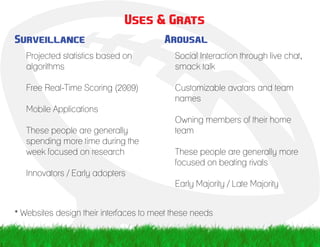
Uses & Grats
Surveillance Arousal
Projected statistics based on
algorithms
Free Real-Time Scoring (2009)
Mobile Applications
These people are generally
spending more time during the
week focused on research
Innovators / Early adopters
Social Interaction through live chat,
smack talk
Customizable avatars and team
names
Owning members of their home
team
These people are generally more
focused on beating rivals
Early Majority / Late Majority
* Websites design their interfaces to meet these needs
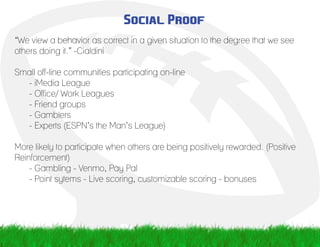
Social Proof
“We view a behavior as correct in a given situation to the degree that we see
others doing it.” -Cialdini
Small off-line communities participating on-line
	 - iMedia League
	 - Office/ Work Leagues
	 - Friend groups
	 - Gamblers
	 - Experts (ESPN’s the Man’s League)
More likely to participate when others are being positively rewarded. (Positive
Reinforcement)
	 - Gambling - Venmo, Pay Pal
	 - Point sytems - Live scoring, customizable scoring - bonuses
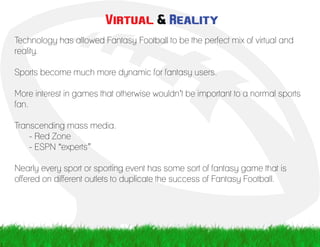
Virtual & Reality
Technology has allowed Fantasy Football to be the perfect mix of virtual and
reality.
	
Sports become much more dynamic for fantasy users.
More interest in games that otherwise wouldn’t be important to a normal sports
fan.
Transcending mass media.
	 - Red Zone
	 - ESPN “experts”
Nearly every sport or sporting event has some sort of fantasy game that is
offered on different outlets to duplicate the success of Fantasy Football.

How Technology has Increased Fantasy Football Popularity

  • 1.
    The Advancement ofTechnology and the Increased Popularity of Fantasy Football
  • 2.
    What is FantasyFootball? On-line communities or leagues centered around the statistical performance of football players in the NFL. Users take the role of general manager and draft offensive players based on different factors. Players are given point values based on performances on the field. Who is Participating? 80% Male, 89.9% White, 51.5% single, 34 years average age, 78.1% have college degree Obsessive sports fans looking for other ways to get involved with the sport
  • 3.
    How is itPlayed? Evolved over time. First league created in 1962 (strictly paper based) but didn’t become widespread until 1997 when CBS launched Beta version of their online site dedicated to fantasy football (database to track stats). Starts with the draft. Different types of drafts that started once drafts moved from offline to online. During the week activities: Pick-up, drop, waiver wire, sit, start, trade. Average fantasy user spends 3 hrs per week: 1.2 billion hours spread over 23 million users over a 17 week season. $1.67 billion spent by those 23 million users = 72 dollars per user in 2013. Doubled since 2008.
  • 4.
    Uses & Grats SurveillanceArousal Projected statistics based on algorithms Free Real-Time Scoring (2009) Mobile Applications These people are generally spending more time during the week focused on research Innovators / Early adopters Social Interaction through live chat, smack talk Customizable avatars and team names Owning members of their home team These people are generally more focused on beating rivals Early Majority / Late Majority * Websites design their interfaces to meet these needs
  • 5.
    Social Proof “We viewa behavior as correct in a given situation to the degree that we see others doing it.” -Cialdini Small off-line communities participating on-line - iMedia League - Office/ Work Leagues - Friend groups - Gamblers - Experts (ESPN’s the Man’s League) More likely to participate when others are being positively rewarded. (Positive Reinforcement) - Gambling - Venmo, Pay Pal - Point sytems - Live scoring, customizable scoring - bonuses
  • 6.
    Virtual & Reality Technologyhas allowed Fantasy Football to be the perfect mix of virtual and reality. Sports become much more dynamic for fantasy users. More interest in games that otherwise wouldn’t be important to a normal sports fan. Transcending mass media. - Red Zone - ESPN “experts” Nearly every sport or sporting event has some sort of fantasy game that is offered on different outlets to duplicate the success of Fantasy Football.