By Marianne Lenox, HMCPL Staff Training and Development Coordinator Created November 2006 Extreme Google
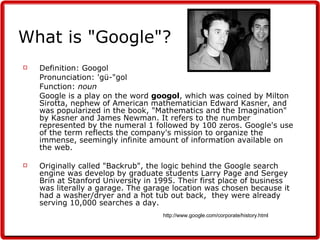
What is "Google"? Definition: Googol  Pronunciation: 'gü-"gol Function:  noun Google is a play on the word  googol , which was coined by Milton Sirotta, nephew of American mathematician Edward Kasner, and was popularized in the book, "Mathematics and the Imagination" by Kasner and James Newman. It refers to the number represented by the numeral 1 followed by 100 zeros. Google's use of the term reflects the company's mission to organize the immense, seemingly infinite amount of information available on the web. Originally called "Backrub", the logic behind the Google search engine was develop by graduate students Larry Page and Sergey Brin at Stanford University in 1995. Their first place of business was literally a garage. The garage location was chosen because it had a washer/dryer and a hot tub out back,  they were already serving 10,000 searches a day. http://www.google.com/corporate/history.html
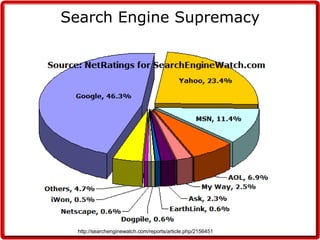
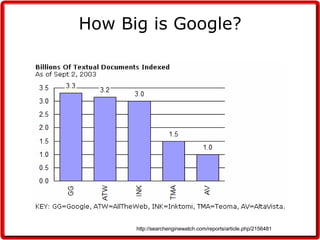
How We Got Here.... For the last 5 years, Google has been the undisputed leader in online search technology. Before Google; Altavista, FAST, and Inktomi had the largest databases; but suffered from poorer search algorithms. Google's profit is partially ad driven, but sponsors do not garner higher ratings in searches.
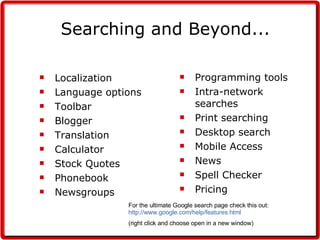
Localization Language options Toolbar Blogger Translation Calculator Stock Quotes Phonebook Newsgroups Searching and Beyond... Programming tools Intra-network searches Print searching Desktop search Mobile Access News Spell Checker Pricing For the ultimate Google search page check this out:  http://www.google.com/help/features.html (right click and choose open in a new window)
Search Engine Supremacy http://searchenginewatch.com/reports/article.php/2156451
How Big is Google? http://searchenginewatch.com/reports/article.php/2156481
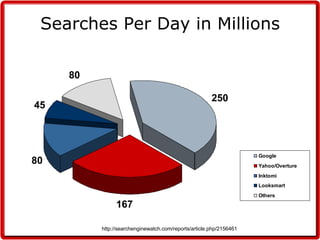
Searches Per Day in Millions http://searchenginewatch.com/reports/article.php/2156461
So How Does Google Work? Crawls and indexes web pages et al. Stores copies of web pages and graphics on their caching servers Presents users with simple front end to query the database of cached pages Returns search results in a ordered fashion based upon relevancy
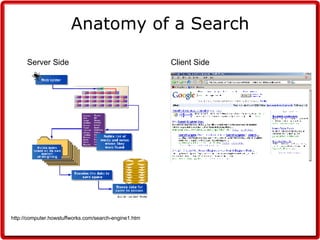
Anatomy of a Search http://computer.howstuffworks.com/search-engine1.htm Server Side   Client Side
What Can Google Search? Adobe Portable Document Format (pdf)  Adobe PostScript (ps)  Lotus 1-2-3 (wk1, wk2, wk3, wk4, wk5, wki, wks, wku)  Lotus WordPro (lwp)  MacWrite (mw)  Microsoft Excel (xls)  Microsoft PowerPoint (ppt)  Microsoft Word (doc)  Microsoft Works (wks, wps, wdb)  Microsoft Write (wri)  Rich Text Format (rtf)  Shockwave Flash (swf)  Text (ans, txt)
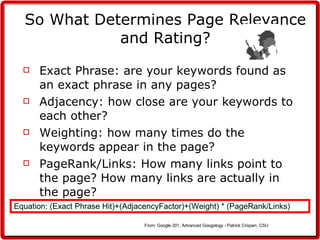
So What Determines Page Relevance and Rating? Exact Phrase: are your keywords found as an exact phrase in any pages? Adjacency: how close are your keywords to each other? Weighting: how many times do the keywords appear in the page? PageRank/Links: How many links point to the page? How many links are actually in the page? Equation: (Exact Phrase Hit)+(AdjacencyFactor)+(Weight) * (PageRank/Links) From: Google 201, Advanced Googology - Patrick Crispen, CSU
Enough! How Do I Get Results? Pick your keywords carefully & be specific Do NOT exceed 10 keywords Use Boolean modifiers Use advanced operators Google ignores some words*: a, about, an, and, are, as, at, be, by, from, how, i, in, is, it, of,  on, or, that, the, this, to, we, what, when, where, which, with *From: Google 201, Advanced Googology - Patrick Crispen, CSU
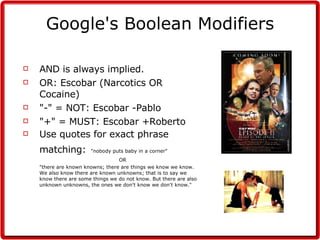
Google's Boolean Modifiers AND is always implied. OR: Escobar (Narcotics OR Cocaine) "-" = NOT: Escobar -Pablo "+" = MUST: Escobar +Roberto Use quotes for exact phrase matching:   "nobody puts baby in a corner" OR "there are known knowns; there are things we know we know.  We also know there are known unknowns; that is to say we know there are some things we do not know. But there are also unknown unknowns, the ones we don't know we don't know."
Wildcards  Google supports word wildcards but NOT stemming. "It's the end of the * as we know it" works. but "American Psycho*" won't get you decent results on American Psychology or American Psychophysics.
Exercise #1 Alright class, it’s time for some hands on experience…. http://intranet/training/google/ex1.htm (Right click and open in a new window)
Advanced Operators cache: define: info: intext: intitle: inurl: link: related: stocks: filetype: numrange 1973..2005 source: phonebook: http://www.googleguide.com/advanced_operators.html
Exercise #2 Ready for another exercise? http://intranet/training/google/ex2.htm (Right click and open in a new window)
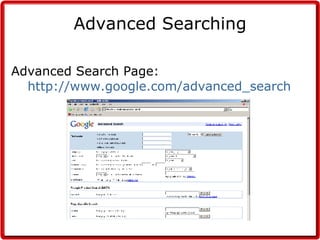
Advanced Searching Advanced Search Page:  http://www.google.com/advanced_search
Extras... Translation and Language options - over 100 to choose from:  http://www.google.com/language_tools   Stock Quotes - enter stocks:, example: stocks:GOOG Newsgroups  -  http://groups.google.com Calculator - "1024 minus 768" or "12 to the 10 power"  Froogle -  http://froogle.google.com Images -  http://images.google.com Spell Checking - just type it in: "convienence" Blogger -  http://www.blogger.com/start Extras can be found at  http://www.google.com/help/features.html
Bibliography and Further Research Search Engine Watch: http:// searchenginewatch.com Google Hacks: 100 Industrial-Strength Tips & Tools by Tara Calishain, Rael Domfest Johnny I Hack Stuff: http:// johnny.ihackstuff.com Google: http:// www.google.com HowStuffWorks: http://computer.howstuffworks.com/search-engine1.htm Google Guide http://www.googleguide.com/ Google Search tips for 2005 http://blog.outer-court.com/archive/2005-09-29-n85.html
Class Evaluation Please visit this page to complete your evaluation of this class: http://intranet/forms/classevaluation.shtml THANK YOU!
Happy Googling!

Extreme Google

  • 1.
    By Marianne Lenox,HMCPL Staff Training and Development Coordinator Created November 2006 Extreme Google
  • 2.
    What is "Google"?Definition: Googol Pronunciation: 'gü-"gol Function: noun Google is a play on the word googol , which was coined by Milton Sirotta, nephew of American mathematician Edward Kasner, and was popularized in the book, "Mathematics and the Imagination" by Kasner and James Newman. It refers to the number represented by the numeral 1 followed by 100 zeros. Google's use of the term reflects the company's mission to organize the immense, seemingly infinite amount of information available on the web. Originally called "Backrub", the logic behind the Google search engine was develop by graduate students Larry Page and Sergey Brin at Stanford University in 1995. Their first place of business was literally a garage. The garage location was chosen because it had a washer/dryer and a hot tub out back, they were already serving 10,000 searches a day. http://www.google.com/corporate/history.html
  • 3.
    How We GotHere.... For the last 5 years, Google has been the undisputed leader in online search technology. Before Google; Altavista, FAST, and Inktomi had the largest databases; but suffered from poorer search algorithms. Google's profit is partially ad driven, but sponsors do not garner higher ratings in searches.
  • 4.
    Localization Language optionsToolbar Blogger Translation Calculator Stock Quotes Phonebook Newsgroups Searching and Beyond... Programming tools Intra-network searches Print searching Desktop search Mobile Access News Spell Checker Pricing For the ultimate Google search page check this out: http://www.google.com/help/features.html (right click and choose open in a new window)
  • 5.
    Search Engine Supremacyhttp://searchenginewatch.com/reports/article.php/2156451
  • 6.
    How Big isGoogle? http://searchenginewatch.com/reports/article.php/2156481
  • 7.
    Searches Per Dayin Millions http://searchenginewatch.com/reports/article.php/2156461
  • 8.
    So How DoesGoogle Work? Crawls and indexes web pages et al. Stores copies of web pages and graphics on their caching servers Presents users with simple front end to query the database of cached pages Returns search results in a ordered fashion based upon relevancy
  • 9.
    Anatomy of aSearch http://computer.howstuffworks.com/search-engine1.htm Server Side Client Side
  • 10.
    What Can GoogleSearch? Adobe Portable Document Format (pdf) Adobe PostScript (ps) Lotus 1-2-3 (wk1, wk2, wk3, wk4, wk5, wki, wks, wku) Lotus WordPro (lwp) MacWrite (mw) Microsoft Excel (xls) Microsoft PowerPoint (ppt) Microsoft Word (doc) Microsoft Works (wks, wps, wdb) Microsoft Write (wri) Rich Text Format (rtf) Shockwave Flash (swf) Text (ans, txt)
  • 11.
    So What DeterminesPage Relevance and Rating? Exact Phrase: are your keywords found as an exact phrase in any pages? Adjacency: how close are your keywords to each other? Weighting: how many times do the keywords appear in the page? PageRank/Links: How many links point to the page? How many links are actually in the page? Equation: (Exact Phrase Hit)+(AdjacencyFactor)+(Weight) * (PageRank/Links) From: Google 201, Advanced Googology - Patrick Crispen, CSU
  • 12.
    Enough! How DoI Get Results? Pick your keywords carefully & be specific Do NOT exceed 10 keywords Use Boolean modifiers Use advanced operators Google ignores some words*: a, about, an, and, are, as, at, be, by, from, how, i, in, is, it, of, on, or, that, the, this, to, we, what, when, where, which, with *From: Google 201, Advanced Googology - Patrick Crispen, CSU
  • 13.
    Google's Boolean ModifiersAND is always implied. OR: Escobar (Narcotics OR Cocaine) "-" = NOT: Escobar -Pablo "+" = MUST: Escobar +Roberto Use quotes for exact phrase matching: "nobody puts baby in a corner" OR "there are known knowns; there are things we know we know. We also know there are known unknowns; that is to say we know there are some things we do not know. But there are also unknown unknowns, the ones we don't know we don't know."
  • 14.
    Wildcards Googlesupports word wildcards but NOT stemming. "It's the end of the * as we know it" works. but "American Psycho*" won't get you decent results on American Psychology or American Psychophysics.
  • 15.
    Exercise #1 Alrightclass, it’s time for some hands on experience…. http://intranet/training/google/ex1.htm (Right click and open in a new window)
  • 16.
    Advanced Operators cache:define: info: intext: intitle: inurl: link: related: stocks: filetype: numrange 1973..2005 source: phonebook: http://www.googleguide.com/advanced_operators.html
  • 17.
    Exercise #2 Readyfor another exercise? http://intranet/training/google/ex2.htm (Right click and open in a new window)
  • 18.
    Advanced Searching AdvancedSearch Page: http://www.google.com/advanced_search
  • 19.
    Extras... Translation andLanguage options - over 100 to choose from: http://www.google.com/language_tools Stock Quotes - enter stocks:, example: stocks:GOOG Newsgroups - http://groups.google.com Calculator - "1024 minus 768" or "12 to the 10 power" Froogle - http://froogle.google.com Images - http://images.google.com Spell Checking - just type it in: "convienence" Blogger - http://www.blogger.com/start Extras can be found at http://www.google.com/help/features.html
  • 20.
    Bibliography and FurtherResearch Search Engine Watch: http:// searchenginewatch.com Google Hacks: 100 Industrial-Strength Tips & Tools by Tara Calishain, Rael Domfest Johnny I Hack Stuff: http:// johnny.ihackstuff.com Google: http:// www.google.com HowStuffWorks: http://computer.howstuffworks.com/search-engine1.htm Google Guide http://www.googleguide.com/ Google Search tips for 2005 http://blog.outer-court.com/archive/2005-09-29-n85.html
  • 21.
    Class Evaluation Pleasevisit this page to complete your evaluation of this class: http://intranet/forms/classevaluation.shtml THANK YOU!
  • 22.