EXAMPLE-1
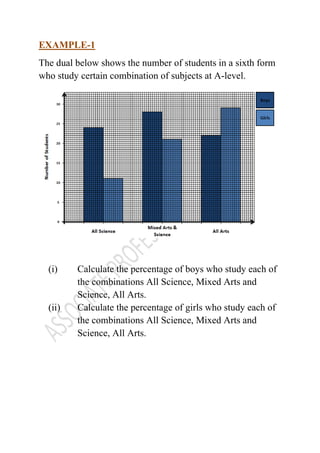
The dual below shows the number of students in a sixth form
who study certain combination of subjects at A-level.
(i) Calculate the percentage of boys who study each of
the combinations All Science, Mixed Arts and
Science, All Arts.
(ii) Calculate the percentage of girls who study each of
the combinations All Science, Mixed Arts and
Science, All Arts.
SOLUTION
(i)
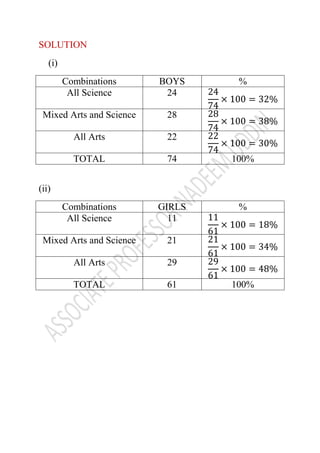
Combinations BOYS %
All Science 24 24
74
× 100 = 32%
Mixed Arts and Science 28 28
74
× 100 = 38%
All Arts 22 22
74
× 100 = 30%
TOTAL 74 100%
(ii)
Combinations GIRLS %
All Science 11 11
61
× 100 = 18%
Mixed Arts and Science 21 21
61
× 100 = 34%
All Arts 29 29
61
× 100 = 48%
TOTAL 61 100%
EXAMPLE-2
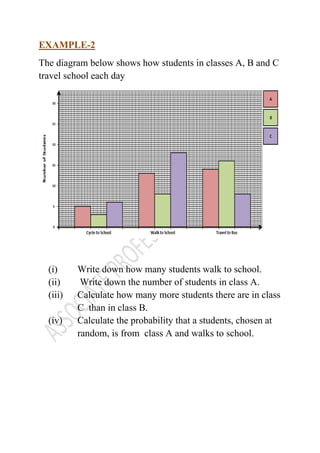
The diagram below shows how students in classes A, B and C
travel school each day
(i) Write down how many students walk to school.
(ii) Write down the number of students in class A.
(iii) Calculate how many more students there are in class
C than in class B.
(iv) Calculate the probability that a students, chosen at
random, is from class A and walks to school.
SOLUTION
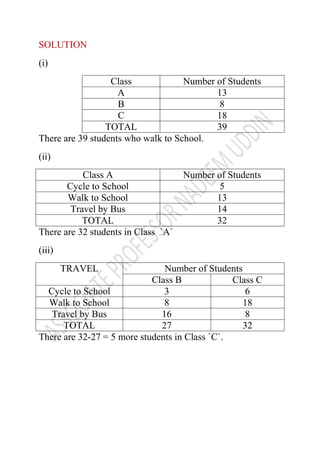
(i)
Class Number of Students
A 13
B 8
C 18
TOTAL 39
There are 39 students who walk to School.
(ii)
Class A Number of Students
Cycle to School 5
Walk to School 13
Travel by Bus 14
TOTAL 32
There are 32 students in Class `A`
(iii)
TRAVEL Number of Students
Class B Class C
Cycle to School 3 6
Walk to School 8 18
Travel by Bus 16 8
TOTAL 27 32
There are 32-27 = 5 more students in Class `C`.
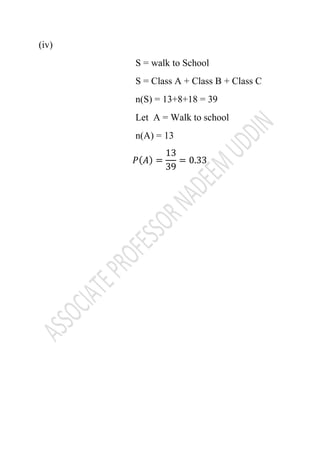
(iv)
S = walk to School
S = Class A + Class B + Class C
n(S) = 13+8+18 = 39
Let A = Walk to school
n(A) = 13
𝑃( 𝐴) =
13
39
= 0.33

Extract information from multiple bar diagram

  • 2.
    EXAMPLE-1 The dual belowshows the number of students in a sixth form who study certain combination of subjects at A-level. (i) Calculate the percentage of boys who study each of the combinations All Science, Mixed Arts and Science, All Arts. (ii) Calculate the percentage of girls who study each of the combinations All Science, Mixed Arts and Science, All Arts.
  • 3.
    SOLUTION (i) Combinations BOYS % AllScience 24 24 74 × 100 = 32% Mixed Arts and Science 28 28 74 × 100 = 38% All Arts 22 22 74 × 100 = 30% TOTAL 74 100% (ii) Combinations GIRLS % All Science 11 11 61 × 100 = 18% Mixed Arts and Science 21 21 61 × 100 = 34% All Arts 29 29 61 × 100 = 48% TOTAL 61 100%
  • 4.
    EXAMPLE-2 The diagram belowshows how students in classes A, B and C travel school each day (i) Write down how many students walk to school. (ii) Write down the number of students in class A. (iii) Calculate how many more students there are in class C than in class B. (iv) Calculate the probability that a students, chosen at random, is from class A and walks to school.
  • 5.
    SOLUTION (i) Class Number ofStudents A 13 B 8 C 18 TOTAL 39 There are 39 students who walk to School. (ii) Class A Number of Students Cycle to School 5 Walk to School 13 Travel by Bus 14 TOTAL 32 There are 32 students in Class `A` (iii) TRAVEL Number of Students Class B Class C Cycle to School 3 6 Walk to School 8 18 Travel by Bus 16 8 TOTAL 27 32 There are 32-27 = 5 more students in Class `C`.
  • 6.
    (iv) S = walkto School S = Class A + Class B + Class C n(S) = 13+8+18 = 39 Let A = Walk to school n(A) = 13 𝑃( 𝐴) = 13 39 = 0.33