INDEX
 EXTENSIVE FARMING
 PICTURE
 ADVANTAGES
 DISADVANTAGES
 QUIZ
Extensive farming
 Extensive farming or extensive agriculture
an agricultural production system that
uses small inputs of labor, fertilizers,
and capital, relative to the land area being
farmed.
 Extensive farming most commonly refers
to sheep and cattle farming in areas with
low agricultural productivity, but can also
refer to large-scale growing of
wheat, barley and other grain crops in
areas like the Murray-Darling Basin.
 Here, owing to the extreme age and
poverty of the soils, yields per hectare are
very low, but the flat terrain and very large
farm sizes mean yields per unit of labor
are high.
 Nomadic herding is an extreme example
of extensive farming, where herders move
their animals to use feed from occasional
Advantages
 Less labor per unit areas is required to farm large
areas, especially since expensive alterations to land
(like terracing) are completely absent.
 Mechanization can be used more effectively over
large, flat areas.
 Greater efficiency of labor means generally lower
product prices.
 Animal welfare is generally improved because
animals are not kept in stifling conditions.
 Lower requirements of inputs such as fertilizers.
 If animals are grazed on pastures native to the
locality, there is less likely to be problems with
exotic species.
 Local environment and soil are not damaged by
overuse of chemicals.
Disadvantage
 Yields tend to be much lower than
with intensive farming in the short
term.
 Large land requirements limit the
habitat of wild species (in some cases,
even very low stocking rates can be
dangerous), as is the case
with intensive farming
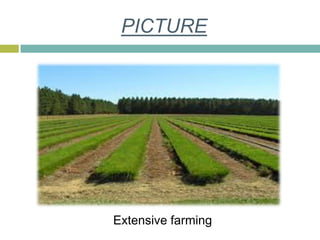
PICTURE
Extensive farming
These are some tips
 Water your plants regularly
 The water which is left after drinking can be
used to water the home plants
 If the weather is too hot and your plants are kept
at a place were direct sun rays reach change
the place of your plant and keep it near your
window or anywhere else.
Quiz
 What are the main features of extensive
farming?
 List 3 advantages of extensive agriculture.
 How many commercial crops are grown in
extensive farming? give example
 List any 1 disadvantage of extensive farming.
 Why is extensive farming is mostly practiced in
the sparsely populated areas?
Extensive farming

Extensive farming

  • 3.
    INDEX  EXTENSIVE FARMING PICTURE  ADVANTAGES  DISADVANTAGES  QUIZ
  • 4.
    Extensive farming  Extensivefarming or extensive agriculture an agricultural production system that uses small inputs of labor, fertilizers, and capital, relative to the land area being farmed.  Extensive farming most commonly refers to sheep and cattle farming in areas with low agricultural productivity, but can also refer to large-scale growing of wheat, barley and other grain crops in areas like the Murray-Darling Basin.  Here, owing to the extreme age and poverty of the soils, yields per hectare are very low, but the flat terrain and very large farm sizes mean yields per unit of labor are high.  Nomadic herding is an extreme example of extensive farming, where herders move their animals to use feed from occasional
  • 5.
    Advantages  Less laborper unit areas is required to farm large areas, especially since expensive alterations to land (like terracing) are completely absent.  Mechanization can be used more effectively over large, flat areas.  Greater efficiency of labor means generally lower product prices.  Animal welfare is generally improved because animals are not kept in stifling conditions.  Lower requirements of inputs such as fertilizers.  If animals are grazed on pastures native to the locality, there is less likely to be problems with exotic species.  Local environment and soil are not damaged by overuse of chemicals.
  • 6.
    Disadvantage  Yields tendto be much lower than with intensive farming in the short term.  Large land requirements limit the habitat of wild species (in some cases, even very low stocking rates can be dangerous), as is the case with intensive farming
  • 7.
  • 8.
    These are sometips  Water your plants regularly  The water which is left after drinking can be used to water the home plants  If the weather is too hot and your plants are kept at a place were direct sun rays reach change the place of your plant and keep it near your window or anywhere else.
  • 9.
    Quiz  What arethe main features of extensive farming?  List 3 advantages of extensive agriculture.  How many commercial crops are grown in extensive farming? give example  List any 1 disadvantage of extensive farming.  Why is extensive farming is mostly practiced in the sparsely populated areas?