



About Exponential


                                               Exponential Interactive is a global provider of advertising
Company                                        intelligence and digital media solutions to brand advertisers.


                                ADVERTISING
                                               e-X combines world-class data and technology to help brands
Platform                        INTELLIGENCE   identify, reach and engage their audiences online.
                                PLATFORM


                                               Our audience engagement divisions apply advertising
                                               intelligence to deliver high-impact, high-engagement
Divisions                                      campaigns across display, video and mobile to more than 450
                                               million unique monthly users worldwide.


     Advertising Intelligence                                                                                   2
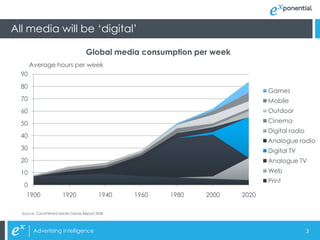
All media will be ‘digital’

                                    Global media consumption per week
       Average hours per week
  90
  80
                                                                               Games
  70                                                                           Mobile
  60                                                                           Outdoor

  50                                                                           Cinema
                                                                               Digital radio
  40
                                                                               Analogue radio
  30                                                                           Digital TV
  20                                                                           Analogue TV
  10                                                                           Web
                                                                               Print
   0
    1900               1920                1940   1960   1980   2000    2020

  Source: Carat/World Media Trends Report 2008


        Advertising Intelligence                                                               3
challenges
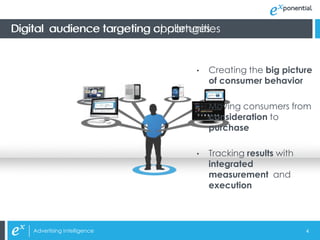
Digital audience targeting opportunities


                                   •   Creating the big picture
                                       of consumer behavior

                                   •   Moving consumers from
                                       consideration to
                                       purchase

                                   •   Tracking results with
                                       integrated
                                       measurement and
                                       execution


    Advertising Intelligence                                   4
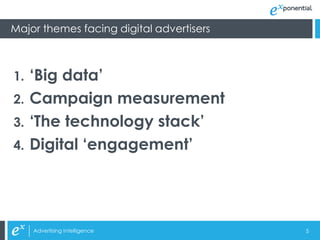
Major themes facing digital advertisers


1. ‘Big data’
2. Campaign measurement
3. ‘The technology stack’
4. Digital ‘engagement’


     Advertising Intelligence             5
Big data: Why you can't beat the
model in online audience targeting


www.exponential.com                  6
Online data overshadows even the biggest events


    Advertising Intelligence                      7
The amount ofability is meaningless…
 …without the data to turn it into action


   Data                        Information   Insight   Action


    Advertising Intelligence                                    8
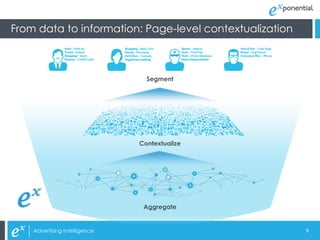
From data to information: Page-level contextualization


                                 Segment


                               Contextualize


                                Aggregate


    Advertising Intelligence                             9
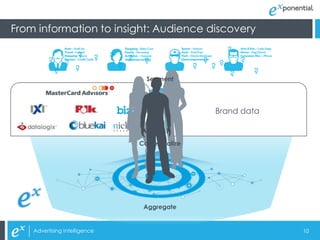
From information to insight: Audience discovery
                                                                              ?
                     ?         ?   ?       ?                ?
         ?       ?                              ?                   ?             ?
                     ?                 ?                        ?       ? ?
             ?                                                                ?       ?
                                                 Segment


                                                                        Brand data


                                               Contextualize


                                                Aggregate


    Advertising Intelligence                                                              10
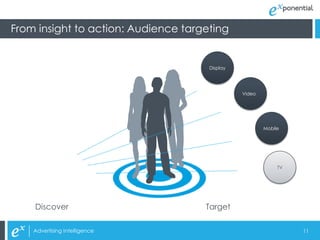
From insight to action: Audience targeting


                                      Display


                                                Video


                                                        Mobile


                                                             TV


    Discover                         Target

    Advertising Intelligence                                      11
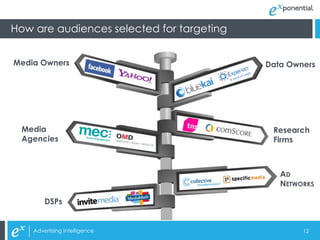
How are audiences selected for targeting


Media Owners                               Data Owners


 Media                                      Research
 Agencies                                   Firms


                                              AD
                                              NETWORKS

        DSPs


    Advertising Intelligence                       12
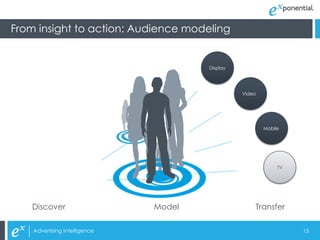
From insight to action: Audience modeling


                                       Display


                                                 Video


                                                         Mobile


                                                              TV


   Discover                    Model                 Transfer

    Advertising Intelligence                                       13
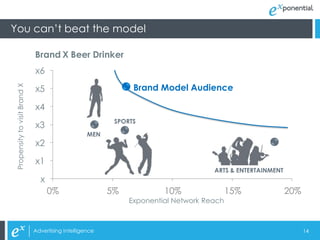
You can’t beat the model

                              Brand X Beer Drinker
                              x6

                              x5                               Brand Model Audience
Propensity to visit Brand X


                              x4
                                                          SPORTS
                              x3
                                                   MEN
                              x2

                              x1
                                                                                    ARTS & ENTERTAINMENT
                                x
                                    0%                   5%            10%                15%              20%
                                                              Exponential Network Reach


                              Advertising Intelligence                                                           14
Questions


Tim Brown I Chief Product Officer
tim.brown@exponential.com


www.exponential.com                 15

Digiday Brand Conference: Workshop with Exponential: Why You Can’t Beat Big Data in Online Audience Targeting

  • 2.
    About Exponential Exponential Interactive is a global provider of advertising Company intelligence and digital media solutions to brand advertisers. ADVERTISING e-X combines world-class data and technology to help brands Platform INTELLIGENCE identify, reach and engage their audiences online. PLATFORM Our audience engagement divisions apply advertising intelligence to deliver high-impact, high-engagement Divisions campaigns across display, video and mobile to more than 450 million unique monthly users worldwide. Advertising Intelligence 2
  • 3.
    All media willbe ‘digital’ Global media consumption per week Average hours per week 90 80 Games 70 Mobile 60 Outdoor 50 Cinema Digital radio 40 Analogue radio 30 Digital TV 20 Analogue TV 10 Web Print 0 1900 1920 1940 1960 1980 2000 2020 Source: Carat/World Media Trends Report 2008 Advertising Intelligence 3
  • 4.
    challenges Digital audience targetingopportunities • Creating the big picture of consumer behavior • Moving consumers from consideration to purchase • Tracking results with integrated measurement and execution Advertising Intelligence 4
  • 5.
    Major themes facingdigital advertisers 1. ‘Big data’ 2. Campaign measurement 3. ‘The technology stack’ 4. Digital ‘engagement’ Advertising Intelligence 5
  • 6.
    Big data: Whyyou can't beat the model in online audience targeting www.exponential.com 6
  • 7.
    Online data overshadowseven the biggest events Advertising Intelligence 7
  • 8.
    The amount ofabilityis meaningless… …without the data to turn it into action Data Information Insight Action Advertising Intelligence 8
  • 9.
    From data toinformation: Page-level contextualization Segment Contextualize Aggregate Advertising Intelligence 9
  • 10.
    From information toinsight: Audience discovery ? ? ? ? ? ? ? ? ? ? ? ? ? ? ? ? ? ? ? Segment Brand data Contextualize Aggregate Advertising Intelligence 10
  • 11.
    From insight toaction: Audience targeting Display Video Mobile TV Discover Target Advertising Intelligence 11
  • 12.
    How are audiencesselected for targeting Media Owners Data Owners Media Research Agencies Firms AD NETWORKS DSPs Advertising Intelligence 12
  • 13.
    From insight toaction: Audience modeling Display Video Mobile TV Discover Model Transfer Advertising Intelligence 13
  • 14.
    You can’t beatthe model Brand X Beer Drinker x6 x5 Brand Model Audience Propensity to visit Brand X x4 SPORTS x3 MEN x2 x1 ARTS & ENTERTAINMENT x 0% 5% 10% 15% 20% Exponential Network Reach Advertising Intelligence 14
  • 15.
    Questions Tim Brown IChief Product Officer tim.brown@exponential.com www.exponential.com 15

Editor's Notes

  • #3 Global reach – 5th behind Google, Microsoft, Facebook and YahooOffices in over 26 countries
  • #4 Every form of media was at one point considered “new.” The natural thing to do is to put it in a silo. “This is different. There are new rules.” Few people in this room are old enough to remember when TV was new, but I’m sure it was siloed, and so was radio before that. Stone tablets were probably “disruptive” to the town crier. Really it’s all just pipes to connect the advertiser and the consumer. Digital has had the luxury of blinders for over a decade. We really did think we were different for a very long time. What’s next? Everything moves to digital underpinnings, and what was old, now becomes new. But what are the implications for you as marketers?
  • #5 The biggest shift is that anything that is delivered via an internet protocol can be behaviorally targeted. We’re talking Minority Report, but in a good way. When I have jet lag and turn on the TV at 3:00 AM, I don’t want to see infomercials about exercise equipment or hair loss treatments. (OK, maybe the hair loss treatments). I want to see information on that car I was thinking about buying, or the new smartphone that’s better than the one I’ve got. Ads are everywhere, and they’re obnoxious when they’re not relevant. We’ve been losing this battle for too long.Digital conversion is the single greatest counterbalance to decreasing return on attention.ChallengesNeed single platform for all media so you can truly follow the customer on their journey. You can create awareness amongst your target audience while they listen to their satellite radio on the way to work. Move them to favorability while they watch TV in the evening. Get them from consideration to purchase on the PC and their mobile. So how far can we take this? The nirvana state is on-line/off-line convergence. Tracking a user through TV, social, display, mobile, and search, all the way to what you really want: a purchase, whether on-line or off. Conversely, you’ll want to know how to take that off line purchase, and tie it back to behaviors across media, so you can model the optimal mix to meet your objectives.
  • #6 The ones you hear all the time?Ones that point to fundamental issues?Ones that advertisers and their agencies need to take a view on and build a strategy for?They’re all interlinked – for ease of consumption (and production) we ourselves have had to ‘silo’. But, they all point to a single solution…
  • #8 In 2011 IBM released a paper with the oft repeated comment that ““Everyday, we create 2.5 quintillion bytes of data–so much that 90% of the data in the world today has been created in the last two years alone.”When people engage online they create huge amounts of data. Exponential has the same big data issue as many other businesses. We collect 80 billion events a month across 450 million users worldwide and organise that into 50,000 categories. That’s equivalent to seeing more than 5600 Olympic Stadia of people more than 170 times a month each. Day to day online business dwarfs the data potential of the biggest events.[“The amount of data is meaningless”]All big data presentations start with stats about the vast scale of data now collected.But we would argue that the amount of data being collected today is now so vast as to be incomprehensible to the human mind. 5 years ago it was about how big your data warehouse was and how fast you could process data.Today, it really isn’t about how big it is but what you do with it.
  • #9 So we prefer to think about how you turn data from information then to insight and finally to action.This is not a new notion, we might even have stolen from Frank Zappa, but there’s still too much noise about data collection and not enough focus on data actionability.
  • #10 For many types of data, the internet can be thought of as a categorisation problem. There are hundreds of millions of pages of content in multiple languages with new content being added constantly. People are consuming this content all the time and it is this real content consumption that provides information at scale. It tells us what people are interested in.To make sense of that raw stream of content consumption we aggregate access to as much of that flow as we can economically justify. We then apply our own page-level contextualisation tool to give each page of content a topic. This a natural language processing problem we’ve been working on for more than 5 years and is our CTOs background. It’s the science part. We’ve also built a hierarchy of topics based on our experience of what is relevant to marketeers from a targeting and insights perspective. That’s the art part. Once a page has a topic we can add that topic to the profile of every visitor to the page. Over time, we can build a rich picture of the actual interests of that person. Some of those interests can indicate purchase intent. For example, we know that people that order a brochure online for a car really do read content about that car brand and model and about competitive brands and models. But those interests also show the other aspects of that persons online life separate to whatever purchase they are in (or we would like them to be in). We’ve even found that what you do online, these observed interests, are more predictive of belonging to a brand’s target audience, than who you are offline, like your income or occupation.This is quite distinct to survey or panel approaches where decisions can be based on just a handful of declared responses.So now we have turned a mass of unstructured data into information, that is categorised and stored in a way navigable and understandable by real people. This lets us do several things.
  • #11 Firstly, it lets us move from information to insight. If you bring together the best audience data available in the market along with our own interest audiences you have a very rich descriptive profile. That can be used to tell you things about your customers that survey data may not be able to. It lets you generate insight in a few moments that previously took a dedicated team several weeks of mining different data sets and running different statistical analyses.Sometimes it simply validates your assumptions. Like our car example before that people who order car brochures really have looked at other sites about that car model. Sometimes is produces a pleasant surprise. For one hotel group we found nightlife, dining and event behaviours formed a solid cluster. In hindsight this should not have been new to them but it hadn’t come up in their previous work. Sometimes it challenges your assumptions. Like the DVD rental group who thought their customers were movie lovers but actually turn out to be people with young children or hardcore gamers – those that can’t or won’t go out for entertainment.
  • #12 But insight on their own are not enough and certainly don’t lead to return on advertising sped you can demonstrate to your CFO. You need to be able to turn that insight into action. That has been the problem with many of the planning tools in place historically. They delivered great insight but then still required you to find and buy a proxy to the audience you just identified. Fortunately digital advertising has become sophisticated enough that audiences can now be passed from planning application to media buying application, in our case on a single platform. The idea is that marketers should be able to buy what they learn.
  • #13 However, there are dozens of digital media and audience data vendors, including some familiar names from the offline world, each with their own segmentation strategy and hierarchy. Any one platform could have tens of thousands of audience segments. In aggregate planners and buyers are faced with competing taxonomies with hundreds of thousands of segments in aggregate. We’ve shown how you can use big data processes to discover and describe brand audiences. But the list of options is still bewildering and challenge for buyer and seller alike.
  • #14 The answer , not surprisingly from a technology company, is to trust the machine. Use audience analytics to discover the segments most relevant to you and let that influence strategy. But let a machine model the most efficient arrangement of those tens of thousands of interest and socio-demographics audience segments [The trick is to work with someone that can explain their model methodology to you!]. Then make sure you’re working with partners that can buy against the model directly or transfer it to your preferred buying platform across devices.Big data techniques can instead be used to model the target audience and take away human selection.
  • #15 In our case we expose that audience model as an explicit trade off between the lift, or quality of fit, of the model to a brand’s target audience – the y-axis – and the reach you can achieve – the x-axis. The larger the model, the worse it gets, but at least it’s transparent. What we find now is that the traditional approach of manually selecting audiences based on their nearest analogue to your survey data, or even based on your audience insights discovery, is never as efficient as the model. In the chart above, the beer brand in question used its brand site visitors as a proxy to its customers. They could compare the lift and reach of their traditional, preferred audience targets – e.g. Men, Sports and Arts & Entertainment – to that suggested by a model. In all cases, their preferred audiences sacrificed significant lift for any given reach or vice versa. For a campaign with brand objectives this represents a missed opportunity and real wastage.So we’ve turned Big Data into a simple, scalable, repeatable action: “you can’t beat the model”