Exploring the
Paradox:
Cheating in the
Most Noble
Profession
Professor Melanie Birks
Dr John Smithson
online.jcu.edu.au
Presented by JCU Nursing and Midwifery:
Introductions
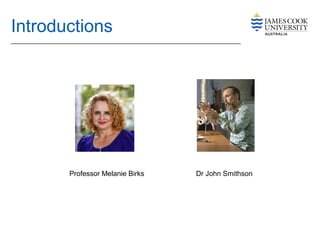
Professor Melanie Birks Dr John Smithson
• Founded in 1961
• Campuses in Townsville, Cairns and Singapore
• Ranked in the top 2% of universities worldwide
• Reputation for excellence built on world-class
research as well as industry-leading
performance of our graduates
• JCU Online launched two accelerated
postgraduate degrees in 2017
About JCU
– Discuss the incidence and prevalence of academic
misconduct amongst nursing students
– Explore why students of the most noble profession
would engage in misconduct
– Describe the types of academic and professional
misconduct reported
– Examine factors that contribute to the problem of
academic and professional misconduct and consider
how these may be addressed
Aims
• Plagiarism and cheating are a growing
problem for universities
• Intentional vs unintentional
• The impact of technology
• What we already know
Some Context…
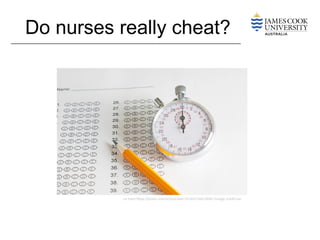
Do nurses really cheat?
<a href='https://jooinn.com/school-test-19.html?ref=2806'>Image credit</a>
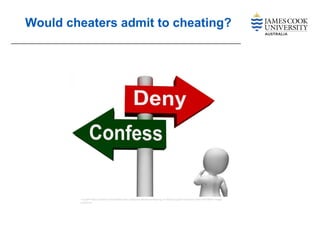
Would cheaters admit to cheating?
<a href='https://jooinn.com/confess-deny-signpost-shows-confessing-or-denying-guilt-innocence.html?ref=2806'>Image
credit</a>
Our research
• Aimed to describe the nature and extent of academic
dishonesty among nursing students in Australia
• Questions included:
– 6 demographic items
– 6 items about their course
– 4 items about academic dishonesty
– 8 items about academic dishonesty
– 9 items about professional dishonesty
• A social desirability scale was also included
Results
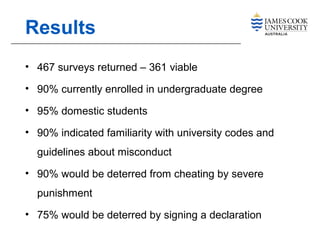
• 467 surveys returned – 361 viable
• 90% currently enrolled in undergraduate degree
• 95% domestic students
• 90% indicated familiarity with university codes and
guidelines about misconduct
• 90% would be deterred from cheating by severe
punishment
• 75% would be deterred by signing a declaration
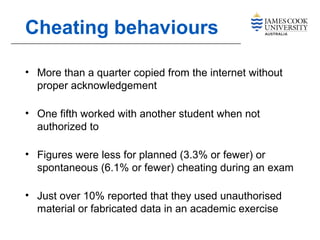
Cheating behaviours
• More than a quarter copied from the internet without
proper acknowledgement
• One fifth worked with another student when not
authorized to
• Figures were less for planned (3.3% or fewer) or
spontaneous (6.1% or fewer) cheating during an exam
• Just over 10% reported that they used unauthorised
material or fabricated data in an academic exercise
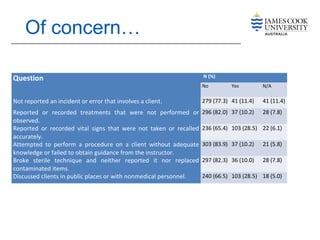
Of concern…
Question  N (%)
No Yes N/A
Not reported an incident or error that involves a client. 279 (77.3) 41 (11.4) 41 (11.4)
Reported or recorded treatments that were not performed or
observed.
296 (82.0) 37 (10.2) 28 (7.8)
Reported or recorded vital signs that were not taken or recalled
accurately.
236 (65.4) 103 (28.5) 22 (6.1)
Attempted to perform a procedure on a client without adequate
knowledge or failed to obtain guidance from the instructor.
303 (83.9) 37 (10.2) 21 (5.8)
Broke sterile technique and neither reported it nor replaced
contaminated items.
297 (82.3) 36 (10.0) 28 (7.8)
Discussed clients in public places or with nonmedical personnel. 240 (66.5) 103 (28.5) 18 (5.0)
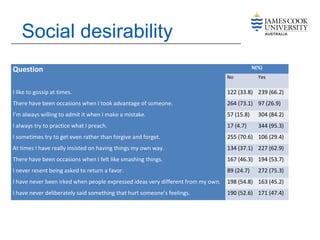
Social desirability
Question N(%)
No Yes
I like to gossip at times. 122 (33.8) 239 (66.2)
There have been occasions when I took advantage of someone. 264 (73.1) 97 (26.9)
I’m always willing to admit it when I make a mistake. 57 (15.8) 304 (84.2)
I always try to practice what I preach. 17 (4.7) 344 (95.3)
I sometimes try to get even rather than forgive and forget. 255 (70.6) 106 (29.4)
At times I have really insisted on having things my own way. 134 (37.1) 227 (62.9)
There have been occasions when I felt like smashing things. 167 (46.3) 194 (53.7)
I never resent being asked to return a favor. 89 (24.7) 272 (75.3)
I have never been irked when people expressed ideas very different from my own. 198 (54.8) 163 (45.2)
I have never deliberately said something that hurt someone’s feelings. 190 (52.6) 171 (47.4)
Interesting to note…
• Academic misconduct (45.4%) occurs at a rate similar to
professional misconduct (49.5%)
• Younger students were more likely to cheat
• Social desirability outcome was (weakly) negatively
correlated with age
• Only a minority reported any undesirable activity ‘often’ or
‘very often’
• Correlation test indicate that students who engaged in
academic misconduct were more likely to engage in
professional misconduct
Discussion
• Why are younger students more likely to cheat?
• How much does technology contribute to facilitating
and detecting the problem?
• Early work found gender to be a factor – why would
that be the case?
• Does academic misconduct result from students not
understanding, or just not caring?
• Are there different degrees of academic and
professional dishonesty?
Continue
learning
with JCU Online
online.jcu.edu.au 1300 535 919
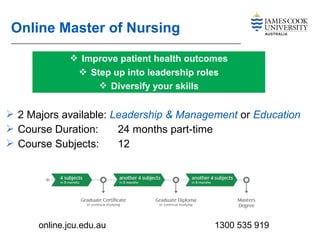
 2 Majors available: Leadership & Management or Education
 Course Duration: 24 months part-time
 Course Subjects: 12
Online Master of Nursing
online.jcu.edu.au 1300 535 919
 Improve patient health outcomes
 Step up into leadership roles
 Diversify your skills
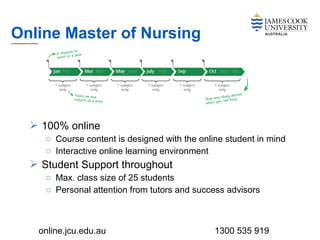
 100% online
o Course content is designed with the online student in mind
o Interactive online learning environment
 Student Support throughout
o Max. class size of 25 students
o Personal attention from tutors and success advisors
Online Master of Nursing
online.jcu.edu.au 1300 535 919

Exploring the Paradox: Cheating in the Most Noble Profession

  • 1.
    Exploring the Paradox: Cheating inthe Most Noble Profession Professor Melanie Birks Dr John Smithson online.jcu.edu.au Presented by JCU Nursing and Midwifery:
  • 2.
  • 3.
    • Founded in1961 • Campuses in Townsville, Cairns and Singapore • Ranked in the top 2% of universities worldwide • Reputation for excellence built on world-class research as well as industry-leading performance of our graduates • JCU Online launched two accelerated postgraduate degrees in 2017 About JCU
  • 4.
    – Discuss theincidence and prevalence of academic misconduct amongst nursing students – Explore why students of the most noble profession would engage in misconduct – Describe the types of academic and professional misconduct reported – Examine factors that contribute to the problem of academic and professional misconduct and consider how these may be addressed Aims
  • 5.
    • Plagiarism andcheating are a growing problem for universities • Intentional vs unintentional • The impact of technology • What we already know Some Context…
  • 6.
    Do nurses reallycheat? <a href='https://jooinn.com/school-test-19.html?ref=2806'>Image credit</a>
  • 7.
    Would cheaters admitto cheating? <a href='https://jooinn.com/confess-deny-signpost-shows-confessing-or-denying-guilt-innocence.html?ref=2806'>Image credit</a>
  • 8.
    Our research • Aimedto describe the nature and extent of academic dishonesty among nursing students in Australia • Questions included: – 6 demographic items – 6 items about their course – 4 items about academic dishonesty – 8 items about academic dishonesty – 9 items about professional dishonesty • A social desirability scale was also included
  • 9.
    Results • 467 surveysreturned – 361 viable • 90% currently enrolled in undergraduate degree • 95% domestic students • 90% indicated familiarity with university codes and guidelines about misconduct • 90% would be deterred from cheating by severe punishment • 75% would be deterred by signing a declaration
  • 10.
    Cheating behaviours • Morethan a quarter copied from the internet without proper acknowledgement • One fifth worked with another student when not authorized to • Figures were less for planned (3.3% or fewer) or spontaneous (6.1% or fewer) cheating during an exam • Just over 10% reported that they used unauthorised material or fabricated data in an academic exercise
  • 11.
    Of concern… Question  N (%) NoYes N/A Not reported an incident or error that involves a client. 279 (77.3) 41 (11.4) 41 (11.4) Reported or recorded treatments that were not performed or observed. 296 (82.0) 37 (10.2) 28 (7.8) Reported or recorded vital signs that were not taken or recalled accurately. 236 (65.4) 103 (28.5) 22 (6.1) Attempted to perform a procedure on a client without adequate knowledge or failed to obtain guidance from the instructor. 303 (83.9) 37 (10.2) 21 (5.8) Broke sterile technique and neither reported it nor replaced contaminated items. 297 (82.3) 36 (10.0) 28 (7.8) Discussed clients in public places or with nonmedical personnel. 240 (66.5) 103 (28.5) 18 (5.0)
  • 12.
    Social desirability Question N(%) NoYes I like to gossip at times. 122 (33.8) 239 (66.2) There have been occasions when I took advantage of someone. 264 (73.1) 97 (26.9) I’m always willing to admit it when I make a mistake. 57 (15.8) 304 (84.2) I always try to practice what I preach. 17 (4.7) 344 (95.3) I sometimes try to get even rather than forgive and forget. 255 (70.6) 106 (29.4) At times I have really insisted on having things my own way. 134 (37.1) 227 (62.9) There have been occasions when I felt like smashing things. 167 (46.3) 194 (53.7) I never resent being asked to return a favor. 89 (24.7) 272 (75.3) I have never been irked when people expressed ideas very different from my own. 198 (54.8) 163 (45.2) I have never deliberately said something that hurt someone’s feelings. 190 (52.6) 171 (47.4)
  • 13.
    Interesting to note… •Academic misconduct (45.4%) occurs at a rate similar to professional misconduct (49.5%) • Younger students were more likely to cheat • Social desirability outcome was (weakly) negatively correlated with age • Only a minority reported any undesirable activity ‘often’ or ‘very often’ • Correlation test indicate that students who engaged in academic misconduct were more likely to engage in professional misconduct
  • 14.
    Discussion • Why areyounger students more likely to cheat? • How much does technology contribute to facilitating and detecting the problem? • Early work found gender to be a factor – why would that be the case? • Does academic misconduct result from students not understanding, or just not caring? • Are there different degrees of academic and professional dishonesty?
  • 15.
  • 16.
     2 Majorsavailable: Leadership & Management or Education  Course Duration: 24 months part-time  Course Subjects: 12 Online Master of Nursing online.jcu.edu.au 1300 535 919  Improve patient health outcomes  Step up into leadership roles  Diversify your skills
  • 17.
     100% online oCourse content is designed with the online student in mind o Interactive online learning environment  Student Support throughout o Max. class size of 25 students o Personal attention from tutors and success advisors Online Master of Nursing online.jcu.edu.au 1300 535 919
  • 18.

Editor's Notes

  • #2 This is an alternative title page with space for images.
  • #3 Amelia
  • #4 Amelia
  • #5 Melanie
  • #6 Melanie
  • #7 The impetus for this study.
  • #8 Describe social desirability scale.
  • #12 I have removed items with less than 10% affirmative response.
  • #13 Not sure if this belongs here. Interesting to show the answers to some of these items.
  • #15 Or are younger students just more likely to be honest as older have lower SDB than mature and experienced students? Evidence suggests that if students think everyone is doing it, it’s okay. Drug use in sport example – need to do it to be competitive.
  • #16 This is an alternative title page with space for images.
  • #17 Amelia
  • #18 Amelia Study through JCU, one of the top 10 nurse educators in Australia, and connect with leading practising and research nurse academics. Diversify your skills Qualify to work autonomously and collaboratively in advanced and expanded clinical roles.  Step into leadership roles Extend your ability to assess and manage clients, refer to other healthcare professionals, prescribe medications and order diagnostic investigations.  Prepares you for any work environment Gain skills and knowledge to adapt to any environment, whether that be in rural, remote or Aboriginal and Torres Strait Islander communities, or increasingly complex urban contexts. Leadership and Management: This major prepares nurses for leadership roles in clinical settings.  This includes leading and managing teams, as well as developing skills in business-related areas such as finance and budgeting. Education: This major is ideal for nurses who wish to develop into a nurse educator role within a clinical environment or perhaps even tertiary education settings. It will provide students with the contemporary tools to facilitate effective adult learning, which is a valuable skill for clinical, education and leadership roles in nursing. SEAs can talk you through which option will help achieve your individual career goals.
  • #19 This is an alternative title page with space for images.