1. Text Preprocessing
Before analysis, text must be cleaned and prepared:
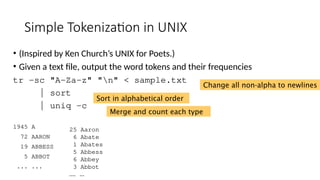
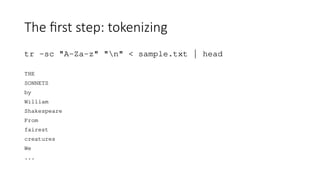
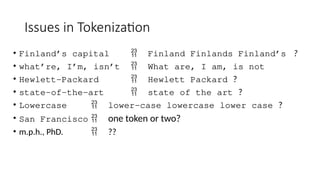
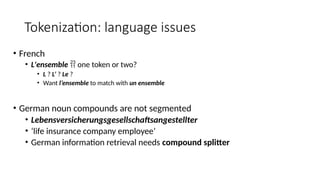
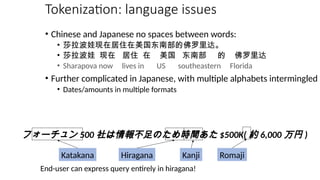
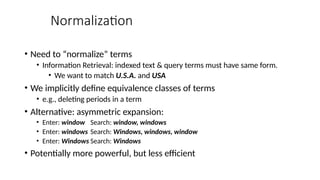
Tokenization → Splitting text into smaller units (words, sentences).
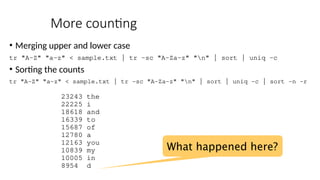
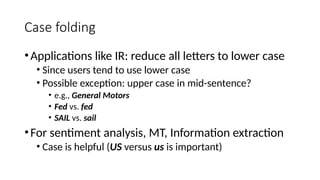
Lowercasing → Converting all text to lowercase for consistency.
Stopwords removal → Removing common words (e.g., “the”, “is”, “and”).
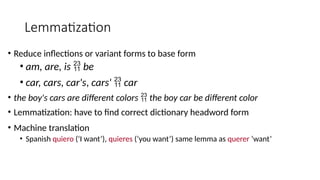
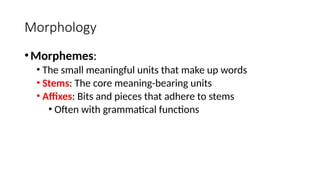
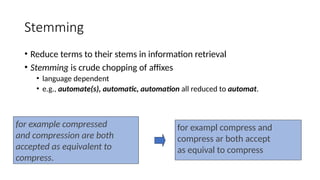
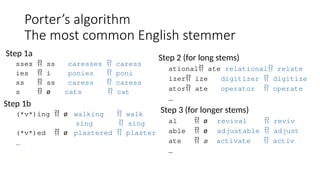
Stemming → Reducing words to root form (e.g., running → run).
Lemmatization → Reducing words to dictionary base form with context (e.g., better → good).
2. Representing Text
Computers need numbers to process language:
Bag of Words (BoW) → Counts word occurrences.
TF-IDF → Weights words by importance (rare words get more weight).
Word Embeddings → Dense vector representations (e.g., Word2Vec, GloVe, FastText).
Contextual Embeddings → Context-aware word meanings (e.g., BERT, GPT).
3. Core NLP Tasks
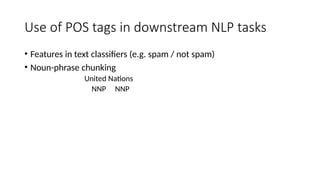
Text Classification → Categorizing text (spam detection, sentiment analysis).
Named Entity Recognition (NER) → Identifying entities (names, places, dates).
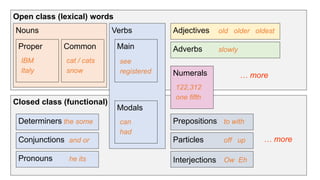
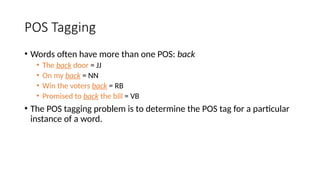
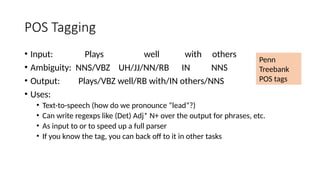
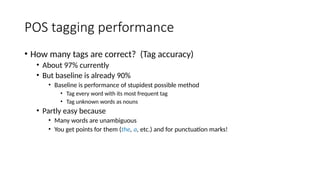
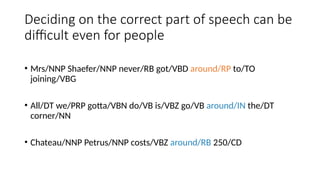
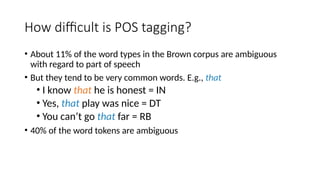
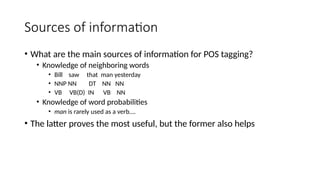
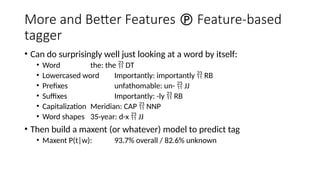
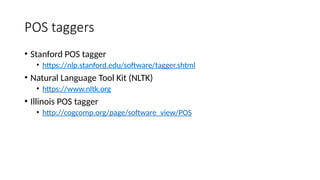
Part-of-Speech Tagging (POS) → Identifying nouns, verbs, adjectives, etc.
Language Modeling → Predicting the next word in a sequence.
Machine Translation → Translating one language into another.
Text Summarization → Condensing text into a shorter form.
Question Answering → Extracting or generating answers from text.
Speech Recognition → Converting spoken words into text.
4. Models in NLP
Rule-Based Systems → Hand-crafted grammar and dictionaries.
Statistical Models → n-grams, Hidden Markov Models.
Neural Networks → RNNs, LSTMs, CNNs for sequential data.
Transformers → Self-attention models (BERT, GPT, T5).
5. Challenges in NLP
Ambiguity → Words with multiple meanings (bank: river vs money).
Context Understanding → Same words mean different things depending on context.
Sarcasm & Irony → Difficult for sentiment analysis.
Low-Resource Languages → Less training data available.
6. Applications of NLP
Virtual Assistants (Siri, Alexa, ChatGPT 🤖)
Sentiment Analysis in social media
Machine Translation (Google Translate)
Spam Detection in emails



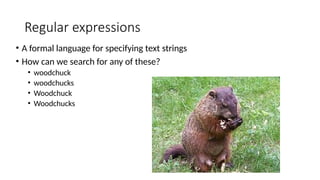
![Regular Expressions: Disjunctions
• Letters inside square brackets []
• Ranges [A-Z]
Pattern Matches
[wW]oodchuck Woodchuck, woodchuck
[1234567890] Any digit
Pattern Matches
[A-Z] An upper case letter Drenched Blossoms
[a-z] A lower case letter my beans were impatient
[0-9] A single digit Chapter 1: Down the Rabbit Hole](https://image.slidesharecdn.com/naturallanugaeprocessingfundamentals-250818061435-296b86af/85/Natural-Lanugae-Processing_fundamentals-pptx-6-320.jpg)
![Regular Expressions: Negation in Disjunction
• Negations [^Ss]
• Carat means negation only when first in []
Pattern Matches
[^A-Z] Not an upper case letter Oyfn pripetchik
[^Ss] Neither ‘S’ nor ‘s’ I have no exquisite reason”
[^e^] Neither e nor ^ Look here
a^b The pattern a carat b Look up a^b now](https://image.slidesharecdn.com/naturallanugaeprocessingfundamentals-250818061435-296b86af/85/Natural-Lanugae-Processing_fundamentals-pptx-7-320.jpg)
![Regular Expressions: More Disjunction
• Woodchucks is another name for groundhog!
• The pipe | for disjunction
Pattern Matches
groundhog|woodchuck
yours|mine yours
mine
a|b|c = [abc]
[gG]roundhog|[Ww]oodchuck
Photo D. Fletcher](https://image.slidesharecdn.com/naturallanugaeprocessingfundamentals-250818061435-296b86af/85/Natural-Lanugae-Processing_fundamentals-pptx-8-320.jpg)
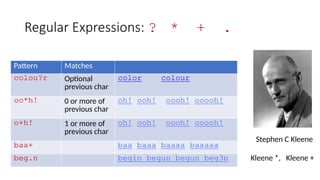
![Regular Expressions: Anchors ^ $
Pattern Matches
^[A-Z] Palo Alto
^[^A-Za-z] 1 “Hello”
.$ The end.
.$ The end? The end!](https://image.slidesharecdn.com/naturallanugaeprocessingfundamentals-250818061435-296b86af/85/Natural-Lanugae-Processing_fundamentals-pptx-10-320.jpg)
![Example
• Find me all instances of the word “the” in a text.
the
Misses capitalized examples
[tT]he
Incorrectly returns other or theology
[^a-zA-Z][tT]he[^a-zA-Z]](https://image.slidesharecdn.com/naturallanugaeprocessingfundamentals-250818061435-296b86af/85/Natural-Lanugae-Processing_fundamentals-pptx-11-320.jpg)
![35
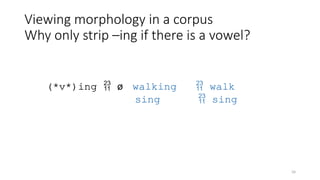
Viewing morphology in a corpus
Why only strip –ing if there is a vowel?
(*v*)ing ø walking walk
sing sing
tr -sc "A-Za-z" "n" < sample.txt | grep "ing$" | sort | uniq -c | sort –nr
tr -sc "A-Za-z" "n" < sample.txt | grep "[aeiou].*ing$" | sort | uniq -c | sort –nr
548 being
541 nothing
152 something
145 coming
130 morning
122 having
120 living
117 loving
116 Being
102 going
1312 King
548 being
541 nothing
388 king
375 bring
358 thing
307 ring
152 something
145 coming
130 morning](https://image.slidesharecdn.com/naturallanugaeprocessingfundamentals-250818061435-296b86af/85/Natural-Lanugae-Processing_fundamentals-pptx-35-320.jpg)

![Two views of linguistic structure:
1. Constituency (phrase structure)
• Phrase structure organizes words into nested constituents.
• How do we know what is a constituent? (Not that linguists don’t argue
about some cases.)
• Distribution: a constituent behaves as a unit that can appear in different places:
• John talked [to the children] [about drugs].
• John talked [about drugs] [to the children].
• *John talked drugs to the children about
• Substitution/expansion/pro-forms:
• I sat [on the box/right on top of the box/there].
• Coordination, regular internal structure, no intrusion,
fragments, semantics, …](https://image.slidesharecdn.com/naturallanugaeprocessingfundamentals-250818061435-296b86af/85/Natural-Lanugae-Processing_fundamentals-pptx-56-320.jpg)
![Statistical parsing applications
Statistical parsers are now robust and widely used in larger NLP applications:
• High precision question answering [Pasca and Harabagiu SIGIR 2001]
• Improving biological named entity finding [Finkel et al. JNLPBA 2004]
• Syntactically based sentence compression [Lin and Wilbur 2007]
• Extracting opinions about products [Bloom et al. NAACL 2007]
• Improved interaction in computer games [Gorniak and Roy 2005]
• Helping linguists find data [Resnik et al. BLS 2005]
• Source sentence analysis for machine translation [Xu et al. 2009]
• Relation extraction systems [Fundel et al. Bioinformatics 2006]](https://image.slidesharecdn.com/naturallanugaeprocessingfundamentals-250818061435-296b86af/85/Natural-Lanugae-Processing_fundamentals-pptx-72-320.jpg)