Exploring Code Comprehension
in Scientific Programming:
Preliminary Insights from Research Scientists
Alyssia Chen, Carol Wong, Bonita Sharif, Anthony Peruma
The 33rd IEEE/ACM International Conference on Program Comprehension
April 27 - 28, 2025 | Ottawa, Ontario, Canada
Scientific Software Is Vital to Modern Research
30-35% of scientists' time spent coding
[1,2]
Domain experts first, programmers second
Unique environments create new challenges
Limited research on scientific code comprehension
[1] J. E. Hannay, C. MacLeod, J. Singer, H. P. Langtangen, D. Pfahl and G. Wilson, "How do scientists develop and use scientific software?," 2009 ICSE Workshop on Software Engineering for Computational Science and Engineering, 2009
[2] Prakash Prabhu, Thomas B. Jablin, Arun Raman, Yun Zhang, Jialu Huang, Hanjun Kim, Nick P. Johnson, Feng Liu, Soumyadeep Ghosh, Stephen Beard, Taewook Oh, Matthew Zoufaly, David Walker, and David I. August. 2011. A survey of the practice of computational science. In State of the Practice
Study Objective
Their coding backgrounds
Code readability practices
Key challenges in understanding code
Online survey of 57 research
scientists in various disciplines
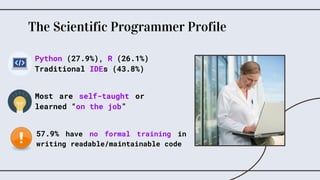
The Scientific Programmer Profile
57.9% have no formal training in
writing readable/maintainable code
Most are self-taught or
learned “on the job”
Python (27.9%), R (26.1%)
Traditional IDEs (43.8%)
Documentation and comments are the
most common strategies
49.1% never use code quality tools
Increasing reliance on AI tools like ChatGPT
Readability: Practices & Challenges
Code Comprehension
Barriers
Insufficient comments
No documentation
Poor naming conventions
Messy structure
Hardcoded values
Code Comprehension
Practices
100% of scientists agree:
Readable code is essential for reproducible research
100% of participants agreed that
good naming is key to readability
56% of participants sometimes face
misunderstandings due to naming
Naming Matters
Identifier Naming
Challenges
Names too short or cryptic
Inconsistent styles
Doesn’t reflect its purpose
Generic names
Names that are too similar
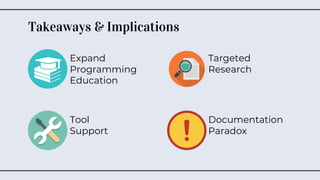
Targeted
Research
Expand
Programming
Education
Documentation
Paradox
Tool
Support
Takeaways & Implications
Thanks!
Alyssia Chen, Carol Wong, Bonita Sharif, Anthony Peruma
scan for preprint

Exploring Code Comprehension in Scientific Programming: Preliminary Insights from Research Scientists

  • 1.
    Exploring Code Comprehension inScientific Programming: Preliminary Insights from Research Scientists Alyssia Chen, Carol Wong, Bonita Sharif, Anthony Peruma The 33rd IEEE/ACM International Conference on Program Comprehension April 27 - 28, 2025 | Ottawa, Ontario, Canada
  • 2.
    Scientific Software IsVital to Modern Research 30-35% of scientists' time spent coding [1,2] Domain experts first, programmers second Unique environments create new challenges Limited research on scientific code comprehension [1] J. E. Hannay, C. MacLeod, J. Singer, H. P. Langtangen, D. Pfahl and G. Wilson, "How do scientists develop and use scientific software?," 2009 ICSE Workshop on Software Engineering for Computational Science and Engineering, 2009 [2] Prakash Prabhu, Thomas B. Jablin, Arun Raman, Yun Zhang, Jialu Huang, Hanjun Kim, Nick P. Johnson, Feng Liu, Soumyadeep Ghosh, Stephen Beard, Taewook Oh, Matthew Zoufaly, David Walker, and David I. August. 2011. A survey of the practice of computational science. In State of the Practice
  • 3.
    Study Objective Their codingbackgrounds Code readability practices Key challenges in understanding code Online survey of 57 research scientists in various disciplines
  • 4.
    The Scientific ProgrammerProfile 57.9% have no formal training in writing readable/maintainable code Most are self-taught or learned “on the job” Python (27.9%), R (26.1%) Traditional IDEs (43.8%)
  • 5.
    Documentation and commentsare the most common strategies 49.1% never use code quality tools Increasing reliance on AI tools like ChatGPT Readability: Practices & Challenges Code Comprehension Barriers Insufficient comments No documentation Poor naming conventions Messy structure Hardcoded values Code Comprehension Practices 100% of scientists agree: Readable code is essential for reproducible research
  • 6.
    100% of participantsagreed that good naming is key to readability 56% of participants sometimes face misunderstandings due to naming Naming Matters Identifier Naming Challenges Names too short or cryptic Inconsistent styles Doesn’t reflect its purpose Generic names Names that are too similar
  • 7.
  • 8.
    Thanks! Alyssia Chen, CarolWong, Bonita Sharif, Anthony Peruma scan for preprint