I empower WordPress developers.
@hellofromtonya
@KnowTheCodePro
Makes Our Jobs Easier
Tonya Mork
This session will cover…
➡ Identify why the practice of “code quality” exists.
What problem is it trying to solve?

➡ Frame the session around you.

➡ Open your mind to how building to maximize quality
makes your job easier.

➡ Give you easy-to-go-implement-right-now strategies.
Code quality is a big topic
My approach is to give you strategies that
immediately increase the quality of your code.
?Why does the
practice of “code quality”
exist?
What problem does it seek to solve?
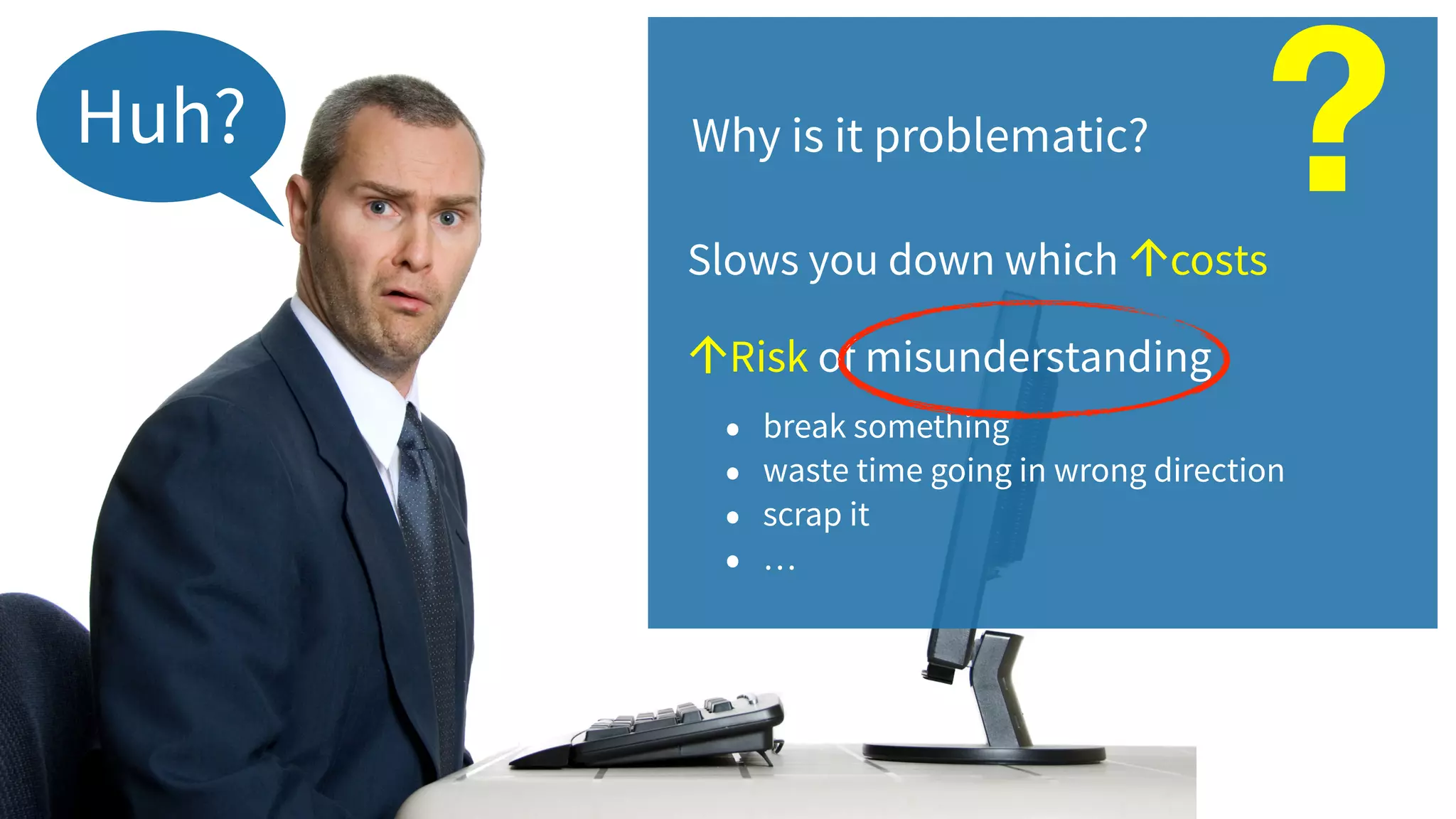
Why is it problematic?Huh?
↑Risk of misunderstanding
?Slows you down which ↑costs
• break something
• waste time going in wrong direction
• scrap it
• …
Standards
Linters
Design Patterns
Better Practices
Mess Detectors
Sniffers
Measure
compliance
Define how
to build
Code quality is all about…
Building code
to maximize
human understanding.
The programming languages and computers
don’t care if your code is human readable.
Did you know? ?
function f471(){$a=f982(); return !empty($a) ? $a->p1 : false;}
function get_the_ID() {
$post = get_post();
return ! empty( $post ) ? $post->ID : false;
}
Uglified code is hard for a human to
read and understand.
But….it’ll run.
!function(t){"use strict";t.component("alert",{defaults:{fade:!0,duration:
200,trigger:".uk-alert-close"},boot:function(){t.$html.on("click.alert.uikit","[data-
uk-alert]",function(i){var o=t.$(this);if(!o.data("alert")){var
e=t.alert(o,t.Utils.options(o.attr("data-uk-alert")));t.$
(i.target).is(e.options.trigger)&&(i.preventDefault(),e.close())}})},init:function()
{var t=this;this.on("click",this.options.trigger,function(i)
{i.preventDefault(),t.close()})},close:function(){var
t=this.trigger("close.uk.alert"),i=function()
{this.trigger("closed.uk.alert").remove()}.bind(this);this.options.fade?
t.css("overflow","hidden").css("max-height",t.height()).animate({height:0,opacity:
0,"padding-top":0,"padding-bottom":0,"margin-top":0,"margin-bottom":
0},this.options.duration,i):i()}})}(UIkit);
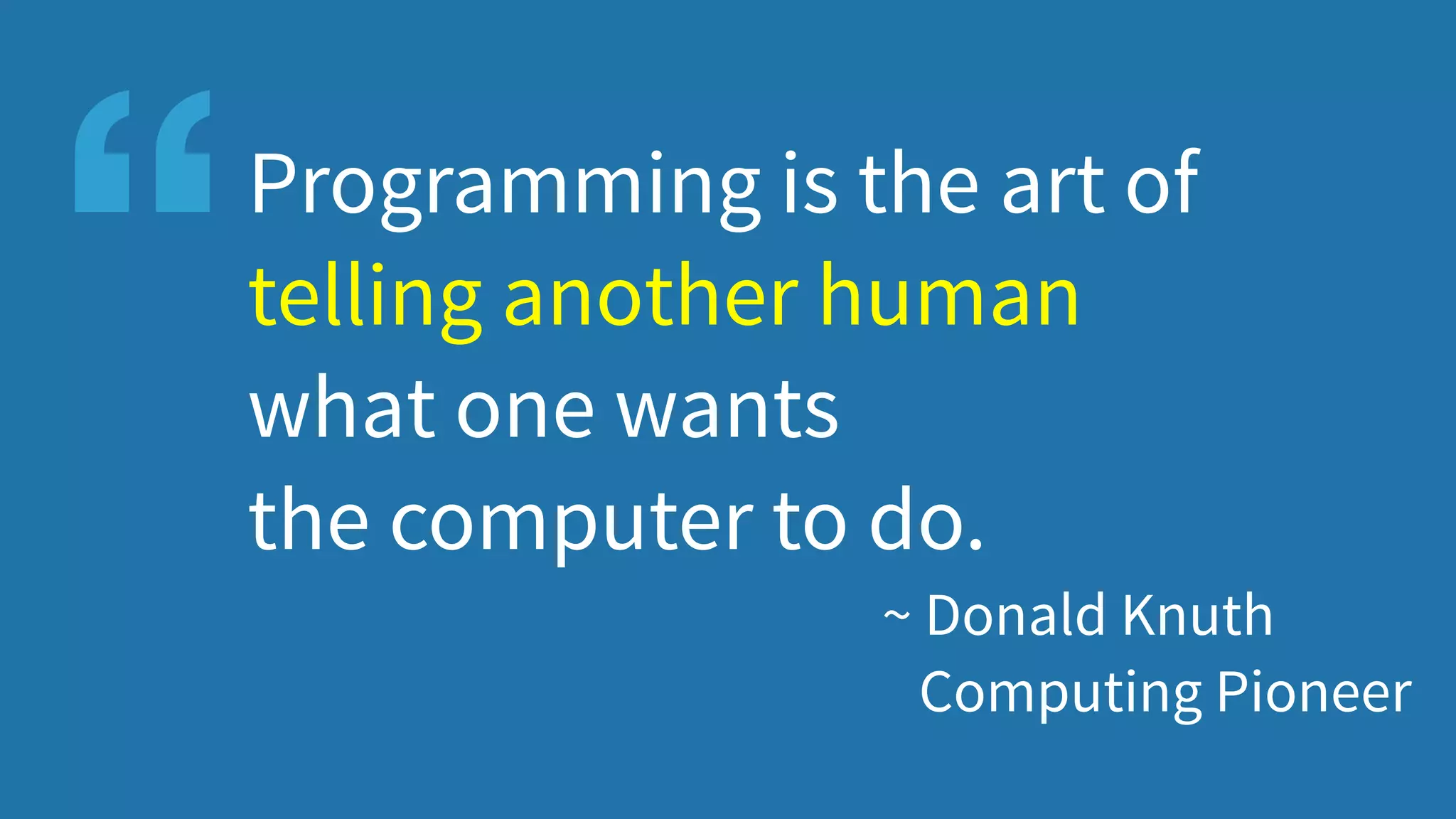
Programming is the art of
telling another human
what one wants
the computer to do.
~ Donald Knuth
Computing Pioneer
“
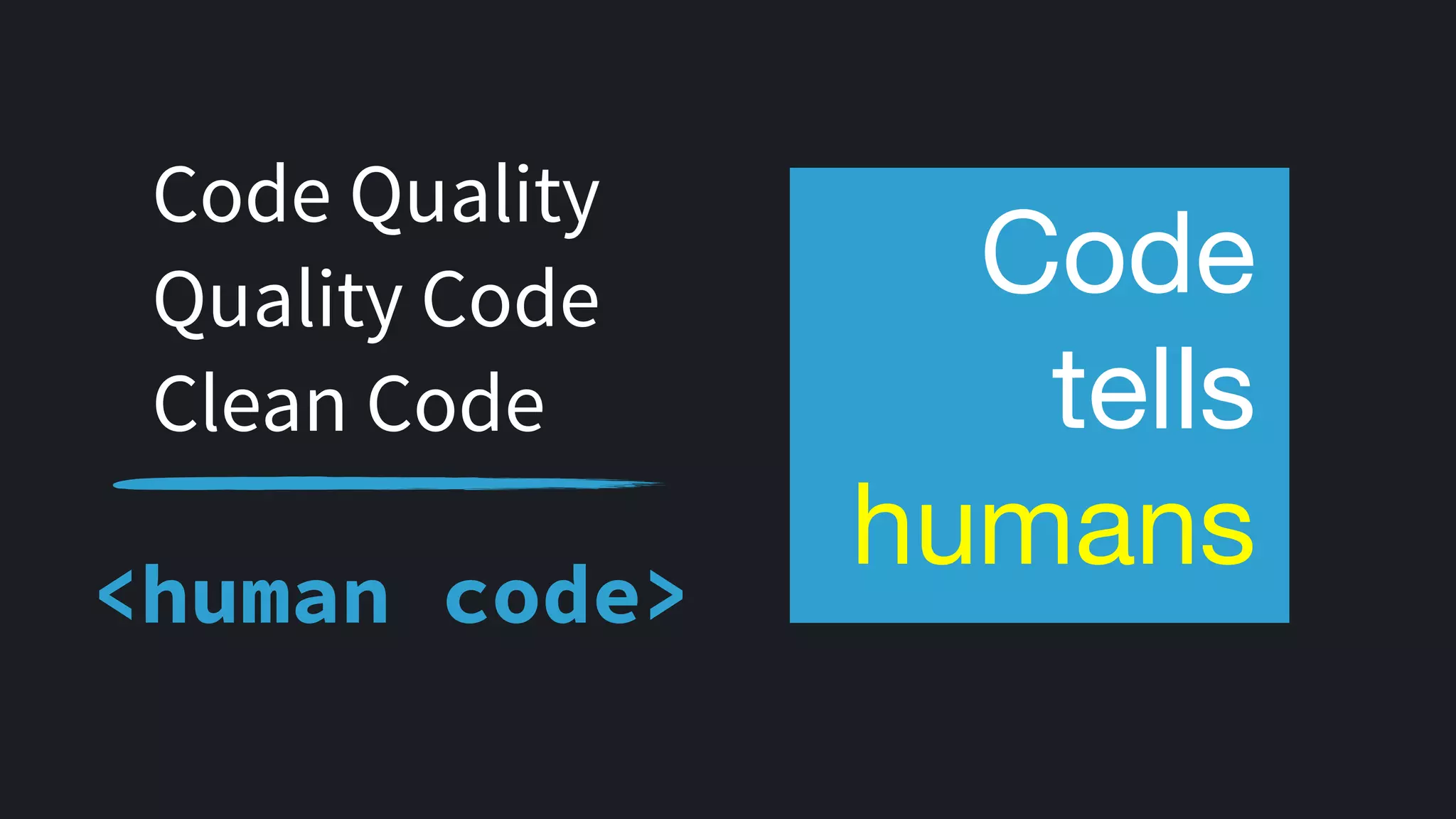
Code Quality
Quality Code
Clean Code
<human code>
Code

tells
humans
of building code that minimizes misunderstandings is:
anyone (including you)
can jump into the project,
quickly figure out what’s going on…and why,
and then get to work.
The Result
Makes your job easier.
The Benefits
How does it make your job easier?
• Easier to sniff out problems

• Easier to reuse on the next project

• Easier to avoid propagating bugs or structural issues

• Easier to extend, remove, reconfigure, and change

• Easier to support and fix without the fear of breaking something else
Benefits for the business of code
• Easier to onboard new contributors or teammates

• Reduce costs

• Reduce risks
How do you build code
to tell humans?
?
HEY, ________
should happen here.
What
makes code easier for
humans?
?
Consider…
Code is readable.
#1
Code is understandable.
#2
What
makes code easier to
read and understand?
?
Keys to reading
✓ Presentation
✓ Structure
Imagine trying to read a 300+ page book with no paragraphs.
You are reading this book for two reasons.First, you are a programmer.Second, you want to be a better programmer.Good.We need better
programmers.This is a book about good programming.It is filled with code.We are going to look at code from every different direction.
We’ll look down at it from the top, up at it from the bottom, and through it from the inside out.By the time we are done, we’re going to
know a lot about code.What’s more, we’ll be able to tell the difference between good code and bad code.We’ll know how to write good
code.And we’ll know how to transform bad code into good code.There Will Be CodeOne might argue that a book about code is somehow behind
the times—that code is no longer the issue; that we should be concerned about models and requirements instead. Indeed some have
suggested that we are close to the end of code.That soon as code will be generated instead of written.That programmers simply won’t be
needed because business people will generate programs from specifications.Nonsense!We will never be rid of code,because code represents
the details of the requirements.At some level those details cannot be ignored or abstracted; they have to be specified. And specifying
requirements in such detail that a machine can execute them in programming.Such a specification is code.I expect that the level of
abstraction of our languages will continue to increate.I also expect that the number of domain-specific languages will continue to
grow.This will be a good thing.But it will not eliminate code.Indeed,all the specifications written in these higher level and domain-
specific language will be code!It will still need to be rigorous, accurate, and so formal and detailed that a machine can understand and
execute it.The folks who think that code will one day disappear are like mathematicians who hope one day to discover a mathematics that
does not have to be formal.They are hoping that one day we will discover a way to create machines that can do what we want rather than
what we say.These machines will have to be able to understand us so well that they can translate vaguely specified needs into perfectly
executing programs that precisely meet those needs.This will never happen.Not even humans,with all their intuition and creativity,have
been able to create successful systems from the vague feelings of their customers.Indeed, if the discipline of requirements
specification has taught us anything,it is that well-specified requirements are as formal as code and can act as executable tests of
that code!Remember that code is really the language in which we ultimately express the requirements.We may create languages that are
closer to the requirements.We may create tools that help us parse and assemble those requirements into formal structures.But we will
never eliminate necessary precision—so there will always be code.Bad CodeI was recently reading the preface of Kent Beck’s book Imple…
Clean Code: A Handbook of Agile Software Craftsmanship
by Robert C. Martin
Keys to reading
✓ Presentation
✓ Structure
✓ Format and code style
✓ Naming conventions
✓ Organization
✓ Consistency
Keys to understanding
✓ Clear communication
✓ Tell what’s going on and why
✓ Small building blocks…think LEGOs
Keys to understanding
✓ Clear communication
✓ Tell what’s going on and why
✓ Small building blocks…think LEGOs
✓ Singular….one thing
✓ Code does what it says it will do…every single time
✓ Relatable for us to comprehend…experiences and skill level
Strategies to build

<human code>
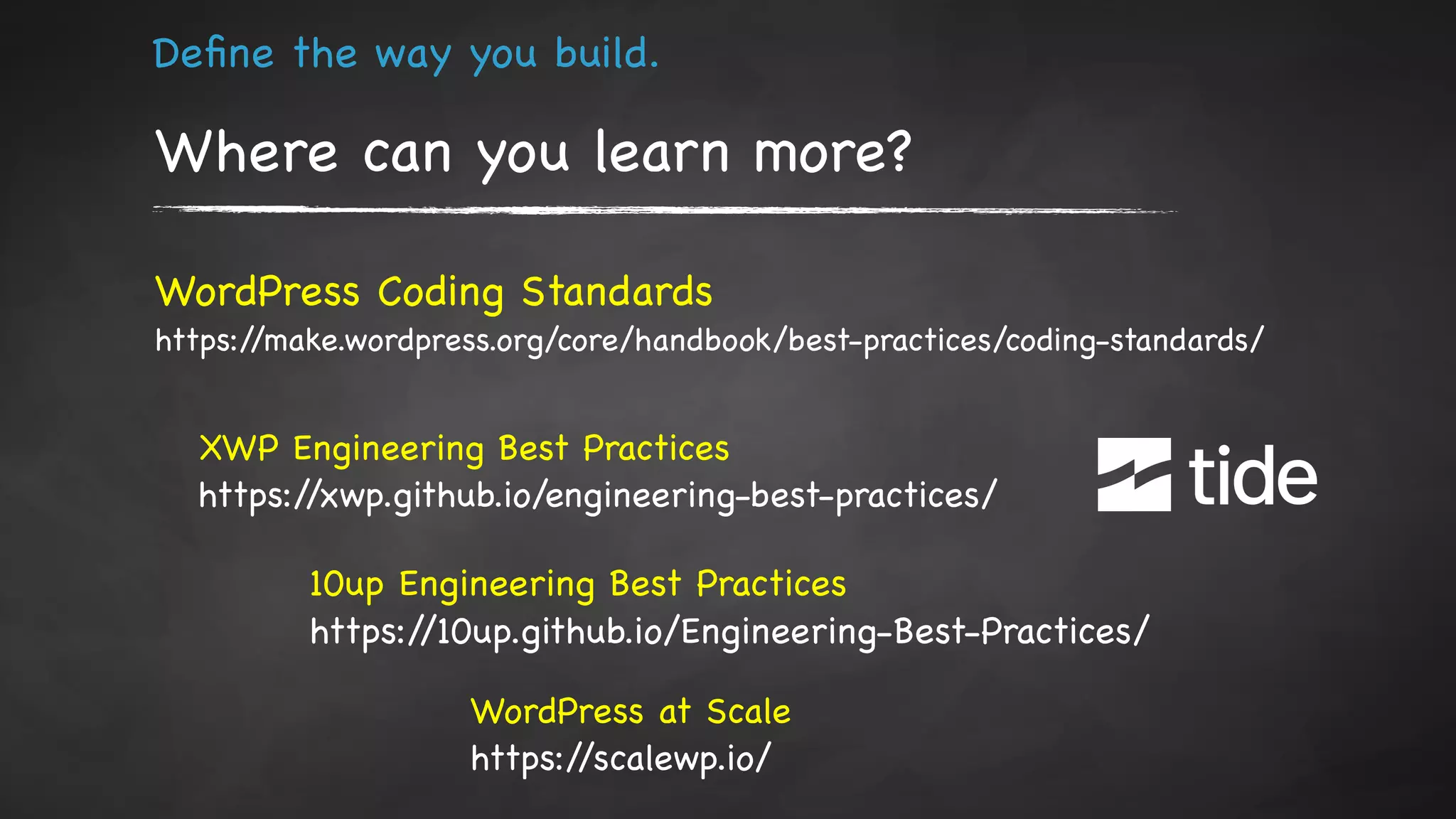
Define the way you build.
Becomes your standard, process, and best
practices.
Consistently follow it.
Validate code to it.
<human code> Strategy
Use community coding standards and best practices.
My Advice
✓ Makes it easier to onboard

✓ Makes it easier for you to reuse community
components, snippets, processes, tooling, practices, etc.

✓ Increases quality in the community and our ecosystem
Define the way you build.
Where can you learn more?
WordPress Coding Standards

https://make.wordpress.org/core/handbook/best-practices/coding-standards/
WordPress at Scale

https://scalewp.io/
XWP Engineering Best Practices

https://xwp.github.io/engineering-best-practices/
10up Engineering Best Practices

https://10up.github.io/Engineering-Best-Practices/
Code Style
<human code> Strategy
Driver of human readable code.
function get_the_ID() {
$post = get_post();
return ! empty( $post ) ? $post->ID : false;
}
function get_the_ID() {
$post = get_post();
return ! empty( $post )
? $post->ID
: false;
}
function get_the_ID() {
$post = get_post();
return !empty($post)
? $post->ID
: false;
}
function get_the_ID()
{
$post = get_post();
return !empty($post)
? $post->ID
: false;
}
Following WPCS:
Your own:
function get_the_ID() {
$post = get_post();
return ! empty( $post )
? $post->ID
: false;
}
One expected behavior

for a given set of conditions.
<human code> Strategy
Name to tell.
<human code> Strategy
Code

tells
humans
Driver of human readable code.
Name to tell.

๏Drives your design

๏Forces you to define what each element
does

๏Forces you to think about the human side
<human code> Strategy
I often hear:

Hey Tonya, naming is hard.
• Expected behavior is not well defined or known.

• Not sure of the set of conditions.

• Not sure what the value is.

• It’s doing too much.
If you’re having a difficult time naming,

that’s a clue….
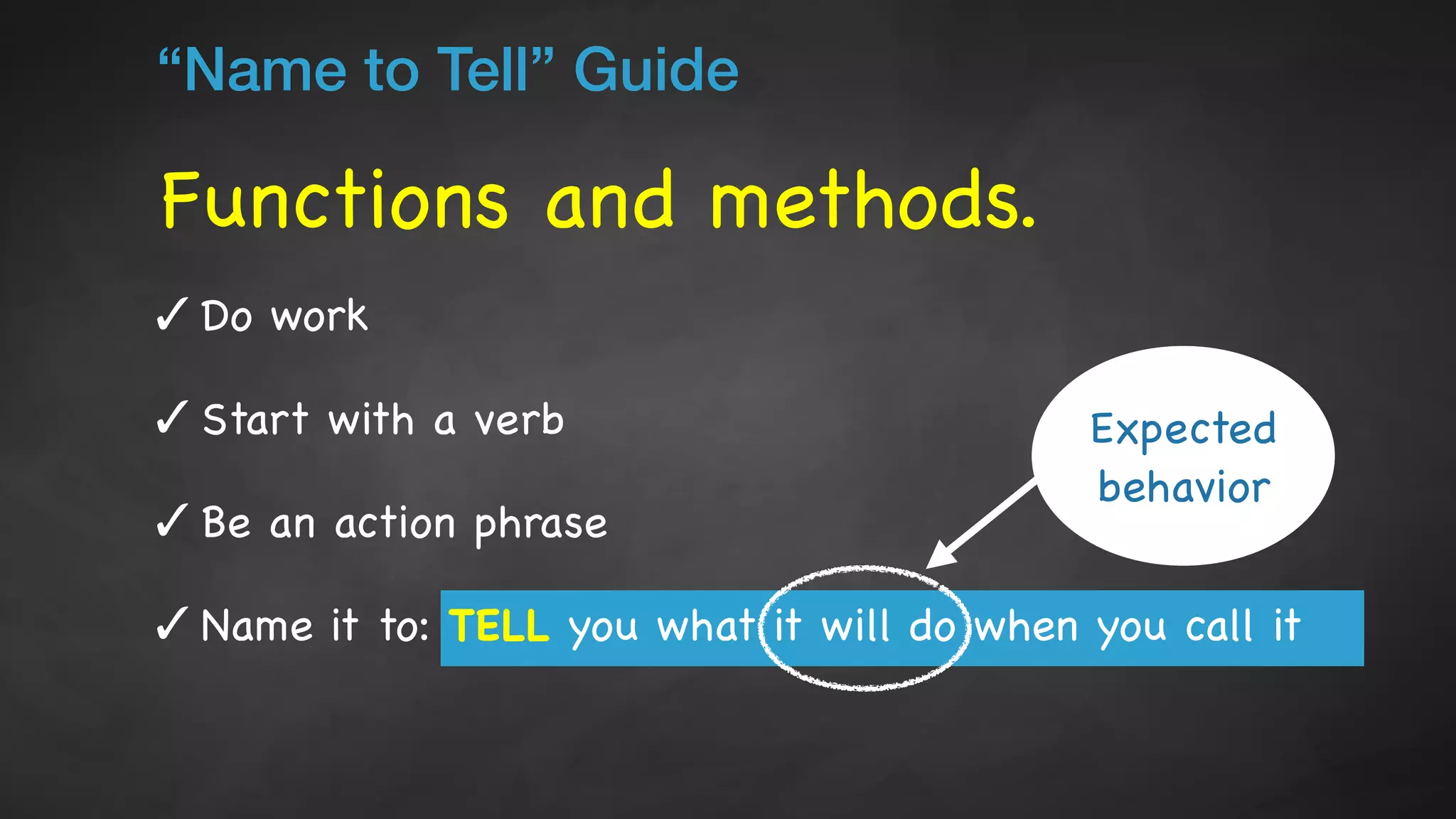
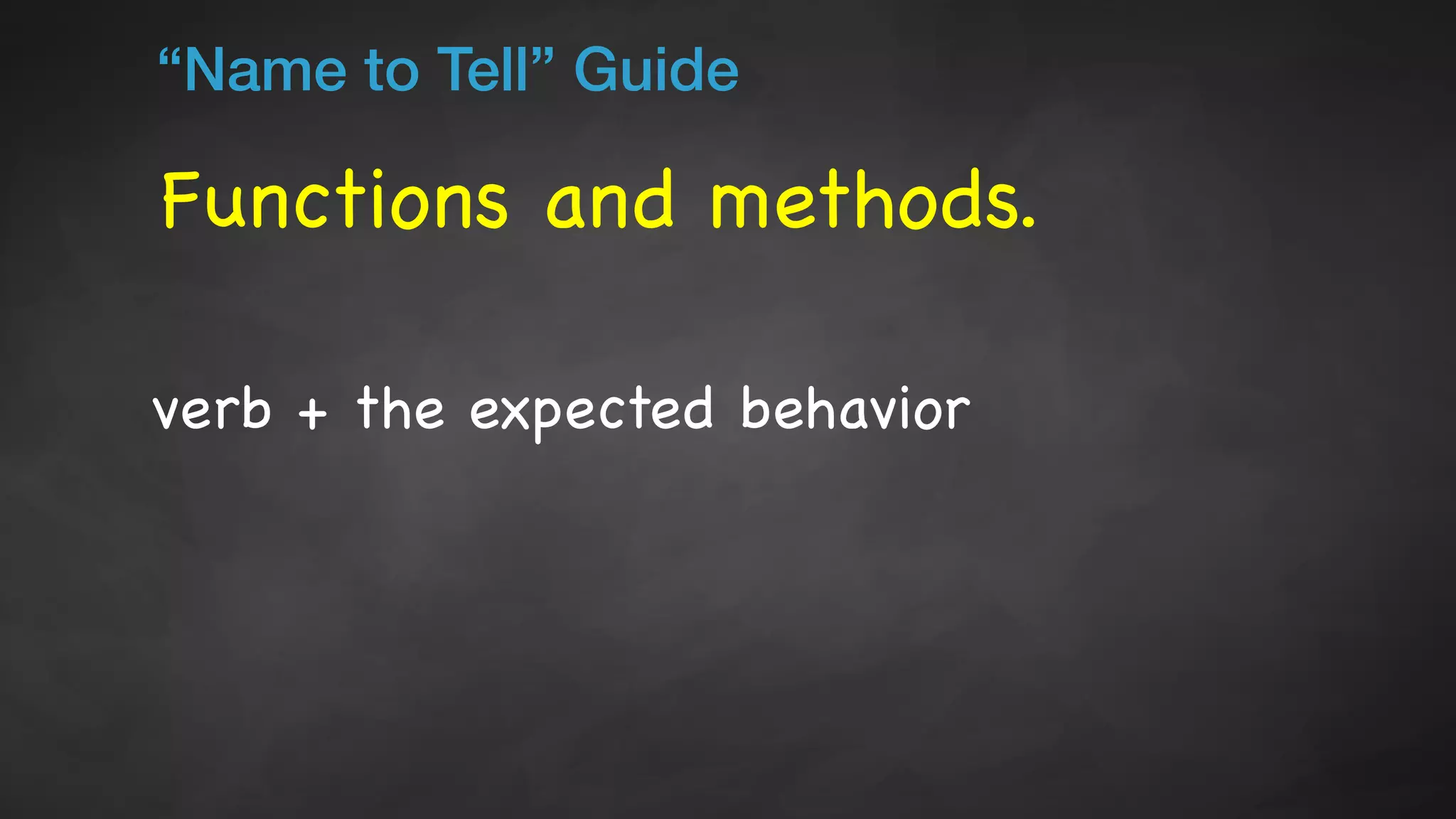
Functions and methods.
“Name to Tell” Guide
✓ Do work

✓ Start with a verb

✓ Be an action phrase

✓ Name it to: TELL you what it will do when you call it
Expected
behavior
Functions and methods.
“Name to Tell” Guide
Starting verbs:

• State checker: is, does, has, did, doing
• Get: get, fetch, open

• Write: set, update, put

• Others: count, enroll, render, parse,
enqueue, process, add, remove
Functions and methods.
“Name to Tell” Guide
verb + the expected behavior
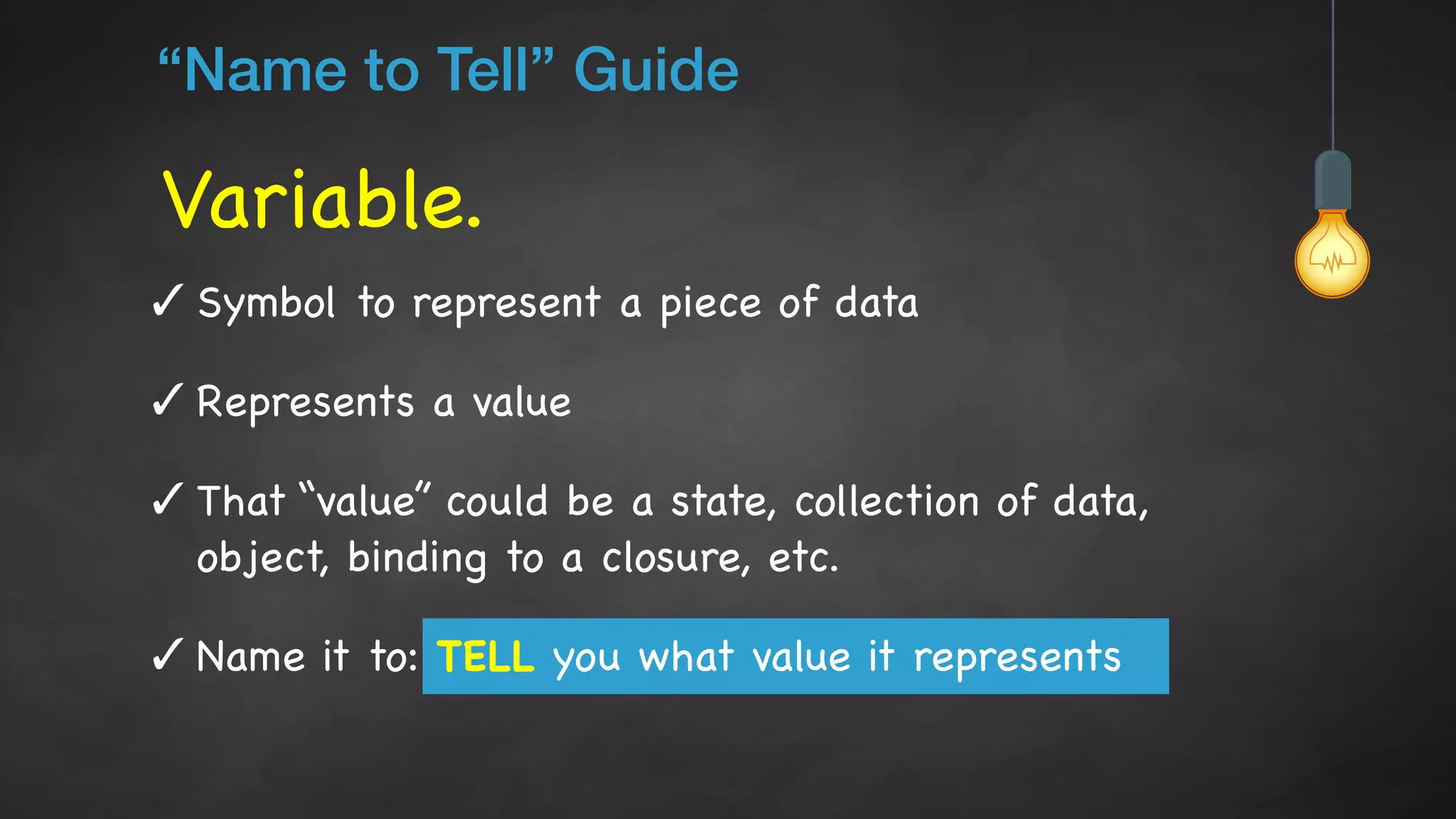
Variable.
“Name to Tell” Guide
✓ Symbol to represent a piece of data

✓ Represents a value

✓ That “value” could be a state, collection of data,
object, binding to a closure, etc.

✓ Name it to: TELL you what value it represents
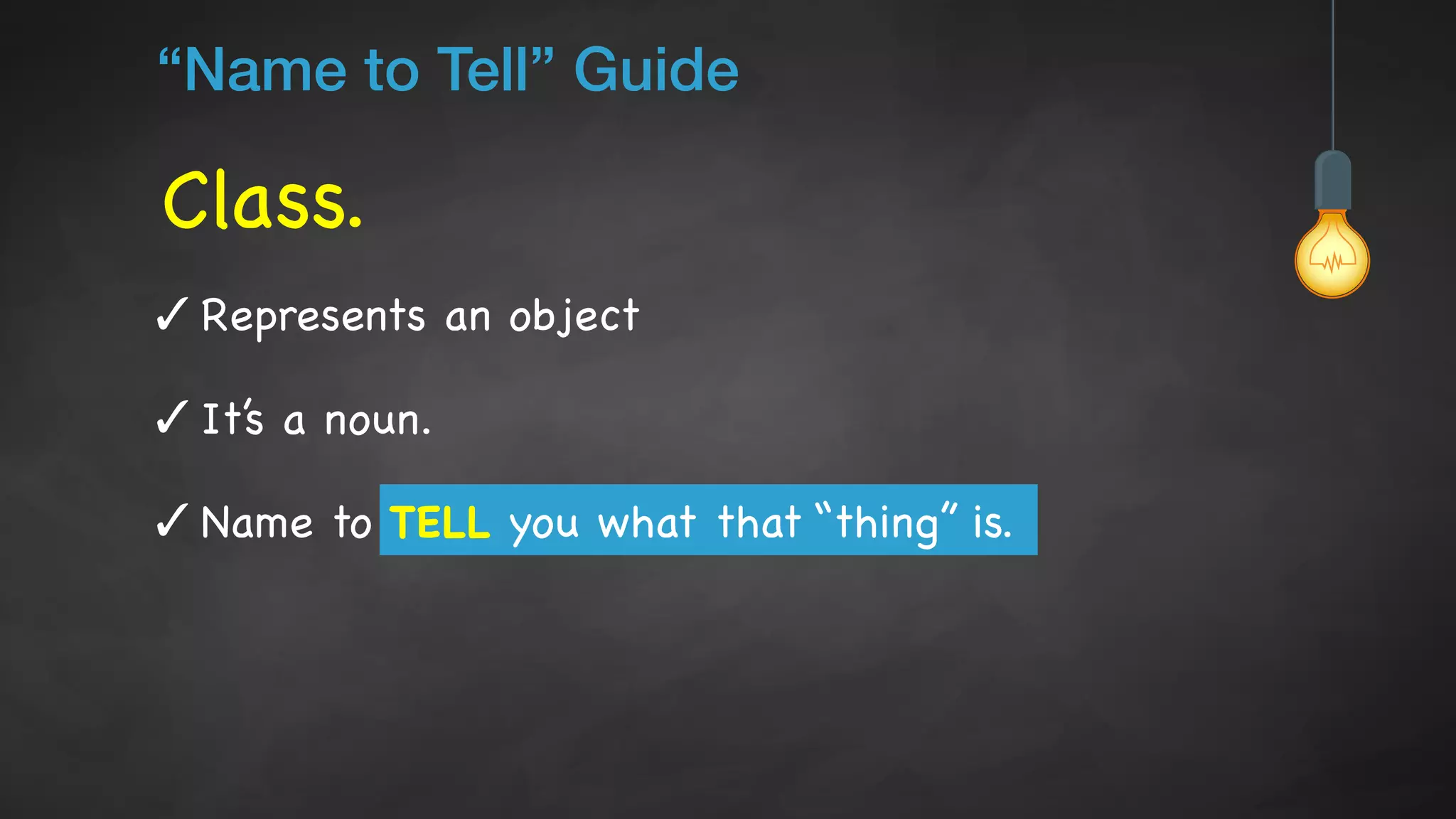
Class.
“Name to Tell” Guide
✓ Represents an object

✓ It’s a noun.

✓ Name to TELL you what that “thing” is.
The more clear the name, 

the greater the understanding.
<human code> Strategy
The less risk of misunderstandings.
Done processing? Bail out.
<human code> Strategy
When the conditions
are not right, stop.
Bail Out Strategy Dos and Don’ts
Don’t wrap your processing code inside a conditional's
code block when nothing else will happen.

Do - invert it into a guard clause.
function strip_fragment_from_url( $url ) {
$parsed_url = @parse_url( $url );
if ( ! empty( $parsed_url['host'] ) ) {
$url = $parsed_url['scheme'] . '://' . $parsed_url['host'];
if ( ! empty( $parsed_url['port'] ) ) {
$url .= ':' . $parsed_url['port'];
}
if ( ! empty( $parsed_url['path'] ) ) {
$url .= $parsed_url['path'];
}
if ( ! empty( $parsed_url['query'] ) ) {
$url .= '?' . $parsed_url['query'];
}
}
return $url;
}
The business logic
Bail Out Strategy Examplefunction strip_fragment_from_url( $url ) {
$parsed_url = @parse_url( $url );
if ( empty( $parsed_url['host'] ) ) {
return $url;
}
$url = $parsed_url['scheme'] . '://' . $parsed_url['host'];
if ( ! empty( $parsed_url['port'] ) ) {
$url .= ':' . $parsed_url['port'];
}
if ( ! empty( $parsed_url['path'] ) ) {
$url .= $parsed_url['path'];
}
if ( ! empty( $parsed_url['query'] ) ) {
$url .= '?' . $parsed_url['query'];
}
return $url;
}
Guard clause
Simplify decision making.
<human code> Strategy
Tell us what the decision is.
Focus us on the details of the decision
Focus on the functionality.
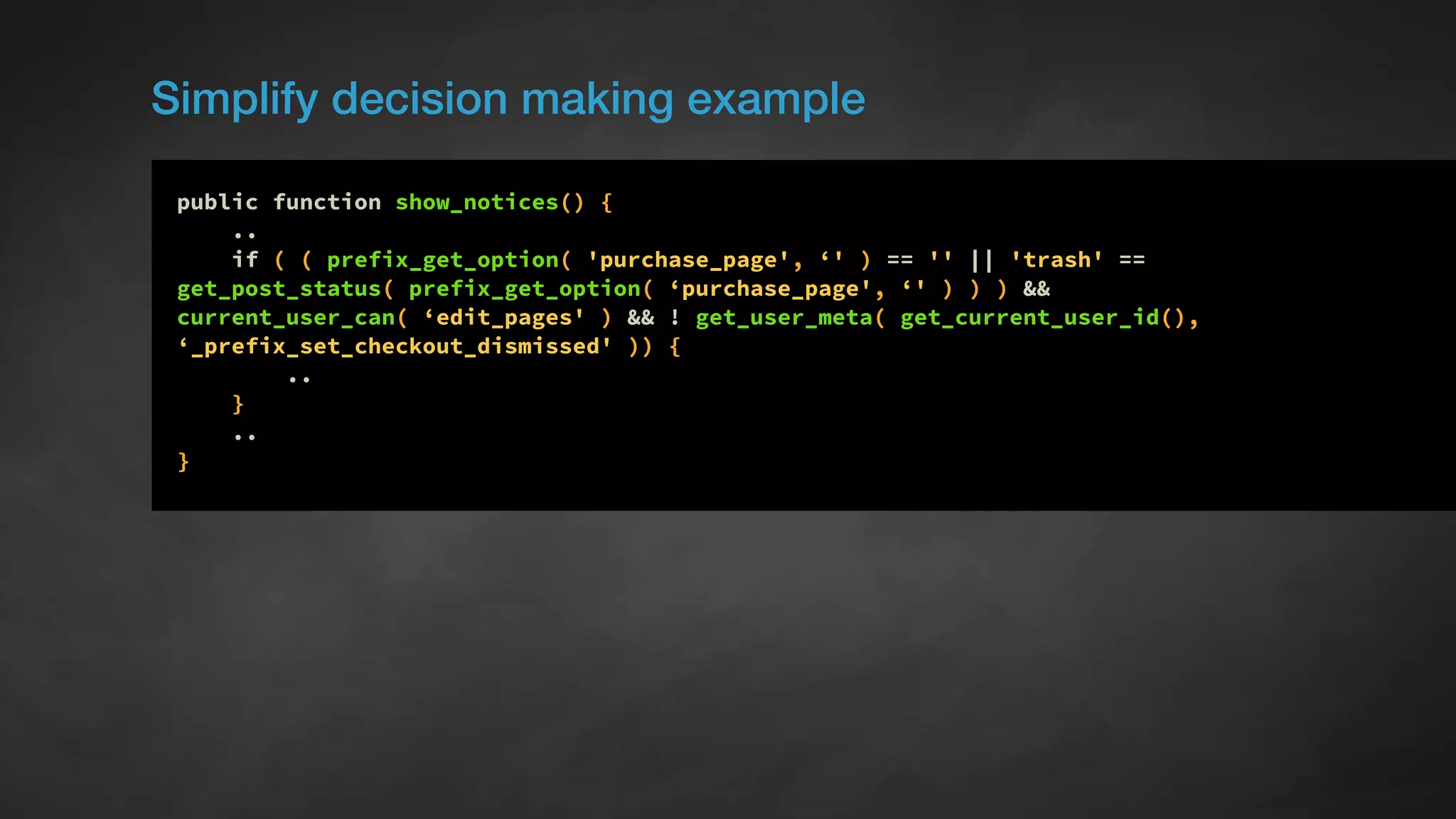
Simplify decision making example
public function show_notices() {
..
if ( ( prefix_get_option( 'purchase_page', ‘' ) == '' || 'trash' ==
get_post_status( prefix_get_option( ‘purchase_page', ‘' ) ) ) &&
current_user_can( ‘edit_pages' ) && ! get_user_meta( get_current_user_id(),
‘_prefix_set_checkout_dismissed' )) {
..
}
..
}
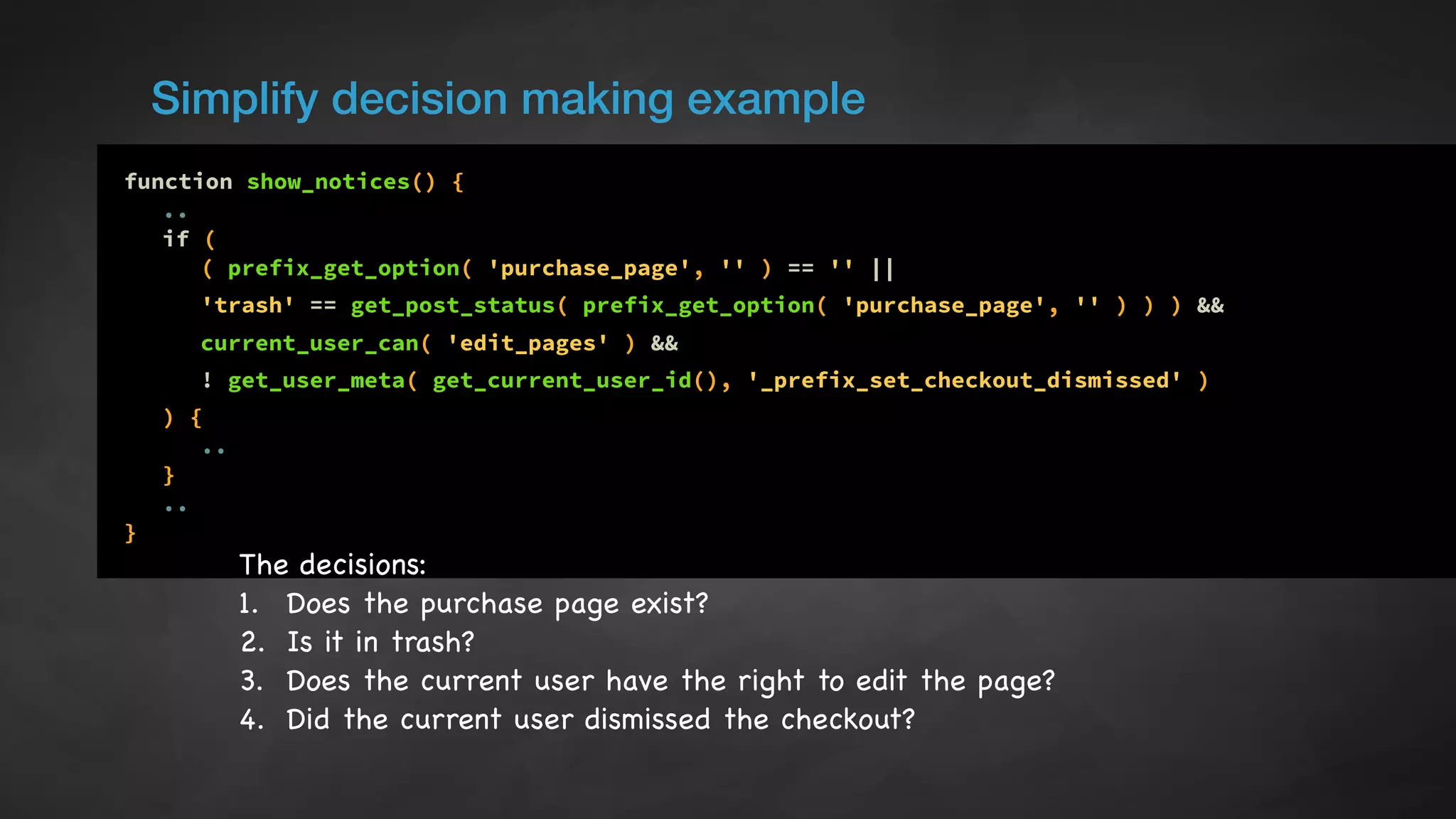
Simplify decision making example
function show_notices() {
..
if (
( prefix_get_option( 'purchase_page', '' ) == '' ||
'trash' == get_post_status( prefix_get_option( 'purchase_page', '' ) ) ) &&
current_user_can( 'edit_pages' ) &&
! get_user_meta( get_current_user_id(), '_prefix_set_checkout_dismissed' )
) {
..
}
..
}
The decisions:

1. Does the purchase page exist?

2. Is it in trash?

3. Does the current user have the right to edit the page?

4. Did the current user dismissed the checkout?
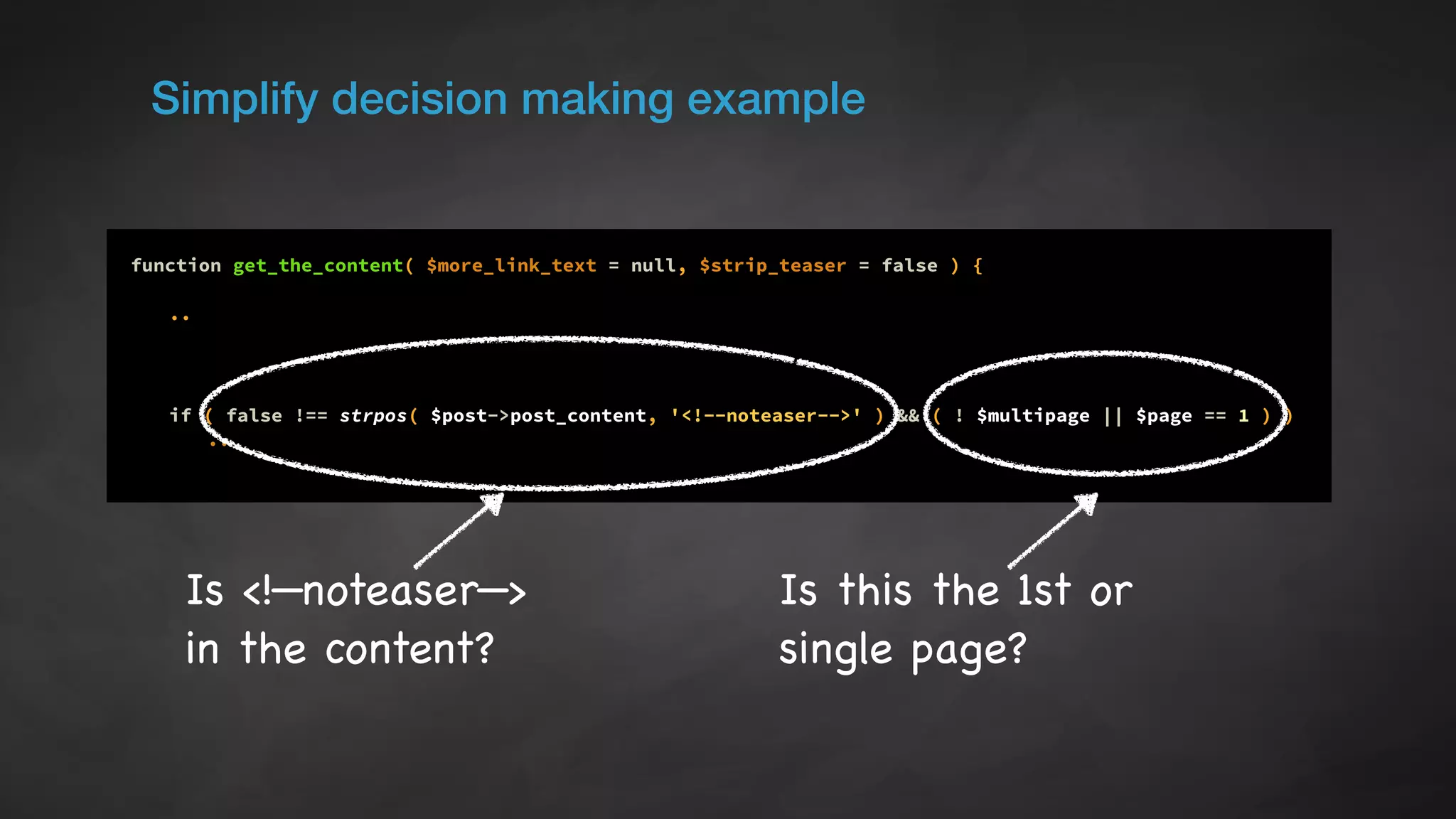
Simplify decision making example
function get_the_content( $more_link_text = null, $strip_teaser = false ) {
..
if ( false !== strpos( $post->post_content, '<!--noteaser-->' ) && ( ! $multipage || $page == 1 ) )
..
Is <!—noteaser—>
in the content?
Is this the 1st or
single page?
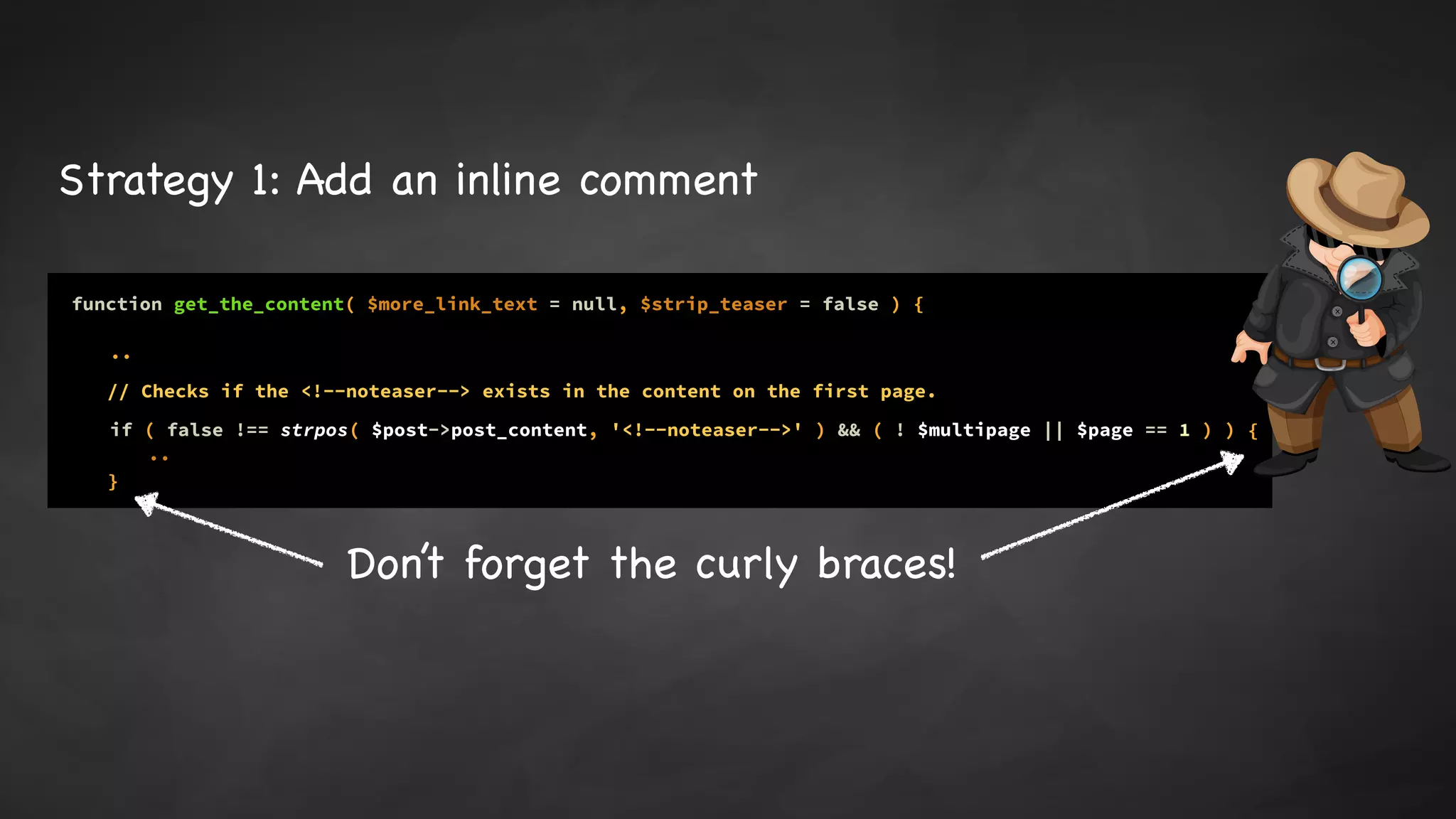
function get_the_content( $more_link_text = null, $strip_teaser = false ) {
..
if ( false !== strpos( $post->post_content, '<!--noteaser-->' ) && ( ! $multipage || $page == 1 ) )
..
// Checks if the <!--noteaser--> exists in the content on the first page.
{
}
Strategy 1: Add an inline comment
Don’t forget the curly braces!
function get_the_content( $more_link_text = null, $strip_teaser = false ) {
..
if ( false !== strpos( $post->post_content, '<!--noteaser-->' ) && ( ! $multipage || $page == 1 ) )
..
{
}
function _has_noteaser_in_content( $post ) {
global $multipage, $page;
if ( $multipage && $page > 1 ) {
return false;
}
return false !== strpos( $post->post_content, '<!--noteaser-->' );
}
( _has_noteaser_in_content( $post ) ) {
Strategy 2: Abstract
Focuses you on the
decision. Why? To keep
you focused on
get_the_content().
A lot more strategies
<human code> Strategy
Let’s Review the Key
Take Aways
Code quality is all about…
Building code
to maximize
human understanding.
Keys to reading
✓ Presentation
✓ Structure
✓ Format and code style
✓ Naming conventions
✓ Organization
✓ Consistency
Keys to understanding
✓ Clear communication
✓ Tell what’s going on and why
✓ Small building blocks…think LEGOs
✓ Singular….one thing
✓ Code does what it says it will do…every single time
✓ Relatable for us to comprehend…experiences and skill level
Code

tells
humans
human
readable
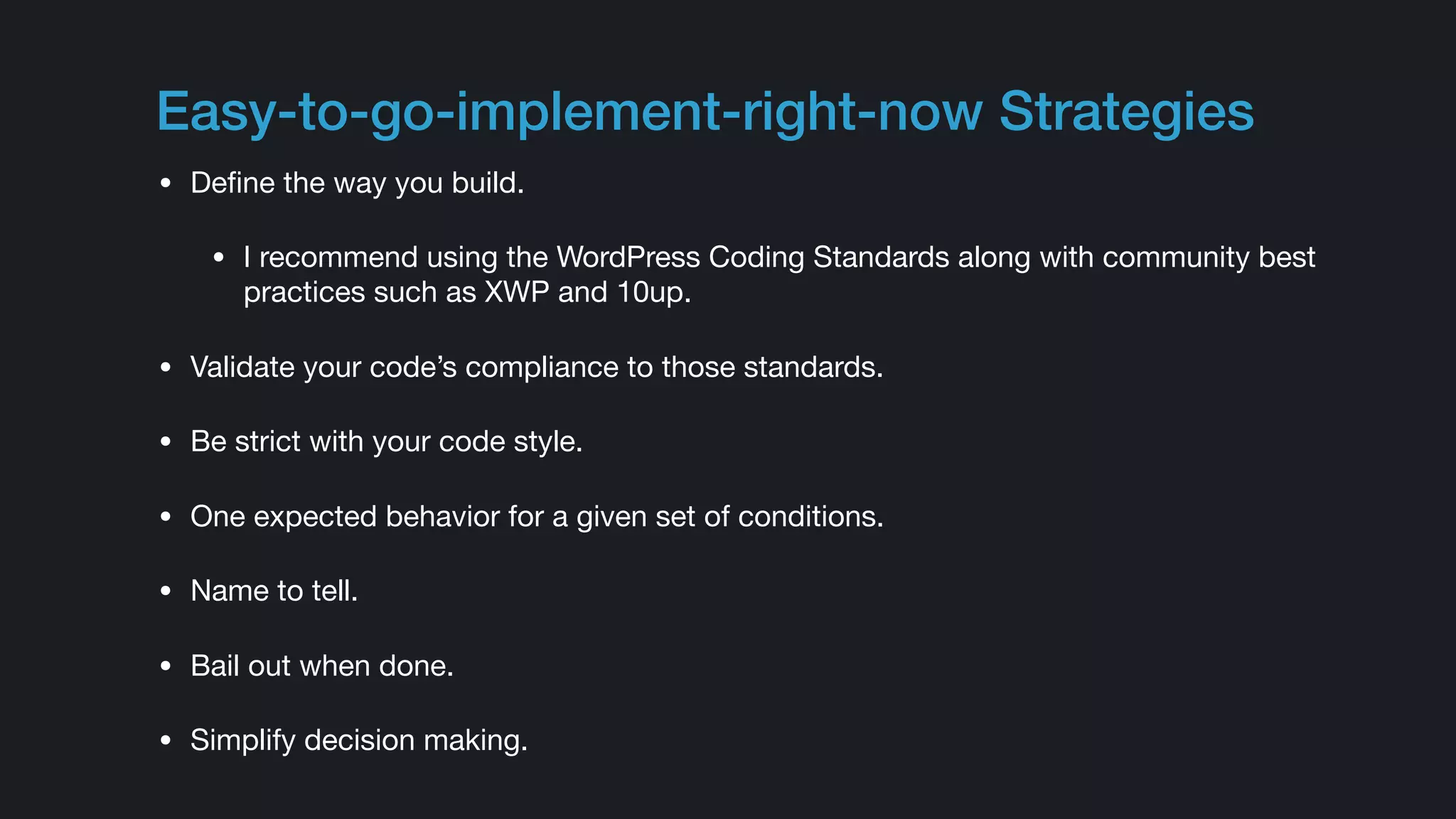
Easy-to-go-implement-right-now Strategies
• Define the way you build.

• I recommend using the WordPress Coding Standards along with community best
practices such as XWP and 10up.

• Validate your code’s compliance to those standards.

• Be strict with your code style.

• One expected behavior for a given set of conditions.

• Name to tell.

• Bail out when done.

• Simplify decision making.
Clues
• If you’re having trouble:

• Identifying the expected behavior or the given set of
conditions

• Naming

• Inline comments
Building <human code>, makes your
code more human readable, lowering
the risk of misunderstandings.
It makes your job easier.
Want more?
Get my Refactoring Tweaks book and workbook bundle 

for free on Leanpub.

https://leanpub.com/b/refactoring-tweaks-bundle.
@hellofromtonya
https://KnowTheCode.io

Code Quality Makes Your Job Easier

  • 1.
    I empower WordPressdevelopers. @hellofromtonya @KnowTheCodePro Makes Our Jobs Easier Tonya Mork
  • 2.
    This session willcover… ➡ Identify why the practice of “code quality” exists. What problem is it trying to solve? ➡ Frame the session around you. ➡ Open your mind to how building to maximize quality makes your job easier. ➡ Give you easy-to-go-implement-right-now strategies.
  • 3.
    Code quality isa big topic My approach is to give you strategies that immediately increase the quality of your code.
  • 4.
    ?Why does the practiceof “code quality” exist? What problem does it seek to solve?
  • 5.
    Why is itproblematic?Huh? ↑Risk of misunderstanding ?Slows you down which ↑costs • break something • waste time going in wrong direction • scrap it • …
  • 6.
    Standards Linters Design Patterns Better Practices MessDetectors Sniffers Measure compliance Define how to build
  • 7.
    Code quality isall about… Building code to maximize human understanding.
  • 8.
    The programming languagesand computers don’t care if your code is human readable. Did you know? ? function f471(){$a=f982(); return !empty($a) ? $a->p1 : false;} function get_the_ID() { $post = get_post(); return ! empty( $post ) ? $post->ID : false; }
  • 9.
    Uglified code ishard for a human to read and understand. But….it’ll run. !function(t){"use strict";t.component("alert",{defaults:{fade:!0,duration: 200,trigger:".uk-alert-close"},boot:function(){t.$html.on("click.alert.uikit","[data- uk-alert]",function(i){var o=t.$(this);if(!o.data("alert")){var e=t.alert(o,t.Utils.options(o.attr("data-uk-alert")));t.$ (i.target).is(e.options.trigger)&&(i.preventDefault(),e.close())}})},init:function() {var t=this;this.on("click",this.options.trigger,function(i) {i.preventDefault(),t.close()})},close:function(){var t=this.trigger("close.uk.alert"),i=function() {this.trigger("closed.uk.alert").remove()}.bind(this);this.options.fade? t.css("overflow","hidden").css("max-height",t.height()).animate({height:0,opacity: 0,"padding-top":0,"padding-bottom":0,"margin-top":0,"margin-bottom": 0},this.options.duration,i):i()}})}(UIkit);
  • 10.
    Programming is theart of telling another human what one wants the computer to do. ~ Donald Knuth Computing Pioneer “
  • 11.
    Code Quality Quality Code CleanCode <human code> Code tells humans
  • 12.
    of building codethat minimizes misunderstandings is: anyone (including you) can jump into the project, quickly figure out what’s going on…and why, and then get to work. The Result
  • 13.
    Makes your jobeasier. The Benefits
  • 14.
    How does itmake your job easier? • Easier to sniff out problems • Easier to reuse on the next project • Easier to avoid propagating bugs or structural issues • Easier to extend, remove, reconfigure, and change • Easier to support and fix without the fear of breaking something else
  • 16.
    Benefits for thebusiness of code • Easier to onboard new contributors or teammates • Reduce costs • Reduce risks
  • 17.
    How do youbuild code to tell humans? ? HEY, ________ should happen here.
  • 18.
    What makes code easierfor humans? ? Consider…
  • 19.
  • 20.
  • 21.
    What makes code easierto read and understand? ?
  • 22.
    Keys to reading ✓Presentation ✓ Structure
  • 23.
    Imagine trying toread a 300+ page book with no paragraphs. You are reading this book for two reasons.First, you are a programmer.Second, you want to be a better programmer.Good.We need better programmers.This is a book about good programming.It is filled with code.We are going to look at code from every different direction. We’ll look down at it from the top, up at it from the bottom, and through it from the inside out.By the time we are done, we’re going to know a lot about code.What’s more, we’ll be able to tell the difference between good code and bad code.We’ll know how to write good code.And we’ll know how to transform bad code into good code.There Will Be CodeOne might argue that a book about code is somehow behind the times—that code is no longer the issue; that we should be concerned about models and requirements instead. Indeed some have suggested that we are close to the end of code.That soon as code will be generated instead of written.That programmers simply won’t be needed because business people will generate programs from specifications.Nonsense!We will never be rid of code,because code represents the details of the requirements.At some level those details cannot be ignored or abstracted; they have to be specified. And specifying requirements in such detail that a machine can execute them in programming.Such a specification is code.I expect that the level of abstraction of our languages will continue to increate.I also expect that the number of domain-specific languages will continue to grow.This will be a good thing.But it will not eliminate code.Indeed,all the specifications written in these higher level and domain- specific language will be code!It will still need to be rigorous, accurate, and so formal and detailed that a machine can understand and execute it.The folks who think that code will one day disappear are like mathematicians who hope one day to discover a mathematics that does not have to be formal.They are hoping that one day we will discover a way to create machines that can do what we want rather than what we say.These machines will have to be able to understand us so well that they can translate vaguely specified needs into perfectly executing programs that precisely meet those needs.This will never happen.Not even humans,with all their intuition and creativity,have been able to create successful systems from the vague feelings of their customers.Indeed, if the discipline of requirements specification has taught us anything,it is that well-specified requirements are as formal as code and can act as executable tests of that code!Remember that code is really the language in which we ultimately express the requirements.We may create languages that are closer to the requirements.We may create tools that help us parse and assemble those requirements into formal structures.But we will never eliminate necessary precision—so there will always be code.Bad CodeI was recently reading the preface of Kent Beck’s book Imple… Clean Code: A Handbook of Agile Software Craftsmanship by Robert C. Martin
  • 24.
    Keys to reading ✓Presentation ✓ Structure ✓ Format and code style ✓ Naming conventions ✓ Organization ✓ Consistency
  • 25.
    Keys to understanding ✓Clear communication ✓ Tell what’s going on and why ✓ Small building blocks…think LEGOs
  • 27.
    Keys to understanding ✓Clear communication ✓ Tell what’s going on and why ✓ Small building blocks…think LEGOs ✓ Singular….one thing ✓ Code does what it says it will do…every single time ✓ Relatable for us to comprehend…experiences and skill level
  • 28.
  • 29.
    Define the wayyou build. Becomes your standard, process, and best practices. Consistently follow it. Validate code to it. <human code> Strategy
  • 30.
    Use community codingstandards and best practices. My Advice ✓ Makes it easier to onboard ✓ Makes it easier for you to reuse community components, snippets, processes, tooling, practices, etc. ✓ Increases quality in the community and our ecosystem
  • 31.
    Define the wayyou build. Where can you learn more? WordPress Coding Standards https://make.wordpress.org/core/handbook/best-practices/coding-standards/ WordPress at Scale https://scalewp.io/ XWP Engineering Best Practices https://xwp.github.io/engineering-best-practices/ 10up Engineering Best Practices https://10up.github.io/Engineering-Best-Practices/
  • 32.
    Code Style <human code>Strategy Driver of human readable code.
  • 33.
    function get_the_ID() { $post= get_post(); return ! empty( $post ) ? $post->ID : false; } function get_the_ID() { $post = get_post(); return ! empty( $post ) ? $post->ID : false; } function get_the_ID() { $post = get_post(); return !empty($post) ? $post->ID : false; } function get_the_ID() { $post = get_post(); return !empty($post) ? $post->ID : false; } Following WPCS: Your own: function get_the_ID() { $post = get_post(); return ! empty( $post ) ? $post->ID : false; }
  • 34.
    One expected behavior fora given set of conditions. <human code> Strategy
  • 35.
    Name to tell. <humancode> Strategy Code tells humans Driver of human readable code.
  • 36.
    Name to tell. ๏Drivesyour design ๏Forces you to define what each element does ๏Forces you to think about the human side <human code> Strategy
  • 37.
    I often hear: HeyTonya, naming is hard. • Expected behavior is not well defined or known. • Not sure of the set of conditions. • Not sure what the value is. • It’s doing too much. If you’re having a difficult time naming, that’s a clue….
  • 38.
    Functions and methods. “Nameto Tell” Guide ✓ Do work ✓ Start with a verb ✓ Be an action phrase ✓ Name it to: TELL you what it will do when you call it Expected behavior
  • 39.
    Functions and methods. “Nameto Tell” Guide Starting verbs: • State checker: is, does, has, did, doing • Get: get, fetch, open • Write: set, update, put • Others: count, enroll, render, parse, enqueue, process, add, remove
  • 40.
    Functions and methods. “Nameto Tell” Guide verb + the expected behavior
  • 41.
    Variable. “Name to Tell”Guide ✓ Symbol to represent a piece of data ✓ Represents a value ✓ That “value” could be a state, collection of data, object, binding to a closure, etc. ✓ Name it to: TELL you what value it represents
  • 42.
    Class. “Name to Tell”Guide ✓ Represents an object ✓ It’s a noun. ✓ Name to TELL you what that “thing” is.
  • 43.
    The more clearthe name, the greater the understanding. <human code> Strategy The less risk of misunderstandings.
  • 44.
    Done processing? Bailout. <human code> Strategy When the conditions are not right, stop.
  • 45.
    Bail Out StrategyDos and Don’ts Don’t wrap your processing code inside a conditional's code block when nothing else will happen. Do - invert it into a guard clause.
  • 46.
    function strip_fragment_from_url( $url) { $parsed_url = @parse_url( $url ); if ( ! empty( $parsed_url['host'] ) ) { $url = $parsed_url['scheme'] . '://' . $parsed_url['host']; if ( ! empty( $parsed_url['port'] ) ) { $url .= ':' . $parsed_url['port']; } if ( ! empty( $parsed_url['path'] ) ) { $url .= $parsed_url['path']; } if ( ! empty( $parsed_url['query'] ) ) { $url .= '?' . $parsed_url['query']; } } return $url; } The business logic
  • 47.
    Bail Out StrategyExamplefunction strip_fragment_from_url( $url ) { $parsed_url = @parse_url( $url ); if ( empty( $parsed_url['host'] ) ) { return $url; } $url = $parsed_url['scheme'] . '://' . $parsed_url['host']; if ( ! empty( $parsed_url['port'] ) ) { $url .= ':' . $parsed_url['port']; } if ( ! empty( $parsed_url['path'] ) ) { $url .= $parsed_url['path']; } if ( ! empty( $parsed_url['query'] ) ) { $url .= '?' . $parsed_url['query']; } return $url; } Guard clause
  • 48.
    Simplify decision making. <humancode> Strategy Tell us what the decision is. Focus us on the details of the decision Focus on the functionality.
  • 49.
    Simplify decision makingexample public function show_notices() { .. if ( ( prefix_get_option( 'purchase_page', ‘' ) == '' || 'trash' == get_post_status( prefix_get_option( ‘purchase_page', ‘' ) ) ) && current_user_can( ‘edit_pages' ) && ! get_user_meta( get_current_user_id(), ‘_prefix_set_checkout_dismissed' )) { .. } .. }
  • 50.
    Simplify decision makingexample function show_notices() { .. if ( ( prefix_get_option( 'purchase_page', '' ) == '' || 'trash' == get_post_status( prefix_get_option( 'purchase_page', '' ) ) ) && current_user_can( 'edit_pages' ) && ! get_user_meta( get_current_user_id(), '_prefix_set_checkout_dismissed' ) ) { .. } .. } The decisions: 1. Does the purchase page exist? 2. Is it in trash? 3. Does the current user have the right to edit the page? 4. Did the current user dismissed the checkout?
  • 51.
    Simplify decision makingexample function get_the_content( $more_link_text = null, $strip_teaser = false ) { .. if ( false !== strpos( $post->post_content, '<!--noteaser-->' ) && ( ! $multipage || $page == 1 ) ) .. Is <!—noteaser—> in the content? Is this the 1st or single page?
  • 52.
    function get_the_content( $more_link_text= null, $strip_teaser = false ) { .. if ( false !== strpos( $post->post_content, '<!--noteaser-->' ) && ( ! $multipage || $page == 1 ) ) .. // Checks if the <!--noteaser--> exists in the content on the first page. { } Strategy 1: Add an inline comment Don’t forget the curly braces!
  • 53.
    function get_the_content( $more_link_text= null, $strip_teaser = false ) { .. if ( false !== strpos( $post->post_content, '<!--noteaser-->' ) && ( ! $multipage || $page == 1 ) ) .. { } function _has_noteaser_in_content( $post ) { global $multipage, $page; if ( $multipage && $page > 1 ) { return false; } return false !== strpos( $post->post_content, '<!--noteaser-->' ); } ( _has_noteaser_in_content( $post ) ) { Strategy 2: Abstract Focuses you on the decision. Why? To keep you focused on get_the_content().
  • 54.
    A lot morestrategies <human code> Strategy
  • 55.
    Let’s Review theKey Take Aways
  • 56.
    Code quality isall about… Building code to maximize human understanding.
  • 57.
    Keys to reading ✓Presentation ✓ Structure ✓ Format and code style ✓ Naming conventions ✓ Organization ✓ Consistency
  • 58.
    Keys to understanding ✓Clear communication ✓ Tell what’s going on and why ✓ Small building blocks…think LEGOs ✓ Singular….one thing ✓ Code does what it says it will do…every single time ✓ Relatable for us to comprehend…experiences and skill level
  • 59.
  • 60.
    Easy-to-go-implement-right-now Strategies • Definethe way you build. • I recommend using the WordPress Coding Standards along with community best practices such as XWP and 10up. • Validate your code’s compliance to those standards. • Be strict with your code style. • One expected behavior for a given set of conditions. • Name to tell. • Bail out when done. • Simplify decision making.
  • 61.
    Clues • If you’rehaving trouble: • Identifying the expected behavior or the given set of conditions • Naming • Inline comments
  • 62.
    Building <human code>,makes your code more human readable, lowering the risk of misunderstandings. It makes your job easier.
  • 63.
    Want more? Get myRefactoring Tweaks book and workbook bundle for free on Leanpub. https://leanpub.com/b/refactoring-tweaks-bundle. @hellofromtonya https://KnowTheCode.io