EXPLANATION
What is AN EXPLANATION ?
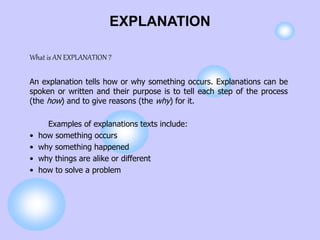
An explanation tells how or why something occurs. Explanations can be
spoken or written and their purpose is to tell each step of the process
(the how) and to give reasons (the why) for it.
Examples of explanations texts include:
• how something occurs
• why something happened
• why things are alike or different
• how to solve a problem
EXPLANATION
Features of AN EXPLANATION
Constructing an explanation
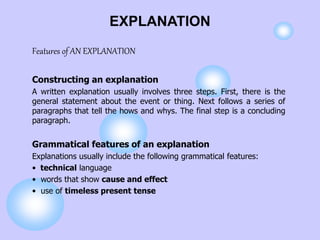
A written explanation usually involves three steps. First, there is the
general statement about the event or thing. Next follows a series of
paragraphs that tell the hows and whys. The final step is a concluding
paragraph.
Grammatical features of an explanation
Explanations usually include the following grammatical features:
• technical language
• words that show cause and effect
• use of timeless present tense
EXPLANATION
The EXPLANATION scaffold
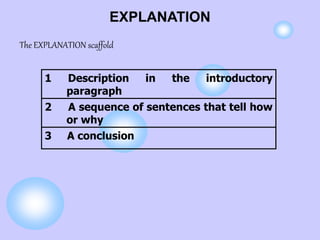
1 Description in the introductory
paragraph
2 A sequence of sentences that tell how
or why
3 A conclusion
EXPLANATIONS
MODEL OF AN EXPLANATION
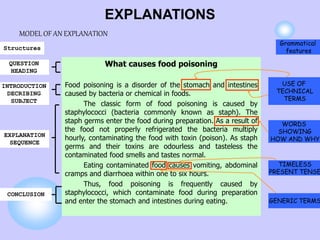
What causes food poisoning
Food poisoning is a disorder of the stomach and intestines
caused by bacteria or chemical in foods.
The classic form of food poisoning is caused by
staphylococci (bacteria commonly known as staph). The
staph germs enter the food during preparation. As a result of
the food not properly refrigerated the bacteria multiply
hourly, contaminating the food with toxin (poison). As staph
germs and their toxins are odourless and tasteless the
contaminated food smells and tastes normal.
Eating contaminated food causes vomiting, abdominal
cramps and diarrhoea within one to six hours.
Thus, food poisoning is frequently caused by
staphylococci, which contaminate food during preparation
and enter the stomach and intestines during eating.
QUESTION
HEADING
Structures
EXPLANATION
SEQUENCE
CONCLUSION
Grammatical
features
TIMELESS
PRESENT TENSE
USE OF
TECHNICAL
TERMS
WORDS
SHOWING
HOW AND WHY
GENERIC TERMS
INTRODUCTION
DECRIBING
SUBJECT

EXPLANATION.ppt

  • 1.
    EXPLANATION What is ANEXPLANATION ? An explanation tells how or why something occurs. Explanations can be spoken or written and their purpose is to tell each step of the process (the how) and to give reasons (the why) for it. Examples of explanations texts include: • how something occurs • why something happened • why things are alike or different • how to solve a problem
  • 2.
    EXPLANATION Features of ANEXPLANATION Constructing an explanation A written explanation usually involves three steps. First, there is the general statement about the event or thing. Next follows a series of paragraphs that tell the hows and whys. The final step is a concluding paragraph. Grammatical features of an explanation Explanations usually include the following grammatical features: • technical language • words that show cause and effect • use of timeless present tense
  • 3.
    EXPLANATION The EXPLANATION scaffold 1Description in the introductory paragraph 2 A sequence of sentences that tell how or why 3 A conclusion
  • 4.
    EXPLANATIONS MODEL OF ANEXPLANATION What causes food poisoning Food poisoning is a disorder of the stomach and intestines caused by bacteria or chemical in foods. The classic form of food poisoning is caused by staphylococci (bacteria commonly known as staph). The staph germs enter the food during preparation. As a result of the food not properly refrigerated the bacteria multiply hourly, contaminating the food with toxin (poison). As staph germs and their toxins are odourless and tasteless the contaminated food smells and tastes normal. Eating contaminated food causes vomiting, abdominal cramps and diarrhoea within one to six hours. Thus, food poisoning is frequently caused by staphylococci, which contaminate food during preparation and enter the stomach and intestines during eating. QUESTION HEADING Structures EXPLANATION SEQUENCE CONCLUSION Grammatical features TIMELESS PRESENT TENSE USE OF TECHNICAL TERMS WORDS SHOWING HOW AND WHY GENERIC TERMS INTRODUCTION DECRIBING SUBJECT