Explain Functional Testing And Its
Types
What is Functional Testing?
Functional Testing is software testing that validates the software
system. It provides input by verifying the output against the
functional requirements. The Testing involves black-box testing,
which isn’t concerned about the Application’s source code. The
testing type in software checks User interface, Security,
Database, APIs, Client communication, and other application
functionality under test.
What to test in Functional Testing?
The main aim of functional testing is to check its purpose of the
software system. Functional Testing is software test types that
focus on
● Mainline Functions
To test the primary function of an application.
● Basic Usability
It involves basic usability testing where a user can
navigate through the screens and without any difficulties.
● Accessibility
Check out the accessibility of the user’s system.
● Error Conditions
The testing technique checks for error conditions and other
displayed messages.
How to perform Functional Testing?
Below steps used for functional Testing:
● Understand the functional needs.
● Compute the expected outcomes with selected test input
values.
● Execute test cases.
● Identify the test input or test data based on needs.
● Compare actual and computed expected results.
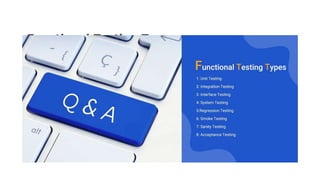
Functional Testing Types
1. Unit Testing
Unit testing is the smallest testable unit of code that’s used
during unit testing. It is one of the most preferred techniques for
developers. It helps uncover the defect during the initial
development phase and helps in saving the higher cost of fixing
the fault during the later stages of STLC.
Functional Testing Example
● Unit testing used for Login that looks like
● Navigate to the login page
● Enter your Email ID and click on Next
● Enter a password of the registered user
● Click on Sign in, if successful, then move to the next page.
● If you get an error message, then re-login it.
2. Integration Testing
When two or more unit tested components of software integrate
to validate integration as expected. It’s performed to test the
module that works fine without showing bugs during integration.
In this software test type, developers build different system
modules and don’t focus on others.
Integration functional testing with example
Test case for test scenario adds to the bag where a bag looks
like:
• The objective is to check the interface between the Add to cart
and My cart module on the e-commerce application homepage.
• The case description is from the homepage. Select product to
click on Add to cart button.
• Where the expected result is a selected product that should
appear in the My cart folder.
• The main objective is to integrate Add to cart and my cart folder
in the above example.
3. Interface Testing
It’s a part of integration functional Testing. It offers correctness
of the data exchange, the message calls, data transfer, and
commands between two integrated tested components. While
testing, there shouldn’t be any error problem encountered.
Interface testing test connection between different interfaces
integrated. It is the Testing used for an integrated group of
modules as a single unit.
4. System Testing
System testing is a type of testing software that conducts and
integrates the system. It evaluates its compliance and specified
requirements. With the completion of the integrated Testing, the
product is later passed to system testing. The functional Testing
performs by testers plays a role in developing the program. It’s
essential to verify that the Application meets the technical and
functional business needs. For example
Perform system testing when all the modules develop and pass
integration. The product adds features like reports, leave
Applications, performance trackers, employee details, etc.
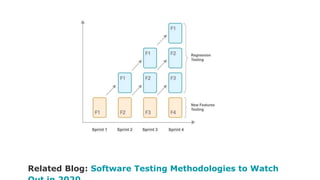
5. Regression Testing
The QA developers can modify its purpose where there is a huge
circumstance that the update cause unexpected behavior. It
comes with various types of Testing. Regression testing is
performed to ensure that a change built and ensure that it
removes bugs that continue to stay dead.
Related Blog: Software Testing Methodologies to Watch
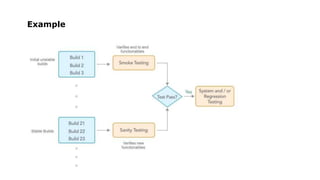
6. Smoke Testing
It’s the best software test type used by developers to publish
new builds to evaluate the system. The main objective of Testing
is to verify the most critical functionality of the system. In these
types of testing, both testers and developers perform smoke
testing to build focus.
7. Sanity Testing
Both smoke testing and sanity testing used for interchangeably
testing contexts. This functional test type runs after each build
received. This type of software testing is a subset of regression
testing, focuses on executing test cases related to the changes
made. The sanity testing is stable and comes with minor
changes. The Testing performed by testers and is release-
focused.
Example
8. Acceptance Testing
In this test case, the acceptance of the Application done by the end-
user to test and make sure that the developed system fulfills all
needs. It’s performed after the system testing and before the
application’s final release in the real world. In addition, the Testing
becomes a criterion for the user to accept or reject the system.
Wrap up
In any software testing, functional testing is a process of testing
functionalities that ensure that the system works as per
requirements specified in the business documents. The main testing
goal is to check whether the system functionality works well or not.
Global Network
USA
4811 N Harding Ave,
Chicago IL 60625
P: +1 (903) 200-8801
CANADA
1445 Rennie St Oshawa,
Ontario, L1K 0N9,CANADA
P: (416) 272-0981
INDIA
609/610,City Center Science
City Road
Ahmedabad - 380060
P: +919586777575
UK
6 Hastings Avenue
Ilford , IG6 1DZ
P: +44 (798) 560 0352
Web & Mobile App Development Company
https://www.concettolabs.com

Explain functional testing and its types

  • 1.
  • 2.
    What is FunctionalTesting? Functional Testing is software testing that validates the software system. It provides input by verifying the output against the functional requirements. The Testing involves black-box testing, which isn’t concerned about the Application’s source code. The testing type in software checks User interface, Security, Database, APIs, Client communication, and other application functionality under test.
  • 3.
    What to testin Functional Testing? The main aim of functional testing is to check its purpose of the software system. Functional Testing is software test types that focus on ● Mainline Functions To test the primary function of an application. ● Basic Usability It involves basic usability testing where a user can navigate through the screens and without any difficulties. ● Accessibility Check out the accessibility of the user’s system. ● Error Conditions The testing technique checks for error conditions and other displayed messages.
  • 4.
    How to performFunctional Testing? Below steps used for functional Testing: ● Understand the functional needs. ● Compute the expected outcomes with selected test input values. ● Execute test cases. ● Identify the test input or test data based on needs. ● Compare actual and computed expected results.
  • 5.
  • 6.
    1. Unit Testing Unittesting is the smallest testable unit of code that’s used during unit testing. It is one of the most preferred techniques for developers. It helps uncover the defect during the initial development phase and helps in saving the higher cost of fixing the fault during the later stages of STLC.
  • 7.
    Functional Testing Example ●Unit testing used for Login that looks like ● Navigate to the login page ● Enter your Email ID and click on Next ● Enter a password of the registered user ● Click on Sign in, if successful, then move to the next page. ● If you get an error message, then re-login it.
  • 8.
    2. Integration Testing Whentwo or more unit tested components of software integrate to validate integration as expected. It’s performed to test the module that works fine without showing bugs during integration. In this software test type, developers build different system modules and don’t focus on others.
  • 9.
    Integration functional testingwith example Test case for test scenario adds to the bag where a bag looks like: • The objective is to check the interface between the Add to cart and My cart module on the e-commerce application homepage. • The case description is from the homepage. Select product to click on Add to cart button. • Where the expected result is a selected product that should appear in the My cart folder. • The main objective is to integrate Add to cart and my cart folder in the above example.
  • 10.
    3. Interface Testing It’sa part of integration functional Testing. It offers correctness of the data exchange, the message calls, data transfer, and commands between two integrated tested components. While testing, there shouldn’t be any error problem encountered. Interface testing test connection between different interfaces integrated. It is the Testing used for an integrated group of modules as a single unit.
  • 11.
    4. System Testing Systemtesting is a type of testing software that conducts and integrates the system. It evaluates its compliance and specified requirements. With the completion of the integrated Testing, the product is later passed to system testing. The functional Testing performs by testers plays a role in developing the program. It’s essential to verify that the Application meets the technical and functional business needs. For example Perform system testing when all the modules develop and pass integration. The product adds features like reports, leave Applications, performance trackers, employee details, etc.
  • 12.
    5. Regression Testing TheQA developers can modify its purpose where there is a huge circumstance that the update cause unexpected behavior. It comes with various types of Testing. Regression testing is performed to ensure that a change built and ensure that it removes bugs that continue to stay dead.
  • 13.
    Related Blog: SoftwareTesting Methodologies to Watch
  • 14.
    6. Smoke Testing It’sthe best software test type used by developers to publish new builds to evaluate the system. The main objective of Testing is to verify the most critical functionality of the system. In these types of testing, both testers and developers perform smoke testing to build focus.
  • 15.
    7. Sanity Testing Bothsmoke testing and sanity testing used for interchangeably testing contexts. This functional test type runs after each build received. This type of software testing is a subset of regression testing, focuses on executing test cases related to the changes made. The sanity testing is stable and comes with minor changes. The Testing performed by testers and is release- focused.
  • 16.
  • 17.
    8. Acceptance Testing Inthis test case, the acceptance of the Application done by the end- user to test and make sure that the developed system fulfills all needs. It’s performed after the system testing and before the application’s final release in the real world. In addition, the Testing becomes a criterion for the user to accept or reject the system.
  • 18.
    Wrap up In anysoftware testing, functional testing is a process of testing functionalities that ensure that the system works as per requirements specified in the business documents. The main testing goal is to check whether the system functionality works well or not.
  • 19.
    Global Network USA 4811 NHarding Ave, Chicago IL 60625 P: +1 (903) 200-8801 CANADA 1445 Rennie St Oshawa, Ontario, L1K 0N9,CANADA P: (416) 272-0981 INDIA 609/610,City Center Science City Road Ahmedabad - 380060 P: +919586777575 UK 6 Hastings Avenue Ilford , IG6 1DZ P: +44 (798) 560 0352
  • 20.
    Web & MobileApp Development Company https://www.concettolabs.com