Experience Report: Agile tools for 
management teams 
19-Nov-14 
Presented by Rob Brown
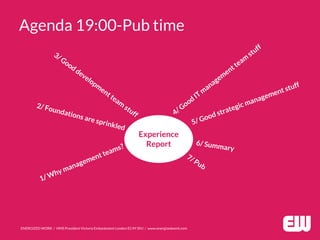
3/ Good development team stuff 
4/ Good IT management team stuff 
Experience 
Report 
2/ Foundations are sprinkled 
1/ Why management teams? 
7/ Pub 
ENERGIZED WORK / HMS President Victoria Embankment London EC4Y 0HJ / www.energizedwork.com 
5/ Good strategic management stuff 
6/ Summary 
Agenda 19:00-Pub time
Why agile and management teams? 
“Manage-Mend” - a job I sometimes have 
Increasingly with “agile” initiatives/programmes/career-saving-last-attempts to improve 
organisational efficiency and effectiveness (aka productivity)(aka more with same/less), 
management teams try their best. 
Managers talk the talk, but 
They struggle to walk the walk: 
● This authenticity gap blocks the rest of the organisation’s adoption of agile methods 
● It’s sociology - we imitate our trusted/respected peers, and our leaders/managers 
I like challenges and prefer to succeed...so I had to embrace uncertainty and welcome 
changing requirements: 
● I took/take agile to management, and we all learned/learn a lot! 
ENERGIZED WORK / HMS President Victoria Embankment London EC4Y 0HJ / www.energizedwork.com
Doh, a deer 
ENERGIZED WORK / HMS President Victoria Embankment London EC4Y 0HJ / www.energizedwork.com
Some good experiences within 
development teams 
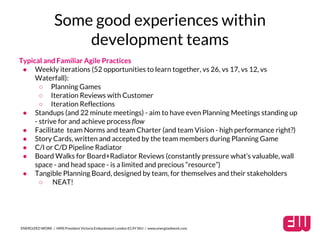
Typical and Familiar Agile Practices 
● Weekly iterations (52 opportunities to learn together, vs 26, vs 17, vs 12, vs 
Waterfall): 
○ Planning Games 
○ Iteration Reviews with Customer 
○ Iteration Reflections 
● Standups (and 22 minute meetings) - aim to have even Planning Meetings standing up 
- strive for and achieve process flow 
● Facilitate team Norms and team Charter (and team Vision - high performance right?) 
● Story Cards, written and accepted by the team members during Planning Game 
● C/I or C/D Pipeline Radiator 
● Board Walks for Board+Radiator Reviews (constantly pressure what’s valuable, wall 
space - and head space - is a limited and precious “resource”) 
● Tangible Planning Board, designed by team, for themselves and their stakeholders 
○ NEAT! 
ENERGIZED WORK / HMS President Victoria Embankment London EC4Y 0HJ / www.energizedwork.com
Some good experiences within 
development teams 
Non-Familiar Practices 
● 1x Team Lunch Weekly: 1 rule - “no work talk!” 
● Feedback: 1-to-1’s: 
○ Leader with followers 
○ Preferably peer-to-peer 
○ 360’s (senior, peer, junior) for all 
● Walls to radiate valuable information to all (especially current, transition and future 
designs and models) 
● Experiential training - Show, Don’t Tell 
○ Current research (“Working with Emotional Intelligence” - Dan Goleman) 
■ Lecture-only training is nearly useless, especially for workplace behaviour 
changes. Negative ROI in fact 
■ Create trainings around simulations, role-play, observers-groups 
● Use a balance of real-time events to “Stop the Line” / pause the team to 
facilitate in depth conversations when opportunities arise 
ENERGIZED WORK / HMS President Victoria Embankment London EC4Y 0HJ / www.energizedwork.com
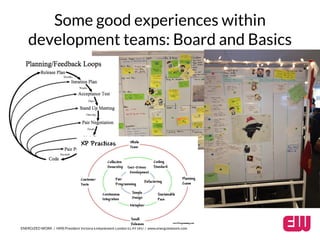
Some good experiences within 
development teams: Board and Basics 
ENERGIZED WORK / HMS President Victoria Embankment London EC4Y 0HJ / www.energizedwork.com
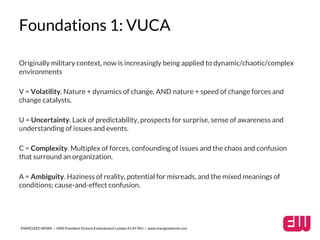
Foundations 1: VUCA 
Originally military context, now is increasingly being applied to dynamic/chaotic/complex 
environments 
V = Volatility. Nature + dynamics of change, AND nature + speed of change forces and 
change catalysts. 
U = Uncertainty. Lack of predictability, prospects for surprise, sense of awareness and 
understanding of issues and events. 
C = Complexity. Multiplex of forces, confounding of issues and the chaos and confusion 
that surround an organization. 
A = Ambiguity. Haziness of reality, potential for misreads, and the mixed meanings of 
conditions; cause-and-effect confusion. 
ENERGIZED WORK / HMS President Victoria Embankment London EC4Y 0HJ / www.energizedwork.com
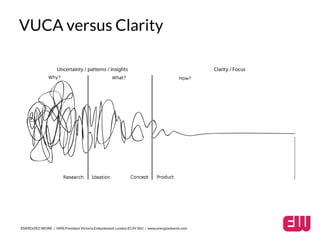
VUCA versus Clarity 
ENERGIZED WORK / HMS President Victoria Embankment London EC4Y 0HJ / www.energizedwork.com
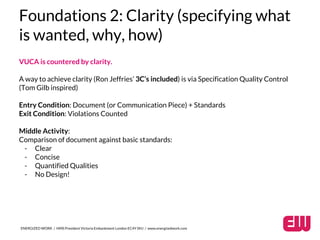
Foundations 2: Clarity (specifying what 
is wanted, why, how) 
VUCA is countered by clarity. 
A way to achieve clarity (Ron Jeffries’ 3C’s included) is via Specification Quality Control 
(Tom Gilb inspired) 
Entry Condition: Document (or Communication Piece) + Standards 
Exit Condition: Violations Counted 
Middle Activity: 
Comparison of document against basic standards: 
- Clear 
- Concise 
- Quantified Qualities 
- No Design! 
ENERGIZED WORK / HMS President Victoria Embankment London EC4Y 0HJ / www.energizedwork.com
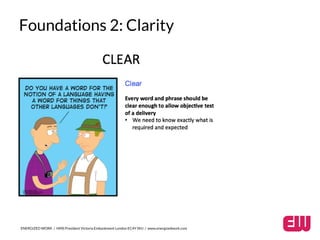
Foundations 2: Clarity 
ENERGIZED WORK / HMS President Victoria Embankment London EC4Y 0HJ / www.energizedwork.com
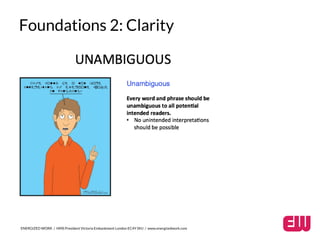
Foundations 2: Clarity 
ENERGIZED WORK / HMS President Victoria Embankment London EC4Y 0HJ / www.energizedwork.com
Foundations 2: Clarity 
ENERGIZED WORK / HMS President Victoria Embankment London EC4Y 0HJ / www.energizedwork.com
Foundations 2: Clarity 
ENERGIZED WORK / HMS President Victoria Embankment London EC4Y 0HJ / www.energizedwork.com
Doh, another deer 
ENERGIZED WORK / HMS President Victoria Embankment London EC4Y 0HJ / www.energizedwork.com
Some good experiences within IT 
management teams 
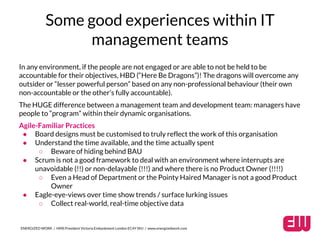
In any environment, if the people are not engaged or are able to not be held to be 
accountable for their objectives, HBD (“Here Be Dragons”)! The dragons will overcome any 
outsider or “lesser powerful person” based on any non-professional behaviour (their own 
non-accountable or the other’s fully accountable). 
The HUGE difference between a management team and development team: managers have 
people to “program” within their dynamic organisations. 
Agile-Familiar Practices 
● Board designs must be customised to truly reflect the work of this organisation 
● Understand the time available, and the time actually spent 
○ Beware of hiding behind BAU 
● Scrum is not a good framework to deal with an environment where interrupts are 
unavoidable (!!) or non-delayable (!!!) and where there is no Product Owner (!!!!) 
○ Even a Head of Department or the Pointy Haired Manager is not a good Product 
Owner 
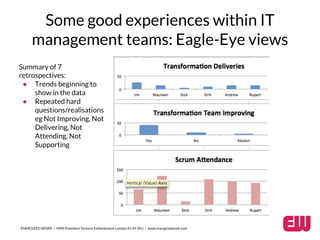
● Eagle-eye-views over time show trends / surface lurking issues 
○ Collect real-world, real-time objective data 
ENERGIZED WORK / HMS President Victoria Embankment London EC4Y 0HJ / www.energizedwork.com
Some good experiences within IT 
management teams 
Unfamiliar Practices 
● Fix the (dynamic) system 
○ 1 piece at a time 
○ Maintain/coordinate balanced approach! 
○ NB! 
■ You can’t fix the people 
■ You can fix your standard(s) and publicise them (eg your values) - thus lead 
by example 
● Specification quality control! (Tom Gilb inspired) 
● More experiential trainings 
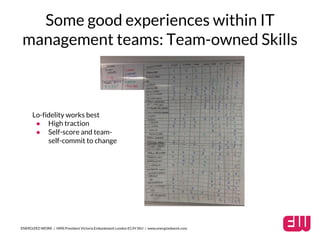
● Capability model/Skills matrix 
ENERGIZED WORK / HMS President Victoria Embankment London EC4Y 0HJ / www.energizedwork.com
Some good experiences within IT 
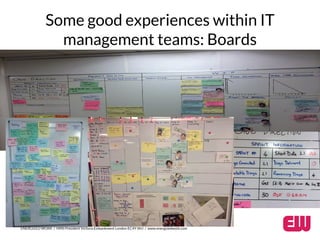
management teams: Boards 
ENERGIZED WORK / HMS President Victoria Embankment London EC4Y 0HJ / www.energizedwork.com
Some good experiences within IT 
management teams: Eagle-Eye views 
Summary of 7 
retrospectives: 
● Trends beginning to 
show in the data 
● Repeated hard 
questions/realisations 
eg Not Improving, Not 
Delivering, Not 
Attending, Not 
Supporting 
ENERGIZED WORK / HMS President Victoria Embankment London EC4Y 0HJ / www.energizedwork.com
Some good experiences within IT 
management teams: Team-owned Skills 
Lo-fidelity works best 
● High traction 
● Self-score and team-self- 
commit to change 
ENERGIZED WORK / HMS President Victoria Embankment London EC4Y 0HJ / www.energizedwork.com
Foundations 3: All organisations are 
dynamic systems 
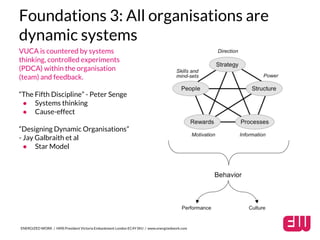
VUCA is countered by systems 
thinking, controlled experiments 
(PDCA) within the organisation 
(team) and feedback. 
“The Fifth Discipline” - Peter Senge 
● Systems thinking 
● Cause-effect 
“Designing Dynamic Organisations” 
- Jay Galbraith et al 
● Star Model 
ENERGIZED WORK / HMS President Victoria Embankment London EC4Y 0HJ / www.energizedwork.com
Foundations 3: All organisations are 
dynamic systems 
● Be aware - dynamic process control systems operate with automatic feedback loop 
○ eg as toilet cistern fills up, the inlet water valve is closed by the rising of the 
balloon attached to the valve 
● We don’t have such closed systems and automated process control/objective 
feedback loop mechanisms in organisations 
○ We strive to achieve similar effect by culture, communication, reports and 
management interventions 
● XP Values are incredibly foresightful (and useful) in achieving the required balance 
for successful organisational dynamic system: 
○ Communication 
○ Simplicity 
○ Feedback 
○ Courage 
○ Respect 
ENERGIZED WORK / HMS President Victoria Embankment London EC4Y 0HJ / www.energizedwork.com
Foundations 4: Plan-Do-Check-Adjust(- 
Dbl Loop Learn) 
VUCA is countered by Deming’s Continuous Improvement Cycle: PDCA 
But! 
Planning theory and practical experience is full of contradictions! 
People feel stressed out when they feel they have no control over their life or work. 
A plan is just a collection of wants and wishes until actions are performed which turn dreams into realities. 
Planning should be done just enough to gain sufficient confidence to proceed with confidence. This level of confidence is 
based on understanding of time and experience of how long things take, why and what risks exist, and how risk will be 
managed. 
Just-In-Time planning, keeping Real Options open until the Last Responsible Moment to Decide. 
Plans provide a possible route from a starting position to a possible end position, that is desirable when route is first 
formulated. 
No plan survives unmodified first contact with reality. 
If you don't plan, you plan to fail. 
Fail fast. It requires an understanding of the Entry Criteria and the Exit Criteria, before you start. This is how you know you 
have not failed AND avoid your subconscious trying to make you feel better by shifting the Exit Criteria around so that you 
"succeed". 
The Cone of Uncertainty may be unscientific (to a degree) but humans who bother to learn from their mistakes do make fewer 
of the same kind of mistake, and/or the mistake has less impact 
It should be (significantly) cheaper to plan than to do - a plan helps to derisk the chance of failure by communicating 
expectations to everyone involved in creating the desired outcome 
Peter Drucker: “[part of] a manager's job is to ensure that a particular crisis only happens once” 
ENERGIZED WORK / HMS President Victoria Embankment London EC4Y 0HJ / www.energizedwork.com
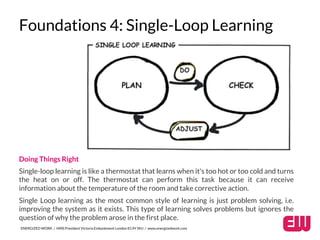
Foundations 4: Single-Loop Learning 
Doing Things Right 
Single-loop learning is like a thermostat that learns when it's too hot or too cold and turns 
the heat on or off. The thermostat can perform this task because it can receive 
information about the temperature of the room and take corrective action. 
Single Loop learning as the most common style of learning is just problem solving, i.e. 
improving the system as it exists. This type of learning solves problems but ignores the 
question of why the problem arose in the first place. 
ENERGIZED WORK / HMS President Victoria Embankment London EC4Y 0HJ / www.energizedwork.com
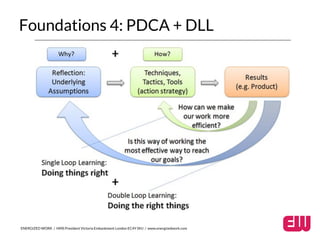
Foundations 4: Double-Loop Learning 
Doing the Right Things 
Double loop learning is like a thermostat that asks "why" - Is this a good time to switch 
settings? Are there people in here? Are they in bed? Are they dressed for a colder setting? 
- thus it orientates itself to the present environment in order to make the wisest decision. 
Double-loop learning occurs when an error is detected and corrected in ways that 
involve the modification of our underlying norms, policies and objectives. It uses 
feedback from past actions to question the underlying assumptions behind techniques, 
goals and values. 
ENERGIZED WORK / HMS President Victoria Embankment London EC4Y 0HJ / www.energizedwork.com
Foundations 4: PDCA + DLL 
ENERGIZED WORK / HMS President Victoria Embankment London EC4Y 0HJ / www.energizedwork.com
Doh, yet another deer 
ENERGIZED WORK / HMS President Victoria Embankment London EC4Y 0HJ / www.energizedwork.com
Some good experiences within strategic 
(software industry) management teams 
In any environment, if the people are having to learn a heck of a lot of stuff (eg startups) 
there are going to be a lot of mistakes and the trick is to experiment quickly, fail fast AND 
fail safely (without death or unrecoverable consequences), amplify the learning, and move 
forward to the next available space. 
Luck == Opportunity Meets Preparation 
The HUGE difference between a strategic management team and management team: 
strategic managers have an entire dynamic organisation to “program” in an epic dance of 
the extremely dynamic market place - everything to play for, everything to lose. Strategy is 
hard 
Agile-Familiar Practices 
● Iterations 
● Facilitator 
● Story cards 
● Standups 
● Timeboxing (strictly) 
ENERGIZED WORK / HMS President Victoria Embankment London EC4Y 0HJ / www.energizedwork.com
Some good experiences within strategic 
(software industry) management teams 
Unfamiliar Practices 
● Gimmick free 
● Wear customers’ shoes by any means (Personas, feedback, role-play, critical thinking) 
● Error reflections (instead of Retrospectives) 
● “Test driven management” 
● Wednesday Quarter-Month-Week review-reflect-planning cycles with different 
granularity tools but same “heartbeat” 
● Granularity and confidences 
● Friday reflections email 
● 1 vision / 1 goal / 1 focus per timebox - there really can be only 1 in order to get 
anywhere planned at this level of a company 
ENERGIZED WORK / HMS President Victoria Embankment London EC4Y 0HJ / www.energizedwork.com
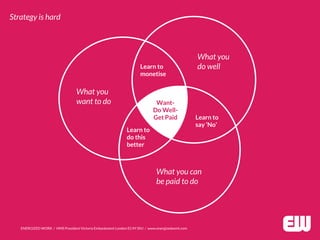
What you 
do well 
What you 
want to do 
Learn to 
say ‘No’ 
Learn to 
monetise 
What you can 
be paid to do 
Learn to 
do this 
better 
Want- 
Do Well- 
Get Paid 
Strategy is hard 
ENERGIZED WORK / HMS President Victoria Embankment London EC4Y 0HJ / www.energizedwork.com
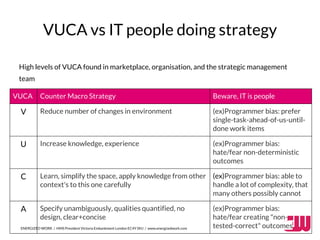
VUCA vs IT people doing strategy 
High levels of VUCA found in marketplace, organisation, and the strategic management 
team 
“We have met the enemy, and he is us”: Beware Analysis Paralysis 
VUCA Counter Macro Strategy Beware, IT is people 
V Reduce number of changes in environment (ex)Programmer bias: prefer 
ENERGIZED WORK / HMS President Victoria Embankment London EC4Y 0HJ / www.energizedwork.com 
single-task-ahead-of-us-until-done 
work items 
U Increase knowledge, experience (ex)Programmer bias: 
hate/fear non-deterministic 
outcomes 
C Learn, simplify the space, apply knowledge from other 
context's to this one carefully 
(ex)Programmer bias: able to 
handle a lot of complexity, that 
many others possibly cannot 
A Specify unambiguously, qualities quantified, no 
design, clear+concise 
(ex)Programmer bias: 
hate/fear creating "non-tested- 
correct" outcomes
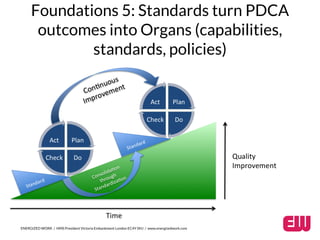
Foundations 5: Standards turn PDCA 
outcomes into Organs (capabilities, 
standards, policies) 
ENERGIZED WORK / HMS President Victoria Embankment London EC4Y 0HJ / www.energizedwork.com
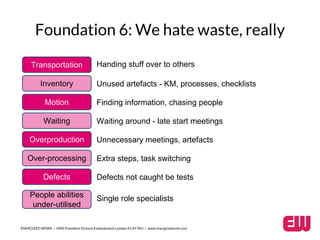
Foundation 6: We hate waste, really 
Transportation 
Inventory 
Motion 
Waiting 
Overproduction 
Over-processing 
Defects 
People abilities 
under-utilised 
Handing stuff over to others 
Unused artefacts - KM, processes, checklists 
Finding information, chasing people 
Waiting around - late start meetings 
Unnecessary meetings, artefacts 
Extra steps, task switching 
Defects not caught be tests 
Single role specialists 
ENERGIZED WORK / HMS President Victoria Embankment London EC4Y 0HJ / www.energizedwork.com
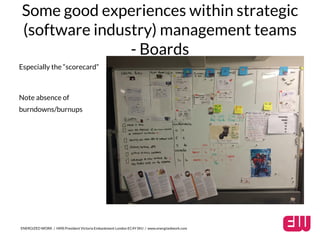
Some good experiences within strategic 
(software industry) management teams 
- Boards 
Especially the “scorecard” 
Note absence of 
burndowns/burnups 
ENERGIZED WORK / HMS President Victoria Embankment London EC4Y 0HJ / www.energizedwork.com
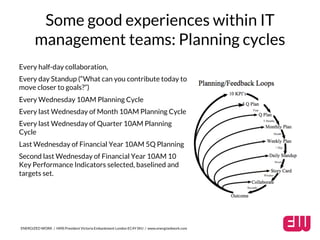
Some good experiences within IT 
management teams: Planning cycles 
Every half-day collaboration, 
Every day Standup (“What can you contribute today to 
move closer to goals?”) 
Every Wednesday 10AM Planning Cycle 
Every last Wednesday of Month 10AM Planning Cycle 
Every last Wednesday of Quarter 10AM Planning 
Cycle 
Last Wednesday of Financial Year 10AM 5Q Planning 
Second last Wednesday of Financial Year 10AM 10 
Key Performance Indicators selected, baselined and 
targets set. 
ENERGIZED WORK / HMS President Victoria Embankment London EC4Y 0HJ / www.energizedwork.com
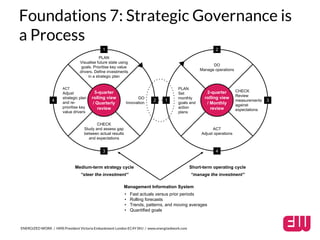
Foundations 7: Strategic Governance is 
a Process 
1 
PLAN 
Visualise future state using 
goals. Prioritise key value 
drivers. Define investments 
in a strategic plan 
4 
5-quarter 
rolling view 
/ Quarterly 
review 
CHECK 
Study and assess gap 
between actual results 
and expectations 
3 
2 
ACT 
Adjust 
strategic plan 
and re-prioritise 
key 
value drivers 
DO 
Innovation 
Medium-term strategy cycle 
“steer the investment” 
ENERGIZED WORK / HMS President Victoria Embankment London EC4Y 0HJ / www.energizedwork.com 
2 
2-quarter 
rolling view 
/ Monthly 
review 
Short-term operating cycle 
“manage the investment” 
Management Information System 
• Fast actuals versus prior periods 
• Rolling forecasts 
• Trends, patterns, and moving averages 
• Quantified goals 
DO 
Manage operations 
1 
4 
3 
PLAN 
Set 
monthly 
goals and 
action 
plans 
ACT 
Adjust operations 
CHECK 
Review 
measurements 
against 
expectations
Foundations 8: Iterate on everything! 
ENERGIZED WORK / HMS President Victoria Embankment London EC4Y 0HJ / www.energizedwork.com 
MARKET 
$$ 
Do not increment! 
It unbalances the dynamic system and leads to failure 
!?
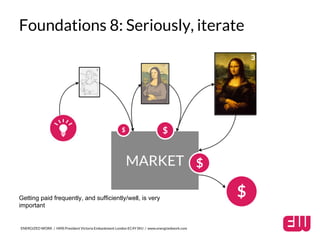
Foundations 8: Seriously, iterate 
MARKET 
$ 
ENERGIZED WORK / HMS President Victoria Embankment London EC4Y 0HJ / www.energizedwork.com 
$ 
$ 
$ 
Getting paid frequently, and sufficiently/well, is very 
important
Foundations 9: Strategic Planning with 
SWOT + PESTLE 
You need to know where you are, 
And where you want to go, 
Before you can imagine or assess how you get there (strategies) 
SWOT: 
● Strengths and Weaknesses - where you are now 
● Opportunities and Threats - external events/truthes/soon-to-be-truthes 
○ PESTLE - Viewing lenses to help you identify externals: 
■ Political 
■ Environment 
■ Social 
■ Technology 
■ Legal 
■ Economy 
ENERGIZED WORK / HMS President Victoria Embankment London EC4Y 0HJ / www.energizedwork.com
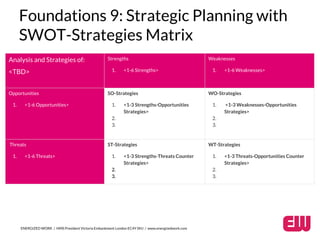
Foundations 9: Strategic Planning with 
SWOT-Strategies Matrix 
Analysis and Strategies of: 
<TBD> 
Strengths 
1. <1-6 Strengths> 
ENERGIZED WORK / HMS President Victoria Embankment London EC4Y 0HJ / www.energizedwork.com 
Weaknesses 
1. <1-6 Weaknesses> 
Opportunities 
1. <1-6 Opportunities> 
SO-Strategies 
1. <1-3 Strengths-Opportunities 
Strategies> 
2. 
3. 
WO-Strategies 
1. <1-3 Weaknesses-Opportunities 
Strategies> 
2. 
3. 
Threats 
1. <1-6 Threats> 
ST-Strategies 
1. <1-3 Strengths-Threats Counter 
Strategies> 
2. 
3. 
WT-Strategies 
1. <1-3 Threats-Opportunities Counter 
Strategies> 
2. 
3.
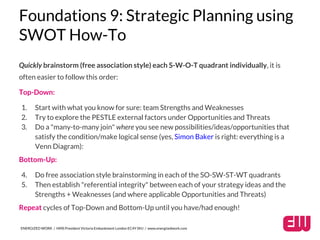
Foundations 9: Strategic Planning using 
SWOT How-To 
Quickly brainstorm (free association style) each S-W-O-T quadrant individually, it is 
often easier to follow this order: 
Top-Down: 
1. Start with what you know for sure: team Strengths and Weaknesses 
2. Try to explore the PESTLE external factors under Opportunities and Threats 
3. Do a "many-to-many join" where you see new possibilities/ideas/opportunities that 
satisfy the condition/make logical sense (yes, Simon Baker is right: everything is a 
Venn Diagram): 
Bottom-Up: 
4. Do free association style brainstorming in each of the SO-SW-ST-WT quadrants 
5. Then establish "referential integrity" between each of your strategy ideas and the 
Strengths + Weaknesses (and where applicable Opportunities and Threats) 
Repeat cycles of Top-Down and Bottom-Up until you have/had enough! 
ENERGIZED WORK / HMS President Victoria Embankment London EC4Y 0HJ / www.energizedwork.com
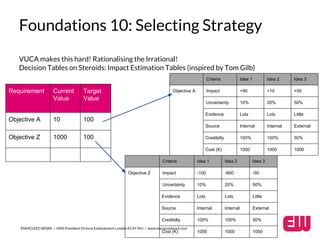
Foundations 10: Selecting Strategy 
VUCA makes this hard! Rationalising the Irrational! 
Decision Tables on Steroids: Impact Estimation Tables (inspired by Tom Gilb) 
ENERGIZED WORK / HMS President Victoria Embankment London EC4Y 0HJ / www.energizedwork.com 
Criteria Idea 1 Idea 2 Idea 3 
Objective A Impact +90 +10 +50 
Uncertainty 10% 20% 50% 
Evidence Lots Lots Little 
Source Internal Internal External 
Credibilty 100% 100% 50% 
Cost (K) 1000 1000 1000 
Requirement Current 
Value 
Target 
Value 
Objective A 10 100 
Objective Z 1000 100 
Criteria Idea 1 Idea 2 Idea 3 
Objective Z Impact -100 -900 -50 
Uncertainty 10% 20% 50% 
Evidence Lots Lots Little 
Source Internal Internal External 
Credibilty 100% 100% 50% 
Cost (K) 1000 1000 1000
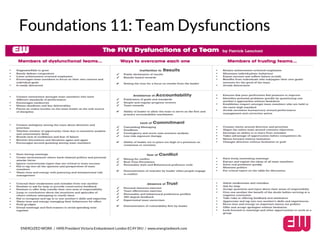
Foundations 11: Team Dysfunctions 
ENERGIZED WORK / HMS President Victoria Embankment London EC4Y 0HJ / www.energizedwork.com
Summary + Thanks! 
Thank you! 
PUB! 
ENERGIZED WORK / HMS President Victoria Embankment London EC4Y 0HJ / www.energizedwork.com
References / Recommended Reading 
● http://www.energizedwork.com/weblog (especially author = Simon Baker) 
● VUCA (wikipedia) 
● Systems Thinking / Cause-Effect Thinking/Modeling: “The Fifth Discipline” - Peter 
Senge 
● Galbraith’s Star Model: “Designing Dynamic Organizations: A Hands-on Guide for 
Leaders at All Levels” -Jay Galbraith, Diane Downey, Amy Kates 
● Specification Quality Control and Impact Estimation Tables: “Competitive 
Engineering: A Handbook For Systems Engineering, Requirements Engineering, and 
Software Engineering” - Tom Gilb 
● “Hard facts, dangerous half-truths and total nonsense” - Jeffrey Pfeffer, Robert I. 
Sutton 
● “How to measure anything” - Douglas W. Hubbard 
● “Secrets of Great Management: Behind closed doors” - Johanna Rothman, Esther 
Derby 
● “Balancing agility with discipline” - Barry Boehm and Richard Turner 
● “Scrumban” - Corey Ladas 
● “Essential Drucker” - Peter Drucker 
● “Practices of management“ - Peter Drucker 
● “Homo Imitans” - Leandro Herrero 
● “Maverick” - Ricardo Semler 
● “Seven Day Weekend” - Ricardo Semler 
ENERGIZED WORK / HMS President Victoria Embankment London EC4Y 0HJ / www.energizedwork.com

Experience report on agile tools for management teams

  • 1.
    Experience Report: Agiletools for management teams 19-Nov-14 Presented by Rob Brown
  • 2.
    3/ Good developmentteam stuff 4/ Good IT management team stuff Experience Report 2/ Foundations are sprinkled 1/ Why management teams? 7/ Pub ENERGIZED WORK / HMS President Victoria Embankment London EC4Y 0HJ / www.energizedwork.com 5/ Good strategic management stuff 6/ Summary Agenda 19:00-Pub time
  • 3.
    Why agile andmanagement teams? “Manage-Mend” - a job I sometimes have Increasingly with “agile” initiatives/programmes/career-saving-last-attempts to improve organisational efficiency and effectiveness (aka productivity)(aka more with same/less), management teams try their best. Managers talk the talk, but They struggle to walk the walk: ● This authenticity gap blocks the rest of the organisation’s adoption of agile methods ● It’s sociology - we imitate our trusted/respected peers, and our leaders/managers I like challenges and prefer to succeed...so I had to embrace uncertainty and welcome changing requirements: ● I took/take agile to management, and we all learned/learn a lot! ENERGIZED WORK / HMS President Victoria Embankment London EC4Y 0HJ / www.energizedwork.com
  • 4.
    Doh, a deer ENERGIZED WORK / HMS President Victoria Embankment London EC4Y 0HJ / www.energizedwork.com
  • 5.
    Some good experienceswithin development teams Typical and Familiar Agile Practices ● Weekly iterations (52 opportunities to learn together, vs 26, vs 17, vs 12, vs Waterfall): ○ Planning Games ○ Iteration Reviews with Customer ○ Iteration Reflections ● Standups (and 22 minute meetings) - aim to have even Planning Meetings standing up - strive for and achieve process flow ● Facilitate team Norms and team Charter (and team Vision - high performance right?) ● Story Cards, written and accepted by the team members during Planning Game ● C/I or C/D Pipeline Radiator ● Board Walks for Board+Radiator Reviews (constantly pressure what’s valuable, wall space - and head space - is a limited and precious “resource”) ● Tangible Planning Board, designed by team, for themselves and their stakeholders ○ NEAT! ENERGIZED WORK / HMS President Victoria Embankment London EC4Y 0HJ / www.energizedwork.com
  • 6.
    Some good experienceswithin development teams Non-Familiar Practices ● 1x Team Lunch Weekly: 1 rule - “no work talk!” ● Feedback: 1-to-1’s: ○ Leader with followers ○ Preferably peer-to-peer ○ 360’s (senior, peer, junior) for all ● Walls to radiate valuable information to all (especially current, transition and future designs and models) ● Experiential training - Show, Don’t Tell ○ Current research (“Working with Emotional Intelligence” - Dan Goleman) ■ Lecture-only training is nearly useless, especially for workplace behaviour changes. Negative ROI in fact ■ Create trainings around simulations, role-play, observers-groups ● Use a balance of real-time events to “Stop the Line” / pause the team to facilitate in depth conversations when opportunities arise ENERGIZED WORK / HMS President Victoria Embankment London EC4Y 0HJ / www.energizedwork.com
  • 7.
    Some good experienceswithin development teams: Board and Basics ENERGIZED WORK / HMS President Victoria Embankment London EC4Y 0HJ / www.energizedwork.com
  • 8.
    Foundations 1: VUCA Originally military context, now is increasingly being applied to dynamic/chaotic/complex environments V = Volatility. Nature + dynamics of change, AND nature + speed of change forces and change catalysts. U = Uncertainty. Lack of predictability, prospects for surprise, sense of awareness and understanding of issues and events. C = Complexity. Multiplex of forces, confounding of issues and the chaos and confusion that surround an organization. A = Ambiguity. Haziness of reality, potential for misreads, and the mixed meanings of conditions; cause-and-effect confusion. ENERGIZED WORK / HMS President Victoria Embankment London EC4Y 0HJ / www.energizedwork.com
  • 9.
    VUCA versus Clarity ENERGIZED WORK / HMS President Victoria Embankment London EC4Y 0HJ / www.energizedwork.com
  • 10.
    Foundations 2: Clarity(specifying what is wanted, why, how) VUCA is countered by clarity. A way to achieve clarity (Ron Jeffries’ 3C’s included) is via Specification Quality Control (Tom Gilb inspired) Entry Condition: Document (or Communication Piece) + Standards Exit Condition: Violations Counted Middle Activity: Comparison of document against basic standards: - Clear - Concise - Quantified Qualities - No Design! ENERGIZED WORK / HMS President Victoria Embankment London EC4Y 0HJ / www.energizedwork.com
  • 11.
    Foundations 2: Clarity ENERGIZED WORK / HMS President Victoria Embankment London EC4Y 0HJ / www.energizedwork.com
  • 12.
    Foundations 2: Clarity ENERGIZED WORK / HMS President Victoria Embankment London EC4Y 0HJ / www.energizedwork.com
  • 13.
    Foundations 2: Clarity ENERGIZED WORK / HMS President Victoria Embankment London EC4Y 0HJ / www.energizedwork.com
  • 14.
    Foundations 2: Clarity ENERGIZED WORK / HMS President Victoria Embankment London EC4Y 0HJ / www.energizedwork.com
  • 15.
    Doh, another deer ENERGIZED WORK / HMS President Victoria Embankment London EC4Y 0HJ / www.energizedwork.com
  • 16.
    Some good experienceswithin IT management teams In any environment, if the people are not engaged or are able to not be held to be accountable for their objectives, HBD (“Here Be Dragons”)! The dragons will overcome any outsider or “lesser powerful person” based on any non-professional behaviour (their own non-accountable or the other’s fully accountable). The HUGE difference between a management team and development team: managers have people to “program” within their dynamic organisations. Agile-Familiar Practices ● Board designs must be customised to truly reflect the work of this organisation ● Understand the time available, and the time actually spent ○ Beware of hiding behind BAU ● Scrum is not a good framework to deal with an environment where interrupts are unavoidable (!!) or non-delayable (!!!) and where there is no Product Owner (!!!!) ○ Even a Head of Department or the Pointy Haired Manager is not a good Product Owner ● Eagle-eye-views over time show trends / surface lurking issues ○ Collect real-world, real-time objective data ENERGIZED WORK / HMS President Victoria Embankment London EC4Y 0HJ / www.energizedwork.com
  • 17.
    Some good experienceswithin IT management teams Unfamiliar Practices ● Fix the (dynamic) system ○ 1 piece at a time ○ Maintain/coordinate balanced approach! ○ NB! ■ You can’t fix the people ■ You can fix your standard(s) and publicise them (eg your values) - thus lead by example ● Specification quality control! (Tom Gilb inspired) ● More experiential trainings ● Capability model/Skills matrix ENERGIZED WORK / HMS President Victoria Embankment London EC4Y 0HJ / www.energizedwork.com
  • 18.
    Some good experienceswithin IT management teams: Boards ENERGIZED WORK / HMS President Victoria Embankment London EC4Y 0HJ / www.energizedwork.com
  • 19.
    Some good experienceswithin IT management teams: Eagle-Eye views Summary of 7 retrospectives: ● Trends beginning to show in the data ● Repeated hard questions/realisations eg Not Improving, Not Delivering, Not Attending, Not Supporting ENERGIZED WORK / HMS President Victoria Embankment London EC4Y 0HJ / www.energizedwork.com
  • 20.
    Some good experienceswithin IT management teams: Team-owned Skills Lo-fidelity works best ● High traction ● Self-score and team-self- commit to change ENERGIZED WORK / HMS President Victoria Embankment London EC4Y 0HJ / www.energizedwork.com
  • 21.
    Foundations 3: Allorganisations are dynamic systems VUCA is countered by systems thinking, controlled experiments (PDCA) within the organisation (team) and feedback. “The Fifth Discipline” - Peter Senge ● Systems thinking ● Cause-effect “Designing Dynamic Organisations” - Jay Galbraith et al ● Star Model ENERGIZED WORK / HMS President Victoria Embankment London EC4Y 0HJ / www.energizedwork.com
  • 22.
    Foundations 3: Allorganisations are dynamic systems ● Be aware - dynamic process control systems operate with automatic feedback loop ○ eg as toilet cistern fills up, the inlet water valve is closed by the rising of the balloon attached to the valve ● We don’t have such closed systems and automated process control/objective feedback loop mechanisms in organisations ○ We strive to achieve similar effect by culture, communication, reports and management interventions ● XP Values are incredibly foresightful (and useful) in achieving the required balance for successful organisational dynamic system: ○ Communication ○ Simplicity ○ Feedback ○ Courage ○ Respect ENERGIZED WORK / HMS President Victoria Embankment London EC4Y 0HJ / www.energizedwork.com
  • 23.
    Foundations 4: Plan-Do-Check-Adjust(- Dbl Loop Learn) VUCA is countered by Deming’s Continuous Improvement Cycle: PDCA But! Planning theory and practical experience is full of contradictions! People feel stressed out when they feel they have no control over their life or work. A plan is just a collection of wants and wishes until actions are performed which turn dreams into realities. Planning should be done just enough to gain sufficient confidence to proceed with confidence. This level of confidence is based on understanding of time and experience of how long things take, why and what risks exist, and how risk will be managed. Just-In-Time planning, keeping Real Options open until the Last Responsible Moment to Decide. Plans provide a possible route from a starting position to a possible end position, that is desirable when route is first formulated. No plan survives unmodified first contact with reality. If you don't plan, you plan to fail. Fail fast. It requires an understanding of the Entry Criteria and the Exit Criteria, before you start. This is how you know you have not failed AND avoid your subconscious trying to make you feel better by shifting the Exit Criteria around so that you "succeed". The Cone of Uncertainty may be unscientific (to a degree) but humans who bother to learn from their mistakes do make fewer of the same kind of mistake, and/or the mistake has less impact It should be (significantly) cheaper to plan than to do - a plan helps to derisk the chance of failure by communicating expectations to everyone involved in creating the desired outcome Peter Drucker: “[part of] a manager's job is to ensure that a particular crisis only happens once” ENERGIZED WORK / HMS President Victoria Embankment London EC4Y 0HJ / www.energizedwork.com
  • 24.
    Foundations 4: Single-LoopLearning Doing Things Right Single-loop learning is like a thermostat that learns when it's too hot or too cold and turns the heat on or off. The thermostat can perform this task because it can receive information about the temperature of the room and take corrective action. Single Loop learning as the most common style of learning is just problem solving, i.e. improving the system as it exists. This type of learning solves problems but ignores the question of why the problem arose in the first place. ENERGIZED WORK / HMS President Victoria Embankment London EC4Y 0HJ / www.energizedwork.com
  • 25.
    Foundations 4: Double-LoopLearning Doing the Right Things Double loop learning is like a thermostat that asks "why" - Is this a good time to switch settings? Are there people in here? Are they in bed? Are they dressed for a colder setting? - thus it orientates itself to the present environment in order to make the wisest decision. Double-loop learning occurs when an error is detected and corrected in ways that involve the modification of our underlying norms, policies and objectives. It uses feedback from past actions to question the underlying assumptions behind techniques, goals and values. ENERGIZED WORK / HMS President Victoria Embankment London EC4Y 0HJ / www.energizedwork.com
  • 26.
    Foundations 4: PDCA+ DLL ENERGIZED WORK / HMS President Victoria Embankment London EC4Y 0HJ / www.energizedwork.com
  • 27.
    Doh, yet anotherdeer ENERGIZED WORK / HMS President Victoria Embankment London EC4Y 0HJ / www.energizedwork.com
  • 28.
    Some good experienceswithin strategic (software industry) management teams In any environment, if the people are having to learn a heck of a lot of stuff (eg startups) there are going to be a lot of mistakes and the trick is to experiment quickly, fail fast AND fail safely (without death or unrecoverable consequences), amplify the learning, and move forward to the next available space. Luck == Opportunity Meets Preparation The HUGE difference between a strategic management team and management team: strategic managers have an entire dynamic organisation to “program” in an epic dance of the extremely dynamic market place - everything to play for, everything to lose. Strategy is hard Agile-Familiar Practices ● Iterations ● Facilitator ● Story cards ● Standups ● Timeboxing (strictly) ENERGIZED WORK / HMS President Victoria Embankment London EC4Y 0HJ / www.energizedwork.com
  • 29.
    Some good experienceswithin strategic (software industry) management teams Unfamiliar Practices ● Gimmick free ● Wear customers’ shoes by any means (Personas, feedback, role-play, critical thinking) ● Error reflections (instead of Retrospectives) ● “Test driven management” ● Wednesday Quarter-Month-Week review-reflect-planning cycles with different granularity tools but same “heartbeat” ● Granularity and confidences ● Friday reflections email ● 1 vision / 1 goal / 1 focus per timebox - there really can be only 1 in order to get anywhere planned at this level of a company ENERGIZED WORK / HMS President Victoria Embankment London EC4Y 0HJ / www.energizedwork.com
  • 30.
    What you dowell What you want to do Learn to say ‘No’ Learn to monetise What you can be paid to do Learn to do this better Want- Do Well- Get Paid Strategy is hard ENERGIZED WORK / HMS President Victoria Embankment London EC4Y 0HJ / www.energizedwork.com
  • 31.
    VUCA vs ITpeople doing strategy High levels of VUCA found in marketplace, organisation, and the strategic management team “We have met the enemy, and he is us”: Beware Analysis Paralysis VUCA Counter Macro Strategy Beware, IT is people V Reduce number of changes in environment (ex)Programmer bias: prefer ENERGIZED WORK / HMS President Victoria Embankment London EC4Y 0HJ / www.energizedwork.com single-task-ahead-of-us-until-done work items U Increase knowledge, experience (ex)Programmer bias: hate/fear non-deterministic outcomes C Learn, simplify the space, apply knowledge from other context's to this one carefully (ex)Programmer bias: able to handle a lot of complexity, that many others possibly cannot A Specify unambiguously, qualities quantified, no design, clear+concise (ex)Programmer bias: hate/fear creating "non-tested- correct" outcomes
  • 32.
    Foundations 5: Standardsturn PDCA outcomes into Organs (capabilities, standards, policies) ENERGIZED WORK / HMS President Victoria Embankment London EC4Y 0HJ / www.energizedwork.com
  • 33.
    Foundation 6: Wehate waste, really Transportation Inventory Motion Waiting Overproduction Over-processing Defects People abilities under-utilised Handing stuff over to others Unused artefacts - KM, processes, checklists Finding information, chasing people Waiting around - late start meetings Unnecessary meetings, artefacts Extra steps, task switching Defects not caught be tests Single role specialists ENERGIZED WORK / HMS President Victoria Embankment London EC4Y 0HJ / www.energizedwork.com
  • 34.
    Some good experienceswithin strategic (software industry) management teams - Boards Especially the “scorecard” Note absence of burndowns/burnups ENERGIZED WORK / HMS President Victoria Embankment London EC4Y 0HJ / www.energizedwork.com
  • 35.
    Some good experienceswithin IT management teams: Planning cycles Every half-day collaboration, Every day Standup (“What can you contribute today to move closer to goals?”) Every Wednesday 10AM Planning Cycle Every last Wednesday of Month 10AM Planning Cycle Every last Wednesday of Quarter 10AM Planning Cycle Last Wednesday of Financial Year 10AM 5Q Planning Second last Wednesday of Financial Year 10AM 10 Key Performance Indicators selected, baselined and targets set. ENERGIZED WORK / HMS President Victoria Embankment London EC4Y 0HJ / www.energizedwork.com
  • 36.
    Foundations 7: StrategicGovernance is a Process 1 PLAN Visualise future state using goals. Prioritise key value drivers. Define investments in a strategic plan 4 5-quarter rolling view / Quarterly review CHECK Study and assess gap between actual results and expectations 3 2 ACT Adjust strategic plan and re-prioritise key value drivers DO Innovation Medium-term strategy cycle “steer the investment” ENERGIZED WORK / HMS President Victoria Embankment London EC4Y 0HJ / www.energizedwork.com 2 2-quarter rolling view / Monthly review Short-term operating cycle “manage the investment” Management Information System • Fast actuals versus prior periods • Rolling forecasts • Trends, patterns, and moving averages • Quantified goals DO Manage operations 1 4 3 PLAN Set monthly goals and action plans ACT Adjust operations CHECK Review measurements against expectations
  • 37.
    Foundations 8: Iterateon everything! ENERGIZED WORK / HMS President Victoria Embankment London EC4Y 0HJ / www.energizedwork.com MARKET $$ Do not increment! It unbalances the dynamic system and leads to failure !?
  • 38.
    Foundations 8: Seriously,iterate MARKET $ ENERGIZED WORK / HMS President Victoria Embankment London EC4Y 0HJ / www.energizedwork.com $ $ $ Getting paid frequently, and sufficiently/well, is very important
  • 39.
    Foundations 9: StrategicPlanning with SWOT + PESTLE You need to know where you are, And where you want to go, Before you can imagine or assess how you get there (strategies) SWOT: ● Strengths and Weaknesses - where you are now ● Opportunities and Threats - external events/truthes/soon-to-be-truthes ○ PESTLE - Viewing lenses to help you identify externals: ■ Political ■ Environment ■ Social ■ Technology ■ Legal ■ Economy ENERGIZED WORK / HMS President Victoria Embankment London EC4Y 0HJ / www.energizedwork.com
  • 40.
    Foundations 9: StrategicPlanning with SWOT-Strategies Matrix Analysis and Strategies of: <TBD> Strengths 1. <1-6 Strengths> ENERGIZED WORK / HMS President Victoria Embankment London EC4Y 0HJ / www.energizedwork.com Weaknesses 1. <1-6 Weaknesses> Opportunities 1. <1-6 Opportunities> SO-Strategies 1. <1-3 Strengths-Opportunities Strategies> 2. 3. WO-Strategies 1. <1-3 Weaknesses-Opportunities Strategies> 2. 3. Threats 1. <1-6 Threats> ST-Strategies 1. <1-3 Strengths-Threats Counter Strategies> 2. 3. WT-Strategies 1. <1-3 Threats-Opportunities Counter Strategies> 2. 3.
  • 41.
    Foundations 9: StrategicPlanning using SWOT How-To Quickly brainstorm (free association style) each S-W-O-T quadrant individually, it is often easier to follow this order: Top-Down: 1. Start with what you know for sure: team Strengths and Weaknesses 2. Try to explore the PESTLE external factors under Opportunities and Threats 3. Do a "many-to-many join" where you see new possibilities/ideas/opportunities that satisfy the condition/make logical sense (yes, Simon Baker is right: everything is a Venn Diagram): Bottom-Up: 4. Do free association style brainstorming in each of the SO-SW-ST-WT quadrants 5. Then establish "referential integrity" between each of your strategy ideas and the Strengths + Weaknesses (and where applicable Opportunities and Threats) Repeat cycles of Top-Down and Bottom-Up until you have/had enough! ENERGIZED WORK / HMS President Victoria Embankment London EC4Y 0HJ / www.energizedwork.com
  • 42.
    Foundations 10: SelectingStrategy VUCA makes this hard! Rationalising the Irrational! Decision Tables on Steroids: Impact Estimation Tables (inspired by Tom Gilb) ENERGIZED WORK / HMS President Victoria Embankment London EC4Y 0HJ / www.energizedwork.com Criteria Idea 1 Idea 2 Idea 3 Objective A Impact +90 +10 +50 Uncertainty 10% 20% 50% Evidence Lots Lots Little Source Internal Internal External Credibilty 100% 100% 50% Cost (K) 1000 1000 1000 Requirement Current Value Target Value Objective A 10 100 Objective Z 1000 100 Criteria Idea 1 Idea 2 Idea 3 Objective Z Impact -100 -900 -50 Uncertainty 10% 20% 50% Evidence Lots Lots Little Source Internal Internal External Credibilty 100% 100% 50% Cost (K) 1000 1000 1000
  • 43.
    Foundations 11: TeamDysfunctions ENERGIZED WORK / HMS President Victoria Embankment London EC4Y 0HJ / www.energizedwork.com
  • 44.
    Summary + Thanks! Thank you! PUB! ENERGIZED WORK / HMS President Victoria Embankment London EC4Y 0HJ / www.energizedwork.com
  • 45.
    References / RecommendedReading ● http://www.energizedwork.com/weblog (especially author = Simon Baker) ● VUCA (wikipedia) ● Systems Thinking / Cause-Effect Thinking/Modeling: “The Fifth Discipline” - Peter Senge ● Galbraith’s Star Model: “Designing Dynamic Organizations: A Hands-on Guide for Leaders at All Levels” -Jay Galbraith, Diane Downey, Amy Kates ● Specification Quality Control and Impact Estimation Tables: “Competitive Engineering: A Handbook For Systems Engineering, Requirements Engineering, and Software Engineering” - Tom Gilb ● “Hard facts, dangerous half-truths and total nonsense” - Jeffrey Pfeffer, Robert I. Sutton ● “How to measure anything” - Douglas W. Hubbard ● “Secrets of Great Management: Behind closed doors” - Johanna Rothman, Esther Derby ● “Balancing agility with discipline” - Barry Boehm and Richard Turner ● “Scrumban” - Corey Ladas ● “Essential Drucker” - Peter Drucker ● “Practices of management“ - Peter Drucker ● “Homo Imitans” - Leandro Herrero ● “Maverick” - Ricardo Semler ● “Seven Day Weekend” - Ricardo Semler ENERGIZED WORK / HMS President Victoria Embankment London EC4Y 0HJ / www.energizedwork.com