Museums and Earth Science Interpretation 
EXPERIENCE PLANET EARTH 
Simon Schneider, GETOECHNOLOGIEN coordination office
“Do not try to satisfy your vanity by teaching a great 
many things. Awaken peoples’ curiosity! It’s enough 
to open minds, do not overload them. Put there just 
a spark. If there is some good inflammable stuff, it 
will catch fire.” - French author and Nobel-Laureate 
Anatole France 
(as cited in Ward & Wilkinson, 2006, p. 24)
There are a lot of regional museums, sometimes as 
small as a single room or a shed somewhere in the 
wild, interpreting geological features like 
outstanding rock formations, paleontological 
discoveries, or breathtaking lookouts.
Exhibition areas about plate tectonics, volcanoes, or 
natural hazards are common in natural and natural 
history museums. Occasionally even mineralogical 
features such as common rock types and natural 
resources are chapters within these museums. 
But the relevance of Earth and Space sciences for our 
daily live stays only marginally highlighted.
There are two sides to Earth science communication in 
museum environments. 
 The slow and shy approach from scientists toward 
museums 
 The new demands of the Information Age on 
museums to develop into multitasking, educational, 
and entertaining facilitators of knowledge
What science has to learn: 
 museums are more than just showcases for artifacts, 
exhibits, and pictures. 
 Museums maintain a complex and multifarious 
infrastructure - not only to support the presentation 
but also to develop new and innovative approaches 
in communicating content, to develop and conduct 
innovative and creative programs.
The communicative know-how at museums is highly 
specialized to present complex issues. 
There are Educationalists who … 
 bring curriculum expertise to museums 
 translate scientific vocabulary into a suitable 
language for different audiences. 
 They are trained in developing educational 
programs (face-to-face, workshops, children’s 
birthday parties, book signings, special events (e.g. 
International Museum Days or “Long Nights”)
Public Understanding of Science and Humanities 
(PUSH) has become the focus of controversial 
discussion within both protagonist camps: 
 scientists are no longer willing to “downsize” and 
translate their research without proper support by 
agencies and policy, 
 communication research has shown that science 
communication by itself is not the suitable tool for 
building the targeted “understanding of science”. 
(for example Renn, 1986; Schiele, Claessens, & Shi, 2012)
American journalist and author Freeman Tilden 
defined the function of interpretation as 
“an educational activity, which aims to reveal 
meaning and relationship through the use of original 
objects, by firsthand experience, and by illustrative 
media, rather than simply to communicate factual 
information”.
Wells, Butler, and Koke (2013) quoted Sir Ken 
Robinson that 
“rather than anesthetizing learners using the 
traditional factory model [of education] we should 
be waking them up by stimulating their 
imaginations and creativity”. 
Ergo, taking science into museums should not have 
strict learning as a goal; instead, it should focus on 
provoking critical thinking and curiosity.
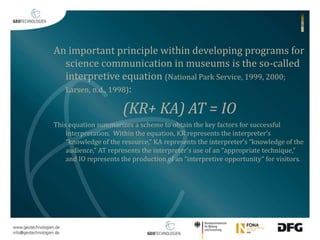
An important principle within developing programs for 
science communication in museums is the so-called 
interpretive equation (National Park Service, 1999, 2000; 
Larsen, n.d., 1998): 
(KR+ KA) AT = IO 
This equation summarizes a scheme to obtain the key factors for successful 
interpretation. Within the equation, KR represents the interpreter’s 
“knowledge of the resource,” KA represents the interpreter’s “knowledge of the 
audience,” AT represents the interpreter’s use of an “appropriate technique,” 
and IO represents the production of an “interpretive opportunity” for visitors.
Scientists and others who start an exhibition project 
often underestimate the impact of accompanying 
text. It is easy to damage the good impression of a 
well-made exhibition by using too much text, the 
wrong style and language, or scientific terms and 
tone.
“Too often writing is seen as unimportant, something 
done in a spare half-hour. Writing which commands 
attention and is memorable is hard work” (Carter, 
2000). 
Tip-sheets proffer guidelines about how to write 
effective text for exhibitions (see for example the 
London Metropolitan University tip sheet). 
A summary on research related to the effectiveness and reception of 
exhibition text is given by Bitgood (2000).
Traveling exhibitions represent great tools for research 
organizations that do not have a museum. 
If scientific organizations and museums cooperate, 
then they can share collective resources such as 
materials, time, consulting with experts on 
particular themes of interest (e.g. family learning or 
accessibility), as well as time with evaluators.
There is both a need and an opportunity to develop the 
exhibit-building capacity of small museums by 
cooperating with research institutions and 
organizations. 
“A collaborative, therefore, is not only seen as a good 
way to build better exhibits, but is also seen as a 
good way to engage in a collective capacity-building 
endeavor” (Carroll et al., 2005).
Museum professionals and Earth scientists would do 
well to remember the wise words of Anatole France: 
“The whole art of teaching is only the art of 
awakening the natural curiosity of young minds for 
the purpose of satisfying it afterwards”. 
Simon Schneider, GETOECHNOLOGIEN coordination office, simon@geotechnologien.de
References 
 Ward, C. W., & Wilkinson, A. E. (2006). Conducting meaningful interpretation: A field guide for success. 
Golden, CO, USA: Fulcrum Publishing. 
 Hudec, H. (2004). Evaluation: A critical step in creating effective museum exhibits. (Unpublished thesis). 
University of Chicago. Retrieved from 
http://mps.uchicago.edu/docs/2005/articles/hudec_thesis_short.pdf 
 Renn, O. (1986). Akzeptanzforschung: Technik in der gesellschaftlichen Auseinandersetzung. Chemie in 
unserer Zeit. 20. Jhrg. Nr.2. Weinheim, Germany: VCH VerlagsgesellschaftmbH (p 44–52). 
 Schiele, B, Claessens, M., Shi, S. (2012). Science Communication in the World, Hamburg, Germany: Springer 
(pp 125–137) 
 Wells, M. D., Butler, B., & Koke, J. (2013). Interpretive planning for museums. Walnut Creek, CA, USA: 
LeftCoast Press. 
 National Park Service. (1999). All about the program. Interpretive Development Program Homepage [On-line]. 
Retrieved from http://www.nps.gov/idp/interp/ 
 National Park Service. (2000). Module 101: How interpretation works: The interpretive equation. Interpretive 
Development Program Homepage. [On-line]. Retrieved from 
http://www.nps.gov/idp/interp/101/howitworks.htm 
 Larsen, D. L. (1998). Observation for “Quest” meeting. (Unpublished manuscript). 
 Leyland, E. (2011). Interpretive Text Panels. Retrieved from 
http://eric-leyland.blogspot.de/2011/08/interpretive-text-panels.html 
 Bitgood, S. (2000). The role of attention in designing effective interpretive labels. Journal of Interpretation 
Research, 5(2), 31–45. 
 Carroll, B., Huntwork, D., & St. John M. (2005). Traveling exhibits at museums of science (TEAMS). A 
Summative Evaluation Report, Inverness Research Associates. Retrieved from http://www.inverness-research. 
org/reports/2005-04-teams/2005-04-Rpt-Teams-summative_eval.pdf

Experience planet earth

  • 1.
    Museums and EarthScience Interpretation EXPERIENCE PLANET EARTH Simon Schneider, GETOECHNOLOGIEN coordination office
  • 2.
    “Do not tryto satisfy your vanity by teaching a great many things. Awaken peoples’ curiosity! It’s enough to open minds, do not overload them. Put there just a spark. If there is some good inflammable stuff, it will catch fire.” - French author and Nobel-Laureate Anatole France (as cited in Ward & Wilkinson, 2006, p. 24)
  • 3.
    There are alot of regional museums, sometimes as small as a single room or a shed somewhere in the wild, interpreting geological features like outstanding rock formations, paleontological discoveries, or breathtaking lookouts.
  • 4.
    Exhibition areas aboutplate tectonics, volcanoes, or natural hazards are common in natural and natural history museums. Occasionally even mineralogical features such as common rock types and natural resources are chapters within these museums. But the relevance of Earth and Space sciences for our daily live stays only marginally highlighted.
  • 5.
    There are twosides to Earth science communication in museum environments.  The slow and shy approach from scientists toward museums  The new demands of the Information Age on museums to develop into multitasking, educational, and entertaining facilitators of knowledge
  • 6.
    What science hasto learn:  museums are more than just showcases for artifacts, exhibits, and pictures.  Museums maintain a complex and multifarious infrastructure - not only to support the presentation but also to develop new and innovative approaches in communicating content, to develop and conduct innovative and creative programs.
  • 7.
    The communicative know-howat museums is highly specialized to present complex issues. There are Educationalists who …  bring curriculum expertise to museums  translate scientific vocabulary into a suitable language for different audiences.  They are trained in developing educational programs (face-to-face, workshops, children’s birthday parties, book signings, special events (e.g. International Museum Days or “Long Nights”)
  • 8.
    Public Understanding ofScience and Humanities (PUSH) has become the focus of controversial discussion within both protagonist camps:  scientists are no longer willing to “downsize” and translate their research without proper support by agencies and policy,  communication research has shown that science communication by itself is not the suitable tool for building the targeted “understanding of science”. (for example Renn, 1986; Schiele, Claessens, & Shi, 2012)
  • 9.
    American journalist andauthor Freeman Tilden defined the function of interpretation as “an educational activity, which aims to reveal meaning and relationship through the use of original objects, by firsthand experience, and by illustrative media, rather than simply to communicate factual information”.
  • 10.
    Wells, Butler, andKoke (2013) quoted Sir Ken Robinson that “rather than anesthetizing learners using the traditional factory model [of education] we should be waking them up by stimulating their imaginations and creativity”. Ergo, taking science into museums should not have strict learning as a goal; instead, it should focus on provoking critical thinking and curiosity.
  • 11.
    An important principlewithin developing programs for science communication in museums is the so-called interpretive equation (National Park Service, 1999, 2000; Larsen, n.d., 1998): (KR+ KA) AT = IO This equation summarizes a scheme to obtain the key factors for successful interpretation. Within the equation, KR represents the interpreter’s “knowledge of the resource,” KA represents the interpreter’s “knowledge of the audience,” AT represents the interpreter’s use of an “appropriate technique,” and IO represents the production of an “interpretive opportunity” for visitors.
  • 12.
    Scientists and otherswho start an exhibition project often underestimate the impact of accompanying text. It is easy to damage the good impression of a well-made exhibition by using too much text, the wrong style and language, or scientific terms and tone.
  • 13.
    “Too often writingis seen as unimportant, something done in a spare half-hour. Writing which commands attention and is memorable is hard work” (Carter, 2000). Tip-sheets proffer guidelines about how to write effective text for exhibitions (see for example the London Metropolitan University tip sheet). A summary on research related to the effectiveness and reception of exhibition text is given by Bitgood (2000).
  • 14.
    Traveling exhibitions representgreat tools for research organizations that do not have a museum. If scientific organizations and museums cooperate, then they can share collective resources such as materials, time, consulting with experts on particular themes of interest (e.g. family learning or accessibility), as well as time with evaluators.
  • 15.
    There is botha need and an opportunity to develop the exhibit-building capacity of small museums by cooperating with research institutions and organizations. “A collaborative, therefore, is not only seen as a good way to build better exhibits, but is also seen as a good way to engage in a collective capacity-building endeavor” (Carroll et al., 2005).
  • 16.
    Museum professionals andEarth scientists would do well to remember the wise words of Anatole France: “The whole art of teaching is only the art of awakening the natural curiosity of young minds for the purpose of satisfying it afterwards”. Simon Schneider, GETOECHNOLOGIEN coordination office, simon@geotechnologien.de
  • 17.
    References  Ward,C. W., & Wilkinson, A. E. (2006). Conducting meaningful interpretation: A field guide for success. Golden, CO, USA: Fulcrum Publishing.  Hudec, H. (2004). Evaluation: A critical step in creating effective museum exhibits. (Unpublished thesis). University of Chicago. Retrieved from http://mps.uchicago.edu/docs/2005/articles/hudec_thesis_short.pdf  Renn, O. (1986). Akzeptanzforschung: Technik in der gesellschaftlichen Auseinandersetzung. Chemie in unserer Zeit. 20. Jhrg. Nr.2. Weinheim, Germany: VCH VerlagsgesellschaftmbH (p 44–52).  Schiele, B, Claessens, M., Shi, S. (2012). Science Communication in the World, Hamburg, Germany: Springer (pp 125–137)  Wells, M. D., Butler, B., & Koke, J. (2013). Interpretive planning for museums. Walnut Creek, CA, USA: LeftCoast Press.  National Park Service. (1999). All about the program. Interpretive Development Program Homepage [On-line]. Retrieved from http://www.nps.gov/idp/interp/  National Park Service. (2000). Module 101: How interpretation works: The interpretive equation. Interpretive Development Program Homepage. [On-line]. Retrieved from http://www.nps.gov/idp/interp/101/howitworks.htm  Larsen, D. L. (1998). Observation for “Quest” meeting. (Unpublished manuscript).  Leyland, E. (2011). Interpretive Text Panels. Retrieved from http://eric-leyland.blogspot.de/2011/08/interpretive-text-panels.html  Bitgood, S. (2000). The role of attention in designing effective interpretive labels. Journal of Interpretation Research, 5(2), 31–45.  Carroll, B., Huntwork, D., & St. John M. (2005). Traveling exhibits at museums of science (TEAMS). A Summative Evaluation Report, Inverness Research Associates. Retrieved from http://www.inverness-research. org/reports/2005-04-teams/2005-04-Rpt-Teams-summative_eval.pdf

Editor's Notes

  • #12 To give an example of how the interpretive equation works, take Earth science communication in art galleries. A venue devoted to fine arts is not the place one would expect Earth science interpretation. Even so, there are plenty of opportunities to talk about natural hazards, climate change issues, or anthropo´-geographic themes. If the communicator is well prepared, the KR factor is max­imized. Visitor studies are well established in art galleries, so KA is equally maximized. By choosing the best interpretive technique, such as science happenings, provocative perfor­mances, or simply guided tours (if the audience is receptive to this kind of interpretation), the Interpretive Opportunity will become optimized.
  • #16 The example of interpreting geological time underscores the disparity between what Earth scientists think is important about the subject and what non-scientists are willing to accept as important. Scientific controversy about where to put boundaries within the stratigraphic tables does not help to create acceptance and appreciation of geological concepts about time. What will arouse curiosity is the technology and methodology of geological dating.