SCIENCE COMMUNICATION
Jan 21, 2022
Dr. Simon Schneider
Department of Earth and Environmental Sciences
Geophysics / Forum der Geowissenschaften
Ludwig-Maximilians-Universität München
Theresienstr. 41
80333 Munich
Germany
phone: 0331 70 43 169
www.geophysik.uni-muenchen.de
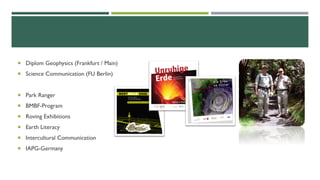
¡ Diplom Geophysics (Frankfurt / Main)
¡ Science Communication (FU Berlin)
¡ Park Ranger
¡ BMBF-Program
¡ Roving Exhibitions
¡ Earth Literacy
¡ Intercultural Communication
¡ IAPG-Germany
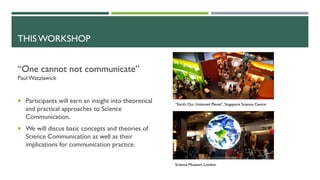
THIS WORKSHOP
“One cannot not communicate”
Paul Watzlawick
¡ Participants will earn an insight into theoretical
and practical approaches to Science
Communication.
¡ We will discus basic concepts and theories of
Science Communication as well as their
implications for communication practice.
“Earth: Our Untamed Planet”, Singapore Science Centre
Science Museum, London
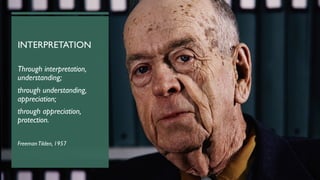
INTERPRETATION
Through interpretation,
understanding;
through understanding,
appreciation;
through appreciation,
protection.
FreemanTilden, 1957
CONTENT DAY 1 ¡ The mechanisms of (Science) Communication
¡ From the deficit model to a complex
understanding of communication
¡ Storytelling in a Nutshell*
¡ Introduction to Geoethics of Science
Communication
CONTENT DAY 2 ¡ Subsystems of Society (functional differentiation
of society)
¡ Observing the Observers
¡ NewsValues
¡ Encoding-Decoding
¡ and Mediatization
¡ Contextual Model of (Science) Communication
¡ Tools and channels for Science Communication*
¡ Summary, Discussion and Conclusion
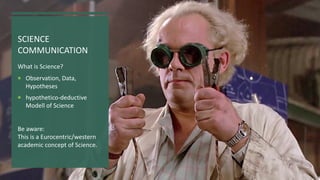
SCIENCE
COMMUNICATION
What is Science?
¡ Observation, Data,
Hypotheses
¡ hypothetico-deductive
Modell of Science
Be aware:
This is a Eurocentric/western
academic concept of Science.
SCIENCE COMMUNICATION
What is Communication?
SCIENCE COMMUNICATION
What is Communication?
Communication is the act
of conveying intended meanings
from one entity or group to another
through the use of
mutually understood signs and semiotic rules.
SCIENCE COMMUNICATION
What is Communication? A functional approach:
¡ Inform the public
¡ Criticize what happens
¡ Set and secure a strong position within a dynamic global society (legitimization)
¡ Create options for participation
¡ Create a sense of responsibility
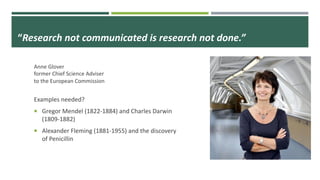
“Research not communicated is research not done.”
Anne Glover
former Chief Science Adviser
to the European Commission
Examples needed?
¡ Gregor Mendel (1822-1884) and Charles Darwin
(1809-1882)
¡ Alexander Fleming (1881-1955) and the discovery
of Penicillin
MODI OF SCIENCE
COMMUNICATION
¡ 1) Communication within Science itself –
sometimes called scholarly communication
¡ 2) Communication with other sub-systems of
society – science outreach, public affairs
¡ 3) Communication about Science by other
sub-systems – Science Journalism etc.
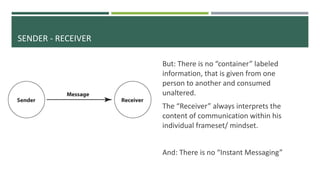
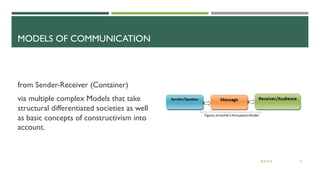
SENDER - RECEIVER
But: There is no “container” labeled
information, that is given from one
person to another and consumed
unaltered.
The “Receiver” always interprets the
content of communication within his
individual frameset/ mindset.
And: There is no “Instant Messaging”
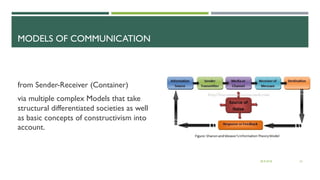
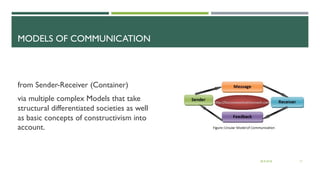
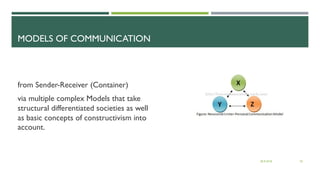
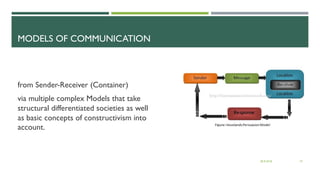
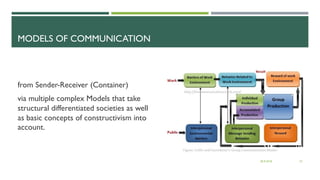
MODELS OF COMMUNICATION
from Sender-Receiver (Container)
via multiple complex Models that take
structural differentiated societies as well
as basic concepts of constructivism into
account.
28.9.2018 15
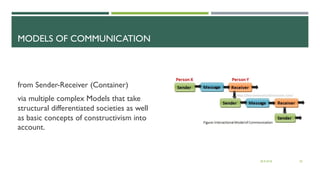
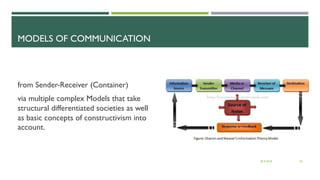
MODELS OF COMMUNICATION
from Sender-Receiver (Container)
via multiple complex Models that take
structural differentiated societies as well
as basic concepts of constructivism into
account.
28.9.2018 16
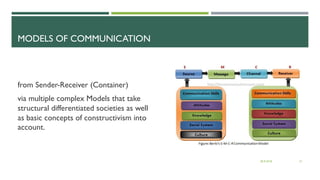
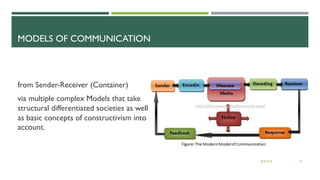
MODELS OF COMMUNICATION
from Sender-Receiver (Container)
via multiple complex Models that take
structural differentiated societies as well
as basic concepts of constructivism into
account.
28.9.2018 17
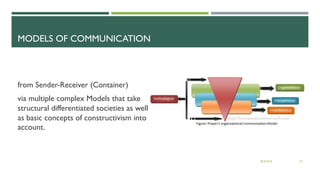
MODELS OF COMMUNICATION
from Sender-Receiver (Container)
via multiple complex Models that take
structural differentiated societies as well
as basic concepts of constructivism into
account.
28.9.2018 18
MODELS OF COMMUNICATION
from Sender-Receiver (Container)
via multiple complex Models that take
structural differentiated societies as well
as basic concepts of constructivism into
account.
28.9.2018 19
MODELS OF COMMUNICATION
from Sender-Receiver (Container)
via multiple complex Models that take
structural differentiated societies as well
as basic concepts of constructivism into
account.
28.9.2018 20
MODELS OF COMMUNICATION
from Sender-Receiver (Container)
via multiple complex Models that take
structural differentiated societies as well
as basic concepts of constructivism into
account.
28.9.2018 21
MODELS OF COMMUNICATION
from Sender-Receiver (Container)
via multiple complex Models that take
structural differentiated societies as well
as basic concepts of constructivism into
account.
28.9.2018 22
MODELS OF COMMUNICATION
from Sender-Receiver (Container)
via multiple complex Models that take
structural differentiated societies as well
as basic concepts of constructivism into
account.
28.9.2018 23
MODELS OF COMMUNICATION
from Sender-Receiver (Container)
via multiple complex Models that take
structural differentiated societies as well
as basic concepts of constructivism into
account.
28.9.2018 24
MODELS OF COMMUNICATION
from Sender-Receiver (Container)
via multiple complex Models that take
structural differentiated societies as well
as basic concepts of constructivism into
account.
28.9.2018 25
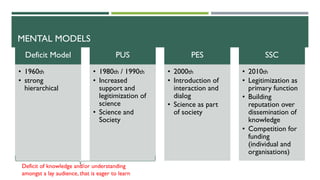
Deficit Model
• 1960th
• strong
hierarchical
PUS
• 1980th / 1990th
• Increased
support and
legitimization of
science
• Science and
Society
PES
• 2000th
• Introduction of
interaction and
dialog
• Science as part
of society
SSC
• 2010th
• Legitimization as
primary function
• Building
reputation over
dissemination of
knowledge
• Competition for
funding
(individual and
organisations)
MENTAL MODELS
Deficit of knowledge and/or understanding
amongst a lay audience, that is eager to learn
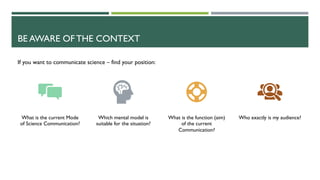
BE AWARE OF THE CONTEXT
What is the current Mode
of Science Communication?
Which mental model is
suitable for the situation?
What is the function (aim)
of the current
Communication?
Who exactly is my audience?
If you want to communicate science – find your position:
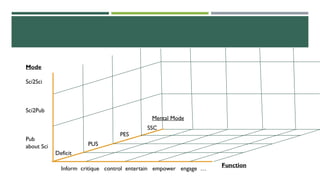
Mode
Sci2Sci
Sci2Pub
Pub
about Sci
Mental Mode
Deficit
PUS
PES
SSC
Function
Inform critique control entertain empower engage …
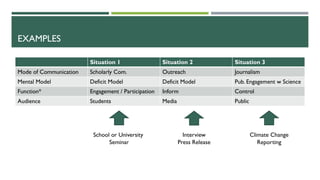
EXAMPLES
Situation 1 Situation 2 Situation 3
Mode of Communication Scholarly Com. Outreach Journalism
Mental Model Deficit Model Deficit Model Pub. Engagement w Science
Function* Engagement / Participation Inform Control
Audience Students Media Public
School or University
Seminar
Interview
Press Release
Climate Change
Reporting
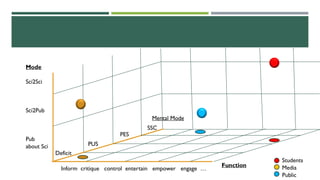
Mode
Sci2Sci
Sci2Pub
Pub
about Sci
Mental Mode
Deficit
PUS
PES
SSC
Function
Inform critique control entertain empower engage …
Students
Media
Public
AUDIENCES
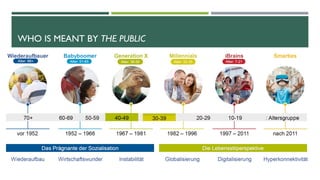
WHO IS MEANT BY THE PUBLIC
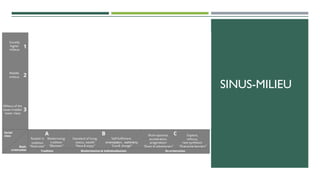
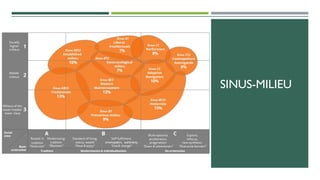
SINUS-MILIEU
SINUS-MILIEU

Science interpretation 01

  • 1.
  • 2.
    Dr. Simon Schneider Departmentof Earth and Environmental Sciences Geophysics / Forum der Geowissenschaften Ludwig-Maximilians-Universität München Theresienstr. 41 80333 Munich Germany phone: 0331 70 43 169 www.geophysik.uni-muenchen.de
  • 3.
    ¡ Diplom Geophysics(Frankfurt / Main) ¡ Science Communication (FU Berlin) ¡ Park Ranger ¡ BMBF-Program ¡ Roving Exhibitions ¡ Earth Literacy ¡ Intercultural Communication ¡ IAPG-Germany
  • 4.
    THIS WORKSHOP “One cannotnot communicate” Paul Watzlawick ¡ Participants will earn an insight into theoretical and practical approaches to Science Communication. ¡ We will discus basic concepts and theories of Science Communication as well as their implications for communication practice. “Earth: Our Untamed Planet”, Singapore Science Centre Science Museum, London
  • 5.
  • 6.
    CONTENT DAY 1¡ The mechanisms of (Science) Communication ¡ From the deficit model to a complex understanding of communication ¡ Storytelling in a Nutshell* ¡ Introduction to Geoethics of Science Communication
  • 7.
    CONTENT DAY 2¡ Subsystems of Society (functional differentiation of society) ¡ Observing the Observers ¡ NewsValues ¡ Encoding-Decoding ¡ and Mediatization ¡ Contextual Model of (Science) Communication ¡ Tools and channels for Science Communication* ¡ Summary, Discussion and Conclusion
  • 8.
    SCIENCE COMMUNICATION What is Science? ¡Observation, Data, Hypotheses ¡ hypothetico-deductive Modell of Science Be aware: This is a Eurocentric/western academic concept of Science.
  • 9.
  • 10.
    SCIENCE COMMUNICATION What isCommunication? Communication is the act of conveying intended meanings from one entity or group to another through the use of mutually understood signs and semiotic rules.
  • 11.
    SCIENCE COMMUNICATION What isCommunication? A functional approach: ¡ Inform the public ¡ Criticize what happens ¡ Set and secure a strong position within a dynamic global society (legitimization) ¡ Create options for participation ¡ Create a sense of responsibility
  • 12.
    “Research not communicatedis research not done.” Anne Glover former Chief Science Adviser to the European Commission Examples needed? ¡ Gregor Mendel (1822-1884) and Charles Darwin (1809-1882) ¡ Alexander Fleming (1881-1955) and the discovery of Penicillin
  • 13.
    MODI OF SCIENCE COMMUNICATION ¡1) Communication within Science itself – sometimes called scholarly communication ¡ 2) Communication with other sub-systems of society – science outreach, public affairs ¡ 3) Communication about Science by other sub-systems – Science Journalism etc.
  • 14.
    SENDER - RECEIVER But:There is no “container” labeled information, that is given from one person to another and consumed unaltered. The “Receiver” always interprets the content of communication within his individual frameset/ mindset. And: There is no “Instant Messaging”
  • 15.
    MODELS OF COMMUNICATION fromSender-Receiver (Container) via multiple complex Models that take structural differentiated societies as well as basic concepts of constructivism into account. 28.9.2018 15
  • 16.
    MODELS OF COMMUNICATION fromSender-Receiver (Container) via multiple complex Models that take structural differentiated societies as well as basic concepts of constructivism into account. 28.9.2018 16
  • 17.
    MODELS OF COMMUNICATION fromSender-Receiver (Container) via multiple complex Models that take structural differentiated societies as well as basic concepts of constructivism into account. 28.9.2018 17
  • 18.
    MODELS OF COMMUNICATION fromSender-Receiver (Container) via multiple complex Models that take structural differentiated societies as well as basic concepts of constructivism into account. 28.9.2018 18
  • 19.
    MODELS OF COMMUNICATION fromSender-Receiver (Container) via multiple complex Models that take structural differentiated societies as well as basic concepts of constructivism into account. 28.9.2018 19
  • 20.
    MODELS OF COMMUNICATION fromSender-Receiver (Container) via multiple complex Models that take structural differentiated societies as well as basic concepts of constructivism into account. 28.9.2018 20
  • 21.
    MODELS OF COMMUNICATION fromSender-Receiver (Container) via multiple complex Models that take structural differentiated societies as well as basic concepts of constructivism into account. 28.9.2018 21
  • 22.
    MODELS OF COMMUNICATION fromSender-Receiver (Container) via multiple complex Models that take structural differentiated societies as well as basic concepts of constructivism into account. 28.9.2018 22
  • 23.
    MODELS OF COMMUNICATION fromSender-Receiver (Container) via multiple complex Models that take structural differentiated societies as well as basic concepts of constructivism into account. 28.9.2018 23
  • 24.
    MODELS OF COMMUNICATION fromSender-Receiver (Container) via multiple complex Models that take structural differentiated societies as well as basic concepts of constructivism into account. 28.9.2018 24
  • 25.
    MODELS OF COMMUNICATION fromSender-Receiver (Container) via multiple complex Models that take structural differentiated societies as well as basic concepts of constructivism into account. 28.9.2018 25
  • 26.
    Deficit Model • 1960th •strong hierarchical PUS • 1980th / 1990th • Increased support and legitimization of science • Science and Society PES • 2000th • Introduction of interaction and dialog • Science as part of society SSC • 2010th • Legitimization as primary function • Building reputation over dissemination of knowledge • Competition for funding (individual and organisations) MENTAL MODELS Deficit of knowledge and/or understanding amongst a lay audience, that is eager to learn
  • 27.
    BE AWARE OFTHE CONTEXT What is the current Mode of Science Communication? Which mental model is suitable for the situation? What is the function (aim) of the current Communication? Who exactly is my audience? If you want to communicate science – find your position:
  • 28.
  • 29.
    EXAMPLES Situation 1 Situation2 Situation 3 Mode of Communication Scholarly Com. Outreach Journalism Mental Model Deficit Model Deficit Model Pub. Engagement w Science Function* Engagement / Participation Inform Control Audience Students Media Public School or University Seminar Interview Press Release Climate Change Reporting
  • 30.
    Mode Sci2Sci Sci2Pub Pub about Sci Mental Mode Deficit PUS PES SSC Function Informcritique control entertain empower engage … Students Media Public
  • 31.
  • 32.
    WHO IS MEANTBY THE PUBLIC
  • 33.
  • 34.